INTRODUCTION
Ascidians are generally abundant in protected eutrophic habitats due to their feeding strategy as filter-feeders which make them particularly adapted to exploit the plankton as well as the dissolved and particulate organic matter which are very abundant in these habitats (Millar, Reference Millar1971; Tursi, Reference Tursi1980). Moreover, many ascidian species are able to tolerate heavy environmental stresses such as those occurring in harbour areas (Brunetti & Menin, Reference Brunetti and Menin1977; Naranjo et al., Reference Naranjo, Carballo and Garcìa-Gòmez1996) and some of them have been considered as marine pollution indicators (Papadopoulou & Kanias, Reference Papadopoulou and Kanias1977; Naranjo et al., Reference Naranjo, Carballo and Garcìa-Gòmez1996; Paparella et al., Reference Paparella, Vaccarella, Sarcinella and Marano1996). The main studies on the ascidians in the Mar Piccolo of Taranto (eastern-central Mediterranean Sea) date back to the 1970s (Tursi et al., Reference Tursi, Gherardi and Lepore1974a, Reference Tursi, Pastore and Panettab, Reference Tursi, Gherardi, Lepore and Chieppa1976, Reference Tursi, Matarrese and Scalera Liaci1977, Reference Tursi, Matarrese, Sciscioli, Vaccarella and Chieppa1979; Matarrese et al., Reference Matarrese, Tursi and Scalera Liaci1980a, Reference Matarrese, Tursi, Scalera Liaci, Montanaro and Cecereb). Such studies revealed that these tunicates are among the most common fouling species in the eutrophic waters of the Mar Piccolo of Taranto, often representing over 40% of the all benthic biomass.
Prior to the current study, 22 ascidian species were recorded and settlement phenomena and seasonal changes in abundance were investigated on the hard substrates of the Mar Piccolo of Taranto. In the last thirty years this semi-enclosed basin of the northern Ionian Sea has been subject to many anthropogenic activities, such as sewage outputs, industrial activities, intense naval traffic and mussel breeding (Cardellicchio et al., Reference Cardellicchio, Annicchiarico, Leone, Marra, Paterno, Piraino and Ragone1991). Thus, the marine ecosystem and its benthic communities have been severely affected. In fact, the sea grass meadows of Cymodocea nodosa and Posidonia oceanica mapped by Parenzan (Reference Parenzan1969, Reference Parenzan1983) have almost completely disappeared while a drifting nitrophilic algal bed is now widespread in the area (Cecere et al., Reference Cecere, Cormaci and Furnari1991, Reference Cecere, Saracino, Fanelli and Petrocelli1992). The abundance of some dominant indigenous species has been markedly reduced and several invasive exotic species including ascidians, have been recorded recently (Cecere et al., Reference Cecere, Petrocelli and Saracino2000; Mastrototaro et al., Reference Mastrototaro, Matarrese and D'Onghia2003; Cecere & Petrocelli, Reference Cecere and Petrocelli2004; Brunetti & Mastrototaro, Reference Brunetti and Mastrototaro2004; Mastrototaro et al., Reference Mastrototaro, Panetta and D'Onghia2004a, Reference Mastrototaro, Petrocelli, Cecere and Matarreseb; Mastrototaro & Dappiano, Reference Mastrototaro and Dappiano2005; Mastrototaro & Brunetti, Reference Mastrototaro and Brunetti2006). Furthermore, at present most of the bottoms in the Mar Piccolo of Taranto are covered with sludge and mud (Matarrese et al., Reference Matarrese, Mastrototaro, D'Onghia, Maiorano and Tursi2004).
The aim of this paper is to define the present qualitative and quantitative composition of the ascidian fauna in the Mar Piccolo of Taranto, in which both urban and industrial impacts occur, and evaluate their response to environmental stress.
MATERIALS AND METHODS
The study area
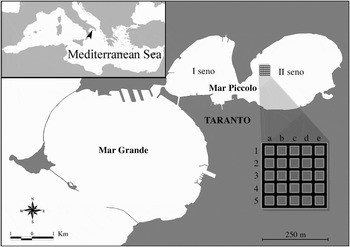
The city of Taranto is located on the coast of the north-western Ionian Sea (eastern-central Mediterranean) (Figure 1). The Mar Piccolo is a semi-enclosed basin located to the north-east of the town and is made up of two inlets (I and II Seno) which cover an area of 20.72 km2. Its maximum depth is 13 m in the first inlet (I Seno, mean = 9 m) and 9 m in the second (II Seno, mean = 4 m) (Matarrese et al., Reference Matarrese, Mastrototaro, D'Onghia, Maiorano and Tursi2004). Mainly in the second inlet there is a low rate of water renewal and an excess of silting and suspended matter (Cardellicchio et al., Reference Cardellicchio, Annicchiarico, Leone, Marra, Paterno, Piraino and Ragone1991). The two inlets of the Mar Piccolo are characterized by reduced muddy bottoms with superficial debris of mussel shells and little stones covered by drift algal species (Cecere et al., Reference Cecere, Saracino, Fanelli and Petrocelli1992; Matarrese et al., Reference Matarrese, Mastrototaro, D'Onghia, Maiorano and Tursi2004). Most of both inlets are occupied by mussel culture structures.
Map of Taranto Seas with indication of the sampling area in the second inlet of the Mar Piccolo.

Sampling
The sampling area was a square of 250 m/side in the second inlet (II Seno) of the Mar Piccolo (Figure 1), in a region 3–4 m in depth. Sampling was carried out on both natural bottoms and artificial substrates. Seasonal samplings were carried out by SCUBA diving from December 2003 to November 2004 by two biologist divers. The study area was divided into 25 square sub-areas 50 m/side in size: 3 of these sub-areas were randomly selected each month. In order to investigate seasonal variation in the ascidian fauna, avoiding confusion between seasonal effects and uncontrolled source of variation, three randomly chosen dates within the same season were considered. All the ascidian species present in a square surface of 1600 cm2 (40 × 40 cm) were collected in three spatial replicates for each sub-area. Thus, a total of 27 samples (3 dates × 3 quadrant replicates × 3 sub-areas) were obtained each season for a total of 108 samples in one year. On the artificial substrates, consisting of the submerged chains of iron buoys and piles of the mussel culture structures near to the sampling area, sampling of the benthic organisms was carried out by scraping an area of about 400 cm2 (40 × 10 cm) at three different depths of 0.5, 2 and 3.5 m, with two replicates for each depth. Thus, a total of 18 samples (3 dates × 2 replicates × 3 depths) were taken each season for a total of 72 samples in one year. Moreover, temperature (°C), dissolved oxygen (% of saturation), pH and salinity (psu) were recorded during each month in the water column (from 0.3 m to the bottom) of the study area using a multi-parametric probe. These environmental parameters together with other abiotic factors influencing ascidian distribution, such as hydrodynamism and suspended solid and organic matter, were assumed to be similar for all the sampling stations.
The ascidians were immediately anaesthetized with a saturated solution of menthol in seawater for a time varying from 2 to 4 hours according to the nature and size of the individual specimens and colonies. After this procedure, all specimens were preserved in 10% seawater–formalin and identified to species.
Data processing
The biomass of each ascidian species was measured by means of the volumetric method (McBurney, Reference McBurney1978). Each sample was plunged into a graduated measuring glass. The volume as biomass index (cm3/surface unit) was adopted as measuring the role of spatial competition among the benthic organisms.
A matrix of average biomass index data of the ascidian species (average of the replicates for each seasonal sample) per station was compiled using square root transformation. Ordination of the sampling stations according to the type of substrate (natural or artificial surfaces), season and depth, was performed by means of non-parametric multidimensional scaling (nMDS) based on Bray–Curtis similarity using the PRIMER 5 software (Clarke & Warwick, Reference Clarke and Warwick2001). The four seasons were identified on the basis of mean water temperature, in particular October, November and December characterized the autumn (mean water temperature ranged from 12 to 22.5°C), January, February and March the winter (mean water temperature ranged from 8.5 to 12.2°C), April, May and June the spring (mean water temperature ranged from 17.33 to 24.53°C), July, August and September the summer (mean water temperature ranged from 24.19 to 26.22°C).
Analysis of similarities (ANOSIM) was applied to test the differences between the groups of the species–station. The pairwise test was carried out to evaluate the differences between levels. Individual species contributions (up to about 90%) to average similarity within each group identified were examined by the SIMPER procedure (Clarke & Warwick, Reference Clarke and Warwick2001).
RESULTS
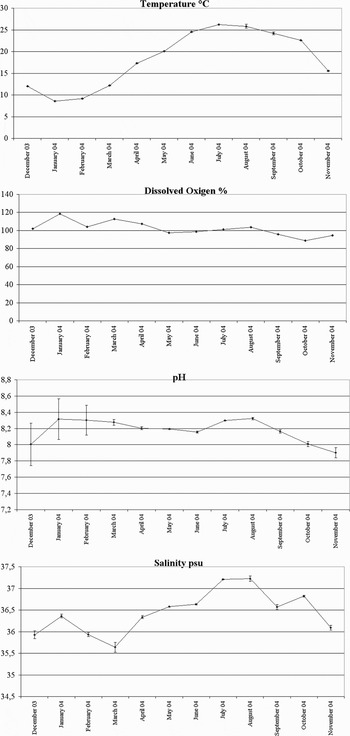
Average monthly values of 4 water parameters are shown in Figure 2. The mean water temperature showed a typical seasonal trend ranging from 8.6°C (January 2004) to 26.22°C (July 2004). The greatest mean value of dissolved oxygen was recorded in January 2004 (118.69%) while the smallest was measured in October of the same year (88.72%). The pH values were between 7.90 (November 2004) and 8.32 (August 2004) and the salinity ranged from 35.64 psu (March 2004) to 37.21 psu (July 2004).
Average monthly value (±SD) of the water parameters (temperature, dissolved oxygen, pH and salinity) recorded in the Mar Piccolo of Taranto.

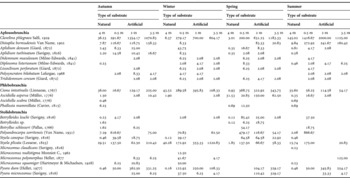
A total of 25 ascidian species were found: 9 Aplousobranchia, 4 Phlebobranchia and 12 Stolidobranchia (Table 1). All but a Botrylloides sp. have been completely identified.
Average biomass index (cm3/m2) of the ascidian species seasonally collected in the Mar Piccolo of Taranto from December 2003 to November 2004 on natural bottoms at about 4 m depth and on artificial substrates at 0.5, 2 and 3.5 m depths.

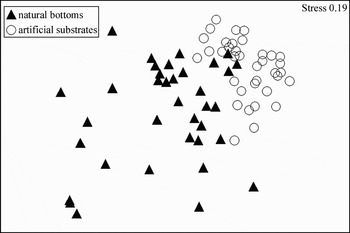
Multivariate analysis indicated the presence of two main groups of species-samples related to the different types of substrate: natural or artificial (Figure 3). The ANOSIM test confirmed that these two groups were significantly different with a global R = 0.425 (P = 0.001). From the SIMPER test, the samples collected on natural bottoms showed an average similarity of 23.26% and were mostly characterized by Clavelina phlegraea (32.84%), Ciona intestinalis (29.33%), Styela plicata (19.16%) and Ascidiella aspersa (13.36%) while those taken on artificial substrates showed an average similarity of 44.13% and mainly consisted of C. phlegraea (60.26%), C. intestinalis (11.21%), Pyura dura (8.35%), S. plicata (8.28%) and Polyandrocarpa zorritensis (6.43%).
Non-parametric multidimensional scaling ordination of the ascidian biomass sampled on different type of substrates (▴, natural bottoms; ○, artificial substrates).

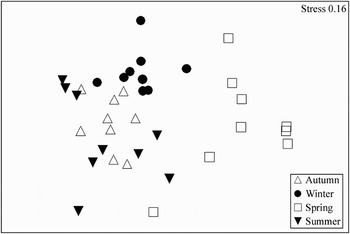
The nMDS carried out for the samples collected on natural bottoms revealed the presence of four groups discriminated significantly by season (global R = 0.58; P = 0.001) (Figure 4). The pairwise test confirmed big differences between autumn versus spring (R = 0.8; P = 0.001), clear differences between winter versus spring (R = 0.74; P = 0.001), spring versus summer (R = 0.72; P = 0.001) and autumn versus winter (0.55; P = 0.001), good differences between winter versus summer (R = 0.47; P = 0.001) and small differences between autumn versus summer (R = 0.21; P = 0.013). The SIMPER test carried out by season provided the following results: the autumn sample-group had an average similarity of 43.96% and was characterized by C. phlegraea (34.96%), C. intestinalis (34.33%), S. plicata (8.84%), Phallusia mammillata (7.16%) and P. zorritensis (6.47%); the winter sample-group had an average similarity of 44.09% and was characterized by C. intestinalis (48.85%) and S. plicata (43.38%); the spring assemblage showed an average similarity of 38.16% and consisted almost exclusively of A. aspersa (94.12%); the summer cluster showed an average similarity of 32.57% and was mostly characterized by C. phlegraea (82.88%) and C. intestinalis (8.42%).
Non-parametric multidimensional scaling ordination of the ascidian biomass sampled on natural bottoms during the four seasons (▵, autumn; •, winter; □, spring; ▾, summer).

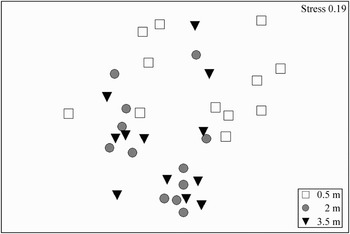
The nMDS carried out for the samples taken on the artificial substrates separated only two groups in relation to the different sampling depths, the first characterized by the samples carried out at surface (0.5 m) and the second characterized by the samples carried out in the water column (2 and 3.5 m) (global R = 0.27; P = 0.001) (Figure 5). In fact, the pairwise test provided good dissimilarities between the group of stations carried out at the surface (0.5 m) and those from 2 and 3.5 m in depth (R = 0.43; P = 0.001 and R = 0.44; P = 0.001 respectively) while no significant differences were detected between these two sample-groups (2 versus 3.5 m R = –0.07; P = 0.947). According to the SIMPER test, the group of stations at the surface showed an average similarity of 46.30% and was mainly characterized by P. zorritensis (38.48%), C. phlegraea (27.47%), S. plicata (14.37%) and C. intestinalis (10.61%), while the cluster of stations in the water column (2 and 3.5 m) had an average similarity of 52.60% and consisted mostly of C. phlegraea (69.62%), P. dura (11.12%), C. intestinalis (9.11%) and S. plicata (5.17%).
Non-parametric multidimensional scaling ordination of the ascidian biomass sampled on artificial substrates at three different depths (□, 0.5 m;  , 2 m; ▾, 3.5 m).

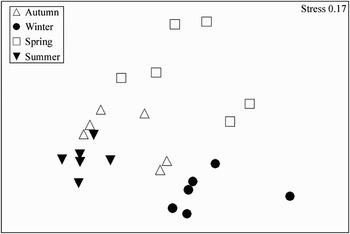
The seasonal factor was also considered in the nMDS carried out for the cluster of stations in the water column (2 and 3.5 m) indicating the presence of different groups, with a global R = 0.55 and highly significant differences (P = 0.001) (Figure 6). Also in this case, the pairwise test showed big differences between winter versus summer (R = 0.87; P = 0.002), clear differences between spring versus summer (R = 0.73; P = 0.002) and winter versus spring (R = 0.59; P = 0.002), good differences between autumn versus winter (R = 0.47; P = 0.004) and autumn versus spring (R = 0.46; P = 0.006) and small differences between autumn versus summer (R = 0.22; P = 0.035). The SIMPER test provided an average similarity of 64.34% for the autumn sample-group which was mostly characterized by C. phlegraea (68.57%), P. dura (16.08%) and C. intestinalis (5.88%). The winter sample-group had an average similarity of 58.15% and consisted mainly of C. phlegraea (47.64%), S. plicata (33.47%), and C. intestinalis (12.95%). The spring cluster showed an average similarity of 52% and was mostly made up by C. phlegraea (61.43%), C. intestinalis (15.86%), Pyura microcosmus (9.1%) and A. aspersa (5.22%). Finally, the summer sample-group showed an average similarity of 70.09% and was almost exclusively characterized by C. phlegraea (77.48%) and P. dura (14.12%).
Non-parametric multidimensional scaling ordination of the ascidian biomass sampled on artificial substrates in the water column (2 and 3.5 m) during four seasons (▵, autumn; •, winter; □, spring; ▴, summer).

No multivariate analysis was conducted for the surface group of stations due to the small number of samples.
DISCUSSION AND CONCLUSIONS
During this study 25 species of ascidians were collected in the Mar Piccolo of Taranto. Three are non-indigenous for the Mediterranean Sea: Microcosmus squamiger, probably of Australian origin (Kott, Reference Kott1985; Lambert & Lambert, Reference Lambert and Lambert1998; Monniot et al., Reference Monniot, Monniot, Griffiths and Schleyer2001; Turon et al., Reference Turon, Nishikawa and Rius2007), was previously recorded in the Taranto Seas as M. exasperatus (Monniot, Reference Monniot1981; Mastrototaro & Dappiano, Reference Mastrototaro and Dappiano2005); Polyandrocarpa zorritensis, a Pacific species originally described from Zorritos, Peru (Van Name, Reference Van Name1945) and first detected in the Mediterranean by Brunetti (Reference Brunetti1978–Reference Brunetti79), and Distaplia bermudensis of Atlantic origin (Van Name, Reference Van Name1945). These latter two species have been recently recorded in the Mar Piccolo of Taranto (Brunetti & Mastrototaro, Reference Brunetti and Mastrototaro2004; Mastrototaro & Brunetti, Reference Mastrototaro and Brunetti2006).
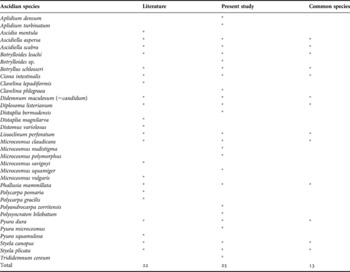
In comparison with the list reported in the literature (Tursi et al., Reference Tursi, Pastore and Panetta1974b; Matarrese et al., Reference Matarrese, Tursi and Scalera Liaci1980a, Reference Matarrese, Tursi, Scalera Liaci, Montanaro and Cecereb; Tursi & Scalera Liaci, Reference Tursi and Scalera Liaci1983) (22 species), 13 are common and 12 are new findings (Table 2). The differences observed seem to be mostly due to the presence of non-indigenous species recently recorded and to those species of new taxonomic revision and classification (Monniot Reference Monniot1981; Brunetti, Reference Brunetti1987; Brunetti & Mastrototaro, Reference Brunetti and Mastrototaro2004; Mastrototaro & Brunetti, Reference Mastrototaro and Brunetti2006).
Comparison between the lists of ascidian species found in the literature (Tursi et al., Reference Tursi, Pastore and Panetta1974b; Matarrese et al., Reference Matarrese, Tursi and Scalera Liaci1980a, Reference Matarrese, Tursi, Scalera Liaci, Montanaro and Cecereb; Tursi & Scalera Liaci, Reference Tursi and Scalera Liaci1983) and the present study.

The spread of non-indigenous species in the Mediterranean has increased in recent years (Galil, Reference Galil2000; Occhipinti Ambrogi, Reference Occhipinti Ambrogi2001) and the Mar Piccolo of Taranto is one of many inner basins affected by this phenomenon (Cecere et al., Reference Cecere, Petrocelli and Saracino2000; Mastrototaro et al., Reference Mastrototaro, Matarrese and D'Onghia2003; Brunetti & Mastrototaro Reference Brunetti and Mastrototaro2004; Cecere & Petrocelli, Reference Cecere and Petrocelli2004; Mastrototaro et al., Reference Mastrototaro, Panetta and D'Onghia2004a, Reference Mastrototaro, Petrocelli, Cecere and Matarreseb; Mastrototaro & Dappiano, Reference Mastrototaro and Dappiano2005; Mastrototaro & Brunetti, Reference Mastrototaro and Brunetti2006). Most probably, the continuous instability, due to environmental stresses in the Mar Piccolo of Taranto, favours the introduction of opportunistic species which often become dominant due to the lack of natural predators or competitors (Mistri, Reference Mistri2002; Matarrese et al., Reference Matarrese, Mastrototaro, D'Onghia, Maiorano and Tursi2004). Clavelina lepadiformis reported by Tursi et al. (Reference Tursi, Pastore and Panetta1974b), even if still present in some areas of the Mar Piccolo (Mastrototaro, personal observation) seems to have been replaced in most areas by the co-generic C. phlegraea. Concerning the restricted investigated area, the absence in this study of some species of ascidians previously recorded (Tursi et al., Reference Tursi, Pastore and Panetta1974b; Matarrese et al., Reference Matarrese, Tursi and Scalera Liaci1980a, Reference Matarrese, Tursi, Scalera Liaci, Montanaro and Cecereb; Tursi & Scalera Liaci, Reference Tursi and Scalera Liaci1983) does not mean that they have disappeared from the Taranto Seas.
The substrate features, seasons and depths seem to affect the distribution of ascidians in the Mar Piccolo of Taranto, confirming previous observations in the same and other marine areas (e.g. Tursi et al., Reference Tursi, Gherardi and Lepore1974a, Reference Tursi, Pastore and Panettab; Brunetti & Menin, Reference Brunetti and Menin1977; Matarrese et al., Reference Matarrese, Tursi and Scalera Liaci1980a, Reference Matarrese, Tursi, Scalera Liaci, Montanaro and Cecereb; Naranjo et al., Reference Naranjo, Carballo and Garcìa-Gòmez1996). Variations in climatic and physical–chemical factors, such as light, temperature and salinity, linked to substrate type, seasons and depths influence the biological cycles and the release of larvae as well as their behaviour and settlement (e.g. Watanabe & Lambert, Reference Watanabe and Lambert1973; Tursi et al., Reference Tursi, Gherardi, Lepore and Chieppa1976; Brunetti & Menin, Reference Brunetti and Menin1977; Svane, Reference Svane1984; Turon, Reference Turon1988; Svane & Young, Reference Svane and Young1989).
Some species, such as Pyura dura and P. microcosmus, were found to be abundant on chains and piles while they were not collected on natural bottoms. On the contrary, A. aspersa was almost exclusively recovered on natural bottoms. Seasonal variation in distribution and abundance could be mainly due to their biological cycles, larval recruitment and adaptation. During the autumn and winter the most abundant species were C. phlegraea and C. intestinalis, confirming previous observations (Tursi et al., Reference Tursi, Gherardi and Lepore1974a; Liaci et al., Reference Liaci, Tursi and Sciscioli1977), while A. aspersa was particularly abundant during spring. This species seems to be capable of tolerating the increase in algal biomass during spring (up to 95% of the total biomass) (Chaetomorpha linum, Cladophora hutchinsiae, Ulva spp.) (Matarrese et al., Reference Matarrese, Mastrototaro, D'Onghia, Maiorano and Tursi2004) since its larval forms are able to settle on the algal surface. Depth and more directly light intensity play an important role in ascidian distribution (Svane & Young, Reference Svane and Young1989). In fact, in the first metres of depth the shallow-water species Polyandrocarpa zorritensis was found to be abundant due to its photopositive larvae (Vazquez & Young, Reference Vazquez and Young1998).
Even though distribution and abundance changed significantly between substrates, seasons and depths, the most abundant species in the study area were C. phlegraea, C. intestinalis and S. plicata. These species are able to tolerate large variations in environmental conditions, low rate of water renewal and continuous silting. Indeed, C. phlegraea can survive environmental stress thanks to its ability to generate resistant forms (Salfi, Reference Salfi1929, Reference Salfi1931; Brunetti, Reference Brunetti1987); C. intestinalis with its filter-feeding ability is capable of living in water with a very low rate of renewal (Tursi et al., Reference Tursi, Gherardi and Lepore1974a; Liaci et al., Reference Liaci, Tursi and Sciscioli1977), and S. plicata with its thick tunic and ability to raise the viscera and branchial sac is able to tolerate the high sedimentation rate (Tursi et al., Reference Tursi, Pastore and Panetta1974b, Reference Tursi, Gherardi, Lepore and Chieppa1976, Reference Tursi, Matarrese, Sciscioli, Vaccarella and Chieppa1979).
Based on their response to environmental stress, Naranjo et al. (Reference Naranjo, Carballo and Garcìa-Gòmez1996) classified the ascidians in Algeciras Bay, southern Spain as: ‘regressive species’ (those living in natural and non-perturbed habitats which disappear or reduce their populations when stress increases); ‘transgressive species’ (those that are dominant in harbour areas and in zones with highly modified substrates, a low rate of water renewal and excess silting and suspended matter, commonly pioneers and opportunists, typical of bio-fouling); and ‘tolerant species’ (those capable of living under almost any conditions, colonizing both natural rocks in the outer zone of the bay and vertical walls of ports, generally absent from internal harbour areas with low water movement). Many species found in the Mar Piccolo of Taranto belong to the second and third categories. In particular, C. intestinalis, P. mammillata, M. squamiger and S. plicata are categorized as ‘transgressive species’. Also P. zorritensis might be added to this category considering its tolerance and adaptation to the physical–chemical changes of the waters (Brunetti, 1978–79); it has become quite common in a number of harbours in southern California (Lambert & Lambert, Reference Lambert and Lambert2003). The species A. aspersa, Botryllus schlosseri, Botrylloides leachi and Diplosoma listerianum are included in the category of ‘tolerant species’.
Assuming the role that the above mentioned species have as marine pollution indicators (Papadopuolou & Kanias, 1977; Naranjo et al., Reference Naranjo, Carballo and Garcìa-Gòmez1996) and the abundance recorded of some of them, a high degree of environmental stress can be confirmed for the Mar Piccolo of Taranto as observed in another study carried out recently in this semi-enclosed sea (Matarrese et al., Reference Matarrese, Mastrototaro, D'Onghia, Maiorano and Tursi2004).
Acknowledgements
The authors wish to thank Professor Riccardo Brunetti for a critical review of the paper and Ilaria Morello for her assistance in sampling and identification of the ascidian species.