Introduction
Cognitive deficits are now widely accepted as a core feature in schizophrenia (Crum et al., Reference Crum, Anthony, Bassett and Folstein1993; Harvey et al., Reference Harvey, Bowie and Friedman2001; Freedman, Reference Freedman2003; Mueser and McGurk, Reference Mueser and McGurk2004). The literature focusing on this topic is quickly growing and data show that almost every cognitive variable is affected in this illness. In Fioravanti et al.'s (Reference Fioravanti, Fioravanti, Bianchi, Bianchi, Cinti and Cinti2012) meta-analysis, for example, data drawn from 247 articles (n = 18,300) published before March 2010 revealed a significant reduction within each cognitive domain (memory, global cognitive functioning, language, executive functions, attention) when compared with normal participants. There is substantial heterogeneity in the cognitive profile of these patients, but cognitive impairment in this population is nonetheless ubiquitous (Wilk et al., Reference Wilk, Gold, McMahon, Humber, Iannone and Buchanan2005). This is a very important finding, especially in elderly patients with schizophrenia, where cognitive deficits have been identified as a strong and reliable predictor of functional outcome, poor awareness of illness, poor treatment adherence, increased medical disabilities, and premature institutionalization (Cuffel et al., Reference Cuffel, Alford, Fischer and Owen1996a; Reference Cuffel, Jeste, Halpain, Pratt, Tarke and Patterson1996b; Green et al., Reference Green, Kern, Braff and Mintz2000; Irani et al., Reference Irani, Kalkstein, Moberg and Moberg2011).
In order to detect cognitive impairment in their patients, clinicians often rely on short cognitive tests because they are readily available, and require little time and resources. Although numerous other tests are now available, the Mini-Mental State Examination (MMSE; Folstein et al., Reference Folstein, Folstein and McHugh1975) is used most frequently, and it is well validated in schizophrenia (Leon et al., Reference Leon, Ellis, Rosen and Simpson1993; Reference Leon, Garcia and Simpson1998). The content and psychometric properties of this 30-point measure of cognitive status are well known (Tombaugh and McIntyre, Reference Tombaugh and McIntyre1992). The MMSE does not measure all cognitive abilities, in particular executive functions, yet it is widely used in clinical and research settings. Unfortunately, normative data are unavailable in patients with schizophrenia. To our knowledge, the only study that attempted to address this issue described the MMSE scores of 272 partially remitted community-dwelling patients with schizophrenia (Ganguli et al., Reference Ganguli1998). Unfortunately, because of the relatively small number of participants, normative data for age, sex, and level of education were limited. This paper aims at synthesizing the literature on MMSE and schizophrenia, and at describing the correlation between age and the MMSE scores in this population.
Methods
We combined the search terms “mini-mental state examination,” “MMSE,” or “Folstein,” and “schizophrenia” in Medline and PsycInfo, and considered articles published between 1975 (Folstein et al., Reference Folstein, Folstein and McHugh1975) and 30 July 2012. We also examined the bibliographies of relevant articles to find additional studies. Every article giving a mean MMSE score along with a corresponding mean age was included, except for the following exclusion criteria: (1) Text was unavailable in English or French, (2) MMSE score was not given on a total of 30 points, (3) patients were excluded if they performed under a predetermined threshold on the MMSE, (4) numerical scores with standard deviations were not provided, (5) sample contained patients suffering from schizophrenia along with patients affected by other disorders, and (6) sample included patients with schizophrenia and concomitant neurodegenerative disorders.
In each article, we collected the following data: age, years of education, mean MMSE score, and Positive and Negative Symptoms Scale (PANSS) score (Kay et al., Reference Kay, Fiszbein and Opler1987), when available. The PANSS is a well-validated scale that assesses general, positive, and negative symptoms in schizophrenia. The extracted data were organized in a graph where the mean age of every group was displayed along with the corresponding mean MMSE score. When a single study reported numerous MMSE scores for different age groups, each score was added on the graph with the matching mean age. We conducted simple linear regression weighted for the inverse of within-trial variance of the age variable (1/standard deviation (SD)), leading to regression equations and correlation indexes (R 2). We used this strategy to confer more importance to studies with narrower age groups, as they reflect more accurately the expected MMSE score at a given age (Thompson and Higgins, Reference Thompson and Higgins2002). In other words, studies that presented MMSE scores of patients with a wide age range had less impact on the regression analysis than studies that yielded MMSE scores for a narrower age group. Of note, a linear model analysis was selected since logarithmic and square root models could not explain the relationship between MMSE and age any better (in fact, the R 2 values were 0.475 for linear regression, 0.473 for logarithmic, and 0.486 for square root). Since heteroscedasticity was found in some of the regressions, confidence intervals (CI) were computed with robust standard errors.
We also ran our analyses on the following subgroups: (a) patients with early age of onset (EOS; <40 years old), (b) patients with late onset (LOS; >40 years old), (c) patients living in the community, and (d) institutionalized patients. We used 40 years age as a cut-off between early and late onset, as recommended by the international consensus on late-onset schizophrenia and very late-onset schizophrenia-like psychosis (Howard et al., Reference Howard, Rabins, Seeman and Jeste2000). When possible, we compared the scores of patients with schizophrenia with the scores of healthy controls. Statistical analyses were performed using SPSS v20.
Results
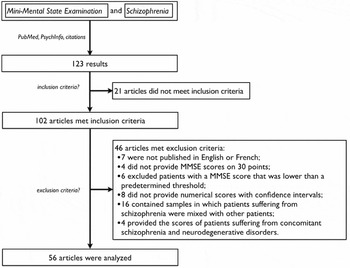
Figure 1 shows the articles that were included in and excluded from the analysis. Among the 56 articles included in this meta-analysis, 11 had an age-matched healthy control group, five compared patients suffering from schizophrenia with patients suffering from Alzheimer's dementia (AD), and four reported scores of patients with late-onset schizophrenia (onset after 40 years of age). Only 14 studies reported PANSS scores as an index of severity of the psychotic illness, limiting the possibility of analyzing the relationship between PANSS and MMSE scores.
Articles identified, included, and excluded in our analysis. These 56 articles were not included in the references to meet journal specifications but are available with the authors upon request.

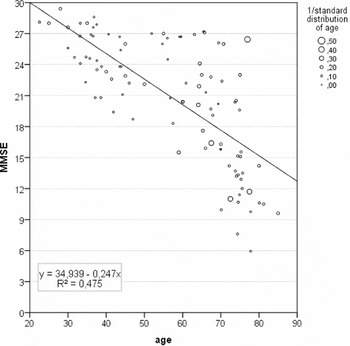
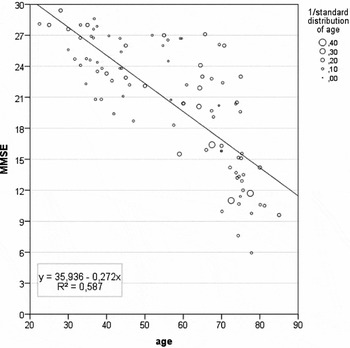
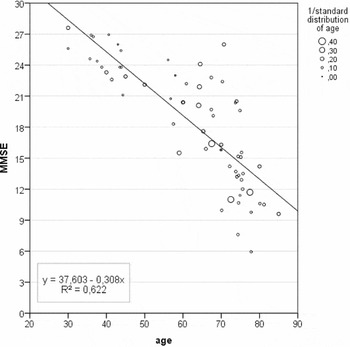
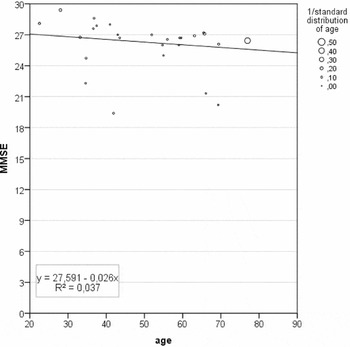
The synthesis of the data drawn from these studies reveals a considerable decrease in MMSE scores throughout aging in patients with schizophrenia (Figure 2). Indeed, the linear slope of the age-corrected regression was −0.247 (95% CI [−0.304, −0.189]), suggesting that the MMSE scores of the patients with schizophrenia would decline by 1 point for every four years, a rate that is approximately five times faster than the 1 point decline observed every 21 years in the general population (Crum et al., Reference Crum, Anthony, Bassett and Folstein1993). Given the above equation, patients suffering from schizophrenia obtained a mean MMSE score of 28/30 at 30 years of age, 23/30 at 50 years of age, and 18/30 at 70 years of age. However, subgroup analyses reveal that these estimates might be largely influenced by over-representation of patients with early-onset schizophrenia (Figure 3) and institutionalized patients (Figure 4) in our study. In these overlapping two groups, the cognitive trajectories are profoundly different from that of the general population (Crum et al., Reference Crum, Anthony, Bassett and Folstein1993). In effect, the regression slope is −0.272 (95% CI [−0.313, −0.231]) for patients with EOS and −0.308 (95% CI [−0.349, −0.267]) for institutionalized patients. In other words, the institutionalized patients suffering from schizophrenia obtained a mean MMSE score of 28/30 at 30 years of age whereas mean scores of 22/30 and 16/30 were obtained at 50 and 70 years of age, respectively. In contrast, the scores of patients living in the community are extremely different (Figure 5). In this case, the regression slope is –0.026 (95% CI [−0.074, 0.023]), suggesting a loss of 1 point for every 38 years. This decline is akin to that of the general population. Using this equation, ambulatory patients with schizophrenia display mean MMSE scores of 27/30 at 30 years, 27/30 at 50 years, and 26/30 at 70 years of age. Finally, change in MMSE scores during aging in patients with late-onset schizophrenia cannot be described accurately because of insufficient data. Results with and without the correction for the variance of age were very similar in each of the regressions.
Association between mean MMSE score and age of patients suffering from schizophrenia, weighted for the inverse of within-trial variance of the age variable.

Association between mean MMSE score and age of patients suffering from early-onset schizophrenia (aged <40 years), weighted for the inverse of within-trial variance of the age variable.

Association between mean MMSE score and age of institutionalized patients suffering from schizophrenia, weighted for the inverse of within-trial variance of the age variable.

Association between mean MMSE score and age of community-dwelling patients suffering from schizophrenia, weighted for the inverse of within-trial variance of the age variable.

Our model shows that age accounts for only a part of the decline in MMSE scores in patients with schizophrenia: in all our analyses, the highest R 2 obtained was 0.622.
When comparing the MMSE scores of patients suffering from schizophrenia with the scores obtained by healthy controls, the former group exhibits a steeper cognitive decline. The MMSE scores in patients with schizophrenia decline by 1 point for every 3.5 years (slope of −0.284 (95% CI [−0.378, −0.191]), while healthy adults do not show any significant decline.
Discussion
To our knowledge, this is the first systematic review that examines the association between age and the MMSE scores in a population of aging patients with schizophrenia. We are confident that our methodology lead to the identification of a vast majority of pertinent articles. Unlike previous cross-sectional (Davidson et al., Reference Davidson, Harvey and Powchik1995; Ganguli et al., Reference Ganguli1998; Seno et al., Reference Seno, Shibata, Fujimoto, Koga, Kanno and Ishino1998; Kelly et al., Reference Kelly, Sharkey, Morrison, Allardyce and McCreadie2000) and longitudinal (Harvey et al., Reference Harvey, Parrella, White, Mohs, Davidson and Davis1999) studies, this meta-regression analysis included a very large number of patients (n = 5,588) involved in 56 studies. It must be said, however, that some of these studies did not have the examination of the relationship between age and the MMSE scores as their main objective.
Our data show that MMSE scores decline during aging in patients with schizophrenia, especially in institutionalized patients. This finding must be interpreted cautiously, as most data concerning patients aged 70 years and older can be traced back to a single group of researchers who published 11 of the 56 articles included in the meta-analysis. In some of these articles, the same database might have been used repeatedly, thus influencing unduly on our regression equations, but this could not be confirmed. Each MMSE score of 15/30 or less was reported by this group of authors. This may have to do with the fact that they studied a population of poor functioning patients, requiring institutionalization. Of note, however, other authors throughout the world have found similar MMSE scores in patients with a comparable clinical profile (Harvey et al., Reference Harvey, Leff, Trieman, Anderson and Davidson1997). In this population, many factors such as severity of psychotic illness and heaviness of medication load may well contribute to a steeper cognitive decline. In addition, institutional settings are often poorly stimulating and induce passivity (Goffman, Reference Goffman1961; Wing and Brown, Reference Wing and Brown2009); the lack of demand on one's cognitive skills may well contribute to their decline. In fact, these patients had MMSE scores that were comparable with that of patients with AD when matched for age and education (Davidson et al., Reference Davidson, Harvey, Welsh, Powchik, Putnam and Mohs1996; Friedman et al., Reference Friedman2001; Bozikas et al., Reference Bozikas, Kosmidis, Gamvrula, Hatzigeorgiadou, Kourtis and Karavatos2004; Palmer et al., Reference Palmer2005; Frisoni et al., Reference Frisoni2009). Larger meta-analyses in patients with AD show a mean annual decline of 3.3 points on the MMSE, which is 13 times faster than in the most severely impaired patients with schizophrenia (Han et al., Reference Han, Cole, Bellavance, McCusker and Primeau2000).
An important limitation of this work is that the data come from cross-sectional studies, which provide, at best, estimates of the average trajectory of a sample. This does not reflect individual trajectories unless the trajectories of all participants in the sample are roughly the same (Thompson et al., Reference Thompson2013). Thus, it is not clear whether real individuals would follow the slope of decline depicted in the graphs. Cohort effects possibly contribute strongly to the decline noted: In contrast to younger persons, older patients with schizophrenia have lower educational levels, worse physical health, greater use of non-psychiatric medications that may impact cognitive status, and greater exposure to first-generation antipsychotics and anticholinergic drugs. However, Davidson et al. (Reference Davidson, Harvey and Powchik1995) have found that prior treatment with leucotomy, insulin coma, and electroconvulsive therapy (ECT) do not seem to impact current cognitive functioning as measured by the MMSE.
Our total sample comprised mostly patients that were severely impaired, thus increasing the slope of linear regression. In the subgroup of community-dwelling patients with schizophrenia, the decline in MMSE scores during aging was radically different, and surprisingly close to that of the general population. These findings are in line with the previous work of Kurtz (Reference Kurtz2005), who reviewed the longitudinal studies published on neurocognitive changes in schizophrenia between 1997 and 2003, and concluded that there might be two different cognitive trajectories in schizophrenia: that of the ambulatory patients and older patients (>55 years old) who live in an institution. In the former, global cognition and intellectual quotient (IQ) were relatively stable through time whereas they declined markedly in the latter. For instance, some studies included in Kurtz's (Reference Kurtz2005) review documented a decline of almost 4 points on the MMSE after a 2.5 year of follow-up in patients aged over 60 years (Harvey et al., Reference Harvey, Parrella, White, Mohs, Davidson and Davis1999). In fact, even in clinically stable outpatients, growth mixture models providing better estimates of heterogeneity in longitudinal trajectories revealed the following three cognitive trajectories in these patients: a relatively high and stable course, a lower, modestly declining course, and a lower, more rapidly declining course, which represented 10% of the enrolled patients (Thompson et al., Reference Thompson2013). Many factors may contribute to these divergent cognitive trajectories, but it seems reasonable to posit that patients who have milder psychotic illness, experience shorter duration of psychosis and receive less medication impacting cognition have the opportunity to develop a better cognitive reserve (Stern, Reference Stern2009). This better protection against age-related brain changes may result in the preservation of cognitive functioning during aging. In turn, this would ensure a better social and affective functioning, allowing these individuals to stay in a stimulating environment, and contributing to the enhancement of their cognitive reserve.
We modeled linear decline in MMSE scores throughout aging in schizophrenia because this simple model seems to perform as well as other models tested on our data. This is different from previous longitudinal research that has shown that the progressive cognitive decline of poor-outcome schizophrenic patients is not linear but rather accelerates after 65 years of age (Friedman et al., Reference Friedman2001). In fact, during their six-year follow-up, Friedman et al. failed to detect cognitive change in younger patients, whereas an average decline of 1 point per year was seen in the oldest schizophrenic patients. We believe that our model does not capture this accelerated decline in older age because data in this age group are scarce. However, upon closer examination of our graphs, an inflexion of the slope is seen after 65 years of age, which is compatible with the data presented by Friedman et al. (Reference Friedman2001).
Thus, the change in MMSE scores in schizophrenia during aging suggest rapid cognitive decline in some patients. Should schizophrenia be considered a neurodegenerative disorder in these deteriorating patients? Since Kraepelin's description of dementia praecox (Kraepelin, Reference Kraepelin1984), compelling evidence has shown that deterioration in cognition occurs early in the course of the illness, and longitudinal data suggest that cognition stabilizes afterwards (Rund, Reference Rund2009; Zipursky et al., Reference Zipursky, Reilly and Murray2013). Our data, however, show that many patients do in fact appear to decline cognitively with aging. Of note, neuropathological series show that AD and other degenerative illnesses account for at least a part of cognitive decline observed in this population, although most cases of dementia in schizophrenia are probably not the result of neuropathologically identifiable dementing illness (Powchik et al., Reference Powchik1998). Thus, the fact that schizophrenia per se is a neurodegenerative disorder remains debated, but our view is that this illness affects cognitive reserve and predisposes to further cognitive impairment during aging in a subset of patients.
When assessing elderly patients with schizophrenia and cognitive decline, clinicians need to look for reversible factors that may deteriorate cognition (e.g. medication, delirium, medical disorder impacting cognition) and for signs of superimposed neurocognitive disorder such as AD. From the clinical standpoint, it may prove difficult to diagnose AD in a patient with schizophrenia, especially if institutionalization was required for a long period. Nonetheless, signs that may point toward this diagnosis include a progressive decline in episodic memory and language along with functional decline in a previously stable individual. Given the modest impact of available treatments for AD, the most pressing issue is not differential diagnosis but periodic functional assessment, so that emerging cognitive difficulties and their impact on the person's capacity for self-care are identified, and remedial strategies implemented.
As mentioned earlier, age is not the only variable impacting MMSE scores in these patients. Additional factors that impact cognition likely include educational level, gravity of illness and negative symptoms, medication load (antipsychotics, anticholinergics, benzodiazepines; Elie et al., Reference Elie, Poirier, Chianetta, Durand, Grégoire and Grignon2010), substance use disorder, and psychiatric and medical comorbidities, including vascular risk factors (Lindenmayer et al., Reference Lindenmayer2012). Studies examining these variables using a multivariate analysis are required.
The MMSE is a widely used cognitive screening test, but it has many psychometric limitations. These are especially important in schizophrenia, as it lacks sensitivity for cognitive domains that are clearly affected in this illness, namely attention, working memory, and executive functioning (Herrmann et al., Reference Herrmann1999). Other cognitive screening instruments, such as the Frontal Assessment Battery (FAB; Dubois et al., Reference Dubois, Slachevsky, Litvan and Pillon2000) or the Montreal Cognitive Assessment (MoCA; Nasreddine et al., Reference Nasreddine2005), are more sensitive to frontal damage and executive impairment, but they have received scant attention in schizophrenia. We see the interest of a better validation of such tools in patients suffering from schizophrenia.
Conflict of Interest
None.
Description of authors’ roles
J-R Maltais reviewed the literature, collected and analyzed data, and wrote the paper. G. Gagnon reviewed the paper and expanded on neuropsychological aspects. M-P Garant was responsible for the statistical design of the study and carried out statistical analysis. J-F Trudel supervised the study and wrote the paper.