Introduction
A high prevalence of depression with onset by early adulthood (Kessler et al. Reference Kessler, Berglund, Demler, Jin, Merikangas and Walters2005) and co-morbidity with other chronic health conditions (Prince et al. Reference Prince, Patel, Saxena, Maj, Maselko, Phillips and Rahman2007; Atlantis et al. Reference Atlantis, Goldney, Eckert, Taylor and Phillips2012) represents a major public health issue. There has been particular interest in the co-morbidity of depression and depressive symptoms with obesity, with many cross-sectional studies showing that obese individuals are more likely to suffer from depression than non-obese individuals (Onyike et al. Reference Onyike, Crum, Lee, Lyketsos and Eaton2003; Scott et al. Reference Scott, Bruffaerts, Simon, Alonso, Angermeyer, de Girolamo, Demyttenaere, Gasquet, Haro, Karam, Kessler, Levinson, Medina Mora, Oakley Browne, Ormel, Villa, Uda and Von Korff2007; Atlantis & Baker, Reference Atlantis and Baker2008; Allison et al. Reference Allison, Newcomer, Dunn, Blumenthal, Fabricatore, Daumit, Cope, Riley, Vreeland, Hibbeln and Alpert2009; de Wit et al. Reference de Wit, van Straten, van Herten, Penninx and Cuijpers2009, 2010). In a meta-analysis of 18 epidemiological surveys (n = 204 507) from various countries (nine studies from the USA; none from the UK), the odds ratio (OR) for clinical and symptoms assessment of depression was 1.32 for obese versus non-obese females (de Wit et al. Reference de Wit, Luppino, van Straten, Penninx, Zitman and Cuijpers2010). If obesity is co-morbid with depression, it is important to know which condition is likely to come first, influencing the onset and development of the other, but to date the direction of association has not been firmly established. A meta-analysis of longitudinal studies (n = 58 745) found evidence for a bidirectional association: (1) depression increased by 58% the risk of obesity onset and (2) overweight and obesity increased by 27% and 55% respectively the onset of depression (Luppino et al. Reference Luppino, de Wit, Bouvy, Stijnen, Cuijpers and Penninx2010). However, this meta-analysis was based on 15 studies, only four of which were rated as good methodological quality and more than 50% were from the USA, where associations from obesity to depression were strong (Luppino et al. Reference Luppino, de Wit, Bouvy, Stijnen, Cuijpers and Penninx2010). Furthermore, a review of 25 prospective studies reported good evidence for an obesity-to-depression association, but mixed evidence for depression-to-obesity (Faith et al. Reference Faith, Butryn, Wadden, Fabricatore, Nguyen and Heymsfield2011).
Some studies have shown co-morbidity of underweight with depression (or suicide) (Atlantis & Ball, Reference Atlantis and Ball2007; de Wit et al. Reference de Wit, van Straten, van Herten, Penninx and Cuijpers2009; Zhao et al. Reference Zhao, Ford, Dhingra, Li, Strine and Mokdad2009; Gunnell & Thomas, Reference Gunnell, Thomas, O'Connor, Platt and Gordon2011) but, to our knowledge, no study has assessed the direction of association. Understanding the interconnections of an unhealthy body mass index (BMI) with depressive symptoms in the general population could provide important information about risk factors involved in depression and facilitate screening and treatment. Most previous co-morbidity estimates have been derived from mixed-aged samples (Luppino et al. Reference Luppino, de Wit, Bouvy, Stijnen, Cuijpers and Penninx2010), which may obscure or mislead associations evident for separate ages (Kraemer et al. Reference Kraemer, Wilson and Hayward2006). Knowledge of co-morbidity across age groups may improve diagnosis, especially for depression, which is poorly recognized in primary care (Mitchell et al. Reference Mitchell, Vaze and Rao2009, Reference Mitchell, Rao and Vaze2011).
Using a life-course approach we examined, first, cross-sectional associations of BMI status (underweight/overweight/obesity) with depressive symptoms across a substantial proportion of life, from childhood to adulthood, to establish whether depression is co-morbid with obesity or underweight; and second, longitudinal associations between (1) depressive symptoms and prior BMI status and (2) BMI status and depressive symptoms at a prior age to shed light on the direction of the association.
Method
Participants
Data were from the 1958 British Birth Cohort, a study of 98% of births in England, Scotland and Wales during 1 week in March 1958 (n = 17 416). An additional 920 immigrants with the same birth dates were recruited to age 16 years. Because of changes in the ethnic composition of the British population since enrolment, the cohort with 98% white Europeans is not ethnically representative of the current population (Power & Elliott, Reference Power and Elliott2006; Atherton et al. Reference Atherton, Fuller, Shepherd, Strachan and Power2008). Information was obtained from schools at ages 7, 11 and 16 years, participant interviews at 23, 33, 42 and 50 years and clinical examination at 45 years. Ethical approval was given by the South-East Multicentre Research Ethics Committee and written consent was obtained from all participants. Analyses were based on all available data: sample size ranged from 12 918 at 7 years to 9240 at 45 years for cross-sectional analyses, and from 13 753 to 11 024 for longitudinal analyses. Those remaining in the study at 42 and 45 years under-represented individuals with internalizing problems at 7 years (Atherton et al. Reference Atherton, Fuller, Shepherd, Strachan and Power2008).
Depressive symptoms
Internalizing symptoms (encompassing symptoms of depression) at 7, 11 and 16 years were assessed using validated teacher-rated questionnaires. Depressive symptoms at 23, 33, 42, 45 and 50 years were obtained from questionnaires completed by participants or clinical assessment.
Child and adolescent measures
Internalizing symptoms were assessed by teachers using the Bristol Social Adjustment Guide (BSAG) at 7 and 11 years (Stott, Reference Stott1969) and by the Rutter behaviour scale at 16 years (Elander & Rutter, Reference Elander and Rutter1996). The BSAG consists of 146 behaviour items assessing 12 syndromes, four of which were used to derive an internalizing score (items such as miserable and fearful); participants had a score of 1 if an item applied and 0 if it did not apply. The Rutter scale consists of 26 behaviour items, five of which were used to derive an internalizing score (items such as worries, solitary, miserable, fearful and fussy); participants had a score of 2 if an item applied ‘definitely’, 1 for ‘somewhat’ and 0 if it did not apply. The BSAG and Rutter scales have demonstrated adequate reliability, sensitivity and external validity in epidemiological surveys (Clark et al. Reference Clark, Rodgers, Caldwell, Power and Stansfeld2007).
Adulthood measures
Depressive symptoms at 23, 33, 42 and 50 years were recorded with the Malaise Inventory, comprising 24 (nine somatic and 15 depressive) symptoms scored ‘no’ or ‘yes’ (Rodgers et al. Reference Rodgers, Pickles, Power, Collishaw and Maughan1999). Somatic symptoms were excluded because, potentially and increasingly with age, they are outcomes of obesity or underweight; for example, at 33 years the prevalence of ‘backache’ increased from 22% in the underweight group to 30% in the obese group whereas ‘upset stomach’ was more common among the underweight (16%) than other BMI groups (∼10%). Excluding somatic items allowed us to detect mental health rather than physical outcome of obesity and underweight. A shorter Malaise Inventory (eight items) was used at 50 years, including depressed mood, sleep disturbance, fatigue, irritability and anxiety. The Malaise Inventory has shown good reliability and external validity consistent with clinical assessment of depression and self-reported use of antidepressants (Rodgers et al. Reference Rodgers, Pickles, Power, Collishaw and Maughan1999). It has been used in epidemiological studies as a screening for depressive tendency (Steptoe & Butler, Reference Steptoe and Butler1996). Core depressive symptoms at 45 years (i.e. persistent sadness/low mood and/or marked loss of interest/pleasure for ⩾4 days/week and/or ⩾3 h/day and/or no reactivity to pleasurable stimuli) in the past week were establish with the Clinical Interview Schedule (CIS) administered by a trained nurse in the participant's residence (Lewis et al. Reference Lewis, Pelosi, Araya and Dunn1992).
For the purpose of analyses, a score ⩾90th percentile of symptoms at each age was identified as an elevated symptom level, comparable to the cut-off used by previous studies with this sample (Clark et al. Reference Clark, Rodgers, Caldwell, Power and Stansfeld2007). Our measures do not allow identification of individuals with clinical depression, but we refer henceforth to the group with elevated symptoms as having depression.
BMI
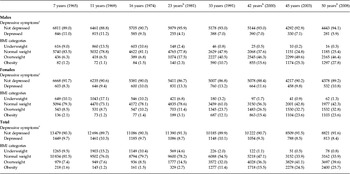
BMIs were obtained by dividing weight in kilograms by height squared in metres (kg/m2). Weight and height were measured by trained staff at 7, 11, 16, 33 and 45 years; and self-reported at 23, 42 and 50 years. Pregnant females at the time of interview were excluded from cross-sectional analyses (n = 542 at 23 years, n = 256 at 33 years, n = 19 at 42 years, n = 2 at 45 years). BMIs were classified using appropriate cut-offs (Table 1) (Cole et al. Reference Cole, Bellizzi, Flegal and Dietz2000, Reference Cole, Flegal, Nicholls and Jackson2007).
Prevalence of depressive symptoms and body mass index (BMI) at several ages, from childhood to adulthood a

Values based on all available data, and given as number (percentage).
a Fieldwork often extended over more than 1 year.
b BMI based on self-reported height and weight (otherwise measured objectively). BMI in childhood was classified using international age and sex-specific cut-offs: underweight, respectively for ages 7, 11 and 16 years as <14.04, <14.97 and <17.54 kg/m2 for males and <13.86, <15.05 and <17.91 kg/m2 for females; overweight, respectively as ⩾17.92, ⩾20.55 and ⩾23.90 kg/m2 for males and ⩾17.75, ⩾20.74 and ⩾24.37 kg/m2 for females; and obesity, respectively as ⩾20.63, ⩾25.10 and ⩾28.88 kg/m2 for males and ⩾20.51, ⩾25.42 and ⩾29.43 kg/m2 for females. BMI in adulthood, cut-off for underweight is <18.5 kg/m2, for overweight, ⩾25 kg/m2; and for obesity, ⩾30 kg/m2.
c Depressive symptoms scores were categorized as <90th percentile (not depressed) versus ⩾90th percentile (depressed). Instruments include teacher-rated Bristol Social Adjustment Guide (BSAG) at 7 and 11 years, teacher-rated Rutter school behavior scale at 16 years, self-rated psychological Malaise at 23, 33, 42 and 50 years and the Clinical Interview Schedule (CIS) at 45 years.
Covariates
Socio-economic position (SEP) in childhood was based on father's occupation at birth (or at 7 years if missing) using the Registrar General's classification, grouped as class I or II (professional/managerial), IIINM (skilled non-manual), IIIM (skilled manual) and IV and V (semi-unskilled manual, including single households). Adult SEP (23, 33 and 42 years) was based on participant's current or most recent occupation and categorized as above. Housing tenure was used as an additional SEP measure, at age 7 (or at 11 or 16 years if missing) and in adulthood (23, 33 and 42 years) categorized as owner-occupier or others. Physical illness was identified from mother's reports of handicap or disability at 7 years (or at 16 years if missing) and 16 years (or at 7 years if missing). Longstanding limiting illness (excluding mental illness) at 23, 33 and 42 years was reported by participants. Self-reported ethnicity was used to distinguish white and non-white participants.
Statistical analysis
Cross-sectional analysis
To establish whether depression is co-morbid with obesity or underweight, we performed logistic regressions in which depression (⩾90th v. <90th percentile) at each age was the outcome and BMI status (underweight/overweight/obesity versus normal) was the exposure. The interaction between sex and BMI categories was tested to establish whether the cross-sectional associations differed by sex. Further analyses controlled for ethnicity, SEP, household tenure and physical illness at appropriate ages (e.g. SEP at 33 years for cross-sectional association at 33 years). Where associations in adulthood (e.g. 33 and 45 years) remained, we explored the possibility that smoking and alcohol consumption may account for associations between depression and BMI, by including further adjustments into the models. For 33 and 42 years, self-reported drinking was categorized as non-drinker/infrequent drinker/more than or less than once a month/most days; smoking was categorized as never or ex/current. Covariates (e.g. ethnicity, SEP, household tenure, physical illness, smoking and alcohol consumption) were not assessed for all participants included in the sample based on unadjusted analyses. To avoid further loss of participants due to listwise deletion, we imputed missing values on covariates using multiple imputations by chained equations methods in SPSS (SPSS Inc., USA). We created 10 complete datasets, and conducted regression analyses that combined the results from the 10 datasets. The results based on the restricted sample were similar to those based on the imputed sample; the latter are presented in Supplementary Table S1.
Because the prevalence of childhood obesity and adult underweight were low in this population, we conducted sensitivity analyses using BMI percentiles ⩽5th (underweight) and ⩾95th (obesity) to test whether findings were influenced by cut-offs for these groups.
Longitudinal analysis
We applied the generalized estimating equation (GEE) approach (Hanley et al. Reference Hanley, Negassa, Edwardes and Forrester2003) to establish the overall direction of the longitudinal association between depression and BMI, for example from BMI to subsequent depression (hypothesis 1) or from depression to subsequent BMI (hypothesis 2), taking into account the within-individual correlations of the outcome measurements. We used the GEE model instead of a trajectory-based approach because the risk associated with depression or BMI categories cannot be expressed as a simple age function (i.e. linear or non-linear) because of their complex lifetime patterns. Preliminary analyses showed that the risk of depression differed little between overweight and normal weight; hence these categories were combined and used as a baseline group.
Three GEE models were applied. In model 1, assessing whether BMI predicted subsequent depression (hypothesis 1), the age-varying exposures were BMI categories (underweight, normal/overweight, obese) at 7, 11, 16, 33 and 45 years and the repeated outcome measures were depression at 11, 16, 23, 42 and 50 years. Baseline depression (7 years) was also included. In model 2, assessing whether depression predicted underweight (hypothesis 2), the age-varying exposures were depression at 7, 11, 23 and 42 years and the repeated outcome measures were underweight (versus normal/overweight) at 11, 16, 33 and 45 years. In model 3, assessing whether depression predicted obesity (hypothesis 2), the age-varying exposures were depression at 7, 11, 23 and 42 years and the repeated outcome measures were obesity at 11, 16, 33 and 45 years. Models 2 and 3 included baseline BMI (7 years).
For each exposure (i.e. prior BMI or depression), we tested its interaction with sex to establish whether its association with the outcome differed by sex. We also stratified analyses by sex, as significant interactions with sex were found. In further analyses we adjusted for ethnicity, age-varying SEP (hypothesis 1: SEP at birth for childhood outcomes and at 33 and 42 years for adulthood outcomes; hypothesis 2: SEP at birth for childhood outcomes and at 23 and 42 years for adulthood outcomes), age-varying household tenure (hypothesis 1: household tenure at 7, 11 and 16 years for childhood outcomes and at 33 and 42 years for adulthood outcomes; hypothesis 2: household tenure at 7 and 11 years for childhood outcomes and at 23 and 42 years for adulthood outcomes), and age-varying physical illness (hypothesis 1: physical illness at 7 and 16 years for childhood outcomes and at 33 and 42 years for adulthood outcomes; hypothesis 2: physical illness at 7 for childhood outcomes and at 23 and 42 years). GEE analyses were performed in SPSS version 19. The direction of associations was examined in additional analysis of incident cases (depression or underweight and obesity) at each age. A series of logistic regressions was conducted in which participants with the ‘condition’ at baseline were excluded. For instance, for hypothesis 1, we examined the effect of obesity versus normal/overweight at 7 years on incident depression at 11 years, excluding participants with depression at 7 years.
Finally, we undertook sensitivity analyses using alternative measures : (i) mother (rather than teacher) report of depressive symptoms at age 7 years; and (ii) the full 24-item Malaise Inventory scale (i.e. including somatic items). In both instances, the results were similar to those presented here, suggesting that the analyses are robust to differences in these measurements.
Results
The prevalence of depression was predefined at approximately 10% but varied for males and females: prevalence was slightly higher in boys (11.0–11.2%) than girls (8.3–9.4%) aged 7–11 years but less prevalent onwards from 16 years (4.1–9.3% in males versus 9.8–13.3% in females) (Table 1). The prevalence of underweight peaked at 11 years (13.5% for males versus 17.1% for females), followed by a marked decreased with advancing age, whereby 0.2% (males) and 0.9% (females) were underweight at 45 years. Conversely, the prevalence of obesity was lowest at 11 years, with 1.1–1.2% increasing to 25.3% (males) and 23.6% (females) at 45 years. The prevalence of overweight was < 20% (i.e. 6.3–17.5%) before 23 years in both sexes, ranging from 40.5% to 49.6% after 33 years among males and from 23.7% to 32.8% among females (Table 1).
Cross-sectional co-morbidity of BMI with depressive symptoms
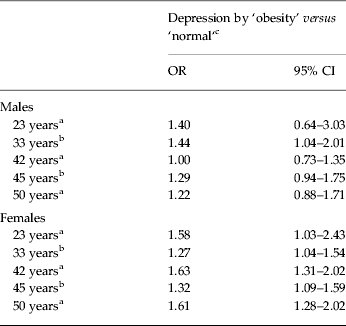
All ages are included in Table 1, irrespective of whether BMI was based on measured or self-reported heights and weights. Consistently, associations tended to be higher for females at ages when BMI was based on self-report (Table 2). To avoid the possibility of associations arising because of differential reporting of weights by depressive symptoms, we excluded self-reported BMIs (23, 42 and 50 years) from further analyses. Therefore, Table 3 shows associations between depression and BMI at three ages in childhood and two ages in adulthood.
Odds ratios (ORs) and 95% confidence intervals (CIs) for cross-sectional associations of depressive symptoms with self-reported and measured obesity in adulthood

Sample sizes ranged from 12 231 at 23 years to 9247 at 50 years.
a Self-reported height and weight.
b Measured height and weight.
c Includes body mass index (BMI) ⩾18.5 kg/m2 but <25 kg/m2.
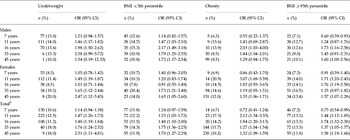
Prevalence (n, %), odds ratios (ORs) and 95% confidence intervals (CIs) for cross-sectional associations of depressive symptoms with measured body mass index (BMI) categories (versus normal a ) at several ages, childhood to adulthood

a Includes BMI ⩾18.5 kg/m2 but <25 kg/m2 and BMI >5th percentile but <85th percentile for sensitivity analyses.
b ORs were adjusted for sex.
Sample size ranged from 12 918 at 7 years to 9240 at 45 years.
p value for BMI categories (International Obesity Task Force, IOTF) = 0.105 at 7 years, <0.001 at 11 years, <0.001 at 16 years, 0.002 at 33 years, and 0.001 at 45 years.
p value for BMI categories (percentiles) = 0.014 at 7 years, 0.001 at 11 years, <0.001 at 16 years, <0.001 at 33 years, and <0.001 at 45 years.
Cross-sectional models showed that obesity was associated with depression at most ages, except 7 years, with ORs ranging from 1.3 to 2.1. All interactions with sex were non-significant (p > 0.05), suggesting that co-morbidity of obesity with depressive symptoms did not differ for males and females. There is a suggestion that associations varied by age, indicated by stronger ORs at 11 and 16 years (ORs 2.1 and 1.9 respectively) than at 33 and 45 years (ORs 1.3). However, in sensitivity analysis with obesity defined as BMI ⩾95th percentile, the variation in ORs by age was less pronounced. In both analyses, obesity at 7 years was inversely associated with depression (OR 0.7). Associations of obesity with depression in adulthood (33 and 45 years) disappeared after adjustment for ethnicity, SEP, household tenure and physical illness, whereas childhood/adolescence (7, 11 and 16 years) associations remained (Supplementary Table S1).
Underweight was associated with 1.5 to 2.3 times the odds of depression at most ages, except 7 years (Table 3). The elevated odds of depression associated with underweight was seen in males [OR 1.98, 95% confidence interval (CI) 1.50–2.62] but not in females at 16 years (p interaction = 0.003). There was a tendency for stronger associations between underweight and depression in adulthood (ORs 1.8 and 2.3) than in childhood/adolescence (ORs 1.5). In sensitivity analysis with underweight defined as BMI < 5th percentile, variation in ORs by age was less pronounced (ORs 1.8 and 1.7 in adulthood; 1.3 and 1.5 in childhood/adolescence). All associations with underweight diminished slightly, but remained significant, after adjustment for ethnicity, SEP, household tenure and physical illness (Supplementary Table S1). Further adjustments for smoking and alcohol consumption in adulthood did not alter associations of underweight with depression (data not shown).
In general, overweight was not associated with depression, except for a borderline association at 33 years (OR 1.16, 95% CI 1.00–1.34).
Longitudinal associations of underweight and obesity with depressive symptoms
Because unadjusted associations of underweight and obesity with depression varied little by age, longitudinal analyses examined the direction of association based on all ages combined.
Hypothesis 1: Prediction from underweight or obesity to subsequent depressive symptoms
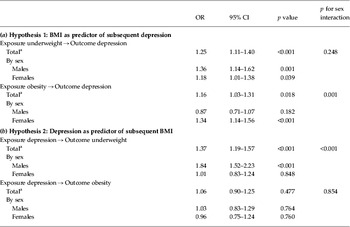
Table 4(a) presents ORs of depression (11–50 years) with underweight and obesity as lag-exposure factors (7–45 years), adjusted for depression at 7 years. Underweight at baseline was associated with ∼1.3 times the odds of depression at follow-up. Obese females (OR 1.34, 95% CI 1.14–1.56), but not males (OR 0.87, 95% CI 0.71–1.07) were at risk for depression at follow-up (p interaction = 0.001). Associations were little changed with adjustment for ethnicity, time-varying SEP, household tenure and physical illness (Supplementary Table S2).
Odds ratios (ORs) and 95% confidence intervals (CIs) for longitudinal associations of depressive symptoms with measured body mass index (BMI), at several ages, child- to adulthood, using generalized estimating equations

a Includes sex.
For hypothesis 1: Exposures underweight and obesity (versus normal/overweight) were based on measured BMI at ages 7, 11, 16, 33 and 45 years; outcome depression (scores <90th percentile versus ⩾90th percentile) was assessed at 11, 16, 23, 42 and 50 years. ORs were adjusted for depression at age 7 years. n = 13 753 cohort members with BMI exposures, depression at 7 years and depression outcomes were included in the analyses.
For hypothesis 2: Exposures depression (scores <90th percentile versus ⩾90th percentile) were assessed at ages 7, 11, 23 and 42 years; outcomes underweight and obesity (versus normal/overweight) were based on measured BMI at ages 11, 16, 33 and 45 years. ORs (95% CI) were adjusted for BMI at 7 years. n = 11 024 cohort members with depression exposures, BMI at 7 years, and underweight outcome and n = 11 895 with depression exposures, BMI at 7 years, and obesity outcomes were included in the analyses.
Consistent with the GEE results, there was good evidence that obesity predicted incident depression at all ages in females (ORs 1.4–2.2) but not in males; as expected, given the low prevalence of childhood/adolescence obesity, CIs were wide for obesity at 7, 11 and 16 years. Underweight predicted incident depression in both sexes (ORs 1.3–1.6) but, as expected, given the low prevalence of underweight in adulthood, CIs were wide for underweight exposure at 33 and 45 years (data not presented).
Hypothesis 2: Prediction from depressive symptoms to subsequent underweight and obesity
Table 4(b) presents ORs of underweight and obesity (11–45 years) with depression as a lag-exposure factor (7–42 years), adjusting for BMI (continuous variable) at 7 years. Depression predicted subsequent underweight but there were sex differences in the associations (p interaction < 0.001), with increased risk of underweight in males at follow-up (OR 1.84, 95% CI 1.52–2.23) but not in females (OR 1.01, 95% CI 0.83–1.24). Depression did not increase subsequent obesity risk in either sex. Associations were little changed with adjustment for ethnicity, time-varying SEP, household tenure and physical illness (Supplementary Table S2). In analyses of incident underweight, ORs for males (but not for females) with depression were elevated (ORs 1.5–7.5) at 11, 16 and 33 years. Furthermore, depression was not associated with incident obesity across ages, with one exception: the OR of incident obesity at 16 years in females with depression but without obesity at 11 years was 4.03 (95% CI 1.97–8.27). However, this analysis was based on a small number of participants (n = 10) with both conditions (data not presented).
Discussion
Using a large prospective British birth cohort, this study is among the first, to our knowledge, to assess life-course (a) co-morbidity of depressive symptoms and BMI status (including underweight) and (b) the direction of association. Our analyses of co-morbidity showed that obesity and underweight were respectively associated with 1.3 to 2.1 and 1.5 to 2.3 times the odds of depression compared with normal weight. In general, overweight was not co-morbid with depression, suggesting that a greater excess of body weight is associated with depression. In longitudinal associations, underweight predicted elevated risk, by 25%, of subsequent depression in both sexes and, conversely, depression predicted elevated risk, by 84%, of subsequent underweight only in males. There was a unidirectional association for obesity: obesity predicted elevated risk, by 34%, of subsequent depression in females but depression did not predict obesity. In addition, longitudinal associations were not explained by covariates including physical illness and socio-economic background. Reciprocal associations from longitudinal models (controlled for baseline depression or BMI) were broadly supported by incident analyses of depression and underweight/obesity.
Methodological considerations
Our analysis of seven assessments of depressive symptoms and BMI over 50 years covers a substantial period of the life course. Further study strengths are prospective measurements of heights and weights, separate consideration of the underweight category, multiple informants to assess depressive symptoms, and national coverage. However, there are study limitations. First, the prevalence of obesity for childhood and adolescence is lower than that observed for today's generation of youths. Nevertheless, co-morbidity estimates of obesity with depression before adulthood may provide insights for societies undergoing the obesity epidemic. Second, except for the psychiatric instrument at 45 years, depressive symptoms measures were based on teacher observations for childhood/adolescence and self-report questionnaires for adulthood. The fact that associations for underweight and obesity with depressive symptoms were observed, in the general population, suggests that instruments may be adequate for this purpose. Third, measures of depressive symptoms were not comparable across childhood to adulthood as would be expected. However, the measures capture similar symptom domains; child/adult are strongly associated (Clark et al. Reference Clark, Rodgers, Caldwell, Power and Stansfeld2007) and standardization of cut-off to identify depression increased comparability across ages. Fourth, because cut-offs identify only a small number at extremes in BMI at some ages, and a larger proportion at other ages, the magnitude of the BMI/depression association may differ. Fifth, because of sample attrition and non-response, some population subgroups were under-represented, including the most severely depressed (Atherton et al. Reference Atherton, Fuller, Shepherd, Strachan and Power2008). Although there are limitations in comparing associations across age (e.g. differences in measures of depression), co-morbidity did not seem to vary in strength from childhood to adulthood (where the rate of attrition is elevated), suggesting that our findings are not markedly affected by loss of depressed participants over time. Sixth, although we controlled for SEP, household tenure, ethnicity, physical illness, and smoking and drinking (adulthood only), we acknowledge that uncontrolled covariates could account for some of the association. Psychotropic medications are known to be associated with underweight and obesity (Lawlor et al. Reference Lawlor, Harbord, Tybjaerg-Hansen, Palmer, Zacho, Benn, Timpson, Davey Smith and Nordestgaard2011). Our findings are unlikely to be explained by psychotropic medication given its expected low use in children/adolescents/young adults, for whom cross-sectional and longitudinal associations were found (Colman et al. Reference Colman, Wadsworth, Croudace and Jones2006). Nevertheless, unmeasured confounders may still partly impact the results. It is noteworthy that we detected associations of underweight and obesity with depression during childhood and adolescence, where confounding factors may have only a limited contribution.
Establishing the causal direction of associations between BMI and depression has not been straightforward in the cross-sectional or longitudinal studies conducted to date. One approach that has been used to improve causal inference is Mendelian randomization (MR). However, evidence from two MR studies investigating the association of obesity gene variants with depressive symptoms is inconsistent (Kivimäki et al. Reference Kivimäki, Jokela, Hamer, Geddes, Ebmeier, Kumari, Singh-Manoux, Hingorani and Batty2011; Lawlor et al. Reference Lawlor, Harbord, Tybjaerg-Hansen, Palmer, Zacho, Benn, Timpson, Davey Smith and Nordestgaard2011). Furthermore, because of the difficulty of identifying gene variants implicated in depression, no MR study has yet examined the association between depression gene variants and obesity. Hence, life-course studies such as ours, which examine several life stages and temporal sequence of associations, contribute to the growing knowledge base on the extent of co-morbidity and direction of association.
Interpretation and comparison with other studies
Obesity/depressive symptoms co-morbidity and direction
Obesity is highly prevalent in Britain, with 25% of adults having a BMI of ⩾30 kg/m2. Its co-occurrence with depression, which is also common (Spiers et al. Reference Spiers, Brugha, Bebbington, McManus, Jenkins and Meltzer2012), is therefore of major interest for health professionals and policy makers. A previous meta-analysis reported a cross-sectional association of obesity with depression in females but not in males (de Wit et al. Reference de Wit, Luppino, van Straten, Penninx, Zitman and Cuijpers2010), whereas a literature review failed to detect co-morbidity in populations other than in the USA (Atlantis & Baker, Reference Atlantis and Baker2008). As far as we are aware, there is no life-course study investigating co-morbidity across multiple ages, although estimates of co-morbidity at multiple ages, from child- to adulthood, are informative in their own right and have the additional advantage of reducing the problem of random co-morbidity due to mixed-age samples (Kraemer et al. Reference Kraemer, Wilson and Hayward2006). Our study confirmed that, across ages, obese individuals had a 1.3 to 2.1 times higher prevalence of depression than those with normal weight. Importantly, our findings suggest that reliance on self-reported weight to define obesity may exaggerate the strength of association between obesity and depression in females, although not in males, which may explain some discrepant results in the literature. In the 1970 British Birth Cohort, co-morbidity of obesity based on self-reported BMI with depressive symptoms was reported in adults females but not males (Viner & Cole, Reference Viner and Cole2005). We also found that obese individuals from all ages are at increased risk of depression, with no covariates in the model. Controlling for ethnicity, time-varying SEP, household tenure and physical illness abolished associations in adulthood but not in childhood. Stronger ORs observed for obesity at 11 and 16 years, defined by the International Obesity Task Force (IOTF) reference, seemed to be a reflection of prevalence and/or obesity severity rather than an effect of age. In our study population, a reverse association at 7 years suggested that obesity may provide some protection against depression before adolescence. This finding does not agree with a recent UK study reporting increased emotional problems among obese boys at 5 years (Griffiths et al. Reference Griffiths, Dezateux and Hill2011), suggesting that co-morbidity of obesity with depressive symptoms in young children may vary across generations with different prevalence of obesity (Pinot de Moira et al. Reference Pinot de Moira, Power and Li2010). When examining the temporal sequence, we found an influence of obesity on subsequent depression in females, but not of depression on subsequent obesity. Although this finding is in agreement with a review of population-based studies that showed good evidence for the obesity-to-depression association but not for the depression-to-obesity association (Faith et al. 2011), the present study extends existing literature in several ways. Our data suggest that obesity is a significant contributor of depression in a non-US population, where the pattern of obesity-to-depression association is thought to differ (Luppino et al. Reference Luppino, de Wit, Bouvy, Stijnen, Cuijpers and Penninx2010). In the UK, few epidemiological surveys have reported longitudinal associations between obesity and depression/depressive symptoms (Viner & Cole, Reference Viner and Cole2005; Kivimäki et al. Reference Kivimäki, Batty, Singh-Manoux, Nabi, Sabia, Tabak, Akbaraly, Vahtera, Marmot and Jokela2009a , Reference Kivimäki, Lawlor, Singh-Manoux, Batty, Ferrie, Shipley, Nabi, Sabia, Marmot and Jokela b ; Griffiths et al. Reference Griffiths, Dezateux and Hill2011). In addition, our analyses provide evidence for sex moderation, with a higher risk of depression in obese females but not in obese males. The British Whitehall II cohort study did not show that obesity predicted future risk of depression, but two-thirds of participants were males, possibly reducing the chances of detecting a sex-moderation effect (Kivimäki et al. Reference Kivimäki, Lawlor, Singh-Manoux, Batty, Ferrie, Shipley, Nabi, Sabia, Marmot and Jokela2009b ). There are several plausible psychological and biological factors that may underlie an obesity-to-depression association, such as eating disorders/binge eating, reduced physical activity, physical pain, and dysfunction of the hypothalamic–pituitary–adrenal (HPA) axis (Luppino et al. Reference Luppino, de Wit, Bouvy, Stijnen, Cuijpers and Penninx2010). Of particular relevance are studies showing that body dissatisfaction, dietary restraint and bulimic symptoms predict onset of depression in adolescent females (Stice et al. Reference Stice, Hayward, Cameron, Killen and Taylor2000).
Underweight/depressive symptoms co-morbidity and direction
Associations of underweight with depression/depressive symptoms have been largely neglected in the literature. One large cross-sectional study of 43 534 Dutch adults aged 18–90 years found an association between underweight and depressive symptoms (de Wit et al. Reference de Wit, van Straten, van Herten, Penninx and Cuijpers2009). In parallel, there is evidence that low BMI in adulthood is associated with increased risk of suicide (Gunnell & Thomas, Reference Gunnell, Thomas, O'Connor, Platt and Gordon2011). Our study shows that underweight from childhood to adulthood could increase the risk of depression. Additionally, we found strong evidence for a reverse association whereby depression triggered weight reduction and underweight in males but not in females. Consistent with our findings, others have reported that males with childhood onset of depression had lower BMI than males without depression (Anderson et al. Reference Anderson, Cohen, Naumova and Must2006). Our results showing that depressed males, but not depressed females, are likely to become underweight suggests that symptoms of depression are expressed differently in males and females. Although reciprocal associations between underweight and depression were not explained by SEP, health factors relating to both underweight and depressive symptoms, including tobacco/alcohol consumption and underlying physical illnesses, there may be other psychological or biological factors that explain such associations. For instance, high density lipoprotein (HDL) cholesterol has been reported to be lower in underweight individuals (Gunnell & Thomas, Reference Gunnell, Thomas, O'Connor, Platt and Gordon2011), and a lower level of HDL cholesterol is associated with depression (Tedders et al. Reference Tedders, Fokong, McKenzie, Wesley, Yu and Zhang2011). Although our findings provide support for a possible influence of underweight on mental health, further exploration of the association is warranted, for example on common causes.
Implications
Depression and obesity are highly prevalent and many individuals live with both conditions simultaneously. There is some indication that general practitioners have limited success in recognizing depression in primary care (Mitchell et al. Reference Mitchell, Vaze and Rao2009, Reference Mitchell, Rao and Vaze2011), which may leave a substantial number of individuals untreated. Depression at all levels of severity, including below clinical thresholds, could impact negatively on health and functioning (Prince et al. Reference Prince, Patel, Saxena, Maj, Maselko, Phillips and Rahman2007) if left untreated. Even though causality cannot be determined from our findings, obesity and underweight could be used by clinicians as a prompt to screen for depression across all ages. Although our study and several others suggest that depressive symptoms co-occur with obesity or underweight, there are few models for treating these conditions simultaneously. Future studies that elucidate mediating factors, especially those amendable to intervention, may help with identification and design of effective treatments.
Supplementary material
For supplementary material accompanying this paper visit http://dx.doi.org/10.1017/S0033291714000142.
Acknowledgements
M. C. Geoffroy was supported by a research fellowship from the Canadian Institutes of Health Research. L. Li was supported by a Medical Research Council (MRC) Career Development Award in Biostatistics (grant G0601941). This work was supported by the Department of Health Policy Research Programme through the Public Health Research Consortium (PHRC). The views expressed in the publication are those of the authors and not necessarily those of the Department of Health. Information about the wider programme of the PHRC is available from http://phrc.lshtm.ac.uk. Data collection was funded by the MRC, grant G0000934. The Great Ormond Street Hospital (GOSH)/University College London (UCL) Institute of Child Health was supported in part by the Department of Health's National Institute for Health Research (NIHR) Biomedical Research Centre. The Centre for Paediatric Epidemiology and Biostatistics was supported in part by the MRC in its capacity as the MRC Centre of Epidemiology for Child Health. We thank the participants of the 1958 British Birth Cohort.
Declaration of Interest
None.