Introduction
In the semiarid portions of Central Great Plains, dryland agriculture has developed around winter wheat production. A variable climate with unpredictable precipitation has made dryland farming in the region inherently riskyReference Dhuyvetter, Thompson, Norwood and Halvorson 1 , Reference Cochran, Danielson, Kolberg, Miller, Peterson, Unger and Payne 2 . Summer fallow, the practice of controlling all plant growth during the non-crop season, was quickly adopted in the region to increase the chances for successful establishment and development of winter wheat and to stabilize winter wheat yieldsReference Tanaka, Lyon, Miller, Merrill, McConkey, Zobeck and Schillinger 3 . However, frequent use of summer fallow, especially when mechanical tillage is used, can result in severe soil erosion, reduced soil carbon and quality, and reduced grain yields and protein content in cereal cropsReference Campbell, Janzen, Juma, Gregorich and Carter 4 .
Organic farming systems frequently rely on biological N fixation from Rhizobium bacteria in symbiotic association with legume species that are used as green manureReference Heckman, Weil, Magdoff and Francis 5 . The release of N from plant residues is dependent on several factors that include chemical composition and N concentration, temperature and soil water availabilityReference Cherr, Scholberg and McSorley 6 . Optimum temperatures and moisture are required for good decomposition and typically occur when soil moisture content is between 50 and 100% of field capacity and when soil temperatures are between 25 and 32 °CReference Stanford and Stevenson 7 . The major challenge to the use of green manure crops in semiarid agriculture is balancing the trade-off between water use by the green manure crop, which will not be available for the following winter wheat crop, and the potential N benefit to the winter wheat crop.
Long-term assessments of lentil (Lens culinaris Medikus) green manure as a partial summer fallow replacement in conventional, i.e., non-organic, cropping systems have been conducted in the US Northern Great Plains and Canadian Prairies. In the first half of a 12-year study conducted at Swift Current, Saskatchewan, lentil was planted in May and turned down at full bloom (late July or early August) to maximize N fixationReference Zentner, Campbell, Biederbeck, Selles, Lemke, Jefferson and Gan 8 . Subsequent spring wheat yields were reduced compared with traditional summer fallow as a result of soil water depletion by lentil. However, in the second half of the study, lentil was planted in April and turned under in early July to reduce water consumption. Subsequent spring wheat yields in the second half of the study were similar between green manure and traditional fallow, plus there was a gradual increase in wheat grain protein and a gradual decrease in N fertilizer requirement following lentil. In Montana, a similar 12-year study was conducted with lentil as a partial summer fallow replacementReference Allen, Pikul, Waddell and Cochran 9 . Although the authors did not see a difference in starting soil water for spring wheat following green manure killed at full bloom or fallow, they did see reduced grain yield following green manure in the first 5 years, which they explained by low soil nitrate following green manure. In the last 6 years of the study, grain yields following green manure and fallow were similar and the green manure treatment had 26% greater spring soil nitrate than fallow.
In a conventional production system in Colorado, winter wheat yield following annual legume green manures [Austrian winter pea (Pisum sativum L. subsp. sativum var. arvense (L.) Poir.), spring field pea and black lentil] was reduced from 400 to 1050 kg ha−1 compared with summer fallow depending on the termination date of the green manureReference Vigil and Nielsen 10 . Water use by the green manure explained 88% of the variability in winter wheat yield. The benefits of green manure fallow were highly weather-dependent and inconsistent. The impact of replacing summer fallow in a no-till production system with various spring-planted crops prior to winter wheat seeding was studied in western NebraskaReference Lyon, Baltensperger, Blumenthal, Burgener and Harveson 11 . Winter wheat yields following summer fallow replacement crops were reduced from 22 to 58% following oat (Avena sativa L.) + pea for forage and corn (Zea mays L.), respectively, compared with wheat following summer fallow. This was largely explained by a 27–41% reduction in soil water at wheat planting following these two crops compared with following summer fallow. Winter wheat yield has been reported to be strongly correlated with the available soil water at wheat plantingReference Nielsen, Vigil, Anderson, Bowman, Benjamin and Halvorson 12 .
In a dryland organic wheat system in Montana, winter wheat yield and quality were higher following winter pea green manure than spring pea green manureReference Miller, Lighthiser, Jones, Holmes, Rick and Wraith 13 . Winter pea had greater shoot N content when terminated at the pod stage, contributed greater soil nitrate-N, and used less soil water than spring pea. Termination timing, either at bloom or pod stages, was of secondary importance to pea type.
Animal manures are widely used to fertilize crops and increase soil organic matter content. Nitrogen content of manure is affected by animal species, feed, bedding, and manure storage and handling. The average apparent first-year N availability for corn was 57, 53, 14 and 4% for fresh poultry, dried poultry, composted poultry and composted cattle (Bos taurus) manure, respectivelyReference Munoz, Kelling, Rylant and Zhu 14 . Corn yield following composted cattle manure was no different than the no N control treatment. Apparent N and phosphorus recovery in barley (Hordeum vulgare L.) was lower for fresh and composted beef cattle manure (5–9%) than for inorganic fertilizer (22–47%)Reference Miller, Beasley, Drury and Zebart 15 . The gradual N release from fresh and composted manures, as opposed to the quick release of inorganic N fertilizer, over several years benefitted weed growth more than spring wheatReference Blackshaw 16 .
Organic growers are restricted to using organic certified N sources. In a semiarid environment such as Sidney, NE, conversion of these organic N sources to nitrate–N may be slower than in a more humid environment. The objective of this study was to ascertain the impact that green manure pea and composted cattle manure had on winter wheat yield and grain quality characteristics in a certified organic production system in the semiarid Central Great Plains.
Materials and Methods
Studies were conducted in fields certified through the Organic Crop Improvement Association in 2006 at the University of Nebraska–Lincoln High Plains Agricultural Laboratory (41o12′N, 103o0′W, 1315 m elevation above sea level) located near Sidney, NE. The certified organic land is divided into three 10-ha fields managed in a 3-year rotation of winter wheat–proso millet (Panicum miliaceum L.)–green manure fallow. Each year, a new study was established in the field with green manure fallow. Soils were an Alliance silt loam (fine-silty, mixed, superactive, mesic Aridic Argiustolls) in 2008/2009 and a Duroc loam (fine-silty, mixed, superactive, mesic Pachic Haplustolls) in 2009/2010 and 2010/2011. Soil pH in the surface 20 cm was 7.3, 6.6 and 7.0 for 2008/2009, 2009/2010 and 2010/2011, respectively. Soil organic matter content in the surface 20 cm was 23, 27 and 27 g kg−1, respectively.
A split-plot experimental design was used. Whole plot treatments were replicated four times in a randomized complete block design and consisted of green manure fallow and conventional tilled fallow (black fallow), and subplots consisted of one of three levels of composted cattle manure (0, 11.2 or 22.5 Mg ha−1). Whole plots were 9 m × 9 m and subplots were 3 m × 9 m. Forage pea ‘4010’ was used as the green manure crop. Peas were treated with the peat formulation of Cell-Tech pea and lentil (Novozymes BioAg, Inc., Brookfield, WI) and planted in early April at a depth of 7.5 cm in 25-cm rows and at a seeding rate of 67 kg ha−1. Peas were allowed to grow until first flower, which occurred during the last 2 weeks of June, and then terminated with a tandem disc operated to a 10-cm depth. This was followed by a chisel plow with small sweep points and then a rod weeder for the remainder of the fallow period. Immediately prior to pea termination, pea biomass was randomly collected from 1 m2 per replication to estimate pea biomass. Pea biomass was dried at 50 °C until a constant weight was achieved. Also, at this time, composted manure treatments were applied to designated plots. Black fallow plots were tilled twice with a tandem disc and then once or twice with a chisel plow with small sweeps and then a rod weeder.
Composted cattle manure was stockpiled to provide fertilizer to the experiment for 3 years. The compost contained 9.5 g N kg−1, 6.7 g P kg−1, and 11.8 g K kg−1 on a dry matter basis. The compost application rates provided a total of 94 and 188 kg N ha−1 each year on an as-applied basis (12% moisture content), but only 10–20% of this would mineralize during the crop growth cycleReference Eghball 17 .
Immediately prior to winter wheat planting, a soil sample was taken from the middle of each plot with a hydraulic soil probe using a 5-cm diameter sampling tube. Soil depth increments were: 0–20, 20–60 and 60–120 cm. A portion of each sample from every plot was used to determine gravimetric soil water content, while a second portion was air dried and analyzed for soil nitrate concentration. Gravimetric soil water content was converted to volumetric water content by multiplying by the soil bulk density for each depth layer.
Winter wheat ‘Goodstreak’ (2008) and ‘Hatcher’ (2009 and 2010) were planted at a rate of 56 kg ha−1 in mid September at a depth of 5 cm and a row spacing of 30 cm. Immediately prior to wheat harvest in mid July, 2 m of row were clipped at ground level and removed from each plot to determine harvest index. Wheat straw from these samples were subsequently ground and analyzed for total N. Plots were mechanically harvested with a plot combine and yield determined from an area 2.0 m wide × 7.6 m long. Grain moisture and test weight were determined and a portion of the grain was analyzed for N content. Grain protein was calculated from grain N content using 5.7 as the multiplier. Total N removal was calculated by adding the N content of the grain and straw.
Data were analyzed using the General Linear Model (GLM) procedure in SAS 18 . Replications were treated as random effects. All other factors in the model were treated as fixed effects. Significant year by treatment interactions were observed, so data were analyzed separately by year. Treatment means were separated using Fishers’ protected LSD at the 0.05 probability level.
Results and Discussion
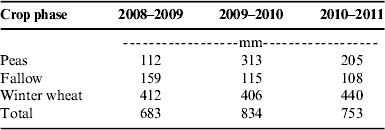
Growing season precipitation, from pea planting through winter wheat harvest, varied from a low of 683 mm in 2008/2009 to a high of 834 mm in 2009/2010 (Table 1). The 30-year average total precipitation for Sidney from 1 April (pea planting) through June of the following year (winter wheat harvest) is 522 mm.
Precipitation during the pea, fallow and winter wheat phases of the field study conducted at Sidney, NE from 2008 to 2011.

Fallow treatments
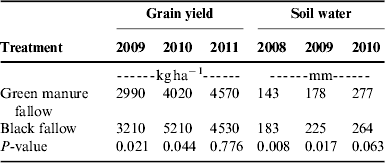
Winter wheat yields were higher following black fallow than green manure fallow in 2 of the 3 years (Table 2). There was no difference in winter wheat yield between black fallow and green manure fallow in 2011. Soil water prior to winter wheat seeding was at least 40 mm higher after black fallow than after green manure fallow in the first 2 years of the study when winter wheat yields were best following summer fallow. This is in agreement with the findings of Nielsen et al., who found that winter wheat yields were correlated with water at planting and that the elimination of summer fallow reduced soil water at planting and subsequent wheat yieldReference Nielsen, Vigil, Anderson, Bowman, Benjamin and Halvorson 12 . In 2010/2011, there was less than 20 mm difference in soil water between the two fallow treatments and there was no significant yield difference (Table 2).
Winter wheat grain yield and soil water in surface 122 cm of soil at wheat planting following green manure and black fallow at Sidney, NE from 2008 to 2011.

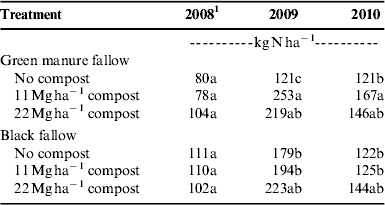
Soil nitrate levels were also different between black fallow and green manure fallow treatments receiving no manure (Table 3). Soil nitrate in the fall of 2008 and 2009, on average, was 45 kg ha−1 higher for black fallow compared with green manure fallow. The green manure crop not only reduced soil water but also soil nitrate. The N was not lost, but taken into the pea biomass. The dry matter accumulation averaged 1920, 1190 and 1420 kg ha−1 for 2008, 2009 and 2010, respectively. The above-ground N content averaged 60, 42 and 44 kg ha−1, which varied due to available soil water. This N would be available later, but the delay in N release in addition to less soil water contributed to reduced grain yield.
Soil nitrate–N in the surface 120 cm of soil before winter wheat planting and following green manure and black fallow at Sidney, NE from fall 2008 through 2010.

1 Means within a column followed by the same letter are not significantly different at the 5% probability level.
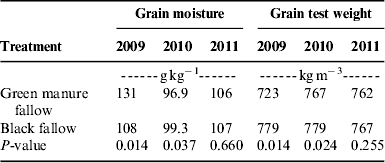
Winter wheat grain moisture also varied by year (Table 4). In 2009, grain moisture was less after black fallow than green manure fallow. This was likely the result of wheat plants having less drought stress following black fallow than green manure fallow, which allowed the crop to mature more quickly following black fallow than after green manure fallow. Although the difference in grain moisture levels was statistically significant in 2010, from a practical standpoint, the small difference between treatments was of no significance. In 2011, no difference in grain moisture content was observed.
Winter wheat grain moisture and test weight following green manure and black fallow at Sidney, NE from 2009 to 2011.

Grain test weight was higher following black fallow than green manure fallow in 2009 and 2010 (Table 4). In 2011, there was no difference in grain test weight. Test weight is an important quality trait used in the wheat industry and low test weights can result in significant price reductions for grain.
Grain protein averaged 138, 127 and 133 g kg−1 in 2009, 2010 and 2011, respectively. Although there were no differences in grain protein content between fallow treatments (data not shown), grain N and total N removal were higher following black fallow than green manure fallow in 2 out of 3 years (Table 5). This was likely the result of greater grain yields following black fallow in the first 2 years of the study.
Winter wheat grain N removal and total N removal (grain and straw) following green manure and black fallow at Sidney, NE from 2009 to 2011.

Manure applications
There were no differences observed between manure treatments in this study. This was likely the result of a short time between manure application and winter wheat planting, and the relatively dry conditions during this time (Table 1), which prevented sufficient release of N from the composted cattle manure. Apparent N recovery in barley was only 5–9% following fresh and composted beef cattle manureReference Miller, Beasley, Drury and Zebart 15 . This low recovery rate, combined with adequate soil N from the mineralization of soil organic matter, particularly following black fallow, resulted in no effect of composted cattle manure on the following winter wheat crop.
We saw no benefit from either green manure or composted beef cattle manure on the following winter wheat crop. In fact, in 2 out of 3 years, green manure fallow decreased winter wheat grain yield, at least in part, as a result of soil water depletion prior to winter wheat planting. This agrees with the findings of Vigil and Nielsen from their work in eastern ColoradoReference Vigil and Nielsen 10 . The other factor related to reduced grain yield and N removal was diminished nitrate in the fall of 2008 and 2009 after green manure fallow. The relationship between winter wheat yield and N application depends on the availability of both N and soil water. In soils with adequate N but insufficient water, yields are depressed, as in 2009. If N fertility is great enough, especially with limited water, the N response curve is curvilinearReference Halvorson, Nielsen and Reule 19 . Figure 1 shows this relationship clearly for this experiment. Yields of each year were normalized to relative yield and compared with soil nitrate before wheat planting. Yield was maximized near 150 kg ha−1 and higher nitrate levels tended to suppress yield, which was similar to results from Halvorson et al.Reference Halvorson, Nielsen and Reule 19 . A multiple regression equation relating relative yield to soil nitrate and preplant soil moisture had an R 2 of 0.47. The equation is
 $$Y = 0.64 + 0.00245{\rm SN} - 0.0000094{\rm SN}2 + 0.00077{\rm SW,}$$
where SN is kg soil nitrate–N in 1.2 m (Table 3) and SW is mm of preplant soil water (Table 2). The comparison of actual and predicted relative yield is shown in Figure 1.
Predicted relative winter wheat yield versus soil nitrate–N (SN) and pre-plant soil water (SW) in the upper 1.2 m of soil. Equation: Y = 0.64 + 0.00254SN − 0.000094SN2 + 0.00077SW, R 2 = 0.47.

Zentner et al. and Allen et al. did not see the benefits of green manure in their long-term field experiments during the first 5 or 6 yearsReference Zentner, Campbell, Biederbeck, Selles, Lemke, Jefferson and Gan 8 , Reference Allen, Pikul, Waddell and Cochran 9 . Our study suggests that growers in the semiarid Central Great Plains are unlikely to see the benefits of green manure or composted cattle manure on the immediately following winter wheat crop. In fact, as a result of the soil water used by green manure crops, winter wheat yields will often be negatively impacted by the use of green manure crops used as a partial summer fallow replacement. This is supported by the work of Nielsen et al.Reference Nielsen, Vigil, Anderson, Bowman, Benjamin and Halvorson 12 . Organic wheat growers in the semiarid Central Great Plains may prefer the use of fresh manure, with its higher N content relative to composted manure. The use of green manures, which use valuable soil water, may be too risky in semiarid winter wheat production. As is often the case in organic production systems, semiarid winter wheat growers may need to be patient and be willing to accept some negative results in the early years of their production systems in order to see the benefits of these practices in their cropping systems.