What is the impact of US Supreme Court dissenting opinions? We suggest that dissents play an important role in the ongoing “constitutional dialogue” among institutions and actors. While the scholarly literature on the concept of constitutional dialogue includes various meanings, including dialogue across branches of government and in multinational contexts (see Meuwese and Snel Reference Meuwese and Snel2013), we use the idea in terms of judicial dialogue: “procedure and case law, the formal and official channels of communication available to courts” (Claes and de Visser Reference Claes and de Visser2012, 105). Furthermore, rather than using the notion of constitutional dialogue as a lens or a metaphor, we employ the concept as a method asking the empirical question posed by Meuwese and Snel (Reference Meuwese and Snel2013, 137): “What dialogic elements/mechanisms/features are having what effects?”
Although constitutional dialogue can be informal, both in writing and via personal contacts, its most obvious form comes via the formal, written opinions issued by judges. A dissenting opinion, by definition, is expressing disagreement with the majority opinion, both in the result reached and the reasoning used. While a majority opinion’s effect on constitutional dialogue—its so-called judicial impact—is plain (an attempt to provide guidance to lower courts, lawyers, executives, legislators, and other judicial audiences; e.g., Baum Reference Baum2006; Epstein, Landes, and Posner Reference Epstein, Landes and Posner2013) and widely studied (e.g., Songer and Sheehan Reference Songer and Sheehan1990; Spriggs Reference Spriggs1996; Benesh and Reddick Reference Benesh and Reddick2002; Klein and Hume Reference Klein and Hume2003; Hume Reference Hume2009), the role of a dissenting opinion may be less apparent.
One potential impact is that the dissent will one day be vindicated in the law. Chief Justice Charles Evans Hughes (Reference Hughes1928, 67–68) stated that “a dissent in a court of last resort is an appeal to the brooding spirit of the law, to the intelligence of a future day, when a later decision may possibly correct the error into which the dissenting judge believes the court to have been betrayed.” That may mean current justices who read a dissent from a prior case are persuaded to give it weight in a future case, such as Justice Anthony Kennedy’s majority opinion in Lawrence v. Texas (2003) that approvingly cited Justice John Paul Stevens’s dissent in Bowers v. Hardwick (478 U.S. 186 [1986]): “Justice Stevens’ analysis, in our view, should have been controlling in Bowers and should control here” (539 U.S. 558, 578).
In fact, justices write dissents with the hope that their views will ultimately become law. In this sense, the judicial audience for a dissent is a future one. For example, in Pembauer v. City of Cincinnati (475 U.S. 469 [1986]), Powell directed his clerk to draft a dissent in order to “simply lay the foundation for what I hope will be an overruling of this unfortunate decision” (memo from Lewis F. Powell Jr. to Michael W. Mosman, January 23, 1986, Powell Papers, box 269). Similarly, in Dow Chemical Co. v. United States (476 U.S. 227 [1986]), Powell wrote his clerk that “I have every confidence that our dissents will be adopted by this Court in a future case” (memo from Lewis F. Powell Jr. to Anne M. Coughlin, April 24, 1986, Powell Papers, box 269).
Dissents can also be persuasive for future lawyers and judges who are still learning the law. For example, in a July 29, 2012, interview on C-SPAN’s Q&A, Justice Antonin Scalia explained that “I write the dissents mainly for the law students.” Dissents can also be written for a more academic audience, as with Powell’s dissent in Martin v. Ohio (480 U.S. 228 [1987]), in which he told his clerks that “I would hope there has been relevant scholarly discussion of [this issue]… . This certainly will be [a] fruitful field for scholarly interest after this case is decided… . This is a rather theoretical area of criminal law, and even though we apparently will be in dissent, our opinion could be important” (memo from Lewis F. Powell Jr. to Andrew D. Leipold, January 11, 1986, Powell Papers, box 280). Beyond future effects, we are interested in probing the contemporaneous constitutional dialogue that takes place within a court—namely, the effect of a dissenting opinion on the majority opinion in the same case.
Intracourt Dialogue
The majority-opinion writer has various purposes in writing opinions. According to Justice Anthony Kennedy, “You must convince the parties that you’ve understood their arguments. You must convince the attorneys that you’ve understood the law… . [And] you must command allegiance to your opinion” (Garner Reference Garner2010, 84). Given that “the most frequent objection to a dissent is that it weakens the force of the decision” (Urofsky Reference Urofsky2015, 9), it is important for majority-opinion authors to respond to arguments made by the dissent.
Supreme Court justices have remarked on how important dissents are to the “intra-court dialogue” (Urofsky Reference Urofsky2015, 11). According to Justice Samuel Alito, “You have to be ready to respond to the dissent” (19). Justice William Brennan (Reference Brennan1985) argued that dissents force majority-opinion writers to deal with the hardest questions and keep the majority accountable for the rationale of its decisions. And Justice Ruth Bader Ginsburg (Reference Ginsburg2010, 3) noted that “there is nothing better than an impressive dissent to lead the author of the majority opinion to refine and clarify her initial circulation,” describing this phenomenon as the “in-house impact” (3). Justice Stephen Breyer agreed, stating that “the impact of [a] dissent will be, at the least, to make me write a better opinion” (Urofsky Reference Urofsky2015, 19).
Consider Powell’s discussion with his clerk Phil Jordan concerning their dissent in Franks v. Bowman (424 U.S. 747 [1976]). Powell explained to Jordan that “the role of a dissenter is similar to that of an advocate… . Where there is room for rational doubt, we should resolve it strongly in favor of our position” (memo from Lewis F. Powell Jr. to J. Phillip Jordan, January 12, 1976, Powell Papers, box 173). After Powell circulated his dissent, Brennan—the majority-opinion author—responded that “I am making a few small revisions in light of Lewis’ most recent circulation. I must say Lewis seems to have made a full scale retreat from his original position… . Thus our opinions don’t seem to differ to any great extent. I am making this clear in a new footnote” (memo from William J. Brennan to the Conference, February 11, 1976, Powell Papers, box 173). Powell replied (somewhat tongue-in-cheek) that “if Bill really thinks there is no material difference, it would clarify the situation for everyone—and especially for the lower courts—if Bill were to join my opinion. He would be most welcome. Or, as an alternative, I cheerfully make my opinion available as a substitute for Part III and Part IV of his opinion. But in all candor, I view our opinions and positions as irreconcilable” (memo from Lewis F. Powell Jr. to the Conference, February 12, 1976, Powell Papers, box 173). After Brennan’s fourth draft was circulated, Powell noted on the draft that “at least we have Bill hopping! And he has made a stronger case for his view” (William J. Brennan, opinion of the Court in Franks v. Bowman, fourth draft, February 13, 1976, Powell Papers, box 173).
Another example of a dissent strengthening the majority occurred in San Diego Gas & Electric Co. v. City of San Diego (450 U.S. 621 [1981]). Brennan circulated a dissent responding to Blackmun’s 5–4 majority opinion. Powell joined Brennan’s dissent, but when Blackmun circulated a revised draft, Powell’s clerk Paul Cane was so impressed with it that he noted that “the changes made here in response to WJB’s opinion are powerful” (Harry A. Blackmun, opinion of the Court in San Diego Gas & Electric v. City of San Diego, third draft, March 10, 1981, Powell Papers, box 218). Powell circled “powerful” and added a question mark but never wavered. Stevens, a member of the majority, sought to reassure Blackmun in the face of Brennan’s dissent: “Before I had the benefit of Bill Brennan’s opinion, I joined you. After reading it, I am even more firmly convinced that your analysis is correct” (memo from John Paul Stevens to Harry A. Blackmun, March 10, 1981, Powell Papers, box 218).
Although there is anecdotal evidence of the impact of dissents, there is very little research that systematically examines their actual impact (but see Bryan and Ringsmuth Reference Bryan and Ringsmuth2016; Hinkle and Nelson Reference Hinkle and Nelson2018; Rice Reference Rice2019). Bryan and Ringsmuth (Reference Bryan and Ringsmuth2016) found that cases with negative dissents attract more media coverage, while Rice (Reference Rice2019) found that dissenting justices emphasize different issue frames and lead to majority opinions addressing a greater number of topics. Hinkle and Nelson (Reference Hinkle and Nelson2018) found that dissents using memorable language are more likely to be cited by future Supreme Court majority opinions. In this article, we test the theory of “in-house impact,” specifically examining the factors that explain which dissents have the biggest contemporaneous impact on the law. When a majority-opinion author cites the dissent, that dissent plays a role in shaping the content of the majority opinion. Why do some dissents “become part of and influence the constitutional dialogue” (Urofsky Reference Urofsky2015, 7) while others do not? We suggest that dissents are primarily important for constitutional dialogue because of their content—namely, the arguments they make and the language they employ. Specifically, we argue that well-written, well-reasoned dissents are more likely to have an impact on the majority opinion. In other words, the majority will be more likely to cite a high-quality dissent.
High-Quality Dissents
To test our theory, we must decide what good legal writing entails and what makes for a high-quality dissenting opinion. According to the Manual on Appellate Court Opinions, “The dissent should be a challenge to the decision or to the reasoning supporting the decision; it seeks the same objective as the majority opinion—good legal doctrine correctly applied” (Witkin Reference Witkin1977, 233). Thus, we argue that a high-quality dissent must be well written and grounded in precedent.
Good Legal Writing
Clarity/Readability
“Clarity … is the most basic quality of good legal writing” (Osbeck Reference Osbeck2012, 428). In other words, judges should use simple language that the general reader can understand. “There is a place for the elegant word, but it should not be necessary for the reader to have a dictionary at hand while reading the opinion” (Federal Judicial Center 1991, 23). More complex opinions mean that fewer people can understand the judgment or role of the court and that the court could potentially lose its public voice (Vickrey, Denton, and Jefferson Reference Vickrey, Denton and Jefferson2012).
In fact, 1 month before his confirmation hearing, Judge Neil Gorsuch was profiled in a lengthy Washington Post article. The reporters noted that “even the simple writing style of his opinions, which have won wide attention in legal circles, reflects his conviction that the law should be understandable to everyone, lest it favor only the wealthy and well educated… . Former clerks say that Gorsuch’s insistence on clear writing reflects his convictions about making the law accessible and understandable to everyone” (Kindy, Horwitz, and Wan Reference Kindy, Horwitz and Wan2017).
There has been a long movement to use plain language in law and regulation and even business (Leonhardt Reference Leonhardt2000). The idea is to use the “simplest, most straightforward way of expressing an idea” (Garner Reference Garner2001, XIV). “The purpose of communication is to communicate, and this can’t be done if the reader … doesn’t understand the words used” (Garner Reference Garner2013, 183). It is difficult for a legal opinion to achieve its core function, to persuade, if the reader cannot understand it. One study found that when given two otherwise identical passages seeking a rehearing of a particular matter, one written in “legalese” and the other in simpler English, participants found the plainer style to be much more persuasive (Benson and Kessler Reference Benson and Kessler1987).
Authentic Voice
In addition to clarity, good legal writing is engaging, which includes using an authentic voice (Osbeck Reference Osbeck2012). “No matter how sound your reasoning, if it is presented in a dull and turgid setting, your hearers—or your readers—will turn aside. They will not stop to listen. They will flick over the pages. But if it is presented in a lively and attractive setting, they will sit up and take notice. They will listen as if spellbound. They will read you with engrossment” (Garner Reference Garner2009, 39, quoting Lord Denning). A writer who uses an authentic voice projects character and individuality, letting “the reader see that there is a real person behind the document” (Osbeck Reference Osbeck2012, 444).
Adverbs
Although good legal writing includes writing clearly and using an authentic voice, many writing experts agree that it does not include using adverbs. According to Garner (Reference Garner2002, 200), “Adverbs often weaken verbs. Think of the best single word instead of warming up a tepid one with a qualifier.” Strunk and White (Reference Strunk and White1999, 75) remark that “inexperienced writers … overwork their adverbs.” Zinsser (Reference Zinsser1980, 102) states that “most adverbs are unnecessary. You will clutter your sentence and annoy the reader if you choose a verb that has a specific meaning and then add an adverb that carries the same meaning. Don’t tell us that the radio blared loudly—‘blare’ connotes loudness.” And according to Justice Anthony Kennedy, “I think adverbs are a cop-out. They’re a way for you to qualify, and if you don’t use them, it forces you to think through the conclusion of your sentence. And it forces you to confront the significance of your word choice, the importance of your diction” (Garner Reference Garner2010, 92–93). However, Judge Gregory Orme (Reference Orme2013) argues that adverbs are necessary when making nuanced arguments, and other legal writers acknowledge that using some adverbs is necessary. “If an athlete loses a game because he played badly, ‘badly’ gives us the helpful information that he didn’t play well. But spare us the news that he moped dejectedly and that the winner grinned widely” (Zinsser Reference Zinsser1980, 102–3).
Intensifiers
Intensifiers should also be avoided. An intensifier is a “linguistic element used to give emphasis or additional strength to another word or statement” (Schiess Reference Schiess2017, 48). The most commonly used intensifiers are adverbs ending in “ly,” such as “clearly” and “obviously.” According to one writing guide, “Clearly is so overused in legal writing that one has to wonder if it has any meaning left” (Enquist and Oates Reference Enquist and Currie Oates2009, 123). The perception is that an argument that includes words such as “clearly” and “obviously” is weak (Garner Reference Garner2002, 35). One writing expert noted that “when most readers read a sentence that begins with something like obviously, undoubtedly … and so on, they reflexively think the opposite” (Williams Reference Williams2007, 123). “Because generations of writers have overused words like ‘clearly’ and ‘very,’ these and other common intensifiers have become virtually meaningless. As a matter of fact, they have begun to develop a connotation exactly opposite their original meaning. So many writers (lawyers and judges alike) have used those labels in place of well-reasoned analysis that some readers see these intensifiers as signaling a weak analysis” (Edwards Reference Edwards2010, 229).
One study examined whether appellate briefs that used intensifiers are more likely to lose (Long and Christensen Reference Long and Christensen2008). The authors examined 400 randomly selected state and federal court civil appellate cases from 2001 to 2003, finding that using intensifiers increased the probability of losing; however, if an appellate opinion used a lot of intensifiers, the brief that also used a lot of intensifiers was more likely to win. Thus, the authors concluded that the conventional wisdom regarding intensifiers being associated with losing arguments is true; however, there may be cases in which intensifiers increase the probability of winning.
In a recent study, Long and Christensen (Reference Long and Christensen2013) presented a theory of argumentative threat, that using intensifiers increases as a response to perceived threat. Specifically, “the idea is that those who agree with us are generally good, and therefore we use general terms indicating that their good acts pervade the entire group and are the norm. Conversely, a bad act is described with specificity so as to limit its application to the specific situation” (947). The authors examined US Supreme Court dissenting opinions, finding that dissenting opinions contain more intensifiers than majority opinions. “This increased use of intensifiers could be a form of linguistic intergroup bias in the sense that a dissenting judge, alienated from the majority, seeks to show that the dissenting argument is ‘obviously,’ ‘clearly,’ and ‘wholly’ superior to the opinion of what is now the dissenter’s out-group. The increased use of intensifiers … could be a subconscious attempt at showing the ‘strength’ of the dissenter’s argument—even though the dissenter consciously knows that using more intensifiers is negatively perceived by judges and legal readers in general” (948).
Adjectives
Writing experts also caution against using too many adjectives. “The adjective hasn’t been built that can pull a weak or inaccurate noun out of a tight place” (Strunk and White Reference Strunk and White1999, 71). Zinsser (Reference Zinsser1980) advises to use adjectives sparingly. Specifically, “most adjectives are … unnecessary. Like adverbs, they are sprinkled into sentences by writers who don’t stop to think that the concept is already in the noun” (103). Just like adverbs weaken verbs, adjectives weaken nouns (Garner Reference Garner2002, 200). However, writers can use adjectives in a powerful way: “When adjectives are placed in high relief, they sometimes serve us well” (200).
Emotional Tone
The emotional tone of a dissenting opinion may also influence whether it has an impact. Good legal writing can include using emotive words because the writer can make the reader more sympathetic to the writer’s argument (Osbeck Reference Osbeck2012, 452). However, when it comes to dissents, Urofsky (Reference Urofsky2015, 13) argues that dissents that are “matters of pique,” and those dissents that have a “strident tone,” do not play a role in the constitutional dialogue and thus are less likely to have an impact. Specifically, these negative dissents are heated and emotional, and they “cloud the intellectual argument” (13). However, as stated previously, one recent study found that negative, emotionally charged dissents attract more media coverage (Bryan and Ringsmuth Reference Bryan and Ringsmuth2016). Additionally, Hinkle and Nelson (Reference Hinkle and Nelson2018) found that dissents using more negative emotion are cited more in future majority opinions. Thus, the majority-opinion writer may be more likely to cite a dissent that uses emotional language and specifically negative emotional language.
Analytical
Good legal writing reflects analytical thinking. Legal training includes learning to reason analytically. “All through most first and second years in a law student’s studies, her teachers are pounding into her brain a style of thinking, a way to think, to reason analytically. She must analyze, examine, appraise, and evaluate. Such process is vital to … thinking like an attorney… . Skilled attorneys develop precise analytical thinking” (Russell Reference Russell2000, 13). In fact, “legal analysis is the cornerstone of the U.S. judicial system” (Walston-Dunham Reference Walston-Dunham2012, 41). Thus, we expect that the majority-opinion writer will be more likely to cite a dissent that reflects analytical thinking.
Precedent
Persuasive citation of precedent is an important part of legal writing. Precedent, or stare decisis, is the foundation of the American legal system. Courts rely on previous decisions on similar questions, or precedent, for guidance in deciding cases. Although there is debate on the effect of prior decisions on Supreme Court justices (e.g., Brenner and Spaeth Reference Brenner and Spaeth1995; Spaeth and Segal Reference Spaeth and Segal1999; Hansford and Spriggs Reference Hansford and Spriggs2005), it is expected that Supreme Court decisions will cite precedent. In fact, although Supreme Court justices rely on other legal resources, “stare decisis predominates” (Epstein and Knight Reference Epstein and Knight1998, 172). Specifically, precedents operate by laying down the rules that subsequent courts apply to the case before them. The reasoning for the result is arguably the most important part of a legal opinion, and the “norm” is that legal reasoning contains precedent (Epstein and Knight Reference Epstein and Knight1998). Reasons must be given if the opinion is going to be useful to lawyers and judges. “Opinions setting precedent will be scoured, today and tomorrow, by countless lawyers and judges duty bound to determine the rights and obligations of parties in dispute” (Cappalli Reference Cappalli2000, 286). Arguably, dissenting opinions that are well grounded in precedent are legally strong opinions and consequently are more likely to be perceived as well reasoned and persuasive; thus, the majority opinion is more likely to cite and respond to the arguments made by the dissenters.
Other Dissent Characteristics
Additionally, there may be other characteristics of a dissent that may influence whether the dissent has an impact on the majority opinion. One such characteristic is the ideological heterogeneity of the dissent. Given that opinions provide ideological signals for liberal or conservative positions on issues, an opinion with a mixed ideological coalition should have greater weight than one that does not. For example, a majority coalition of only conservatives might give more weight to a dissenting opinion that was supported by both liberals and conservatives as opposed to one simply supported by the ideological opposition. Consider the dissent issued by conservative Justice Antonin Scalia and liberal Justice Stevens in Hamdi v. Rumsfeld (542 U.S. 547 [2004]). Justice Sandra Day O’Connor’s plurality opinion not only cites their dissent but spends five paragraphs discussing it: “Scalia acknowledges … Scalia relies … Scalia cites … Scalia accepts … paradigm outlined by … Scalia … Scalia envisions … Scalia largely ignores … Scalia refers to … Scalia’s treatment … Scalia finds … Scalia can point to … Scalia presumably would …” (542 U.S. 507). A heterogeneous dissenting coalition arguably sends a more credible signal to outside observers, which increases the majority’s motivation to explain why the majority is right and the dissent is wrong.
Another characteristic is the number of dissenters. If it is a close case, the majority-opinion writer may respond to the arguments made by the dissent in an effort to make the majority opinion more persuasive. The last characteristic we include is the ideological difference between the majority-opinion writer and the dissenting author. If two justices are ideologically compatible and they find themselves on opposite sides, the majority-opinion writer may perceive the dissent to be persuasive. Additionally, the dissenting author may be relying on precedent when the two justices were in agreement. Thus, we expect that the closer the two are ideologically, the more likely the majority will cite the dissent.
Data and Method
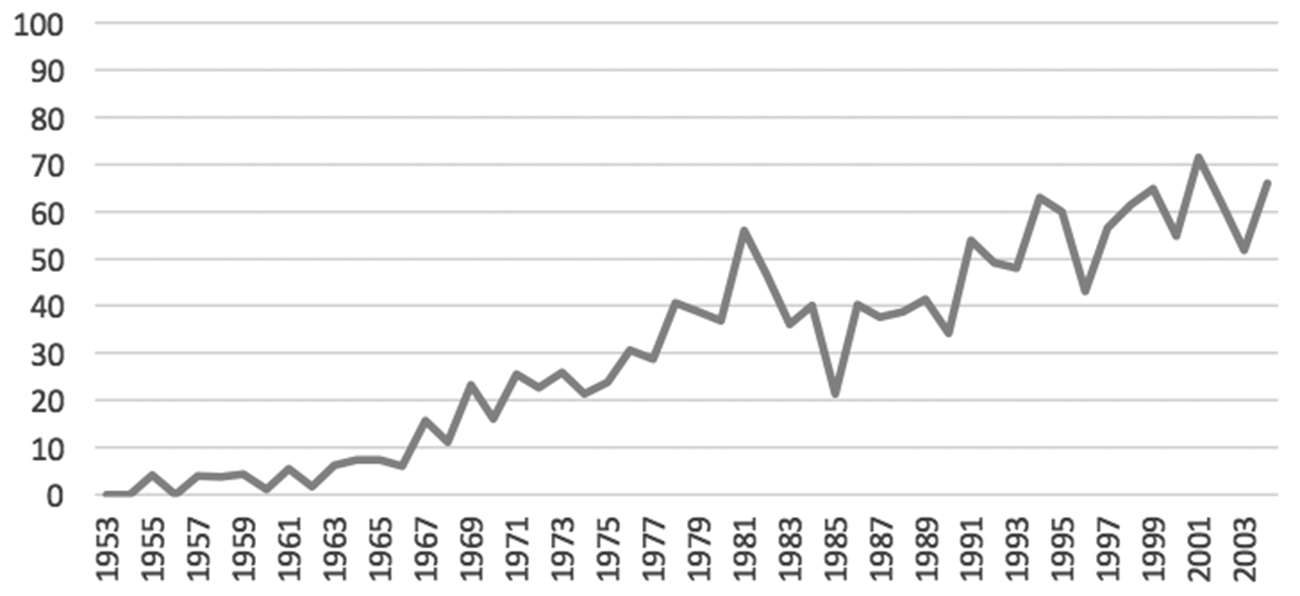
To examine the effects of a dissent on the majority opinion, we analyze the Supreme Court’s dissenting opinions in all signed, orally argued decisions during the 1953–2004 terms.Footnote 1 The unit of analysis is the dissenting opinion, and the dependent variable is whether the majority or plurality opinion cited the dissent in the same case, which equals 1 if the dissent was cited and 0 otherwise. As shown in figure 1, the proportion of majority/plurality opinions citing dissents has been increasing over time, which should not be surprising given that the number of dissents has also increased over time owing to changes in Court personnel who made separate opinion writing, including dissents, the norm (see, e.g., Corley, Steigerwalt, and Ward Reference Corley, Steigerwalt and Ward2013). Still, what accounts for the rise in dissent citations?
Proportion of majority/plurality opinions citing dissents
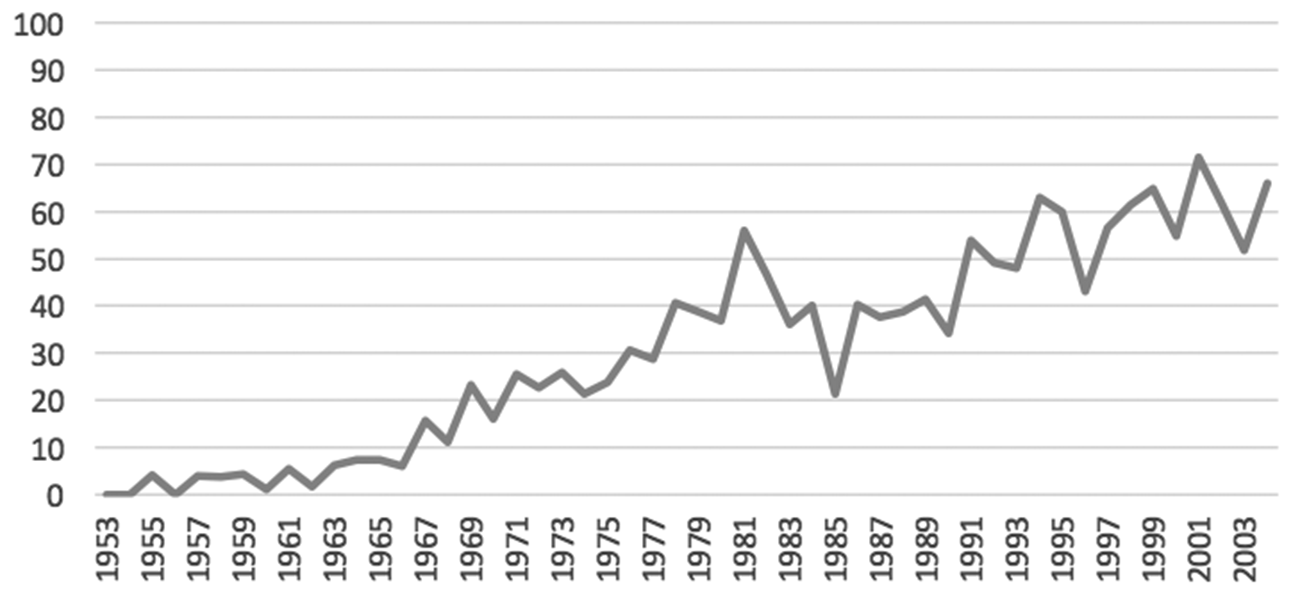
The rise of dissent citations is consistent with the growth of law clerks who are chiefly responsible for drafting opinions as well as reading, analyzing, and making recommendations on the opinions circulated from other chambers (Ward and Weiden Reference Ward and Weiden2007, 36–46). In general, each justice employed a single law clerk through the 1950s. By the 1960s, most justices employed two. In 1970, Congress increased the number of clerks per justice to three and then to four in 1974. At that same time, the Court established the cert pool and the Legal Office staffed with semipermanent lawyers to assist with the cert process. These institutional changes considerably lightened the workload of each clerk, and they spent more time on opinion writing—a welcome change for many justices, given that opinion assignments were equalized during the Warren Court. Clerks were more necessary than ever, and their role in opinion writing was substantial. Clerks became the vehicle through which the justices bargained with and accommodated each other in the opinion-writing process.
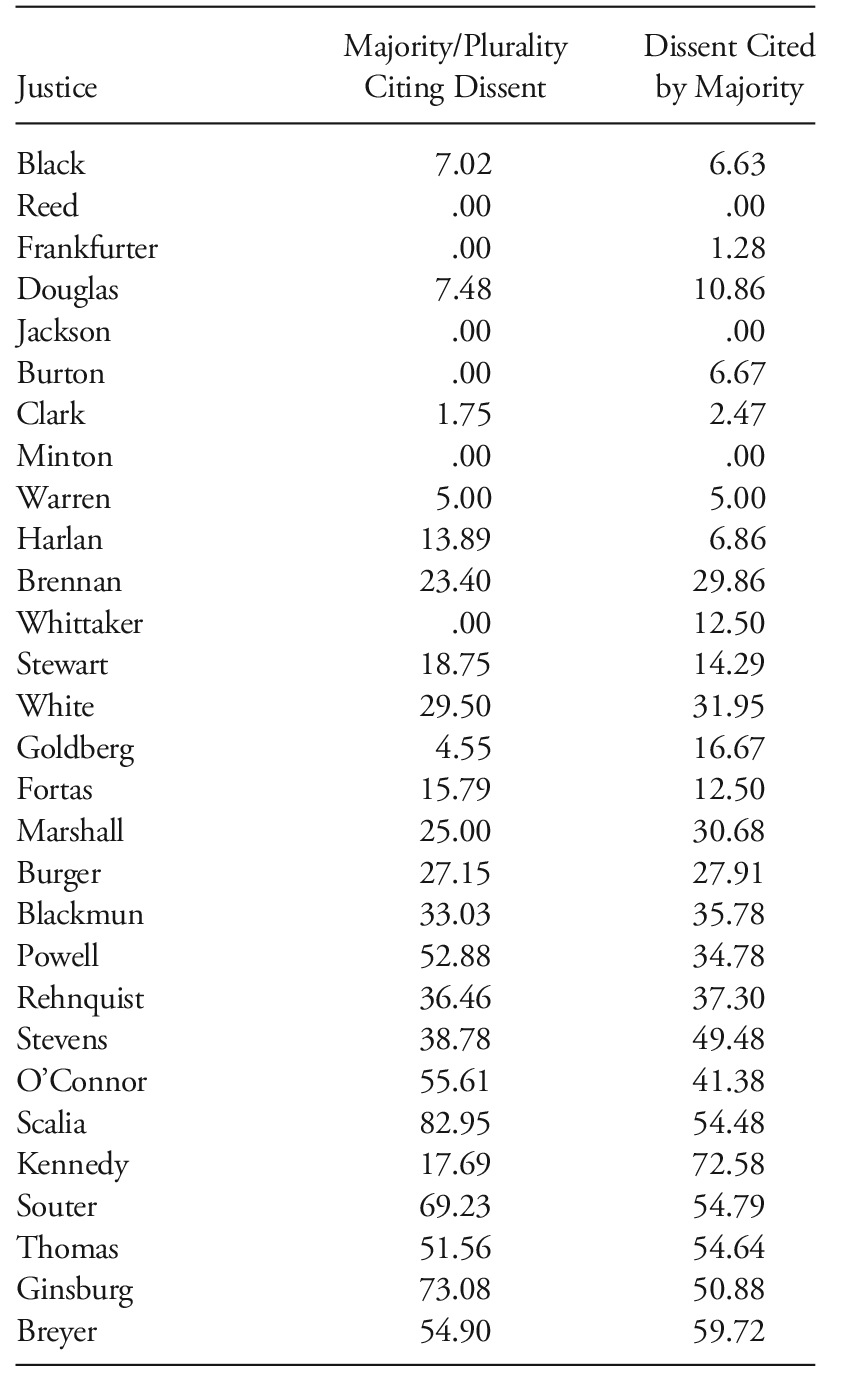
Which majority/plurality opinion writers cite dissents and which dissenters are cited the most? According to table 1, the most recent justices are far more likely to cite dissents and to have their dissents cited than their predecessors. This is consistent with the aforementioned developments during the Burger and Rehnquist Courts. Justice Kennedy’s dissents are the most cited by a wide margin (73%) over Justice Breyer’s (60%), whose are the next most cited. This could be due to their relatively moderate positions on the Court and willingness to bargain with those in the majority for their votes. In terms of which majority-opinion writers cite the most dissents, Justice Scalia (83%) leads the pack by a wide margin, followed by Justice Ginsburg (73%). In contrast to Kennedy and Breyer, Scalia and Ginsburg are somewhat less moderate in their views and may be citing dissents as a foil to strengthen their positions as opposed to attempting to bargain with and accommodate their colleagues. But not all dissents are created equal. Beyond the justice who issues them, there is likely something about the way a dissent is written (such as readability, tone, and language) or what the dissent contains (such as how embedded it is in precedent or the ideological composition of the dissent coalition) that makes the dissent worthy of citation by the majority.
Percentage of Majority/Plurality Opinions Citing Dissents and Percentage of Dissents Cited by Majority Opinion, by Justice, 1953–2004 Terms

To measure clarity/readability, we use the computer content analysis program Linguistic Inquiry and Word Count (LIWC).Footnote 2 It is a software program developed by psychologists to measure a variety of linguistic meanings, such as expression of emotions, cognitive thought processes, and use of pronouns (Tausczik and Pennebaker Reference Tausczik and Pennebaker2010). LIWC is a dictionary-based program, meaning that it contains lists of words that correspond to separate dictionaries that represent a larger concept. See the appendix for a detailed discussion of how words and categories are selected for LIWC.
Dozens of studies have used indicators from LIWC to explain various phenomena, with these results demonstrating predictive validity. Moreover, LIWC’s validity and reliability on a variety of its indicators have been established by several studies (e.g., Alpers et al. Reference Alpers, Winzelberg, Classen, Roberts, Dev, Koopman and Barr Taylor2005; Kahn et al. Reference Kahn, Tobin, Massey and Anderson2007; Bandum and Owen Reference Bandum and Owen2009; Owens and Wedeking Reference Owens and Wedeking2011; Cohen Reference Cohen2012). In short, LIWC appears to be widely accepted as a text analysis tool. We should note, however, as with any linguistic software program, LIWC has its limitations.Footnote 3
We follow the standard in LIWC-based psychological studies and use a composite measure for clarity. First, we use two measures often used for assessing the readability of texts. These are sentence length (measured as the average number of words per sentence) and word length (measured as the proportion of words with six or more letters).Footnote 4 Arguably, the more words in a sentence, the more complex the sentence is. Additionally, word length indicates the use of big words. Second, we include the proportion of all words that are prepositions and the proportion of all words that are conjunctions. Prepositions are generally associated with increasingly complex sentences (Pennebaker, Slatcher, and Chung Reference Pennebaker, Slatcher and Chung2005), while conjunctions are more often used in connecting ideas and, consequently, indicate more complex sentences (Joksimovic et al. Reference Joksimovic, Gasevic, Kovanovic, Adescope and Hatala2014). Thus, the readability of the opinion includes sentence length, word length, prepositions, and conjunctions.
To determine our composite measure of clarity/readability, we first calculate the z-score for each component of the measure (i.e., the z-scores of words per sentence, six-letter words, prepositions, and conjunctions). Our measure is simply the sum of those four z-scores. By summing z-scores instead of raw values, we are able to weigh each component equally based on its deviation from the mean for all opinions. We then multiply that number by −1 so that higher scores represent clarity/readability and lower scores represent complexity. In our data, the minimum readability (the most complex) is −16.08 and the maximum readability (the highest clarity) is 13.95, with a median of −0.036.
Emotional tone, authenticity, and analytical language are measured by using LIWC as well. They are summary variables and have been rescaled to reflect a 100-point scale ranging from 0 to 100 (Pennebaker et al. Reference Pennebaker, Boyd, Jordan and Blackburn2015). For emotional tone, a high number is associated with a more positive, upbeat style while a low number reveals greater anxiety or hostility. A number around 50 suggests either a lack of emotionality or ambivalence. For example, in using LIWC to analyze the final Clinton-Trump debate, Jordan (Reference Jordan2016) found that Clinton’s emotional tone was upbeat and positive compared with Trump’s dark, pessimistic tone. Specifically, “[Clinton] stays on her message that America is already great and she can help make it better. Trump, on the other hand, continued his pessimistic decline. Trump paints a much darker view of America and aggressively meets challenges and criticisms” (Jordan Reference Jordan2016). Not surprisingly, most dissents are written using a negative emotional tone, with a median emotional tone of 33.375, a low of 1, and a high of 99.
For authenticity, higher numbers are associated with a more honest, personal, and disclosing text while lower numbers suggest a more guarded and distant text. Writers who are considered to be more authentic tend to use more “I” words (e.g., “I,” “me,” “mine”), present-tense verbs, and relativity words (e.g., “near,” “new”) and fewer “she” or “he” words (e.g., “his,” “her”) and discrepancies (e.g., “should,” “could”; Jordan and Pennebaker Reference Jordan and Pennebaker2016). In general, dissents tend to be low in authenticity. The median for authentic language is 13.08, with a minimum of 1 and a maximum of 87.93.
Finally, a high number for analytical reflects formal, logical, and hierarchical thinking, and lower numbers reflect more informal, personal, and narrative thinking. Analytical thinking is indicated by the greater use of nouns, articles, and prepositions, while an informal manner of writing is reflected by using more pronouns, auxiliary verbs (e.g., “is,” “have,” “was”), and common adverbs (e.g., “really,” “so,” “very”; Jordan and Pennebaker Reference Jordan and Pennebaker2016). For example, LIWC was used to analyze the debates during the primaries, finding that “Clinton spoke in a formal, analytic style. She focused on her policy proposals and issues and laid them out in a logical fashion. Trump had a shoot-from-the-hip, informal way of speaking using stories and anecdotes to explain his thinking” (Jordan and Pennebaker Reference Jordan and Pennebaker2016). Not surprisingly, dissenting opinions are written quite analytically, with a median of 94.95, a low of 45.51, and a high of 99. Overall, dissents are generally negative in tone, guarded, and distant, and they reflect a formal analytic posture.
In order to measure the intensifiers, we created a custom dictionary in LIWC to measure the percentage of intensifier words in each dissenting opinion, and we used the most common intensifiers: “very,” “obviously,” “clearly,” “patently,” “absolutely,” “really,” “plainly,” “undoubtedly,” “certainly,” “totally,” “simply,” “wholly,” “extremely,” “quite,” “blatantly,” “completely,” and “highly” (see Long and Christensen Reference Long and Christensen2008; Edwards Reference Edwards2010; Schiess Reference Schiess2017).Footnote 5 The median percentage of intensifiers is 0.2, with a low of 0 and a high of 2.47. Additionally, we modified the adverb variable in LIWC, removing any previously listed intensifier; thus, this variable reflects the percentage of adverbs in the dissenting opinion, excluding common intensifiers. The minimum percentage of adverbs is 0 and the maximum is 6.46, with a median of 2.5. In order to measure the variable representing adjectives, we used the category Adjectives in LIWC, which provides the percentage of adjectives in the dissenting opinion. The minimum percentage of adjectives is 0 and the maximum is 11.11, with a median of 3.29.
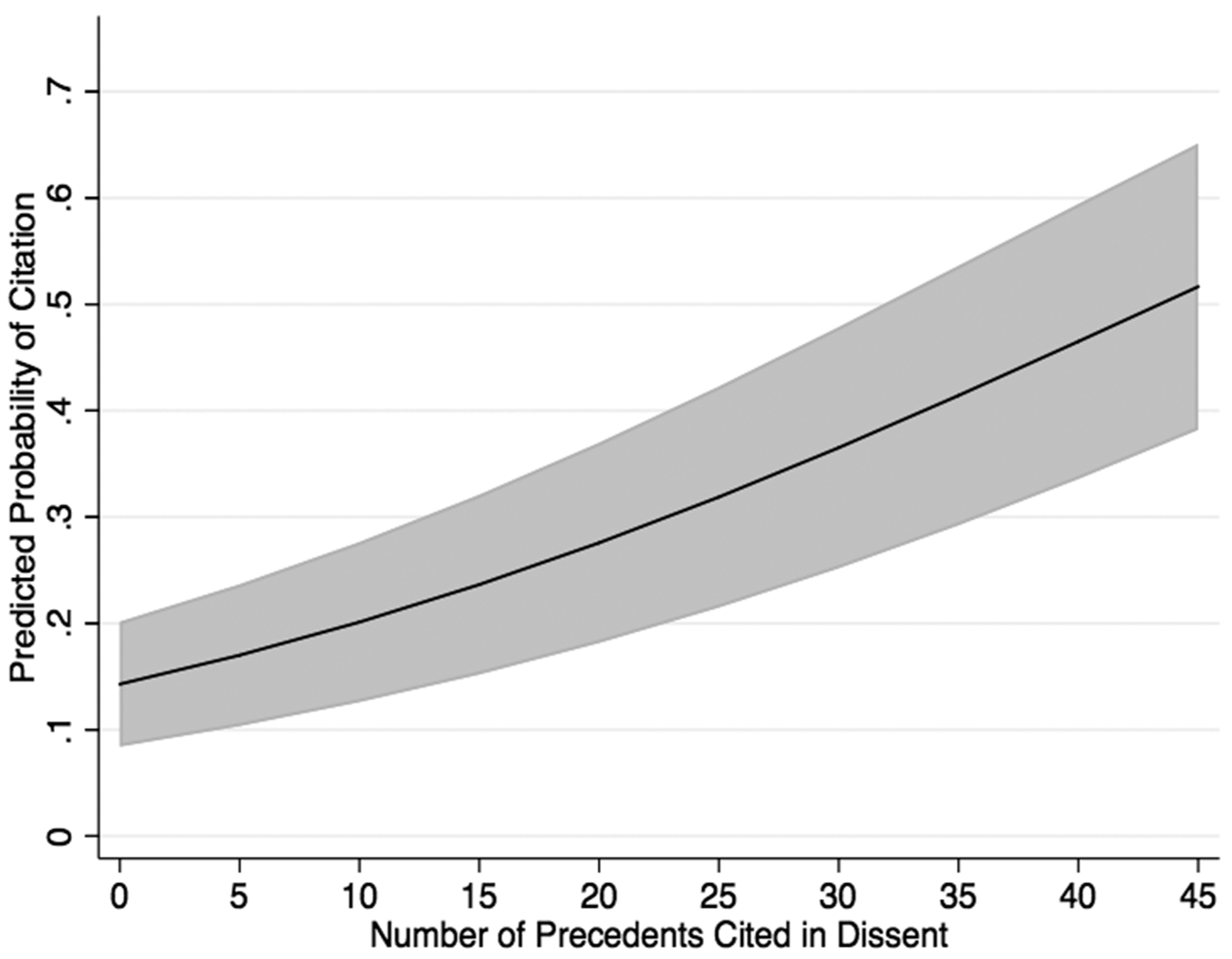
To measure the extent to which the dissenting opinion is embedded in precedent, we include the number of Supreme Court cases cited by the dissent.Footnote 6 The median number of Supreme Court precedents cited by the dissent is 7, with a low of 0 and a high of 128. We expect that as the number of precedents cited by the dissent increases, the majority opinion will be more likely to cite the dissent.
To measure the ideological heterogeneity of the dissenters, we calculated the difference between the maximum and minimum Martin-Quinn score (Martin and Quinn Reference Martin and Quinn2002) of the justices in the dissent and we expect that, as the ideological heterogeneity of the dissenting coalition increases, the majority opinion will be more likely to cite the dissent. The minimum ideological heterogeneity is 0, the highest is 10.539, and the median is 1.3.
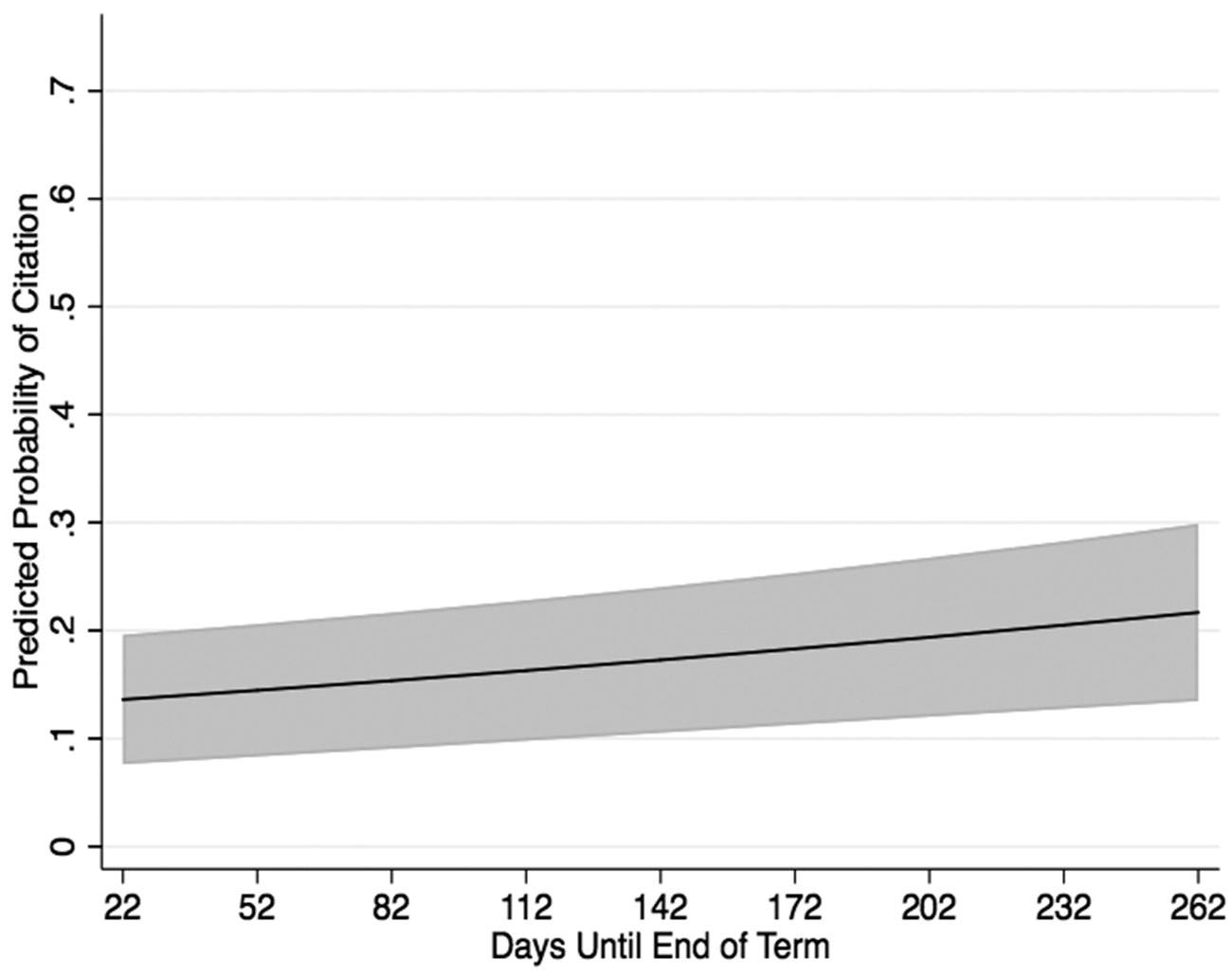
Even though larger dissenting-opinion coalitions will tend to have more ideological heterogeneity, we may inaccurately attribute the effect of coalition size to the ideological heterogeneity of the coalition if we do not control for the size of the dissenting coalition. Additionally, as stated previously, the majority-opinion writer may be more likely to respond to arguments made by the dissent if the vote is close in an attempt to make the majority opinion more persuasive. Thus, we include a variable for the number of dissenters, and we expect that as that number increases, the majority opinion will be more likely to cite the dissent. We also include a variable for the ideological difference between the majority-opinion author and the dissenting author, using Martin-Quinn scores. Finally, we control for the number of days until the end of the term. Given time constraints, the majority-opinion writer may not have time to respond to the dissent as it gets closer to the end of the term. We use June 30 as the date for the end of the term and subtract the date of oral argument (or the date of reargument) for this variable.
Our modeling strategy also accounts for the possibility that variance in citing dissents might be due to shifts over time and that certain majority-opinion authors may be more likely to cite dissents. We address this by estimating a multilevel model with random effects for term and for majority-opinion author. Since the dependent variable is dichotomous, we use a multilevel logit model.
Results
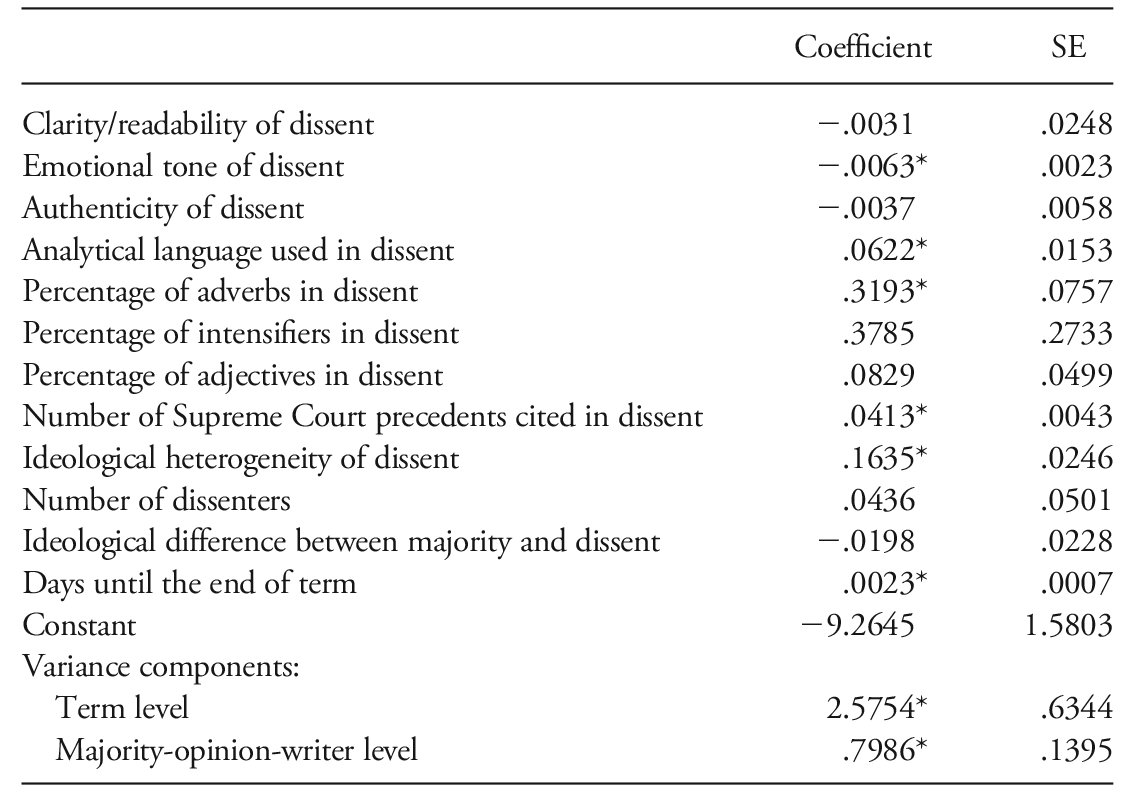
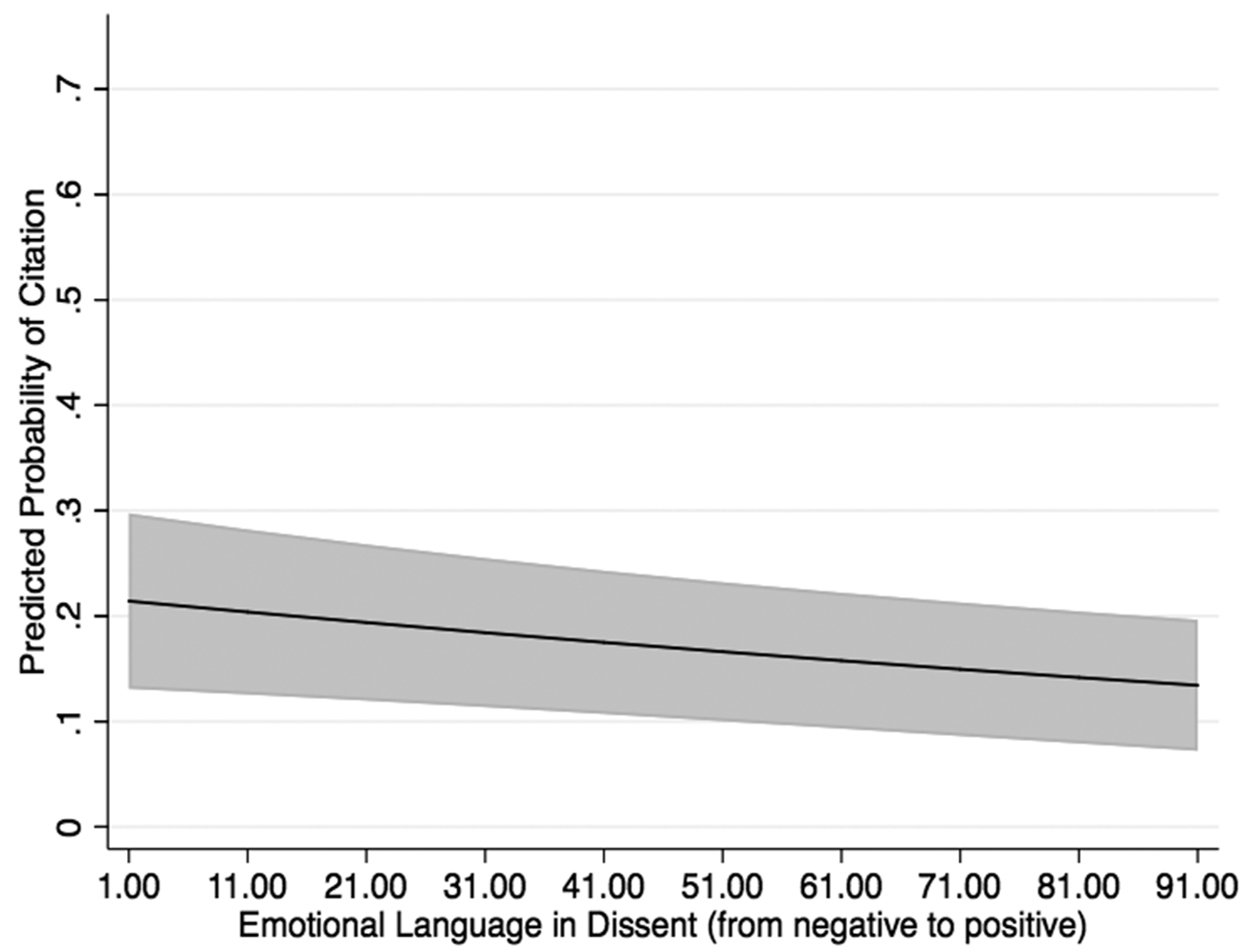
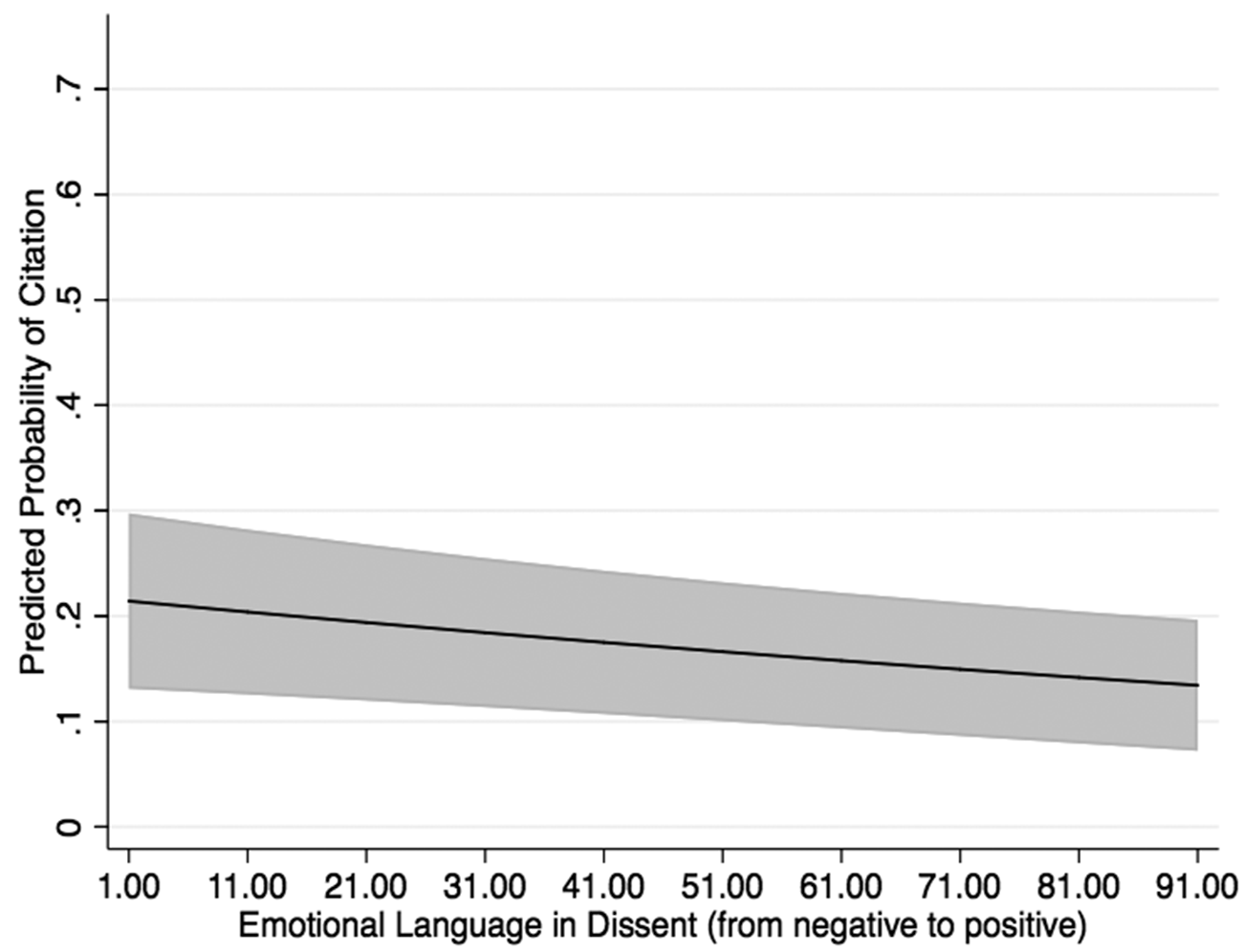
What dissent characteristics affect whether the majority opinion cites the dissent? The empirical results displayed in table 2 show that as the emotional tone of the dissent becomes less negative (toward neutral or positive), the majority opinion is less likely to cite the dissent. As figure 2 illustrates, there is a slight decrease in the predicted probability of the majority citing the dissent as the emotional tone becomes less negative and more neutral or positive. Specifically, when the emotional language in the dissent is very negative (set at 1) and all other variables are set to their median value, the predicted probability of citation is .214. When the emotional language is very positive (set at 99), the predicted probability of citation falls to .129.
Multilevel Logit Model with Random Effects for Majority-Opinion Writer and Term: Whether Majority/Plurality Opinion Cited Dissent, 1953–2004

Note.— N = 3,802. LR test vs. logistic model: χ2(2) = 637.01; Prob > χ2 = .0000.
* p < .05 (two-tailed).
Probability of majority opinions citing dissents in relation to emotional tone
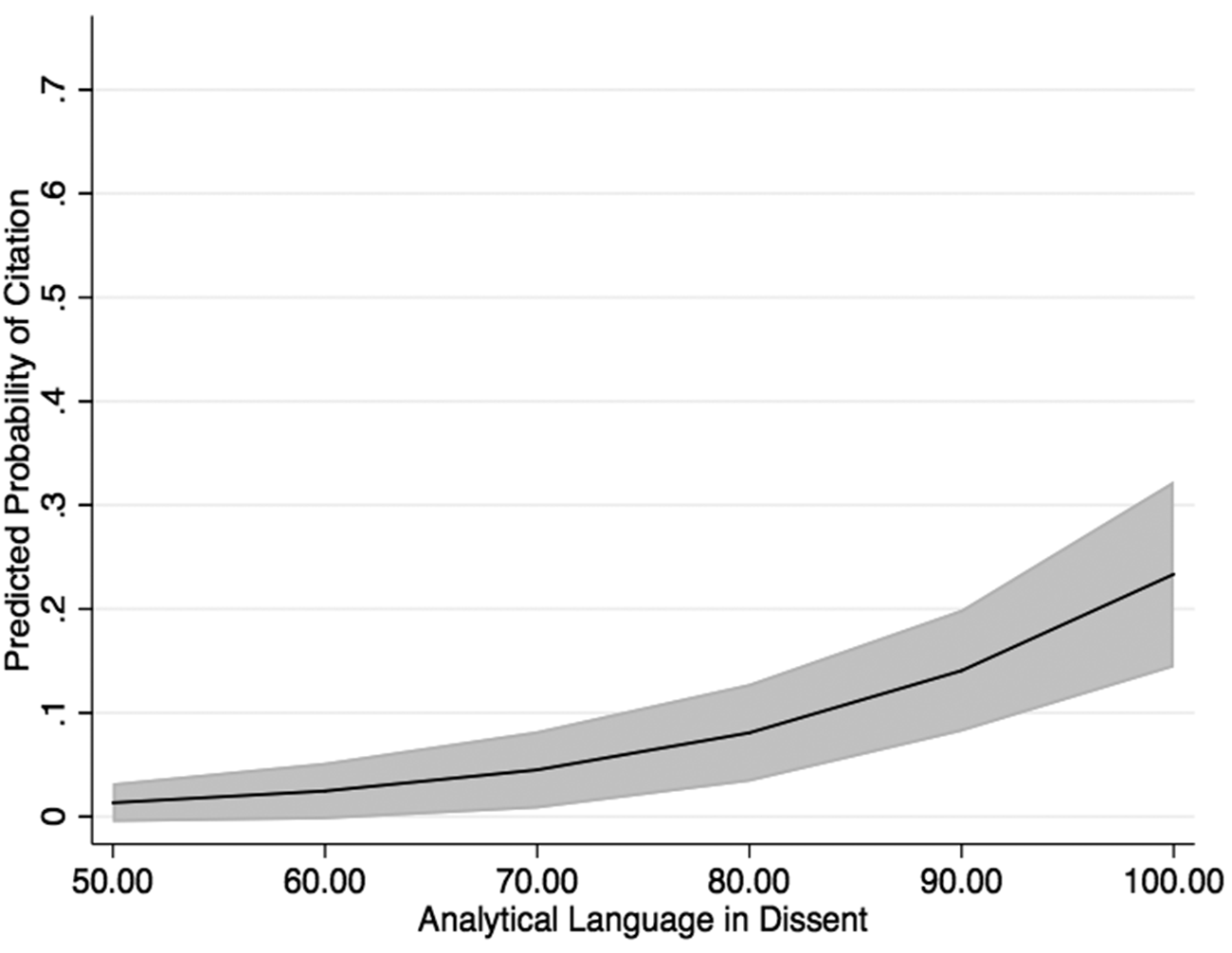
When the dissent reflects formal, logical, and hierarchical thinking, the majority opinion is more likely to respond to the dissent. Figure 3 highlights the effect of a highly analytically written dissent on the probability of citation. When the analytical language used is low (set at 45.51), the predicted probability of the majority opinion citing the dissent is only .010, whereas when the analytical language used is high (set at 99), the predicted probability of citation increases to .223.
Probability of majority opinions citing dissents in relation to analytical language.

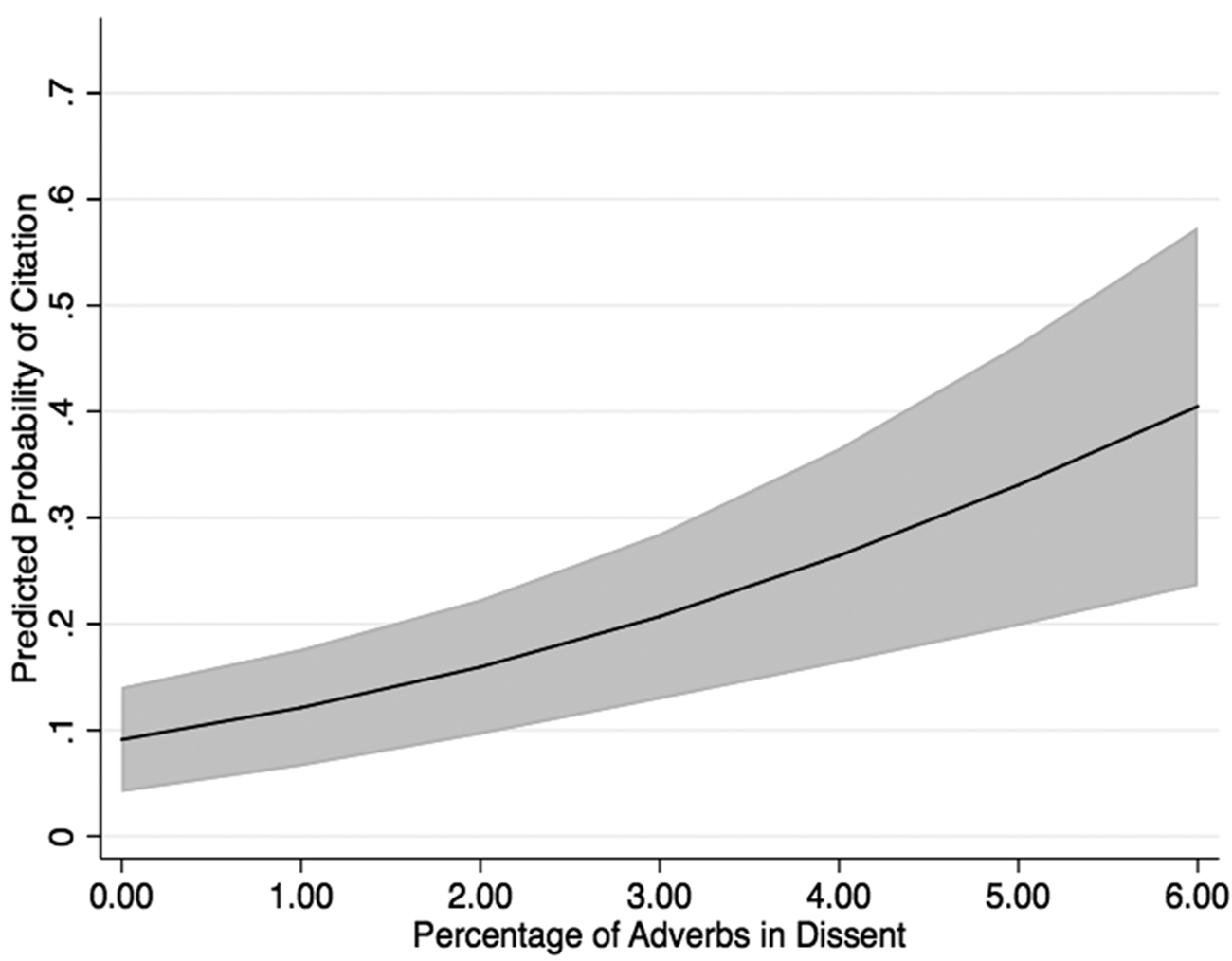
Contrary to our expectations, the clarity/readability of the dissent, the authenticity of the language used in the dissent, and the use of intensifiers and adjectives in the dissent do not appear to influence whether the majority cites the dissent. However, as the percentage of adverbs used in the dissent increases, the probability of the majority citing the dissent increases as well. Figure 4 illustrates this relationship. When the dissent contains a low percentage of adverbs (set at 0), the predicted probability of citation is .091. However, when the dissent contains a higher percentage of adverbs (set at 6.46), the predicted probability of citation increases to .441. Thus, despite the many writing experts who advise against using adverbs, it appears that majority-opinion writers respond to their use. However, it may be that dissent authors are using adverbs sparingly, as advised, and thus when they use adverbs, those adverbs are powerful.
Probability of majority opinions citing dissents in relation to use of adverbs

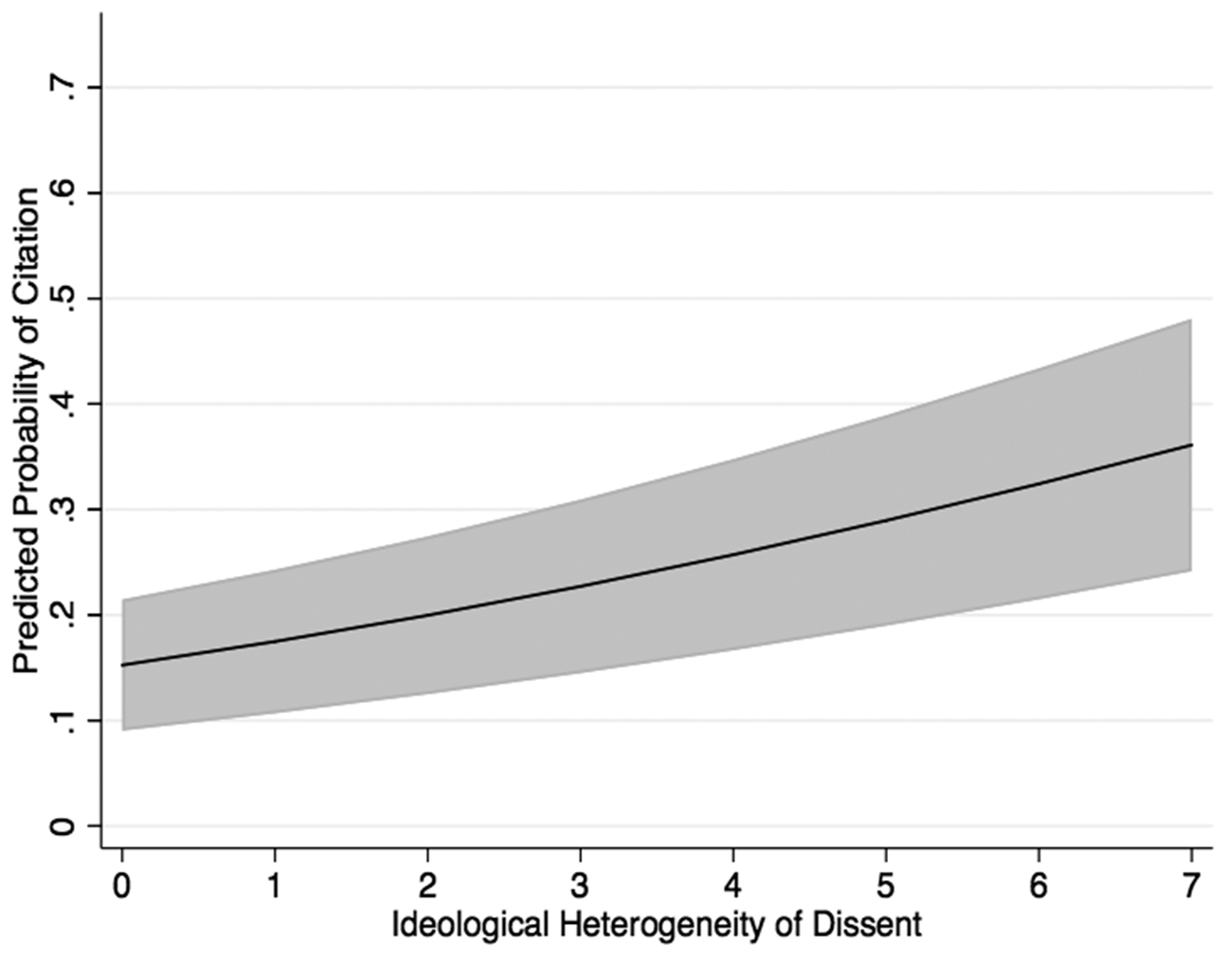
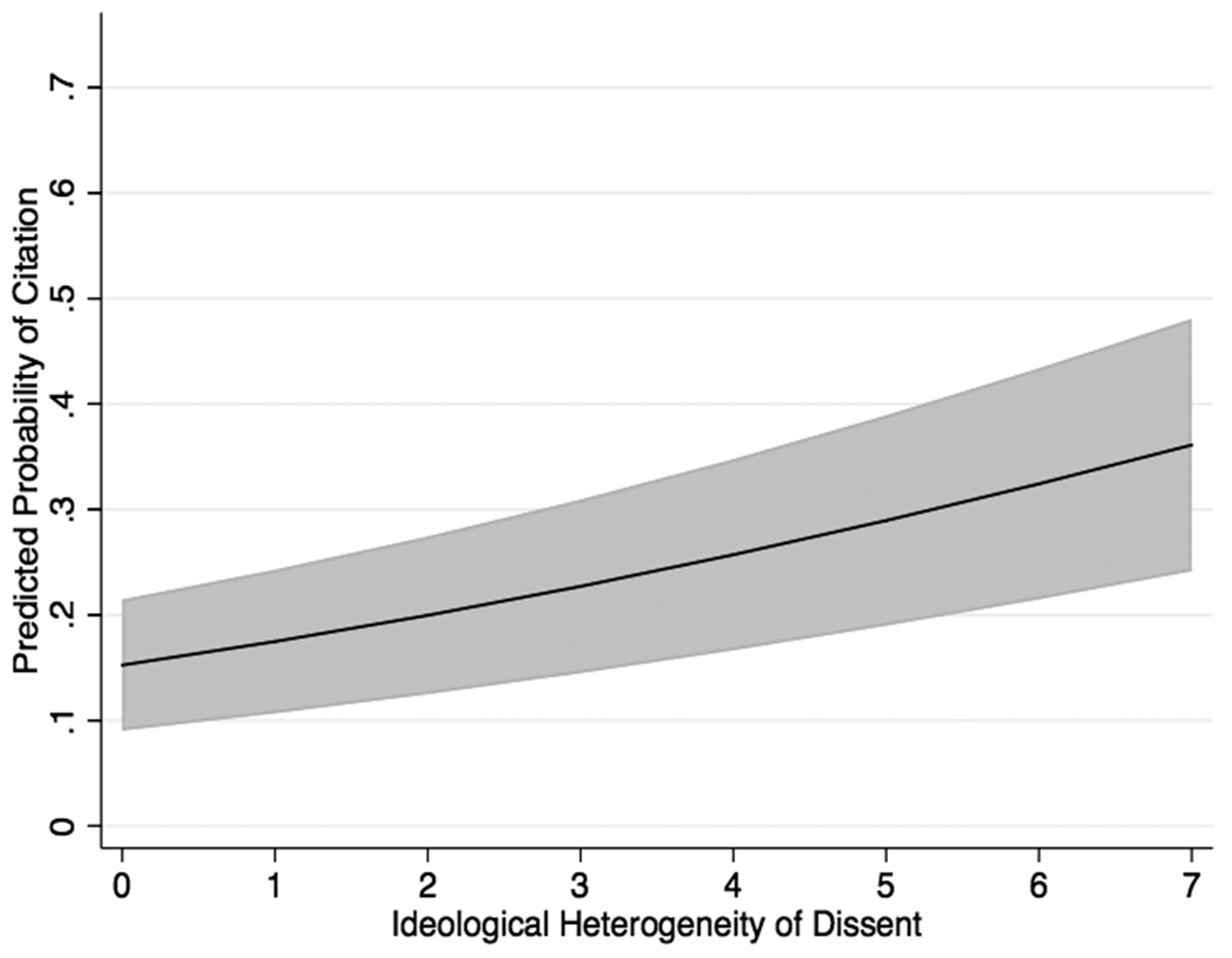
As expected, as the ideological heterogeneity of the dissenting coalition increases, indicating that the coalition contains ideologically divergent justices, the majority opinion is more likely to cite the dissent. Figure 5 shows the predicted probability of citation over the values in the data set. When ideological heterogeneity is 0 (a solo dissent), the predicted probability of citation by the majority is .152. When ideological heterogeneity is set at the median value (1.3), the predicted probability is .182, and when it is set at a high value (7.337), the predicted probability is .374.
Probability of majority opinions citing dissents in relation to ideologically divergent justices.
Consider Metropolitan Life Insurance Co. v. Ward (1985), in which the Court’s most ideologically liberal justices—William Brennan and Thurgood Marshall—joined conservative William Rehnquist in a dissent issued by Justice O’Connor. The majority cited their dissent twice, each time self-consciously defending their position: “As the dissent finds our failure to resolve whether Alabama may continue to collect its tax ‘baffling,’ post, at 887, we reemphasize the procedural posture of the case… . This case does not involve or question, as the dissent suggests, post, at 900–901, the broad authority of a State to promote and regulate its own economy” (479 U.S. 869, 875, 882).
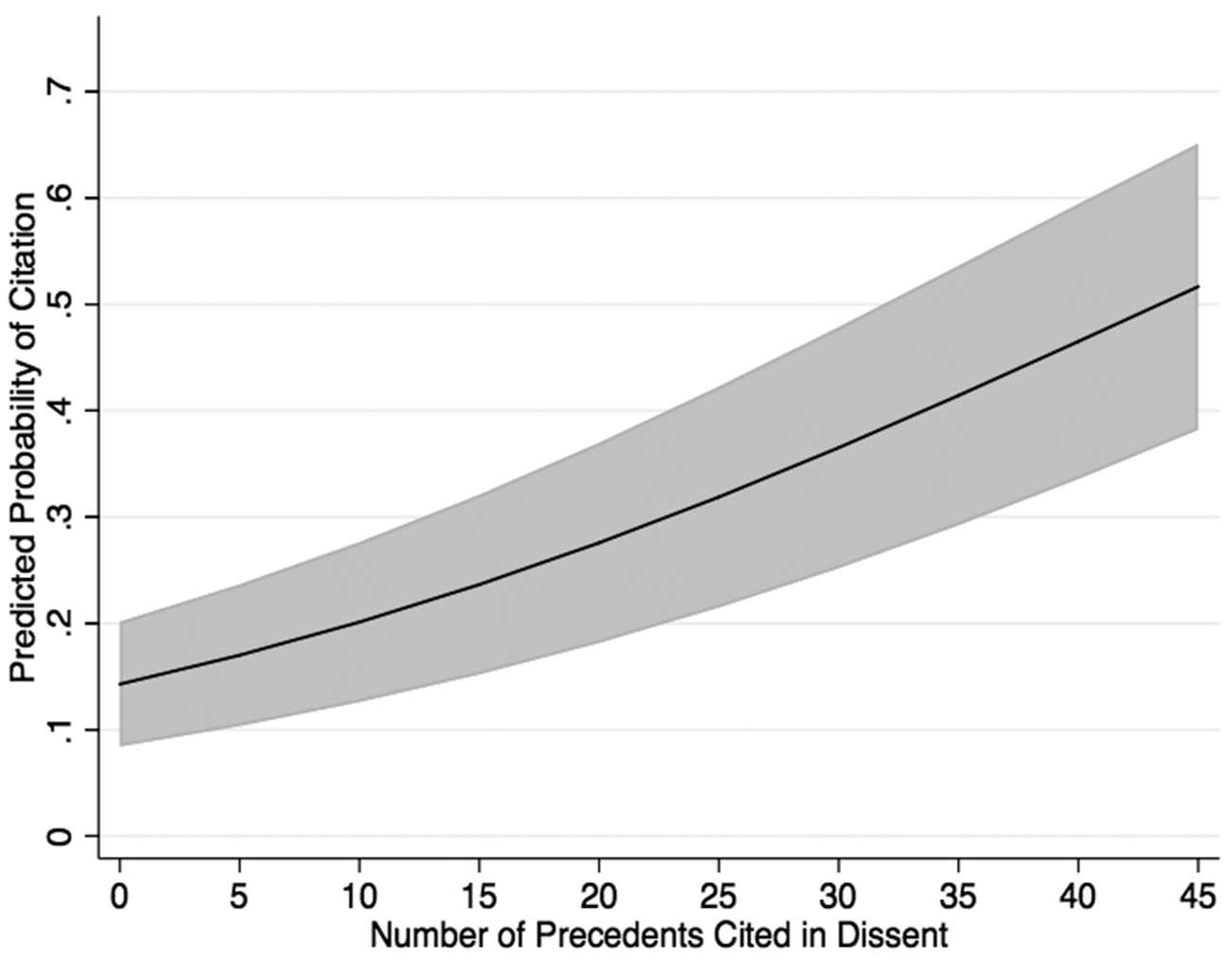
Our results also indicate that as the number of Supreme Court precedents cited in the dissent increases, the predicted probability of the majority opinion citing the dissent increases. As figure 6 illustrates, when the dissent does not cite any Supreme Court precedents, the predicted probability of citation by the majority is .143; when the dissent cites the median number of precedents (7), the predicted probability of citation is .182; and when the dissent cites a high number of precedents (23, which is the 90th percentile), the predicted probability of citation is .301. Given that stare decisis is regularly invoked by the justices to justify their decisions, it is not surprising that majority-opinion writers would feel obligated to address dissents that are rife with citations to precedent.
Probability of majority opinions citing dissents in relation to cited precedents
For example, Justice Stevens’s lengthy dissent in Pennhurst v. Halderman (1984) contains a whopping 116 Supreme Court precedents. Justice Powell’s majority opinion spends 10 pages—much of which are detailed discussions of precedents in footnotes—refuting Stevens’s opinion, taking note of both its size and its heavy reliance on prior decisions:
The contrary view of Justice Stevens’ dissent rests on fiction, is wrong on the law, and, most important, would emasculate the Eleventh Amendment… . We are prompted to respond at some length to Justice Stevens’ 41-page dissent in part by his broad charge that “the Court repudiates at least 28 cases,” post, at 127. The decisions the dissent relies upon simply do not support this sweeping characterization. See nn. 19, 20, and 21, infra… . The dissent bases its view on numerous cases from the turn of the century and earlier. These cases do not provide the support the dissent claims to find. Many are simply miscited. (465 U.S. 89 at 106, n. 14 106, 109)
Similarly, in Seminole Tribe v. Florida (1996), Chief Justice Rehnquist’s majority opinion discusses Justice David Souter’s dissent at length, both in multiple footnotes and over six pages in the main text of the opinion. Because Souter’s dissent contains an unusually large number of Supreme Court precedents (101), Rehnquist spends considerable time attacking this aspect of the dissent. For example, “the dissent … disregards our case law in favor of a theory cobbled together from law review articles and its own version of historical events. The dissent cites not a single decision since Hans (other than Union Gas) that supports its view of state sovereign immunity, instead relying upon the now-discredited decision in Chisholm v. Georgia, 2 Dall. 419 (1793). See, e.g., post at ___ n. 47. Its undocumented and highly speculative extralegal explanation of the decision in Hans is a disservice to the Court’s traditional method of adjudication. See post at ___ (68–69).”
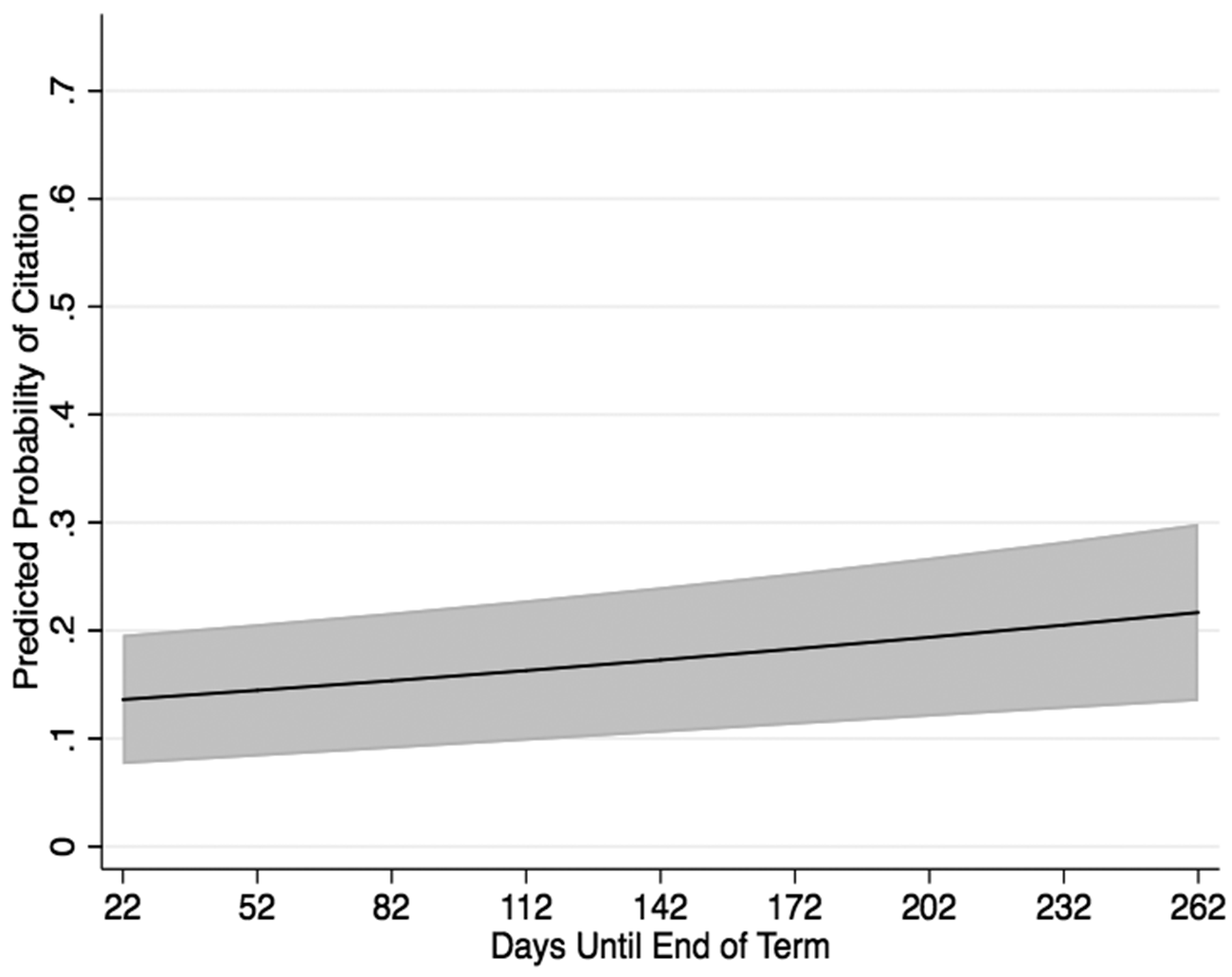
Finally, as expected, time is a factor when revising the majority opinion to respond to the dissent. As the end of the term nears, the majority opinion is less likely to cite the dissent. Figure 7 illustrates this relationship. This is not surprising given that chambers are under considerable pressure to complete opinions before the Court adjourns for the summer. Justice Powell wrote on June 23, 1984, “We are witnessing the usual June-end ‘rush to judgment’ that often leads to poorly written opinions and even errors” (memo from Lewis F. Powell Jr. to Cammie R. Robinson, David A. Charny, Joseph E. Neuhaus, and Robert M. Couch, June 23, 1984, Powell Papers, box 130b).
Probability of majority opinions citing dissents in relation to days before term ends.
Conclusion
Our results provide insights into the role of dissenting opinions on the US Supreme Court and are suggestive of appellate courts generally. We explore the internal, in-house impact of dissents on the majority opinion. Our results suggest that dissenting opinions do, in fact, have an effect on the majority opinion. Dissenting opinions point out flaws in the reasoning of the majority opinion and raise objections that force the majority-opinion writer to respond. Accordingly, majority opinions respond to possible objections that would undermine their authority and call the law into question.
Our results show that not all dissents are equal. Certain dissents are more influential than others, “becom[ing] part of and influenc[ing] the constitutional dialogue” (Urofsky Reference Urofsky2015, 7). Specifically, dissents that have a negative emotional tone, that are highly analytical, and that use a high percentage of adverbs are most effective at engaging the majority opinion. Also, dissents that are embedded in precedent and that have heterogeneous ideological coalitions are more influential with the majority than those without much precedential grounding and composed by ideologically proximate justices.
Still, it is important to note that our results do not speak to the external influence or future effects of dissents. The extent to which certain dissents are important for actors outside the Court or with future Courts remains an open question. Do the factors that trigger majority-opinion writers to cite the dissent also influence external and future actors? Subsequent research is necessary to answer these questions. Still, it is plain that certain types of dissents are influential in an immediate sense, as the law of the land, reflected in majority opinions, regularly cites and engages with dissenting opinions written in a particular way and composed of particular justices.
Our findings suggest that dissenting justices and clerks who are strategic in the way they write and with whom they join can maximize their chances of immediate influence within the Court. Those who are not careful writers and choose to go it alone, either by issuing solo dissents or by appealing to familiar ideological allies, will have less influence. Thus, for dissenters, the opinion-writing and coalition-formation process is one of strategy in the same way that prior research has shown it to be for those in the majority.
Appendix
For the LIWC 2007 dictionary, an initial selection of words for each category was made by research assistants using dictionaries, thesauruses, and questionnaires. Groups of three individuals then independently rated whether each word was appropriate for that category. Those category word lists were updated: a word remained in the category list if two out of the three evaluators agreed it should be included, a word was deleted if at least two reviewers agreed it should be excluded, and a word was added to the category if at least two agreed it should be added. That process was then repeated by a separate group of three reviewers.
For the development of the LIWC 2015 dictionary, step 1 involved word collection. Sets of words were first generated for each conceptual dimension using the LIWC 2007 dictionary as a starting point (Pennebaker et al. Reference Pennebaker, Boyd, Jordan and Blackburn2015). Using Roget’s Thesaurus, standard English dictionaries, and emotion rating scales (for those categories related to emotions), two to six judges individually generated word lists for each category. Then groups of four to eight judges met in brainstorming sessions to add words to that list. Once the grand list was assembled, in step 2 four to eight judges examined each word and qualitatively rated the word in terms of “goodness of fit” for each category. A majority of judges had to agree in order for a word to remain in the category.
Once there was a working version of the dictionary, step 3 of the dictionary development involved analyzing texts from several sources using the Meaning Extraction Helper (MEH) to determine how frequently the dictionary words were used in different contexts, such as blog posts, novels, student writings, and other sources. If a dictionary word did not show up at least once in multiple sources, it was not included in the dictionary. Step 4 involved expanding the dictionary using MEH to identify high-frequency words that had not been added by the judges. Four to eight judges reviewed a candidate list of words and qualitatively rated the words in terms of “goodness of fit” for each category. Again, a majority of judges had to agree in order for a word to be added to that category. Step 5 of the dictionary development involved psychometric evaluation. Specifically, each language category was separated into its constituent words and then quantified as a percentage of total words. All words for each category were treated as a “response” and then used to compute internal consistency statistics for each language category as a whole. Words that were not internally consistent to the language category were added to a list, and then a group of two to six judges reviewed the list to determine whether the words should be retained. The final step involved repeating steps 1 through 5 in order to find any possible mistakes, and two judges reviewed the dictionary for mistakes during the last stage of the final refinement stage.