


Introduction
Motivational interviewing [MI; (Miller and Rollnick, Reference Miller and Rollnick1991, Reference Miller and Rollnick2002)] is a client-centered yet directive counselling style for aiding clients in recognizing and resolving ambivalence for change in behaviour. In its delivery, the practitioner is expected to: 1) express empathy for the client's perspective; 2) develop discrepancy between client values and behaviour; 3) “roll with” rather than amplify client resistance; and 4) support client self-efficacy for behaviour change. MI has been applied to a host of clinical issues, with reviews reliably noting strong empirical support (Burke, Arkowitz and Dunn, Reference Burke, Arkowitz, Dunn, Miller and Rollnick2002; Burke, Arkowitz and Menchola, Reference Burke, Arkowitz and Menchola2003; Dunn, Deroo and Rivara, Reference Dunn, Deroo and Rivara2001; Hettema, Steele and Miller, Reference Hettema, Steele and Miller2005; Vasilaki, Hosier and Cox, Reference Vasilaki, Hosier and Cox2006). Efforts to disseminate MI to the treatment community have swelled, encompassing fidelity instruments (Miller, Reference Miller2000; Moyers, Martin, Manuel and Miller, Reference Moyers, Martin, Manuel and Miller2004), skill assessment measures (Martino, Haeseler, Belitsky, Pantalon and Fortin, Reference Martino, Haeseler, Belitsky, Pantalon and Fortin2007; Rosengren, Hartzler, Baer, Wells and Dunn, Reference Rosengren, Hartzler, Baer, Wells and Dunn2008), and other supervision tools (Madson, Campbell, Barrett, Brondino and Melchert, Reference Madson, Campbell, Barrett, Brondino and Melchert2005; Martino et al., Reference Martino, Ball, Gallon, Hall, Garcia, Ceperich, Farentinos, Hamilton and Hausotter2006) used in conjunction with practitioner training workshops and related activities. Despite progress for MI across the stages of behaviour therapy development, unanswered questions remain concerning which MI-relevant clinical strategies are best emphasized in initial, intervening, and concluding phases of a clinical encounter. This exploratory study seeks to characterize temporal trends in use of such strategies within a set of standardized brief encounters.
Scientific emphasis on quality of MI delivery is strong, as evident by attention given to treatment fidelity in its community-based trials (Ball et al., Reference Ball, Martino, Nich, Frankforter, Van Horn, Crits-Cristoph, Woody, Obert, Farentinos and Carroll2007; Carroll et al., Reference Carroll, Ball, Nich, Martino, Frankforter, Farentinos, Kunkel, Mikulich-Gilbertson, Morgenstern, Obert, Polcin, Snead and Woody2006; Miller, Moyers, Arciniega, Ernst and Forcehimes, Reference Miller, Moyers, Arciniega, Ernst and Forcehimes2005; Winhusen et al., Reference Winhusen, Kropp, Babcock, Hague, Erickson, Renz, Rau, Lewis, Leimberger and Somoza2008); yet, a degree of mystery surrounds notions of what constitutes skilful MI delivery (Apodaca and Longabaugh, Reference Apodaca and Longabaugh2009; Miller and Rollnick, Reference Miller and Rollnick2009). Recently, Miller and Rose (Reference Miller and Rose2009) distinguished components of MI delivery into general classes of relational and technical elements. Relational elements are likened to qualities of capacity for empathy (Rogers, Reference Rogers and Koch1959), and the collaborative, eliciting, and autonomy-supporting quality now commonly referred to as MI spirit (Rollnick and Miller, Reference Rollnick and Miller1995). Thus, relational elements represent practitioner interpersonal qualities. Technical elements of MI delivery are just that, techniques, such as posing of open-ended questions, responding with reflective listening statements, expressing affirmation of client strengths, and offering periodic summaries that organize client narrative. Miller and Rose (Reference Miller and Rose2009) further distinguish relational and technical elements via hypothesized, complementary intents – to promote client engagement, and to elicit client change talk (e.g. arguments in favour of behaviour change), respectively. Process research underscores the pervasive influence of the relational elements of MI (Moyers, Miller and Hendrickson, Reference Moyers, Miller and Hendrickson2005), though temporal aspects of its technical elements merit further specification. For instance, skilful MI delivery may be better characterized by documenting the relative emphasis to be given its technical elements in opening, intervening, and concluding phases of therapeutic discussion.
Expanded scientific emphasis on quality of MI delivery is also evident in a burgeoning literature on training processes (Hartzler, Rosengren and Baer, Reference Hartzler, Rosengren, Baer, Cohen, Collins, Young, McChargue and Leffingwell2009; Madson, Loignon and Lane, Reference Madson, Loignon and Lane2009). Training evaluations often assess aspects of MI delivery by scoring a practice sample as an outcome, and a common methodology is recording clinical encounters with a standardized patient as a consistent and consequence-free behavioural challenge (Baer et al., Reference Baer, Rosengren, Dunn, Wells, Ogle and Hartzler2004; Hartzler, Baer, Rosengren, Dunn and Wells, Reference Hartzler, Baer, Rosengren, Dunn and Wells2007). An established fidelity instrument (Moyers, Martin, Catley, Harris and Ahluwalia, Reference Moyers, Martin, Catley, Harris and Ahluwalia2003; Moyers, Martin, Manuel, Hendrickson and Miller, Reference Moyers, Martin, Manuel, Hendrickson and Miller2005) may then be used to score relational elements via Likert ratings of interpersonal qualities (e.g. empathy, MI spirit), and technical elements via continuous tallies for specific technical elements (e.g. open questions, reflections). Global ratings of relational elements are useful in broadly identifying skilful MI delivery, and tallies of technical elements shed light on what technical elements a practitioner was most apt to employ. Regarding the latter, however, reliance on cumulative tallies neglects potential temporal variance in use of technical elements, and fuller understanding of when in a clinical encounter a given element is best emphasized may promote more effective delivery.
To define criteria for skilful MI delivery, Miller (Reference Miller2000) and Miller, Yahne, Moyers, Martinez and Pirritano (Reference Miller, Yahne, Moyers, Martinez and Pirritano2004) proposed a set of conceptually-derived benchmarks for relational elements (e.g. global ratings of empathy, MI spirit) and skill indices computed from tallied technical elements (e.g. percentage open questions, reflection-to-question ratio, percentage complex reflections). In their MI text, Miller and Rollnick (Reference Miller and Rollnick2002) outline opening strategies for practitioner delivery (e.g. reflective listening, elicitation), of which several overlap conceptually with the noted skill indices. How might the magnitude of these skill indices, or frequency of technical elements from which they are computed, progress as therapeutic discussion unfolds? Would some elements be given greater emphasis at the outset of therapeutic discussion, others emphasized more as discussion becomes more focused, and still others given more emphasis as an encounter approaches conclusion? If a proscribed technical element (e.g. psychoeducation) is unavoidable, when is that best offered?
Discourse analysis is one traditional means of studying therapeutic process (Siegfried, Reference Siegfried1995), and sequential coding systems have been used to explore patterns of dyadic conversation in the delivery of MI-based interventions (Gaume, Gmel, Faouzi and Daeppen, Reference Gaume, Gmel, Faouzi and Daeppen2008; Moyers and Martin, Reference Moyers and Martin2006; Moyers et al., Reference Moyers, Martin, Christopher, Houck, Tonigan and Amrhein2007). Such methods are, however, both complicated and resource-intensive. A practical alternative method is evidenced in Amrhein and colleagues’ (Reference Amrhein, Miller, Yahne, Palmer and Fulcher2003) identification of commitment language (e.g. utterance of intention to change behaviour) as a predictor of behaviour change. In this oft-cited study, 50-minute MI sessions were partitioned into time-regulated deciles (e.g. 5-minute intervals), in which variation in frequency of client commitment language and its prediction of change behaviour were found. The study did not evaluate technical elements of practitioner delivery in the same manner, but provides a methodological blueprint for examining within-encounter fluctuation in both skill indices and technical elements of MI delivery.
The current study seeks to better characterize temporal trends in technical aspects of skilful delivery via examination of standardized, brief clinical encounters. Study data are taken from a large MI training trial conducted with community practitioners at substance abuse treatment facilities in northwest United States. The primary aim of the training trial was to compare training methods, for which outcomes are published elsewhere (Baer et al., Reference Baer, Wells, Rosengren, Hartzler, Beadnell and Dunn2009). Trial methodology included the recording of 20-minute clinical encounters with a standardized patient (SP) at each of three points in a repeated-measures design, all independently scored with the Motivational Interviewing Treatment Integrity scale (Moyers et al., Reference Moyers, Martin, Manuel and Miller2004). A unique aspect of the scoring process is that raters tracked time and tallied technical MI elements in four 5-minute increments. The scope of the trial afforded 503 SP encounters, and opportunity to identify a subset of encounters wherein ratings of MI spirit – a salient relational element – met a proficiency benchmark, as well as a subset for which MI spirit ratings were conversely poor. By partitioning SP encounters into quartile intervals, temporal trends in MI skill indices and specific technical elements were then examined in each of these two subsets of encounters.
Method
Participants
For purposes of the aforementioned training trial, treatment personnel were recruited from community substance abuse treatment programs to attend training and complete sequential training outcome assessments. The University of Washington IRB approved all procedures. Interested practitioners provided informed consent and completed an audio-recorded 20-minute SP interview prior to, just after, and 3 months following training. A total of 168 community practitioners participated in the study between January 2005 and March 2007, each completing a personal demography form from which sample characteristics were extracted. A majority were female (68%), with ethnic/racial composition as 72% Caucasian, 10% African American, 7% Native American, 6% Hispanic/Latino, 3% Asian, and 2% Pacific Islander. Mean age was 46.4 years (SD = 11.5), and mean length of experience in clinical service provision was 9.5 years (SD = 8.7). In terms of formal education, 30% had completed a graduate degree, 27% a Bachelor's degree, 29% an associate's degree, and 14% a high school diploma or equivalent. A majority of the sample (61%) reported prior exposure to MI through varied means (e.g. training workshop, coursework, reading of MI texts or journal articles) in advance of study participation.
SP encounters
All SP encounters were audio-recorded, 20 minutes in duration, and consisted of a single SP portraying a recent referral encompassing common background and presenting characteristics of a substance abuse treatment-seeker for its entirety. SP portrayal of a new treatment referral was consistent across encounters, irrespective of their timing within the repeated-measures design of the training trial. The involved SPs were experienced in portrayal of client characters through prior university-based health education endeavours, and received substantive input from investigators about the conduct of their character. Practitioners were given the option of completing the SP encounter at their workplace, or in a private room at UW.
Rating process
Three independent reviewers used the Motivational Interviewing Treatment Integrity (MITI 2.0) scale (Moyers et al., Reference Moyers, Martin, Manuel and Miller2004) to score delivery skill in the SP encounters. The MITI 2.0 includes as relational elements two global practitioner ratings (e.g. empathy, MI spirit), each scored on a 7-point Likert scale and intended to capture gestalt (all-at-once) impressions. Also included are behavioural tallies of seven MI-relevant technical elements: 1) giving information; 2) closed questions; 3) open questions; 4) simple reflections; 5) complex reflections; 6) MI adherent behaviours; and 7) MI non-adherent behaviours. In contrast to typical MITI scoring procedures wherein behavioural tallies are cumulative, reviewers kept continuous tallies in 5-minute increments. Thus, scoring of each 20-minute encounter was split into quartile intervals. Reviewers received training and supervision in use of the MITI 2.0, and were blind to assessment timing and practitioner identifiers throughout their scoring process.
Inter-rater reliability
Inter-rater reliability was assessed via pairwise intra-class correlations (ICCs) for nine MITI elements, evaluated against Cicchetti's (Reference Cicchetti1994) psychometric standards (.00–.40, poor; .41–.59, fair; .60–.74, good; .75–1.00, excellent). ICCs values were in acceptable ranges for relational elements (empathy, .50–56; MI spirit, .57–.72). Similarly, ICC values for all MITI technical elements were in acceptable ranges, as follows: 1) giving information (.52–.89); 2) closed questions (.84–.94); 3) open questions (.72–.95); 4) simple reflections (.59–.70); 5) complex reflections (.66–.76); 6) MI adherent behaviours (.50–.60); and 7) MI non-adherent behaviours (.61–.80). Consequently, all elements were retained for further analysis. A set of three MI skill indices – open questions (%OQ), reflection-to-question ratio (R:Q), and % complex reflections (%CR) – were computed as outlined by instrument originators (Moyers et al., Reference Moyers, Martin, Manuel and Miller2004).
Selection of SP encounters for analyses
Ratings of relational MI elements reflect practitioner interpersonal qualities that hold pervasive influence on therapeutic process (Moyers, Miller et al., Reference Miller, Moyers, Arciniega, Ernst and Forcehimes2005). In particular, MI spirit is the core relational element in its delivery (Miller and Moyers, Reference Miller and Moyers2006; Miller and Rollnick, Reference Miller and Rollnick2002; Rollnick and Miller, Reference Rollnick and Miller1995) and a MITI 2.0 rating domain for which a proficiency benchmark (e.g. Likert rating of 6+) is established (Moyers et al., Reference Moyers, Martin, Manuel and Miller2004). Consequently, MI spirit ratings were utilized in selecting subsets of the 503 SP encounters for which overall delivery was assumed to be particularly skilful (e.g. MI-proficient) or at odds with established MI principles (e.g. MI-inconsistent). A subset of 74 SP encounters at or above the MI spirit proficiency threshold were identified as MI-proficient. Given normal distribution of MI spirit ratings in the collective sample of SP encounters, an inverse MI spirit rating scale criterion (i.e. Likert rating of 2 or less) was used to identify 70 MI-inconsistent encounters. Due to the repeated-measures design of the training trial, selection methods initially resulted in over-representation of a few individual practitioners by virtue of high (or low) MI spirit ratings in multiple encounters. All instances of practitioner over-representation were managed by randomly selecting for inclusion a single encounter by that practitioner from among those with high (or low) MI spirit ratings, resulting in eventual subsets of 49 MI-proficient and 43 MI-inconsistent SP encounters. A multivariate analysis of variance (MANOVA) further confirmed disparities in quality of MI delivery (e.g. empathy rating, R:Q, %OQ, %CR) between these subsets of encounters, with both a significant omnibus effect, F (4,87) = 133.15, p <. 001, and robust univariate effects (all F-values > 16.78, all p-values < .001) unsurprisingly indicating more skilful delivery in MI-proficient encounters.
Data analytic strategy
Noted preliminary analyses described the practitioner sample, established inter-rater reliability across MITI 2.0 elements, and provided data-driven support to contrast selected encounters with MI-proficient and MI-inconsistent delivery. Primary analyses then examined temporal aspects of MI skill indices and technical elements for encounters with MI-proficient and MI-inconsistent delivery. Initially, descriptive statistics – stratified by MI-proficient/MI-inconsistent encounter group – were computed to illustrate temporal trends in skill indices and technical elements. Generalized Estimating Equations (GEE) regression analyses (Hedeker and Gibbons, Reference Hedeker and Gibbons2006) then tested statistical significance of linear and curvilinear trajectories for skill indices and technical elements. GEE is well-suited to these temporal data given its robustness to different covariance structures and calculation of model-based standard errors (appropriate with smaller sample sizes), and post-hoc Bonferroni-adjusted comparisons of predicted means at different follow-up points. GEE was performed separately for each skill index and technical element. For each, three parameters were included to test the average direction and shape of in-session trajectory. The intercept corresponded to the initial quartile interval, thus reflecting emphasis of the skill index or technical element as an opening strategy. The linear slope, hereafter referred to as “early-session trajectory”, corresponded to the direction and shape of subsequent trajectory in the earlier intervals, thus reflecting emphasis of the skill index or technical element as a focusing strategy. The quadratic slope, hereafter referred to as “late-session trajectory”, corresponded to direction and magnitude of subsequent curvilinear change in the final quartile interval, thus reflecting emphasis as a concluding strategy.
Results
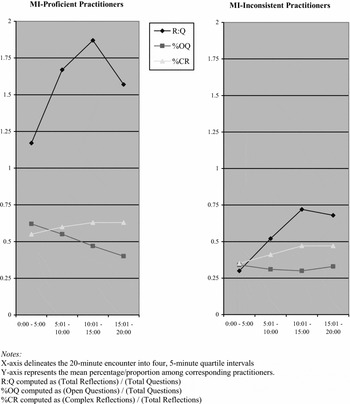
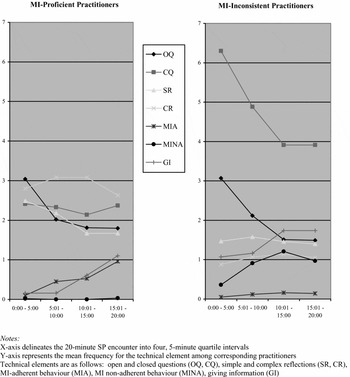
Descriptive statistics of MI skill indices were stratified for encounters with MI-proficient and MI-inconsistent delivery. Temporal trajectories for three skill indices – R:Q,%OQ, and %CR – were addressed by computing means for each quartile intervals of the encounters. Figure 1 illustrates these interval means for MI-proficient and MI-inconsistent encounters. Descriptive statistics for technical elements were similarly computed, which were the seven tallied practice behaviours of the MITI 2.0 – open questions, closed questions, simple reflections, complex reflections, MI-adherent behaviours, MI non-adherent behaviours, and giving information. Interval means for MI-proficient and MI-inconsistent encounters are illustrated in Figure 2.
Temporal fluctuation of skill indices by MI-proficient and MI-inconsistent practitioners.

Temporal fluctuation of technical elements by MI-proficient and MI-inconsistent practitioners.

Temporal trajectory of skill indices and technical elements in MI-proficient delivery
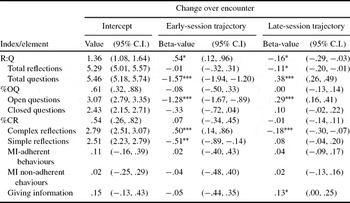
Table 1 outlines GEE results for skill indices and technical elements among MI-proficient encounters. With respect to R:Q, the intercept (1.36) indicated a high rate of reflective listening in encounters’ 1st interval. A positive, significant linear slope (.54) indicated increased reflective listening in subsequent intervals, and a negative, significant quadratic slope (−.16) indicated decreased reflective listening in the final interval. As outlined in Table 1, constituent elements involved in computation of R:Q (e.g. total reflections, questions) were also examined. For total reflections, the intercept indicated a rate of over five in the 1st interval, a nonsignificant linear slope indicated the rate did not substantively change in subsequent intervals, and a significant negative quadratic slope indicated the rate decreased in the final interval. For total questions, the intercept indicated a rate of over five in the 1st interval, a significant negative linear slope indicated the rate decreased in the subsequent interval, and a significant positive quadratic slope indicated the rate then increased in the final intervals.
Temporal trajectory of technical skill indices and elements in MI-proficient delivery

Notes:
Based on 49 recordings of a 20-minute encounter with delivery rated high in MI spirit (x > 5 on Likert scale).
Intercept corresponds to the 1st quartile interval of the encounter.
Early-session trajectory corresponds to subsequent quartile intervals of the encounter.
Late-session trajectory corresponds to final quartile interval of the encounter.
R:Q computed as (Total Reflections)/(Total Questions).
%OQ computed as (Open Questions)/(Total Questions).
%CR computed as (Complex Reflections)/(Total Reflections).
***p<.001, **p<.01, *p<.05 (based on Walden X2 value).
With respect to %OQ, the intercept (.61) indicated more than half of questions in the initial interval were posed in an eliciting fashion. A nonsignificant linear slope (−.08) indicated the percentage of open questions did not substantively change in subsequent intervals, and a nonsignificant quadratic slope (.00) similarly indicated no substantive change in the final interval. As outlined in Table 1, constituent elements involved in computation of %OQ (e.g. open, closed questions) were examined. For open questions, the intercept indicated an average of just over three were posed during the initial interval, a significant negative linear slope indicated this rate decreased in the subsequent interval, and a significant positive quadratic slope indicated this negative slope decelerated in the later intervals. For closed questions, the intercept indicated an average of more than two posed in the initial interval, and nonsignificant linear and quadratic slopes indicated this rate did not substantively change in any subsequent intervals. Figure 2 depicts these temporal trends in rate of open and closed questions.
With respect to %CR, the intercept (.54) indicated just over half of reflections offered in the initial interval were complex. Nonsignificant linear (.07) and quadratic slopes (−.01) suggested no change in any subsequent intervals. As outlined in Table 1, constituent elements involved in computation of %CR (e.g., complex, simple reflections) were examined. For complex reflections, the intercept indicated an average of nearly three offered in the initial interval, a significant positive linear slope indicated this rate increased in subsequent intervals, and a significant negative quadratic slope indicated this rate decreased in the final interval. For simple reflections, the intercept indicated an average of 2½ offered in the initial interval, a significant negative linear slope indicated this rate decreased in subsequent intervals, and a nonsignificant quadratic slope indicated this rate was then unchanged during the final interval. Figure 2 depicts these temporal trends in rate of simple and complex reflections.
Additional technical elements were also examined. For MI-adherent behaviours, the intercept indicated these were infrequent in encounters’ initial interval, and nonsignificant linear and quadratic slopes indicated the rate did not change in any subsequent interval (see Table 1). For MI non-adherent behaviours, the intercept indicated these were quite rare in the initial interval, and nonsignificant linear and quadratic slopes indicated this remained true in each subsequent interval (see Table 1). For information provision, the intercept indicated information was provided infrequently in the initial interval, a nonsignificant linear slope indicated this did not change in the subsequent interval, and a significant positive quadratic slope indicated that frequency of information provision increased during the final intervals (see Table 1). Figure 2 depicts temporal trends in each of these technical elements.
Temporal trajectory of skill indices and technical elements in MI-inconsistent delivery
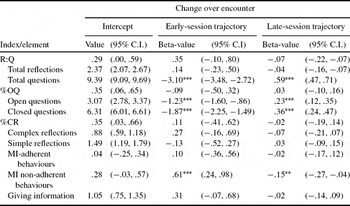
Table 2 shows GEE results for skill indices and technical elements in MI-inconsistent encounters. With respect to R:Q, the intercept (.29) indicated limited reflective listening in encounters’ 1st interval. A nonsignificant linear slope (.35) indicated that increases in reflective listening in subsequent intervals failed to reach statistical significance, and a nonsignificant quadratic slope (−.07) indicated that rate of reflective listening did not change during the final interval. As outlined in Table 2, constituent elements involved in computation of R:Q were examined. For total reflections, the intercept indicated these occurred at a rate of just over two in the 1st interval, nonsignificant linear and quadratic slopes indicated this did not change in any subsequent interval. For total questions, the intercept indicated these occurred at a high rate of more than nine during the 1st interval, a significant negative linear slope indicated this rate decreased in subsequent intervals, and a significant positive quadratic slope indicated the rate then increased in the final interval.
Temporal trajectory of technical skill indices and elements in MI-inconsistent delivery

Notes:
Based on 43 recordings of a 20-minute encounter with delivery rated low in MI spirit (x > 3 on Likert scale).
Intercept corresponds to the 1st quartile interval of the encounter.
Early-session trajectory corresponds to subsequent quartile intervals of the encounter.
Late-session trajectory corresponds to final quartile interval of the encounter.
R:Q computed as (Total Reflections)/(Total Questions).
%OQ computed as (Open Questions)/(Total Questions).
%CR computed as (Complex Reflections)/(Total Reflections).
***p<.001, ** p<.01, * p<.05 (based on Walden X2 value)
With respect to %OQ, the intercept (.35) indicated nearly 1 of 3 questions in the initial interval was posed in an eliciting fashion. A nonsignificant linear (−.09) and quadratic slopes (.03) indicated no substantive change in any subsequent intervals. As outlined in Table 2, constituent elements involved in the computation of %OQ were examined. For open questions, the intercept indicated an average of just over three posed in the initial interval, a significant negative linear slope indicated this rate decreased in subsequent intervals, and a significant positive quadratic slope indicated the negative linear slope decelerated in the final interval. For closed questions, the intercept indicated an average of more than six in the initial interval, a negative linear slope indicated this rate decreased in subsequent intervals, and a significant positive quadratic slope indicated this negative linear slope also decelerated in the final interval. Figure 2 depicts these temporal trends in rate of open and closed questions.
With respect to %CR, the intercept (.35) indicated nearly 1 of 3 reflections offered in the initial interval were complex. Nonsignificant linear (.11) and quadratic slopes (−.02) indicated no substantive change in any subsequent interval. As outlined in Table 2, constituent elements involved in computation of %CR were examined. For complex reflections, the intercept indicated a rate of less than one during the initial interval, and nonsignificant linear and quadratic slopes indicated this was unchanged in all subsequent intervals. For simple reflections, the intercept indicated a rate of 1½ offered during the initial interval, and nonsignificant linear and quadratic slopes indicated this rate did not change in all subsequent intervals. Figure 2 depicts these temporal trends in rate of simple and complex reflections.
Additional technical elements were also examined. For MI-adherent behaviours, the intercept indicated these rarely occurred in the initial interval, and nonsignificant linear and quadratic slopes indicated no substantive change in subsequent intervals (see Table 2). For MI non-adherent behaviours, the intercept indicated these also occurred infrequently in the initial interval, a significant positive linear slope indicated the rate increased in subsequent intervals, and a significant negative quadratic slope indicated it then decreased in the final interval (see Table 2). For information provision, the intercept indicated information was provided just over once in the initial interval, and nonsignificant linear and quadratic slopes indicated this was not substantively changed in all subsequent intervals (see Table 2). Figure 2 depicts temporal trends in each of these technical elements.
Discussion
This exploratory study utilized behavioural data concerning MI skilfulness of community treatment personnel exhibited in brief simulated encounters. Outcomes of the original training trial are presented elsewhere (Baer et al., Reference Baer, Wells, Rosengren, Hartzler, Beadnell and Dunn2009; Hartzler et al., Reference Hartzler, Baer, Rosengren, Dunn and Wells2007). Yet, the trial's scope, use of standardized clinical stimuli, and partitive MITI scoring application afforded an opportunity to contrast delivery samples rated as exhibiting strong MI spirit with those rated poorly in this salient relational element of MI fidelity. Analyses examined temporal trajectories in MI skill indices as well as individual MI-relevant elements reflective of prescribed techniques (e.g. open questions, reflections, affirmations) and proscribed techniques (e.g. confrontation, information provision). Findings highlight temporal aspects of proficient technical MI delivery in this simulated brief encounter, namely the differential emphasis given to a collective set of MI-relevant techniques in therapeutic discussion as the encounter was initiated, as discussion became more focused, and as the brief encounter eventually approached its conclusion.
Initial strategies
Study findings inform clinical strategies emphasized in MI-proficient delivery at the outset of a brief encounter. During the first 5 minutes of the encounter, elicitation (e.g. %OQ) was emphasized, with practitioner questions offered at higher rates than in subsequent intervals, and the majority of this inquiry framed in “open” fashion to promote greater client narrative. The mean percentage of open questions observed in this initial interval (61%) exceeded a suggested proficiency benchmark (Moyers et al., Reference Moyers, Martin, Manuel and Miller2004). The initial rate of reflective listening (R:Q = 1.36) also exceeded the corresponding proficiency benchmark, and suggests the offering of reflections was also a prominent initial clinical strategy. Further, the quality of reflective listening (%CR = 54) suggested a majority of reflections offered were substantive in nature, and this rate also exceeded a corresponding, suggested proficiency benchmark. Interestingly, instance of client affirmation/support were infrequent. Though such offerings are not a proscribed MI practice, some have suggested they may have equivocal impact on rapport-building early in therapeutic processes (Farber and Lane, Reference Farber, Lane and Norcross2002; Karpiak and Benjamin, Reference Karpiak and Benjamin2004). In the context of a single brief encounter, such displays may have been infrequent so as to avoid practitioners appearing disingenuous or imperceptive. Unsurprisingly, provision of treatment-related information was also infrequent, and client confrontation was largely avoided.
In contrast, the opening 5 minutes of encounters marked by MI-inconsistent delivery were dominated by heavy reliance on posing of closed questions. Although this may suggest some focus on elicitation, the style is more consistent with cursory data-gathering than collaborative inquiry. A rapid-fire style of questioning was paired with limited use of reflective listening and greater information provision relative to MI-proficient delivery. Thus, the initial therapeutic process in MI-inconsistent delivery appears one wherein clients are afforded limited opportunity to contribute to conversational substance or direction, and left to passively provide brief responses to practitioner questions and receive treatment-relevant information. If one hopes to foster a strong therapeutic alliance believed to benefit treatment process and outcome (Connors, Carroll, DiClemente, Longabaugh and Donovan, Reference Connors, Carroll, DiClemente, Longabaugh and Donovan1997; Gifford, Ritsher, McKellar and Moos, Reference Gifford, Ritsher, McKellar and Moos2006; Meier, Barrowclough and Donmall, Reference Meier, Barrowclough and Donmall2005), this approach should be discouraged. The inherent loss of clients’ perceived freedom and control in decision-making raises the likelihood of reactance (Brehm and Brehm, Reference Brehm and Brehm1981), and limited opportunity to speak diminishes engagement as well as client articulation of arguments favouring change thought to be a precursor to statements of behavioural intention and/or eventual behaviour change (Amrhein, Reference Amrhein2004; Amrhein, Miller, Yahne, Palmer and Fulcher, Reference Apodaca and Longabaugh2003; Gaume, Gmel and Daeppen, Reference Gaume, Gmel and Daeppen2008; Moyers, Martin, Houck, Christopher and Tonigan, Reference Moyers, Martin, Houck, Christopher and Tonigan2009).
Focusing strategies
Study findings also inform how relative technical emphases in MI-proficient delivery changed as the encounter progressed to more focused therapeutic discussion. Elicitation was de-emphasized during this phase of the encounter, with frequency of open questions reduced by nearly half. This decreased inquiry contributed directly to increased rate of reflective listening (e.g. R:Q), as the rate at of reflective listening statements remained stable. More importantly, the quality of reflective listening was enhanced as practitioners offered fewer simple reflections but a greater number of complex reflections. Thus, a primary initial emphasis on elicitation subsequently shifted as encounters proceeded into focused therapeutic discussion. This subsequent focus was marked by greater conveyance of understanding of client statements wherein depth of understanding was highlighted. As relates to therapeutic alliance, this sequence may indicate practitioner effort to first spur a sense of collaboration and then deepen the affective practitioner-client bond (Bachelor and Horvath, Reference Bachelor, Horvath, Hubble, Duncan and Miller1999; Horvath and Greenberg, Reference Horvath and Greenberg1994). No substantive change was observed in rates of client affirmation/support, information provision, or client confrontation in MI-proficient delivery during this subsequent phase of the encounter.
In this subsequent phase of the brief encounter, MI-inconsistent delivery was also marked by reduced elicitation as the overall rate of practitioner questions decreased. A data-gathering approach to inquiry, however, continued and became more concentrated as the proportional reduction of open questions (40%) exceeded that for closed questions (29%). No concurrent increase in rate or quality of reflective listening was observed. Instead, the practitioner technique that increased in rate was confrontation of the client. Thus, the technical elements employed in MI-inconsistent delivery again paint a troubling picture. A client, likely to have initially felt poorly understood and perceiving little control, is then more likely to be confronted. In a prior study, Moyers, Miller et al. (Reference Miller, Moyers, Arciniega, Ernst and Forcehimes2005) unexpectedly found technical elements of MI-inconsistent delivery enhanced the impact of practitioner interpersonal skills on measures of in-session client involvement (e.g. engagement, cooperation, disclosure). Still, a pattern of frequent inquiry followed by confrontation seems a recipe for eliciting and strengthening client reactance and runs contrary to most prevailing notions for effective dealing with client resistance (Gifford et al., Reference Gifford, Ritsher, McKellar and Moos2006; Miller and Rollnick, Reference Miller and Rollnick2002; Moyers and Rollnick, Reference Moyers and Rollnick2002; Shaffer and Simoneau, Reference Shaffer and Simoneau2001).
Concluding strategies
Study findings also inform what techniques are emphasized in MI-proficient delivery as the brief encounter approached conclusion. The rate of reflective listening (e.g. R:Q) decreased somewhat – a product of both fewer complex reflections offered and increased open questions. It is conceivable this reflected increased practitioner focus on eliciting client statements of commitment to behaviour change via posing of what Miller and Rollnick (Reference Miller and Rollnick2002) term “evocative” open questions intended to prompt decisions about behaviour change and planning about methods whereby it may be achieved. Greater practitioner emphasis on change planning may also explain concurrent increase in provision of treatment-related information. Though information provision remained relatively infrequent, its more frequent provision may signal practitioner attempts to provide parameters for change-planning. Collectively, these temporal trends may represent aspects of “task-related alliance” (Elvins and Green, Reference Elvins and Green2008; Green, Reference Green2006; Hougaard, Reference Hougaard1994), which relates more in this context to contractual aspects of goal-setting.
As the brief encounter concluded, MI-inconsistent delivery was also marked by renewed technical emphasis on elicitation. Notably, however, this differed somewhat from trends in MI-proficient delivery in that the rate of both open and closed questions increased. It seems likely that practitioners exhibiting MI-inconsistent delivery may also be focused on treatment planning at the conclusion of the encounter, as may explain the increased rate of inquiry. Yet, sustained reliance on predominantly closed questions suggests any treatment planning that occurred was likely practitioner-generated and for which authentic interest or substantive commitment by the client was unlikely to have been articulated. Interestingly, client confrontation decreased in MI-inconsistent delivery as the encounter approached its conclusion, though notably its rate of occurrence was still 20+ times the mean rate observed in MI-proficient delivery.
Study limitations
Some caveats bear mentioning. A clear limitation is the use of simulated encounters, for which authenticity of trained actors portraying concerns of treatment-seekers is difficult to gauge. In this case, experienced SPs worked collaboratively with investigators and treatment agencies to sculpt representative characters. The use of SPs does carry a noteworthy scientific advantage of minimizing variance in client variables that may otherwise confound evaluation of practitioner delivery. Still, some detriment to external validity is possible, and current findings would be strengthened via replication in clinical encounters with actual treatment-seekers. An additional caveat is potential for selection bias, given a sample of encounter recordings from practitioners enrolled in an MI training trial. The sample size, inclusion of sessions recorded prior to training, and described procedures for limiting the influence of any one practitioner on rates of skill indices and technical elements, may mitigate some such concerns.
A further set of caveats concern the use of the MITI 2.0, which is not as comprehensive as its predecessor (Miller, Reference Miller2000) or other instruments (Madson et al., Reference Madson, Campbell, Barrett, Brondino and Melchert2005; Martino et al., Reference Martino, Ball, Gallon, Hall, Garcia, Ceperich, Farentinos, Hamilton and Hausotter2006). Further, all of these MI fidelity measures require some inference as to practitioner intent, and thus caution is warranted in interpreting why certain techniques occur more (or less) during identified intervals. Further caveats include use of time-limited intervals to gauge changes in practitioner delivery, which lacks the specificity of an alternative sequential coding method (Moyers and Martin, Reference Moyers and Martin2006; Moyers et al., Reference Moyers, Martin, Christopher, Houck, Tonigan and Amrhein2007), and the absence of fidelity scoring for alternative therapeutic approaches (some of which may prescribe MI-inconsistent practices). Finally, these data are based on one set of raters, trained to reliability by this investigative group. Replication of the observed patterns in studies involving training of other raters by other investigators would strengthen the basis for generalizing these findings.
Conclusions
Caveats notwithstanding, this exploratory study sought to clarify the magnitude and timing of technical elements involved in proficient delivery of MI in a brief clinical encounter. As might be expected of a complex and multidimensional behavioural intervention, perceived skill in delivery may vary as a product of how proficiency is defined. Indeed, variable perception about proficient delivery skills is a significant issue among psychotherapy researchers (Perepletchikova, Hilt, Chereji and Kazdin, Reference Perepletchikova, Hilt, Chereji and Kazdin2009), and remains a broad challenge to the field. In the current study, investigators used the MI spirit rating as a singular, relational criterion to classify practitioner delivery as “proficient” or “inconsistent” given intent to focus on temporal trends in technically-based skill indices and elements. MI spirit is emphasized in seminal writings about MI (Miller and Rollnick, Reference Miller and Rollnick1991, Reference Miller and Rollnick2002), and more recently delineated as a pervasive influence of practitioner collaboration, evocation, and support (Miller, Moyers, Ernst and Amrhein, Reference Miller, Moyers, Ernst and Amrhein2008; Moyers et al., Reference Moyers, Martin, Manuel and Miller2004). Further attributes of the MI spirit rating as a proficiency criterion are its documented measurement reliability (Baer et al., Reference Baer, Wells, Rosengren, Hartzler, Beadnell and Dunn2009; Madson and Campbell, Reference Madson and Campbell2006; Moyers et al., Reference Moyers, Martin, Catley, Harris and Ahluwalia2003; Moyers, Martin et al., Reference Moyers, Martin, Manuel, Hendrickson and Miller2005), prediction of treatment outcome (Gaume, Gmel et al., Reference Gaume, Gmel, Faouzi and Daeppen2008; Moyers et al., Reference Moyers, Martin, Houck, Christopher and Tonigan2009; Vader, Walters, Prabhu, Houck and Field, in press), and designation as a primary learning target for those seeking to develop skill in MI delivery (Madson et al., Reference Madson, Loignon and Lane2009; Miller and Moyers, Reference Miller and Moyers2006). Other technically-based MI skill indices offer conceptually-derived proficiency benchmarks, though notably an uneven pattern of association among them has been previously reported among well-trained practitioners (Miller et al., Reference Miller, Yahne, Moyers, Martinez and Pirritano2004).
A growing training literature (Hartzler et al., Reference Hartzler, Rosengren, Baer, Cohen, Collins, Young, McChargue and Leffingwell2009; Madson et al., Reference Madson, Loignon and Lane2009) and advent of the MIA-STEP product (Martino et al., Reference Martino, Ball, Gallon, Hall, Garcia, Ceperich, Farentinos, Hamilton and Hausotter2006) have contributed to tests of various training methods. Current findings may be most useful to those providing training in settings where brief interventions are utilized. For example, as trainees progress beyond initial technical learning, training may then focus on optimal timing for execution of particular techniques. That is, elicitation and reflective listening could be trained as primary techniques to aid in opening therapeutic conversations, complex reflections may similarly be offered as a predominant technique for later focusing of therapeutic conversation, and pairing of evocative questions and limited information provision may then be suggested as elements of negotiating a change plan (Miller and Rollnick, Reference Miller and Rollnick2002). Whether training that gives greater attention to optimal timing for use of particular techniques results in more effective implementation awaits further study.
In summary, study findings note base rates of skill indices and technical elements – as well as temporal change in those rates - for proficient delivery of MI in brief intervention formats. Findings are generally consistent with Miller and Rollnick's (Reference Miller and Rollnick1991, Reference Miller and Rollnick2002) seminal descriptions of MI as a therapeutic approach, and provide data-driven support for notions about relative emphasis and timing of several core clinical techniques. Admittedly, replication of study findings in encounters with actual treatment-seeking clientele would strengthen confidence about their ecological validity and generalizability. Still, current findings have implications for how MI proficiency is conceptualized, and how it may be attained by practitioners. Further, these findings contribute to a growing empirical literature concerning the mechanics of skilful and effective delivery of MI, and how relational and technical elements of this therapeutic approach may be optimally blended for those implementing brief interventions.
Acknowledgements
This research was supported by NIDA 1 R01 DA016360-01A1. The authors wish to thank Jeretta Scott, Amber Wolfe, and Deborah Kelley for their expertise in portraying substance abuse treatment clientele during the described SP encounters; Andrew Slade, David G. Peterson, and Avry Todd for their MITI scoring efforts; the participating substance abuse treatment agencies for their collaboration; and the individual practitioners for their participation in the training trial.



Comments
No Comments have been published for this article.