FOCUS POINTS
• In World War I, the appearance of “shell shock” was thought, in part, to be due to the physical injury to the body and brain.
• Particular experiences are more likely to result in PTSD than other types of trauma.
• Blunt trauma and combination injury are associated with high rates of PTSD.
• Individuals with particular injury types may merit greater attention in screening for PTSD.
Introduction
Post-traumatic stress disorder (PTSD) can occur after a variety of traumatic experiences.Reference Keane, Marshall and Taft1 It is well established that particular experiences, such as sexual assaults, are more likely to result in PTSD than other types of trauma.Reference Bromet, Sonnega and Kessler2 Wartime experiences are also particularly likely to result in PTSD.Reference Bromet, Sonnega and Kessler2 Within the overall context of war, a service member deployed to a combat zone may be exposed to a variety of traumatic experiences, including the possibility of incurring personal injuries. Although some studies have suggested that those with combat wounds are actually less likely than the non-injured to develop PTSD,Reference Grieger, Cozza, Ursano, Hoge, Martinez, Engel and Wain3 the more common finding has been that physical injury increases the chance of psychological sequelae.Reference Koren, Norman, Cohen, Berman and Klein4, Reference Amir and Sol5
A number of studies have examined how type and severity of injury may influence the risk for PTSD in civilian trauma.Reference Mason, Wardrope, Turpin and Rowlands6, Reference Michaels, Michaels, Zimmerman, Smith, Moon and Peterson7 Work has also been done to discover how different types of physical injury may influence PTSD from service members returning from Iraq and Afghanistan.Reference Gaylord, Cooper, Mercado, Kennedy, Yoder and Holcomb8–Reference Macgregor, Corson and Larson10 Of particular interest is to learn if complex trauma, or trauma that is more likely to be associated with traumatic brain injury (TBI), is more likely to result in symptoms of PTSD.
In this study, we reviewed records from service members who had returned to a military hospital after serving in Iraq or Afghanistan. We wanted to examine if those with injuries were more likely than others to return with PSTD, and to determine whether different types of physical injury would predict the risk and severity of PTSD symptoms.
Methods
Study site
The study was conducted from a convenience sample taken at Naval Medical Center San Diego (NMCSD). NMCSD is a military medical treatment facility located in metropolitan San Diego; it employs approximately 6000 healthcare providers, and serves a potential patient population of about 500,000 service members, military retirees, and military dependents. The medical center is the main receiving facility for the western U.S. for injured service members being medically evacuated from combat theater. NMCSD also regularly deploys military healthcare providers to shipboard and ground combat deployments, mostly in support of Marine Corps operations. NMCSD does not contain a burn unit, so patients with this mechanism of injury are likely to be treated elsewhere.
Record review
The local institutional review board approval was obtained to perform a record review. Medical records were gathered from electronic databases/Composite Health Care System software (CHCS) that included post-deployment screenings performed at NMCSD between January 1, 2005, and October 1, 2007. All military medical providers working at the hospital who had returned from any sort of military deployment, as well as patients who had been medically evacuated to the hospital from combat theaters, underwent screening. Some subjects had likely completed earlier, paper-only versions of the screening exam. Hard copy records, however, were not readily available for review; only records from which forms had been scanned into the electronic medical record were reviewed. A total of 1998 records were reviewed in total. Data were taken only from cases where subjects had completed the Post-Deployment Health Assessment Test (PDHAT), a locally used screening tool that includes information on demographics, risk-exposures, mechanism of injury or illness, head trauma, means of arriving at the hospital, the 17 items from the Post Traumatic Stress Disorder Checklist Military version (PCL-M), and questions about other symptom clusters, such as depression and alcohol use. Of note, the PDHAT is distinct from the similarly named Post Deployment Health Assessment (PDHA), a national, military screening program that includes screening for PTSD, but not information on individual symptoms. Data were consolidated into an electronic database that was free of all personal, identifying information, and this anonymous database was used for all further analysis. For the purposes of our study, records were used only from PDHATs performed at the time subjects initially returned from deployment, and only when information was available in regard to the presence or absence of physical trauma, the nature of that trauma, and when the subject had completed at least 10 of 17 items on the PCL-M; 1402 records were available that met these criteria.
Main outcome variable
The PCL-M was used as the primary measure of PTSD symptom severity. This is a self-report scale in which a patient rates the severity of the 17 Diagnostic and Statistical Manual IV-TR (DSM-IV) symptoms of PTSD on a scale from 1 (no symptoms) to 5 (extreme problems) over the previous month. Scores on the PCL-M range from 17 to 85. To meet “loose” criteria for PTSD, according to the PCL-M, a respondent must rate as moderate (3) at least one criteria B symptom, three criteria C symptoms, and at least two criteria D symptoms. Loose criteria on the PCL-M thus correspond with a DSM diagnosis of PTSD. A respondent is considered to meet “strict” criteria for PTSD if clinical criteria are met and the total severity score is 50 or higher.Reference Blanchard, Jones-Alexander, Buckley and Forneris11 Previous studies have found that the PCL-M has a high correlation with the clinician administered PTSD scale and is an accurate reflection of PTSD symptom severity.Reference Monson, Gradus, Young-Xu, Schnurr, Price and Schumm12
Data analysis
Subject records were categorized according to whether the subject had suffered penetrating trauma (from bullet, shrapnel, or edged wound), nonpenetrating trauma (blast exposure, fall, motor-vehicle accident), both, or neither. Mean scores on the PCL-M among the four groups were compared using one-way analysis of variance (ANOVA), with post-tests using Bonferroni correction for multiple comparisons. Calculations were performed using SPSS version 16.0. For subjects who completed 10 or more items on the PCL-M, but who left some items blank, the blank items were assumed to indicate an absence of symptoms for that particular item, and thus scored as a “1” on the PCL-M. Subjects were also grouped according to whether they met DSM-IV (“loose”) criteria for PTSD on the PCL-M, or “strict” criteria on the same instrument. Demographic information on age, gender, marital status, branch of service, and military rank were also organized for descriptive statistics. A binary, logistic regression model was also constructed to determine if age, gender, marital status, branch of service, rank, and trauma type predicted the presence or absence of PTSD by DSM and by strict criteria.
Results
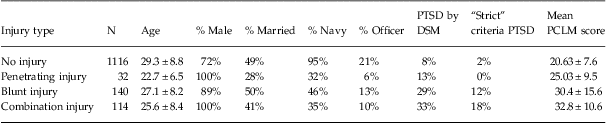
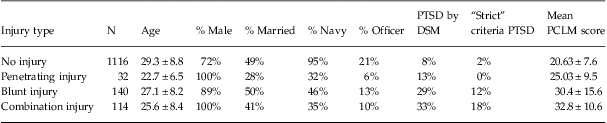
Descriptive statistics for the age, gender, marital status, military branch, officer vs. enlisted, and qualification for PTSD according to DSM-IV criteria or “strict” criteria on the PCL-M are provided in Table 1. Means for age and PTSD severity score on the PCL-M are given plus or minus standard deviation.
Descriptive statistics for service members with and without injuries
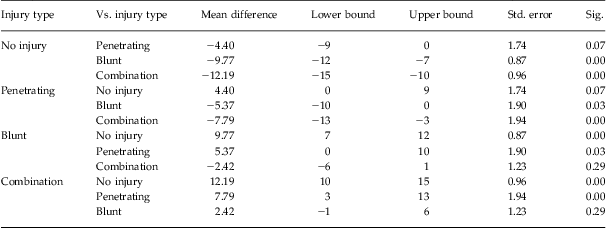
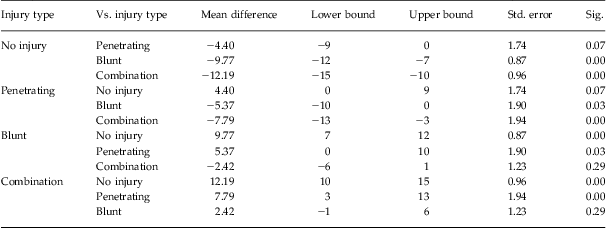
ANOVA showed that there was a significant effect of injury type on PCL-M score (p < 0.001). Differences among the types of trauma and significance level based on post-tests, with Bonferroni correction for multiple comparisons, are listed in Table 2. Service members with blunt and combination injuries had higher scores on the PCL-M after returning from deployment than those with no trauma or those with purely penetrating trauma (P < 0.05).
Differences in PCL-M scores for individuals with and without injuries
Binary logistic regression–constructed models that significantly (p < 0.001, 87.7% correct) predicted DMS criteria PTSD, and strict PTSD criteria (P < 0.001, 96.1% correct). For DSM criteria, blunt trauma (p < 0.001, B = 0.60, Wald stat = 31.2, odds ratio 1.83 with 95% CI 1.48 to 2.26) and being in a service other than the Navy (p < 0.01, B = 0.63, Wald stat = 7.64, odds ratio 1.88 with 95% CI 1.20 to 2.93) predicted the presence or absence of PTSD. For strict criteria, blunt trauma (p < 0.001, B = 1.07, Wald stat = 49.39, odds ratio 2.91 with 95% CI 2.16 to 3.92) and being enlisted (p < 0.05, B = 2.24, Wald stat = 4.87, odds ratio 9.44 with 95% CI 1.29 to 69.25) predicted the presence of PTSD.
Discussion
In a population of U.S. active duty service members who had just returned from military deployments, the type of physical injury incurred significantly predicted the severity of PTSD symptoms. Combination injury appeared to be associated with the worst PTSD severity scores, with less severity in those with only blunt injury, followed by lower severity among those with penetrating trauma, and the lowest PTSD severity in those with no physical injury. This was reflected both in the mean score on the PCL-M and in the percentage of individuals from each group who met DSM-IV criteria for PTSD (see Table 1). Statistically, differences were only significant between those with blunt or combination injuries versus those with penetrating injuries or no injury (see Table 2). There was also a nonsignificant, statistical trend toward those with penetrating injuries reporting greater PTSD symptoms than those with no injuries.
Numerically, the difference on PTSD severity scores between those with penetrating trauma and those with no injury was just as great as between penetrating and nonpenetrating injures (about 5 points greater in each case), so the failure to see significance may have been due to the relatively low number of individuals who had pure, penetrating injuries. The low number of such “clean” injuries is likely reflective of the type of warfare occurring in Iraq and Afghanistan during the period covered by the study (2005–2007). A greater number of individuals with blast injuries from improvised explosive devices than those with bullet wounds or purely shrapnel injuries were seen at NMCSD.
It is worth noting that individuals with purely penetrating injuries were younger, less likely to be officers, and more likely to be single than individuals in the other categories (Table 1). Again, this likely reflects the nature of the warfare at the time. Traditional combat troops, the most likely to engage in firefights, were still mostly made up of young, single males. A wider variety of service members, however, was vulnerable to events like roadside bombing. The way in which differences in demographics impact the presentation of PTSD symptoms remains to be investigated in this particular population and is worthy of further study.
The population examined here was taken from individuals returning to a Navy hospital. This undoubtedly skewed the population toward two distinct groups of individuals: Navy medical providers, most of whom were returning healthy, and individuals from a variety of services who were being hospitalized because of injury or illness. This is reflected in the percentages of Navy personnel and officers in the different groups (Table 1). In logistic regression modeling, being in the Navy or being an officer appeared protective against PTSD, both of which were likely associated with less combat exposure. A better control group would have been individuals from the same units as the injured service members. Unfortunately, that population was not available for analysis in this study.
The non-injured population examined was derived from individuals returning from military deployments in the same parts of the world and during the same time period as those with injures, who likely shared many traumatic experiences of war. However, the non-injured population was returning on a schedule, and thus might have had several months between a sentinel trauma and the screening. Conversely, the injured population was likely screened immediately after what was likely their most important traumatic event, and would have had little time to recover psychologically. Also, injury itself might be a marker for greater combat exposure and trauma. The finding that those with injuries suffer greater symptoms of PTSD than those without injury is also not new.Reference Schneiderman, Braver and Kang13 The demographic differences may have impacted the results somewhat, but it seems probable that the overall finding that injury increases PTSD severity remains valid.
Besides the demographics, another limitation of this study was that it was drawn from self-reported data taken as part of on-the-record screenings. Because such screenings can influence future service, service members may have been motivated to over-report, under-report, or leave particular sections blank. Previous studies have suggested that rates of PTSD can vary widely depending on the method used to survey the population.Reference McLay, Deal, Murphy, Center, Kolkow and Grieger14, Reference Ramchand, Schell, Karney, Osilla, Burns and Caldarone15 It would seem unlikely that any group of individuals would be more or less likely to characterize their PTSD symptoms differently based on their mechanism of injury (i.e., if they had blunt versus penetrating trauma). However, the overall, injured population already had a reason that they would be removed from combat service. Conversely, the non-injured population presumably was still eligible to remain on active duty or redeploy, and thus might be motivated to over-report or under-report symptoms based on their desire to stay on active duty and deploy again. This could have contributed to different rates of PTSD being reported in the two populations.
Perhaps the most interesting finding of our research was to recognize that blunt trauma was associated with greater PTSD severity than penetrating trauma. Much has been written about the tendency of injuries in current wartime conflicts to result in traumatic brain injury (TBI).Reference Galarneau, Woodruff, Dye, Mohrle and Wade16–Reference Martin, Lu, Helmick, French and Warden18 This study did not specifically examine post concussive symptoms, but it is not unreasonable to assume that those injuries classified as non-penetrating—blast exposure, fall, and motor-vehicle accidents—would be more likely to result in TBI. It may be that those individuals in whom a physical injury to the brain has occurred are also more likely to suffer an emotional or biochemical injury to the mind.
The way that physical injury might increase the possibility of PTSD has an interesting historical context. In World War I, the appearance of “shell shock” was thought, in part, to be due to the physical injury to the body and brain.Reference Bourke19 It has long been noted that the lines between what is PTSD and what is TBI are blurry.Reference Bryant20 Loss of consciousness has previously been associated with PTSD, major depressive disorder, and post-concussive symptoms.Reference Hoge, McGurk and Thomas21 In fact, the presence of one type of symptom is often the best predictor for the presence of the other cluster of difficulties.Reference Hoge, McGurk and Thomas21 Neither the nature of the trauma (physical vs. emotional) nor the locus of injury is easily able to differentiate PTSD from TBI symptoms.Reference Stein and McAllister22 One of the difficulties in such research has been that the presence or absence of a TBI is based not only on post-concussive symptoms, but also on a retrospective recollection if a particular type of injury occurred.Reference Schneiderman, Braver and Kang13 The consequence of all this is that legitimate questions have arisen: Does a particular type of trauma or injury truly lead to a particular symptom cluster? Is there a tendency to look harder for an etiologic agent when a syndrome associated with that agent has been seen?
Like similar studies before it,Reference Mora, Ritenour, Wade, Holcomb, Blackbourne and Gaylord9, Reference Macgregor, Corson and Larson10 our findings indicate that the mechanism of injury does matter in predicting who develops PTSD. Our study was limited in that it looked only at the most broad categories for injuries: blunt vs. penetrating trauma. Further study will be needed to determine if it is the physical or emotional component of an injury that carries the most weight in PTSD symptoms. Also, it will be important to examine if different brain injuries alter the way in which PTSD symptoms present. Ideally, this will eventually help in targeting mental health services to those most in need of care.
Disclosures
The authors have nothing to disclose. We are all federal employees with no ties to, or funding from, industry.