Workplace bullying is recognized as a harassment and social exclusion process in which an individual is systematically subjected to hostile and undesirable social negative behaviors at work over a prolonged period of time (Einarsen, Hoel, Zapf, & Cooper, Reference Einarsen, Hoel, Zapf, Cooper, Einarsen, Hoel, Zapf and Cooper2011; Leymann, Reference Leymann1990). Many studies (e.g., Estes & Wang, Reference Estes and Wang2008) have suggested that psychological harassment is frequent and that workplace bullying is an occupational problem of significant magnitude. Indeed, it may cause higher negligence, absenteeism, turnover and earlier retirements, thus reducing job satisfaction and health of victims and leading to a negative impact on both employees and organizational performance. Previous research demonstrated that organizational climate is a critical antecedent of workplace bullying, independently from individual psychological vulnerability (Balducci, Cecchin, & Fraccaroli, Reference Balducci, Cecchin and Fraccaroli2012), and that personality cannot be considered as a sufficient factor for an understanding of the phenomenon (Balducci, Fraccaroli, & Schaufeli, Reference Balducci, Fraccaroli and Schaufeli2011). Indeed, poor psychosocial conditions at work may trigger interpersonal conflicts, which if not properly managed may escalate into bullying (Balducci et al., Reference Balducci, Fraccaroli and Schaufeli2011). In this regard, team, job description and leadership seem to have a role in the account of bullying at work (Giorgi, Reference Giorgi2009). As well, being a victim of bullying is predicted by the exposure to role stressors, specifically role conflict resulting from simultaneous contrasting pressures and role ambiguity in terms of inadequate role-related information (Balducci et al., Reference Balducci, Cecchin and Fraccaroli2012; Bowling & Beehr, Reference Bowling and Beehr2006). The role of context is thus a relevant issue in research on workplace bullying, as also suggested by several authors (Giorgi, Leon-Perez, & Arenas, Reference Giorgi, Shoss and Leon-Perez2015; Power et al., Reference Power, Brotheridge, Blenkinsopp, Bowes-Sperry, Bozionelos, Buzády and Nnedumm2013), who consider cultural norms and societal environments as influencing the perception of the phenomenon. This seems to be confirmed by previous comparative studies showing high variability across EU countries with regard to the prevalence of workplace bullying (European Foundation for the Improvement of Living and Working Conditions (Eurofound), 2012) and procedures to deal with bullying and harassment at work (European Agency for Safety and Health at Work, 2010). Overall, higher prevalence rates have been reported in Northern European countries compared to Southern ones, moreover when subjective estimation methods are considered (Giorgi, Arenas, & Leon-Perez, Reference Giorgi, Arenas and Leon-Perez2011). This seems to highlight potential differences on awareness and knowledge of bullying and its severe consequences (Power et al., Reference Power, Brotheridge, Blenkinsopp, Bowes-Sperry, Bozionelos, Buzády and Nnedumm2013; Salin, Reference Salin2001). In this regard, Italy is one of the Southern European countries where knowledge of the relevance and the dangers of bullying are quite limited and workplace bullying has only been of recent interest as a social problem (Giorgi, Reference Giorgi2009; Giorgi et al., Reference Giorgi, Arenas and Leon-Perez2011). Indeed, it is hypothesized that in Italy employees are more likely to tolerate negative acts than in other cultures, probably because in such a masculine society, bullying may be considered as part of the job or a reasonable managerial practice, and conflicts are more likely to be solved through fight and harassment rather than negotiation (Giorgi et al., Reference Giorgi, Arenas and Leon-Perez2011).
The current situation of workplace bullying in Italy
The Fifth European Working Conditions Survey (EWCS) 2010 by the European Foundation for the Improvement of Living and Working Conditions (Eurofound, 2012) estimated in Italy a prevalence of bullying or harassment at work equal to 0.9%, which was thus below the European average of 4.1%. According to the European Survey of Enterprises on New and Emerging Risks (ESENER) (European Agency for Safety and Health at Work, 2010), only 9.43% of surveyed Italian employers indicated formal procedures in place to deal with bullying and harassment, whereas at least a half of the organizations in Northern European countries had formal procedures to tackle bullying at work. Besides, albeit formal employee representation with relevance for safety and health issues was highest in Italy (100%) – compared to the European average 70% - health and safety representatives received requests to tackle bullying and harassment in the workplace in only 15% of cases, below the European average of 22%. Indeed, despite the existence of laws that safeguard workers’ health, safety and overall protection (e.g., art. 32, 35 and 41 of the Italian Constitution and Law 300/1970 of the Statute of Workers) and of work-related stress obligations imposed to companies (Legislative Decree no. 81/2008 and subsequent amendments), Italy has no specific laws on workplace bullying, differently from many European and Scandinavian countries.
Overall, the prevalence rates found in national studies were often higher than those resulting from the EWCS, especially when operational estimation methods were used (Giorgi et al., Reference Giorgi, Arenas and Leon-Perez2011). Whereas the “subjective” method (Einarsen, Reference Einarsen2000) requests the person to indicate, on the basis of a definition of workplace bullying, whether or not he or she feels exposed to bullying at work; the “operational” method measures the frequency with which respondents have been subjected to various types of negative acts, e.g. at least two bullying behaviors in a weekly or daily basis during the last six months (Mikkelsen & Einarsen, Reference Mikkelsen and Einarsen2001).
For example, in Italy a survey among the general working population in Lombardy showed that 7% of the respondents were classified as targets of workplace bullying differently from what emerged in EWCS (Italy = 0.9%) (Campanini, Punzi, Costa, & Conway, Reference Campanini, Punzi, Costa and Conway2008). According to Italian National Institute for Occupational Safety and Prevention (ISPESL), in 2003 one and a half out of twenty-one million Italian workers were victims of workplace bullying (Fattorini, Reference Fattorini2005). This problem was more widespread in the north of the country (65%) and affected mainly women (52%). Moreover, data showed that the most frequent victims were clerks (79%). ISPESL determined that for employers workplace bullying represented a considerable cost, as employees who were victims of workplace bullying usually were 70% less productive.
According to the recent European Institute of Political, Economic and Social Studies (EURISPES) survey on Stress and Work (2013), workers report stressful conditions in 92% of cases albeit with different forms and levels of intensity: 59.5% of participants claim work-related psychological pressure only sometimes, 21.9% often and 10.6% always. The main stressful conditions refer to: Pressure for deadlines and delivery time (59.5%), lack of free time to care of oneself (51.7%), excessive workload (51.5%) and scarcity of professional stimuli (50.5%). Besides, 23.5% of workers report bullying and persecution at workplace (with no significant difference between men and women) from both supervisors (87.6%) and co-workers (39.2%).
Giorgi (Reference Giorgi2009) reported that 16.4 per cent of employees in the Italian organizations were victims of bullying, thus resulting in a higher rate compared to other studies mainly conducted in Europe that reported average frequencies of bullying up to 7 per cent. A further research study (Giorgi et al., Reference Giorgi, Arenas and Leon-Perez2011) on 3,112 professionals from Italian companies estimated that 15.2% of all employees were victims of bullying, reporting withholding information, jobs outside of the level of competence and gossip as the most frequent acts; whereas transferred damages, teasing/sarcasm, and intimidating behaviors were the least frequent ones. Specifically, this study indicated that work-related bullying in Italy was more prevalent in the public sector compared to the private sector. A more recent study by Arenas et al. (Reference Arenas, Giorgi, Montani, Mancuso, Perez, Mucci and Arcangeli2015) on 1,151 Italian employees found that the prevalence rate of workplace bullying was 14.9%. Bullying behaviors were mostly related to withholding information, having opinions and views ignored, and excessive monitoring of one’s work; whereas threats of violence or physical abuse, intimidating behaviors and having offensive remarks were less frequent.
Aim of the study
The present study aims at exploring some common thematic domains which characterize workplace bullying stories of adult Italian participants, contributing to the area of quality research on bullying and harassment at workplace. Specifically, a narrative based approach was adopted in order to detect the emotional dimensions which shape the workplace bullying experience and affect relational dynamics between individuals and work contexts. This is without testing specific or well-defined workplace bullying indicators, previously assumed by the researcher, but trying to formulate data-driven hypotheses by directly using participants’ narratives. In this regard, it is demonstrated that a priori measures of workplace bullying do not succeed in accounting for workplace bullying experience and may bias the real prevalence of the phenomenon (Nielsen, Matthiesen, & Einarsen, Reference Nielsen, Matthiesen and Einarsen2010).
Our theoretical framework is based on the proposition that workplace bullying is a function of the dynamic interaction between the individual and the work context, as a cultural and discursive phenomenon that relies on sense-making and social coexistence processes within a specific context (Carli & Paniccia, Reference Carli and Paniccia2002). From this perspective, the need for qualitative research methods is advocated for studying workplace bullying (Yaman, Reference Yaman2010) in order to provide a more reliable and consistent conceptualization in phenomenological terms. Indeed, a narrative approach can better describe how and why workers are bullied and the impact of the bullying on their professional lives (De Wet, Reference De Wet2011), as well as it can grasp some organizational culture and climate related issues directly from workers’ perceptions about their work contexts (Yaman, Reference Yaman2010). This study may thus contribute to shed light on the main shared dimensions affecting the subjective experience of workplace bullying, which may have a role in explaining differences on the sensitivity and awareness about the phenomenon, to be integrated with previous research evidence. In addition, this study may allow the identification of some organizational situations that are “at risk” for workplace bullying, directly from the victims’ perspective, in order to promote better organizational health.
Method
Participants of the study
Textual data consisting of workplace bullying stories were used for the analysis. The stories were anonymously retrieved via a public online forum where people could post and share their experiences of workplace bullying. The online forum was part of an Italian no-profit website providing information on services addressed to violence-related issues. When the participants signed up to the online forum, they gave their informed consent for their stories to be posted online, shared and used as public data as long as anonymity was guaranteed. It is demonstrated that online forums can serve as a qualitative data collection method also in health-related research (Caputo, Reference Caputo2014a). In addition, online qualitative research methods allow researchers to sample minority groups that would otherwise be difficult to contact, such as in the case of mobbed workers, and allow respondents to express their deeper feelings and be less inhibited than in a traditional interviewing environment (Hanna, Weinberg, Dant, & Berger, Reference Hanna, Weinberg, Dant and Berger2005).
These stories were posted between 2008 and 2013 by 28 Italian adults, both men (n = 8) and women (n = 20), working in private (n = 22) and public sector (n = 6). In more detail, private sector included small business (n = 3), company (n = 14), private hospital (n = 1), multinational corporation (n = 3) and international organization (n = 1) contexts; while public sector related to education (n = 3), local administration (n = 2) and legal (n = 1) system. With regard to job position, most of them were clerical workers while none was supervisor or middle manager.
Textual data analysis
Research framework. Computer-aided content analysis was performed to detect meaningful contents emerging in workplace bullying stories. It was selected because of its use as both quantitative and qualitative method, in order to explore the subjective component of workplace bullying experience. Specifically, Emotional Text Analysis (AET) (Carli & Paniccia, Reference Carli and Paniccia2002) was adopted to get a representation of textual corpus contents through few and significant thematic domains, from the semantic variability of the text rather than from ad hoc categories established by the researcher. According to this research framework, emotions are not considered as individual responses but as shared categorization processes by which people symbolize the reality and are expressed through language. The basic hypothesis of AET relies on the “double reference” principle - both lexical and symbolic - implicitly connected to the language text (Fornari, Reference Fornari1979). This allows one to capture the emotional and symbolic dimensions running through the text, apart from its intentional structuring or cognitive sense. In this sense, with polysemy, we refer to the infinitive association of emotional meanings attributable to a word, when it is taken out of language context. Thus the words organizing the language sample can be divided into two large categories: Dense words, with the maximum of polysemy, if taken alone, and the minimum of ambiguity in the sense of a contradictory, indefinite emotional configuration (i.e., words like “bomb” or “good”); non-dense words, with the maximum of sense ambiguity and thus with the minimum of polysemy (i.e., words like “to guess” or “anyway”). If dense words, which maintain a strong emotional meaning even when taken in isolation, are identified in a text, they can be grouped according to their co-occurrence in the same text segments, thus creating different symbolic and emotional repertoires. Indeed, the function of the co-occurrence of words within the same text segments is hypothesized to reduce the association of meanings attributable to each word, thus allowing a thematic domain to be constructed (Caputo, Reference Caputo2013)Footnote 1. In this sense, the analysis of workplace bullying stories is not focused on their intentional structuring or ordered constituent parts, but rather on the common symbolic domains which shape workplace bullying experiences throughout the text.
Analysis procedures. Consistently with this methodology, some statistical multidimensional techniques are carried out using text analysis software, in our case T-LAB, already used in psychosocial research (Caputo, Reference Caputo2014b, Caputo, Giacchetta, & Langher, Reference Caputo, Giacchetta and Langher2016). The whole textual corpus was composed of 48 pages including 21,671 word occurrences (on average 774 words by story).
In more detail, the T-LAB tool we used for the analysis was the “Thematic analysis of elementary context” which transforms the textual corpus in a digital “presence-absence” matrix. To do that, each headline/subheading was considered as a segment of the corpus (namely, an elementary context unit) and represented a row of the matrix, while all the words present in the corpus represented the columns of the matrix.
The analysis procedure consists of the following steps:
a) Construction of a data table context units x lexical units (up to 150,000 Rows X 3,000 Columns), with presence/absence values; b) normalization and scaling of row vectors to unit length (Euclidean norm); c) clustering of the context units (measure: Cosine coefficient; method: Bisecting K-means); d) filing of the obtained partitions and, for each of them; e) construction of a contingency table lexical units x clusters (n x k); f) chi square test applied to all the intersections of the contingency table; g) correspondence analysis of the contingency table lexical units x clusters.
This procedure therefore performs a type of co-occurrence analysis (steps a-b-c) and, subsequently, a type of comparative analysis (steps e-f-g). In particular, comparative analysis uses the categories of the “new variable” derived from the co-occurrence analysis (categories of the new variable = thematic clusters) to form the contingency table columns.
Cluster analysis allows the detection of some groupings of words co-occurring in the same text segments (the so-called elementary context units) with highest probability (p < .05, at 95% confidence level), as indicated by Chi-square test (χ2). Clusters are labelled by the researcher based on the typical vocabulary and sentences of which they are composed of. Indeed, the interpretation relies on a more qualitative approach based on reading the texts to achieve an in-depth familiarity with the workplace bullying stories and on using models of affective symbolization (Carli & Paniccia, Reference Carli and Paniccia2002; Langher, Brancadoro, D’Angeli, & Caputo, Reference Langher, Brancadoro, D’Angeli and Caputo2014) - such as the emotional dichotomies of inclusion/exclusion, power/dependence, trust/mistrust - to give sense to words/sentences of each thematic domain.
Then, correspondence analysis enables the exploration of the relationship between clusters in n-dimensional spaces, so as to detect the latent factors which organize the main semantic oppositions in the textual corpus. The association between clusters and factors is expressed by absolute contributions of clusters to the formation of each factor which consent to judge the quality of representation of the latent dimensions detected. Only clusters offering the highest values, respectively on the positive and negative pole of each factor, are kept to explain the dimension. Indeed, the interpretative analysis of each factor (labelled by the researcher) is based on the meaningful themes (clusters) that deal with different and opposite symbolic contents pertaining to the same issue (latent dimension).
Results
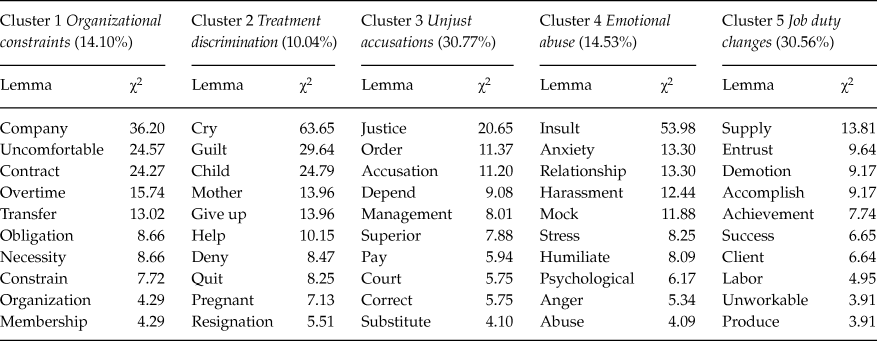
Cluster Analysis has detected five thematic domains of which we report the percentage of context units, indicating their relevance in the overall textual corpus, and some of the most characteristic key-words (lemmas) at p < .05 (at 95% confidence level) and participants’ statements (elementary context units) (Table 1).
The Most Characteristic Lemmas in Thematic Domains

Note: The threshold value of Chi-square test (χ2) for each lemma is 3.84 at 95% confidence level (df = 1; p <.05). Textual data were translated into English only for the purposes of the paper.
Thematic Domains
Cluster 1: Organizational constraints
This cluster is focused on the coercion of the organizational context. Workplace bullying experience is related to the uncomfortable job situation of the individual at workplace (weak contract conditions, compulsory transfers or overtime requirements) mainly due to some critical events affecting the organizational structure (such as economic slumps, changes in working conditions, corporate merger or reorganization).
P1: I received a letter where they stated that the management decided to definitively suppress my customer service position, according to the overall company’s restructuring.
In this sense, workplace bullying is depicted as something concrete dealing with material causes or objective factors which undermine the sense of stability and membership of the employees to the organization itself.
P5: My boss said that an open-ended contract was no more possible because of the scarce financial availability of the company […] He offered me a commission based contract which did not guarantee any economic security.
Workers report their feeling of obligation to fulfil their duties under hard organizational constraints, without being recognized and appreciated for their personal contributions.
P14: They imposed a new role on me because of organizational necessities and I was obliged to accept it.
High priority is given to the company’s necessities and employees are uniquely considered as a labor force to be exploited from the top-down.
P16: The financial crisis constrained them to make staff cuts and thus they could not assign me new duties.
This leads to a lowered perceived empowerment because workers feel at the mercy of external agencies they can’t control and look at the organization as something they are not part of.
Cluster 2: Treatment discrimination
In this cluster workplace bullying is depicted as deriving from the lack of support in work/family balance, because of treatment discrimination and prejudice regarding the private sphere which leads to employees’ progressive resignation.
P26: I began to feel bad, frequently cry, suffer from colitis, and I put on weight of almost 7 kilos […] This nightmare went on for one year, then I decided to resign.
In particular, issues of maternity and pregnancy are used to treat women unfavorably or gradually exclude them from the work organization because they belong to a minority group.
P12: Last year we talked about maternity leave and to my surprise I was told that if I had got pregnant I would have had to resign, because this was a small family-owned business.
It is possible to hypothesize that this type of workplace bullying refers to wider cultural ideologies and stereotypes dealing with treatment disparities, such as the scarce acceptance of women entering the employment market because they are considered fully responsible for the day-to-day care of their children.
P7: They deny me any accumulated holydays because of the “crisis” […] I am compelled to ask unpaid time off work to care for my child when the nursery is off.
The lack of recognition of certain rights (such as maternity leave or parental benefits) does not facilitate a balance between the professional activity and family life. Workers thus experience depressive and dismissing feelings caused by others’ discriminating attitudes which tend to deny them any form of support and comfort.
P15: I endured humiliations, thinking that sooner or later the situation could finish; I got sick, I quit my job and I found no other job in the same city.
This contributes to make them feel alone and guilty about having poor chance for job development compared to their co-workers because of their family or personal life conditions.
Cluster 3: Unjust accusations
This cluster mainly focuses on the relationship between workers and the authority of the organization. Workplace bullying is experienced in terms of unjust or false accusations and unfair decisions from management which undermine personal job reputation by means of all sort of power measures and intimating use of disciplinary procedures (such as warnings for negligence or dismissal letters for misconduct at work).
P18: I received a dismissal letter because of my serious misconduct […] I had put my heart and my soul into my job, many foreign companies cooperated with us, we received many commissions… was that a serious misconduct? Or perhaps my failure was having refused to have an affair with my supervisor?
Workers feel unsafe and vulnerable, because they perceive themselves as victims of undeserved, malicious and voluntary actions which aim at ruining and discrediting them, as a specific organizational strategy to substitute them.
P9: Against me, several intimidating legal letters and continuous medical inspections to check my real health conditions: That was an exhausting situation.
Indeed, defamation is reported as the main workplace bullying behavior enacted against those employees who do not accept to respect the implicit rules imposed by the company.
P2: They warned me for negligence at work, sullied my professional and personal reputation and excluded me from participating in training. Over the last two years I have received two disciplinary measures […] the first one was revoked thanks to some colleagues’ depositions, the other one is now challenged awaiting trial at the Supreme Court of Labor.
In this sense, workplace bullying seems to limit the individual power and freedom of expression leading in turn to a strong sense of injustice.
P20: I received verbal harassments from both the company’s manager and legal representative. They affirmed that I did not have a right to sick leave because I had used paid sick days more than my colleagues in the previous year.
Workers are asked to be fully dependent on the top, correctly behave and avoid conflicts with management, thus assuming a passive and conformist position.
Cluster 4: Emotional abuse
This cluster deals with the emotional abuse which affects communication occurring within the relationships in the workplace.
P23: The chief cook has sided with the boss and humiliates me in front of the kitchen staff, shooting me for useless things. I experience moments of anxiety and acute emotions, with nervous trembling, distressed by the fear of making mistakes
Workplace bullying is experienced as a series of harassments, insults, humiliations coming from supervisors or colleagues which damage workers’ psychological well-being.
P4: I’m being taken everything: Responsibility, dignity, health. I suffer continuous humiliations and harassments; most people do not greet me and when they do that, it is to mock.
In this sense, workplace bullying consists in frequently repeated unkind behaviors which cause to stay in helpless and undefended position and are concluded with psychological complaints and psychosomatic symptoms (from occasional sleep difficulties to nervous breakdowns, from irritability to depression, from difficulties to concentrate, to panic or even to heart attacks).
P11: Despite this absurd situation, I continued to work, trying in vain not to worry at least in the office. This caused me a load of stress and anxiety, as well as emotional problems both in interpersonal relations and at work.
Indeed, workers report their feeling of anxiety and anger deriving from being in a continuous alarm state and from their powerlessness to react against the violence they are exposed to.
P19: Things got worse over time: I went to work with such anxiety that prevented me from working peacefully and, in the evening when I got home, I received harassing messages from my boss on my phone.
This stressful condition gradually contributes to a sense of isolation, marginalization and affective detachment from the organization, because workplace bullying behaviors attack workers’ dignity, adequacy and integrity as persons, thus in turn affecting their job commitment and performance.
Cluster 5: Job duty changes
In this cluster job duties represent the central theme used to account workplace bullying experience. In detail, workplace bullying seems to be related to some changes affecting the nature of job role or duties to be accomplished.
P6: Without any formal communication or explanation, de facto I was not part of the company board anymore. My new job was to contact customers on the phone, like I did in the first period of my work experience. It was an evident demotion, so humiliating to jeopardize my health status.
Workers are given unnecessary or less important tasks and are downgraded to a lower position in the company hierarchy or, on the contrary, they are requested to achieve high-demanding performances and unworkable goals.
P27: They gradually started to entrust me with less important tasks compared to those required for the job role for which I was hired. I did nothing but make photocopies, go to the post office to pay bills or deliver parcels, also very heavy, in the other offices.
P22: I was asked to achieve unworkable goals […] there were daily meetings where my boss complained about my unsuccessful results.
In both these situations, they feel a deep sense of failure deriving from the received demotion or from their inability to guarantee good job results and work quality. In this sense, workplace bullying behaviors directly damage self-esteem and professional identity and reduce job motivation because workers feel devalued in relation to their skills and productivity or have to face unfamiliar job tasks and co-workers. This leads to stressful conditions because of the lack of stimuli for growth and career development or excessive workload they are subjected to.
P3: There is no time limit. You are not a human being. You must only produce.
In addition, this workplace bullying dynamics also contributes to employees’ alienation and isolation because the strong focus of the work organization on individual achievement does not allow solidarity and human exchange but favors competitive and hostile relationship among workers.
Latent Factors
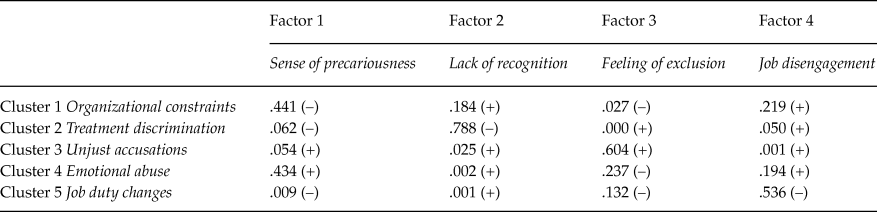
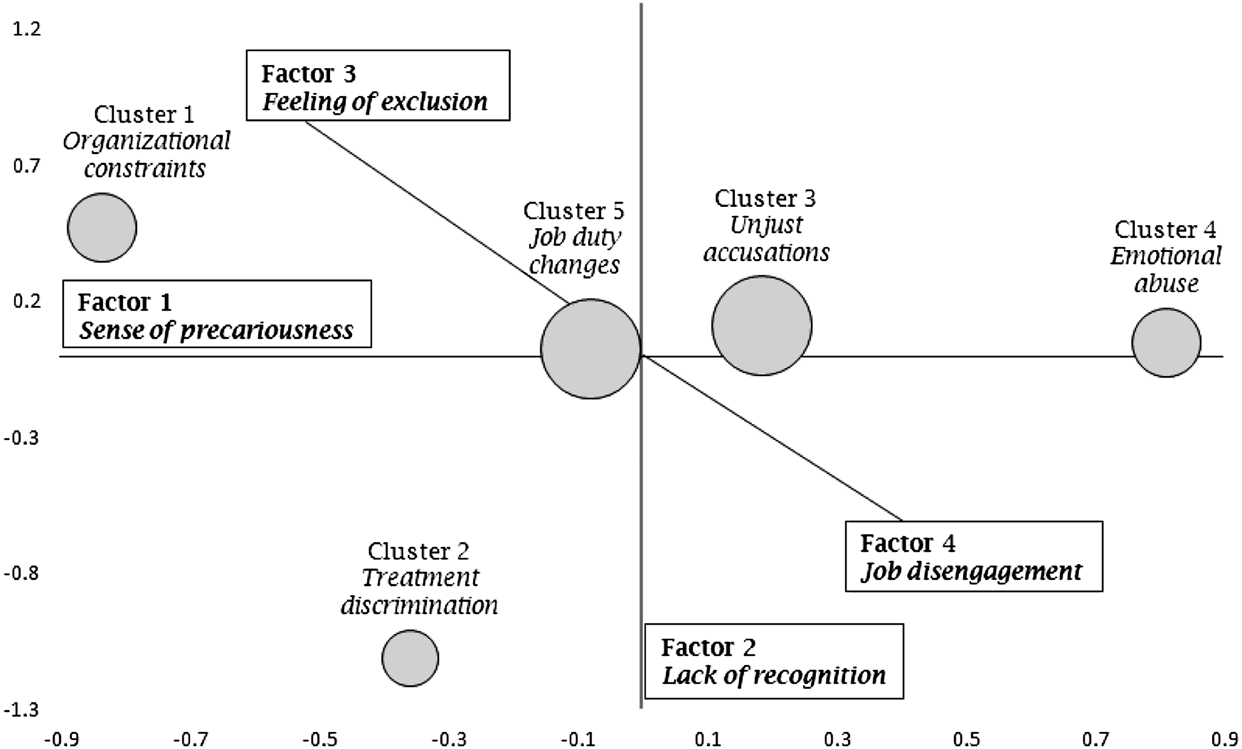
Correspondence Analysis has detected four latent dimensions which organize the main semantic oppositions in the textual corpus, from the different position of clusters in the space, indicated by the relative contributions of the factorial axes to the formation of each cluster (Table 2). These four latent factors explain all of the data variance (R 2 = 100%). Below, Figure 1 shows the distribution of clusters within the factorial space, represented graphically on a two-dimensional plane defined by the first (horizontal axis) and the second factor (vertical axis) and, with respect to which, the third and the fourth factors are ‘‘virtually’’ perpendicular (Figure 1).
Absolute Contributions of Factors to Each Cluster

Note: The sign reported in brackets (–/+) indicates the specific factorial pole (negative/positive) associated with each cluster.
Factorial Space.

Sense of precariousness: Occupational and psychological insecurity (F1). The first factor (34.38% of total variance) mainly differentiates Cluster 1 from Cluster 4, respectively on the negative and the positive pole. It refers to a different contextualization of workplace bullying experiences, dealing with hostile organizational constraint or relational climate which may cause a deep sense of precariousness. On the one hand, workplace bullying is depicted as deriving from the uncomfortable job situation of the individual at workplace which leads to workers’ economic/material destabilization. On the other hand, workplace bullying is experienced as emotional abuse deriving from relational dynamics concerning humiliations and harassments coming from supervisors or colleagues. In this sense, workplace bullying is conceived as damaging both occupational (threatening stability and membership to the organization) and psychological security (lowering personal integrity and wellbeing).
Lack of recognition: Professional and private sphere (F2). The second factor (26.35% of total variance) mainly differentiates Cluster 1 from Cluster 2, respectively on the positive and the negative pole. It seems to express a conflicting relationship between the company’s and workers’ needs leading to a lack of recognition of workers’ rights. Indeed, on the one hand, workers perceive themselves as a labor force to be exploited from the top, because they are uniquely asked to adapt to workplace and accomplish the company’s requests and are not appreciated for their professional value and competence. On the other hand, workers feel scarcely recognized as persons and report the company’s discriminating attitudes which tend to deny them any form of support with regard to their personal and family needs. In both these situations workers express the lack of recognition of their rights from the company and the consequent feeling of being devalued with regard to both professional and private sphere.
Feeling of exclusion: Rejection or isolation (F3). The third factor (23.01% of total variance) mainly differentiates Cluster 3 from Clusters 4 and 5, respectively on the positive and the negative pole. It seems to express the sense of exclusion from the work organization resulting from two different workplace bullying strategies, which respectively aim at rejecting or isolating workers. Indeed, on the one hand, workers perceive themselves as victims of undeserved, malicious and voluntary attacks which aim at ruining and discrediting them, as a direct organizational strategy to substitute and excluding them from the workplace. On the other hand, subtler and indirect forms of workplace bullying are enacted which aim at progressively making workers feel isolated: They are subjected to stressful conditions affecting their psychological (i.e. being humiliated and marginalized, see Cluster 4) or job-related status (i.e. being downgraded and given unfamiliar tasks, see Cluster 5).
Job disengagement: Detachment and powerlessness (F4). The fourth factor (16.27% of total variance) mainly differentiates Clusters 1 and 4 from Cluster 5, respectively on the positive and the negative pole. Workplace bullying experience relates to the reduced perception of job engagement and motivation because workplace bullying seems to affect two different basic needs of workers: Affiliation and achievement. On the one hand, workplace bullying is mainly perceived as deriving from affective detachment from the work organization: Workers report being scarcely recognized and appreciated for their personal contributions (Cluster 1) or being emotionally rejected from supervisors and colleagues (Cluster 4). As a result, they thus look at the organization as something they are not part of. On the other hand, workplace bullying refers to the sense of powerlessness deriving from the lack of stimuli for growth and career development or to excessive workload they are subjected to. In this sense, workplace bullying seems to reduce workers’ job motivation, by discouraging their need to belong to the workplace (affiliation) and their desire for significant accomplishment and mastering of skills (achievement), thus contributing to their progressive disengagement.
Discussion
This study deals with the main emotional dimensions which shape the subjective experience of workplace bullying directly resulting from workers’ narratives. In detail, five themes emerged from workplace bullying stories which respectively refer to organizational constraints, treatment discrimination, unjust accusations, emotional abuse and job duty changes. In addition, four synthetic dimensions were detected which consent to account the variability of workplace bullying experience based on: Precariousness, lack of recognition, feeling of exclusion and job disengagement.
Despite emotional abuse (Davenport, Distler-Schwartz, & Pursell-Elliott, Reference Davenport, Distler-Schwartz and Pursell-Elliott1999) being widely recognized as the main form of workplace bullying - in terms of psychological terror and attacks to social interactions at workplace (Leymann, Reference Leymann1990) - this thematic cluster is only partially present in our workplace bullying stories (about 15% out of the total text). This is consistent with previous studies that reported teasing, intimidating and offensive behaviors as less frequent in the Italian context (Arenas et al., Reference Arenas, Giorgi, Montani, Mancuso, Perez, Mucci and Arcangeli2015; Giorgi et al., Reference Giorgi, Arenas and Leon-Perez2011).
Instead, unjust accusations and job duty changes are reported as the most frequent bullying behaviors (together consisting in over 60% of themes detected), which both threaten workers’ professional status rather than relational climate or communication. Unjustified criticism, attacks against reputation and intimating use of disciplinary procedures can be considered as voluntary malicious actions which aim at destabilizing workers (Rayner & Hoel, Reference Rayner and Hoel1997). In this sense, workplace bullying may become a form of direct persecution enacted by company management, which often involves targeting the best employees because, despite they are skilled and able to work well with others, they show strong independence and refuse to be subservient or controlled by others (Richardson & McCord, Reference Richardson and McCord2001). As well, job duty changes in terms of work overload/underload, demotion, undue work pressure and impossible deadlines (Rayner & Hoel, Reference Rayner and Hoel1997) could represent an organizational strategy based on deskilling employees (Aiello, Deitinger, Nardella, & Bonafede, Reference Aiello, Deitinger, Nardella and Bonafede2008) in order to allow management to maintain control over them. This is in line with the findings by Giorgi et al. (Reference Giorgi, Arenas and Leon-Perez2011) who found jobs outside of the level of competence as one of the most frequent bullying acts affecting Italian workers.
Another form of workplace bullying resulting from workers’ experience deals with organizational constraints. As suggested by van Heugten (Reference van Heugten2010), organizations are becoming increasingly stressful and demanding, which can lead to an array of issues, such as role conflicts and staff shortages, and thus create a workplace where bullying can thrive. Because the stories used in the present study were posted since 2008, the economic crisis may be regarded as a vital stressor that can affect this result, because reduced psychological well-being and job satisfaction may create fertile soil for bullying behaviors (Giorgi, Shoss, & Leon-Perez, Reference Giorgi, Leon-Perez and Arenas2015). Indeed, the rise of workplace bullying in last decades may also be linked to some phenomena, such as globalization and the recent global economic crisis loom over society, causing higher instability and competitiveness in the workplace culture (Duffy, Reference Duffy2009). In this regard, Kearns, McCarthy and Sheehan (Reference Kearns, McCarthy and Sheehan1997) argued that organizational restructuring can foster workplace bullying due to the insecurities of employees because of potential job losses. This seems to be especially true in the Italian context, where the recent EURISPES survey on Stress and Work (2013) highlighted that younger workers mostly suffer from workplace bullying, probably because of their precarious job conditions.
Then, treatment discrimination is also considered as an expression of bullying at workplace. This result is widely confirmed in the literature, indeed many cross sectional studies showed that workers who experience racial/ethnic discrimination in the workplace suffer a range of negative psychological health outcomes, such as poor mental health, distress and negative emotions (Hammond, Gillen, & Yen, Reference Hammond, Gillen and Yen2010). Often times, workplace discrimination is motivated by beliefs of inferiority of a socially disadvantaged outgroup compared to a dominant group and these ranking systems are shown to be initiated and perpetuated by both co-workers and employers/supervisors alike (de Castro, Fujishiro, Sweitzer, & Oliva, Reference de Castro, Fujishiro, Sweitzer and Oliva2006). Specifically, various pressure tactics are used by employers to force employees who are pregnant or new mothers to resign both in Italy and in other European countries (such as Croatia and Greece), where the worrying practice of the so-called “blank (or white) resignation”Footnote 2 was identified as affecting around 2 million women (Tomescu & Cace, Reference Tomescu and Cace2010). This has in turn triggered a political debate and, as a result, the Italian Parliament has adopted Act No. 92/2012, The Labor Market Reform from a Perspective of Growth, which now strengthens the rules prohibiting the use of “white resignations”.
With specific regard to the factors detected, sense of precariousness (in terms of both occupational and psychological insecurity) is found to be the most relevant issue explaining the variability among workplace bullying stories. In this regard, workplace bullying is generally related to destabilization and deterioration of interpersonal relations as well as organizational dysfunctions (Rayner & Hoel, Reference Rayner and Hoel1997). van Heugten’s (Reference van Heugten2010) findings showed that the lack of job control contributes to higher uncertainty of employees’ roles within the organization. This sense of uncertainty may also explain the lack of recognition perceived by workers, which mainly relates to the difficult interface between work and family. Having opinions and views ignored was indeed found as one of the most prevalent bullying acts in the Italian context (Arenas et al., Reference Arenas, Giorgi, Montani, Mancuso, Perez, Mucci and Arcangeli2015). For instance, in Italy people employed in fixed-term contracts/working on a project or in other kinds of temporary positions do not tend to enforce their rights regarding pregnancy and maternity because they fear that their contract might not be extended. This is especially true for young people, who are also potential parents. The economic crisis tends to further reinforce the fear of victimization and therefore the strong reluctance to enforce individual rights (Masselot, Caracciolo Di Torella, & Burri, Reference Masselot, Caracciolo di Torella and Burri2012). In other words, workers’ sense of precariousness overtime contributes to reduce their feeling of being recognized, supported and appreciated by the company which in turn may lead to experience workplace bullying actions to a greater extent. With regard to exclusion feelings, in terms of rejection and direct pressure to resign or subtle process of gradual isolation, literature demonstrated that workplace bullying is experienced as a process of expulsion and exclusion from which transformation is possible through the exercise of agency (Shallcross, Reference Shallcross2003). Schuster (Reference Schuster1996) discussed workplace bullying as a method for socially excluding “outsiders” and identified gender and social class as potential risk factors. This dimension seems to be consistent with findings by Aiello et al. (Reference Aiello, Deitinger, Nardella and Bonafede2008) who specifically detected a relational factor of workplace bullying, dealing with relationships with supervisors and co-workers, emphasizing aspects of verbal and non-verbal, formal and informal communication within the organization, verbal violence, derision and exclusion from informal gatherings or during work breaks.
Then, job disengagement is another dimension emerging from our analysis, consisting in both affective detachment and powerlessness in accomplishing job duties. These two consequences of workplace bullying were also highlighted in previous studies (Aiello et al., Reference Aiello, Deitinger, Nardella and Bonafede2008): Bullied workers tend overtime to develop reduced affective relationship with working environment and low correspondence between occupational and individual values, as well as increased powerlessness mainly deriving from deskilling. In this sense, workplace bullying seems to destabilize two basic needs of workers: their desire to belong and form relationships with others within a worksite which meets their identity needs (Clark, Reference Clark and Burton1990), as well as their desire to achieve goals and compete (Duffy, Reference Duffy2009). Workplace bullying thus creates a sort of double bind where the victim is caught in a tangle of paradoxical injunctions in which he cannot do the right thing, because workers are allowed neither to feel safe and affectively attached to their workplace nor to have stimuli for job satisfaction and career development.
Overall, the present study seems to suggest precariousness, lack of recognition, feeling of exclusion and job disengagement as main subjective factors, which characterize the self-perception as a victim of workplace bullying and may potentially account for the sensitivity and awareness about the phenomenon.
Besides, from the emotional experience shaping the relationship between bullied workers and their work environments, this research study allows the identification of some organizational situations that are “at risk” for workplace bullying in order to promote better organizational health. Indeed, a psychosocial evaluation should be increasingly oriented towards a more perspective interpretation of organizations aimed at prevention, rather than at “curing” the effects of workplace bullying, in order to achieve necessary “early diagnosis” of more general organizational dysfunctions (Aiello et al., Reference Aiello, Deitinger, Nardella and Bonafede2008).
Despite our results being quite preliminary and needing further investigation, the analysis of workplace bullying stories reveals some conditions of work contexts which may trigger potential bullying actions. Precariousness is the most relevant one: work organizations which largely use fixed-term contracts and temporary positions may lead to helpless and undefended conditions of employees which in turn may contribute to the low enforcement of their rights. In this regard, work policies could better guarantee workers’ rights and protect employees from weak contract conditions, excessive overload or company’s requests. This is especially important along the current financial crisis which increasingly affects organizational contexts in terms of corporate merger or reorganization with some consequences for workers, such as compulsory transfers, overtime requirements, work pressure, impossible deadlines and job duty changes. In addition, the strong destabilization which workers are subjected to makes them progressively invisible, interchangeable, unnecessary, thus contributing to scarce recognition of their personal contribution and value, as well as to their affective detachment from work contexts.
Another issue that should be taken into account deals with treatment disparities and discrimination actions which may affect workers, mainly female ones. A gender-sensitive work policy regulating the initial access to labor market and next career perspectives could thus favor the reduction of stereotypes and prejudices leading overtime to workplace bullying. This could works for gender disparities as well as for other minorities (i.e. based on religious and sexual orientation).
With regard to exclusion process affecting bullied workers, prevention strategies should be implemented which aim at promoting better teamwork, communication with colleagues and supervisors, knowledge of work processes and procedures, awareness of the work context and external environment. This could enhance employees’ sense of job control, as well as participative and cooperative practices at workplace. Indeed, emotional abuse in terms of harassments, insults, humiliations, derisions can be considered as the extreme consequence of organizational cultures which are individualistic and competitive, and where workers are mainly viewed as labor force to be exploited and not as human resources needing to form relationships and belong to the organization.
Then, ongoing professional development and training opportunities should be provided in order to value workers’ competences, discourage possible job disengagement and improve career adaptability (Bocciardi, Caputo, Fregonese, Langher, & Sartori, Reference Bocciardi, Caputo, Fregonese, Langher and Sartori2017). Indeed, occupational contexts which do not invest on proficiency and innovation may be at higher risk for workplace bullying, because workers who are only requested to fulfil assignations and to be subservient or controlled by management may perceive themselves as dependent and passive and thus easily perpetuate their status of workplace bullying victims.
However, some limitations need to be acknowledged regarding the present study, because of its merely qualitative and exploratory nature. Therefore, it does not consent to assess the real spread of workplace bullying and the different related behaviors in the Italian context, rather it only provides some thematic areas regarding workplace bullying experience that need further investigation. Indeed, workplace bullying could be characterized by higher variability compared to what emerges from the analysis of our workplace bullying stories. In this regard, future research could carry out a representative nationwide survey in order to confirm and better explain our results. For instance, a questionnaire including some measures regarding precariousness, lack of recognition, feeling of exclusion and job disengagement could be administered and validated in order to test whether these factors successfully explain workplace bullying perceptions and discriminate workers who are victims of workplace bullying and not. This would also consent to perform secondary sub-group analyses by individual socio-demographic characteristics (such as gender, age, education), job position and variables of organizational context (such as public or private sector, type of employment sector, size of the company) to further disentangle the perceived contents of workplace bullying in a large sample.