

1. Introduction
Bryozoans are colonial, mainly marine animals, their fossil record going back to the Early Ordovician (Taylor & Larwood, Reference Taylor, Larwood, Taylor and Larwood1990; Taylor & Ernst, Reference Taylor, Ernst, Webby, Paris, Droser and Percival2004). They feed by suspension filtering, catching mainly phytoplankton. Palaeozoic bryozoans belong mainly to the Class Stenolaemata are often diverse and abundant in marine sediments from Ordovician to Permian times (Taylor & Allison, Reference Taylor and Allison1998). Owing to their stable calcitic skeletons, Palaeozoic stenolaemate bryozoans usually show better preservation than many other groups. As sessile animals, they show manifold interactions with their environment. This makes them valuable for the investigation of different aspects of evolution, ecology and biogeography. Bryozoan colony shape has often been used for the interpretation of environment conditions (e.g. Stach, Reference Stach1936; Schopf, Reference Schopf1969; Hageman, Bone & McGowran, Reference Hageman, Bone and McGowran1997; Hageman et al. Reference Hageman, Bock, Bone and McGowran1998).
The earliest bryozoans are known from the Early Ordovician of China (Hu & Spjeldnaes, Reference Hu, Spjeldnaes, Bigey and d'Hondt1991; Xia, Zhang & Wang, Reference Xia, Zhang and Wang2007). This early bryozoan fauna contains five trepostome and one cryptostome species, and comes from the Fenghsiang Formation of Changyang and Yidu, Hubei, China, which is late Tremadocian in age. The finding of bryozoans is associated with the deltifer Conodont Zone (Zhang et al. Reference Zhang, Xia, Yan and Wang2009). These early bryozoans were involved in biogenic constructions of the reef-mound type (Adachi, Ezaki & Jianbo, Reference Adachi, Ezaki and Jianbo2010; Cuffey et al. Reference Cuffey, Xiao, Zhu, Spjeldnaes, Hu, Ernst, Schäfer and Scholz2012).
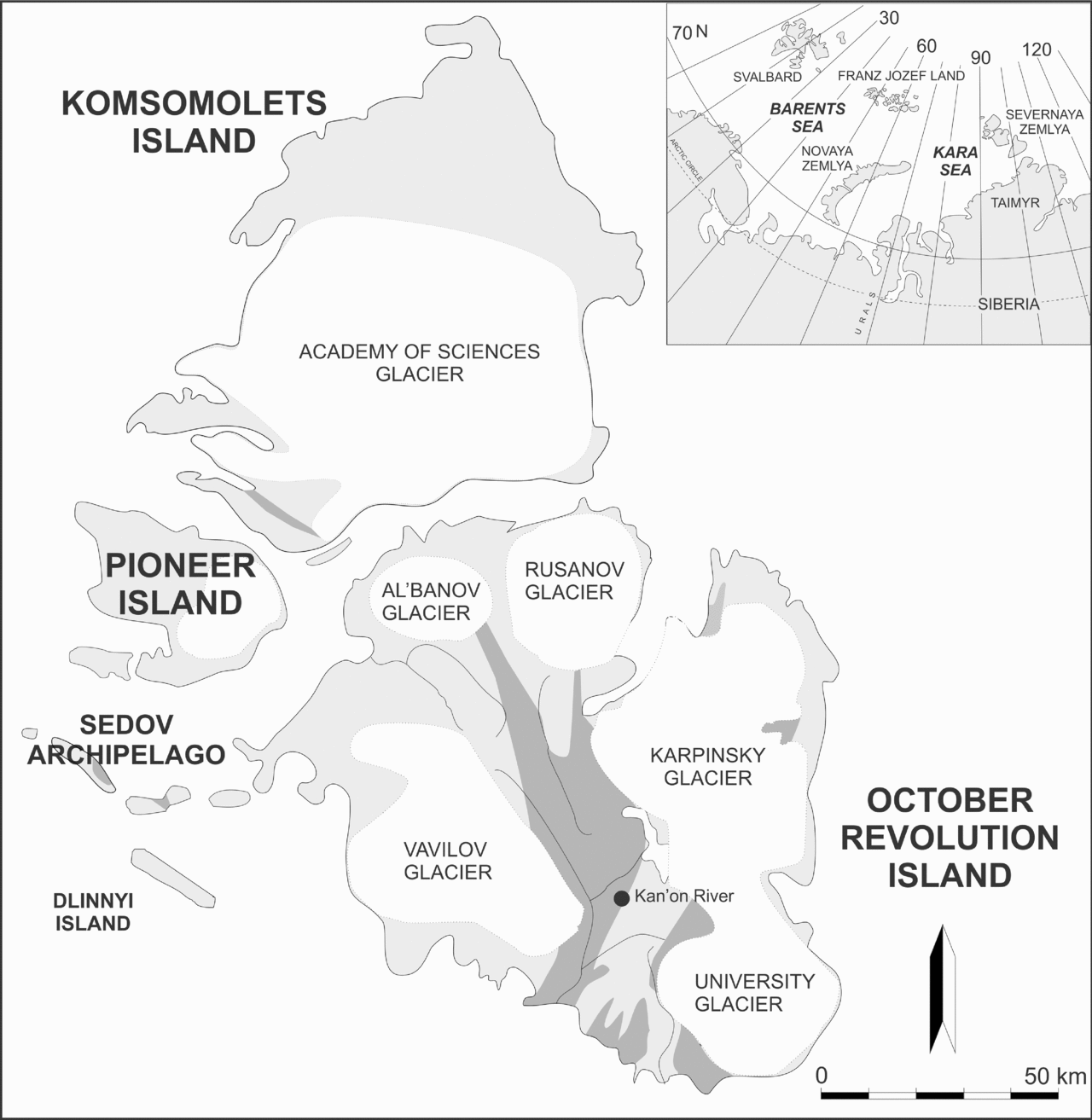
The Severnaya Zemlya Archipelago is located on the edge of the Arctic Ocean north of the Taimyr Peninsula, separating the Kara and Laptev seas (Fig. 1). Its position on the edge of the Eurasian margin and well-exposed Palaeozoic geology make this domain important for reconstructing the early history of the Arctic Ocean.
Geographic location of the studied area and a map of Severnaya Zemlya showing areas with Ordovician (dark-grey) outcrops. Black circle shows the basin of the Kan'on River, where bryozoan samples were collected.

Ordovician bryozoans have been repeatedly reported from Arctic Russia (e.g. Astrova, Reference Astrova1965; Nekhorosheva, Reference Nekhorosheva1970, Reference Nekhorosheva and Basset1976, Reference Nekhorosheva1977). These records concern mainly Taimyr and Novaya Zemlya. Bryozoans occur commonly in the Ordovician successions of October Revolution Island. However, the published information on Early Ordovician bryozoans from this area is scarce. Only trepostomes, among them Halloporina and Nicholsonella, have been recorded from the Middle Ordovician Ozernaya Formation of Severnaya Zemlya (Nekhorosheva, Reference Nekhorosheva2002).
The aim of the present paper is to describe new material of the trepostome bryozoan Dianulites borealis Astrova, Reference Astrova1965, collected on October Revolution Island of Severnaya Zemlya and to discuss their implications for palaeogeography and palaeoecology.
2. Stratigraphy
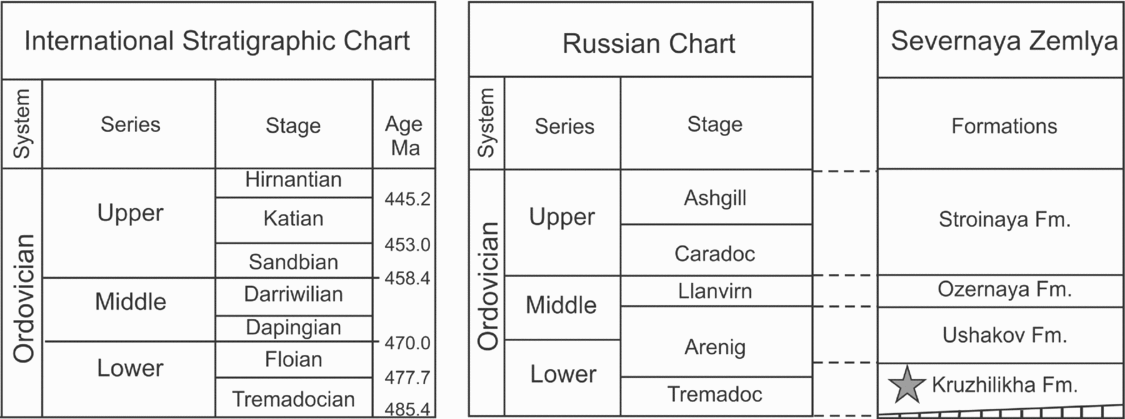
In Severnaya Zemlya, Ordovician strata are well exposed in the central and southern parts of October Revolution Island, and on the southeastern part of Komsomolets Island (Fig. 1). The Ordovician deposits (Fig. 2) are up to 1700 m thick and are composed of conglomerates, sandstones, siltstones and claystones with interbeds of gritstones, gypsum, dolomites and limestones.
Ordovician stratigraphy of Severnaya Zemlya (modified from Krasnov et al. Reference Krasnov, Savitsky, Tesakov and Khomentovsky1983), showing an approximate position (asterisk) of the samples collected for this study. Vertical strokes indicate timing of the major unconformity.

The Ordovician strata of Severnaya Zemlya Archipelago have been subdivided into the Kruzhilikha, Ushakov, Ozernaya and Stroinaya formations (Markovsky & Makar'ev, Reference Markovsky, Makar'ev, Kaban'kov and Lazarenko1982). It should be noted that the ages of the Ordovician rocks are poorly constrained and need additional faunal studies.
The Lower Ordovician rocks are characterized by two formations. The lowermost Kruzhilikha Formation (Fig. 2) is made up of sandstone with conglomerate and gritstone lenses, and interbeds of siltstones, sandstones, tuffs, clayey dolostones and limestones (Gubanov, Bogolepova & De Ronde, Reference Gubanov, Bogolepova and Ronde2011). Strata are rich in fossils: brachiopods, ostracodes, trilobites, gastropods, bryozoans, crinoids and conodonts. Based on the conodonts, the age of the formation is constrained to the uppermost Tremadoc – Arenig. The thickness is 100–250 m (Markovsky & Makar'ev, Reference Markovsky, Makar'ev, Kaban'kov and Lazarenko1982).
The Lower to Middle Ordovician Ushakov Formation (Fig. 2) is subdivided into three parts. The lower part is composed mainly of red and green quartz sandstones with ripple marks. A few sheets of rhyolites and tuff beds (up to 5 m thick) occur in the succession. The uppermost beds of the lower part are stromatolitic limestones (up to 1.5 m thick). The middle part of the formation is represented by variegated (cherry-red, green, ash-grey) marls, siltstones and sandy dolostones with interbeds and lenses (up to 8 m thick) of orange and white gypsum (Gubanov, Bogolepova & De Ronde, Reference Gubanov, Bogolepova and Ronde2011). The upper part of the formation is made up of red to green quartz sandstones with ripple marks, which pass up into alternations of sandstones, marls, siltstones, dolostones and clayey limestones. Gastropods, brachiopods and stromatolites have been found in this formation. The thickness of the formation across Severnaya Zemlya varies from 300 to 1100 m (Markovsky & Makar'ev, Reference Markovsky, Makar'ev, Kaban'kov and Lazarenko1982).
The Middle Ordovician Ozernaya Formation (Fig. 2) is composed of dark-grey to black limestones, dolostones and gypsiferous rocks; the amount of gypsum varies from 20 to 50%. Marls and quartz sandstones are subordinate. The lower boundary with the Ushakov Formation is defined by a transition from variegated sandstones to dark limestones. In some places there is a stratigraphic gap between the Ushakov and Ozernaya formations. The limestones yield gastropods, cephalopods, bryozoans and conodonts (Bogolepova et al. Reference Bogolepova, Gubanov and Pease2006; Gubanov, Bogolepova & De Ronde, Reference Gubanov, Bogolepova and Ronde2011). The thickness varies from 100 to 300 m (Markovsky & Makar'ev, Reference Markovsky, Makar'ev, Kaban'kov and Lazarenko1982).
The Upper Ordovician Stroinaya Formation (Fig. 2) is composed of predominantly light coloured sandstones, dolostones, rarely marls and limestones. Common are tabulates, brachiopods, gastropods, bryozoans, scolecodonts and conodonts (Bogolepova, Gubanov & Pease, Reference Bogolepova, Gubanov and Pease2006; Männik et al. Reference Männik, Bogolepova, Põldvere and Gubanov2009). A Late Ordovician age has been suggested on the basis of the tabulate corals. The thickness of the formation changes from 50 to 200 m (Markovsky & Makar'ev, Reference Markovsky, Makar'ev, Kaban'kov and Lazarenko1982). There is a conformable contact with the underlying Middle Ordovician Ozernaya strata. The upper boundary of the formation corresponds to the level where variegated sandstones are replaced by the first dark-grey limestones of the lower Silurian Vodopad Formation. There is a stratigraphic gap between these units (Bogolepova, Gubanov & Pease, Reference Bogolepova, Gubanov and Pease2006).
3. Material and methods
The material described here was collected from the Kruzhilikha Formation in outcrops along the Kan'on River in the southeastern part of October Revolution Island of Severnaya Zemlya (Fig. 1). Bryozoans were collected at the following four localities.
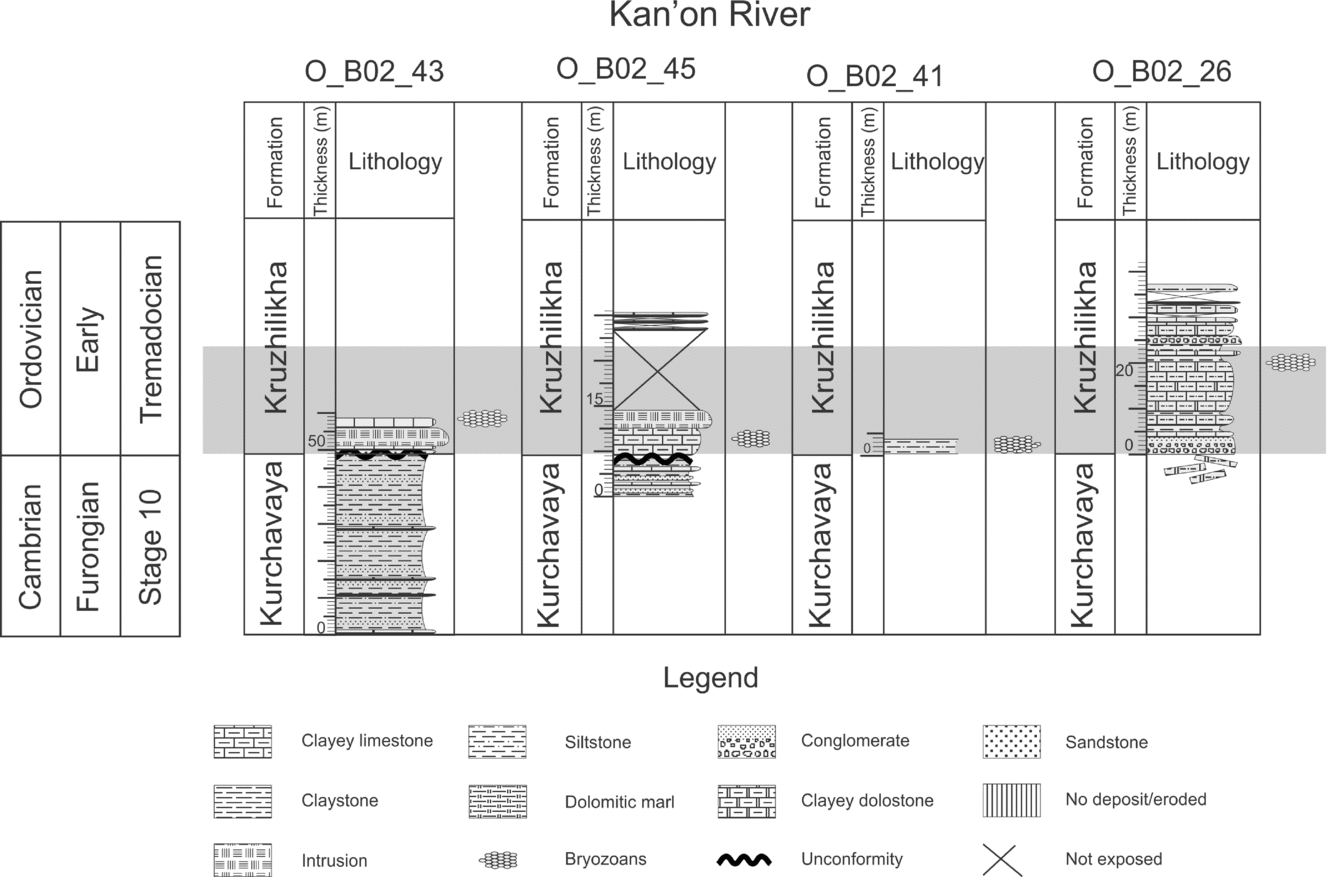
At locality B02_26 (N 79.94, E 97.22), a sequence of sandy limestones, conglomerates, claystones, dolostones and limestones is exposed (Fig. 3) on the right tributary of the Kan'on River (Fig. 1). Bivalves, trilobites, monoplacophoran molluscs and bryozoans are known in these strata (fieldwork data).
Simplified logs and their tentative correlation showing position of the sampled bryozoan material (Gubanov, Bogolepova & De Ronde, Reference Gubanov, Bogolepova and Ronde2011; unpub. CASP Report).

Locality B02_43 (N 79.2295, E 97.892323) is situated on the right tributary of the Kan'on River (Fig. 1). At this locality, an alternation of light-grey siltstone and sandstone with interbeds of grey limestone is exposed. Limestones yield abundant brachiopods and bryozoans.
At locality B02_45 (N 79.2295, E 97.96872) a sequence of grey massive detrital limestones interbedded with claystones (Fig. 3) is exposed along the unnamed creek in the basin of the Kan'on River (Fig. 1). Limestones yield gastropods, crinoids and bryozoans.
Locality B02_41 (N 79.21952, E 98.06625) is situated on the bank of an unnamed creek flowing in to Ostroe Lake. At this locality, a sequence of alternating grey siltstones and dark-grey shales is exposed. Shales yield trilobites and bryozoans.
The collected bryozoans form massive hemispherical colonies that are mainly freely weathered from or partly embedded in the surrounding rock (Fig. 4a, b). Three colonies were thin-sectioned, and six thin-sections were used for the taxonomic description. The study was performed using a binocular microscope. The studied material is housed at the Palaeontological collections, Museum of Evolution, Uppsala University, Uppsala, Sweden, under collection numbers PMU 26951 (26951/1, 26951/2 and 26951/3), PMU 26952 (26952/1 and 26952/2) and PMU 26953 (26953/1) (numbers in brackets are thin-sections).
Dianulites borealis Astrova, Reference Astrova1965. (a) Hemispherical colony embedded in the rock. (b) Hemispherical colony, external view. (c) Longitudinal thin-section through the hemispherical colony, 26953/1. (d) Longitudinal thin-section of the exozone showing autozooecial chambers with diaphragms, 26951/2. (e) Longitudinal thin-section of the endozone showing autozooecial chambers with sparse diaphragms, 26953/1. (f) Longitudinal thin-section of the exozone showing autozooecial chambers with diaphragms, 26952/2.

4. Systematic palaeontology
Phylum BRYOZOA Ehrenberg, Reference Ehrenberg1831
Class STENOLAEMATA Borg, Reference Borg1926
Order TREPOSTOMATA Ulrich, Reference Ulrich1882
Suborder ESTHONIOPORINA Astrova, Reference Astrova1978
Family Dianulitidae Vinassa de Regny, Reference Vinassa de Regny1921
Genus Dianulites Eichwald, Reference Eichwald1829
Type species. D. detritus (= D. fastigiatus) Eichwald, Reference Eichwald1829. Early to Middle Ordovician; Russia, Estonia.
Diagnosis. Colony turbinate, cone or horn-shaped, sometimes compound, occasionally with a conical central cavity, in some species massive hemispherical; zooecia opening on upper, distal surface of colony; colony sides comprising exterior wall; not differentiated into endozone and exozone; maculae variably developed, some monticulate. Zooecia long polygonal tubes, monomorphic or obscurely polymorphic; walls thin, indistinct, granular, inclusion-rich; styles lacking; diaphragms moderately abundant, microstructural fabric strongly radial (modified after Taylor & Wilson, Reference Taylor and Wilson1999).
Comparison. Dianulites Eichwald, Reference Eichwald1829 belongs to the family on its own (Vinassa de Regny, Reference Vinassa de Regny1921). It shows similarities to the unplaced genus Nicholsonella Ulrich, 1890. These genera possess re-crystallized walls, which suggest a diagenetically unstable aragonitic (McKinney, Reference McKinney1971) or high-magnesium calcite composition (Taylor & Wilson, Reference Taylor and Wilson1999). Nicholsonella differs from Dianulites by having abundant mesozooecia and acanthostyles.
Discussion. The systematic position of Dianulites is controversial. Whereas Utgaard (Reference Utgaard, Boardman, Cheetham, Blake, Utgaard, Karklins, Cook, Sandberg, Lutaud and Wood1983), Taylor & Wilson (Reference Taylor and Wilson1999) and Pushkin (Reference Pushkin2002) placed Dianulites in the Order Trepostomata, some other specialists regarded this genus as a cystoporate bryozoan (Astrova Reference Astrova1965, Reference Astrova1978; Gorjunova, Reference Gorjunova1992). The arguments for both positions are tenable. The main trepostome affinity is the strongly prismatic zooecia with polygonal shaped transverse sections and absence of any structures resembling lunaria. The cystoporate affinity is explained by the granular wall microstructure contrasting with the typically laminated structure in most trepostome bryozoans, as well as by the presence of heterozooecia, which Astrova (Reference Astrova1965) regarded as being cystopores (thought of as a special type of heterozooecia constituting the vesicular skeleton). Vesicular structures are characteristic mainly for cystoporates (Utgaard, Reference Utgaard, Boardman, Cheetham, Blake, Utgaard, Karklins, Cook, Sandberg, Lutaud and Wood1983), but also occur in trepostomes (Boardman & Buttler, Reference Boardman and Buttler2005) and in ptilodictyine cryptostomes (Karklins, Reference Karklins, Boardman, Cheetham, Blake, Utgaard, Karklins, Cook, Sandberg, Lutaud and Wood1983; Gorjunova & Lavrentjeva, Reference Gorjunova and Lavrentjeva1993). As supporting structures (kenozooids), a vesicular skeleton also occurs in fenestrates (Morozova, Reference Morozova2001). Only the rhabdomesine cryptostomes seem to lack vesicular structures (maybe with the exception of Clausotrypa Bassler, Reference Bassler and Wanner1929, an uncertain genus).
The typical colony shape of Dianulites is turbinate, cone or horn-shaped. However, several species are placed in this genus that have a massive hemispherical colony shape, but correspond to the genus diagnosis in their internal morphology (see Section 5).
Occurrence. Early to Late Ordovician; Europe, North America, Asia.
Dianulites borealis Astrova, Reference Astrova1965
Figures 4, 5; Table 1
-
1965 Dianulites borealis Astrova, p. 133, pl. 4, fig. 2.
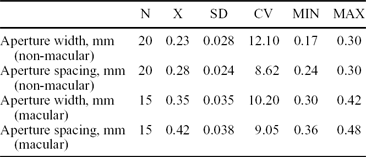
Descriptive statistics of Dianulites borealis Astrova, Reference Astrova1965

Abbreviations: N – number of measurements; X – mean; SD – sample standard deviation; CV – coefficient of variation; Min – minimal value; Max – maximal value.
Dianulites borealis Astrova, Reference Astrova1965. (a) Tangential thin-section showing autozooecial apertures in maculae and non-macular area, 26951/3. (b) Tangential thin-section showing autozooecial apertures and an immature zooecium, 26951/1. (c) Tangential thin-section showing an immature zooecium (arrow), 26951/1. (d, e) Tangential thin-sections showing autozooecial apertures and irregular autozooecial walls, 26951/3. (f) Longitudinal thin-section of the endozone showing autozooecial walls, 26953/1.

Material. Three colonies and six thin-sections: PMU 26951 (26951/1, 26951/2 and 26951/3), PMU 26952 (26952/1 and 26952/2), PMU 26953 (26953/1).
Description. Massive hemispherical colonies, 13–18 mm thick in their central part, 20–25 mm wide at their base. Secondary overgrowth occurs. Exozone indistinct. Autozooecia long, prismatic, growing from epitheca. Autozooecial apertures polygonal. Immature zooecia smaller than autozooecia common, situated in corners of autozooecia. Diaphragms straight, rare to common in endozone, common in exozone. Autozooecial walls indistinctly granular, irregularly thickened, 0.02–0.04 mm thick. Maculae consisting of larger autozooecia present, 1.95–2.34 mm in diameter.
Comparison. Dianulites borealis Astrova, Reference Astrova1965 differs from D. janischevskyj Modzalevskaya, Reference Modzalevskaya1953 in having smaller apertures (non-macular aperture width 0.17–0.30 mm v. 0.24–0.30 mm in D. janischevskyj; macular aperture width 0.39–0.42 mm v. 0.36–0.46 mm in D. janischevskyj), as well as having less abundant diaphragms.
Occurrence. Early Ordovician, Tremadocian; Yuzhny Island, Novaya Zemlya, Arctic Russia. Early Ordovician, Tremadocian; October Revolution Island of the Severnaya Zemlya Archipelago, Arctic Russia.
5. Palaeoecology
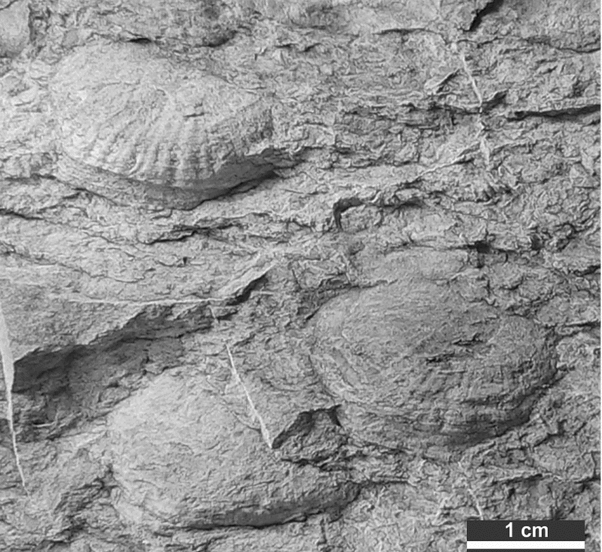
Bryozoan colonies were collected from fine-grained sediments such as siltstones (Fig. 6). All the bryozoans possess a hemispherical massive colony shape, which is characteristic for many trepostome and cystoporate genera of the Early Palaeozoic. In particular, the early taxa occurring in the time from the Tremadocian to Darriwilian tend to develop such a colony shape (e.g. Modzalevskaya, Reference Modzalevskaya1953, Reference Modzalevskaya1955; Hu & Spjeldnaes, Reference Hu, Spjeldnaes, Bigey and d'Hondt1991; Pushkin & Popov, Reference Pushkin and Popov1999; Gorjunova & Koromyslova, Reference Gorjunova and Koromyslova2008; Koromyslova, Reference Koromyslova2011; Koromyslova, Fedorov & Ershova, Reference Koromyslova, Fedorov and Ershova2009). These colonies are associated with fine-grained sediments which suggest deposition under moderate sedimentation and erosion rates (Modzalevskaya, Reference Modzalevskaya1955; Spjeldnaes, Reference Spjeldnaes, Gordon, Smith and Grant-Mackie1996). In contrast, Late Palaeozoic bryozoans are rarely known to develop massive hemispherical colonies. The increase in diversity of bryozoans as well as other benthic groups such as echinoderms during the Early Ordovician is often linked to the rapid spread of hardgrounds in the Ordovician owing to the ‘Calcite Seas’ conditions, which means the prevailing precipitation of low-magnesium calcite in marine environments (Wilson et al. Reference Wilson, Palmer, Guensburg, Fintin and Kaufman1992; Rozhnov & Palmer, Reference Rozhnov and Palmer1996; Taylor & Ernst, Reference Taylor, Ernst, Webby, Paris, Droser and Percival2004; Taylor & Wilson, Reference Taylor and Wilson2003). The hardgrounds represent reliable substrates for benthic organisms. In contrast, soft, loosely cemented substrates erode easily, making an unstable attachment surface (Taylor & Wilson, Reference Taylor and Wilson2003). Hardgrounds allow development of various colony shapes, whereas soft bottoms can be colonized by specialists, to which bryozoans with hemispherical colonies certainly belong. Biotopes in which hemispherical taxa occur usually show low diversity of other bryozoans (Spjeldnaes, Reference Spjeldnaes, Gordon, Smith and Grant-Mackie1996; pers. obs.). Massive colonies have some structural constraints for occupation of vertical space in the water column, and their capacities for regulation of the feeding currents are also limited (except the development of maculae which use the chimney effect; Taylor, Reference Taylor1975). The new forms became more advanced, alongside the reduction of soft-bottomed biotopes in the shallow seas, which were preferably inhabited by bryozoans with hemispherical colonies. The change of substrate conditions (predominance of hardgrounds) during the Ordovician resulted in a shift in faunal composition (Wilson et al. Reference Wilson, Palmer, Guensburg, Fintin and Kaufman1992; Taylor & Wilson, Reference Taylor and Wilson2003).
Colonies of Duanulites borealis Astrova, Reference Astrova1965 in situ, Kruzhilikha Formation, Early Ordovician.

6. Palaeogeography
The Severnaya Zemlya Archipelago together with the northern part of Taimyr was part of the Kara Plate (Bogdanov et al. Reference Bogdanov, Khain, Rosen, Shipilov, Vernikovsky, Drachev, Kostyuchenko, Kuzmichev and Sekretov1998), a microplate that collided with central Taimyr (today part of the Siberian Plate) during Late Palaeozoic times (Vernikovsky, Reference Vernikovsky1996).
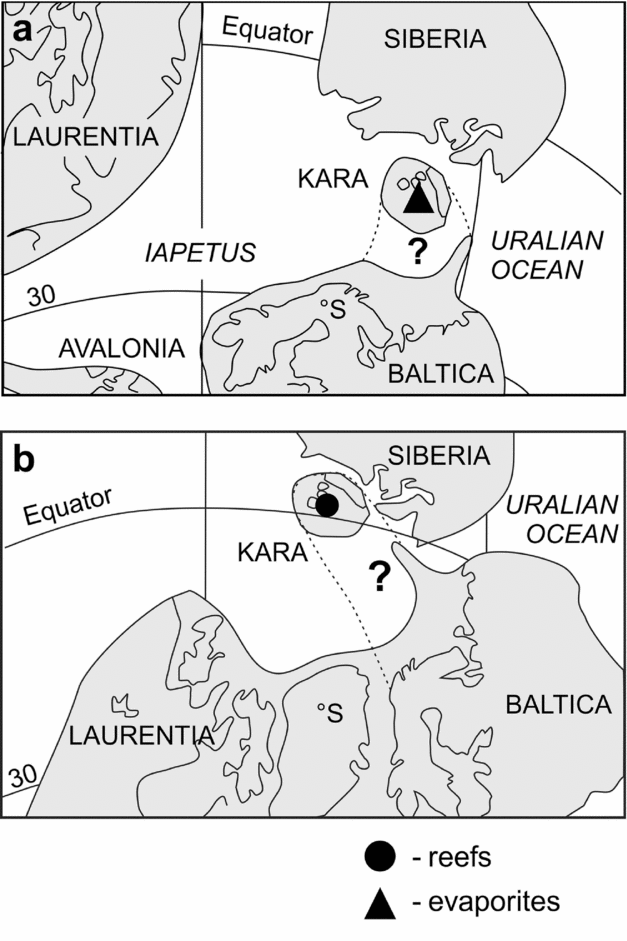
Reconstruction of the Early Palaeozoic history of the Kara Plate is problematic owing to significant differences and controversy surrounding its interpretations (e.g. Otto & Bailey, Reference Otto and Bailey1995; Gramberg, Ivanov & Pogrebitsky, Reference Gramberg, Ivanov and Pogrebitsky2004; Korago & Timofeeva, Reference Korago and Timofeeva2005; Ivanova, Sakoulina & Roslov, Reference Ivanova, Sakoulina and Roslov2006; Matveev et al. Reference Matveev, Verba, Ivanov, Roslov, Kuzina and Gavrilov2007; Drachev, Malyshev & Nikishin, Reference Drachev, Malyshev, Nikishin, Vining and Pickering2010). Palaeogeodynamic reconstruction is not the subject of this paper, but some ideas might be shown very briefly. Two interpretations of the pre-Mesozoic geodynamic history of this area prevail: (1) the Kara Plate as an independent terrane (see Zonenshain, Kuz'min & Natapov, Reference Zonenshain, Kuz'min and Natapov1990; Vernikovsky, Reference Vernikovsky1996; Metelkin et al. Reference Metelkin, Vernikovsky, Kazansky, Bogolepova and Gubanov2005) and (2) the Kara Plate as a part of Baltica (see Gee, Bogolepova & Lorenz, Reference Gee, Bogolepova, Lorenz, Gee and Stephenson2006; Pease & Scott, Reference Pease and Scott2009). Both interpretations, however, are in agreement with the Palaeozoic palaeogeography maps of Kara presented by many authors (see Metelkin et al. Reference Metelkin, Vernikovsky, Kazansky, Bogolepova and Gubanov2005; Cocks & Torsvik, Reference Cocks and Torsvik2005; Golonka, Reference Golonka2007). Though debatable in some details, these maps, however, show Kara's position at tropical latitudes (Fig. 7), correctly explaining a wide distribution of the Ordovician and Devonian evaporites and the Silurian reefs in the basin.
Palaeogeographic reconstructions of the Kara Plate during Ordovician (a) and Silurian (b) times (modified from Bogolepova, Gubanov & Pease, Reference Bogolepova, Gubanov and Pease2006). Question mark indicates a possible Kara–Baltica connection.

The first assessments of the Cambrian (Bogolepova, Gubanov & Raevskaya, Reference Bogolepova, Gubanov and Raevskaya2001; Jensen, Bogolepova & Gubanov, Reference Jensen, Bogolepova and Gubanov2010) and Ordovician (Bogolepova, Gubanov & Pease, Reference Bogolepova, Gubanov and Pease2006) faunas of Kara show a mixture of Siberian and Baltic affinities and do not bear a strong resemblance to either area. The Silurian fauna of Severnaya Zemlya is more complex and indicates that during this time the basin was well connected to the basins of North Greenland, Baltica (eastern Timan and northern Urals, in particular), Siberia and South China (Bogolepova, Gubanov & Pease, Reference Bogolepova, Gubanov and Pease2005; Siveter & Bogolepova, Reference Siveter and Bogolepova2006; Männik et al. Reference Männik, Bogolepova, Põldvere and Gubanov2009).
The record of Trepostomata ranges from the Early Ordovician to the Late Triassic (Astrova, Reference Astrova1978; Schäfer & Fois-Erickson, Reference Schäfer, Fois-Erickson and Walliser1986; Taylor & Cope, Reference Taylor and Cope1987). The earliest trepostome bryozoans are known from the Early Ordovician of China, and belong to the genera Orbiramus and Nekhorosheviella (Hu & Spjeldnaes, Reference Hu, Spjeldnaes, Bigey and d'Hondt1991; Xia, Zhang & Wang, Reference Xia, Zhang and Wang2007; Adachi, Ezaki & Jianbo, Reference Adachi, Ezaki and Jianbo2010; Cuffey et al. Reference Cuffey, Xiao, Zhu, Spjeldnaes, Hu, Ernst, Schäfer and Scholz2012). Dianulites borealis Astrova, Reference Astrova1965 described herein, is the oldest known member of the genus Dianulites Eichwald, Reference Eichwald1829. At the current stage of knowledge, the palaeobiogeographic application of this species is quite restricted, because no contemporary record of Dianulites is known. D. borealis was originally described from the late Tremadoc of Yuzhny Island, Novaya Zemlya, Arctic Russia. In the early Floian just a series of Dianulites species appeared (Modzalevskaya, Reference Modzalevskaya1953; Pushkin & Popov, Reference Pushkin and Popov1999, Reference Pushkin and Popov2001). The genus Dianulites is entirely restricted to the Ordovician, with a few species persisting until the Katian.
7. Summary
The species Dianulites borealis Astrova, Reference Astrova1965 has been identified from deposits of the Kruzhilikha Formation (Tremadocian, Early Ordovician) of October Revolution Island of the Severnaya Zemlya Archipelago, Arctic Russia. This species shows a palaeobiogeographical connection to Yuzhny Island of Novaya Zemlya, confirming the likely proximity of these basins. Dianulites borealis developed hemispherical colonies which were adapted to colonizing relatively soft substrate with moderately low rates of sedimentation and erosion.
Acknowledgements
Fieldwork on October Revolution Island was funded by the Swedish Polar Research Secretariat. The consortium of oil and gas industry subscribers is thanked for its financial support of the CASP Severnaya Zemlya Project. We also thank two anonymous reviewers for their helpful and constructive comments.