1 Introduction
The study of
 $C^*$
-algebras arising from number theory lies at the intersection of operator algebras and arithmetic. A substantial body of work has focused on
 $C^*$
-algebras associated with integral domains, rings of integers and adelic structures, often through crossed product constructions involving finite and infinite adeles [Reference Cuntz, Li, Blanchard, Ellwood, Khalkhali, Marcolli, Moscovici and Popa1, Reference Kaliszewski, Omland and Quigg3].
In this paper, we consider the
 $C^*$
-algebras associated with the rational lattice
 $\mathbb Q \subset \mathbb A$
and with the adele ring
 $\mathbb A$
itself. The main result of this paper can be summarised in the following theorem.
Theorem 1.1. The K-theory of the group
 $C^*$
-algebras associated with the adele ring
 $\mathbb {A}$
and its lattice
 $\mathbb {Q}\subset \mathbb {A}$
can be described as follows.
-
(a) For the rational lattice
 $\mathbb {Q}\subset \mathbb {A}$
, we have
$K_0\bigl (C^*(\mathbb {Q})\bigr ) \;\cong \; \mathbb {Z}$
and
$K_1\bigl (C^*(\mathbb {Q})\bigr ) \;\cong \; \mathbb {Q}$
(see Remark 4.5 and Theorem 4.4).
-
(b) For the adele ring
$\mathbb {A}$
, we have
$K_0\bigl (C^*(\mathbb {A})\bigr ) \;\cong \; 0$
and
$K_1\bigl (C^*(\mathbb {A})\bigr ) \;\cong \; C_0(\mathbb {A}_f,\mathbb {Z})$
(see Remark 5.2 and Theorem 5.1).


Beyond the computations themselves, the main contribution of this work is a geometric and topological interpretation of these K-theory groups. Using elementary harmonic-analytic methods, we introduce a pre-periodicity condition that enables a decomposition of adelic function spaces into local components, while a winding number invariant encodes the relevant global homotopical information. This perspective provides a transparent explanation of the above K-theoretic phenomena and highlights geometric structures intrinsic to adelic function spaces.
We describe certain topological properties of adelic
 $\mathbb {Q}$
-periodic continuous functions by introducing pre-periodic functions, a class of complex-valued functions capturing the essential approximate periodicity of their adelic counterparts. Formally, for
 $f \in C(\mathbb {R}, S^1)$
, we define pre-periodicity through the condition:
 $$ \begin{align*} \text{for all } \varepsilon> 0 \text{ there exists } N\in \mathbb{Z}^+\; \text{such that for all } k \in \mathbb{Z}, x \in \mathbb{R}:\ |f(x + kN) - f(x)| < \varepsilon. \end{align*} $$
This approximate periodicity enables the construction of a
 $\mathbb {Q}$
-valued homotopy invariant, the generalised winding number, defined for pre-periodic functions by
 $$ \begin{align*} \lim_{x\to+\infty}\frac{\tilde{f}(x)-\tilde{f}(-x)}{2x}, \end{align*} $$
where
 $\tilde {f}$
denotes a lift of f to
 $\mathbb {R}$
. For adelic functions, we fix the finite adele component and compute this invariant for the resulting real-valued function, thereby linking local analytic behaviour to global topological properties.
The paper is organised as follows. Section 2 includes, for completeness, an alternative perspective on the K-theory of
 $C^*(\mathbb {Q})$
, making use of its inductive limit description together with the continuity of K-theory. Section 3 then develops a pivotal construction: pre-periodic functions on
 $\mathbb {R}$
, characterised by a homotopy invariant termed the generalised winding number. These theoretical advances naturally lead to subsequent applications in Sections 4 and 5, where we employ the established framework to achieve a complete classification of homotopy equivalence classes for unitary elements in both
 $C(\mathbb {A}/\mathbb {Q})$
and
 $C_0(\mathbb {A})$
.
2 A standard argument via inductive limits
There is a direct way to compute the K-theory of
 $C^*(\mathbb {Q})$
using the continuity of K-theory for inductive limits. We recall this for completeness before giving an elementary computation that further clarifies the structure of
 $K_*(C^*(\mathbb {Q}))$
.
Let
 $\mathcal {N}$
be the positive integers ordered by divisibility. For
 $N\in \mathcal {N}$
, set
 ${X_N := \mathbb {R}/N\mathbb {Z} \cong \mathbb {T}}$
, and for
 $N\mid M$
, define the covering map
 $$ \begin{align*} \pi_{M\to N}: X_M \to X_N, \quad [t]_M \mapsto \bigg[\frac{M}{N} t\bigg]_N. \end{align*} $$
The inverse system
 $\{X_N, \pi _{M\to N}\}$
has inverse limit
 $$ \begin{align*} \varprojlim_{N} X_N = \bigg\{(x_N)_N \in \prod_N X_N : \pi_{M\to N}(x_M) = x_N \text{ whenever } N\mid M\bigg\}, \end{align*} $$
the universal one-dimensional solenoid.
Proposition 2.1. There is a canonical topological group isomorphism
 $$ \begin{align*} \widehat{\mathbb{Q}} \cong \varprojlim_N X_N. \end{align*} $$
Proof. For each N,
 $N^{-1}\mathbb {Z}/\mathbb {Z}\subset \mathbb {Q}/\mathbb {Z}$
is cyclic of order N and
 $\text {Hom}(N^{-1}\mathbb {Z}/\mathbb {Z}, \mathbb {T}) \cong X_N$
. Since
 $\mathbb {Q}/\mathbb {Z} = \varinjlim\nolimits_N (N^{-1}\mathbb {Z}/\mathbb {Z})$
, Pontryagin duality gives
 $\widehat {\mathbb {Q}/\mathbb {Z}} \cong \varprojlim _N X_N$
. Divisibility of
 $\mathbb {Q}$
then yields
 $\widehat {\mathbb {Q}} \cong \widehat {\mathbb {Q}/\mathbb {Z}}$
.
By Gelfand duality, Proposition 2.1 yields
 $$ \begin{align*} C(\widehat{\mathbb{Q}})\ \cong\ \varinjlim_{N\in\mathcal{N}}\ C(X_{N}), \end{align*} $$
where for
 $N\mid M$
, the connecting
 $*$
-homomorphism
 $$ \begin{align*} \phi_{N,M}: C(X_{N})\longrightarrow C(X_{M}),\quad \phi_{N,M}(f)=f\circ \pi_{M\to N} \end{align*} $$
is the pullback. The continuity of K-theory with respect to inductive limits [Reference Rørdam, Larsen and Laustsen5, Ch. 6] implies that
 $$ \begin{align*} K_{*}(C^{*}(\mathbb{Q}))\ \cong\ \varinjlim_{N}\, K_{*}(C(X_{N})). \end{align*} $$
For each N,
 $X_{N}\cong \mathbb {T}$
,
 $$ \begin{align*} K_{0}(C(X_{N}))\cong \mathbb{Z}\cdot[1],\quad K_{1}(C(X_{N}))\cong \mathbb{Z}\cdot[u_N], \end{align*} $$
where
 $[1]$
is the class of the unit and
 $[u_N]$
is the class of the canonical unitary
 $u_N(z)=z$
on
 $\mathbb {T}$
(under a fixed identification
 $X_{N}\cong \mathbb {T}$
). We can now state the final computation of the K-groups of
 $C^*(\mathbb {Q})$
in a concise form.
Theorem 2.2. For the discrete group
 $\mathbb {Q}$
,
 $$ \begin{align*} K_0(C^*(\mathbb{Q})) \cong \varinjlim_N (\mathbb{Z},\text{id}) \cong \mathbb{Z}, \quad K_1(C^*(\mathbb{Q})) \cong \varinjlim_N (\mathbb{Z}, \times M/N) \cong \mathbb{Q}. \end{align*} $$
Here,
 $[1]$
generates
 $K_0$
and the
 $K_1 \cong \mathbb {Q}$
identification arises from the direct-limit construction.
In summary, using continuity of K-theory for inductive limits, we obtain
 $K_*(C^*(\mathbb {Q}))$
concisely and conceptually, setting the stage for a direct elementary computation.
3 Introduction to pre-periodic functions
In this section, we introduce the concept of pre-periodic functions. After proving the existence of the lifts of pre-periodic functions, we define a homotopy invariant termed the generalised winding number. This invariant plays a crucial role in classifying homotopy equivalence classes, laying the groundwork for K-theoretic computations.
Definition 3.1. Let
 $ f \in C(\mathbb {R}, S^1) $
and suppose that it satisfies the following properties: for any
 $ \varepsilon> 0 $
, there exists
 $ N\in \mathbb {Z}^+ $
such that for all
 $ k \in \mathbb {Z} $
and
 $ x \in \mathbb {R} $
,
 $$ \begin{align*} \lvert f(x + kN) - f(x) \rvert < \varepsilon. \end{align*} $$
Such functions are called pre-periodic functions.
Functions with rational periods are naturally pre-periodic functions. The following example is used to illustrate the unique characteristics of pre-periodic functions compared with periodic functions.
Example 3.2. Take a function on
 $\mathbb {R}$
in a recursive form, given by

For any  , a calculation yields
 $$ \begin{align*} | f(x + 2 \times 3^n) - f(x)-3^n | < \dfrac{1}{3^{n+1}}, \quad | f(x) - f(x- 2 \times 3^n)-3^n | < \dfrac{1}{3^{n+1}}. \end{align*} $$
Furthermore,

Thus,
 $e^{2\pi i f(x)}$
is a pre-periodic function.
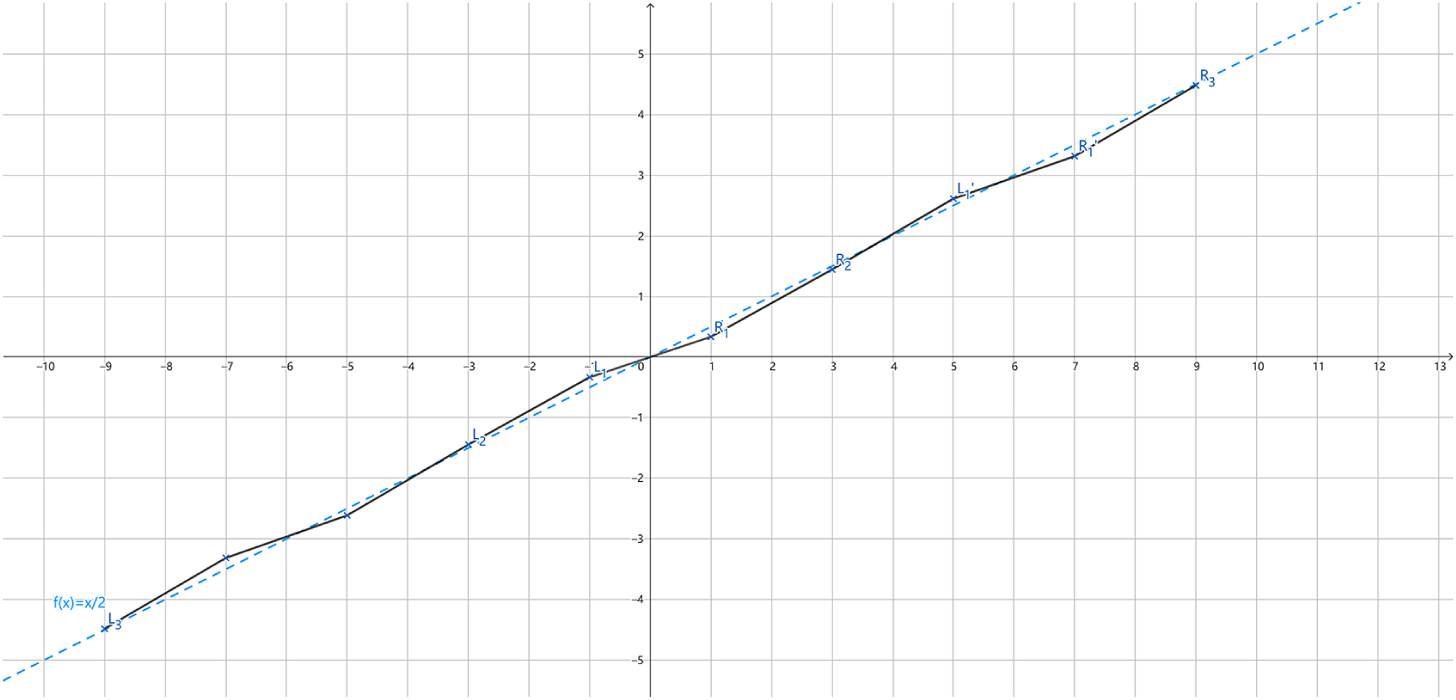
Figure 1 shows the ‘approximate periodicity’ of this pre-periodic function. In fact, the function on
 $[3, 9],[-9,-3]$
is obtained by vertically stretching the function on
 $[-3, 3]$
by a factor of
 $({3^4+1})/({3^4-3})$
and then splicing them together.
The graph of
 $ f(x) $
within the interval
 $[-9, 9]$
.

The following lemma is immediate.
Lemma 3.3. A pre-periodic function is uniformly continuous.
This property enables these functions to be lifted to
 $C(\mathbb {R,\mathbb {R}})$
.
Lemma 3.4. Define the map
 $ p: \mathbb {R} \to S^1 $
by
 $ p(x) = e^{2\pi ix} $
. For any pre-periodic function
 $ f \in C(\mathbb {R}, S^1) $
and for any
 $ e \in p^{-1}(f(r)) $
, there exists a function
 $ \tilde {f} \in C(\mathbb {R}, \mathbb {R}) $
such that
 $ \tilde {f}(r)=e$
and
 $p\circ \tilde {f}=f. $
Proof. Without loss of generality, we may assume
 $ r = 0 $
. By Lemma 3.3, take
 $ \varepsilon = 1 $
. There exists
 $ m \in \mathbb {N} $
such that for all
 $x,y$
with
 $ |x - y| \leq {1}/{m} $
, we have
 $ |f(x) - f(y)| < 1 $
. Divide
 $ \mathbb {R} $
into countably many intervals
 $ \ldots , I_{-1}, I_0, I_1, \ldots $
, where
 $ I_i = [{i}/{m}, {(i+1)}/{m}] $
. If
 $ f $
restricted to
 $ I_i $
is not surjective, for any
 $i\in \mathbb {Z}$
, we can successively define the lifts
 $ \tilde {f}_i $
such that
 $$ \begin{align*} \tilde{f}_0(0)=e, \quad \tilde{f}_i\bigg(\frac{i}{m}\bigg) = \tilde{f}_{i-1}\bigg(\frac{i}{m}\bigg). \end{align*} $$
Combine these
 $ \tilde {f}_i $
to form the lift
 $ \tilde {f} $
of
 $ f $
. If there exists
 $ \tilde {f}' $
such that
 $$ \begin{align*} \tilde{f}'(0)=e \quad\mbox{and}\quad p\circ\tilde{f}'=f , \end{align*} $$
then
 $ p(\tilde {f}' - \tilde {f}) \equiv 1$
and
 $ \tilde {f}' - \tilde {f} $
is identically zero.
Using a similar method, one obtains the following lemma, which establishes the continuity of lifting: sufficiently close functions in the original space admit lifts in the target space that remain close.
Lemma 3.5. Let
 $ \tilde {f} $
be a lift of the pre-periodic function
 $ f $
. Then, for
 , if the pre-periodic function
 $ g $
satisfies
 $ |g - f| < \varepsilon $
, then there exists a unique lift
 $ \tilde {g} $
of
 $ g $
such that
 $ |\tilde {g} - \tilde {f}| < {\varepsilon }/{4}$
.
With the lifting of pre-periodic functions, we can define the following generalised winding number as a homotopy invariant.
Theorem 3.6. If f is a pre-periodic function, then the limit
 $$ \begin{align*} \lim_{x\to+\infty}\frac{\tilde{f}(x)-\tilde{f}(-x)}{2x} \end{align*} $$
exists and is a rational number. This limit is called the generalised winding number of f, denoted by
 $\#f$
.
Proof. Because f is a pre-periodic function, for
 $\varepsilon =\frac {1}{8}$
, we have
 $N_{\varepsilon }\in \mathbb {N}$
such that
 $$ \begin{align*} |f(x+kN_\varepsilon)-f(x)|<\tfrac{1}{8}\quad \mbox{for all } k\in \mathbb{Z}, x\in \mathbb{R}. \end{align*} $$
Let
 $ f^k(x) = f(x + kN_{\varepsilon }) $
and define
 $ f^0(x) = f(x) $
. Consider the lift
 $ \tilde {f}(x) $
of
 $ f(x) $
. By Lemma 3.5, there exists a lift
 $ \widetilde {f^k} $
of
 $ f^k $
such that
 $$ \begin{align*} |\widetilde{f^k}(x) - \tilde{f}(x)| < \tfrac{1}{32}. \end{align*} $$
Note that
 $ p(\tilde {f}(x + kN_{\varepsilon })) = f^k(x) $
,
 $\tilde {f}(x + kN_{\varepsilon })$
and
 $\widetilde {f^k}(x)$
differ by an integer. Therefore, there exists an integer
 $ n_k $
such that
 $$ \begin{align*} |\tilde{f}(x + kN_{\varepsilon}) - n_k - \tilde{f}(x)| < \tfrac{1}{32}. \end{align*} $$
We show by mathematical induction that
 $ n_k = kn_1 $
. First,
 $ n_1 = 1 \cdot n_1 $
is trivially satisfied. Next, suppose
 $ n_k = kn_1 $
. Consider the three equations:
 $$ \begin{align*} |\tilde{f}(x + kN_{\varepsilon}) - \tilde{f}(x) - n_k| & < \tfrac{1}{32}, \\ |\tilde{f}(x + (k+1)N_\varepsilon) - \tilde{f}(x + kN_\varepsilon) - n_1| & < \tfrac{1}{32},\\ |\tilde{f}(x + (k+1)N_\varepsilon) - \tilde{f}(x) - n_{k+1}| & < \tfrac{1}{32}. \end{align*} $$
Since
 $|n_{k+1}-n_k-n_1|<({3}/{32})$
, we have
 $ n_{k+1} = n_k + n_1 = (k+1)n_1 $
. Finally,
 $$ \begin{align*} \lim_{x \to +\infty} \frac{\tilde{f}(x) - \tilde{f}(-x)}{2x} = \lim_{x \to +\infty} \frac{\tilde{f}(\lfloor {x}/{N_\varepsilon}\rfloor) - \tilde{f}(-\lfloor {x}/{N_\varepsilon}\rfloor )}{2x} = \lim_{x \to +\infty} \frac{2\lfloor {x}/{N_\varepsilon}\rfloor \cdot n_1}{2x} = \frac{n_1}{N_\varepsilon}. \end{align*} $$
This limit does not depend on the choice of the lift.
The generalised winding number possesses properties analogous to those of the classical winding number.
Proposition 3.7. The generalised winding number has the following properties:
-
(1)
$ \#(fg) = \#f + \#g $
; -
(2) the generalised winding number is locally constant.

The proof follows from standard arguments and is omitted; these properties will enable us to construct homotopy invariants for adelic periodic functions from local to global in the next section.
Remark 3.8. In fact, for functions
 $ f \in C(\mathbb {R}, S^1) $
that share identical limits at both
 $ +\infty $
and
 $ -\infty $
, an analogous analysis applies: such functions similarly admit a unique lift
 $ \tilde {f} \in C(\mathbb {R}, \mathbb {R}) $
, allowing the definition of a winding number
 $ \#f $
:
 $$ \begin{align*} \#f=\lim_{x\to+\infty}\tilde{f}(x)-\tilde{f}(-x). \end{align*} $$
This concept is essential when studying the K-theory of
 $C^*(\mathbb {A})$
.
4 Periodic adelic functions and pre-periodic functions
The goal of this section is to describe the structure of
 $ K_1(C^*(\mathbb {Q})) $
by identifying all homotopy equivalence classes of unitary elements in
 $ C_0(\mathbb {A}/\mathbb {Q}) $
. We introduce a new definition: the generalised winding number, and prove that the existence of a homotopy between two elements is determined by whether the values of this quantity are equal. The lifting of periodic adelic functions provides an effective approach to the construction of the homotopy, and the resulting disjoint partition of
 $ \mathbb {A}_f $
is the first step in this procedure. The properties of p-adic numbers can be found in [Reference Goldfeld and Hundley2].
Lemma 4.1. Let
 $ A_f $
denote
 $\prod _{p \text { prime}} \mathbb {Q}_p $
, the restricted product of all
 $ \mathbb {Q}_p $
, let
 $ e_p(N) $
denote the exponent of the prime
 $ p $
in the prime factorisation of a positive integer N, that is,
 $ N = \prod _{p \text { prime}} p^{e_p(N)}, $
and let
 $K_N:=\prod _{p \text { prime}}p^{e_p(N)}\mathbb {Z}_p$
. Then,
 $$ \begin{align*} \mathbb{A}_f=\bigsqcup_{\alpha \in \mathbb{Q}/N\mathbb{Z}} \alpha+K_N. \end{align*} $$
Proof. First, we choose an
 $x_f=\{x_2,x_3,x_5\cdots \}\in \mathbb {A}_f$
and construct a finite set of prime numbers
 $$ \begin{align*} S:=\{p \text{ is prime} : x_p\notin p^{e_p(N)}\mathbb{Z}_p\}. \end{align*} $$
Because
 $x_p$
belongs to
 $\mathbb {Z}_p$
and
 $e_p(N)=0$
holds for almost every prime number p, S is finite. Denote the elements in S by
 $p^{\prime }_1, p^{\prime }_{2},\ldots ,p^{\prime }_{\lvert S\rvert }$
.
By the Chinese remainder theorem, for any
 $p^{\prime }_{i}\in S$
, we can find an integer
 $M_i$
such that
 $$ \begin{align*} M_i\equiv 1 & \pmod {(p^{\prime}_i)^{e_{p^{\prime}_i}(N)}}, \\ M_i\equiv 0 & \pmod {(p^{e_p(N)}} \quad \mbox{for all } p\neq p^{\prime}_i. \end{align*} $$
Now, take
 $p^{\prime }_i \in S$
. There exists an
 $\alpha _i\in \mathbb {Q}$
satisfying
 $$ \begin{align*} \alpha_i+(p^{\prime}_i)^{e_{p^{\prime}_i}(N)}\mathbb{Z}_{p^{\prime}_i}=x_{p^{\prime}_i}+(p^{\prime}_i)^{e_{p^{\prime}_i}(N)}\mathbb{Z}_{p^{\prime}_i}, \end{align*} $$
and the denominator of
 $\alpha _i$
is a power of
 $p^{\prime }_i$
. It follows that for any
 $p\neq p^{\prime }_i$
,
 $\alpha _i$
is a p-adic integer. As a result, we obtain the rational number
 $$ \begin{align*} \alpha:=\sum\limits_{i=1}^{\lvert S \rvert}\alpha_i\cdot M_i. \end{align*} $$
A direct componentwise verification shows that
 $ x - \alpha \in K_N $
.
Given
 $x_f\in \mathbb {A}_f$
, we have found
 $\alpha \in \mathbb {Q}$
such that
 $x_f\in \alpha +K_N$
. Let
 $\alpha '\in \mathbb {Q}$
satisfy the same conditions. This leads to
 $$ \begin{align*} x_f-\alpha\in K_N,\ x_f-\alpha'\in K_N \quad\Rightarrow\quad \alpha-\alpha'\in K_N. \end{align*} $$
Consequently,
 $\alpha -\alpha '\equiv 0\ \text {mod}\ N$
and
 $\alpha +K_N=\alpha '+K_N.$
Now, we can extend the concept of generalised winding numbers to adelic periodic functions.
Theorem 4.2. For
 $ g \in C(\mathbb {A}/\mathbb {Q}, S^1) $
,
 $ x_f \in \mathbb {A}_f $
, the associated element in
 $ C(\mathbb {R}, S^1) $
given by
 $$ \begin{align*} g_{x_f}(x_\infty) := g(\{x_\infty, x_f\}) \end{align*} $$
is a pre-periodic function. For any
 $ x_f \in \mathbb {A}_f$
, we have
 $\#g_{x_f}=\#g_{0_f}$
, where
 $0_f$
is the embedding of
 $0$
in
 $\mathbb {A}_f$
. Therefore, we can define the generalised winding number of
 $ g \in C(\mathbb {A}/\mathbb {Q}, S^1) $
by
 $ \#g:=\#g_{0_f}. $
Proof. One can define norms
 $ |\cdot |_{\mathbb {A}_f} $
on
 $ \mathbb {A}_f $
and
 $ |\cdot |_{\mathbb {A}} $
on
 $ \mathbb {A} $
such that
 $$ \begin{align*} |x|_{\mathbb{A}}=|\{x_{\infty,},x_f\}|_{\mathbb{A}}=|x_{\infty}|_{\infty}+|x_f|_{\mathbb{A}_f}, \end{align*} $$
and the corresponding norm topologies are equivalent to the restricted product topology (see [Reference Lang4]).
Since
 $ \mathbb {A}/\mathbb {Q} $
is a compact
 $ C_1 $
-metric space, any continuous functions g on it are uniformly continuous. For
 $ \varepsilon> 0 $
, there exists a sufficiently large positive integer
 $ N> 0 $
such that for any
 $ x = \{ x_\infty , x_2, x_3, x_5, x_7,\ldots \} = \{ x_\infty , x_f \} \in \mathbb {A}$
and
 $k \in \mathbb {Z}$
, we have
 $ |g(x) - g(\{x_\infty , x_f + kN\})| < \varepsilon. $
Therefore,
 $$ \begin{align*} \varepsilon> |g(x) - g(\{ x_\infty, x_f + kN \})| = |g(x) - g(\{ x_\infty - kN, x_f \})| = |g_{x_f}(x_\infty) - g_{x_f}(x_\infty - kN)| \end{align*} $$
for all
 $k\in \mathbb {Z}, x_{\infty }\in \mathbb {R}$
. This shows that
 $g_{x_f}$
is a pre-periodic function. By Proposition 3.7, we can find
 $N\in \mathbb {N}$
such that for any
 $x_f\in K_N,\ \#g_{x_f}=\#g_{0_f}$
. Then, for any
 ${x_f\in \mathbb {A}_f} $
, there exists an
 $\alpha \in \mathbb {Q}/N\mathbb {Z}$
satisfying
 $ x_f-\alpha \in K_N$
by Lemma 4.1, from which
 $ \#g_{0_f}=\#g_{x_f}. $
To establish relationships between functions with the same generalised winding number using simple linear homotopy, it is necessary to lift functions from
 $ C(\mathbb {A}/\mathbb {Q}, S^1) $
to
 $ C(\mathbb {A}/\mathbb {Q},\mathbb {R}) $
.
Lemma 4.3. For
 $ g \in C(\mathbb {A}/\mathbb {Q}, S^1) $
with
 $ \#g = 0 $
, there exists
 $ \widetilde {g} \in C(\mathbb {A}/\mathbb {Q}, \mathbb {R}) $
such that
 $ g = p \circ \widetilde {g} $
, where
 $p(x)=e^{2\pi ix}\in C(\mathbb {R}).$
Proof. Let
 $ g_{0_f}(x_\infty ) = g(\{x_{\infty }, 0_f\}) $
, a pre-periodic function on
 $ \mathbb {R} $
. Following Lemma 3.4, there exists
 $ \widetilde {g_{0_f}} \in C(\mathbb {R}, \mathbb {R}) $
such that
 $ p(\widetilde {g_{0_f}}) = g_{0_f} $
. By the uniform continuity of g, we can select a suitable positive integer
 $ N $
such that
 $$ \begin{align*} \lvert g_{x_f}(x_\infty) - g_{0_f}(x_\infty)\rvert= \lvert g(\{x_{\infty}, x_f\}) - g(\{x_{\infty}, 0_f\})\rvert < \tfrac{1}{8} \quad\mbox{for all } x_f\in K_N. \end{align*} $$
By Lemma 3.5, there exists a unique lift
 $\widetilde {g_{x_f}}$
of
 $ g_{x_f} $
, satisfying
 $$ \begin{align*} |\widetilde{g_{x_f}}(x_\infty) - \widetilde{g_{0_f}}(x_\infty)| < \tfrac{1}{32}. \end{align*} $$
As stated in Lemma 4.1, for any
 $ x_f \in \mathbb {A}_f $
, there exists
 $ \alpha \in \mathbb {Q}/N\mathbb {Z} $
such that
 $ x_f + \alpha \in K_N $
. Then, by Lemma 3.4 and the
 $\mathbb {Q}$
-periodicity of g, the function
 $ g_{x_f} $
has a unique lift at
 $ 0_{\infty } $
with value
 $ \widetilde {g_{x_f + \alpha }}(0_\infty +\alpha ) $
, which is denoted by
 $ \widetilde {g_{x_f}} $
.
Define the map
 $ \widetilde {g}: \{x_{\infty }, x_f\} \mapsto \widetilde {g_{x_f}}(x_\infty ) $
from
 $ \mathbb {A} $
to
 $ \mathbb {R} $
, such that
 $g=e^{2\pi i \tilde {g}}.$
Since g is uniformly continuous in both the
 $x_\infty $
- and
 $x_f$
-variables,
 $\widetilde{g}$
is uniformly continuous.
Finally, we prove that
 $ \widetilde {g} \in C(\mathbb {A} / \mathbb {Q}, \mathbb {R}) $
, that is, for any
 $ x_f \in \mathbb {A}_f, \alpha \in \mathbb {Q} $
,
 $$ \begin{align*} \widetilde{g}(\{x_\infty, x_f\}) = \widetilde{g}(\{x_\infty + \alpha, x_f + \alpha\}). \end{align*} $$
With the positive integer N given above, we divide the rational number
 $\alpha $
into the sum of
 $\alpha _1$
and
 $\alpha _2$
, where
 $ \alpha _1 \in N\mathbb {Z} $
and
 $ \alpha _2 \in \mathbb {Q} /N\mathbb {Z} $
. Let us further assume that
 $x_f\in \beta +K_N$
for some
 $\beta \in \mathbb {Q}/N\mathbb {Z}$
.
Part 1. For the integer N given previously,
 $$ \begin{align*} |g_{x_f}(x_\infty) - g_{x_f}(x_\infty + kN)| < \tfrac{1}{8} \quad\mbox{for all } x_\infty \in \mathbb{R}, k \in \mathbb{Z}. \end{align*} $$
However, the generalised winding number of
 $g_{x_f}$
is zero. It follows that
 $$ \begin{align*} |\widetilde{g_{x_f}}(x_\infty) - \widetilde{g_{x_f}}(x_\infty + kN)| < \tfrac{1}{32}. \end{align*} $$
Note that
 $x_f$
and
 $ x_f+kN$
both belong to
 $\beta +K_N$
, so for every
 $ k\in \mathbb {Z}, x_{\infty }\in \mathbb {R}, x_{f}\in \beta +K_N$
,
 $$ \begin{align*} & |\widetilde{g_{x_{f}+kN}}(x_{\infty})-\widetilde{{g}_{x_{f}}}(x_{\infty}-kN)| \\ &\quad <|\widetilde{g_{x_{f}}}(x_{\infty})-\widetilde{g_{x_{f}+kN}}(x_{\infty})|+|\widetilde{g_{x_{f}}}(x_{\infty})-\widetilde{g_{x_{f}}}(x_{\infty}+kN)|<\tfrac{1}{16}. \end{align*} $$
Additionally,
 $ \widetilde {g_{x_f+kN}}(x_\infty ) $
and
 $ \widetilde {g_{x_f}}(x_\infty -kN) $
differ by an integer. Thus,
 $$ \begin{align*} \widetilde{g_{x_{f}+kN}}&(x_{\infty})=\widetilde{{g}_{x_{f}}}(x_{\infty}-kN). \end{align*} $$
We can replace
 $ kN $
with
 $ \alpha _1 $
to complete the first part of the proof.
Part 2. From the definition of
 $\widetilde{g}$
, for
 $ x_f \in \beta + K_N $
, we have
 $\widetilde {g_{x_f}}(0_{\infty })=\widetilde {g_{x_f-\beta }}(-\beta ).$
However,
 $\widetilde {g_{x_f}}(x_{\infty }) - \widetilde {g_{x_f-\beta }}(x_{\infty }-\beta )$
is a lift of the constant function
 $$ \begin{align*}g_{x_f}(x_{\infty}) \cdot g_{x_f-\beta}(x_{\infty}-\beta)^{-1},\end{align*} $$
from which it follows that
 $\widetilde {g_{x_f}}(x_{\infty }) - \widetilde {g_{x_f-\beta }}(x_{\infty }-\beta ) = 0$
. Thus,
 $$ \begin{align*}\widetilde{g}(\{x_\infty, x_f\})=\widetilde{g_{x_f}}(x_{\infty})=\widetilde{g_{x_f-\beta}}(x_{\infty}-\beta)=\widetilde{g}(\{x_\infty-\beta, x_f-\beta\}).\end{align*} $$
In conclusion,
 $\widetilde{g}$
is a function with rational periods.
Now, let
 $ f, g \in C(\mathbb {A}/\mathbb {Q}, S^1) $
and suppose that
 $ \#f = \#g = \alpha \in \mathbb {Q} $
. Note that the generalised winding numbers of
 $ e(\alpha x)f $
and
 $ e(\alpha x)g $
are both 0, where e is the standard additive character on
 $\mathbb {A}$
. With their lifts
 $ \widetilde {e(\alpha x)f},\widetilde {e(\alpha x)g} \in C(\mathbb {A}/\mathbb {Q}, \mathbb {R}), $
we can construct a homotopy
 $ H $
between f and g by
 $$ \begin{align*} H: \mathbb{R} \times \mathbb{A}/\mathbb{Q} &\to S^1 \\ (t, \{x_\infty, x_f\}) &\mapsto \text{exp}(2\pi i ( t \cdot \widetilde{e(\alpha x)f} + (1-t) \cdot \widetilde{e(\alpha x)g} )) \cdot e(\alpha x). \end{align*} $$
However, if
 $ f $
and
 $ g $
are homotopic, f can be continuously transformed into
 $ g $
, so
 $$ \begin{align*} f \text{ and }g \text{ are homotopic}\quad \mbox{ if and only if } \#f=\#g .\end{align*} $$
As a conclusion of this section, we obtain the following theorem.
Theorem 4.4. Let
 $\mathbb {A}$
be the adele ring,
 $\mathcal {U}(\text {C}(\mathbb {A}/\mathbb {Q}))$
be the group of unitary elements of
 $\text {C}(\mathbb {A}/\mathbb {Q})$
and
 $\mathcal {U}_0(\text {C}(\mathbb {A}/\mathbb {Q}))$
be the subgroup of
 $\mathcal {U}(\text {C}(\mathbb {A}/\mathbb {Q}))$
consisting of elements whose generalised winding numbers are zero. Then,
 $$ \begin{align*} K_1(C^*(\mathbb{Q}))=K_1(C(\mathbb{A}/\mathbb{Q}))=\mathcal{U}(\text{C}(\mathbb{A}/\mathbb{Q}))/\mathcal{U}_0(\text{C}(\mathbb{A}/\mathbb{Q}))\cong\mathbb{Q}. \end{align*} $$
Remark 4.5. To compute the
 $ K_0 $
-group of
 $ C^*(\mathbb {Q}) $
, it is necessary to consider the projections in
 $ M_n(C_0(\mathbb {A}/\mathbb {Q}))\cong C_0(\mathbb {A}/\mathbb {Q},M_n(\mathbb {C})) $
, which are uniformly continuous,
 $ \mathbb {Q} $
-periodic functions taking values in projections of
 $M_n(\mathbb {C})$
. If
 $\text {rank}\ f(0)=m$
, then by the continuity of f, we can choose a sufficiently large integer N such that
 ${\text {rank}\ f_{|\mathbb {R}\times K_N}\equiv m}$
. Finally, for any
 $x=\{x_\infty ,x_2,x_3,\ldots \}\in \mathbb {A}$
, there exists
 $q\in \mathbb {Q}$
satisfying
 $$ \begin{align*} x-q=\{x_\infty-q,x_2-q,x_3-q,\ldots\}\in \mathbb{R}\times K_N \end{align*} $$
by Lemma 4.1. Hence, the
 $\mathbb {Q}$
-periodicity implies that
 $\text {rank}\ f(a)\equiv m$
for all
 $a\in \mathbb {A}/\mathbb {Q}$
. Any two projections with the same rank are Murray–von Neumann equivalent, so
 $$ \begin{align*} K_0(C^*(\mathbb{Q}))=K_0(C_0(\mathbb{A}/\mathbb{Q}))=\mathbb{Z}. \end{align*} $$
5
$K_1$
group of
$C^\ast (\mathbb {A})$


We first consider the unitisation of
 $ C_0(\mathbb {A}) $
, denoted by
 $ C_0(\mathbb {A})^+$
, endowed with the following algebraic operations:
 $$ \begin{align*} (f , \lambda) + (g , \mu) &= (f+g , \lambda+\mu), \\ (f , \lambda)(g , \mu) &= (fg + \mu f + \lambda g, \lambda\mu),\\ (f , \lambda)^*&=(f^* , \bar{\lambda}), \end{align*} $$
where
 $f,g \in C_0(\mathbb {A}), \lambda ,\mu \in \mathbb {C}.$
For a unitary element
 $(f, \lambda )$
in
 $C_0(\mathbb {A})$
, we define a function in
 $C(\mathbb {R},S^1)$
by
 $$ \begin{align*} f^\lambda_{x_f}(x_\infty):=f(\{x_\infty,x_f\}) + \lambda. \end{align*} $$
The mapping
 $ f + \lambda $
is uniformly continuous on
 $ \mathbb {A} $
. By selecting an appropriate positive integer
 $ N $
, we ensure that for any
 $ x_f, y_f \in \mathbb {A}_f $
that satisfy
 $ x_f, y_f \in \alpha + K_N $
with some rational number
 $ \alpha $
, we have
 $$ \begin{align*} \sup_{x\in \mathbb{R}}\lvert f^\lambda_{x_f}-f^\lambda_{y_f}\rvert<\tfrac{1}{8}. \end{align*} $$
By Remark 3.8, there exists a lift
 $\widetilde {f^\lambda _{x_f}}$
of
 $f^\lambda _{x_f}(x_\infty )$
. With Lemma 4.1, we can construct lifts of
 $ f^\lambda _{x_f} $
on each subset
 $\alpha +K_N$
, analogous to the procedure developed in Section 4, which yields a continuous mapping from
 $\mathbb {A}$
to
 $\mathbb {R}$
given by
 $$ \begin{align*} \widetilde{f+\lambda}:\ \{x_\infty,x_f\}\mapsto\widetilde{f^\lambda_{x_f}(x_\infty)} \end{align*} $$
and
 $$ \begin{align*} \text{exp}(2\pi i\widetilde{f+\lambda})=f+\lambda. \end{align*} $$
For any
 $(f+\lambda )\in C(\mathbb {R},S^1)$
, we can define the map:
 $$ \begin{align*} \#(f+\lambda):\mathbb{A}_f & \mapsto \mathbb{Z} \\ x_f & \mapsto\#f^\lambda_{x_f} \end{align*} $$
and it can be verified that this constitutes a homotopy invariant. If
 $\#(f+\lambda )=\#(g+\mu )$
, we can construct the homotopy:

This leads to the following theorem.
Theorem 5.1. Denote the group of unitary elements in
 $C_0(\mathbb {A})^+$
by
 $\mathcal {U}(C_0(\mathbb {A})^+)$
and the subgroup of unitary elements homotopic to the constant function by
 $\mathcal {U}_0(C_0(\mathbb {A})^+)$
. Then,
 $$ \begin{align*}K_1(C_0(\mathbb{A})^+)= \mathcal{U}(C_0(\mathbb{A})^+)/\mathcal{U}_0(C_0(\mathbb{A})^+)=C_0(\mathbb{A}_f,\mathbb{Z}). \end{align*} $$
Moreover, we have the exact sequence
 $$ \begin{align*} 0\rightarrow K_1(C_0(\mathbb{A}))\rightarrow K_1(C_0(\mathbb{A})^+)\rightarrow K_1(\mathbb{C})\rightarrow 0 \end{align*} $$
and we arrive at the result
 $ K_1(C^*(\mathbb {A}))=K_1(C_0(\mathbb {A}))=C_0(\mathbb {A}_f,\mathbb {Z}). $
Remark 5.2. To consider the projection g in
 $M_n(C_0(\mathbb {A})^+)\cong C_0(\mathbb {A},M_n{(\mathbb {C})})^+$
, we first claim that
 $g_{x_f}(x_\infty ):=g(\{x_\infty ,x_f\})$
is a uniformly continuous matrix-valued function for any
 $x_f\in \mathbb {A}_f$
. Since
 $\mathbb {R}$
is contractible and the limit
 $\lim _{|x|_{\mathbb {A}}\to \infty } g(x)$
exists, the rank of the projection matrices of
 $g_{x_f}(x_\infty )$
remains constant. This implies that
 $$ \begin{align*} K_0(C_0(\mathbb{A})^+)=K_0(\mathbb{C})=\mathbb{Z}. \end{align*} $$
We have
 $K_0(C_0(\mathbb {A}))=0$
.
Acknowledgement
We are indebted to Haluk Şengün for his guidance in providing relevant references in number theory and for valuable discussions regarding the alternative proof presented in Section 2.