




No CrossRef data available.
Article contents
Ximelagatran: A new type of oral anticoagulant
Published online by Cambridge University Press: 25 October 2005
Abstract
Objectives: This assessment sought to evaluate the comparative benefit and adverse effect profile of ximelagatran, as well as the clinical issues surrounding its potential use.
Methods: We performed a Dialog OneSearch across BIOSIS Previews, EMBASE, MEDLINE, PASCAL, and ToxFile to identify published literature. PubMed and The Cochrane Library were also searched. Gray literature was identified by searching a variety of Web sites of health technology assessment and related agencies and their associated databases. The manufacturer's Canadian office, AstraZeneca, was invited to submit information.
Results: Ximelagatran is the first oral agent from a new class of anticoagulants called direct thrombin inhibitors. Other oral anticoagulants require routine blood monitoring; ximelagatran does not. Ximelagatran has been evaluated in the areas of venous thromboembolism management, particularly after orthopedic surgery, and stroke prevention in patients with atrial fibrillation. Overall, ximelagatran's efficacy appears comparable to other anticoagulants in these clinical settings. Also, bleeding rates were generally similar between ximelagatran and comparators but, as for warfarin, bleeding risk increases with higher ximelagatran doses. In addition, there is no specific antidote to help manage ximelagatran-induced bleeding. Finally, significantly more patients exposed to long-term ximelagatran developed elevated liver enzymes more than three times the upper normal limit, compared with patients on comparator anticoagulants.
Conclusions: Given its apparent simplicity of use, ximelagatran carries the potential to replace, at least in part, anticoagulants currently used in the management of venous thromboembolism or for preventing stroke in atrial fibrillation patients. However, the safety of ximelagatran will not be fully known without further evaluation and surveillance for potential liver toxicity. There is also a need to evaluate its use in special populations such as patients with renal failure and patients using several concurrent medications.
Keywords
Information
- Type
- GENERAL ESSAYS
- Information
- International Journal of Technology Assessment in Health Care , Volume 21 , Issue 4 , October 2005 , pp. 480 - 486
- Copyright
- © 2005 Cambridge University Press
Ximelagatran is the first oral representative from a new class of anticoagulants called direct thrombin inhibitors (18). After absorption, it is converted to its active form, melagatran (23;28). Ximelagatran acts by binding directly to free and clot-bound thrombin, thereby preventing the conversion of fibrinogen to fibrin, the primary component of blood clots (28). Ximelagatran has a wide therapeutic window, allowing for fixed dosing, no routine laboratory monitoring, and low potential for drug interactions (23).
Ximelagatran is approved in Europe for the prevention of venous thromboembolism (VTE) after total hip (THR) or total knee replacement (TKR) surgery (1). In the United States, the Food and Drug Administration (FDA) declined approval of ximelagatran for VTE prevention in TKR, as well as in long-term secondary prevention of VTE and stroke prevention in patients with atrial fibrillation (AF) (1).
OBJECTIVES
This assessment sought to evaluate the comparative benefit and adverse effect profile of ximelagatran, as well as the clinical issues surrounding its potential use. It was undertaken as part of the Canadian Emerging Technology Assessment Program of the Canadian Coordinating Office for Health Technology Assessment (CCOHTA). The purpose of this horizon scanning program is to inform decision-makers in Canada about emerging health technologies.
METHODS
We performed a Dialog OneSearch across BIOSIS Previews, EMBASE, MEDLINE, PASCAL, and ToxFile to identify published literature. PubMed and The Cochrane Library were also searched. No date limits were imposed, and all searches were updated regularly. Gray literature was identified by searching a variety of Web sites of health technology assessment and related agencies and their associated databases. The manufacturer's Canadian office, AstraZeneca, was invited to submit information.
RESULTS
Venous Thromboembolism
VTE is a common condition and mainly consists of deep vein thrombosis (DVT) and its potentially fatal complication, pulmonary embolism (PE) (18). Proximal DVTs can recur, result in postphlebotic symptoms, and carry a higher risk of fatal PE than distal DVTs (24). Important risk factors for VTE include age, hospitalization, trauma, and cancer (18). Major orthopedic surgery patients are also at high risk of developing VTE (21). Without anticoagulation, venographic studies indicate approximately 50 percent of THR and TKR patients will develop a DVT (15). Currently, warfarin and low-molecular-weight heparin (LMWH) are standard components of drug therapy for the management of VTE (21). The use of warfarin is associated with the need for coagulation monitoring and numerous drug interactions (28). LMWH needs to be injected subcutaneously.
Prevention of Venous Thromboembolism After Orthopedic Surgery
Comparison with Low-Molecular-Weight Heparin
Three studies compared ximelagatran with LMWH. METHRO III (9) and EXPRESS (8) are similarly designed European clinical trials that enrolled patients undergoing THR or TKR. Participants were randomized to receive subcutaneous LMWH enoxaparin 40 mg daily (started 12 hours before surgery) or one dose of subcutaneous melagatran 3 mg after surgery, then oral ximelagatran 24 mg twice daily started the day after surgery. Participants in the EXPRESS trial also received subcutaneous melagatran 2 mg immediately before surgery (8). In METHRO III, the only statistically significant difference was a lower rate of total VTE (proximal or distal DVT, PE, or all-cause death) with enoxaparin in THR subjects (Table 1). In EXPRESS, ximelagatran significantly reduced the rate of total VTE and major VTE (proximal DVT, PE, or all-cause death) in all groups, relative to enoxaparin (Table 1). A double-dummy randomized controlled North American trial compared oral ximelagatran 24 mg twice daily with subcutaneous enoxaparin 30 mg twice daily in patients undergoing THR (5). Treatment was initiated the morning after surgery and continued for 7–12 days. Ximelagatran was associated with a higher rate of VTE (total and major) compared with enoxaparin (Table 1). Differences in efficacy between the trials may be explained by differences in dosing strategies between Europe and North America (20).

Comparison with Warfarin
Three North American trials (6;12;13) compared oral ximelagatran (24 or 36 mg twice daily) with warfarin (target international normalized ratio [INR] of 2.5) in patients undergoing TKR. Ximelagatran 36 mg significantly reduced the rate of total VTE compared with warfarin (6;12) (Table 1). No significant difference was seen with ximelagatran 24 mg (12;13). There was no between-group difference in rates of major VTE for either 24- or 36-mg regimens (Table 1).
Treatment of Patients with Venous Thromboembolism
THRIVE was a randomized, double-blind, noninferiority trial involving 2,489 patients with acute DVT, with or without PE (11). Oral ximelagatran 36 mg twice daily was compared with subcutaneous enoxaparin 1 mg/kg twice daily for 5 to 20 days followed by 6 months of warfarin therapy (target INR: 2–3). There was no statistically significant difference between ximelagatran and enoxaparin/warfarin for the primary end point of VTE recurrence (2.1 percent versus 2 percent; risk difference (RD): 0.2 percent; 95 percent confidence interval [CI]:–1, 1.3).
Secondary Prevention of Venous Thromboembolism
The THRIVE III trial evaluated ximelagatran for the secondary prevention of VTE in DVT/PE patients treated with anticoagulants for 6 months (25). In this multicenter, double-blind trial, patients were randomized to oral ximelagatran 24 mg twice daily (n = 612) or placebo (n = 611) for 18 months. Ximelagatran significantly lowered the overall rate of symptomatic recurrent VTE compared with placebo (2.8 percent versus 12.6 percent; hazard ratio [HR]: 0.16; 95 percent CI: 0.09, 0.3).
Arterial Thromboembolism
Atrial fibrillation
AF is the most common sustained cardiac arrhythmia (2). It is a major risk factor for stroke (7); the rate of ischemic stroke among patients with nonvalvular AF averages 5 percent per year (2;7) and can reach 12– 15 percent in high-risk groups (7). High-risk factors for stroke in AF patients include prior thromboembolism, age >75 years, mitral valve disease, prosthetic heart valve, hypertension, and heart failure (2;14). Several studies show that oral anticoagulant therapy decreases the risk of stroke in patients with AF and is more effective than daily acetylsalicylic acid (ASA) alone in high-risk patients (2;22). However, bleeding risks are more frequent with anticoagulants than with ASA (2). In selecting anticoagulation for AF patients, patients' individual risks of stroke and bleeding must be considered (2;22).
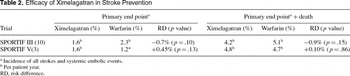
Two phase III trials investigated ximelagatran for stroke prevention in patients with AF. The SPORTIF III and V trials were designed to test the noninferiority of ximelagatran relative to warfarin based on a less than 2 percent difference in event rates (3;10). SPORTIF III enrolled 3,407 participants in 259 sites located in 23 countries in Europe, Asia, and Australasia (10). It was a randomized, open-label, parallel group trial, with blinded end point assessment (10). SPORTIF V was a North American, multicenter, randomized, double-blind, double dummy trial with 3,922 participants (3). In both studies, patients with nonvalvular AF and one or more risk factors for stroke were randomized to either a fixed dose of ximelagatran 36 mg twice daily or to adjusted-dose warfarin (target INR: 2 to 3) (3;10). ASA, up to 100 mg daily, was allowed in both trials (3;10). The primary end point in both SPORTIF studies was the incidence of all strokes (ischemic or hemorrhagic) and systemic embolic events, based on an intention-to-treat analysis. Secondary end points included all cause mortality, transient ischemic attack, myocardial infarction (MI), and composites of these outcomes (3;10). There was no statistically significant between-group difference in event rates in both SPORTIF studies. Based on this evidence, ximelagatran may be considered at least as effective as warfarin for the prevention of stroke in high-risk AF patients (Table 2). However, the use of a noninferiority margin of 2 percent was considered too liberal by the FDA. Indeed, a margin of that size could leave open the possibility that ximelagatran is only half as effective as warfarin and still be considered “noninferior” (4).

Myocardial Infarction
Currently, the mortality rate during hospitalization for acute MI varies between 5 percent and 15 percent, depending on the age (26). Antiplatelet and anticoagulant agents are usually part of the acute MI treatment; however, patients still remain at high risk for subsequent events, especially when anticoagulant therapy is stopped (16). Controversy exists regarding whether or not to continue anticoagulants after an MI to prevent recurrent cardiac ischemia (26). Limited evidence shows that combined moderate-intensity (target INR: 2 to 3) warfarin and ASA may be better than ASA alone with a marginal increase in major bleeding (19).
The ESTEEM trial evaluated ximelagatran for secondary prevention in post-MI patients. It was a phase II, randomized, placebo-controlled, double-blind, dose-guiding study of 1,883 patients in eighteen countries (27). Patients who experienced an acute MI within the past 14 days received either oral ximelagatran at doses of 24, 36, 48, or 60 mg twice daily, or placebo, for 6 months. Study drug was initiated within 6 to 12 hours of heparin cessation. All patients received ASA 160 mg once daily. The combined four ximelagatran groups significantly reduced the risk for the primary end points (all-cause mortality, nonfatal MI, and severe recurrent ischemia) compared with placebo (16.3 percent vs. 12.7 percent; HR: 0.76; 95 percent CI: 0.59, 0.98). There was no difference in efficacy among ximelagatran dose groups (27).
Adverse Effects
Bleeding Complications
The overall rates of bleeding complications between ximelagatran and comparators were similar in the VTE treatment or prevention studies, except in the EXPRESS trial (Table 3). In the SPORTIF trials, rates of major bleeding (bleeding causing death, involving critical anatomical sites, causing significant reduction in hemoglobin, or requiring blood transfusion) were similar between treatment groups. However, rates of combined bleeding (major and minor) were significantly lower in patients randomized to ximelagatran. In the ESTEEM trial, the frequency of major bleeding did not differ between ximelagatran and placebo groups (HR: 1.97; 95 percent CI: 0.80, 4.84) (Table 3). However, the combined bleeding rates were higher in the ximelagatran group (HR: 1.76; 95 percent CI: 1.38, 2.25), and the risk increased in a dose-related manner (27). In SPORTIF III and V, 15 to 18 percent of the study population was taking concurrent ASA and had higher rates of combined bleeding compared with those not on ASA (3;10). The concurrent use of ASA and a higher dose of ximelagatran may increase the risk of bleeding.

Liver Enzymes
Ximelagatran was associated with a greater than three times the upper limit of normal elevation of the liver enzyme alanine aminotransferase (ALT) in longer-term (6–18 months) VTE trials (11;25) (Table 4). Enzyme levels normalized in most patients (25). Long-term use (6– 26 months) of ximelagatran was also associated with elevated ALT levels in stroke prevention (3;10) and post-MI trials (27) (Table 4). ALT increases were typically asymptomatic, detected after 2–6 months of treatment, and returned toward baseline levels, even with those who continued the drug (27). ALT elevations were generally not associated with any serious clinical adverse events (10;27), although at least two suspected fatal cases of drug-induced hepatitis occurred in patients treated with ximelagatran (3;11). The FDA review identified three deaths associated with severe liver injury in patients using ximelagatran for more than 35 days. Although there does not appear to be an elevated risk of severe liver injury during short-term use (less than 12 days), it is unknown whether delayed onset of severe liver injury after short-term ximelagatran use could occur (4).

Others
In the THRIVE study, a retrospective analysis of adverse events found a higher rate of serious coronary events (including MI) with ximelagatran (10/1,240 patients) relative to enoxaparin/warfarin (1/1,249 patients; p = .006) (11).
DISCUSSION AND CONCLUSIONS
Currently available evidence indicates the efficacy of ximelagatran in preventing VTEs after major orthopedic surgery is comparable to existing anticoagulants. Further testing of ximelagatran for the treatment of acute VTE and determination of its effect on fatal PE, however, are required. Limited evidence suggests that the efficacy of ximelagatran in stroke prevention in AF is comparable to warfarin. Phase III secondary prevention trials are needed to assess the safety and efficacy of ximelagatran in post-MI patients.
Bleeding risk associated with the use of ximelagatran appears to be generally comparable to that of existing anticoagulants. However, there is no known antidote to reverse the anticoagulant effect of ximelagatran in the case of bleeding (17). Furthermore, there is a need for additional evaluation of ximelagatran's potential for drug interactions (potential for increase in adverse events with concurrent use with other drugs such as nonsteroidal anti-inflammatory agents) and potential for serious coronary events. Evaluation of ximelagatran in special populations (e.g., renal failure, pregnancy) is also required. Finally, postmarketing surveillance with emphasis on hepatic toxicity will be very important should ximelagatran achieve widespread clinical use, particularly for patients on long-term regimens.
Policy Implications
On the basis of its apparent simplicity of use, the introduction of ximelagatran may have the potential to replace, at least in part, anticoagulants currently used in practice, particularly in patients in whom the use of warfarin may be difficult to manage (e.g., remote access to a laboratory, poor candidate for home-based INR testing). However, given the potential risk of liver toxicity and serious cardiac events identified in longer-term trials, policy-makers may consider, for now, limiting reimbursement to short-term perioperative uses in patients who have no pre-existing risk factors for either liver or cardiac disease.
CONTACT INFORMATION
Lisa Kwok, PharmD (lisac.kwok@utoronto.ca), Clinical Pharmacist, Fairview Family Health Network, 1333 Sheppard Avenue East, Toronto, Ontario M2J 1V1, Canada
Dana Molckovsky, BScPhm (dana.molckovsky@utoronto.ca), Medical Information Specialist, Department of Medical Information, AstraZeneca Canada Inc., 1004 Middlegate Road, Mississauga, Ontario L4Y 1M4, Canada
Michel Boucher, B Pharm, MSc (michelb@ccohta.ca), Research Officer–Pharmaceuticals, Health Technology assessment Directorate, Canadian Coordinating Office for Health Technology Assessment, 600-865 Carling Avenue, Ottawa, Ontario K1S 5S8, Canada
The authors acknowledge the contribution of CCOHTA information specialists Becky Skidmore, MLS, and Kaitryn Campbell, MLIS, for their assistance in performing the electronic searches for this project and for verifying and formatting the bibliography. At the time of the preparation of the manuscript, Dana Molckovsky was an Industrial Pharmacy Resident, University of Toronto, Toronto, Ontario, Canada
References
AstraZeneca receives action letter from FDA for Exanta® (ximelagatran)
[news release].
London:
AstraZeneca International;
October 11,
2004.
Available at: http://www.astrazeneca.com/pressrelease/3285.aspx. Accessed October 28, 2004.
Albers GW,
Dalen JE,
Laupacis A, et al.
2001
Antithrombotic therapy in atrial fibrillation.
Chest.
119:
194S–
206S.Google Scholar
Albers GW,
Diener HC,
Frison L, et al.
2005
Ximelagatran vs warfarin for stroke prevention in patients with nonvalvular atrial fibrillation: A randomized trial.
JAMA.
293:
690–
698.Google Scholar
Center for Drug Evaluation and Research, US Food and Drug Administration.
2004.
Integrated executive summary of FDA review for NDA 21-686 Exanta (ximelagatran)
[Clinical review].
Rockville (MD):
The Center;
2004. Available at: http://www.fda.gov/ohrms/dockets/ac/04/briefing/2004-4069B1_03_FDA-Backgrounder-Execsummaryredacted.pdf. Accessed October 7
Colwell CW,
Berkowitz SD,
Davidson BL, et al.
2003
Comparison of ximelagatran, an oral direct thrombin inhibitor, with enoxaparin for the prevention of venous thromboembolism following total hip replacement. A randomized, double-blind study.
J Thromb Haemost.
1:
2119–
2130.Google Scholar
Colwell CW,
Berkowitz SD,
Comp PC, et al.
2003.
Randomized, double-blind comparison of ximelagatran, an oral direct thrombin inhibitor, and warfarin to prevent venous thromboembolism (VTE) after total knee replacement (TKR): EXULT B.
American Society of Hematology 45th Annual Meeting and Exposition; December 6–9, 2003; San Diego. Available at: http://www.hematology.org/meeting/abstracts.cfm. Accessed December 16
Donnan GA,
Dewey HM,
Chambers BR.
2004
Warfarin for atrial fibrillation: The end of an era?
Lancet Neurol.
3:
305–
308.Google Scholar
Eriksson BI,
Agnelli G,
Cohen AT, et al.
2003
The direct thrombin inhibitor melagatran followed by oral ximelagatran compared with enoxaparin for the prevention of venous thromboembolism after total hip or knee replacement: The EXPRESS study.
J Thromb Haemost.
1:
2490–
2496.Google Scholar
Eriksson BI,
Agnelli G,
Cohen AT, et al.
2003
Direct thrombin inhibitor melagatran followed by oral ximelagatran in comparison with enoxaparin for prevention of venous thromboembolism after total hip or knee replacement: The METHRO III Study.
Thromb Haemost.
89:
288–
296.Google Scholar
Executive Steering Committee on behalf of the SPORTIF III Investigators.
2003
Stroke prevention with the oral direct thrombin inhibitor ximelagatran compared with warfarin in patients with non-valvular atrial fibrillation (SPORTIF III): Randomised controlled trial.
Lancet.
362:
1691–
1698.
Fiessinger JN,
Huisman MV,
Davidson BL, et al.
2005
Ximelagatran vs low-molecular-weight heparin and warfarin for the treatment of deep vein thrombosis: A randomized trial.
JAMA.
293:
681–
689.Google Scholar
Francis CW,
Berkowitz SD,
Comp PC, et al.
2003
Comparison of ximelagatran with warfarin for the prevention of venous thromboembolism after total knee replacement.
N Engl J Med.
349:
1703–
1712.Google Scholar
Francis CW,
Davidson BL,
Berkowitz SD, et al.
2002
Ximelagatran versus warfarin for the prevention of venous thromboembolism after total knee arthroplasty. A randomized, double-blind trial.
Ann Intern Med.
137:
648–
655.Google Scholar
Fuster V,
Rydén LE,
Asinger RW, et al.
2001
ACC/AHA/ESC guidelines for the management of patients with atrial fibrillation: Executive summary. A report of the American College of Cardiology/American Heart Association Task Force on Practice Guidelines and the European Society of Cardiology Committee for Practice Guidelines and Policy Conferences (Committee to Develop Guidelines for the Management of Patients With Atrial Fibrillation): Developed in collaboration with the North American Society of Pacing and Electrophysiology.
J Am Coll Cardiol.
38:
1231–
1266.Google Scholar
Geerts WH,
Heit JA,
Clagett GP, et al.
Prevention of venous thromboembolism.
2004.
Chest.
2001;119:132S-175S. Available at: http://www.chestjournal.org/cgi/reprint/119/1_suppl/132S.pdf. Accessed April 7
Granger CB,
Miller JM,
Bovill EG, et al.
1995
Rebound increase in thrombin generation and activity after cessation of intravenous heparin in patients with acute coronary syndromes.
Circulation.
91:
1929–
1935.Google Scholar
Gustafsson D.
2003
Oral direct thrombin inhibitors in clinical development.
J Intern Med.
254:
322–
334.Google Scholar
Heit JA.
2003
The potential role of direct thrombin inhibitors in the prevention and treatment of venous thromboembolism.
Chest.
124:
40S–
48S.Google Scholar
Hirsh J,
Dalen J,
Anderson DR, et al.
2001
Oral anticoagulants: Mechanism of action, clinical effectiveness, and optimal therapeutic range.
Chest.
119:
8S–
21S.Google Scholar
Hull RD,
Pineo GF,
Stein PD, et al.
2001
Timing of initial administration of low-molecular-weight heparin prophylaxis against deep vein thrombosis in patients following elective hip arthroplasty: A systematic review.
Arch Intern Med.
161:
1952–
1960.Google Scholar
Hyers TM.
2003
Management of venous thromboembolism: Past, present, and future.
Arch Intern Med.
163:
759–
768.Google Scholar
Man-Son-Hing M,
Laupacis A.
2003
Anticoagulant-related bleeding in older persons with atrial fibrillation: Physicians' fears often unfounded.
Arch Intern Med.
163:
1580–
1586.Google Scholar
McCall KL,
MacLaughlin EJ.
2003
Ximelagatran: A new era in oral anticoagulation.
J Pharm Technol.
19:
222–
228.Google Scholar
Raskob GE,
Hull RD,
Pineo GF.
2001:
Venous thrombosis.
In: Beutler E,
Coller BS,
Lichtman MA,
Kipps TJ, eds.
Williams hematology.
6th ed.
New York:
McGraw-Hill;
1735–
1741.
Schulman S,
Wåhlander K,
Lundström T, et al.
2003
Secondary prevention of venous thromboembolism with the oral direct thrombin inhibitor ximelagatran.
N Engl J Med.
349:
1713–
1721.Google Scholar
Stringer KA,
Lopez LM.
Uncomplicated myocardial infarction.
In: DiPiro JT,
Talbert RL,
Yee GC, et al, eds.
1999:
Pharmacotherapy: a pathophysiologic approach.
5th ed.
New York:
McGraw-Hill;
251–
271.
Wallentin L,
Wilcox RG,
Weaver WD, et al.
2003
Oral ximelagatran for secondary prophylaxis after myocardial infarction: The ESTEEM randomised controlled trial.
Lancet.
362:
789–
797.Google Scholar

Efficacy of Ximelagatran: Surgical Venous Thromboembolism (VTE) Prevention Trials
Efficacy of Ximelagatran in Stroke Prevention

Bleeding Complications

Elevated Liver Enzymes
 You have
Access