


9.1 Introduction
The uses of data-driven infrastructures in global environmental governance are often touted as having numerous benefits, by international organizations and corporations alike.Footnote 1 While the availability of environmental data through organizations like the UN Environment Programme (UNEP) has benefits, including granting access to open data that can guide policymakers in decision-making for climate mitigation and adaptation measures, the benefits of the uses of data-driven infrastructures in global environmental governance are often overestimated and their harms underestimated. These harms include contributions to environmental harms, racial and global inequality,Footnote 2 and a political economy that reflects the same growth and extractive capitalist production models that contribute to climate change in the first place.
An important dimension of these developments is the role of large tech corporations, such as Google and Microsoft, in this evolving data ecosystem. Platforms and data-driven corporate actors provide essential infrastructures and services – mapping, visualization, and cloud computing – for responding to climate change through data-driven environmental governance. We therefore increasingly observe partnerships between these companies and international organizations such as UNEP. Climate change has thereby become a legitimizing force for big data, shaping an environmental data economy. Data-driven environmental governance raises questions about power dynamics and legitimacy, since despite the increased use of these technologies by public and private institutions aiming to include multi-stakeholders in governance, these initiatives may instead strengthen the role of private actors, limit who is able to participate, and reinforce existing power relations in sustainability governance.Footnote 3 At the same time, as UNEP and other organizations using environmental data are shifting to more open-source, accessible forms of data, they are also shifting the data-driven business models of platforms involved in the environmental data economy that provide the digital infrastructure for environmental data analytics, visualization, and cloud computing.
In analyzing these developments, this study draws on the conceptual framework of governance by data – tying together various strands of infrastructure studies, governmentality theory, and science and technology studies – to examine how digital climate monitoring infrastructures and environmental data shape environmental governance and policy. While earth system governance has until now largely fallen under international environmental law, this field faces methodological limitations emanating from its state-centrism, anthropocentrism, and its reductionist tendency to separate regulatory objects, locations, and parts rather than the planetary system as a whole.Footnote 4 As international law grapples with the intractable problem of climate change, there is an increasing turn to technological governance techniques in the form of what I term “algorithmic environmentality.”Footnote 5
Algorithmic environmentality offers a way to conceptualize these shifts in global environmental governance, which reflect a “mentality” of environmental governance that presumes algorithmic and data-driven infrastructures can help better manage climate change mitigation and adaptation. These developments have turned global environmental problems into global data problems – driven by an assumption that the reason institutions of international law and global environmental governance have been unable to address climate change is due to a lack of sufficient data. Algorithmic environmentality also entails shifts in scales of governance that tend to universalize and flatten the multiple spatio-temporalities of climate change. By universalizing and flattening the spatio-temporalities of climate change and environmental phenomena through the production of globally uniform data, algorithmic environmentality obscures the inequalities of climate change and environmental degradation.
The chapter also examines how data-driven environmental governance is forging new forms of legal knowledge and action: monitoring infrastructures can alter environmental governance by shaping knowledge about environmental problems, how those environmental problems ought to be addressed, and who ought to do so. In environmental law, big data is transforming knowledge about how the environment and planetary systems ought to be governed and regulated at distinct scales. Integrating data infrastructures in environmental law and governance impacts environmental legal knowledge and action by making datasets about the environment the object of governance.
A critical eye must be brought to the extractive economic logics that are left untouched by the increased proliferation of data in algorithmic environmentality. Questions about who stands to benefit from ever-increasing environmental datafication, who will end up making decisions and policies based on that data, and whether there might be alternative forms of governance and ordering that are overlooked by algorithmic environmentality ought to be foregrounded.
This contribution calls into question current modes of data-driven environmental governance in institutions such as the UNEP, and considers whether these are sufficient to overcome the limitations of international environmental law in addressing the climate crisis. Reliance on data infrastructures and corporate actors to provide solutions for the climate crisis cannot provide meaningful alternatives to the status quo for those who bear the brunt of environmental harms without more fundamental transformations.
International law and global environmental governance need to be reimagined at this juncture to enable transformations in governance, political economy, and socio-material and sociotechnical infrastructures in ways that can address climate inequalities at a more fundamental level than what algorithmic environmentality offers. Foregrounding infrastructures may open new avenues for this reimagining.Footnote 6 Analyzing the role that data infrastructures play in contemporary environmental governance and how such infrastructures are institutionalized and enlisted in governance projects invites us to think about broader questions; these include questions of scale, logics or rationalities of governance, and their relationship to law and legal norms in current modes of global governance and ordering.Footnote 7 It also invites us to imagine alternative infrastructures that can promote and reflect alternative forms of governance and collective social life in the face of climate crisis. These infrastructures could promote the interests of otherwise marginalized communities through citizen sensing, civic technologies, and visibilizing and restructuring environmental data and algorithms.
9.2 Data Infrastructures in Global Environmental Governance
Institutional climate governance projects are increasingly using digital data derived from climate monitoring infrastructures to inform environmental policy and action. The United Nations (UN), for example, has increasingly turned to the idea of “sustainable development,” reflected in the Sustainable Development Goals (SDGs), and the use of technological tools and resources, such as big data and sensing infrastructures, to address the challenges of climate change and the adaptation goals outlined in the Paris Agreement of 2018. The UN Framework Convention on Climate Change (UNFCCC) Paris Agreement expressly calls for strengthening scientific knowledge on climate, including “systematic observation of the climate system … in a manner that informs climate services and supports decision-making.”Footnote 8
Environmental governance and knowledge have long been based on the use of data, modeling, and monitoring to analyze the atmosphere, biodiversity, and climate change. In the 1970s, for example, carbon cycle modeling with empirical data was used in climate change research.Footnote 9 The uses of data in environmental governance has been premised, in part, on ideas that calculation and quantification are needed to better understand and manage environmental problems.Footnote 10
There are several distinguishing features of contemporary uses of digital data in environmental governance from prior uses of data, including the use of so-called “big data,” algorithms and machine learning in data analytics, and the integration of distributed climate monitoring and sensing infrastructures. First, while there is no singular definition of “big data,” references here to that term or to data refer to digital data. Big data is often described as differing from prior forms of data not only in its volume, velocity, and variety, but also its flexibility and scalability.Footnote 11 Data can be interoperable, aggregated, and cross-referenced in ways that permit analysis across different datasets.Footnote 12 Data analytics in the contemporary context differs from prior forms of use and analysis of environmental data due to the use of algorithms and machine learning to extract patterns and correlations in that data,Footnote 13 as well as to predict future phenomena.Footnote 14 This is also the case with environmental data where technologies of automation are used for data collection and analytics, including algorithmic detection and processing.Footnote 15 Second, digital environmental data are collected through distributed environmental sensor networks (ESNs). ESNs consist of sensor nodes that gather data (at times, autonomously) and a communication system that allows their data to reach a server whereby the data can be integrated with other environmental datasets.Footnote 16, Footnote 17 These sensor nodes can be in situ or remote, wired or wireless, fixed or mobile, and can include satellites, sensors embedded in forests, and underwater sensors.Footnote 18 ESNs can sense, observe, and monitor a wide range of environmental phenomena in real-time and at different scales.Footnote 19 Third, contemporary environmental data can be described as a form of “sensory power” which operationalizes new techniques of visualization for rendering data “visible, sensible and articulable” through live, interactive maps and dashboards. Finally, the units of analysis used to create visualizations and further representations of the data to inform environmental policy and governance are clusters of environmental data and datasets that are related by automated means. The units of analysis are not necessarily the phenomena the data and visualizations purport to represent.Footnote 20 Rather, the digital environmental data and datasets become the units of analysis and actionable targets of environmental governance for policymakers.Footnote 21
A 2019 report by the UNEP noted that “[t]here is either no data or no progress towards all 12 of the SDGs related to the state of the environment,” such as those relating to biodiversity, ecosystem health, pollution, and waste in the environment.Footnote 22 Spatial environmental data is often emphasized as essential to mapping biodiversity, protected areas, and deforestation.Footnote 23 Without geospatial data, the report states that “it is impossible to understand the challenges facing ecosystems or the relationships between the environment and people.”Footnote 24 Remote sensing and satellite data are proposed to “fill the gap” in efforts to protect and restore water-related ecosystems.Footnote 25 This data is then translated into policy and governance. The UNEP uses environmental data for developing policy recommendations, monitoring compliance with international treaties and climate targets, including the UNFCCC Paris Agreement, making impact assessments, coordinating emergency responses, and to support research into climate change.
The Intergovernmental Panel on Climate Change’s assessments and processes, which influence negotiations under the UNFCCC, have standardized climate modeling and data analysis, and resulted in the data sharing infrastructure of the Earth System Grid Federation.Footnote 26 Today, data portals such as the Global Climate Action Platform have amassed data on climate actions taken by nonstate actors toward mitigation, adaptation, and financial commitments which inform climate governance and policymaking by the UNFCCC and other institutions.Footnote 27 Moreover, the UN Biodiversity Lab, an initiative of UNEP, collects spatial data and offers a data platform to help national policymakers take action on biodiversity and track the impact of efforts to promote environmental protection and restoration.Footnote 28
Institutional climate change and sustainability initiatives are increasingly turning to remote sensing, climate modeling, and digital data infrastructures for monitoring and mapping the Earth, creating an “Internet of Trees”Footnote 29 or a “Smart Earth.”Footnote 30 These initiatives include monitoring pollution, water levels, and biodiversity.Footnote 31 They also include mapping land for the purposes of renewable energy investment in Global South countries. DistributedFootnote 32 sensing infrastructures used to monitor environmental processes have been described as “emergent sensor relations articulated across humans, more-than-humans, environments and devices.”Footnote 33
Gabrys argues that this process of datafication of the environment reflects “particular ways of materialising environments and ways of acting on environmental problems,” which have their own effects in the world and remake the objects of study.Footnote 34 This datafication process affects governance in several ways, one of which is to generate new objects of concern, new scales of governance, and new ways of problematizing environmental degradation.Footnote 35 These new objects of concern for environmental governance include environmental datasets, the “whole ocean,”Footnote 36 digital forestsFootnote 37 and smart forests,Footnote 38 and digital twins of the Earth to model adaptation and mitigation strategies, such as the European Commission’s “Destination Earth.”Footnote 39
Monitoring the environment and the natural world through data infrastructures transforms the natural world into both objects and subjects of environmental governanceFootnote 40 – hybrid, individualized sociotechnical objects to be monitored and datafied,Footnote 41 through which environmental governance is distributed and enacted.Footnote 42 These infrastructures represent transformations that extend “computational capacities to environments through sensors, where objects and phenomena are transformed into sensor data and made manageable through those same computational architectures.”Footnote 43 These sensing infrastructures have enabled real-time environmental data collection on a large scale, which some argue has the benefit of providing more insights into ecological processes and systems. The risk is a never-ending search for more and better data as those ecologies shift and transform over time, and as real-time environmental data requires continuous updating.
This contribution builds on these works by examining how environmental data is adopted in institutionalized forms of global environmental governance, or forms of environmental governance and policymaking, including the development of laws, rules, norms, and data-gathering and decision-making processes relating to the environment and climate change,Footnote 44 that are undertaken by international organizations such as the UNEP. Digital environmental data, infrastructures, and the technology platforms that play an infrastructural role in analyzing, mapping, modeling, and visualizing environmental data have significant political and epistemological implications for global environmental law and governance. These implications include novel objects of governance through the incorporation of digital environmental data, which then determine governance objectives in ways that are not always attuned to the needs of those most affected by climate change.
The next section will propose “algorithmic environmentality” as a way to conceptualize the rationality of governance behind these aforementioned shifts in global environmental governance and to offer a direction of critique. As will be further described, algorithmic environmentality reflects a “mentality” of environmental governance that presumes algorithmic and data-driven infrastructures can help better manage climate change mitigation and adaptation.
9.3 Algorithmic Environmentality
Infrastructures are vital for understanding contemporary forms of governmentality. “[T]hey reveal forms of political rationality that underlie technological projects and which give rise to an ‘apparatus of governmentality’.”Footnote 45 Governmentality is a neologism developed by Michel Foucault to describe transformations in the rationalities and objectives of government starting in the sixteenth century.Footnote 46 Governmentality, according to Foucault, is: “the ensemble formed by the institutions, procedures, analyses and reflections, calculations, and tactics that allow the exercise of this very specific, albeit very complex, power that has the population as its target, political economy as its major form of knowledge, and apparatuses of security as its essential technical instrument.”Footnote 47
Scholars have built on Foucault’s concept of governmentality, such as understanding particular governance rationalities at different scales, including the “global.”Footnote 48 Taking into account the uses of data and algorithms in rationalities of governance today, global governmentality has taken on a new meaning in the context of “algorithmic governmentality,” or the “idea of a government of the social world that is based on the algorithmic processing of big data sets rather than on politics, law, and social norms” and which is not concerned with “governing what is … but about governing uncertainty.”Footnote 49 According to Rouvroy, algorithmic governmentality minimizes the uncertainty associated with human agency through preemptive framing of the future and making certain human actions impracticable and limiting critical cognitive thinking of humans.Footnote 50 Rouvroy’s conception is fruitful for considering the tensions created by algorithmic governmentality and human agency. However, the algorithmic environmentality described here is distinct from Rouvroy’s conceptualization in that it emphasizes transformations of politics and agency, rather than an apolitical government of the social world. As this governance rationality increasingly embeds and integrates itself into different areas of global governance, it may require alternate forms of resistance and agency, such as opacity,Footnote 51 or civic technologies and citizen sensing that can enable locally informed and participatory environmental governance.
In addition to his popular neologism of governmentality, Foucault later theorized the idea of environmental governmentality, or governance and regulation through environments (or milieus) and environmental techniques rather than population-based governance. Here, “[a]ction is brought to bear on the rules of the game rather than on the players, and finally in which there is an environmental type of intervention instead of the internal subjugation of individuals.”Footnote 52 While Foucault may not have been concerned with environments in the sense of ecosystems and climate change, other scholars have brought this concept to bear on issues relating more specifically to environmental politics, the formation of environmental subjects,Footnote 53 the uses and roles of digital technologies in environmental governance,Footnote 54 and “to analyse how social interactions with the natural world (the environment) are regulated.”Footnote 55 Environmentality used here refers to the sensing infrastructures, the ecologies in which they are embedded, and the data they produce which help make milieus of environmental regulation and governance.Footnote 56
Algorithmic governmentality and environmentality are particularly fruitful in thinking about how knowledge and governance of the environment are distributed and enacted through data and digital infrastructures, and rethinking the subjects and objects of contemporary digitalized and datafied environmental governance. Environmentality refers to the governance and production of particular kinds of environmental subjects in the context of climate change, environmental degradation, and environmental politics. It is concerned with the construction of both governable environmental subjects and environmental datasets as objects of knowledge and concern.Footnote 57
Bridging these concepts of algorithmic governmentality and environmentality, here I use the term “algorithmic environmentality” to describe a distinct form of governmentality that arises in relation to environmental data and monitoring infrastructures at the planetary scale. Algorithmic environmentality uses data derived from remote and in situ sensing, satellite imagery, and data infrastructures that enable new forms of surveillance, power, and controlFootnote 58 over humans and more-than-humans alike. These new forms of surveillance, power, and control include using climate monitoring technologies to detect illegal activities such as poaching and timber harvesting, that can “justify new forms of coercive environmental management and control.”Footnote 59 These surveillance capabilities can track not only illegal activities, but also have the potential to threaten Indigenous and local populations’ customary practices for biodiversity, their rights to land, and their livelihoods.Footnote 60 In addition, these dynamics can feed into an increasing discourse of climate security in the context of international environmental law, which reveals a potential prioritization of affluent countries’ interests that invisibilizes others.Footnote 61
As Gabrys has noted, “[t]he project of monitoring and managing environmental relationships continues to be a way in which the governmentality – and even environmentality – of sensor systems unfolds, where sensor capacities may point toward particular relations to manage or sustain in distinct ways.”Footnote 62 The relations at which algorithmic environmentality aims include both human and more-than-human subjects. These subjects include the environmental phenomena that are subject to algorithmic environmentality, public and private actors, as well as the sensors and technologies that are not only sensing and detecting, but also acting as subjects “as part of generative processes for making interpretive acts of sensation possible.”Footnote 63
In this remaking of subjects, algorithmic environmentality entails a transformation of traditional conceptualizations of social and legal agency, as agency is mediated by digital data in ways that require a multiple view of agency that incorporates human and nonhuman actors.Footnote 64 The uses of sensing infrastructures and the ecologies which they are monitoring, along with the algorithms and machine learning used to analyze data collected from ESNs, complicate traditional notions of agency which center the human as the “authorial agent.”Footnote 65 The environmental data itself also becomes a key actor within networks of environmental governance, shaping the construction of environmental problems and their potential solutions.Footnote 66 In addition to rethinking subjects in this context as including humans and more-than-humans, algorithmic environmentality produces particular human environmental subjects through their “interaction with computational sensing technologies used for environmental monitoring and feedback” through “citizen sensing.”Footnote 67
In algorithmic environmentality, data and digital infrastructures are used to produce environmental knowledge, law, and policy, shaping ideas of how to best govern the climate. Beyond protection of the environment and meeting climate targets, the intention is to obtain more and better environmental data to inform governance and policy and manage economic and existential uncertainties associated with climate change through predictive governance informed by real-time data. Environmental data are then used to inform decision-making on meeting climate targets for mitigation, adaptation, and financing (among other things). However, this is done in a way that is inseparable from commodity-based economic relations that are at the heart of both digital infrastructures and environmental governance that aims to manage economic risks and uncertainties.Footnote 68 The next section will dive deeper into some of these and other critiques of algorithmic environmentality.
9.4 Critiques of Algorithmic Environmentality
9.4.1 Environmental Harms of Data Infrastructures
Data-driven infrastructures and data value chains contribute to environmental harms in direct ways due to the massive resource extraction, water and energy consumption, and contribution to global waste that they entail.Footnote 69 Data-driven environmental monitoring infrastructures rely on sensors, satellites, data servers, data centers, cables, chips, semiconductors, batteries, and other material equipment that is required for them to run. These in turn require extraction of lithium and rare earth minerals to build, which form part of the global data supply chain underpinning data-driven infrastructures.Footnote 70 Moreover, the running of data centers contributes to significant water and energy consumption. These infrastructures require massive amounts of energy consumption to power the equipment. This electricity generates heat which then requires water to cool the equipment, straining the water resources of local communities that are already facing drought conditions.Footnote 71 Significant amounts of water are also used in mineral extraction processes, which can also result in toxic chemical leaks that affect local water supplies and ecologies.Footnote 72 As drought conditions are one of the impacts of climate change, data-driven infrastructures are further exacerbating this problem as they require water for mineral extraction and cooling of equipment in places already facing water shortages.
Digital devices and infrastructures also contribute to e-waste (or electronic waste), one of the fastest growing forms of global waste, as well as to space debris in the context of climate monitoring satellites. The toxic e-waste that is produced is then transported and dumped in the Global South, including Mongolia, Ghana, and Nigeria.Footnote 73 These dynamics can be placed in a broader pattern of trade in global waste markets.Footnote 74
These impacts are increasing as more data is collected, and as more intensive data-driven infrastructures, algorithms, and machine learning models are used to analyze and make use of that data. As will be further discussed, this dynamic is driven by a growth-oriented production model and political economy in which tech corporations such as Google, Microsoft, and Amazon play a significant role.Footnote 75 Further, environmental data infrastructures have raised concerns about their potential uses as extractive technologies that can increase “the efficiency of resource extraction.”Footnote 76 Oil and gas companies, for example, benefit from environmental monitoring, such as ocean observation.Footnote 77 These infrastructures can be used not only for environmental monitoring, but also for more efficient resource extraction that would further exacerbate environmental degradation.
9.4.2 Political Economy
The UNEP and other international organizations use environmental data to develop policy recommendations, monitoring compliance with international treaties and climate targets, including those in the UNFCCC Paris Agreement, make impact assessments, coordinate emergency responses, and support research into climate change. These data-driven initiatives are facilitated by corporate partnerships for cloud computing, data visualization, and mapping. These partnerships are necessitated by private corporations’ considerable access to and ownership of cloud infrastructure and algorithmic capabilities. Private corporations’ capabilities for algorithmic data analytics based on their access to large-scale datasets to train their machine learning models shape the public-private relations in this context since public institutions and international organizations often lack those technical capabilities on their own. The reliance on private technology corporations in this context, however, risks replicating the same economic growth, production, and extractive models that have contributed to ecological crisis in the first place.Footnote 78
UNEP partners with companies like Google and Microsoft for use of their data infrastructures, including geospatial data analytics, mapping, visualization, and cloud computing capabilities.Footnote 79 For example, Google Earth Engine, powered by Google’s cloud infrastructure, provides a “planetary-scale platform for Earth science data & analysis.”Footnote 80 As further described by Google:
Earth Engine is a platform for scientific analysis and visualization of geospatial datasets, for academic, non-profit, business and government users. Earth Engine hosts satellite imagery and stores it in a public data archive that includes historical earth images going back more than forty years. The images, ingested on a daily basis, are then made available for global-scale data mining. Earth Engine also provides APIs and other tools to enable the analysis of large datasets.Footnote 81
The datasets used for this platform are sourced from, among others, UNEP’s World Conservation Monitoring Centre (UNEP-WCMC), along with Landsat, the European Space Agency (ESA), and the US National Aeronautics and Space Administration (NASA).Footnote 82 Google Earth Engine is free for use by non-commercial users and for a fee for commercial users for everything from managing their supply chains to managing climate-related business risks.Footnote 83 The data and the use of algorithms that compile, assemble, and render those datasets visible are commodified in the process.
As Jennifer Cobbe argues, the infrastructural platform services of Google and Microsoft illustrate some of the interdependencies afforded by data-driven technologies and how certain players leverage the “structuring power of technology” to create asymmetrical interdependencies between platforms and users.Footnote 84 The relationship between UNEP’s environmental data and monitoring initiative and these platforms is complex; there are interdependencies within the ecosystem of actors and technologies formed around data-driven infrastructures. There are also interdependencies between platforms and contemporary forms of global environmental governance that incorporate data-driven infrastructures.
The uses of environmental data by UNEP and other organizations that are shifting to more open-source, accessible forms of data are also changing the business practices and data-driven business models of platforms providing digital infrastructure for environmental data analytics, visualization, and cloud computing. The increasing use of environmental observation and monitoring data that is free and openly accessible has “shifted the value proposition for many companies from data towards algorithms, applications and tailored interfaces based on [Earth observation (EO)] data and related services.”Footnote 85 Earth observation data is thus helping shape environmental data economies that promote the profitability and economic interests of private technology corporations.
The European Commission has made efforts toward developing an environmental data economy as part of its plan to develop EU industry competitiveness. One of the claimed benefits of environmental observation data obtained from the EU Copernicus satellite program is the opportunity to support economic growth in the EU.Footnote 86 While the vast majority of the environmental observation data obtained from the EU Copernicus satellite program is free and open data accessible to the public, commercializing uses of this data is central to initiatives to maintain economic competitiveness for the EU.Footnote 87 For example, in 2016, the European Commission launched the EU Copernicus Accelerator to increase the use of EO data obtained from the EU Copernicus satellite program by incentivizing startups to use the data for commercial applications.Footnote 88 This example too points to a developing environmental data economy built around commercializing and commodifying open environmental data.
These initiatives leave questions on the political economy of data-driven infrastructures, and the role of law in shaping that political economy, in the background. These questions are important to consider when there is infrastructural reliance on private technology corporations. The use of data-driven infrastructures in global environmental governance will further empower and entrench already powerful technology companies and has created profitable opportunities for private companies focusing on environmental data. This is illustrated by the increased use of private satellites for EO data, which is visualized and commodified using automated software, algorithms, and machine learning analytics to process satellite images.Footnote 89 For example, one company, Planet, has over 200 satellites in orbit for EO, outnumbering NASA and the ESA combined. The company sells products based on this data for commercial and humanitarian use, allowing customers to derive value from their datasets.Footnote 90 This raises issues of inequality in relation to the production of and access to environmental datasets, who stands to benefit from their production and commodification, and who might be vulnerable to their harms, including both their associated environmental harms and the embedding of racial inequalities in environmental data.
While public institutions behind open and free environmental monitoring and observation data offer benefits in terms of accessibility by the public and are preferable to commercialized environmental data which offer less accessibility, these public institutions are often reliant upon partnerships with private technology companies and platforms for data analytics, storage, and visualization services. One reason this is problematic is that private corporations are less responsive to public concerns and interests and are driven by motives of capital accumulation that are at odds with public concerns over climate change. Moreover, as Isin and Ruppert note, “[t]he data that sensory power produces is transparent (‘open data’) but how such data is transformed into analytics or intelligence remains opaque as are the infrastructures, code, algorithms and machine learning practices that are part of the relations that make up sensory assemblages.”Footnote 91 Part of this opacity can be traced to the need to gain competitive advantages in a capitalist economy.Footnote 92
In many ways, climate change has become a legitimizing force for big data and the “practice of corporate collection and targeting of user data” for profit.Footnote 93 Platforms, data-driven corporate actors, and their technological capabilities have become essential infrastructures for responding to climate change with data-driven environmental governance. By incorporating the uses of private technology corporations’ software and hardware infrastructure to inform environmental governance, the processing of environmental datasets to make them actionable for policymakers entangles commodified environmental data and algorithms with political decisions on how to best govern the climate.Footnote 94
Digital technologies cannot be understood without also considering “capitalist understandings of value-market relations.”Footnote 95 The use of data-driven infrastructures in environmental governance reflects a “technological solutionism”Footnote 96 that is inadequate to address the broader structural and political economic problems associated with ecological crisis, including the role of data-driven infrastructures in perpetuating the same growth-oriented and extractive political economy of capitalism that underlies environmental degradation in the first place.
9.5 Novel Scales of Governance and the Universalization of Spatio-temporal Inequalities of Climate Change
Manuel Castells described how the “global networked society,” enabled by developments in information and communications technologies, shaped space–time in ways that required conceptualizing social practices beyond states and territories.Footnote 97 The uses of data-driven infrastructures for global environmental governance also require shifting conceptualizations of the spatio-temporal associations and scales of global environmental governance.Footnote 98
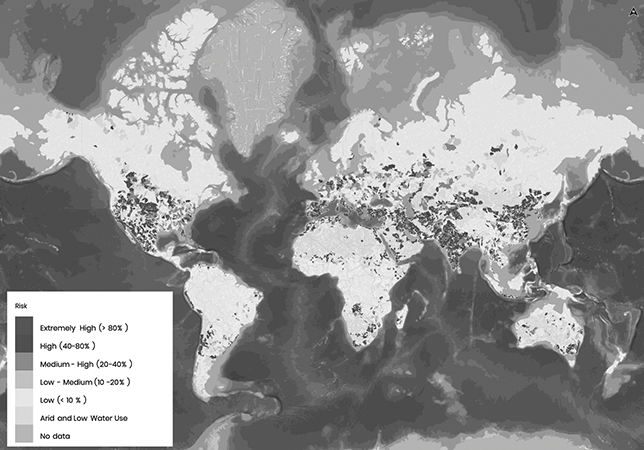
Climate change has multiple spatio-temporalitiesFootnote 99 that are flattened and universalized by data-driven climate monitoring. While the sources of environmental data are heterogeneous and collected and implemented for policymaking at different scales, the data is often standardized for processing, storage, and analysis. This data standardization is not only for facilitating the interoperability of diverse datasets, but also for creating visualizations to help make sense of that data for environmental policymakers. For example, the UNEP’s World Environment Situation Room (WESR) platformFootnote 101 enables visualization of geospatial data across various criteria, such as air pollution, sea level rise, and water stress (see Figure 9.1).Footnote 102
UNEP’s World Environment Situation Room’s visualization of baseline water stress data.Footnote 100
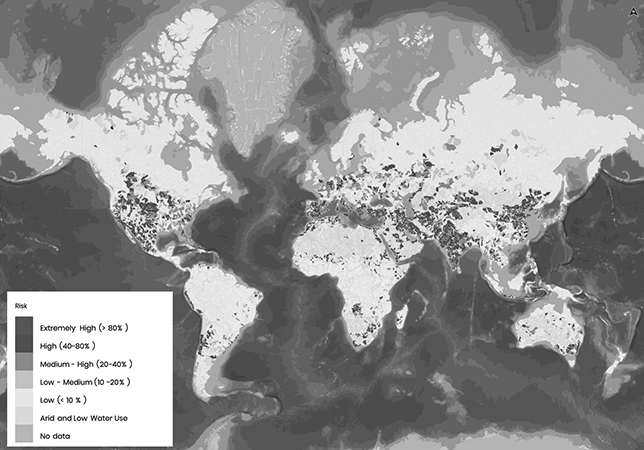
It is noteworthy what these data visualizations do not show. These geospatial visualizations obscure the unequal spatialities of climate change impacts among populations based on their location, race, wealth, and other factors that correlate to the unequal distribution of the harms of climate change. These inequalities exist even among people who live in the same city, let alone among those within areas of the world that are shown on visualizations and mappings of geospatial data. These visualizations may help policymakers in thinking about large scale impacts, but they do not show smaller scale climate impacts among unequally situated communities.
Moreover, the temporal orientation of algorithmic environmentality is at odds with the multiple temporalities of the problem of climate change, which is at once urgent and a problem that will be faced by future generations.Footnote 103 Algorithmic environmentality focuses on contemporaneous and predictive governance based on real-time data, with performative effects in the future that might foreclose other avenues of knowledge, action, and politics.Footnote 104 The future impact of climate policy decisions entail high stakes for the most vulnerable populations, potentially “compounding climate change damage or displacing the worst impacts onto particular populations.”Footnote 105 A climate policy that focuses on the ever-shifting urgency of the present moment risks overlooking the historical factors that contribute to disaster risk and neglecting to imagine alternative futures.Footnote 106 The universalizing temporality of algorithmic environmentality that focuses on real-time data for contemporaneous and predictive governance is at odds with the multiple geological, multispecies, and political timescales and temporalities of climate change.
Algorithmic environmentality also universalizes the spatially and geographically unequal dimensions of climate change and aspires to novel scales of governance. Climate change is a systemic problem that is simultaneously planetary, global, transboundary, and local. While the Earth and the environment have long centered shifting ideas of the “global,”Footnote 107 sensing infrastructures used in environmental monitoring and governance have transformed the concept. Dipesh Chakrabarty’s distinction between the global and the planet in historical thought being centered on their reference to the human or their relative indifference to the human, relatively, implies that the “globe” reflects human institutions and technology, while the planet is emerging as a “category of humanistic thought.”Footnote 108 One of the benefits of a planetary rather than global perspective in thinking about climate change is that it decenters humans and collapses the timescales of human history (including empire and capitalism) with geological and biological history.Footnote 109
In contrast to Chakrabarty’s historical distinction, algorithmic environmentality is a product of human rationalities of governance and shapes a political space of the “global” that is to be governed at the planetary level. Algorithmic environmentality, while aspiring to planetary scale governance, still reflects, and is limited by, human institutions and technology in ways similar to historical thought regarding the “global.”Footnote 110
The planetary scale and the aim for a totalizing or universal vision of the planet are reminiscent of historical modes of control and colonialism.Footnote 111 Here, “the planet might be understood as an entity to be sensed and transformed into data.”Footnote 112 This has implications for governance as environmental data infrastructures help produce forms of sensing and the production of data that, in turn, inform environmental governance and policy initiatives.Footnote 113 As Gabrys argues,
The detached and distant view of Earth produces an entity that could seemingly be managed – or programmed. This total view of the planet suggests complete interconnectedness, but also forms of imperial control. It is the product of globality as well as universal science. A total view can even seem to be necessary: as a way to organize the problem of climate change, for instance, in order to act upon it. Climate change is an event that comes into view through planetary computation, where global infrastructures make it knowable.Footnote 114
The totalizing and universalizing view that is promoted by algorithmic environmentality risks overlooking the spatially heterogeneous effects of climate change and unequal embodied experiences of it, while aspiring to new totalizing scales of governance.
By universalizing and flattening the spatio-temporalities of climate change and environmental phenomena through the production of globally uniform data,Footnote 115 algorithmic environmentality obscures the inequalities of climate change and environmental degradation. Through this flattening and universalizing, algorithmic environmentality overlooks historical patterns of colonialism, accumulation, dispossession, injustice, and extraction that have shaped the unequal impacts of climate change today, while at the same time risking contributing to those patterns. It may also deflect policymakers from engaging in deeper questions about desirable forms of collective responsibility, social life, and futures by embracing technological solutionism.
9.6 Transforming Global Environmental Problems into Global Data Problems
Turning global environmental problems into global data problems has potential epistemic ramifications by shaping new forms of legal knowledge and action that can result in problematic policy and epistemic injustice. Environmental monitoring infrastructures affect environmental governance by shaping knowledge about environmental problems, how they ought to be governed, and who ought to govern them. In the context of environmental law, data is transforming knowledge about how the environment and planetary systems ought to be governed and regulated.Footnote 116 As such, the use of data infrastructures in environmental governance transforms the epistemology of environmental governance. Data infrastructures make the targets of environmental governance and regulation more precise geospatially, in real-time, and with future effects by enabling monitoring and surveillance.Footnote 117 When environmental data is transformed into scientific knowledge for the purpose of data-driven or evidence-based policy and decision-making, it also shapes legal knowledge.Footnote 118
Data and algorithms that construct patterns and correlations risk ignoring knowledge that does not fit within those patterns, which can result in problematic policies. Moreover, the use of algorithms in environmental governance “is disempowering not just through what it misses, but by ‘locking in’ social, political, or environmental assumptions it could also exacerbate climate vulnerabilities.”Footnote 119 When environmental data is visualized and overlayed on maps provided by UNEP or Google Earth, for example, the creation of decontextualized and discrete data layers (focused on air quality, pollution, biodiversity, water loss, agricultural impacts, etc.) can prevent systemic understandings of environmental damage in governance, including problems of inequality, distribution, attribution, and responsibility. This creates a fundamental contradiction in bringing a planetary, ecological, and relational perspective to environmental governance through data infrastructures, which objectify, decontextualize, and silo environmental phenomena on discrete issues.
The integration of environmental data in environmental law transforms environmental legal knowledge and action, making datasets the objects of environmental governance. In other words, one of the increasingly prevalent aims of environmental governance is obtaining more and better environmental data with the goal of removing uncertainties and informing law and policy. These developments imply that going forward, the central concerns for environmental governance will be who decides the kinds of data to collect, who has access to environmental datasets, and who has the capabilities for analytics and interpretation of that data.Footnote 120
9.7 Epistemic Injustice and Resistance
Algorithmic environmentality reflects a particular civic epistemologyFootnote 121 that values the purported objectivity of data as a driver of environmental policy, preempting other visions of the kinds of knowledge(s) of environmental problems that should be valued and how publics and governance regimes should engage with those knowledge(s).Footnote 122 “Contemporaneous governance” through real-time data has future performative effects when it is oriented toward predictive governance that might foreclose other avenues of knowledge, action, and politics.Footnote 123
Environmental data is not a mere reflection of environmental processes, but rather subject to considerable political choice regarding the kinds of data collected, how such data are used, and who has access. For example, the exclusion of Indigenous peoples and their lands from environmental mapping in ocean planning and coastal management data portals such as the Mid-Atlantic Ocean Data Portal reflects not only the absence of these groups from environmental governance and planning forums, but also may result in environmental policies and practices that exclude their knowledges, their rights, and their lands.Footnote 124 As environmental data is increasingly used to inform global environmental governance, including climate mitigation and adaptation measures, this could result in the exclusion of those most vulnerable to the effects of climate change from having a say in data collection practices, how they are framed, and the policy choices that result from them.
One of the potential ways to counter these risks is to incorporate “citizen sensing” and civic technology initiatives in global environmental governance. Citizen sensing, participatory digital technologies, and civic climate technologies can empower marginalized communities, permit their participation in data-driven environmental policy, and provide a means for them to highlight their knowledge(s) and concerns. Citizen sensing takes the form of “practices for monitoring environments through low-cost and do-it-yourself (DIY) digital technologies.”Footnote 125 Citizen sensing is not just for gathering data and information or producing environmental knowledge; it can enable forms of collective claim-making about environmental problems.Footnote 126 Community-led civic technology initiatives, such as the Sustainable Environment and Ecological Development Society (SEEDS) in India, can help promote participation and engagement in governance over local environmental disasters that might be overlooked by policymakers and center the needs of the most vulnerable and marginalized communities affected by those disasters.Footnote 127 Indigenous-led environmental data infrastructures can also counter the universalizing spatio-temporality of centralized algorithmic environmentality.Footnote 128
There are limits to the extent to which digital technologies can promote marginalized communities’ interests. For example, citizen sensing can result in neoliberal political engagement that aims to “responsibilise individuals for environmental care (e.g., by collecting data for citizen science apps).”Footnote 129 Moreover, these initiatives often still depend on private digital infrastructures, falling into the same trap of contributing to the same problems that data-driven environmental governance aims to ameliorate. Nevertheless, citizen sensing and participatory digital technologies may permit alternative modes of engagement mediated through digital technologies to counter epistemic injustices that result when marginalized voices are excluded altogether.
Algorithmic environmentality’s way of “seeing” climate change raises questions on power-knowledge formations in global environmental governance: “[w]hose seeing counts, under which rules of the game, and what gets relegated to the margins of invisibility and inaction?”Footnote 130 The uses of algorithms for analyzing and visualizing environmental data shows that the rules of the game in algorithmic environmentality are, at times, beyond human visibility, making them more difficult to contest. Alternative infrastructures that enable visibility and restructuring of environmental data and algorithms may offer another avenue for potential contestation and resistance.
9.8 Conclusion
Climate change and recent developments in digital technologies have challenged international law and global governance, both conceptually and in practice. As international law has been unable to grapple with the intractable problem of climate change, there has been an increasing turn to technological techniques of governance. The growing entanglements of these areas, and the uses of data infrastructures in climate governance require critical reexaminations of how we conceptualize governance.
The logic and rationality of algorithmic environmentality which informs, distributes, and enacts environmental governance by and through data infrastructures have transformed environmental governance by turning global environmental problems into global data problems. Algorithmic environmentality redistributes power to those who decide on the kinds of data to be collected, those who have access to environmental datasets, and those who have the capabilities for analytics and interpretation of that data. The processing of environmental datasets to make them actionable for policymakers entangles commodified environmental data and algorithms with political decisions on how to best govern the climate. Yet, it leaves more fundamental problems in environmental law and governance unaddressed. It risks perpetuating environmental harms and the same extractive political economy that contributed to ecological crisis. These developments further risk foreclosing alternative forms of knowledge and action in the face of climate change. Algorithmic environmentality may signal a dangerous shift in governance to the extent it sidelines questions of power and injustice that the problem of climate change has rendered so exigent, and may very well exacerbate those problems.
In the face of the multiple crises associated with climate change, alternative infrastructures are needed to counter algorithmic environmentality. Climate change may require infrastructural thinkingFootnote 131 in global governance to take into account the multiple spatio-temporal scales of climate change and the multiple human, nonhuman, and more-than-human relations it implicates.
The questions, then, are, how to counter algorithmic environmentality’s infrastructural interdependency on private technology corporations that is shaped by law and political economy? Can alternative socio-material and sociotechnical infrastructures promote global economic restructuring that can advance alternative production, consumption, and resource allocation models to address climate change, including degrowth?Footnote 132 What forms of nonhuman witnessingFootnote 133 can provide alternative modes of agency, resistance, and politics for marginalized communities? In what ways, if any, can algorithms dealing with environmental data better address the multiple crises of climate change where they intersect with political economy, power, and inequality? Might socio-material infrastructures help rethink international law in a more ecological way, such that “the thought and practice of international law might encompass not just relations among states, international organizations, peoples, individuals, corporations, and the like, but also relations among sensors, databases, archives, river systems, oceans, animal colonies, and forests”?Footnote 134 While citizen sensing, civic technologies, and visibilizing and restructuring environmental data and algorithms may offer some partial answers, this chapter serves as a call for further engagement on these questions.
By lack of engagement with these issues, the technological solutionism offered by algorithmic environmentality in environmental law and governance risks undermining reflexive, critical thinking on these normative, distributive, and political questions. The problem of climate change will require alternative models of sociality and governance going forward. Climate change and environmental degradation have given greater urgency to the need to reimagine collective forms of social life and responsibility in global governance beyond what algorithmic environmentality can offer.

 Open access