Introduction
White matter neuropathology in dementia has received considerable attention. This is due, in part to neuroradiological and large-scale autopsy studies that suggest neuropathology involving periventricular and deep white matter, most often linked to vascular dementia (VaD), also occurs in Alzheimer's disease (AD) (Yip et al., Reference Yip, McKee, Green, Wells, Young, Cupples and Farrer2005). As a result, white matter damage or diffuse leukoaraiosis (LA) seen as high signal white matter hyperintensities on T2-weighted MRI have been associated with cognitive deficits in AD (Burns et al., Reference Burns, Church, Johnson, Xiong, Marcus, Fotenos and Buckner2005) and VaD (Price, Jefferson, Merino, Heilman, & Libon, Reference Price, Jefferson, Merino, Heilman and Libon2005). Thus, LA contributes to the clinical presentation of dementia regardless of diagnosis. Little is known about the specific degree to which LA influences the states preceding dementia. Given that white matter neuropathology is present in over 40% of healthy controls without dementia at autopsy (Petrovitch et al., Reference Petrovitch, Ross, He, Uyehara-Lock, Markesbery, Davis and White2007), increasing our understanding of the interplay between white matter damage and the clinical syndromes associated with increased risk for dementia may provide valuable information for disease prevention.
Mild Cognitive Impairment
Mild cognitive impairment (MCI), defined as the presence of subjective and objective cognitive impairment in the absence of frank dementia, is considered an at-risk state for developing dementia (Petersen et al., Reference Petersen, Smith, Waring, Ivnik, Tangalos and Kokmen1999). Recent conceptualizations of MCI suggest subgroups exist that may provide more specific clinical characterizations to assist in predicting conversion to dementia (Delano-Wood et al., Reference Delano-Wood, Bondi, Sacco, Abeles, Jak, Libon and Bozoki2009; Petersen et al., Reference Petersen, Doody, Kurz, Mohs, Morris, Rabins and Winblad2001). Amnesic mild cognitive impairment or the aMCI subtype, in which deficits are limited to episodic memory, is a strong predictor of developing AD (Petersen et al., Reference Petersen, Doody, Kurz, Mohs, Morris, Rabins and Winblad2001) with higher conversion rates than other, non-amnestic subtypes (Jak et al., Reference Jak, Bangen, Wierenga, Delano-Wood, Corey-Bloom and Bondi2009; Libon et al., Reference Libon, Xie, Eppig, Wicas, Lamar, Lippa and Wambach2010).
LA has been associated with increased risk for all types of MCI (Lopez et al., Reference Lopez, Jagust, Dulberg, Becker, DeKosky, Fitzpatrick and Kuller2003) and for conversion from MCI to AD in some (van Straaten et al., Reference van Straaten, Harvey, Scheltens, Barkhof, Petersen, Thal and DeCarli2008), but not all (DeCarli et al., Reference DeCarli, Mungas, Harvey, Reed, Weiner, Chui and Jagust2004) studies. White matter damage in MCI is associated with executive dysfunction (Bombois et al., Reference Bombois, Debette, Delbeuck, Bruandet, Lepoittevin, Delmaire and Pasquier2007) and predicts memory impairment in this at-risk group when combined with diffusion tensor imaging (DTI) (Delano-Wood et al., Reference Delano-Wood, Bondi, Jak, Horne, Schweinsburg, Frank and Salmon2008). Preliminary evidence has shown that white matter damage within periventricular brain regions was greater in MCI associated with memory/language deficits while a greater degree of deep white matter damage was found in MCI associated with deficits in executive function/processing speed (Delano-Wood et al., Reference Delano-Wood, Bondi, Sacco, Abeles, Jak, Libon and Bozoki2009). This, however, is one of only few studies to date comparing specific cognitive subtypes of MCI and cerebral white matter damage. More work needs to be done investigating the relationship between white matter damage and distinct cognitive phenotypes of prodromal AD.
Subjective Cognitive Impairment
Individuals with subjective cognitive impairment (SCI) have subjective memory complaints but no objective evidence of memory impairment on neuropsychological testing; thus, they meet some, but not all criteria for MCI. The subjective memory complaints associated with SCI may be related to an increased risk of conversion to dementia in otherwise cognitively normal individuals (Jessen et al., Reference Jessen, Wiese, Bachmann, Eifflaender-Gorfer, Haller, Kolsch and Bickel2010); however, not all studies agree on the clinical significance (de Groot et al., Reference de Groot, de Leeuw, Oudkerk, Hofman, Jolles and Breteler2001; Stewart et al., Reference Stewart, Dufouil, Godin, Ritchie, Maillard, Delcroix and Tzourio2008). SCI has also been associated with biological correlates of dementia including volumetric (Saykin et al., Reference Saykin, Wishart, Rabin, Santulli, Flashman, West and Mamourian2006; van der Flier et al., Reference van der Flier, van Buchem, Weverling-Rijnsburger, Mutsaers, Bollen, Admiraal-Behloul and Middelkoop2004), perfusion (Mosconi et al., Reference Mosconi, De Santi, Li, Tsui, Li, Boppana and de Leon2008), and functional (Rodda, Dannhauser, Cutinha, Shergill, & Walker, Reference Rodda, Dannhauser, Cutinha, Shergill and Walker2009) MRI-based assessments of brain integrity; but not in all (Archer et al., Reference Archer, Macfarlane, Price, Moore, Pepple, Cutler and Rossor2006; Copenhaver et al., Reference Copenhaver, Rabin, Saykin, Roth, Wishart, Flashman and Mamourian2006) studies.
Conflicting results also exist when attempting to determine the relationship among SCI, white matter damage, and associated subjective and/or objective cognition. Some (de Groot et al., Reference de Groot, de Leeuw, Oudkerk, Hofman, Jolles and Breteler2001; Minett, Dean, Firbank, English, & O'Brien, Reference Minett, Dean, Firbank, English and O'Brien2005), but not all (Miranda et al., Reference Miranda, Madureira, Verdelho, Ferro, Pantoni, Salvadori and Inzitarion2008; Stewart et al., Reference Stewart, Dufouil, Godin, Ritchie, Maillard, Delcroix and Tzourio2008) studies have reported a correlation between the severity of subjective memory complaints and the degree of white matter alterations in non-demented older adults. As part of a larger longitudinal study, investigators found that otherwise healthy older adults with white matter damage and subjective memory complaints at baseline were 8.5 times more likely to experience generalized cognitive decline at 2-year follow-up than individuals with only one (or none) of these predictor variables at baseline (Dufouil, Fuhrer, & Alperovitch, Reference Dufouil, Fuhrer and Alperovitch2005). While these studies excluded participants with dementia, many have not excluded participants with MCI. In a study where MCI, SCI and healthy control groups were examined, there were no between-group differences in severity of white matter alterations (Archer et al., Reference Archer, Macfarlane, Price, Moore, Pepple, Cutler and Rossor2006). Taken together, these studies suggest an association between LA and SCI; however, they do little to distinguish the nature of the relationship between LA and cognition within SCI and aMCI groups.
The aim of our study was to quantify white matter damage in individuals with aMCI and SCI to determine the impact of LA on the cognitive phenotypes of these two at-risk states. We compared cognitive performance in these groups to healthy controls (HC) to first determine their cognitive differences and then to establish the contribution of LA to these differences.
Methods
Participants
Individuals with aMCI and SCI were recruited from the Derwent Memory Clinic in Essex. The function of this clinic, described in detail elsewhere (Rodda et al., Reference Rodda, Dannhauser, Cutinha, Shergill and Walker2009), is the assessment, diagnosis and monitoring of cognitive impairment in older adults. Patients are referred from either primary or secondary care physicians with secondary care referrals received from psychiatrists, neurologists or geriatric physicians. HC were recruited from the community. The study was approved by the West Essex Local Research Ethics Committee and the research was completed in accordance with the Helsinki Declaration. All participants provided written informed consent.
All participants underwent a thorough psychiatric, neurological and physical examination to exclude other causes of perceived and/or objective cognitive impairment. These included current psychiatric illness or prescription of psychotropic medication during the previous 12 months; current or previous diagnosis of depression, bipolar or major psychotic illness; major neurological, medical or significant physical illness including Parkinson's disease or epilepsy; a history of alcohol or drug misuse; head injury; or the presence of contra-indications to MRI including pacemakers, recent surgery and claustrophobia. Any participant with a score ≥4 on the Modified Hachinski scale (Hachinski et al., Reference Hachinski, Iliff, Zilhka, Du Boulay, McAllister, Marshall and Symon1975) was excluded to separate aMCI and SCI from vascular cognitive impairment.
Procedures
Both clinic groups (i.e., SCI and aMCI) and HCs received a comprehensive neuropsychological assessment which included the Mini-Mental State Examination (MMSE; Folstein, Folstein, & McHugh, Reference Folstein, Folstein and McHugh1975) and the National Adult Reading Test (NART; Sharpe & O'Carroll, Reference Sharpe and O'Carroll1991) and underwent structural neuroimaging. Clinic groups also received subjective measures of affective functioning. In addition to these procedures (discussed in detail below), a standardized screening instrument known to measure cognitive impairment (Roth et al., Reference Roth, Tym, Mountjoy, Huppert, Hendrie, Verma and Goddard1986) and predict conversion to MCI (Oulhaj, Wilcock, Smith, & de Jager, Reference Oulhaj, Wilcock, Smith and de Jager2009)—the Cambridge Cognitive Examination (CAMCOG; Roth et al., Reference Roth, Tym, Mountjoy, Huppert, Hendrie, Verma and Goddard1986)—was used to determine the presence or absence of objective memory impairment and overall cognitive functioning for all three groups (i.e., SCI, aMCI, and HC).
The CAMCOG (Roth et al., Reference Roth, Tym, Mountjoy, Huppert, Hendrie, Verma and Goddard1986) includes subscales of memory (remote memory, recent memory, new learning), orientation, language (comprehension, expression), attention, praxis, abstract thinking, and perception. The new learning score, part of the memory subscale, was used as a measure of delayed recall and contributed to the diagnosis of aMCI and its distinction from SCI and HC subjects. It is comprised of free recall and recognition of six-items encoded during a picture naming task, and delayed free recall of five-items verbally encoded and written by subjects (max score = 17). Episodic memory was considered impaired if there was a discrepancy between performance on the new learning subscale and NART estimated IQ using a cutoff score ≤ 12 (1.5 SD below non-demented population mean) for subjects with average IQ and a cutoff score ≤ 14 for above average IQ based on published data (Huppert, Brayne, Gill, Paykel, & Beardsall, Reference Huppert, Brayne, Gill, Paykel and Beardsall1995).
The presence or absence of subjective memory impairment was assessed in all three groups. For clinic populations, that is, aMCI and SCI, the presence of subjective memory complaint was established by spontaneous complaint from the patient, which was concerning enough for them to attend the memory clinic for further assessment (Rodda et al., Reference Rodda, Dannhauser, Cutinha, Shergill and Walker2009). Furthermore, a diagnosis of subjective memory impairment in these groups (regardless of the presence or absence of objective memory deficits) required outside corroboration either through an informant or primary care physician knowledgeable of the participant's health and well-being. Healthy control participants were required to report normal subjective memory function, that is, deny subjective memory complaints on direct questioning with “Have you or anyone close to you noticed any problems or change in your memory?” There is precedent in the literature from both large-scale (Geerlings, Jonker, Bouter, Ader, & Schmand, Reference Geerlings, Jonker, Bouter, Ader and Schmand1999; Miranda et al., Reference Miranda, Madureira, Verdelho, Ferro, Pantoni, Salvadori and Inzitarion2008; Schofield et al., Reference Schofield, Marder, Dooneief, Jacobs, Sano and Stern1997; van Oijen, de Jong, Hofman, Koudstaal, & Breteler, Reference van Oijen, de Jong, Hofman, Koudstaal and Breteler2007) and small-scale (van der Flier et al., Reference van der Flier, van Buchem, Weverling-Rijnsburger, Mutsaers, Bollen, Admiraal-Behloul and Middelkoop2004) studies to use a single query and/or a binary presence/absence variable when considering subjective memory impairment in older adults.
Diagnostic determinations
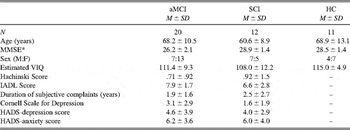
Twenty participants were diagnosed with aMCI (mean age = 68.2 ± 10.5; Table 1) by a consensus of senior psychiatrist and clinical neuropsychologist staff. Specific operational criteria (Petersen et al., Reference Petersen, Doody, Kurz, Mohs, Morris, Rabins and Winblad2001) included the following: (i) informant corroborated memory complaints; (ii) impaired episodic memory documented by the new learning subscale of the CAMCOG (described in detail above); (iii) normal general cognitive function based on a Clinical Dementia Rating Score ≤ 0.5 (CDR; Morris, Reference Morris1993) and a total CAMCOG score within 1 SD of age-appropriate population mean (≥78 for age <79 years; ≥75 for age >80 years); (iv) intact activities of daily living (ADL) as determined by a clinician's judgment and structured interview with the patient and an informant; (v) absence of any physical or psychiatric illness that may be responsible for the perceived memory deficit; and (vi) not meeting NINDS-ADRDA criteria for AD (McKhann et al., Reference McKhann, Drachman, Folstein, Katzman, Price and Stadlan1984).
Participant characteristics

Note. aMCI = amnesic mild cognitive impairment; SCI = subjective cognitive impairment; HC = healthy controls; M ± SD = mean ± standard deviation; MMSE = Mini-Mental State Examination; VIQ = verbal intelligence quotient (derived from the National Adult Reading Test); IADL = Instrumental activities of daily living; HADS = Hospital Anxiety and Depression Scale.
* p < .001.
Twelve individuals were diagnosed with SCI (mean age = 60.6 ± 8.9; Table 1). Criteria for SCI included: (i) self-perceived memory deficit persistent and severe enough to seek advice from a healthcare practitioner and referral to secondary services; (ii) memory complaint perceived as a decline from previous memory performance; (iii) intact episodic memory documented by the new learning subscale of the CAMCOG; (iv) normal general cognitive function based on a CDR Score ≤ 0.5 (Morris, Reference Morris1993) and a total CAMCOG score within 1 SD of age-appropriate population mean (see above for details); (v) absence of any physical or psychiatric illness that may be responsible for the perceived memory deficit; and (vi) normal ADL functioning.
Eleven HC subjects were also recruited. They were of comparable age (mean age = 68.9 ± 13.1; Table 1) to our aMCI population having been matched for a separate fMRI study (Dannhauser et al., Reference Dannhauser, Shergill, Stevens, Lee, Seal, Walker and Walker2008) and had no evidence of objective or subjective cognitive impairment that applied for SCI or aMCI groups outlined above. It should be noted that one HC participant did not receive structural neuroimaging thus, this person did not contribute to data analyses involving MRI-derived variables of interest. Re-running the cognitive analyses without this individual did not alter reported results.
Groups did not differ on age, NART estimated IQ or sex distribution (Table 1). Groups significantly differed on MMSE scores, F(2,40) = 10.0, p < .001; the aMCI group scored below the SCI and HC groups (aMCI < SCI = HC; p values ≤ .002). Clinic groups (i.e., aMCI and SCI) did not differ in terms of duration of memory complaints as measured by current age minus estimated age at onset of perceived memory impairment; nor did they differ in terms of reported depressive or anxiety related symptoms (all p values > .15; Table 1).
Neuropsychological assessment
Learning and memory was assessed with the story-based Logical Memory (LM) test from the Wechsler Memory Scale-III (Wechsler et al., Reference Wechsler, Wycherley, Benjamin, Callanan, Lavender and Mockler1998). LM requires participants to recall two distinct prose passages (one of which is presented twice) immediately after presentation and again after a 25-min delay. Variables of interest included immediate and delayed free recall, learning slope (i.e., the amount of benefit from repeat exposure to the repeated prose passage: 2nd recall total – 1st recall total) and percent retention (i.e., delay recall total/immediate recall total*100). Variables not already in percentages were transformed into percentages. Executive functioning was assessed with the Trail Making Test (TMT; Reitan & Wolfson, Reference Reitan and Wolfson1995), a two-part test of attention and motor speed (TMT-A) combined with cognitive set shifting and mental flexibility (TMT-B). Time to completion was measured in seconds for each subtest. Verbal fluency (Spreen & Benton, Reference Spreen and Benton1969) in which participants produce as many words as possible beginning with particular letters (F,A,S) or that come from a particular category (animals) measured aspects of language and executive function. Variables of interest included the total number of correct words produced across all three letter trials and a separate index of the number of correct words produced during animal fluency.
Affective measures
Subjective cognitive complaints have been associated with depressive symptomatology in normal and pathological aging (Reid & Maclullich, Reference Reid and Maclullich2006). We administered the Cornell Scale for Depression (Alexopoulos, Abrams, Young, & Shamoian, Reference Alexopoulos, Abrams, Young and Shamoian1988) and the Hospital Anxiety and Depression Scale (HADS; Zigmond & Snaith, Reference Zigmond and Snaith1983) to our clinic populations but not our healthy control population.
Neuroimaging protocol
Participants underwent structural MRI using a 1.5 Tesla GE NV/i Signa system (General Electric, Milwaukee, WI) at the Maudsley Hospital, London. A quadrature birdcage headcoil was used for radio frequency transmission and reception. Foam padding and a head restraint were used to minimize head movement. Initially, a series of sagittal fast gradient echo scout images were acquired. A three-dimensional inversion recovery prepared fast spoiled GRASS (SPGR) sequence was applied to the whole brain to obtain axial T1-weighted images with 1.5-mm contiguous sections (repetition time [TR] = 18 ms, inversion time [TI] = 450 ms, echo time [TE] = 5.1 ms, flip angle = 20° with one data average and a 256 × 256 × 128 voxel matrix). Finally, high resolution axial T2-weighted fast spin echo images were acquired covering the whole head (TR = 4500, TE = 80 ms, echo train length 15, 5-mm-thick slices, 0.5-mm slice gap, 256 × 224 acquisition matrix zero-filled to 512 × 512 to give 0.49 × 0.49 mm in plane resolution). The T2-weighted data was used to quantify LA for the current research.
LA Quantification
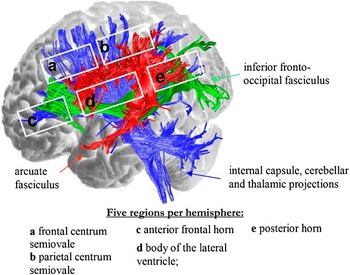
A cognitive neuroscientist trained in white matter hyperintensity quantification (ML) and blinded to the clinical and diagnostic data of study participants graded LA using the 40-point Leukoaraiosis Scale of Junque (Junque et al., Reference Junque, Pujol, Vendrell, Bruna, Jodar, Ribas and Marti-Vilalta1990). This MRI visual rating scale categorizes MRI-LA into five regions per hemisphere (Figure 1): frontal centrum semiovale, parietal centrum semiovale, white matter around the anterior frontal horns, white matter around the body of the lateral ventricles, and white matter around the posterior horns (originally termed the atrium/occipital horn) (Junque et al., Reference Junque, Pujol, Vendrell, Bruna, Jodar, Ribas and Marti-Vilalta1990). Each region was graded separately with scores ranging from 0 (no visible LA) to 4 (severe LA) and summed; max score = 40. Interrater reliability between ML and board certified neuroradiologists was high (r = 0.92; p < .001) as was intra-rater reliability (r = 0.96; p < .001).
Five regions categorized by the 40-point Leukoaraiosis Scale of Junque overlayed on affiliated white matter tracts; adapted from Lamar et al. (2008). Neuropsychologia, 46, 2597–2601.

Statistical Analyses
Given group differences on the MMSE and the effects of age on white matter integrity (Jones et al., Reference Jones, Catani, Pierpaoli, Reeves, Shergill, O'Sullivan and Howard2006), we controlled for age and MMSE in all analyses. To determine the cognitive phenotypes for SCI and aMCI we compared neuropsychological test performance in these groups to HCs using separate analyses of covariance (ANCOVA). Those variables that showed significant between-group differences were then the targets for our investigation of the impact of LA on cognition within each clinic group. The Junque Scale total score, a semi-quantitative measure of white matter damage, met criteria for normality across the entire sample and within each group (all p values > .05). Thus, parametric testing in the form of separate linear regression analyses was used to determine the contribution of LA on neuropsychological performance. After forcing age and MMSE into the model, the amount of variance accounted for by LA was determined through a second, stepwise procedure.
Results
Degree of Leukoaraiosis
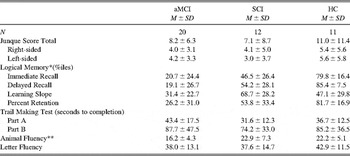
Results of an ANCOVA controlling for age and MMSE revealed no significant difference among our three groups on overall white matter burden as measured by the Junque Scale, F(2,37) = 1.0, p = .36 (Table 2).
White matter burden and cognitive phenotypes

*All Logical Memory ANCOVAs significantly different among groups, p ≤ .01.
**HC > aMCI only, ANCOVA p = .02.
ANCOVA = analysis of covariance; aMCI = amnesic mild cognitive impairment; SCI = subjective cognitive impairment; HC = healthy controls.
Cognitive Phenotypes
Separate ANCOVAs controlling for age and MMSE revealed significant differences among HC, SCI, and aMCI groups on select cognitive measures. Variables derived from the WMS-III LM test were significant including immediate [F(2,36) = 15.1; p < .001] and delayed [F(2,36) = 19.1; p < .001] recall scores, learning slope [F(2,32) = 5.5; p = .009] and percent retention [F(2,32) = 8.0; p = .002]. Follow-up pairwise comparisons of estimated marginal means determined a hierarchy of performance for both immediate and delayed recall (HC > SCI > aMCI) where HC outperformed SCI who outperformed aMCI (all p values < .01). The SCI group showed a steeper learning slope than HC or aMCI groups (p = .002); HC and aMCI showed comparable performance. SCI and HC groups performed similarly on percent retention but significantly better than their aMCI counterparts (p values < .05; Table 2).
Across measures of executive and language functioning, only animal fluency showed significant between-group differences [F(2,36) = 4.2; p = .02]. Follow-up pairwise comparisons of estimated marginal means revealed that the HC group produced more animals compared to the aMCI group only (p = .008).
Individual subscales derived from the CAMCOG did not reveal any significant differences between the groups with the exception of the attention subscale, [F(2,37) = 4.1; p = .02]. Pairwise comparisons of estimated marginal means revealed a significant difference between the SCI and aMCI group only (i.e., SCI < aMCI; p = .006). We did not analyze the new learning subscale given this index was a key part of our criteria for determining groups.
Impact of LA on Cognitive Phenotypes
We ran separate linear regressions within each clinic group using individual neuropsychological variables found to be significant in the ANCOVAs outlined above as outcome variables. These included the four percentile scores derived from LM, animal fluency, and the attention subscale from the CAMCOG.
For the aMCI group, forcing age and MMSE into the model did not significantly explain the variance for any variable with the exception of the attention subscale [50.2% of the variance, F(2,17) = 8.6; p = .003]; standardized beta coefficients: age = .17; p = .33; MMSE = .73; p = .001). White matter burden did not enter into this model. In fact, LA as quantified by the Junque did not enter into any linear regression model for the aMCI group.
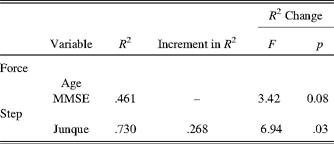
For the SCI group, after forcing age and MMSE into the model (46.1% of the variance at p = .08), Junque total score contributed an additional 26.8% of the variance to learning slope percentile scores (p = .03). Individual standardized beta coefficients and their significance may be found in Table 3. The only other model to reach significance involved the attention subscale with age and MMSE contributing 84.5% of the variance (p < .001); however, LA did not enter into this model.
Logistical regression results for learning slope in SCI

Note. Overall model significance, F(3,7) = 6.29, p = .02; standardized beta coefficients, age = 0.986, p = .02; MMSE = −1.12, p = .14; Junque = −1.9, p = .03.
SCI = subjective cognitive impairment; MMSE = Mini-Mental State Examination.
Discussion
When comparing individuals with subjective memory complaints with and without objective memory impairment, the impact of LA on patterns of cognitive performance was restricted to individuals without objective memory deficits. Thus, while the SCI group showed a steeper learning slope compared to HC and aMCI groups and their recall performance fell between HC and aMCI, white matter burden contributed to SCI performance variance in learning slope only. In contrast, while results in aMCI confirmed mild impairment in memory recall and retention, LA did not contribute to this profile. LA did not contribute to the aMCI group's semantic language performance which was also impaired relative to HCs. In summary, within the context of equivalent white matter burden across clinic groups, results suggest that LA significantly, and selectively, contributed to the cognitive phenotype of SCI.
Results point toward a subtle role for white matter alterations in younger adults with subjective cognitive complaints. White matter burden negatively contributed to learning slopes in SCI such that increasing amounts of LA contributed to a failure to benefit from repeat exposure to to-be-remembered information. Although forced into the model, age also significantly (and positively) contributed such that the younger the participant, the worse their learning slope. Taken together, this may suggest that greater white matter burden at a younger age contributes to subtle alterations in learning for individuals with subjective memory complaints. The learning performance of younger SCI participants with greater LA may explain why, as a group, individuals with SCI showed spontaneous recall significantly below their HC counterparts. A lack of benefit from repeat exposure in “young-old” adults as a subtle marker of cognitive decline has been previously reported (Lamar, Resnick, & Zonderman, Reference Lamar, Resnick and Zonderman2003); however, this is the first time such a performance pattern has been associated with white matter burden.
SCI learning performance may also be due, in part to their subtle attentional deficits when compared to aMCI when one considers that control of attentional focus is required to optimize episodic memory performance. In fact, previous fMRI work in our SCI cohort found altered cortical activation during a divided attention task (i.e., increased activation in left medial temporal lobe, bilateral thalamus, posterior cingulate cortex and caudate) suggestive of functional compensation for early neuropathology when compared to HCs with comparable divided attention performance (Rodda et al., Reference Rodda, Dannhauser, Cutinha, Shergill and Walker2009). Although LA did not contribute to declines in attention for the SCI group in the current study, MMSE scores did. A post hoc investigation revealed that LA and MMSE were highly correlated in SCI only, r = −0.86, p ≤ .001; by taking MMSE out of the model, LA explained 75% of the variance in attention scores on the CAMCOG. Regardless of whether our binary response regarding subjective memory impairment led to the inclusion of perceived attention or executive dysfunction—often misconstrued as impaired memory, it is clear that white matter damage in SCI may contribute to alterations in attention as well as learning leading to the self-perceived cognitive impairment in this group. Our study findings need to be followed up in a larger sample to better understand these relationships.
Since this study's inception, researchers have shown the importance of using more than one aspect of memory for a diagnosis of aMCI (Chang et al., Reference Chang, Bondi, Fennema-Notestine, McEvoy, Hagler, Jacobson and Dale2010). While we focused on the new learning subscale of the CAMCOG to categorize participants into aMCI, SCI and HC groups, we also used CAMCOG total score—encompassing, among other things remote and recent memory—in our diagnostic criteria. This did not, however, prevent the SCI group from showing lower LM scores than the HC group and lower attention scores than the aMCI group despite the fact that none of the SCI participants were judged to be impaired on these measures when considered individually. While early deficits may be present in SCI that are not far enough from normative values to be detected at an individual level but only at a group level, future work should determine if independent tests of memory would be more robust in guarding against group differences. An assessment of all possible cognitive complaints or a more in-depth assessment of perceived memory complaints may have allowed for greater generalization of the role of LA on perceived versus objective cognitive impairment in various clinic populations. We chose to focus on a more global assessment of memory and memory complaints given their preponderance in older adults and their applicability to AD, the most prevalent form of dementia.
While a limitation of our study is the small sample size, our method for quantifying white matter burden provided a robust characterization of LA that contributed to the strength of this study. The Junque Scale (Junque et al., Reference Junque, Pujol, Vendrell, Bruna, Jodar, Ribas and Marti-Vilalta1990) allows for a larger range of scores and provides indices of regional white matter burden that may, in a larger sample further elucidate the underlying mechanisms by which LA exerts its negative impact on SCI. While we did not collect subjective reports of depressive and anxiety related symptoms in our HC sample, these individuals did receive a thorough psychiatric examination which screened for the presence of affective dysfunction. Despite this, we cannot deny the possibility that depressive symptomatology in otherwise euthymic older adults may have contributed to the pattern of learning and memory in this population.
Similarly, our NART-based estimate of IQ may be less accurate for individuals in the lower and higher ends of the intelligence scale thus negatively impacting our categorizations linked to this measure. It should be noted that only a few individuals fell into this category. Furthermore, over a 2-year longitudinal follow-up (i) none of our HCs converted to SCI or aMCI; (ii) 3 SCIs converted to aMCI while the rest remained SCI; and (iii) 12 individuals with aMCIs converted to AD or mixed dementia, 7 remained aMCI and 1 was lost to follow-up. This data demonstrates the validity of our initial classifications given that HCs remained intact, 3 SCI converted while the rest remained stable supporting their increased risk in some but not all cases and that the majority of aMCIs progressed at the expected rate toward dementia.
The incorporation of state-of-the-art neuroimaging techniques would also help to elucidate and expand upon the findings of this study. For example, recent DTI studies have reported links between declines in white matter integrity and declines in cognitive performance in MCI (Delano-Wood et al., Reference Delano-Wood, Bondi, Jak, Horne, Schweinsburg, Frank and Salmon2008) possibly due to increased sensitivity of DTI to white matter damage (Lamar, Charlton, Morris, & Markus, Reference Lamar, Charlton, Morris and Markus2010; O'Sullivan et al., Reference O'Sullivan, Jones, Summers, Morris, Williams and Markus2001). The lack of association between LA and cognition in our aMCI group may also be due to the fact that increasing AD neuropathology associated with the development and progression of aMCI (Apostolova et al., Reference Apostolova, Mosconi, Thompson, Green, Hwang, Ramirez and de Leon2010) may be driving this group's cognitive profile. This is not to say that LA does not impact on the larger umbrella of MCI or the trajectory of development and progression of AD; numerous studies support these associations (van Straaten et al., Reference van Straaten, Harvey, Scheltens, Barkhof, Petersen, Thal and DeCarli2008; Yoshita et al., Reference Yoshita, Fletcher, Harvey, Ortega, Martinez, Mungas and DeCarli2006). Work combining hippocampal volumes with more subtle DTI measures of white matter integrity would facilitate knowledge regarding these pathologies in at-risk individuals; particularly given conflicting results investigating the individual contributions of white matter and subcortical structures (DeCarli et al., Reference DeCarli, Mungas, Harvey, Reed, Weiner, Chui and Jagust2004; Delano-Wood et al., Reference Delano-Wood, Bondi, Jak, Horne, Schweinsburg, Frank and Salmon2008).
Our data, while preliminary, suggest white matter alterations at younger ages may negatively impact learning; this, combined with subtle alterations in attention may lead to self-perceived (and objective) learning impairment in older adults starting as early as the fifth decade. Individuals with SCI, possibly with an emphasis on those presenting in mid-life, may benefit from a closer evaluation of LA and subtle cognitive change. Our study provides preliminary support for this assertion but additional empirical evidence should be pursued in mid-life groups with subjective memory complaints given their unique position on the aging spectrum. Given that vascular risk factors (growing in prevalence for individuals between 40 and 60 years of age; Lyketsos et al., Reference Lyketsos, Toone, Tschanz, Rabins, Steinberg, Onyike and Williams2005) have a negative impact on cerebral white matter and can lead to increased risk of dementia later in life (Breteler, Reference Breteler2000), work incorporating LA and cognitive profiles of SCI and aMCI in mid-life is needed to better address possible implications of the current research.
Acknowledgments
We thank Drs. Catherine C. Price and Andy Simmons for their assistance with this study. Portions of these data were presented at the 37th annual meeting of the International Neuropsychological Society, Atlanta, GA This work was supported by the Wellcome Trust (No 066810/z/02/z) and an unrestricted grant from Novartis Pharmaceuticals UK Ltd (GR1A). There are no conflicts of interest related to this research study.