


%20--%3e%3c!DOCTYPE%20svg%20PUBLIC%20'-//W3C//DTD%20SVG%201.0//EN'%20'http://www.w3.org/TR/2001/REC-SVG-20010904/DTD/svg10.dtd'%3e%3csvg%20version='1.0'%20id='Layer_1'%20xmlns='http://www.w3.org/2000/svg'%20xmlns:xlink='http://www.w3.org/1999/xlink'%20x='0px'%20y='0px'%20width='64px'%20height='64px'%20viewBox='5.5%20-3.5%2064%2064'%20enable-background='new%205.5%20-3.5%2064%2064'%20xml:space='preserve'%3e%3cg%3e%3ccircle%20fill='%23FFFFFF'%20fill-opacity='0'%20cx='37.785'%20cy='28.501'%20r='28.836'/%3e%3cpath%20fill='%23595959'%20d='M37.441-3.5c8.951,0,16.572,3.125,22.857,9.372c3.008,3.009,5.295,6.448,6.857,10.314%20c1.561,3.867,2.344,7.971,2.344,12.314c0,4.381-0.773,8.486-2.314,12.313c-1.543,3.828-3.82,7.21-6.828,10.143%20c-3.123,3.085-6.666,5.448-10.629,7.086c-3.961,1.638-8.057,2.457-12.285,2.457s-8.276-0.808-12.143-2.429%20c-3.866-1.618-7.333-3.961-10.4-7.027c-3.067-3.066-5.4-6.524-7-10.372S5.5,32.767,5.5,28.5c0-4.229,0.809-8.295,2.428-12.2%20c1.619-3.905,3.972-7.4,7.057-10.486C21.08-0.394,28.565-3.5,37.441-3.5z%20M37.557,2.272c-7.314,0-13.467,2.553-18.458,7.657%20c-2.515,2.553-4.448,5.419-5.8,8.6c-1.354,3.181-2.029,6.505-2.029,9.972c0,3.429,0.675,6.734,2.029,9.913%20c1.353,3.183,3.285,6.021,5.8,8.516c2.514,2.496,5.351,4.399,8.515,5.715c3.161,1.314,6.476,1.971,9.943,1.971%20c3.428,0,6.75-0.665,9.973-1.999c3.219-1.335,6.121-3.257,8.713-5.771c4.99-4.876,7.484-10.99,7.484-18.344%20c0-3.543-0.648-6.895-1.943-10.057c-1.293-3.162-3.18-5.98-5.654-8.458C50.984,4.844,44.795,2.272,37.557,2.272z%20M37.156,23.187%20l-4.287,2.229c-0.458-0.951-1.019-1.619-1.685-2c-0.667-0.38-1.286-0.571-1.858-0.571c-2.856,0-4.286,1.885-4.286,5.657%20c0,1.714,0.362,3.084,1.085,4.113c0.724,1.029,1.791,1.544,3.201,1.544c1.867,0,3.181-0.915,3.944-2.743l3.942,2%20c-0.838,1.563-2,2.791-3.486,3.686c-1.484,0.896-3.123,1.343-4.914,1.343c-2.857,0-5.163-0.875-6.915-2.629%20c-1.752-1.752-2.628-4.19-2.628-7.313c0-3.048,0.886-5.466,2.657-7.257c1.771-1.79,4.009-2.686,6.715-2.686%20C32.604,18.558,35.441,20.101,37.156,23.187z%20M55.613,23.187l-4.229,2.229c-0.457-0.951-1.02-1.619-1.686-2%20c-0.668-0.38-1.307-0.571-1.914-0.571c-2.857,0-4.287,1.885-4.287,5.657c0,1.714,0.363,3.084,1.086,4.113%20c0.723,1.029,1.789,1.544,3.201,1.544c1.865,0,3.18-0.915,3.941-2.743l4,2c-0.875,1.563-2.057,2.791-3.541,3.686%20c-1.486,0.896-3.105,1.343-4.857,1.343c-2.896,0-5.209-0.875-6.941-2.629c-1.736-1.752-2.602-4.19-2.602-7.313%20c0-3.048,0.885-5.466,2.658-7.257c1.77-1.79,4.008-2.686,6.713-2.686C51.117,18.558,53.938,20.101,55.613,23.187z'/%3e%3c/g%3e%3c/svg%3e)
%20--%3e%3c!DOCTYPE%20svg%20PUBLIC%20'-//W3C//DTD%20SVG%201.0//EN'%20'http://www.w3.org/TR/2001/REC-SVG-20010904/DTD/svg10.dtd'%3e%3csvg%20version='1.0'%20id='Layer_1'%20xmlns='http://www.w3.org/2000/svg'%20xmlns:xlink='http://www.w3.org/1999/xlink'%20x='0px'%20y='0px'%20width='64px'%20height='64px'%20viewBox='5.5%20-3.5%2064%2064'%20enable-background='new%205.5%20-3.5%2064%2064'%20xml:space='preserve'%3e%3cg%3e%3ccircle%20fill='%23FFFFFF'%20fill-opacity='0'%20cx='37.637'%20cy='28.806'%20r='28.276'/%3e%3cg%3e%3cpath%20fill='%23595959'%20d='M37.443-3.5c8.988,0,16.57,3.085,22.742,9.257C66.393,11.967,69.5,19.548,69.5,28.5c0,8.991-3.049,16.476-9.145,22.456%20C53.879,57.319,46.242,60.5,37.443,60.5c-8.649,0-16.153-3.144-22.514-9.43C8.644,44.784,5.5,37.262,5.5,28.5%20c0-8.761,3.144-16.342,9.429-22.742C21.101-0.415,28.604-3.5,37.443-3.5z%20M37.557,2.272c-7.276,0-13.428,2.553-18.457,7.657%20c-5.22,5.334-7.829,11.525-7.829,18.572c0,7.086,2.59,13.22,7.77,18.398c5.181,5.182,11.352,7.771,18.514,7.771%20c7.123,0,13.334-2.607,18.629-7.828c5.029-4.838,7.543-10.952,7.543-18.343c0-7.276-2.553-13.465-7.656-18.571%20C50.967,4.824,44.795,2.272,37.557,2.272z%20M46.129,20.557v13.085h-3.656v15.542h-9.944V33.643h-3.656V20.557%20c0-0.572,0.2-1.057,0.599-1.457c0.401-0.399,0.887-0.6,1.457-0.6h13.144c0.533,0,1.01,0.2,1.428,0.6%20C45.918,19.5,46.129,19.986,46.129,20.557z%20M33.042,12.329c0-3.008,1.485-4.514,4.458-4.514s4.457,1.504,4.457,4.514%20c0,2.971-1.486,4.457-4.457,4.457S33.042,15.3,33.042,12.329z'/%3e%3c/g%3e%3c/g%3e%3c/svg%3e)
Introduction
The election year began with active speculation that the first term Albanese government would be reduced to minority or possibly make history by losing office. Instead, the result was a surprise landslide for the incumbent Australian Labor Party (ALP) and a second (and deeper) electoral disaster for the Coalition. The defeat prompted a brief split between the Liberal (LPA) and National (NP) parties, who maintain a perpetual Coalition even in opposition, albeit, one that was hastily repaired. Following the May election, the year was dominated by the politics of inflation, cost of living, housing, and the Gaza war. The year ended in tragedy, when 15 people were massacred in antisemitic terrorist attack during a Chanukah celebration.
Election report
Parliamentary elections
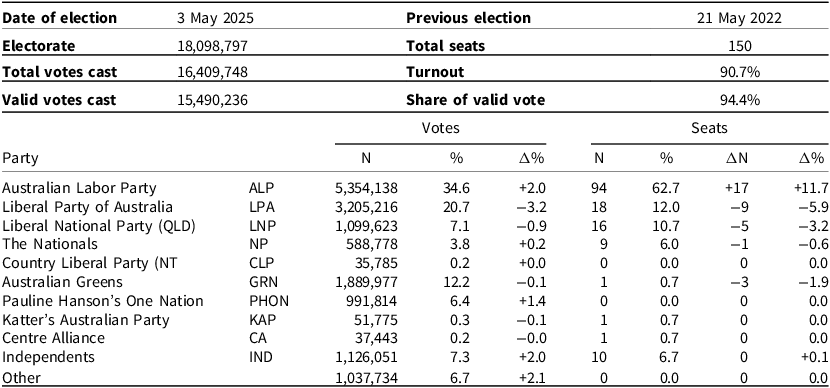
The federal election held on 3 May 2025 contested all 150 seats in the lower house (the House of Representatives) and 40 of 76 in the upper house (the Senate). The ALP won 94 of 150 seats in the House of Representatives in a landslide – the highest number in the party’s history – and was returned to government. It achieved this from a relatively modest primary vote of 34.6 per cent, with single member electorates and majoritarian preferential voting distorting proportionality, a defining feature of Australia’s alternative vote electoral system.
The Coalition Parties (LPA and NP) reached a new nadir, winning only 43 of 150 seats in the House and 31.8 per cent of votes. The Liberals bore the brunt of seat losses, losing 9 metropolitan seats to Labor, with the LNP (a combined LPA/NP that contests in the state of Queensland) also suffering 6 losses, largely centred around the Brisbane metropolitan area. The LNP’s losses included Opposition Leader Peter Dutton – the first opposition leader to lose their seat at a federal election. By contrast, the rural-based National Party’s single seat loss can be attributed to the defection of Andrew Gee from the party to independent status in 2022, with the party’s vote percentage marginally increasing to 3.80 per cent.
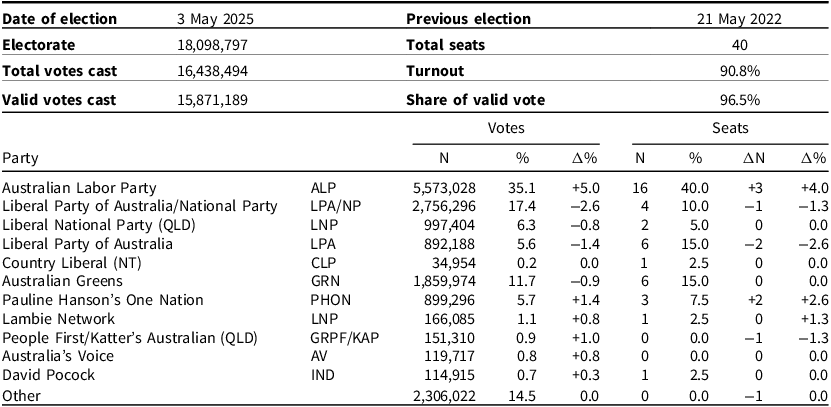
The crossbench remained large by Australian standards, with 10 independents, 2 micro party members (from Centre Alliance and Katter’s Australian Party respectively), and 1 Green member elected. The Greens had a disastrous lower house result – losing 3 of the 4 members elected in 2022 (including their leader Adam Bandt), despite maintaining 12.2 per cent of votes. These losses for the Greens were largely caused by an inner metropolitan surge for Labor, the redistribution of some constituency boundaries, and tactical voting. The full House of Representatives results can be found in Table 1, whilst results for the senate can be found in Table 2.
Elections to lower house of Parliament (House of Representatives) in Australia in 2025

Table 1. Long description
A table summarizing election results for the lower house of Parliament in Australia. The table has 13 rows and 10 columns. Column headers are Date of election, Previous election, Electorate, Total seats, Total votes cast, Turnout, Valid votes cast, Share of valid vote, Party, Votes N, Votes %, Votes Delta %, Seats N, Seats %, Seats Delta N, Seats Delta %. Row 1: Date of election, 3 May 2025; Previous election, 21 May 2022; Electorate, 18,098,797; Total seats, 150; Total votes cast, 16,409,748; Turnout, 90.7 percent; Valid votes cast, 15,490,236; Share of valid vote, 94.4 percent. Row 2: Party, Australian Labor Party; Votes N, 5,354,138; Votes %, 34.6; Votes Delta %, 2.0; Seats N, 94; Seats %, 62.7; Seats Delta N, 17; Seats Delta %, 11.7. Row 3: Party, Liberal Party of Australia; Votes N, 3,205,216; Votes %, 20.7; Votes Delta %, -3.2; Seats N, 18; Seats %, 12.0; Seats Delta N, -9; Seats Delta %, -5.9. Row 4: Party, Liberal National Party (QLD); Votes N, 1,099,623; Votes %, 7.1; Votes Delta %, -0.9; Seats N, 16; Seats %, 10.7; Seats Delta N, -5; Seats Delta %, -3.2. Row 5: Party, The Nationals; Votes N, 588,778; Votes %, 3.8; Votes Delta %, +0.2; Seats N, 9; Seats %, 6.0; Seats Delta N, -1; Seats Delta %, -0.6. Row 6: Party, Country Liberal Party (NT); Votes N, 35,785; Votes %, 0.2; Votes Delta %, 0.0; Seats N, 0; Seats %, 0.0; Seats Delta N, 0; Seats Delta %, 0.0. Row 7: Party, Australian Greens; Votes N, 1,889,977; Votes %, 12.2; Votes Delta %, -0.1; Seats N, 1; Seats %, 0.7; Seats Delta N, -3; Seats Delta %, -1.9. Row 8: Party, Pauline Hanson’s One Nation; Votes N, 991,814; Votes %, 6.4; Votes Delta %, +1.4; Seats N, 0; Seats %, 0.0; Seats Delta N, 0; Seats Delta %, 0.0. Row 9: Party, Katter’s Australian Party; Votes N, 51,775; Votes %, 0.3; Votes Delta %, -0.1; Seats N, 1; Seats %, 0.7; Seats Delta N, 0; Seats Delta %, 0.0. Row 10: Party, Centre Alliance; Votes N, 37,443; Votes %, 0.2; Votes Delta %, -0.0; Seats N, 1; Seats %, 0.7; Seats Delta N, 0; Seats Delta %, 0.0. Row 11: Party, Independents; Votes N, 1,126,051; Votes %, 7.3; Votes Delta %, +2.0; Seats N, 10; Seats %, 6.7; Seats Delta N, 0; Seats Delta %, +0.1. Row 12: Party, Other; Votes N, 1,037,734; Votes %, 6.7; Votes Delta %, +2.1; Seats N, 0; Seats %, 0.0; Seats Delta N, 0; Seats Delta %, 0.0.
Notes: The Official Opposition grouping is called ‘The Coalition’, made up of the LPA, LNP, NP, and the CLP. The LNP Party is the merger of the Queensland divisions of the LPA and the NP. Members choose to sit in either the NP or LPA party rooms in the Federal Party. The CLP only exists in the Northern Territory. Members choose to sit in either the NP or LPA party rooms in the Federal Party.
Source: Australian Electoral Commission (2025a).
Elections to the upper house of Parliament (The Senate) in Australia in 2025

Table 2. Long description
A table comparing election results for the Australian Senate in 2025. The table has 15 rows and 10 columns. Column headers are Date of election, Previous election, Electorate, Total seats, Total votes cast, Turnout, Valid votes cast, Share of valid vote, Party, Votes, and Seats. Row labels include Australian Labor Party, Liberal Party of Australia/National Party, Liberal National Party (QLD), Liberal Party of Australia, Country Liberal (NT), Australian Greens, Pauline Hanson’s One Nation, Lambie Network, People First/Katter’s Australian (QLD), Australia’s Voice, David Pocock, and Other. Each row provides data on the number of votes, percentage of votes, number of seats, and percentage of seats for each party. Notable trends include the Australian Labor Party receiving the highest percentage of votes and seats, while the Liberal Party of Australia/National Party shows a decrease in both votes and seats compared to the previous election.
Notes: In total, the Senate has 76 Seats. Vote percentages are calculated as percentages of half Senate results, not for the whole chamber. The Liberal Party of Australia and the National Parties run a joint Senate ticket in NSW and Victoria. The LNP is the merger of the Queensland divisions of the LPA and the NP. Members choose to sit in either the NP or LPA party rooms in the Federal Party. The CLP only exists in the Northern Territory, members can choose to sit with either the Liberal or National Parties in the Federal Parliament. The LPA ran separately in WA, SA, Tas, and the ACT. The NP ran separately in South Australia and Western Australia, and it is not reported here (received <1% of the national vote). Incumbent Queensland Senator Gerard Rennick opted to run a joint ticket of his People First party and Katter’s Australian Party in his home state of Queensland. People first ran joint tickets with the Libertarian and HEART parties in NSW and HEART in Victoria, while running separately in remaining jurisdictions. These variants are not reported directly here (received <1% of the national vote). David Van, who was elected as a Liberal in 2019 is reflected ‘in the ‘Other’ category. Van resigned from the LP in 2023 following sexual assault allegations and unsuccessfully sought re-election as an ungrouped candidate in Victoria.
Source: AEC 2025b.
The trend of declining major party votes continued, with combined votes for Labor and Coalition reaching a new low of 66.39 per cent. This has caused a dramatic rise in the number of ‘non-classic contests’, where at least one of the two major parties is not in the final count – accounting for 35 contests in 2025. A growing proportion of constituency contests with a large field of candidates has also resulted in an increasing number of complex counts, where the order in which candidates are eliminated can have a disproportionate and unpredictable effect on the winning candidate (see Raue Reference Raue, Sheppard, Sawer and Warhurst2026 for a more detailed analysis of this fragmentation in the Australian electorate).
The election campaign formally began on 28 March, which was later than anticipated. The poll was delayed first by a cyclone and then had to take the Easter holidays into consideration. The expectation was a highly competitive contest with open discussion of a possible hung parliament. The government’s poor prospects were the result of the Coalition’s narrow lead in most opinion polls since December 2024. The Albanese Government took a cautious approach in the election campaign, as it had for most of its first term in office, choosing to emphasise traditional Labor strengths such as investments in health and early childhood education. It notably chose to avoid contentious social and cultural issues, such as the failed voice referendum, instead opting to deliver a pre-election mini budget which provided modest tax cuts to the lowest income bracket (see Manwaring and Foley Reference Manwaring, Foley, Sheppard, Sawer and Warhurst2026). Albanese became the first Australian Prime Minister to win a second consecutive term in two decades.
The Coalition’s campaign was widely hailed as a disaster. It doubled down on the masculine, outer-suburban campaign that was run by Morrison in 2022, and explicitly targeted traditional Labor supporters rather than seeking to win back more affluent, socially liberal voters who had traditionally formed part of the Liberal Party’s core base. This proved to be an electoral disaster, with the Liberal Party achieving the lowest number of votes and seats since its formation in 1944. The Coalition lacked a coherent policy narrative, proposing heavily interventionist nuclear and gas programmes, opposing Labor’s tax cuts, and offering sugar-hit cost-of-living relief through temporary cuts to the fuel excise. All of these measures went against traditional Liberal policy prescriptions. Additionally, the Coalition campaign was hampered by negative perceptions of its leader – Peter Dutton, who was perceived by the electorate as somewhat ‘Trumpian’ in nature (Sunman, Ghazarian and Taflaga Reference Sunman, Ghazarian, Taflaga, Sheppard, Sawer and Warhurst2026); A perception that hampered the Coalition’s campaign amidst Trump’s return to office and trade volatility caused by the U.S.’s imposition of tariffs.
Turnout was generally high in the election, ranging from 88.7 per cent in Queensland to 93.19 per cent in Tasmania (the national figure was 90.7 per cent). An outlier here was the Northern Territory, which saw a 2.3 per cent dip in turnout to 70.8 per cent of enrolled voters (AEC 2025a). Turnout amongst the Territory’s indigenous communities is an ongoing issue in Australian elections, with this decrease perhaps influenced by the increased enrolment of indigenous electors in the run up to the 2023 Voice referendum.
Senate results saw the Coalition lose 3 Senators for a total of 27. This number increases to 5 if factoring in the defections of Gerard Rennick and David Van, elected on LNP and LPA tickets in 2019. Two of these seats were captured by the populist radical-right One Nation Party – which increased its representation to 4 in the total Senate. Labor increased its tally by 3, for a total of 30, while the Greens, David Pocock and Lambie Network maintained their positions. These results provided Labor with a workable Senate – being able to pass legislation with the support of either the Greens or the Coalition.
Regional elections
Tasmania returned to the polls on 19 July for the third time since 2021, despite nominally having fixed four-year terms for its parliament. In 2024, the returning Rockliff Liberal Government won a plurality of 14 seats (36.7 per cent of votes), having fallen short of the 18 required for a majority. In that election it had formed a minority government, relying on supply and confidence from three of the Jacqui Lambie Network (JLN) and two independent members (TEC 2024).
The disintegration of the JLN opened a window for the Labor opposition to move a successful motion of no confidence against the government, which passed by a narrow 18-17 margin. The subsequent election saw the Liberals again win 14 seats (39.9 per cent of votes) to the ALP’s 10 (25.9 per cent of votes), with 11 seats won by crossbenchers, the largest being the 5 (14.4 per cent of votes) won by the Greens (TEC 2025). Unable to negotiate confidence and supply, this election saw the Liberals returned in minority without crossbench support (Macdonald Reference MacDonald2025). Tasmania is notable amongst Australian states as being the only one to use a proportional electoral system to elect its lower house.
The Western Australian election saw the Labor government, under the new leadership of Roger Cook, returned for a third subsequent landslide. Despite suffering a −18.5 per cent swing, Labor still took a commanding 41.4 per cent of votes and 46 of 59 seats in the Legislative Assembly. The Liberals had a modest recovery, increasing their vote by 6.7 per cent to 28 per cent and its seat tally to 7. This allowed it to reclaim official opposition status from the Nationals who claimed 6 seats (5.2 per cent) – as the two parties do not sit in Coalition in Western Australia (WAEC 2025). This election was also notable as the first where the upper house (Legislative Council) was elected via a single statewide proportional district.
Cabinet report
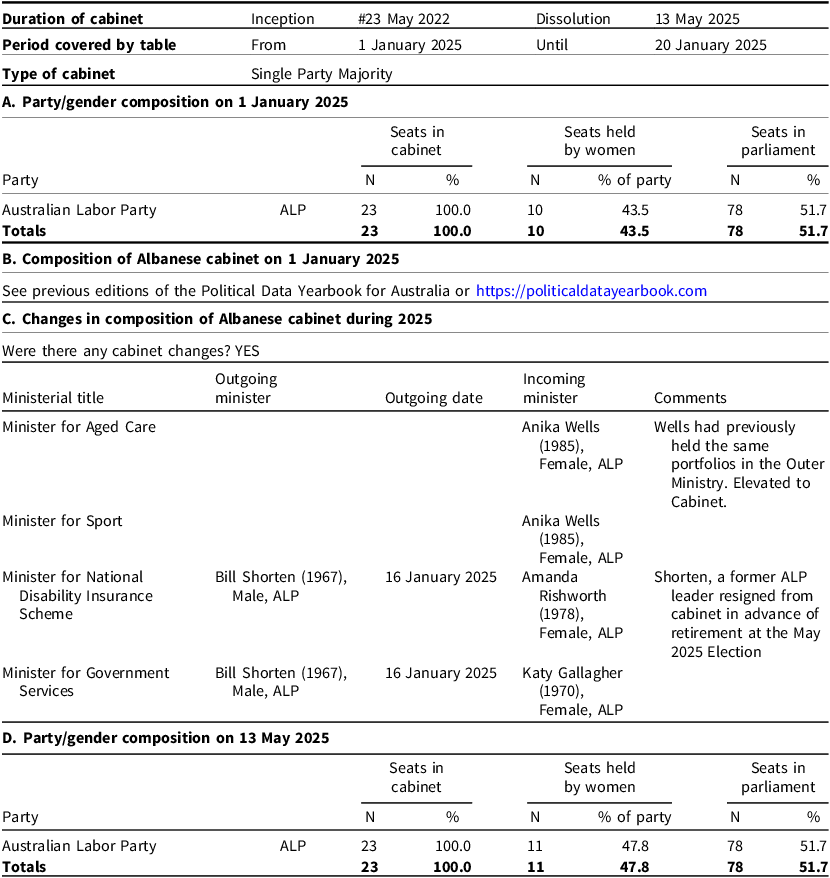
A minor reshuffle to the Albanese I cabinet occurred on 16 January, with the pending retirement of former Labor leader Bill Shorten at the 2025 election. Shorten’s role as Minister for the National Disability Insurance Scheme was added to Amanda Rishworth’s Social Services portfolio, while the Government Services portfolio was added to Finance Minister Katy Gallagher’s list of responsibilities. Minister for Aged Care and Sport, Anika Wells, filled Shorten’s cabinet vacancy. These cabinet changes are depicted in Table 3.
Cabinet composition of Albanese I in Australia 2025 (Existing Cabinet)

Table 3. Long description
The table provides detailed information on the composition of the Albanese cabinet in Australia for 2025. It includes data on the duration of the cabinet, party and gender composition on specific dates, and changes in the cabinet during the year. The table is divided into several sections: A, B, C, and D. Section A shows the party and gender composition on 1 January 2025, with the Australian Labor Party holding 23 seats in the cabinet, 10 of which are held by women. Section B lists the composition of the Albanese cabinet on 1 January 2025. Section C details changes in the cabinet during 2025, including outgoing and incoming ministers and the dates of these changes. Section D shows the party and gender composition on 13 May 2025, with the Australian Labor Party still holding 23 seats in the cabinet, but now 11 are held by women.
Source: Department of Prime Minister and Cabinet 2025a.
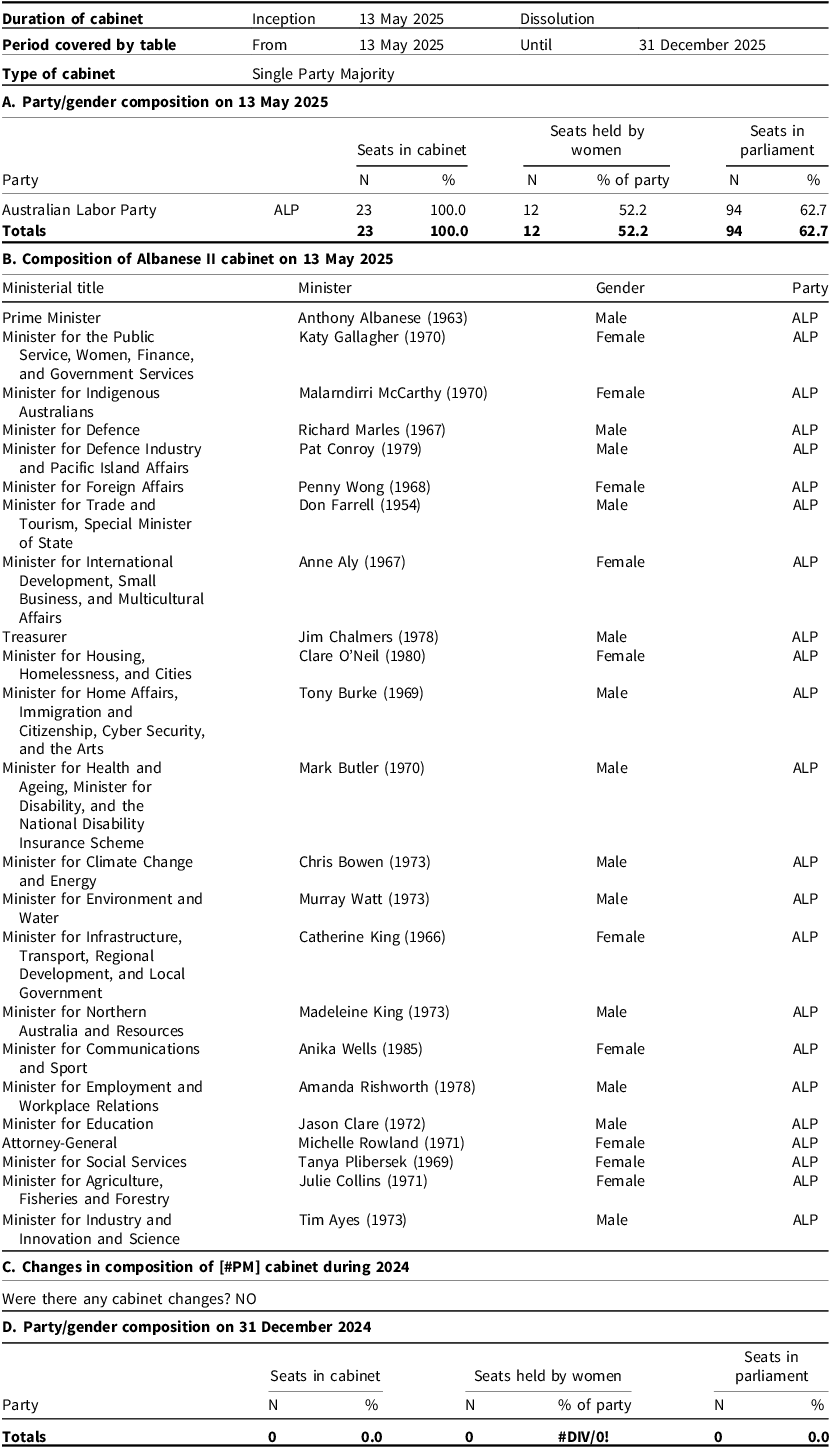
While the Albanese II cabinet installed on 13 May 2025 was largely one of continuity, it was notable in two regards. First, it represents the first majority female cabinet in Australian history with a composition of 52.2 per cent. Second, and partly due to the size of Labor’s election victory, it was surrounded by factional infighting around the distribution of cabinet roles. The ALP’s Left and Right factions are highly formalised and nominate candidates to cabinet. This resulted in veteran Right faction ministers Mark Dreyfus and Ed Husic being removed from the Cabinet, with Husic publicly labelling Deputy Prime Minister and Right powerbroker Richard Marles a ‘factional assassin’ in the media (Grattan Reference Grattan2025a). The full Albanese II cabinet is outlined in Table 4.
Cabinet composition of Albanese II Cabinet in Australia (New Cabinet)

Table 4. Long description
The table provides details on the composition of the Albanese II Cabinet in Australia. It includes the duration of the cabinet, party/gender composition on specific dates, and the changes in composition during the year. The table is divided into several sections: A, B, C, and D. Section A shows the party/gender composition on 13 May 2025, with the Australian Labor Party holding 23 seats in the cabinet, 12 of which are held by women. Section B lists the ministers and their respective portfolios as of 13 May 2025, including their names, genders, and parties. Section C indicates there were no cabinet changes during 2024. Section D shows the party/gender composition on 31 December 2024, which is not applicable due to division by zero errors.
Department of Prime Minister and Cabinet 2025b.
Parliament report
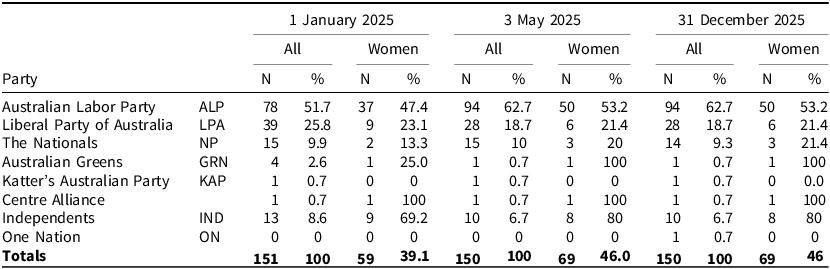
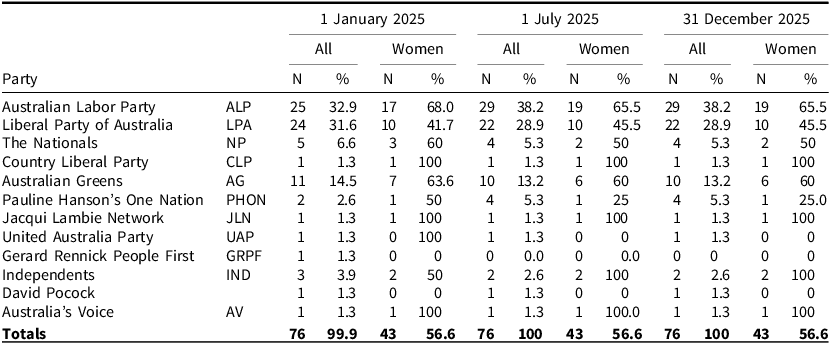
The Parliament’s composition changed as a result of the 2025 election. Combining numbers in both the lower and upper houses, women’s representation has reached near parity – at 112 of 226 positions, 49.6 per cent of the Australian Parliament. This is largely driven by the composition of the Labor caucus. Labor has 50 women MPs out of its 94 lower house seats (53.2 per cent), with 19 of its 29 senators also being women (65.5 per cent). Women make up 46 per cent of the House of Representatives, and 56.6 per cent of the Senate respectively (Parliamentary Handbook 2026).
This continued increase in women’s representation was driven by Labor’s large gains at the expense of the Coalition, but it should be noted that 13 out of 27 of the Coalition’s Senators are now women (48.1 per cent) – a product of list ticket voting used in the Senate, although, women only make up 9 out of 42 of the Party’s House of Representatives members (21.4 per cent) – dragging down the party’s performance on gender parity (Parliamentary Handbook 2026). The crossbench retained a strong presence in the House, despite contracting slightly due to the failure of Liberal defectors Russell Broadbent and Ian Goodenough to retain their seats, the abolishment of independent Kylea Tink’s seat in a redistribution, and the Greens’ loss of 3 seats to Labor. The Senate shifted leftwards due to Labor’s strong performance, with the Government able to negotiate with either the Greens or the Coalition to pass legislation. Composition of the House of Representatives is outlined in Table 5, whilst the Senate is captured in Table 6.
Party and gender composition of the lower house (House of Representatives) in Australia 2025

Table 5. Long description
The table presents the party and gender composition of the lower house (House of Representatives) in Australia for the year 2025. It includes data for three different dates: 1 January 2025, 3 May 2025, and 31 December 2025. The table has 11 rows and 12 columns, with the columns representing the number and percentage of members for all and women in each party. Row 1: Australian Labor Party, ALP, 78, 51.7, 37, 47.4, 94, 62.7, 50, 53.2, 94, 62.7, 50, 53.2. Row 2: Liberal Party of Australia, LPA, 39, 25.8, 9, 23.1, 28, 18.7, 6, 21.4, 28, 18.7, 6, 21.4. Row 3: The Nationals, NP, 15, 9.9, 2, 13.3, 15, 10, 3, 20, 14, 9.3, 3, 21.4. Row 4: Australian Greens, GRN, 4, 2.6, 1, 25.0, 1, 0.7, 1, 100, 1, 0.7, 1, 100. Row 5: Katter’s Australian Party, KAP, 1, 0.7, 0, 0, 1, 0.7, 0, 0, 1, 0.7, 0, 0. Row 6: Centre Alliance, 1, 0.7, 1, 100, 1, 0.7, 1, 100, 1, 0.7, 1, 100. Row 7: Independents, IND, 13, 8.6, 9, 69.2, 10, 6.7, 8, 80, 10, 6.7, 8, 80. Row 8: One Nation, ON, 0, 0, 0, 0, 0, 0, 0, 0, 1, 0.7, 0, 0. Row 9: Totals, 151, 100, 59, 39.1, 150, 100, 69, 46.0, 150, 100, 69, 46. Notes: Ian Goodenough defected from the Liberal Party to Independent on 1 January 2025 over a pre-selection dispute. He recontested his seat of Moore in the 2025 election and lost. Barnaby Joyce defected from the Nationals to One Nation on 8 December 2025. LNP members from Queensland can elect to sit in either the Liberal or National Party rooms. Their preferences are reflected in this table. Source: Australian Electoral Commission 2025a, Australian Parliamentary Handbook 2026.
Notes: Ian Goodenough defected from the Liberal Party to Independent on 1 January 2025 over a pre-selection dispute. He recontested his seat of Moore in the 2025 election and lost. Barnaby Joyce defected from the Nationals to One Nation on 8 December 2025. LNP members from Queensland can elect to sit in either the Liberal or National Party rooms. Their preferences are reflected in this table.
Source: Australian Electoral Commission 2025a, Australian Parliamentary Handbook 2026.
Party and gender composition of the lower house (House of Representatives) in Australia 2025

Table 6. Long description
A table detailing the party and gender composition of the lower house (House of Representatives) in Australia for 2025. The table has 15 rows and 12 columns, including headers. The columns are labeled with dates: 1 January 2025, 1 July 2025, and 31 December 2025, each with sub-columns for All and Women, showing the number (N) and percentage (%). The rows are labeled with different political parties and independents. Row 1: Australian Labor Party, ALP, 25, 32.9, 17, 68.0, 29, 38.2, 19, 65.5, 29, 38.2, 19, 65.5. Row 2: Liberal Party of Australia, LPA, 24, 31.6, 10, 41.7, 22, 28.9, 10, 45.5, 22, 28.9, 10, 45.5. Row 3: The Nationals, NP, 5, 6.6, 3, 60, 4, 5.3, 2, 50, 4, 5.3, 2, 50. Row 4: Country Liberal Party, CLP, 1, 1.3, 1, 100, 1, 1.3, 1, 100, 1, 1.3, 1, 100. Row 5: Australian Greens, AG, 11, 14.5, 7, 63.6, 10, 13.2, 6, 60, 10, 13.2, 6, 60. Row 6: Pauline Hanson’s One Nation, PHON, 2, 2.6, 1, 50, 4, 5.3, 1, 25, 4, 5.3, 1, 25.0. Row 7: Jacqui Lambie Network, JLN, 1, 1.3, 1, 100, 1, 1.3, 1, 100, 1, 1.3, 1, 100. Row 8: United Australia Party, UAP, 1, 1.3, 0, 100, 1, 1.3, 0, 0, 1, 1.3, 0, 0. Row 9: Gerard Rennick People First, GRPF, 1, 1.3, 0, 0, 0, 0.0, 0, 0.0, 0, 0.0, 0, 0.0. Row 10: Independents, IND, 3, 3.9, 2, 50, 2, 2.6, 2, 100, 2, 2.6, 2, 100. Row 11: David Pocock, 1, 1.3, 0, 0, 1, 1.3, 0, 0, 1, 1.3, 0, 0. Row 12: Australia’s Voice, AV, 1, 1.3, 1, 100, 1, 1.3, 1, 100, 1, 1.3, 1, 100. Row 13: Totals, 76, 99.9, 43, 56.6, 76, 100, 43, 56.6, 76, 100, 43, 56.6. Notes mention specific defections and changes in party affiliations during the year.
Notes: Dorinda Cox defected from the Australian Greens to the Australian Labor Party on 3 June 2025. Jacinta Nampijinpa Price of the Country Liberal Party swapped her party room affiliation from NP to LPA on 7 May 2025 to contest the LPA deputy leadership. This table diverges from House of Representatives table in commencement dates as the Senate commenced on 1 July 2025.
Australian Electoral Commission 2025b; Australian Parliamentary Handbook 2026.
Political party report
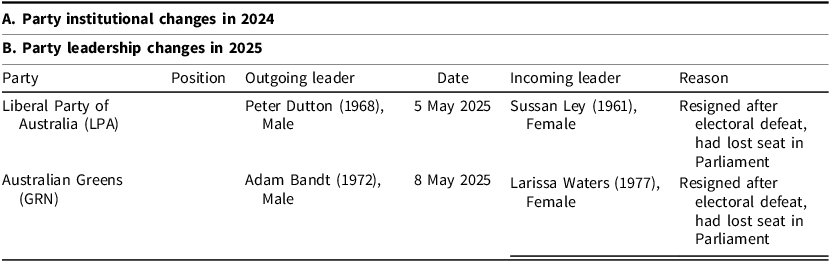
There were two changes of party leadership in the immediate aftermath of the 2025 election. Opposition leader and Liberal leader Peter Dutton, and Greens leader Adam Bandt both lost their seats. Dutton from the Queensland Right of the Liberals was replaced by Sussan Ley – becoming the Partys’ first female leader. Bandt was replaced by Queensland Senator Larissa Waters who became the party’s second female leader.
Ley, affiliated with the NSW centre-right faction, was seen as a more moderate alternative to Dutton, with potential to appeal to female and socially liberal voters who had abandoned the Coalition over the previous two elections. However, Ley’s leadership faced immediate challenge, when the National Party severed the Coalition agreement over the Liberals intention to review key parts of its 2025 policy manifesto. For the Nationals, manifesto pledges supporting nuclear power, regional funding, supermarket divestment and increased rural mobile coverage were non-negotiable. While this break-up only lasted a week, it represented only the third rupture in an otherwise permanent Coalition since 1945. Changes in political party leadership are contained in Table 7.
Changes in political parties in Australia in 2026

Table 7. Long description
A table detailing changes in political parties in Australia in 2026. The table has two rows and six columns. The columns are labeled Party, Position, Outgoing leader, Date, Incoming leader, and Reason. Row 1: Party, Liberal Party of Australia (LPA); Position, Peter Dutton (1968), Male; Date, 5 May 2025; Incoming leader, Sussan Ley (1961), Female; Reason, Resigned after electoral defeat, had lost seat in Parliament. Row 2: Party, Australian Greens (GRN); Position, Adam Bandt (1972), Male; Date, 8 May 2025; Incoming leader, Larissa Waters (1977), Female; Reason, Resigned after electoral defeat, had lost seat in Parliament.
Parliamentary Handbook 2026.
Institutional change report
In February, the government voted with the Opposition to introduce the largest overhaul of Australia’s electoral finance framework in decades. Changes included lowering the disclosure threshold from $16,900 to $5,000 for donations, and mandating monthly disclosure reports (daily in the week either side of the election date). The legislation also introduced both donation and election spending caps. Spending caps will limit the amount individual candidates and political parties can spend. The changes will disproportionately favour candidates running for established political parties, who can spend up to their own candidate cap and benefit from spending by the party – which is also capped.
Third parties and associated entities (essentially fundraising vehicles), are now required to register and have become part of the disclosure framework. However, political parties can also benefit from ‘nominated entities’, a sub-class of associated entities, which are registered to a political party that is exempted from the donations cap. Independents are strictly prohibited from having nominated entities. Public funding will be increased to $5 per vote and include an annual administrative assistance payment to parties and incumbent parliamentarians ($30,000 for MPs and $15,000 for Senators). The changes have improved transparency from a very low base, but have further entrenched incumbent parties’ power, reflecting the increasing cartelisation of the party system. The 2025 election was effectively conducted under the existing rules, as most of the changes will come into effect on 1 January 2027 (Politics and Public Administration section 2025).
The joint standing committee on electoral matters finalised its inquiry into civics education in schools, with recommendations focusing on pathways for implementation across the federation (Joint Standing Committee on Electoral Matters 2025).
Issues in national politics
The government was again relentlessly focused on the cost of living, which was the underlying theme of its pre-election budget. The government offered additional tax cuts to workers (opposed by the Opposition), increased funding for the Pharmaceutical Benefits Scheme, capping the price of listed medicines at $25 and expanding access to free (bulk-billed) medical appointments under Australia’s public Medicare system. The government progressed its goal of making the childcare system universal, with further investment in its subsidy scheme for private providers. On housing affordability, the government increased rent assistance by 45 per cent, banned foreign buyers from purchasing established housing for two years and invested a further $9.2 billion in measures to address housing affordability. In education, the government cut existing tertiary student debts by 20 per cent and committed to free non-university tertiary education in the public system (The Treasury 2025).
In the aftermath of Labor’s unexpected landslide, the Labor government focused on introducing legislation associated with its budget and election promises. In July, Albanese visited China, affirming Australia’s commitment to improving Australia’s economic relationship. This was despite multiple incidents, including the naval circumnavigation of Australia, that were interpreted as provocations by the government and opposition alike (‘China’s naval activity off Australia’ 2025). The Treasurer’s August Economic Reform Roundtable was interpreted as an opportunity to open up space for a broader economic reform narrative, with modest results in 2025 (Caisley Reference Caisley2025). For months, significant media attention focused on whether, and when, the Prime Minister would meet with US President Donald Trump. The meeting finally occurred in October, was hailed a diplomatic success and resulted in a critical minerals deal. The leader’s meeting also reaffirmed the AUKUS security pact, which was the subject of ongoing criticism in the Australian media due to its costs and questions about the reliability of the US as an ally. The Geelong Treaty was signed in July with the UK, cementing a 50-year bilateral defence cooperation agreement (The Hon Richard Marles, Minister of Defence 2025).
The government renewed its attempts to pass a new Environmental Protection Bill after withdrawing from it in late 2024. A less environmentally ambitious form of the bills were passed after negotiations with the Greens, bringing an end to a reform cycle initiated under the previous Coalition government (Cox Reference Cox2025). The green energy transition continued apace, with the government subsidising the cost of domestic batteries for solar power. The government also announced its intention to legislate for a domestic gas reservation, anticipating a growing campaign to change the taxation arrangements on Australia’s gas exports.
The war in Gaza continued to affect domestic politics, with significant public debate about social cohesion. In September, the Australian government recognised the State of Palestine, alongside Canada and the United Kingdom, presenting the decision as part of a coordinated effort to revive momentum towards a two-state solution (Knott Reference Knott2025). The year ended in shock after an antisemitic terrorist attack at a Chanukah celebration at Bondi Beach on 14 December, in which 15 people were killed. The massacre stunned the country and unleashed a fierce public debate about the nature of the attack, the adequacy of police and security responses, and the responsibilities of government in protecting Jewish communities while preserving democratic freedoms. The federal government faced significant criticism from some Jewish communal voices, including over whether its proposed national gun buyback scheme was an adequate response (Grattan Reference Grattan2025b; Tru Reference Tru2025). The New South Wales government passed emergency laws to restrict public assemblies under a terrorism declaration. The federal government, and Prime Minister Albanese in particular, ended the year politically under siege, their post-election ascendancy overtaken by demands for accountability, including calls for a royal commission into the attack.
Supplementary material
The supplementary material for this article can be found at https://doi.org/10.1017/S2047884426100159.
Data availability statement
The data for this article can be found at the PDY Interactive website: http://politicaldatayearbook.com.
Competing interests
Both authors declare that they have no financial, institutional or other conflicts of interest.


 Open access

