Introduction
During the Soviet era social services for older people in Lithuania were in a rudimentary stage of development. By the late Soviet period, with a population of 3.7 million, Lithuania had only 11 nursing homes comprising 2,224 older adult residents (Mikulioniene Reference Mikulioniene and Hoff2011: 36). The institutionalised population constituted 0.2 per cent of this age group despite the fact that in 1989 23.1 per cent of the population 60 years and over were living alone, indicating the presence of a significantly higher need for older-age care services (United Nations 2005: 17, 51). Furthermore, residential institutions were the only option for severely disabled older people. Nursing homes were centralised and financed by Moscow through the All-Union Ministry of Social Security and Labor. Care provided to older people by charitable organisations was prohibited.
Since the early 1990s, a combination of long-term demographic trends such as population ageing, declining birth and increasing divorce rates, and the impact of radical neo-liberal reforms, has led to a significant deterioration in the demographic situation of the country. Thus, from 1989 to 2013 the proportion of the population of 60 years and over in Lithuania increased from 15.8 to 24 per cent. The proportion of people 80 years and older in the population grew in the same period from 2.7 to 4.8 per cent (Mikulioniene Reference Mikulioniene and Hoff2011: 36; Statistikos Departamentas 2013a). Currently, close to one in three individuals aged 65 years and older are living alone (Mette Reference Mette2006: 17). The United Nations estimates that by 2050 the proportion of the population in Lithuania aged 60 years and over will reach 37.3 per cent and 9.4 per cent of those will be 80 years and over (United Nations 2006: 310).
In response to the rapid growth of older-age cohorts, social services also expanded significantly. By 2012, 4,514 older-age clients (0.63% of the population 60 years and over) were receiving long-term care in 102 residential institutions. New institutions such as day-care and communal care centres had been established. In 2012, 19,000 people attended day-care centres and 15,900 more older-age clients were receiving social services at home (Statistikos Departamentas 2013c). Older-age care expenditure also grew significantly from 64.9 million litas in 1996 to 205.6 million litas (1 LT = €0.29) in 2011 and in 2013 constitute approximately 1 per cent of the annual State budget (Statistikos Departamentas 2013b). This suggests that a significant and growing social care service has been developed in post-independent Lithuania.
This paper examines the dynamics of the development of older-age care in Lithuania. It focuses on the politics and policies of older-age services, i.e. on analysis of the expansion of residential services and the introduction of new, non-residential services that are driven by the process of conflict as well as co-operation among institutional actors such as political parties, international organisations, lobbying groups, government agencies, local and county authorities, and social services personnel. Thus, the institutional development of social services is interpreted as an outcome of the interaction among collective actors who have vested interests in particular type or types of services as defined by their scope, eligibility and sources of financing. More specifically, we identify three periods in the course of welfare reforms characterised by their relatively distinct political dynamics and outcomes leading to decentralisation, institutional layering and institutional recalibration of older-age services. We argue that the historical legacy of state socialism proved to be especially significant in the institutional development of older-age services in Lithuania, reproducing a State-centred system although with a growing trend towards the privatisation and marketisation of social care.
Our analysis of older-age care reforms in Lithuania relies on path-dependency theory, a predominant approach in the analysis of welfare reforms in post-socialist countries, in general, and the Baltic states, in particular (Bahle, Kohl and Wendt Reference Bahle, Kohl, Wendt, Immerfall and Therborn2009; Burau, Theobald and Blank Reference Burau, Theobald and Blank2007; Cerami and Vanhuysse Reference Cerami and Vanhuysse2009; De Vos Reference De Vos2002; Ferge Reference Ferge, Sykes, Palier, Prior and Campling2001). Path-dependence theory is based on the notion
that [in a political process] specific patterns of timing and sequence matter; large consequences may result from relatively ‘small’ or contingent events; particular courses of action, once introduced, can be virtually impossible to reverse; and, consequently, political development is often punctuated by critical moments or junctures that shape the basic contours of social life. (Pierson Reference Pierson2000: 251; see also Mahoney Reference Mahoney2000)
One of the advantages of the path-dependency approach is that it represents an alternative to large-scale, macro explanations of political outcomes (such as political economy) that tend to be deterministic in character.
The predominance of path-dependent conceptualisation in post-socialist welfare analysis can be explained by two factors. First, there is a profound influence of a distinct Communist legacy, which includes (and ideologically justifies) massive redistribution of wealth in a society through extensive social policy covering full employment, free education and health care, and social security (Cook Reference Cook and Lane2002; Guogis and Bogdanova Reference Guogis and Bogdanova2012; Novak Reference Novak, Woodward and Kohli2001). Second, unlike the domains of politics and the economy which were subjected to neo-liberal ‘shock therapy’, welfare reforms in the Baltic States (as well as throughout post-socialist countries in general) proceeded much more slowly and had a character of mostly ad hoc measures designed to respond to crises or short-term political considerations, rather than attempting to comprehensively restructure the provision of social insurance and social services inherited from the socialist era (Kornai, Haggard and Kaufman Reference Kornai, Haggard and Kaufman2001; Orenstein Reference Orenstein2008).
Lithuanian welfare studies also drew extensively on path-dependency theory, but tended to focus on the analysis of factors that shaped its post-socialist transformation, such as the role and impact of international organisations such as the International Monetary Fund, World Bank, European Union (EU) and others (Bernotas and Guogis Reference Bernotas and Guogis2003; De la Porte and Deacon Reference De la Porte and Deacon2004; Dunajevas Reference Dunajevas2011: 70–2) or the institutional and ideological legacy of the Soviet era including the impact that weak civic society had on national welfare politics and policies (Aidukaite Reference Aidukaite2003, Reference Aidukaite, Cerami and Vanhuysse2009: 102–7; Lazutka Reference Lazutka2007; Paluckiene Reference Paluckiene, Taljūnaitė, Blom and Melin2000).
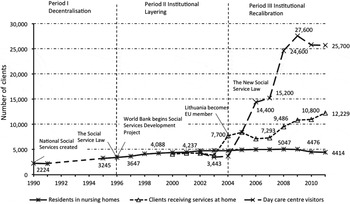
In this study we rely on existing studies to analyse institutional development of older-age services in Lithuania. However, instead of focusing on the ‘drivers’ of institutional change, we pay more attention to the analysis of the political process of negotiation and conflict concerning older-age care reforms. From a political process perspective, the institutional reform process can be characterised by a presence of ‘critical junctures’ or periods of time when institutional change became possible, i.e. windows of opportunity opened up by a societal crisis leading to the establishment of new rules (Ebbinghaus Reference Ebbinghaus2005; Offe Reference Offe, Shapiro, Skowronek and Galvin2006). By applying the notion of critical junctures we can subdivide the older-age services ‘pathway’ in post-independent Lithuania into three segments (Figure 1).
Social services provided to older-age clients in Lithuania, 1990–2011.

Period I (the late 1980s to 1995) begins when the perestroika era brought to the public's attention a deteriorating situation of a significant number of older people living alone and in deep poverty, thereby initiating the first attempt to expand and reform older-age services. Decentralisation characterised the institutional changes in social services during this period. It was produced by escalating political confrontation between Moscow and increasingly separatist government in Vilnius. When in 1990 Mikhail Gorbachev, then the General Secretary of the Communist Party of the Soviet Union, imposed an economic blockade on the breakaway region, he also blocked budgetary transfers from Moscow that were used to finance social services in Lithuania. As a result, the Lithuanian government was forced to take over the administration and financing of social care.
Upon taking control of social welfare, the Lithuanian government, in line with the perestroika-era activism that considered decentralisation to be an integral part of democratisation, decided to devolve administrative authority over social services to local municipalities. However, the decentralisation of older-age care was accomplished only partially and in a contradictory way. Thus, all functioning Soviet-era residential facilities were left intact, i.e. financed and run by the national government. Only newly established facilities were to come under the administrative authority of municipalities and financed from municipal budgets.Footnote 1 Such arrangements had placed the municipalities in an ambiguous position vis-à-vis central government, because they did not have an independent tax authority and were dependent on budgetary transfers from Vilnius to finance social care. In other words, decentralisation created a two-tier social care system in the country and initiated a bureaucratic ‘tug-of-war’ between two residential care sectors, i.e. fiscally strapped local municipalities were reluctant to accept new responsibilities (and liabilities) in older-age care and preferred to refer clients to the State-run residential facilities, while the central government was intent on relegating the same demands to the local authorities.
In the early 1990s this bureaucratic infighting between national and local agencies in residential care provision was politicised by the introduction of democratic electoral politics in the country. In 1992, as a result of a political backlash against the radical neo-liberal reforms, large segments of the population (including older-age citizens who were pauperised by the reforms) voted the neo-Communists back into power. Elected former Soviet state and party functionaries responded to the rapidly deteriorating situation of senior citizens by significantly expanding residential care in the country. All new facilities were placed under the administrative authority of local jurisdictions, which represented a significant departure from the Soviet era practices.
Such residential care expansion did not go unopposed because this era also marked the growing interest of international organisations in welfare reforms in post-socialist countries. International organisations such as the World Bank, the International Monetary Fund, the United Nations Development Programme (UNDP), the EU and others were becoming concerned that the failure to respond to growing social needs in the region was threatening the future course of reforms. The World Bank became especially active in Lithuania by creating initiatives to promote the restructuring of the ex-Soviet (residence-based) care system into a non-residential, means-tested system that was decentralised to local municipalities and community organisations.
Period II (1996–2003) began with the passage of the new Social Service Law (1996) that accommodated these two divergent strategies: (a) an expansion of residential care under a new neo-Communist administration and (b) promoted by the World Bank, a restructuring of social care towards locally based and financed non-residential services. We interpret the new law as ‘a path-departure based on institutional layering through the addition of new institutional arrangements with divergent orientation’ (Ebbinghaus Reference Ebbinghaus2005: 17). The restructuring represents institutional layering because the 1996 legislation preserved (with important but limited modifications) the preferential status of Soviet-era residential institutions within the reformed system of older-age services. At the same time, lobbying and financing by the World Bank added new non-residential services that expanded and diversified the older-age care system. Furthermore, unlike ex-Soviet care, added services were structured following neo-liberal principles.
As a result, by the end of Period II the older-age care system was characterised by two conflicting tendencies, between (a) residential and non-residential establishments and (b) State residential and municipal residential care facilities. These two sets of institutional conflicts and tensions to a large degree explain why, despite an often very heated neo-liberal rhetoric on urgency of welfare reforms in the country, change in older-age provision was slow and limited.
Finally, Period III began in 2004 when Lithuania's entry into the EU initiated a new juncture, this time path-departure by recalibration. Institutional recalibration occurs when gradual changes implemented over time lead to long-term systemic recalibration of a system (i.e. quantitative changes are evolving into qualitative ones) (Ebbinghaus Reference Ebbinghaus2005: 19). The EU membership began to change older-age care in Lithuania because of transfer of significant funds and targeted financial and organisational resources from Brussels. Due to substantive EU funding, the older-care system is currently being recalibrated from residential to non-residential services with a continuous emphasis on strengthening the authority and capacities of local municipalities, an increase in the role of community care and the introduction of market-based social services.
In this paper a number of data sources are used. In addition to published studies, we undertake a secondary analysis of Lithuanian statistics and reports published by governmental and local agencies. We also use national and international news media coverage of welfare politics and policies in Lithuania and neighbouring Baltic countries. Finally, our analysis is informed by field research in nursing homes and community-based day-care centres for older adults and disabled people that we conducted in Lithuania in 2009–2010.
Since a path-dependent approach is used to analyse older-age care services in Lithuania, the empirical analysis begins with an outline of this type of care provision during the late Soviet period, including initial attempts at its reforms during the perestroika era (Period I). Then the dynamics of a political process leading to institutional layering (Period II) and path recalibration (Period III) is described. The paper concludes with the discussion of the impacts that various organised interest groups as well as the ideologies and broader sets of cultural values had in shaping older-age services in the country.
Period I: perestroika and decentralisation of social services in Lithuania (late 1980s to 1995)
The establishment of social services in Soviet Lithuania was related to the declining capacity of rural three-generational households to provide social care for the growing number of older people in a rapidly industrialising and urbanising society. More specifically, during the 1960s and 1970s modernisation policies pursued by Moscow in the Baltic region triggered large-scale rural-to-urban migration. The social care of older people was also shifted from rural to urban settings as traditional three-generational households were relocated to the cities.
From the late 1970s, older-age care needs began to increase rapidly. In part this was related to severe and chronic shortages of housing in the cities, which limited the possibilities of reproducing three-generational households in small and cramped city apartments. At the same time, the capacity of extended households to provide older-age care was declining because of long-term demographic trends (declining birth rate, the ageing of the population, increasing rates of divorce, etc.), changes in the role of women (the opening up of the education system for women, their full participation in the labour force) and broader cultural changes (nascent Soviet-style consumerism, the spread of urban lifestyles, etc.) (Velkoff and Kinsella Reference Velkoff and Kinsella1993).
Initially the Soviet regime reacted to the growing needs for social care in a typical to a highly centralised state manner: growing needs in older-age care were interpreted as predominantly a medical problem to be dealt with by modifying and extending hospital-like settings to institutionalise older-age clients needing care. The inadequacy of such a solution became a matter of public controversy during the perestroika era when investigative journalism brought attention to the growing number of pauperised, frail and sick older people living alone, their meagre pensions and the absence of co-ordinated social services (Powell Reference Powell, Jones, Connor and Powell1991).
The newfound publicity and barrage of criticism directed at the inadequacies of older-age care led to the first attempts of its overhaul and reform. The reforms of the late Soviet period included three elements. First, in 1988 charitable organisations were legalised allowing volunteering and donations from the public as well as from foreign organisations (Matthews Reference Matthews, Jones, Connor and Powell1991). Second, attempts were made to decentralise the State social welfare system in order to make it more responsive and differentiated according to local needs. Finally, initiatives were undertaken to humanise social services, i.e. redirect social care towards improving the quality of life, autonomy and dignity of the senior citizens (Schultz and Rafferty Reference Schultz and Rafferty1990; Weiss and Theno Reference Weiss and Theno1991).
These early perestroika era initiatives in reforming social services proved to be very important when the Lithuanian government was forced to reorganise the social welfare system because of an escalating political confrontation with the central government in Moscow and a rapidly deteriorating economic situation. In 1990, in an attempt to suppress rising political separatism in the Baltic republics, Gorbachev imposed an economic blockade on Lithuania. Among other punitive measures, Moscow withdrew budgetary transfers to Lithuania that were used to finance social welfare. In response, the Lithuanian government created the State Social Insurance Fund (SODRA). Furthermore, in line with perestroika initiatives towards decentralisation, the new legislation also established a separate division of social services to be placed under the municipal authorities (LR Aukščiausioji Taryba 1990). Thus, the new welfare legislation represented an important juncture in the development of social services in the country. When in the mid-1990s, social services were significantly expanded, all new facilities were placed under the administrative authority of local jurisdictions, which represented a significant departure from the Soviet-era practices.
In the meantime, the newly independent Lithuania found itself in a deep and protracted crisis. Faced with a collapsing economy, the Lithuanian government, with the help of the International Monetary Fund and other international organisations, undertook wide-ranging radical neo-liberal reforms. The reforms focused almost exclusively on economic issues such as restraining inflation, the reduction of price controls, banking and monetary reforms, and privatisation of the economy (Bohle and Greskovits Reference Bohle and Greskovits2007; Samonis Reference Samonis, Iatridis and Hopps1998). Despite the dramatic social costs of the economic crisis and the implementation of these reforms, little attention was paid to strengthening the provision of social services, especially for the most vulnerable sectors of the population who were disproportionately affected by the social change that Lithuania was experiencing (Izyumov Reference Izyumov2010; Milanovic Reference Milanovic1998).
The social and economic impact of the reforms on older citizens was especially deleterious (Kalediene and Petrauskiene Reference Kalediene and Petrauskiene2004). Hyperinflation combined with monetary reform wiped out savings and the value of pensions, while the withdrawal of food, housing and transport subsidies significantly increased living costs. As a result, during the period 1990–1994 the purchasing power of pensions declined by almost 400 per cent, leading to the pauperisation of the majority of the older people. If in Soviet times pensioners were able to provide support to their children, by the early 1990s they were in urgent need of support from their children (Lazutka Reference Lazutka2007: 73). According to Ministry of Social Security estimates, in the early 1990s the number of older people living alone had increased to 39,000. Approximately 10,000 of them had acute social care needs (Kostelnickiene and Lazutka Reference Kostelnickiene, Lazutka and Simpura1995: 215). Extreme forms of poverty among older people re-emerged which had not been seen in Lithuania since the end of WWII, such as homelessness and vagrancy, while life expectancy declined sharply (Vosyliūtė et al. Reference Vosyliūtė, Kasparavičienė, Maniukaitė and Kocai2004).
By the early 1990s the crisis in the social welfare system had become a matter of legitimacy and political stability for the new democracy. As pauperised older generations started to look back at the Soviet times with nostalgia, they increasingly embraced pro-Soviet views and preferences (Velikonja Reference Velikonja2009). In 1992, with the overwhelming support of older voters, the Lithuanian Democratic Labor Party (LDLP), the former Communist Party of Lithuania, won parliamentary elections in Lithuania. In February 1993, Algirdas Brazauskas, the former secretary of the Lithuanian Communist Party, turned into the leader of the social-democrats, won the presidential election (Janusauskiene Reference Janusauskiene, Bozóki and Ishiyama2002). The bedrock of LDLP support was mostly rural and older populations who were especially affected by the economic crisis. The LDLP won the elections by making, among other claims, promises to improve the lives of impoverished senior citizens.
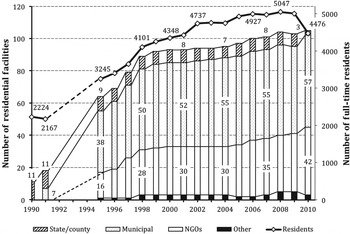
The return of neo-Communists to power initiated a rapid expansion of residential nursing care inherited from the Soviet era. Municipalities began converting small and mostly rural hospitals into nursing facilities, as well as using hospitals for the temporary placement of older people with high care needs (Krisciunas Reference Krisciunas, Brodsky, Habib, Hirschfeld and Siegel2003: 234–7). The central government, in turn, financed the new residential facilities. As a result, the number of nursing homes increased from 11 in 1990 to 66 in 1996. The number of residents in county and municipal nursing facilities also grew from 2,224 in 1990 to 3,404 in 1996 (Figure 2).
Old-age nursing facilities and their full-time residents in Lithuania, 1990–2010.

Although converting or using hospitals for residential care was, in the long term, the least economically and socially effective way to address the growing needs of older people, for the central government and municipalities this was, in the short run, the most expedient way to deal with the dearth of social services. With the exception of a small number of religious and non-governmental facilities for older people, there were no alternatives to residential institutions. The creation of new social services provision centres required time, expertise, professional staff and money unavailable to financially strapped municipalities.
At the same time, the rapid expansion of institutional care raised a number of serious problems associated with residential nursing: the use of dilapidated, run-down and inadequate facilities that had not been maintained since Soviet times; overcrowding, underfunding, and a lack of professionally trained personnel; and dreariness and despondency of the day-to-day lives in the nursing homes (Tobis Reference Tobis2000).
Period II: restructuring of social services – path-departure via institutional layering (1996–2003)
In 1994, in order to address the impending residential care crisis, the government adopted a resolution ‘On the New Principles of the National Social Services’ which in 1996 was elaborated in the ‘Social Service Law’ (Lietuvos Respublikos Seimas 1996). This legislation reflected an uneasy compromise between (a) widely shared expectations, especially by older generations, of universal State-centred social care provision inherited from the Soviet era and (b) commitment of the political class to the neo-liberal course of reforms in the country. Thus, the Social Service Law confirmed the commitment of the Lithuanian government to the retention of the Soviet-era service infrastructure as well as the creation of new social assistance programmes. Social assistance was expanded because the high social costs of transition began to threaten the political stability of the country, potentially stalling the process of reforms. At the same time, the expanded social services were set to be firmly rooted within neo-liberal ideological principles such as: further decentralisation and deinstitutionalisation of social services; social assistance based on residual, means-tested access; private, as opposed to public, responsibility for the welfare of individuals; and procedures to prevent abuse and dependency of welfare recipients which codified their differentiation into ‘deserving’ and ‘undeserving’ clients.
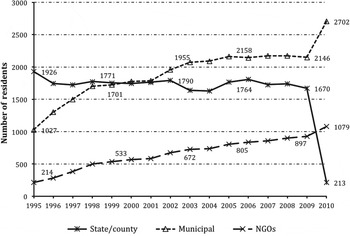
In terms of neo-institutional theory, the 1996 legislation on social services could be interpreted as a ‘path-departure based on institutional layering through the addition of new institutional arrangements with divergent orientation’ (Ebbinghaus Reference Thelen, Mahoney and Rueschemeyer2005: 17; see also Thelen Reference Ebbinghaus2003), because the new legislation preserved (with important but limited modifications) the Soviet-era residential social services infrastructure with its bureaucracy, personnel and financing. The surprising resilience of the State care sector can be illustrated by the data on full-time residents according to the administrative affiliation of nursing homes. It shows that from the mid-1990s until 2010, the number of ex-Soviet residential homes administered by State/counties (Figure 2) and their full-time residents remained virtually unchanged (eight facilities with approximately 1,700 residents) (Figure 3). Furthermore, the preferential treatment of State nursing facilities vis-à-vis other types of services was expressed in budgetary allocations per resident, and these were one-third higher in State as opposed to municipal facilities and three times higher than in voluntary institutions (Bikmanienė Reference Bikmanienė2005: 62).
Full-time residents in nursing facilities according to administrative affiliation, 1995–2010.

At the same time, the institutional layering that occurred was driven by the explicit ideological, political, economic and social critique of the Soviet-era (i.e. collectivist) welfare policies, in general, and residential social care institutions, in particular. This critique proved to be effective because conservative politicians were able to link discredited Soviet-era ‘collectivism’ to the widespread dissatisfaction of the broader public with the poor quality of social services and the low levels of social benefits provided by the government (Tobis Reference Tobis2000). Such a critique was widespread in 1996, when following the loss of neo-Communists in elections the Conservative (Homeland) party came to power. A number of influential domestic groups allied with Conservative politicians in campaigning for neo-liberal welfare reforms in Lithuania. Among them, and particularly significant, were the Liberal Party, the largest business association in the country – the Confederation of Industrialists – as well as the Lithuanian Free Market Institute, the influential think-tank financed by national and international corporate interests (Lazutka Reference Lazutka2007).
The Conservatives used claims of a denied social justice to taxpayers of the country in their successful appeals to the electorate. Their campaign alleged that misguided State policies inherited from Soviet times were victimising those who were financing social welfare. Thus, provision of social services based on principles of generational solidarity and social rights to all citizens should be rejected. Instead, the individual should be responsible for his/her situation, with public assistance limited to means-tested emergency assistance only. More specifically, it was claimed that the major goal of the 1996 Law on Social Assistance was to ‘redistribute responsibilities between individual, family and the State’, because ‘the biggest drawback of the equality [in accessing social welfare] was the State's suppression of the individual's responsibility for [his/her] future’ (UNDP 1997: 97).
With the ex-Soviet residential services establishments co-opted by the new Social Service Law and large sectors of the general public apathetic or hostile to welfare services expansion, there were virtually no senior citizens or other left-of-the centre political organisations to provide an alternative to the neo-liberal ‘departure’ in social services reforms. Furthermore, the neo-liberal course of reforms was legitimised by the international context: throughout Europe and North America the Welfare State was in retrenchment (although varying in degree) and reforms pursued goals of rationalisation, increasing effectiveness and the privatisation of social services (De la Porte and Deacon Reference De la Porte and Deacon2004; Pierson Reference Pierson1996).
By the late 1990s the socio-political context that had developed in Lithuania, to a large degree, explains how and why the World Bank and other international organisations had come to play such a significant role in reforming social, including older-age care, provisions. Lithuanian political elites were receptive to reforms proposed by international financial institutions not only because of the prevalence of neo-liberal ideological orientation. Even more important were promises by international donors that such measures would significantly reduce social care costs and expand coverage. At the same time, the new social service legislation of the 1990s was passed, not as much to restructure ex-Soviet residential care (which might have generated resistance from the ex-Soviet social services establishment), as to provide venues for adding new types of institutions with the provision of services to older people. The only actors who had political influence, expertise and resources to develop new social services programmes were international ones. Furthermore, the addition of new institutions sponsored by foreign organisations and the inevitable conflict created by competition as well as co-operation with the residential care establishment inherited from the Soviet era became the defining feature of older-age care development in Lithuania up until the late 2000s.
World Bank, EU and creation of non-residential social services in Lithuania
The World Bank's involvement in welfare reforms throughout former socialist countries was related to a growing anxiety within international institutions over the political backlash produced by structural adjustment policies (Kapstein and Mandelbaum Reference Kapstein and Mandelbaum1997). By the early 1990s, the magnitude and extent of the economic downturn in the region proved to be more severe and extensive than was anticipated. In response to the turmoil, the reformers were beginning to be voted out of power. Lithuania was the bellwether of this trend, having ex-Communists returned to power in late 1992. Over next three years ex-Communists were voted back into office in Poland, Russia, Hungary, Bulgaria, Estonia and Latvia.
In order to sustain public support for the continuous restructuring of the economy, the World Bank significantly increased funding for a selective social safety net while simultaneously encouraging the privatisation of all forms of social protection in post-socialist countries (Alber and Standing Reference Alber and Standing2000; De la Porte and Deacon Reference De la Porte and Deacon2004). Since Lithuania was among the first countries to experience the return of ex-Communists, it also became the first country where, in 1996, the World Bank initiated large-scale projects of social services reforms. A partnership was created between the Ministry of Social Security and Labor, the University of Stockholm, six Lithuanian municipalities and the World Bank. The project was funded by US $12 million to be invested during the period 1997–2002 (World Bank 1999).
By 2001, 14 new social services centres were established throughout Lithuania. The most important objective of the project was to demonstrate the viability of the decentralisation and deinstitutionalisation of social services. It showed that the costs of community services for older people were only 25 per cent of the cost of residential care; the project was estimated to save the Lithuanian government approximately US $2 million a year by diverting clients from institutional care to community services centres (World Bank 1999: 6). Non-residential services for older people were further expanded in 1999, when the Council of Europe Development Bank, the Lithuanian government and the EU-financed pre-accession programme ‘Poland and Hungary Assistance to the Restructuring of the Economy’ (PHARE) started a project to develop 58 new communal centres in the country.
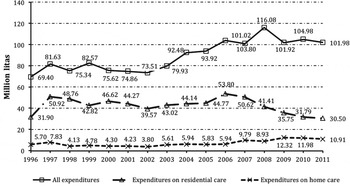
As a result of these two complementary initiatives, expenditure on non-residential services began to increase but bottomed out by the late 1990s at approximately 30–35 per cent of all budgetary outlays on old-age policies (excluding home care) (Figure 4). More importantly, despite international initiatives and significant funding, the provision of non-residential services remained relatively limited (in 2003 there were 4,761 residents in nursing homes compared to 3,800 seniors visiting day-care centres; see Figure 1).
Public expenditures on older-age services in Lithuania, 1996–2011.

Municipalities: between administrative authority and fiscal dependence in provision of social services
The slow pace of the reforms was to a large degree reflective of the dependent (vis-à-vis central government) structural position of municipalities within the social welfare system. Although since 1990 municipalities had de jure full administrative authority over social services, it was the national government that controlled their finances (through direct budgetary allocations). A high level of centralisation represents a deeply entrenched ‘path-dependent’ characteristic of the State administration inherited from the Soviet era. Moreover, in the early post-independence period, the powers of central government increased as the State responded with the swing to emergency measures in order to deal with a deepening socio-economic crisis (Daugirdas and Mačiulytė Reference Daugirdas and Mačiulytė2006).
Although a number of initiatives aimed at the decentralisation of the State have been undertaken since the mid-1990s, the autonomy of municipalities remained very limited and it did not extend to local tax collection. Furthermore, decentralisation created its own confusion relating to the diverse budgetary allocation and division of labour among national (ministries), county and municipality administrations especially concerning the provision of services to various sub-groups of clients (disabled people, older people, etc.). As lobbying and competition among various institutional interests and groups intensified, significant disparities among municipalities in budgeting for and providing social services developed. In turn, this led to increasing demands for national government intervention, i.e. re-centralisation of service financing (Guogis Reference Guogis2005).
Having little control over budgetary allocations, the municipalities opted once again for the services provided primarily through residential institutions. Unlike the newly developed community centres, residential institutions, because of their historical legacy, represented ‘secure’ budgetary items. In addition, the directors of residential institutions proved to be very effective in lobbying the government to preserve their budgets and fend off the expansion of funding for alternative, community care organisations. Therefore, it was no surprise that the World Bank officials managing the social services reform project in Lithuania bitterly complained about bureaucratic inertia and organisational pressure to maintain residential care, as it represented a large and influential constituency whose interests were tied to the preservation of this institution (World Bank 1999: 16).
Other factors also contributed to the bureaucratic in-fighting and inertia adding to the slow pace of social care reforms. The very way international donors structured new services provided little incentive for the municipalities to expand community care policies. Although international donors financed infrastructure and staff training for the new service centres, the operating costs of the new facilities were deemed to become the sole responsibility (and long-term financial liability) of fiscally strapped municipalities. In comparison, the use of residential facilities for the municipalities was cheaper because they were either fully or partially financed by central government. The legal regulations for operating non-residential services were also underdeveloped; there were too few trained and qualified social workers, making it difficult to administer and contributing to negative attitudes among local policy makers towards social services in general (European Social Network 2008: 8).
Finally, there were cultural factors at play slowing down the acceptance of the new forms of older-age care provisions by the broader public, as well as senior citizens. The preferential treatment of residential care was rationalised by some in professional circles by claims that this type of social service was more appropriate because the clients, including older people, are ‘not able to make rational decisions and define their needs and wishes’ (European Social Network 2008: 9). Therefore many officials as well as the broader public viewed new World Bank and other international initiatives as wasteful and unnecessary expenditure; in some cases, day-care centres were mocked as ‘kindergartens for the elderly’, resulting in the stigmatisation of clients. There were also problems harmonising family and community care (i.e. lack of transport for clients, confusion as to what services were to be provided at home and at the centres, etc.). As a result, three years into the World Bank project barely 50 per cent of clients were satisfied with the quality of services provided in the communal centres (Bertelsen and Zalmiene Reference Bertelsen and Zalmiene2004: 2).
Period III: EU membership, fiscal reforms and institutional recalibration of social services (2004 to present)
Upon entry into the EU in 2004, Lithuania became eligible for access to various EU structural funds. In 2004–2007, Lithuania received on average 5 million litas a year for the development of social services infrastructure in the country. For 2007–2013, such funding was to increase to 126 million litas for residential facilities and 153 million litas for non-residential facilities. The funding was to be used to further decentralise social services provision and improve social services infrastructure in communities (see the annual reports of the Ministry of Social Security and Labor at http://www.socmin.lt/index.php?-1191824460).
As the social services infrastructure expanded, the number of older-age clients receiving non-residential services rapidly increased as well. Thus, in 2003–2011 the number of home-care recipients more than tripled from 3,800 to 12,200; the number of day-care centre visitors increased by about 7.5 times from, correspondingly, 3,500 to 25,700. At the same time, the number of full-time residents in nursing facilities began to gradually decline after reaching its peak in 2008 (Figure 1). Thus, in 2004 the Ministry of Social Security and Labor had 222 eligible individuals to be placed in residential institutions on its waiting list. By 2013 the waiting list had declined to 110 (Socialinės Apsaugos ir Darbo Ministerija 2013: 41).
However, a rapidly growing demand and costs of social services during this period brought its own set of concerns. Thus, in just four years (2006–2009) the monthly costs of in-home social services per client doubled. During the same period of time residential care costs per client per month increased by one-third and in 2009 became four times as high as an average pension (Dunajevas Reference Dunajevas2011: 129). In the long run, such a continuous acceleration of social service costs was hardly sustainable.
Rapidly rising costs of services were not a new concern. Already in 1998, in order to slow down growth in expenditure on social services, the government adopted guidelines for social service payments by clients (Lietuvos Respublikos Vyriausybė 1998). The guidelines attempted to limit the demand of social services by introducing means-tested payments and shifting part of the costs to clients. This was a significant change in policy inherited from the Soviet era, when social services were provided free of charge for citizens (although the informal practice of ‘gratitude money’ given to social care personnel and administrators was widespread during the Soviet period and remained deeply entrenched and resented in post-Soviet Lithuania as well).
It was estimated that the proportion of expenditure covered by client fees in municipal residential institutions increased from 9 per cent in 2000 to 19 per cent in 2006 and to 33 per cent in 2009 (Socialinių Paslaugų Priežiūros Departamentas 2006: 5, 2009: 76). By 2006, the governmental decree had further extended payment responsibilities of clients by allowing local authorities to use clients' assets (such as housing, land, means of transportation, etc.) to pay for their long-term social care (Lietuvos Respublikos Vyriausybė 2006).
However, increasing contributions by clients were insufficient to slow down the growth of expenditure on social services because senior citizens tended to be among the poorest members of society. Even if the clients were paying ever-increasing fees, increases in the costs of social services by far outpaced the purchasing power of pensions (the only source of income for the majority of older people).
In 2006, Seimas approved new legislation with the goal of creating a social service market in the country. Thus, instead of the State financing and providing social services, it was to become a purchaser of social services. The introduction of market mechanisms was supposed to further rationalise costs, increase the availability of services and improve quality (Lietuvos Respublikos Seimas 2006).
Finally, in 2010, at the peak of the economic recession, the Lithuanian government carried out austerity-driven administrative reforms so as to reduce the administrative apparatus and decentralise State governance. As counties were dissolved, the administrative State structure was reduced from three to two levels consisting of 60 municipalities and 524 wards. All county-run older-age care facilities were transferred to municipalities, which is reflected in Figure 3 showing (by 2010) a large drop in the number of clients residing in county nursing homes. However, in the short run, the abolition of counties had little, if any, impact on the financing and day-to-day management of ex-county facilities: the national government continued their financing by direct budgets, while the counties continued to operate de jure, even if their administrative staff were dissolved and partially absorbed either by the central government, or by municipalities and wards. This was due to the fact that until the start of the new budgetary cycle in 2014, EU structural funds will continue to be channelled to Lithuania through counties. In the long run, it seems that administrative reforms have placed fiscally strapped municipalities at a disadvantage since they are mandated to take over not only management, but also the financing of social services from local budgetary sources (Lankininkaitė Reference Lankininkaitė2013).
At the time of writing, the passage of new social service legislation and attempts at the decentralisation of the State administration have had limited impact in stimulating the development of social services markets. A number of factors have constrained the diversification of the social service economy: the sector continues to be overwhelmingly dominated by organisations (budgetary and not-for-profit) that were created by the central government and municipalities. Due to the very low purchasing power of senior citizens, there are very few private (for profit) social services providers. Furthermore, municipalities have continued funding their social service organisations even if, in comparison with alternative service providers, their costs are higher and the quality lower. This is because the new social service legislation did not mandate to give priority to buying social services (as opposed to allocating funding to municipal institutions). Finally, because of the lingering impacts of the deep economic recession of 2008–2011 and the austerity policies adopted by the Lithuanian government, the capacities of municipalities to invest in social services modernisation and reforms remains very limited.
Conclusions
This paper has used a path-dependent approach to analyse older-age care reforms in post-independent Lithuania with a special focus on the political process, i.e. political conflicts and power relationships implicated in destabilising existing as well as institutionalising new older-age policies. The analysis demonstrates that despite the ideological hegemony of neo-liberalism in the country, older-age care reforms have proved to be much more gradual and partial, especially when compared with far-reaching ‘shock therapy’ undertaken in political and economical spheres.
Reforms were slow in part because they represented mostly emergency-type measures implemented to respond to crises and other short-term political considerations. Thus, the decentralisation of social services occurred as a fallout from the political struggle between Vilnius and Moscow, and it was partial and contradictory. This led to creation of a two-tier social services system characterised by bureaucratic infighting between State-affiliated and municipal residential establishments. In the immediate post-independence period, social care politics extended beyond intra-bureaucratic negotiations and in-fighting because of the introduction of electoral politics. Political backlash against neo-liberal reforms led to a rapid expansion of the residential sector as a short-term emergency measure to deal with rapidly growing older-age care needs. At the same time, the return of neo-Communists to power initiated the involvement of international organisations, interested in promoting the restructuring of residential services and the expansion of non-residential services. The outcome of this political struggle was the creation of an institutional layering, which, similar to decentralisation, was gradual because of rising tensions and conflict between residential establishments inherited from the Soviet era and non-residential services that were developed and financed by international institutions.
Lithuania's entry into the EU and access to EU funding initiated a recalibration of the social care system from residential to non-residential services. Nevertheless, after two decades of reforms, the social care system in Lithuania remains characterised by Soviet-era features, especially the prioritisation of residential care and an overwhelming dominance of State (budgetary) organisations. Non-governmental organisations providing older-age care remain of very limited capacity and are dependent on finance from local municipalities, while only the first steps are being made to develop commercial services. Most recently, the national government has begun to implement fiscal reforms designed to stimulate the development of the private older-age care sector as well as ‘rationalising’ spending, in part, by shifting older-age care costs to clients.
In the near future, the politics of older-age care will continue to be dominated by negotiations and conflicts resulting from (a) pressure to expand and diversify older-age care, since the demand for such services is by far outpaced by their supply; and (b) a countervailing pressure on limiting access to older-age care via the implementation of residual and means testing and further marketisation and commodification. According to some estimates, currently there are about 42,000 older people in Lithuania in need of full-time nursing, while only half of them are able to access residential and/or in-home services (Saukienė Reference Saukienė2011b). Therefore critics are asserting that the registered decline in the number of people on waiting lists for nursing homes has little to do with the decline in the need for such services. Instead, it is argued, senior citizens are simply priced out of the services they need (Masionytė Reference Masionytė2013). A recent nationally representative survey has found that about 40 per cent of respondents in Lithuania in the last ten years needed social care or had a family member in need of social care; 13 per cent of respondents indicated that in the near future they will need to switch from full-time to part-time working in order to take care of ageing family members – the highest percentage among EU countries (Eurobarometer 2007: 90, 208).
A number of informal strategies have emerged in response to the rapidly growing unmet needs of older people. Anecdotal evidence indicates the rise of (virtually unstudied as of yet) an informal economy of ‘baby-sitting’ for the older people. A number of unlicensed and unregulated private nursing homes (currently operating under the charter of ‘guest houses’, as licensing private nursing homes and service providers will begin only in 2015) has emerged, offering lower prices, but allegedly plagued by the neglect and abuse of their clients (Saukienė Reference Saukienė2011a; Vanagaitė Reference Vanagaitė2012). Finally, older-age care politics continues to be brought to public attention by controversies resulting from investigative reporting that periodically exposes dreadful conditions as well as alleged neglect and mistreatment in some facilities that, in one case, became a matter of a political crusade for a nationally prominent politician (Vanagaitė Reference Vanagaitė2011).