To practice an art, it is necessary to begin with the procurement of instruments. (Rousseau)
The eighteenth and nineteenth centuries were particularly important for the development of medical instruments, mostly because of new techniques in industrial production. These technical changes put medicine on a more modern footing and reinforced the bond between medicine and technology, notably with the advent of sterilisation of instruments at the end of the nineteenth century.Reference Davis1 The introduction of sterilisation techniques lead to dramatic changes in surgical instruments, notably the use of heat-resistant materials. However, whether primitive or refined, an instrument is defined by the way it is used. Most surgical instruments are actually just modifications of similar instruments employed in other disciplines.Reference Kirkup2 The physical properties and biological responses of bone require special surgical instruments and techniques.Reference Shambaugh3 Surgeons in the eighteenth and nineteenth centuries were fascinated by the new-found possibilities of producing fine, specific instruments. Initially, surgeons used existing instruments. Subsequently, however, they attempted progressively to modify, adapt and then invent specific instruments for different aspects of surgical procedures.
The term mastoidectomy is understood as meaning the opening of the bony part of the mastoid region. The term includes antrotomy and simple, radical or conservative mastoidectomy (the instruments used are the same). The purpose of this study was to present the most specific instruments used for mastoidectomy. It is obvious that the instruments assembled should include all those necessary not only to perform the surgery indicated (i.e. scalpels, scissors, retractors, forceps, needles etc) but also to meet any possible emergency which might reasonably be expected. The extremely minute and delicate bony structures within the ear have necessitated the development of highly specialised techniques and instruments for mastoid surgery. This review referred to original written documents, specialised trade catalogues and collections of instruments, and also assessed the secondary literature concerning this subject.
The history of instruments used in mastoidectomy can be divided into three general periods: the trepan period (in the eighteenth century); the chisel and gouge period (in the second half of the nineteenth and first half of the twentieth centuries); and the electrical drill period (in the remainder of the twentieth century). These three periods will be discussed below.
The trepan period
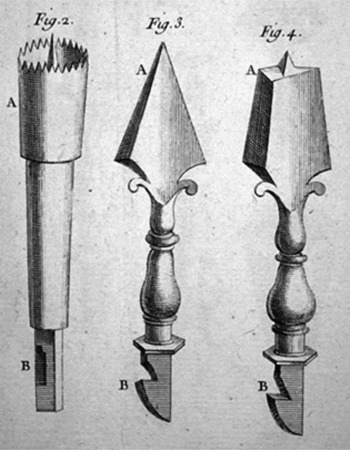
Many prehistoric peoples performed skull trephination, but whether this was done for relief of suppuration (possibly in the mastoid region) or intracranial conditions is not definitively known.Reference Brothwell and Sandison4 Surgery on the human body presented physicians with their earliest opportunity to apply special instruments to the treatment of disease. The earliest records of formal mastoidectomy procedures date from the eighteenth century. However, surgical opening of the mastoid had already been suggested by Ambroise Paré in the sixteenth centuryReference Mudry5 and by Jean Rioland the Younger in the seventeenth century.6, Reference Sunder, Jackler and Blevins7 These men proposed use of a hand trepan to perform the operation. The hand trepan was a kind of brace in the form of a crown saw which was turned to remove a piece of bone, especially of the skull.Reference Bouchet8 The head or crown of the trepan could be a circular saw (‘the ordinary trephine’)Reference Ballance9 used to cut a circular piece of bone; alternatively, an ‘exfoliative’ head could be used to shed a superficial layer of bone, or a ‘perforative’ head to make a hole in the bone (Figure 1). Different systems were used in the sixteenth century to rotate the trepan, such as a handle set at right angles to the shaft (later named a trephine because of its triangular shape),Reference Thompson10 a drill stock type handle commonly known as a brace, and a mechanical rotary with a cog-wheel turned by hand. In addition, another, simpler trepan existed, the drill or ‘terebra’, known since antiquity, which was an instrument with an edged or pointed end used to make a hole in hard substances.
Three different types of trepan head. Published with permission.Reference Petit11

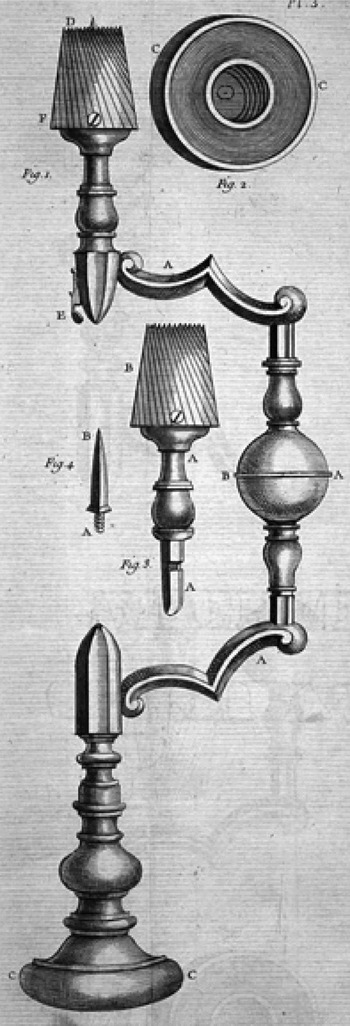
In 1736, the French surgeon Jean Louis Petit performed the first known surgical opening of the mastoid, in a case of mastoid abcess.Reference Petit11 The aim was to create a hole to allow the drainage of pus. As described in his posthumous book, he made a deep skin incision and then used an exfoliative trepan to open the outer mastoid table to the diploe (Figure 2). In similar cases, he used a perforator to open the outer mastoid table and the point of a myrth sheet or a kind of elevator to enlarge the borders of a spontaneous fistula. He also mentioned the use of a rugine or gouge and mallet to clear the ‘caried bone’. The terminology of gouges, rugines and elevators is perplexing. In practice, many English-language instrument catalogues interchange the terms rugine, periosteal elevator and raspatory. Such instruments were employed to push away pieces of bone. Some were used with a mallet and others alone.
Petit's trepan. Published with permission.Reference Petit11

In 1776, Jasser, a Prussian surgeon, incised down to the bone a swelling that had appeared over the mastoid.Reference Schmucker12 Because he had no other instruments, he used a trocar to open the mastoid region, and he then inserted the nozzle of a syringe into the opening to withdraw the pus. This operation became known as the ‘Jasser operation’. The term trocar, from the French ‘trois-quarts’, appears to have first been used at the beginning of the eighteenth century to describe an instrument with three-sided cutting edges used to make a hole. In one of the first books dealing exclusively with the opening of the mastoid region, published in 1792, the German surgeon Justus Arneman described trepanation of the mastoid process using a trocar, a probe and a perforative trepan.Reference Arneman13 The probe used was probably a dental one with a sharp extremity, allowing the surgeon to make an adequate hole in the mastoid region. When a trepan was used, it was necessary to plunge it into cold water at frequent intervals because of frictional heat.Reference Bennion14 This operation quickly fell into disrepute because the high risk of a fatal outcome, and was practised by very few surgeons until the second part of the nineteenth century.
The twentieth century American otologist Frederick Whiting referred to the trepan period as the ‘experimental stage’.Reference Whiting15 This term emphasises the importance of this period in the history of mastoidectomy instruments, because the idea of opening the mastoid region for evacuation of pus or clearing caried bone was present but no specific instruments existed – surgeons used pre-existing instruments such as the trepan or the trocar. The 1860s saw the publication of some of the first trade catalogues of surgical instruments, such as the Illustrated Wholesale Catalogue Of Surgical And Dental Instruments… 16 and A Catalogue Of Surgical Instruments, Apparatus, Appliances, Etc.17 None of these catalogues mentions specific instruments for mastoidectomy.
The chisel and gouge period
The introduction of general anaesthesia in the second part of the nineteenth century allowed surgery to proceed at a more leisurely pace once the patient was made insensitive to pain. This completely modified the concept of mastoid surgery.
In 1860, Amédée Forget, a French surgeon, used a gouge and mallet to open the mastoid region in a case of mastoid abscess.Reference Forget18 He then enlarged the opening with a lenticular knife to give a circular form to the aperture in order to obtain a larger drainage space.
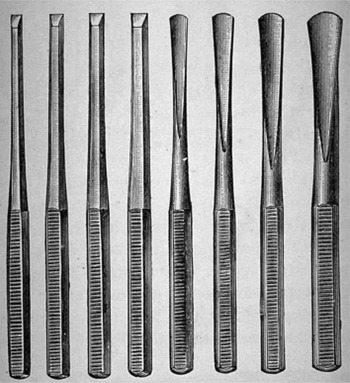
However, an 1873 publication by the German otologist Hermann Schwartze and his assistant Adolf Eysell marked the true beginning of the chisel and gouge period, or the ‘modern mastoid operation’ stage, as Whiting named it.Reference Schwartze and Eysell19 Schwartze quickly abandoned use of the trepan in favour of chisels and gouges especially modified for mastoid surgery. Schwartze's chisel was a short-bladed hand tool with a straight, bevelled cutting edge and a plain handle which was struck with a mallet. The gouge derived from the same instrument but had a concave, bevelled cutting edge. Schwartze did not depict his instruments in his publication, but illustrations were published by colleagues (Figure 3). Schwartze described the advantages of the chisel and gouge over the trepan and other perforators. This new instrumentation enabled the creation of a larger, safer, funnel-shaped opening of the mastoid region down to the antrum for drainage of mastoid abscesses. It also expanded the indications for mastoid surgery, notably to include cases of chronic otitis.
Schwartze's chisels. Published with permission.Reference Dench20

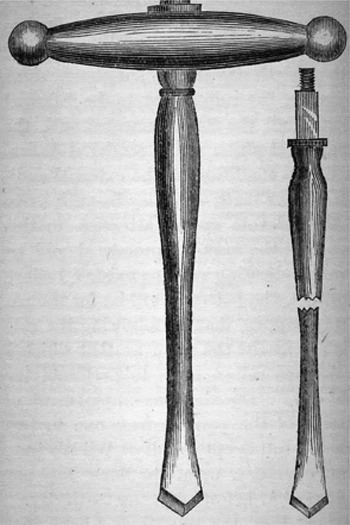
Mastoidectomy became rapidly a routine operation. Other surgeons began to use other, additional instruments, such as the conical drill (Figure 4), derived from the trepan with a handle set at right angles to the shaft and used notably by the American School of Otology. Albert Buck, an American otologist, wrote in 1880: ‘I fail to appreciate, however, in what respect these instruments (chisels and gouges) are superior to the drill’.Reference Buck22 The principal problem with this conical drill was the difficulty of making a funnel-shaped aperture. Nine years later, Buck reversed his position:
I have been a strong advocate of the employment of the drill… . My attention, however, has recently been called to one or two aspects of the question under discussion which lead me to admit that on the whole the employment of the chisel or gouge is the preferable plan of operating.'Reference Buck23
Buck's conical drill. Published with permission.Reference Buck21

Buck introduced the use of a small curette with rounded edges to remove bone chips from the antral region. Other mastoidectomy instruments were progressively added, as Buck explained in 1898:
The chiselling is to be continued until enough of the comparatively hard cortex has been removed to enable the operator to use effectively the Volkmann sharp-edged spoons in excavating the softer bone substance which constitutes the framework of the pneumatic spaces. As soon has this excavation work as progressed so far that the margins of the opening in the cortex are undermined, then the rongeur forceps may be used to great advantage in enlarging the external opening still further. At this stage of the operation it is certainly a more effective instrument than the chisel.Reference Buck24
The term rongeur was commonly applied to gouge cutters, also known as gouge forceps. The word spoon was used to describe instruments resembling the domestic article, which could have a blunt or sharp edge. These spoons were characteristically used to detach diseased tissue such as necrotic bone. The term curette was sometimes used in place of ‘sharp spoon’. All these instruments were modified for the purpose of penetrating the mastoid process to a sufficient depth to communicate with the antrum. Together they constituted an imposing array, and offer an eloquent tribute to the ingenuity of the surgeons of the time.
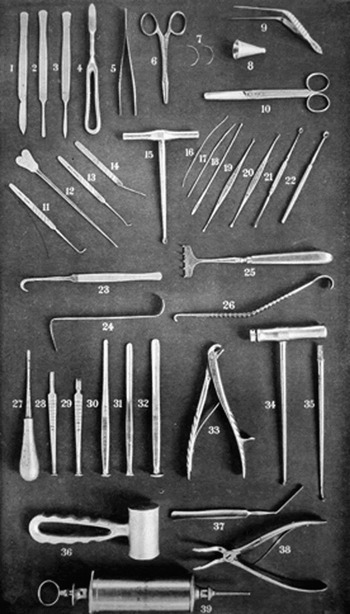
In the selection and purchase of instruments, as in their inventive pursuits, nineteenth century surgeons remained highly individualistic and particular. Every eminent otologist of the late nineteenth century had at least one (and often several) instruments named after him. Such contrivances took the form of burrs (to be used with a handle or brace), drills, trephines, forceps, stiff probes, gimlets, rongeurs, curettes, chisels and gouges (Figure 5).
Instruments for mastoidectomy. Published with permission.Reference West and Scott25

In the first part of the twentieth century, many specialist ENT trade catalogues were available, published by such companies as Firma H Windler26 and Firma H PfauReference Pfau27 in Berlin, Maison Luer in Paris,28 Kny-Scheerer in New York,29 and Mueller in Chicago.30 Faced with this great variety of instruments, Samuel Kopetzky, an American otologist, wrote in 1908: ‘Effort should be made to become dexterous with one set, and new instruments should be added only when they represent distinct advantages over the old and well-tried ones’.Reference Kopetzki31 While perhaps no particular appliance is entitled to claim distinctive merit, in as much as all were so very similar in design, the instruments that found greatest favour with aural surgeons were mostly German. Chisels, gouges and rongeurs became the principal instruments used for mastoidectomy until the mid-twentieth century.Reference Kopetzki32 The chisel and gouge period saw the adaptation and modification of older instruments for specific uses in mastoid surgery.
The electrically driven drill period
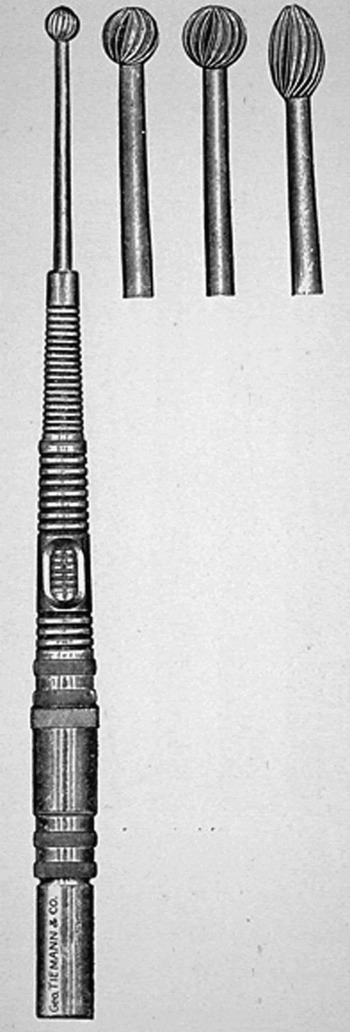
Already proposed for the treatment of caries of bone in 1882,Reference Garretson33 it was only in 1893 that William Macewen, an English neurosurgeon, drew attention to the use of the globular dental bur (or burr) in mastoid surgery:
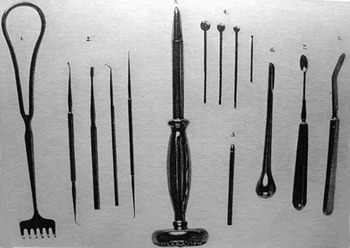
The safest instrument for the purpose of exposing antrum is the rotatory bur, propelled by a surgical engine, driven by hand or water power (the electro-motor can be used, but the supply of electricity is often uncertain – unless when used from storage cells – and requires more attention), the hand-piece of which is held in the hand like a pen. The size of the bur to be used will depend upon the dimensions of the triangle… . This instrument applied lightly to the bone removes osseous flakes, leaving a smooth, almost polished surface, upon which any dark objects, such as are presented by the interstices of the mastoid antrum or any of the adjoining cells, are readily recognised previous to being opened… . A small bur is applied to its margins until the whole of the external wall of the antrum is removed.Reference Macewen34
Figures 6 and 7 illustrate Macewen's instruments.
Macewen's instruments for mastoidectomy. Published with permission.Reference Macewen35

Macewen's drill. Published with permission.Reference Bacon36

Three years later, Thomas Barr, an English otologist, proposed use of the electrical drill in mastoid surgery.Reference Barr37 This instrument employed a dental engine of considerable power, using either a hand or a foot regulator. To prevent excessive heat from developing, as well as to allow inspection of the parts, the burr needed to be removed momentarily every few seconds. However, very few otologists became interested in this new mastoid instrumentation.Reference Halasz38, Reference Sturm39
In 1922, Gunnar Holmgren, a Swedish otologist, reconsidered utilisation of the electrical burr.Reference Holmgren40 However, it was Julius Lempert, a Russo-American otologist, who reintroduced the electrical drill to mastoid surgery, in the 1920s:
Since the subcortical mastoidectomy is a burr [i.e. a fine, electrically driven, dental burr] and curet operation, it does away with the hammer and chisel; thus the amount of trauma and shock is reduced to a minimum.Reference Lempert41
This instrumentation increased drill velocity and ease of management by using turbine engines and micromotors for drill propulsion. It also allowed a direct view and complete accessibility of all the anatomical structures normally present within the mastoid process. Again, many ear surgeons were less than enthusiastic about this instrumentation; Terence Cawthorne, an English otologist, wrote: ‘I am now finding that I rely almost entirely on the gouge’.Reference Cawthorne42
The adoption of the operating microscope in the early 1950s led to use of the electrically driven, dental-type burr as a definitive substitute for the chisel and gouge. Initially, the drill was used almost exclusively for the removal of cortical and hard cellular bone, the curette being used for soft cellular bone and the rongeur for thin bony plates.Reference Shambaugh3 This technique allowed the surgical field to be bevelled and opened widely. Drilling was accompanied by continuous irrigation and suction to avoid heating of the bone and accumulation of bone dust.
The hints offered in many of the practical applications of the electrical drill quickly supplemented the other instruments used for mastoidectomy. A man has only two hands ! So it was impossible for him to practice alone the surgery because a third hand was necessary: one for drilling, one for irrigation and one for suction. William House, an American otologist, explained the revolutionary impact of this new instrumental era thus:
I can remember taking 4 or 5 hours to do a radical mastoid with the headlight and loops, the two hands on the drill, and the squirt and suck technique, which was the way that mastoid surgery was done. But times were changing… . I became a microscope afficionado and spent many evening with June [his wife] at the morgue developing instrumentation to allow the suction irrigator to be used in one hand and the drill in the other.Reference House43
Three different systems were progressively developed, with more or less success: fixation of the irrigator on retractors;Reference Gembloux44 suction and irrigation on the same instrument;Reference Shambaugh45 and fixation of the irrigator on the drill. This last system became the most popular. Progressively, the drill replaced all other specific instruments for mastoid surgery. In the 1960s, an air-driven hand pieceReference Glenner46 replaced the conventional, electric engine, belt-driven hand piece in temporal bone surgery.Reference Michelson47 Among the many advantages of the air-driven hand piece was its extreme flexibility – it could be driven at highly variable speeds, from very slow to very fast. All the bony work of a mastoidectomy could be achieved with drills of different sizes, depending upon the task. The electrically driven drill period saw the adaptation of the electrical dental drill, together with the development of specific instruments for irrigation and suction.
Conclusion
The history of ENT surgical instruments has been poorly documented. Instruments become historical objects every day as techniques and equipment constantly change in response to new surgical ideas, advancing technology and a growing disposable armamentarium. The basic surgical armamentarium for mastoidectomy was already in place in the nineteenth century, and was able to adapt quickly to the innovative techniques of predictable, safe surgery through numerous material and structural modifications.
When surgeons do develop the itch to design a new instrument, they would be well advised to browse around the show rooms or workshops of high quality instrument manufacturers, or to study the history of their specialty. Such research will often reveal virtually the precise tool that is desired, designed many years ago, often for an entirely different purpose. Today surgical instruments are manufactured in response to surgical need as perceived by surgeons, interpreted by bioengineers, and ultimately refined by material scientists and instrument makers. In the past, this chain of command was less evident. The role of instrument development should have its due share of recognition in the history of medicine and science. It is hoped that this manuscript will contribute to such recognition.