For some time now, scholars have been documenting the power of whites' negative racial predispositions. Dozens of studies, conducted with surveys, lab experiments, or observational methods, have found that white Americans' political preferences are shaped by predispositions that characterize African Americans as lazy, welfare-dependent, violent, or demanding special favors.1
See Sears, Sidanius, and Bobo 2000 for a review.
Hutchings and Valentino 2004, 392.
More recently, this literature has asked how the information environment reinforces or primes negative attitudes about groups with lower life chances in American society.3
Berinsky and Mendelberg 2005; Clawson and Trice 2000; Entman and Rojecki 2000; Gilens 1999; Huddy 1994; Kellstedt 2003; Kinder and Sanders 1996; Nelson and Kinder 1996; Sniderman and Piazza 1993.
Scholars also investigate how negative views diminish or are neutralized (e.g., Gilliam, Valentino, and Beckmann 2002; Glaser 2002; Hurwitz and Peffley 1997a; Kellstedt 2003; Mendelberg 2001; Peffley and Hurwitz 1993).
However, some scholars posit that the U.S. has experienced enough progress in race relations that negative references to African Americans are scarce and often marginalized beyond the ability to carry an impact. For example, Thernstrom writes, “the American political scene is filled with fringe candidates peddling lines to which no one listens, and in many communities racists operate on the fringe.5
Thernstrom 1987, 204.
Thernstrom 1987, 202.
A recent study appears to lend support to her argument. Huber and Lapinski have conducted by far the largest study of racial messages, and find that no racial message, whether overt or subtle, has much effect.7
Huber and Lapinski 2006.
Huber and Lapinski 2006, 421.
This claim matters because it overturns the current understanding of the lingering effects of negative racial predispositions in politics. If racial messages evoke racial predispositions, then we can conclude that one of the important reasons that race continues to shape politics is the communication process from elites to citizens. That is, citizens respond to elite-generated or media-conveyed messages that maintain or enhance African Americans' disadvantage. Conversely, we can conclude that if elites abandon negative racial messages, then citizens' racial views will adjust accordingly, with racial progress following as a result. If racial messages do little to cue racial predispositions, however, then we are left without the key political explanation of the continuing effects of racial orientations in the political life of citizens. The effects of racial predispositions, then, appear impervious to influence from political forces, with less potential for racial progress.
As important as is the dynamic of racial politics in the U.S., the issues at hand are broader than that. Scholars have now extended the investigation of communication and group divisions to a variety of social groups in the U.S. and across countries.9
For U.S., see Berinsky and Mendelberg 2005; Fraga and Leal 2004; Hutchings et al. 2004. For across countries, see Chandra 2004; Dickson and Scheve 2006; Gibson and Gouws 2002.
The Controversy Outlined
To study the impact of negative racial cues, investigators first assess citizens' exposure to these messages, with most studies using experimental design to randomly assign a viewer either to a stereotypical racial cue (e.g., a black criminal) or to a counter-stereotypical or a nonracial cue (e.g., a white criminal, or a cue on an issue unrelated race, such as the environment). They then measure viewers' subsequent preferences for relevant candidates or policies, and test for evidence that the racial cue caused a racialized reaction. The racialized reaction can take several forms. In a common version of this design, investigators assess citizens' level of longstanding negative racial predispositions (stereotypes, resentments, etc.), and test for evidence that the racial cue caused racial priming, defined as the increased impact of negative racial predispositions on relevant candidates or policy opinions.10
Put differently, in this version, researchers test whether the negative racial cue especially influences people already inclined to stereotype or resent African Americans.
This general approach to the impact of negative racial cues applies to studies of implicit racial cues or messages as well. Implicit messages are distinguished from explicit messages, which use “racial nouns or adjectives to endorse white prerogatives, to express anti-black sentiment, to represent racial stereotypes, or to portray a threat from African Americans.”11
Mendelberg 2001, 8.
See Mendelberg 2001, ch. 1.
This implicit/explicit model has been most closely tested with a research design that contrasts implicitly racial messages against explicitly racial messages (which make the racial content obvious by using categorical racial nouns), nonracial messages devoid of any racial association, or counter-stereotypical messages that cast whites in a negative light or blacks in a positive one. This model is perhaps most elaborated and most thoroughly tested in Mendelberg, the subject of Huber and Lapinski's critique.15
Mendelberg 2001.
The Huber and Lapinski article, by contrast, finds no evidence that any race cues have any statistically significant effects. It concludes that implicit appeals are no more effective at priming racial predispositions than are explicit appeals, and that neither one is effective relative to a nonracial control message. According to Huber and Lapinski, there is a small exception among low education respondents, whose resentment is slightly activated by both implicit and explicit messages (although this result is not statistically significant).17
Huber and Lapinski 2006, 436.
Huber and Lapinski 2006, 436.
Mendelberg 2001.
Huber and Lapinski 2006, 436.
I make two main points in response, each of which I will elaborate below. The first point is that Huber and Lapinski's findings—that racial cues do not generate any racial effects—do not square with several large, even massive, literatures showing that racial cues do affect opinion. These literatures also repeatedly replicate the more specific claim rejected by Huber and Lapinski—that racialization often works implicitly. Huber and Lapinski's null findings are a large anomaly, and require explanation.
The second point is that Huber and Lapinski's evidence shows that their experimental manipulations did not work. This is true not only in the sense of null results, but in the sense that subjects do not appear to be able to tell Huber and Lapinski's messages apart clearly. In addition, there is reason to believe that many, perhaps most, of their subjects in fact were not exposed to any message. If two-thirds of responses on the key causal variable consist of measurement error, then the variable's impact may be severely under-estimated. Moreover, Huber and Lapinski's is the only study that measures racial predispositions just before exposing subjects to ads; in doing so it likely primed subjects in every condition and neutralized the distinctive effects of the implicit racial ad.
Evidence for a Dynamic View of Race
Social Psychology Studies
The largest literature in conflict with Huber and Lapinski's null findings is found in social psychology. Hundreds of studies demonstrate that race cues are primed by racial stereotypes. Moreover, this literature also makes the specific point critiqued by Huber and Lapinski—that racial cues often work in an implicit way, that is, without awareness. This is an important development because it comes on the heels of studies showing a dramatic drop in explicit measures of racial stereotypes and prejudice, with social desirability a heavy influence.21
Devine and Elliot 1995; Devine et al. 1991, Study 3; Dovidio and Gaertner 1986; Kinder and Sanders 1996; Schuman et al. 1998; Sears et al. 2000.
There are many implicit cue designs, and space permits me only a partial review here. One common type of implicit priming study exposes subjects to a subliminal racial cue, such as the words “black” or “white.” The exposure is too quick to register consciously; that is, when asked, subjects are not able to say that they saw these words. Nevertheless, subjects exposed to the word “black” and who are asked to indicate whether subsequent letter strings represent real words or not are quicker and more accurate in classifying negative than positive stereotypical words; the reverse is true for those exposed to “white”.22
Wittenbrink, Judd, and Park 1997.
Eberhardt et al. 2004.
Eberhardt et al. 2006.
Perhaps the most famous of these designs is the Implicit Association Test (IAT).26
Greenwald and Krieger 2006.
Greenwald and Krieger 2006.
Poehlman et al. 2005.
Implicit stereotyping has been replicated over time, situation, stimuli, samples and target groups.29
Banaji and Greenwald 1994; Bargh 1996; Bargh and Chen 1997; Bargh, Chen, and Burrows 1996; Correll et al. 2002; Devine 1989; Dovidio, Evans, and Tyler 1986; Dovidio et al. 1997; Fazio et al. 1995; Fiske et al. 1999; Krueger 1996; Macrae, Milne, and Bodenhausen 1994; Olson and Fazio 2004; Payne 2001.
Blair, Judd, and Chapleau 2004; Eberhardt et al. 2004; Eberhardt et al. 2006; Graham and Lowery 2004; Plant and Peruche 2005.
So the evidence suggests that racial cues racialize people's responses even though—and especially when—people are unaware that they have been exposed to racial cues, and that their decisions are shaped by racial stereotypes or attitudes. These findings, along with the dramatic decrease in explicit stereotyping, lend support to the claim rejected by Huber and Lapinski: that racial messages are likely to work, and to work implicitly. However, because these studies tend to deal with cues and responses that are often removed from political decisions, their evidence is insufficient. I therefore turn to studies of public opinion.
Studies of Media and Public Opinion
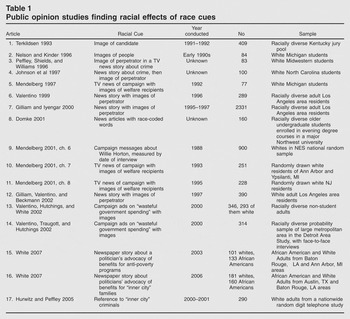
The specific literature of greatest relevance is the set of studies of the impact of racial media messages on public opinion (see table 1 for a summary of sample characteristics and other relevant information).31
In all the experiments described here subjects were randomly assigned to a condition.
Johnson et al. 1997.
Public opinion studies finding racial effects of race cues

A more political application of the implicit stereotyping literature is found in Terkildsen, whose findings support the notion that racial predispositions can be activated out of awareness through an implicit process.33
Terkildsen 1993.
Citrin, Green, and Sears 1990 conducted a survey study of an actual black candidate and did not find racial priming, but their analyses of pre-election polls are contaminated by omitting the extensive “don't know” and refusal responses to questions about the black candidate, which are likely to hide rejection of that candidate (Berinsky 1999), and by miscoding “don't know” and refusal responses together with the most egalitarian responses on the stereotype scales.
The most direct test of the hypothesis that implicit appeals prime racial predispositions, other than Mendelberg's, is Valentino, Hutchings, and White's study.35
Valentino, Hutchings, and White 2002.
The results clearly support the racial priming hypothesis. The implicit, “undeserving blacks” condition primed the racial predisposition of racial resentment in vote choice more powerfully than did the other conditions. It also primed the related racial predispositions of laissez-faire racism and perception of blacks' undue influence.36
Bobo and Smith 1998.
These authors conducted a limited replication with a probability sample of the Detroit area, using face-to-face at-home interviews. They found that the samples in their previous study, which was conducted in a lab in Ann Arbor, Michigan, and the Detroit at-home study, behaved according to a similar pattern.38
Valentino, Traugott, and Hutchings 2002.
Nelson and Kinder also found that implicit racial cues prompt racial priming in attitudes about affirmative action.39
Nelson and Kinder 1996.
Especially noteworthy is Hurwitz and Peffley's study, which reinforces the finding that implicit cues produce racial priming, this time with a national sample.40
Hurwitz and Peffley 2005.
Hurwitz and Peffley 2005, 102–103.
Valentino also found racial priming with implicit crime-based race cues.42
Valentino 1999.
Gilliam and Iyengar conducted the largest of the existing experiments of racial cues, also using implicit cues.43
Gilliam and Iyengar 2000.
Peffley, Shields, and Williams employed a design without a no-story control condition, but their findings replicate these studies in other respects.44
Peffley, Shields, and Williams 1996.
Gilliam, Valentino, and Beckmann replicated Gilliam and Iyengar, finding that exposure to implicit cues consisting of black violent criminals in local news stories increased negative racial stereotypes by 6 points, feelings of distance from blacks by 4 points, dispositional causal attributions by 4 points, and punitive crime solutions by 11 points among whites living in homogenous racial areas (as the majority of whites do).45
Domke extended these studies on the impact of implicit race cues with two new measures.46
Domke 2001.
Not only do negative messages work this way, but even messages advocating more spending to assist programs that benefit blacks can backfire and cause racial priming if they cue negative racial stereotypes. White conducted two experiments using such messages.47
White 2007.
Aggregate Studies
Studies of aggregate opinion do not tell us about the mechanism, but they do find that racial cues in the media shape collective opinion on race. Kellstedt finds that aggregate public opinion on race policy shifts predictably with the negative or positive balance of media coverage of blacks.48
Kellstedt 2003.
Gilens provides aggregate evidence on the impact of race cues on the issue of welfare.49
Gilens 1999.
Summary of the Literatures
In sum, several large literatures based on various methods and samples lead to two conclusions. First, public opinion can be more or less racialized depending on the messages in the political environment. Second, in all but the aggregate studies (in which the nature of the cue is unclear), these messages appear to work implicitly, that is, they conform to Mendelberg's definition of implicit messages. These studies are sufficiently different in demographics, method, time frame, and the nature of the race cues, that their consistent conclusion is difficult to refute by reference to any one of these dimensions. A study that finds no evidence of racial response to race cues stands out from not one but several literatures showing otherwise.
Null Results and Manipulation Checks
The question then is not the one posed in Huber and Lapinski's paper, namely why Huber and Lapinski failed to replicate one experiment in Mendelberg's chapter 7.51
Mendelberg 2001.
To start, I briefly summarize Huber and Lapinski's design. Huber and Lapinski assigned subjects in their experiment A to view an implicit or explicit anti-welfare issue ad or an off-issue nonracial control ad. The implicit and explicit ads each feature an image of a black woman on welfare; the explicit condition in addition verbally targets blacks (“too many welfare recipients, especially blacks, take advantage of our tax dollars”). Subjects in experiment B were assigned to one of four anti-welfare messages: either the implicit or explicit ads from experiment A, a counter-stereotypical ad replacing the image of the black welfare woman with a white counterpart, or a fourth ad designed to check for accurate audio reception that showed the white woman but used the verbal content of the explicit anti-black ad. Before the ad, they assessed subjects' predispositions, and after the ad, they asked subjects about the ad assigned to them and about their preferences on various race-related policies. The authors then tested whether the implicit message causes a greater increase in the effect of negative racial predispositions on race policies.
As a first step, I turn to Huber and Lapinski's table 4, the key table in the paper. This table tests one of the basic hypotheses of the race cues literature in general, and the key hypothesis of the racial priming literature in particular: that racial cues strengthen the impact of racial predispositions on relevant opinion. Table 4 is striking because it consists entirely of null results; there is not a single statistically significant effect of racial messages.
When experimental conditions fail to have effects, the next logical step is to conduct a manipulation check. Huber and Lapinski's manipulation check rests on a question about whether “issue advertisements were good for democracy”, worded as: “Do you think that it is good for democracy that groups run these types of ads?”52
Huber and Lapinski 2006, 424, 427.
Huber and Lapinski 2006, 427.
However, with over 6,300 respondents, even a small difference of means is likely to reach statistical significance, so the question is not significance alone but magnitude. In fact, the key contrast, which is between implicit and explicit conditions, amounts to a difference of only 7 percentage points in experiment A and 6 percentage points in experiment B. Also problematic for the authors' claim that the explicit message was perceived as clearly racial and therefore that the treatment was received as intended is the small difference between the explicit message and the two types of messages that did not have any stereotypical racial cues—12 percentage points in experiment A, and 8 percentage points in experiment B.
Two plausible possibilities suggest themselves to explain the apparent failure of Huber and Lapinski's experimental manipulation: 1) that many subjects did not receive their assigned message (and the faulty manipulation check leaves open the possibility that most subjects did not get their message), and 2) that racial predispositions were measured just before the messages were sent and therefore likely washed out the effects of the message. I take up each explanation in turn below.
Explaining Null Results I: WebTV and Exposure
First, unlike the many successful race cue studies, the Huber and Lapinski study used a WebTV survey administered via the Internet to a sample of Knowledge Networks participants in their homes. The study to which Huber and Lapinski refer readers for details of their experimental procedure is Clinton and Lapinski,54
Clinton and Lapinski 2004.
Huber and Lapinski 2006, 423, n. 5. This is one of only two published studies of political ads using WebTV, and the study using by far the largest number of respondents. The other study is Gale et al. 2005. A recent KN study by Brooks and Geer of negative campaign appeals used brief written statements rather than ads that must be downloaded, and this difference may have been important; in any case, it does not seem to have suffered the problem of indistinguishable treatments, with a manipulation check yielding percentages of 64 percent, 44 percent and 23 percent for the three basic conditions (Brooks and Geer 2007, 6).
Clinton and Lapinski 2004, 76, n. 8.
Knowledge Networks provided information only about general current procedures and without sufficient detail to evaluate these procedures or to know which procedures were followed by Huber and Lapinski (Mike Dennis, e-mail March 3, March 13, 2006). The “download rate” for the most recent studies exposing viewers to ads is 75 percent–78 percent but no academic studies are included in this set so this rate does not apply to Huber and Lapinski.
That almost two-thirds of subjects supposed to get an ad probably did not get it, and yet are apparently miscoded as receiving it, has important implications for the Huber and Lapinski study. It means that the key independent variable has more measurement error than true values. Measurement error in any explanatory variable biases the estimated effects of all the variables in the model.58
Achen 1983.
Bartels 1993, 270, 271.
Bartels 1993, 275.
Of course, it is more realistic for study participants to view ads in their own homes. But if the goal is to make strong causal inferences and a controlled experiment is run toward that end which assumes full exposure by every subject, then we need to ascertain that this level of control was in fact exercised.
Skeptics might raise the counter-argument that even if many subjects are not exposed to their assigned message, there is no threat to internal validity, because subjects watch or do not watch to the same extent across conditions. However, while it is true that there is no threat to internal validity here, that is because there is no effect whose validity is threatened. Equally low exposure across conditions would explain the weak effects we observe across conditions.
Skeptics may raise a second counter-argument: that Huber and Lapinski included a condition designed to check that the ads were in fact received. In Experiment B some subjects were assigned to a condition that used the explicit condition's explicit racial audio but included a visual of a white welfare recipient. Huber and Lapinski included this explicit-audio condition to ensure that all subjects heard the audio in whatever message they were assigned. They report finding no difference in the “issue ads are bad for democracy” responses in this explicit-audio condition and the explicit condition. From this similarity in response they conclude that subjects were in fact exposed to their assigned ad. However, as noted, replies to that question do not tell us if subjects were exposed to any ad, since the question does not ask about an ad. Furthermore, the responses to this question do not vary much across the various conditions, as noted above.62
Finally, I consider the possibility that the particular message used by Huber and Lapinski was ineffectively constructed. This is unlikely because in Gilliam's study exposure to the same images used by Huber and Lapinski for the black versus white welfare “queen” produced a 5-point increase in opposition to welfare spending and a 10-point increase in negative views of welfare recipients, so the images could not have been a total wash (Gilliam 1999). I do not include this study in my discussion of the public opinion literature because its full details have not yet been published.
Explaining Null Results II: Unintended Priming Prior to Exposure
A final explanation for the null results rests with question order. More precisely, Huber and Lapinski measured racial predispositions just before exposure to the ad, which likely neutralized the effect of the ad's racial cue.63
Huber and Lapinski 2006, 424, n. 7.
Huber and Lapinski 2006, 424, n. 7.
A well-established literature documents the pervasive influence of question order in surveys.65
For example, asking questions about women's rights—a predisposition relevant to abortion policy—alters answers to policy questions about abortion.66Tourangeau and Rasinski 1988.
These findings on question order have transformed our understanding of substance (how the public decides) and method (how to prevent the huge biases introduced by seemingly small changes in question order).67
The lesson here is that the close pre-message measurement of racial predispositions increases the accessibility of these predispositions, blurring the distinctions between the subsequent message conditions and undermining the ability of the race cues to elicit distinctive racial effects. If we want to know whether a message primes predispositions, we must measure the predispositions well in advance of the message.68See Mendelberg 2001.
Why the Reasons Offered by Huber and Lapinski for the Discrepancy Fail to Explain It
We are now in a better position to evaluate the main reasons provided by Huber and Lapinski for the discrepancy between their findings and Mendelberg's. Their first reason is that Mendelberg's study in chapter 7 was regionally specific while their study is national, and therefore more valid. However, Mendelberg replicated her Michigan study in New Jersey, and further corroborated it with the 1988 National Election study (NES), a national sample.69
Mendelberg 2001.
The second reason they provide for the discrepancy is that the Michigan study used only a few hundred cases while theirs used several thousand. However, the basic finding—that cues can racialize public preferences—rests on studies totaling over 5,000 cases, adding across the public opinion studies detailed above. If Mendelberg's results are due to sampling vagaries, then we would expect replications to fail, yet as reviewed above, they do not.
Third, the article claims that Mendelberg had no control group.70
Huber and Lapinski 2006, 424.
One experiment is reported in Mendelberg 2001, ch. 8, and the other in a 1997 article also described on p. 184 of the book. Mendelberg writes of the New Jersey experiment: “the impact of resentment on candidate choice is negligible when the candidate does not engage in a racial appeal. Resentment makes a good deal of difference to candidate choice, but only when candidates communicate racial messages” (2001, 219–220).
Huber and Lapinski 2006, 197, n. 8.
Huber and Lapinski also claim that too few resentful individuals were included in the Mendelberg study and therefore the results are due to chance. But while the Michigan study did have a low resentment mean, the New Jersey study's mean approaches the mean of national samples such as NES or Huber and Lapinski's (0.50 versus 0.59 in Huber and Lapinski). In addition, Mendelberg also established the racial priming effect with the nationally representative 1988 NES, with a resentment mean of .60.73
Mendelberg 2001, 188.
Another explanation provided by Huber and Lapinski for their discrepant finding is that because their study was a representative national sample, it had a good distribution of education, while Mendelberg's study had a very high education level. They argue that people with more education are especially immune to racial priming. But this argument does not explain the discrepancy. First, the poorly-educated subsample in the Huber and Lapinski study does not behave differently at conventional levels of statistical significance. Second, highly educated samples in other studies have yielded strong racial priming effects.74
Mendelberg 2001 and Valentino, Hutchings, and White 2002; also, many implicit stereotyping studies are conducted on well educated samples.
Federico 2004. Another possibility for the discrepancy, not suggested by Huber and Lapinski, is that the implicit message used in Mendelberg is too overt for the “post-Willie Horton” period. However, Valentino, Hutchings, and White 2002 found strong racial effects for messages very similar to Mendelberg's during the 2000 campaign, over a decade after the media discussion of Horton, so this, too, fails as an explanation.
Most importantly, the particulars of Mendelberg's study are now virtually irrelevant given the large number of studies that replicate her basic results. Even if Mendelberg's study was set aside entirely and disregarded, its conclusion remains.
Conclusion
Over a decade ago, Larry Bartels noted:
The state of research on media effects is one of the most notable embarrassments of modern social science. The pervasiveness of the mass media and their virtual monopoly over the presentation of many kinds of information must suggest to reasonable observers that what these media say and how they say it has enormous social and political consequences. Nevertheless, the scholarly literature has been much better at refuting, qualifying, and circumscribing the thesis of media impact than at supporting it.76
Bartels 1993, 267.
Bartels faulted, in part, the “limitations of research design.”77
Bartels 1993, 267.
The literature review here reveals many studies replicating the finding that implicit race cues racialize public opinion. But beyond the claim that race cues work effectively in an implicit fashion, the issue at hand revolves most centrally around the claim that no race cue of any kind matters. These studies contradict the Huber and Lapinski findings of null results by establishing the potency of racial cues in political judgments. In that sense, the question of implicit appeals becomes secondary; the main issue is Huber and Lapinski's failure to find any statistically significant racialized response.
Huber and Lapinski do raise the useful question of whether there are subgroups that might react favorably to explicit racial messages. It is possible that Mendelberg's conclusion that explicit messages in the post-civil rights era do not work very well is too unqualified. The next step is to discover the circumstances and reasons that make this true.
For example, in the South racial attitudes appear to lean more rightward than in the rest of the country, so explicit racial cues may have some effect there.78
Glaser and Gilens 1997; Kuklinski, Cobb, and Gilens 1997; Kuklinski et al. 1997; Valentino and Sears 2005.
Hutchings, Walton, and Benjamin 2005.
Huber and Lapinski 2006, figure 5. See also p. 436. In other analyses of the effect of education they interact education with racial predispositions without including the main effect of education (tables 5 and 6). The results in figure 5 may well derive from a model that omitted this term as well (the model's specification is not reported).
Federico 2004.
Relatedly, explicit messages may work when certain frames are used. Hutchings and Valentino suggest that messages about policy conflicts between racial groups can be explicit and still work, while messages that convey racial stereotypes are more likely to work if implicit.83
Hutchings and Valentino 2003.
Relatedly, explicit messages may work when the first black candidate is poised to win an influential office and is perceived as a challenge to whites' interests. Reeves' 1997 experimental study identified the candidates verbally as “black” or “white,” and the black candidate as “seeking to become the city's first black mayor.” Reeves codes this as a subtle appeal, but it appears explicit by Mendelberg's definition. Negative racial predispositions kick in against the black candidate, but only when the disagreement is over affirmative action, not when it is about the environment.
A second question for future research, suggested by the literature on race cues reviewed above, is how the distinction between implicit and explicit works. In past work, I have treated these as a dichotomy, but actually it seems more accurate to think of them as end points on a continuum.85
Mendelberg 2001.
A final and important question emerging from the literature I reviewed is how the subjects of these messages perceive and react to them. Gilliam and Iyengar find that race cues in news coverage of crime do not affect African Americans as they do white Americans.86
Gilliam and Iyengar 2000.
White 2007.
Valentino, Hutchings, and White 2002.
Mendelberg 2001.
Cohen 1999.
Dawson and Wilson 1991.
In sum, the weight of the evidence from well over a dozen experiments and two aggregate studies, along with hundreds of implicit stereotyping studies, supports the hypothesis that race cues often racialize white public opinion. Racial messages do shape the political response of white citizens. Conversely, racialized preferences are not immutable; when the cues change, so does public opinion. In addition, much of this evidence also shows that race cues frequently work implicitly. Methodological problems explain why a massive randomized study contradicts this conclusion. The null findings for racial cues are artifacts of flawed methodology. The conclusion remains that the media and politicians strengthen or dampen the impact of race on politics in ways consequential for American democracy. Future research should take that as a given and proceed to investigate its contingencies and complexities.