Introduction
A global ‘caregiving crisis’ (Carter, Reference Carter2008) is widely forecast owing to dramatic demographic transitions and health trends that strain conventional healthcare mechanisms (Wiener, Reference Wiener, Brodsky, Habib and Hirschfeld2003). Rapid population aging (Wiener, Reference Wiener, Brodsky, Habib and Hirschfeld2003; Carter, Reference Carter2008; Bloom, Reference Bloom2011; Lee, Reference Lee2011) is accompanied by increases in age-related morbidity and disability (Vogeli et al. Reference Vogeli, Shields, Lee, Gibson, Marder, Weiss and Blumenthal2007; Christensen et al. Reference Christensen, Doblhammer, Rau and Vaupel2009). The old age dependency ratio is accordingly projected to double by 2050 and triple by 2100 (Lee, Reference Lee2011). Confronted with the resultant growth in long-term care (LTC) needs and critical shortages of professional resources (Jacobzone, Reference Jacobzone2000; Wiener, Reference Wiener, Brodsky, Habib and Hirschfeld2003; Carter, Reference Carter2008; Christensen et al. Reference Christensen, Doblhammer, Rau and Vaupel2009; Levine et al. Reference Levine, Halper, Peist and Gould2010; Kakuma et al. Reference Kakuma, Minas, van Ginneken, Dal Poz, Desiraju, Morris, Saxena and Scheffler2011), public health systems increasingly seek community solutions, including deinstitutionalization, laws mandating care of dependent relatives, and ‘cash-for-care’ incentives (Jacobzone, Reference Jacobzone2000; Bolin et al. Reference Bolin, Lindgren and Lundborg2008; Levine et al. Reference Levine, Halper, Peist and Gould2010). Such initiatives will doubtlessly compound the burden of family caregivers (Jacobzone, Reference Jacobzone2000; Awad & Voruganti, Reference Awad and Voruganti2008; Lamura et al. Reference Lamura, Mnich, Nolan, Wojszel, Krevers, Mestheneos and Dohner2008) who already shoulder the vast majority of LTC responsibilities without pay or compensation for forgone wages (Jacobzone, Reference Jacobzone2000; Wiener, Reference Wiener, Brodsky, Habib and Hirschfeld2003; Carter, Reference Carter2008; Levine et al. Reference Levine, Halper, Peist and Gould2010).
However, informal caregiving systems are simultaneously dwindling (Ekwall et al. Reference Ekwall, Sivberg and Hallberg2007) due to sociodemographic trends towards delayed childbearing, smaller families, more divorce and remarriage, more female employment and dual-earner households, higher migration and globalization, and less intergenerational co-residency (Wiener, Reference Wiener, Brodsky, Habib and Hirschfeld2003; Heitmueller, Reference Heitmueller2007; Bolin et al. Reference Bolin, Lindgren and Lundborg2008; Lamura et al. Reference Lamura, Mnich, Nolan, Wojszel, Krevers, Mestheneos and Dohner2008). As a result of these trends, the burden of chronic care increasingly falls on family caregivers who are themselves aging (Jacobzone, Reference Jacobzone2000; Wiener, Reference Wiener, Brodsky, Habib and Hirschfeld2003; Levine et al. Reference Levine, Halper, Peist and Gould2010; Kakuma et al. Reference Kakuma, Minas, van Ginneken, Dal Poz, Desiraju, Morris, Saxena and Scheffler2011; Lee, Reference Lee2011) and vulnerable to the burdens of caregiving, which include financial strain (Hickenbottom et al. Reference Hickenbottom, Fendrick, Kutcher, Kabeto, Katz and Langa2002; Carmichael & Charles, Reference Carmichael and Charles2003; Heitmueller & Inglis, Reference Heitmueller and Inglis2007; Bolin et al. Reference Bolin, Lindgren and Lundborg2008; Kusano et al. Reference Kusano, Bouldin, Anderson, McGuire, Salvail, Simmons and Andresen2011), depression (Pinquart & Sörensen, Reference Pinquart and Sörensen2003a, Reference Pinquart and Sörensen2007; Haley et al. Reference Haley, Allen, Grant, Clay, Perkins and Roth2009; Opree & Kalmijn, Reference Opree and Kalmijn2012; Papastavrou et al. Reference Papastavrou, Charalambous, Tsangari and Karayiannis2012), sleep disruption (Happe & Berger, Reference Happe and Berger2002), mobility limitation (Fredman et al. Reference Fredman, Cauley, Satterfield, Simonsick, Spencer, Ayonayon and Harris2008, Reference Fredman, Doros, Ensrud, Hochberg and Cauley2009), immunosuppression (Kiecolt-Glaser et al. Reference Kiecolt-Glaser, Dura, Speicher, Trask and Glaser1991), neuroendocrine dysregulation (Brummett et al. Reference Brummett, Boyle, Siegler, Kuhn, Surwit, Garrett, Collins, Ashley-Koch and Williams2008; Kring et al. Reference Kring, Brummett, Barefoot, Garrett, Ashley-Koch, Boyle, Siegler, Sørensen and Williams2010), general physical morbidity (Vitaliano et al. Reference Vitaliano, Zhang and Scanlan2003; Pinquart & Sörensen, Reference Pinquart and Sörensen2007; Haley et al. Reference Haley, Roth, Howard and Safford2010), and even excess mortality (Schulz & Beach, Reference Schulz and Beach1999; Christakis & Allison, Reference Christakis and Allison2006).
Although the above trends lead experts to conclude that informal care is among the most pressing public policy challenges of our time (Wiener, Reference Wiener, Brodsky, Habib and Hirschfeld2003), credible data evaluating current burden among family caregivers are few and fragmentary. Most evidence on caregiving has been collected incidentally in research on specific conditions (Hickenbottom et al. Reference Hickenbottom, Fendrick, Kutcher, Kabeto, Katz and Langa2002; Prince, Reference Prince2004; Torti et al. Reference Torti, Gwyther, Reed, Friedman and Schulman2004; Awad & Voruganti, Reference Awad and Voruganti2008; National Alliance for Caregiving in collaboration with AARP, Reference Navaie-Waliser, Spriggs and Feldman2009), often based on small convenience samples in industrialized countries that focused on particular relationships and burdens. Few large population-based estimates of condition- or region-specific burden exist (Hickenbottom et al. Reference Hickenbottom, Fendrick, Kutcher, Kabeto, Katz and Langa2002; Prince, Reference Prince2004; Wimo et al. Reference Wimo, Winblad and Jonsson2007; Awad & Voruganti, Reference Awad and Voruganti2008), while multinational assessments are generally confined to overviews and meta-analyses of small-scale studies (Pinquart & Sörensen, Reference Pinquart and Sörensen2003a, Reference Pinquart and Sörensen2005, Reference Pinquart and Sörensen2006,Reference Pinquart and Sörensen2007, Reference Pinquart and Sörensen2011; Torti et al. Reference Torti, Gwyther, Reed, Friedman and Schulman2004). For instance, a recent meta-analysis of kinship differences in 168 caregiver studies over the last three decades identified no pertinent cross-national surveys (Pinquart & Sörensen, Reference Pinquart and Sörensen2011), while a systematic review of 93 studies on dementia caregivers (Torti et al. Reference Torti, Gwyther, Reed, Friedman and Schulman2004) identified no contemporary large-scale cross-national surveys, leading experts to conclude that culturally inclusive large-scale studies are sorely needed (Torti et al. Reference Torti, Gwyther, Reed, Friedman and Schulman2004; Pinquart & Sörensen, Reference Pinquart and Sörensen2011). The small amount of cross-national research undertaken in this area to date has focused largely on topical issues such as service use (Lamura et al. Reference Lamura, Mnich, Nolan, Wojszel, Krevers, Mestheneos and Dohner2008), palliative caregiving (Gysels et al. Reference Gysels, Evans, Menaca, Andrew, Toscani, Finetti, Pasman, Higginson, Harding and Pool2012), dementia caregiving (Schneider et al. Reference Schneider, Murray, Banerjee and Mann1999), and compound caregiving (Opree & Kalmijn, Reference Opree and Kalmijn2012) in small European samples. While these studies document significant objective and subjective burden among family caregivers (Schneider et al. Reference Schneider, Murray, Banerjee and Mann1999; Gysels et al. Reference Gysels, Evans, Menaca, Andrew, Toscani, Finetti, Pasman, Higginson, Harding and Pool2012), virtually no broad-based population data exist on the magnitude of the burden experienced by family caregivers across developed and developing countries.
The current report presents data on this issue based on cross-sectional community epidemiological surveys of older (aged 50+ years) family caregivers in 20 countries participating in the World Health Organization (WHO) World Mental Health (WMH) Survey Initiative (Kessler & Üstün, Reference Harwood, Barker, Ownby, Bravo, Aguero and Duara2008). We examine both objective and subjective burdens associated with a wide range of family health problems. We focus on older caregivers based on concerns about the aging of the world population (Opree & Kalmijn, Reference Opree and Kalmijn2012), the rising share of caregiving provided by older family members (Heitmueller & Inglis, Reference Heitmueller and Inglis2007; Bolin et al. Reference Bolin, Lindgren and Lundborg2008; Opree & Kalmijn, Reference Opree and Kalmijn2012), and the vulnerability of older caregivers to burden due to their own pre-existing health problems and functional limitations (King & Brassington, Reference King and Brassington1997; Schneider et al. Reference Schneider, Murray, Banerjee and Mann1999).
Method
Sample
Surveys were administered in 10 countries classified by the World Bank (World Bank, 2009) as high income (Belgium, France, Germany, Israel, Italy, the Netherlands, Northern Ireland, Portugal, Spain, USA), five as upper-middle income (São Paulo in Brazil, Bulgaria, Lebanon, Mexico, Romania), and five as low/lower-middle income (Colombia, Pondicherry in India, Iraq, Nigeria, Shenzhen in the People's Republic of China). A total of 13892 respondents aged 50+ years (7265 in high-income, 4077 in upper-middle-income, and 2550 in low-/lower-middle-income countries) were interviewed about family burden. All but five surveys were based on national household samples. The exceptions were two surveys of urban areas (Colombia, Mexico) and three of specific metropolitan areas (São Paulo, Brazil; Pondicherry, India; Shenzhen, People's Republic of China). Interviews were conducted face-to-face in respondent households after obtaining informed consent. Human Subjects Committees monitored the study and approved recruitment and consent procedures in each country. Response rates ranged from 45.9% in France to 98.6% in Pondicherry and averaged 71.8%. Further details about WMH design have been presented elsewhere (Harkness et al. Reference Harkness, Pennell, Villar, Gebler, Aguilar-Gaxiola, Bilgen, Kessler and Üstün2008; Heeringa et al. Reference Heeringa, Wells, Hubbard, Mneimneh, Chiu, Sampson, Berglund, Kessler and Üstün2008; Pennell et al. Reference Pennell, Mneimneh, Bowers, Chardoul, Wells, Viana, Dinkelmann, Gebler, Florescu, He, Huang, Tomov, Vilagut, Kessler and Üstün2008).
Subsampling within interviews was used to reduce respondent burden. The family burden questions were consequently administered to between a random 15% (Portugal) and 100% (in five surveys) of respondents. The number of such respondents aged 50+ years ranges from 233 to 287 respondents in six surveys (Belgium, Colombia, Lebanon, Mexico, Pondicherry and Portugal) to highs of 1110–1904 in five others (Israel, Northern Ireland, Romania, São Paulo and the USA). Because of this wide sample size variability, analyses were implemented in pooled cross-national samples disaggregated into high-, upper-middle-, and low-/lower-middle-income countries.
Measures
Burden was conceptualized according to the traditional distinction between objective and subjective (Awad & Voruganti, Reference Awad and Voruganti2008; Idstad et al. Reference Idstad, Roysamb and Tambs2011). Questioning began by asking respondents how many living first-degree relatives of four types they had (parents, siblings, spouses, children) and whether one or more of each type had each of 12 broadly defined classes of health conditions: four physical (cancer, serious heart problems, permanent physical disability like blindness or paralysis, any other serious chronic physical illness) and eight mental (serious memory problems such as senility or dementia, mental retardation, alcohol or drug problems, depression, anxiety, schizophrenia or psychosis, manic-depression, any other serious chronic mental problem). We did not assess the number of each kinship type with each condition but only whether any kin of each type had each condition. The condition list was purposefully kept short based on concerns that respondents might provide superficial answers to longer lists, the intent being to provide an operational definition of ‘serious’ by beginning with a short set of exemplar conditions to establish an implicit threshold before asking a more general question about ‘any other’ comparably serious condition. To the extent that respondents experience some family health conditions as burdensome but not ‘serious’, this approach underestimates conditions.
Respondents reporting at least one first-degree relative with at least one condition were then asked: ‘Taking into consideration your time, energy, emotions, finances, and daily activities, would you say that (his/her/their) health problems affect your life a lot, some, a little, or not at all?’ This question was asked only once, implicitly asking respondents to consider all conditions of all first-degree relatives. Respondents who answered ‘a lot’ or ‘some’ were then asked two questions about subjective burden: how much their family members' health conditions caused them to be either psychologically distressed (‘worried’, ‘anxious’, or ‘depressed’) or embarrassed (‘a lot’, ‘some’, ‘a little’, ‘not at all’). Additional yes/no questions then assessed whether respondents helped with practical tasks (e.g. washing, getting around, housework) and spent more time keeping company or giving emotional support to their ill relatives than they would otherwise. This strategy of asking about ‘additional’ time due to relative conditions was designed to adjust for between-country differences in normal amount of interaction with relatives. Respondents were also asked whether they had any financial burden (either money spent or earnings foregone) due to their relatives' conditions and, if so, average monthly amount of this burden. Responses were converted to median national household income equivalents to adjust for between-country differences in currency.
First-degree relatives were selected as the focus to create a well-defined network for sampling purposes. While respondents could doubtlessly have reported caregiving activities involving other kin (e.g. grandparents, grandchildren) and non-relatives, it was less clear whether respondents would have reliable information regarding serious mental and physical health problems in these broader networks, leading to upward bias in estimates of conditional probability of burden given a condition. Although the focus on first-degree relatives avoids that bias, it leads to underestimating total caregiver burden by excluding other care recipients.
Analysis methods
A total of seven outcome measures were considered. Five are dichotomies: any burden, any time burden, any financial burden, a lot/some psychological distress, and a lot/some embarrassment. The other two are continuous: amount of time (in h) and amount of financial burden (as a proportion of median within-country household income). Regression analysis was used to predict each outcome among respondents with at least one relative with a condition. Predictors included count variables (coded 0–4) for number of kinship types with each condition (i.e. 12 separate variables, each coded 0–4), three count variables (coded 0–12) for number of condition types experienced by each kinship type (parents, spouse, children, compared with the contrast category of siblings), and demographic controls (respondent age, gender, marital status, education).
Logistic regression analysis (Hosmer & Lemeshow, Reference Hosmer and Lemeshow2000) was used to predict dichotomous outcomes. Coefficients and standard errors were exponentiated to produce odds ratios (ORs) with 95% confidence intervals (CIs). Generalized linear models with a log link function and Poisson error variance structure (McCullagh & Nelder, Reference McCullagh and Nelder1989) were used to predict continuous outcomes. We explored numerous model specifications and selected log link/Poisson based on standard fit comparisons (Buntin & Zaslavsky, Reference Buntin and Zaslavsky2004). Coefficients and standard errors were exponentiated to produce incidence density ratios (IDRs) with 95% CIs. IDRs can be interpreted as ratios of expected scores on the continuous outcomes among respondents who differ by one point on the predictor.
Population attributable risk proportions (PARPs) of the continuous outcomes were calculated to characterize proportions of time and financial burden due to particular kinship types and conditions. A PARP can be interpreted as the proportion of burden that would be prevented if particular conditions were eliminated and regression coefficients represented causal effects (Northridge, Reference Northridge1995). The methods used to calculate PARPs have been described elsewhere (Levinson et al. Reference Levinson, Lakoma, Petukhova, Schoenbaum, Zaslavsky, Angermeyer, Borges, Bruffaerts, de Girolamo, de Graaf, Gureje, Haro, Hu, Karam, Kawakami, Lee, Lepine, Browne, Okoliyski, Posada-Villa, Sagar, Viana, Williams and Kessler2010). The design-based jack-knife repeated replications method (Wolter, Reference Wolter1985) was used to adjust standard errors for sample weighting-clustering. Statistical significance was consistently evaluated using 0.05-level, two-sided design-based tests.
Results
Prevalence
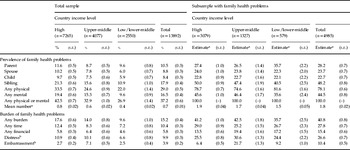
Serious health conditions of first-degree relative were reported by 26.9–42.5% of respondents across country income groups (Table 1). Relative physical conditions were reported by more respondents (22.0–33.5%) than were mental conditions (9.6–19.4%). The fact that we did not assess number of family members of given types with conditions partly explains the highest estimates being in high-income countries despite epidemiological evidence that prevalence of chronic conditions is inversely related to country income level (Mathers et al. Reference Mathers, Lopez, Murray, Lopez, Mathers, Ezzati, Jamison and Murray2006). More detailed analyses not presented in Table 1 show that these cross-national differences are much less pronounced when focusing on the subsamples of respondents reporting particular relative–condition combinations, such as parent conditions among respondents with living parents. (The results of this and other preliminary analyses reported verbally in various parts of the paper but not shown in tables are available in appendix tables posted on the WMH web site at www.hcp.med.harvard.edu/wmh) Any burden was reported by 35.7–42.5% of respondents who reported relative conditions, among whom 25.2–29.0% devoted time, 13.5–19.4% reported financial burden, 24.4–30.6% reported distress, and 6.4–21.7% reported embarrassment.
Prevalence and reported burden of family health problems

Data are given as percentage (s.e.) or as estimate (s.e.). s.e., Standard error.
a Mean number of family health problems out of 48 (12 types of problems for each of four types of family members).
b ‘A lot’ or ‘some’ distress or embarrassment reported in response to questions about intensity of these feelings.
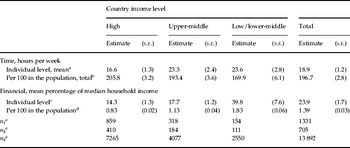
Estimates of mean caregiving hours per week among those devoting any time are substantial: 18.9 h/week across all countries and more in low-/middle-income (23.3–23.6 h) than high-income (16.6 h) countries (Table 2). Population-level equivalents are 169.9–205.8 h/week per 100 people aged 50+ years in the population (i.e. including within these 100 people those without ill first-degree family members). As noted above, these estimates are conservative due to health problems not considered ‘serious’ and of non-first-degree relatives and non-relatives not being considered. Mean financial burden among those with any is equivalent to nearly one-quarter (23.9%) of median within-country family income among respondents who report any financial burden, with lower estimates in high- (14.3%) and upper-middle- (17.7%) income countries than in low-/lower-middle- (39.8%) income countries. Population-level equivalents, again likely to be underestimates, are 0.83–1.83% of total sample-wide median family income among all people aged 50+ years in the samples (i.e. including those without ill family members).
Individual-level and population-level time and financial burdens of family health problems

Data are given as estimate (s.e.). s.e., Standard error.
a Individual-level reports of hours per week spent with or doing things for ill family members.
b The population-level estimate was obtained by multiplying the individual-level estimate by the proportion of respondents who reported spending any time.
c Individual-level reports of financial burden were converted to percentages of median household income in the country. The means of these transformed scores among respondents who reported any financial burden are reported here. For example, the mean monthly financial impact of family illness (due either to out-of-pocket expenses or foregone income) across countries among respondents who reported such costs was equal to 23.9% of the median monthly household income in the country.
d The population-level estimate of financial burden was obtained by multiplying the individual-level estimate by the proportion of respondents who reported such burdens. The resulting estimate can be interpreted as the total financial costs of family health problems as a percentage of total household income in the country.
e n 1 = subsample of responded who devoted any time to family health problems; n 2 = subsample of respondents with any financial burden due to family health problems; n 3 = total sample, including respondents who had no family health problems.
Sociodemographic correlates
Preliminary analyses not shown in tables found three significant sociodemographic correlates of multiple burden dimensions in total-sample multivariate models: (i) women reported significantly more burden than men on all indicators other than financial burden, with ORs of 1.3–1.8; (ii) the previously married reported significantly less distress and less time on relative conditions than the married (0.6–0.8); (iii) education was positively associated with having any financial burden (1.1) and with magnitude of financial burden among those having any (1.1). However, little geographic consistency was found in these patterns, with the only statistically significant patterns found in more than one country income group being higher ORs of distress (1.9–2.2) and time spent (1.8–2.3) by women than men in both high- and upper-middle-income countries.
Variations in burden by kinship and condition
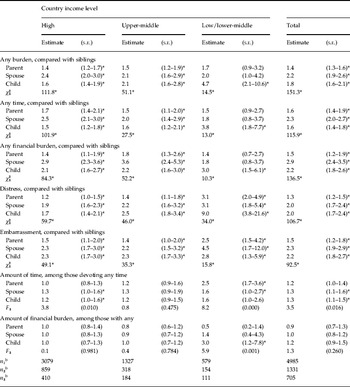
Total-sample multivariate models show spouse and child conditions associated with highest and sibling conditions lowest burden across all outcomes other than amount of financial burden, where relationship type is not significant (Table 3). This result is probably conservative, as the most plausible bias in such reports would be for less severe conditions of siblings to be under-reported relative to those of spouses, parents and children. Correction for such bias would yield even stronger evidence for lowest burden associated with sibling conditions. These patterns are generally consistent across high- and upper-middle-income country groups. For low-/lower-middle-income countries, though, child problems are associated with substantially higher relative effects on time, financial burden, and distress, with relative effects of spouse conditions closer to those of parent and sibling conditions.
Differential burdens of family health problems by type of relativea

Data are given as odds ratio (s.e.) for the first five outcomes, all of which are dichotomies, and incidence density ratio (s.e.) for the last two outcomes, which are continuous. s.e., Standard error.
a Based on multivariate models (logistic for dichotomous outcomes; generalized linear models for continuous outcomes with log link function and Poisson error distribution) with predictors that included a separate count variable (coded 0–4 ) for the number of types of relatives with each of the 12 health problems, a separate count variable (coded 0–12 ) for the number of types of health problems experienced by each of three types of relatives (parents, spouse, children, compared with the implicit contrast category of siblings), and demographic controls (respondent age, gender, marital status, and level of educational attainment). All equations were estimated in a pooled dataset across either the entire set of 20 countries or in the high-, upper-middle-, and low-/lower-middle-income countries. Romania was removed from the models for financial burden, as this aspect of burden was not assessed in Romania.
b n 1 = total subsample of respondents with family health problems; n 2 = subsample of responded who devoted any time to family health problems; n 3 = subsample of respondents with any financial burden due to family health problems.
* p < 0.05 level (two-sided test).
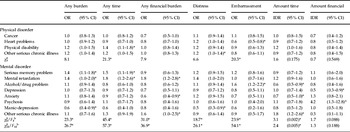
The same total-sample multivariate models found significant variation in burden by type of condition for all indicators other than amount of financial burden (Table 4). However, little consistency exists in the most burdensome conditions across outcomes. Results not reported in the table also failed to detect geographic consistencies in differential burden across conditions for individual outcomes. The most consistent pattern is for mental retardation to be associated with elevated odds of both devoting any time (1.8 in the total sample; 1.6–2.1 across country groups) and having any financial burden (1.8 in the total sample; 1.4–3.3 across country groups). Physical disability is the only other family condition consistently (across all country groups) associated with elevated odds relative to other conditions of devoting any time (1.4 in the total sample; 1.3–2.1 across country groups), while memory problems are the only other condition associated with elevated odds relative to other conditions of devoting time in high- and upper-middle-income countries (1.5 in the total sample; 1.5–1.6 across country groups). In interpreting this result, though, it must be recalled that our ascertainment method is biased against detecting between-disorder variation in burden because we assessed only conditions rated ‘serious’. While significant differential burden presumably exists due to between-condition variation in severity, these differences are beyond the scope of the present study.
Differential burdens of family health problems by type of problem in the total sample (n = 4985)a

OR, Odds ratio; CI, confidence interval; IDR, incidence density ratio.
a Based on multivariate models (logistic for dichotomous outcomes; generalized linear models for continuous outcomes with log link function and Poisson error distribution) with predictors that included a separate count variable (coded 0–4) for the number of types of relatives with each of the 12 health problems, a separate count variable (coded 0–12) for the number of types of health problems experienced by each of three types of relatives (parents, spouse, children, compared with the implicit contrast category of siblings), and demographic controls (respondent age, gender, marital status, and level of educational attainment). All equations were estimated in a pooled dataset across the entire set of 20 countries. Romania was removed from the models for financial burden, as this aspect of burden was not assessed in Romania.
b χ2 Tests were used for the first five (dichotomous) outcomes and F tests for the last two (continuous) outcomes.
* p < 0.05.
In a similar way, our failure to find strong between-condition variation in psychological distress does not mean that serious conditions are not distressing (as indicated by 24.4–30.6% of respondents reporting distress associated with serious relative health conditions) but rather that the magnitude of this distress does not differ significantly across conditions. The bias against detecting such differences due to our truncation of the severity distribution makes it all the more striking that two particular conditions are consistently associated with differential embarrassment: relative heart problems with comparatively low embarrassment (in the total sample 0.6; 0.3–0.6); and relative alcohol/drug problems (in high-/upper-middle-income countries) with comparatively high embarrassment (in the total sample 1.6; 1.7–2.0). Relative alcohol/drug problems (in the total sample 0.6; 0.1–0.9) and anxiety (in the total sample 0.7; 0.2–0.8) are the only two conditions associated with low differential time devoted to caregiving, while relative depression (in the total sample 0.5; 0.2–0.8) and psychosis (in the total sample 4.2; 3.0–4.1 in high-/upper-middle-income countries) are the only conditions associated with differential financial burden in more than one country income group.
Interactions between kinship and condition
Analyses not reported in the tables found that interactions between kinship and condition types are globally significant in predicting both amount of time and amount of financial burden among those with any in the total sample. However, inspection of detailed data patterns found few consistencies across country income groups. The latter were confined to models for time. In particular, six kinship–condition combinations were found to have significant differential effects on time across two or more country income groups: parent depression (in the total sample 1.7; 2.6–3.3 in upper-middle- and low-/lower-middle-income countries), spouse physical disability (1.8; 2.1–2.8), spouse depression (in the total sample 2.6; 2.0–4.8 in high-/upper-middle-income countries), spouse other mental illness (in the total sample 2.6; 1.8–3.7), child mental retardation (in the total sample 1.4; 1.5–3.6), and child other mental illness (in the total sample 3.3; 2.6–5.0 in high-/upper-middle-income countries). As with the above results regarding differential burden by kinship and condition, these interactions are likely to be conservative.
PARPs
A total of five significant patterns are noteworthy in the PARP estimates (Table 5). First, sibling health problems are generally associated with insignificant PARPs, meaning that little time or financial resources are devoted in the aggregate to ill siblings. Second, PARPs are consistently highest for spouses and generally lower for parents than children in high-/upper-middle-income countries, but highest for children in low-/lower-middle-income countries. These differences reflect the joint influences of two factors: (i) roughly equivalent prevalence of reported health conditions across kinship types in high-/upper-middle-income countries versus much higher prevalence of parent than spouse/child problems in low-/lower-middle-income countries (see Table 1); and (ii) highest individual-level associations for spouses in high-/upper-middle-income countries and for children in low-/lower-middle-income countries, with generally lower associations for parents than either spouses or children in all country income groups (see Table 3).
Significant population attributable risk proportions of time and financial burdens due to family health problems
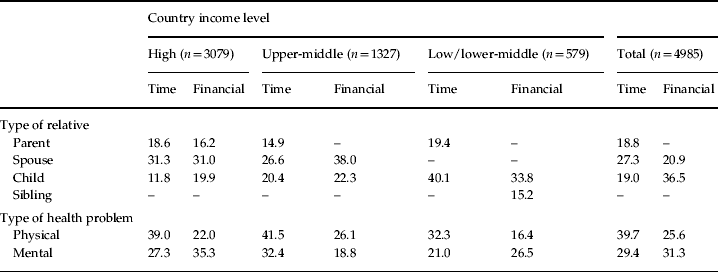
Third, despite between-kinship differences, conditions of parents, spouses, and children all account for meaningful components of burden in all three country income groups. Fourth, the sums of PARP estimates across kinship types are consistently less than 100. This reflects the fact that the effects of compound caregiving are not captured in the condition-specific and kinship-specific PARP estimates. Fifth, while the PARPs for physical conditions are almost always higher than those for mental conditions, with the exception of financial burden in high- and low-/lower-middle-income countries, comparative importance of mental conditions is much higher than expected from relative prevalence (see Table 1) due to generally higher individual-level associations of mental (especially mental retardation and memory problems) conditions than physical conditions with most burden dimensions (see Table 3).
Discussion
The above results are broadly consistent with more focused studies of specific conditions such as dementia (Prince, Reference Prince2004; Torti et al. Reference Torti, Gwyther, Reed, Friedman and Schulman2004; Wimo et al. Reference Wimo, Winblad and Jonsson2007), stroke (Hickenbottom et al. Reference Hickenbottom, Fendrick, Kutcher, Kabeto, Katz and Langa2002) and schizophrenia (Awad & Voruganti, Reference Awad and Voruganti2008) in documenting that many older caregivers experience significant burdens associated with serious family health conditions. Our estimate of 16.6–23.6 mean caregiving hours per week among those with any is broadly consistent with a pooled estimate of 26.8 h per week obtained in a meta-analysis averaging estimates across many smaller studies (Pinquart & Sörensen, Reference Pinquart and Sörensen2003b), but our large-scale representative samples and wide range of conditions allowed us to go beyond this previous type of aggregation by producing true population-level estimates. The magnitude of these estimates is staggering. The 205.8 h/week per 100 people aged 50+ years devoted to family caregiving in high-income countries translates in the USA (with roughly 60 million people aged 50+ years) into approximately 3.2 million full-time-equivalent older adults working as informal family caregivers. The 0.83% average household income among people aged 50+ years in high-income countries devoted to family caregiving translates in the USA alone into US$5.3 billion per year, equivalent to the average annual salaries of over 130 000 US workers. The individual-level financial burdens in low-/lower-income countries are especially striking, with 39.8% of median household income devoted to family caregiving among the 4.6% of respondents with this burden (compared with 14.3–17.7% of household income among the 5.8–6.4% of respondents with this burden in high-/upper-middle-income countries).
Caregivers in the low-/lower-middle-income group are especially burdened. The higher relative burden for children and siblings in low-/lower-middle-income compared with higher-income countries is consistent with previous evidence of greater ‘familism’ in developing countries; i.e. with the fact that the relationships of parents with adult children and of adult siblings with each other are not nearly as attenuated in developing than developed countries (Youn et al. Reference Youn, Knight, Jeong and Benton1999; Torti et al. Reference Torti, Gwyther, Reed, Friedman and Schulman2004; Losada et al. Reference Losada, Robinson Shurgot, Knight, Marquez, Montorio, Izal and Ruiz2006). The much higher magnitude of financial burden in low-/lower-middle-income than richer countries presumably reflects the well-documented fact that government resources and supports for family caregivers are relatively low in these countries (Maulik & Darmstadt, Reference Maulik and Darmstadt2007; Prince et al. Reference Prince, Livingston and Katona2007; Beaglehole et al. Reference Beaglehole, Epping-Jordan, Patel, Chopra, Ebrahim, Kidd and Haines2008), although strong social norms encouraging intra-familial financial support could also play a role (Youn et al. Reference Youn, Knight, Jeong and Benton1999; Izuhara, Reference Izuhara2004; Lin & Yi, Reference Lin and Yi2011). It is important to recall that these cost estimates are lower bounds because they exclude costs associated with self-defined non-serious conditions and with care recipients who are not first-degree relatives. It is more difficult to quantify psychological burdens, but finding as we did that 6.6–10.1% of the population aged 50+ years has meaningful distress and 2.5–7.1% meaningful embarrassment related to serious first-degree family health problems shows clearly that psychological burdens are non-trivial.
Our results on variations in burden are also consistent with most previous studies and meta-analyses in finding higher caregiving burdens for women than men (Bedard et al. Reference Bedard, Pedlar, Martin, Malott and Stones2000; Harwood et al. Reference Harwood, Barker, Ownby, Bravo, Aguero and Duara2000; Yee & Schulz, Reference Yee and Schulz2000; Navaie-Waliser et al. Reference Navaie-Waliser, Spriggs and Feldman2002; Torti et al. Reference Torti, Gwyther, Reed, Friedman and Schulman2004; Pinquart & Sörensen, Reference Pinquart and Sörensen2006). Although our finding that greater burden was associated with health conditions of spouses and children than parents and siblings is also consistent with previous empirical research and large recent meta-analyses (Chumbler et al. Reference Chumbler, Grimm, Cody and Beck2003; Pinquart & Sörensen, Reference Pinquart and Sörensen2011), our lack of data on co-residence prevented any assessment of the extent to which this variation is attributable to differences in residential propinquity (Siegler et al. Reference Siegler, Brummett, Williams, Haney and Dilworth-Anderson2010). Nor did we consider complex kinship profiles (e.g. variation in burden by number of siblings or birth order in caring for elderly parents) or complex caregiving profiles (i.e. caring for multiple relatives with multiple conditions). Our evidence that higher burden is associated more with mental than physical conditions also confirms previous research (Hastrup et al. Reference Hastrup, Van Den Berg and Gyrd-Hansen2011; Pinquart & Sörensen, Reference Pinquart and Sörensen2011), although our exclusive focus on self-defined serious conditions prevented closer study of between-condition differences and almost certainly led to an underestimate of true differences in burden across different types of conditions.
The above results must be interpreted in light of possible sample biases (i.e. that older adults caring for severely ill family might have been less likely than others to participate in the survey, or conversely that we had a ‘healthy caregiver effect’ whereby those who participated were more robust than those who refused), limitations in focus (i.e. exclusion of non-serious conditions and conditions of care recipients who were not first-degree relatives) and measurement (i.e. short checklists rather than more comprehensive and objective assessments of family health conditions, short assessments of caregiver burden, failure to obtain information on the number of each kinship type with health conditions), and the fact that the small sample sizes in individual countries required us to carry out analyses at a high level of geographic aggregation. Due to our broad focus we failed to consider some important variables previously addressed in more focused studies, such as independent observer-based and perceived health effects on the caregivers themselves (Pinquart & Sörensen, Reference Pinquart and Sörensen2003b, Reference Pinquart and Sörensen2007; Vitaliano et al. Reference Vitaliano, Zhang and Scanlan2003; Torti et al. Reference Torti, Gwyther, Reed, Friedman and Schulman2004), caregiver ‘load’ (Gallo et al. Reference Gallo, Jimenez, Shivpuri, Espinosa de los and Mills2011; Opree & Kalmijn, Reference Opree and Kalmijn2012), general quality of life (Ekwall et al. Reference Ekwall, Sivberg and Hallberg2007), and opportunity costs (Carmichael & Charles, Reference Carmichael and Charles2003; Heitmueller & Inglis, Reference Heitmueller and Inglis2007). Also beyond the scope of the present study were possible burden offsets such as pre-morbid relationship, caregiving rewards (e.g. enhanced closeness with care recipients or sense of mattering), coping styles and traits (e.g. resilience, self-efficacy, locus of control), and service availability (Schneider et al. Reference Schneider, Murray, Banerjee and Mann1999; Nomura et al. Reference Nomura, Inoue, Kamimura, Shimodera, Mino, Gregg and Tarrier2005; Ekwall et al. Reference Ekwall, Sivberg and Hallberg2007; Lamura et al. Reference Lamura, Mnich, Nolan, Wojszel, Krevers, Mestheneos and Dohner2008; Poulin et al. Reference Poulin, Brown, Ubel, Smith, Jankovic and Langa2010; Winter et al. Reference Winter, Bouldin and Andresen2010; Lockenhoff et al. Reference Lockenhoff, Duberstein, Friedman and Costa2011; Morse et al. Reference Morse, Shaffer, Williamson, Dooley and Schulz2012). Future epidemiological research would benefit from tandem assessments of caregiver and care recipient health status as well as multi-level studies of the effects of national social policies and cultural norms/expectations on caregiver burdens.
Notwithstanding these limitations and despite some evidence of differential burden by gender, kinship type and condition, the consistency of the basic data patterns reported here is striking in arguing for the existence of substantial caregiver burden comparable with that suggested in cross-national comparisons of smaller, more focused, and less representative samples (Schneider et al. Reference Schneider, Murray, Banerjee and Mann1999; Torti et al. Reference Torti, Gwyther, Reed, Friedman and Schulman2004). This uniformity indicates that important basic aspects of caregiving burden extend across a range of serious mental and physical conditions, health delivery systems and cultures. When seen against the backdrop of global population trends, this consistency adds compelling evidence to concerns that the shrinking and aging family caregiving system is becoming increasingly strained as it responds to rising demand. Policy makers need to recognize the importance of maintaining the well-being and functional capacities of this aging cadre of family caregivers in light of the vital role they play in the worldwide healthcare and human services delivery systems. While formal interventions that help reduce the burden of family caregivers exist, most address narrow needs of condition-specific caregivers in industrialized countries, and few of these have been rigorously evaluated (Sörensen et al. Reference Sörensen, Pinquart and Duberstein2002; Stoltz et al. Reference Stoltz, Uden and Willman2004; Torti et al. Reference Torti, Gwyther, Reed, Friedman and Schulman2004). The data presented here suggest that more broad-based programs are needed not only in industrialized countries but perhaps even more so in developing countries to reduce both the objective and subjective burdens of family caregivers.
Acknowledgements
The WHO WMH Survey Initiative is supported by the National Institute of Mental Health (NIMH; R01 MH070884), the John D. and Catherine T. MacArthur Foundation, the Pfizer Foundation, the US Public Health Service (R13-MH066849, R01-MH069864 and R01 DA016558), the Fogarty International Center (FIRCA R03-TW006481), the Pan American Health Organization (PAHO), Eli Lilly & Co., Ortho-McNeil Pharmaceutical, Inc., GlaxoSmithKline and Bristol-Myers Squibb. We thank the staff of the WMH Data Collection and Data Analysis Coordination Centers for assistance with instrumentation, fieldwork and consultation on data analysis.
Each WMH country obtained funding for its own survey. The São Paulo Megacity Mental Health Survey is supported by the State of São Paulo Research Foundation (FAPESP) Thematic Project Grant 03/00204-3. The Bulgarian Epidemiological Study of common mental disorders (EPIBUL) is supported by the Ministry of Health and the National Center for Public Health Protection. The Shenzhen Mental Health Survey is supported by the Shenzhen Bureau of Health and the Shenzhen Bureau of Science, Technology, and Information. The Colombian National Study of Mental Health (NSMH) is supported by the Ministry of Social Protection. The ESEMeD (European Study of the Epidemiology of Mental Disorders) project is funded by the European Commission (contracts QLG5-1999-01042; SANCO 2004123), the Piedmont Region (Italy), Fondo de Investigación Sanitaria, Instituto de Salud Carlos III, Spain (FIS 00/0028), Ministerio de Ciencia y Tecnología, Spain (SAF 2000-158-CE), Departament de Salut, Generalitat de Catalunya, Spain, Instituto de Salud Carlos III (CIBER CB06/02/0046, RETICS RD06/0011 REM-TAP), and other local agencies and by an unrestricted educational grant from GlaxoSmithKline. The Epidemiological Study on Mental Disorders in India was funded jointly by the Government of India and WHO. Implementation of the Iraq Mental Health Survey (IMHS) and data entry were carried out by the staff of the Iraqi Ministry of Health and Ministry of Planning with direct support from the Iraqi IMHS team with funding from both the Japanese and European Funds through the United Nations Development Group Iraq Trust Fund (UNDG ITF). The Israel National Health Survey is funded by the Ministry of Health with support from the Israel National Institute for Health Policy and Health Services Research and the National Insurance Institute of Israel. The Lebanese National Mental Health Survey (LEBANON) is supported by the Lebanese Ministry of Public Health, the WHO (Lebanon), the National Institute of Health/Fogarty International Center (R03 TW006481-01), anonymous private donations to the Institute for Development, Research, Advocacy and Applied Care (IDRAAC), Lebanon, and unrestricted grants from Astra Zeneca, Eli Lilly, GlaxoSmithKline, Hikma Pharm, Janssen Cilag, MSD, Novartis, Pfizer, Sanofi Aventis and Servier. The Mexican National Comorbidity Survey (MNCS) is supported by The National Institute of Psychiatry Ramon de la Fuente (INPRFMDIES 4280) and by the National Council on Science and Technology (CONACyT-G30544-H), with supplemental support from the PAHO. The Nigerian Survey of Mental Health and Wellbeing (NSMHW) is supported by the WHO (Geneva), the WHO (Nigeria) and the Federal Ministry of Health, Abuja, Nigeria. The Northern Ireland Study of Mental Health was funded by the Health & Social Care Research & Development Division of the Public Health Agency. The Portuguese Mental Health Study was carried out by the Department of Mental Health, Faculty of Medical Sciences, NOVA University of Lisbon, with collaboration of the Portuguese Catholic University, and was funded by the Champalimaud Foundation, Gulbenkian Foundation, Foundation for Science and Technology (FCT) and the Ministry of Health. The Romania WMH study projects ‘Policies in Mental Health Area’ and ‘National Study regarding Mental Health and Services Use’ were carried out by the National School of Public Health & Health Services Management (former National Institute for Research & Development in Health, present National School of Public Health Management & Professional Development, Bucharest), with technical support of Metro Media Transilvania, the National Institute of Statistics – National Centre for Training in Statistics, SC Cheyenne Services SRL, Statistics Netherlands and were funded by the Ministry of Public Health (former Ministry of Health) with supplemental support of Eli Lilly Romania SRL. The US National Comorbidity Survey Replication (NCS-R) is supported by the NIMH (U01-MH60220) with supplemental support from the National Institute of Drug Abuse (NIDA), the Substance Abuse and Mental Health Services Administration (SAMHSA), the Robert Wood Johnson Foundation (RWJF; grant 044708) and the John W. Alden Trust. A complete list of all within-country and cross-national WMH publications can be found at http://www.hcp.med.harvard.edu/wmh/
The views and opinions expressed in this report are those of the authors and should not be construed to represent the views or policies of any of the sponsoring organizations, agencies, the WHO, or the US Government. A complete list of NCS publications and the full text of all NCS-R instruments can be found at http://www.hcp.med.harvard.edu/ncs. Send correspondence to: ncs@hcp.med.harvard.edu
Declaration of Interest
J.M.H. has been a consultant for AstraZeneca, Eli Lilly & Co. and Lunbeck. J.-P.L. has given lectures for Servier, Pfizer-Wyeth, Sanofi Aventis and Pierre Fabre. R.C.K. has been a consultant for GlaxoSmithKline Inc., Kaiser Permanente, Pfizer Inc., Sanofi-Aventis, Shire Pharmaceuticals and Wyeth-Ayerst; has served on advisory boards for Eli Lilly & Co. and Wyeth-Ayerst; and has had research support for his epidemiological studies from Bristol-Myers Squibb, Eli Lilly & Co., GlaxoSmithKline, Johnson & Johnson Pharmaceuticals, Ortho-McNeil Pharmaceuticals Inc., Pfizer Inc. and Sanofi-Aventis.