Nosocomial respiratory virus infections (NRVIs) are a relatively common hospital-associated condition.Reference Quach, Shah and Rubin 1 In a point-prevalence survey of pediatric units, NRVIs represented 10% of healthcare-associated infections.Reference Rutledge-Taylor, Matlow and Gravel 2 Such infections can be associated with substantial morbidity and some mortality.Reference Lo, Lee, Gunawardane, Burchett, Lachenauer and Lehmann 3 , Reference Zinna, Lakshmanan and Tan 4 Inpatients with viral respiratory infections serve as a reservoir for infection of healthcare personnel and other inpatients.Reference Hall, Douglas, Geiman and Messner 5 , Reference Goldmann 6 Hospital personnel and patient visitors may transmit infection to inpatients when they have acute infections and when asymptomatic via indirect contact transmission.Reference Goldmann 6 The Centers for Disease Control and Prevention Healthcare Infection Control Practices Advisory Committee (HICPAC) guidelines recommend standard precautions plus special isolation precautions for patients with respiratory infections that vary by individual respiratory viral pathogen or by clinical syndrome based upon the predominant routes of transmission.Reference Siegel, Rhinehart, Jackson and Chiarello 7 These precautions include droplet and/or contact transmission precautions, depending upon the virus or syndrome, with airborne precautions reserved for special pathogens such as Middle East respiratory syndrome due to coronavirus. The purpose of this study was to determine whether the use of enhanced isolation precautions is associated with a reduction in the rate of NRVIs caused by selected respiratory viruses.
METHODS
The study design was quasi-experimental, with the rate of NRVI as the primary dependent variable and the rate of nosocomial Clostridium difficile infection as a nonequivalent dependent variable comparator. The study was conducted at the Steven and Alexandra Cohen Children’s Medical Center of New York, a 171-bed tertiary-care teaching pediatric hospital with a hematology-oncology unit, a stem-cell transplant unit, a pediatric intensive care unit, and a level-4 neonatal intensive care unit. Both NVRI and hospital-acquired C. difficile detection were detected by laboratory detection-based active surveillance. The viruses surveyed were human metapneumovirus, influenza A and B viruses, parainfluenza viruses types 1, 2, 3, and 4, respiratory syncytial virus (RSV), and rhinovirus/enterovirus (R/E, the assay did not distinguish between rhinoviruses and enteroviruses). Adenovirus was also surveyed but was not included because the special isolation precautions (ie, contact and droplet) did not change during the 4-year study period. A respiratory viral infection was defined as nosocomial if it met the all 3 of the following criteria: (1) the patient had a positive test for a respiratory virus by nucleic acid amplification (or enzyme immunoassay for RSV, in use only during year 1); (2) the patient had a new onset of one or more respiratory tract symptoms and/or a new onset of fever; (3) a minimum time from hospital admission to onset of symptoms/fever had elapsed that varied with the viral pathogen as follows: influenza, 2 days; parainfluenza viruses, RSV, and R/E, 3 days; or human metapneumovirus, 4 days.Reference Quach, Shah and Rubin 1 For patients with a positive test and only new-onset fever, no alternative diagnosis was found as a cause for fever. Nosocomial C. difficle infection was monitored as “Clostridium difficile LabID events” using the Centers for Disease Control (CDC) and Prevention National Healthcare Safety Network (NHSN) definitions. 8
Prospective surveillance was conducted over 2 sequential 2-year periods: (1) pre-enhanced special isolation precautions (years 1 and 2) from July 2012 through June 2014 and (2) enhanced special isolation precautions (years 3 and 4) from July 2014 through June 2016, except for influenza virus infections for which the pre-enhanced special isolation precaution period was years 1–3 and the enhanced special isolation precautions period was year 4. A study year was defined as a 12-month period from July through June to include an entire winter virus season within each study year and to minimize the contribution of year-to-year variation in the timing or peak of infection with a particular virus infection. During the entire study period, inpatients from whom a specimen for viral detection was submitted were placed on both contact and droplet precautions while the viral testing results were pending. During years 1 and 2, special precautions were as follows: contact precautions (human metapneumovirus, parainfluenza viruses, RSV, and R/E from November through March); standard precautions (R/E from April through October); and droplet precautions (influenza). During year 3, contact and droplet precautions were used for all virus categories other than influenza; droplet precautions remained in place for influenza. During year 4, contact and droplet precautions were used for all virus categories. Isolation precautions were maintained until resolution of symptoms except for immunocompromised patients (primarily oncology patients) for whom precautions were maintained for 7 days after the resolution of symptoms.
During both 2-year periods, hand hygiene audits of healthcare personnel entering and exiting each patient room were performed and tabulated on a monthly basis in all hospital units. The employee health policy for employees with influenza and influenza-like illness did not change during the period of the study. Employees were to stay out of work until they were feeling well and were without fever for 24 hours without antipyretics.
Laboratory Methods
Nasopharyngeal swabs were tested using nucleic acid amplification for multiple respiratory viruses using commercial multiplex nucleic acid amplification tests. The xTAG Respiratory Viral Panel (Luminex, Luminex Molecular Diagnostics, Toronto, Canada) was used from July 2012 through March 2014, and Filmarray (Idaho Technologies, Salt Lake City, UT) was used from April 2014 through June 2016. No significant differences were found when comparing the sensitivities of these assays used to examine clinical specimens of the viruses under study (ie, the xTAG Respiratory Viral Panel IVD package insert [MLD-019-KPI-001 Rev P] versus the October 2016 Filmarray Respiratory Panel Instruction Booklet). Stool specimens were tested for C. difficile using a nucleic amplification assay for the toxin B gene using the Xpert C. difficile toxin B gene (tcdB) polymerase chain reaction (PCR) assay (Cepheid, Sunnyvale, CA).
Statistical Methods
Comparisons of nosocomial infection rates were made using the incidence density ratio method.Reference Kleinbaum, Kupper and Morgenstern 9 With this method, the null hypothesis is that the proportion of nosocomial infections will be proportional to the number of inpatient days at risk for each period. Comparisons of compliance rates for hand hygiene were made using the χ2 test. Although it is possible that staff members are represented multiple times in this analysis, the data did not identify who was observed. Therefore, due to the nature of the data available, each observation of hand hygiene was treated as an independent event.
RESULTS
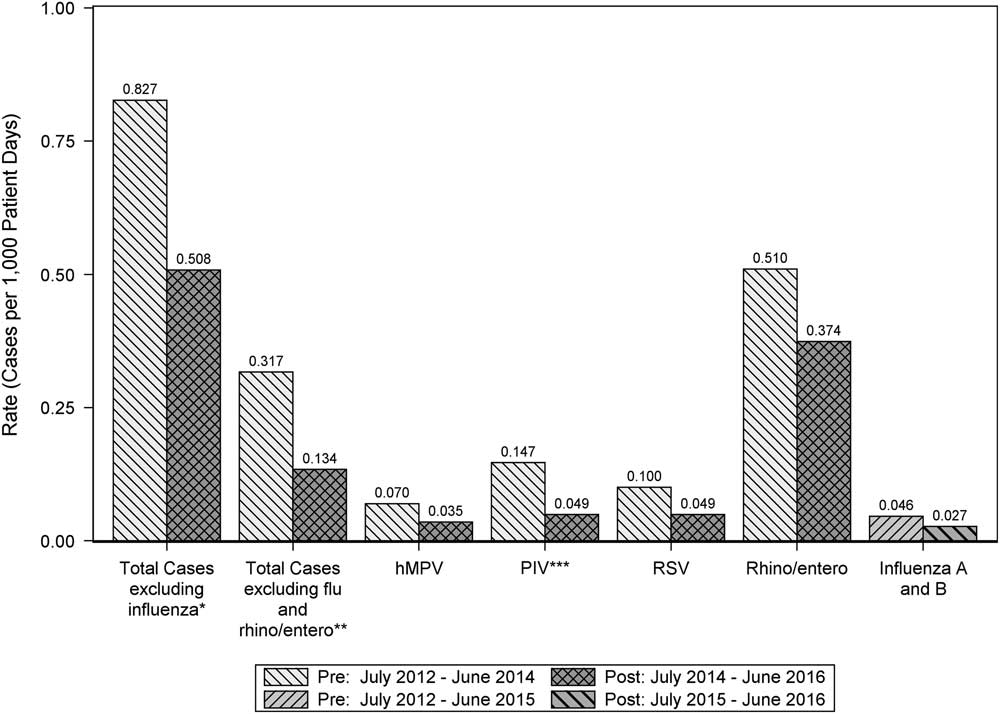
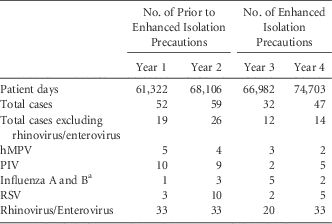
During the period of enhanced isolation precautions, the number of NRVIs decreased while the number of patient days increased (Table 1). The rate of NRVIs caused by human metapneumovirus, parainfluenza virus, RSV, or R/E decreased from 0.827 per 1,000 hospital days prior to the precautions to 0.508 per 1,000 hospital days, a decrease of 39% (P<.0013) (Figure 1). Among the viruses surveyed, the rate was highest for R/E and second highest for parainfluenza viruses. For rhinovirus, nucleic acid amplification tests may remain positive for an extended time period after infection and are commonly positive in asymptomatic children;Reference Self, Williams and Zhu 10 – Reference van den Bergh, Biesbroek and Rossen 12 observations that raise the possibility that the specificity of a positive test result for nosocomial R/E may be low. Therefore, overall rates were reanalyzed after excluding R/E infections. These rates were 0.317 per 1,000 hospital days prior to and 0.134 per 1,000 hospital days during enhanced precautions, a 58% lower rate during the enhanced precautions period (P<.0014) (Figure 1). For individual viruses, a significant reduction in rate was observed during the enhanced precautions for parainfluenza virus infections (67% reduction) (Figure 1). For human metapneumovirus, influenza, RSV, and R/E, reductions in rate of 50%, 41%, 51%, and 52%, respectively, were noted during the period of enhanced precautions; however, these differences were not statistically significant.
Comparison of rates of nosocomial respiratory virus infection during periods prior to enhanced precautions (“Pre”) and during enhanced precautions (“Post”). Rates are indicated above each column. For influenza, the period prior to enhanced isolation precautions is years 1–3 and the period of enhanced precautions (contact and droplet) is year 4 only. Flu, influenza; hMPV, human metapneumovirus; PIV, parainfluenza virus; RSV, respiratory syncytial virus; rhino/entero, rhinovirus/enterovirus. Asterisks indicate significant differences with *, P<.0013; **, P<.0014; ***, P<.0097.

Nosocomial Respiratory Virus Infection Cases and Rate by Virus and Year
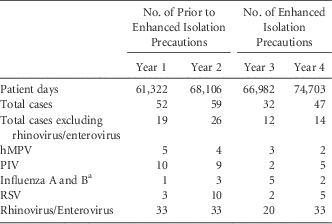
NOTE. hMPV, human metapneumovirus; PIV, parainfluenza virus; RSV, respiratory syncytial virus.
a For influenza, the period prior to enhanced isolation precautions is years 1–3 and the period of enhanced precautions (contact and droplet) period is year 4 only.
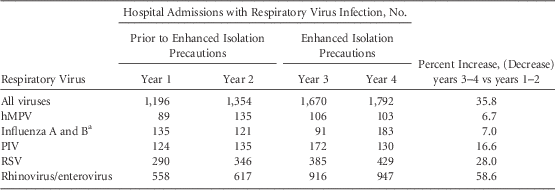
Several potentially confounding factors were examined, specifically the volume of respiratory virus-infected inpatients, the respiratory virus testing frequency, changes in the proportion of single-bed rooms, the visitation policy for young children, and Enterovirus D68-related hospitalizations. If the volume of respiratory virus-infected patients admitted to hospital had been lower during the enhanced isolation precautions period, there could have been a lower exposure to respiratory viruses, which might in part explain the lower nosocomial infection rate. However, the volume of patients admitted to hospital with viral respiratory infections was 35.8% higher during the 2-year period of enhanced precautions than during the earlier period (Table 2). This finding indicates that there was a higher potential exposure of inpatients to patients with respiratory viruses during the enhanced precautions period but that the rate of nosocomial infection was reduced. The number of respiratory virus tests performed increased 15% and 26% during May and June (months for which comparative data were available) of years 3 and 4 compared to year 2, respectively. The percentage of single-bed rooms increased from 22% toward the end of year 1 to 39% during years 2–4, with the opening of a new pavilion containing medical-surgical and pediatric intensive care unit beds with all single-bed rooms. Also, a severe restriction on visitation by young children was in place November through March in years 2–4, but not during year 1. However, comparing year 2 to year 1, periods with an identical isolation precaution practice but with a higher proportion of single-bed rooms and a more stringent young child visitation policy in place during year 2, there were no significant differences in rates of overall (P<.9106), overall excluding R/E (P<.4884), or individual nosocomial respiratory virus pathogens. During September and October 2014 (study year 3), our center experienced a surge in hospitalizations of children with acute respiratory symptoms, presumably due to Enterovirus D68 infection, but the number or rate of nosocomial R/E infections was not higher during this period than during the same months in either year 2 or 4, making it unlikely that this pathogen increased the rate of nosocomial R/E infection.
Burden of Hospitalizations with Respiratory Viral Infection (Number of Cases per year) by Virus and Year
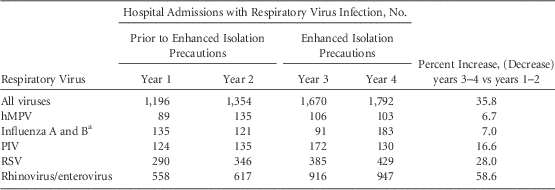
NOTE. hMPV, human metapneumovirus; PIV, parainfluenza virus; RSV, respiratory syncytial virus.
a For influenza, the period prior to enhanced isolation precautions was years 1–3 and the period of enhanced precautions (contact and droplet) was year 4 only.
We examined the rate of nosocomial C. difficile infection as a nonequivalent dependent variable. The rates of nosocomial C. difficile infection during the initial 2-year period was 0.605 per 1,000 hospital days compared to a rate of 0.550 per 1,000 hospital days during the period of enhanced isolation precautions, a reduction of 9.1%, which was not statistically significant (P<.6652).
The hand hygiene audits showed similar rates of adherence, with mean monthly adherence at 96.3% of 4,863 observations and 96.4% of 6,224 observations during the pre-enhanced and enhanced isolation precautions 2-year periods, respectively; these differences were not statically significant (P<.7319). Compliance with influenza vaccination among staff was 84% during study year 1 and 95% during each of study years 2, 3, and 4.
DISCUSSION
The sources of respiratory viruses transmitted to inpatients resulting in nosocomial infection may include other inpatients with respiratory viral infection, healthcare personnel with respiratory infection, uninfected healthcare personnel who transmit virus by indirect contact transmission following contact with infected inpatients or their environment, and patient visitors. The relative contribution of each of these sources has not been elucidated. The results of this study, in which an intervention initiated to decrease transmission emanating from infected inpatients was associated with a reduction in nosocomial infection, supports an important impact of infected inpatients, either directly or indirectly, on the occurrence of nosocomial NRVI.
The virus-specific special isolation precautions used during the pre-enhanced precaution years were largely CDC-recommended precautions.Reference Siegel, Rhinehart, Jackson and Chiarello 7 , 13 However, the recommended special precautions (eg, droplet precautions for influenza-positive patients and contact precautions for RSV-positive patients) are based on the predominant mode of transmission. Respiratory viruses are unlikely to be transmitted exclusively by droplet or by contact.Reference Goldmann 6 For example, experimental studies of humans support transmission of rhinovirus by droplet or by contact.Reference Couch, Cate, Douglas, Gerone and Knight 14 – Reference Gwaltney, Moskalski and Hendley 16 Direct or indirect contact is the predominant means of transmitting RSV, but transmission can occur by droplet,Reference Siegel, Rhinehart, Jackson and Chiarello 7 , Reference Hall 17 and use of masks and goggles has been associated with a lower rate of RSV infection of hospital personnel.Reference Agah, Cherry, Garakian and Chapin 18 Therefore, it is biologically plausible that the addition of droplet precautions to contact precautions and the addition of contact precautions to droplet precautions could result in a reduction in the nosocomial respiratory virus infection rate.
The modest reduction in the rate of nosocomial R/E infections during the period of enhanced precautions was not statistically significant, suggesting a limited effect of the intervention. However, R/E RNA is commonly detected in swabs from asymptomatic children.Reference Self, Williams and Zhu 10 – Reference van den Bergh, Biesbroek and Rossen 12 Therefore, our data are likely to include patients with asymptomatic shedding of R/E or R/E RNA prior to onset of respiratory symptoms or fever. The inclusion of such patients in both groups could mask the positive effect of enhanced isolation precautions.
The rate of nosocomial C. difficile detection would not be expected to be lowered by enhanced isolation precautions for relatively small proportion of inpatients with a respiratory viral infection. Therefore, the absence of a significant reduction in the C. difficile rate supports the hypothesis that the reduction in NRVI during the same period was due to the intervention.
This study has several limitations in addition to the potential confounding factors discussed above. The timing and severity of seasonal epidemics of infection by viruses such as RSV and influenza may vary annually and could contribute to variation in rates of nosocomial viral infection observed between groups. This aspect should have been mitigated by our definition of a study year as a 12-month period from July through June. In addition, there is no standard definition of nosocomial viral respiratory infection, including no consensus of the time interval between hospital admission and onset of new symptoms for the infection to be considered nosocomial.Reference Quach, Shah and Rubin 1 The intervals used in this study and in our NRVI surveillance were consistent during the study period and were chosen to maximize sensitivity while maintaining reasonable specificity. Therefore, it is possible that the rate of NRVI was overestimated. Finally, this was a single-institution study, and it is possible that factors discussed or unrecognized factors contributed to the reduction in nosocomial respiratory virus infections. This study provides sufficient plausibility of a positive effect of enhanced isolation precautions in prevention of NRVIs to warrant a multicenter study of this intervention.
ACKNOWLEDGMENTS
Financial support: No financial support was provided relevant to this article.
Potential conflicts of interest: All authors report no conflicts of interest relevant to this article.