INTRODUCTION
In 2006, immigration policy once again rose to the top of the national agenda. The mainstream print media presented this issue to the U.S. public in terms of images that constitute sociopolitical understanding. With the tools of critical discourse analysis and cognitive metaphor theory, weFootnote 1 compare two substantial samples of this discourse stream. We sampled mainstream national newspaper reports in May 2006, at the height of national attention on the Great May Day marches across the country. We compare this spring 2006 sample to a sample of mainstream national newspapers taken in October 2006, the month the president signed the 2006 Secure Fence Act into law. We do not focus on the political deliberations that led to the passage of the 2006 Secure Fence Act. Rather, we conduct a critical discourse content analysis of constitutive metaphors, focusing on how the print media represented the immigration issue with metaphoric imagery. Since we also concur with cognitive science theorizing on the constitutive role of metaphor, we scrutinize the metaphors for immigrants that the print media are promulgating in order to evaluate how this discourse stream represented the national immigration policy debate in 2006. To preview our results, previous research indicated for the past century that mass media constitutive metaphors for immigration had been limited to dehumanizing metaphors. The mass media imagery in May 2006 changed in important ways. The print media presented alternative images about immigrants, both human and non-human, at levels nearing parity. However, we found mass media representations of the immigration issue in October 2006 less balanced than six months earlier, indicating a less than ideal setting for future public discussion of this political issue.
CONCEPTUAL FRAMEWORK AND RESEARCH OBJECTIVES
Social Theory
In this article, we empirically explore the effectiveness in the United States of what Jürgen Habermas (Reference Habermas1989) has called the bourgeois public sphere. This is his term for the aspects of modern society which Nancy Fraser describes as “a theatre in modern societies in which political participation is enacted through the medium of talk … an institutionalized arena of discursive interaction” (Fraser Reference Fraser1990, p. 57). The two main sources of national talk about any issue are the State-sponsored discourse and the corporate-sponsored mass media discourse. Although Fraser believes that only the State produces a “strong” public discourse, since it has unsurpassed power to mold public opinion and policy (Fraser Reference Fraser1990, p. 75), the mass media arguably have preeminent power to mold opinion, hence it can influence policy (McChesney Reference McChesney2004).
In a democracy, corporate-sponsored sources of information should always be subject to critical scrutiny. Moreover, with the diminution of major news sources, U.S. citizens of the twenty-first century should be particularly worried. Habermas expressed concern that mass news cannot be considered truly independent, since the news is ultimately the product of market-driven corporations. Moreover, the concentration of U.S. mass media corporations makes them an oligopoly (McChesney Reference McChesney2000, p. 16). With this in mind, we began our study by carefully gathering large samples of this mainstream discourse on a single political issue. To analyze the pertinent elements of mass print-media discourse, we turn now to a description of cognitive metaphor theory and critical discourse analysis.
Cognitive Metaphor Theory and Critical Discourse Analysis
Language is a powerful tool because it provides images that determine how we understand reality. The intellectual origin of the linguistic turn of social theory can be traced back to German thinkers Wilhem von Humboldt and Gottlob Frege. Frege (Reference Frege, Geach and Black1892 [1980]) solved a classic dilemma of logic: the evening star and the morning star cannot be logically identical but are indeed identical. His solution, that two senses (intention and extension) refer to a single entity, the planet Venus, provoked thinking that gives precedence to the concept over the object. Christina Lafont paraphrases Frege's insight as follows: “Linguistic expressions are held to determine, if not what there is, at least what there can be for a linguistic community—or what such a community can say (i.e., believe) that there is. In this sense, the key function of language is held to lie in its world-disclosing capacity” (Lafont Reference Lafont1999, p. xii, emphasis in the original). This line of thinking has led, among other research avenues, to George Lakoff's cognitive linguistic modeling. He and his collaborators theorize that metaphor, above other structures of language, establishes the basis of people's everyday comprehension of life. Metaphors provide a framework that people use to make sense of behavior, relations, objects, and people, even to the point that people forget that the semantic associations they created with metaphors are not natural, but merely conventional correspondences between one semantic domain and another (Lakoff Reference Lakoff1987). Following this framework, through an empirical analysis of the conceptual metaphors found in the mainstream print-media discourse stream, we will examine the metaphors that everyday Americans used in 2006 to make sense of immigrants and immigration policy.
The theorizing of cognitive linguists demonstrates striking similarities to the social theorizing of Michel Foucault, who argued that discursive practice reveals the (oppressive) social relations that are constituted in everyday social interaction (Foucault Reference Foucault and Gordon1980, pp. 92–108). Foucault's macrolevel theories correspond neatly with Lakoff's microlevel theorizing about metaphor: both produce constitutive narratives that construct social structure. These narratives (“discourses” within Foucault's formulation) are types of social practices within social orders commonly expressed by individuals. The enactment of discursive practices then reaffirms ideological practices. Subject positions defined by these discursive practices confine both oppressor and oppressed people's lives in terms of knowledge and beliefs, social relationships, and social identity. By subject positions, Foucault refers to the legitimated roles that society allots to individuals and which provide identity and standing (Foucault Reference Foucault and Gordon1980, p. 97). To use Lakoff's term, these discourse practices embody naturalized ideological assumptions. Lakoff holds that metaphoric thinking is a fundamental human cognitive process. As people live their lives, they enact the discourse practices associated with their subject positions. By enacting the discourse practices, individuals tend to accept the ideology of the standing social order, namely, the institutional practices that sustain and legitimize repressive power relations. When people go about their daily tasks and obligations, they take for granted a good deal about the sources of oppression. For both Lakoff and Foucault, ideology constitutes the articulated social relations that people generally do not discern because they have come to seem normal and natural.Footnote 2 In this article, we study the material content of discourse, cataloguing the actual texts and words in speech that pass “back and forth between participants in dialogues and conversation, giving communicative cohesion, and providing a means for both consensus and conflict” (Chilton Reference Chilton1996, pp. 37–38). Our job involves gathering and analyzing this material content of mainstream print-media discourse, the primary evidence upon which our analyses are based.
On the basis of two large text samples drawn from the mainstream mass print-media discourse of the U.S. public sphere, we are in a position to characterize how the U.S. public viewed immigration policy in 2006, describing the patterning of conceptual metaphors about immigration policy. Using robust empirical methods that are buttressed by formal cognitive theory, we offer material-centered discourse analysis to textually substantiate Foucault's discursive formations. These moves are in keeping with the linguistic turn in the social sciences.
Following these assumptions, we maintain a strong form of the thesis that language use constitutes ideology. We employ Lakoff's “Embodied Realism” epistemology, which declares that human knowledge is constituted in terms of metaphor and a few other tropes (Lakoff Reference Lakoff and Ortony1993; Lakoff and Johnson, Reference Lakoff and Johnson1999). We base our claims on the naturally occurring public discourse, rather than intuition. We endeavor to link the explanatory power about metaphors provided by cognitive linguistics to an empirical study of the metaphors promulgated in the U.S. public sphere in 2006. Consumers of these discourses, so the theory goes, tend to accept their use as legitimated “common sense” public discourse. Our objective is to open a window onto the U.S. public's worldview, namely, its hegemonic principles as expressed in the public sphere via mainstream print media.
Methods
Because the principal author is a Chicano social scientist, the findings of his team's research on politicized topics are likely to be read with more than average professional skepticism. More generally, the method we use, critical discourse analysis, is expressly designed to be both a scientific and a normative enterprise (Van Dijk Reference Van Dijk1993, p. 253). Indeed, it is appropriate to acknowledge that all analyses of political issues are normative (Himmelfarb Reference Himmelfarb1996). Consequently, when investigating politicized topics, we must proactively address the two judicious doubts that skeptics will have about our research. First, the skeptic may dismiss analyses that appear to have a selectional bias, since doubts arise if it seems that the investigators have “cherry picked” data, choosing only material that supports their own political stance. Second, the skeptic may reject any analysis that seems to interpret the data with a bias.
In this study, we prevented selectional bias by means of a series of steps. Having established that the mass media news discourse representations of immigrants would be the target of investigation, we decided to use newspaper texts as our source. We selected the commercially produced electronic database LexisNexis because it independently indexes its archived newspaper articles. We wanted to gather print-media news articles from across the country for two time periods, May and October of 2006. To do this, we designed the two searches using the Boolean search engine provided by LexisNexis, having made prior decisions on both the range of dates and the streams of public discourse on which to draw. Using a Boolean formula that included our previously determined time frames and print sources, with one keystroke we electronically downloaded a complete set of independently indexed newspaper articles for May 2006, and another for October 2006. Because we did not create the original article index, and because every news article in each sample was analyzed, the data sets were not “cherry picked.”
To preclude biased interpretation, no single individual read or analyzed major portions of the news texts. Instead, we followed a research protocol such that two distinct groups of readers would read and interpret the data (Santa Ana Reference Santa Ana2002). The principal author trained UCLA undergraduate students (his coauthors) in the basics of critical discourse analysis and metaphor theory using articles from the sports and business sections of newspapers, so as to avoid inadvertently shaping their judgments regarding the metaphors that appeared in the pertinent news articles for this study.
To assess the May 2006 mass media discourse, Bodossian and De Necochea (our May team) obtained fifty articles using the “General News” and “Major Papers” categories of the guided news search of LexisNexis, which catalogues over forty “major newspapers.” The search terms were undocumented plus the root words immigra- and illegal-. We chose May 2, 2006, the day after the Great May Day marches, for our LexisNexis search. The initial output was 184 newspaper articles, from which the 50 most relevant articles were selected by ordering them using the LexisNexis automated relevance-sorting algorithm. Bodossian and De Necochea found 1136 metaphors in these articles, of which 969 specifically pertained to immigrants or immigration.
In a similar fashion, Bailey and Treviño (our October team) obtained fifty newspaper articles to assess the October 2006 mass media discourse with the LexisNexis guided news search tools. To ensure comparable data, Bailey and Treviño used search parameters that patterned closely with those used to obtain the May 2006 data. The search output limit restricted them to one week, October 23–29, 2006, centering on October 26, when President Bush signed the Secure Fence Act. The 489 newspaper article output was again sorted using the LexisNexis relevance algorithm to select the fifty most relevant articles for their October 2006 print-media discourse sample. Bailey and Treviño found a total 1098 metaphors, of which 903 specifically pertained to immigrants or immigration.
Each reader was trained to identify conceptual metaphors—the object of this investigation—and to code the source and target domains of each instance of a metaphor, i.e., a conceptual mapping from a semantic source domain to a different semantic target domain (Lakoff and Johnson, Reference Lakoff and Johnson1980). Once the readers became proficient at these tasks, two individuals were assigned to the May data and two others to the October data. The two individuals on each team read overlapping subsets of the news article sample. In this way, different individuals independently read and coded the same article. No one established a priori the terms used for coding metaphor sources and targets. Instead, each reader independently coded the metaphors that appeared in a newspaper article, determining his or her own labels for the source semantic domain and target semantic domain of each metaphor. Once the readers had completed an initial reading of their respective subset of articles, the members of each team convened to compare their interpretations. The principal author instructed the team members to try to reach a consensus for each particular instance of a metaphor. If they could reach a consensus, the term was added to the metaphor database. If not, then it was eliminated from further consideration. Finally, the teams switched data and sought further consensus. The May team reviewed the October team's interpretations, and the October team reviewed the May team's interpretations, with the goal of obtaining a high level of intersubjective reliability of interpretation.
Public-discourse metaphors tend to be either occasional or productive. Occasional metaphors are semantically unrelated to other metaphors, appear in only one or two linguistic expressions, and carry little constitutive weight. Productive metaphors, on the other hand, are not limited to a finite set of linguistic phrases, but instead occur in a multitude of forms. When used to depict crucial political concepts, productive metaphors are linked to other semantically related concepts in well-rehearsed narratives that recite commonplace aspects of our world. Through conventionality and repetition, these tropes constitute a legitimated political stance, in this case, regarding U.S. immigration policy. In the final step of the method, the principal author took the lead to focus each team's attention on the highly productive metaphors located in the data. We now present a chronology of public-sphere discourse on immigration policy from 1970 to 2006.
REPRESENTATIONS OF IMMIGRANTS IN 1994
American attitudes toward immigrants across history have reflected an ambivalence toward newcomers. In spite of its overwhelmingly immigrant origins, the United States has been two-faced toward immigrants. As long as residents sense that they stand to benefit from the work of immigrants, and especially when the economic cycle demands growth, Americans and U.S. commerce smile at immigrants and publicize the “American Dream” to everyone willing to work hard for little gain. The Dream is an advertisement known across the world: Come here willing to mortgage your life energies, and, in exchange, you will earn a better life for your children. However, when the economic cycle wanes, then Americans reveal their other side, declaiming immigrants as a menacing army, a devastating plague, or as creatures less than human, who deserve no better treatment than dogs or vermin (O'Brien Reference O'Brien2003).
Conventionalized Nonhuman Language
The empirical baseline of this article is the last period of anti-immigrant opprobrium, at the end of the Cold War, in 1989, when the longest economic expansion period of California's military-based economy came to a close. Over 830,000 defense jobs were lost by 1993, with its ripple effect felt throughout the economy. California had not suffered such a recession with governmental budget shortfalls since the Great Depression. Governor Pete Wilson blamed immigrants, not the fall of the Berlin Wall, endorsing an infamous anti-immigrant referendum, Proposition 187, which California voters overwhelmingly enacted, in spite of common knowledge that its provisions were unconstitutional and the courts would overrule it. Santa Ana (Reference Santa Ana2002) conducted a critical discourse analysis employing cognitive metaphor theory on Los Angeles Times articles published between June 1992 and December 1994 in order to sample the mass media discourse about immigrants during the campaigns for and against the referendum.
The predominant conceptual metaphor of the 1990s was immigrants as animals,Footnote 3 which in the sample of 107 newspaper articles studied was expressed in eighty-seven instances, for example, that immigrants were animals who could be attacked and hunted:
Beaten-down agents, given only enough resources to catch a third of their quarry, sense the objective in this campaign is something less than total victory.
—Los Angeles Times (King Reference King1992)Beyond a store runs the I-5 [freeway], where the agents now must quit the chase.
—Los Angeles Times (King Reference King1992)Among other portrayals, immigrants were animals to be eaten:
The truth is, employers hungering for really cheap labor hunt out the foreign workers.
—Los Angeles Times (Bernstein Reference Bernstein1992)Although the key public discourse image of the Los Angeles Times was found to be immigrants as animals, this was not the yellow journalism of earlier periods, but rather involved subtle references diffused through newspaper article metaphors. Cognitive science findings indicate that this language (especially conventionalized conceptual metaphor) encodes social values and constructs social relations. The immigrant as animal metaphor, combined with the concept of citizen, is the ontological kernel or unit of social meaning that establishes this hierarchy of living things: Citizens are humans, while immigrants are animals.
This implied argument is, of course, fallacious. (The name of the logical fallacy is Illicit Major Premise.) Social semantics are not logical, but the ontology falsely implies that citizens are human, and, since immigrants are not citizens, they are not human. This argument and metaphor evoke a narrative that reflects a polarized social order which subordinates immigrants to citizens as it diminishes their humanity. Human beings are arguably vested with natural rights by birth. However, it is a commonplace to presume that animals (including immigrants, in this ontology) simply are not equal to humans, and “by nature” do not have such entitlements. The immigrant as animal metaphor is also racist, as is the associated narrative articulated in the U.S. public sphere of the 1990s. Margaret Wetherell and Jonathan Potter defined racist discourse as one which “establishes, sustains and reinforces oppressive power relations, … categorizes, allocates and discriminates between certain groups, … justifies, sustains and legitimates those practices which maintain the power and dominance” (Wetherell and Potter, Reference Wetherell and Potter1992, p. 70).
In the 1990s, depictions of immigrants were not limited solely to animals, but as soldiers or invaders of the land, as weeds that infest the land, as burdens on society, and as diseases infecting the body politic. Indeed, all predominant and secondary metaphors of 1990 mass media language disparaged immigrants.
Another striking finding in the 1990 data was that the opponents and proponents of Proposition 187 used the same metaphors to articulate clashing beliefs. The people who believed that immigration threatened American sovereignty, and their opponents who believed that immigrants should not be blamed for economic downturns, employed exactly the same types of metaphors for immigrants and immigration, despite the fact that their political positions were diametrically opposed. While they did not utter the same words, the two groups employed similar metaphors to articulate divergent views, with the result that in California's public sphere of the 1990s, only one view about immigrants was articulated, with no alternative set of metaphors. All parties used the immigrant as animal, as weed, as soldier, as burden, and as disease metaphors. At best, spokespeople opposed to Proposition 187 repeated these metaphors in order to reject the claims of their conservative opponents. But the advocates for immigrant rights did not sustain an alternative set of images, as evidenced in the Los Angeles Times. One might suppose that the Times knowingly sustained anti-immigrant language. However, in fact, the Times consistently rejected Proposition 187 in its editorials, and sought to inform the electorate with balanced news reports. Still, even the Times did not offer its readership a coherent alternative constellation of metaphors to contest the conservative, hegemonic worldview. Consequently, political progressives appeared to give their assent to the conservative worldview—in terms of conceptual metaphors—which put them at a decided disadvantage in the political debate, and provided the electorate with no option but to vote for what appeared to be the more coherent, anti-immigrant worldview. The electorate came to view immigrants in a bad light, and voted accordingly: there was no real debate at the level of images.
REPRESENTATIONS, 2004–2006
Inauspicious Start of Compassionate Language
At the start of 2004, President Bush announced an immigration reform initiative in which he used astonishingly compassionate language when he spoke about immigrants. In his twenty-minute speech introducing the initiative, Bush called immigrants, “Americans by choice,” who are members of families of “talent, character, and patriotism,” and who hold values such as “faith in God, love of family, hard work, and self reliance.” He further described the United States as a “welcoming society … by tradition and conviction,” which is a “stronger and better nation because of the hard work and the faith and entrepreneurial spirit of immigrants” (Bush Reference Bush2004). In this way, the president inadvertently set off a powder keg of public expression of apprehension about the nation's 12 million unauthorized immigrants. Immigration policy once again became a topic of the national public sphere, as it had been in the mid-1990s. Members of his own political party ridiculed Bush for stating a truism: “Immigrants are hard-working, decent human beings” (Bush Reference Bush2004). On January 7, 2004, he proposed immigration policy reform to change the status quo. His initiative never became a congressional bill; it may have only been an attempt to court the Latino vote at the start of his 2004 reelection campaign. In any case, his initiative was thoroughly rebuffed by critics on both sides of the political spectrum.
In spite of his own conservative credentials, Bush's compassionate language regarding immigrants infuriated conservatives who wanted to retain control of the immigration policy issue, and who persisted in their use of disparaging language. Two demographic processes have fueled their intense reaction, which is shared by millions of less-aggrieved citizens. One such process is the growth of Spanish-speaking communities across the nation, which has changed the complexion and cultural mix of the United States. A large segment of the citizenry is also appalled at the size of the burgeoning underground economy, a laissez-faire labor market of unauthorized workers which now services major sectors of the nation's economy. Although they were overshadowed in 2004 by the presidential reelection campaign and the Iraq war, the immigrant antagonists assiduously sought public expression. The Minutemen, a group of a couple hundred people who fear an invasion from across the Mexican border, sought to shame the president (whom they labeled as “traitor” on their websites) over his administration's lax border control. In an effective publicity stunt in March 2005, the Minutemen took up posts as symbolic sentinels along the U.S.-Mexican border, claiming to defend the country against the immigration invasion. Latinos protested, and the president called the Minutemen “vigilantes,” but they nevertheless captured the nation's attention. By December 2005, the U.S. House of Representatives approved by a vote of 239 to 182 the Border Protection, Antiterrorism, and Illegal Immigration Control Act, HR 4437. James Sensenbrenner (R-WI), Chair of the U.S. House Judiciary Committee, sponsored the bill, which would further criminalize unauthorized workers. Such workers (and the citizens who succor them) could have been charged with a felony under this legislation. HR 4437 also would have imposed new penalties on employers who hire unauthorized workers, in addition to mandating the construction of fences along one-third of the U.S.-Mexican border, and enacting a number of measures to further penalize immigrant workers. HR 4437 further angered Latinos. The tone and substance of the Minutemen's actions and Sensenbrenner's bill, as well as hundreds of editorials and letters to the editor across the country, signaled the start of another national anti-immigrant crusade.
Latinos reacted to these events with marches beginning on February 2, 2006, in San Diego, to commemorate the death of Guillermo Martínez Rodríguez, whom the Border Patrol killed on December 31, 2005, as he tried to enter the United States to find work. The Catholic Church condemned the national vitriol directed at immigrants. Further, Cardinal Roger Mahony asked his priests to continue to provide aid to people without proof of documentation, and to engage in civil disobedience if the proposed restrictions became law. Religious leaders of other denominations also called for greater compassion toward immigrants. Jaime Contreras, president of the National Capital Immigrant Coalition, headed a March 7, 2006, rally that shocked even their organizers, as more than 30,000 protesters gathered on the west lawn of the U.S. Capitol—organizers had expected 5000. On March 10, 2006, 100,000 protestors marched in downtown Chicago. Throughout March 2006, thousands of people across the country assembled to protest against HR 4437 in Los Angeles, Phoenix, Atlanta, and other cities. The demonstrations included “blow outs” (high school walkouts), marches, and work stoppages.
By April 2006, Spanish-language radio talk show hosts across the nation (in Los Angeles, El Cucuy, and Piolín) urged their listeners to exercise their rights and demonstrate for more humane treatment for Latino and other immigrant workers.Footnote 4 The Washington Post reported that an immigrants-rights social movement had emerged as a loose coalition of immigrants-rights groups; unions; religious groups; and Latino, Asian, Eastern European, and African student organizations. During this time, established Latino political organizations worked directly with the main nonpolitical organizations at the heart of Latino communities in each city across the country: churches, Spanish-language radio, sporting teams, and social groups. “I'm not sure anybody totally understands this phenomenon…. But we are happily stunned,” said Cecilia Muñoz, vice president for policy at the National Council of La Raza, a civil rights organization based in Washington, D.C. “We're all very aware that this is history in the making, and the country will be transformed by it” (Aizenman Reference Aizenman2006).
On April 10, 2006, a nationwide call for marches displayed the movement's latent political power. Marchers showed up in unprecedented numbers in San Antonio; Houston; Dallas; Austin; Atlanta; Washington, D.C.; Seattle; Tucson; Phoenix; and Los Angeles; among other cities. Demonstrators in smaller towns such as in Tyler, Texas; Jackson, Mississippi; Homestead, Florida; and Garden City, Kansas, also registered their solidarity. The first cresting of this new pro-immigrant social movement came at the May Day protests, where an estimated 5 million people in hundreds of locales marched peacefully and proudly (Rodríguez Reference Rodríguez2006).Footnote 5 Sensenbrenner's HR 4437 bill and the nationwide support of the Minutemen cause indicate that the demographic and cultural changes taking place in the nation have disturbed millions of citizens, even as millions of others call for justice and respect. In what follows, an analysis of the conceptual metaphors used in the press, which guide how immigrants are depicted, provides perspective on the major political stances in 2006 with regard to revamping immigration policy.
Trends in Immigrant Headlines and Labels
We ask how the journalistic language about immigrants has changed since the 1990s, particularly in light of Bush's key Reference Bush2004 policy initiative, which clearly humanized the State language regarding immigrants, in the first of two small sample studies of the mass media discourse stream. Park (Reference Park2006) has studied the headlines over a period from 2001 to 2006. She takes as her baseline Fernández and Pedroza's (Reference Fernández and Pedroza1982) work, the most complete content analysis of the mass media representations of immigration policy during the 1970s. They wrote, “Headings are an important category because it initially captures the reader's attention. Even if the individual does not read the entire article, reading the headings on a particular topic over a period of time can have an influence on the reader's perception of that topic” (Fernández and Pedroza, Reference Fernández and Pedroza1982, p. 15). Park notes:
More often than they arguably should, newspaper headlines cater to fast-paced U.S. lifestyle. The headline's larger size and placement more readily captures reader attention than news text. Moreover, readers use headlines to decide to read an article or not. They are structured to persuade individuals to take the time to read the article. Copy editors, who construct headlines, use many literary tools, especially metaphors, to capture the reader's attention
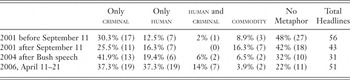
(Park Reference Park2006, p. 1).Fernández and Pedroza observed that relevant newspaper headlines in the 1970s often employed images such as illegal aliens (Fernández and Pedroza, Reference Fernández and Pedroza1982, p. 14). Thirty years later, in her study of 181 article headlines drawn from 2001 to 2006, Park notes that copy editors nearly abandoned the term alien with reference to immigrants in their headlines. By 2001, it was no longer used. Table 1 provides a summary of her findings.
Frequency of Newspaper Headline Immigrant Metaphors across Time

Park further found, to our surprise, many fewer immigration headlines making use of nonhuman metaphors, with a concomitant and steady increase in the number and proportion of humanizing metaphors. However, newspapers continue to perpetuate the metaphor immigrant as criminal, especially in the period before September 11, 2001, by joining the adjective illegal to the noun immigrant. In a nationwide sample of newspapers from 2006, there are equal percentages of the headlines that humanize immigrants and those that criminalize immigrants. Across time, only 6% of headlines (n = 10) display both positive and negative metaphors; seven of the ten are from headlines in 2006. For the same period, 14% of headlines display both criminalizing and humanizing metaphors, up from 2% in 2001. Finally, the greatest change in one time period was the large increase in the use of the negative metaphor, immigrant as criminal. This occurred after Bush's Reference Bush2004 controversial speech introducing his immigration policy reform initiative. Copy editors apparently initially rejected Bush's effort to humanize the print-media language used to speak about immigrants, but later warmed up to it.
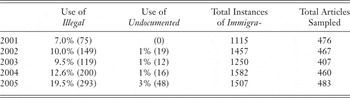
In a separate word-count study, we compared the use of the conflicting terms (illegal vs. undocumented) within the body of U.S. newspaper articles for a large article sample in 2001, 2002, 2003, 2004, and 2005. These terms have become code words for opposing political positions on immigration policy. On the one hand, the term illegal criminalizes immigrant workers. While the adjective illegal currently tends to be the common-use term of newspapers, politically conservative partisans have appropriated it expressly to emphasize the unlawfulness of unauthorized immigration as they call for greater punitive measures to limit immigration. On the other hand, undocumented highlights the legal detail of paper permissions for immigrant workers seeking a livelihood. Liberal and progressive partisans who emphasize benevolent considerations for current immigrant workers and their families prefer this term. On these grounds, Santa Ana (Reference Santa Ana2006) has claimed that news writers' overuse of one term constituted political partisanship, and that journalists cannot claim that word use is merely a matter of standard journalistic stylistic criteria (i.e., common use and concision). To explore the balance of adjective use, we retrieved large samples of U.S. newspaper articles in comparable LexisNexis searches. As noted above, LexisNexis search outputs have an article count limit, so we designed samples that drew on a period generating fewer than 1000 articles from 2001 to 2005, searching the full text of articles for the root word immigra-. Table 2 summarizes the findings.
Frequency of Illegal versus Undocumented Terminology across Time

As noted in Santa Ana (Reference Santa Ana2002), the word undocumented was rarely used in mainstream newspapers during the 1990s. It appeared in the Los Angeles Times in a few quotes of politically progressive advocates during the campaign against Proposition 187. Although George Bush legitimized the use of the term undocumented with his nationally broadcasted speech of January Reference Bush2004, news writers did not employ it immediately. However, up to 2005, we see a very modest increase in the use of undocumented. Thus, these two diachronic studies indicate that the print news media steadily decreased their use of deprecating imagery, while at the same time increasing the use of humanizing metaphors. Based on these preliminary measures, we find that U.S. journalists did not present a balanced or neutral view of this political issue. A neutral presentation would have broadcasted equal numbers of rival partisan adjectives, or would have avoided partisanship and used a nonpartisan alternative such as unauthorized to refer to the immigrants at issue.
Representations, May 2006
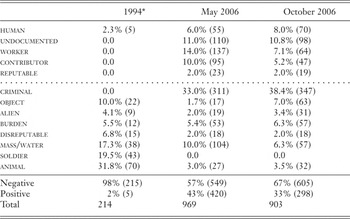
As described in the methods section, we used LexisNexis to sample the fifty most relevant print-media articles of May 2, 2006, the day following the Great May Day marches. Using a research protocol designed to obtain high levels of intersubjective reliability, we coded 1136 metaphors in these articles, of which 969 specifically pertained to immigrants or immigration (see Table 3). The patterning of metaphors changed significantly in two ways, including a new predominant conceptual metaphor, immigrant as criminal, which displaced immigrant as animal. Most importantly, the mass media reported the marches and the immigration debate with both affirming and negative language regarding immigrants. While the overall proportion of negative metaphors (57%) remains substantial, 43% of the print-media metaphors in May 2006 characterized the immigrant in terms such as worker, person without documents, and someone who contributes to the nation. Journalists presented both sides of the debate on immigration reform with distinctive discourses.
Frequency of Print-Media Immigrant Metaphors across Time

* Source: Adapted from Santa Ana (2002, p. 83), excluding six occasional metaphors.
The print-media tendencies before May 2006 (see Tables 1 and 2) indicated a slow softening of the imagery of immigrants. However, the spring marches of 2006 brought millions of immigrants and their supporters to the streets across the country. These immigrants demanded that the nation recognize their sizeable contributions to the United States. The immigrants stepped out of the shadows and presented themselves on the national stage as people claiming basic rights to work to support their families and deserving of respect from the nation where they work. They marched dressed in white shirts to signal their peaceful nature and carried U.S. flags to display their commitment. Print journalists witnessed the men and women marching, and reported on the human beings calling for justice. In this sample of print media, the conventional language that criminalizes and disenfranchises workers was countered by a language that sustained their worthiness and humanity.
Ontologies of Other Nonhuman Metaphors
CRIMINAL
In 1994, the most pervasive immigrant metaphor in the Los Angeles Times was immigrant as animal. This dehumanizing metaphor accounted for only 3% of immigrant metaphors by May 2006. The predominant metaphor in this time period was immigrant as criminal using associated negative imagery (our emphases):
[Rep. Tom Tancredo] penned an article for a conservative online journal saying that without illegal immigration, “Youth gangs would see their membership drop by 50 percent in many states, and in Phoenix, child-molestation cases would drop by 34 percent.”
—Denver Post (Soraghan Reference Soraghan2006)“I'm highly offended when illegal people come into this country, take jobs illegally, and then protest and wave foreign flags,” Lott, a former Senate majority leader, told Fox News.
—Boston Globe (Klein Reference Klein2006)What we are witnessing for the first time in our history are large numbers of foreign nationals here illegally—and their supporters who include politicians sworn to uphold our laws—telling all who will listen that they have no respect for the rule of law or the sovereignty of the American people.
—Chicago Sun-Times (Gorak Reference Gorak2006)“We're not really criminals,” he said, “we're just trying to survive. We're not trying steal this land.”
—Sacramento Bee (Ferriss Reference Ferriss2006)Among all immigrant metaphors of May 2006, criminal was the most frequent, appearing in 33% of all cases. Illegal is the official term used in many government documents and much legislation. However, the State's imprimatur does not exempt its metaphor from critical analysis. The criminal metaphor conceptualizes all immigrants as lawbreakers, foregrounding and highlighting their legal status and passing over all other aspects of their lives, in particular, their worker status. This metaphor also associates unauthorized immigrants with violent, heinous crimes. This is not hyperbole. HR 4437 would have formally classified workers and the citizens who aid them as felons, not as individuals guilty of only a civil infraction.
In 2006, it was conventional to refer to immigrants as lawbreakers, although their sole misdeed was to cross the national border without permission. For example, common phrases, such as here illegally, indicate that one step on U.S. soil defines immigrants as felons who are guilty of having entered the country. Their decent actions while living unauthorized in the United States (such as pursuing employment, going to school, and raising a family) can be erroneously equated with the dangerous acts of malicious malefactors. The conventionalized link to the word illegal filters immigrants' acts through a lens of criminality.
Many print-media references blur by design the distinction between the actual civil misdemeanor of immigrants and far more serious crimes such as gang activity and violent offenses.
Both my state—New Mexico—and California are dealing with violence and illegal activity as a result of our nation's broken border policy.
—Sacramento Bee (Richardson Reference Richardson2006)With such metaphors, all immigrants are depicted as a destructive presence, their major offenses being to falsify documents, to trick gullible employers into hiring them, to drain government coffers, to damage the environment, and to challenge—by marching—the established order. The criminal metaphor does not distinguish the small percentage of actual immigrant perpetrators of serious crime from the vast majority of immigrants who are hardworking, law-abiding family men and women. By depicting these people as violent criminals, the metaphor ignores their contributions and motivations. It also passes over the role of government, business, and the complacent citizen consumer in encouraging immigration. The cognitive mapping of the source domain criminal onto the target domain immigrant thus makes criminality a part of the conceptualization of immigrants. Because criminals are thought to exhibit inferior moral characters and other failings, many members of society hold that these people have broken the law and should be prosecuted. By placing immigrants on a par with felons and convicted criminals, such public discourse furthermore justifies harsh penalties for peaceful immigrants seeking work and residence in the United States.
Replacing the dominant metaphor animal of the late twentieth century with criminal of the early twenty-first century has significantly transformed the nation's image of immigrants. Insofar as criminal is a more human metaphor than animal, the conceptualization shifts immigrants from being lowly animals to actual humans—albeit with violent volitions and immoral intentions. Now portrayed as criminals, immigrants remain the lowest form of humans—the devious and dangerous. Criminal imagery drives a psychological wedge between immigrants and people who consider themselves to be law-abiding citizens.
MASS
Within the May 2006 data, the immigrant as mass/water metaphor comprised 10% of all immigrant metaphors (Table 3). The ontology of immigrant as mass reduces the individual immigrants to a huge, undifferentiated mass to be reckoned with in terms of their overwhelming size.
We've got only a partial picture what life would be like if we didn't have millions of illegal immigrants here.
—Los Angeles Times (Gorman et al., Reference Gorman, Miller and Landsberg2006)In the same way, immigrant as water is a negative and nonhuman metaphor that characterizes immigrants as a large volume, evoking negative images of devastating storms and uncontrollable waves of water that can obliterate whole communities.
Never in the last 40 years or so has this country been under such a threat. Illegal immigrants from all over the world are pouring into America, mostly from Mexico and South America.
—Rocky Mountain News (2006)But some people remain concerned by what they describe as a dangerous flow of illegal immigrants across the country's southern border.
—Columbus Dispatch (Pyle Reference Pyle2006)These metaphors conceal the individuality of immigrants, their humanity, and the major forces behind immigration such as economic desperation that has arguably resulted from globalization.
OBJECT
The immigrant as object metaphor, which represented 1.7% of the total May 2006 print-media immigrant metaphors, characterizes immigrants as things other than humans. The object metaphor encompasses a wide range of images: immigrants as trash, commodities, cargo, and contraband.
Now that they think that there is too many of us, they want to throw some of us out.
—Sacramento Bee (Ferriss Reference Ferriss2006)Importing temporary workers simply for their willingness to accept low wages, while companies avoid paying higher wages to jobless Americans, is hardly a wise immigration policy.
—Christian Science Monitor (2006)These are images of unwanted and disposable objects. The immigrant as object metaphor sustains a nonhuman discourse about immigrants, given that objects lack moral agency or human value.
BURDEN
Another negative metaphor, immigrant as burden, refers to the costs, annoyances, and ills commonly linked to immigrants. Burden contributes 5.4% of the total immigrant metaphors (see Table 3). In this case, immigrants are a disease, strain, or parasite on the U.S. body. Hence, the metaphor frames the issue as one in which the nation must fight off the immigrant infection that damages its (economic) health. In the May 2006 data, we found burden statements that blamed immigrants for taking job opportunities from more deserving citizens, generating millions in costs, and undermining the economy.
Illegal immigrants cost the country more in tax dollars than they contribute.
—Sacramento Bee (Ferriss Reference Ferriss2006)It's overkill to add a large, new general category of workers—especially when one considers that there's already low—and unskilled labor to be had in the US.
—Christian Science Monitor (2006)“I believe that these people are hurting our country and they need to go back,” she [Jackie Pinjuv] said.
—New York Times (Davey Reference Davey2006)“I think people's biggest problem with illegal immigrants is that they come in and suck the system dry,” Wilson said.
—Los Angeles Times (Rosenblatt and Powers, Reference Rosenblatt and Powers2006)Immigrant as burden metaphors are subsumed under a more encompassing metaphor, nation as body. In this higher-order metaphor, money is represented as the blood and health of the nation (Santa Ana Reference Santa Ana2002, pp. 253–294). Thus, immigrants are said to overtax and hurt the health of the nation when they utilize public and private services such as health care, education, law enforcement, jobs, and housing. This conceptualization passes over the economic contributions of immigrants. All strata of Americans benefit from immigrants' low-wage and often tax-free labor. Similar to the criminal metaphor, statements quoted in the press that use the burden metaphor rarely employ empirical evidence but instead are presented as common knowledge.
ALIEN
The term alien, meaning ‘strange, foreign’, or ‘belonging to another’, has been attested since medieval times. The legal term was used in English common law and continues to be used in juridical circles to refer to a foreign national. Attorneys may use it, but legal scholars acknowledge (Ngai Reference Ngai2005) that it no longer can be disassociated from today's more widespread extraterrestrial connotation, which originated in twentieth-century science fiction usage. Popular culture has by now fully appropriated the legal term. Moreover, as Ramírez Berg argues, since the resurgence of the science fiction film in the late 1970s, the extraterrestrial alien is now Hollywood's ideological symbol to project national anxiety about immigrants (Ramírez Berg Reference Ramírez Berg2002, pp. 153–182). In this context, referring to immigrants as aliens, even in a courtroom or congressional setting, evokes the image of a strange violent threat from a world entirely unlike an American hometown. The blockbuster appeal of the alien/immigrant is evident in film franchises such as the Alien series, the Predator series, the Terminator series, the Men in Black series, as well as Independence Day. The immigrant becomes a threatening nonhuman being who represents fear-inspiring Otherness. This meaning is widely shared in the public sphere, and, as a result, the mass media, pro-immigrant groups, President Bush, and many progressives no longer use the term. The Minutemen, the Federation for American Immigration Reform (FAIR), and other uncompromisingly anti-immigrant organizations and conservative individuals insist on using alien in their language. The implication is that, beyond criminal untrustworthiness, immigrants are unidentifiable beings living in the shadows of the United States that can never be any part of the nation, much less citizens.
Nearly 300 Latinos, their supporters and a handful of “little aliens” sang love songs outside U.S. Rep. Paul Gillmor's office yesterday.
—Columbus Dispatch (Lecker Reference Lecker2006)Since illegal aliens are not part of our political process, it seems to me their energy and efforts would be better directed in their own countries where they should be demanding of those governments what they have no right to demand of ours.
—Chicago Sun-Times (Gorak Reference Gorak2006)Human Metaphors and their Ontologies
The May 2006 mass media representation also reported the immigration debate with affirming language regarding immigrants. Our findings indicate that 43% of the print-media metaphors characterized the immigrant as a worker, as a person without documents, or as someone who contributes to the nation. In the following section, we present these human metaphors and their ontological force, that is to say, the social meanings they construct.
UNDOCUMENTED
Of the 969 instances of May 2006 print-media metaphors, 11% are of the immigrant as undocumented metaphor, where the term is most often used as an adjective. In some examples, undocumented is a bare noun, which presupposes reference to an immigrant. The term refers to a key U.S. immigration regulation that requires individuals to possess certain official authorizing documents to enter or reside in the United States. Immigrants are classified and have an identity imposed on them by government edict, and then it is spread by mass media into the public-sphere discourse.
Counting just the undocumented, these new Americans represent almost 1 in 20 of the nation's workers.
—Star Tribune (Minneapolis, MN 2006)We must require the undocumented workers who are productive members of our economy to declare themselves and meet a series of law-abiding mainstream conditions, including being taxed, paying a penalty for their illegal entry and learning English.
—Sacramento Bee (Richardson Reference Richardson2006)We need to find a way to legally help undocumented people in the country.
—Boston Globe (Sacchetti and Tench, Reference Sacchetti and Tench2006)Immigrants of previous generations, including African Americans, should see the new undocumented workers as allies, not threats.
—Chicago Sun-Times (Jackson Reference Jackson2006)While illegal is the official term, the alternative term, undocumented, has been used sporadically since 1980 in mainstream newspapers. Our earliest attestation appears in a 1982 New York Times quote from then Secretary of State Alexander Haig, who referred to Salvadoran refugees as undocumented immigrants (Gwertzman Reference Gwertzman1982). This metaphor foregrounds the idea that these immigrants lack official authorization and permissions, and it does not criminalize immigrants in the manner that the predominant criminal metaphor does.
HUMAN
To refer to an immigrant as a human being is a truism; formally, immigrant as human is not a metaphor. However, journalism's use in the 1990s of overwhelmingly nonhuman language to characterize immigrants makes especially notable the regular use in the 2006 print-news media references to immigrants performing human activities. This led us to take a hard look at the language shift. References to human metaphors elicit feelings to which the public can relate, describing ordinary and often desperate lives. Most often, they refer to an immigrant's fear and vulnerability.
“No one knows the pain we feel,” said Miguel Baez, who came here illegally from Mexico five years ago and works as a bartender in Manhattan. “We need these jobs to survive,” he said. “But we can't visit our families back home for years for fear we'll get caught coming back.”
—Daily News [New York] (Gonzalez Reference Gonzalez2006)They march to make their humanity known. They march to make their views known. They march because they will not be victims or pawns, but will be the subjects of their own history in this country.
—Chicago Sun-Times (Jackson Reference Jackson2006)Criminals? No. They are our mothers, fathers, aunts and uncles. Illegal aliens? No. They are our friends, teachers, church leaders, health care providers and business owners.
—Chicago Sun-Times (Jackson Reference Jackson2006)“It is immoral to continue to have millions of people living in the shadows of America, subject to exploitation, not afforded basic human and civil rights, and possibly depressing wages for U.S. workers,” said Howard Dean, the Democratic National Committee chairman.
—San Antonio Express-News (Martin Reference Martin2006)These depictions are designed to evoke sympathy, empathy, and at times even admiration, and they challenge the dominant criminal metaphor that characterizes immigrants as inferior humans. This humane language contests the conventional incarcerating language by placing these men and women among the rest of U.S. society.
WORKER
This metaphor emphasizes that immigrants come to the United States to make an honest living. Due to familiar U.S. workplace regulations, the immigrant as worker metaphor also carries an assumption that the immigrant is an adult. In the May 2006 sample of articles, 14% of all immigrant metaphors were worker metaphors (Table 3).
“Supporters of Senate proposals that would allow at least 400,000 generally low- and un-skilled guest workers into the US each year argue that business needs a steady, legal flow of such workers for jobs ‘Americans won't do.’”
—Christian Science Monitor (2006)“We want to work,” she said. “We don't want welfare. We don't want handouts. We have dreams just like everyone else, and we want the opportunity to be able to work hard to achieve our dreams. What's so bad about that?”
—Tampa Tribune (2006)In the May 2006 data, we also noted frequent use of the adjective undocumented to modify the positive noun worker. This metaphor emphasizes positive qualities of immigrants. It is understood that the average employer will usually not hire individuals who are irresponsible. Through this line of reasoning, referring to immigrants as workers conveys the idea that they are dependable, responsible, and decent individuals, who “follow the rules,” rather than criminals, who “break the rules.” However, being labeled strictly as a worker brings with it imagery of an individual who lives to work, rather than working to live. Since the semantics of the worker metaphor foregrounds labor, it tends to background other reasons for immigrating, such as the search for formal education, personal freedom, or political escape, among other motivations. Since workers tend to be adults, this metaphor also tends to pass over child immigrants.
CONTRIBUTOR
Finally, in May 2006, we note the print media discussed the roles that immigrants carry out in U.S. society. Immigrants play a crucial role within society as they build homes and communities, contribute not only with their hands and minds, but also with their lives, when serving in the U.S. military. In the May 2006 sample, 10% of immigrant metaphors had a contributor source domain. The ontological domain of contributor consists of semantic elements that connote assistance to others. People who contribute are imbued with highly valued traits such as generosity, selflessness, and compassion. The image rendered is an immigrant who enables the nation to thrive.
“Immigrants work hard, study hard, fight in wars, pledge their allegiance, and help America be great,” said Luis Jeula, 34, a native of Ecuador.
—Columbus Dispatch (Pyle Reference Pyle2006)Some 300,000 protesters streamed through the streets of Chicago, and immigrants in scores of smaller cities withheld their manpower from restaurants, construction sites, and landscaping businesses, in an economic show of force.
—Boston Globe (Klein Reference Klein2006)Other signs said, “We don't run the country, but we make the country run,” “Today we march. Tomorrow we vote,” and “No human being is illegal.”
—Denver Post (Brown Reference Brown2006)Community leaders said illegal immigrants help keep the Social Security System afloat by paying taxes—under false identification—into a system that they cannot tap into.
—Omaha World-Herald (Gonzalez and Burbach, Reference Gonzalez and Burbach2006)The Kernel of the Debate
Narratives are stories. In our cognitive-metaphor-based critical discourse analysis, a political narrative is made up of conceptual metaphors (having congruent images) and tells a coherent and consistent story about the political issue at hand. In the 1990s, during California's Proposition 187 campaign, immigration policy was the major issue in the public sphere. At that time, the Los Angeles Times, California's main print-media source presented (unintentionally) only one narrative, which denigrated the immigrant, in spite of the newspaper's anti-Proposition 187 political stance.
In contrast, the mainstream print media of May 2006 articulated two competing political narratives. The core of the debate is the character and nature of the unauthorized immigrant. The ontological kernel or unit of social meaning in the 2006 print-media anti-immigrant metaphors is: Immigrants who deliberately violate U.S. law and exploit its social services are criminals and deserve only punishment.
This shared social evaluation is sustained by conventional metaphors which portray immigrants as an inferior form of humans (immigrant as criminal) or nonhumans (as animal, alien, object, water, masses), who endanger the country with their burgeoning and unregulated presence. These metaphors create a criminality narrative as a lens through which to view potential change in immigration policy. The resultant narrative characterizes unauthorized immigrants as lower forms of human beings who must be restricted, removed, and closely regulated throughout society, because the government cannot control their numbers, and their large numbers have disrupted the decent daily lives of citizens.
In contrast, the ontological kernel of the positive human immigrant metaphors is: Immigrants are decent people who commit a minor civil infraction for the higher purpose of working for their daily bread. Such positive human immigrant metaphors create a narrative about immigrants that reflects compassion (immigrant as human), positive sentiment (as contributor, reputable), or provides a technical description (as undocumented, worker). These metaphors create a decent-worker lens and narrative through which to view the immigration policy debate. The human narrative characterizes immigrants as honest individuals who work hard every day and contribute to U.S. society. However, working without authorization in the United States makes them vulnerable to exploitation. These workers and caregivers toil, go to school, and perform other normal daily actions under the constant threat of deportation. The human narrative may seem self-evident, but its expression in 43% of the images of the May 2006 print-media discourse stream is a noteworthy change in U.S. print-media discourse. In 1994, few conceptual metaphors in the Los Angeles Times portrayed human images of immigrants (Santa Ana Reference Santa Ana2002). Without such imagery, the public is less likely to identify with the emotions, desires, and humanity of immigrants.
The rivalry of competing metaphors demonstrates the public-sphere issue is not a matter of economics, but the worth of the immigrant. Adjectives such as criminal and illegal are highly politicized terms which evoke images of the immoral immigrant crossing borders to commit violent acts, steal resources, and threaten national security. Conservative and anti-immigrant supporters intentionally use criminal metaphors, while their political rivals, liberals, progressives, and pro-immigrant groups prefer the rival adjective, undocumented. The immigrant as undocumented metaphor does not criminalize its target, and by contrast with its adversary, portrays immigrants sympathetically. In the public-sphere debate, these rival metaphors use imagery to argue for alternative degrees of immigrant humanity. Criminal metaphors consign immigrants to a permanent lower caste status. Undocumented metaphors, on the other hand, do not morally judge, but focus instead on the bureaucratic circumstances of immigrants. The winner of the debate will be those who convince the public to choose their image of immigrants. Either these immigrants committed crimes and deserve punishment from our aggrieved society, or they are decent people who deserve respect for their hard work and a chance to become full members of society.
The other major rival metaphor struggle involves negative metaphors portraying immigrants, on the one hand, as people worthy of public respect or, on the other hand, as lower forms of humanity or even outright nonhumans. Images of humanness are articulated through the worker metaphor which highlights the crucial role that these people play in society. The contributor images present the benefits and good character traits of immigrants. Images of family members, hardworking individuals who overcome adversity, and people who seek to better themselves, remove the layer of Otherness that negative metaphors project. These human metaphors ascribe to immigrants humanness, and they contrast with other subhuman and nonhuman metaphors (such as immigrant as animal, masses, water, or object), which project images that strip humanness from immigrants.
Even two metaphors that appear only occasionally can be juxtaposed. Immigrant as reputable appeared in 2% of the total May 2006 sample. The reputable metaphors included the ideas of law-abiding or innocent immigrants and resident immigrants. In contrast, 2% of the metaphors depicted immigrants as disreputable, and suggest that immigrants are selfish, elusive, and disrespectful cheats. These metaphors make up elements of contending narratives that aim to sway the public.
“They have a country. They are just too lazy and corrupt to do anything to make it a success themselves.”
—Sacramento Bee (Ferriss Reference Ferriss2006)Immigrants are proud and grateful to be here and eager to learn English, eager to assimilate and acculturate. Immigrants will embrace and obey the laws of America.
—San Francisco Chronicle (Lochhead Reference Lochhead2006)Representations, October 2006
Even as the Great May Day demonstrations electrified public interest in immigration, the Republican senate had short-circuited further development of meaningful policy reform in the 109th Congress. After the Great Marches, an escalating sectarian war and rampant violence in Iraq, as well as Israel's invasion of Lebanon, redirected public attention from domestic to foreign affairs. Mass media discussions about immigration nearly disappeared, except for minor coverage of the Republican-sponsored “summer field hearings” held in San Diego and at ten other sites. These field meetings were cynical “made-for-media-displays” to remind the public about the “vulnerability of the nation's borders to terrorists” (Spagat Reference Spagat2006). In fact, maneuvering by the early spring involving control of Congress after the midterm elections had ended any possibility of significant immigration legislation. Still, Congress ultimately passed the restrictive Secure Fence Act, which President Bush signed on October 26, 2006. Congress apportioned no money to the bill; it was only a symbolic gesture to the conservative base of the Republican Party. While momentarily tabled, immigration policy will undoubtedly return to the agenda of the 110th Congress and the 2008 presidential campaign. Thus, it is important to examine how print news media are representing immigrants as the memory of the marches receded from public memory.
While the May 2006 mass media presented a rough balance of human and traditional representations of immigration issues, we sampled the print media once again, around the time of the signing of the Secure Fence Act, using LexisNexis tools to gather the fifty most relevant print-media articles in the days before and after President Bush signed the 2006 Secure Fence Act. Using a research protocol designed to obtain high levels of intersubjective reliability, we coded 1098 metaphors in these articles, of which 903 specifically pertained to immigrants or immigration (Table 3).
The October data metaphors exhibited 67% nonhuman metaphors and 33% human ones. The change from the May sampling seems to be associated with discussion of the Secure Fence Act. Of the five most prevalent metaphors, the negative immigrant as criminal was dominant, at 38%. The four runners-up were: immigrant as undocumented (10.9%), human (7.8%), worker (7%), object (7%), and burden (7%). In October 2006, the two sides to the immigration debate were no longer conveyed in a balanced manner, as had been the case only six months earlier.
The October 2006 news articles exhibited the familiar negative view of immigration. Two affirming metaphors, worker and contributor, each appear 50% less frequently in October 2006 than they did six months earlier. Moreover, there was no longer much mention of the economic contribution of immigrants. The absence of the narratives of immigrants as hardworking individuals who benefit communities indicated a retreat from more compassionate representations regarding immigrants. In contrast, journalists used the term undocumented in October 2006 with the same frequency as they had in May 2006. This far less affirming image (but still positive) of immigrants was sustained and has become a standard alternative to illegal, the negative term of preference. The term undocumented conveys the human character of immigrants. Some articles of the period describe the increasing fear that haunts immigrants who live in cities that have enacted laws to deny immigrants access to rental housing or to authorize local police officers to perform the activities of federal immigration agents. These articles discuss the plight of immigrants as they struggle to work and raise their families, contributing to society under greater threat of deportation.
The October 2006 news articles on immigration ultimately are dominated by the criminal metaphor, which was found in 38% of all images. Further, immigrant as object, burden, and water all increased in October 2006. Immigrants are portrayed as stubborn weeds or mounting levels of trash that must be cleaned up, or as a costly illness that damages the economic health and cultural dominance of the nation. Immigrants are described as forces that can wipe out entire communities and the traditional American lifestyle, or as potential terrorists and criminals seeking only to harm the nation. Given these descriptions, the only solution appears to be to build a fence, hire more border patrol agents, and build more detention centers. As the conservative narrative regains its traditional power to control anti-immigrant sentiments in the public sphere, the policy debate in the public sphere will become increasingly one-sided.
CONCLUSION AND IMPLICATIONS
Analysts have diverged in their views about what the most fundamental issue motivating the national debate on immigration policy was in 2006. Some have suggested that terrorism, the rule of law, social justice, economics, globalization, or demographics was at the heart of this debate. We conducted a critical discourse analysis of mainstream print-media reporting on the 2006 immigration policy debate, cataloguing each conceptual metaphor that we came across in a hundred of the most relevant newspaper articles during two time periods. The concept we found most frequently metaphorized in these articles was not immigration, the border, the economy, amnesty, or naturalization, but immigrant. Given the fundamental role that conceptual metaphor plays in constructing social understanding, we are in a position to identify the ontological kernel or root social meaning underlying the policy debate that was in the public sphere: the character of the unauthorized immigrant. One view is that unauthorized immigrants are criminals, who deliberately violate U.S. law, and, once here, continue to abuse the social network of services, and therefore deserve only punitive treatment. The opposing view is that immigrants are for the most part decent people who break minor laws in order to provide food for their children. In this second case, Americans should treat immigrants with respect, protect them from exploitation, and welcome them to our table. The two views are diametrically opposed; consensus will be hard to achieve. However, the good news is that in May 2006 the U.S. mainstream articulated these two political stances, offering the American public a real debate on national immigration policy. This was not the case in 1994. Twelve years ago, a single narrative dominated the news media and the expectation of our team was that this trend would continue.
The divergent human values that the affirming and disparaging metaphors attribute to unauthorized immigrants expose a deep psychological divide among U.S. citizens regarding this issue. The fulcrum is trust. Those opposed to liberalizing today's policies do not trust unauthorized immigrants as worthy of sharing America's challenges and bounty. Opponents to immigration express anxiety, fear, and even hatred toward the unknown immigrant. In the televised images of marchers, they saw threatening, dark-skinned masses. However, Americans on the other side of the debate express hope, and they call for unjust laws to be revised. Many previously silent citizens have recognized their Greek father or Irish grandmother in the face of today's immigrant. Such citizens realize that today's immigrants cling to the same American Dream that was the article of faith of their immigrant forbearers. This long-standing American credendum guided the Great Marches and underpins the immigrant-rights movement.
George Bush did not invent the human language about immigrants he used in Reference Bush2004. He appropriated the language of the immigrant-rights counterpublic sphere, which was not aired in the mass media during the 1990s. As president, Bush legitimized the human immigrant language, making its dissemination acceptable in the public sphere. However, like other major elements of his presidential agenda, his “Americans by choice” speech led to unintended consequences. The legitimation of the language of immigrant humanity provoked the Minutemen's sputtering repudiation. In turn, their own words provoked a response among the most humble and dignified workers and families of the nation. While Bush inaugurated this latest debate on immigration policy, the stars of the parade were millions of marchers in hundreds of locales, from Los Angeles and Chicago to Homestead, Florida, and “tiny Wendover, [where] more than 500 Latinos marched Monday afternoon carrying placards and American flags while chanting ‘USA, USA, USA’ … to mark a nationwide effort to underscore the economic and labor clout immigrants wield in the United States” (Salt Lake Tribune 2006). This rally represented one-third of the total population of Wendover, Utah, an unmistakable indicator of the pervasiveness and potency of the immigrant presence in the nation.
In May 2006, American journalism had redeemed itself as the fourth estate of U.S. democracy, particularly after its reporting debacle leading up to the Iraq War had eroded its credentials. But by October 2006, the balanced coverage of the immigration debate was gone. The press has now reverted to its old habit of articulating immigration as a matter of criminality. As the magnificent marches of May 2006 fade from public memory, the conventional disparaging language is returning to the press. This is to be expected since the October 2006 news reports described dry policy and symbolic legislation, not dynamic human events. Under the constraints of news organization routine and practice, professional newsrooms tend to create official, negative, and detached news, which is centered on action and events (Schudson Reference Schudson2003, p. 48). For a short period, U.S. journalism demonstrated its willingness to present a balanced debate, but the faces of immigrant marchers must remain in the public sphere in order for mass media news to report on the humanity of the immigrants and their cause.Footnote 6