The Scientia artis musice was completed (albeit with lacunae) in the spring of 1274, while its author, Hélie Salomon, a native of the village of Saint-Astier in Périgord, was serving in the papal Curia, then resident at Lyon for an important church council. The original manuscript of the treatise was presented to Pope Gregory X (1271–6) in that city, where it remained until the first decade of the seventeenth century, when it was purchased for the library then being assembled for Cardinal Federico Borromeo – the present Biblioteca Ambrosiana at Milan – where the manuscript now carries the shelf mark D 75 inf. It is the earliest (and virtually only) medieval music treatise to survive in the original manuscript, prepared under its author's personal supervision.Footnote 1 This is proven both by an insertion a the bottom of folio 1, in which an unnamed parish priest (‘plebanus’) attests (rather tepidly) to its merits, and by the presence of the dedication inscription, inserted in available space at the bottom of folio 4v (Fig. 4). In offering his treatise to the pope, the author sought in return the award of a canonry in his home village of Saint-Astier. There would be no point to including either of these inserted items in a copy. There is, in fact, no evidence that the treatise was ever copied in the Middle Ages or Renaissance. The librarian of the Biblioteca Ambrosiana brought the existence of the Scientia artis musice to the attention of Abbot Martin Gerbert, who published it in the third volume of Scriptores ecclesiastici de musica sacra potissimum (1784).Footnote 2 Gerbert omitted most of the tonary, and the shape of the images was misrepresented beyond recognition: all the circular images were converted into squares.
Hélie Salomon's terminology is frequently idiosyncratic – perhaps one reason why it has rarely been studied or referred to since its publication more than 230 years ago.Footnote 3 The author consistently uses ‘seculorum’ (instead of the more usual ‘differentia’) to denominate the cadential formulae of the psalm tones and ‘singing in four voices’ (rubric 30) instead of the more usual ‘organum’. For this reason the treatise might have escaped the attention of scholars researching psalmody or early polyphony using the resources of the Thesaurus Musicarum Latinarum database.
The Scientia artis musice is a decidedly practical manual, not a treatise devoted to speculative musica and mathematical proportion. Its thirty-one ‘rubrics’ (i.e., chapters, a name derived from legal terminology) cover the basic elements of medieval music theory: letter names, hexachord syllables, the claves as combinations of letter and syllable(s), the musical (‘Guidonian’) hand, mutation, staff notation, clef placement and chant genres.Footnote 4 Exceptional is the aforementioned rubric that offers instructions on how to sing chant in parallel four-voice organum.Footnote 5 Several times Hélie addresses his pupil directly as ‘tu minor’,Footnote 6 but one cannot imagine that the treatise was destined for a beginner or even a boy in his early teens, as ‘minor’ might suggest. The use of such direct address enhances the probability that the Scientia artis musice preserves a record of its author's viva voce teaching, cast in written form as a model to guide a cantor whose responsibility it was to instruct pueri in the singing of chant.Footnote 7 More than half of the treatise (rubrics 11–27) is taken up by an incomplete tonary with explanatory commentary. The comments virtually disappear after tone 4, perhaps an indication of haste in preparing the manuscript for presentation to the pope or because most of the essential matters had already been covered in the extensive comments to tones 1 and 2.
Image and diagram
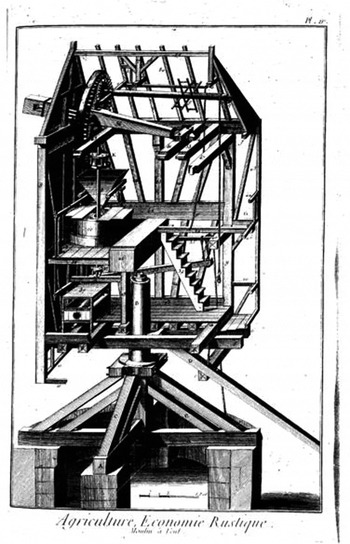
I will refer to the illustrations in the treatise as ‘images’ for a reason. A distinction exists between an image and a diagram, the former having more layers of complexity than the latter. An image may be defined as ‘a physical likeness or representation of a person, animal, or thing’, while a diagram is ‘a simplified drawing showing the appearance, structure or workings of something; a schematic representation’.Footnote 8 An extraordinary exemplification of the centrality of images (as well as diagrams) is the publication in eleven volumes of 5,569 engravings in the Recueil des planches sur les Sciences, les Arts libéraux, et les Arts mécaniques (Paris, 1762–72). The thousands of images in these volumes formed a complement to the seventeen volumes of the Encyclopédie des Arts et des Métiers of Denis Diderot and Jean Le Rond d'Alembert (Paris, 1751–65). Most of the detailed images of the Recueil could not be fully understood independently of the narration provided by the text of the Encyclopédie. The operation of a windmill (Planches, vol. 4), for example, could never be understood without such a narrative (Fig. 1).
Windmill from Encyclopédie: Recueil des Planches, vol. 4.

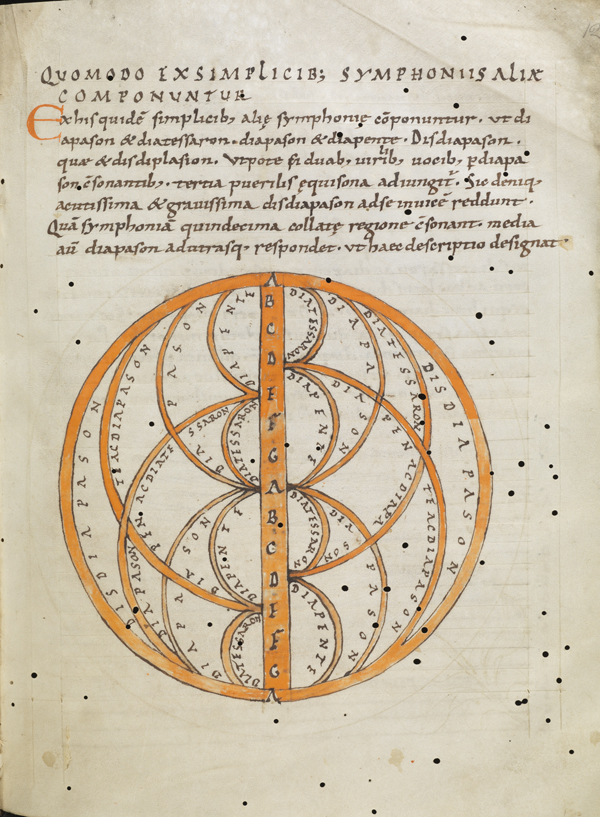
Many medieval music theory treatises contain diagrams that illustrate mathematical proportion: the division of the gamut into species of fourths, fifths and octaves.Footnote 9 Absent a narration, they could almost be said to ‘speak for themselves’. On either side of the central vertical in Figure 2, a diagram from a manuscript of the Musica enchiriadis, the overarching diapason curves enclose smaller curves representing the fourth (diatesseron) and fifth (diapente) that make up the octave.Footnote 10 Diagrams of this type were linked to the division of the monochord; still others indicated points of mutation from one hexachord to another.
Interval diagram (Einsiedeln, Stiftsbibl., cod. 79 (522), p. 12). (colour online)

The images in the treatise
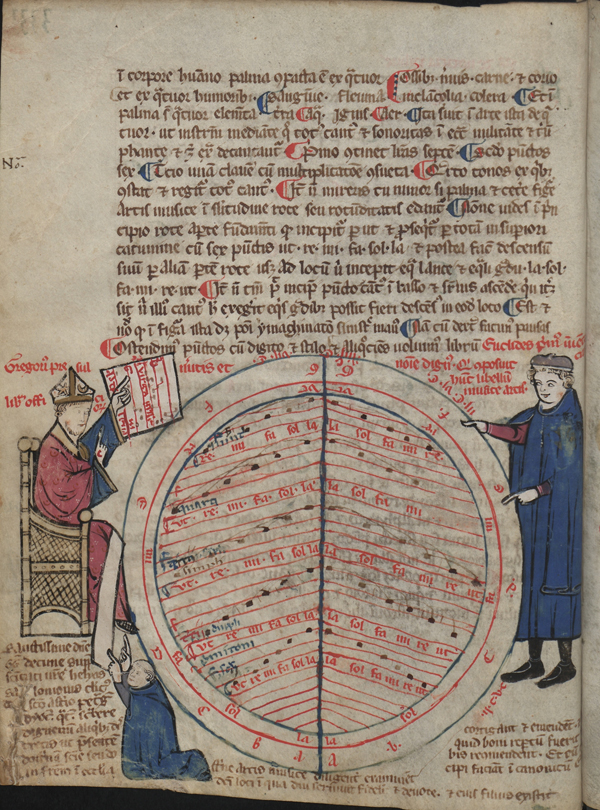
The images (figurae) of the Scientia artis musice belong to a different tradition, one that is represented in no other music treatise of the Middle Ages inasmuch as it is the only medieval theory treatise in which human images appear.Footnote 11 They are not merely decorative features – as, for instance, Musica depicted as a female figure holding a monochord or the Davidic musicians depicted as jongleurs in the tonary BNF, lat. 1118.Footnote 12 While Aribo's De musica describes the relationship between the authentic and the plagal tones as two dancing ‘choirs’ of men and women represented by overlapping circles, none of the extant manuscripts have human images corresponding to the narrative.Footnote 13 The eight images of the Scientia artis musice must have been part of the original conception, since two of them are surrounded by text. Oddly enough, only three are specifically referenced in the text: (1) the image with exercises in the grouping and separation of notes (Fig. 4), (2) the tonus image with an enthroned bishop (Fig. 5), and (3) the semicircular image that depicts the singing of four-voice parallel organum. The latter includes phrases from the text of rubric 30, which describes the technique in great detail.
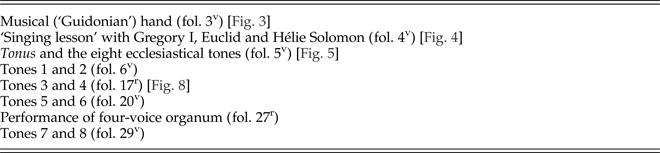
Seven of the eight images in the treatise are enclosed within circles carefully drawn with a compass, the only formal exception being the semicircular image just mentioned that recapitulates the Scientia’s instructions about the singing of organum. Table 1 lists the images in the treatise; the four that are reproduced in the present article are indicated within square brackets.
Images in the Scientia artis musice.

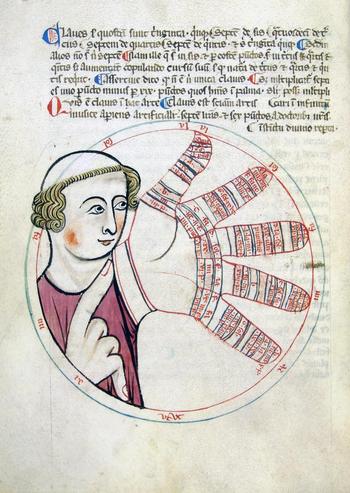
The first image in the treatise is a musical (‘Guidonian’) hand enclosed within a circle and displayed in a slanted position, uniquely so among the numerous hands depicted in medieval theory treatises (Fig. 3). This is, moreover, the sole example of a musical hand that incorporates a human image – perhaps intended as a portrait of the author? A large index finger (also a unique feature) is poised to point to joints of the hand, on which the claves (a combination of pitch letter and sol-fa syllables) are inscribed.Footnote 14 The possible combinations are exhaustively catalogued in rubric 2 of the treatise and exemplified visually in the image of the hand. Once mastered, the hand served as an excellent, ever-present aide-mémoire, whose pedagogical value is evident from its popularity. (The images of the Scientia artis musice and the ‘art of memory’ will be discussed below.) Johannes Affligemensis (speaking only of the syllables) affirmed the superiority of the hand over the monochord for basic instruction in musical intervals.Footnote 15
‘Guidonian’ hand (Milan, Bibl. Ambrosiana, D 75 inf., fol. 3v). (colour online)

Singing in four voices
The only image in the Scientia artis musice besides the hand that has drawn scholarly notice is the semicircular illustration related to rubric 30, which depicts four singers singing four-voice parallel organum. Martin Gerbert had it engraved as half of the frontispiece to the third volume of the Scriptores, in which the Scientia artis musice was published.Footnote 16 The style of organum described in the Scientia is identical to that found nearly four centuries earlier in the Musica enchiriadis tradition (more precisely in the Scolica enchiriadis), yet Hélie's exposition of the method is exclusively practical, unconcerned about the theory behind the simple and composite ‘symphonies’ of the Enchiriadis.Footnote 17 Strictly speaking, a visual representation would not have been essential, since Hélie's meticulous description of the practice in rubric 30 leaves nothing to be desired, but the striking image of the four singers (seated) summarises his instruction in a memorable way.Footnote 18 The singers in the image are arranged to illustrate graphically the intervals between the voices (5th–4th–5th), but Hélie advises that (for practical reasons) those who sing in octaves should stand next to each other.
The singers who sing in octaves are linked by bands that describe their relationships: ‘The third [voice] resounds with the first, because it models itself on the lowest’ and ‘the fourth gives forth melodies, the second voice mediating’ (‘Tertia cum prima resonat quod capit in ima [and] Dat modulos quarta mediante voce secunda’). Between the first and second singers, just below the inner band, is inserted the phrase ‘parum sonas nimis’, an injunction (also present in the text of rubric 30) that admonishes the singer to sing more loudly.Footnote 19 A band of text that begins next to the director (rector) must be read across the width of the illustration: ‘Custodiatis / diligenter / prima[m] voce[m]’. The phrase below reads: ‘pausatim / pausati[m] / exaltetis voces’. The first reiterates the responsibilities of the singers to coordinate their voice parts with the first (lowest) voice; the second is a general injunction to sing with full voice, but not stridently. Elsewhere in the rubric (30.23) Hélie condemns the kind of stentorian singing he has heard from the canons in Lyon. Between the third and fourth singers in the curve of the semicircle is the instruction: ‘Cu[m] fueritis gravatus / Resumatis cu[m] pot[erit] si e[st] p[er] p[rim]u[m] i[n] q[ua]rto / et ex necessitate fit aliqu[ando] faciendu[m]’. This sums up instructions in the text of rubric 30 about how the singers can recover from a breakdown in performance: the sonorities of the fifth and the fourth must be built up again from the lowest voice.
A ‘singing lesson’
The second image in the treatise (Fig. 4) elucidates what I have described in Table 1 as a ‘singing lesson’. On either side of the circle are the figures of Pope Gregory the Great (left, seated) and Euclid (standing right, wearing a doctor's cloak and biretta).Footnote 20 Kneeling at the lower left is a figure representing the author of the treatise in the act of presenting his work to Pope Gregory I, reinterpreted for this purpose as the reigning pontiff, Gregory X. Hélie's petition for the award of a canonry at his birthplace, Saint-Astier, is at the bottom of the page.
A ‘singing lesson’ (Milan, Bibl. Ambrosiana, D 75 inf., fol. 4v). (colour online)

Inside the circle are puncti (crudely notated), ascending on the left and descending on the right placed on freely drawn lines intended to represent musical staves. They have six pitches, accompanied by the appropriate sol-fa syllables (ut-la on the left, la-ut on the right). The only exception is the second stave from the top on the right, where the last two pitches and their syllables (re, ut) have been scraped away. Hélie draws attention to this omission (perhaps he erased the notes himself?), but he can offer no reason for their absence other than that they are no longer in use (‘nulla ratione caret, sed usus abolevit’).Footnote 21 Either Gerbert or the Milanese scribe who prepared a copy of the manuscript and its illustrations for him resupplied the deleted pitches and syllables. As described in the text of rubric 8, the pitches are first to be sung separately (separatim), as indicated by the short vertical lines (called tricte) that divide them, and then grouped (copulatim) by twos, threes, etc. These groupings are indicated by ‘slurs’, perhaps their first appearance in the history of music. The meaning of copulatim seems evident enough – legato – but the alternative mode of articulation, separatim (quasi pausatim) is not so obvious. What degree of separation is intended?
Tonus and the ecclesiastical tones
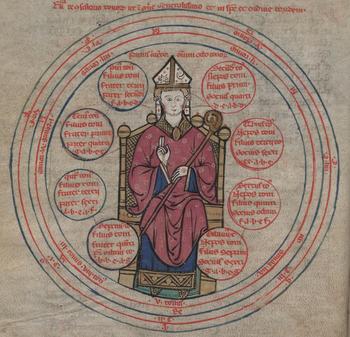
A set of four circular images of identical layout depict the paired authentic and plagal tones along with the seculorum proper to each tone (mode).Footnote 22 (See Table 1.) These are preceded and introduced by an image (Fig. 5) that elucidates an utterly unique theory of the structure of the tonal system of Gregorian chant and the relationships between authentic and plagal tones. This image, which occupies all of rubric 9, depicts an enthroned bishop flanked on either side by four vertically aligned medallions. The four medallions on the viewer's left represent the authentic tones (1, 3, 5, 7); the four on the viewer's right represent the related plagal tones (2, 4, 6, 8).Footnote 23 The whole is bounded by five concentric rings drawn alternately in blue and red ink.Footnote 24 Over the bishop's head is inscribed the phrase ‘Primus inventor / omnium tonorum’ – the line of text split by the top of his mitre. He must represent Pope Gregory the Great, since he wears the same vestments and mitre as the figure identified as this pope in the previous image (Fig. 4). Gregory's presence here would be consistent with the purpose of the image – to demonstrate the interrelationships among the tones, of which Gregory could be regarded as their legendary ‘inventor’.
Tonus and the eight tones (Milan, Bibl. Ambrosiana, D 75 inf., fol. 5v). (colour online)

Rubric 10 supplies a discursive explanation of the teaching encoded in this complex image, which could never be understood without such an explanation (cf. the previous reference to the windmill). Hélie first poses the question: ‘What is tone as genus?’ He answers that ‘tone as genus is the image (figura) of seven letters and one clavis, six notes and the eight tones, embracing the nature of all chant, artificial as well as natural’.Footnote 25 This statement is elaborated as follows:
This passage establishes two sets of relationships between the authentic and the plagal tones. All eight tones are called equally species of ‘tonus in genere’ (tone considered as genus),Footnote 26 but at the same time the four authentic tones are said to be genera in their own right with the four plagal tones as species under them (10.6–8). In addition, the authentic tones are called sons of tonus, while the plagal tones are said to be sons of the authentics and consequently grandsons of tonus. Both concepts (genus-species and familial relationships) are woven together in the author's explanation, which likewise involves a ‘tree’ (10.6) – two in fact – whose branches I will now attempt to disentangle.
The genus-species link and the ‘familial’ relationships involve two different kinds of ‘trees’: (1) the Tree of Porphyry, a diagram that exemplifies the descent (according to principles of logic) from the highest genus (substance) to the lowest species and (2) a tree of consanguinity that depicts familial (blood) relationships. Trees were familiar demonstration models in the Middle Ages.Footnote 27 The philosophical divisio scientiarum, for example, displayed within roundels connected by straight or undulating lines the interrelationships among the domains of human knowledge.Footnote 28 There were also trees of vices and virtues, the tree of life, genealogical trees and trees of saints of the religious orders, to mention only a few representative types.Footnote 29 The term was often employed metaphorically: any resemblance to a natural tree with branches and foliage growing from the ground up might be slight or non-existent.
Tonus and the Tree of Porphyry
The title of rubric 9 (the tonus image) is spread across the top of folio 5v. It reads: ‘De consistorio tonorum ut in genere generalissimo et in specie et ordine eorumdem’ (‘Concerning the consistory of the tones as in most general genus and in species and their ordering’).Footnote 30 The reference to species and especially the expression ‘most general genus’ points in the direction of two philosophical texts well known in the thirteenth century: the Isagoge of Porphyry and the Summulae logicales attributed to Peter of Spain (later Pope John XXI, d. 1277).Footnote 31 The Isagoge, an introduction to the Categories of Aristotle by the third-century neoplatonist philosopher Porphyry (ad 223/4–305), formed (in the Latin translation and commentary of Boethius) part of the logica vetus.Footnote 32 It amounted to an adaptation rather than an exact transmission of Aristotle's teaching in the Categories (and Topics).Footnote 33 Students at a medieval university would have begun their studies in logic with the Isagoge, admired for its clarity and succinctness. A source contemporary with the Scientia artis musice that transmitted these ideas is the Summulae logicales.Footnote 34 The first six of its dozen libri correspond to Aristotelian teaching; the final six, to more modern ‘scholastic’ logic. Since Hélie Salomon had had some university training, he would have been familiar with one or another (or both) of these texts. For instance, he occasionally initiates a discussion according to the format of the academic questio (‘queritur utrum’), but he never follows through according to the established protocols of the genre.
For Porphyry (and hence for the scholastics) the predicables that could be said of anything were: genus, species, difference, property and accident.Footnote 35 Porphyry proposed three definitions of genus, two of which apply to the discussion of tonus in the Scientia artis musice: (1) genus as ‘the origin (ἀρχή) of anyone's birth’ and (2) genus as ‘that under which a species is ordered (ὑποτάσσεται)’.Footnote 36 Later in the Isagoge, Porphyry lists differences between genus and species, the first of which is the fact that ‘the genus contains the species; the species do not contain the genera, for the genus is more extensive (πλεῖον) than the species’.Footnote 37 Species, unlike genera, cannot be ‘predicated of several items’ indiscriminately. Species can be predicated only of items that differ in number; for example, the hundreds of millions of individuals on earth who all fall under the species ‘rational animal’.
The second chapter of the Summulae logicales (‘De praedicabilibus’) repeats the Porphyrian definition of genus and species, supplementing it by further definitions of each term. It offers three definitions of genus: (1) ‘a collection of many things (collectio multorum) somehow related to one another and to a single origin’, (2) ‘the beginning of any line of descent’ and (3) ‘[something] under which one puts a species’.Footnote 38 The Summulae distinguishes between genus generalissimum (the term used by Hélie in the title of rubric 9), above which there can be no higher genus, and genus subalternum; making the distinction that ‘a subaltern species, while it is a species, can be a genus; … [subaltern species] are therefore genera with respect to what is below and species with respect to what is above’.Footnote 39 The principle of ‘subalternation’ is of crucial importance for the understanding of Hélie Salomon's concept of the structure of the tonal system of medieval chant.
The Summulae replicates the teaching of Porphyry, who, after listing relationships of genus and species descending from the most general genus (substance), through body, animate body, animal, rational animal, to man and individual men (Socrates, Plato), concludes that ‘these intermediates have two relations: one with prior classes in which they are called species and the other with posterior classes in which they are called genera’.Footnote 40 In other words, something can be a species from one point of view and a genus from another and vice versa.Footnote 41 Eleonore Stump summarised the principle in the following way: ‘except for the highest genera, all genera are subaltern genera – that is, they can all be described also as species; all species except lowest species are subaltern species – that is, they can all be described also as genera’.Footnote 42 After defining the levels of logical relationships, the Summulae logicales concludes with the remark that ‘the Tree of Porphyry makes this all clear to you’.Footnote 43 About half of the 400 surviving medieval manuscripts of the Summulae include such a ‘tree’, but only a minority of them sport vegetal embellishment.Footnote 44 Thus we can speak of ‘trees’ in the Scientia artis musice without requiring the presence of something the looks like a natural tree.
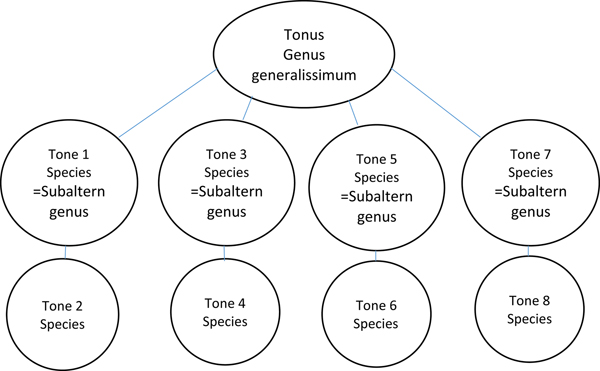
In Figure 5, tonus, symbolised by the enthroned bishop in the centre of the image, occupies the place of ‘most general genus’. The eight ecclesiastical tones are described as equal species of tonus, but this statement is immediately qualified. Under a different aspect the four authentic tones, species of tonus, can be construed as subaltern genera, of which the plagal tones are in turn species, one under each subaltern genus. Once this principle is understood, Hélie's theory is rendered clearer: the authentic tones are species of tonus, but they are concurrently subaltern genera with respect to the related plagals, which are species under them. This is exemplified in the diagram in Figure 6.
Genus/Species relationship of tonus and the eight tones.

Hélie confirms the genus–species relationship between authentic and plagal tones in rubric 14, defining it there with respect to tones 1 and 2, but the explanation can be applied to each of the other three authentic–plagal pairs.
In rubric 19 the plagals are again called species of the authentics:
Thus, to summarise: the authentics, species of tonus regarded as genus generalissimum, are under another aspect regarded as subaltern genera, each of which has a single species beneath it: its related plagal. The idea that each of the subaltern genera has but a single species makes for a somewhat stunted Tree of Porphyry, a point that does not diminish the coherence of Hélie's explanation.Footnote 45 All this constitutes a curious, but from a logical standpoint reasonable, conceptualisation of the tonal system of medieval chant. It is not concerned with the historical development of the system, but rather with modelling a philosophically grounded explication of the inherited structure.
Tonus and the tree of consanguinity
In rubric 10.6–10 (quoted earlier) Hélie introduced a parallel filiation (even in the etymological sense). With respect to a second type of ‘tree’ the authentic tones are said to be sons of tonus, and the plagal tones his grandsons, thus making the authentics their fathers: ‘the aforesaid four sons are as genus and head of the other four grandsons’ (10.8). The four authentic tones are said to relate to tonus as to their father and among themselves as ‘brothers’. Rubric 10.9–10 calls attention to the faint lines on the bishop's right (viewer's left) that link the medallions vertically with each other as brothers and horizontally with the figure of the bishop, their ‘father/tonus’.Footnote 46 The same feature is present in the medallions on the left (viewer's right) side of the bishop, where the plagal tones are called ‘sons’ of the authentics and grandsons of the aforementioned father [tonus]’.Footnote 47 One must imagine the lines passing behind the figure of the bishop linking the parallel medallion on either side. At the end of rubric 10, Hélie confirms the relationships among the tones as a tree of relationships, here identified specifically an arbor matrimonii, or tree of consanguinity (arbor consanguinitatis) as it was more generally known, in which the central figure ‘in persona hominis’ is the progenitor:
The mention of descendants hints that Hélie might have also had in mind a genealogical tree, which depicts individuals of a specific, often noble, family, thereby indicating lines of succession.Footnote 48 (One still speaks of a ‘branch’ of a family.)
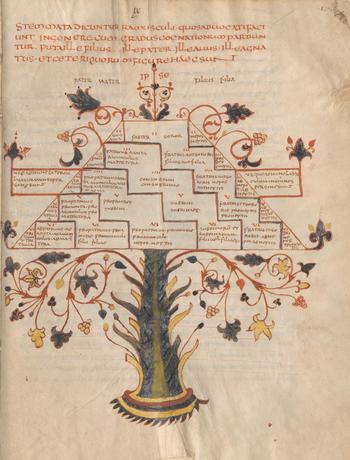
The medieval tree of consanguinity originated in the diagrams used in Roman law to display family relationships, direct and collateral, mainly for purposes of establishing inheritance and succession rights.Footnote 49 Also called arbor iuris from the ninth century, it passed into standard legal manuals such as the Decretals of Gratian (causae xxxiii–xxxvi) and those of Gregory IX.Footnote 50 In the Etymologiae, Isidore of Seville included a chapter entitled ‘De agnatis et cognatis’, to which he added three stemmata exemplifying the relationships.Footnote 51 Although Isidore referred to ‘ramusculi’, the depiction of an actual tree – trunk, branches and leaves – was not assumed, though the way was prepared for the eventual insertion of tree-like decoration or actual trees in later manuscripts. The ‘vegetalisation’ of such designs, displaying the shape of a tree with its branches, dates from the beginning of the ninth century (Fig. 7).Footnote 52
Isidorean arbor consanguinitatis (Montpellier, École de médicine, ms. 53, fol.138). (colour online)

According to Hermann Schadt, 90 per cent of the arbores consanguinitatis in the canon law manuals lack vegetal decoration, as one might expect in practical manuals designed for functionality rather than ostentation.Footnote 53 Most remained unadorned stemmata, not least of all due to the problems of adapting a physical tree, which ascends from a root, for a diagram that maps out descendants of a common ancestor.Footnote 54 Some ‘trees’ of this type were triangular geometric shapes, sometimes superimposed on a human figure.
The medieval Christian tree of consanguinity, unlike its Roman predecessor, determined degrees of family relationships between which marriage was licit or illicit, not questions of inheritance; hence the suitability of the of the alternate name ‘arbor matrimonii’. The ‘trees’ served canon lawyers, for whom determining impediments to marriage (or seeking dispensations from marriage) were a stock-in-trade. It is not at all surprising that Hélie Salomon would have adapted the tree of consanguinity as a demonstration model. The nearly two dozen legal maxims quoted in the Scientia artis musice confirm that he was familiar with the workings of the legal profession.Footnote 55
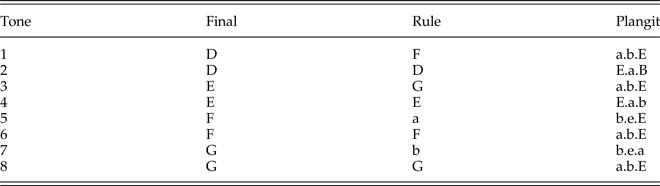
The inscription inside the top medallion (tone 1) on the viewer's left in Figure 5 is representative: ‘first tone / son of tonus / brother of the third [tone] / father of the second / .f.a.b.e.d’ (‘primus tonus / filius toni / frater tercii / pater secundi / .f.a.b.e.d’). Similarly, the tone-8 medallion (on the lower right) reads: ‘eighth tone / grandson of tonus / son of the seventh [tone] / companion of the sixth / .g.a.b.e.g’ (‘octavus tonus / nepos toni / filius septimi / socius sexti / .g.g.b.e.g’). The string of phrases and letters in each medallion (analysed in Table 2) delivers a maximum amount of information in a small space.
The Tonus medallions (Fig. 5).

The first four phrases in the medallions express the ‘family’ relationships already explained. The last letter of the following group of five letters is the final of the tone; the first is the ‘rule’ of the tone, identified elsewhere in the treatise as the third above the final in the authentics and the final itself in the plagals.Footnote 56 The author recommends that this letter be used as a clef at the beginning of a piece in order to indicate the tone (mode).Footnote 57
The function of the three middle letters (Table 2, col. 4) is more difficult to determine. They are described thus: ‘the remaining [letters] for a planctus ascending and descending, above as well as below’ (‘reliquas pro planctu ascendendo et descendendo, tam subtus se quam supra se’).Footnote 58 ‘Planctus’ and the related verb ‘plangere’, though they appear twenty-nine times in the Scientia artis musice, are found in no other medieval theory treatise in a technical sense. Neither term is ever defined in the Scientia, and the basic meaning of plangere, ‘to beat or strike’ (also ‘to lament or bewail’), sheds little light on the intended meaning. Hélie is quite insistent that certain pitches can be ‘planged’, while others cannot under any circumstances be associated with ‘plangere’ or be subjected to whatever the word implies.Footnote 59 The three pitches associated with plangere in the treatise (E/e, a, B/b) have a semitone above, necessarily so in the case of E/e and B/b, potentially so in the case of a, assuming the presence of ♭. This obvious commonality does not go very far in explaining why a special term would need to be employed to describe them. In the Gregorian repertoire, a is found most often with a whole tone above. Nor is it obvious why the pitches are listed each time in a different order (Table 2, col. 4).
The image of tonus flanked by medallions representing his ‘descendants’ is framed by five concentric circles drawn alternately in blue and red ink. Letters, roman numerals and hexachord syllables (puncti) are inserted at widely spaced intervals inside the rings. The letters A–G in the outermost ring run in a counter clockwise direction, beginning beneath the bishop's feet. The seven claves (i–vii) in the second ring begin opposite G (gama) on the lower left and also run counter clockwise. They stand in exact correspondence to the seven letters of the outer ring.
It appears that, of the sol-fa syllables, only ut, re and la are aligned with entries in the other rings. Whether or not this is intentional is difficult to establish. The syllable ‘la’ is aligned with clavis 7 and the letter F, a pitch which can be sung only to ‘fa’ or ‘do’ (soft hexachord), never to ‘la’.Footnote 60 Placed in the innermost ring are the eight tones, not in numerical order (1–8) but each opposite the letter ‘on which each tone makes its letter’ (‘in qua littera quilibet tonorum facit litteram suam’), that is, opposite the pitch that corresponds to the ‘rule’ of the tone (and the preferred clef letter). The four rings along with the material enclosed within them demonstrate the power of a single image to impress upon the memory in a compact form the essential elements of a teaching.Footnote 61
While the figure of a bishop representing tonus as most general genus in a tree of Porphyry might pass with only a brief comment, a celibate bishop's role as ‘father’ of the four authentic tones and ‘grandfather’ of the plagal tones might seem more than a little awkward. It was not uncommon, however, for medieval trees of consanguinity to include a ‘presentation figure’ of authoritative standing, like an emperor or king.Footnote 62 In a genealogical tree that role would have been fulfilled by the ancestor regarded as the founder of the house. In the present context it seems fitting that Pope Gregory, whose identity (as we have seen) can be confirmed by the second image in the treatise (Fig. 4), should be enthroned in his role as inventor and fons et origo of the tonal system of the chant that bears his name.Footnote 63 The authentic and plagal tones can be related to him as ‘descendants’.
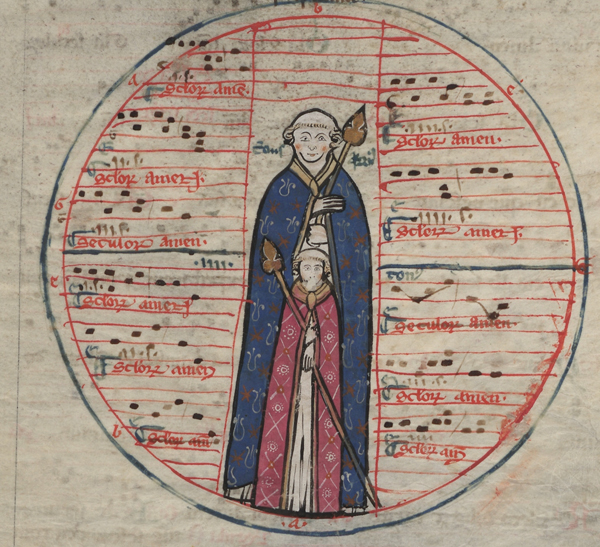
Four of the circular images in the Scientia artis musice depict paired authentic and plagal tones with their respective seculorum.Footnote 64 They are related to the tonus image just discussed, though the connection is never specifically brought out. Figure 8, which illustrates tones 3 (authentic) and 4 (plagal), may serve as a representative example. Here and in the other three parallel images the abstract medallions of the tonus illustration become ‘enfleshed’ as cantors – one tall, the other short – recognisable by their staffs of office. The taller in a blue cope represents the authentic tone; the shorter in a red-coloured cope, its related plagal – in other words, the son and grandson of tonus, respectively. The other three images of the tones are similar, even to the colour of the copes worn by the cantors.Footnote 65 On either side of the two figures are the (crudely notated) seculorum of the psalm tones – the authentic (3) at the top and the related plagal (4) at the bottom. The clefs, puncti and lines intended to represent the staff were drawn by hand. Their roughness contrasts sharply with the perfect circles framing the Scientia’s images.
Tones 3 and 4 with seculorum (Milan, Bibl. Ambrosiana, D 75 inf., fol. 17r). (colour online)

Other musical trees
Hélie Salomon was not the only music theorist to employ a tree as an illustrative model, but all of the other ‘musical’ trees demonstrate rhythmic relationships – not the structure of the tonal system as is Hélie's intent.Footnote 66 There are two minutely detailed ‘trees’ of rhythmic values in the treatise known as Quatuor principalia.Footnote 67 The Ars mottetorum of Petrus Picardus refers to two trees devised by a certain Johannes de Burgundia, but the intended diagrams were never entered in any of the three surviving manuscripts of the treatise.Footnote 68 One of Johannes's trees would have illustrated the relationship among the long, breve and semibreve; the other, the relationship among ligatures on the basis of propriety, perfection, etc. Johannes Vetulus de Anagnia (14th century) employed six complex trees in his exposition of rhythmic values.Footnote 69 The composer and theorist Johannes Ciconia supposed the entire ars musica could be represented in the image of a tree, of which the branches are the consonances. The flowers represent species (of fourths and fifths); the apples, proportions.Footnote 70 It was not a concept that he developed further. Such trees illustrate (1) how many very short rhythmic values (minima) fit into a longer one (semibrevis), and (2) how many of both fit into a still longer value (brevis). They foreshadow the diagrams familiar from modern music theory books that illustrate for beginners the relationship of note values from the semibreve to the hemidemisemiquaver.
Pedagogical value of images
Though the saying that ‘a picture is worth a thousand words’ is of fairly recent coinage (the early twentieth century, in fact), the wisdom of that adage has long been appreciated. In De memoria et reminiscentia Aristotle affirmed that ‘it is not possible to think without an image’ (‘νοεῖν οὐκ ἐστιν ἄνευ φαντάσματος’).Footnote 71 He restated this in De anima: ‘to the thinking soul images serve as if they were contents of perception … hence the soul never thinks without an image’ (‘τῇ δὲ διανοητικῇ ψυχῇ τὰ φαντάσματα οἷον αἰσθήματα ὑπάρχει … διὸ οὐδέποτε νοεῖ ἂνευ φαντάσματός ἡ ψυχή’).Footnote 72 In De memoria he affirmed the principle that memory, ‘which relates to what is past’, cannot exist without an image.Footnote 73 He did not mean, of course, that an ‘image’ (‘φάντασμα’) had to be exclusively a mental picture of some physical object; it could be closer to what we might think of as an idea, concept or mental construct of some sort preserved in the absence of a present stimulus or object of sensation. Persisting in memory, images could be recalled as required and used as the subject of further contemplation (to speak in philosophical terms). Once imprinted on the memory, an image recalled the content of the image in its physical absence. Aristotle observed as much in De insomniis: ‘even when the external object of perception has departed, the impressions it has made persist and are themselves objects of perception’.Footnote 74 Since ‘the sense organ is capable of receiving the sensible object without its matter … even when the sensible objects are gone, the sensings and imaginings continue to exist in the sense-organs’.Footnote 75
Book 3 of the anonymous Rhetorica ad Herennium, believed in the Middle Ages to be an authentic work of Cicero, promoted the use of images in the exercise of ‘artificial’ memory. Whilst natural memory might suffice for many tasks, more complex and demanding ones required mastery of specialised techniques.Footnote 76 The Rhetorica ad Herennium recommended that ‘we ought to set up images of a kind that can adhere longest in the memory, and we shall do so if we establish images as striking as possible’. Important were not just the images themselves, which should be colourful and memorable, but also their background and arrangement.Footnote 77 Not all of these aspects are germane to the images in the Scientia, but Rhetorica ad Herennium’s emphasis on the importance of images of a striking character most certainly is.
Thomas Aquinas, commenting on memory as part of the virtue of prudence, observed that ‘when a man wishes to remember a thing, he should adopt some suitable likenesses, not, however, ones too ordinary, because we are struck more by what is out of the ordinary (ea que sunt inconsueta), and thus in such things the mind is more and more intensely occupied’.Footnote 78 Whatever is more strongly impressed on the mind and frequently recalled is less likely to be forgotten. Thomas's teacher, Albert the Great (c.1193–1280), in arguing for a by then traditional practice, expressed similar views: ‘in images, so that we might remember through them, we have need of two things, that is, study and that [they be] uncommon and unusual; which [images] as they are remarkable, we organize for ourselves’.Footnote 79 Albert and Thomas were, of course, speaking of the ars memorativa that assigned arbitrary meaning to exceptional images, but the points about serious application (studium) and the value of images that were out of the ordinary possess a perennial validity. The figure of the bishop and the contents of the medallions in rubric 9 (Fig. 5) or that of the organum singers confirm this principle. It is safe to say that Hélie's teaching is rendered memorable by its presentation within the framework of multifaceted images.Footnote 80
In chapter 3 of the first book of the Rationale Divinorum Officorum (‘De picturis et cortinis et ornamentis ecclesiae’), Guillaume Durand alluded to Gregory the Great's letter (Ep. 9.209) on the value and appropriateness of images of the saints that were venerated in churches. Durand affirmed that ‘a picture moves the spirit more than something written’ (‘pictura namque videtur movere animum quam scriptura’).Footnote 81 The image places something, a ‘res gesta’, vividly before the eyes, but a text merely recalls the same to the memory through the sense of hearing, ‘which moves the mind less’ (‘qui minus animum movet’). Though Durand is concerned exclusively with sacred images, the principle could easily be applied to those in the Scientia artis musice.
Conclusion
As I have tried to show, images were powerful tools for the acquisition and organisation of knowledge in the Middle Ages.Footnote 82 The Scientia artis musice, which has all the marks of being a record of its author's oral teaching, was not directed to learned university students and masters, but to cantors and young students who might profit from the instruction.Footnote 83 It may be that the eight figurae in the manuscript once formed a component of Hélie Salomon's pedagogical endeavours. Larger versions of some of them might have been mounted on a wall for purposes of instruction, though we know nothing about Hélie's career as chant instructor.Footnote 84 The contents of the Scientia artis musice strongly suggest, however, that he had a good many years of practical experience as a teacher.
The unusual character of the images in the Scientia artis musice – unique in the music theory literature of the Middle Ages – would have facilitated their retention in memory and thus recall the teaching they embodied. Unfortunately, they never had an opportunity to fulfil this promise, since the treatise disappeared into a cupboard in Lyon, not to be discovered until more than three centuries had passed.
At present, when the public is bombarded with a surfeit of images, their impact is far less than it once was. More than sixty-five years ago, the philosopher Joseph Pieper went so far as to say that ‘man's ability to see is in decline’ because ‘the average person of our time loses the ability to see because there is too much to see!’ (italics original).Footnote 85 He said this at a time when relatively few people had television sets in their homes – much less Internet connections and an endless series of apps. Advertisers have long appreciated the power of images and that an image must be simple and intelligible at first glance, for it will soon be shoved aside by another one. Understanding complex images like those in the Scientia artis musice requires more of the viewer – medieval or modern – than can be satisfied by a casual glance. Hélie Salomon, more than any other music theorist of the Middle Ages, appreciated this fact and in his teaching. In the Scientia artis musice he attributed to the image a significant pedagogical role. As Aristotle maintained (and as our author would have agreed), ‘it is not possible to think without an image’ – even about medieval chant theory!