


1. Introduction
Convection driven by internally generated heat is a common physical phenomenon and underpins several problems in geophysics, such as mantle convection (Schubert, Turcotte & Olson Reference Schubert, Turcotte and Olson2001; Mulyukova & Bercovici Reference Mulyukova and Bercovici2020). One important open problem is to characterise the vertical heat transport as a function of the heating strength, measured by the non-dimensional Rayleigh number R. Simulations and experiments (Hewitt, McKenzie & Weiss Reference Hewitt, McKenzie and Weiss1980; Ishiwatari, Takehiro & Hayashi Reference Ishiwatari, Takehiro and Hayashi1994; Lee, Lee & Suh Reference Lee, Lee and Suh2007; Goluskin Reference Goluskin2015) reveal that the heat transport increases with the heating strength, and heuristic scaling laws based on physically reasonable, but unproven, assumptions have been put forward (Goluskin Reference Goluskin2016). However, corroborating or disproving such heuristic arguments through the derivation of rigorous R-dependent bounds remains a challenge (Arslan et al. Reference Arslan, Fantuzzi, Craske and Wynn2021).
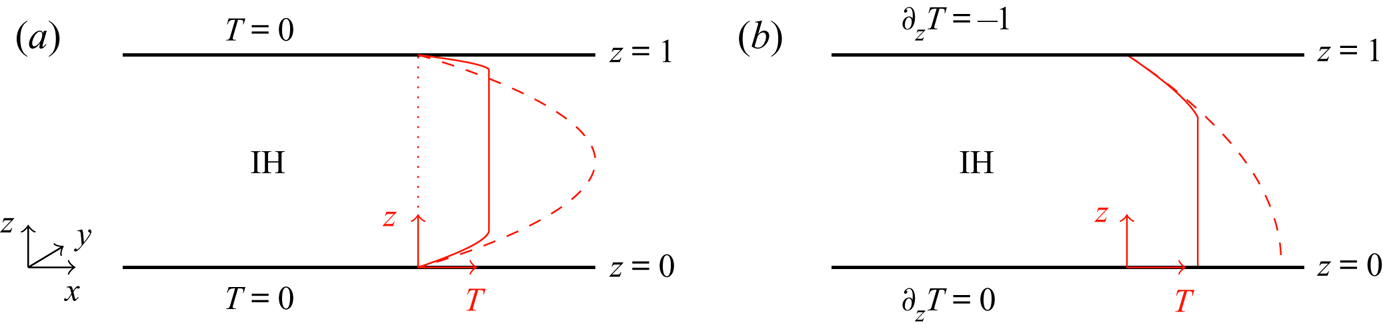
For internally heated (IH) convection between isothermal boundaries, a major difficulty in bounding the heat transport is the subtle interplay between the lower and upper thermal boundary layers (Arslan et al. Reference Arslan, Fantuzzi, Craske and Wynn2021). In contrast to Rayleigh–Bénard convection, for which fixed-temperature or fixed-flux boundary conditions are symmetric and produce unstable thermal boundary layers, internal heating produces positive buoyancy that acts in the positive vertical direction and therefore creates asymmetry in relation to the lower and upper boundaries (see Figure 1a). In this regard, the lower thermal boundary layer of IH convection (see, for example, Goluskin & van der Poel Reference Goluskin and van der Poel2016) has a different character from those found in Rayleigh–Bénard convection, and is stably stratified.
The IH convection (a) with isothermal boundaries, studied by Arslan et al. (Reference Arslan, Fantuzzi, Craske and Wynn2021), and (b) with fixed-flux boundary conditions, studied in this paper. In both panels, IH represents the uniform unit internal heat generation. Red dashed lines denote the conductive temperature profiles, and red solid lines denote indicative mean temperature profiles in the turbulent regime.

In this study, we remove the subtleties associated with the lower boundary by specifying a zero-flux condition, as illustrated in figure 1(b). The hypothesis behind this choice is that the resulting problem will be driven primarily by the properties of the unstably-stratified thermal boundary layer near the top boundary and, therefore, will bear a closer resemblance to Rayleigh–Bénard convection. To ensure that the energy generated internally leaves the domain and the fluid's temperature does not increase without bound, we also replace the isothermal top boundary with one satisfying a fixed-flux condition. These boundary conditions idealise models of mantle convection, where radioactive decay provides the internal heating, the core-mantle boundary is approximated by a thermal insulator and a warm crust or atmosphere limits the rate of heat loss to space (Kiefer & Li Reference Kiefer and Li2009; Trowbridge et al. Reference Trowbridge, Melosh, Steckloff and Freed2016; Mulyukova & Bercovici Reference Mulyukova and Bercovici2020).
Within this flow configuration, our goal is to bound the dimensionless convective heat flux  $\langle w T \rangle$, where angled brackets denote an average over volume and infinite time. This quantity is related to the mean temperature difference between the top and bottom boundaries: multiplying the equation governing the evolution of temperature (see § 2) by the vertical coordinate
 $z$ and integrating by parts over the volume and infinite time yields
 \begin{equation} \langle w T \rangle+\overline{T}_{0}-\overline{T}_{1}=\tfrac{1}{2}, \end{equation}
with  $\overline {T}_{0}$ and
 $\overline {T}_{1}$ denoting the average temperatures of the bottom and top boundaries, respectively, where the average is over the horizontal directions and infinite time. The right-hand side of (1.1) represents the input of potential energy (
 $1/2$), which balances the reversible work
 $\langle wT\rangle$ done by the velocity field (equal to the average viscous dissipation) and the unknown rate
 $\overline {T}_{0}-\overline {T}_{1}$ at which the fluid's potential energy decreases due to conduction. Thus,
 $\langle wT \rangle =0$ corresponds to the static case of upward conductive transport,
 $\langle wT \rangle = \frac 12$ corresponds to purely convective transport between boundaries of equal mean temperature, and
 $\langle wT \rangle > \frac 12$ implies downward conduction on average.
The sign of the conductive term  $\overline {T}_{0}-\overline {T}_{1}$ is a priori unknown, but it can be shown that
 $|\overline {T}_{0}-\overline {T}_{1}|\leq |\langle T\rangle - \overline {T}_{1}|^{1/2}$ (Goluskin Reference Goluskin2016). For sufficiently large Rayleigh numbers, this estimate can be combined with the lower bound
 $c {\textit {R}}^{-1/3}< \langle T \rangle -\overline {T}_{1}$ (Lu, Doering & Busse Reference Lu, Doering and Busse2004) and the upper bound
 $\langle T \rangle -\overline {T}_{1} \leq \frac {1}{3}$ (Goluskin Reference Goluskin2015) to yield
 $\langle wT \rangle \leq \frac {1}{2}+\frac {1}{\sqrt {3}}$ uniformly in
 $R$. However, assuming that
 $\overline {T}_{0}$ and
 $\langle T \rangle$ scale similarly with the Rayleigh number, Goluskin (Reference Goluskin2016) conjectured that the mean vertical heat flux should satisfy
 $\langle wT \rangle \leq \frac {1}{2} - O(R^{-1/3})$.
The present work proves that
 \begin{equation} \langle wT \rangle \leq \frac 12 \left(\frac{1}{2}+\frac{1}{\sqrt{3}} \right) - c {\textit{R}}^{-(1/3)}, \end{equation}
with  $c \approx 1.6552$. This bound scales with R exactly as conjectured and asymptotes to (approximately)
 $0.5387$, which is slightly larger than
 $\frac{1}{2}$ but halves the only existing uniform bound. To obtain (1.2), we employ the background method (Doering & Constantin Reference Doering and Constantin1994, Reference Doering and Constantin1996; Constantin & Doering Reference Constantin and Doering1995) interpreted as the search for a quadratic auxiliary function (Chernyshenko et al. Reference Chernyshenko, Goulart, Huang and Papachristodoulou2014; Fantuzzi et al. Reference Fantuzzi, Goluskin, Huang and Chernyshenko2016; Chernyshenko Reference Chernyshenko2017; Rosa & Temam Reference Rosa and Temam2020). This interpretation makes it easier to derive a convex variational problem that yields bounds on
 $\langle w T \rangle$ even though, contrary to traditional applications of the background method, the heat flux in IH convection is not directly related to the thermal dissipation.
The work is structured as follows. Section 2 presents the governing equations. In § 3, we derive the variational problem to bound  $\langle wT \rangle$ from above. Analytical and numerical bounds are presented in §§ 4 and 5, respectively. Section 6 offers concluding remarks.
2. Model
We consider a uniformly heated layer of fluid bounded between two horizontal plates at a vertical distance  $d$. The fluid has kinematic viscosity
 $\nu$, thermal diffusivity
 $\kappa$, density
 $\rho$, specific heat capacity
 $c_p$, and thermal expansion coefficient
 $\alpha$. The dimensional heating rate per unit volume
 $Q$ is constant in time and space. For simplicity, we assume that the layer is periodic in the horizontal (
 $x$ and
 $y$) directions, with periods
 $L_x$ and
 $L_y$. While these values affect the mean vertical heat flux, the analytical bounds derived below do not depend on
 $L_x$ or
 $L_y$ and therefore apply to domains of all sizes (including the limiting case of a horizontally infinite fluid layer).
To make the problem non-dimensional, we use  $d$ as the characteristic length scale,
 $d^{2}/\kappa$ as the time scale and
 $d^{2}Q/\kappa \rho c_p$ as the temperature scale. The motion of the fluid in the non-dimensional domain
 $\varOmega = [0,L_x] \times [0,L_y] \times [0,1]$ is then governed by the Boussinessq equations
 $$\begin{gather} \boldsymbol{\nabla} \boldsymbol{\cdot} \boldsymbol{u} = 0, \end{gather}$$
 $$\begin{gather}\partial_t \boldsymbol{u}+ \boldsymbol{u}\boldsymbol{\cdot} \boldsymbol{\nabla} \boldsymbol{u} + \boldsymbol{\nabla} p = {\textit{Pr}} ({\nabla}^{2}\boldsymbol{u} + {\textit{R}} T \boldsymbol{\hat{\boldsymbol{z}}}), \end{gather}$$
 $$\begin{gather}\partial_t T + \boldsymbol{u}\boldsymbol{\cdot} \boldsymbol{\nabla} T = {\nabla}^{2}T + 1, \end{gather}$$
where  $\boldsymbol {u}$ is the fluid velocity,
 $p$ is the pressure, and the unit forcing in (2.1c) represents the non-dimensional internal heating rate. The no-slip, fixed-flux boundary conditions are expressed by
 $$\begin{gather} \left.{\boldsymbol{u}}\right\rvert_{z=0}^{} = \left.{\boldsymbol{u}}\right\rvert_{z=1}^{} =0, \end{gather}$$
 $$\begin{gather}\left.{\partial_z T}\right\rvert_{z=0}^{} = 0, \quad\left.{\partial_z T}\right\rvert_{z=1}^{} ={-}1. \end{gather}$$
The dimensionless quantities
 \begin{equation} {\textit{Pr}} = \frac{\nu}{\kappa} \quad\text{and}\quad {\textit{R}} = \frac{g \alpha Q d^{5}}{\rho c_p \nu \kappa^{2}}, \end{equation}
where  $g$ is the acceleration of gravity, are the only two non-dimensional control parameters. The former is the usual Prandtl number, which measures the ratio of momentum and heat diffusivity. The latter, instead, measures the destabilising effect of internal heating compared with the stabilising effects of diffusion, and may therefore be interpreted as a Rayleigh number.
Since the volume-averaged temperature  $\int\kern-8pt - T(\boldsymbol {x},t) \textrm {d}\kern0.06em \boldsymbol {x}$ is conserved in time, we assume it to be zero without loss of generality. With this extra condition, the governing equations admit the solution
 $\boldsymbol {u}=\boldsymbol {0}$,
 $p = \text {constant}$ and
 $T = -({z^{2}}/{2}) + \frac 16$ at all
 $ {\textit {R}}$, which represents a purely conductive state. This state is globally asymptotically stable irrespective of the horizontal periods
 $L_x$ and
 $L_y$ if
 $ {\textit {R}} < 1429.86$, and it is linearly unstable when
 $ {\textit {R}} > 1440$ for sufficiently large horizontal periods (Goluskin Reference Goluskin2015). Convection ensues above this Rayleigh number for at least one choice of the horizontal periods, and cannot currently be ruled out above the known global stability threshold. We are therefore interested in bounds on
 $\langle wT \rangle$ that hold for arbitrary
 $ {\textit {R}} \geq 1429.86$.
3. Bounding framework
To derive an upper bound on  $\langle wT \rangle$, it is convenient to lift the inhomogeneous boundary condition on the temperature by introducing the temperature perturbation
 \begin{equation} \theta(\boldsymbol{x},t) = T(\boldsymbol{x},t) + \frac{z^{2}}{2} -\frac 16. \end{equation}
The heat equation (2.1c) and boundary conditions (2.2b) show that  $\theta$ satisfies
 $$\begin{gather} \partial_t \theta + \boldsymbol{u}\boldsymbol{\cdot} \boldsymbol{\nabla} \theta = {\nabla}^{2}\theta + z w, \end{gather}$$
 $$\begin{gather}\left.{\partial_z\theta}\right\rvert_{z=0}^{} = 0, \quad\left.{\partial_z\theta}\right\rvert_{z=1}^{} = 0. \end{gather}$$
To rewrite the heat flux in terms of  $\theta$, observe that, by virtue of incompressibility and of the boundary conditions in (2.2a), the horizontal-and-time average
 $\bar {w}(z)$ of the vertical velocity
 $w$ vanishes for all
 $z$. Then
 \begin{equation} \langle w f(z) \rangle= \int_0^{1} \bar{w}(z) f(z) \, \textrm{d}z = 0 \end{equation}
for any  $z$-dependent function
 $f(z)$, and in particular we conclude that
 \begin{equation} \langle wT \rangle = \langle w\theta \rangle. \end{equation}
A rigorous upper bound on  $\langle w\theta \rangle$ can be derived using the auxiliary functional method (Chernyshenko et al. Reference Chernyshenko, Goulart, Huang and Papachristodoulou2014) with the quadratic auxiliary functional
 \begin{equation} \mathcal{V}\{\boldsymbol{u}, \theta \} = \int\kern-8pt -_{\varOmega} \frac{a}{2 {\textit{Pr}} {\textit{R}}} |\boldsymbol{u}|^{2} + \frac{b}{2} |\theta|^{2} - \phi(\boldsymbol{x}) \theta - \boldsymbol{\psi}(\boldsymbol{x}) \boldsymbol{\cdot} \boldsymbol{u}\,\textrm{d}\kern0.06em \boldsymbol{x}, \end{equation}
where the non-negative scalars  $a$ and
 $b$, the function
 $\phi$ and the vector field
 $\boldsymbol {\psi }$ are to be optimised in order to obtain the best possible bound. Chernyshenko (Reference Chernyshenko2017) showed that this is equivalent to employing the background method: the profile
 ${\phi }/{b}$ is the background temperature (defined with respect to
 $\theta$), the vector field
 $({Pr R}/{a}) \boldsymbol {\psi }$ is the background velocity, and
 $a$ and
 $b$ are the so-called balance parameters. Contrary to the classical background method, there is no need to impose boundary or incompressibility conditions on
 $\boldsymbol {\psi }$ or
 $\phi$ when defining
 $\mathcal {V}$. To simplify the analysis below, however, we take
 $\boldsymbol {\psi }$ to be incompressible, horizontally periodic and vanishing at the top and bottom plates. The optimality of these choices can be proved rigorously, but the details are beyond the scope of this work.
Arguments identical to those given by Goluskin & Fantuzzi (Reference Goluskin and Fantuzzi2019, appendix A) show that the auxiliary function (3.5) may be taken to be invariant under arbitrary horizontal translations and under the ‘horizontal flow reversal’ variable transformation
 \begin{equation} \begin{pmatrix}\boldsymbol{u}(\boldsymbol{x},t)\\ \theta(\boldsymbol{x},t) \\ p(\boldsymbol{x},t)\end{pmatrix} \mapsto \begin{pmatrix} \mathsf{G} \boldsymbol{u}(\mathsf{G}\boldsymbol{x},t)\\ \theta(\mathsf{G}\boldsymbol{x},t) \\ p(\mathsf{G}\boldsymbol{x},t)\end{pmatrix},\qquad \mathsf{G}= \begin{pmatrix}-1 & 0 & 0\\ 0 & -1 & 0\\ 0 & 0 & 1\end{pmatrix}. \end{equation}
This is because the governing equations (2.1a), (2.1b) and (3.2a) are invariant under the same set of transformations. Invariance under horizontal translation requires  $\phi (\boldsymbol {x})=\phi (z)$ and
 $\boldsymbol {\psi }(\boldsymbol {x})=\boldsymbol {\psi }(z)$. In particular, the incompressibility and no-slip conditions on
 $\boldsymbol {\psi }$ imply that we must have
 $\boldsymbol {\psi }(z) = (\psi _1(z), \psi _2(z), 0)$. Invariance under (3.6a,b) then requires
 $\psi _1(z)=\psi _2(z)=0$, so
 $\boldsymbol {\psi }=\boldsymbol {0}$.
Making these restrictions from now on, it can be shown that  $\mathcal {V}\{\boldsymbol {u}(t), \theta (t) \}$ remains uniformly bounded in time along solutions of (2.1b) and (3.2a) for any given initial velocity and temperature. We can therefore use the fundamental theorem of calculus and the governing equations to write
 \begin{align} \langle w \theta \rangle
&= \limsup_{\tau \rightarrow \infty}\frac{1}{\tau}
\int_{0}^{\tau} \int\kern-8pt -_{\varOmega} w\theta +
\frac{\textrm{d}}{
\textrm{d}t}\mathcal{V}\{\boldsymbol{u}(t),\theta(t)\}\,\textrm{d}\kern0.7pt\boldsymbol{x}\,\textrm{d}t
\nonumber\\ &= \limsup_{\tau \rightarrow
\infty}\frac{1}{\tau} \int_{0}^{\tau} \int\kern-8pt -_{\varOmega} w\theta +
\frac{a}{ {\textit{Pr}} {\textit{R}}}\boldsymbol{u}
\boldsymbol{\cdot} \partial_t \boldsymbol{u} + b \theta \partial_t
\theta - \phi(z)\partial_t \theta
\,\textrm{d}\kern0.06em\boldsymbol{x}\,\textrm{d}t \nonumber\\ &= U
-\liminf_{\tau \rightarrow \infty}\frac{1}{\tau}
\int_{0}^{\tau} \mathcal{S}\{\boldsymbol{u}(t),\theta(t) \}
\,\textrm{d}t \end{align}
for any constant  $U$, where
 \begin{equation} \mathcal{S}\{\boldsymbol{u},\theta\} = \int\kern-8pt -_{\varOmega} \frac{a}{R}|\boldsymbol{\nabla}\boldsymbol{u}|^{2} + b |\boldsymbol{\nabla} \theta|^{2} - (a+1 +bz - \phi' )w\theta -\phi' \partial_z\theta + U\, \textrm{d}\kern0.06em\boldsymbol{x} \end{equation}
and primes denote derivatives with respect to  $z$. The last equality in (3.7) is obtained after a few integrations by parts that exploit the boundary conditions, incompressibility and the identity (3.3). The bound
 $\langle w T \rangle = \langle w\theta \rangle \leq U$ follows from (3.4) and (3.7) if
 $\mathcal {S}\{\boldsymbol {u},\theta \}$ is non-negative for all time-independent velocities
 $\boldsymbol {u}$ and temperature perturbations
 $\theta$ that satisfy incompressibility and the boundary conditions in (2.2a) and (3.2b). Our goal, therefore, is to choose
 $a$,
 $b$ and
 $\phi (z)$ such that this condition holds for the smallest possible
 $U$.
To simplify this task, we invoke the horizontal periodicity and expand the velocity and temperature fields using Fourier series:
 \begin{equation} \begin{bmatrix} \theta(x,y,z)\\ \boldsymbol{u}(x,y,z) \end{bmatrix} = \sum_{\boldsymbol{k}} \begin{bmatrix} \hat{\theta}_{\boldsymbol{k}}(z)\\ \hat{\boldsymbol{u}}_{\boldsymbol{k}}(z) \end{bmatrix} \exp({\textrm{i}(k_x x + k_y y)}). \end{equation}
The sum is over wavevectors  $\boldsymbol {k}=(k_x,k_y)$ of magnitude
 $k = \sqrt {k_{\smash {x}}^{2} + k_{\smash {y}}^{2}}$ that are compatible with the horizontal periods
 $L_x$ and
 $L_y$. The (complex-valued) Fourier amplitudes
 $\hat {\theta }_{\boldsymbol {k}}$ and
 $\hat {\boldsymbol {u}}_{\boldsymbol {k}}=(\hat {u}_{\boldsymbol {k}}, \hat {v}_{\boldsymbol {k}},\hat {w}_{\boldsymbol {k}})$ satisfy
 $$\begin{gather} \hat{u}_{\boldsymbol{k}}(0) = \hat{u}_{\boldsymbol{k}}(1)= \hat{v}_{\boldsymbol{k}}(0) = \hat{v}_{\boldsymbol{k}}(1)=0, \end{gather}$$
 $$\begin{gather}\hat{w}_{\boldsymbol{k}}(0) = \hat{w}_{\boldsymbol{k}}'(0) = \hat{w}_{\boldsymbol{k}}(1) = \hat{w}_{\boldsymbol{k}}'(1)= 0, \end{gather}$$
 $$\begin{gather}\hat{\theta}_{\boldsymbol{k}}'(0)=\hat{\theta}_{\boldsymbol{k}}'(1) = 0. \end{gather}$$
After substituting (3.9) into (3.8), the Fourier-transformed incompressibility condition  $ik_x \hat {u}_{\boldsymbol {k}} + ik_y \hat {v}_{\boldsymbol {k}} + \hat {w}_{\boldsymbol {k}}' = 0$ can be combined with Young's inequality to estimate
 \begin{equation} \mathcal{S}\{\boldsymbol{u},\theta\} \geq \mathcal{S}_{0}\{\hat{\theta}_0\} + \sum_{\boldsymbol{k}} \mathcal{S}_{\boldsymbol{k}} \{\hat{w}_{\boldsymbol{k}}, \hat{\theta}_{\boldsymbol{k}}\}, \end{equation}
where
 \begin{equation} \mathcal{S}_0\{\hat{\theta}_0\}:= U + \int^{1}_{0} b|\hat{\theta}'_0(z)|^{2} - \phi'\hat{\theta}'_0(z)\,\textrm{d}z \end{equation}
and
 \begin{align} \mathcal{S}_{\boldsymbol{k}}\{\hat{w}_{\boldsymbol{k}},\hat{\theta}_{\boldsymbol{k}}\} := \int^{1}_{0} \frac{a}{R}\left(\frac{|\hat{w}''_{\boldsymbol{k}}(z)|^{2}}{k^{2}} + 2|\hat{w}'_{\boldsymbol{k}}(z)|^{2} + k^{2}|\hat{w}_{\boldsymbol{k}}(z)|^{2} \right) +b|\hat{\theta}'_{\boldsymbol{k}}(z)|^{2} \nonumber\\ + bk^{2}|\hat{\theta}_{\boldsymbol{k}}(z)|^{2} - [a+1+bz - \phi'(z)]\hat{w}_{\boldsymbol{k}}(z)^{*}\hat{\theta}_{\boldsymbol{k}}(z) \, \textrm{d}z. \end{align}
Standard arguments (see e.g. Arslan et al. Reference Arslan, Fantuzzi, Craske and Wynn2021) show that the right-hand side of (3.11) is non-negative if and only if each summand is non-negative, and that to check these conditions one can assume that  $\hat {w}_{\boldsymbol {k}}$ and
 $\hat {\theta }_{\boldsymbol {k}}$ are real functions. Thus, the best bound on
 $\langle w T \rangle$ is found upon solving the optimisation problem
 \begin{equation} \begin{aligned}
\inf_{U,\phi'(z),a,b} \{U:\quad &
\mathcal{S}_0\{\hat{\theta}_0\} \geq 0 \quad\forall\
\hat{\theta}_0 \text{ s.t. }
(3.10c),\\ &
\mathcal{S}_{\boldsymbol{k}}\{\hat{w}_{\boldsymbol{k}},\hat{\theta}_{\boldsymbol{k}}\}
\geq 0 \quad\forall\
\hat{w}_{\boldsymbol{k}},\hat{\theta}_{\boldsymbol{k}}
\text{ s.t. }(3.10a),
\forall \boldsymbol{k}\neq 0\}. \end{aligned}
\end{equation}
We refer to the condition  $\mathcal {S}_{\boldsymbol {k}}\{\hat {w}_{\boldsymbol {k}},\hat {\theta }_{\boldsymbol {k}}\} \geq 0$ as the spectral constraint and consider
 $\phi '$, rather than
 $\phi$, as the optimisation variable because only the former appears in the problem.
4. Analytical bound
To derive an analytical bound on  $\langle wT \rangle$, we begin by observing that
 \begin{equation} \mathcal{S}_0\{\hat{\theta}_0\} = \int^{1}_{0} b\left(\hat{\theta}'_{0}(z) - \frac{\phi'(z)}{2b} \right)^{2} - \frac{\phi'(z)^{2}}{4b} + U\, \textrm{d}z \geq U - \int^{1}_{0}\frac{\phi'(z)^{2}}{4b}\textrm{d}z, \end{equation}
so the constraint on  $\mathcal {S}_0$ in (3.13) is satisfied if we choose
 \begin{equation} U = \int^{1}_{0}\frac{\phi'(z)^{2}}{4b}\,\textrm{d}z. \end{equation}
This choice is also optimal because the lower bound in (4.1) is sharp. To see this, let  $\hat {\theta }_0$ be such that
 $\hat {\theta }_0'(z) = ({1}/{2b})\phi '(z)$ except for boundary layers of width
 $\epsilon$ near
 $z=0$ and
 $z=1$, where
 $\hat {\theta }_0'(z)=0$ to satisfy (3.10c). Then, let
 $\epsilon \to 0$ and apply Lebesgue's dominated convergence theorem to conclude that
 $\mathcal {S}\{\hat{\theta}_{0}\}$ converges to the right-hand side of (4.1).
Next, we seek constants  $a$ and
 $b$ and a function
 $\phi (z)$ that minimise the right-hand side of (4.2) whilst satisfying the spectral constraint in (3.13). The simplest way to ensure this is to set
 $\phi '(z)=a+1+bz$, because then the only sign-indefinite term in
 $\mathcal {S}_{\boldsymbol {k}}$ vanishes. This choice yields
 \begin{equation} \langle wT \rangle \leq U = \frac{1}{12} \left[ b + 3(a+1) + \frac{(a+1)^{2}}{b} \right], \end{equation}
which attains the minimum value of  $\frac {1}{2}(\frac {1}{2} + \frac {1}{\sqrt {3}})$ when
 $b=\sqrt {3}(a+1)$ and
 $a=0$.
While this simple construction already halves the uniform bound proved by Goluskin (Reference Goluskin2016), an even better result that depends explicitly on the Rayleigh number can be obtained by letting  $\phi '$ develop boundary layers of width
 $\delta$ near
 $z=0$ and
 $z=1$. Specifically, we still fix
 \begin{equation} b = \sqrt{3}(a+1), \end{equation}
but this time take
 \begin{equation} \phi '(z) = (a + 1)\xi (z),\quad \xi (z) = \left\{ \begin{array}{l}
\left( {\frac{1}{\delta } + \sqrt 3 } \right)z,\,\,\,\,\,\,\,\,\,\,\,\,\,\,\,\,\,\,\,\,\,\,\,\,0 \le z \le \delta ,\\1 + \sqrt 3 {\mkern 1mu} z,\,\,\,\,\,\,\,\,\,\,\,\,\,\,\,\,\,\,\,\,\,\,\,\,\,\,\,\,\,\,\,\,\delta \le z \le 1 - \delta ,\\
\left( {\frac{{1 + \sqrt 3 }}{\delta } - \sqrt 3 } \right)(1 - z),\,\,\,\,\,1 - \delta \le z \le 1.
\end{array} \right. \end{equation}
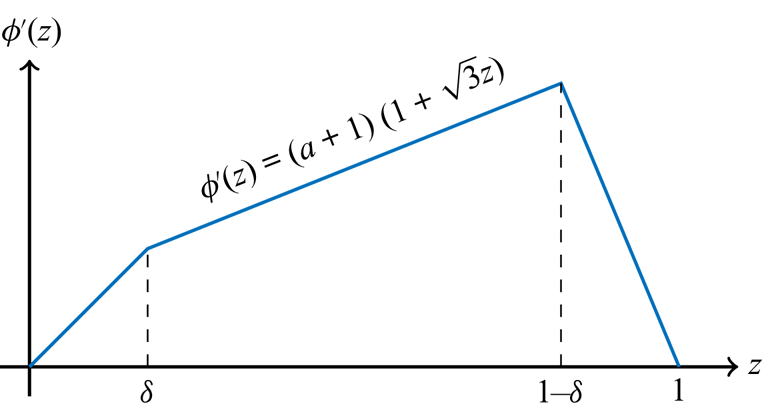
This profile, illustrated in figure 2, yields the upper bound
 \begin{align} \langle wT \rangle \leq U &= \frac 12 \left(\frac 12 + \frac{1}{\sqrt{3}} - \frac{6+5\sqrt{3}}{9}\delta + \frac{\sqrt{3}}{6}\delta^{2} \right) (a+1) \end{align}
 \begin{align} &\leq \frac 12 \left( \frac 12 + \frac{1}{\sqrt{3}} - A\delta \right) (a+1), \end{align}
where the last inequality holds for any constant  $A$ satisfying
 $A \leq \frac {1}{9}(6 + 5\sqrt {3}) - \frac {\sqrt {3}}{6}\delta$. Anticipating that the height of the boundary layers in
 $\phi '$ will have to be small, we arbitrarily assume that
 $\delta \leq \frac{1}{3}$ (this will be checked a posteriori) and therefore set
 $A = (4+3\sqrt {3})/6$ irrespective of
 $\delta$. These conservative choices considerably simplify the algebra in what follows.
Sketch of the piecewise linear  $\phi '(z)$ in (4.5a,b).

Note that although (4.2) suggests setting  $\xi (z)=0$ throughout the boundary layers, a linear variation makes the spectral constraint easier to satisfy and results in a smaller bound on
 $\langle wT \rangle$. The values of
 $a$ and
 $\delta$ must be chosen as functions of
 $ {\textit {R}}$ to minimise (4.6b) whilst ensuring that the indefinite term in
 $\mathcal {S}_{\boldsymbol {k}}$,
 \begin{equation} \mathcal{I} := (a+1)\int_{[0,\delta]\cup[1-\delta,1]}[1 + \sqrt{3}z-\xi(z)] \hat{w}_{\boldsymbol{k}}(z) \hat{\theta}_{\boldsymbol{k}}(z) \,\textrm{d}z, \end{equation}
can be controlled. For the boundary layer at  $z=0$, we can use the boundary conditions on
 $\hat{w}_{\boldsymbol{k}}$ and
 $\hat{w}'_{\boldsymbol{k}}$ in (3.10b) and the Cauchy–Schwarz inequality to estimate
 \begin{align} \left\vert {\hat{w}_{\boldsymbol{k}}(z)} \right\vert = \left\vert {\int_0^{z} \!\! \int_0^{\zeta} \! \hat{w}_{\boldsymbol{k}}''(\eta) \,\textrm{d}\eta \,\textrm{d}\zeta } \right\vert &\leq \int_0^{z} \!\!\int_0^{\zeta} \! \left\vert { \hat{w}_{\boldsymbol{k}}''(\eta)} \right\vert \,\textrm{d}\eta \,\textrm{d}\zeta \nonumber\\ &\leq \int_0^{z} \!\!\!\sqrt{\zeta} \textrm{d}\zeta \, \|\hat{w}_{\boldsymbol{k}}''\|_2 = \frac{2}{3}z^{3/2}\lVert \hat{w}''_{\boldsymbol{k}} \rVert_2. \end{align}
Using this estimate, the definition of  $\xi$ from (4.5a,b), and the Cauchy–Schwarz inequality once again, we obtain
 \begin{equation} \left\vert
{\int_0^{\delta} [1 + \sqrt{3}z-\xi(z)]
\hat{w}_{\boldsymbol{k}}(z)
\hat{\theta}_{\boldsymbol{k}}(z)\,\textrm{d}z} \right\vert \leq
\frac{\delta^{2}}{3\sqrt{15}} \lVert \hat{w}''_{\boldsymbol{k}}
\rVert_{2} \lVert \hat{\theta}_{\boldsymbol{k}} \rVert_{2}.
\end{equation}
Similar arguments near  $z=1$ yield
 \begin{equation} \left\vert
{\int^{1}_{1-\delta}[1 + \sqrt{3}z-\xi(z)]
\hat{w}_{\boldsymbol{k}}(z)
\hat{\theta}_{\boldsymbol{k}}(z)\,\textrm{d}z} \right\vert\leq
\frac{1+\sqrt{3}}{3\sqrt{15}} \delta^{2} \lVert
\hat{w}''_{\boldsymbol{k}} \rVert_{2} \lVert
\hat{\theta}_{\boldsymbol{k}} \rVert_{2}.
\end{equation}
Using these inequalities we can now estimate
 \begin{align}
\mathcal{S}_{\boldsymbol{k}}\{ \hat{w}_{\boldsymbol{k}},
\hat{\theta}_{\boldsymbol{k}}\} &\geq
\frac{a}{Rk^{2}}\lVert \hat{w}''_{\boldsymbol{k}} \rVert_{2}^{2}
+ \sqrt{3}(a+1)k^{2} \lVert \hat{\theta}_{\boldsymbol{k}}
\rVert_{2}^{2} - \left\vert {\mathcal{I}} \right\vert \nonumber\\
&\geq \frac{a}{Rk^{2}}\lVert
\hat{w}''_{\boldsymbol{k}} \rVert_{2}^{2} + \sqrt{3}(a+1)k^{2}
\lVert \hat{\theta}_{\boldsymbol{k}} \rVert_{2}^{2} -
\frac{2+\sqrt{3}}{3\sqrt{15}}(a+1)\delta^{2} \lVert
\hat{w}''_{\boldsymbol{k}} \rVert_{2} \lVert
\hat{\theta}_{\boldsymbol{k}} \rVert_{2}.
\end{align}
The last expression is a homogeneous quadratic form in  $\lVert \hat{w}''_{\boldsymbol{k}} \rVert _{2}$ and
 $\lVert \hat{\theta}_{\boldsymbol{k}} \rVert _{2}$, and is non-negative if its discriminant is non-positive. To ensure that the spectral constraints hold with the largest possible
 $\delta$, so the bound (4.6b) is minimised, we therefore set
 \begin{equation} \delta = \alpha\left( \frac{a}{(a+1)R} \right)^{1/4}, \end{equation}
with  $\alpha = [540(7\sqrt {3} -12)]^{1/4}$. Substituting this into (4.6a) yields an upper bound on
 $\langle wT \rangle$ that depends only on
 $a$, and in principle this parameter can be optimised numerically for each value of R. To obtain a fully analytical bound, however, we substitute (4.12) into the weaker bound (4.6b) and use the fact that
 $a>0$ to arrive at
 \begin{align} \langle wT \rangle &\leq \frac 12 \left( \frac 12 + \frac{1}{\sqrt{3}} \right)(a+1) - \frac{1}{2} A\, \alpha\, a^{{1}/{4}} (a+1)^{3/4} R^{-({1}/{4})} \nonumber\\ &\leq \frac 12 \left( \frac 12 + \frac{1}{\sqrt{3}} \right)(a+1) - \frac{1}{2} A \alpha a^{{1}/{4}}R^{-({1}/{4})}. \end{align}
This bound can be optimised analytically over  $a$ by solving the equation
 $\partial U/\partial a =0$, which gives
 \begin{equation} a = a_0 R^{-(1/3)} \end{equation}
with  $a_0 = [\frac {1}{2}A\alpha (2\sqrt {3}-3)]^{4/3}$. This translates into the upper bound
 \begin{equation} \langle wT \rangle \leq \frac{1}{2} \left( \frac{1}{2} + \frac{1}{\sqrt{3}} \right) \left(1 - 3 a_0 R^{-(1/3)} \right). \end{equation}
Substituting (4.14) into (4.12) shows that  $\delta = O(R^{-(1/3)})$, which agrees with scaling arguments proposed for Rayleigh–Bénard convection (Spiegel Reference Spiegel1963). Moreover, the constraint
 $\delta \leq \frac 13$ imposed at the beginning is satisfied for all
 $ {\textit {R}} \geq 591.51$, which is below the energy stability limit (cf. § 2). As required, therefore, the upper bound (4.15) applies to all values of
 $ {\textit {R}}$ for which convection cannot be ruled out.
5. Numerically optimised bounds
To assess how far the analytical bound (4.15) is from being optimal, we numerically approximated the best upper bounds on  $\langle wT \rangle$ implied by problem (3.13) using the MATLAB toolbox quinopt (Fantuzzi et al. Reference Fantuzzi, Wynn, Goulart and Papachristodoulou2017). This toolbox employs truncated Legendre series expansions for the tunable function
 $\phi$ and for the unknown fields
 $\hat {\theta }_0$,
 $\hat {\theta }_{\boldsymbol {k}}$ and
 $\hat {w}_{\boldsymbol {k}}$ in order to discretise the convex variational problem (3.13) into a numerically tractable semidefinite program (SDP) (for more details on this approach, see Fantuzzi & Wynn Reference Fantuzzi and Wynn2015, Reference Fantuzzi and Wynn2016; Fantuzzi, Pershin & Wynn Reference Fantuzzi, Pershin and Wynn2018). Numerically optimal solutions to (3.13) were obtained for
 $10^{3} \leq {\textit {R}} \leq 10^{9}$ in a two-dimensional domain with horizontal period
 $L_x = 2$. The number of terms in the Legendre series expansion used by quinopt was increased until the optimal upper bound changed by less than
 $1\,\%$, and an iterative procedure (see e.g. Fantuzzi & Wynn Reference Fantuzzi and Wynn2016) was employed to check the spectral constraints
 $\mathcal {S}_{\boldsymbol {k}}\geq 0$ up to the cutoff wavenumber
 \begin{equation} k_c:=\left(\frac{R}{4ab}\right)^{1/4}\lVert a + 1+ bz - \phi' \rVert^{1/2}_{\infty}, \end{equation}
where  $\lVert \boldsymbol{\cdot} \rVert _{\infty }$ is the
 $L^{\infty }$ norm. This value was derived using the method described in Arslan et al. (Reference Arslan, Fantuzzi, Craske and Wynn2021, appendix B), which ensures that
 $\mathcal {S}_{\boldsymbol {k}}\geq 0$ is non-negative for all
 $k > k_c$ given any fixed choices of
 $ {\textit {R}}$,
 $a$,
 $b$ and
 $\phi '$.
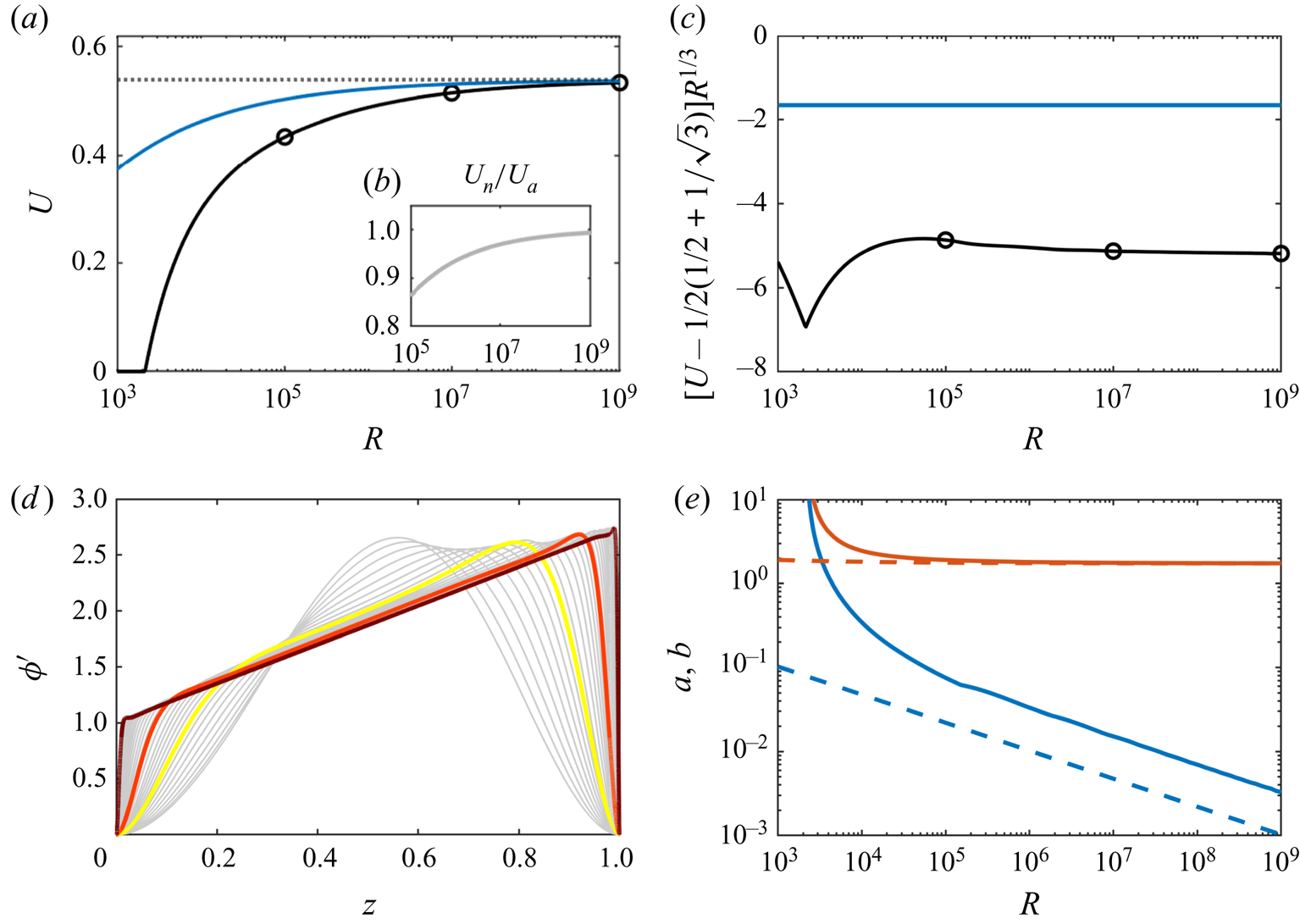
The numerically optimal bounds on  $\langle w T \rangle$ are compared to the analytical bound (4.15) in figure 3(a). The former are zero until
 $ {\textit {R}}_E = 2147$, which differs from the energy stability limit reported by Goluskin (Reference Goluskin2015) due to the choice of horizontal period made in our numerical implementation. The inset (b) reveals that the optimal and analytical bounds appear to tend to the same asymptotic value as
 $ {\textit {R}} \to \infty$. Moreover, as evidenced by panel (c), they seem to do so at the same rate. This suggests that the only possible improvement to our analytical bound is in the coefficient of the
 $O( {\textit {R}}^{-(1/3)})$ correction, which for our numerically optimal bound is estimated to be
 $5.184 \pm 0.062$.
(a) Numerically optimal bounds  $U_{n}$ computed with quinopt (black solid line), compared to the analytical bound
 $U_{a}$ (4.15) (blue solid line) and the improved uniform upper bound
 $\frac 12(\frac 12 + \frac {1}{\sqrt {3}})$ (dotted line). The inset (b) shows the ratio of the two R-dependent bounds. (c) Analytical (blue) and numerical (black) corrections to the uniform bound
 $\frac 12(\frac 12 + \frac {1}{\sqrt {3}})$, compensated by
 $ {\textit {R}}^{1/3}$. (d) Numerically optimal profiles
 $\phi '$ for
 $10^{3} \leq {\textit {R}} \leq 10^{9}$ (grey). Highlighted profiles for
 $ {\textit {R}} = 10^{5}$ (yellow),
 $ {\textit {R}} = 10^{7}$ (red) and
 $ {\textit {R}} = 10^{9}$ (brown) correspond to the circles in panels (a) and (c). (e) Balance parameters
 $a$ (blue solid line, optimal; blue dashed line, analytical) and
 $b$ (orange solid line, optimal; orange dashed line, analytical).

Figures 3(d) and 3(e) show the optimal profiles of  $\phi '$ and the optimal balance parameters
 $a,b$ in the range of
 $ {\textit {R}}$ spanned by our computations. For large
 $ {\textit {R}}$, the optimal
 $\phi '$ are approximately piecewise linear, corroborating our analytical choice in (4.5a,b), and the optimal balance parameters behave like the analytical ones from § 4 (plotted with dashed lines). The main differences between the optimal and analytical
 $\phi '$ profiles are oscillations near the edge of the boundary layers and the fact that the two boundary layers of the optimal
 $\phi '$ have different widths. This suggests that a better prefactor for the
 $O( {\textit {R}}^{-(1/3)})$ term in our analytical bound could be obtained, at the expense of more complicated algebra, by considering boundary layers of different sizes.
6. Conclusions
We have proved that the mean convective heat transport  $\langle wT \rangle$ in IH convection with fixed boundary flux is rigorously bounded above by
 $\frac {1}{2}(\frac {1}{2}+ \frac {1}{\sqrt {3}} ) - cR^{-(1/3)}$ uniformly in
 $ {\textit {Pr}}$, where
 $c \approx 1.6552$. This result is the first to depend explicitly on the Rayleigh number and halves the previous uniform bound
 $\langle wT \rangle \leq \frac 12 + \frac {1}{\sqrt {3}}$ (Goluskin Reference Goluskin2016) in the infinite-R limit. Our proof relies on the construction of a feasible solution to a convex variational problem, derived by formulating the classical background method as the search for a quadratic auxiliary function in the form (3.5). Numerical solution of this variational problem yields bounds that approach the same asymptotic value as R increases and, crucially, appear to do so at the same
 $O( {\textit {R}}^{-1/3})$ rate. This suggests that our analytical bound is qualitatively optimal within our bounding approach, the only possible improvement being a relatively uninteresting increase in the magnitude of the
 $O( {\textit {R}}^{-1/3})$ correction to the asymptotic value. In particular, we conclude that the background method (at least as formulated here) cannot prove that
 $\langle wT \rangle \leq \frac 12 - O( {\textit {R}}^{-1/3})$ as conjectured by Goluskin (Reference Goluskin2016, § 1.6.3.4).
With the identity (1.1), our upper bound on  $\langle wT \rangle$ can be translated into the lower bound
 $\overline {T}_0 - \overline {T}_1 \geq \frac {1}{2}(\frac {1}{2}- \frac {1}{\sqrt {3}} ) + 1.6552\, R^{-(1/3)}$. This bound is negative when
 $ {\textit {R}} \geq 78\,390$, so conduction downwards from the top to the bottom cannot be ruled out in this regime. Determining whether
 $\overline {T}_0 - \overline {T}_1$ can indeed be negative or is positive at all Rayleigh numbers, as physical intuition suggests, remains an open question for future work. Possible approaches to answer this question include direct numerical simulations at high
 $ {\textit {R}}$, the construction of incompressible flows with optimal wall-to-wall transport (Hassanzadeh, Chini & Doering Reference Hassanzadeh, Chini and Doering2014; Tobasco & Doering Reference Tobasco and Doering2017; Doering & Tobasco Reference Doering and Tobasco2019), and the computation of certain steady solutions to the Boussinesq equations (2.1a–c), which in Rayleigh–Bénard convection have been shown to transport heat more efficiently than turbulence over a wide range of
 $ {\textit {R}}$ (Wen, Goluskin & Doering Reference Wen, Goluskin and Doering2020). These and other alternatives could provide a crucial understanding of the difference between the conjectured asymptotic value of
 $\frac 12$ for
 $\langle wT \rangle$ and the larger asymptotic value,
 $\frac 12(\frac 12 + \frac {1}{\sqrt {3}})$, of the upper bound proved in this paper.
Funding
A.A. acknowledges funding by the EPSRC Centre for Doctoral Training in Fluid Dynamics across Scales (award number EP/L016230/1). G.F. was supported by an Imperial College Research Fellowship.
Declaration of interests
The authors report no conflict of interest.