INTRODUCTION
Before age three, children start producing complement-clause constructions by combining simple sentences with phrases such as I think (Bloom, Tackeff &Lahey, Reference Bloom, Tackeff and Lahey1984; Diessel, Reference Diessel2004; Diessel & Tomasello, Reference Diessel and Tomasello2001; see Ambridge & Lieven, Reference Ambridge and Lieven2011, for a review). Complement-clause constructions are a type of complex sentence in which one clause is the object of another. Even though subject complements are also possible (that she was late again didn't surprise him), we focused on object complements in the current study, as these are much more common. Syntactically, complement-clause constructions can be grouped into two categories: (i) non-finite complement-clause constructions in which a non-finite clause is the object of a finite clause (e.g. He wanted her to go to the park); (ii) finite complement-clause constructions in which one finite clause is the object of another finite clause (e.g. He told her (that) he went to the park). Learning complement-clause constructions involves figuring out the syntactic and semantic relations between the matrix and the complement clause. The focus of this study is the syntactic and semantic coordination of the two clauses within the finite complement-clause constructions produced by one American English-speaking child (L).
In finite complement-clause constructions, it is argued that the degree of syntactic integration between the matrix clause and complement clause is less tight as compared to the non-finite complement constructions (Diessel, Reference Diessel2004; Givón, Reference Givón1990). The verb of the complement clause can be in any form as opposed to being in the infinitive (to VERB) or the participial form (VERB-ing); the pronoun subject in the complement clause has the nominative case as in simple sentences, as opposed to the accusative/dative form in non-finite complement-clause constructions. Thus, the matrix and complement clause are syntactically more independent and it is almost as if two sentences are successively produced: He told her – he went to the park, since the complementizer that is usually omitted in spoken discourse (Thompson & Mulac, Reference Thompson, Mulac, Traugott and Heine1991). However, children cannot just combine any matrix clause with any simple sentence. The integration of the two clauses is constrained by syntactic and semantic regularities. For instance, if the verb of the matrix clause is in the past tense form (I thought), then the complement clause has to be in the past tense as well (he was from Germany). Moreover, the semantic coordination between the clauses becomes more important. For instance, the child has to master the semantics of the matrix verb, such as understanding the counterfactual meaning of wish (I wish I could go to the park rather than I wish I can go to the park, conveying the meaning that the speaker has not actually gone to the park).
Early in development, children tend to produce complement-clause constructions that lack any formal signs of syntactic coordination and integration. According to usage-based accounts, children initially use a limited number of lexically specific chunks, usually in frozen forms, with specific discourse–pragmatic functions such as attention getters (See if …, Know what …) and epistemic markers (I think …, I know …) (see also Dąbrowska, Rowland & Theakston, Reference Dąbrowska, Rowland and Theakston2009). These frozen matrix clauses are followed by complement clauses, which have the form and function of simple sentences. They provide foreground information and lack a complementizer. Later in development, children break up the formulaic matrix clauses and use a greater variety of verbs, subjects, tenses, and negation (she didn't know …, they thought …). Together with this greater variety of matrix clauses, children also start to mark the subordinate status of complement clauses by introducing them with complementizers, thus showing syntactic integration (e.g. Brandt, Lieven & Tomasello, Reference Brandt, Lieven and Tomasello2010; Diessel, Reference Diessel2004). Bloom, Rispoli, Gartner, and Hafitz (Reference Bloom, Rispoli, Gartner and Hafitz1989) examined the characteristics of the complement clauses and their co-occurrence patterns with matrix clauses. They analyzed four highly frequent matrix verb types across children between ages 2;0 and 3;0 and found that certain morphological characteristics in the complement clause occurred more often after particular co-occurring matrix verbs (e.g. 65% of complement clauses co-occurring with the matrix clauses with think were marked for modality, e.g. I think he should …, compared to 29% with see). Moreover, whether the complement clause was introduced by a complementizer, and the type of complementizer, depended on the matrix verb. For example, the matrix verb see was productively used with what, if, how, and where, whereas look (at) was only used with what.
According to generative–nativist approaches, however, children have the abstract, adult-like representations of complex sentences early on (e.g. Thornton & Crain, Reference Thornton, Crain, Hoekstra and Schwartz1994). That their production of complement-clause constructions looks item-specific does not necessarily mean that their knowledge of these constructions is item-specific. For example, Fisher (Reference Fisher2002) pointed out that children might not produce certain words in specific syntactic constructions because they have not figured out the semantics of these words yet. In addition, even adults' production and comprehension of syntactic structures is constrained by lexical knowledge (e.g. which words can be used in which structures; e.g. Snedeker & Trueswell, Reference Snedeker and Trueswell2004). Furthermore, children's production and comprehension of complement-clause constructions could be constrained by performance factors, such as memory and task demands (see Valian, Reference Valian1991, for simple sentences).
In this study, we were interested to see early signs of syntactic and semantic coordination and how this develops with age. We investigated whether L has problems of coordination in her production of finite complement-clause constructions by analyzing the grammatical and semantic acceptability of these utterances. In order to exclude performance-based explanations (cf. Pinker, Reference Pinker1996; Valian, Reference Valian1991; Weissenborn, Reference Weissenborn, Weissenborn, Goodluck and Roeper1992), we compared the grammatical acceptability of L's early complement-clause constructions to that of her simple sentences, which matched the target utterance by length (number of words). Furthermore, in order to exclude the possibility that the coordination of matrix and complement clauses is caused by a lack of lexical knowledge (cf. Clahsen & Penke, Reference Clahsen, Penke and Meisel1992; Fisher, Reference Fisher2002), we compared the grammaticality of the child's complement-clause constructions to that of her simple sentences, which contained the same verb as the complement clause. We especially relied on production data rather than comprehension data because performance limitations would be more at play while producing an utterance from scratch; whereas comprehending an utterance might be less effortful and more facilitated by contextual factors (e.g. the speaker can highlight some important parts of a long utterance through intonation, etc.).
We predicted that if finite complement-clause constructions were simple juxtaposition of two clauses and the errors were due to insufficient lexical knowledge or performance limitations, then the grammaticality would not differ between finite complement-clause constructions and their simple matches. However, if L produces grammatical simple sentences (of the same length or with the same verb as in the complement clause) but errs in the finite complement-clause constructions, this would suggest that she has problems in coordinating and integrating the two clauses. We also predicted that the grammaticality of the finite complement-clause constructions would increase with age, due to the child's developing linguistic (grammatical and semantic) sophistication. We used a rich diary to analyze L's finite complement-clause constructions between the ages 01;08 and 03;05 because the diary method is a particularly powerful approach to capture the recurring errors that children make in infrequent constructions (cf. Rowland & Fletcher, Reference Rowland and Fletcher2006; Tomasello & Stahl, Reference Tomasello and Stahl2004).
METHOD
The data
The data came from The Susan R. Braunwald Language Acquisition Diary, which is supplemented by audio recordings (Braunwald, Reference Braunwald and Lock1978, Reference Braunwald1985, Reference Braunwald, Tomasello and Merriman1995; Braunwald & Brislin, Reference Braunwald, Brislin, Ochs and Schieffelin1979; deposited on CHILDES – the Braunwald–Max Planck corpus). The child observed, L, is an American English-speaking girl with two college-educated parents. Using a diary method of speech observation, L's mother recorded all novel constructions, paying particular attention to new ‘emergent structures', which were recorded regardless of the correctness of form for a 26-month period beginning when L was 1;03 (see Braunwald & Brislin, Reference Braunwald, Brislin, Ochs and Schieffelin1979). The diary captured utterances by both L and her interlocutors. These utterances were further annotated for context in an attempt to systematically record relevant aspects of the situations (e.g. time of day, L's activity). The diary consists of a total of 12,591 utterances by L. To serve as supplementary data, L's mother created audio recordings of L's speech two to three times a week, each lasting roughly 1 hour, between the ages of 1;05 and 3;05. The recordings took place during various activities (e.g. meals, play). The audio recordings consisted of 19,093 utterances by L. All proper names of people and pets that L mentions in the examples reported here are replaced with pseudonyms for anonymity.
Data extraction
Extraction of finite complement-clause constructions
All utterances that L produced were extracted using CLAN (MacWhinney, Reference MacWhinney2000). All finite complement-clause constructions by L were manually identified. The following cases were excluded:
1. Adverbial/conditional clauses (It's not dangerous if I climb on the sink) were excluded because the subordinate clause was not an argument of the main clause.
2. See and look complement-clause constructions without complementizers, such as See I did it, Look it's all messy, were excluded because each of these could be two independent clauses rather than one finite complement. That is, the matrix clause functions as an attention getter that does not require an object. However, we included the utterances without objects in the complement clause, such as Look I doing, because there seems to be some syntactic dependency between the clauses. The complement clause is missing the object and the (left out) complementizer could serve as the object of the complement clause (Look what I am doing). The intonation contour of the whole phrase would be informative. However, since most of the finite complement-clause constructions came from diary notes, we did not have prosodic information.
3. Self-repetitions were excluded unless L made some changes in the utterance, such as adding/deleting an argument.
A total of 491finite complement-clause constructions, 425 (86·56%) from the diary and 66 (13·44%) from the audio recordings, were identified. A second coder went over 10% of the files (the diary and the audio recordings) and singled out the finite complement-clause constructions out of a sample of L's 2,065 intelligible utterances. The agreement was κ = 0·97. The coders were near-native speakers of English.
Extraction of simple matching utterances
There were two types of matches: (i) simple sentences of the same length as the target (word count matches); (ii) simple sentences containing the same verb as the complement clause of the target (verb matches). The simple matches could only consist of one clause. Non-finite complement-clause constructions, sentences with connectors such as if–then, but, and noun phrases without verbs (My favorite baby food) were excluded.
The dataset for the word count analyses
Target finite complement-clause constructions
Seven target complement-clause constructions from the audio recordings could not be included in the word count analyses because the transcriber had doubts for one or more words. For instance, L said that means you can say & vegta[?] too. Since we could not know how many words were uttered, we could not accurately calculate the length of the utterance. Some target complement-clause constructions had more than two clauses (see example (1)) and these were included as a whole, a 10-word utterance. However, there were 16 target finite complements, in which the utterance consisted of up to 5 clauses that were connected with the conjunction and, such as example (2), which had 22 words. In these cases, we only included the finite complement-clause construction and he felt like he wanted to get dead and treated it as a 9-word utterance in the word count analysis. Example (3) was an exception, and included as a whole, because the third clause started with a complementizer, suggesting that it was the second complement clause.
(1) I think that was a gorilla because it was big (3;03·06)
(2) He fell down and he felt like he wanted to get dead and then he found a poisoned mushroom and ate it (3;03·11)
(3) Mommy I dreamed that you weren't mommy and that daddy and mommy slept in my room (3;02·23)
First, we coded the speech act of each target finite complement-clause construction: indicatives vs. interrogatives (wh- and yes/no questions). Because the type of speech act influences the length of the utterance and requires a different syntax, the simple matches had to match the speech act of the target utterances. Then we calculated the number of words that each target finite complement-clause construction had, using the following criteria:
- The word count included only lexical words and contractions such as 'm for am, n't for not, etc. We did not count morphemes like the past tense -ed, plural -s.
- In disfluent utterances, only the segment without the exact repetition was counted. For instance, If you play at school you must have to tell a grownup how you do you must have to was counted as a 15-word utterance (i.e. without the last four words you must have to which are an exact repeat).
Word count matches
For each target finite complement-clause construction, we identified the utterances of the same length that occurred within the same two-week period. The two-week periods corresponded to L's age. For instance, utterances produced between the ages 1;10·01 and 1;10·15 would count as produced in the same two-week period, and the ages 1;10·16 to 1;10·30 would count as another two-week period. The initial collection of matching sentences included complex sentences, noun phrases (without verbs), etc. Therefore, the first round of coding involved filtering the simple word count matches with one clause out of all matching utterances. As indicated above, simple sentences had to match the target complement's speech act.
Once we identified the simple word count matches, we grouped them with the corresponding target finite complement-clause constructions of the same length for statistical analyses. For instance, between the ages 2;05·01 to 2;05·15, L produced one finite complement-clause construction (example (4)) with four words and 43 simple word count matches, as in example (5).
(4) Look what I done (2;05·01)
(5) I need more paper (2;05·01)
These 44 utterances (1 target, 43 simple utterances) were grouped together, e.g. Group 1. Group 1 clustered all of the 4-word utterances of interest (the finite complement-clause construction and its simple matches) which were produced within the same two-week period. Sometimes, L produced more than one finite complement-clause construction of the same length within the same two-week period. For instance, between the ages of 1;11·01 and 1;11·15, L produced two finite complement-clause constructions with six words, as in examples (6) and (7):
(6) I think my car seat doing (1;11·02)
(7) Look what my cracker's doing (1;11·09)
(8) I don't like it Eric (1;11·03)
(9) Washing the dish with my hand (1;11·09)
The target complement-clause constructions in examples (6) and (7) had the exact same set of simple matching utterances. In fact, there were two simple word count matches with six words in this two-week period (see example (8) and (9)). Since using the same simple matches multiple times for different target utterances would falsely inflate the data, all the target complement-clause constructions of the same length and their simple matches in the same period were placed in a single group. That is, these four utterances (two target complement-clause constructions and two simple matches) were treated as one group, e.g. Group 2, which clustered all of the 6-word target utterances and their 6-word simple matches from a particular two-week period (1;11·01–1;11·15).
Consequently, there were 484 target finite complement-clause constructions and 2,888 matching utterances. These were clustered in 243 groups, which can be treated as the N of the dataset. The longest complement-clause construction had 17 words (M = 6·82, SD = 2·49; example (3)). The shortest finite complement construction had three words (example (10)). For the simple matches, the range was 3–12 (M = 4·79, SD = 1·31; examples (11) and (12)). When a target complement had no simple matches of the same length, then that target complement constituted a group on its own and was still included in the analyses (14·7% of the target complements did not have simple matches of the same length).
(10) Look what happened (2;10·17)
(11) And there's one not a police car but a fire car (3;04·24)
(12) I did it (02;08·19)
The dataset for the verb analyses
Target finite complement-clause constructions
Thirty-five target complement-clause constructions could not be included in the verb analyses because the verb phrase in the complement clause only had auxiliaries (example (13)) or the verb was missing (example (14)). Four target complement-clause constructions had two finite complement-clause constructions in the same utterance, such as example (15). These were included twice in the verb analyses and coded once for each of the finite complement-clause constructions. In the case of example (15), for the part Pretending I came along see, the simple matching sentences were with the verb see. That is, when the verb phrase of the complement clause was complex, as in came see, the search was done with the last verb (see) denoting the ‘action’ (Thompson, Reference Thompson2002). And for the part I came along see if you have a new car, the simple matching sentences were with the verb have.
(13) I hope he won't (3;03·10)
(14) Daddy said it dangerous (2;04·10)
(15) Pretending I came along see if you have a new car (3;00·10)
Verb matches
We matched verbs in the complement clauses with the simple sentences with the same verb. First, the verb in the complement clause was identified. We then extracted all the simple sentences with that verb produced within the same month as the target finite complement-clause construction. The one-month period corresponded to L's age. For instance, utterances produced between the ages of 1;10·00 and 1;10·30 would count as produced within the same one-month period, and ages 1;11·00 to 1;11·30 would count as another one-month period. Similar to the word count matches, the first round of coding involved filtering simple matches with one clause and eliminating complex sentences (e.g. non-finite complement constructions, if–then utterances, etc.).
Once we identified the simple verb matches, we grouped them with the corresponding target finite complement-clause construction(s) for statistical analyses. For instance, when L was 2;02, she produced two target finite complement-clause constructions with the verb feel (examples (16) and (17)). These two target utterances would have had the exact same set of matching utterances, which were the three simple sentences in this month with feel (examples (18), (19), and (20)).
(16) Mommy I think Alison feels better (2;02·05)
(17) Hope Julian feel better (2;02·06)
(18) You feel better (02;02·13)
(19) You feel better Alison yeah? (02;02·13)
(20) Mommy I feel serious (02;02·15)
Examples (16–20) (two target and three simple sentences) were grouped together, e.g. Group 1, so that the same set of simple matching utterances with feel was used only once. Thus, Group 1 clustered all the finite complement-clause constructions and their simple matches with the verb feel produced between the ages of 2;02·00 and 2;02·30.
Consequently, there were 460 target finite complement-clause constructions and 2,136 matching utterances. These were in 232 groups, which can be treated as the N of the dataset. There were 87 verbs within 232 groups. When a target complement had no simple matches with the same verb, then that target complement constituted a group on its own and was still included in the analyses (15·2% of the target complements did not have simple matches with the same verb).
Coding
All target complements and their simple matches were coded for their grammaticality. If the target finite complement-clause constructions or the simple matching utterances were ungrammatical, the types of syntactic errors were coded. In the target utterances with more than two clauses (see example (1)), there was no instance in which the grammatical mistake was outside the complement clause construction. Dislocations (but I guess I don't wanna open it, my window), omissions of first person pronouns ((I) wonder where Crystal is), or phonological mistakes (pippit for blanket) were not considered as errors. An utterance was considered ungrammatical only when there were obvious violations of grammatical rules (see Table 1).
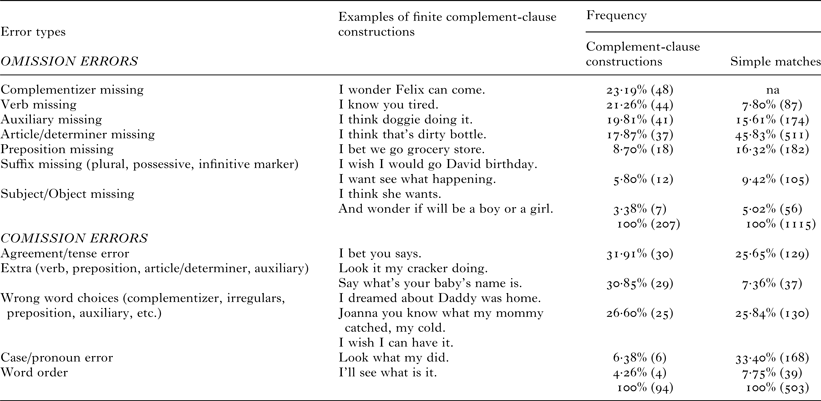
The error types, examples from target finite complement-clause constructions and their percentage (the numbers in parentheses are the raw frequencies

While coding for the syntactic error types, there were two overarching categories: (i) omission errors: omissions of complementizer, auxiliary, article/determiner, preposition, verb, suffix (plural, possessive, infinitive marker), and object/subject; and (ii) commission errors: wrong complementizer, agreement/tense errors, extra words (verb, preposition, article/determiner, auxiliary), wrong word choices (irregular verbs/plurals, prepositions, auxiliaries), case/pronoun errors, and errors in word order (see Table 1 for examples for each error category). Forty-two percent of the target finite complement-clause constructions (208) and their matches (1,985) (1,094 word count matches and 891 verb matches) were extracted and coded by a second coder. The second coder first coded for whether the matching utterances were simple or not and the agreement on matching utterances was κ = 0·81.Target complements and their simple matches were then coded for their grammaticality and the reliability for the grammaticality was κ = 0·82. Finally, the agreement on the syntactic errors was κ = 0·71 for the target finite complement-clause construction and κ = 0·69 for the simple matches. The reliability on the type of syntactic error was lower because there is more than one way to fix an ungrammatical utterance. For instance, in the utterance I'm make some more, the error could be listed as ‘wrong auxiliary’, ‘extra auxiliary’, or ’-ing suffix missing’. When there were disagreements between the coders, we stuck to the decision of the original coder to have consistency across similar cases.
Statistical analyses
To compare the grammaticality of the target complements and their simple matches, we used Generalized Linear Mixed Models (GLMM; Baayen, Reference Baayen2008), using R (version 3.0·2; R Development Core Team, 2013) and the statistics package lme4 (Bates, Maechler, Bolker & Walker, Reference Bates, Maechler, Bolker and Walker2013). We conducted two analyses: (i) word count analyses, and (ii) verb analyses. In both analyses, we included age and sentence complexity and their interaction as fixed effects (the predictors of interest) and the group variable (see above) as the random effect. We included the group as a random effect such that target utterances and their simple matches could reveal clustered/grouped observations (with regard to grammaticality of the utterances). The verb analyses additionally included the verb as the second random effect because children might have more difficulties in constructing grammatical sentences with some verbs over others.
A GLMM is a commonly recommended (and also the most straightforward) method to account for such data with random effects. Since the response was binary (grammatical vs. ungrammatical), we used a logistic GLMM (with binomial error structure and logit link function). To account for multiple testing in the sense of having two fixed effects and the interaction in the model (Schielzeth & Forstmeier, Reference Schielzeth and Forstmeier2009), we compared the full model as described above with the null model, which only included the random effects, using a likelihood ratio test (Dobson, Reference Dobson2002).
RESULTS
We analyzed the grammatical acceptability of the target finite complement-clause constructions and their matching utterances. First, we limited the statistical analyses to syntactic errors and next we analyzed some of the recurring semantic errors qualitatively.
Syntactic errors
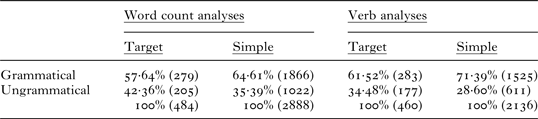
Table 2 shows the percentage of grammatical and ungrammatical utterances across the complex target utterances and their simple matches.
The percentage of grammatical and ungrammatical utterances across target complements and their matches. The numbers in parentheses are the raw frequencies.
Word count analyses
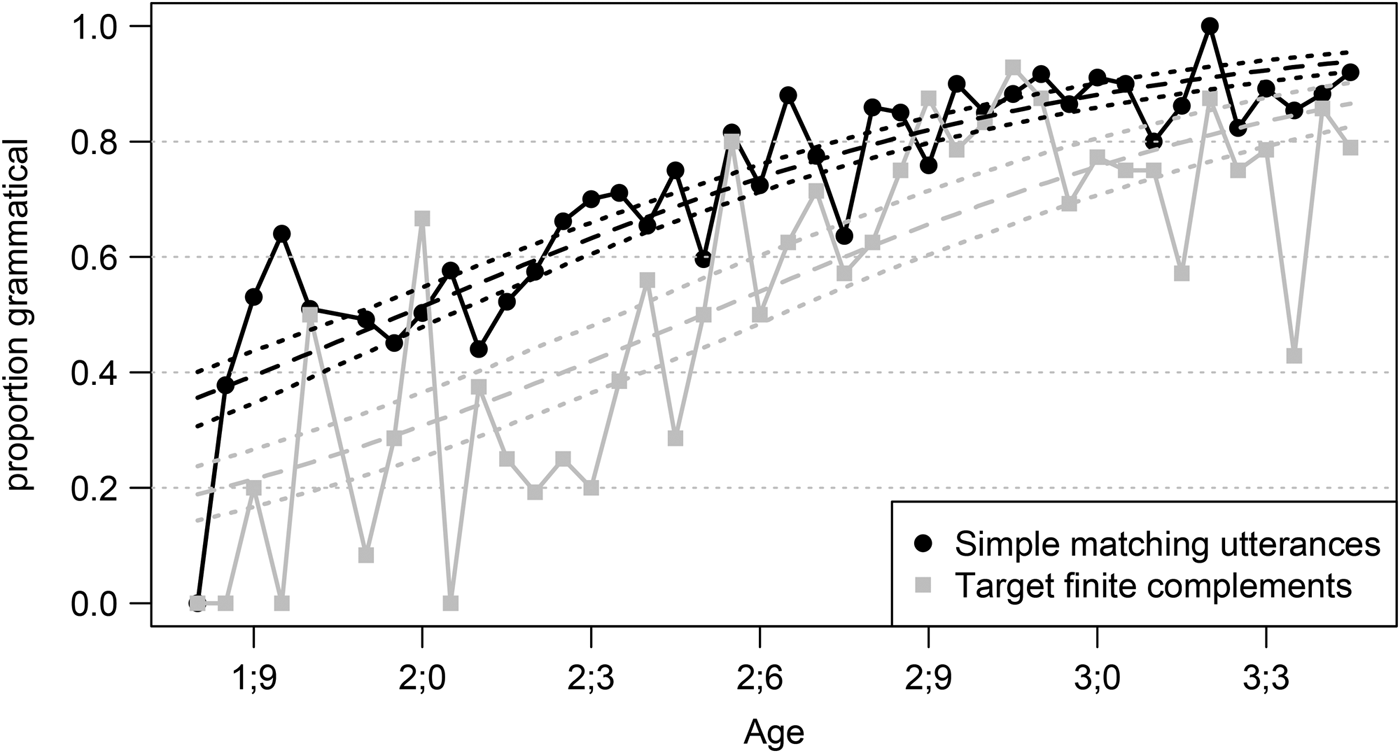
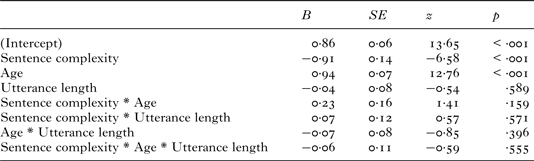
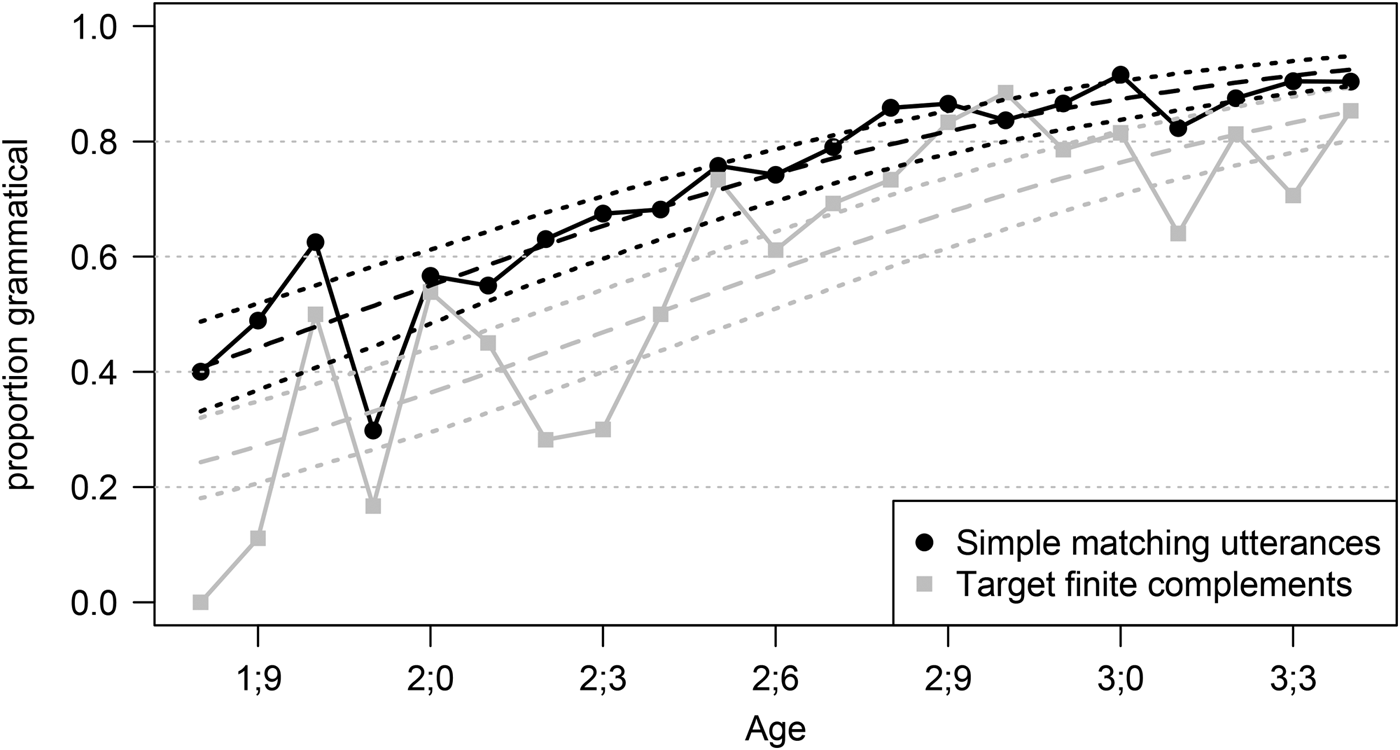
In the word count analyses, the response variable was the binary measure of grammaticality (grammatical vs. ungrammatical). The full model included the predictors: the complexity of the sentence (complex target vs. simple match), age of L at the time of the utterance in months (z-transformed), the length of the utterance (z-transformed), and their interaction. We also included the random factor of the group (how utterances were grouped into 2-week periods, N = 243). Because age and the length of utterance are correlated, we checked for multicollinearity. All the VIF-values (Variance Inflation Factor values) were less than 1·52, suggesting that there was no serious multicollinearity in the model. The null model only included the random factor. The full model improved the fit as compared to the null model (χ 2 = 199·25, df = 7, p < ·001). However, none of the 2- or 3-way interactions between the predictors were significant (see Table 3a). That is, the full model did not improve the fit when compared to a reduced model without the interaction terms (χ 2 = 3·99, df = 4, p = ·406) and the reduced model improved the fit when compared to the null model (χ 2 = 195·26, df = 3, p < ·001). In the reduced model, the two significant main effects of sentence complexity and age suggested that the target finite complement-clause constructions were less grammatical than their simple matches of the same length (z = –6·98, p < ·001) and the grammaticality (in both complex and simple utterances) increased with age (z = 14·72, p < ·001; see Table 3b and Figure 1). The length of the utterance, however, did not have a significant effect on the grammaticality of the utterances (z = –0·96, p = ·336).
The proportion of grammatical utterances within target finite complement-clause constructions and the simple matching utterances of the same length by age. The solid lines show the actual data, the dotted lines show the confidence intervals, and the dashed lines show the estimated values of the final reduced model. The fact that the dotted and dashed lines do not overlap suggests that the difference in terms of grammaticality between the target finite complements and simple matching utterances is consistent across different ages and utterances of different length.
The full model in the word count analyses
The final reduced model in the word count analyses

Verb analyses
In the verb analyses, the response variable was also binary (grammatical vs. ungrammatical). The full model included the predictors: the complexity of the sentence (complex target vs. simple match), age of L at the time of the utterance in months (z-transformed), and their interaction. We also included two random factors in the model: (i) the group (how utterances were grouped into one-month periods, N = 232); and (ii) the verb (N = 87). The null model only included the two random factors. The full model improved the fit as compared to the null model (χ 2 = 136·66, df = 3, p < ·001). To test the significance of the interaction, we compared the reduced model without the interaction term to the full model. The interaction was not significant (see Table 4a). That is, the full model did not improve the fit when compared to a reduced model without the interaction term (χ 2 = 1·61, df = 1, p = ·204) and the reduced model improved the fit when compared to the null model (χ 2 = 135·05, df = 2, p < ·001). In the reduced model, the two significant main effects of sentence complexity and age suggested that the target finite complement-clause constructions were less grammatical than their simple matches with the same verb (z = –6·02, p < ·001), and the grammaticality (in both complex and simple utterances) increased with age (z = 11·69, p < ·001; see Table 4b, and Figure 2).
The percentage of grammatical utterances within target finite complement-clause constructions and the simple matching utterances of the same verb by age. The solid lines show the actual data, the dotted lines show the confidence intervals, and the dashed lines show the estimated values of the final reduced model. The fact that the dotted and dashed lines do not overlap until later ages suggests that the difference in terms of grammaticality between the target finite complements and simple matching utterances is consistent across different ages.
The full model in the verb analyses

The final reduced model in the verb analyses

Type of syntactic error
Table 1 shows the types and number of errors that L makes in her target finite complement-clause constructions and in her simple matching utterances. There are four interesting points these errors raise for the coordination of clauses within finite complement-clause constructions.
a. The most frequent omission error (for complement-clause constructions) is the omission of the complementizer, as in examples (21–22). This suggests that L is still negotiating the syntactic connections across the matrix and complement clauses and has not figured out how to link the clauses and in which contexts the complementizer is obligatory.
(21) I wonder (if) we going Patrick's (2;02·12)
(22) the baby doesn't know much (what) mommy's doing to her (3;03·10).
b. Within commission errors, more than half of the category ‘extra’ comprises target complements with look it. Up to 2;7, the majority of finite complement-clause constructions start with the frozen matrix clause Look it (see example (23)). These can be interpreted as the early attempts at formulating complex sentences (e.g. Look what I made). The Look it-utterances all lack a complementizer, and while verbs in the accompanying complement clauses are sometimes inflected for tense, they are often missing objects (see examples (24–25)), and thus appeared to be simply juxtaposed with the matrix. After 2;08, most uses of the matrix verb look occur with a complementizer (see examples (26–27)).
(23) Look it I found (1;09·26)
(24) Look it I have (2;00·08)
(25) Look it I made (2;00·27)
(26) Look how much I got (2;08·15)
(27) Look what happened (2;10·17)
c. Within commission errors, half of the category of ‘wrong word choices' comprises the wrong use of auxiliaries, which are mostly due to the target complement-clause constructions with wish. These will be discussed in the following section on semantic errors.
d. When the types of errors L makes in her complement-clause constructions and in her simple matching utterances are compared, there are some interesting differences (see Table 1). For instance, almost half of L's omission errors are omissions of articles/determiners (45·83%) and prepositions (16·32%) in simple matching utterances, whereas in her complement-clause constructions half of the errors are omissions of complementizers (23·19%) and verbs (21·26%). The omission errors in her simple matching sentences are more local and mostly about the noun phrases, which are not as central to the syntactic structure of the whole utterance as the omissions of complementizers and verbs. Within commission errors, another interesting pattern is that L incorrectly uses extra words (30·85% of her commission errors) more often in the complement-clause constructions than in her simple matching utterances (see Table 1). This is another indicator that the length of the utterance is not an issue for L. In fact, L's use of these extra verb/preposition/auxiliary may indicate that she is negotiating various forms in her production, rather than performance limitations.
Semantic errors
We qualitatively investigated the changes in L's finite complement-clause constructions with wish and hope over time, because both show clearly the difficulties L experienced in coordinating the syntax and semantics of these two constructions.
Auxiliary errors with I wish. One set of recurring semantic (as well as syntactic) errors was with the 21 complement-clause constructions with I wish. Up to 2;08, there were clear problems with coordinating the ‘desiderative’ nature of wish with the counterfactual modality of the verb in the complement clause. There were eight (grammatical) examples of I wish I could/had X but also five (ungrammatical) of I wish I can/would X and five of I wish I want X. Evidence that L's grammar was unstable in this respect is provided by alternations that occurred on the same day and in reference to the same wish (see examples (28–31) and (32–33)). After 2;8, all three complement-clause constructions with I wish have the correct modality (the past tense in example (34)), although she still has not mastered the special construction I wish I were (see example (35)).
(28) I wish I would go David birthday (2;02·22)
(29) I wish I want go David (2;02·22)
(30) I wish I want go (2;02·22)
(31) I wish I want go David's birthday (2;02·22)
(32) I wish I want hop in Eric's car (2;03·28).
(33) I wish I could hop in Eric's car (2;03·28)
(34) I wish you were my Mommy (3;02·29)
(35) I wish I was a baby still (3;03·12)
Negation errors with I hope. Further evidence for the lack of coordination between the matrix and the complement clauses comes from L's semantic errors in the 34 complement-clause constructions with I hope. Between 2;01 and 2;05 there were 7 out of 18 complement-clause constructions in which the positive desiderative meaning of hope is semantically coordinated with the complement clause (see examples (36–38)).
(36) Hope Julian feel better (2;02·06)
(37) Hope Winnie the Pooh's in there (2;03·25)
(38) I hope Collie dogs there (2;04·12)
However, there were 11 in which L appeared to want to express the wish that a negative outcome not occur but was usually not able to produce the syntactic coordination of the matrix clause and the negation in the complement clause that would bring about the meaning she intended (see examples (39–43)).
(39) I hope your car stalls (2;01·23)
(40) I hope my chair uh tipped (2;02·21)
(41) Hope those cats fighting (2;03·21)
(42) Hope this room get on fire (02;04·21)
(43) Hope fire get in my room (2;04·29).
Before 2;05 there is one example of a negated complement clause, as in example (44).
In fact, there were a number of occasions throughout the diary when L's mother questioned her daughter explicitly about whether she really meant to say hope, suggesting that L's use did not represent her communicative intentions. In the diary, the mother noted: “I keep thinking that she means ‘I hope not’.” At 2;05, L manages to coordinate complement-clause constructions with I hope with a negative wish in the complement clause (see example (45)). From then on, her 16 complement-clause constructions with I hope seem to be correctly marked as either negative or positive wishes (see examples (46–47)).
(44) I hope not make pee bathtub (2;01·23)
(45) I hope I don't choke on carrot (2;05·21)
(46) I hope they don't crash (2;09·02)
(47) I hope they make it (2;11·11).
DISCUSSION
Our results show that L made more syntactic errors in her finite complement-clause constructions than in her simple utterances. Since L was able to produce grammatical simple sentences of the same length and with the same verb, the errors in the finite complement-clause constructions were more likely to arise from the syntactic and semantic coordination of the matrix and complement clauses (e.g. omission of the complementizer) than from performance limitations or a general lack of lexical knowledge. In addition, L made some semantic errors, such as negation errors with I hope complements and the complements with I wish I want. Finally, both target finite complement-clause constructions and their simple matches get increasingly more grammatical with age, suggesting a developmental change.
These results support usage-based accounts in a number of ways. First, there is evidence that the initial production of finite complement clauses involves relatively fixed forms of matrices, e.g. Look it and I wish, juxtaposed with simple sentences which are not fully coordinated, as has been noted in previous studies (Bloom, Reference Bloom1992; Budwig, Reference Budwig1995; Lieven, Reference Lieven and Slobin1997; Slobin, Reference Slobin and Slobin1985; Tomasello, Reference Tomasello2000, Reference Tomasello2003). Second, these matrices become internally analyzed and finite complement-clause constructions become more productive and with wider scope, both in the matrices and in the complements. For example both Look it and I wish I want disappear to be replaced with Look + wh complementizer and I wish X, respectively. Thus, the suggestion is that an abstract syntax of complementation develops rather than being pre-given (Brandt, Verhagen, Lieven & Tomasello, Reference Brandt, Verhagen, Lieven and Tomasello2011; Diessel, Reference Diessel2004). Our results suggest that this development is a matter of increasing syntactic and semantic coordination between matrices and the simple sentences acting as complements.
The development of syntactic and semantic coordination is supported by the significant increase in the grammaticality of L's finite complement-clause constructions with age such as the provision of obligatory complementizers, as well as auxiliaries and determiners, and from increasing coordination between matrix and complement clause (see examples (48–51)):
(48) I don't know where my head should go (3;02·14)
(49) I told him I was a banana eater (3;03·05)
(50) Daddy forgot I could take Tesla out (3;04·11)
(51) Let me tell you what I wanna do (3;04·18).
In addition to figuring out the syntactic relations between the two clauses, it seems from L's semantic errors (e.g. negation errors in the complement-clause constructions with I hope and the complement-clause constructions with I wish) that she was also working out the semantic links between the clauses.
This idea of an emergent and learned grammar of complementation stands in opposition to the proposal that complementation is an early feature of children's syntactic competence and that the developments, including errors and failures of coordination, derive from performance limitations on memory, utterance length, or lack of lexical knowledge (Fisher, Reference Fisher2002; Pinker, Reference Pinker1996; Valian, Reference Valian1991; Weissenborn, Reference Weissenborn, Weissenborn, Goodluck and Roeper1992). The questions are what these performance limitations are, how they affect the observed errors, and, finally, how they resolve. Our results address these questions to some extent (see also Theakston, Lieven, Pine & Rowland, Reference Theakston, Lieven, Pine and Rowland2001). The problem is unlikely to be a simple restriction on memory or utterance length, since when we controlled for utterance length, finite complement-clause constructions were significantly more ungrammatical than their simple matches of the same length. Nor is it that children do not have a full grasp of the argument structures of the verbs used in the subordinate clauses since finite complement-clause constructions with the same verbs in the subordinate clause are significantly more ungrammatical than simple sentences with the same verbs.
The cognitive ability to hold two propositions in mind, one dependent on the other, is important in the development of complementation. On the other hand, being able to comprehend and produce the recursive structure of complement-clause constructions also supports children's understanding of concepts such as hope, think, and know (e.g. de Villiers, Reference de Villiers2007). According to the notes of L's mother, L understood the socio-cognitive underpinnings of finite complementation before she had the syntactic ability to fully coordinate matrix and complement. In the case of the utterances with I hope, e.g. I hope my chair uh tipped, her communicative intentions are clear to her mother, who noted, “She is trying to say I hope my chair doesn't tip.” However, L is struggling with the negation of the complement clause. Her utterances with the matrix I wish, e.g. I wish I want, are another example that she has the socio-cognitive framework for complementation but has not worked out the semantic coordination of the matrix and the complement. This suggests that children's socio-cognitive and their syntactic development are interdependent.
Everyone would probably agree that children initially have problems coordinating and integrating the two clauses. However, the devil lies in the details: Where exactly does this problem of coordination lie? One approach is to accept a very early syntax of complementation and to posit various types of performance limitation. We have tried to exclude two of these factors and suggest that potential performance limitations need to be explicitly defined and tested. The alternative is to see complementation as emergent and based on the ability to combine earlier simple syntax with low-scope matrices. Development consists in re-analyzing these matrices and connecting low-scope schemas into a wider and more abstract network. While data from one child will, of course, not resolve this issue, the richness of this diary, capturing the utterances at the leading edge of development, does provide an important additional window on the development of complementation, which seems more consistent with the emergentist approach.