In 2004, the Mesoamericanists Maarten Jansen and Gabina Aurora Pérez Jiménez noted a striking disjunction in works on Mexican pictorial manuscripts. Although scholars more broadly appeared to have readily adopted more accurate names for individual signs, in step with ongoing decipherments—forgoing the so-called toothache glyph for its actual meaning (“accession”), for example—the same could not be said for the codices themselves. “The documents in question often are named for collectors, politicians, scholars, or institutions of the ‘Western’ world or the national elite,” wrote Jansen and Pérez Jiménez (Reference Jansen and Aurora Pérez Jiménez.2004:267), adding that they are “far removed from the region from which they originated and to which they refer.”
Examining the corpus of khipus—Andean knotted-string recording devices—we cannot but share their concern some two decades later. Of the 1,386 surviving examples in collections (Medrano Reference Medrano2021), more than 600—those included in the Open Khipu Repository (OKR Team 2022), the largest existing compilation—are named after the modern scholars who cataloged them. That more than 90% of OKR khipu entries are attributed to non-Peruvian researchers is itself a reflection of both historical and ongoing disparities in geographic proximity, research funding, and privileged access to data caused by the social and cultural capital accumulated via prestigious university membership, among other factors. In addition to disassociating specimens from their locations of origin, current khipu naming conventions also commit a linguistic disservice, replacing the Quechua term khipu (also kipu or quipu) with the names of (often) non-Andean researchers.
In this report, we follow Jansen and Pérez Jiménez's (Reference Jansen and Aurora Pérez Jiménez.2004) example in proposing a new naming convention for the 630 Inka-style khipus in the OKR, formerly known as the Harvard Khipu Database. We believe that the new nomenclature, of the form KH#### (KH[ipu]{0001, . . . , 0630}), offers a more neutral, recognizable, and conventional terminology going forward. The proposal falls within the broader initiatives of the OKR Advisory Board, an independent consultative body of which the coauthors are part. Deeply concerned with the legacies of neocolonialism and abusive practices in khipu studies, we have issued a series of statements about ethical research norms (OKR Team 2022) for the purpose of nurturing a discipline that is inclusive, accountable, and accessible to all. In our view, a new khipu nomenclature is an important step in ensuring such a future.
The State of Khipu Naming
The 630 khipus in the OKR are currently named using a two-part alphanumeric code. Take, for example, AS211: the first two characters, AS, abbreviate Ascher, the surname of its catalogers (who themselves debuted the convention; Ascher and Ascher Reference Ascher and Ascher.1978:3–4). The subsequent digits imply that this khipu is the 211th that the Aschers recorded, although because of inconsistent labeling practices, the number assigned to each khipu does not reflect the cumulative tally. More recent recordings have resolved this issue: JC005, for example, is indeed the fifth cataloged by Jon Clindaniel (Reference Clindaniel2019).
At the same time, not all the labels are those originally imposed by the respective researchers. For instance, 59 khipus published by Proyecto Quipu, a Peruvian initiative, were originally reported using museum accession and National Registry numbers; however, they were subsequently relabeled with the initials (HP) of Proyecto Quipu's director, Hugo Pereyra Sánchez (Reference Pereyra Sánchez2006), when they were entered into the OKR between 2007 and 2012.
Other OKR khipus have atypical names, often to denote multiple studies by different researchers. The Aschers, for example, appended a shorthand of the previous scholar's surname to their own description: khipu VA16636 in the Ethnologisches Museum, Berlin—initially labeled “Quipu 9” by the early twentieth-century researcher Erland Nordenskiöld—was subsequently dubbed AS140/N9 by the Aschers (Reference Ascher and Ascher.1978:903–915). Confusingly, Gary Urton instead opted to replace the previous initials with his own and then to prefix the numerical code with a “1” upon restudy. As such, AS140/N9 became simply UR1140; AS052 entered the OKR as UR1052. Table 1 totals the khipus in the OKR as of the writing of this report, grouped by their respective catalogers and alphabetic codes.Footnote 1
Khipus in the OKR, Grouped by Cataloger.

Justifications for the New System
Khipus Should Not Be Named after Modern Academic Researchers
Jansen and Pérez Jiménez (Reference Jansen and Aurora Pérez Jiménez2007:xiii) have described existing naming practices for Ñuu Dzaui pictorial manuscripts as being part of an ongoing “colonization process”: their solution was to “find names directly and unequivocally related to [each] document.” The Andean case is problematic in that khipus remain only partially deciphered, and so we cannot yet confidently assign designations to individual specimens that reflect their contents. This reality makes a more neutral and unambiguous terminology even more important: forefronting the “khipu” designation makes for a more direct and unequivocal identification than at present.
Further, approximately 90% of the more than 800 known publications related to khipus are written in English (45.5%) or Spanish (45.6%; Urbizagástegui Alvarado Reference Urbizagástegui Alvarado2014), producing an “international metalanguage” (Jansen and Pérez Jiménez Reference Jansen and Aurora Pérez Jiménez.2004:267) that disassociates khipus from Indigenous Andean language groups. The least we can do is instead use more culturally specific terms. The Smithsonian affiliates Gillian Flynn and Deborah Hull-Walski (Reference Flynn and Hull-Walski.2001:33) describe the relabeling of ethnographic objects and associated updates to collections databases as important features of culturally sensitive museum curation.
The Existing Terminology Is Ambiguous, Misleading, Internally Inconsistent, and Overly Complex
Explicit defenses of the status quo are lacking. The Aschers (Reference Ascher and Ascher.1978:3) aimed for “clarity and brevity” in creating the nomenclature. However, these qualities are hardly exclusive to the current convention, which retains an inherent ambiguity: for the more than two hundred AS khipus, it is unclear whether Marcia Ascher or Robert Ascher produced each record, given that they shared a surname and researched together. The final documentation for the 59 HP khipus credits Hugo Pereyra (Reference Pereyra Sánchez2006:23) with managing the “project, database, and photography”; Alejo Rojas Leiva with the “measurement and analysis of textile characteristics”; and Maritza Tovar Prado with being Proyecto Quipu's assistant. Yet the subsequent translation of this data to the OKR omitted the other group members’ names; today's HP label, according to the Aschers’ definition, implies that Pereyra (and only Pereyra) recorded each khipu.
What is ambiguous can also dip into the misleading, as evidenced by the restudied UR khipus. Urton's replacement of AS designations with his own initials obscures previous researchers’ recordings, in contrast to the Aschers’ method of appending the deprecated designation to their own. Urton's practice also lends the impression that he recorded all the UR khipus alone, which is inaccurate. A survey of OKR data reveals numerous updates and observations by Carrie Brezine, the Harvard Khipu Database's builder and first administrator, who analyzed (and recorded) many of the UR khipus.
In addition to the tension between the Aschers’ (appending) and Urton's (replacing) notations for restudied khipus, we note that individual labels have not all been carried through. A khipu in the former collection of Óscar Núñez del Prado, once analyzed by Carol Mackey (Reference Mackey1970:213) as khipu “no. 36,” was registered by the Aschers (Reference Ascher and Ascher.1978:351–352) as AS061/MA36 on restudy—a label that persists in the OKR. By contrast, AS167/N15's renaming as UR1167, despite implicitly recognizing the Aschers with the “leading one,” drops Nordenskiöld's original record entirely.
Precedents Exist for More Neutral Naming Conventions, Both in and outside Khipu Studies
Among the earliest khipu researchers, L. Leland Locke and Erland Nördenskiold employed simple ordinal labels in the 1920s. Frank Salomon's fieldwork in the central Andean village of Tupicocha, where some 10 khipus are used in an annual civic plenum, is more recent. Because locals do not assign unique names to the khipus, Salomon (Reference Salomon2004:22) introduced a binomial system: a first term identifies the associated ayllu, and the second the order of observation; for example, M-02 = khipu belonging to Mujica ayllu, second observed. In a later study of an assemblage of more than 260 single-cord khipus in Rapaz, Salomon and Brezine debuted another alphanumeric code: a prefix (KR; “Khipu Rapaz”), followed by three digits roughly identifying each cord's position; for example, KR025 is the 25th khipu from the left (Brezine Reference Brezine2011:10–11). At present, a lack of secure provenience renders such culturally specific names untenable for individual OKR khipus,Footnote 2 though our ordinal numbering scheme seems a realistic and attainable middle ground.
More broadly, we find parallel initiatives in museum curation, medicine, and the history of mathematics. Curator-scholar Stephen Gilchrist (Reference Gilchrist and Conway2021:25) describes the Indigenous-led renaming of Australian collections as a means of resisting their “intentional anonymisation” by collectors’ names. Mora and Bosch (Reference Mora and Bosch.2010:1500) have called for replacing honorific medical eponyms with acronyms that “convey the underlying features” of complex syndromes. Among mathematics historians, there is renewed interest in using author-forward labels for papyri, clay tablets, and other sources. Thus, the Rhind Mathematical Papyrus, a monumental source of ancient Egyptian mathematics, has also been dubbed the Ahmes Papyrus to recognize the scribe who copied it, rather than its nineteenth-century Scottish antiquarian purchaser. These, too, are instructive reference points.
Implementation
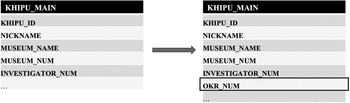
What is entailed in practice? The Open Khipu Repository currently contains an SQLite relational database along with associated metadata. It is publicly hosted on GitHub and is open source, open access, and version controlled. All GitHub releases are archived on Zenodo, with each version assigned a unique DOI. Our proposal entails changes to the database's KHIPU_MAIN table (Figure 1), which stores the data pertaining to each khipu as a whole. The KHIPU_ID field is the table's primary key, consisting of seven-digit integers that correlate closely (in ascending order) with the creation date of each record. It uniquely identifies each khipu and links its knot, cord, and color recordings across the database's tables. The current alphanumeric names, such as AS122, appear in the INVESTIGATOR_NUM field. Our proposed nomenclature, which updates the OKR investigator numbers, fills a new field in KHIPU_MAIN that we call OKR_NUM.
Changes to the KHIPU_MAIN table in the OKR relational database. A relevant subset of fields is shown.

To map existing names to new ones, the 630 translations were achieved using three principles:
1. The khipu groupings in Table 1 were ordered chronologically by initial year of recording: that is, Locke (= LL, beginning 1923), Ascher (= AS, beginning 1972), Urton (= UR, beginning 1994), Pereyra (= HP, beginning 2006), Quave (= QU, beginning 2008), and Clindaniel (= JC, beginning 2016). Thus, LL001 precedes AS001, which precedes UR001, et cetera.
2. Within each group of investigator numbers, the original ordinal listing is respected. That is, AS002 follows AS001, and QU015 follows QU014, et cetera.
3. In 13 instances, duplicate recordings of the same khipu by different researchers were consolidated to a single OKR name, with the most recent iteration preserved as the version of record. For instance, when consolidating duplicates AS046 and HP041 into KH0057, we deleted the independent AS046 (the older entry) and preserved HP041 as the definitive record. We modified its INVESTIGATOR_NUM field from “HP041” to “AS046/HP041” to acknowledge the duplicate recordings and then set “KH0057” as its new OKR_NUM. In addition, four records were removed because they are blank and, lacking accession numbers, cannot be reconstructed with a follow-up visit (see Supplemental Table 1).
We reproduce the key transition points of the OKR naming system in Table 2. Subsequent khipus added to the OKR will be appended to the existing list, by agreement of the OKR Advisory Board, using names beginning with KH0631. Crucially, the OKR's transition to new khipu names is an additive procedure: it constitutes a change in emphasis, rather than an “overwriting” of past scholarship. The nature of a relational database allows one to add the new designations to the KHIPU_MAIN table while retaining the former investigator numbers. As such, no information on previous scholars is lost—at least no more than is already lost using the present system. Furthermore, the khipu recordings dropped in this naming transition (e.g., the older readings of the same khipu) can be recovered by reverting to previous version-controlled iterations of the data.
OKR Number Ranges Associated with Existing Investigator Number Ranges.

Conclusion
For the OKR Advisory Board, the new KH naming convention is a key facet of our broader efforts to democratize the study of khipus, making it increasingly accessible, accountable, inclusive, and collaborative. We see the existing nomenclature as contrary to these aims, given its ambiguity, internal inconsistency, and honorific bent. Even if unintentional, its conveyance of “ownership” of certain data allows expertise in khipu studies to continue to be “disproportionately claimed by the global North” (DuBay et al. Reference DuBay, Palmer and Piland.2020), thereby eclipsing the rich history of khipu research by Andean scholars and others outside the English-speaking world. By no longer rhetorically reproducing these inequalities, the OKR nomenclature is a first step in the process of decolonizing the discipline. We also hope that this proposal can have a broader catalytic effect, encouraging collective consideration of the inequities latent within our research that are often reproduced in our naming practices. In this regard, our Mesoamericanist colleagues have put it well: “Common reflection, we hope, will result in a generally accepted, recognizable, and dignifying terminology” (Jansen and Pérez Jiménez Reference Jansen and Aurora Pérez Jiménez.2004:270). In our view, the Andean khipu—the tremendous primary source with which we continue to reckon—deserves nothing less.
Acknowledgments
The authors thank Lisa Trever and Mackinley FitzPatrick for their helpful suggestions during earlier discussions of this work.
Funding Statement
This research received no specific grant funding.
Data Availability Statement
The khipu names described here are reproduced in full in Supplemental Table 1. Data recorded from the 630 khipus themselves are available from the Open Khipu Repository v2.0.0 (https://doi.org/10.5281/zenodo.6908343). For the code necessary to replicate the renaming procedure, visit https://doi.org/10.5281/zenodo.6908292 (Open Khipu Research Laboratory 2022).
Competing Interests
The authors declare none.
Supplemental Material
For supplemental material accompanying this report, visit https://doi.org/10.1017/laq.2023.71.
Supplemental Table 1. Open Khipu Repository Translation Table.