The self-focus concept was introduced by Duval and Wicklund in 1972 as part of a model that related self-control and affect. Since then, many studies have been done on the role of this variable in psychological disorders (Mor & Winquist, Reference Mor and Winquist2002). Ingram (Reference Ingram1990) defined self-focused attention as “an awareness of self-referent, internally generated information that stands in contrast to an awareness of externally generated information derived through sensory receptors” (p. 156). Ingram (Reference Ingram1990) concluded that self-focused attention was present in many psychological disorders, such as depression, anxiety, substance abuse, schizophrenia and psychopathy. To explain this broad relationship with psychopathology in general, Ingram proposed the term “self-absorption” to refer to a dysfunctional quality of inadaptive self-focused attention. Defining it as excessive, sustained and inflexible attention on internal states, he argued that a chronic self-focused attention style was not necessarily dysfunctional in itself. What made self-focus dysfunctional was the inflexibility or inability to change to an external focus when circumstances so required.
Different forms of self-focused attention have been proposed. One of them is the distinction proposed by Fenigstein, Scheier, and Buss (Reference Fenigstein, Scheier and Buss1975) between private and public self-focused attention. The first refers to paying attention to internal facets, such as thoughts, feelings, plans, etc., and the second has to do with paying attention to the physical facet, their outer appearance or the impression they make on others, that is, a general awareness of the self as a social object that has an effect on others.
In recent years, private self-focused attention has been studied in persons with auditory hallucinations (Allen et al., Reference Allen, Freeman, McGuire, Garety, Kuipers, Fowler and Ray2005; Ensum & Morrison, Reference Ensum and Morrison2003; Morrison & Haddock, Reference Morrison and Haddock1997; Perona-Garcelán et al., Reference Perona-Garcelán, Cuevas-Yust, García-Montes, Pérez-Álvarez, Ductor-Recuerda, Salas-Azcona and Rodríguez-Martin2008; Perona Garcelán et al., Reference Perona-Garcelán, García-Montes, Ductor-Recuerda, Vallina-Fernández, Cuevas-Yust, Pérez-Álvarez and Gómez-Gómez2012; Startup, Startup, & Sedgmen, Reference Startup, Startup and Sedgman2008). However, we have not found any on public self-focused attention in persons with hallucinations. We think this is probably because the voices are considered an experience having more to do with private events, such as thoughts and memories, than with self-assessment of outer appearance or one’s impression on others.
Morrison and Haddock (Reference Morrison and Haddock1997) did an empirical study in which they asked a sample of schizophrenic patients with hallucinations, psychiatric patients without hallucinations and subjects without any psychiatric pathology, fill out the Self-Consciousness Scale (PSCS) subscale, the Private Self-Focused Attention Scale by Fenigstein et al. (Reference Fenigstein, Scheier and Buss1975). The results showed that subjects with hallucinations showed significantly higher private self-awareness than the psychiatric control group, further demonstrating that those self-focusing levels predicted the appearance of hallucinations. However, Perona-Garcelán et al. (Reference Perona-Garcelán, Cuevas-Yust, García-Montes, Pérez-Álvarez, Ductor-Recuerda, Salas-Azcona and Rodríguez-Martin2008) using the PSCS, and Perona Garcelán et al. (Reference Perona-Garcelán, García-Montes, Ductor-Recuerda, Vallina-Fernández, Cuevas-Yust, Pérez-Álvarez and Gómez-Gómez2012) using the MCQ-30 Cognitive Self-Consciousness subscale (Wells & Cartwright-Hatton, Reference Wells and Cartwright-Hatton2004), found that psychotic patients with hallucinations showed higher private self-focusing scores than the controls without psychiatric pathology, but did not significantly differentiate from psychotic subjects without hallucinations. In another study, Ensum and Morrison (Reference Ensum and Morrison2003) using the Private Self-Consciousness Scale (PSC, Sedikides, Reference Sedikides1992), found that the increase in levels of self-focused attention contributed significantly to higher probability of psychotic subjects with hallucinations giving their own thoughts external attributions. However, Startup et al. (Reference Startup, Startup and Sedgman2008), using the Self-focus Sentence Completion Blank (SFSC, Exner, Reference Exner1973), were unable to repeat these results. In a study of this variable in a sample of healthy university students, but with predisposition to hallucinations, Allen et al. (Reference Allen, Freeman, McGuire, Garety, Kuipers, Fowler and Ray2005) found that private self-focusing was also a good predictor of hallucination proneness.
Another form of self-focus is the one that refers to the distinction between ruminative and experiential self-focus. The first is related to increased distress and pathology, especially when it is highly abstract, general and out of context. The second is a kind of reflexive, open-minded self-focus, concentrating on the concrete awareness of the present time, and is associated with more adaptive results (Watkins, Reference Watkins2008). Baer (Reference Baer2009) considers this second type of adaptive self-focus similar to mindfulness. Kabat-Zinn (Reference Kabat-Zinn1990) defined it as the ability to concentrate attention in a particular way: on purpose, at the present moment, and without making any judgment about it. In this state of mindfulness, one is aware of and concentrates on the reality of the present moment “as it is”, accepting it and recognizing it as a complete reality, without intermediating discursive thoughts, without trying to change anything, and without the mind drifting into a state of diffuse thought concentrating on the present or on the past (Teasdale, Segal, & Williams, Reference Teasdale, Segal and Williams1995). Bishop et al. (Reference Bishop, Lau, Shapiro and Carlson2004) suggest that mindfulness has two defining features. The first involves the self-regulation of attention, specifically maintaining attention on immediate experience. The second feature is the adoption of a particular orientation towards one’s experience of the present moment, characterized by curiosity, openness and acceptance. The evidence for wide-ranging effectiveness of mindfulness-based interventions is accumulating rapidly (e.g., Ma & Teasdale, Reference Ma and Teasdale2004).
In recent years, more and more intervention programs using mindfulness techniques are being carried out in persons with general psychotic disorders, and with hallucinations in particular, (e.g., Chadwick, Reference Chadwick2006). However, there are few studies concentrating on the natural capacity of persons with hallucinations for this type of attention. We have only found two publications reporting on this variable directly in subjects with hallucinations. One of these is by Chadwick, Barnbrook, and Newman-Taylor (Reference Chadwick, Barnbrook and Newman Taylor2007) in people with psychoses. In this study, the authors found that mindfulness correlated negatively with negative affect and with distress associated with voices. They also found that this variable correlated negatively with beliefs on the malevolence, omnipotence and resistance to voice. The other study was done by Varese, Barkus, and Bentall (Reference Varese, Barkus and Bentall2011) in healthy people with hallucination proneness. They found that two factors on the FFMQ mindfulness scale (Baer et al., Reference Baer, Smith, Hopkins, Krietmeyer and Toney2006), observing and acting with awareness, significantly predicted hallucination-proneness.
As seen from this brief review, private self-focused attention is associated with auditory hallucinations (Morrison & Haddock, Reference Morrison and Haddock1997), although some studies have found that it is not specific to persons with voices, but to persons with psychosis in general (Perona-Garcelán et al., Reference Perona-Garcelán, Cuevas-Yust, García-Montes, Pérez-Álvarez, Ductor-Recuerda, Salas-Azcona and Rodríguez-Martin2008, Reference Perona-Garcelán, García-Montes, Ductor-Recuerda, Vallina-Fernández, Cuevas-Yust, Pérez-Álvarez and Gómez-Gómez2012). However, there are no studies relating public self-focus to hallucinations. Apart from this, there is another type of self-focus called experiential or mindfulness, which seems to be related to less affect and negative beliefs in persons with psychosis who suffer from auditory hallucinations (Chadwik et al., Reference Chadwick, Barnbrook and Newman Taylor2007). However, another study with healthy participants by Varese et al. (Reference Varese, Barkus and Bentall2011) showed results contradicting the above, finding that mindfulness predicted hallucination-proneness.
In this study, we wanted to find out the relationship of private and public self-focus and mindfulness skills to hallucination proneness in healthy subjects. We think private self-focus is a type of attention ability that is opposite to mindfulness, and we hypothesize that these two types of attention abilities are negatively associated. Finally, if there is a relationship between private self-focus and hallucinations as some research has found, and if mindfulness has a positive effect on the well-being of persons who hear voices as some treatment programs have found (Chadwick, Reference Chadwick2006), this variable may have a mediating effect between self-focus and hallucination-proneness.
We therefore pose the following hypotheses:
-
- The participants in this study who are highly prone to hallucinations will have higher levels of self-focused attention than participants with low proneness.
-
- The participants with high hallucination proneness will have lower levels of mindfulness than participants with low proneness.
-
- Self-focused attention will be negatively associated with the mindfulness variable.
-
- Finally, the mindfulness variable will mediate negatively between self-focused attention and hallucination proneness.
Method
Participants
Three hundred and twenty-nine students at the Universidad de Sevilla and Almeria (Spain), of whom 11 were discarded because they were under psychiatric treatment with psychopharmaceuticals (mainly anxiolytics and antidepressants) participated in this study. The final sample consisted of 318 participants with a mean age of 21.41 years (SD = 5.78) and a male-to-female ratio of 67:251, respectively. All of them participated voluntarily and received no economic incentive.
Instruments
Launay-Slade Hallucination Scale-revised (LSHS-R, Bentall & Slade, Reference Bentall and Slade1985)
This is a scale for measuring hallucination proneness in normal and psychiatric populations. The LSHS-R was developed based on the assumption that hallucinatory experiences are part of a continuum of normal-to-psychosis functioning. In this study, we used the 12-item version adapted to Spanish (Fonseca-Pedrero et al., Reference Fonseca-Pedrero, Lemos-Giráldez, Paino, Sierra-Baigrie, Villazón-García, García-Portilla González and Muñiz2010), which uses a Likert-type response format with 4 categories (1 = “certainly does not apply to you”; 2 = “possibly does not apply to you”; 3 = “possibly applies to you”; 4 = “certainly does apply to you”). Internal consistency of the questionnaire in this study measured by the Cronbach´s alpha was 0.90.
The Self-Absorption Scale (SAS, McKenzie & Hoyle, Reference McKenzie and Hoyle2008)
This scale was designed to assess the self-absorption construct as a pathological form of self-focused attention, and distinguish it from the concept of non-pathological self-awareness, including the three dimensions proposed by Ingram for defining self-absorption: excessive, sustained and rigid attention to all information emanating from internal sources (Ingram, Reference Ingram1990). It is comprised of 17 items that measure the level of self-absorption in its two aspects: private (PrSAS, 8 items) and public (PubSAS, 9 items). To measure the response to each item, we used a 5-point Likert scale, in which 0 indicates “never” and 4 “always”. In our study, we used a Spanish version of the SAS that was translated following the recommendations of Muñiz and Hambleton (Reference Muñiz and Hambleton1996), using the “back-translation” method with two translators, one familiar with the Spanish culture and another familiar with the USA. The first translator translated the questionnaire into Spanish, and this translation was then translated back into English. This version was then compared with the original English version for accuracy. The Cronbach’s alpha of this version is 0.81 for the PrSAS scale and 0.89 for the PubSAS scale.
The Southampton Mindfulness Questionnaire (SMQ; Chadwick et al., Reference Chadwick, Hember, Symes, Peters, Kuipers and Dagnan2008)
The SMQ can be conceptualized in terms of four related (i.e., not independent) bipolar constructs. These are (1) ‘decentered awareness’ of cognitions as ‘mental events in a wider context or field of awareness’ versus being lost in reacting to them, (2) allowing attention to remain with difficult cognitions versus experiential avoidance, (3) accepting difficult thoughts/images and oneself, versus judging cognitions and self, (4) letting difficult cognitions pass without reacting versus rumination/worry (Chadwick et al., Reference Chadwick, Hember, Symes, Peters, Kuipers and Dagnan2008). It consists of a 16-item instrument assessing a mindful approach to distressing thoughts and images. All items begin with, “Usually, when I have distressing thoughts or images” and continue with a mindfulness-related response, such as, “I am able just to notice them without reacting” and “I am able to accept the experience.” Items are rated on a 7-point Likert-type scale (agree totally to disagree totally). In this study, we used a Spanish version of the SAS translated following the recommendations of Muñiz and Hambleton (Reference Muñiz and Hambleton1996). Internal consistency of the questionnaire in this study measured by the Cronbach´s alpha was 0.91.
Determining hallucination proneness (HP)
To achieve the goals of this study, we distributed the sample of subjects into two groups based on their scores on the Hallucination Proneness Scale (LSHS-R, Bentall & Slade, Reference Bentall and Slade1985):
Group 1: Subjects with high hallucination proneness.
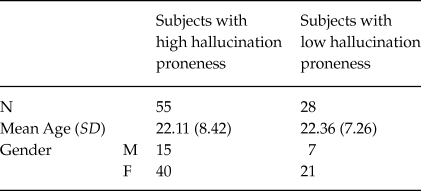
Those who scored higher than a standard deviation from the mean. This group was made up of 55 subjects of whom 15 were men and 40 were women. The mean age was 22.11 years.
Group 2: Subjects with low hallucination proneness.
Those who scored less than a standard deviation below the mean. This group was made up of 28 subjects, of whom 7 were men and 21 women, with a mean age of 22.36 years (see Table 1).
Group characteristics

Note: M: Male; F: Female.
Procedure
Participants completed the scales in the order they appear in the above descriptions. The tests were given in groups of about 40 people, each group in a different classroom). Given the nature of some items, it was ensured that the distance between subjects was sufficient to prevent them from observing the responses of their companions. The total battery of scales took approximately 30 minutes to complete.
Data Analysis
Data were analyzed using the SPSS 18.0 statistical package for Windows.
We analyzed the data in this study using parametric tests. For the first and second hypotheses, only participants who had the highest and lowest hallucination proneness scores on the LSHS-R according to the above criteria were included, since we wanted to compare those who had the most extreme values and avoid the effect of subjects with intermediate values. Specifically, there were 88 participants, of whom 55 had high hallucination proneness and 28 had low proneness. The student-t test was used to compare the self-focused attention (private and public) variables and mindfulness in subjects with high and low proneness. We used Pearson’s correlations to check the third hypothesis. The entire sample (318 participants) was used to check this hypothesis, because the purpose was to study the extent of association between self-focused attention and mindfulness. To examine the last hypothesis, we tested two simple mediation models in which the total score on the SMQ was the mediating variable. The first model studied the relationship between private self-focused attention as the independent variable (X) and hallucination proneness as the dependent variable (Y). In the second model, the independent variable was public self-focused attention over the same dependent variable. For estimating the mediation effects, we followed the bootstrap procedure proposed by Preacher and Hayes (Reference Preacher and Hayes2004) using a 95% confidence interval (CI) and 5000 bootstrap samples. According to these authors, if the 95% CI does not include zero, then the effect is said to be significant with p < .05. N was also 318 participants.
Results
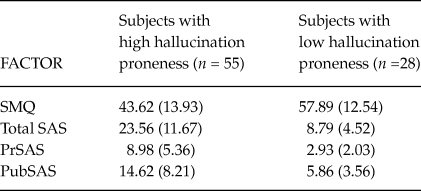
Based on the student t-test, we found that the subjects with high hallucination proneness showed significantly higher levels of private (t(77) = 7.39, p < .001; Cohen´s d: 1.57) and public (t(80) = 6.81, p < .001; Cohen´s d: 1.49) self-focused attention and total self-focused attention scores (t(77) = 8.25, p < .001; Cohen´s d: 1.81) than subjects with low proneness. Subjects with high proneness also showed significantly lower levels on the mindfulness scale compared to participants with low proneness (t(81) = –4.56, p < .001; Cohen´s d: 1.12) (See Table 2).
Comparison of mean scores (SD in parentheses) on the mindfulness scale (SMQ) and the self-focused attention scale (SAS) and its two subscales (private, PrSAS, and public, PubSAS, self-focused attention) in subjects with high and low hallucination proneness

Furthermore, we found a significant negative correlation between the mindfulness variable and the private (r = –0.23, p < .001) and public (r = –0.38, p < .001) self-focused attention variables and with the total score on this scale (r = –0.36, p < .001). See Table 3.
Correlations found in scores on the mindfulness scale (SMQ), total self focused attention (SAS) and its two subscales: private (PrSAS) and public (PubSAS) self-focused attention. N = 318

**p < .001.
Finally, in the simple mediation analysis between private self-focused attention and hallucination proneness, both the direct and indirect effects were significant, indicating partial mediation by mindfulness. The indirect effect in this first model was 12% of the total effect. With regard to the model of mediation between public self-focused attention and hallucination proneness, the direct and indirect effects were also significant, although in this second case, the indirect effect was 24% of the total effect. The results of this analysis may be seen in Tables 4 and 5.
Summary of the simple mediation model (5000 bootstraps), showing the mediating relationship of the total mindfulness scale scores between private self-focused attention and hallucination proneness

Note: SMQ scores (M), PrSAS scale scores (X), LSHS-R scores (Y). The data are expressed as non-standardized B coefficients. If the 95% CI does not include zero, then the effect is significant. N = 318.
*p < .01; **p < .001.
Summary of the simple mediation model (5000 bootstraps), showing the mediating relationship of total mindfulness scale scores between public self-focused attention and hallucination proneness

Note: SMQ scores (M), PubSAS scale scores (X), LSHS-R scores (Y). The data are expressed as non-standardized B coefficients. If the 95% CI does not include zero, then the effect is significant. N = 318.
*p < .01; **p < .001.
Since the study design was cross-sectional, to reinforce our findings on mediation of mindfulness between self-focused attention and hallucination proneness, a new analysis of mediation was done to examine the specificity of the findings. In this new analysis, the mediator and the independent variable were switched to see if self-focused attention (private and public) could also mediate between mindfulness and hallucination proneness and how much. This analysis showed that mediation of self-focus was significant for both private and public self-focused attention, but to a lesser extent than mindfulness. The indirect effect of private self-focus was –.033 and for public –.041.
Discussion
The first hypothesis of this study states that participants with high hallucination proneness will show higher self-focused attention than those with low proneness. The results confirm this hypothesis, that is, participants who were more prone were more focused on their own thoughts, memories and images than persons without hallucinations proneness. This result is coherent with the results found by Allen et al. (Reference Allen, Freeman, McGuire, Garety, Kuipers, Fowler and Ray2005) in healthy prone subjects and also those found by Morrison and Haddock (Reference Morrison and Haddock1997) and Perona-Garcelán et al. (Reference Perona-Garcelán, Cuevas-Yust, García-Montes, Pérez-Álvarez, Ductor-Recuerda, Salas-Azcona and Rodríguez-Martin2008, Reference Perona-Garcelán, García-Montes, Ductor-Recuerda, Vallina-Fernández, Cuevas-Yust, Pérez-Álvarez and Gómez-Gómez2012) in subjects with psychosis.
We also found that participants with high hallucination proneness had higher levels of public self-focused attention. As far as we know, no study on this subject has yet been published in scientific literature. This finding, from our point of view, is striking, because theoretically, hallucinations are conceptualized as private events (thoughts, images, etc.) which the person does not recognize as his own. Therefore, in these cases, attention would logically be directed at those private events as such, regardless of context. The fact that these subjects also pay close attention to their personal appearance and the image they offer others, or the image others may have of them, is unexpected in a theoretical conceptualization of hallucinations. This leads us to think that subjects with hallucinations are not only self-focused on their private events, but also on those aspects of the self that have to do with their relationships with other persons, whether real or hallucinated.
Our second hypothesis states that participants with hallucination proneness will show lower levels of mindfulness than those who are not prone. The results of our study also confirm this hypothesis. Following the factors that make up the Chadwick et al. SMQ (2008), the participants in this study with high hallucination proneness had a stronger tendency to experiential avoidance and rumination/worry, and to lose themselves in their reaction to negative thoughts, than the participants with low hallucination proneness. However, subjects with low proneness do spontaneously show a greater ability for being aware of their negative thoughts and reacting to them in a more adaptive manner. These results are coherent with other studies done with subjects with other pathologies in which, for example, training subjects in techniques that develop this type of ability can improve their mental health, as the case of subjects with depression (Teasdale et al., Reference Teasdale, Segal and Williams1995).
The third hypothesis states that self-focused attention will be associated negatively with mindfulness. Our results show that the higher levels of mindfulness and awareness of their own thoughts in a specific form in the here and now are, the lower levels of rumination and worry about both their own thoughts (private self-focus) and about their judgments of the image they could be giving other people (public self-focused) will be. This is coherent with the findings of Chadwick et al. (Reference Chadwick, Barnbrook and Newman Taylor2007) in subjects with psychoses in whom mindfulness correlated negatively with negative affect, distress associated with voices, beliefs of malevolence, omnipotence and resistance to voice.
The last hypothesis in this study states that the mindfulness variable will mediate between the self-focused attention variable and hallucination proneness. Our results partly confirmed this hypothesis, in the sense that mediation of mindfulness found between these two variables is not full but partial. Thus, the results of this study show two types of relationship between self-focused attention and hallucination proneness: one direct, in which high self-focusing is directly and positively associated with high hallucination proneness, and a second type, in which the relationship is indirect and mediated negatively by the mindfulness variable, so high self-focused attention is associated with low-mindfulness, and in turn, low mindfulness is associated with high hallucination proneness. Fetterman, Robinson, Ode, and Gordon (Reference Fetterman, Robinson, Ode and Gordon2010) also found that mindfulness mediated negatively between neuroticism and impulsiveness in university students, and stressed the importance of mindfulness as a regulating factor between these two variables.
In view of these results, we might ask why self-focused attention (private and public) and mindfulness, as two attention styles highly concentrated on the individual himself are negatively correlated. We think it is because the difference in these two styles of attention is not quantitative but qualitative. In this study we measured self-focused attention using the Self-Absorption Scale (SAS) by Mckenzie and Hoyle (2008). This scale was designed based on Ingram’s concept of Self-Absorption (1990) to distinguish between pathological self-focused attention, which would consist of excessive, sustained and rigid attention on internal events, and non-pathological. And the questionnaire we used to measure the mindfulness variable was the Southampton Mindfulness Questionnaire (SMQ) by Chadwick et al. (Reference Chadwick, Hember, Symes, Peters, Kuipers and Dagnan2008). According to these authors, this instrument measures the ability to defocus from negative thoughts, allowing attention to remain on difficult cognitions, accept negative thoughts and images, and finally, to allow those negative thoughts to go by without reacting to them. Therefore, although both instruments measure highly self-focused attention levels, the SAS measures an inflexible ruminative attention style and the SMQ measures a flexible, nonjudgmental attention style, able to switch attention to different stimuli depending on the person’s needs, and to concentrate on the present time.
These differences between the two styles of attention allow us to propose the clinical contributions of the results of this study. People with high hallucination proneness show an attention style highly concentrated on themselves, very ruminative and inflexible, so training in techniques that develop mindfulness skills can help them to change to a nonjudgmental, more flexible attention style making it possible for them not to react negatively to their own thoughts and achieve greater acceptance of themselves. This leads us to suggest the use of mindfulness training in subjects with high risk of suffering from psychotic episodes as a strategy for the prevention of first episodes. Furthermore, and keeping in mind the hypothesis of a continuum between the normal population and psychiatric pathology, a possible extrapolation of our results to persons with psychoses who suffer from hallucinations is that interventions based on mindfulness could also decrease the discomfort these people suffer from by decreasing ruminative self-focused attention on beliefs about the negative intentions and purposes or omnipotence of the voices (Chadwick & Birchwood, Reference Chadwick and Birchwood1994). Therefore, if a person with voices is trained to decrease this private self-focus through mindfulness techniques, such as those developed by Chadwick (Reference Chadwick2006), the distress associated with these beliefs could probably be decreased.
The conclusions of this study must take into account its methodological limitations.
In the first place, the type of design used did not allow causal relationships to be established between the variables studied. In the second place, the effect of other clinical symptoms such as anxiety and depression were not controlled for, so we have to consider whether our results are specific to hallucinations or are related to the general psychopathology. Finally, participants in this study who were taking psychopharmaceuticals were eliminated as a means of discarding all those that could have some psychiatric disorder from the samples. This is another limitation of this study, since this criterion may not have been sufficiently exhaustive to eliminate this contaminating variable.
This work was done in the framework of research project PSI2009–09453, funded by the Spanish Ministerio de Ciencia y Tecnología del Gobierno de España.