Introduction
With the evolution of target-driven health care in the UK, the requirement to conform to a maximum nine-month waiting list has led to waiting list ‘initiative’ cases being treated within alternative healthcare provider settings, i.e. in the private sector rather than in state-sponsored hospitals. Such waiting list initiatives were set up to relieve pressure on overwhelmed National Health Service (NHS) trust waiting lists and to help reduce the waiting time for any surgical procedure to an acceptable national level.
During the period February 2003 to September 2003, it was noted that a larger than normal number of patients were being readmitted to the NHS primary provider hospital with secondary haemorrhage following tonsillectomy and adenotonsillectomy. It was therefore decided to examine treatment patterns in both the NHS primary provider site and the alternative provider, in order to assess any differences in practice.
Materials and methods
Following registration of the audit project with the trust audit office, admission and discharge registries and individual patient case notes were retrospectively examined for all patients undergoing tonsillectomy and adenotonsillectomy during the period February 2003 to September 2003. Only cancer patients were excluded. A secondary haemorrhage was defined as any patient readmitted with bleeding from the tonsil bed following post-operative discharge.
The variables assessed were: patient age and gender, type of anaesthetic, operating consultant surgeon, method of tonsillectomy, and post-operative analgesic prescription. As the clinicians treating the patients on both sites were the same, and used the same non-disposable instruments and the same techniques (i.e. cold steel dissection, with either ties or bipolar diathermy or both for haemostasis), the only apparent clinical difference was post-operative analgesic prescription practice. Adults received co-proxamol and diclofenac, while children received paracetamol and ibuprofen; prescriptions were for three days in the alternative provider but for seven days in the primary provider.
The patients treated within the alternative provider therefore had their analgesic prescription increased to seven days. A prospective study of secondary haemorrhage rates was then performed from October 2003 to April 2004. Data were collected using the same techniques as for the earlier, retrospective study. Data were analysed using the Statistical Package for the Social Sciences software package (SPSS Inc, version 12 Chicago, Illinois, USA) (chi-square test).
Results
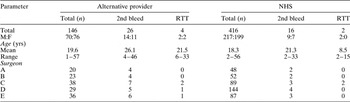
In the first cohort, 26 patients who had been treated at the alternative provider site were readmitted with a secondary haemorrhage, from a total of 146 patients undergoing tonsillectomy (17.8 per cent). This was compared with 16 patients out of a total of 416 treated within the primary trust (3.9 per cent) who suffered the same complication. The difference was significant (χ2 = 30.5; p < 0.001).
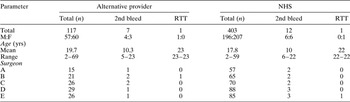
In the second cohort, the alternative provider site treated 117 patients, with seven cases of secondary haemorrhage (5.9 per cent). During the same period, the primary provider site treated 403 patients, with 12 patients being readmitted with secondary haemorrhage (3 per cent). The difference was no longer significant (χ2 = 2.3; p > 0.1). A change was also seen in the proportion of patients returning to theatre; this proportion ceased to be significant in the second cohort, compared with double the numbers in the first cohort. Tables I and II summarise these results, and also illustrate the differences between each consultant surgeon involved, which were insignificant (χ2 = 1.49; p < 0.2). The results confirm that bleeding rates were not influenced by the surgeon involved, nor by the patient's age or gender.
Results for first cohort

NHS = National Health Service; RTT = return to theatre; yrs = years; M = male; F = female
Results for second cohort

NHS = National Health Service; RTT = return to theatre; yrs = years; M = male; F = female
Discussion
It has long been believed that post-tonsillectomy pain leads to the maintenance of a soft diet, which can encourage slough build-up in the tonsillar fossae and thus increase the likelihood of secondary bleeding. However, previous studies suggested that diet does not affect bleeding rates.Reference Husband and Davis1–Reference Cook, Murrant, Evans and Lavelle3
• It has long been believed that post-tonsillectomy pain leads to the maintenance of a soft diet, which can cause slough build-up in the tonsillar fossae, increasing the likelihood of secondary bleeding
• This audit study investigated the influence of post-operative analgesia on secondary haemorrhage following tonsillectomy
• Adequate analgesic duration following tonsillectomy reduces the rate of secondary haemorrhage
As the patients in this study were selected randomly for the initiative waiting list, we assumed that the risk of secondary bleeding inherent in the indication for surgery (whether it be recurrent acute tonsillitis, chronic tonsillitis, previous quinsy and/or obstructive sleep apnoea) would be spread equally between the two groups in both cohorts. Recent results from the national prospective tonsillectomy audit have highlighted the risk factors associated with a relatively higher rate of secondary bleeding, i.e. adult age, previous quinsy, and use of disposable instruments, monopolar diathermy forceps and coblation technique.Reference Toma, Blanchard, Eynon-Lewis and Bridger4 In this audit, we analysed various factors that could be associated with secondary bleeding, including the period of analgesic supplied and used.
This study would have been more rigorous if all patients had been operated upon by the same surgeon; as it was, five different consultant surgeons were involved. However, the results are compelling as the surgeons involved did equivalent numbers of cases in both halves of the audit loop, using the same instruments and operative techniques; a strongly significant result was still obtained.
It is well recognised that post-tonsillectomy pain reaches a peak some five days post-operatively.Reference Murthy and Laing5 This study demonstrates the importance of providing adequate analgesia to cover this period.Reference Murthy and Laing5, 6
Conclusion
We conclude that adequate analgesic duration following tonsillectomy reduces the rate of secondary haemorrhage.