Introduction
Traditionally, old age is regarded as a quiet, calm stage in people's lives, characterized by higher levels of patience and, apparently, by a low level of impulsivity. Nevertheless, if we observe old people's behavior we may see that they express impatience in such daily activities as queuing in a shop, or making inappropriate comments, which may indicate that their impulsivity levels are not as low as might be thought. Moreover, the levels of physical aggression in the elderly are similar to those in younger adults, which implies that old people are not as peaceful or quiet as they seem (Morales-Vives and Vigil-Colet, Reference Morales-Vives and Vigil-Colet2010). The main aim of this paper is to analyze whether impulsivity increases or decreases in the elderly.
Over the past few decades interest in the study of impulsivity has been growing because of its association with several behavior disorders such as substance abuse, aggression, and gambling (for an exhaustive review of these issues, see McCown et al., Reference McCown, Johnson and Shure1993; Webster and Jackson, Reference Webster and Jackson1997). Impulsivity has also been related to common problems in the elderly, such as suicide risk, non-adherence to treatments, less monitoring and control of dietary intake, or higher triglyceride levels (Webster and Jackson, Reference Webster and Jackson1997; van den Bree et al., Reference van den Bree, Przybeck and Cloninger2006; Reach, Reference Reach2010; Sutin et al., Reference Sutin2010). Traditional stereotypes that regard elderly people as having low levels of impulsiveness might lead clinicians to underestimate the impulsivity levels of their patients and the consequences that these levels have on many of these problems. For instance, Shah (Reference Shah2007) pointed out that in many countries suicide rates are higher in the elderly so the detection of highly impulsive elderly people may prevent this kind of behavior. The same could be applied to such health-related behaviors in the elderly as treatment adherence, control of dietary intake or body weight.
Although many authors have emphasized the negative consequences of impulsivity, Dickman (Reference Dickman1990) suggested that there were two types of impulsivity. The first type, dysfunctional impulsivity (DI), refers to the traditional conception of impulsivity and is defined as the tendency to take speedy and thoughtless decisions, which have negative consequences for the individual. The second type, functional impulsivity (FI), is related to a tendency to take quick decisions when they are required by the situation for personal gain. Dickman (Reference Dickman1990) developed Dickman's Impulsivity Inventory (DII) to measure both impulsivities. The factor analysis performed by Whiteside and Lynam (Reference Whiteside and Lynam2001) showed that dysfunctional impulsivity loaded on the same factor as other traditional impulsivity measures such as the impulsivity subscale from the I7 Impulsiveness Questionnaire (I7; Eysenck et al., Reference Eysenck, Pearson, Easting and Allsopp1985). Furthermore, when reliability is taken into account to compute disattenuated correlation coefficients, Eysenck's I7 impulsivity and Dickman's dysfunctional impulsivity seem to measure the same construct (Vigil-Colet, Reference Vigil-Colet2007).
Several studies have shown the relationship between impulsivity and deficits in inhibitory control. People with high scores on impulsivity questionnaires show lower cognitive inhibition than people with low scores, and have greater difficulty in inhibiting prepotent responses (Horn et al., Reference Horn, Dolan, Elliott, Deakin and Woodruff2003). More specifically, the studies performed by Vigil-Colet and Codorniu-Raga (Reference Vigil-Colet and Codorniu-Raga2004) and Horn et al. (Reference Horn, Dolan, Elliott, Deakin and Woodruff2003) have shown that inhibition deficits are more related to DI than to other impulsivity dimensions such as FI.
Despite the importance of impulsivity and its relation with several behavioral disorders, very few studies have been made on impulsivity in the elderly. Traditional studies on personality have tended to focus on younger samples because personality is regarded as being stable throughout life. However, in recent years several studies have shown some changes in personality traits in middle and old age (e.g. Roberts et al., Reference Roberts, Walton and Viechtbauer2006). Despite the lack of studies on impulsivity in the elderly, there are a considerable number of experimental studies that report inhibitory deficits in old people (e.g. Butler and Zacks, Reference Butler and Zacks2006). In fact, the inhibition deficit theory of Hasher and Zacks (Reference Hasher, Zacks and Bower1988) proposes that many of the cognitive deficits reported in the elderly are caused by impaired inhibitory processes. According to this theory, older adults have inhibition deficits that involve difficulties at three levels of the working memory: limiting the access of goal-irrelevant information to the working memory, deleting or suppressing the activation of any marginally relevant or irrelevant information (or information that becomes irrelevant at a particular moment), and resisting responding when the prepotent response is incorrect. These inhibition deficits have important consequences: higher distractibility, more inappropriate responses or the need for a longer time to give the right answer. Many experimental studies, performed with the Stroop test or antisaccade tasks, support this theory (e.g. Butler and Zacks, Reference Butler and Zacks2006). The study by Hamm and Hasher (Reference Hamm and Hasher1992) with reading tasks suggests that older people have more activated information in the working memory than younger adults, which also supports this theory. In fact, in this study older people tended to generate a broader range of possible inferences from a particular text, although they also had greater difficulty in abandoning the inferences that were proved to be wrong when new information became available. Moreover, von Hippel and Dunlop (Reference von Hippel and Dunlop2005) found that inhibitory deficits in the elderly were related to socially inappropriate behavior such as embarrassing inquiries in a public setting, especially when there was not a close relationship with the person being asked.
Considering the relation between impulsivity and inhibition processes, age-related inhibition deficits suggest that older adults could be more impulsive than younger adults. The few studies performed on this issue, however, show contradictory results. Coyne et al. (Reference Coyne, Whitbourne and Glenwick1978) aimed to compare the reflection-impulsivity of 20 young adults and 20 old adults, using a modified version of the Matching Familiar Figures Test (MFFT). More specifically, this modified version used 24 sets of pictures of familiar objects. Each set consisted of a standard picture and four additional pictures (instead of the eight additional pictures used in the MFFT). On half of the 24 sets, one of the additional pictures was a duplicate of the standard picture, while in the other sets all the additional pictures were variants of the standard picture. The participants were asked to say whether or not they found an exact duplicate of the standard picture, and which picture it was. The authors concluded that older adults were generally more impulsive (had shorter latencies and made more mistakes) than younger adults. However, it should be pointed out that the MFFT has tended not to show significant correlations with impulsivity self-report measures. The sample size of this study was also quite small. As far as self-report measures are concerned, Jorm et al. (Reference Jorm, Christensen, Henderson, Jacomb, Korten and Rodgers1999) used the Behavioral Inhibition System and Behavioral Activation System (BIS/BAS) questionnaire in a sample aged 18–79 years. Older adults had lower scores on the BIS and BAS scales, so the authors concluded that behavioral inhibition and behavioral activation systems become less responsive with age. Eysenck et al. (Reference Eysenck, Pearson, Easting and Allsopp1985) reported that older people had lower scores than adults on the impulsiveness subscale from the I7 Impulsiveness Questionnaire. However, few people in the sample were aged more than 70 years (only 52). Other studies did not find a significant correlation between age and impulsivity, such as the one by Costa and McCrae (Reference Costa, McCrae and 1988) in a sample aged 22 to 90 years. In most of these studies the authors do not specify whether they screened the cognitive status of the elderly people whereby participants with severe cognitive impairment and dementia were excluded. This kind of pathology could have an effect on the results and make the comparison between the different studies difficult.
Taking all the above into account, the purpose of the current research was to compare the FI and DI scores of a sample of people aged 65 years and above without cognitive pathologies with those obtained in previous studies with adults and teenagers. Because of the relation between inhibitory deficits and impulsivity, DI scores are expected to be higher in the elderly sample than in the samples of adults, while FI scores are expected to be slightly lower or equivalent. It should be noted that although elderly individuals tend to show slower decision processes, it seems that the quality of these decisions, which is what FI is indexing, is almost unaffected by age (Deakin et al., Reference Deakin, Aitken, Robbins and Sahakian2004).
Methods
Participants
The participants were 190 individuals aged between 65 and 94 years (M = 77.2; SD = 6.3), of whom 101 (53%) were female and 89 (47%) were male. The sample was recruited from various senior community centers and retirement homes in Tarragona (Spain) and the surrounding area. Participation in the study was voluntary. All participants were previously evaluated with the Spanish version of the Mini-Mental State Examination (MMSE; Folstein et al., Reference Folstein, Folstein and McHugh1975) to guarantee the absence of cognitive impairment in the sample. The data from ten participants were removed from the dataset because their results in the MMSE suggested cognitive impairment. It should be pointed out that most of the sample had a low educational level because they went to school during or immediately after the Spanish Civil War, a period in which most children in Spain did not receive any formal education. For this reason, only 8% of the sample had attended high school or had a university degree. The rest of the sample had no education or had only attended primary school.
Measures
Dickman's Impulsivity Inventory (DII; Dickman, Reference Dickman1990). We used the Spanish version developed by Chico et al. (Reference Chico, Tous, Lorenzo-Seva and Vigil-Colet2003). The inventory consists of 23 items (11 of functional impulsivity and 12 of dysfunctional impulsivity). The Spanish version shows a factor structure equivalent to other versions and internal consistencies of 0.78 and 0.76 for functional and dysfunctional impulsivity, respectively.
The Mini-Mental State Examination (MMSE; Folstein et al., Reference Folstein, Folstein and McHugh1975). We used the Spanish version of the MMSE, which is a quick test for screening cognitive function deficits in the elderly and is one of the most widely used questionnaires for this purpose. As in other versions of MMSE, the authors found that the optimal cut-point for the cognitive deficits associated with dementia was 23 which gives good sensitivity (90%) and specificity (75%), with an area under the ROC curve of 0.92
Procedure
The participants were individually tested by one psychologist with experience in elderly people. The psychologist helped the participants when they had difficulties understanding the test items. Taking into account the relationship between dementias and inhibition deficits, ten individuals were rejected because they had scores on the MMSE below the cut-point of 23, so the final sample of 171 individuals was assumed to be free of this kind of pathology.
The data were analyzed using the program SPSS 17.0
Results
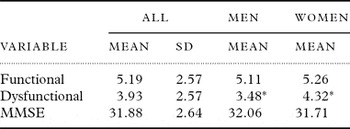
Table 1 shows the descriptive statistics for the impulsivity measures and MMSE across the whole sample, men and women. As can be seen, elderly women have higher scores than elderly men on DI (t(167) = 2.15 p<0.05; effect size: d = 0.33), but there were no differences in FI.
Descriptive statistics for the whole sample, men and women

MMSE = Mini-Mental State Examination.
** p<0.01 * p<0.05.
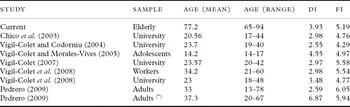
Table 2 shows the means for FI and DI in the current study and the means reported in previous studies using the Spanish version of the DII questionnaire. When our data were compared with the data in these studies, the DI levels of our elderly sample were slightly lower than the levels of the adolescents (t412 = 2.433; p<0.05; d = 0.24) reported by Vigil-Colet and Morales-Vives (Reference Vigil-Colet and Morales-Vives2005), but equivalent to the levels of university students (t393 = 0.73; p>0.05) and higher than the levels of an older sample of factory workers (t493 = 4.12; p<0.01; d = 0.39) reported by Vigil-Colet et al. (Reference Vigil-Colet, Morales-Vives and Tous2008). No significant differences were found for FI. We chose these data for comparison because the samples were the biggest (N from 216 to 323) and because, as well as frequently reported data on university students, they provided data on adolescents and a sample of workers with an educational level closer to that of the elderly individuals. When the DI of the elderly sample was compared to the DI of another sizeable sample, the one reported by Pedrero (Reference Pedrero2009), consisting of 398 individuals with a mean age similar to that of the sample of workers, the elderly sample again showed higher levels of DI (t586 = 5.8; p<0.01; d = 0.52). Nevertheless, it should be taken into account that this sample was obtained by a snowball sampling procedure, and more than half of the individuals had had a university education. The elderly sample only showed considerably lower levels of DI (t334 = 9; p<0.01; d = 0.98) when compared with the sample of individuals addicted to alcohol (47.1%) and drugs (52.9%) also reported by Pedrero (Reference Pedrero2009).
Means in impulsivity in our study and previous studies using the DII with Spanish samples

(*) Substance addicted.
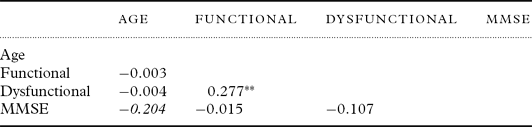
Finally, Table 3 shows the correlations between impulsivity measures, cognitive status and age. Age showed no significant correlations with impulsivity measures, which implies that impulsivity is quite stable across the elderly. There was a positive significant correlation between FI and DI. Cognitive status showed no significant correlations with impulsivity measures.
Correlation matrix between impulsivity measures, MMSE and age

** p<0.01 * p<0.05.
Discussion
This study provides evidence of age-related changes in impulsivity. It reveals that elderly subjects aged over above 65 years old have higher levels of DI than younger adult subjects, and in fact only have lower levels than such populations as adolescents or addicts, which are characterized by high levels of DI (e.g. Vigil-Colet et al., Reference Vigil-Colet, Morales-Vives and Tous2008). It seems, then, that impulsivity cannot be considered to decrease with age and DI may even increase. FI did not show the same pattern as DI, being quite stable across the age span.
These results seem to suggest that inhibition deficits are responsible for the increases observed in the elderly sample. However, previous studies have found contradictory results in this area. While some studies have reported no significant differences in impulsivity (e.g. Costa and McCrae, Reference Costa, McCrae and 1988), others have shown changes in the elderly (e.g. Eysenck et al., Reference Eysenck, Pearson, Easting and Allsopp1985; Jorm et al., Reference Jorm, Christensen, Henderson, Jacomb, Korten and Rodgers1999). One explanation for these differences might be the measures used in these studies, because impulsivity is a multidimensional trait and the different questionnaires seem to cover different facets (Whiteside and Lynam, Reference Whiteside and Lynam2001). Also, the sample size used in some studies was quite small. Finally, some studies did not report whether dementia and cognition deficits had been assessed, although this kind of pathology might affect the results.
Many studies in adolescence and adulthood have found that sex does not seem to lead to any differences in impulsivity (e.g. Costa et al., Reference Costa, Terracciano and McCrae2001; Vigil-Colet et al. Reference Vigil-Colet, Morales-Vives and Tous2008). On the other hand, those studies that reported sex differences in FI found higher scores in men (Vigil-Colet et al., Reference Vigil-Colet, Morales-Vives and Tous2008; Adan et al., Reference Adan, Natale, Caci and Prat2010), while some studies have found higher levels of DI in men (Adan et al., Reference Adan, Natale, Caci and Prat2010) or in women (Pedrero, Reference Pedrero2009). In the current study, women have higher DI scores than men, although there are no differences in FI. Further studies with new samples are needed to determine whether this difference is due to any specific characteristic of the sample or whether it is an effect of aging. Nevertheless, the low effect size found for sex differences in our sample seems to indicate that if there is an overall age effect on this difference it is not of any great importance.
The current study is one of the few that have reported data related to impulsivity self-reports scores in the elderly, but the results obtained should be considered with caution because it is a cross-sectional study. Further longitudinal and sequential studies with new samples are required in order to acquire more indepth knowledge of the maturational changes in impulsivity. Moreover, these sorts of studies might help to explain whether sex differences in impulsivity in the elderly are the consequence of social, contextual or cohort effects.
Another question to bear in mind is that the different groups used to compare the impulsivity scores of the elderly sample may be non-equivalent, which may decrease the internal validity of the conclusions stated above because they may differ in more variables than just age. Nevertheless, one way of improving this kind of design is to compare the sample of interest with a variety of different groups (Shadish et al., Reference Shadish, Cook and Campbell2002). The results reported above were obtained by comparing the elderly sample scores with the scores reported by different researchers in different samples. The fact that the results as a whole are in the hypothesized direction increases the internal validity of the conclusions reached.
The results obtained in this study, which indicate the possible presence of high levels of dysfunctional impulsivity in old age, have significant implications for the professionals involved in the health and quality of life of old people. Impulsivity has been linked to various behaviors that have a high impact on health and quality of life in the elderly. As we have explained above, high levels of impulsivity have been associated, among other things, with low levels of adherence to treatments, deficits in diet control, high cholesterol levels and an increased risk of suicide. This is why the results have important implications for the professionals involved in caring for the elderly, not only psychologists but also physicians, nutritionists and caregivers. The elderly commonly suffer from chronic diseases that require both continuous treatment and a controlled diet (for example, diabetes, high cholesterol levels, hypertension, etc.). Identifying individuals with high levels of impulsivity, then, may be helpful for preventive work, since, in these individuals, disease control may be poorer and quality of life reduced. Similarly, impulsivity should be taken into account as a risk factor in the increase in the number of suicides associated with age. However, the traditional view of old people as having low impulsiveness might lead professionals to underestimate the impulsivity level of their patients.
Furthermore, DI is also related to behaviors that prevent good social interaction, such as verbal or physical aggression (e.g. Vigil-Colet et al., Reference Vigil-Colet, Morales-Vives and Tous2008). The aggressive behavior of old people who suffer from dementia is a source of considerable concern. However, old people without dementia are not as peaceful and quiet as they are often believed to be. In fact, the levels of physical aggression in old people without dementia are similar to those in younger adults (Morales-Vives and Vigil-Colet, Reference Morales-Vives and Vigil-Colet2010). The study by Trompetter et al. (Reference Trompetter, Scholte and Westerhof2011) shows that resident-to-resident relational aggression exists in assisted living facilities between old people without dementia. This study also shows that being a victim of relational aggression is related to a resident's subjective well-being, anxiety, depression and social loneliness. Given that impulsivity is one of the best predictors of aggressive behavior, old people with high impulsivity levels may show a high risk of aggressive behaviors against peers and caregivers. In this regard, the introduction of impulse control therapies in high impulsive elders to improve inhibition skills might improve their quality of life and subjective well-being. More specifically, it might improve their social interaction and lead to better cohabitation in old people's homes. Following Hasher and Zacks (Reference Hasher, Zacks and Bower1988), who propose that many of the cognitive deficits reported in the elderly are caused by impaired inhibitory processes, inhibition training might also improve overall cognitive status.
Conflict of interest
None.
Description of authors’ roles
F. Morales-Vives formulated the research question, collected the data and wrote the paper. A. Vigil-Colet supervised the data collection, was responsible for the statistical design of the study and assisted with writing the paper. Both authors contributed to the design of the study and performed the statistical analysis.
Acknowledgments
The research was supported by a grant from the Spanish Ministry of Education and Science (PSI2008-00236/PSIC). We also acknowledge the collaboration of the following senior community centers and retirement homes: Residència Nostra Senyora del Carme (Santa Coloma de Queralt), Centre sociosanitari i residencia assistida de Salou, and Casals de gent gran de l'obra social de Caixa Catalunya i de Montblanc.