Once the federal government decided not to investigate, then they [the family of Jordan Miles] was like ‘ya'll do ya'll thing’. So that's when we do the video and put Zappala's name on there. We shut down Zappala's phone line. We shut Zappala's phone line down when we put the video out literally.
(Jasiri X, personal communication, 2012)In the epigraph above, hip-hop artist/activist Jasiri X is referring to his 2011 music video ‘Jordan Miles’ which provides a narrative of a 2010 police brutality case. The dramatic video ends by urging the audience to call Pittsburgh District Attorney Stephen A. Zappala with the following text: ‘Call Stephen A. Zappala Allegheny County District Attorney 412.350.4400. Demand he press charges on the three officers who brutally beat Jordan Miles’ (Jasiri X 2011c). The incident occurred nearly three years earlier, and the first civil trial resulted in a hung jury on accusations that the police – Pittsburgh police officers Saldutte, Sisak and Ewing – beat and falsely arrested Mr Miles. This decision sparked three years of cultural and artistic protest and legal manoeuvres. Central to these efforts was a grassroots media production organisation called 1Hood Media whose two-man team consisted of Jasiri X and Paradise Gray.
In this respect, the beginning of the second civil trial in the case of 11 March 2014 was an important mini-victory for the hip-hop fuelled Justice for Jordan Miles campaign. On 10 January 2013, Gary L. Lancaster, US District Chief Judge for the City of Pittsburgh, announced that three police officers charged in the beating and unwarranted arrest of Jordan Miles would face a new civil trial (Lord Reference Lord2013). 1Hood Media and the broader 1Hood coalition from which it came were instrumental in creating and supporting the Alliance for Police Accountability (APA), formed to address this incident, and for supporting the efforts of the APA and Miles's family in a variety of ways. Their work included organising marches and rallies via social media, blogging about the campaign, and other strategies of raising awareness.
1Hood Media's use of ‘hip-hop activism’ as cultural politics was an important component of the campaign (Tucker Reference Tucker2005).Footnote 1 Jasiri X wrote the song and 1Hood Media worked with youth in Pittsburgh to write, shoot and distribute the video. Uploaded to YouTube in July 2011, the video became a central text of the campaign and was reposted on blogs throughout the USA. X performed the song at a variety of national events,Footnote 2 ensuring that the case's visibility lived beyond the short time frame of a typical news cycle. No one would argue that hip-hop was solely responsible for the decision to reopen the trial, but there is little question that the Justice for Jordan Miles campaign, and similar campaigns such as the George Zimmerman trial, provide examples of the ways in which hip-hop activism may affect social justice efforts. Local artists used hip-hop culture to draw in the attention of global ‘networked publics’ (Boyd) to issues of police brutality in their community, and to pressure the city into enacting democratic judicial practices.
The success of 1Hood's tactics and similar approaches operate concurrently with the emergence of hip-hop philanthropic efforts such as ‘The Water Project’, led by Jay-Z and celebrated by Oprah Winfrey, Yele Haiti, led by Wyclef, Street King, led by Curtis Jackson, and many others (News One 2011). These efforts suggest that a new class of typically mainstream hip-hop artists is choosing philanthropic, less explicitly political, non-confrontational methods to engage with social inequalities (Hasan Reference Hasan2014). This is not to suggest that earlier forms of hip-hop activism have gone away or even become less common, but they must now compete with ‘hip-hop corporate charity’ supported by widely promoted hip-hop artists with strong pro-capitalist vision of hip-hop's role in social transformation. This study was motivated by curiosity about the rhetorical and musical features that might distinguish hip-hop activist approaches that diverge from philanthropic hip-hop in their explicit critiques of capitalism and corrupt state power.
When artists write songs and speak publicly about social justice issues and civic engagement, they engage with, reflect and/or refashion political rhetoric (Ards Reference Ards, Neal and Forman2004; Watkins Reference Watkins2005; Alim Reference Alim2006). It is partly for this reason that Street (Reference Street2013) argues that music and politics should not be seen as distinct categories. By closely examining the traces of political philosophy or philosophies of activism as they exist in musical texts, we come to understand both the music and the rhetoric itself in new ways.
After a brief theoretical orientation exploring how discussions of constitutive rhetoric can contribute to scholarship of popular music and hip-hop studies I will describe 1Hood's basic narrative, and then move into a deeper exploration of how this narrative is articulated in a variety of texts. To this end, I will consider a variety of ways in which the audience is implied, paying special attention to how they are positioned with respect to character archetypes and real social actors as they are constructed in the world of the narrative.
Key concepts
While a variety of work in hip-hop studies focuses on hip-hop's political rhetoric in general, this study takes up the precise question of how the audience is implied. In doing so, it also draws on several concepts from continental philosophy. From Burke (Reference Burke1969), White (Reference White1973) and the work of authors such as Charland (Reference Charland1987) who engage with their ideas, this study borrows insights regarding the crucial role that narratives play in rhetorical appeals and the idea that audiences are constructed by texts. For these authors, narratives – political and otherwise – inevitably use processes of identification that address and position readers as ‘implied auditors’ with ethical, temporal, spatial, legal and economic relationships to other textual reference points. In fact, human beings cannot access and interpret their own relation to historical, contemporary and future events without narrative structures that allow them to select specific phenomena as particularly important. As Charland points out, narratives ‘render the sites of action and experience stable’, and in so doing they ‘offer a world in which human agency is possible and acts can be meaningful’ (Charland Reference Charland1987, p. 139). These campaigns connect their audiences through representations of distant and familiar events, people, institutions, conditions and locations. It is in this way that texts can be said to constitute audiences as already interpolated subjects, positioning them through linguistic and semiotic rhetoric in particular social locations within hierarchies of social power.
With this in mind, various authors explore how specific texts elicit identification, and the roles that specific narratives play in that process. James Boyd White (Reference White1973, p. 37) coined the term ‘constitutive rhetoric’ in writing about the language and appeals of judicial decisions, stressing the circumstances under which audiences come to accept a collective identity. Burke argues that a primary task of rhetoric is to move beyond individuality by forming ‘transcendental unities’ and ‘consubstantial’ identities. Quoting Watson,Footnote 3 Burke notes that ‘in identification lies the source of dedications and enslavements, in fact of cooperation’ (Burke Reference Burke1969, p. xiv). In addition to positioning the audience within the narrative, the process of constituting the audience can also be viewed as a process of creating a ‘transcendental unity’ among audience members that supersedes their sense of individual identities.
Following Burke (Reference Burke1969), Charland (Reference Charland1987) applies the concept of constitutive rhetoric by positing several stages of identification in state discourses related to the Mouvement Souveraineté-Association (MSA), a movement trying to achieve political sovereignty for Quebec. The first stage that Charland identifies is the rhetorical constitution of the collective subject. In Charland's Quebec example, the forms of individuality that needed to be overcome were class interests, religious interests, differences of circumstance, loyalty, and a broad range of potential divisions that might cause the citizens being addressed to see themselves as French, Canadian or other subject positions less unified in service of the sovereignty project (Charland Reference Charland1987). The rhetorical mechanism worked to transcend these differences by the positing of ‘a people’ – the ‘Quebecois’.
Fairclough (Reference Fairclough2003) also recognises that problems of ‘I’ and ‘we’, individuality and collectivity, are central to the process of eliciting identification. But in his exploration of these ‘external relations of texts’, he reveals another important dimension of identification in its function as a major aspect of textual meaning. He discusses a relational view of the process of identification, which emphasises its dialectal relationship to action and representation. Fairclough argues that identities are constructed ‘necessarily in relation to others’ because ‘who one is is a matter of how one relates to the world and other people’. He then offers examples of how both characters within texts and audiences/readers are constructed as ‘identities in relation’ within business management and political media.
This idea can be applied to certain features of Charland's Canadian example – the citizens who would be newly constructed as ‘Quebecois’ are defined ‘in relation to’ and in opposition to other Canadian citizens (Charland Reference Charland1987). However, for Charland, the rhetorical appeal relies more on positioning the collective subject in relation to their own ancestry, within a historical narrative that they must now complete. 1Hood Media's rhetorical motives aim at creating social issue-based solidarity (in the case of 1Hood Media) rather than political sovereignty, but different sources of division must nevertheless be overcome in the process of constituting the collective subject. Of course appeals that are critical of corporate and state power in general are not at all exclusive to 1Hood. By focusing on 1Hood's constitutive rhetoric, I invite scholars of popular music, hip-hop studies, rhetoric and social movements to ask more explicitly how audiences are rhetorically constituted by musical texts, and what role such appeals play in cultural politics.
1Hood's background
1Hood began in 2006 as a coalition of young Pittsburgh-based grassroots organisations and activists, focused on a variety of issues affecting African American communities. The coalition became known in Pittsburgh for an approach to activism that combined physical presence in some of Pittsburgh's most feared and violence-ridden areas, cultural programming, events and public confrontation with local elected officials. Eventually, the founders of the coalition, Jasiri X and Paradise Gray, would form the media production company 1Hood Media. 1Hood Media produces a variety of media products, but the music videos and songs of Jasiri X are a significant portion of their work and tend to have the highest profile.
1Hood's albums and videos have been released on music platforms such as YouTube, Bandcamp, iTunes and Spotify, and promoted on social media platforms such as Facebook and Twitter. However, their cultural products are frequently created in contractual relation or implicit solidarity with specific activist organisations or campaigns. So although the sale of albums is part of what supports Jasiri X's and Paradise Gray's careers as full time hip-hop activists, the sale of albums seems to be of less concern than the exchange and promotion of their content.
The emergence of affordable digital production tools, and new media distribution and social platforms, were central to 1Hood media's strategy, particularly after 2007. 1Hood Media's productions therefore offer an insight into the intersections between music, cultural politics, user-generated content and promotional capital that deserves more complete treatment than will be offered here. The rhetorical constitution of 1Hood's audience is not separate from the politics and tactics of audience production facilitated by digital measurement features of online platforms: their musical and narrative choices were partially informed by their understanding of online audiences that they actively built and maintained.
Gray and X take advantage of affordances that allow users to upload and promote their own media in order to attach their musical products to timely news topics. The most interesting questions around this strategy have to do with how citizens produce and are organised and measured by digital platforms. This kind of relationship between audiences, production, distribution and new/social media platforms has been theorised using concepts such as user-generated content, ‘Prosumption’ (Ruckenstein 2011) , ‘Playbour’ (Kücklich Reference Kücklich2005) and many other terms. Hamilton (Reference Hamilton2014) offers a historically grounded framework in which to think about these strategies. Gray and X's use of the participation in ‘communitarian’ user-communities associated with the aforementioned platforms fit within Hamilton's framework to some extent, but their negotiation of activist, capitalist logic warrants a nuanced reading. The possibility of fast online distribution combined with the promotional strategy of what I call hip-hop journalism, meant that 1Hood's musical topics were directly influenced by news events.
1Hood's central narrative
The plots of 1Hood's media narrative unfold according to familiar, populist tropes. Often, the video introduces a problematic violation of rights that requires a response from the collective public. 1Hood Media appears to expose the injustice, recruit followers and threaten the powers that be with the prospect of their imminent demise. Some versions of the narrative invite the viewer into the story, as populist protest has already begun. In other versions, Jasiri X rhetorically constructs the events in ways that lead the audience to the inevitable conclusion that action is now required. In both cases, the narrative predicts an uprising in which citizens obtain justice through collective political action.
These plot features arise from a variety of texts that comprise the campaign, while the broader data collection included newspaper articles, televised commercials, news reports, interviews, music videos, web pages, customised pages and posts on social media platforms such as Facebook and Twitter and other texts. This analysis focuses mainly on music videos that 1Hood members uploaded to YouTube. I illustrate the elements of each brand's narrative by analysing specific texts, highlighting the common patterns of representation that reflect an underlying ideology, most closely in the ‘Jordan Miles’ video (Jasiri X 2011c), the ‘Occupy (We the 99)’ video (Jasiri X 2011d), and an RT interview with Jasiri X (Jasiri X 2011a). First, I explore how the victims of injustice are represented in each case and how the audience is constituted in relation to these victims. The focus on victims sets up the necessary conflict that creates the context for heroic action. I then assess the representation of heroic action, focusing on the role of the audience and the nature of agency that is represented.
Now the whole community wants justice: victims and the audience in 1Hood Media's texts
The first key to 1Hood Media's rhetorical constitution of its audience is the term ‘1Hood’ itself. The term ‘hood’ as it is used in urban and hip-hop vernacular, is polysemic: it simultaneously connotes specific geographic and or socio-economic locations as well as sets of belongings, affective bonds, and obligations that are understood as being linked to those locations.
Partially as a result of its circulation and exchange in urban vernacular, including the urban vernacular in hip-hop music, the term ‘hood’ has become a site of tension surrounding its spatial, socio-economic, cultural and moral meanings. Cornel West makes the distinction between the terms ‘hood’ and ‘neighbourhood’ by suggesting that the former connotes criminalised and hostile aspects of urban life, while the latter connotes more sympathetic and communal dimensions (West Reference West, Batstone and Mendieta1999). This binary, however, does not map onto the complex contemporary usages of the term with sufficient precision. Just as crime, poverty, solidarity, family, death, decay and transformation are linked in the lived experience of residents of the urban, economically impoverished neighbourhoods, these experiences are also linked in contemporary usages of the term ‘hood’. Forman (Reference Forman2002) offers a more nuanced framework, considering the concept of ‘the hood’ as a new spatial trope that can be deployed with a greater and more responsive range of meanings than the term ‘ghetto’, ‘when used by members of the hip-hop generation to describe and delineate locality’ (Forman, Reference Forman2002, p. 62). Where ‘the ghetto’ was linked primarily to disparaging images of poverty and crime, in Forman's view, ‘the hood’ can transcend these binaries.
The specific usage of the term ‘hood’ by X and Gray captures both the regionally specific as well as the broader social conditions raised in the aforementioned debates. Paradise chose 1Hood as a name for the emerging coalition as a way of intervening into the problem of ‘hoodism’ – a sense of individualism and competitive localism he felt was present in the dominant culture. Both Richardson and Skott-Myhre (Reference Richardson and Skott-Myhre2012, p. 62) cite Paul Gilroy's (Reference Gilroy and Dent1992) concern that the localised political commitments implied in the term ‘hood’ might work against ‘the enabling potentials of a mobilizing politics of race’. Therefore, in their formulation, the 1 in 1Hood is used to mediate the specifics of particular neighbourhoods in Pittsburgh with what Richardson and Skott-Myhre (Reference Richardson and Skott-Myhre2012, p. 9) describe ‘as an awareness of community, an enclosed space in which residents are united in their daily struggles’. This rhetorical logic is also present in the aesthetic similarities of 1Hood's logo to the Pittsburgh Steelers’ logo and colours. ‘Sunday is one day when all of Pittsburgh comes together for football’ (Gray, personal communication, 2012). In this sense, the term might be understood as another way of saying ‘we are one community’, or ‘we should operate as one neighbourhood and community’.
The coalition would have the members of its collectivity transcend the narrow and divisive interests of its many hoods by unifying into 1Hood, based on common sets of economic, cultural, political and ethical interests. Therefore, while in their work at home the term ‘hood’ operates on the surface as specific to Pittsburgh, in their national and international work 1Hood repositions the term ‘hood’ as a globally relevant, sociopolitical concept describing racial, partisan, organisational and other types of commitments.
Collectively, 1Hood's texts offer a populist vision that ascribes multiple roles to its audience. They position the implied audience as simultaneously hero, victim and witness. The victims in 1Hood's narratives are diverse in racial and ethnic identity. 1Hood's texts suggest that what the implied auditors (the audience) shares with these victims is a witnessing of instances of oppression. In this framework, 1Hood's texts frequently address their audiences as rights-bearing citizens, and reference the democratic ideals of the USA to highlight the contrasts between the American promise of justice and equality inherent in such ideals, and the real-life deployment of laws by the state apparatus. X and Gray appear most often as hosts, narrators or enablers, offering the audience the rhetorical evidence that rights have been violated, and encouraging them to fight back.
Many of 1Hood's texts advocate on behalf of young black males. This focus is partially related to the fact that the problems of racialised police brutality and stereotypical images of African American men in the media hit home with X, Gray and other 1Hood founders, all African American male residents of Pittsburgh's urban areas. This issue of white supremacist law enforcement practices also gained increasing currency in the national media during the years of 1Hood's founding and development. For instance, in 2012, the Malcolm X Grassroots movement produced and publicised a report ‘on the extrajudicial killings of Black people by police security guards, or self-appointed law enforcers’ (Akuno Reference Akuno2012). The study found that in the first half of 2012, 120 African Americans were killed in this manner, 96 per cent of whom were male, and 69 per cent of whom were between the ages of 13 and 31. Also noteworthy is the finding that 46 per cent of the victims were unarmed, and in another 36 per cent of the cases the initial claims by law enforcement that the victim was armed were disputed by witnesses or future investigation. ‘Enough's Enough’ (Jasiri X 2008), ‘Free the Jena Six’ (Jasiri X 2007), ‘Trayvon’ (Jasiri X 2012), ‘I am Troy Davis’ (Jasiri X 2011b), ‘Jordan Miles’ (Jasiri X 2011c), and Game Changers (One Hood Media 2013), are all 1Hood Media videos that construct the audience as witnesses to the victimisation of African American males.
It is important to recognise that Jasiri X's discussions of police brutality in a song like ‘Jordan Miles’ (2010) operate differently from the fairly common references to police corruption in mainstream commercial hip-hop music (Charity et al. Reference Charity, Diaz and Drake2014). In mainstream hip-hop, references to police tend to be general in the sense that they often focus on regional departments or units rather than individuals that are currently under investigation. Some hip-hop songs contain warnings and/or fantasies of fighting police corruption by shooting back at police officers. For example, Miller (Reference Miller2004) discusses the Goodie Mob's reference to the Red Dog Unit in the song ‘Dirty South’ (1996),Footnote 4 where the artists describe a scene in which the police are ‘at their door’, perhaps to steal drugs. Miller notes that, although the Red Dog Lyric does point to a police unit that was functional at the time, the references to police corruption are ‘oblique’ and he focuses on the way that they are used as part of a broader construction of the ‘dirty south’. A 1992 group called Success-N-Effect also referenced the Red Dog unit in the song ‘F**ck 1 Time Revolutionist Side’, which comes closer to Jasiri X's style by presenting details about specific instances of contemporary police brutality through the use of news footage-style speech that interrupts the lyrics. Here, however, these specific cases are presented as evidence to support broader claims about problems with policing. This contrasts with the context and rhetoric of Jasiri X's lyrics, which are organised around inviting the public to engage with a specific campaign that is underway at the time that the song was released.
The instrumental for 1Hood's song and video ‘Jordan Miles’ is borrowed from the Beastie Boys Reference McDaniel and Simmons1986 hit ‘Paul Revere’, and signifies through a complex chain of intertextuality. In addition to providing a sparse but catchy musical bed, this instrumental functions as a coded semiotic cue to hip-hop fans that a story will be told,Footnote 5 and assumes to some extent an audience that will recognise the song as a remix. Jasiri X also borrows the Beastie Boys’ ‘flow’ and certain key phrases that nod to the original. The lyrical and musical elements of ‘Jordan Miles’ draw on the familiarity and aesthetically opportune musical arrangement of the original, rather than commenting specifically on the original as some parodies do. Jasiri X's quotation of specific phrases such as ‘here's a little story, I got to tell’ set up the narrative presentation. In addition to being familiar, the song also has the benefit of being instrumentally sparse, which creates rhythmic space to foreground the lyrical content.
Justin Williams calls this kind of borrowing ‘allosonic quotation’ – a particular kind of quotation that alludes to another rapper's style by using combinations of words and flows (Williams 2013). Williams’ identification of allosonic quotation is helpful, but it lacks a developed discussion of the functions of this kind of allusion. In the case of ‘Jordan Miles’, X's verses occasionally point back to the Beastie Boys’ lyrics (actually written by both the Beasties and Run DMC), but there is more extensive quotation of the Beastie Boys’ flow. The function of this quotation appears to be about the pleasures of familiarity. Additionally, the repetitive, evenly spaced rhythmic phrasing of the lyrics in ‘Paul Revere’ makes the narrative easier to follow for the listener.
This particular form of borrowing also operates in the tradition of dub toasting as articulated through the instrumental borrowing in hip-hop mixtapes (Veal Reference Veal2007). Despite the seemingly simple lyrical presentation there is a dimension of artistic ‘showing off’ present in ‘Jordan Miles’: musical skill is required to insert one's own lyrics into another rapper's flow with rhythmic precision. In the mixtape tradition, the quotation of flows and instrumentals is done so that an artist can display superior skills. By choosing to create a mixtape version of a song, rappers are often showing off their ability to identify and reproduce the elements of the style of their competition. Additionally, mixtape versions highlight an artist's ability to ‘fill’ another rapper's basic melodic and rhythmic structure more substantively, with content that speaks to specific situations. In this case, Jasiri X makes the musical elements of ‘Paul Revere’, originally an urban/western robbery fantasy, into an instructive social justice commentary.
The video starts with an especially prominent branding technique consisting of a large yellow 1Hood logo (reminiscent of the Pittsburgh Steelers’ logo) against a black screen. Punctuated with the sound of a cymbal played backward, this screen then switches to X's logo (an X with an eye at its centre). The next shot features Jasiri X descending the front steps of a house rapping the opening lines:
Shots of X performing these lyrics are juxtaposed with black-and-white footage of the officers and Miles from the arraignment. The footage features each officer holding up his judicially required name card. The chronological and step-by-step presentation of the events rhetorically constructs the audience as juror. X's lyrics editorialise, but also reason with the collective viewer/jury. The dramatic re-enactments and court footage appear as objective confirmation of X's claims.
The primary problematic that the viewer is asked to assess is that Jordan Miles, a high school-aged, rights-bearing, model African American male citizen was chased, brutally beaten, and arrested by Pittsburgh police, and yet he was innocent. X's lyrics articulate both of these claims. While 1Hood has decried the unlawful beatings and killings of a variety of citizens, Miles is constructed as an especially undeserving candidate for criminal profiling:
This representation of Jordan as studious, nurturing, respectful and creative appeals to a viewer who would appreciate these traits. It gives the viewer the necessary materials to experience pathos, when the graphic details of the beating are relayed. Standing at the scene of the beating, in Pittsburgh's Homewood district, X narrates a version of the sequence of events in which plain-clothes officers emerge from an unmarked vehicle and accuse Miles of possessing drugs and guns. The discussion of Jordan's desire to be a forensic officer enhances the sense of injustice in the narrative by creating a sense of irony for the viewer. Not only was Miles a law-abiding citizen and a good student, he also actually dreamed of working in law enforcement. The irony in turn works to construct both Miles and the outraged audience-witness as morally superior to the police officers who, according to the narrative, fail to uphold the law.
Although Ewing, Sisak and Saldutte are identified early on in the video, to bring them into the light as named, tangible actors that can be realistically brought to justice, they are also strategically ‘depersonalised’ with terms like ‘the cops’. As a representation of social actors, phrases such as ‘the officers’ and ‘the cops’ invite the audience to think about the actions of these individuals through their roles as part of the state apparatus. As cops, rather than as named individuals, they are part of the larger force of police and more easily connectable to historical trends of racial profiling, abuse and murder:
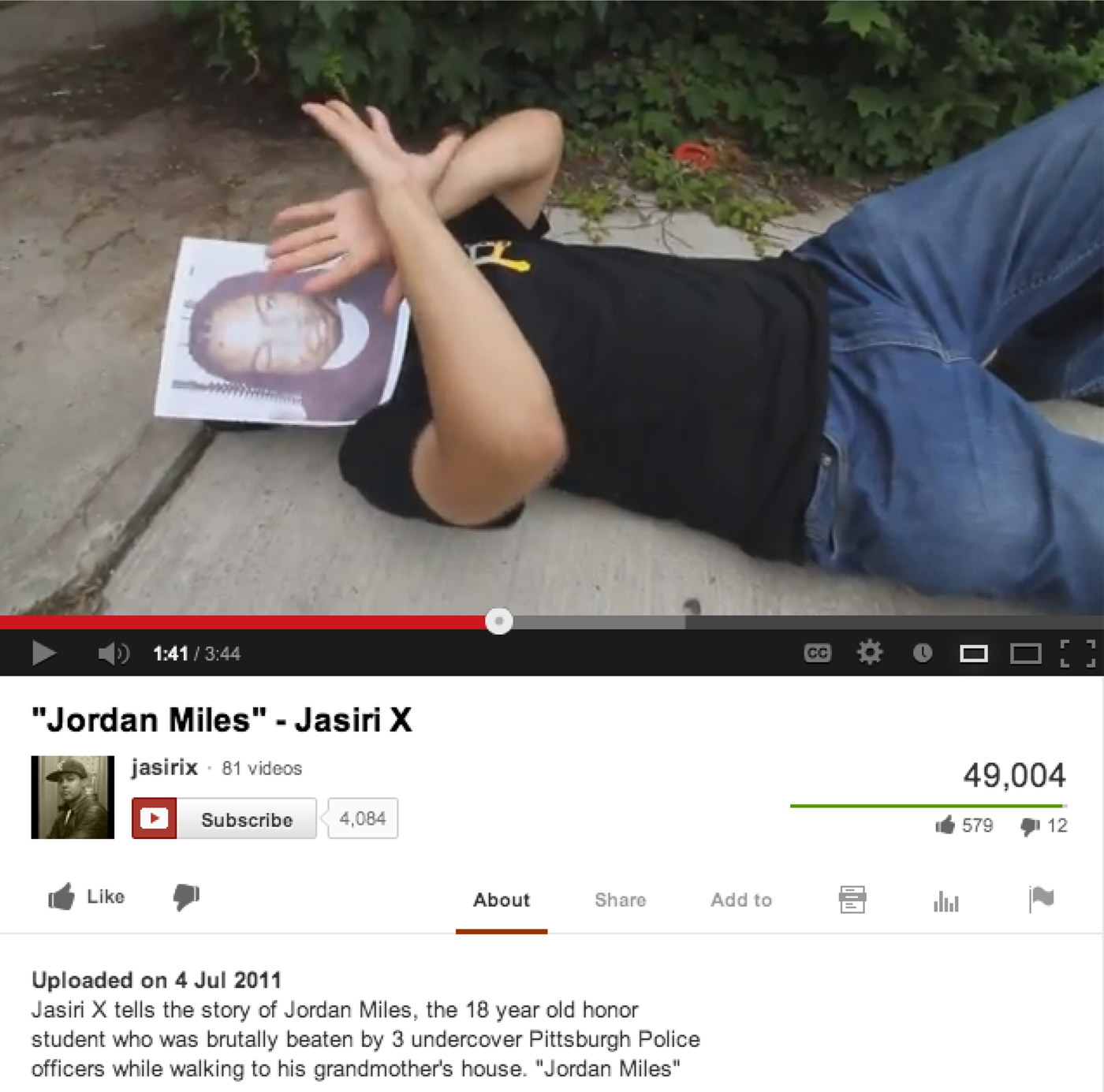
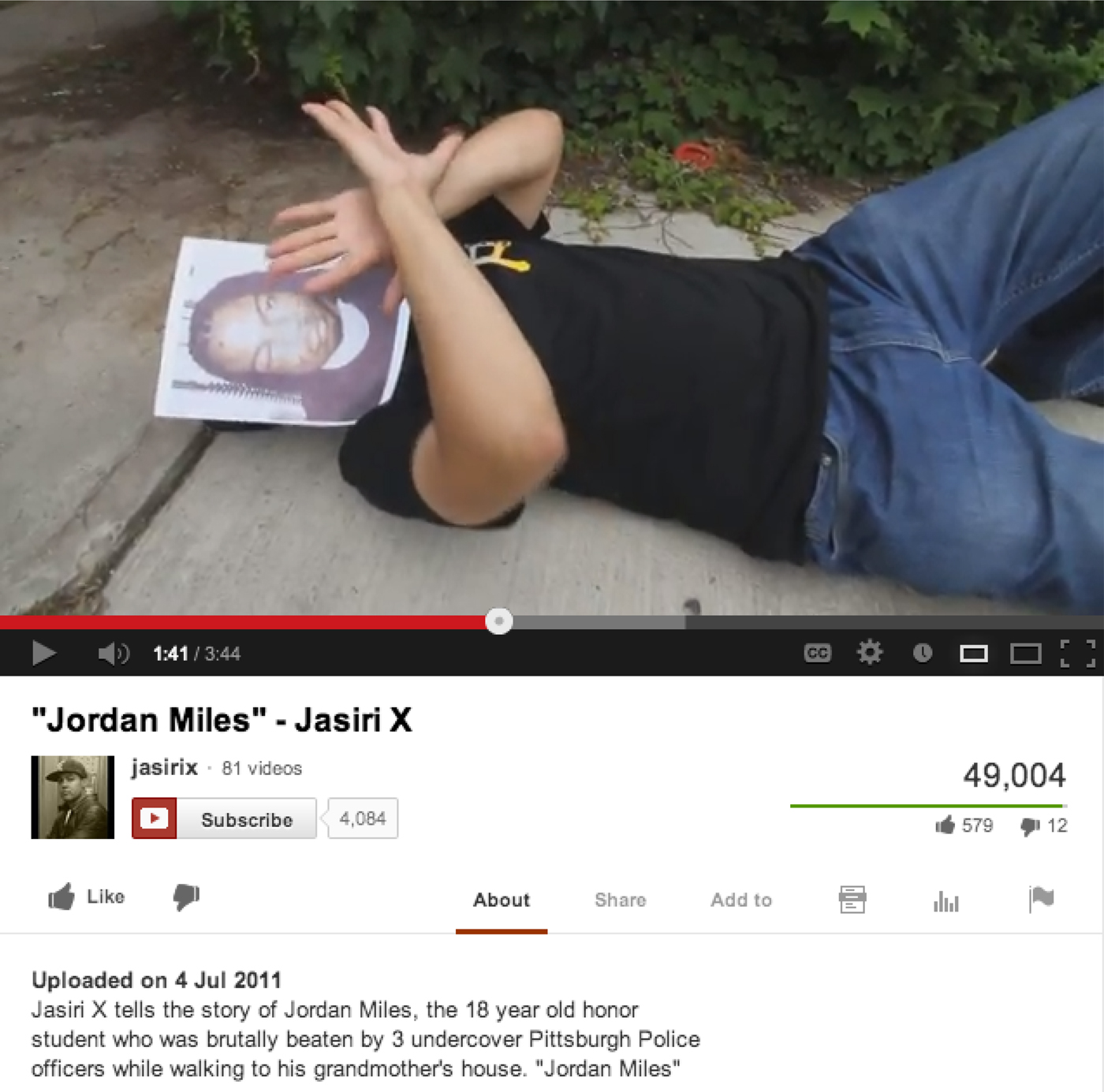
X lies on the ground during his performance of these lines, taking the position of Miles during the beating. X raises his hands protectively across his face, and at one point he performs with a photograph of Miles's swollen, post-beating mug shot covering his face (see Figure 1). The camera maintains its position, looking down onto X's depiction of the events, but the lines ‘He thinks they're gonna stop but they just keep going’ inviting the viewer to enter into and identify with Miles's perspective during the moment of the beating. As such, the appeal to identification is one that invites the viewers to imagine themselves as Miles and to form their own empathic outrage at the wrongness of his treatment by police, and the legal system that refused to put them on trial.
X performs with image of Miles's beaten face over his own.
While there are a variety of meanings at work in the Jordan Miles video, the narrative is essentially an account of a model citizen suffering multiple rights violations at the hands of a racially biased and ineffective legal process. Like many other 1Hood texts, this text does not appeal to viewers who favour extra-legal justice actions. Instead, this appeal asks viewers to understand restorative justice as beginning with the legal investigation and the accountability of the officers in question. The transcendental identity of the audience-subject that Jordan Miles constructs is that of a citizen who is outraged at the violation of rights. X indicates this by placing his own body at the site of the incident. Lying down and acting out Miles's victimisation, X constructs himself, and by implication other citizens, as consubstantial with Miles. In this case, the vulnerability to rights violation is a key mechanism of violation.
Fairclough defines modality as ‘what one commits to when they make statements or ask questions, or make demands or offers’ (Fairclough Reference Fairclough2003, p. 165). In his view, modality is one discursive parameter that produces meaning by structuring the relationship between texts, action, representation and identification. X constructs himself as what might be called a ‘citizen-witness’ who is deeply familiar with the facts of the case and wary of an attempt to obstruct justice. Bridging Miles's vulnerability to civil rights violation with the implied audience through his own situation in the narrative, X commits himself to two attitudes. The first is an attitude of determination to see the due process of law carried out despite the initial unwillingness of the city to investigate, which can be seen as a demand on both the collective audience-subject and on Pittsburgh's judicial authorities. The second stance that X commits to is an assertion of the guilt of the police officers. As noted above, this is accomplished through the attribution of intention to the police officers, the imaginative entering of Miles’ perspective during the beating, and the graphic description of Miles’ ‘beaten and bloody’ state at the time of his arrest. These commitments are modal choices that represent one of many potential ways of relating the facts of the case.
The vast majority of 1Hood's pieces on individual instances of police brutality and murder highlight racial bias as a problematic mode of law enforcement. The argument is explicit at the end of the Trayvon video, as X concludes his narrative of Martin's killing by a self-appointed neighbourhood watchman: ‘And George Zimmerman wasn't even arrested / the message is only white lives are protected / in America.’ In the Jordan Miles video, the focus on race is captured in the lines, ‘but he was found guilty before a trial cause he's a young black man in the wrong part of town’. The racial profiling of the victims is also specifically mentioned later in the song, as X describes the details of the incident: ‘They saw Jordan walking / they lips they start lickin / there's a young black male hell yeah let's get him.’ X attributes an intentional maliciousness to Zimmerman in the Trayvon case and the officers in the Miles case. In reality, it is impossible to know what the actors were thinking, but this rhetorical strategy prompts viewers who believe that the perpetrators of each case did not have malicious intent to recognise that the outcomes would have been the same, either way.
Ultimately, 1Hood Media's highlighting of racial bias is positioned in contrast to the due process of law or humane treatment as prescribed by civil rights. The incidents are presented in such a way as to disturb the identity of viewers who see themselves as part of a just, law-governed society, who must then act to restore justice. Again, the audience is constructed through this description of the resulting social action, because in the narrative of the music video, ‘the whole community’ acts, not simply African American males or specific advocacy groups. This can be observed in the lines: ‘Now the whole community wants justice for Jordan, and the cops charged for the crimes they reported / Call the DA and tell him to press charges we demand justice and we just getting started.’
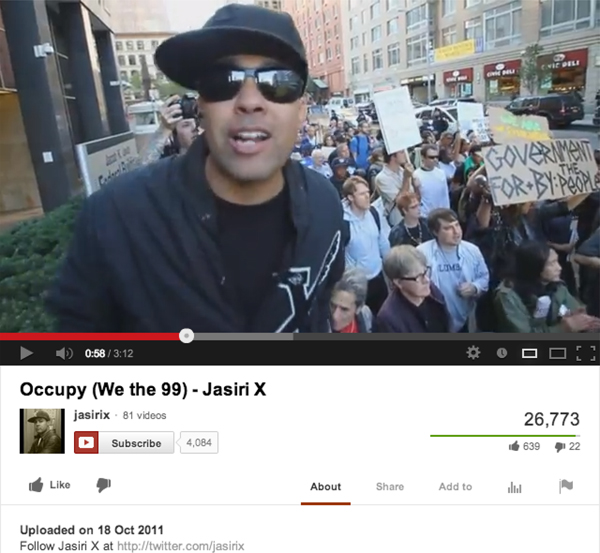
Another way that 1Hood Media's overarching narrative works to construct the audience's identification with victims through a sense of shared injustice has been by expanding from its primary focus on incidents of police brutality against young black males to include an age-, race- and gender-diverse representation of the victims of injustice. The ‘Occupy (We the 99)’ video, which was filmed and released at roughly the same time as the SK launch, offers a clear example of 1Hood's rhetorical positioning of the audience as both victims of and witnesses to instances of injustice. First, the video constructs the victims of injustice and protesters as ethnically diverse, male and female, and predominantly working class. These appeals invite viewers from a variety of backgrounds to see the context of their involvement as one of mutually intertwined rights rather than charitable volunteerism. X sees 1Hood's participation in the video as countering the mainstream media's attempts to discredit the movement by characterising its supporters as exclusively young, white, privileged students. ‘Occupy (We the 99)’ challenges this characterisation, depicting the bodies that march and that are brutalised by police as disproportionately white but ultimately diverse. The representation of diversity is achieved by the juxtaposition of X, an African American man, with the images of mostly white protesters (see Figure 2), supplemented by intermittent shots of African American protesters holding signs. During one shot, X holds up a newspaper that features the image of executed African American male prisoner, Troy Davis. This invites the viewer to make connections between the unequal and racialised application of the death penalty, and unequal law enforcement with respect to issues of economic inequality.
X performing in ‘Occupy (We the 99)’ video at New York protest.
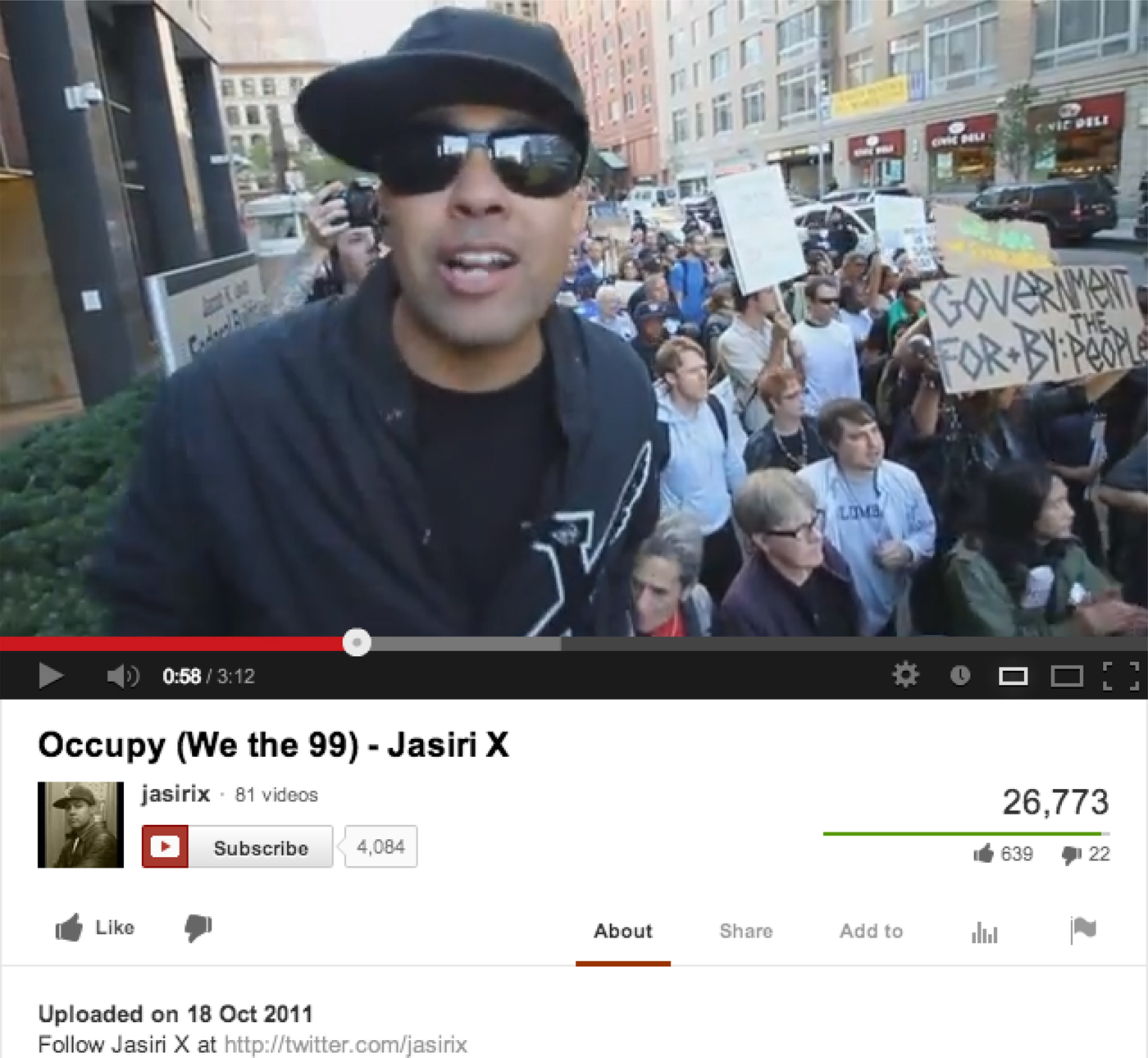
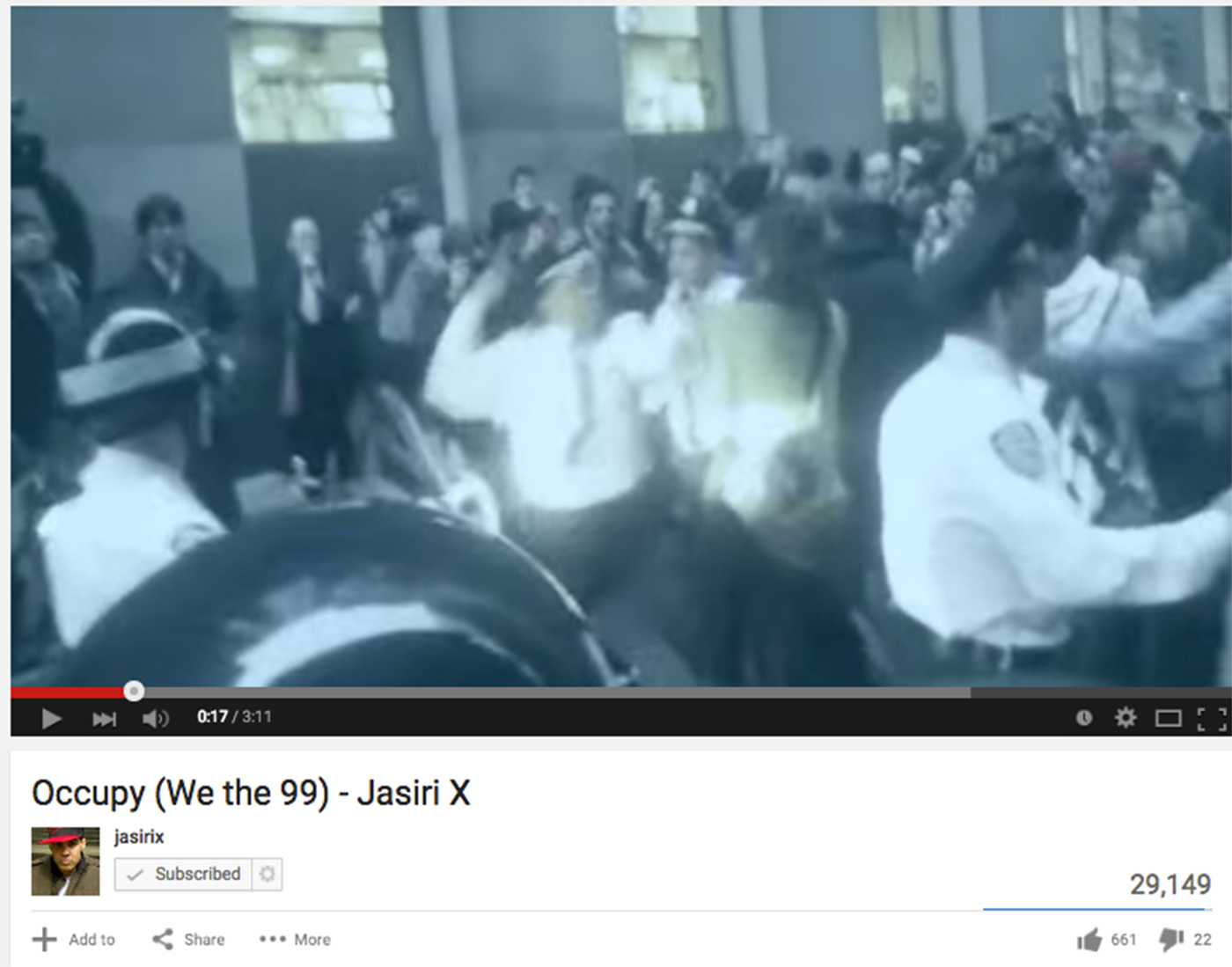
X doesn't appear in the first 40 seconds of the video and his performance scenes are consistently interrupted by the footage of protesters being beaten, pepper-sprayed, dragged through the street, and arrested by police officers. The inclusion of a variety of instances of police brutality, particularly at the beginning of the video, suggests that police brutality has become a standard mode of law enforcement, rather than an exception in isolated incidents.
Lyrically, X describes the scenes playing out on the screen and contrasts the images of police brutality with Obama's foreign policy rhetoric:
The suggestion here is that in this case, Americans receive less justice than Africans (Egyptians). In other words, this is a form of oppression that is close to the audience and one that they can relate to.
The next lines of the song clarify what X means by ‘bias’, contrasting the brutal treatment of some protesters with supportive policies for banks and investment firms:
The phrase ‘the people’ invites the audience to identify with the working protesters and, by extension, the working class. X's use of the idiom ‘carrots and sticks’ works in multiple layers: at one level it operates as an ironic reversal of Warren Buffet's 2009 use of the same idiom to suggest ‘Wall Street was not evil but needs carrots and sticks’ (Crippen Reference Tamraz2009). Since Buffet, a high-profile investor, suggested that Wall Street needs ‘more sticks’, meaning more punitive regulatory policies, any citation of this widely circulated metaphor in reference to Wall Street can be viewed as ironic. X appropriates the metaphor to suggest that America's justice system operates in ways that reward investors for corrupt practices, while violently punishing citizens who protest that corruption. The term ‘sticks’ – a metaphor for punitive discipline – in this context evokes the image of the police nightsticks that are used in incidents of police brutality.
Like the chorus of the song, ‘we gon’ occupy’, the lines ‘building skyscrapers with billions from my labor’ solicit identification by inviting the listener to sing its lyrics. In the mouth of the listener/audience, the words ‘my labor’ doesn't refer to X's work, but to the work of taxpayers and investment clients that were defrauded by the practices of the financial sector. Therefore, by singing the lyrics the listener is constituted as a member of the working class. The combination of footage and X's lyrics invites viewers to confront events that are rhetorically framed as injustices.
Another central component of the appeal in ‘Occupy (We the 99)’, is that 1Hood's audience is also addressed as rights-bearing American citizens. Under the video's opening montage of police brutality footage, a voice can be heard shouting the following words:
Leave these people alone! They're US citizens, US citizens!!!!! U.S.!!!! It does not make you tough to do this to them! It doesn't! Stop hurting these people, man. Why y'all doing this to our people?!!!! I been to Iraq 14 times for my people. You come here and hurt them. They don't have guns. They don't have guns! They don't, why are you hurting these people? It doesn't make any sense. It doesn't make any sense! How do you sleep at night? There is no honor in this! There is no honor in this! There is no honor in this shit!
The voice is that of Iraq War veteran and Marine Sergeant, Shamar Thomas as he confronted the NYPD, following a large ‘Occupy (We the 99)’ Wall Street demonstration in Times Square on 15 October 2011. The first words uttered in the video are ‘leave these people alone. They're US citizens’. This rhetoric refers to the occupy protesters but also attempts to forge a citizenship-based bond with the audience of confrontation (and the officers themselves). The confrontation was recorded, uploaded to YouTube, and went viral in a matter of days, generating over eight million views and widespread blog coverage (Huffington Post 2011). In the beginning of ‘Occupy (We the 99)’, footage from the video of the confrontation is juxtaposed with the opening scenes of brutality. As an Iraq War veteran who confronts the line of police officers in uniform, Thomas operates as ‘the ultimate citizen’, modelling the outrage that the video is meant to evoke from its audience. Thomas admonishes the police officers not for brutality, but for abusing ‘US citizens’. Thomas's outrage is not a response to a human rights violation, but what he perceives as civil rights violations wherein police are assaulting citizens that have rights that he felt he had risked his life to protect. By beginning the video with Thomas's argument, the video offers it as an analytic framework through which to understand everything that follows. Thomas's shouting of ‘there is no honor in this shit’ is interrupted by X's voice on the chorus of the song, ‘we gon’ occupy, we the 99’.
The aforementioned lyrics of the song also construct the audience as rights-bearing citizens:
Here X appeals to the constitution as the authority that grants occupy protesters the moral right to ‘crash your party’. The line, ‘anyone against that's committing treason’ is another Shamar Thomas-esque reference to the police who are framed in the video as working against the constitutional rights of protesting citizens. The next line continues to develop the rights-based argument, claiming that the protesting citizens are ‘real patriots’ while those who refuse to join them are not. This rhetorical move clearly addresses a US citizen who imagines himself to be a patriot. Again, the use of ‘we’ invites the audience to identify with the perspective of occupy protesters by singing along.
This construction of a collective subject that is a rights-bearing, American witness to inequality and repression is also at work in other media coverage of 1Hood actions. In an RT interview about the Occupy protests, X discusses the attempt of the University of Connecticut to censor his performance by contractually stating that if he performed the song ‘Occupy (We the 99)’ he would not be paid (Jasiri X 2011a). The introduction of the newscast sets up X's censorship as the primary problematic, and invites the viewer to bear witness to this:
Just this month he was slated to appear at a political awareness rally organized by the student government. But then he was told that he would only be paid and allowed to attend if he did not perform his song, Occupy We Are the 99 [sic], because it contained obvious political statements.
When asked why he chose to perform the song anyway, X responds by saying ‘because I felt this was more erosion of freedom of speech’. X situates this incident within a narrative of ongoing erosion of constitutional rights, packaging the frame to appeal to a viewer who would be displeased at such a prospect.
The texts of 1Hood Media depict transformative social action through representations of citizens holding local state agencies accountable through legal action, citizens holding corporate citizens accountable through radical protest, and the development of marginalised populations into media literate producers of media.
We came to crash your party: heroic action in 1Hood Media's texts
Among the variety of ways that 1Hood Media depicts heroic action, three stand out in the specific texts under analysis. The first of these is the representation of citizens holding local state agencies accountable through legal action; the second is protest aimed at obtaining accountability from national government bodies and nationally influential private entities; the third is the process of assisting youth to develop critical media literacy. The aforementioned Jordan Miles video offers an instructive example of this. The video describes the events surrounding the civil rights case of Jordan Miles (the Pittsburgh-based African American youth who was physically assaulted and arrested by police on 12 January 2010). As both an educational piece of media about the case and protest song/video, ‘Jordan Miles’ stands as an example of social action. Specific types of social action are also represented in the text of the song, which constitutes a subject position of citizenship.
The primary representation of legal agency in ‘Jordan Miles’ comes at the end of the song, with the lyrics: ‘now the whole community wants justice for Jordan / And the cops charged for the crimes they reported / Call the DA and tell him to press charges / we demand justice and we just getting started.’ These lyrics are specific about the kind of justice that is being sought: in this case, legal action. The phrase ‘we just getting started’ indicates the intention of the Justice for Jordan Miles campaign to continue to push for this specific end. The use of the term ‘we’ refers to those already in support of the campaign, but it also invites the audience to identify with the campaign through the act of singing the lyrics. The video ends by directly asking the viewer to take action on behalf of the case by placing the following text in white lettering over a black screen:
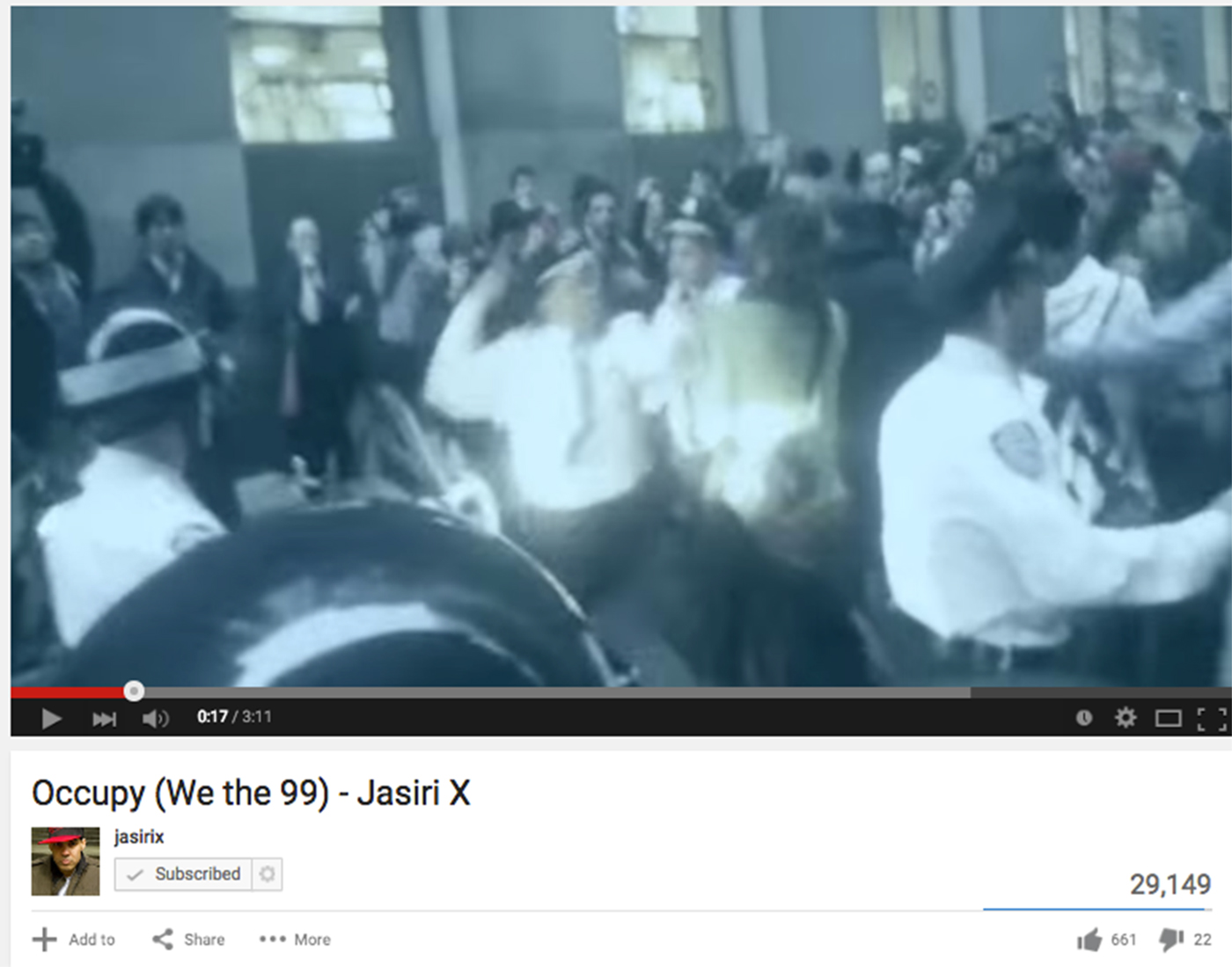
1Hood's texts also depict citizens working to obtain accountability from national government bodies and nationally influential private entities. The song and video for ‘Occupy (We the 99)’ offers an additional example of this pattern of representation. The song was written as a manifesto for the Occupy movement, and it decries the actions of the financial sector in relation to the sub-prime mortgage crisis, the absence of legal accountability in the wake of the crisis, and the methods of law enforcement directed at the Occupy protests. This video was filmed at Zucotti Park in New York and in Pittsburgh, PA, and includes footage from a variety of other protests. The video's clearest symbol of social action is the seemingly endless collage of footage, playing throughout the video, of police physically assaulting protesters at various Occupy events. These are juxtaposed with scenes of marches and protests, and shots of Jasiri performing his verses at various Occupy locations (see Figure 3). The lyrics of the song interpret these images for the viewer in a number of ways.
Jasiri X performs in ‘Occupy (We the 99)’
The song's chorus ‘we gon’ occupy / we the 99’, is sung by Jasiri X. The phrase ‘we gon’ occupy’ announces the literal intention to continue engaging in politically oriented processes of reclaiming physical space, but it also announces a general intention to take action against the forms of injustice that are argued elsewhere in the song. ‘We the 99’ takes up the rhetoric of the Occupy movement, inviting the viewers to see themselves as the victims of the practices of the financial sector and lax regulatory policies and processes, but also as part of a community that reclaims space and demands accountability. The verses reaffirm the intention to act and offer more rhetorical appeals that justify action. In this sense, the aforementioned lines, ‘we came to crash your party and we ain't leaving until we're even’, are an announcement of political action. The lyrics go further, to argue that, for those who consider themselves patriots, social action is not a choice but a requirement of participation in democracy. But the form of action being discussed, ‘we came to crash your party’, describes the radical action directed at the institutions involved with the governance of the financial sector. In this case, ‘your party’ is meant to describe the villain, whereas the ‘we’ refers to the constituted audience.
Conclusion
1Hood Media's texts construct its collective subject as rights-bearing American citizens who bear witness to, are close to, and respond to instances of injustice. The victims of injustice, who frequently speak for themselves in 1Hood Media productions, are mostly African American males, but also include citizens who come from a variety of geographic and ethnic backgrounds. 1Hood Media invites its audiences to feel consubstantial with their experiences of injustice. Additionally, 1Hood Media offers a multi-faceted representation of social action. This includes local and national strategies to hold law enforcement accountable, as well as more radical projects of reclaiming public space. Additionally, the development of art, political media and new generations of media producers ‘from the margins’ are also depicted as necessary components for participation in the promotional public sphere. Certainly, X and Paradise are prominent figures, even protagonists, in the productions’ stories, but similarities between them, audiences and victims of injustice are emphasised.
Due to the focus on violations of justice, almost all of 1Hood Media's songs or videos feature the victim or victims as prominent – as rights-bearing American citizens, with whom the imagined audience is seen to share certain key similarities. This contrasts with the victims (the recipients of aid) in the media of philanthropic campaigns who are generally depicted as foreign and desperate ‘others’, and whose only salvation is compassionate institutional or celebrity actors. While the institutional actors in 1Hood Media's narrative are occasionally privately governed systems, such as the G20, or investment banks, they are more frequently state apparatuses, such as the police, or the state itself in the form of the White House, or members of Congress. Rather than acting on behalf of citizens, these institutions are depicted as systems of oppression and are the perpetrators of injustice.
1Hood's texts, like many commercial brands, constitute the artist-celebrity and the imagined audience as heroes. But the heroic action of commercial brands is essentially consumption, whereas 1Hood's narrative provides a view of heroic action more fundamentally rooted in ideas of citizenship. The audience-heroes, male and female, come from a diverse range of ethnicities and are constituted as having literacy with the constitution, economic policies and systems of oppression. In response, they speak courageously and articulately about the nature of the injustices that they witness and experience. Finally, they are able to act in collective protest and endure violent repression in the service of their cause.
X, and to a lesser extent Paradise Gray, are heroes in 1Hood's narratives; however, 1Hood Media's brand narrative relies on X's history as a driving component to a limited extent. This may be partially due to the fact that the complex interplay between 1Hood's history as an organisational coalition and the artist/activist careers of both X and Gray do not lend themselves to a quickly relatable heroic ‘backstory’. Additionally, the lifestyle of X or Gray is almost never a topic of 1Hood's productions. Rather than being the primary vehicle for social change, X's role in this narrative fluctuates between narrator, journalist and ‘prophet of rage’, as he addresses specific events and constructs them as injustices.
1Hood's narrative also struggles with its own contradictions. Their appeals straddle the mixed blessings that result from the political and promotional strategy of responding to high profile and controversial incidents or events. The overarching narrative of 1Hood's overall body of work positions citizens in a proactive, ongoing participation in democratic practices through the naming and challenging of systems of oppression. The sub-narratives of individual pieces of media that are related to specific initiatives or campaigns may carry the unintended message that the primary political energy of citizens should be geared toward reacting to specific instances of injustice, as a corrective measure to systems that are fundamentally sound. This risks overly personalising the ‘characters’, especially victims and villains. The narrative logic of individual stories can therefore take over from a more historical or institutional understanding of social injustice.
The lyrics in songs such as ‘Occupy (We the 99)’ include references to the constitution or patriotic rhetoric that appears to aim at two goals. This rhetoric illustrates the failure of US domestic law enforcement and economic policies to live up to the ideals that are espoused by its politicians and cherished by many citizens. Citing violations or unequal enforcement of civil rights also carries the potential benefit of attracting the support of audiences who are sympathetic to patriotic views while also offering evidence of deeply embedded structural injustice. This type of appeal has often been used in populist movements to delegitimise the state, and inspire protest by highlighting a pattern of hypocrisy in the rhetoric or application of laws.
Needless to say, Jasiri X is far from the first hip-hop artist to take up issues of social justice. Since its beginnings in the early 1970s, hip-hop has produced a variety of socially conscious artists and songs. One distinctive element of 1Hood's presentation is the specificity of their rhetorical appeal. Jasiri X speaks to locally and personally specific instances of current injustices. More widely distributed political hip-hop songs such as Public Enemy's ‘Fight the Power’ (Ridenhour Reference Ridenhour1989), or Lupe Fiasco's ‘Words I Never Said’ (Jaco Reference Jaco, Hafermann and Grant2011), take on big social issues such as racism or the war on terror, offering ideas and broadly familiar cultural reference points. Songs such as 1Hood's ‘Jordan Miles’, ‘Enough is Enough’, ‘Troy Davis’ or ‘Three Little Girls’ (Jasiri X 2011e) critique the injustice of police brutality and the extrajudicial killings of African Americans, but they do so through close readings of specific and ongoing cases of particular situations.