Welfare reforms in advanced European countries have resulted in substantial cuts to social insurance benefits over recent decades. While aiming to restore the sustainability of financially stressed programs, governments have promoted policy change in diverse ways. In some cases, a top-down unilateral approach has been implemented, pressing for retrenchment without consulting those who would be adversely affected. In others, governments have adopted a corporatist approach by engaging in institutionalized negotiation with stakeholders (Taylor-Gooby, Reference Taylor-Gooby and Talyor-Gooby2002; Schludi, Reference Schludi2005: 62–63, Reference Schludi, Arza and Kohli2008; Schulze and Moran, Reference Schulze, Moran, Immergut, Anderson and Schulze2009; Palier, Reference Palier and Palier2010).
This study explores more complicated cases located between these two stylized paths to welfare retrenchment. It examines hybrid cases that demonstrate the combined features of unilateralism and negotiation. In these cases, governments engage in ‘non-corporatist’ bargaining, wherein they negotiate with stakeholders, but in a way overshadowed by their unilateral efforts for intervention. This paper seeks to explain these reform cases by employing an ‘insider-outsider’ framework for public policy reform (Rueda, Reference Rueda2005; Häusermann, Reference Häusermann2010; Palier, Reference Palier and Palier2010; Emmenegger et al., Reference Emmenegger, Häusermann, Palier and Seeleib-Kaiser2012). The key thesis is that the presence of exclusive insiders in the welfare system complicates the reform process, disqualifying both unilateralism and corporatist bargaining as feasible options for benefit cuts.
To support this argument, the author draws evidence from two Anglophone countries: the UK and Ireland, which are widely acknowledged examples of residual welfare states in Europe. However, in certain policy areas, governments have provided more generous welfare programs for narrowly targeted insiders. The public sector pension is a prime example (Lindeman, Reference Lindeman2002; Palacios and Whitehouse, Reference Palacios and Whitehouse2006). Focusing on this policy area, the author traces and explains the core mechanism of the hybrid reform.
The two country cases provide diverse empirical contexts for testing the insider-outsider thesis. In particular, the legacy from decades of experiments with social partnership (Hardiman, Reference Hardiman2002; Baccaro, Reference Baccaro2003; cf. Regan, Reference Regan2012) provides Ireland with an institutional context that the government would promote a more consensus-based solution than that implemented in the UK. In this study, it is claimed that the legacy may not be overwhelming enough to change the fundamental course of the reform outlined by the insider-outsider thesis. Like the UK, Ireland followed a non-corporatist path to welfare retrenchment. This provides a firm basis for the thesis, demonstrating that the two cases produce the same broad outcome despite a notable difference in a potentially important causal condition.
Overall, the study finds that public sector pension reforms in the UK and Ireland are more complicated cases than those expected for countries with residual welfare states. Researchers should pay closer attention to program-specific characteristics of the reform cases to improve their understanding of welfare retrenchment in these countries. Future studies may also build on the findings of this research to examine hybrid cases in a general European context.
1. Diverse paths to welfare retrenchment in Europe
Throughout recent decades, governments in Europe have made considerable efforts to cut various benefits in traditional contributory programs such as unemployment and pension payments. These programs faced an enormous fiscal challenge, because of the mismatch between an increasing number of benefit claimants and shrinking body of contributors. To fiscally balance the programs, governments introduced various reform measures to tighten contribution requirements, eligibility criteria, and payment formulae. Certainly, governments were initially hesitant to introduce these unpopular policies (Pierson, Reference Pierson1994). However, they have eventually endorsed the agenda, assisted by various political, institutional, and ideational factors that have minimized electoral backlashes from the reform and expanded voters' support for it (Huber and Stephens, Reference Huber and Stephens2001; Armingeon and Bonoli, Reference Armingeon and Bonoli2006; Palier, Reference Palier and Palier2010; Bonoli and Natali, Reference Bonoli and Natali2012).
This study examines the ways governments promoted the retrenchment. While sharing the same objective to restore the financial sustainability of social insurance programs, governments adopted diverse methods to promote their policy goal. In Southern, Continental, and Northern Europe, where welfare programs provide relatively generous and extensive benefits for broad population groups, governments have favored corporatist bargaining. The term ‘corporatist’ refers to an attribute of concerted policy-making (Baccaro, Reference Baccaro2003), rather than a structural form of interest intermediation (Schmitter, Reference Schmitter1974). The core feature is that governments engage in institutionalized policy negotiation with a broad group of stakeholders, wherein all involved actors display mutual consensus on the process and outcome of the reform (Baccaro, Reference Baccaro2003; Bonoli and Natali, Reference Bonoli and Natali2012; Ornston and Shulze-Cleven, Reference Ornston and Schulze-Cleven2015). Governments can opt for unilateral welfare cuts when they enjoy broad parliamentary support and/or there are impending economic crises that justify immediate policy responses (Schludi, Reference Schludi, Arza and Kohli2008; Vis, Reference Vis2010; Hamann and Kelly, Reference Hamann and Kelly2011). Otherwise, governments involve important stakeholders in the policy-making process to ensure the success of their reform efforts (Ebbinghaus and Hassel, Reference Ebbinghaus and Hassel2000; Rhodes, Reference Rhodes and Pierson2001; Schludi, Reference Schludi, Arza and Kohli2008; Palier, Reference Palier and Palier2010).
The situation differs in Anglophone countries where social insurance programs provide only residual benefits. With no broad stakeholders entrenched in the welfare system, governments rely on a unilateral approach to policy change, in which they dominate the process by allowing little room for social negotiation (Anderson and Meyer, Reference Anderson and Meyer2003: 26; Schludi, Reference Schludi2005: 62–63, Reference Schludi, Arza and Kohli2008: 52). Existing studies found the best empirical evidence of this reform route in the UK. As a representative case of residual welfare states coupled with weak welfare insiders, the country presents reform cases where governments assumed a central role in all major changes in welfare and labor market policy, starting with Thatcher's neoliberal retrenchment in the 1980s (Gamble, Reference Gamble1988; Pierson, Reference Pierson1994; Huber and Stephens, Reference Huber and Stephens2001; Taylor-Gooby, Reference Taylor-Gooby and Talyor-Gooby2002; Howell, Reference Howell2005; Schulze and Moran, Reference Schulze, Moran, Immergut, Anderson and Schulze2009).
2. Non-corporatist bargaining: hypotheses and cases
The paper builds on these previous studies on diverse paths to welfare retrenchment in Europe. However, it pays closer attention to more complicated cases in which retrenchment occurred through a combination of unilateralism and bargaining. Existing studies noted these cases in their analyses of various welfare reforms in Europe. Examples include the 1997 reform by the OVP (Austrian People's Party)-SPO (Social Democratic Party of Austria) grand coalition in Austria (Hamann and Kelly, Reference Hamann and Kelly2011), 2001 reform by the SPD (Social Democratic Party of Germany)-Green coalition in Germany (Schludi, Reference Schludi2005), 1992 reform by the ND (New Democracy) conservative government and 1997–1999 reform by the PASOK (The Panhellenic Socialist Movement) social democratic government in Greece (Triantafillou, Reference Triantafillou, Immergut, Anderson and Schulze2009), 1992 reform by the emergency government and 2004 reform by Berlusconi's conservative government in Italy (Jessoula and Alti, Reference Jessoula, Alti and Palier2010), and 1993 reform by Balladur's conservative government in France (Natali and Rhodes, Reference Natali and Rhodes2004). However, researchers examined these hybrid cases to support their dualistic understanding of welfare reform. Consequently, they discussed the cases as incomplete or complicated approximations to the idealistic paths to retrenchment.
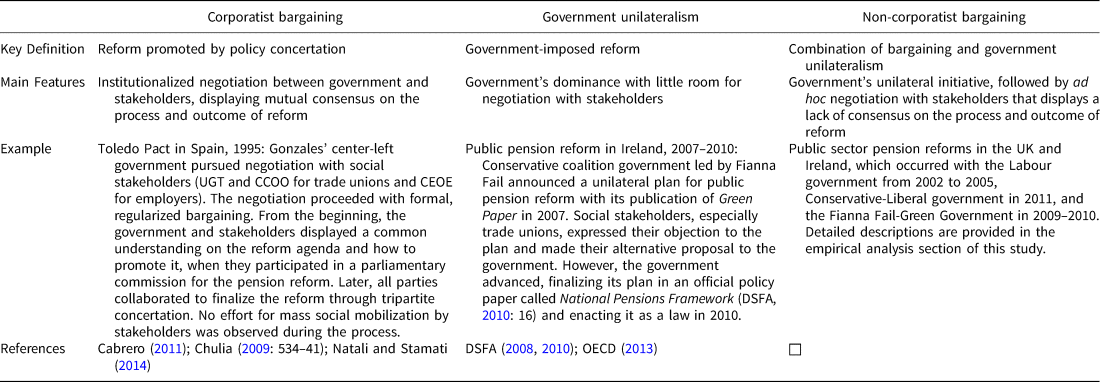
This study focuses on the distinctive features of these reform cases. It demonstrates that governments engage in ‘non-corporatist bargaining’ through which they promote reform by combining unilateral policy initiatives and ad hoc negotiation that displays a lack of consensus on the process and outcome of the reform. Table 1 summarizes the key features of this reform path in comparison with corporatist and unilateral alternatives. Next, the author provides a detailed account of this reform case and offers a causal explanation thereof by drawing on the insider-outsider framework for policy reform.
Three paths to welfare reform

2.1 The insider-outsider hypothesis
Widely employed in various studies on the labor market and social welfare reforms in Europe (Rueda, Reference Rueda2005; Palier, Reference Palier and Palier2010; Emmenegger et al., Reference Emmenegger, Häusermann, Palier and Seeleib-Kaiser2012; Hassel, Reference Hassel2014; Baccaro and Pontusson, Reference Baccaro and Pontusson2016; Biegert, Reference Biegert2017), the insider-outsider framework builds on the premise that public policies may not provide equal benefits for all citizens. Core stakeholders – called insiders – enjoy exclusive benefits by relying on strong organizations, resources, and political leverage within the system. However, outsiders receive small to little benefits, because they have no strong stake in the welfare programs or retain little of the resources necessary to mobilize their demands. Therefore, the theory contends that governments would listen to insiders more carefully than to outsiders. Welfare state scholars including Häusermann (Reference Häusermann2010), Emmenegger et al. (Reference Emmenegger, Häusermann, Palier and Seeleib-Kaiser2012), and Natali and Rhodes (Reference Natali and Rhodes2004) apply this idea to their research on contemporary welfare reforms in Europe, concurring that governments have been more attentive to the concerns of insiders in major private and public sectors and consequently, have produced uneven reform results at the expense of marginal groups of beneficiaries.
The present study hones this broad insight into a focused research question, examining how exclusive insiders influence the process of welfare reform. Existing studies demonstrated that governments adopt unilateral cuts when dealing with welfare programs associated with dispersed outsiders or general recipients with slim benefits (Anderson and Meyer, Reference Anderson and Meyer2003: 26; Schludi, Reference Schludi2005: 62–63, Reference Schludi, Arza and Kohli2008: 52). Studies have also confirmed that governments are more inclined to strike corporatist bargains when facing extensive stakeholders who enjoy generous benefits. Governments find it difficult to ignore these sizable voter groups during the reform process. Stakeholders also consider it difficult to reject the reform agenda, because they cannot fully externalize the costs of their extensive benefits to the rest of the economy (Olson, Reference Olson1971). Under these circumstances, the parties may seek an opportunity to make corporatist deals depending on whether other favorable conditions are satisfied. They may agree to cut programs that lack efficiency and equity, in exchange for maintaining or expanding others that benefit broader populations in a way more friendly to the economy (Levy, Reference Levy1999). A large body of literature on European social pacts confirms this contention (Ebbinghaus and Hassel, Reference Ebbinghaus and Hassel2000; Baccaro, Reference Baccaro2003; Hamann and Kelly, Reference Hamann and Kelly2011).
The presence of exclusive welfare insiders makes neither of these two options available for welfare reform. Powerful insiders receive selective benefits separately from ordinary citizens. Appreciating that the costs of their targeted benefits are more readily externalizable than are those of extensive benefits, insiders make persistent efforts to defend their interests at the expense of the general public interest, a point echoed in related studies on special interest politics in contemporary democracies (Lohmann, Reference Lohmann1998; Grossman and Helpman, Reference Grossman and Helpman2001). Given this circumstance, it will be difficult for governments to ignore the veto players who can derail their reform efforts. However, the wide gap in the policy preferences of the two sides means that governments cannot aim to achieve full consensus with insiders regarding the reform process and outcome. Therefore, governments develop a bargaining pattern where they initiate the process by pushing for their agenda but later allow social negotiations on an ad-hoc basis. While this complicated pattern of interaction reflects governments' lack of power to predominate their recalcitrant veto players, it does help them promote successful reforms by expanding the ground of moderate policy compromise.
Initially, governments may announce their plan for reforming special welfare programs unilaterally without policy consultation. The insiders respond by rejecting the initiative as contradictory to their core interests. Appreciating the difficulty with alienating insiders from successful reform, governments invite them to the bargaining table. However, the negotiation does not proceed well, because of the gap between the two sides' policy preferences and consequently, governments' unwillingness to provide enough bargaining space to insiders. Ultimately, the insiders increase their active social mobilization to defend their benefits. As it becomes clear that the reform plan will not survive in its original form, governments express their willingness to soften their policy position. They reconfirm their commitment to cutting special welfare programs, but only as a long-term project. This flexible approach paves the way for striking a policy compromise with the insiders, where both sides agree that existing benefits will be preserved at the expense of future benefits (Myles and Pierson, Reference Myles, Pierson and Pierson2001: 321). While losing some ground for their unrealized constituencies, the insiders protect the interests of their core constituencies – present and especially senior members – against governments' reform efforts.
Based on these configurations of causal conditions and preferences surrounding the involved actors, the author postulates the following testable hypotheses regarding core features and sequences of the reform:
Hypothesis 1
Governments start the reform by presenting their own plans without consulting welfare insiders.
Hypothesis 2
Governments soon invite the insiders to negotiate, although this effort does not proceed well.
Hypothesis 3
The insiders respond by promoting active social mobilization to veto benefit cuts.
Hypothesis 4
Passing through this stalemate period, governments tone down their policy stance to pave the way for a feasible compromise with the insiders.
2.2 Cases: countries and policy
The author examines this complicated scenario of welfare retrenchment in the contexts of two European countries: the UK and Ireland. As discussed shortly, these cases were selected because they provide ideal examples of non-corporatist bargaining. A comparison with other reform cases may not be necessary, because existing studies on government unilateralism and corporatist bargaining have already provided persuasive information for analyzing what would happen if welfare beneficiaries are weak and dispersed or form extensive stakeholder groups. Using these studies as a reference, the author focuses on what would happen if stakeholders represent exclusive insiders.
A bird's-eye view of the two country cases reveals that their welfare programs feature slim but relatively equal benefits – such as universal flat-rate social insurance or means-tested public assistance – delivered to broad recipient groups (Huber and Stephens, Reference Huber and Stephens2001: ch. 4; Taylor-Gooby, Reference Taylor-Gooby and Talyor-Gooby2002; Pontusson, Reference Pontusson2005: ch. 2). In other selective policy areas, however, governments provide more generous benefits to certain exclusive groups. Although these targeted policies seem incongruent with the general notion of welfare residualism, governments nevertheless have endorsed them to court the loyalty of strategically important voter groups (Rothenbacher, Reference Rothenbacher2004). The public sector pension is one prime example in which governments provide notably generous benefits to public employees. A higher level of unionization and job tenure in the public sector as well as governments' political interest in maintaining employee loyalty (Blake, Reference Blake2003: 3–5; Rothenbacher, Reference Rothenbacher2004: 45–6) contribute to expanding these benefits (Lindeman, Reference Lindeman2002; Palacios and Whitehouse, Reference Palacios and Whitehouse2006).
Scholars have examined these special welfare benefits through an occupational pension framework (Myles and Pierson, Reference Myles, Pierson and Pierson2001; Ebbinghaus, Reference Ebbinghaus and Ebbinghaus2011; Ebbinghaus and Gronwald, Reference Ebbinghaus, Gronwald and Ebbinghaus2011). Different from general pensions that provide standardized benefits for most citizens, occupational pensions deal with only narrowly defined stakeholders who take their benefits as ‘quasi-property rights’ (Myles and Pierson, Reference Myles, Pierson and Pierson2001: 321) tailored to their pay levels, work records, and contribution periods. The public sector pension represents an ideal case where beneficiaries take generous, exclusive benefits based on their occupation category.
As such, public sector unions, which represent public employees, emerge as the most powerful welfare insiders in the UK and Ireland. Cuts in pension benefits would not be conceivable without engaging them in the reform process. Their exclusive status is well contrasted with outsiders of the pension programs, such as private sector unions and even future public employees, who do not share a high stake in public pension programs, or even if so, have not yet made their interests represented. Public sector unions are even more privileged in the UK and Ireland because the payment gap between regular and public sector pensions is wider in these countries than in their European counterparts, where regular pensions provide relatively generous payments (Bonoli, Reference Bonoli2000; Myles and Pierson, Reference Myles, Pierson and Pierson2001).
Note that an organizational issue regarding public sector unions further complicates the reform process in the two countries. Consistent with the general notion of interest group fragmentation in a plural society (Gamble, Reference Gamble1988; Ebbinghaus and Visser, Reference Ebbinghaus and Visser2000: ch. 9, 17; Howell, Reference Howell2005: ch. 5; Wallace et al., Reference Wallace, Gunnigle, McMahon, Wallace, Gunnigle and McMahon2013), public sector unions in the UK and Ireland have not developed an overarching authority to promote cross-group representation. While possessing an active capacity for intra-organizational mobilization, multiple union associations are involved in membership competition for overlapping groups of public employees (Bach and Winchester, Reference Bach, Winchester and Edward2003; Wallace et al., Reference Wallace, Gunnigle, McMahon, Wallace, Gunnigle and McMahon2013). Understandably, this creates complexity in the reform process by inviting multiple unions to play leading roles in the negotiation with and social mobilization against governments. When governments revise their plans to seek compromises, all unions must be invited to the bargaining table. Even when governments make their final offers, the deals should be ratified separately across union organizations. These complicated features add a further contextual ground to the reform mechanism stipulated in Hypotheses 1–4.
Hypothesis 5
Fragmentation in insider organizations further complicates the bargaining process by involving multiple stakeholders throughout the reform.
Also noteworthy is that distinctive empirical circumstances differentiate the UK and Ireland cases. The Westminster-style policy-making in the UK – wherein central governments supported by a parliamentary majority play a leading role in introducing and changing public policies – produces a broader space for unilateralism when governments attempt cuts in welfare programs (Taylor-Gooby, Reference Taylor-Gooby and Talyor-Gooby2002; Schulze and Moran, Reference Schulze, Moran, Immergut, Anderson and Schulze2009). This makes the UK a likely case for non-corporatist bargaining, by encouraging governments to deviate from a steady path to policy concertation with public sector unions.
The context in Ireland is different. The country is known for successful experiments with social pacts in which governments engage in broad policy concertation for macroeconomic management (targeting income and jobs) in collaboration with trade unions and employers (Hardiman, Reference Hardiman2002; Baccaro, Reference Baccaro2003; cf. Regan, Reference Regan2012). Therefore, decades of successful public bargains make Ireland a less likely case for non-corporatist bargaining, encouraging governments and public sector unions to forge consensus-based bargaining for public sector pension reform.
In the empirical section, the author conducts a comparative analysis considering these differences. Employing the logic of Mill's method of agreement (Mahoney, Reference Mahoney2007), the analysis examines if the two cases produce the same broad outcome of non-corporatist bargaining, despite their notable differences. Important in this regard is a claim that social partnership in Ireland has been in place to address broad policy issues in which governments and social partners develop overlapping mutual interests. Therefore, the same logic of cooperation may not be fully incorporated into other policy areas such as public sector pension reform, where exclusive insiders are dedicated to protecting their narrow benefits at the expense of the public interest. Based on this insight, the author contends that institutions of policy concertation in Ireland do not play a meaningful role until a later stage of the reform when governments and trade unions are finally interested in striking a bargain after passing through a considerable period of stalemate and social confrontation. While promoting these actors to negotiate their deal at this final stage, this does not alter the fundamental course of reform, as outlined in non-corporatist bargaining.
Hypothesis 6
The corporatist legacy in Ireland does not affect the course of reform outlined in Hypotheses 1–5. However, it makes a difference at a later stage of the reform by expanding the scope of consensus among public sector unions toward their final deal.
3. Public sector pension retrenchment in the UK and Ireland: empirical analysis
This section examines the validity of the six hypotheses postulated against three reform cases that occurred in the UK and Ireland over the last few decades. Two cases were from the UK: one with the Labour government in the early 2000s and the other with the Conservative-Liberal coalition government in the early 2010s. In Ireland, the coalition led by Fianna Fail (conservative nationalists) and Green promoted reform around 2010. All these cases were characterized by fragile, conflict-ridden bargaining between governments and public sector unions. To demonstrate, this section first outlines the causal conditions common to the three cases. It then undertakes a comparative historical analysis tracing diverse reform processes that led to the common outcome of non-corporatist bargaining.
Before presenting the case analyses, a few remarks are made to address potential unidentified causes that may have intervened in the reform process. Besides the features of welfare stakeholders and corporatist institutional legacy, which have been extensively discussed here, studies on European welfare reforms highlighted several other factors that may affect the reform process. For instance, sweeping economic crises may facilitate governments to introduce unilateral policy measures as urgent steps toward swift national recovery. Governments' electoral strength also matters. Strong governments are more ready to endorse unilateral policy change because they are less sensitive to the electoral backlashes cutbacks would likely trigger (Schludi, Reference Schludi, Arza and Kohli2008; Vis, Reference Vis2010; Hamann and Kelly, Reference Hamann and Kelly2011). In addition, government partisanship may play a part. The general scholarship on European welfare states has thus far deemphasized the role of partisan variables in recent reform cases. The fiscal inevitability of welfare retrenchment and weakening of post-war partisan cleavages on the one hand, and electoral difficulty of radical cutbacks on the other, are the main factors that have narrowed the room for partisan effects in welfare reforms (Ross, Reference Ross2000; Huber and Stephens, Reference Huber and Stephens2001; Pierson, Reference Pierson2001; van Kersbergen and Vis, Reference van Kersbergen and Vis2014). Against this broad assessment, it is still plausible to contend that political partisanship can make a difference in a particular issue, namely the way governments promote reforms. Likely, left governments would choose a corporatist path, because of their political and ideological affinity with trade unions. Right governments would promote unilateralism, because of the lack of such affinity and their suspicion of trade unions as veto players in market-oriented reforms.
However, none of these alternative causal conditions were important in determining the path to public sector pension reform in the UK and Ireland. First, two governments from the UK maintained sizable majorities in Parliament (62.5% for the Labour government and 55.9% for the Conservative-Liberal government), whereas the one from Ireland led a minority coalition with 48.1% in the Dail (Fisher, Reference Fisher2002; O'Malley, Reference O'Malley2010; Whitaker, Reference Whitaker2011). Despite these differences in electoral position, all three governments adopted the same path to non-corporatist bargaining. Also noteworthy is that two of the three cases (the Conservative-Liberal coalition in the UK and Fianna Fail–Green coalition in Ireland) promoted welfare cuts in the middle of the economic and financial crisis that hit many European countries around 2010, while the Labour government promoted reform before the crisis emerged. The former cases also coincided with conservative dominance in the government cabinet, whereas the latter represented a social democratic one. Given these diverging constellations of causal conditions, one would expect the former two cases to exhibit unilateralism and the latter corporatist negotiation. However, all three cases demonstrated the same reform path through non-corporatist bargaining. Based on this brief analysis, we conclude that none of the three alternative causes affected the way governments promoted reforms in the UK and Ireland. This corroborates the premise of the present study that strong insiders embedded in welfare programs encourage governments into non-corporatist bargaining, regardless of configurations in other potentially relevant causal conditions.
3.1 Common causal conditions in the UK and Ireland
Table 2 summarizes the public sector pension programs in the UK and Ireland, vis-à-vis other regular public pension programs. It confirms that public sector pensions delivered more generous benefits to recipients than did regular pensions. In the UK, public sector workers were entitled to pension payments equivalent to 50–67% of their final-year salaries at the age of 60, until the New Labour government embarked on a pension reform in the early 2000s. These sharply contrasted slimmer benefits for other workers in the private sector, who also faced a more restrictive age qualification. The situation was similar in Ireland, where public sector workers were entitled to 50% of their final-year salaries at the age of 65 until the conservative coalition led by Fianna Fail and Green introduced major reform around 2010. Ordinary workers in the private sector were provided only with low-level, flat-rate payments based on the average earnings of the entire working population.
Public pension schemes and organizational characteristics of beneficiary groups

Sources:
b EurWork (2010, 2012b); Thurley (Reference Thurley2010).
c European Commission (2013); Visser (Reference Visser2006).
Besides these privileged pension benefits, public sector unions were better organized. Trade union density – a popular indicator to measure the power of trade unions by the share of union members among all wage and salary workers – indicated that 60–70% of public sector workers in the UK and Ireland were unionized by the time their governments launched major overhauls of public sector pension programs. Of course, these rates were much higher than the lower density rates for the overall economy, as shown in Table 2.
However, public sector unions in the UK and Ireland did not develop overarching leadership to organize their members under a coherent central authority. Instead, multiple organizations competed to garner support from target employees. Examples in the UK include the Public and Commercial Services Union (PCS); Public Sector Unions (UNISON); Unite the Union (UNITE); General Municipal Boilermakers and Allied Trade Union (GMB); First Division Association (FDA); Fire Brigades Union (FBU); National Union of Teachers (NUT); Association of Teachers and Lecturers (ATL); and University and College Union (UCU). In Ireland, examples include Services Industrial Professional and Technical Union (SIPTU); Irish Municipal, Public and Civil Trade Union (IMPACT); Civil Public & Services Union (CPSU); Association of Secondary Teachers of Ireland (ASTI); Teachers Union of Ireland (TUI); and Irish Nurses and Midwives Organization (INMO).
Respectively, these organizations represented various overlapping groups of central government workers, local government workers, teachers, administrative professionals, educational professionals, health workers, police officers, and firefighters (Bach and Winchester, Reference Bach, Winchester and Edward2003; Wallace et al., Reference Wallace, Gunnigle, McMahon, Wallace, Gunnigle and McMahon2013). Peak-level national confederations – the Trade Union Congress (TUC) in the UK and Irish Congress of Trade Unions (ICTU) in Ireland – formally represented trade unions nationwide. However, the power of these confederations was limited compared to member union associations. Important issues for organizational management such as union membership, financing, wage bargaining, and the decision to strike rested in the jurisdiction of member unions (Ebbinghaus and Visser, Reference Ebbinghaus and Visser2000: ch. 9, 17).
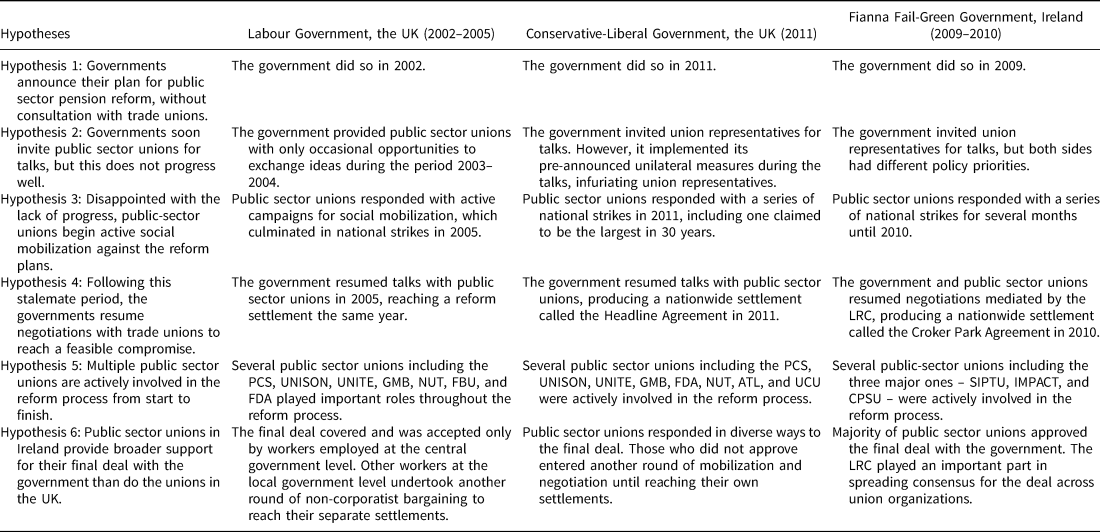
Given all these conditions, public sector unions emerged as an important social group that played a critical role in public sector pension reform. However, their negotiations with governments were not well institutionalized, because of the two sides' different policy priorities. The unions' limited capability for collective action further complicated the process. Table 3 summarizes key findings regarding how these causal configurations played out in the public sector pension reform in the two countries. It validates all six hypotheses in the previous section and provides systematic evidence for the thesis of non-corporatist bargaining.
Summary of the hypotheses and key empirical findings of the three reform cases

3.2 Public sector pension retrenchment: The UK cases
This section details the empirical findings in Table 3, starting with the reform introduced by the British Labour government. In response to the financial challenge to the public pension system consequent to population ageing and slow economic growth, the Labour government initiated a retrenchment project in 2002 by announcing a plan to increase the official retirement age from 60 to 65 years. While the government emphasized that the proposed reform would mainly affect future public employees, it sought to extend the new rule to cover existing public workers (DWP, 2002: 106–107). Trade unions immediately expressed their disagreement with the plan. They were particularly critical of the possibility that benefit cuts could affect existing public workers. Complaining about the lack of government effort for bipartite consultation prior to the policy announcement, unions also demanded that any future reform plan must be an outcome of inclusive bargaining with stakeholder groups (TUC, 2003).
Soon thereafter, the government called for talks with public sector unions. Union representatives were drawn from the PCS, UNISON, UNITE, GMB, NUT, FBU, and FDA. However, during the negotiations from 2003 to 2004, the government offered unions only occasional opportunities to exchange ideas, pushing them to rely on press conferences and other means to lobby politicians (TUC, 2003, 2004). With little progress in the negotiations, public sector unions soon deployed their mobilization power to express their objection to the government's plan. The unions played an integral part in the TUC's Public Service Liaison Group (the PSLG), which coordinated social protests against the proposed pension cuts. They provided most of the human and organizational resources needed to mobilize protests, as illustrated by the national pension strike called on 18 February 2005. To provide momentum for their protest against the government, public sector unions unanimously decided on the one-day national strike at the PSLG meeting. They successfully supported this plan by securing high approval rates from all member unions, demonstrating sector-wide solidarity to protecting public sector pension benefits (TUC, 2005).
Responding to trade unions' successful efforts for social mobilization, the Labour government changed its course of reform and proposed fresh talks with trade unions. This time, the negotiation was successful (Thurley, Reference Thurley2010: 5). The government accepted unions' demand that changes in the pension program should not affect benefits paid for existing public workers. This consensus paved the way for a final agreement on pension reform, wherein the official retirement age was raised to 65 years for all new entrants. In return, existing workers (and most future workers) retained their current benefit formula, which would continue to be calculated based on final-day salaries (IPSPC, 2010: 39–41).
This bipartite agreement introduced an important change in the public pension system, but still in a limited way. It covered only workers associated with the central government such as civil service workers, police officers, military forces, teachers, and NHS workers, excluding other local government workers (EurWork, 2005a). From the beginning, the negotiation proceeded separately for central and local government workers. The government proposed this two-track negotiation (EurWork, 2005b), highlighting that pension formulae (especially regarding the set retirement age) differed across government levels (Thurley, Reference Thurley2011: 5). Public sector unions, who had thus far emphasized sector-wide solidarity in their protest against the Labour government, accepted this proposal without notable internal debate (EurWork, 2005b; Thurley, Reference Thurley2010: 5). Arguably, this decision contributed to the limited success of the pension reform. The groups not covered by the central agreement engaged in separate negotiations with the government, repeating another round of non-corporatist bargaining that featured the same sequence of the government's unilateral policy initiatives, trade unions' social mobilization, and final policy compromises (EPSU, 2006, 2007).
A similar pattern of non-corporatist bargaining emerged when the new Conservative-Liberal coalition replaced the Labour government and formulated another plan for public sector pension retrenchment in 2011. Endorsing recommendations from a cabinet-sponsored commission called the Independent Public Sector Pension Commission (EurWork, 2011a; IPSPC, 2011: 8–13), the government announced a plan to introduce two major measures to improve the balance sheet of the public sector pension program. The first measure was changing the calculation base of pension payments from final-year salaries to career-average salaries, and the second was to further increase the official retirement age from 65 to 68 years, as was the case in the State Pension Scheme (i.e., the general flat-rate public pension program for all citizens in the private sector). These changes would apply to both existing and future workers in the public sector. In a further effort to stabilize pension financing alongside these structural measures, the government also promoted a few contentious short-term plans. For instance, it switched the base of inflation adjustment for pension payments from the Retailers' Price Index (RPI) to the Consumers' Price Index (CPI), hoping to lower the scale of annual adjustment. The government also announced a plan to increase pension contributions from public employees by 2–5% (mostly 3%) until the end of 2015 (Thurley et al., Reference Thurley, Cracknell, McInnes and Rutherford2012: 16–21). These measures were introduced or proposed without consulting public sector unions, which made them critical thereof. The unions argued that no change was necessary because the previous reform implemented by the Labour government had already addressed all major fiscal problems in the pension system. To them, the government's new plan simply meant longer work and higher contributions in exchange for lower benefits (EurWork, 2011a).
Soon after the retrenchment plan was announced, the government invited trade unions for talks to reduce the gap in the policy preferences of the two sides (Alexander, Reference Alexander2011). Government delegates and the TUC (who were supported by public sector unions) held a series of occasional gatherings starting in spring 2011. These talks did not progress well. The government then made official its pre-announced plan to increase employees' pension contributions. On top of the inflation index switch to the CPI the government introduced soon after electoral victory in 2010, this decision seemed to reconfirm it was not interested in serious talks with social partners (‘Public sector unions’, 2011).
Disappointed with the government's unilateral action, public sector unions began their efforts for active social mobilization. A 1-day nationwide strike was organized for 30 June 2011 to express their solidarity against the government's plan. Several public sector unions including the PCS, NUT, ATL, and UCU played a leading role in this mobilization (EurWork, 2011b). The government responded by resuming negotiations with representatives of the TUC. However, neither side was yet prepared to compromise. Amid resumed pension talks, the government unilaterally executed the widely criticized plan to increase employees' contributions. In response, public sector unions mobilized another round of mass protests, culminating in the 1-day national solidarity strike on 30 November 2011. The TUC claimed this event was the largest in 30 years, with up to 30 TUC member associations participating in the strike. The PCS, NUT, and other newly joined public sector unions such as UNISON, UNITE, GMB, and FDA made important contributions to this mobilization (EPSU, 2011a; EurWork, 2012a).
Following these mass protests, the government finally offered a concession to the unions (House of Commons, 2011). While maintaining its plan for structural measures including switching the calculation base of pension payments to career-average salaries and increasing the official retirement age to 68 years, the government proposed a ‘transition clause’ wherein senior public workers who were to retire within 10 years would retain their existing benefits (HM Treasury, 2011: 9–11). The TUC negotiation team welcomed this offer and signed a national pension agreement, named the Headline Agreement, on 20 December 2011 (TUC, 2011; Thurley et al., Reference Thurley, Cracknell, McInnes and Rutherford2012: 24–27).
Hailing the agreement as a victory of union solidarity, the TUC retained no formal authority to impose the deal on member unions. It, therefore, clarified that no final settlement would be made until each union had decided on it (Thurley, Reference Thurley2012: 37–38). While an overall majority of public sector workers supported the Agreement, each member union produced a different result depending on its ratification process. The police officers' union accepted the deal, but some of the teachers' unions and civil service workers' unions rejected it, as did all the NHS unions and firefighters' unions (EPSU, 2011b; PCS, 2011, 2012; Thurley et al., Reference Thurley, Cracknell, McInnes and Rutherford2012: 24–27). These opposing unions resumed mobilization activities, which they maintained for years (EPSU, 2012). Similar to the previous reform promoted by the Labour government, the bargaining for pension cuts under the Coalition government had limited success.
3.3 Public sector pension retrenchment: the case of Ireland
Public sector pension reform in Ireland provides another example of non-corporatist bargaining in a residual welfare state. Different from the UK, Ireland was a more difficult case for testing the hypotheses, as it could have promoted a more corporatist solution to welfare reform because of the legacy of social partnership that had for decades addressed major macroeconomic issues of the country (Baccaro, Reference Baccaro2003; Daly and Yeates, Reference Daly and Yeates2003).
To elaborate, the Irish model of social pacts began in the late 1980s with a tripartite agreement, namely the Programme for National Recovery (PNR, 1988–1990), which enabled governments, employers, and trade unions to address many chronic problems of the Irish economy centered on unemployment, inflation, low investment, and public debt. Although successful in revitalizing the Irish economy in the run-up to the creation of the single European market and monetary union, the social partnership came under pressure with the outbreak of the economic and financial crisis in 2008 and Eurozone debt crisis thereafter. The Irish government failed to renew the national income pact, which had been the key feature of macroeconomic governance in the country since the late 1980s. Furthermore, the government began relying more frequently on unilateralism in various policy reform issues (Regan, Reference Regan2012; Culpepper and Regan, Reference Culpepper and Regan2014).
While these changes seemed to position the Irish case closer to a UK-style majoritarian democracy, the legacy of the past did not simply evaporate. For public sector pension reform, the author identified the active role of a public intermediating institution, the Labour Relations Commission (LRC), in promoting a deal between the government and fragmented public sector unions. However, the LRC played a meaningful role only in a later stage of the reform, when government and public sector unions' interests converged to finding a feasible deal. This moment came after a year of stalemate and confrontation following the government's initial announcement of the reform.
Taking a closer look at this complicated bargaining process, the Irish government first hinted at pension reform in 2007 by publishing a Green Paper, wherein it proposed a list of policy options to increase the retirement age and shift the base of pension payments from final-year to career-average salaries (DSFA, 2007a: 204–205). The ICTU and other public sector unions opposed this idea, arguing that the existing pension system was already fiscally sustainable (DSFA, 2008: 69). The Taoiseach (the Prime Minister of Ireland) disagreed, contending that a major overhaul would be necessary to ensure the financial sustainability of the pension system (DSFA, 2007b). The economic and financial crisis in 2008 strengthened the government's confidence in its position. Building on the already implied reform ideas, the government announced an official reform plan in February 2009. It also added a radical short-term measure to increase employees' contributions by 7% (from 6 to 13%) of their annual salaries, doubling the financial responsibility of public sector workers to the pension system (EurWork, 2009). Trade unions, especially the three major ones SIPTU, IMPACT, and CPSU, responded furiously to this policy initiative, immediately withdrawing from the tripartite talks they were participating in for a new national income pact to address the economic crisis (EurWork, 2009).
Soon thereafter, the government invited public sector unions (represented by the Public Services Committee of the ICTU) to talks beginning in August 2009 (CPSU, 2011: 10). However, as in the UK cases, the negotiations stalled because of the two sides' different policy priorities. While the government continued to advance reform measures to stabilize pension financing, trade unions maintained that none of these measures were urgently needed. The stalemate triggered a series of mass protests. Organized and supported by the three leading general union associations in the public sector, these efforts aimed to mobilize nationwide solidarity strikes and picketing (EPSU, 2009a, 2009b). These activities lasted several months until March 2010, when the government finally expressed its earnest interest in promoting industrial peace and striking a deal with public sector unions (EurWork, 2010).
To ensure a successful policy compromise, the government and Public Services Committee of the ICTU requested the LRC – the public mediating agency legally mandated to promote conflict resolution in all fields of industrial and labor relations – to oversee the negotiation process (IB, 2011: 3–4). Thus far sidelined in the pension negotiation, the LRC accepted this bipartisan request. Starting with the first meeting, which was called at its headquarters, the agency assumed a leadership role in promoting the bipartite negotiation (EurWork, 2010; LRC, 2010: 17; IB, 2011: 3–4). Over several weeks of renewed negotiation, a final deal was brokered in June 2010. The government pledged that existing public sector workers would retain their pension benefits, which would be based on their final-year salaries at the age of 65 years. In return, public sector unions accepted the 7% increase in employees' pension contributions. Future workers would have to work until the age of 68 years to earn new payments that would be calculated based on career-average salaries. The government and ICTU negotiation team were satisfied with this deal, signing a national agreement called the Croke Park Agreement, which was named after the famous sports stadium in Dublin (DSFA, 2010: 49–50).
While the majority of public sector workers favored the reform deal, as evidenced by the ratification results with a two-to-one majority at the Public Services Committee of the ICTU (CPSU, 2011: 19), the ICTU leadership did not have the formal authority to impose the deal on member unions. As in the UK case, the final decision for or against the Agreement was to be made by each member union. Fortunately, all three major general unions accepted the deal, first SIPTU, and IMPACT, reluctantly followed by CPSU (EurWork, 2010; CPSU, 2011: 8).
The LRC, who had recently brokered the Croke Park Agreement at the high-level talks, further contributed at this ratification stage: it significantly influenced IMPACT's decision to accept the deal. Remember that IMPACT was one of the two major general unions that played a leading role in mobilizing social support for the Agreement. However, while SIPTU quickly approved the deal, IMPACT initially took an ambivalent position. While appreciating most elements of the deal, the IMPACT leadership was suspicious of certain clauses related to public sector restructuring. In particular, they were concerned these clauses might provide the government with leeway to redeploy or discharge public sector workers in the near future. The LRC intervened by hosting consultations with the IMPACT leadership. The agency confirmed that the new Agreement had no sources of legal contradiction with the existing setting of the workforce in the public sector. It also highlighted that any future attempt at public sector restructuring should proceed through negotiation with trade unions. Satisfied with the LRC's consultation, IMPACT decided to put the Agreement to a member referendum with a solid recommendation for approval (EPSU, 2010). Following this important decision, support for the Agreement increased among public sector unions. While smaller unions and especially teachers' unions such as ASTI and TUI continued to express their opposition, their voices could not challenge the resounding support the Agreement had gained (EurWork, 2010; CPSU, 2011: 8; ASTI, 2012).
4. Conclusion
This study explored nuanced cases of welfare retrenchment, which are under-researched in the extant literature. It examined reform cases that featured non-corporatist bargaining between governments and stakeholder groups. Relying on the insider-outsider framework of public policy reform, it claimed these hybrid cases were a product of a particular situation where governments sought to cut policy benefits provided exclusively for powerful insiders. The analysis validated this claim against recent cases of public sector pension reform in the UK and Ireland. While Ireland was a more consensus-oriented case, because of its legacy of social partnership, that did not change the fundamental course of non-corporatist bargaining.
The presence of this hybrid path to reform, which conforms to neither government unilateralism nor corporatist bargaining, calls for researchers to extend beyond the dualistic understanding of welfare retrenchment that has long dominated the literature. Future studies should examine hybrid cases from a broader European perspective. Southern European cases, where welfare insiders are relatively strong but organizationally fragmented, may be relevant for this extended research project. A bird's-eye view suggests that these countries showcase more diverse reform paths than the Anglophone cases, ranging from corporatist bargaining to government unilateralism and other hybrid cases between the two (Ferrera, Reference Ferrera2005; Immergut et al., Reference Immergut, Anderson and Schulze2009; Carrera et al., Reference Carrera, Marina and Carolo2010; Natali and Stamati, Reference Natali and Stamati2014). These cases should be more systematically explored to validate the new research agenda.
In doing so, it will be also worthwhile to elaborate the idea of hybrid reform through increased conceptual scrutiny. The work of Natali and Rhodes (Reference Natali and Rhodes2004) on ‘preemptive unilateralism’ deserves attention in this regard. In a rare effort to make sense of hybrid reform cases in Europe, they identified a reform path where governments relied on unilateralism, but in a way that produced consensual reform solutions. Drawing on the French and Italian pension reforms in the mid-1990s to early 2000s, they found that governments, while maintaining a top-down approach to benefit cuts, made notable efforts to negotiate implicit and preemptive policy trade-offs with major stakeholders. The authors described these reform cases as a variant of unilateralism, but the cases may be better suited to a separate category of hybrid reform where governments promote policy change by actively combining unilateralism with negotiation. To the extent that this alternative interpretation holds, Natali and Rhodes' work presents a sub-case of non-corporatist bargaining in which government activism is combined with implicit negotiation. Alternatively, the reform cases examined in this study combine the same government activism with explicit negotiation. Future studies may expand this preliminary insight to explore multiple paths to hybrid reform across European countries.
Acknowledgement
This work was supported by the Ministry of Education of the Republic of Korea and the National Research Foundation of Korea (NRF-2018S1A5A2A01037173).
Sung Ho Park is associate professor of International Relations at Yonsei University, Wonju Campus, South Korea. His research focuses on industrial relations and social welfare in Western Europe and East Asia. His recent work has appeared in International Political Science Review, Economic and Industrial Democracy, Public Administration, and Korean Political Science Review.