In his study of the representation of law and morality in television crime dramas John Sumser argues that by the mid-1990s a profound change had taken place within the genre. According to Sumser earlier shows had employed a version of the mythology of the frontier, with the cop positioned as the “moral boundary of society” and the private detective as the person whose actions might extend “past the moral boundaries in order to bring a bit of personal justice to the frontier.”Footnote 1 However, in the shows then dominating the television schedules – Homicide: Life on the Street, NYPD Blue, In the Heat of the Night and Law and Order, among others – authority over crime had been shifted from cops and private detectives to lawyers, who functioned to “bureaucratize the frontier,” so subordinating the “adventure” that had characterized the genre to “the culture of the law.”Footnote 2 According to Sumser the subjugation of the individual authority of cops and detectives to the letter of the law led to a loss of moral certainty, of the clear sense of justice associated with the cop or detective, which had vanished when bureaucratized law enforcement required that the crime not only be solved, but be solved in a way that would permit its successful prosecution.Footnote 3 The tension that Sumser identifies, between an ill-defined sense of justice and a codified, bureaucratized law is a key element in several recent successful television shows,Footnote 4 and in this article I am going to examine the treatment of this conflict in the critically acclaimed television crime drama The Shield.
The Shield constructs a world that perfectly captures the sense of moral ambiguity to which Sumser refers. There are no clear-cut moral distinctions in The Shield, only grey areas. But what makes The Shield particularly deserving of attention is not simply its depiction of a morally uncertain world where conflict between codified law and personal justice is employed as a narrative structuring device, but its alignment of the show's conceptions of law and justice with racially marked and gendered characters so that this tension is played out along the fault lines of race, ethnicity and gender in a way that, while recognizing the distribution of power among different ethnic groups and between the sexes in a progressive multi-cultural society, nevertheless reasserts a conservative vision of the white male hero as the ultimate guarantor of social order.
THE LAW OF THE LAND
A promotional trailer for The Shield, broadcast on Fox's FX cable subsidiary in the period leading up to the show's debut in March 2002, promised to take the viewer to “the dark side of the badge,” asking, “What is a good cop? What is a bad cop? What is justice?” The trailer thus invited the viewer into The Shield's tough urban milieu, in which moral certainties have vanished. In the opening moments of the pilot episode, viewers would meet these questions embodied in a single character, Vic Mackey (Michael Chiklis), leader of the “Strike Team,” an elite police unit with a mandate to deal with gang-related crime in the fictitious Farmington district of Los Angeles in which the show is set.
The moral ambiguity of Mackey's character is clearly signalled by the opening sequence of the episode, in which Mackey is seen pocketing a stash of drugs recovered from a street dealer without concern for the suspect's Miranda – or any other – rights, and reiterated in a later scene, in which he discovers the whereabouts of a young girl being held prisoner by a paedophile by brutally beating the suspect around the head with a telephone directory, prefiguring his actions with the words “good cop and bad cop have left for the day. I'm a different kind of cop.” Any lingering doubts about the morality of his character are banished by the closing sequence of the pilot episode, in which Mackey shoots dead a fellow cop, Terry (Reed Diamond) – who has been planted in the strike team to gather evidence of Mackey's suspected illegal activities – thus committing what the show's creator, Shawn Ryan, has called an “unforgivable act,”Footnote 5 and what regular viewers of the crime drama genre will instantly recognize as the crime guaranteed to make its perpetrator “public enemy number one.” That Mackey succeeds, as the season progresses, in gaining if not forgiveness then at least the sympathetic identification of the viewer, against these seemingly impossible odds, provides a clear indication of the show's ideological investment in defending a white male perspective on the problems of maintaining social order against challenges represented by The Shield's diverse range of ethnic minority and/or female characters.
The racial polarization of competing claims to power and legitimacy in The Shield is evident from the outset. Mackey's chief antagonist at the start of the series is Captain David Aceveda (Benito Martinez), the Mexican American head of the Farmington precinct. While Mackey has worked his way up through the ranks and learned his style of law enforcement on the streets of LA, the captain is a more bureaucratic type of cop, a “test-taker,” as Aceveda himself puts it, a cop who acknowledges other officers' perception of the role played by his ethnicity in the achieving his position: “I know what everyone here thinks … came time to name a new captain, I was the right colour at the right time.”Footnote 6 Whereas Mackey represents the maverick style of law enforcement identified by Sumser as being a distinguishing feature of earlier generations of cop show, his instinctive sense of right and wrong having been gained through his experiences as a street cop, Aceveda is, at the start of the series, strictly a “by-the-book” type of cop and he pursues a campaign to expose what he suspects is Mackey's involvement in a range of illegal activities.
Aceveda's suspicions are well-founded. Mackey maintains order on the streets by cooperating with gang leaders in the district, acting as a “landlord” to the local drug dealer and using the strike team to drive out competing dealers – thereby avoiding violent turf wars – and taking a cut of the dealer's profits in return for guaranteeing the latter's monopoly in the district. Between them, the characters of Mackey and Aceveda circumscribe the extremes of the show's conception of social order. Aceveda represents the force of governance, the law of the land, while Mackey more pragmatically maintains an uneasy order based on his personal judgement of what is necessary – of what is right and just – in the circumstances.
Although at the outset Aceveda is portrayed as the pious guardian of the law, intent on bringing down the renegade cop, the captain's integrity is compromised. Aceveda is politically ambitious, aspiring to elected office in city government. Although he manages to maintain his probity for most of the first season, Aceveda's political ambition ultimately forces him to compromise with Mackey. When Deputy Police Chief Gilroy (John Diehl) tries to play both men off against each other to evade arrest for his own illegal activities, during the early episodes of season 2, the two antagonists have little option but to call an uneasy truce, and if they do not exactly work together then at least they do stop working against each other for a time. These compromises damage Aceveda's claim to the moral high ground in the show, and this position is filled by another character who is more consistently given moral authority – detective Claudette Wyms (C. C. H. Pounder).
Wyms is an experienced cop and, crucially, an African American woman. In the pilot episode, although it is clear that Wyms does not approve of Mackey and his methods, it is less clear that she believes that the realities of policing The Shield's tough urban setting can easily be changed, as this conversation between Wyms and Aceveda illustrates:
Wyms … as long as Mackey's producing on the street he's got friends; Gilroy, even the chief
Aceveda So he's bulletproof, huh?
Wyms From you, yeah!
…
Wyms You think taking on Mackey is going to change people's minds.
Aceveda Ah, I'm just talking.
Wyms Right now Vic Mackey must look like a mighty big catch to you. Do the smart thing though, son, cut bait.
Aceveda Doesn't bother you, the things he does?
Wyms I don't judge other cops.
Aceveda Mackey's not a cop; he's Al Capone with a badge.
Wyms Al Capone made money by giving people what they wanted. What people want these days is to make it to their cars without getting mugged; come home from work, see their stereo still there; hear about some murder in the Barrio, find out the next day the police got the guy. If having those things means some cop roughs up some nigger or some spick in the ghetto, well as far as most people are concerned it's don't ask, don't tell. How you figure on changing that?Footnote 7
By the middle of season 2, however, when she becomes convinced that Mackey and the strike team – aided by Aceveda's unwillingness to wield authority over them – are impeding a serial murder and rape investigation, Wyms becomes the real antagonist to Mackey and the character who embodies the principles of morality and law initially associated with the captain. Wyms maintains this position through seasons 2 and 3, eventually coming close to attaining real power within the Department in the latter part of season 3, when she is groomed by the chief of police to succeed Aceveda after his election to the City Council. Although The Shield comes close to legitimizing Wyms's position as the moral centre of the show and giving her character the status to challenge Mackey's patriarchal power, this possibility is ultimately denied when Wyms effectively becomes the victim of her own high principles, losing her chance of the captaincy and even jeopardizing her career, by pursuing the retrial of all of the cases handled by a public defender whose drug addiction has come to light in the course of an investigation. While Wyms's rejection of political expediency deprives her character of the power to challenge Mackey, she nevertheless retains her moral authority throughout season 4. Between the characters of Aceveda and Wyms it is possible to perceive a clear pattern in The Shield, where legal and moral authority are consistently vested in non-white and/or female characters: the Mexican American captain, the African American female detective who is the moral centre of the narrative. In this respect The Shield conforms to a trend that has become increasingly common in some of America's most popular television programmes.
RACE AND AMERICAN QUALITY POPULAR TELEVISION
One of the major complaints levelled against some of the most successful American television programmes of recent years has been the lack of visibility of non-white characters and the absence of engagement with issues concerning race and ethnicity. Although there was an increase in the number of African American-produced television shows during the 1980s and early 1990s,Footnote 8 the concomitant rise in the number of roles for African Americans appeared to be going into reverse as the 1990s progressed and, “by 1999 African American representation on television was on the brink of another decline.”Footnote 9 In some of the most significant television shows of recent years there has been a noticeable shortage of ethnic minority characters. Several contributors to a recent anthology on Sex and the City remarked on the predominantly white milieu depicted in the show.Footnote 10 Albert Auster has criticized “must-see” television comedies, and particularly Friends, for presenting an image of a “totally sanitized bohemia … without any poor, or the ethnic and racial tensions that plague the city,”Footnote 11 and other commentators have condemned the continuing lack of ethnic diversity in network television programming.Footnote 12
According to Herman Grey, the situation is rather better in the category of hour-long drama shows that includes The Shield since these shows – and he specifically identifies ER, Homicide and NYPD Blue – provide “the most integrated casts and story-lines” in terms of race and ethnicity.Footnote 13 Despite the decline in African American roles at the end of the 1990s, Nama argues that pressure brought to bear on the television networks by lobbying groups such as the National Association for the Advancement of Colored People (NAACP) has more recently resulted in an increase in roles for African Americans. Accompanying that numerical increase in roles, however, there has also been a fundamental change in the “mode of African American representation.”Footnote 14 This new mode is characterized by a shift away from the problematization of ethnic minority characters that typified earlier modes and by a “utopian reversal” that increasingly constructs ethnic minority characters as successful, middle-class professionals, with
just over 70% of African American characters occupying professional or management positions on network television. In the fictional world of television, African Americans appear to be doing quite well. They are literally, symbols of success and possibly even the end of racism.Footnote 15
Surveying some of the most recent successes in the television crime drama genre it may seem that there is a reasonably good presence of non-white characters in key roles and, crucially, in roles that do not problematize race or ethnicity.Footnote 16 Against this, however, I would argue that the evident liberal desire not to present race as a problem goes so far in these shows that racial and ethnic difference almost disappear; we may see non-white faces but there is an almost complete absence of any attempt to address the issues relating to race and ethnicity that continue to exist in multi-cultural societies. So although these characters are visibly ethnically marked, the failure to engage with these issues limits the ability of these characters to signify racial or ethnic difference. Writing towards the end of the 1990s, Zook argued that the challenge for the television networks “is to create characters like those played by Andre Brauer (Homicide) and Eriq La Salle (ER): characters who ‘transcend’ race.”Footnote 17 On the evidence of highly rated contemporary crime dramas, Such as CSI and Law and Order, this appears to be a challenge that the networks have attempted to meet, but the result of their efforts has been a mode of representation that renders race and ethnicity almost invisible despite quantitatively increasing roles for non-white characters. While these characters may contribute to what Nama calls the “racial verisimilitude” of these shows,Footnote 18 the lack of engagement with issues relating to race and ethnicity relegates the characters to the status of “background images that are seen but do not talk, talk but do not act,”Footnote 19 a situation that is registered in the complaint by the female actor S. Epatha Merkerson, of her role in Law and Order: “why am I in a position of authority yet you rarely see me onscreen.”Footnote 20 Micheal Pounds makes a similar observation with regard to the treatment of ethnic characters in Star Trek and Star Trek: The Next Generation, seeing them used solely as “fonctionnaires, just a detail to move the plot along.”Footnote 21 In some of America's most popular television shows it seems that the response to the complaint that race is only present when it is a problem has swung so far the other way that race is hardly present at all, despite characters from non-white backgrounds being given highly visible roles.
Against this background The Shield stands out as different. The Shield constructs African American and Mexican American characters as legitimate possessors of legal power and/or moral authority, and so conforms to the general trend of depicting ethnic minority characters as successful and well integrated into the fabric of mainstream American life. However, it also makes race highly visible by repeatedly undermining this ostensibly progressive image of a racially integrated society by revealing the failure of the mechanisms of the law and of the ideals of high moral principle, represented by these ethnic minority characters, to deliver a convincing sense of justice. There is an elusive ideal of “natural” justice in The Shield, which is presented as being just beyond the grasp of the law, respect for the suspects' rights consistently confounding the attainment of this “authentic” justice. While ethnic minority characters are invested with legal and moral authority, this sense of authentic, “natural” justice is unquestionably the possession of the middle-aged, white father figure, Vic Mackey. The Shield goes further than simply suggesting that this ill-defined, abstract sense of justice exists beyond the reach of the law. By consistently privileging Mackey's maverick solutions to the problems of law enforcement, it elevates those solutions above the values of law and morality that Aceveda and Wyms represent, not in order to present justice and law as being in conflict, but in order to present this “natural” justice as being an essential precondition for the existence of a social order in which it is possible to have the indulgence of a system of law enforcement in which the rights of the accused can be enshrined and respected, in which we have the luxury of moral principle or ethical law enforcement at all. Furthermore, through the racialized construction of the characters associated with these values of law and morality on the one hand and “natural” justice on the other, The Shield conveys a compelling sense of the ultimate dependence of a successfully integrated multi-cultural society upon the continuing power of a white patriarch, who functions as the guarantor of egalitarian multiculturalism.
THE LAW OF THE FATHER
The Shield's positioning of Mackey as the protector of social order is well illustrated by the closing sequence of the pilot episode, a montage sequence that juxtaposes images of a safe domestic sphere with shots depicting the city streets as a place of criminality and danger. The sequence begins with Mackey and the Strike Team leaving their “clubhouse” inside the station house in order to raid the home of a drug dealer. As they walk through the station they pass one of the detectives, Dutch Wagenbach (Jay Karnes), who is cleaning out one of his desk drawers after a practical joke played on him by another cop. Although this part of the sequence takes place inside the station house and, therefore, outside an obviously domiciliary setting, Dutch cuts a very domestic figure, wearing rubber gloves and holding a can of disinfectant spray, thus establishing the opposition between domestic and public spaces that will structure the closing sequence of the episode. As the sequence progresses, images of Wyms arriving home and being greeted by her pet Labrador and of Aceveda sitting in his living room, feeding his baby with a bottle, are intercut with shots showing Mackey and the team arming themselves and driving to the drug dealer's apartment, reiterating the opposition between domestic and public and aligning the terms of this opposition with notions of safety and danger respectively. In one shot we see another cop, Danni (Catherine Dent), preparing to go out on a date. The opposition between the domestic sphere as a place of safety and the outside world as a place of danger is reinforced by these shots of Danni, who initially removes her service revolver from her purse and places it in a drawer in her living room. However, as she opens the front door to greet her date and faces the moment when she must step over the threshold of her house, leaving behind the safe domestic realm and entering the world of danger outside, Danni reconsiders her decision to leave the handgun behind and returns to the drawer to recover her weapon, which she conceals in her purse once again before moving from the safety of the home to the danger of the streets.
The way this sequence connects these contrasting images, of the world of danger inhabited by Mackey and the safe world of domestic normalcy, creates a strong impression of the dependence of the one on the other, of the necessity for someone like Mackey to be doing whatever it takes to maintain social order so that the possibility of ordinary domestic life can be preserved. This is well illustrated near the end of the sequence when a long shot of a crowd at a football game initially appears simply to offer yet another view of American normalcy, until a cut to a longer shot allows the Strike Team's van to drive into the frame, stopping between the camera and the football stadium while the team disembark for their raid on the dealer's apartment. Although the spatial arrangement of this shot positions the football stadium as a background to the activities of Mackey's team, the ideological arrangement of the sequence as a whole reverses this spatial organization, making Mackey's activities the unseen background that enables the possibility of the kind of normalcy exemplified by the football game. Towards the end of the final sequence of the pilot episode, Mackey commits the “unforgivable act” – the execution of another cop – that will test the audience's willingness to identify with his character and thus to subscribe to The Shield's ideological vision of white, patriarchal, “natural” justice as the essential foundation of contemporary multiculturalism.
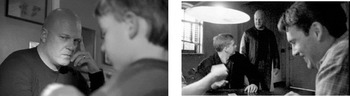
As Cynthia Fuchs correctly discerns, The Shield's solution to the dilemma of how to make its anti-hero “even remotely sympathetic … goes through kids.”Footnote 22 The protection of children is a key theme that runs throughout all four seasons of The Shield, typified by numerous minor incidents, such as Mackey's rescue of a baby dropped into a heavily polluted swimming pool when its crazed father jumps from a first-floor balcony with the baby in his arms,Footnote 23 and his ongoing concern to preserve the relationship between a prostitute, Connie (Jamie Brown), and her child, as well as by major plot events such as the saving of a young girl sold for drug money by her addict father and then trafficked by paedophiles,Footnote 24 the rescue of an underage Asian girl forced into prostitution in a sex club,Footnote 25 the rape of a twelve year old girl by a Mexican drug lord,Footnote 26 a multiple homicide at a refuge for battered women and their children and the abduction of a seven-year-old boy from the refuge,Footnote 27 the killing of a Farmington patrolman's ex-wife and son,Footnote 28 the investigation into the lynching of a black teenager,Footnote 29 the abduction of a three-year-old from the scene of a multiple homicide, the revenge beating meted out by Mackey to a child-abuser caught on video surveillanceFootnote 30 and the killing of a young black girl by a gang leader, Antwon Mitchell (Anthony Anderson), in order to frame Shane Vendrell (Walton Goggins), formerly Mackey's right-hand man in the Strike Team but now working in the vice squad and using his position to protect Mitchell and his gang.Footnote 31 But this apparently specific concern about children is really only symptomatic of The Shield's more general deployment of the family – with Mackey positioned as its patriarchal head – as a metaphor for the wider society depicted in the show. While Mackey's home life is shown to be riddled with problems – Mackey's family is split, his daughter Cassidy (Autumn Chiklis) living with him while his two autistic children live with his estranged wife, Corrine (Cathy Cahlin Ryan) – he nevertheless struggles to maintain both a semblance of familial normalcy and his position as head of the family. Mackey's constant effort to single-handedly resolve all of the intractable problems presented by family life is perfectly mirrored by his attempts to negotiate the moral ambiguities of contemporary policing and his more successful effort to maintain control over his second “family,” the Strike Team and, through the Strike Team, society at large. A scene in “Our Gang”Footnote 32 reinforces the sense of the Strike Team as a second family for Mackey by juxtaposing shots of Mackey at home watching his autistic son Matthew (Joel Rosenthal) with a flashback scene showing Mackey introducing Terry to the other members of the Strike Team. Continuity between the two elements in the scene is created by an edit from a shot of Matthew, lining up dinner forks on the dining table, to another shot of playing cards being dealt to Strike Team members. The framing of shots in both parts of the sequence and the positioning of Mackey as an observer of two familial scenes both increases the feeling of equivalence between the two otherwise different settings and establishes Mackey's privileged position within both settings as the paternalistic overseer of both his real family and his symbolic family.
Two images of paternalism. Vic Mackey looks on with fatherly concern at his autistic son Matthew (left) and with fatherly pride at his other family, the Farmington Strike Team (right). Season 1 episode 2, “Our Gang.” Columbia Tristar Home Entertainment, 2003.

Although the Strike Team are perhaps more routinely depicted as a fraternal group, the many moments of crisis that beset the group expose its patriarchal power dynamic by revealing the relative infantilism of the other members of the Strike Team alongside the paternal figure of Mackey. The continuing narrative of the series is punctuated by numerous such crises, most often precipitated by the actions of Shane – for example, his visit to a girlfriend for sex, resulting in the theft of his police vehicle containing drugs that will implicate the Strike Team in illegal activities;Footnote 33 his exacerbation of racial tensions in the district by urinating on a black suspect;Footnote 34 his active pursuit of more lucrative drug transactions and use of the team's accumulated funds to purchase a large quantity of drugs when he takes over leadership of the Strike Team while Mackey is preoccupied with family problems;Footnote 35 and his purchase of a car for his new girlfriend, against Mackey's explicit instructions, using money stolen by the Strike Team from Armenian gangsters.Footnote 36 More than any of Aceveda's or Wyms's concerted attempts to challenge Mackey's power, it is these crises precipitated by Shane that represent the real threat to Mackey's authority.
The intensity of these crises increases markedly during season 3, as mounting tensions within the Strike Team threaten to split the group apart. The growth of these tensions, which undermine Mackey's power base, coincides with an alteration in Shane's status that changes the relationship between his character and that of Mackey within the show's symbolic economy. Throughout its first two seasons The Shield manifests no interest in developing the characters of Strike Team members other than Mackey. While the show presents a detailed picture of Mackey's home life and his relationships with family members, the viewer is given no insight into any aspect of the lives of Shane, Lemonhead (Kenneth Johnson) or Ronnie (David Rees Snell) outside their activities with the Strike Team. This changes in season 3 when Shane's relationship with a new partner, Mara (Michele Hicks), becomes a focal point of the narrative and a source of conflict between Mackey and Shane. What initially appears to be no more than a spat between close friends – precipitated by the threat of a woman disrupting their friendship – is revealed to have more serious implications for power relations within the Strike Team when Shane reveals that Mara is pregnant.Footnote 37 As a prospective father himself, Shane's increasingly belligerent attitude towards Mackey can be interpreted as a sign of his refusal to remain in a subordinate position in the Strike Team and of his own claim to possession of the law of the father.
At the start of season 4, radical changes in the power dynamic of The Shield seem to be taking place, with the arrival of a new character, Monica Rawlings (Glenn Close), the new captain of the Farmington Precinct. The introduction of this white, female authority figure, the accompanying departure of Aceveda for public office and the disempowerment of Wyms appear to set the stage for a reconfiguration of the power struggle against the patriarchal Mackey along gendered lines alone, without the racial element that defined this struggle in earlier seasons. However, the relationship between Mackey and Rawlings never really coalesces into a straightforward competition for power. Rawlings's background – a street cop from Farmington who has worked her way up to her position of authority – is sufficiently similar to Mackey's for the two characters to recognize the mutual benefits of cooperation rather than conflict. Although Rawlings remains wary of Mackey throughout the season – sufficiently so to initiate a covert Internal Affairs Division investigation into his activities – and although they do have their moments of conflict, their relationship generally lacks the enmity that has characterized Mackey's earlier relationships with The Shield's ethnically marked figures of legal or moral authority, Aceveda and Wyms, who in season 4 become antagonistic figures towards the new power nexus formed between Mackey and Rawlings.
As at the close of season 3, the main threat to Mackey's power in the first half of season 4 emanates from Shane, whose desire to possess patriarchal authority himself has caused the Strike Team to split apart and who, at the start of the season, is working as a vice cop and building his own power base among the gang leaders and drug dealers in his district. However, motivated entirely by personal gain and lacking the innate sense of the greater good that Mackey's character has always possessed, Shane proves to be an inadequate father figure. The closing scene of “Tar Baby”Footnote 38 amply illustrates Shane's inadequacy as the holder of patriarchal power. Shane and his partner, ‘Army’ (Michael Pena) have been providing information to local gang leader, Antwon Mitchell, in order to protect his drug distribution operation. Throughout the earlier episodes of the season, Shane has insisted that he holds the dominant position in his dealings with Antwon. However, in “Tar Baby” the fallacy of this belief is revealed when Antwon's gang overpower Shane and Army and Antwon uses their service revolvers to execute – in the presence of the helpless cops – a fourteen-year-old girl who has been providing information to the police about his operations. Not only does Shane's inability to save the girl reveal his failure as a father figure (in stark contrast to the instances enumerated above in which Mackey has come to the rescue of children), but Antwon's possession of the girl's body – murdered with weapons belonging to Shane and Army and thus incriminating them – decisively shifts power from Shane to Antwon, from the white man to the black man, a change Antwon takes pleasure in reinforcing and framing in patriarchal terms in his final words to Shane in this episode: “From now on, I say ‘suck my dick’, you say ‘you want me to lick your balls Daddy?’”.
In the succeeding episodes, Shane's surrender of power to Antwon develops into a threat to Mackey himself when Antwon solicits Shane to kill Mackey in order to secure the return of the body of the murdered girl.Footnote 39 Antwon explicitly frames Shane's powerlessness to refuse his demands in terms of the latter's status as a literal father to his son and, implicitly, his symbolic position as a putative patriarch. As Antwon explains it to Shane, “I send her body to the po-po,Footnote 40 you go to jail. You go to jail, who's gonna protect that pretty little wife and son of yours?” It is this ultimatum that leads to the restoration of the law of the father to Mackey, as Shane comes to appreciate his inability to effectively wield patriarchal authority and finally accepts Mackey's superior claim to power when the two men confront each other:Footnote 41
Mackey You got one shot. Take it.
Shane No. No. I would never choose him over you. We let that money-train bullshit get in the way but you're my friend. I need you. Will you help me?
This restoration of the normative power relation between Mackey and Shane marks a decisive shift in The Shield's narrative, away from the preoccupation with the fragmentation of the Strike Team and Shane's challenge to Mackey's authority that characterized the earlier part of season 4. Throughout the season a controversial property seizure programme instigated by Rawlings, and supported by Mackey and other white officers, but vehemently opposed by ethnic minority characters – most notably Aceveda, Wyms and Julien (Michael Jace) – has provided a secondary narrative strand, which becomes central following the removal of the challenge to Mackey's authority and ultimately leads to Rawlings's forced departure at the season's close. While Mackey's continuing possession of the law of the father is far from assured,Footnote 42 there is at least an unstable equilibrium in which this white patriarch maintains his hold on power by repeatedly defending his position against frequent challenges to his authority from The Shield's array of ethnic minority and female characters.
CONCLUSIONS
Conflict between the law and moral principle on the one hand, and an abstract sense of “natural” justice that is consistently held by the figure who most clearly represents white patriarchal power on the other, lies at the core of The Shield's narrative throughout the four seasons screened by the time of writing. These competing ideologies are not ranked equally and it is the latter that is consistently privileged by the show and allowed to undermine the rule of law, substituting its own arbitrary sense of “justice” for legally prescribed remedies. This prioritization of the law of the father over the law of the land is well illustrated by an incident in “Dead Soldiers,”Footnote 43 in which Mackey, the embodiment of the principle of patriarchal “justice,” seizes a law book from the hands of a Mexican gang leader and uses it to beat the man around the head, thus substituting his own brand of arbitrary retributive justice for the rule-governed remedies enshrined in the book, perverting the idea of codified law that the book itself symbolizes. That the conflict between this brand of arbitrary “justice” and the law is played out along racial and gendered lines in The Shield is not a concealed ideological facet of the show but is prominently displayed throughout the series, from Mackey's racialized expression of contempt for Aceveda's authority in the pilot episode – “in the real world I don't answer to you. Not today, not tomorrow, not even on Cinco de Mayo”Footnote 44 – to the polarization between white and ethnic minority characters over the property seizure policy that dominates the latter episodes of season 4. While these incidents may contribute to the realism of The Shield's depiction of a racially diverse milieu in which conflicts between individuals of different races are inevitable, these are not mere disputes between equals since these clashes ultimately provide the opportunity for the triumph of the white, patriarchal values represented by Mackey and thereby serve to shore up the image of the power of the white male in contemporary society. So while The Shield may at first sight appear progressive in its presentation of a relatively well integrated multi-ethnic milieu in which race is no barrier to the attainment of authority, this appearance is consistently undermined by the show's depiction of the reliance of this idealized egalitarian social order upon the continuing power of the white man.