


Introduction
Most experimentalists are familiar with the classic example of James Lind’s experiment on the prevention and treatment of scurvy (Angrist and Pischke Reference Angrist and Pischke2014; Bullock and Green Reference Bullock and Green2021; Gerber and Green Reference Gerber and Green2012). In 1747, Lind conducted a quasi-randomized controlled trial aboard a ship plagued by scurvy, in which some sailors received citrus for six days. Repeated exposure to citrus was necessary; a single dose would not produce a detectable effect. If political scientists were to test the effect of eating lemons on scurvy, they might conclude that lemons have no causal relationship with the disease’s cure. Political science experiments are typically single-shot designs.Footnote 1
Recent studies have reported null relationships where theory strongly anticipates effects. Affective polarization was expected to influence support for democratic norms (e.g., Iyengar et al. Reference Iyengar, Lelkes, Levendusky, Malhotra and Westwood2019; Levendusky Reference Levendusky2018). Yet others report no substantial decrease in democratic norm support resulting from decreases in affective polarization (Broockman, Kalla, and Westwood Reference Broockman, Kalla and Westwood2023; Cox, Cubillos, and Le Foulon Reference Cox, Cubillos and Foulon2025; Finkel et al. Reference Finkel, Landry, Hoyle, Druckman and Van Bavel2024; Voelkel et al. Reference Voelkel, Chu, Stagnaro, Mernyk, Redekopp, Pink, Druckman, Rand and Willer2023; Yeung Reference Yeung2025). This null finding carries important implications for both political scientists and policymakers. For political scientists, it reduces the perceived importance of affective polarization research by implying no effect on a key political outcome. For policymakers, it implies that efforts to strengthen democracy by reducing affective polarization may be ineffective.
How we interpret these findings depends on what our studies have actually put to the test. In most democracies, citizen support for democracy has remained high and stable over the past two decades (Claassen Reference Claassen2020). Indeed, democratic norms are by definition characterized by stability and resilience (Berman Reference Berman2001). Against this stability, most experimental studies are single-shot and achieve only relatively small (approximately five-percentage-point) changes in affective polarization. One reading of the literature is that affective polarization has no causal impact on democratic norms. A different interpretation is that, because democratic norms are stable, one-shot manipulations of affective polarization are not strong enough to move them. Work on relatively stable attitudes more generally (e.g., partisan identification) has begun to grapple with this problem. Coppock, Green, and Porter (Reference Coppock, Green and Porter2024) argue that “the treatments analyzed to date by experimentalists have quite simply been too weak.”
This paper tests whether repeated treatments of affective polarization are stronger than single-shot treatments and therefore influence democratic norm support. Why might a single treatment be insufficient? Attitude change is a “change in the balance of positive and negative considerations relating to a given issue” (Zaller Reference Zaller1992). Adding a positive outparty consideration should, in principle, reduce affective polarization. Yet a consideration must be both received and accepted to enter the cognitive ledger (Zaller Reference Zaller1992), and positive outparty information is unlikely to be accepted. When information conflicts with affective priors, people discount or disregard it (Lodge and Taber Reference Lodge and Taber2005). Individuals with strong prior beliefs are least likely to accept incongruent information (Taber and Lodge Reference Taber and Lodge2006); thus, respondents with the highest affective polarization should be the least responsive. Prior studies may therefore have found small average effects because the manipulations primarily influenced respondents with lower baseline polarization.
Nevertheless, attitudes can shift even in the presence of motivated reasoning. A proven strategy is to expose people repeatedly – and in varied forms – to information that contradicts their prior beliefs. A discordant consideration is more likely to be accepted when presented multiple times and through multiple channels. Redlawsk, Civettini, and Emmerson (Reference Redlawsk, Civettini and Emmerson2010) document an “affective tipping point” – a “significant threat to expectations” that prompts respondents to reconsider their views – that can be induced through repeated exposure.
Accordingly, I implement a longitudinal survey design that features multiple affective polarization treatments (misperception correction treatments) administered over three survey waves. Accumulated exposure over time is expected to produce larger changes in affective polarization, which may, in turn, affect support for democratic norms. In preview, I find that the treatments do not reduce affective polarization at all, either within individual waves or cumulatively across waves. Because the interventions fail to move affective polarization, they also cannot provide a clean test of whether cumulative reductions in affective polarization would translate into stronger support for democratic norms of restraint.
I argue that these null first-stage results are best understood as a consequence of measurement. Similar treatments have been effective in prior experimental papers. But in contrast to those papers, which tend to measure affective polarization as a function of outparty feeling thermometers alone, I conceive of it as the gap between inparty and outparty evaluations. This choice brings the experiment in line with how the construct is usually conceptualized, but it also yields a noisier outcome and makes treatment effects harder to detect. The paper therefore highlights how measurement decisions may drive apparent discrepancies across studies and identifies an important difference in the measurement of affective polarization across experimental and observational work.
Experimental design
Using a longitudinal experiment, I test the hypothesis that respondents who receive multiple treatments designed to decrease affective polarization will increase their support for democratic norms. Three surveys were fielded at three-day intervals (beginning on July 29, 2025) on Prolific, which provides a representative sample of the U.S. population. Consistent with prior work (Lee, Ward, and Rodriguez Reference Lee, Ward and Rodriguez2022; Palan and Schitter Reference Palan and Schitter2018), I anticipated approximately 20 percent attrition across the three waves. An a priori power analysis indicated that 368 respondents per treatment group were required.Footnote 2 To achieve this target after attrition, the planned sample size was 460 respondents per group.
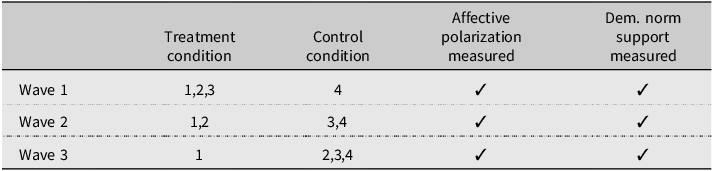
Respondents were randomly assigned to one of four groups (Treatment Groups 1–4), and these assignments remained fixed across the three survey waves. In each wave, a subset of groups received a treatment designed to manipulate affective polarization; the remaining groups received a control treatment that was unrelated to politics and not expected to affect affective polarization. Table 1 summarizes the assignment of groups to treatment and control conditions across the three surveys. Treatment Group 1 received the treatment in Surveys 1, 2, and 3; Treatment Group 2 received it in Surveys 1 and 2; Treatment Group 3 received it in Survey 1; and Treatment Group 4 never received it. In each survey, affective polarization was measured as a manipulation check, followed by measures of support for democratic norms.
Between-subjects experimental design: treatment groups in the treatment and the control conditions in each wave

Table 1. Long description
A table with four rows and four columns. The columns are labeled Treatment condition, Control condition, Affective polarization measured, and Dem. norm support measured. The rows are labeled Wave 1, Wave 2, and Wave 3. Row 1: Treatment condition, 1, 2, 3; Control condition, 4; Affective polarization measured, checked; Dem. norm support measured, checked. Row 2: Treatment condition, 1, 2; Control condition, 3, 4; Affective polarization measured, checked; Dem. norm support measured, checked. Row 3: Treatment condition, 1; Control condition, 2, 3, 4; Affective polarization measured, checked; Dem. norm support measured, checked.
Hypotheses
This design tests whether cumulative exposure reduces affective polarization and, only once AP is sufficiently reduced, increases support for democratic norms.
H1a (Accumulation–Wave 2): From Wave 1 to Wave 2, the reduction in affective polarization for Groups 1 and 2 will exceed that for Groups 3 or 4.
H1b (Accumulation–Wave 3): From Wave 2 to Wave 3, the reduction in affective polarization for Group 1 will exceed that for Groups 2, 3, or 4.
Early effects on democratic norms are not expected.
H2 (No early norm effect): In Wave 1 and Wave 2, average democratic norm support will not differ between Groups 1, 2, 3, and 4.
A later norm effect is expected.
H3 (Late norm effect): In Wave 3, the mean democratic norm support will be higher in Group 1 than in Groups 2–4.
Experimental treatments
Affective polarization is often operationalized as the gap between evaluations of the inparty and outparty, but conceptual definitions vary and are underspecified. Iyengar, Sood, and Lelkes (Reference Iyengar, Sood and Lelkes2012) define it as the extent to which “Americans increasingly dislike, distrust, and do not want to interact with” the outparty – treating avoidance of cross-party interaction as a defining tenet rather than a downstream consequence (Chen and Rohla Reference Chen and Rohla2018; Huber and Malhotra Reference Huber and Malhotra2017; Iyengar et al. Reference Iyengar, Lelkes, Levendusky, Malhotra and Westwood2019). Druckman et al. (Reference Druckman, Klar, Krupnikov, Levendusky and Ryan2021) place “ingroup favoritism and bias” at its core, implying a behavioral component. Other accounts emphasize emotions, yet the specific emotions implicated remain unsettled (Bakker and Lelkes Reference Bakker and Lelkes2024; Röllicke Reference Röllicke2023). There is also ambiguity about the target – outparty elites or ordinary citizens (Druckman and Levendusky Reference Druckman and Levendusky2019). This conceptual scatter complicates decisions about what experiments should manipulate.
I adopt a pragmatic approach to treatment selection. Priming manipulations are common (e.g., Levendusky Reference Levendusky2018; Pasek et al. Reference Pasek, Ankori-Karlinsky, Levy-Vene and Moore-Berg2022) but typically have short-lived effects (Gerber et al. Reference Gerber, Gimpel, Green and Shaw2011), making them ill-suited for sustained change. Dictator-game designs that rely on deception (Broockman Reference Broockman, Kalla and Westwood2023) also pose practical constraints.Footnote 3 I therefore do not use these approaches.
Instead, I employ misperception-correction treatments about the outparty. People systematically overestimate how stereotypical (Ahler and Sood Reference Ahler and Sood2018), ideologically extreme (Levendusky and Malhotra Reference Levendusky and Malhotra2016), and anti-democratic (Druckman Reference Druckman2023) outparty members are. Correcting these misperceptions has reduced affective polarization in multiple studies (Ahler and Sood Reference Ahler and Sood2018; Druckman et al. Reference Druckman, Klar, Krupnikov, Levendusky and Ryan2022; Lees and Cikara Reference Lees and Cikara2020; Voelkel et al. Reference Voelkel, Chu, Stagnaro, Mernyk, Redekopp, Pink, Druckman, Rand and Willer2023). This study targets those three domains. The mechanism is straightforward: updating beliefs to reflect greater similarity and moderation should diminish negative affect (e.g., anger, fear, worry) toward the outparty, thereby lowering affective polarization.
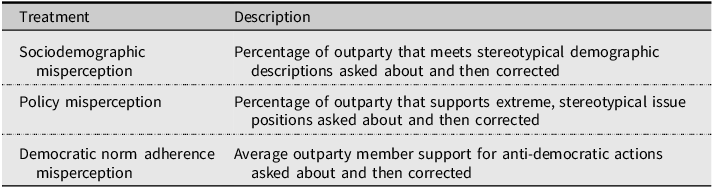
To reduce habituation, the three misperception-correction treatments varied slightly across waves (see Table 2). The treatments corrected distinct outparty misperceptions: (i) sociodemographic composition (respondents estimated outparty demographics and then received correct values and over/under-estimate feedback); (ii) policy positions on salient issues (respondents estimated outparty support/positions and then saw the true rates); and (iii) affect and democratic-norm adherence (respondents estimated outparty feeling-thermometer ratings of the inparty and willingness to endorse norm-violating or violent actions and then received the correct values). Control respondents answered parallel questions about a non-political group (e.g., football fans) and received the same corrective feedback.Footnote 4
Treatments and descriptions

Table 2. Long description
A table with three rows and two columns. The columns are labeled Treatment and Description. Row 1: Sociodemographic misperception, Percentage of outparty that meets stereotypical demographic descriptions asked about and then corrected. Row 2: Policy misperception, Percentage of outparty that supports extreme, stereotypical issue positions asked about and then corrected. Row 3: Democratic norm adherence misperception, Average outparty member support for anti-democratic actions asked about and then corrected.
This design could introduce a potential confound: if one treatment was intrinsically more effective for democratic norms, its impact could be mistaken for a time (wave) effect. To address this, the order of the three treatments was randomized within each treatment arm by creating three subgroups (e.g., 1a, 1b, 1c). Subgroup 1a received Treatment 1 first in Wave 1, 1b received Treatment 2 first, and 1c received Treatment 3 first, with subsequent waves following a randomized/counterbalanced sequence. This within-arm randomization separates order/time from treatment identity, enabling identification of any treatment-specific effects.
Construct measurement
Following each treatment, subjects in both the treatment and control groups were asked thermometer score ratings for the Democratic and Republican parties. Affective polarization is instantiated as the difference between the inparty and outparty scores. As affective polarization towards citizens has different implications than affective polarization towards elites (Druckman et al. Reference Druckman, Klar, Krupnikov, Levendusky and Ryan2022), both were measured.
Democratic norms were measured using a conglomerate of questions from prior studies (Broockman Reference Broockman, Kalla and Westwood2023; Hall and Druckman Reference Hall and Druckman2023; Voelkel et al. Reference Voelkel, Chu, Stagnaro, Mernyk, Redekopp, Pink, Druckman, Rand and Willer2023) as well as questions from the literatures on political tolerance and system legitimacy (see the Appendix Section D for question wording). Support for democratic norms and system legitimacy varies systematically with which party holds power (Anderson Reference Anderson2005; McCoy, Simonovits, and Littvay Reference McCoy, Simonovits and Littvay2020; Simonovits, McCoy, and Littvay Reference Simonovits, McCoy and Littvay2022): respondents are more inclined to back constraints on the president and to view the system as less legitimate when the president is from the outparty. To account for this, respondents received two vignette blocks – one with outparty control (presidency and Congress) and one with inparty control (with the order randomized). This approach follows Coppock (Reference Coppock, Green and Porter2024) and McCoy (Reference McCoy, Simonovits and Littvay2020).
Under outparty control, I measured (i) support for effective governance (willingness to compromise to avoid shutdowns), (ii) support for fair elections (the concession norm), and (iii) system legitimacy (three-item index). Under inparty control, I measured (i) participatory inclusivity (opposition to targeted voting restrictions on outparty supporters), (ii) limits on presidential power (rule-of-law constraints and non-abuse of agencies), and (iii) tolerance toward a respondent-selected least-liked outparty–associated group, followed by standard civil-liberties items (allow speeches/rallies, eligibility for office, government monitoring/content removal).Footnote 5 All items use a five-point agree–disagree scale; multi-item constructs (e.g., system legitimacy) are combined into additive indices with appropriate reverse-coding.
The affective polarization manipulations are expected to influence democratic norms through two pathways. The first is by reducing perceived social distinctiveness. Correcting misperceptions about the outparty’s sociodemographic composition should increase willingness to compromise, interact with, and tolerate outparty members. Social discrimination – and reduced tolerance – rests partly on perceived ingroup–outgroup distinctiveness (Mummendey and Wenzel Reference Mummendey and Wenzel1999; Turner, Brown, and Tajfel Reference Turner, Brown and Tajfel1979). Lower distinctiveness should raise tolerance, participatory inclusivity, and support for effective governance.
The second is by reducing negative trait attributions and perceived threat. Correcting misperceptions about outparty ideology and commitment to democratic norms should increase tolerance, inclusivity, and support for effective governance. Discrimination is fueled not only by difference but by negative characterization of the out-group (Hjerm et al. Reference Hjerm, Eger, Bohman and Connolly2020; Mummendey and Wenzel Reference Mummendey and Wenzel1999). By lowering perceived extremism and norm-violation, these treatments should also reduce the perceived costs of outparty control – i.e., fewer expectations of extreme policies or undemocratic behavior – which in turn should increase support for fair elections, system legitimacy, and limits on presidential power.
Estimation strategy
H1 and H2 are tested with mean-difference estimates, reporting the intention-to-treat (ITT) effect of randomized assignment on democratic norm outcomes. Specifically, linear models of individual change scores are estimated:
 $\Delta {\rm AP}_i = \alpha + \beta \,{\rm HighExposure}_i + \varepsilon _i$
where ΔAP i is change in affective polarization between waves, and HighExposure i is an indicator for assignment to groups that received treatments in both waves.
Interpreting these ITT estimates as the effect of affective polarization on norms requires an exclusion restriction: treatment assignment influences democratic norm support only via its effect on affective polarization (i.e., no direct paths and no alternative mediators such as partisan strength or worry about polarization). If the exclusion restriction does not hold, then the only inference that can be made is that the treatments themselves caused the effect; one cannot pinpoint the effect of an intermediary variable.
This assumption is demanding, but common alternatives rest on comparably strong assumptions. Instrumental variables likewise require the exclusion restriction (as well as a sufficiently strong first stage). Mediation analyses require no unmeasured mediator-outcome confounding and yield only the effect of the treatment that travels through affective polarization – not the desired effect of affective polarization on democratic norm support. I prioritize the ITT as the primary estimand and report alternative sensitivity/auxiliary analyses in the Appendix.
Results
No evidence of accumulated first-stage effects
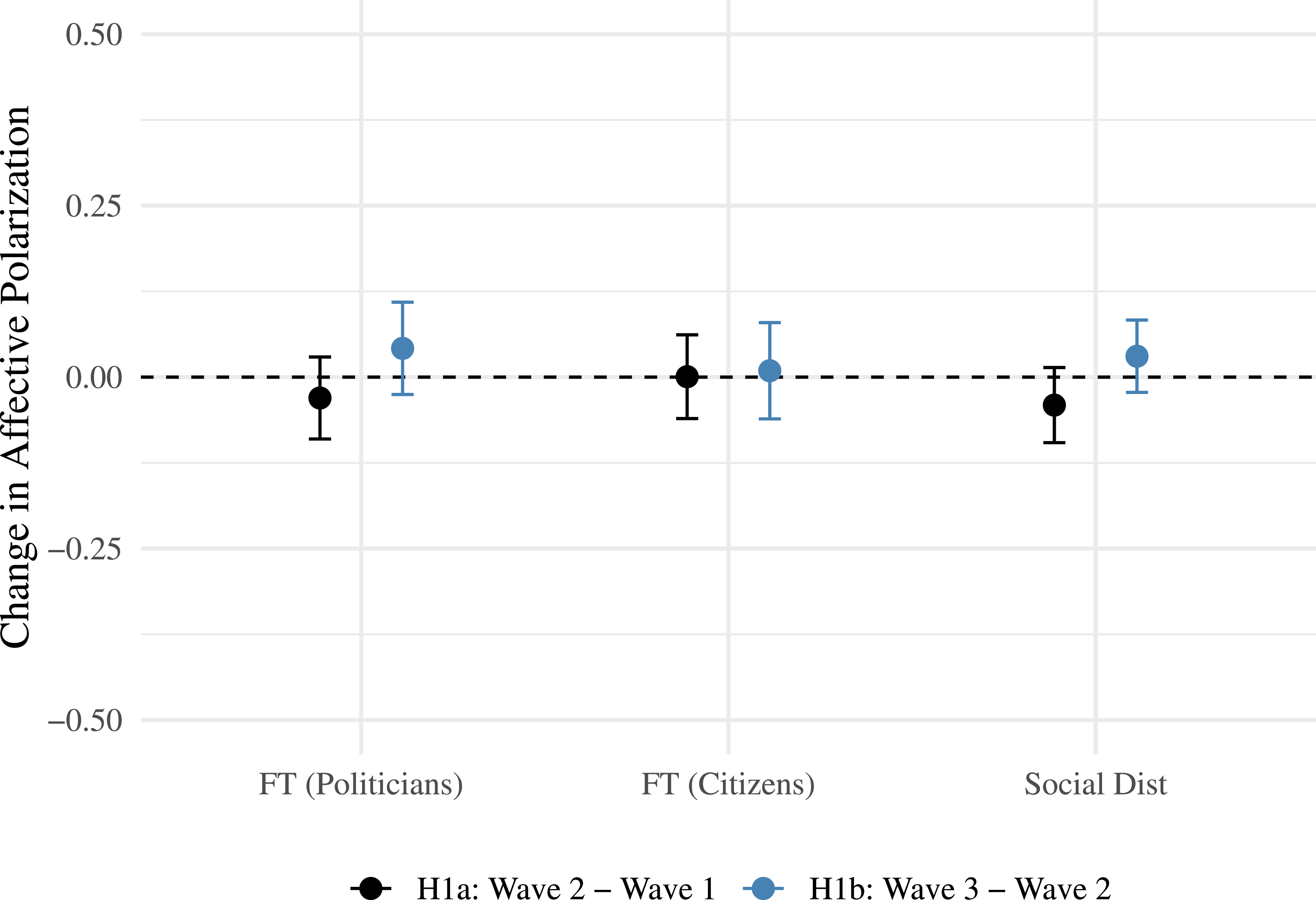
The first set of results evaluates whether repeated exposure to the treatments produced cumulative effects on affective polarization (H1). Figure 1 plots the estimated effects of the treatments on changes in affective polarization between Waves 2 and 1 and between Waves 3 and 2. For the comparison between Waves 1 and 2, Groups 1 and 2 are the “high-exposure” groups: they received the treatment in both waves. They are contrasted with Group 3, which received the treatment only in Wave 1, and Group 4, which never received the treatment. For the comparison between Waves 2 and 3, Group 1 is the only group that received the treatment in all three waves; it is contrasted with Group 2 (treated in Waves 1 and 2 only), Group 3, and Group 4. These comparisons therefore test whether greater cumulative exposure to the treatment leads to larger reductions in affective polarization over time.
No evidence of accumulated effects (H1 unconfirmed). Estimates are differences in differences: differences between the treatment and control groups’ differences in affective polarization between the two waves. FT stands for feeling thermometer. N = 1563 (Waves 1 and 2) and N = 1345 (Waves 2 and 3). Affective polarization measures are standardized to have mean 0 and SD 1.

Effects were null for all three measures of affective polarization in both sets of wave comparisons. This does not mean the treatments had no impact within any single wave (though that is true; those results are reported in the Appendix Section E). Instead, it indicates that receiving the treatment in two or three waves did not meaningfully change affective polarization relative to receiving it in only one or two waves. Although the point estimates vary in sign, they are uniformly small – each is under 0.05 standard deviations in affective polarization. The figure is plotted on a wider scale (0.5 SD) to highlight how modest these estimates are relative to a moderate-sized effect.
Effects of affective polarization on norm support cannot be analyzed
Given that there were no cumulative first-stage effects, these data cannot be used to analyze the effects of cumulative increases in affective polarization on democratic norm support (H2 and H3). It follows from the lack of cumulative first-stage effects that there will be no effects of the treatments on democratic norm support that can be attributed to affective polarization.Footnote 6
Discussion
In order to judge the effects of cumulative decreases of affective polarization on democratic norm support, it is necessary that those cumulative effects actually occur. The repeated treatments used here were ineffective in achieving stronger effects on affective polarization than a single-shot treatment.
This pattern could arise for two reasons. Subjects may simply have forgotten earlier treatments because those treatments conveyed information that conflicted with their prior beliefs. The “affective tipping point” depends on people retaining discrepant information over time (Redlawsk Reference Redlawsk, Civettini and Emmerson2010), yet prior work suggests that belief-incongruent information is especially likely to be forgotten (Lodge and Hamill Reference Lodge and Hamill1986; Schwalbe et al. Reference Schwalbe, Joseff, Woolley and Cohen2024). At the same time, it seems somewhat implausible that respondents would entirely forget a multi-question treatment within just three days.
A more plausible explanation is that the treatments themselves are relatively weak. In Wave 1, there were almost no detectable effects of the treatments on affective polarization. Two of the three treatments produced no statistically significant changes in affective polarization across any of the three measures. Only one treatment – correcting respondents’ misperceptions about the outparty’s sociodemographic composition – yielded a significant effect, and this appeared only on feeling thermometer measures, not on social distance measures.Footnote 7 The lack of cumulative effects may be a function of the inability of these treatments to influence subjects’ affective polarization at all.
Why, then, are the effects so uncertain and weak?
One possibility is the measurement of affective polarization. The three treatments in this study were closely adapted or directly adopted from prior work. For example, the sociodemographic composition treatment is taken directly from Ahler and Sood (Reference Ahler and Sood2018), who report that treated respondents like the outparty about 6.4 percentage points more than control respondents.Footnote 8 A key difference between the studies is the measure of affective polarization. Their measure captures only feelings toward the outparty (“outparty-only measure”), whereas my pre-registered measure is the gap between inparty and outparty feelings (“comparative measure”). A number of other papers that use experiments to manipulate affective polarization also use the outparty-only measure (Druckman and Levendusky Reference Druckman and Levendusky2019; Druckman et al. Reference Druckman, Klar, Krupnikov, Levendusky and Ryan2022; Levendusky Reference Levendusky2018; Santoro and Broockman Reference Santoro and Broockman2022; Voelkel et al. Reference Voelkel, Chu, Stagnaro, Mernyk, Redekopp, Pink, Druckman, Rand and Willer2023; Webster and Abramowitz Reference Webster and Abramowitz2017; Wojcieszak and Warner Reference Wojcieszak and Warner2020).Footnote 9
Inparty feelings have been relatively stable over the past 20 years in observational data such as the ANES and may be less responsive to experimental interventions. If this is the case, then there will be no difference in effect size based on which measure one uses (only the scale). However, the standard error may still differ between the two measures. For the comparative measure, the variance equals σ in 2 + σ out 2 − 2Cov(in,out). If inparty ratings are not tightly correlated with outparty ratings, or the inparty ratings have a sizable variance, this combined variance can easily be larger than the outparty-only measure’s variance, which will increase the p-value. Indeed, my data provide support for this hypothesis. Using the outparty-only measure, the treatments increase affective polarization towards both citizens and politicians significantly in Wave 1 (see Figure A.12 for these exploratory results), whereas this was not the case using the comparative measure. Indeed, the takeaways from this paper would be very different if I were to use this measure of affective polarization.
From a practical standpoint, it is therefore understandable that many experimental studies have adopted an outparty-only measure of affective polarization. At the same time, the non-experimental literature typically conceptualizes affective polarization as the difference between inparty and outparty evaluations. This divergence in measurement across methodological approaches is problematic, because it means that experimental and observational studies are often speaking about related but not identical constructs. As a result, the comparative strengths of each methodological approach are not being brought to bear on the same outcome, leaving our understanding of the causes of affective polarization weaker than it could be.
Perhaps the first step is to clarify the construct we are trying to measure. A growing body of work now grapples directly with this issue, asking what affective polarization is and what it ought to be taken to mean (Campos and Federico Reference Campos and Federico2025; Kasper, Schumacher, and Bakker Reference Kasper, Schumacher and Bakker2025; McMurtrie et al. Reference McMurtrie, Philipp, Hebden and Williams2024; Tichelbaecker et al. Reference Tichelbaecker, Gidron, Horne and Adams2023). Experimentalists should recognize that even seemingly minor shifts in the underlying construct can change how responsive affective polarization is to our treatments. Likewise, when summarizing the literature, we should be explicit that the construct many of us have been measuring differs in important ways from the standard conception of affective polarization.
This discussion additionally highlights the importance of aligning experimental treatments with outcomes. Experimentalists should think carefully not only about the validity of their outcome measures but also about whether those measures capture the specific construct that the treatment is designed to affect. In this study, the treatments were intended to update beliefs about the composition of the outparty. Theoretically, this can be expected to most strongly influence evaluations of that party.Footnote 10 The null findings may in part reflect a potential disconnect between the concept being manipulated and the outcomes being measured rather than the absence of meaningful attitudinal change.
More broadly, this paper highlights a gap in the experimental literature on attitude change. While many studies evaluate the immediate impact of one-shot interventions, relatively few papers in political science systematically examine the effects of repeated treatments or cumulative exposure over time. Hall et al. (Reference Hall, Solomon, Voelkel, Stagnaro, Chu and Willer2025) is an exception, in which the authors use three treatments given over a week to reduce partisan antipathy. Generally speaking, we know little about whether interventions can build on themselves to produce larger or more durable changes in attitudes. Given that real-world political communication is rarely a single exposure, but instead unfolds through repeated messaging across time, it is important for future research to more directly test whether and when repeated treatments can generate meaningful cumulative effects.
Additionally, knowing which interventions (at times) do not produce meaningful effects is essential for theory development, for refining experimental designs, and for preventing the field from repeatedly investing in ineffective treatments. The null results reported here are consistent with a growing body of recent work that finds limited or no effects of informational interventions on political attitudes and beliefs. For example, Dias et al. (Reference Dias, Aarslew, Frederiksen, Lelkes, Pradella and Westwood2024), Holliday, Lelkes, and Westwood (Reference Holliday, Lelkes and Westwood2024), and Druckman (Reference Druckman2023) similarly document null effects across a range of experimental contexts. This body of work suggests that many commonly studied interventions may be less potent than previously thought. Rather than viewing such null results as isolated findings, it is more appropriate to interpret them as part of an emerging pattern in the literature, one that raises important questions about the conditions under which political attitudes can be meaningfully shifted. In this sense, the present findings contribute by helping to delimit the set of interventions that are likely to be fruitful.
Supplementary material
The supplementary material for this article can be found at https://doi.org/10.1017/XPS.2026.10033.
Data availability statement
The data and code required to replicate all analyses in this article are available in the Harvard Dataverse, at doi: 10.7910/DVN/A8UZPO (Jenke Reference Jenke2026).
Competing interests
The author has no conflicts of interest.
Ethics statement
This research was approved by the University of Houston IRB (protocol number 000180138). The research adheres to APSA’s Principles and Guidance for Human Subjects Research. Please see the Appendix Section A for more details.


 Open access

