Introduction
The Pericope Adulterae (John 7:53–8:11, henceforth referred to as PA) has recently undergone extensive research, which has gained momentum over the past two decades, thanks to a series of publications jointly authored by Jennifer Knust and Tommy Wasserman.Footnote 1 Knust and Wasserman’s principal achievement lies not only in unearthing new data concerning the pericope’s attestation, with the aim of addressing questions regarding its “authenticity,” but also in delving into important inquiries regarding why and how this pericope persisted throughout the centuries, appearing in numerous Greek and Latin manuscripts despite the evident awareness of copyists regarding its questionable origins.Footnote 2 As such, the questions surrounding the transmission of the pericope are no less significant than the inquiry into the number of witnesses to its presence or absence, as these witnesses did not exist in isolation.
In this regard, Knust and Wasserman have paid attention to the context of these witnesses by closely examining the comments of the scribes. This careful examination has allowed us to gain insights into the circumstances of the pericope’s attestation within their respective exemplars and sources, which would otherwise remain inaccessible. Their scrutiny of the well-known scholion preceding the PA in Family 1 members GA 1 and 1582, alongside GA 565, offers a glimpse into the scriptorium of a scribe who exhibited reluctance in copying the PA in its traditional position at John 7:53. This reluctance stemmed from an examination of the patristic sources available to the scribe, ultimately leading to a decision to include it at the end of the Gospel as a compromise.Footnote 3 Another noteworthy case highlighted by Knust and Wasserman is the commentary of Zigabenus in his twelfth-century catena.Footnote 4 This commentary allows us to understand the circumstances surrounding the PA’s attestation within its specific context. Consequently, such comments play a significant role in comprehending the phenomenon of the PA’s uneven transmission, leading Knust and Wasserman to conclude their latest article by proposing that “a closer examination of paratextual evidence can help us better understand the history of this popular gospel story.”Footnote 5
In this regard, I offer this study as a response to this invitation. I will provide an assessment of the intriguing notes on the PA, appended by two of the most eminent Coptic scholars during the Coptic intellectual golden age (eleventh to fourteenth centuries).Footnote 6 These hitherto unstudied notes provide a record of the PA’s attestation in numerous copies across the liturgical languages of the Middle East, including Coptic, Arabic, Greek, and Syriac, spanning several centuries. Thanks to the digital revolution, we can now gain insights into the sources referenced in these notes, enabling us to better comprehend how the PA was located, identified, and copied in this region.
Ibn Kabar: The Problem of Section 86
Šams ar-Riʾāsa Abū al-Barakāt, known as ibn Kabar (henceforth Kabar), was one of the most prominent writers of the Coptic golden age.Footnote 7 Kabar ascended in administrative positions until he became the chief writer in the court (Dīwān) of the Mamluk Sultan aẓ-Ẓāhir Baybars, in late-thirteenth-century Egypt. However, as the tide was changing against Copts, he lost his position, along with all Copts in the Mamluk’s court, in the early-fourteenth century. When the anti-Christian pogrom, also known as the Great Persecution of Copts, took place in 1321 CE,Footnote 8 Kabar had to escape and disappear.Footnote 9 It is believed that during his disappearance he wrote his magnum opus: Miṣbāḥ aẓ-Ẓulma wa-Īḍāḥ al-Ḫidma, or The Lamp of Darkness and the Elucidation of Ministry, before he died in 1324 CE.Footnote 10 To the best of my knowledge, this large encyclopaedia was never published in the west. The only printed edition that I am aware of was edited and published by the Jesuit scholar Samir Khalil Samir in Cairo, which was based on two manuscripts: the BNF Arabe 203, and another held in Saint Anthony’s monastery in the Red Sea Desert.Footnote 11 Unfortunately, the text of this edition is partial (just half of the work), and not entirely reliable as it shows significant editorial interventions by Samir. Yet, in the last decade the oldest three witnesses were digitised and made available, which has made a proper study of Kabar’s work possible.Footnote 12
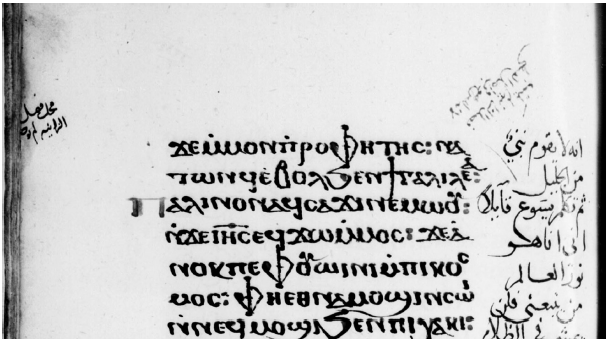
The Lamp of Darkness is an encyclopaedia formed of twenty-four units. The sixth unit is a description of the “canonical books accepted by the church.” Kabar follows the Apostolic Constitutions in his list of canonical books from the Hebrew Scriptures (Apostolic Constitutions 8.47). However, as I recently showed elsewhere, he followed an old Alexandrian Greek canon known as τίτλοι (تطلسات) for the New Testament canon.Footnote 13 As he introduces each text, Kabar highlights various parameters of each gospel: the number of Coptic chapters, Greek Kephalaia (إصحاحات), the titles and the number of the “small sections (فصول صغار),” which are the Ammonian sections. Before concluding his introduction to the Gospel of John and commencing with the Eusebian canon tables, Kabar records a problem with a particular section in a page-long note.Footnote 14 He states that “this Gospel (John) includes the Section of the Adulteress (فصل الزانية).” Kabar informs us that he found it in Arabic copies, designated as section number 86. Conversely, he states that it is unattested in Coptic translations. This implies that Kabar revised the sections he had against gospel texts in Arabic and Coptic, which led him to discover this discrepancy. Kabar’s designation of that pericope as a section (faṣl), identifying it with section number 86, reflects an understanding of it as an “Ammonian” section, not a chapter (iṣḥāḥ). This designation itself is not an innovation of Copts or Arabic writers in general, but it connects this tradition to what is already attested in key Greek minuscules that have the Eusebian canons in their margins. It is noteworthy that the prefatory scholion of PA in the Family 1 (f 1) core-group members refers to its location as being within section 86 (π̅ς κεφάλαιου).Footnote 15 Furthermore, the wording suggests that the problem was not unknown to the reader; Kabar simply refers to the Gospel where the section of the Adulteress is, rather than to the section itself. This suggests that the term “section of the adulteress” was a commonly known title for the PA. This is illustrated in references to this section in several bilingual manuscripts where it was not attested in Coptic, necessitating the insertion of a note to explain it. For instance, a fourteenth-century Coptic-Arabic Tetraevangelion preserved in the Bibliothèque Nationale de France (Copte 14 A) refers to that section as “the section of the Adulteress,” indicating its location and the supposed spot for writing the section number in the margin (see Fig. 1):
BNF Copte 14 A, f.346v.
Copyrights: Public Domain; https://gallica.bnf.fr/ark:/12148/btv1b100872221/f349.item.

In the Arabic column, we notice an upside-down note with a line referencing the end of verse 7:52, stating: “the section of the adulteress was not written because it is not in the original Coptic (فصل الزانية لم يُكتب لأنه ليس في الأصل القبطي).” On the left (outer) margin of the Coptic side, where the Ammonian section numbers and Eusebian canons are inscribed, we come across another note: “the place of the section of the adulteress was not found (محل فصل الزانية لم يوجد).” It is reasonable to suggest that the two notes were not done by the same hand, as they exhibit notable differences in handwriting and script thickness. The latter note does not pertain to the Pericope Adulterae (PA) itself but rather to its “location (محل),” implying that the note’s author was systematically scanning the section list in the margins to identify its corresponding section number and confirm its presence. This was probably part of the routine practice of muqābalah (collation), in the enterprise of Arabic manuscripts.Footnote 16
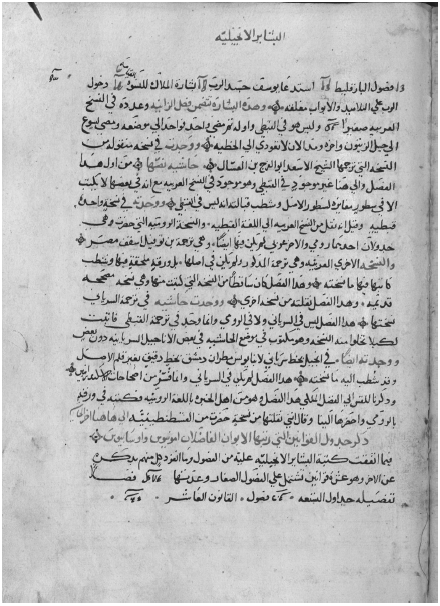
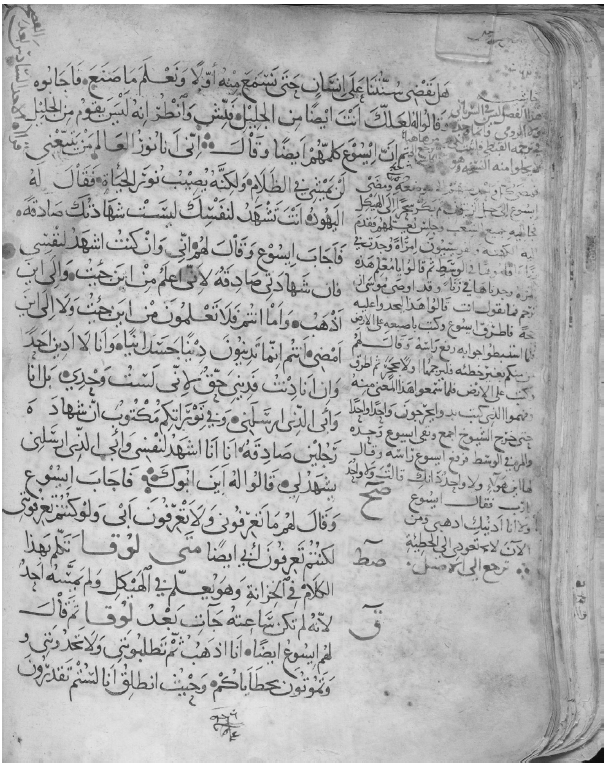
Although section 86 does not precisely correspond to the PA, starting at verse 7:45, this number was employed as a reference point for locating and comparing the PA across different languages.Footnote 17 Kabar does not provide explicit guidance on how to interpret this discrepancy. Instead, he relays an extensive note he found in a renowned Arabic translation of the gospels, completed by al-Asʿad ibn al-ʿAssāl (Fig. 2), whose note will be subject to the following analysis.
The oldest witness to ibn Kabar’s note on the PA (lines 2–18).
Uppsala University, shelfmark: O Vet. 12. Folio: 92r (according to the original Coptic foliation).
Copyright: Public Domain; https://www.alvin-portal.org/alvin/imageViewer.jsf?dsId=ATTACHMENT-0093&pid=alvin-record:102243.

Al-Asʿad ibn al-ʿAssāl
The note that Kabar incorporates into his Lamp of Darkness originates from a four-gospel Arabic translation conducted by one of the most distinguished Coptic scholars of his era: al-Asʿad ibn al-ʿAssāl (hereafter referred to as al-Asʿad). His translation enjoyed wide circulation during his time. To comprehend al-Asʿad’s note and its significance, we must first explore the nature of his translation.
Al-Asʿad belonged to one of the most prominent Coptic families that held esteemed political and ecclesiastical positions in the thirteenth century, known as Awlād al-ʿAssāl (ʿAssāl’s sons).Footnote 18 While his brothers produced important theological works, al-Asʿad displayed a particular interest in language and translation. He possessed mastery over Coptic and Arabic, in addition to a demonstrated knowledge of at least Greek. Notably, al-Asʿad was renowned for his resourcefulness, often traveling to places like Yemen and Damascus to personally copy manuscripts.Footnote 19
During his research, he encountered a dearth of high-quality and eloquent Arabic translations. When tasked with producing such a translation, al-Asʿad embarked on a meticulous endeavour, completing it in 1253 CE.Footnote 20 In his work, al-Asʿad introduced meticulously selected witnesses from each language he consulted: Greek, Coptic, and Syriac.Footnote 21 He chose the most credible witnesses from each language, transcending denominational boundaries, and consulted at leastFootnote 22 nine exemplars. Subsequently, he relied on a specific Coptic witness as his primary exemplar, incorporating variants above each word in the running text. He also provided a comprehensive list of witnesses supporting and opposing each reading.
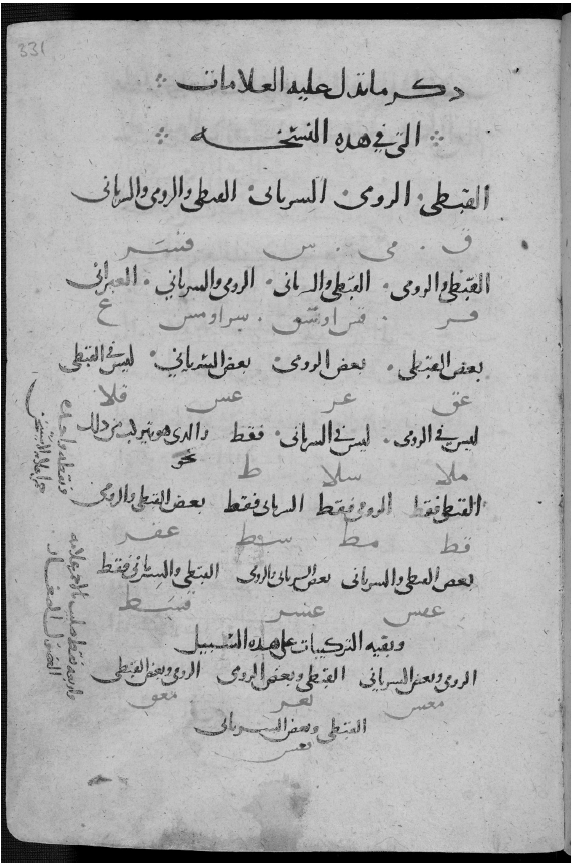
To efficiently accomplish this task, al-Asʿad developed a set of sigla for each language. He also devised sigla to denote the degree of presence of a variant per language, using sigla such as “not in,” “only in,” and “some of.” He combined these sigla with the language he was referring to. For example, he used ميط to indicate “only in Greek,” قلا for “not in Coptic,” or عس for “some of the Syriac (witnesses)” (see Fig. 3).
Bodleian Library Hunt. 118 f. 331r. Al-Asʿad’s table explaining his sigla.
Copyright: © Digital Bodleian Creative Commons license CC-BY-NC 4.0

Unfortunately, this text did not receive enough attention in western scholarship.Footnote 23 As we reach section 86 with the PA, we find al-Asʿad’s note which ibn Kabar copied faithfully.Footnote 24 The note records al-Asʿad’s journey to verify the source of the PA. Al-Asʿad went through what he found in the exemplars of his translation as well as other exemplars, in addition to personal enquiries he made to experts in his time. First, al-Asʿad understands the problem to be with a specific Ammonian section that uses the term faṣl (فصل). Al-Asʿad informs us that the problem started when he found that:
هذا الفصل وإلى هنا غير موجود في القبطي، وهو موجود في أكثر النسخ العربية مع أنه في بعضها.لا يُكتب وإلا في سطورٍ مغايرةٍ لسطور الأصل، ويُشطَب قبالته أنه ليس في القبطي
This section—and up to here—is not attested in Coptic, but it is found in most of Arabic copies, even though in some of them, it is not written except in lines that are distinct from the original lines, and is written opposite to it that it is not in Coptic.
He checked this section, not just in his regular exemplars, but he went much further to consult several other manuscripts and persons. Al-Asʿad went through the material he inspected by categorising them under three languages: Coptic, Greek and Syriac. We will analyse al-Asʿad’s findings likewise.
A. Coptic
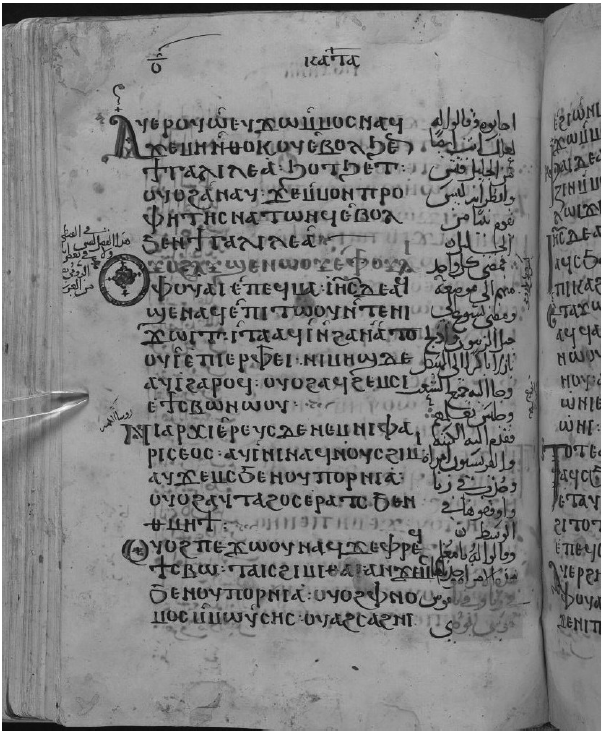
In Coptic manuscripts, al-Asʿad encountered the PA “in a single Coptic copy” accompanied by a marginal note indicating that it had been translated from Arabic copies into Coptic. Beyond this instance, he did not come across it in Coptic manuscripts. The notion that the Coptic version of the PA originated from either Arabic or Greek sources finds support in several paratextual notes discovered in Bohairic manuscripts.Footnote 25 While it is not uncommon to encounter these caveats in the margins without the accompanying text, two specific cases align with al-Asʿad’s assertion, as they include the explicit mention of a translation from Arabic to Coptic. This aligns with the instances found in the recently digitised bilingual thirteenth-century manuscripts: Vat.Copt.9 and Or. 1315. In the British Library’s Or. 1315, a note declares that the Arabic text originates “not from Coptic but from Greek (ليس قبطي بل رومي),” while the Coptic side bears a gloss stating that “this section is neither in Coptic, nor in some Greek, but it was translated from Arabic.” (see Fig. 4).
British Library, shelfmark: Or. 1315 f. 386v.
Copyright: Public Domain.

In the Vatican manuscript vat.copt.9 two notes appear at the beginning and end of the Coptic text of the PA (fol. 431r). The first states: “This section is not included in Coptic, nor in some of the Greek and Syriac copies (هذا ليس تتضمنه القبطي ولا بعض نسخ الرومي ولا السرياني).” At the conclusion of the PA (fol. 431v), the second note states: “up to here, it was translated from Arabic (إلى هُنا نُقل من العربي).”Footnote 26 Interestingly, vat.copt.9 has a waqf (endowment) statement written by the hands of the Coptic patriarch Gabriel in Cairo, in 1270 CE (fol. 1r). The waqf declares that the manuscript shall be endowed in the monastery of Saint Anthony in the Red Sea. Gabriel was one of al-ʿAssāls’ proteges who produced a significant number of copies for their library, for ten years (as we shall see below).Footnote 27 Was this the very manuscript that al-Asʿad was referring to in his note?
From the Coptic section of al-Asʿad’s note, we learn that his examination of Coptic manuscripts led him to the conclusion that the PA is “not in Coptic.” The solitary case he encountered suggests that the PA was likely introduced to Coptic from Greek through a Greek-based Arabic text. This leads us to investigate the next section of his note, which deals with his Greek exemplars.
B. Greek
1. Ibn Tawfīl: In Greek and Greek-based translations, al-Asʿad informs us that he consulted two works done by Theophilus ibn Tawfīl, the Melkite bishop of Cairo (Miṣr). Ibn Tawfīl, originally from Damascus, was renowned as a scholar and was known for his expertise in the Arabic language, according to al-Asʿad himself.Footnote 28 External information regarding his contributions is scarce, except for a homily attributed to him in an eighteenth-century collection of homilies preserved in Beirut (Bibliothèque Orientale MS 510 pp. 66–71). The date of the copy that al-Asʿad used (1047 CE) serves as a firm terminus ante quem for the Greek exemplars behind ibn Tawfīl’s translations. Historical records from the Alexandrian patriarchate indicate that a certain bishop in Cairo named Theophilus assumed patriarchal duties following the murder of Patriarch Arsenius in 1010, during the severe persecution of Christians in Egypt under the rule of al-ḥākim.Footnote 29 Facing these extraordinary circumstances, Theophilus sought refuge in Constantinople, where he continued his responsibilities remotely until 1020 when the persecution stopped and a new patriarch in Egypt (George II) was appointed.Footnote 30 Consequently, his name led to discrepancies in the lists of patriarchs, and he was not officially recognised as a patriarch in the patriarchal official yearbook.Footnote 31 Therefore, it is likely that the Greek Vorlagen of his translations precede the eleventh century, as he probably prepared his translation in the first decade of the eleventh century, prior to the eruption of violence and the systematic destruction of Melkite properties in 1010 CE. Given his position as a bishop of the capital city, where the patriarch himself was situated (since the tenth century), we should expect that ibn Tawfīl used the most authoritative (probably oldest) exemplars he was able to lay his hands on.
The copies of ibn Tawfīl’s translations that al-Asʿad consulted included a bilingual Greek-Arabic manuscript completed in 1047 CE and another Greek-based Arabic manuscript completed in the year 1194.Footnote 32 This raises the question of whether these were two distinct translations or one. In his own introduction to the sigla for Greek readings, al-Asʿad clearly states that “by using ‘some of the Greek,’ I mention one of them.”Footnote 33 Indeed, throughout the translation, discrepancies in wording are evident as he repeatedly uses this siglum. This suggests that ibn Tawfīl produced two translations, based on different Greek manuscripts. Additionally, al-Asʿad informs us that ibn Tawfīl supplemented his second translation with a textual commentary (وحشى اللغة العربية في ترجمته), implying that ibn Tawfīl approached his text critically and verified its content against other copies of the Greek exemplar when necessary.
Al-Asʿad further informs us that the Pericope Adulterae (PA) was not present in the bilingual Greek-Arabic edition, nor did it appear in the Arabic-only edition in its original text (لم يكن في أصلها). However, the latter edition featured the PA added on a separate sheet at its conclusion, accompanied by the following note: “this section was not present in the exemplar that I used, which was a revised and old copy. (So,) I copied this section from another exemplar.” From this, we learn that the most esteemed and reliable Greek manuscripts, as considered by the bishop of Cairo, lacked the PA.
Given the context and quality of his translations, we can reasonably assume that ibn Tawfīl utilised the best materials available to him and must have consciously noted the absence of the PA, deciding against its inclusion. However, the question of the specific sources ibn Tawfīl accessed in the late-tenth and early-eleventh centuries will be addressed in the next section as we move on to discuss the next set of Greek witnesses.
2. Ibn al-Faḍl al-Anṭākī: Al-Asʿad’s introduction to ibn Tawfīl’s second translation hints at another Greek-based source that he most likely consulted. While praising ibn Tawfīl’s translation (the Arabic-only edition), al-Asʿad informs us that his comparison between its text and the citations (īrād) found in the works of ʿAbdullāh ibn al-Faḍl al-Anṭākī led him to see striking similarity.Footnote 34 Ibn al-Faḍl was one of the most celebrated translators and writers among the Melkites in the eleventh century. He produced an extensive body of translations from Greek into Arabic, demonstrating his mastery of both languages.Footnote 35 Among his notable works, he completed a comprehensive translation of John Chrysostom’s homilies on Matthew and John, which served as commentaries on these gospels. To what extent al-Asʿad used ibn al-Faḍl’s work remains uncertain. However, I can confirm that a recently digitised manuscript at Saint Catherine’s Monastery reveals that ibn al-Faḍl’s introduction to his commentary was incorporated into al-Asʿad’s own introduction to his gospels, albeit with the removal of ibn al-Faḍl’s reference to himself and his criticism of non-Chalcedonian Christologies (Sin. Ar. 76 fols. 4v–8v).
Based on al-Asʿad’s utilisation of ibn al-Faḍl’s introduction and the comparison he conducted between ibn al-Faḍl’s text and ibn Tawfīl’s, it is reasonable to suggest that al-Asʿad must have examined ibn al-Faḍl’s works, particularly the “commentary,” in his quest to identify instances of PA citation. After a careful examination of its surviving copies, I can also confirm that ibn al-Faḍl’s “commentary” on John, which essentially comprises a compilation of John Chrysostom’s eighty-eight homilies, does not contain any reference to the PA.Footnote 36 Another work attributed to ibn al-Faḍl is a commentary on the lectionary readings of the year, presented in the format of an alternating catena. This work was widely copied up until the nineteenth centuryFootnote 37 and found use in the Melkite church. Again, ibn al-Faḍl’s edition lacks the PA. Consequently, the earliest printed edition published by the Patriarch of Antioch in 1706 featured the PA added at the end of the book as a reading for “confessing women.”Footnote 38 Hence, to al-Asʿad’s dismay, the “citations” attributed to ibn al-Faḍl constituted another source that did not include the PA.
3. Abū al-Faḍl: Although the note moves to the next set of witnesses in Syriac, we find that the note makes an unexpected return to Greek at the end, with the following statement:
وذكرنا للقس أبي الفضل الملكي بالقاهرة هذا الفصل، وهو من أهل الخبرة باللغة الرومية، فكتبه في.ورقةٍ بالرومي، وأحضرها إلينا وقال إنني نقلتها من نسخةٍ حضرت من القسطنطينية
And we mentioned this section to Abū al-Faḍl the Melkite priest in Cairo, and he is amongst the experts of Greek language. So, he wrote it on a paper, in Greek, and he brought it to us, and he said that: “I transcribed it from a copy that came from Constantinople.”
The placement of the note at the end of the gloss raises some intriguing observations. While the entire gloss is presented in the first-person singular, this particular sentence is in the plural form. Furthermore, it is not found in the second oldest manuscript (British Library Or. 3382 f. 327v). These observations provide compelling reasons to believe that it was a later addition to the original gloss. However, it must have been added within a relatively short period, probably during the lifetime of al-Asʿad himself, as it also appears in Hun. 118, a manuscript completed seven years after al-Asʿad’s original copy. This suggests that the issue of the PA continued to trouble al-Asʿad’s efforts in Cairo, even after he completed the translation in Damascus. It prompted his associates to persist in their quest for witnesses to the PA.
From this passage, we learn that they sought the expertise of a Melkite priest in Cairo named Abū al-Faḍl, who had a strong command of Greek. Abū al-Faḍl later returned to al-Asʿad with a sheet containing the PA in Greek, indicating that he “copied it from a copy that had arrived from Constantinople.” Unlike other instances where al-Asʿad personally examined the offered manuscripts, this case reveals that the valuable manuscript from Constantinople was immovable, leading Abū al-Faḍl to provide a copy of the Greek text of the PA separately, which he “brought” to al-Asʿad’s team.
Up to this point, the insights gleaned from al-Asʿad’s gloss concerning the existence of the PA in Egypt are remarkable. The PA is conspicuously absent not only from Coptic manuscripts but also from the significant Greek and Greek-based translations that al-Asʿad consulted. Moreover, it remained difficult to resource within the Melkite parish of Cairo, at least to the extent that Abū al-Faḍl’s search could ascertain.
C. Syriac
1. Ibn as-Sirrī: In Syriac, al-Asʿad used three exemplars for his work which are Syriac-based Arabic translations. The first is of the ninth-century translation with commentary done by Bišr ibn as-Sirrī in Damascus.Footnote 39 Unfortunately, as-Sirrī’s translation of the gospels was lost, but his translation of the Pauline epistles and Acts survives in Sinai (Saint Catherine’s Monastery, shelfmark MS Arab. 151), which is the oldest surviving Arabic translation of a New Testament text known to us.Footnote 40 The impression al-Asʿad had regarding this translation was that it is “very much in agreement with the Greek (كثيرة الموافقة بالرومي).”Footnote 41 Unfortunately, we have no further information on its text, and there is evidence in al-Asʿad’s wording suggesting that the copy does not cover John.Footnote 42
2. Ibn aṭ-Ṭayyib: Al-Asʿad also made use of the translation by the eleventh-century Iraqi scholar Abū al-Farag ʿAbdullāh ibn aṭ-Ṭayyib, who died in 1043. Ibn aṭ-Ṭayyib was renowned as one of the most prominent writers and translators of his era.Footnote 43 Among his numerous works, he translated the Diatessaron and compiled a catena-style commentary from Syriac sources, blending patristic exegesis with the entire text of the gospels. This particular commentary is the one al-Asʿad employed. Despite the fact that his translation was part of a commentary containing Nestorian teachings, it gained wide acceptance in Egypt, as evidenced by the numerous copies produced by Copts. Footnote 44 However, Coptic scribes carefully edited out any Nestorian elements in the commentary,Footnote 45 and employed their own editions of Coptic-based Arabic translations.
This led to the existence of two recensions: the first, which preserves ibn aṭ-Ṭayyib’s original work, and the second, adopted in Egypt after revision.Footnote 46 Thanks to HMML’s recent digitization efforts, previously unknown witnesses held in the Chaldean church in Turkey now provide us with complete editions of the first recension. Consequently, we now know that ibn aṭ-Ṭayyib did not include the PA in his catena.Footnote 47 As Copts replaced ibn aṭ-Ṭayyib’s gospel texts with their Alexandrian vulgate, they left signs and references to the missing PA. In later manuscripts, explicit mentions of the PA or even its inclusion in the text can be observed.Footnote 48 Al-Asʿad utilised the original recension, which he accessed in Damascus during his collection of Syriac material. This is evident from the way he referenced the Syriac chapter divisions “in the copy of ibn aṭ-Ṭayyib” in the prologue of every gospel, reaffirming that he did not find the PA there.
An interesting possibility regarding the interaction between al-Asʿad and ibn aṭ-Ṭayyib lies in the latter’s translation of the Diatessaron from Syriac. Did al-Asʿad have access to it? An eighteenth-century codex preserved in the Bodleian Library (MS. Arab. e. 163) contains three works: An Introduction to the Four Gospels, an apologetic treatise by aṣ-Ṣafī ibn al-ʿAssāl titled Tiryāq al-ʿUqūl fī ʿIlm al-Usūl, and ibn aṭ-Ṭayyib’s translation of the Diatessaron. The copyist, Anthony Saʿd, attributes the exemplar to Awlād al-ʿAssāl (the sons of al-ʿAssāl). Although the date provided for this copy (500 Hijri, equivalent to 1106/7 CE) predates the period of al-Asʿad’s activities and likely ibn aṭ-Ṭayyib’s translation, it could be a miscalculation of the Hijri date from the Coptic calendar. Nevertheless, the first two works undoubtedly belong to the al-Asʿad family; the second work was completed by al-Muʾtaman (al-Asʿad’s brother). Having inspected the manuscript’s text in the Bodleian Library, I can confirm that the Introduction to the Four Gospels corresponds to al-Asʿad’s own introduction to his translation.Footnote 49 Further, upon personal inspection, I found that the same combination of works in the Bodleian Library’s manuscript are found in the thirteenth- to fourteenth-century Borgiani Arabi codex (Borg.ar.250), preserved in the Vatican Library. Therefore, it is quite plausible that al-Asʿad’s family possessed a similar codex containing a copy of ibn aṭ-Ṭayyib’s Arabic Diatessaron alongside al-Asʿad’s preface and his edition of the ten Eusebian canons, mirroring the composition found in the eighteenth-century codex.Footnote 50 In this scenario, al-Asʿad, once again, did not find the PA in ibn aṭ-Ṭayyib’s translation of the Diatessaron. This explains why al-Asʿad extended his examination to other Syriac witnesses in Damascus.Footnote 51 A careful analysis of the paratext of the Egyptian recension of the Arabic Diatessaron shows that it was almost certainly developed in ibn al-ʿAssal’s scriptorium, as I have shown elsewhere.Footnote 52
3. The Copies of Bishop Yu’annis: In Damascus, al-Asʿad mentions the name of Yu’annis, the bishop of Damascus, who provided him with additional manuscripts. Al-Asʿad discovered the PA in two manuscripts. The first is a Syriac-based Arabic translation that contained the PA in the margin, along with a note about the PA’s source. Al-Asʿad copied this note into his gloss. Can we verify the existence of this manuscript? Recently, HMML posted images of a manuscript held at Saint Mark’s Monastery in Jerusalem that matches al-Asʿad’s description. This translation was completed from Syriac in November 1228.Footnote 53 A series of notes scattered throughout the codex document its journey from “the Holy Mountain” through Homs to Bab Tuma in Damascus, where it was acquired by Yu’annis, the bishop of Damascus, according to an endowment (waqf) statement that Yu’annis himself added in Syriac at the end of the Gospel of Mark (folio 86v).Footnote 54 Today, this manuscript is held in Saint Mark’s Monastery in Jerusalem (shelfmark MS 261).Footnote 55
The text’s layout has chapter divisions and numbers, and it is supplemented with the prefatory canon tables in the Peshitta’s revised version. The PA is encountered on folio 143v (Fig. 5 below). It appears in a smaller handwriting as a gloss in the outer margin, accompanied by a note stating: “This section is neither in Syriac nor in Greek, but it was found in the translation of Coptic, and so it was recorded here lest this copy lacks it.”Footnote 56 The Arabic wording matches exactly the note reported by al-Asʿad. Since this manuscript indeed resided in Damascus and was endowed by al-Asʿad’s acquaintance, Yu’annis, the Syrian bishop of the city, it is plausible that al-Asʿad had access to this very copy. This assumption is strengthened by the striking similarity between al-Asʿad’s report and what is found on folio 143v. Interestingly, the copyist assigned a chapter number (not section) 274 in both Syriac (ܪܥܕ) and Coptic Epact (𐋴𐋰𐋤) to the PA. It raises the question of whether he imported this continuous chapter system from the Coptic-based Arabic source where he found the PA. Does this, in turn, explain why the scribe added the chapter numbers in Epact alongside Syriac?
Saint Mark’s Monastery MS 261 fol. 143v.
Image courtesy of the Saint Mark’s Monastery, Jerusalem, and the Hill Museum & Manuscript Library. Published with permission of the owners. All rights reserved.

Finally, al-Asʿad consulted a copy offered to him by Yu’annis himself. The copy this time was in Syriac. He found, again, that the PA appeared in a “small handwriting, different to the original hand.” al-Asʿad found a note next to it. Unfortunately, the wording of this note is unstable amongst al-Asʿad’s manuscript witnesses. The oldest witness that was copied from al-Asʿad’s own copy (Bodleian Library Hunt. 118) says:
هذا الفصل لم يكن في السرياني، وإنما فُسِّر من إصحاحات الإسكندرانيينFootnote 57
This section was not (yet) in Syriac, but it was interpreted from the chapters of the Alexandrians.
This is the wording also known to ibn Kabar as he quotes al-Asʿad’s gloss in his Lamp of Darkness. However, other witnesses that I was able to accessFootnote 58 have the second part of the note as: “but Paul interpreted it from the chapters of the Alexandrians,” including the second oldest copy in the British Library (Or. 3382). So, the difference is about the subject responsible for the PA’s transmission to Syriac tradition. The note itself is intriguing for several reasons. It refers to the PA as a section (فصل) that originated from chapters (إصحاحات), implying that it was not a standalone text but part of a larger context. Additionally, it suggests that the PA entered the Syriac world from Alexandria through interpretation (فُسِّر) rather than mere copying. The usage of both section (ܦܣܘܩܐ) and chapter (ܪܫܐ) in Syriac can be confusing, as previously noted by scholars like Knust and Wasserman.Footnote 59 If al-Asʿad’s sentence was indeed a direct translation from Syriac, then this should also explain the other elements such as the interpretation and the name of Paul (if it belongs to al-Asʿad’s original gloss). We have similar notes in a group of Syriac witnesses in which a certain Mar Boula (the same Arabic rendition we find in al-Asʿad’s witnesses)Footnote 60 copied it into Syriac from Alexandrian exemplars.Footnote 61 In fact, the term “interpretation” here is associated with the Eusebian canons, in one of the Syriac notes, which says: “But Mar Paula (ܦܘܠܐ) translated/interpreted it (ܦܫܩܗ) from the Greek into the Syriac tongue. And it is in number 86 (ܦܘ) in the tenth canon; according to the tradition (ܡܫܠܡܢܘܠܐ) of the Alexandrians.”Footnote 62 This Syriac gloss is very close to what al-Asʿad reported in Arabic. The Arabic word فُسِّر for “translated”/“interpreted” is a literal translation of the Syriac word ܦܫܩܗ that we find in this Syriac gloss. Yet the Syriac gloss explains what was behind the Arabic word “chapters” (إصحاحات). It was a mistranslation of the reference to section 86 in the Eusebian canons. Again, we see the importance of the reference to the section number as a marker that helps the translators and copyists trace and compare the presence of a certain section across witnesses. Like other references in al-Asʿad’s Syriac witnesses, the PA was perceived to have been introduced to the Syriac world from Egypt, either via “Alexandrians’ tradition” of the Eusebian canons, or what was perceived as Coptic-based Arabic.
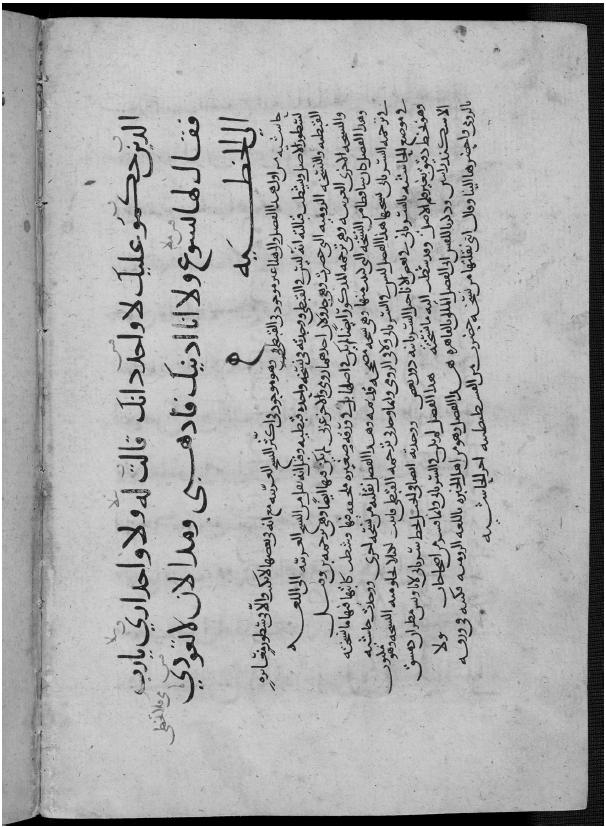
Al-Asʿad’s tireless quest to unravel the complexities of the PA’s attestation ultimately did not yield a definitive conclusion. This enigma is vividly portrayed in his work, where most of the early witnesses, including the earliest ones (Hunt. 118 and Or. 3382), present the PA’s text vertically, accompanied by the comprehensive note that surrounds it or is placed below, as depicted in Fig. 6, above. With this layout and the large gloss, al-Asʿad concludes his pursuit of the PA.
Bodleian Library, shelfmark: Huntington 118, fol. 285v.
The last verse of the PA with the note, written vertically. The following folio (left) showing the normal orientation of the text, with sigla and variants.
Copyright: © Digital Bodleian Creative Commons license CC-BY-NC 4.0.

Reading Evidence
The gloss provides information on where the PA was found, but it does not indicate where al-Asʿad did not find it. The PA’s absence is equally crucial to understand the prevalence of the PA’s presence in al-Asʿad’s milieu. To address this, I conducted a systematic examination of all the manuscripts mentioned in al-Asʿad’s entire work, not just those in the PA’s gloss. This approach served as a foundation for assessing the evidence he encountered. It is important to note that this forms the basis for the quantity of evidence al-Asʿad consulted, as he also referred to some copies in various languages for which we cannot ascertain precise numbers. For example, al-Asʿad’s reference to Abū al-Faḍl implies that the latter could not find the PA in his parish, let alone possess knowledge of it. Abū al-Faḍl had to make effort to obtain it from a preserved manuscript in Constantinople in response to al-Asʿad’s inquiry. The exact number of manuscripts examined during their exchange remains unknown. Furthermore, al-Asʿad mentioned “some Syriac copies” in Damascus that contained the PA in the margins while others omitted it, making it challenging to quantify these manuscripts based on his brief statement. Therefore, it would be misleading to regard the gloss as an exhaustive representation of the evidence in al-Asʿad’s investigation. Nevertheless, it provides insight into the broad range of manuscripts he had access to, when considering the historical context of al-Asʿad and his sources.
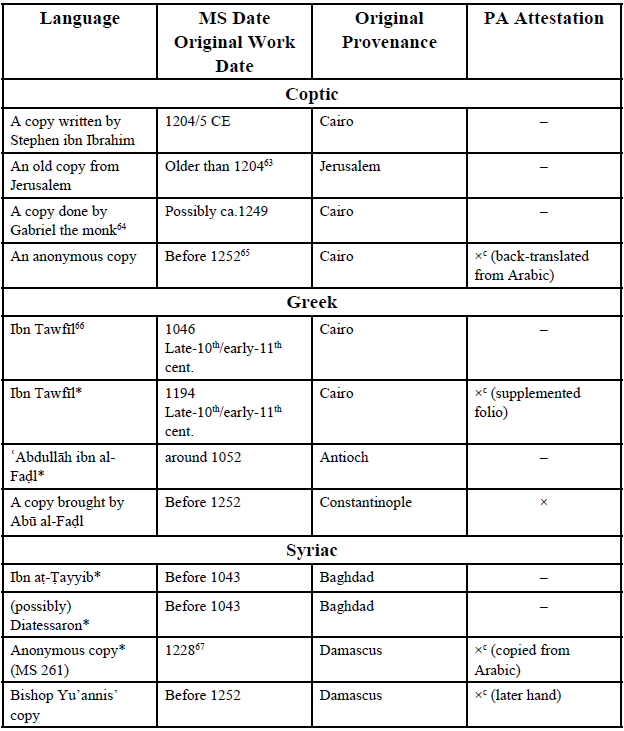
In summary, his research encompassed several key aspects. He conducted physical research activities in at least two major capital cities: Cairo and Damascus. In addition to examining manuscripts, his research involved personal inquiries directed at individuals known for their expertise in relevant fields. The manuscripts he consulted were in Coptic, Greek, and Syriac, as well as translations based on these languages. These translations were renowned for their quality, antiquity, and reputation, as confirmed by our knowledge of some of them today. The manuscripts and translations date from the ninth to the thirteenth century and originated from various locations, including Egypt, Syria, Baghdad, and Constantinople. In the case of the PA, al-Asʿad displayed a commitment to access additional manuscripts beyond those listed in his appendix. The following Table 1 illustrates the attestation of the PA in al-Asʿad’s exemplars and the additional manuscripts he mentioned.

Symbols: * = a translation, – = unattested, × = attested, ×c = added/supplement
This evidence should also be considered against the historical backdrop of al-Asʿad. He was one of four brothers, known as the ʿAssāl sons, celebrated for their intellectual contributions and significant social and political influence. They provided patronage to notable copyists, who produced copies of various works to support their research endeavours, not only in Cairo but also in Damascus. Gabriel, a priest and monk under the patronage of al-Amğad, al-Asʿad’s youngest brother, spent a decade in their residences in Cairo and Damascus, creating numerous copies of the gospels in both Coptic and Arabic.Footnote 68 Later, with the support of the ʿAssāls, he rose to become Patriarch Gabriel IIIFootnote 69 in the Sultan’s court. Al-Asʿad himself managed an extensive library containing the acquired, copied, and stored works. Renowned for its size and rich collection, this library was referred to as the Main and High Asʿadic Library, a nod to al-Asʿad, and was endowed with manuscripts from Damascus, Jerusalem, and Cairo. It continued to serve as a valuable source of manuscripts for generations of scholars and became known as the Asʿadic Archive (الخزانة الأسعدية).Footnote 70
Therefore, it is essential to view this four-gospel translation not as the product of an enthusiast or a solitary monk secluded in a monastery with access to a limited number of manuscripts. Instead, it represents the culmination of a comprehensive enterprise, which helps explain how a work as extensive and complex as this multilingual apparatus could be completed in one year.Footnote 71 When al-Asʿad refers to “Coptic” or “Syriac copies” in an indefinite form while addressing the PA, we should not assume a small number of copies. If we consider the table above as indicative of a more extensive pool of manuscripts examined by al-Asʿad (and his proteges), we realise that the PA was virtually absent from Coptic until it was introduced through Arabic translations originating from Greek. This absence is consistent with earlier Sahidic manuscripts,Footnote 72 persisting in Bohairic well into the fourteenth century, as attested by ibn Kabar, corroborating the findings of Christian Askeland, Knust, and Wasserman in modern times.Footnote 73
However, what is surprising in al-Asʿad’s assessment is the notable absence of any reference to the PA in the Chalcedonian branch of the Alexandrian church, which continues to employ Greek in its liturgy. The translations by ibn Tawfīl, the bishop of Cairo in the late-tenth and early-eleventh centuries, displayed a neglect of the PA. Yet, the most striking aspect is Abū al-Faḍl’s inability to locate a Greek copy with the PA in his immediate surroundings, compelling him to copy it from a codex that “came from Constantinople.” Considering the situation of the Melkite patriarchate during the times of ibn Tawfīl and Abū al-Faḍl, it is evident that they had access to a significant number of ancient manuscripts. According to records from the Greek Orthodox Patriarchate of Alexandria, the Melkite patriarch of Alexandria, Elias I, relocated the ancient patriarchal library to the new Egyptian capital, Cairo, in 997 CE, during the tenure of ibn Tawfīl as the bishop of Cairo. Later, in 1252, it was moved to the Patriarchal Monastery in ḥāret ar-Rūm (the Greeks’ Quarter) in Old Cairo, close to al-Asʿad’s residence, and in the same year he began working on his translation.Footnote 74 By the tenth century, this library had already been recognised and consulted by both Coptic and Melkite bishops for its valuable contents.Footnote 75 Given these circumstances, it is implausible that the bishop of Cairo, ibn Tawfīl, who resided where the library was located,Footnote 76 did not consult its holdings. This also elucidates Abū al-Faḍl’s actions. Since the PA was absent from his local parish copies, he likely visited the patriarchal library, where he encountered a precious “copy from Constantinople.” Due to the waqf (endowment) of this manuscript, he was unable to take it outside. Consequently, he copied it onto a separate sheet and delivered it to al-Asʿad, who was accustomed to consulting the manuscripts himself. This particular copy from Constantinople may have been one of several copies that the Melkite Alexandrian patriarchs, appointed in or seeking refuge in Constantinople during times of persecution, brought with them and placed in the patriarchal library with an associated waqf statement.
Therefore, this Constantinopolitan codex likely arrived and was confined to the patriarchal library with a waqf statement, at some point after ibn Tawfīl, and was brought in along with a returning bishop, after the dust of the persecution settled. A famous case is of Patriarch Athanasius III who brought in several codices from Constantinople, sealed all of them with a waqf statement written and signed in both Greek and Arabic that only allows reading through, and copied from them in the patriarchal residence (الدار البطريركية).Footnote 77 Both Athanasius (who was a patriarch shortly after al-Asʿad time) and his predecessor Nicholas II (a contemporary of al-Asʿad) sought refuge in Constantinople, and were looked after by the emperor (Michael VIII and then his son Andronikos II Palaiologos), and returned to Egypt. At least in the case of Athanasius III we have documented waqfs of the codices that were given to him by the emperor as gifts. That evidence makes it very likely that the emperor likewise presented similar gifts to Nicholas II, whom he brought in to preside over a council convened to excommunicate the unionist patriarch of Constantinople.Footnote 78 This was probably the scenario behind the codex Abū al-Faḍl consulted to provide the PA. It is not even unreasonable to envisage that al-Asʿad himself had consulted the library’s copies, given its proximity and significance. But what prompted Abū al-Faḍl to highlight the codex’s provenance rather than simply supplying the text of the PA from a manuscript in the patriarchate’s possession in Cairo? If he could not locate the PA in Alexandrian manuscripts—an observation consistent with what ibn Tawfīl found—then recourse to Constantinople became necessary. Stating this explicitly, however, effectively acknowledges that the PA had to be sought in copies originating abroad. Moreover, mentioning Constantinople invokes an unmistakable authority that would have been useful to foreground vis-à-vis other prestigious witnesses that lacked the PA. As I have shown elsewhere, the patriarchal library during the time of Abū al-Faḍl’s use of it contained Codex Alexandrinus, which was treated as an authoritative biblical artefact from Alexandria.Footnote 79 Yet Codex Alexandrinus almost certainly lacks the PA,Footnote 80 and Abū al-Faḍl therefore likely needed countervailing evidence of recognisable weight in order to provide the PA to al-Asʿad. When we consider this information collectively, we observe that the attestation of the PA in Cairo was notably scarce, as perceived by al-Asʿad.
Turning our attention to Damascus, where al-Asʿad accessed his Syriac sources and completed his translation, the situation appears more intricate. It seems that, compared to Coptic and Greek manuscripts from Egypt, it was relatively common to find the PA copied in the margins with comments about its source, as indicated by al-Asʿad’s reference to “some copies.” However, the notes that al-Asʿad copied attribute the PA to Egypt. For example, the note in MS 261 states that the PA was introduced into the copy from an Arabic translation of Coptic. The copyist likely assumed that the Arabic text originated from Coptic because it was produced in a Coptic context. Nevertheless, this Arabic translation cannot be considered the sole source, as demonstrated by Yu’annis’ copy, which attributes the introduction of the PA into Syriac manuscripts to Paul, who “interpreted the Alexandrian chapters.” This note is also found in other Syriac manuscripts. This brings us back to Arabic as the primary suspect for the spread of the PA in this region and era.
Al-Asʿad’s account and the recently digitised and previously unstudied MS 261 provide an explanation for what is observed in contemporary scholarship. In his classification of Arabic translations, Hikmat Kashouh identified an intriguing case in a nineteenth-century manuscript (Beirut, Bibliothèque Orientale MS 430)Footnote 81 with a series of colophons tracing its lineage to the tenth century.Footnote 82 Kashouh, while examining select passages, identified it as a Peshitta-based translation.Footnote 83 However, he encountered an anomaly—the presence of the PA, despite its omission in the Peshitta. Kashouh’s collation of the PA text revealed alignment with the Alexandrian Vulgate, particularly the Arabic text found in the bilingual Coptic-Arabic Vat.Copt. 9. This Coptic manuscript states that the PA in the Coptic column was back-translated from Greek through Arabic.Footnote 84 Kashouh left the question of the source for the PA in this Peshitta-based translation unanswered, as he lacked additional family members of that manuscript or paratextual comments that could clarify the matter. Today, al-Asʿad’s note, along with the recently uncovered MS 261, can elucidate the phenomenon referred to by Kashouh as “Family G.” Until Kashouh’s systematic analysis, the so-called Alexandrian vulgate, which dominated from at least the twelfth century, was mistakenly considered a translation from Coptic due to its presence alongside Bohairic in bilingual manuscripts.Footnote 85 However, Kashouh’s examination of a set of test passages (Teststellen) provided substantial evidence that this translation was derived from Greek, or at the very least, underwent revision against Greek exemplars, even if the primary source no longer exists. Therefore, when the copyist of MS 261 mentioned that the PA was sourced from the “translation of Coptic,” he likely was referring to the Alexandrian vulgate.
If we examine the Greek-based Arabic translations housed in Saint Catherine’s Monastery, we discern a clear line of tradition in which the PA is channelled through liturgical practice. The majority of these witnesses fall under the category of Family J, as per Kashouh’s classifications, representing translations from Syriac that underwent revisions influenced by Greek. When we peruse the list of manuscripts associated with this family, a noteworthy proportion, specifically thirty-eight out of fifty-three manuscripts, is found within Saint Catherine’s Monastery.Footnote 86 This distribution hints at a significant connection. In a substantial number of these manuscripts situated in the Sinai, we encounter a distinctive tradition where the PA is notated alongside the name of Pelagia (as part of her feast day reading). However, these manuscripts also include liturgical directives such as “move forward” (تقدم إلى الأمام) or “seek this sign (اطلب هذه العلامة),” guiding the reader to skip the PA’s text and proceed to 8:12, where a cross-reference sign or the phrase “the end of the Pentecost (reading)” (تمام العنصرة) awaits.Footnote 87 This practice bears a resemblance to what we find in Family Kr manuscripts, believed to have originated in Constantinople during a timeframe corresponding to the manuscripts inspected by al-Asʿad.Footnote 88
Between the ninth and twelfth centuries, Saint Catherine’s Monastery housed at least eight distinct Arabic translations of the gospels, providing a melting pot for these translations before they were disseminated and utilised by Arabic-speaking Christians, including Copts.Footnote 89 In this context, I propose the following scenario: these translations introduced the PA among Arabic-speaking Copts who recognised it as “translated from Greek.” From Coptic copies that included the Arabic translation known as the Alexandrian Vulgate,Footnote 90 the PA was incorporated into Syriac-based Arabic translations, particularly those used by the Syrian Orthodox (non-Chalcedonians). This adoption occurred on a larger scale than before, effectively overturning the longstanding Syriac omission of the PA. As we have observed, when ibn aṭ-Ṭayyib’s Syriac-based Arabic translation arrived in Egypt, Copts standardised it by including the PA, among other editorial interventions. This process also involved replacing the biblical lemmata with the Alexandrian Vulgate in later copies. Additionally, Copts back-translated the PA into Coptic, as indicated by twelfth- and thirteenth-century Bohairic-Arabic Gospel manuscripts. There is evidence to suggest that the knowledge of how the PA was introduced into Coptic, with a clear indication of its non-Coptic source, persisted in the copying process as late as the nineteenth century.Footnote 91
The Melkites of Alexandria (and likely Antioch) were not significantly affected by these interventions because they had their own Greek exemplars to rely on (and translate from), as exemplified by ibn Tawfīl’s work. This explains why some Greek minuscules from these regions maintained older Greek traditions that did not incorporate the PA. This is evident in the case of ibn Tawfīl’s Greek exemplars, which likely originated from the Patriarchal Library, and in other Greek manuscripts produced by Arab-speaking Melkites in the Eastern Mediterranean.Footnote 92 Notably, these manuscripts, including ibn al-Faḍl’s Greek-based lectionary catena, GA 72 (British Library Harley 5647), and GA 1333 (Jerusalem, Hagios Sabas 243), all attest to the omission of the PA during the same period as ibn Tawfīl’s Greek-based translation within the circles of Arab-speaking Melkite communities in this region. To corroborate these findings, a comparison with the most recent comprehensive study of Arabic gospels reveals that, among the three Greek-based Melkite translations, Family C manuscripts lack the PA.Footnote 93 This observation may lead to the impression that the other families include the PA, potentially conflicting with al-Asʿad’s findings. However, I can confirm that the PA is not present in any of Family A’s manuscripts that I was able to access, including its representative text (Sinai, Ar. 74).Footnote 94 Neither is it attested in the representative text of Family B (Sinai, Ar. NF 8).
Conclusion
In this study, I have examined the textual issue of the Pericope Adulterae (PA) as it is presented in the works of two prominent medieval Egyptian scholars: Abū al-Barakāt ibn Kabar and al-Asʿad ibn al-ʿAssāl. Within the context of their efforts to compile the gospels’ kephalaia and the Eusebian canons, ibn Kabar brought to light the problem he encountered with what he termed as “section 86 of the adulteress.” Recognising a disparity between the Arabic and Coptic sections, he referred to al-Asʿad’s quest to investigate the PA’s presence across different languages.
Al-Asʿad’s extensive research provides us with a panoramic overview of the PA’s attestation in the Coptic, Syriac, and Greek manuscripts (as well as translations) in his time. His findings reveal that the PA’s inclusion in these manuscripts remained an exception rather than the norm. The evidence points towards Greek-based Arabic translations, particularly those conforming to the Byzantine text, as the agents responsible for introducing the PA into Coptic and Syriac circles. Meanwhile, the Melkite tradition, up to the time of al-Asʿad, continued to rely on their Greek manuscripts that did not contain the PA. It is worth noting that while this evidence does not provide an exhaustive account of the PA’s transmission to the Middle East, it is significant given the breadth and quality of the materials al-Asʿad consulted. Furthermore, the study of newly digitised and previously unstudied manuscripts highlight that the accommodation of the PA was often accompanied by notes of caution and warning, a problem that persisted at least until the fourteenth century within the circle of ibn Kabar, a resourceful scholar who felt compelled to document it in his Lamp of Darkness. While providing a complete account of the PA’s transmission history is beyond the scope of this study, it is clear that references to the PA’s problem predominantly arose during the process of comparing texts in relation to the Eusebian canons. Kabar’s inquiry into “section 86” during the incorporation of the Eusebian tables into his encyclopaedia lead us to al-Asʿad’s investigation, whose work was also supplemented with the Eusebian apparatus.Footnote 95
Finally, al-Asʿad’s approach to the PA was not driven by theological concerns, and he did not consult patristic texts, as some other scholars did. For him, the PA was purely a matter of attestation or omission across manuscripts. As such, al-Asʿad’s presentation of the PA problem holds particular relevance for contemporary New Testament textual criticism, shedding light on the transmission of the PA in the medieval East.