In the summer of 1922, a young Cambridge physicist applied for the recently vacated chair of natural philosophy at the University of Aberdeen. The testimonials he enclosed with the application letter, nine in total, all came from well-established scholars directly related to Cambridge.Footnote 1 This comes as no surprise if we take into account that the applicant, George Paget Thomson (G.P.), had not only received all his academic training in that university, but had also been born in that town, son of one of the best-known British physicists of his time, and then master of Trinity College, Joseph John Thomson (J.J.). In some of these testimonials, we can read sentences such as ‘I have known Mr George Thomson of Corpus Christi College since his school days, and have watched his career with much interest’, or ‘I have known Mr Thomson for a number of years, dating back to a period much before his undergraduate days, and have followed his career with great interest’.Footnote 2 For obvious reasons, the application did not include a testimonial from his father, who, in G.P.'s words, ‘has been my chief teacher’.Footnote 3
The academic careers of J.J. and G.P. Thomson are linked to an entity very popular among historians and philosophers of science: the electron. In this paper, I want to tell a story in which these three characters (J.J., G.P. and the electron) share their prominence on the stage provided by the University of Cambridge and the Cavendish Laboratory.Footnote 4 The plot is as follows: in 1897, after a tenure of almost fifteen years at the Cavendish, J.J. Thomson attributed mass to the carriers of negative electricity and pointed to the fact that these ‘corpuscles’ were present in all matter.Footnote 5 J.J. was the first to suggest an atomic model in which the only material components of atoms were the corpuscles. In the following years, J.J. tried to develop different models to explain what electrons were and what role they had in the constitution of atoms. In 1927, exactly thirty years after the first mention of corpuscles, G.P. measured the wave associated with the particle, which gave him evidence for the theoretical principle of wave–particle duality. The main attribute that the father had underlined in 1897 – the fact that the carriers of electricity were corpuscles – was jeopardized in 1927 by the son when he showed that the electrons behaved also like waves. One might initially think that the son was reacting against his father and demolishing the world view he had built; but, as we shall see, the work of the son was partly a continuation of, rather than a reaction against, his father's science. Thus, while understanding how G.P. came to measure and interpret electron diffraction, we will also witness what went through J.J.'s mind in the last years of his career.
The life of J.J. Thomson has been studied from the point of view of the content of the science he developed (especially the discovery of the electron and the first model of the atom),Footnote 6 the pedagogical tradition he belonged to (the Mathematical Tripos in Cambridge),Footnote 7 and his institutional role as director of the Cavendish Laboratory for almost thirty-five years.Footnote 8 There is, however, not a single comprehensive biography of J.J., except for the rather historically inaccurate one Rayleigh wrote when Thomson died,Footnote 9 and the hagiography his son produced in 1964.Footnote 10 Furthermore, little has been said on his work in the 1910s, except for the very fine paper by Falconer,Footnote 11 and almost nothing about his scientific work after his resignation as director of the Cavendish in 1919.
Nevertheless, the latest work of J.J. Thomson is of interest for at least two reasons. First, because it helps us understand his lifelong scientific and philosophical beliefs, since these appear almost obsessively in his latest work, thus illuminating his earlier and most significant scientific production (these would be his belief in the ether as a continuous dynamical all-pervasive entity, his passion for mechanical and dynamical models to explain physical phenomena, his reluctance to accept discreteness in nature, and certainly his resistance to quantum physics as an ultimate explanation of reality). Second, because his work in these years is crucial to the understanding of the early career of his son, work that eventually led G.P. to the observation of electron diffraction and to the Nobel Prize. Furthermore, G.P.'s work in the 1920s, and J.J.'s reaction to it, may help illuminate the attitude with which Cambridge-trained physicists understood and worked on quantum physics and early quantum mechanics, an aspect that can be interpreted within a natural continuation of the analysis developed in Andrew Warwick's Masters of Theory.Footnote 12
In this paper, I also discuss the scientific and cultural ethos that shaped the early career of G.P. Thomson. I argue that his birth and education in Cambridge, and the fact that he was the son of J.J. Thomson, were influential factors in his personal and scientific development. G.P.'s intellectual proximity to his father, at a time when many regarded J.J.'s science as ‘on the shelf’,Footnote 13 proved to be first a constraint and then a springboard for him to become a world-known physicist. Furthermore, G.P.'s early career was influenced not only by his father but also by a number of acquaintances also trained in the old Cambridge Mathematical Tripos; here I particularly emphasize his relationship with one of his contemporaries, Charles Galton Darwin. In the first section I will discuss the education G.P. received in Cambridge – at home, in the schools he attended and in the university. This discussion will enable us to understand his choice to work on positive rays in Cambridge, a project he maintained when appointed the professor of natural philosophy in Aberdeen. The work on electron diffraction and its dependence on the Cambridge network will be discussed, after which I will compare the reactions of the father and the son to the evidence that electrons behave like waves.
G.P.'s education in Cambridge
George Paget Thomson belongs to that particular brand of British scientists with deep roots in the University of Cambridge.Footnote 14 The son of ‘Sir J.J.’, who was proud of having ‘kept every term’Footnote 15 since his arrival in the university at the age of nineteen, and of Rose Paget, born in Cambridge and daughter of the Regius Professor of Physic in that university, G.P. was born in 1892 in 6 Scroope Terrace, just a few minutes' walk from the Cavendish Laboratory. Until the age of nine, he was educated mainly by his mother, who had been trained in physics before getting married to J.J., and he later studied in the King's College Choir School and in the Perse School, both in Cambridge. His playground was, at times, the backs of the colleges, where he remembers ‘playing at telephoning from some of [the trees] at a very early age’,Footnote 16 and most of his peers were the offspring of other well-established Cambridge families, since both schools were mainly day-schools.
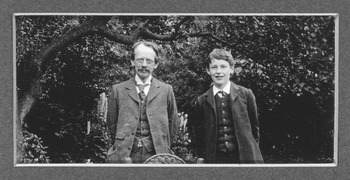
J.J. and G.P. Thomson, father and son, c.1909 (courtesy of the Science Museum/SSPL).

When he was eight years old, his father was becoming famous for his work on corpuscles (i.e. electrons), and at the age of fourteen he saw him receive the Nobel Prize for his work on electric discharge. In some autobiographical notes, he would recall the office of his father as the sancta sanctorum of the house, into which he would make ‘semi-legal invasions … in the morning to borrow blue pencils’. In several accounts, J.J. is portrayed as a very absent-minded person.Footnote 17 G.P. adds to this idea, describing him as ‘a much loved but inscrutable Jove, mostly in the Olympian clouds of his own thoughts’Footnote 18 – distant, but not totally oblivious to his only son's needs. G.P. was passionate about making model sailing ships, a hobby that he kept all his life,Footnote 19 and this may have helped in his decision to develop a career in physics. The following anecdote is illustrative of the possible early influence his father had on his decision to become a physicist. The first models did not quite work:
My mother, when consulted, spoke about centres of gravity as applied to tables and carts, but this was clearly different, so I took the case to the highest court, my father. He explained roughly how a ship differed from a cart for this purpose and said the stability could be calculated by mathematics and that this was done for real ships. I was much impressed, gave up the idea of a career in archaeology which had attracted me up till then and decided that mathematics and ships should be my future.Footnote 20
G.P. was given permission to get wood and materials from the Cavendish. The head mechanic of the laboratory, W.G. Pye, provided him with everything he needed and helped him in the construction of some of the biggest models. We can therefore imagine the young Thomson playing in the same laboratory where J.J. was working on cathode rays, C.T.R. Wilson was improving his cloud chamber, Rutherford was undertaking his first experimental work on X-rays, and Richard Tetley Glazebrook was giving his last lectures in physics before resigning as assistant director of the Cavendish. All these people would later become his referees in his application for the chair in Aberdeen.
In the Perse School, G.P. was taught classics, mathematics and sciences by teachers who were mostly former graduates of the University of Cambridge. This is important since, as Andrew Warwick shows in Masters of Theory, the particular way maths and physics were taught in the Cambridge Mathematical Tripos was spread to most public schools in Britain by way of high wranglers becoming schoolmasters. ‘The success of the wrangler schoolmaster in reproducing the coaching system in schools and colleges throughout Britain is evident in the escalating levels of technical competence expected of Cambridge freshmen’, writes Warwick; ‘wrangler masters also knew from firsthand experience how hard, for how long, and in what manner students needed to study in order to tackle difficult problems with the speed and confidence that would win them a Minor Scholarship to the university’.Footnote 21
However, G.P. Thomson had a very special pre-university education. Concerned that the Perse School might not be giving enough scientific training, his father arranged for him to receive private mathematical coaching by H.W. Turnbull (second wrangler in 1907), and to attend the brilliant lectures on introductory physics given by Alex Wood at the Cavendish. J.J. was happy with his son's choice of academic career in science, and he was determined to help him pursue it: when the master of the Perse School suggested that G.P. was suitable for a career in classics, J.J. dismissed the suggestion and kept encouraging his son to go into science, and to do it following in his footsteps. His advice was that G.P. should stick to the same path he himself had trodden in his youth – to study for the Mathematical Tripos and only later to move to experimental physics. ‘He maintained that mathematics was a very important thing and you would learn physics somehow, roughly speaking.’Footnote 22 J.J. kept this opinion throughout his life. In his memoirs we can read, ‘I am glad that I came under the older system, for I probably read much more mathematics than I should have done if I had taken my degree a few years later. I have found this of great value (c'est le premier pas qui coÛte).’Footnote 23
All these details help us understand the upbringing of someone who, at the time of becoming an undergraduate in the Cambridge Mathematical Tripos in 1910, had already deeply engraved in his soul the particular ethos of this institution. As a result of his previous training, G.P. managed to take the examinations for the Mathematical Tripos after two years, in the spring of 1912, when, at that time, most people took three years to finish the Tripos. Since a Cambridge degree was only conferred after three years in residence, G.P. sat in on many lectures in experimental physics, including those given by his father, and sat the exam for Part II of the Natural Sciences Tripos in the spring of 1913. Therefore G.P.'s academic training included an unusual combination of advanced and fundamental mathematics together with a sound knowledge of experimental physics. This aspect is emphasized by almost all the referees in their testimonials to support G.P.'s application to the Aberdeen chair.
The teaching of physics in Cambridge in the early 1910s was still centred on the nature and properties of electricity and its interaction with matter. The world of Cambridge was, as most of the physics world of the time, still a world of ether. The two major professors of physics, J.J. Thomson and Joseph Larmor, had developed parallel theories in which the ether was one of the central entities. Larmor's book Aether and Matter and Thomson's work Conduction of Electricity through Matter were the two major representatives of Cambridge physics.Footnote 24 There was almost nothing of the new quantum physics. ‘I think’, G.P. said later in life, ‘the quantum theory in my undergraduate days was something which was regarded by people with a good deal of reserve.’Footnote 25
The early formulation of quantum physics and early quantum mechanics is a story that almost completely skips Cambridge and, broadly speaking, the whole of British physics. The success of Maxwellian physics, the power of Cambridge mathematics and the mechanical world view created an atmosphere that regarded the new developments of early twentieth-century physics as only an intermediate step towards a more physical (that is to say, mechanical), explanation of the new phenomena. Warwick has analysed in great detail the early understanding of Einstein's special theory of relativity in Cambridge.Footnote 26 This reception was mediated by the particular theoretical tools and pedagogical methods created and transmitted in the Cambridge Mathematical Tripos.Footnote 27 That local culture created an army of mathematicians and physicists convinced that all physical problems could and should be solved with the application of analytical mathematical methods to mechanical and dynamical models.
In the case of Planck's theory, we can look at the reaction of J.J. Thomson, which was characteristic of Cambridge physics in the early 1910s.Footnote 28 The history of the understanding of light and the new X-ray and γ-ray radiations is the history of the tension between corpuscular and wave explanations of radiation or, in an expression of J.J., the history of the battle between ‘the tiger and the shark’.Footnote 29 As the work of Bruce Wheaton thoroughly described, in the first two decades of the twentieth century there was a permanent and very complex tension between the discrete and the continuous understanding of light and radiation.Footnote 30 J.J.'s approach was characteristic of Cambridge physics in that, broadly speaking, he accepted the experimental evidence in favour of the discreteness of energy while, at the same time, maintaining the continuous metaphysics of the ether. This task was, of course, no easy business. To do so, he made use, as he had in his research since 1891, of the notion of Faraday's tubes of force.Footnote 31
As heir to Maxwell's legacy, but also embedded in the Newtonian tradition, J.J. felt the need to explain better the nature of light. On the one hand, Hertz's experiments seemed to prove the reality of electromagnetic waves and, therefore, the continuous nature of light; on the other hand, the discovery of X-rays, the corpuscle and radioactivity all seemed to point towards discreteness in the electromagnetic field. In an attempt to join both tendencies, J.J. relied on the reality and the properties of the Faraday tubes. In his view, the electromagnetic interaction between bodies was transmitted through Faraday tubes, ‘bundles of vortex filaments, the axis of rotation being parallel to the axis of the tube’.Footnote 32 Although these tubes were, from a mathematical point of view, infinitely divisible, the fact that they were real physical entities posed a limit to their divisibility. Therefore impulses through the Faraday tubes could be thought to consist of discrete impulses, similar in magnitude to the ones Planck was obtaining from a totally different perspective.
Thomson's first theory of light was explicitly described in his 1903 Silliman Lectures at Yale University and, at that time, he felt that there was no need to react against Planck's theory, which he thought to be very hazy in its foundations.Footnote 33 But in a decade things had changed; evidence for discreteness in the propagation of radiation was growing, especially with the photoelectric effect, and the number of people inclined to accept some metaphysical discreteness in nature increased. In this state of affairs, J.J. made his first statement against the new emerging quantum physics in his presidential address to the British Association for the Advancement of Science in Winnipeg in 1909.Footnote 34 From J.J.'s point of view the problem with Planck's quantification was not the mathematical result but the discrete metaphysics it implied. That is why he was trying to obtain Planck's quantification from well-established Newtonian and Maxwellian principles.Footnote 35
His opposition to quantum physics increased at the same pace that it was accepted. As Russell McCormmach put it,
throughout his long argument with the quantum theory, Thomson's basic position was that energy itself has no coherence, or inherent structure, but rather that the carriers of energy – Faraday tubes, electrons, etc. – are the permanent, indivisible entities … Wherever the new ideas threatened the foundations [of Newtonian principles] he would step in with one or another construction of corpuscles, tubes, ether, and forces.Footnote 36
As we shall see, in the late 1920s J.J. continued this trend and used his son's evidence in favour of the principle of de Broglie to advocate, once again, the usefulness of the Faraday tubes and their power in accounting for quantum phenomena.
In Cambridge, as much as in most British universities, quantum physics and relativity were not formally taught until after the Great War, and even then only in the form of ‘special courses’: Charles Galton Darwin gave a course on spectra and quantum physics, and Arthur Eddington a course on relativity. Darwin was, together with Ralph Fowler, one of the first to introduce the new quantum physics in Cambridge.Footnote 37 Darwin became very critical of ‘the deficiencies of the syllabus [in Cambridge] which was disconnected from the subjects then coming into importance’.Footnote 38 After graduating in Cambridge, he moved to Manchester, where he met Niels Bohr in the crucial years of the development of his atomic model. This was his first real contact with the new physics and, after the war, when he returned to Cambridge as fellow of Christ's College, he started to do some work related to quantum physics. Fowler's engagement with the new science was more independent than Darwin's. It was during the war, after being wounded in Gallipoli, that Fowler could study quantum physics from German scientific journals. Both Darwin and Fowler were Cambridge contemporaries of G.P. As we shall see, G.P. relied on them to become acquainted with the new quantum mechanics in the late 1920s. Thus, during his formative years, quantum principles were rarely mentioned at home or in the university, and when they were, it was with a certain dose of suspicion.
Work on positive rays
In the summer of 1913, G.P. Thomson was graduated and decided to start research work at the Cavendish, after being offered a research fellowship in Corpus Christi. Certainly, his last year as a student of Part II in the Natural Sciences Tripos had put him in contact with the basic experimental tools and skills. Wanting to pursue a scientific career, he needed to find a place and a topic to develop his own research. His decision can be seen as slightly conservative: to stay in the family, in the Cavendish, with his father as supervisor.
When it was founded, in the early 1870s, the Cavendish Laboratory had originally been intended mainly as a teaching laboratory, not as a research institution. Only in the 1890s had the research tradition taken off, especially with the opening of the laboratory to young scientists with degrees from universities other than Cambridge. J.J. Thomson's charisma became a pole of attraction, and researchers from the British colonies filled the rooms of the laboratory with top-class research projects. The leadership of J.J. in the Cavendish School at the beginning of the twentieth century was based on his experience, his broad range of interests, his creativity and also his gentleness. Researchers at the Cavendish ‘considered him a preacher of new ideas and a trusted advisor, and many of them frequently consulted his books and papers as major references’.Footnote 39 Thus the number of full-time researchers in the Cavendish kept increasing year after year in the first decade of the century.
A significant aspect of the evolution in the Cavendish between 1900 and 1910 was the progressive establishment of groups working on related topics. If research at the Cavendish had been quite individualistic at the founding of this institution, the increasing number of good researchers triggered the spontaneous emergence of subgroups in the laboratory. J.J. neither organized nor controlled these groups; rather, they were natural spin-offs from his work, his ideas and his suggestions.Footnote 40 These subgroups concentrated on topics such as radioactivity, thermionics, ionization, X-rays and γ-rays, condensation nuclei, and positive rays. The latter was his personal project.Footnote 41
If the pursuit of mechanical and dynamical models based on a metaphysics of the continuum was the main characteristic of J.J.'s theoretical physics, one could say that his experimental science had always had, in one way or another, some relationship with phenomena in tubes filled with gases. This was the project that, in the long run, led him to the formulation of the corpuscle hypothesis in 1897 and, since 1906, had evolved into a research programme on positive rays. In that year, Thomson had come to realize that the number of corpuscles in the atom was of the same order of magnitude as the atomic weight, which proved that the bulk of the matter of an atom could not be due to the mass of its corpuscles. If that was the case, J.J. felt the urgency to understand better what positive electrification was and, perhaps, to find the ‘corpuscles’ of positive electricity. His early experimental results, although quite uncertain, were promising: Thomson thought he was on the right track to prove that H+ ions were universal constituents of matter, similar to the negative corpuscles. But, in 1910, suggestions by his new research assistant F.W. Aston made him restructure the experimental setting and realize that he was actually obtaining positive ions of all atomic numbers. Far from dropping his interest in positive rays, he redefined the reasons for his interest in the project. In the 1910s, Thomson's project on positive rays aimed at creating a technique of chemical analysis, a project that eventually led Aston to the construction of the mass spectrometer and the discovery of isotopes.Footnote 42
At this point, G.P. Thomson trusted his career, as he had done earlier in life, to his father's advice and guidance. This choice, although not unusual, and certainly not a bad one, deserves some reflection. In 1913, the Cavendish was no longer the only vibrant place for physics in Britain as it had been ten years earlier. According to Dong-Won Kim, one proof of that is that while in the early 1900s the Cavendish was virtually the only destination for 1851 Exhibition Scholars, in the early 1910s an increasing number of them decided to move to other British research centres.Footnote 43 New laboratories, such as at Manchester and Leeds, had taken off, with research programmes more on the cutting edge of science.Footnote 44 Perhaps the best-known example of disappointment with the Cavendish was Niels Bohr. Full of energy and with his recent PhD dissertation on a theory of electrons, Bohr was eager to meet Thomson as the father figure of the electron, only to find a person doing experiments in the same old way that fifteen years earlier had led him to the formulation of the corpuscle hypothesis, and quite reluctant to introduce conceptual changes into his world view. Bohr decided to move to Manchester, where he eventually developed his quantum model of the atom.
If those from outside Cambridge were starting to look also to other possible destinations for research, some Cambridge graduates were doing the same. C.G. Darwin, a lifelong friend of G.P. Thomson and, like him, born and raised in that provincial town, decided to move to Manchester, aware of the subtle, but increasing, limitations of the Cavendish.Footnote 45 As another example, William Bragg, who had graduated in 1912 and started his own X-ray research project, considered the laboratory a ‘sad place’.Footnote 46 With this, I want to illustrate that the Cavendish was certainly not the only possible exciting destination for a Cambridge graduate of G.P.'s generation, by which we may want to infer that he considered it a positive thing to stay intellectually close to his father.
In 1914, G.P. was, like most young British scientists, enlisted as an ordinary soldier. After a few months in France he was sent back to England, to work as a scientist for the Royal Air Force in problems concerned with aerodynamics and the building of aeroplanes. This provided him with the possibility to develop that aspect of physics that had, as a child, triggered his interest in science, as well as removing him from the theoretical world of Cambridge and the research projects of the Cavendish. The thorough knowledge of aerodynamics he acquired during the war materialized in a book on the topic in 1919.Footnote 47
As the war was coming to an end, J.J. agreed to resign from his position and Rutherford was appointed new director of the Cavendish, bringing with him the school of radioactive research he had built in Manchester. In spite of all these changes, when the war ended G.P. decided to continue the research project on positive rays with his father. Later in life G.P. justified this move, saying that ‘the positive ray … was a very big thing in the Cavendish’.Footnote 48 It was certainly a ‘big thing’ for his father, who in 1913 had put together in the form of a book all his researches on positive rays and was then, in 1920, preparing a second highly revised edition.Footnote 49 And it was a ‘big thing’ in the mind of Aston, who, while also working on the construction of aeroplanes in Farnborough during the war, was struggling to understand his experimental results in terms of isotopes,Footnote 50 an interpretation totally different to the one J.J. was giving.Footnote 51 Where Aston finally saw the existence of the isotope 22Ne, J.J. only saw a new ion of the form NeH2+. A quick survey of the publications in scientific journals in the 1910s and 1920s, however, disproves G.P.'s statement on the scope of positive-ray research. Only a handful of papers on the topic can be found from other scientists.Footnote 52
In J.J.'s mind, Aston's developments were only ‘the beginning of a harvest of results which will elucidate the process of chemical combination, and thus bridge over the most serious gap which at present exists between Physics and Chemistry’.Footnote 53 He was determined to use research on positive rays as an alternative method to study the composition and structure of the atoms by analysing the proportion and behaviour of positively charged ions. The charge of these, acquired by losing a certain number of electrons, would give information about the most likely arrangement of corpuscles in the atom. And G.P. eventually became his main support in this project. It was on the field of positive rays that G.P. centred his research and published his first experimental papers after the Great War.Footnote 54
Professor in Aberdeen
On 13 June 1922, the professor of natural philosophy at the University of Aberdeen, Charles Niven, resigned, vacating the chair that James Clerk Maxwell had also occupied some decades earlier. Niven formed, together with his elder brother William and Horace Lamb, what Warwick called ‘the first generation of Cambridge Maxwellians’.Footnote 55 Graduating as the senior wrangler in the Cambridge Mathematical Tripos in 1867, C. Niven had made important early contributions to the understanding of Maxwell's Treatise. But by 1922 it had been a long time since he had done any relevant scientific research and his resignation was awaited with anticipation.
G.P. Thomson was appointed professor on 5 September 1922, and was granted the sum of £1,600 to equip the totally out-of-date laboratory with new instruments. With the appointment and the money for research, it appeared only natural to him to continue the research he had been doing in Cambridge, the result of which was that he actually turned his research laboratory into a virtual extension of his father's basement room at the old Cavendish. He bought the tubes and the vacuum pumps needed, and reproduced in Aberdeen his father's experimental set-up in order to continue research on positive rays. G.P.'s laboratory notes show, however, that this transfer of skills from Cambridge to Aberdeen was no straightforward business. Maintaining a steady high vacuum proved to be more difficult than expected, his teaching and administrative duties were time-consuming, and the lack of research students to help with the practicalities of research was a clear limitation.Footnote 56 With these contingencies, he managed to publish his first experimental results only in 1926, four years after moving to his new position.Footnote 57
The Cavendish connection, as it were, had not disappeared with his transfer to Aberdeen. G.P. was more often than not going down to Cambridge to discuss ideas and, during the summer vacation, even to perform some experiments in the Cavendish Laboratory. For instance, in a paper of 1926 he acknowledges advice and help received from C.D. Ellis and Mr Wooster ‘for their kindness in helping me to use the microphotometer in the Cavendish Laboratory … and to Sir Ernest Rutherford for permission to use it’.Footnote 58 Another element we have to support this Cavendish connection is the letters from his wife Kathleen, which help us trace his relatively frequent trips to Cambridge.Footnote 59 A third source is his presentations at the Kapitza Club.Footnote 60
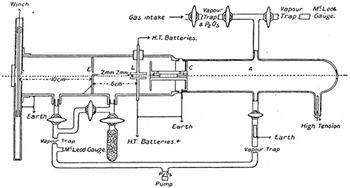
A glance, however quick, at the major features of G.P.'s initial experimental set-up is essential in order to understand the events of 1926–1928. Figure 2 shows the schematic representation of G.P.'s experiments. A cathode ray tube on the right with the cathode perforated is the source of positive rays. These are introduced into the tube on the left, where they can be deflected by the electric and magnetic field, scattered by other gases, or made to interfere with matter in some other way. A photographic plate on the extreme left of the tube records the impact of the positive rays after their interaction with fields or matter. The experiments he had started in 1920 in the Cavendish, and which he was continuing in Aberdeen, consisted of a study of the scattering of these positive rays by different elements and molecules. G.P. and J.J. supposed this to be a valid way to study the binding force between atoms in molecules. However, even the only two papers he managed to produce on this topic while in Aberdeen show major uncertainties as to the validity of the experimental results and their analysis. One of the major issues was the impossibility of discriminating between atomic and molecular positive rays in the incident beam. Furthermore, the charge of the positive rays was not necessarily constant as they made their way through the scattering chamber, since they could easily gain and lose electrons. Last, but not least, G.P. was working and analysing his results on the Newtonian assumption that the scattering between atoms and molecules was ruled by an inverse square law, as with macroscopic bodies, an assumption that did not fit his experimental results at all.
Experimental setting for the experiments on positive rays. A cathode ray tube (right) sets the positive ions of the gas in motion. These ions are deflected in L and photographed in F. G.P. Thomson, ‘The spectrum of hydrogen positive rays’, Philosophical Magazine (1920) Ser. 6, 40, p. 241 (courtesy of Taylor and Francis, Ltd).

While he was working with valves, sealing glass tubes, and pursuing the fine-tuning of the vacuum pump, G.P. was also trying to keep up to date with theoretical developments in physics. The episode that is important for this story is that he was well aware of de Broglie's principle, recently translated into English probably by Fowler.Footnote 61 In that paper, de Broglie presented the results of his recent PhD dissertation, from which he was ‘inclined to admit that any moving body may be accompanied by a wave and that it is impossible to disjoin motion of body and propagation of wave’.Footnote 62 This suggestion is what soon came to be understood as the principle of wave–particle duality, and which Schrödinger eventually turned into a full formulation of a wave quantum mechanics.Footnote 63
De Broglie's English paper was entitled ‘A tentative theory of light quanta’, a title which had very strong resonances in the Thomson family. As seen above, the nature of light and the other radiations had been a topic of heated debates for the past twenty years, a debate in which J.J. had been one of the main actors. Actually, in the same year (1924), J.J. Thomson was working on his latest attempt to explain the photoelectric effect and the nature of light within his metaphysical framework in which the ether, and the Faraday tubes in it, were an essential element. His suggestion constitutes a very good example of the dynamical models that, as a former Cambridge wrangler, constituted one of his basic tools for reasoning.Footnote 64
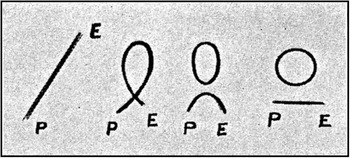
Far from denying the experimental evidence for the quantum of light, J.J. stressed that this quantification was only the result of a process in the continuous medium. Figures 3 and 4 show very graphically the process of photon emission and absorption, respectively, in the simple case of a hydrogen atom. Assuming, as he did, that the proton (P) and electron (E) in the atom interacted by means of a Faraday tube connecting them, one could imagine what happened to the tube when an electron ‘jumped’ from an orbit of high energy to one of lesser energy. The Faraday tube would first bend and then form a loop that would detach from the original tube: this would constitute the emission of a photon. Similarly, a quantum of radiation in the form of a closed loop of Faraday tube could be absorbed by the tube uniting a proton and electron, providing the energy for the electron to jump to a higher energy state.Footnote 65
A Faraday tube between the electron and the proton bends and forms a photon. J.J. Thomson, The Structure of Light: The Fison Memorial Lecture (1925), p. 24 (courtesy of Cambridge University Press).

A photon is absorbed by a Faraday tube between the electron and the proton. J.J. Thomson, The Structure of Light: The Fison Memorial Lecture (1925), p. 27 (courtesy of Cambridge University Press).

This theory could be relegated to a cabinet of intellectual curiosities, were it not for the impact it had on his son. The paper by de Broglie was an attempt to design a new theory of light, as much as J.J.'s was. Both were published in the same year and G.P. tried to unite them in a paper in the Philosophical Magazine. In retrospect, G.P. would regret publishing this paper, calling it ‘an example of a thoroughly bad theoretical paper’,Footnote 66 even though it was proof, in his reconstructions of history, that he had paid attention to de Broglie's theory as soon as it was published in the British milieu: ‘I think in retrospect I was in advance of my time, I think I paid more attention to de Broglie than probably anybody else in this country on the whole. Some people thought it was just nonsense.’Footnote 67
There are two points to emphasize here. First, G.P. was among the first British physicists to pay serious attention to de Broglie's theory. Second, he understood it as a theory of light and electronic orbits, not as a theory of electron diffraction or even as a theory of free electrons.Footnote 68 Although there were not many, a few scientists, including de Broglie and Einstein, as well as M. Born, J. Frank and W. Elsasser in Göttingen and, possibly, also C.D. Ellis in Cambridge, were, by 1925, already thinking about de Broglie's in terms of electron diffraction.Footnote 69 As we shall see, the idea of having electron diffraction as an experimental application of de Broglie's theory came to G.P. Thomson only some time in the summer of 1926, not in 1924.
The title of his 1925 paper is ‘A physical interpretation of Bohr's stationary states’, and in it he tries to explain de Broglie's radical hypothesis in continuity with J.J.'s metaphysical framework. If the trajectories of electrons were understood in terms of waves, only those orbits in which the path is a multiple of the wavelength can be stable orbits around the nucleus, a suggestion that was totally in tune with Bohr's quantification. G.P.'s suggestion was that these stationary states could be equally achieved following his father's 1924 atomic model explained above. If proton and electron were united by a Faraday tube of force, ‘it will thus be able to transmit waves, and the condition that will be taken as determining the possible states is that the vibrations in this tube shall be in tune with the period of the orbit’.Footnote 70 Thus the physical properties of the Faraday tube uniting the electron with the nucleus would determine the waves accompanying the movement of the electron and, therefore, the possible orbits in an atom.Footnote 71
This example shows once again the son's intellectual continuity with his father's ideas. Tubes of force were very much a Thomson working tool, and G.P. was preserving the tradition. We can see this not only in the 1925 paper but also in the notes for his lectures in Aberdeen of 1923. The lectures on electricity to the Senior Honours Class contain the following definition, which reflects G.P.'s use of Faraday tubes: ‘Defn. Regarded as filling all space. Originally an attempt to interpret the phenomena of electricity as residing in the medium. Now perhaps best regarded as a mathematical dodge but may have physical reality in a modified form.’Footnote 72 It is worth noting that G.P.'s attachment to this concept played a paradoxical role. While they were an increasingly problematic and out-of-fashion theoretical tool, it was his attachment to Faraday tubes that predisposed him to pay particular attention to de Broglie's work well before most British physicists did. At the same time, as the last sentence on his lecture notes suggests, tubes of force were, for G.P., a heuristic tool with perhaps less metaphysical reality than they had for his father. The science of the son, while highly dependent on that of the father, was not a simple reproduction of it, but an evolution from it. And this continuity could be better done in Aberdeen, where G.P. Thomson virtually extended the dominions of the old J.J.'s physics into a new environment. Experimentally, the devices he developed in his new laboratory turned it almost into a mere extension of his father's rooms in the Cavendish. Intellectually, no one in Aberdeen was going to react against this physics as the young generation of ‘modernists with a vengeance’ did in Cambridge.Footnote 73
Electron diffraction
‘By 1926 I was feeling depressed by having failed to produce anything of real note. In fact, positive rays, as distinct from the study of isotopes, were nearly worked out, at least for the time.’Footnote 74 Looking at his laboratory notebooks, however, no hint of G.P.'s disappointment is evident: in the first half of the year he keeps accumulating data and changing the experimental conditions in his work on positive rays. The last entry before the summer break is from 23 June, in which he is testing the scattering of positive rays in argon; the next entry, on 23 August, clearly signals a shift of research project: ‘Alteration to apparatus. A slip of gold leaf mounted on brass carrier+partly covering aperture in camera.’Footnote 75 His quest for electron diffraction had started.
The different autobiographical notes by G.P. on the events leading up to his measurement of electron diffraction are a bit incomplete and not totally consistent with each other in some details.Footnote 76 They all coincide, however, as does all the other evidence, in assigning a central role to the month of August 1926, both in Oxford and in Cambridge. From 4 to 11 August, the British Association for the Advancement of Science held its annual meeting in Oxford, and it turned out to be the forum in which many British and American physicists learnt about the latest developments in wave quantum mechanics. During the spring of that year Erwin Schrödinger, based on de Broglie's ideas, had reinterpreted wave mechanics from a quantum perspective. Max Born, present at the meeting, explained these developments to the participants, and the topic became one of the highlights in the informal discussions at the meeting.Footnote 77
Straight after the Oxford meeting, G.P. stopped over in Cambridge, where he could continue discussions on electron diffraction. In the Cavendish he met E.G. Dymond, who thought he had obtained evidence of electron diffraction with experiments on the scattering of electrons in helium.Footnote 78 The case is that be it in conversations in Oxford or in Cambridge,Footnote 79 G.P. saw – or was led to understand – that his experimental device in Aberdeen was almost all that was needed to try electron diffraction through solids. Actually, the role played by Dymond's results, later to be proved erroneous, is one of the unclear episodes of this story. In one of the accounts, G.P. said that Dymond's experiments were slightly demoralizing, since the ‘only’ thing left for him was to obtain evidence for the same phenomenon in solids: ‘When I returned to Aberdeen I thought, “Well, it has apparently been done with a gas, but let's try it on solids”.’Footnote 80 In other accounts, however, G.P. emphasizes that it was the uncertainty of Dymond's results that encouraged him to attempt electron diffraction through solids.Footnote 81 The first experiments, actually performed by his research student Andrew Reid, tried to obtain pictures of diffraction through films of celluloid. The results, although encouraging, were certainly not conclusive. They were, however, published in a note in Nature in June 1927,Footnote 82 and put in relationship with and as a confirmation of Dymond's earlier results.
After the unfortunate death of Reid in a motorcycle accident, G.P. Thomson continued the experiments on his own, no longer with celluloid, but with thin films of gold, aluminium and other metals, with which he obtained better and more definitive pictures of electron diffraction. These results were published in a note in Nature in December 1927, followed by a full account of his work in several articles in the Proceedings of the Royal Society between 1928 and 1929.Footnote 83 A quick comparison of the experimental setting he had so far used for his experiments on positive rays (Figure 2) with the one he used in his work of 1926–1927 (Figure 5) clearly shows that few changes were needed for the new measurements. His original display provided positive rays using a cathode ray tube, and now the same tube could be the source of a beam of electrons. The ‘apparatus for studying the scattering of positive rays … could be used for this experiment with little more change than reversing the current in the gaseous discharge which formed the rays’.Footnote 84 The rest of the arrangement only varied in the fact that instead of scattering the electrons in a gas, he would attempt their diffractive dispersion through a thin metallic plate. The latter was, in a way, the only real experimental change, one in which he depended on the good skills of his assistant, C.G. Frazer, who succeeded in obtaining the extremely thin metallic films that were needed.
Experimental device used by G.P. Thomson in his observations of electron diffraction. A cathode ray tube (right) sends electrons to be photographed on E after being diffracted in C. G.P. Thomson, ‘Experiments on the diffraction of cathode rays’, Proceedings of the Royal Society, Ser. A, 117, 778 (1 February 1928), p. 602 (courtesy of the Royal Society).

A detailed account of the technicalities of G.P.'s experiments would be the topic for another paper. But one element needs to be highlighted here: the close connection between his experiments and the long tradition in research on X-ray diffraction, to which G.P. was certainly no stranger. After the discovery of X-ray diffraction by Planck's protégé, Max von Laue, in Munich in 1912, G.P.'s lifelong friend Lawrence Bragg had modified his own father's research project on X-rays and understood that X-ray diffraction could be used as a tool to determine the crystalline structure of metals. This other father–son story culminated in the shared Nobel Prize that both Braggs received in 1915 and, most importantly, consolidated the emergence of the new science of X-ray crystallography in Britain.Footnote 85 G.P. certainly followed closely these developments due to his friendship with the young Bragg, with whom he spent summer holidays in his boat, the Fortuna.Footnote 86 His other lifelong friend, C.G. Darwin, was responsible for the formulation of the most successful theory of X-ray diffraction between 1913 and 1922.Footnote 87
There were quite a few similarities between G.P.'s experiments and X-ray diffraction, since the energy of the waves de Broglie was talking about was of the same order as that of hard X-rays. The only great difference between X-rays and the waves of cathode rays was that the latter could be deflected with electric and magnetic fields due to their electric charge, a difference that proved essential in order to make sure that the diffracted patterns were not due to secondary X-rays but to the cathode rays.Footnote 88 Again, this was a feature that the experimental arrangement for G.P.'s project on positive rays already included: like the experiment that had led to the hypothesis of the corpuscle in 1897, the Thomsons' study on positive rays involved their deflection by electric and magnetic fields in the glass tube.
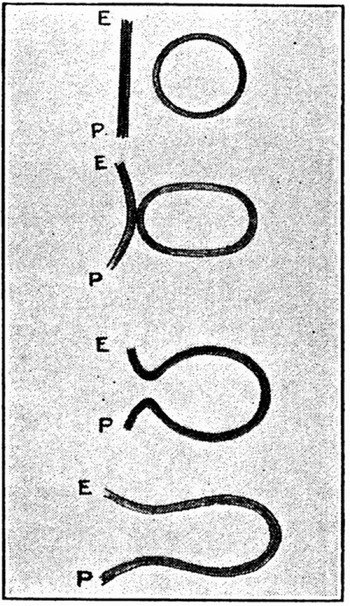
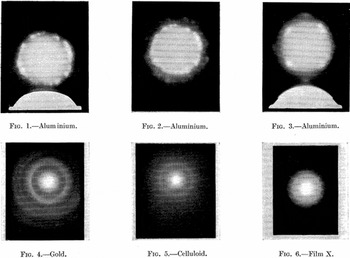
The pictures G.P. obtained were powerful enough to convince his audience (Figure 6). The circular halos were widely recognized as the Hull-Debye-Scherrer patterns of diffraction, already known for X-rays. Therefore, if those pictures were really obtained from dispersed cathode rays, there was no other way out but to accept that the electrons behaved like waves: ‘The detailed agreement shown in these experiments with the de Broglie theory must, I think, be regarded as strong evidence in its favour.’Footnote 89
First patterns of electron diffraction obtained by G.P. Thomson. G.P. Thomson, ‘Experiments on the diffraction of cathode rays’, Proceedings of the Royal Society, Ser. A, 117, 778 (1 February 1928), plate 19, facing p. 604 (courtesy of the Royal Society).

If the period between the summer of 1926 and the spring of 1928 required only a few changes in the experimental culture of G.P. Thomson, there is more to be said about the impact that his experimental results had on the theoretical foundations of his physics. The photographs were, for him, a clear demonstration that the electrons behaved like waves, and solid evidence of the validity of de Broglie's principle, a principle that involved a serious reconsideration of the nature of waves and particles. In his November 1927 paper, we can read that his results involved ‘accepting the view that ordinary Newtonian mechanics (including the relativity modifications) are only a first approximation to the truth, bearing the same relation to the complete theory that geometrical optics does to the wave theory’.Footnote 90 This and other similar sentences appear to be suggesting a first abandonment of the classical mechanics he had thus far been immersed in, and it immediately raises the question of what it was that G.P. was understanding and accepting about the latest developments in quantum physics.
Besides the impetus that the BAAS Oxford meeting of 1926 meant for a significant number of British physicists, G.P. benefited, once again, from his close friendship with C.G. Darwin, who since 1924 had been the Tait Professor of Natural Philosophy in Edinburgh, and spent the spring of 1927 in Copenhagen, where he could discuss the latest developments in quantum mechanics with Bohr, Heisenberg and Schrödinger, among others. On his way back, Darwin spent some time in Aberdeen, in G.P.'s home. This way, G.P. learnt the new wave mechanics from Darwin's explanations: ‘we had long talks about all this, and really began to get an idea about it’.Footnote 91 The timing was just right. As G.P. was seeing with his own eyes the diffraction patterns of cathode rays, he understood them in light of Darwin's explanations. There were obvious reasons, on G.P.'s side, to think that Darwin was possibly the British physicist best suited for understanding them at the moment. In his biographical memoir on Darwin, G.P. said that ‘I am inclined to think that his most useful work was as an interpreter of the new quantum theory to experimental physicists … I should like to record my great debt to him for the many ideas in physics he helped me to understand.’Footnote 92
In the last section I will explore the impact that the experiments on electron diffraction had on G.P.'s theoretical framework, looking at his early explanations of the phenomena, and also at the relationship between his and Darwin's explanations. However, let us pause for a moment before that and look at the reaction of his father, J.J., in the face of the inescapable experimental evidence.
The father's interpretation
The father saw, in the experiments of his son, the final proof of his lifelong metaphysical project and a clear sign of the invalidity of quantum physics as an ultimate explanation. His world had always been, and still was, a world of ether, in which discrete entities, including the electrons, were but epiphenomena in the ether.Footnote 93 Now, in 1928, J.J. Thomson felt his metaphysical idea had proved true and that electron diffraction was a sign that discrete models of matter were only rough approximations to reality. In his mind, the ‘very interesting theory of wave dynamics put forward by L. de Broglie’, and experimentally demonstrated by his son, was not in contradiction with classical mechanics. In the first of a series of papers he would publish in the Philosophical Magazine, J.J. tried to show that
the waves are also a consequence of classical dynamics if that be combined with the view that an electric charge is not to be regarded as a point without structure, but as an assemblage of lines of force starting from the charge and stretching out into space.Footnote 94
Thomson had never accepted the idea put forward by Larmor and Lorentz at the turn of the century of an electron being a point charge of electricity in the ether. Now, the detection of a train of waves associated with the movement of electrons was, for him, proof that he had been right: Maxwell's equations had not predicted such a wave for a point electron, and therefore such a view of the electron had to be wrong. On the other hand, de Broglie's wave could be obtained on purely classical grounds if he assumed the electron to be a two-part system: a ‘nucleus which … is a charge e of negative electricity concentrated in a small sphere’,Footnote 95 and a sphere surrounding it ‘made up of parts which can be set in motion by electric forces … consist[ing] either of a distribution of discrete lines of force, or of a number of positively- and negatively-electrified particles distributed through the sphere of the electron’.Footnote 96 With this ad hoc structure J.J. deduced the relationship between the speed of an electron and the wavelength of its sphere to be the same as that expected by de Broglie and measured by G.P.
In a conference given in Girton College, Cambridge, in March 1928 entitled ‘Beyond the electron’, J.J. argued that talking about a structure for the electron was not ludicrous. Thirty years earlier, when he first suggested that corpuscles would be constituents of all atoms, thus initiating the exploration of the structure of the atom, he had been accused of being an alchemist. Developments in the physics of the electron had dismissed that accusation. Now he felt justified to talk about the structure of the electron in the light of the latest developments by his son. ‘Is not going beyond the electron really going too far, ought one not draw the line somewhere?’, he would ask rhetorically. To which he would reply,
It is the charm of Physics that there are no hard and fast boundaries, that each discovery is not a terminus but an avenue leading to country as yet unexplored, and that however long the science may exist there will still be an abundance of unsolved problems and no danger of unemployment for physicists.Footnote 97
The diffraction experiments showed that ‘we have energy located at the electron itself, but moving along with it and guiding it, we have also a system of waves’.Footnote 98 Following the similarities with his structure of light of 1924, he supposed that the electron ‘had a dual structure, one part of this structure, that where the energy is located, being built up with a number of lines of electric force, while the other part is a train of waves in resonance with the electron and which determine the path along which it travels’.Footnote 99 For him, the association of a wave with an electron was not a new phenomenon. It had already happened when, in the late eighteenth century, the corpuscles of light that Newton had postulated needed to be complemented by wave explanations. It was not so strange to see that the new corpuscles, the electrons, had to undergo a similar process. Furthermore, discussions on the nature of light in the previous two decades had paved the way for the acceptance of the duality of the electron.
In the world of J.J., electron diffraction brought with it the possibility of challenging, rather than accepting, the new quantum physics. A continuous metaphysics in which all phenomena and entities could be seen as structures of the ether was, in his view, still possible. Furthermore, J.J. felt that at last electron diffraction provided the final argument to defend the old world view, something that the developments of the previous two decades had, only apparently, jeopardized. Electron diffraction was proof of the complexity of the electron and, therefore, of the validity of classical mechanics. Quantification of magnitudes such as momentum or energy ‘is the result and expression of the structure of the electron; only such motions are possible, or at any rate stable, as are in resonance with the vibrations of the underworld of the electron’.Footnote 100
At the root of his models there was a metaphysical problem as much as an epistemological one. As already stated, J.J.'s metaphysics involved a continuum in terms of which all discrete phenomena could, and should, be explained. Parallel to that was an epistemological problem: for Thomson, de Broglie's theories, as much as Planck's, were valid only from a mathematical point of view. Their results were valid, but they did not entail real, true physics. And that was the strength J.J. saw his theory had over de Broglie's: ‘The coincidences are remarkable because two theories could hardly be more different in their points of view. M. de Broglie's theory is purely analytical in form; the one I have brought before you … is essentially physical.’Footnote 101 It comes to no surprise that, true to the spirit in which he was educated in the old Mathematical Tripos, physical meant mechanical.
In an ironical remark on the situation of physics in previous years, he would state in 1930 that
when the waves are taken into account, the classical theory of dynamics gives the requisite distribution of orbit [of the electrons] in the atom, and as far as these go the properties of the atom are not more inconsistent with classical dynamics than are the properties of organ pipes and violin strings, in which, as in the case of the electron, waves have to be accommodated within a certain distance. It is too much to expect even from classical dynamics that it should give the right result when supplied with the wrong material.Footnote 102
Obviously, the fact that the proof had come in the family was only an added reason to rejoice.Footnote 103 In the decade between these events and his death in 1940, J.J. did not change his mind. The last paper he ever published, sent in October 1938 at age eighty-one, still proclaimed his son's experiments as proof of the validity of the old classical mechanics.Footnote 104
The son's reaction
G.P. made public his first preliminary results in a short note in Nature dated May 1927 and in a presentation at the Kapitza Club, in Cambridge, on 2 August.Footnote 105 In November he was ready to publish a long and detailed paper in the Proceedings of the Royal Society preceded by another short note in Nature.Footnote 106 These papers were basically a cold description of the experimental methods and results from which he extracted what were, for him, two obvious consequences: the results could only be explained if we considered electron beams to suffer diffraction, similar to X-rays, and if this diffraction was consistent with the one predicted by de Broglie. In other words, G.P. Thomson had no doubts that his experiments were a direct proof of the principle of wave–particle duality; but, as for further consequences of this principle, he preferred to be cautious. A quotation from his Friday speech at the Royal Institution of 6 June 1929 describes his approach to what we may call metaphysical speculation in this period of his life. After explaining with full detail the experiments on electron diffraction, he would venture into trying to answer the
great difficulties of interpretation. What are these waves? Are they another name for the electron itself? … Some of these questions I should like very briefly to discuss, but we now leave the sure foothold of experiment for the dangerous but fascinating paths traced by the mathematicians among the quicksands of metaphysics.'Footnote 107
Despite this reluctance, the questions that he often addressed in these metaphysical incursions were two: the reality of the ether, and the ontological status of the electronic wave in relation to the particle.
The best and most exhaustive document we have to understand G.P.'s views at that time is a series of lectures he gave at Cornell University in the last term of 1929, and immediately published in the form of a book, The Wave Mechanics of Free Electrons. Here we find a thorough explanation of the implications of his experiments on the very important question of the existence of the ether. The wavelengths of electron waves and X-rays are in the same range, but they clearly behave differently, for the first can be deflected, and the second cannot. If that is the case, one might need to assume two different media to account for the different behaviour of the two waves, ‘but it is not a very attractive idea to have two ethers filling the space, especially as the waves of protons – if they exist – would demand yet a third. Space is becoming overcrowded.’Footnote 108 G.P.'s decision was to apply Ockham's razor, to do away with the ether and stick to the information given by the wave formulation, and ‘perhaps simple physicists may be content as long as the waves do their job guiding the electron, and it is possible that, after all, the question will ultimately be seen to be meaningless’.Footnote 109 In the lecture at the Royal Institution mentioned above, he would state that the ‘easiest way of looking at the whole thing seems to be to regard the waves as an expression of the laws of motion’.Footnote 110 And to give authority to his point of view, he finished his speculations by quoting Newton's famous hypotheses non fingo.
Abandoning the implications of an ether was, however, not straightforward. One of G.P.'s most radical, and short-lived, speculations during these years was his adherence to the possibility that strict energy conservation might have to be abandoned in order to explain beta radioactive decay.Footnote 111 That comes as no surprise since C.G. Darwin had been, since 1919, a strong advocate of this possibility.Footnote 112 Actually, it was following calculations made by Darwin on his way back from Copenhagen that G.P. suggested a mechanism to account for the dispersion of energy. Essentially, G.P. was suggesting that the actual beta emission did conserve energy, only that the huge acceleration suffered by the electron in its ejection from the nucleus involved the creation of an energetic wave, like ‘the sound produced by the firing of an atomic gun whose bullet is the electron’.Footnote 113 Such a wave could be supposed to ‘possess energy when highly concentrated which it loses on spreading out’,Footnote 114 giving rise to an indeterminacy in the energy of the electron. This idea, however, involves some friction of the pulse wave which is an implicit remnant of the role of the ether.Footnote 115 G.P. did not pursue this idea any further, but this instance shows us both that the abandonment of classical concepts was not straightforward, and that his incursion into the quantum physics was very strongly dependent on Darwin's understanding of the new physics.
C.G. Darwin's work in the late 1920s has not received sufficient attention by historians of science.Footnote 116 Here, it suffices to point out those aspects that influenced G.P.'s reception of quantum mechanics, especially the fact that, in Darwin's view, Schrödinger's wave mechanics had some sort of ontological priority over matrix mechanics. It is part of the received view on the developments of quantum physics that, in 1926, the equivalence between wave and matrix mechanics was demonstrated.Footnote 117 However, Darwin's work in these years shows his uneasiness with Heisenberg's methods, since they do not provide true – that is, mechanical – explanations. In several places we find statements like the following:
There are probably readers who will share the present writer's feeling that the methods of non-commutative algebra are harder to follow, and certainly much more difficult to invent, than are operations of types long familiar to analysis. Wherever it is possible to do so, it is surely better to present the theory in a mathematical form that dates from the time of Laplace and Legendre, if only because the details of the calculus have been so much more thoroughly explored.Footnote 118
Furthermore, in what looks like a very clear philosophical positioning, both epistemologically and metaphysically, Darwin argues for the metaphysical reality of the wave function:
We shall … take the wave function ψ as the central feature of the quantum theory … From the practical point of view the great advantage of thinking in terms of ψ is that it forces on our attention the diffractive effects of matter and treats them as a more fundamental property than the ray-like properties which suffice for the description of ordinary events … There is no need to invoke particle-like properties in the unobserved parts of any occurrence, since the wave function ψ will give all the necessary effects.Footnote 119
According to Darwin, matrix mechanics was only an ingenious mathematical method to explain observable results, especially in the field of spectroscopy, but it was not helpful in order to understand what the reality of things was.
Darwin's understanding of quantum physics emphasized the link between a continuous undulatory metaphysics and the discrete quantum manifestations in natural phenomena. The latter were only particular instances of a much richer world, the world of possibilities.Footnote 120 G.P. Thomson's interpretation was, although slightly different, related to Darwin's. He regarded his experiments as some sort of proof of de Broglie's principle, and this meant, for him, that matter could altogether be thought of as essentially continuous. Matter, he said,
is still supposed made of discrete units, but instead of these units moving according to laws which concern them alone, as did the laws of Newtonian dynamics, we have had to introduce laws based on waves. Now a wave is essentially a continuous thing, even if the continuity is only mathematical. It is spread through space, not divided into little lumps. So although the older belief in the discontinuity of matter still holds, it has lost some of its rigidity; continuity has crept in by the back door.Footnote 121
Quantum physics was, in this way, no longer a threat to the continuous conceptions of matter in which he had been bred. Certainly, continuity was no longer dependent on the physical existence of the ether, but the fundamental entities of Nature, electrons and quanta were proving to be also fundamentally continuous.
In this respect, Darwin's influence was instrumental for G.P. to understand the new physics as, in some way, being in continuity with the old. In a very revealing statement, Darwin would emphasize the natural link between both approaches:
We recall that Hamilton worked out very exact analogies between the behaviour of rays of light and particles of matter … But de Broglie pushed the matter to its logical conclusion by saying that if light and matter are refracted in the same way, then they ought to be diffracted in the same way too.Footnote 122
From Darwin's point of view, the new physics in its undulatory formulation was a natural extension of classical physics and could preserve a continuous ontology. This approach enabled G.P. to embrace electron diffraction as a radical experimental result, and electron diffraction as an equally revolutionary principle, without totally undermining his fundamental understanding of physics, both mathematically and metaphysically. Certainly, both Darwin and Thomson could feel at ease with a quantum mechanics that preserved a continuous ontology, as well as a need for visual explanations, since these were fundamental tenets in the way they were trained in physics. As for visual interpretations, an example G.P. often used in his popular lectures is that of the gossamer spider:
When at rest this spider is a minute insect. When it wants to move it sends out streamers into the air, and floats away owing to the action of the air on these filaments which stretch out a foot or more all round it. Just so the electron, when it is part of an atom its waves are limited to that atom, or even to a part of it. They are curled round on themselves, as it were. Suppose, now, an electron escapes from the hot filament of a wireless valve and gets free. Its waves will spread far out into the space round it. I regard it as still a particle at the centre of its wave system. The analogy can be pressed further. If the wind sweeps the spider past an obstacle the filaments will catch. The pull on filaments will move the spider, and he will feel that there is something in the way, even though his body does not actually hit it. In the same way the waves are a means by which the motion of the electron is affected by things which the main body of the electron never comes very near.Footnote 123
This analogy resonates with J.J.'s suggestion of a structure for the electron, and it can also be seen as a pedagogical explanation of Darwin's idea that the wave function describes all the possible movements of the electron. The three approaches are certainly not totally equal, but they are linked by a rejection of an ultimate exclusively discrete – that is, quantum – physics. The three were aware that the diffraction experiments entailed a turning point in physics, but a turning point that allowed for continuous explanations of Nature to regain their legitimacy, against the threat of an excessively discrete quantum physics.
The Aberdeen experience came to an end in 1930, when G.P. was offered the chair at Imperial College London, after his close friend W.L. Bragg had declined the offer. In his new appointment, G.P. made use of his experimental skills to study the minutiae of electron diffraction and some possible applications, soon to move, following the steps of Fermi, to the very promising field of slow neutrons. He soon gave up the possibility of making any serious contribution to the development of quantum physics and remained, mainly, an experimental physicist. Electron diffraction, for which he would become universally known and receive the Nobel Prize in 1937, soon became a closed chapter of his scientific life.
Conclusion
The Thomsons are one example, but certainly not the only one, of a saga of scientists.Footnote 124 In this paper we have come across people from other scientific families: the Braggs, the Darwins, the de Broglies and the Bohrs. It comes as no surprise that growing up in a scientific environment may act as an influence in the scientific career of the youngest members of these families. The J.J.–G.P. relationship is interesting in the way the son's early career appears to be in intellectual continuity with the father's work: the son was neither simply replicating his father's science, nor was he rejecting it. Rather we find continuity between the two generations in a period of time, the 1920s, often associated with revolutions in physics. Actually, one thesis of this paper is that, in the 1920s, G.P.'s small laboratory in Aberdeen evolved as a branch of the Cavendish of the 1910s and, therefore, the experiments on electron diffraction, one of the major experimental breakthroughs of the new quantum physics, were a result – although an unintended one – of one Cavendish culture.Footnote 125 But, as argued in this paper, it was also the influence of the Cambridge Mathematical Tripos milieu, and not only the relationship with his father, which was partly responsible for the way with which G.P. Thomson embraced some ideas of quantum physics.
As argued above, G.P.'s experiments on electron diffraction were, in a way, a spin-off from his and his father's project on positive rays. Similar to what had happened in 1897 when J.J. found the corpuscles only when he shifted his long-lasting experimental project on discharge in gases to cathode rays,Footnote 126 G.P. Thomson observed electron diffraction within an experimental setting initially meant for something else. Furthermore, G.P.'s mindset at the time of his new experiments was still largely classical, not quantum. The partial shift towards the new physics came only afterwards, and this was mediated by the views of his friend, C.G. Darwin, who was also Cambridge-trained. Both Darwin and the younger Thomson saw the new quantum mechanics in continuity, rather than as a rupture, with some mathematical tools of the old physics, as well as with a few metaphysical ideas associated with them.
G.P. Thomson's name eventually became common currency in the history of wave mechanics for his experiments. But he need not have been a convinced quantum physicist to perform them, nor did he become one after the experiments. Electron diffraction was proof that electrons behaved like waves, and it triggered in G.P. a certain conviction that wave mechanics was worth embracing, especially since Darwin's approach allowed for a certain continuity between classical physics and quantum physics in its wave formulation. But, as we have seen, the experiments were not necessarily an experimentum crucis for quantum physics – certainly not for J.J. and his generation, who were, in Kuhnian terms, excessively immersed in the paradigm of ether physics. But neither did it trigger in G.P. a full shift towards quantum mechanics. Electron diffraction was, for him, a demonstration of wave–particle duality, something that could situate his understanding of the new quantum mechanics in continuity, rather than discontinuity, with an ontological and epistemological framework with origins in the pre-First World War Cambridge Mathematical Tripos.