1. Introduction
The parallel manipulator with flexible morphing platform (FMP) is a novel type of parallel mechanism, which utilizes the overall continuous deformation of FMP and the coordinated motion of multiple rigid actuation to achieve controllable deformation of the FMP. To a certain extent, this type of parallel mechanism can be regarded as a special rigid–flexible coupling parallel mechanism, which with rigid chains and flexible morphing moving platform. This type of mechanism can not only change the shape of its morphing platform but also has compliant characteristics and a certain degree of overall stiffness.
Compared with soft mechanism, the combination of rigid chains and FMP ensures this type of parallel mechanism has better stiffness ability and load capacity. Compared with compliant mechanism, this type of parallel mechanism utilizes the overall large continuously deformation of the FMP, rather than the local concentrated deformation of the flexible joints, which can overcome the shortcomings of compliant mechanism, such as small range of movement, large deformation stress, and easy fatigue failure. Compared with traditional rigid parallel mechanism, this type of parallel mechanism can utilize the elastic deformation of the FMP to absorb energy and realize passive compliance when colliding with the external environment. Which will greatly improve the environmental adaptability and robustness of this mechanism.
According to the advantages presented above, this type of parallel mechanism can be used in the following fields: shape control of fluid shape-morphing underwater robots [Reference Garcia, Castillo, Campos and Lozano1, Reference Zhong, Li and Du2], cross-section design of deformable wings [Reference Li, Zhao, Da Ronch, Xiang, Drofelnik, Li, Zhang, Wu, Kintscher, Monner, Rudenko, Guo, Yin, Kirn, Storm and De Breuker3], and environmental interaction and perception of human–machine interaction equipment [Reference Iwata, Yano, Nakaizumi and Kawamura4–Reference Follmer, Leithinger, Olwal, Hogge and Ishii6]. For example, this new type of parallel mechanism can be designed in a closed envelope form, which can be used to design the shape-morphing underwater robots. This controllable morphing surface can optimize its hydrodynamic performance, reduce underwater resistance, and improve the speed and maneuverability of the robot.
In present, the design of mechanism with FMP is mostly based on spherical structures. The concept of quasi-spherical deformable parallel mechanism was first proposed by Chen and Li [Reference Chen, Li and Cathala7]. However, the research on this rigid–flexible coupled mechanism by the international robotics community is still at the proof-of-concept stage. In some literature, relevant research work on mechanism with FMP has been reported. However, most of them are principle demonstration prototypes established based on intuitive experience [Reference Sugiyama and Hirai8–Reference Masuda and Ishikawa10]. These research works only preliminary verify the feasibility of this kind of mechanism and is unable to have practical applications. Lacking of effective design and analysis approach to predict and control the surface deformation of the FMP is an important reason for this situation.
Shape control of the flexible morphing moving platform can be regarded as the inverse kinematics problem of this kind of parallel mechanism. The inverse kinematics problem of the traditional rigid parallel mechanism can be defined as solving the input of each driving joint when the position and orientation of the rigid moving platform is given [Reference Ozgoren11]. However, this new type of parallel mechanism is based on the given target surface shape of the flexible moving platform and solves the input of each drive joint, so that the moving platform deforms to the closest shape of the target surface. Related methods for nonlinear large deformation control of spatially flexible surfaces can be used for reference. Nonlinear large deformation control of spatially flexible surfaces can be divided into two methods: discrete and continuous [Reference Wang, Suo and Chortos12].
For the discrete control method, the discrete surface is composed of a matrix of linear actuators that control the height of each pixel. This concept was first proposed by Hirota [Reference Hirota and Hirose13]. Since then, many prototypes with higher accuracy (more actuators) and more complex applications have been developed, such as FEELEX [Reference Iwata, Yano, Nakaizumi and Kawamura4], Relief [Reference Leithinger and Ishii5], and inFORM [Reference Follmer, Leithinger, Olwal, Hogge and Ishii6]. The actuators used have also evolved from traditional motors to pneumatic linear actuators [Reference Zhu and Book14, Reference Deng, Stommel and Xu15], SMA [Reference Poupyrev, Nashida, Maruyama, Rekimoto and Yamaji16], and DEA [Reference Wang, Zhang, Hong and Wang17].
The continuous control method uses an array of coupled actuators. Coelho et al. proposed the most basic continuous surface, which consists of four SMA actuators forming a square [Reference Coelho, Ishii and Maes18]. Chen et al. proposed a soft robotic surface driven by a pneumatic bending actuator, which can achieve several basic surface shapes [Reference Chen, Yang, Wang, Branson, Dai and Kang19].
In summary, the discrete control method has a simple control algorithm, but the control accuracy depends on the number of actuators. The internal coupling relationship of the continuous control actuator is complex, and the establishment of a control algorithm is difficult. At present, only simple surface control can be achieved. Therefore, there is an urgent need to develop control methods that balance actuator cost and surface control accuracy.
The forward kinematics modeling problem of this kind of parallel mechanism is different from the traditional parallel mechanism modeling approach [Reference Zhou, Chen, Liu and Li20–Reference Rolland and Chandra22]. For the traditional parallel mechanisms, the forward kinematics problem is defined as solving the position and orientation of the rigid moving platform by giving the input actuation. The kinematics problem of this new kind parallel mechanism can be regarded as the deformation estimation of the flexible morphing moving platform by given the input actuation. This problem is more complicated, due to the final deformation form of the flexible morphing moving platform needs to consider the deformation coordination between the redundant input joints. The deformation estimation method of spatially morphing surface can be used for reference, which is mainly developed from two aspects: pure geometry approach and the mechanical approach considering relationship between force and deformation. For the pure geometry approach, surface parameterization or geometric description methods are usually used for modeling. When considering relationship between force and deformation, it is necessary to conduct in-depth study of the constitutive relationships of materials and the dynamic characteristics of the structure.
In terms of pure geometry approach, commonly used methods include surface parameterization, B-spline surface, triangular meshes, etc. The surface parameterization method represents the surface through parameterization and can conveniently perform geometric description and calculation of the surface [Reference Yang, Kim, Luo, Hu and Gu23–Reference Floater and Hormann25]. B-spline surface is a widely used surface representation method, which has good local controllability and mathematical expression capabilities, and is suitable for modeling complex-shaped surfaces [Reference Gordon and Riesenfeld26–Reference Kermarrec, Kargoll and Alkhatib28]. The triangular mesh method realizes the geometric description and processing of the surface by discretizing the surface into a series of triangular meshes [Reference Mavriplis and Jameson29–Reference Munkberg, Hasselgren, Shen, Gao, Chen, Evans, Müller and Fidler31].
For the mechanical approach, widely used methods include finite element modeling, material mechanics modeling, etc. Finite element modeling is a numerical method widely used in spatial flexible surface modeling. By dividing the structure surface into a limited number of units and establishing appropriate mechanical equations within each unit, the deformation behavior of the entire structure can be solved [Reference Duriez32, Reference Largilliere, Verona, Coevoet, Sanz-Lopez, Dequidt and Duriez33]. Material mechanics modeling method focus on describing the mechanical properties of material. Commonly used methods include linear elastic models [Reference Curnier, He and Zysset34], hyperelastic models [Reference Marckmann and Verron35], constitutive relationship models [Reference Sun, Zeng, Zhao, Qi, Ma and Han36, Reference Zhou and Wu37], etc.
In summary, it can be seen that purely geometric approach cannot obtain the force–deformation transfer relationship. The finite element modeling method introduces a large computational burden, which limits the feasibility of real-time calculation and deformation control. Material mechanics modeling method is difficult to describe nonlinear materials. Meanwhile, using a simplified model is difficult to describe complex spatial surfaces and cannot describe deformation behavior under extremely complex boundary conditions. Therefore, it is of great significance to develop an efficient and effective large deformation analysis approach for spatially flexible morphing surface.
In this article, a deformation estimation and shape control approach is proposed for the thin plate structure FMP. The deformation estimation approach draws on the simplicity and efficiency of the geometric approach. The shape control approach is realized by utilizing a nonrigid ICP match algorithm, which can continuously deform the morphing platform to an arbitrary target surface.
The remaining of this paper is organized as follows: Section 2 designs a parallel mechanism with flexible morphing moving platform as an illustration for this kind of manipulator. Section 3 first proposes a shape description method based on the 3D TPS algorithm, which realizes the shape description of the entire FMP through limited deformation control points. Subsequently, an effective shape control approach to deform the morphing platform from source to an arbitrary target surface is presented. Section 4 defines the deformation bending energy, which is used to quantify the level of bending deformation. Furthermore, a PSO algorithm is used to optimize the synergistic effect of each rigid chain on the flexible morphing moving platform to obtain the final deformation equilibrium state and realize the deformation estimation. In Section 5, the effectiveness of the proposed approach is verified through a series of deformation experiments. Finally, conclusions are drawn in Section 6.
2. Mechanism design
2.1. Structure of the 9-UPS parallel mechanism
As illustrated in Figure 1, a 9-UPS parallel mechanism is designed as demonstration for this novel type of parallel mechanism. Where U represents the universal joint, S represents the spherical joint, and P represents the prismatic joint, respectively. This parallel mechanism consists of a flexible morphing moving platform, a rigid fixed platform, and 9 rigid UPS limbs. Each limb is made up of one active drive linear actuator P, one passive joint U, and one passive joint S. Different from traditional rigid parallel mechanism, the moving platform of this mechanism is composed of a flexible thin plate, which has a large bending deformation ability and negligible tensile deformation ability. Combined with the 9 redundant actuation, the moving platform can be deformed into complex spatial surface shapes.
Prototype of the 9-UPS parallel mechanism.

2.2. Geometry definition
For the subsequent analysis, the frame and key geometry elements of the parallel mechanism are defined, as shown in Figure 2. Where
 $\left \lbrace W\right \rbrace$
represents the world fixed frame, which is defined in the origin frame of the external measurement device, for example, a 3D camera.
 $\left \lbrace F_{i}\right \rbrace$
represents the
 $i-th$
fixed frame, which is located at the center of joint U and fixed with the rigid platform. The
 $z$
axis direction is vertically upward, the
 $y$
axis direction is perpendicular to the axis of linear actuator and the
 $z$
axis direction, and the
 $x$
axis direction is obtained by the cross product of the
 $y$
axis and
 $z$
axis directions.
 $n_{i},p_{i},q_{i}$
represent the axis of linear actuator, the center point of
 $i-th$
joint U, and the center point of
 $i-th$
joint S, respectively.
Geometry definition of the 9-UPS parallel mechanism.

3. Shape control
Shape control of the FMP is an essential research work of this kind of parallel mechanism. The key work of shape control is how to find an effective approach to deform the morphing platform from source to an arbitrary target surface. This can be regarded as the inverse kinematics problem of this kind of parallel mechanism. First, it is necessary to solve how to use limited control points to achieve an approximate description of the morphing platform. Subsequently, by giving an arbitrary target surface, how to determine the transformed position of control points on the target surface, and then determine the input value of the actuation. Finally, approximate shape control of the target surface is achieved by using this input value.
3.1. Shape description based on 3D TPS algorithm
In this subsection, the research work will focus on shape description of the FMP by using limited control points.
Thin plate spline (TPS) method is an efficient and widely used 2D image registration method. The basic idea of this method is to utilize positions of registration points in two images that need to be registered, and through the correspondence of these registration points, obtain the deformation effect of the entire image [Reference Siarohin, Lathuilière, Tulyakov, Ricci and Sebe38]. The physical meaning of TPS method is to ensure that the deformation object has the minimum bending deformation energy while satisfying that all corresponding registration points can be matched.
In this paper, the 2D TPS method [Reference Bookstein39] is further improved so that it can be used to describe the deformation of 3D objects through limited deformation control points. Here this method is named as 3D TPS. As shown in Figure 3, where
 $\boldsymbol{q}_{i}^{0}$
represents the control point before deformation,
 $\boldsymbol{q}_{i}^{1}$
represents the control points after deformation, and
 $N$
is the number of control points. When the control points move in corresponding ways, the entire thin plate will inevitably be distorted. The purpose of this algorithm is to find a reasonable deformation function
 $\Phi$
, which can be used to describe the coordinates of any point
 $\boldsymbol{q}_k$
on the thin plate before deformation and the corresponding coordinates
 $\Phi [\boldsymbol{q}_k]$
on the thin plate after deformation.
The principle of 3D TPS algorithm.

Above all, two parts are defined to describe the loss function during the deformation process. The first part is the fitting term
 ${\varepsilon }_{\phi }$
, which is used to describe the overall distance deviation after deforming the control points from source to target. The second part is distortion term
 ${\varepsilon }_{d}$
, which is used to describe the overall distortion level of the thin plate after deformation. The overall loss function is then defined as
 \begin{equation} \varepsilon ={{\varepsilon }_{\phi }}+\lambda{{\varepsilon }_{d}} \end{equation}
where
 $\lambda$
is the weight coefficient used to describe the rigidity of the thin plate.
For the fitting term
 ${\varepsilon }_{\phi }$
, it is defined as follows
 \begin{equation} {{\varepsilon }_{\phi }}={{\sum \limits _{i=1}^{N}{\left \| \Phi (\mathbf{q}_{\mathrm{i}}^{\mathrm{0}})-\mathbf{q}_{\mathrm{i}}^{\mathrm{1}} \right \|}}^{2}} \end{equation}
The distortion term
 ${\varepsilon }_{d}$
is defined as follows:
 \begin{equation} {{\varepsilon }_{d}}=\iiint _{{{R}^{3}}}{\left [ \left ({{\left(\frac{{{\partial }^{2}}\Phi }{\partial{{x}^{2}}}\right)}^{2}}+{{\left(\frac{{{\partial }^{2}}\Phi }{\partial{{y}^{2}}}\right)}^{2}}+{{\left(\frac{{{\partial }^{2}}\Phi }{\partial{{z}^{2}}}\right)}^{2}} \right )+2\left ({{\left(\frac{{{\partial }^{2}}\Phi }{\partial x\partial y}\right)}^{2}}+{{\left(\frac{{{\partial }^{2}}\Phi }{\partial x\partial z}\right)}^{2}}+{{\left(\frac{{{\partial }^{2}}\Phi }{\partial y\partial z}\right)}^{2}} \right ) \right ]dxdydz}\quad \end{equation}
For the solution of the deformation function
 $\Phi$
, according to the research of FL Bookstein [Reference Bookstein39], if the total loss function Eq.(1) is minimized, the unique closed-form solution of the deformation function can be derived as
 \begin{equation} \Phi ({{\boldsymbol{q}}_{\text{k}}})=\mathbf{M}\cdot{{\boldsymbol{q}}_{\text{k}}}+{{\boldsymbol{m}}_{\text{0}}}+\sum \limits _{i=1}^{N}{\boldsymbol{\omega }_{i}U\left(\left \|{{\boldsymbol{q}}_{\text{k}}}-\boldsymbol{q}_{\text{i}}^{\text{0}} \right \|\right)} \end{equation}
where
 ${{\boldsymbol{q}}_{k}}={{({{x}_{k}},{{y}_{k}},{{z}_{k}})}^{T}}$
represents arbitrary point on the thin plate before deformation,
 $\boldsymbol{q}_{i}^{0}$
is the control point before deformation,
 ${{\mathbf{M}}}={{({\boldsymbol{m}_{1}},{\boldsymbol{m}_{2}},{\boldsymbol{m}_{3}})}}$
is the coefficient matrix,
 $\boldsymbol{m}_0$
is the constant coefficient vector, and
 $\boldsymbol{\omega }_i$
is the coefficient vector that measures the influence on the control points.
 $U(.)$
is a radial basis function, which indicates how the deformation control points affect the point on the thin plate, and is defined as follows:
 \begin{equation} U(r)=\left \{ \begin{aligned} &{{r}^{2}}\log r,\quad r\ne 0 \\[5pt] & 0,\quad \quad \quad r=0 \\[5pt] \end{aligned} \right . \end{equation}
From Eq.(4), we can know that,
 $\mathbf{M}\in{{R}^{3\times 3}},\,{{\boldsymbol{m}}_{\mathrm{0}}}\in{{R}^{3}},\,{{\boldsymbol{\omega }}_{\mathbf{i}}}\in{{R}^{3}}$
, and the total number of the variables is
 $(1+3+N)\times 3$
.
The control point before deformation
 $\boldsymbol{q}_{i}^{0}$
can be written in matrix form, and named as control matrix, which is defined as follows:
 \begin{equation} \mathbf{P}=\left [ \begin{aligned} & 1\quad{{x}_{1}}^{0}\quad{{y}_{1}}^{0}\quad{{z}_{1}}^{0} \\[5pt] & 1\quad{{x}_{2}}^{0}\quad{{y}_{2}}^{0}\quad{{z}_{2}}^{0} \\[5pt] & \vdots \quad \,\vdots \quad \quad \vdots \quad \,\,\vdots \\[5pt] & 1\quad{{x}_{N}}^{0}\quad{{y}_{N}}^{0}\quad{{z}_{N}}^{0} \\[5pt] \end{aligned} \right ]\in{{\text{R}}^{\text{N}\times \text{4}}} \end{equation}
The control points after deformation
 $\boldsymbol{q}_{i}^{1}$
can also be written in matrix form, and named as Landmarks Matrix, which is defined as follows:
 \begin{equation} \mathbf{Y}=\left [ \begin{aligned} &{{x}_{1}}^{1}\quad{{y}_{1}}^{1}\quad{{z}_{1}}^{1} \\[5pt] &{{x}_{2}}^{1}\quad{{y}_{2}}^{1}\quad{{z}_{2}}^{1} \\[5pt] & \,\vdots \quad \quad \vdots \quad \quad \vdots \\[5pt] &{{x}_{N}}^{1}\quad{{y}_{N}}^{1}\quad{{z}_{N}}^{1} \\[5pt] & \quad \quad \,\,\mathbf{0} \\[5pt] \end{aligned} \right ]\in{{R}^{(N+4)\times 3}} \end{equation}
Define the matrix
 $\mathbf{K}$
as the following form
 \begin{equation} \mathbf{K}=\left [ \begin{aligned} & U({{r}_{11}})\quad U({{r}_{12}})\quad \cdots \quad U({{r}_{1N}}) \\[5pt] & U({{r}_{21}})\quad U({{r}_{22}})\quad \cdots \quad U({{r}_{2N}}) \\[5pt] & \quad \vdots \quad \quad \quad \vdots \quad \quad \,\,\,\vdots \quad \quad \vdots \\[5pt] & U({{r}_{N1}})\quad U({{r}_{N2}})\quad \cdots \quad U({{r}_{NN}}) \\[5pt] \end{aligned} \right ]\in{{R}^{N\times N}} \end{equation}
where
 $r_{ij}=\left \| \boldsymbol{q}_{\mathrm{i}}^{\mathrm{0}}-\boldsymbol{q}_{\mathrm{j}}^{\mathrm{0}} \right \|$
represents the distance between two control points.
Define the matrix
 $\mathbf{L}$
as the following form
 \begin{equation} \mathbf{L=}\left [ \begin{aligned} & \mathbf{K}\quad \mathbf{P} \\[5pt] &{{\mathbf{P}}^{\mathbf{T}}}\,\,\,\mathbf{0} \\[5pt] \end{aligned} \right ]\in{{R}^{(N+4)\times (N+4)}} \end{equation}
The parameters to be solved for the deformation function can be written in matrix form
 $(\boldsymbol{\Omega }\, |{{\mathbf{m}}_{\mathrm{0}}}\,{{\mathbf{m}}_{\mathrm{1}}}\,{{\mathbf{m}}_{\mathrm{2}}}\,{{\mathbf{m}}_{\mathrm{3}}})$
. From Eq.(4) and
 $N$
groups of corresponding deformation control points, the following Eq. can be derived
 \begin{equation} \mathbf{Y}=\mathbf{L}{{(\boldsymbol{\Omega }\,|{{\mathbf{m}}_{\mathrm{0}}}\,{{\mathbf{m}}_{\mathrm{1}}}\,{{\mathbf{m}}_{\mathrm{2}}}\,{{\mathbf{m}}_{\mathrm{3}}})}^{T}}\, \end{equation}
where
 $\boldsymbol{\Omega }=(\boldsymbol{\omega }_1, \boldsymbol{\omega }_2, \,\cdots, \boldsymbol{\omega }_N,)\in{{R}^{3\times N}}$
.
From Eq.(10), the parameter matrix of the deformation function can be obtained
 \begin{equation} {{(\boldsymbol{\Omega }\,|{{\mathbf{m}}_{\mathrm{0}}}\,{{\mathbf{m}}_{\mathrm{1}}}\,{{\mathbf{m}}_{\mathrm{2}}}\,{{\mathbf{m}}_{\mathrm{3}}})}^{T}} = \mathbf{L}^{-1} \mathbf{Y} \end{equation}
The deformation function
 $\Phi$
can be determined from the parameter matrix in Eq.(11). Furthermore, an arbitrary point coordinate after deformation can be calculated from Eq.(4), and the geometric shape of the deformed thin plate can be described.
3.2. Shape control of the morphing platform
In this subsection, we used an effective shape control approach to deform the morphing platform from source to an arbitrary target surface. Figure 4(a) and Figure 4(b) is the source template surface of the morphing platform and an arbitrary target surface, respectively. For the source surface, a serial of control points
 $\boldsymbol{q}_i$
is predefined. Shape control of the morphing platform is utilizing the control points to achieve an approximately deformation control to the target surface. And the key work is finding the transformed position of the control points
 $\boldsymbol{q}_i^{'}$
on the target surface, as shown in Figure 4(b).
Shape control of an arbitrary target surface.

A nonrigid ICP algorithm [Reference Amberg, Romdhani and Vetter40] is used to determine the transformed position of the control points on the target surface. This algorithm uses a locally affine regularization which assigns an affine transformation to each points on the surface and minimizes the difference in the transformation of neighboring points. As shown in Figure 5, the source surface is deformed to the target surface. Accordingly, the transformed control points on the target surface are determined.
Control points calculation based on nonrigid ICP algorithm.

Figure 6(a) and Figure 6(b) is the transformed control points on target surface and the approximate shape description based on the 3D TPS algorithm by using nine transformed control points, respectively. It can be seen from the figure that using a limited number of deformation control points can approximately control a complex space surface. However, to obtain more precise control, increasing the number of control points is necessary.
Approximate shape control of the target surface.

4. Deformation estimation
Utilizing the 3D TPS algorithm proposed in subsection 3.1, the geometric shape of the deformed thin plate can be described by using limited control points. For the deformation estimation of the FMP, there is still an important work need to do. This part of work can be regarded as the forward kinematics modeling of the parallel mechanism with FMP, that is, predicting the deformation shape of the FMP under the rigid joint and input drive constraints. Different from the general rigid parallel mechanism, this type of parallel mechanism has multiple redundant actuation, and the moving platform has a large degree of bending deformation ability. Therefore, the difficulty lies in how to calculate the position of the redundant actuation after the deformation compatibility of the flexible morphing moving platform.
4.1. Bending energy definition
In this subsection, we will focus on the definition of bending energy used to describe the deformation energy of FMP. The deformation ability of the FMP (such as carbon fiber plate) used in this research work is determined by the physical properties of its material. The main deformation form is elastic bending deformation, and the other deformation forms, such as tension and compression deformation, are negligible. The equilibrium state of the FMP after deformation compatibility can be solved using the bending energy method, which corresponds to the minimize bending energy state of the FMP under given constraints.
The bending energy of FMP can be expressed as the square of the curvature multiplied by the stiffness of the material, which is defined as follows:
 \begin{equation} {{E}_{bending}}=\iint _{D}{\left(\frac{1}{2}{{\kappa }^{2}}{{h}^{3}}\right)}dA\, \end{equation}
where
 $\kappa$
represents the curvature,
 $h$
is the thickness of the plate, respectively.
For an elastic thin plate with uniform thickness, the stiffness coefficient
 $h^3$
only affects the magnitude of the bending energy and can be regarded as a constant coefficient. Therefore, the bending energy of the thin plate under different deformations is mainly affected by the curvature distribution of the thin plate.
The curvature of the plate described by implicit surface in space is mainly related to its normal vector, gradient, and Hessian matrix. The definition of theses corresponding concepts is as follows:
1) Gradient: represents the change rate and direction at a certain point of the implicit surface equation
 $f(x,y,z)=0$
, which is defined as follows:
 \begin{equation} \nabla f=\left(\frac{\partial f}{\partial x},\,\,\frac{\partial f}{\partial y},\,\frac{\partial f}{\partial z}\right)\, \end{equation}
2) Normal Vector: the normal vector
 $N$
can be obtained through the negative direction of the gradient, which is defined as follows:
 \begin{equation} \mathrm{N}=-\nabla f=-\left(\frac{\partial f}{\partial x},\,\,\frac{\partial f}{\partial y},\,\frac{\partial f}{\partial z}\right)\, \end{equation}
3) Hessian Matrix: is the Jacobian matrix of gradient, describes the second derivative information of the surface function
 $f(x,y,z)=0$
, and is expressed in the following form:
 \begin{equation} \mathbf{H}=\left [ \begin{aligned} & \frac{{{\partial }^{2}}f}{\partial{{x}^{2}}}\quad \frac{{{\partial }^{2}}f}{\partial x\partial y}\quad \frac{{{\partial }^{2}}f}{\partial x\partial z} \\[5pt] & \frac{{{\partial }^{2}}f}{\partial y\partial x}\quad \frac{{{\partial }^{2}}f}{\partial{{y}^{2}}}\quad \frac{{{\partial }^{2}}f}{\partial y\partial z} \\[5pt] & \frac{{{\partial }^{2}}f}{\partial z\partial x}\quad \frac{{{\partial }^{2}}f}{\partial z\partial y}\quad \frac{{{\partial }^{2}}f}{\partial{{z}^{2}}} \\[5pt] \end{aligned} \right ] \end{equation}
4) Curvature: describes the bending and twist level of the surface and can be defined in various forms. In particular, normal curvature is rate at which normal is bending along a given tangent direction
 \begin{equation} {{\kappa }_{N}}(X)=\frac{\left \langle df(X),\,dN(X) \right \rangle }{{{\left | df(X) \right |}^{2}}}\, \end{equation}
Normal curvature definition.

Principal curvatures definition.

As illustrated in Figure 7, normal curvature equivalent to intersecting surface with normal-tangent plane and measuring the usual curvature of a plane curve. Among all directions
 $X$
, there are two principal directions
 $X_1,X_2$
, where normal curvature has minimum / maximum value (respectively). Corresponding normal curvatures are the principal curvatures, written as
 $\kappa _1, \kappa _2$
, which can be seen in Figure 8.
Principal curvatures
 $\kappa _1, \kappa _2$
can be calculated through Hessian matrix Eq.(15)
 \begin{equation} \left \{ \begin{aligned} &{{\kappa }_{1}}=\frac{trace(\mathbf{H})+\sqrt{trace{{(\mathbf{H})}^{2}}-4\det (\mathbf{H})}}{2} \\[5pt] &{{\kappa }_{2}}=\frac{trace(\mathbf{H})-\sqrt{trace{{(\mathbf{H})}^{2}}-4\det (\mathbf{H})}}{2} \\[5pt] \end{aligned} \right .\, \end{equation}
where
 $trace(\mathbf{H})$
represents the trace of Hessian matrix,
 $det(\mathbf{H})$
represents the determinant of Hessian matrix, respectively.
For the implicit surface equation
 $f(x,y,z)=0$
, define the deformation bending energy by using
 $\kappa _1, \kappa _2$
, which is shown as follows:
 \begin{equation} {{E}_{bending}}=\iint _{S}{(\kappa _{1}^{2}+\kappa _{2}^{2})}dS\, \end{equation}
where principal curvatures
 $\kappa _1, \kappa _2$
measures the maximum and minimum bending curvature at a given point on the implicit surface. It is a reasonable way to measure the bending energy of the FMP by integrating the sum of principal curvatures’ squares over the entire surface.
4.2. Deformation estimation using PSO algorithm
In this subsection, we will use the bending energy defined in Eq.(18), to calculate the equilibrium state of the FMP after deformation compatibility. According to the bending energy method, this problem can be understood as finding the deformation form with the smallest bending energy among all the possible deformation form sets that satisfy the boundary constrains. A particle swarm optimization (PSO) algorithm is used to solve this optimization problem.
1) Definition of the optimization problem
The objective function of this optimization problem can be defined as the following form:
 \begin{equation} {{E}_{bending}}(\boldsymbol{X})={{\sum \limits _{k=1}^{m}{\left \|{{f}_{\kappa }}(\Phi (\boldsymbol{X},\,{{\boldsymbol{q}}_{k}})) \right \|}}^{2}}dS\, \end{equation}
where
 $\boldsymbol{X}=\left [ R{{y}_{1}},R{{y}_{2}}\cdots R{{y}_{N}}|R{{z}_{1}},R{{z}_{2}}\cdots R{{z}_{N}}|{{l}_{1}},{{l}_{2}},\cdots{{l}_{N}} \right ]\in{{R}^{3N}}$
represents the input parameters that can determine the control points.
 $N$
represents the number of control points.
 $m$
represents the number of points in the morphing platform.
 $Ry_i, Rz_i, l_i$
represent the rotation angle along axis
 $y$
, the rotation angle along axis
 $z$
, and length of linear actuator, respectively. where
 $\boldsymbol{q}_k=(x_k,y_k,z_k)$
represents arbitrary point on the morphing platform before deformation, and
 $\Phi (\boldsymbol{X}\boldsymbol{q}_k)$
represents the point after deformation by using deformation function
 $\Phi$
, respectively, where
 $f_k(\boldsymbol{q}_k^{\Phi })$
represents the principal curvatures calculation function, according to arbitrary deformed point
 $\boldsymbol{q}_k^{\Phi }$
on the morphing platform, that calculates its principal curvatures
 $\kappa =[\kappa _1, \kappa _2]$
through a KNN nearby point search algorithm and Eq.(17).
As shown in Figure 2, control points after deformation
 $\boldsymbol{q}_i^1$
can be expressed as the following form:
 \begin{equation} \boldsymbol{q}_{\mathrm{i}}^{\mathrm{1}}={{\boldsymbol{p}}_{\mathrm{i}}}+\mathbf{R}_{\mathrm{Fi}}^{\mathrm{W}}\cdot \mathbf{Ry}(R{{y}_{i}})\cdot \mathbf{Rz}(R{{z}_{i}})\cdot{{\boldsymbol{n}}_{\mathrm{i}}}^{\mathrm{Fi}}\cdot{{l}_{i}}\, \end{equation}
where
 $\mathbf{R}_{Fi}^W$
represents the rotation matrix from fixed frame
 $\{Fi\}$
to world frame
 $\{W\}$
,
 $\mathbf{Ry}$
represents rotation matrix along
 $y$
axis, and
 $\mathbf{Rz}$
represents rotation matrix along
 $z$
axis, respectively.
This optimization problem can be defined as the following Eq.(21). By giving the input length
 $l_i$
of each linear actuator, the optimization problem is to find the optimal input parameters
 $\boldsymbol{X}$
within the constrained space
 $R{{y}_{i}}\in [R{{y}_{i}}^{L},R{{y}_{i}}^{U}],\quad R{{z}_{i}}\in [R{{z}_{i}}^{L},R{{z}_{i}}^{U}]$
that obtain the minimum bending energy
 $E_{bending}$
.
 \begin{equation} \begin{aligned} &{{\min }_{\boldsymbol{X}}}\quad f(\boldsymbol{X})={{E}_{bending}}(\boldsymbol{X}),\quad \boldsymbol{X}=[R{{y}_{1}},R{{y}_{2}}\cdots R{{y}_{N}}|R{{z}_{1}},R{{z}_{2}}\cdots R{{z}_{N}}|{{l}_{1}},{{l}_{2}},\cdots{{l}_{N}}]\in{{R}^{3N}}\quad \\[5pt] & s.t.\quad \left \{ \begin{aligned} & R{{y}_{i}}\le R{{y}^{U}} \\[5pt] & R{{y}_{i}}\ge R{{y}^{L}} \\[5pt] & R{{z}_{i}}\le R{{z}^{U}} \\[5pt] & R{{z}_{i}}\ge R{{z}^{L}} \\[5pt] \end{aligned} \right .\quad i=1,2,\cdots N \\[5pt] \end{aligned}\, \end{equation}
2) Optimization problem solving using the PSO algorithm
A PSO algorithm is used to solve the optimization problem defined in Eq.(21). This problem is defined in the
 $D=3N$
dimensional search space and use M particles for the search. Each particle represents a solution and has the following key parameters.
The position of the
 $i-th$
particle is expressed as:
 \begin{equation} {{\boldsymbol{X}}_{\mathrm{id}}}=({{x}_{i1}},\,{{x}_{i2}},\,\cdots, \,{{x}_{iD}})\, \end{equation}
The velocity of the
 $i-th$
particle is expressed as:
 \begin{equation} {{\boldsymbol{V}}_{\mathrm{id}}}=({{v}_{i1}},\,{{v}_{i2}},\,\cdots, \,{{v}_{iD}})\, \end{equation}
The individual optimal position searched by the
 $i-th$
particle is expressed as:
 \begin{equation} {{\boldsymbol{P}}_{\mathrm{id,pbest}}}=({{p}_{i1}},\,{{p}_{i1}},\,\cdots{{p}_{iD}})\, \end{equation}
The swarm optimal position searched by all particles is expressed as:
 \begin{equation} {{\boldsymbol{P}}_{\mathrm{d,pbest}}}=({{p}_{1,gbest}},\,{{p}_{2,gbest}},\,\cdots{{p}_{D,gbest}})\, \end{equation}
The fitness value (optimal objective function value) searched by the
 $i-th$
particle is
 $f_p$
, searched by the whole swarm is
 $f_g$
.
Flowchart of particle swarm optimization algorithm.

The flowchart of solving the optimization problem Eq.(21) by using PSO algorithm is described in Figure 9. For each iteration of the calculation loop, the position and velocity of the particles are updated.
For each iteration process, the distance and direction of next movement are calculated from three parts: the inertia of the particle itself, the optimization position of particle itself, and the optimization position of the entire swarm, which is defined as Eq.(26).
 \begin{equation} v_{id}^{k+1}=\omega v_{id}^{k}+{{c}_{1}}{{r}_{1}}(p_{id,pbest}^{k}-x_{id}^{k})+{{c}_{2}}{{r}_{2}}(p_{d,gbest}^{k}-x_{id}^{k})\, \end{equation}
The particle position is updated based on the position of previous iteration and velocity of next iteration.
 \begin{equation} x_{id}^{k+1}=x_{id}^{k}+v_{id}^{k+1}\, \end{equation}
Finally, the optimal results
 ${{P}_{d,gbest}},\,{{f}_{g}}$
that satisfies the optimization stopping criterion is obtained. By using
 $P_{d,gbest}$
, the control points after deformation can be determined, and deformation of the FMP can be described by the deformation function
 $\Phi$
introduced in Eq.(4).
5. Experimental validation
5.1. Experimental setup
In order to verify the effectiveness of the proposed approach, a physical prototype of the 9-UPS parallel mechanism is built, as shown in Figure 10. The rigid fixed platform is constructed through a optical platform, and the moving platform is made of a
 $0.5mm$
thick carbon fiber plate that can undergo a wide range of bending deformation. 9 µ linear actuators (prismatic joint) are used for driving, which are connected to the fixed platform and flexible morphing moving platform through the universal (U) joint and spherical (S) joint, respectively. The numbers of the nine linear actuators are marked in Figure 10. The entire 9-UPS parallel mechanism is fixedly placed within the field of view of a Photoneo 3D camera. The 3D point cloud data of the FMP under different driving inputs is captured and compared with the theoretical calculation result to verify the effectiveness of the proposed approach.
Experimental platform of 9-UPS parallel mechanism.

Frame definition of the experimental platform.

Point cloud data of flexible morphing moving platform captured by 3D camera.

The frame definition of the experimental platform is shown in Figure 11, where
 $\left \lbrace W\right \rbrace$
represents the world fixed frame and is defined in the origin frame of the 3D camera.
 $\left \lbrace F_{i}\right \rbrace$
represents the
 $i-th$
fixed frame, which is located at the center of universal joint and fixed with the rigid platform. The
 $z$
axis direction is vertically upward, the
 $y$
axis direction is perpendicular to the axis of linear actuator and the
 $z$
axis direction, and the
 $x$
axis direction is obtained by the cross product of the
 $y$
axis and
 $z$
axis directions.
 $R_{y}$
,
 $R_{z}$
, and
 $l_{i}$
represent rotation angle along
 $y$
axis, rotation angle along
 $z$
axis, and length of
 $i-th$
linear actuator, respectively, and are defined in the frame
 $\left \lbrace F_{i}\right \rbrace$
. The nine deformation control points are defined in the world fixed frame and are located in the center of the nine spherical joints.
As shown in Figure 12 is the 3D point cloud data of the flexible morphing moving platform captured by the 3D camera, which will be used as the template before deformation.
5.2. Experiment 1: shape description validation
In this subsection, the effectiveness of the proposed shape description approach based on 3D TPS algorithm is verified. It is verified that the overall deformation of the FMP can be approximately described through limited control points.
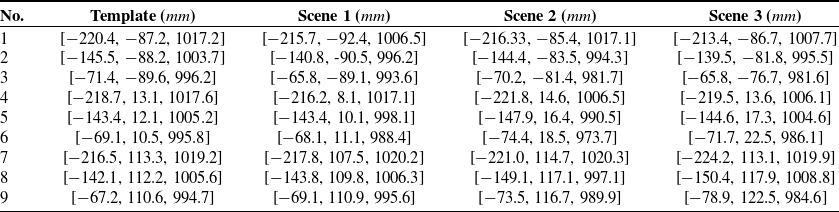
In the experiment, first, the point cloud data of the FMP before deformation was captured by a 3D camera, and the coordinates of the control points before deformation were extracted from it. Subsequently, by controlling the length of the 9 linear actuators, the FMP is accordingly controlled to undergo different forms of deformation. Meanwhile, using the 3D camera to capture the point cloud data of FMP, which is Scene 1, Scene 2, and Scene 3. The coordinate information of the control points before and after deformation is shown in Table I. As shown in Figure 11, the nine control points is defined in world fixed frame and is located in the center of the nine spherical joints.
Control points in different deformation scenes.

As shown in Figure 13, for three arbitrarily selected deformed scenes of morphing platform, the point cloud data captured by the 3D camera, the point cloud data calculated using the 3D TPS algorithm, and the description errors between captured data and calculated data are drawn, respectively, which is shown in Figure 13(a), Figure 13(b), and Figure 13(c), respectively. As can be seen from Figure 13(a) and Figure 13(b), the point cloud data calculated using the 3D TPS algorithm is basically consistent with the point data captured by 3D camera, which means that the overall deformation of the morphing platform can be approximately described by the nine control points. Without a doubt, a more precise shape description can be obtained by increasing the number of the deformation control points.
Shape description validation.

In order to quantitatively describe the deviation between the algorithm calculation and the measured data, the cloud to cloud (C2C) absolute distance between point cloud
 $\boldsymbol{A}$
and point cloud
 $\boldsymbol{B}$
is defined as follows.
 \begin{equation} d\boldsymbol{A,B}=\left [{{\left \|{{\boldsymbol{a}}_{1}}-\boldsymbol{b}_{1}^{neiber} \right \|}_{2}},\quad{{\left \|{{\boldsymbol{a}}_{2}}-\boldsymbol{b}_{2}^{neiber} \right \|}_{2}},\quad \cdots, \quad{{\left \|{{\boldsymbol{a}}_{M}}-\boldsymbol{b}_{M}^{neiber} \right \|}_{2}} \right ] \end{equation}
where
 $\boldsymbol{a}_i=(x,y,z)^T$
represents arbitrary point in point cloud
 $\boldsymbol{A}$
. And
 $\boldsymbol{b}_i^{neiber}$
represents the corresponding closest point with
 $\boldsymbol{a}_i$
in point cloud
 $\boldsymbol{B}$
, which is searched through a KNN nearby point search algorithm.
As shown in Figure 13(c) is the C2C absolute distance between the algorithm calculation result and the measured data. The max and mean value of the C2C absolute distance is shown in Table II, in which the mean error is within
 $1mm$
and max error is within
 $4mm$
, indicating that the proposed method has a high description accuracy.
5.3. Experiment 2: deformation estimation validation
In this subsection, we will verify the effectiveness of the proposed deformation estimation approach. By giving the input length value
 $l_i$
of the nine linear actuators and revolution range of the U joint, the equilibrium state of the FMP is calculated. As shown in Table III is the input values of arbitrary three sets of scenes.
According to Eq.(20), deformed control points
 $\boldsymbol{q}_i^1$
can be uniquely determined by using any set of input parameters
 $\boldsymbol{X}=[\boldsymbol{ l, Ry, Rz}]$
in Table III. As shown in Figure 11,
 $R_{y}$
,
 $R_{z}$
, and
 $l_{i}$
represent passive rotation angle along
 $y$
axis, passive rotation angle along
 $z$
axis, and actuator length of
 $i-th$
linear actuator, respectively. Furthermore, the deformation function
 $\Phi$
can be obtained by using Eq.(4). Subsequently, the deformed point cloud data of the FMP can be calculated by using the deformation function.
According to the bending deformation energy calculation formula defined in Eq.(19), the bending energy of the morphing platform was calculated, the result is shown in Figure 14. The color coordinate represents the principal curvature of the point. The hotter color represents greater degree of bending deformation that occurs in this area. According to the definition in Eq.(19) and Eq.(18), we can get that the bending energy is a dimensionless number. For example, 56.2123 in the figure is obtained by integrating the bending energy of the entire point cloud.
As shown in Figure 15, a PSO algorithm is used to solve the deformation compatibility of the FMP. For each iteration step, calculate the bending energy of the possible deformation form of FMP, which is shown from Figure 15(a) to Figure 15(e). The global optimal solution of the PSO algorithm is used as the equilibrium state of deformation compatibility, which is shown in Figure 15(f), where the FMP has the minimum bending energy at this state.
In the three arbitrary selected scenarios, the equilibrium state of deformation compatibility for the FMP is used as the deformation estimation result. As shown in Figure 16 is a comparison graph of the real data measured by 3D camera and the deformation estimation data. It can be seen from the figure that the estimated deformation and the measured deformation have similar deformation forms, which reveals that the proposed deformation estimation approach can approximately describe the deformation results of this type of parallel mechanism and verifies the effectiveness of proposed approach.
Shape description error by using C2C absolute distance.

Input length and revolution range of the 9 linear actuator.

Bending energy calculation of flexible morphing platform.

Deformation compatibility analysis by using PSO algorithm.

Deformation estimation based on optimal bending energy.

Shape control of a parabolic cylindrical surface.

Shape control of an elliptic cone surface.

5.4. Experiment 3: shape control validation
In this subsection, the effectiveness of the shape control approach is verified by using two kinds of target surface: parabolic cylindrical surface and elliptic cone surface, as shown in Figure 17(b) and Figure 18(b).
During the experiments, first, we define the nine control points on the source template surface of the morphing platform, which can be seen in Figure 17(a) and Figure 18(a). Subsequently, according to the nonrigid ICP algorithm used in Subsection 3.2, transformed control points on the target surface were calculated, as shown in Figure 17(b) and Figure 18(b). Hereafter, an approximate shape description based on 3D TPS algorithm by using the transformed control points is achieved. As shown in Figure 17(c) and Figure 18(c), the shape approximated using the 3D TPS algorithm has a high similarity to the target surface. Finally, according to the transformed control points, the input length of each linear actuator is determined, which can be seen in Table IV. The actual deformation forms of the morphing platform under these input lengths were captured by a camera, which are shown in Figure 17(d) and Figure 18(d). It can be seen that the actual deformation form has a high similarity with the target surface, which verifies the effectiveness of the proposed deformation control approach.
6. Conclusions
The parallel manipulator with a FMP is a novel type of parallel mechanism, which utilizes the overall continuous deformation of FMP and the coordinated motion of multiple rigid actuation to achieve controllable deformation of the FMP. In this article, a 9-UPS redundant actuation parallel manipulator with a flexible morphing moving platform is designed to represent this kind of manipulator. The FMP’s deformation estimation and shape control approach is presented. This can be used in the following fields: shape control of fluid shape-morphing underwater robots, cross-section design of deformable wings, and environmental interaction and perception of human–machine interaction equipment.
The proposed deformation estimation approach is designed based on bending energy, which can achieve high calculation efficiency, and avoid complex mechanical definition and calculation. This approach includes three major parts: (1) shape description by using deformation control points, (2) bending energy function definition, and (3) deformation estimation using a particle swarm optimization algorithm. The proposed shape control approach is realized by using a nonrigid ICP match algorithm, which can continuously deform the morphing platform to an arbitrary target surface. A prototype of the 9-UPS redundant actuation parallel manipulator with flexible morphing moving platform is fabricated and analyzed as verification. The experiment results show that the proposed approach offers a promising avenue for the deformation estimation and shape control.
It also should be noted that when using this approach to calculate the deformation compatibility of the FMP, it is possible to obtain results with approximate bending energy but different deformation shapes. The unique result can be obtained by limiting the movement range of the U joints. This reveals that there are multiple solutions to the forward kinematics of this type of parallel mechanism. In addition, due to the limitation of the number of deformation control points, only approximate deformation control can be achieved for complex target surfaces. To obtain a more precise control, increasing the number of control points is necessary.
Although the designed mechanism is a 9-UPS parallel mechanism, the deformation estimation and shape control approach is also applicable to general parallel manipulator with FMP. In future work, more designs (such as shape-morphing robot) and test based on the proposed deformation estimation and shape control approach will be developed to extend the application of this kind of parallel mechanism.
Input length of the 9 linear actuator for the target surface control
 $(mm)$
.

Author contributions
Zhengtao Chen and Yanjun Wang conceived and designed the study. Zhenkun Liang conducted experimental setup and data gathering. Zhengtao Chen performed statistical analysis. Genliang Chen and Hao Wang supervised this study. Zhengtao Chen and Yanjun Wang wrote the article.
Financial support
This research work was supported in part by the National Key Research and Development program of China under the Grant 2019YFA0709001, Science and Technology Commission of Shanghai Municipality under the project number 21NL2600200, and the National Natural Science Foundation of China under the Grant 52022056 and 51875334.
Competing interests
The authors declare no conflicts of interest exist.
Ethical approval
None.