At calving, dairy heifers are expected to initiate a healthy and highly productive first lactation. Still, ample evidence exists that a large proportion of heifers suffers from mastitis, an inflammation of the mammary gland mostly caused by bacterial intramammary infection (IMI), even before first milking (De Vliegher et al. Reference De Vliegher, Fox, Piepers, McDougall and Barkema2012). This disease can be accompanied with local or systemic symptoms (clinical heifer mastitis) or without visible symptoms (subclinical heifer mastitis). The latter is mostly detected by an increase in the concentration of somatic cells, mainly leucocytes, in milk (somatic cell count, SCC) (Fox, Reference Fox2009). Both clinical and subclinical heifer mastitis threaten the future performances of heifers and consequently farm profitability (Huijps et al. Reference Huijps, De Vliegher, Lam and Hogeveen2009), especially when so-called major mastitis pathogens such as Staphylococcus aureus and Streptococcus uberis are involved (Piepers et al. Reference Piepers, Opsomer, Barkema, de Kruif and De Vliegher2010). In contrast, the impact on udder health of the so-called minor pathogens such as the coagulase-negative staphylococci (CNS), is limited.
Seeking for better prevention and control of heifer mastitis, multiple research groups have put efforts into the identification of risk factors potentially associated with this disease. As a result, risk factors at the farm (De Vliegher et al. Reference De Vliegher, Laevens, Barkema, Dohoo, Stryhn, Opsomer and de Kruif2004; Svensson et al. Reference Svensson, Nyman, Persson and Emanuelson2006), heifer (Myllys & Rautala, Reference Myllys and Rautala1995; Waage et al. Reference Waage, Odegaard, Lund, Brattgjerd and Rothe2001; De Vliegher et al. Reference De Vliegher, Laevens, Barkema, Dohoo, Stryhn, Opsomer and de Kruif2004; Piepers et al. Reference Piepers, Peeters, Opsomer, Barkema, Frankena and De Vliegher2011), and quarter level (Kromker & Friedrich, Reference Kromker and Friedrich2009; Piepers et al. Reference Piepers, Peeters, Opsomer, Barkema, Frankena and De Vliegher2011) have been identified. Still, these risk factors only explain part of the variation in the prevalence and incidence of mastitis in (early) lactating heifers. In particular the variation in udder health between recently calved heifers housed in the same herd and thus managed under identical conditions is still remarkably high (De Vliegher et al. Reference De Vliegher, Laevens, Barkema, Dohoo, Stryhn, Opsomer and de Kruif2004; Piepers et al. Reference Piepers, Peeters, Opsomer, Barkema, Frankena and De Vliegher2011) suggesting a role for genetics of these animals.
Part of the variation in susceptibility to IMI between heifers is genetically determined (Wanner et al. Reference Wanner, Rogers, Kehrli and Cooper1998; Nash et al. Reference Nash, Rogers, Cooper, Hargrove and Keown2003). Thus, selection of heifers that are less susceptible might offer a durable and sustainable prevention and control of heifer mastitis, avoiding extensive antimicrobial treatment. Identification of genetic polymorphisms linked with (heifer) mastitis resistance would allow evaluation of genetic make-up of male and female breeding animals for udder health, even before their offspring is born. For this reason, genetic markers associated with udder health are needed (Ogorevc et al. Reference Ogorevc, Kunej, Razpet and Dovc2009). In a recent genome-wide association study (GWAS), polymorphisms located near CXCR1 and CXCR2 were highly associated with occurrence of mastitis (Sodeland et al. Reference Sodeland, Kent, Olsen, Opsal, Svendsen, Sehested, Hayes and Lien2011).
Migration of polymorphonuclear leucocytes from peripheral blood to the milk is a key event in the immune defence of the mammary gland against invading bacteria (Paape et al. Reference Paape, Shafer-Weaver, Capuco, Van Oostveldt and Burvenich2000). Interleukin 8 (IL8) is the main chemoattractant in this process (Barber & Yang, Reference Barber and Yang1998; Caswell et al. Reference Caswell, Middleton and Gordon1999) and binds to two receptors, namely chemokine (C-X-C motif) receptor 1 (CXCR1) and chemokine (C-X-C motif) receptor 2 (CXCR2). Besides inducing and mediating chemotaxis, binding IL8 causes prolonged survival (Kettritz et al. Reference Kettritz, Gaido, Haller, Luft, Jennette and Falk1998) and increases activity (Mitchell et al. Reference Mitchell, Albright and Caswell2003) of neutrophils. Polymorphisms in CXCR1 might affect expression or functionality of the receptor causing variability in the innate immune responses subsequent to the contact with a mastitis pathogen. Until recently, 5 single nucleotide polymorphisms (SNP) have been identified (Grosse et al. Reference Grosse, Kappes, Laegreid, Keele, Chitko-McKown and Heaton1999; Youngerman et al. Reference Youngerman, Saxton and Pighetti2004b; Pighetti & Rambeaud, Reference Pighetti and Rambeaud2006) of which some seem to explain some udder health variability (Youngerman et al. Reference Youngerman, Saxton, Oliver and Pighetti2004a; Beecher et al. Reference Beecher, Daly, Childs, Berry, Magee, McCarthy and Giblin2010; Galvao et al. Reference Galvao, Pighetti, Cheong, Nydam and Gilbert2011). Very recently, 5 additional SNP in the coding region and 25 SNP in non-coding regions were reported (Pighetti et al. Reference Pighetti, Kojima, Wojakiewicz and Rambeaud2012). It is reasonable to believe that CXCR1 polymorphisms might play a key role in the host resistance of (periparturient) heifers as well and explain part of the variation in prevalence and incidence of heifer mastitis. Still, these polymorphisms have not yet been studied as potential factors associated with heifer mastitis.
The objectives of this study were to screen the entire coding region of CXCR1 for polymorphisms and to analyse potential (pathogen-group specific) associations between CXCR1 polymorphisms and subclinical mastitis phenotype (quarter milk SCC in early lactation, IMI status in early lactation, and composite milk SCC during first lactation) in Belgian dairy heifers.
Materials and Methods
Herds and heifers
The database for the current research consisted of phenotypic records (Piepers et al. Reference Piepers, Opsomer, Barkema, de Kruif and De Vliegher2010) combined with data on the CXCR1 genotype. In total, records and blood samples of 140 Holstein heifers were available. Heifers were housed on 20 commercial dairy farms. On average, 7 heifers per farm were included, ranging between 3 and 10. The Cattle Breeding Association (CRV, Arnhem, The Netherlands) was consulted for data on the relationship of heifers. Records of all but 2 heifers could be retrieved. Seventy-seven different fathers, 136 different mothers, 339 different grandparents, and 550 different great-grandparents were noted, indicating that the heifers are not closely related to each other.
Data collection and sampling
As described previously (Piepers et al. Reference Piepers, Opsomer, Barkema, de Kruif and De Vliegher2010), quarter milk samples were aseptically collected twice, between 1 and 4 days in milk (DIM) and between 5 and 8 DIM, for determination of the quarter milk SCC (qSCC) (30 ml) and bacteriological culturing (5 ml) at each sampling. Composite milk SCC (cSCC) throughout first lactation was determined on milk samples collected as part of the dairy herd improvement (DHI) programme of the CRV on a four- to six-weekly basis. Records from 14 until 285 DIM were used.
As a source of DNA, blood samples were taken from the tail vein of all heifers and stored in EDTA vacutainer tubes (Terumo) at −20°C.
Phenotypic data
Quarter and composite milk SCC was determined at the Milk Control Centre (MCC) Flanders (Lier, Belgium) using a Fossomatic 5000 (Foss Electric).
Bacteriological culture was based on National Mastitis Council standards and performed at the MCC Flanders (Lier, Belgium) as described by Piepers et al. (Reference Piepers, De Meulemeester, de Kruif, Opsomer, Barkema and De Vliegher2007). In short, 10 μl of milk was spread on blood-aesculin agar (Oxoid) and on MacConkey's agar (Oxoid). In order to grow bacteria, plates were incubated aerobically for 24–48 h at 36–38°C. Identification of bacteria was done by Gram-staining and inspection of the colony morphology. Catalase tests were performed to differentiate Gram-positive cocci in catalase-positive or catalase-negative cocci. Staphylococci were identified as CNS or Staph. aureus by colony morphology, haemolysis patterns, and DNase tests. Streptococci were differentiated in aesculin-positive and aesculin-negative streptococci (Str. agalactiae and Str. dysgalactiae). Str. agalactiae and Str. dysgalactiae were distinguished using the Christie, Atkins, Munch-Petersen (CAMP) test. Gram-negative bacteria were not further differentiated. Corynebacterium bovis and CNS were categorized as minor pathogens, while Staph. aureus, aesculin-positive streptococci, Str. dysgalactiae and Str. agalactiae were categorized as major pathogens. Other than the above-mentioned Gram-positive bacteria and Gram-negative bacteria were classified as ‘other pathogens’ and excluded from the analyses. Eight quarters yielded Gram-negative bacteria, one was culture-positive for Trueperella pyogenes, and one was culture-positive for both latter pathogens. In order to study subclinical mastitis only, quarters reported to be clinically infected between 1 and 8 DIM were excluded from the analysis (in total 6 cases, see further). Intramammary infection status of each quarter was determined on the outcome of bacteriological culture of the two consecutive milk samples (collected between 1 and 4 DIM, and 5 and 8 DIM, respectively) (Piepers et al. Reference Piepers, Peeters, Opsomer, Barkema, Frankena and De Vliegher2011). In short, a quarter was considered non-infected if no pathogens could be isolated from both samples. A CNS-infection was defined as isolation of CNS at the first sampling and isolation of CNS or no pathogen at the second sampling. A C. bovis-infection was defined as isolation of C. bovis at the first sampling and isolation of C. bovis or no pathogen at the second sampling. A quarter was considered as infected with a major pathogen if a major pathogen was isolated at the first sampling and if the same pathogen, a minor pathogen or no pathogen was isolated at the second sampling. All quarters that could not be allocated to one of those classes were considered as missing values.
CXCR1 genotyping and polymorphism screening
DNA was extracted from blood samples (100 μl) using a proteinase K digestion method (Van Poucke et al. Reference Van Poucke, Vandesompele, Mattheeuws, Van Zeveren and Peelman2005) and its concentration was estimated with a ND spectrophotometer (NanoDrop).
In order to amplify the whole single-exon coding region (1083 bp) of bovine CXCR1, a forward PCR primer (5′-TCCTTGATGAGAGTGATTTGGA-3′) binding 76–55 bp upstream the start codon and a reverse PCR primer (5′-TTGACATGGGACTGTGAACG-3′) binding 61–80 bp downstream the stop codon was designed using Primer3Plus (Untergasser et al. Reference Untergasser, Nijveen, Rao, Bisseling, Geurts and Leunissen2007) based on the reference sequence of CXCR1 [GenBank: NM_001105038.1]. Regions forming potential secondary structures were identified with Mfold (Zuker, Reference Zuker2003) and avoided. Specificity of binding of both primers was analysed using NCBI BLAST (Altschul et al. Reference Altschul, Gish, Miller, Myers and Lipman1990). A PCR mix containing approximately 100 ng genomic DNA, 1·0 μl 10×FastStart Taq DNA Polymerase Buffer (Roche Applied Science), dNTP Mix (0·2 mm each; BIOLINE), 0·25 μm forward primer (Integrated DNA Technologies), 0·25 μm reverse primer (Integrated DNA Technologies) and 0·5 U Taq DNA Polymerase (Roche Applied Science) was made.
The PCR program consisted of an initiation step of 5 min at 95°C followed by 30 amplification cycles (denaturation for 30 s at 95°C, annealing for 30 s at 62°C and extension for 75 s at 72°C) and a final 4-min elongation step at 72°C. All amplicons were sequenced by direct sequencing with the BigDye Terminator v3.1 Cycle Sequencing Kit (Applied Biosystems) on a 16-capillary 3130xl DNA Analyzer (Applied Biosystems) according to the manufacturer's protocol. Sequencing reactions per sample were performed in duplicate using the forward and reverse primers.
Sequences of the coding region of CXCR1 of all samples were compared with the reference sequence and with each other to identify polymorphisms. Four haplotypes were identified based on homozygous genotypes, present in a number of animals. The genotype of all but 2 heterozygous heifers could be explained by a combination of these haplotypes (see further). The haplotypes of these 2 heifers were identified by cloning. First, the amplicon generated by PCR of either of both alleles was cloned into a pCR 2·1 vector using TA Cloning Kit (Invitrogen). Next, the vector was transformed in DH5a Competent Cells (Invitrogen). Plasmid DNA from single colonies (Birnboim & Doly, Reference Birnboim and Doly1979) was sequenced for the whole CXCR1 coding region as previously described. Finally, the haplotype of the non-ligated allele was deducted from this sequence and the heifer's genotype. Single nucleotide polymorphisms and haplotype sequences were submitted to the NCBI dbSNP and GenBank database, respectively (Table 1, Table 2).
Statistical method
Deviations from Hardy-Weinberg equilibrium of each studied polymorphism were analysed using chi-square goodness of fit tests. Chi-square were calculated to analyse linkage association between loci.
Associations with phenotype were only analysed for polymorphisms c.642G>A, c.735C>G, c.816C>A and c.980A>G as all other detected polymorphisms were in strong linkage disequilibrium (correlation >95%) with either one of these SNP, and results would be similar for that reason.
The associations between the different polymorphisms and qSCC in early lactation were determined using a linear mixed regression model with herd, heifer and quarter as random effects to correct for clustering of heifers within herds, quarters within heifers, and the two observations (measured at 1–4 DIM and 5–8 DIM, respectively) per quarter (PROC MIXED, SAS 9.2, SAS Institute Inc.). A natural logarithmic transformation of qSCC (LnqSCC) was performed to obtain a normalized distribution. The different models included ‘observation’ (1=at 1–4 DIM, 2=at 5–8 DIM, respectively) and the different heifers’ genotypes (c.642G>A, c.735C>G, c.816C>A and c.980A>G, respectively) at the position of the polymorphism as categorical fixed effects (PROC MIXED, SAS 9·2, SAS Institute Inc.). Models excluding and including IMI status (0=non-infected quarter, 1=quarter infected with CNS and 2=quarter infected with Staph. aureus, Str. agalactiae, Str. dysgalactiae and aesculin-positive streptococci, respectively) as fixed effect were compared and the interaction between IMI status and CXCR1 genotype were tested as well in the models including IMI status.
The associations between the different polymorphisms and presence of IMI in early lactation were determined using a logistic mixed regression model with herd and heifer as random effects to correct for clustering of heifers within herds and quarters within heifers (MlwiN 2·02, Centre for Multilevel Modeling, Bristol, UK). Different models were fitted separately for three different binary outcome variables: (1) ‘CNS IMI’ (0=non-infected quarter v. 1=quarter infected with CNS), (2) ‘Major pathogen IMI’ (0=non-infected quarter v. 1=quarter infected with Staph. aureus, Str. agalactiae, Str. dysgalactiae or aesculin-positive streptococci), and (3) ‘all IMI’ (0=non-infected quarter v. 1=quarter infected with CNS, C. bovis, Staph. aureus, Str. agalactiae, Str. dysgalactiae or aesculin-positive streptococci). All models included heifers’ genotype at the position of the polymorphism (c.642G>A, c.735C>G, c.816C>A and c.980A>G, respectively) as a categorical fixed effect. To allow convergence of the statistical models, records on rare genotypes (c.980AA, see further) were omitted.
The associations between the different polymorphisms and test-day cSCC were determined using a linear mixed regression model with herd and heifer as random effects to correct for clustering of heifers within herds and multiple observations per heifers (PROC MIXED, SAS 9.2, SAS Institute Inc.). A first order autoregressive correlation structure (AR1) was used to model the multiple milk recordings within heifer. A natural logarithmic transformation of cSCC (LncSCC) was performed to obtain a normalized distribution. The model included DIM as continuous fixed effect and heifers’ genotype (c.642G>A, c.735C>G, c.816C>A and c.980A>G, respectively) at the position of the polymorphism as categorical fixed effect. In all models, the quadratic term for DIM and the interaction between DIM and genotype were tested.
Statistical significance for all tests was assessed at P⩽0·05.
Results
Phenotypic data
On average, herds counted 48 lactating cows [Interquartile range (IQR) 27–56] producing 8344 kg milk/year (IQR 7693–9470 kg milk/year) and had a herd milk SCC of 280 000 cells/ml (IQR 193 000–343 000 cells/ml) during the study period. Of the 140 heifers selected for analysis, two heifers had a non-functional quarter at calving. Six quarters were reported to be clinically infected at 1–8 DIM. The latter 8 quarters were omitted from the analysis.
Geometric mean of qSCC of all quarters declined from 336 000 cells/ml (IQR 102 000–1013 000) at 1–4 DIM to 110 000 cells/ml (IQR 35 000–253 000) at 5–8 DIM (P<0·0001). Quarters infected with Staph. aureus, Str. agalactiae, Str. dysgalactiae or aesculin-positive streptococci had higher geometric mean qSCC (1 011 000 cells/ml, IQR 277 000–4 151 000) than healthy quarters (119 000 cells/ml, IQR 44 000–255 000) (P<0·0001). The geometric mean qSCC of quarters infected with CNS was intermediate (341 000 cells/ml, IQR 57 000–498 000) with respect to healthy quarters and quarters infected with a major pathogen.
The IMI status could be determined for 442 out of 552 (80%) functional, nonclinical quarters from the 140 heifers. In total, 46% of 442 quarters (n=204) and 9% of the heifers (n=13) were non-infected. Approximately 54% of the quarters (n=238) and 76% of the heifers (n=106) were subclinically infected, the vast majority of which were CNS infections (84%, n=201). Infections by major pathogens were detected in 35 quarters of 24 heifers (15% of IMI). Aesculin-positive streptococci were the most frequently isolated pathogens (n=20), followed by Staph. aureus (n=14). One quarter was infected with Str. agalactiae, two were infected with C. bovis. No IMI status could be determined in 20% of the quarters (n=110) because of the definitions in use. Data on these quarters were considered as missing values in the analysis. The main reason of exclusion was a culture-negative result at 1–4 DIM combined with a culture-positive result at 5–8 DIM (n=59).
During lactation, the cSCC followed a quadratic curve (DIM2: P<0·01). The geometric mean cSCC was 92 000 cells/ml (IQR 35 000–174 000) at 14–45 DIM, declined to 57 000 cells/ml (IQR 25000–97 000) at 76–105 DIM and rose again to 94 000 cells/ml (IQR 38 000–199 000) at 256–285 DIM.
Polymorphism screening
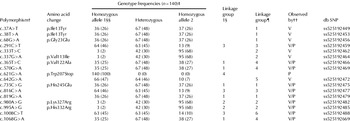
In total, 16 polymorphisms were detected. Ten have been described in the literature before (Pighetti et al. Reference Pighetti, Kojima, Wojakiewicz and Rambeaud2012) Pighetti is correct including 6 silent mutations (c.291C>T, c.570G>A, c.816C>A, c.819G>A, c.1008C>T, c.1068G>A) and 4 missense mutations (c.365T>C, c.735C>G, c.980A>G, c.995A>G). Two novel silent polymorphisms (c.333T>C, c.642G>A) and 3 novel missense polymorphisms (c.37A>T, c.38T>A, c.68G>A, c.337G>A) were discovered. The missense mutations cause amino acid changes at 7 positions in the protein (p.Ile13Tyr, p.Gly23Glu, p.Val113Ile, p.Val122Ala, p.His245Glu, p.Lys327Arg, p.His332Arg) (Table 1). All studied polymorphisms were in strong linkage disequilibrium (P<0·05). In the investigated population, polymorphisms c.37A>T, c.38T>A, c.68G>A, c.735C>G and c.819G>A were in complete linkage (linkage group 1). The same was true for polymorphisms c.333T>C, c.337G>A, c.980A>G and c.995A>G (linkage group 2), polymorphisms c.291C>T and c.816C>A (linkage group 3), and for polymorphisms c.365T>C, c.570G>A and c.1068G>A (linkage group 4, Table 1). The studied population was in Hardy-Weinberg equilibrium (P>0·05) for all polymorphisms. Five haplotypes were detected. Sequences, and frequencies are shown in Table 2.
Polymorphisms detected in the coding region of CXCR1 of 140 Holstein–Friesian heifers from 20 Belgian dairy farms

† Locations are relative to the start codon
‡ Numbers of the heifers in the study expressing the given genotype and their relative percentage in parentheses
§¶ Linkage groups as observed by Pighetti et al. (Reference Pighetti, Kojima, Wojakiewicz and Rambeaud2012) and in our study, respectively
†† Polymorphisms detected in this study (V), by Pighetti et al. (Reference Pighetti, Kojima, Wojakiewicz and Rambeaud2012) (P) or in both studies (V/P)
‡‡ Submitted SNP (ss) number in the NCBI dbSNP database (http://www.ncbi.nlm.nih.gov/snp)
§§ Allele with nucleotide(s) equal to the nucleotide(s) in the reference sequence [GenBank: NM_001105038.1]
CXCR1 haplotype sequences and frequencies for 140 Holstein Friesian dairy heifers from 20 Belgian dairy farms

† Numbers indicate positions of the polymorphisms relative to the start codon
‡ GenBank accession number
Association between polymorphisms in CXCR1 and subclinical mastitis
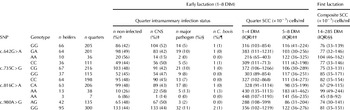
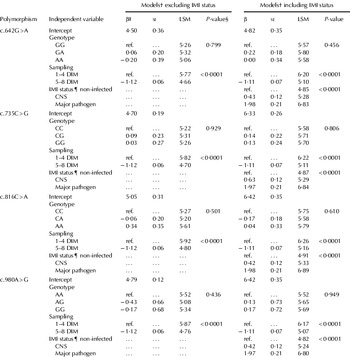
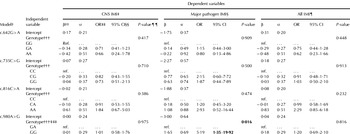
Descriptive statistics on subclinical mastitis by CXCR1 polymorphisms are given in Table 3. Neither in the models including IMI status as fixed effect nor in the models excluding IMI status, were polymorphisms significantly associated with qLnSCC (Table 4). None of the studied polymorphisms were associated with ‘All IMI’ or ‘CNS IMI’ (P>0·05). However, a significant association between polymorphism c.980A>G and ‘major pathogen IMI’ was detected: quarters of heifers with genotype GG on position 980 were more likely to be infected with major pathogens compared with quarters from heifers with genotype AG (P<0·05, Table 5). None of the investigated polymorphisms (c.642G>A, c.735C>G, c.816C>A or c.980A>G) were associated with LncSCC (data not shown).
Descriptive statistics on subclinical mastitis by CXCR1 polymorphisms c.642G>A, c.735C>G, c.816C>A and c.980A>G, respectively

† No pathogens isolated
‡ IMI caused by coagulase-negative staphylococci (CNS)
§ IMI caused by Staphylococcus aureus, Streptococcus agalactiae, Streptococcus dysgalactiae or aesculin-positive streptococci
¶ IMI caused by Corynebacterium bovis
††,‡‡ Geometric mean quarter milk SCC between 1 and 4 DIM and between 5 and 8 DIM, respectively
§§ Geometric mean composite milk SCC determined at test-day on a four- to six-weekly basis
Association between quarter SCC in early lactation and CXCR1 polymorphisms c.642G>A, c.735C>G, c.816C>A and c.980A>G, respectively

† The linear mixed regression models included herd, heifer and quarter as random effect. A natural logarithmic transformation of quarter SCC (qLnSCC) was performed to obtain a normalized distribution
‡ Regression coefficient
§ Overall P-value of the fixed effect
¶ Intramammary infection (IMI) status; IMI caused by CNS and IMI caused by major pathogens Staphylococcus aureus, Streptococcus agalactiae, Streptococcus dysgalactiae and aesculin-positive streptococci v. non-infected
The interaction term between CXCR1 genotype and IMI was not significant and therefore excluded from the models
Association between pathogen-group specific intramammary infection and CXCR1 polymorphisms c.642G>A, c.735C>G, c.816C>A and c.980A>G, respectively

† The logistic mixed regression models included herd, heifer and quarter as random effect
‡ Intramammary infection caused by coagulase-negative staphylococci (CNS) v. non-infected
§ Intramammary infection caused by Staphylococcus aureus, Streptococcus agalactiae, Streptococcus dysgalactiae and aesculin-positive streptococci v. non-infected
¶ Intramammary infection caused by CNS, Corynebacterium bovis, Staphylococcus aureus, Streptococcus agalactiae, Streptococcus dysgalactiae and aesculin-positive streptococci v. non-infected
†† Regression coefficient
‡‡ Odds ratio
§§ 95% confidence interval of OR, intervals excluding ‘1′ are marked in bold
¶¶ P-value of the overall fixed effect with values <0·05 marked in bold
††† Genotype at the position of the studied polymorphism
‡‡‡ To allow convergence of the statistic models, records on the rare genotype c.980AA were omitted
Discussion
To improve prevention and control of heifer mastitis, identification of risk factors is required. Because of the multifactorial nature of mastitis, not only pathogen-specific but host-specific factors as well determine the outcome. Mastitis resistance, and host resistance in general, are partly genetically determined (Wanner et al. Reference Wanner, Rogers, Kehrli and Cooper1998; Nash et al. Reference Nash, Rogers, Cooper, Hargrove and Keown2003). Although many genes influence mastitis traits, polymorphisms in a few genes with major effects might alter mastitis susceptibility of cows significantly (Detilleux, Reference Detilleux2009). Because of the importance of the encoded protein in the innate immunity of the mammary gland (Barber & Yang, Reference Barber and Yang1998; Caswell et al. Reference Caswell, Middleton and Gordon1999), a QTL for mastitis in this region of the bovine genome (Sodeland et al. Reference Sodeland, Kent, Olsen, Opsal, Svendsen, Sehested, Hayes and Lien2011) and the demonstrated relevance of CXCR1 polymorphisms for mastitis susceptibility (Youngerman et al. Reference Youngerman, Saxton, Oliver and Pighetti2004a; Leyva-Baca et al. Reference Leyva-Baca, Schenkel, Martin and Karrow2008; Beecher et al. Reference Beecher, Daly, Childs, Berry, Magee, McCarthy and Giblin2010; Galvao et al. Reference Galvao, Pighetti, Cheong, Nydam and Gilbert2011), we opted to study CXCR1 genotype as a potential risk (or protective) factor for heifer mastitis. Novel polymorphisms and a pathogen-group specific association between CXCR1 genotype and intramammary infection status of early lactating heifers were detected.
Recently, Pighetti et al. (Reference Pighetti, Kojima, Wojakiewicz and Rambeaud2012) performed a polymorphism screening on CXCR1 by genotyping 88 Holstein dairy cows. Although investigating the coding region of CXCR1 in the same breed, we observed some differences compared with their results. Ten common polymorphisms were detected in the two study populations. Additionally, one missense polymorphism (c.621G>A) was discovered in the American dairy population which was not found in our Belgian dairy heifer population and 6 polymorphisms (c.37A>T, c.38T>A, c.68G>A, c.333T>C, c.337G>A and c.642G>A) were only observed in our study. Consequently, linkage groups of SNP and haplotypes differed slightly among both study populations. The haplotypes labelled GCCA, GCAG and GGCG based on tag SNP c.621G>A, c.735C>G, c.816C>A and c.980A>G present in the American study population are equal to the haplotypes H1, H2 and H4 of our study, respectively. Haplotype AGCG was only observed in the American study, whereas haplotype H3 and H5 were only found in the Belgian study population.
Intramammary infection status at quarter level assessed by bacteriological culture is usually not available on large scale, although it is a direct parameter for udder health. Youngerman et al. (Reference Youngerman, Saxton, Oliver and Pighetti2004a) were the first and until now the only to report on the association between CXCR1 polymorphisms and udder health determined by bacteriological culture. Subclinical mastitis was quantified as the percentage of observations positive on IMI per cow and found to be associated with polymorphism c.735C>G. Pathogen-group specific associations were not studied. As not all pathogens have the same impact on udder health and milk production of early lactating heifers (Piepers et al. Reference Piepers, Opsomer, Barkema, de Kruif and De Vliegher2010) and as risk factors for IMI with the different groups of pathogens differ as well (Piepers et al. Reference Piepers, Peeters, Opsomer, Barkema, Frankena and De Vliegher2011), it is important to differentiate between them. We studied associations with both IMI by all pathogens and pathogen-group specific IMI (IMI by CNS and IMI by major pathogens, respectively). This allowed us to identify an association between polymorphism c.980A>G and IMI by major pathogens while no association was found with IMI by all pathogens and IMI by CNS, respectively. Polymorphism c.980A>G (p.Lys327Arg) was in complete linkage disequilibrium with 2 other missense SNP (c.337G>A, p.Val113Ile; c.995A>G, p.His332Arg) and one silent SNP (c.333T>C). The less frequently detected allele c.980A seemed to offer protection compared with the more frequent allele c.980G. Although c.980 may not be the causative mutation, the A allele codes for lysine at amino acid position 327 which is conserved across species (Pighetti et al. Reference Pighetti, Kojima, Wojakiewicz and Rambeaud2012).
Although polymorphism in CXCR1 has been linked with mastitis susceptibility (Youngerman et al. Reference Youngerman, Saxton, Oliver and Pighetti2004a; Galvao et al. Reference Galvao, Pighetti, Cheong, Nydam and Gilbert2011), we and several other research groups failed to demonstrate an association with SCC (Galvao et al. Reference Galvao, Pighetti, Cheong, Nydam and Gilbert2011) or estimated breeding values of SCC (Goertz et al. Reference Goertz, Baes, Weimann, Reinsch and Erhardt2009). As Youngerman et al. (Reference Youngerman, Saxton, Oliver and Pighetti2004a) proposed, the relationship between CXCR1 and SCC might be more complex than expected. From one point of view, heifers with genotype associated with more expression or higher functionality of the receptor could respond more efficiently to invading pathogens. Therefore, these heifers might have less (chronic) IMI and subsequent elevation of SCC. From another point of view, geometric mean SCC could be higher because of the higher response to IL8 causing more cells to migrate from blood to milk. Additionally, as suggested by results in our study, associations between genotype and udder health might be pathogen (-group) specific. Latter associations might not be detected when using SCC data only.
The sample size of this study was rather small (140 heifers) and the number of infections caused by major pathogens was limited, i.e. 32 quarters of heifers with genotype AG, 3 quarters of heifers with genotype GG. Whether a P-value below 0·05 is sufficient to claim that associations are not observed by chance can be argued. Keeping in mind the important function of the receptor and findings of other research (Youngerman et al. Reference Youngerman, Saxton, Oliver and Pighetti2004a; Galvao et al. Reference Galvao, Pighetti, Cheong, Nydam and Gilbert2011, Sodeland et al. Reference Sodeland, Kent, Olsen, Opsal, Svendsen, Sehested, Hayes and Lien2011; Pighetti et al. Reference Pighetti, Kojima, Wojakiewicz and Rambeaud2012), it seems unlikely that heifers with genotype GG had more infections by major pathogens compared with heifers with genotype AG merely by coincidence. Nevertheless, confirmation of the findings in other observational studies with larger populations and experimental studies would be helpful. The current results increase the knowledge on the impact of CXCR1 polymorphisms on mastitis susceptibility, complement what is already known and allow for designing further studies. Information from previous (Youngerman et al. Reference Youngerman, Saxton, Oliver and Pighetti2004a; Galvao et al. Reference Galvao, Pighetti, Cheong, Nydam and Gilbert2011, Sodeland et al. Reference Sodeland, Kent, Olsen, Opsal, Svendsen, Sehested, Hayes and Lien2011; Pighetti et al. Reference Pighetti, Kojima, Wojakiewicz and Rambeaud2012), current and future research will enable us to draw better conclusions on the relationship between mutations in CXCR1 and mastitis susceptibility and its potentials for genetic selection.
Conclusions
Sixteen polymorphisms including 8 missense were discovered in the coding region of CXCR1. Because of the important function of CXCR1 in innate immune responses, mutations in the encoding gene might alter disease resistance. In this study, an association between subclinical mastitis of early lactating heifers and polymorphism c.980A>G was detected. Allele A was found to be a protective factor for IMI by major pathogens. These results indicate that selection against certain CXCR1 genotypes could offer possibilities for prevention and control of heifer mastitis. The observed association stimulates us to further unravel the impact of CXCR1 polymorphisms on innate immunity and pathogen-specific resistance of the mammary gland.
This study was financed by a PhD grant (no. 101206) by the Agency for Innovation by Science and Technology in Flanders (IWT Vlaanderen). The authors wish to thank Milk Control Centre Flanders for bacteriological culture and quarter SCC analyses and the Cattle Breeding Association (CRV) for access to data on composite SCC at test-day and relationship among heifers. Technical assistance by Linda Impe, Ruben Van Gansbeke and Dominique Vander Donckt was greatly appreciated.