If we are willing to listen, the materials we work with (our own bodies, but also metals, clay, paint, fabric…) will tell us which forms they can hold or sustain, and which they cannot. Or rather, this knowledge will emerge between the vital materiality that we are and that which we encounter, and with which we interact.Footnote 1
Much of the work of an academic library can be characterized as supporting research at many levels, from further education projects to doctoral theses. Traditionally this work is seen as being text based, framed by principles and research models characteristic of the humanities or the STEM (science technology engineering mathematics) subjects. However the student cohort at the University for the Creative Arts follow studio based disciplines, and can struggle with identifying the relevance of the text based resource of the library to their creative practice. This can result in a perception that theory and practice are unrelated, irrelevant or even inimical to each other, attitudes that have been shared with me by course tutors. The ultimate consequence of this approach is that the library is in danger of being seen as inhabiting the part of the course they have to do rather than want to do. The question is therefore: how can the library at UCA become more engaged with the courses it supports?
The key to addressing this potential issue lies in considering the nature of the research carried out by arts students. While traditional text-based discourse is indeed relevant, it does not exhaust the avenues of inquiry available to the creative arts student. The heart of the research ‘output’ lies in studio based exploration and creativity that will incorporate reflective practice. We may see this as an example of arts based research, clearly summarized by Shaun McNiff:
…the systematic use of artistic process, the actual making of artistic expressions in all the different forms of the arts, as a primary way of understanding and examining experience by both researchers and the people that they involve.)Footnote 2
At centre of this definition is the idea of creativity. Informal discussions with students reveal that they see the unexpected as a significant element in the creative process, and developing creativity means building awareness of recognizing and responding to new ideas. None of the students to whom I spoke told me that they knew in detail initially how the final work would be manifest. Remembering that the main question in this paper concerns library engagement with arts students, some approaches began to suggest themselves. One example is using the idea of creativity to frame information literacy. By presenting research as employing the same processes as creativity, the attempt is made to encourage students firstly to break through the antipathy many feel toward research per se and, secondly, to begin to address the issue of its relevance to studio work. This is not to say that research or critical thought in general are coterminous with creativity, but neither are they mutually exclusive. Creativity enables the possibilities afforded by the idea of play: that you could play with ideas as much as you could play with images, materials, shapes, textures, colours and so forth. It is however worth remembering that creativity isn't the exclusive province of the arts.
Normally we see “creativity” most manifestly in the work of artists so we assume that creativity and art are synonymous. As a result of this confusion we believe that to teach creativity we must teach people to behave like artists.Footnote 3
By drawing a parallel with studio work, we show that one can be led and follow different ideas as they became apparent, can follow resonances and suggestions, can be aware of the possibility of your idea emerging from an unknown and indeterminate state and have the confidence to do this. Only then do we begin to address the reservations held by some arts students surrounding the research process by drawing attention to practices with which they are already familiar.
This is the dynamic of creativity and it is how research works, especially with regard to finding and developing a research question. So how could one extend library involvement beyond the textual? Is it possible for the library to become involved in the wider studio practice of the students? Could we actually create an arena that fosters creativity in both theory and practice at the same moment?
The requirement of students to produce studio journals as part of their reflective practice provided a site where materials are incorporated into pages alongside textual commentary. This activity suggested a model that could be amplified into a library-based activity which could be undertaken by groups as well as individuals. Inspired by the work of Professor Mark Miodownik Footnote 4 and the Institute of Making, I began to explore the possibilities of developing a materials collection. Miodownick suggests that there are 2 ways of engaging with materiality: through its physical properties, and those of the ‘sensoaesthetic’.
Within the world of materials, there exists a big split between the materials science community, those scientists, technologists and industrialists who are interested in the physicality of materials, and those in the materials-arts community who are interested in the sensoaesthetic properties of materials.Footnote 5
It is this sensoaesthetic aspect of materiality with which this paper is concerned. The immediacy of creating an awareness and an understanding of the material based upon its sensory qualities as opposed to what is known in terms of function, cultural meaning and physical properties is characteristic of haptic learning, and provides a rich arena for imaginative and creative response. Haptic learning refers to the way in which we construct our experience and conception of the world through the senses and are fundamental ways in which both artists and designers work. The architectural theorist Juhani Pallasmmaa puts it like this:
Touch is the sensory mode which integrates our experience of the world and ourselves. Even visual perceptions are fused and integrated into the haptic continuum of the self: my body remembers who I am and how I am located in the world.Footnote 6
These reflections provided the conceptual space for the development of a material collection, with the specific intent of encouraging haptic learning within a critical environment.Footnote 7 This would be achieved by prioritizing the materiality of the objects, the sensoaesthetic characteristics over the familiar functional contexts, in a way is analogous to phenomenological reduction.Footnote 8 The term reduction is used in phenomenology as a way of concentrating on the contribution of consciousness to experience, by ‘bracketing’ what we already know of and about the object from the moment of encounter. If arts based research does not prioritize purely conceptual and verifiable knowing over the experience of what is happening,Footnote 9 then the phenomenological reductive process is totally appropriate to explore and foster the research responses characteristic of such an engagement, and is the space that is occupied by the materials collection.
What Materials?
Learning to see as strange makes us un-at home in the everyday, and thereby restores it as a potential place of marvel, where we might become other than what or who we are.Footnote 10
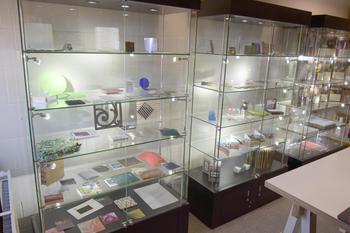
Because the activity centres on developing a particular attitude, it could be argued that anything could be displayed. This would be unsustainable as an approach, so consideration was given to those that had particular sensory qualities, including those that could spark imaginative flights of fancy. We have a piece of a meteorite, a stuffed kingfisher. It was also important to incorporate the everyday and familiar, so that the process of displaying them as museum exhibits created an aura that removed them from the mundane. A pine cone for example, or some pebbles, offcuts of metal and so forth. Items with particular textures and weights, objects that embody contradiction. A piece of metal that looks really heavy but is in fact amazingly light for example, wood that bends. (Fig. 1)
The materials collection in the UCA library.

Alongside these items, we displayed artists’ books, as a way of drawing attention to the importance of materiality in the meanings of such artefacts. Access was found to a supply of samples of smart and sustainable materials. This was a category unforeseen in the initial conception of the collection, but has proved very popular. As well as the sensoaesthetic qualities offered by these materials, we can include metadata that links them to information surrounding functional and structural qualities. This is hosted online. UCA has its own streaming service, where images of the appropriate exhibits are stored along with links, accessed by a QR code on the guide that accompanies the collection.
Using the collection
One must be able to lose oneself occasionally if one wants to learn from things different from oneselfFootnote 11
The collection has attracted interest from the academic community here, and timetabled sessions are incorporated into the relevant study modules. Three courses in particular have been actively involved: an MA in Crafts and Design, an undergraduate textiles degree and a creative writing course. Three different sessions were planned, designed to reflect the academic context of each group. Each session started with an activity that introduced the idea of haptic learning. Each student had a large brown envelope inside of which was an object, a pencil and a piece of paper. After assurances that the objects were all ‘benign’, the students were asked to put their non-dominant hand into the bag, and draw through touch what they felt inside. The objects ranged from material that had indefinite form, to a toy car and a boat. Those who had indeterminate objects took much longer to produce an image than those who had the car for example, who in discussion realized that as soon as they recognized it, they stopped haptic exploration and completed it from schema they already had concerning the class of object. This was common to all these sessions.
Participants in the workshops were asked to explore the artefacts with their senses, paying attention to texture, feel, smell and sound. Also, they were encouraged to imagine possible uses for the objects, to create fictional narratives or histories, and to express the results of their engagement in whatever way they liked. The MA class worked in small groups, and each one responded in a strikingly different way. One group photographed an artefact, and digitally manipulated it to enhance different colours and light effects. Another cast themselves as a team of archaeologists struggling to interpret the cultural and symbolic use of a square of white marble, whilst a third enacted a small scene to determine whether or not a pine cone had consciousness as it closed up at night.
A second set of engagements surrounded the textile students. The group comprised of weavers and printers, and were much more absorbed in the haptic responses they had to the items. They had elected to work individually. Their tutor invited me to see the end of the year show for that department, and the results of the engagement with the materials collection were plain to see in the patterns and fabric structures of the textile, especially as many of them had taken photographs of artefacts that particularly appealed to them and exhibited those images alongside the finished work. In the third course, that of creative writing, the students again worked individually. This session had much more of a directed brief from the tutor, who also sat in on the session. The students produced either short stories or poems, either directly reflecting the relationship with the whole artefact, attributing an identity to it, or in response to a particular haptic quality.
Developing the Collection
Together Lyotard and Irigaray remind us that letting go of conceptual knowledge can be the condition for renewing the activity of thinking and for bringing other ways of relating to the world into play.Footnote 12
The biggest factor that will influence the development of the collection is how it is being used. Keeping records of group and individual engagements will bring into relief new areas and conceptions into which the collection can develop. Promoting the collection away from 3D making and fine art to other areas of the university, film production, animation and photography, for example, will suggest developments in response to the lens based arts interactions with materiality. The digital presence of the collection is still under development , but must be seen as adding value to haptic explorations, rather than being presented as a substitute experience. Initially the digital platform will provide a space where functional and physical aspects of the material may be supplied via links. However high quality and well constructed photographs can also explore the visual potential of the items. Overall though, the collection will develop through questions. Questions about the nature of materiality, the relationship between the irrationality of haptic experience and the structure of critical thought, and the developing dialogues between the studio, the library and arts based research.