Introduction
Tuberous sclerosis complex (TSC) is a genetic disorder characterized by tumour-like lesions called hamartomas in the skin, brain, heart, kidneys and other organs. The brain lesions (cortical tubers and subependymal nodules) develop during embryogenesis and can be identified prenatally (Orlova & Crino, Reference O'Callaghan, Harris, Joinson, Bolton, Noakes, Presdee, Renowden, Shiell, Martyn and Osborne2010). Later, usually in the early postnatal period, some cortical tubers or perituberal cortex act as epileptogenic foci and are associated with an increased risk for epilepsy, intellectual impairment and behavioural disturbances. TSC is caused by a mutation in either the TSC1 gene on chromosome 9 (which codes for the protein hamartin) or in the TSC2 gene on chromosome 16 (which codes for tuberin). However, in addition to the primary mutation event, somatic mutations in the second allele occur at random within progenitor cells during embryogenesis, giving rise to clonal abnormalities. These clonal abnormalities ultimately give rise to the development of hamartomas (Green et al. Reference Green, Smith and Yates1994; Crino et al. Reference Crino, Aronica, Baltuch and Nathanson2010). The TSC proteins hamartin and tuberin form a heterodimeric complex involved in intracellular signalling and the activation of mTORC1 (Huang et al. Reference Huang, Dibble, Matsuzaki and Manning2008) which regulates the initiation of protein synthesis via the S6 kinase pathway and via regulation of 4E-BP (eIF4E binding protein). Thus, through these and other signalling pathways TSC genes play an important role in the regulation of cell proliferation and differentiation, dendritic and axonal growth and synaptogenesis and plasticity (Kwiatkowski, Reference Kwiatkowski2003; Huang et al. Reference Huang, Dibble, Matsuzaki and Manning2008; Orlova & Crino, Reference O'Callaghan, Harris, Joinson, Bolton, Noakes, Presdee, Renowden, Shiell, Martyn and Osborne2010).
Individuals with TSC develop a diverse array of physical, cognitive and behavioural manifestations with marked variability in phenotypic expression (Harrison & Bolton, Reference Harrison and Bolton1997). Brain involvement is evident in over 90% of cases, but the number of cortical tubers varies from none to ≥50. Approximately 90% of individuals with TSC develop epilepsy, with seizures usually beginning within the first year of life. Infantile spasms are common but various other seizure types occur and the epilepsy can be very difficult to control (Yates et al. Reference Winterkorn, Pulsifer and Thiele2011). Approximately 50% of individuals develop an intellectual disability, which can range from mild to profound (Gillberg et al. Reference Gillberg, Gillberg and Ahlsen1994; Harrison & Bolton, Reference Harrison and Bolton1997; Joinson et al. Reference Joinson, O'Callaghan, Osborne, Martyn, Harris and Bolton2003).
Several studies have reported that TSC2 mutations are associated with a more severe phenotype and a higher risk of intellectual impairments (Dabora et al. Reference Dabora, Jozwiak, Franz, Roberts, Nieto, Chung, Choy, Reeve, Thiele, Egelhoff, Kasprzyk-Obara, Domanska-Pakiela and Kwiatkowski2001; Winterkorn et al. Reference van Eeghen, Chu-Shore, Pulsifer, Camposano and Thiele2007; Jansen et al. Reference Jansen, Braams, Vincken, Algra, Anbeek, Jennekens-Schinkel, Halley, Zonnenberg, van den Ouweland, van Huffelen, van Nieuwenhuizen and Nellist2008a ). In addition, several reports have suggested that the number and distribution of cortical tubers is associated with the risk, severity and age of onset of epilepsy, as well as the risk for intellectual and behavioural abnormalities (Shepherd et al. Reference Shepherd, Houser and Gomez1995b ; Bolton & Griffiths, Reference Bolton and Griffiths1997; Goodman et al. Reference Goodman, Lamm, Engel, Shepherd, Houser and Gomez1997; Harrison et al. Reference Harrison, O'Callaghan, Hancock, Osborne and Bolton1999; Bolton et al. Reference Bolton, Park, Higgins, Griffiths and Pickles2002; Curatolo et al. Reference Curatolo, Verdecchia and Bombardieri2002; O'Callaghan et al. Reference Numis, Major, Montenegro, Muzykewicz, Pulsifer and Thiele2004; Doherty et al. Reference Doherty, Goh, Poussaint, Erdag and Thiele2005; Raznahan et al. Reference Raznahan, Higgins, Griffiths, Humphrey, Yates and Bolton2006, Reference Peters, Taquet, Prohl, Scherrer, van Eeghen, Prabhu, Sahin and Warfield2007; Kassiri et al. Reference Kassiri, Snyder, Bhargava, Wheatley and Sinclair2010). Furthermore , the type and severity of seizures appears to be associated with the likelihood of intellectual and behavioural problems (Jambaque et al. Reference Jambaque, Cusmai, Curatolo, Cortesi, Perrot and Dulac1991, Reference Jambaque, Chiron, Dumas, Mumford and Dulac2000; Shepherd & Stephenson, Reference Shepherd, Houser and Gomez1992; Gillberg et al. Reference Gillberg, Gillberg and Ahlsen1994; Jóźwiak et al. Reference Jóźwiak, Goodman and Lamm1998; Bolton et al. Reference Bolton, Park, Higgins, Griffiths and Pickles2002; Bolton, Reference Bolton2004; Zaroff et al. Reference Yates, Maclean, Higgins, Humphrey, le Marechal, Clifford, Carcani-Rathwell, Sampson and Bolton2006; Winterkorn et al. Reference van Eeghen, Chu-Shore, Pulsifer, Camposano and Thiele2007; Jansen et al. Reference Jansen, Vincken, Algra, Anbeek, Braams, Nellist, Zonnenberg, Jennekens-Schinkel, van den Ouweland, Halley, van Huffelen and van Nieuwenhuizen2008b ; van Eeghen et al. Reference Tillema, Leach, Krueger and Franz2012), and may be an independent predictor of intellectual ability (Jansen et al. Reference Jansen, Vincken, Algra, Anbeek, Braams, Nellist, Zonnenberg, Jennekens-Schinkel, van den Ouweland, Halley, van Huffelen and van Nieuwenhuizen2008b ; Kaczorowska et al. Reference Kaczorowska, Jurkiewicz, Domańska-Pakieła, Syczewska, Lojszczyk, Chmielewski, Kotulska, Kuczyński, Kmieć, Dunin-Wąsowicz, Kasprzyk-Obara and Jóźwiak2011).
However, there have been very few studies that have examined the interplay between risk factors in the emergence of cognitive, intellectual and behavioural impairments (although see Jansen et al. Reference Jansen, Braams, Vincken, Algra, Anbeek, Jennekens-Schinkel, Halley, Zonnenberg, van den Ouweland, van Huffelen, van Nieuwenhuizen and Nellist2008a , Reference Jansen, Vincken, Algra, Anbeek, Braams, Nellist, Zonnenberg, Jennekens-Schinkel, van den Ouweland, Halley, van Huffelen and van Nieuwenhuizen b ; Numis et al. Reference Muthén and Muthén2011). The studies that have been conducted have had to rely on clinically ascertained samples, simple estimates of intellectual ability and retrospective information on epilepsy, thus the conclusions that could be drawn were necessarily limited. It is clear therefore, that multivariate analysis of prospective longitudinal data incorporating all the key risk factors would represent a major step forward in the delineation of the developmental risk pathways and the characterization of the ontogeny of gene–brain–mind relationships in TSC. Here we report on the predictors of intellectual outcome from the Tuberous Sclerosis 2000 (TS 2000) Study, a population-based longitudinal study of TSC providing prospective data on genotype, brain involvement and systematically assessed seizure severity and intellectual ability (Yates et al. Reference Winterkorn, Pulsifer and Thiele2011).
Method
Study design
The TS 2000 Study is a population-based, prospective longitudinal study of the natural history of TSC (Yates et al. Reference Winterkorn, Pulsifer and Thiele2011). The study was approved by a Multicentre Research Ethics Committee and by Local Research Ethics Committees for the participating centres.
Sample recruitment
Children aged 0–16 years resident in the UK with definite or possible TSC diagnosed between 1 January 2001 and 31 December 2005 were ascertained through paediatricians, paediatric neurologists and clinical geneticists and the UK Tuberous Sclerosis Association by mailing at the start of the recruitment period and annually thereafter. Current diagnostic criteria were used (Roach et al. Reference Ridler, Suckling, Higgins, De Vries, Stephenson, Bolton and Bullmore1999) and cases with a possible diagnosis of TSC were included because young children with TSC do not always meet the criteria for a definite diagnosis when they first present. Written informed consent was obtained (for full details see Yates et al. Reference Winterkorn, Pulsifer and Thiele2011).
Assessments and measures
Children were reviewed by clinicians with experience of TSC in a network of clinics covering the UK. At the initial recruitment assessment a full medical history was obtained and a physical examination carried out using a standardized protocol. Full details of the study assessment protocol have been reported elsewhere (Yates et al. Reference Winterkorn, Pulsifer and Thiele2011).
Genetic testing and mutation analysis
Genotyping was carried out by the two diagnostic laboratories providing TSC mutation testing in the UK (East Anglian Medical Genetics Service, Addenbrooke's Hospital, Cambridge and the Institute of Medical Genetics, Cardiff; Yates et al. Reference Winterkorn, Pulsifer and Thiele2011). Samples were tested for whole exon deletions (including TSC2/PKD1) by multiplex ligation-dependent probe amplification (MLPA; MRC-Holland, The Netherlands). The causal mutation was determined for 96 children. In seven children a pathogenic mutation could not be identified and in 22 children genetic testing was not performed.
Brain imaging
Whenever possible, copies of all clinical brain scans were obtained from the hospitals where imaging had been conducted. The scans were reviewed and rated without knowledge of other clinical details by J.N.P.H. using a pre-specified coding system that recorded the number and lobar location of cortical tubers and the presence of subependymal nodules. The inter-rater reliability of this procedure has previously been shown to be acceptable (Bolton et al. Reference Bolton, Park, Higgins, Griffiths and Pickles2002). Tuber count was summated for each major lobe of the brain.
Epilepsy
A detailed seizure history was obtained from the parents using a specially devised epilepsy interview schedule that enquired about the manifestations of possible seizures. Parents were also given a seizure diary to record seizure type and frequency over a 2-week period, as well as the drug regimen and medication changes. Details from the parent interview were cross-checked against and supplemented with information from contemporaneous medical records and the summary information was used to determine the key features of the epilepsy. Age of onset and details of seizure type, frequency, duration and response to treatment were gathered for three time periods: the first and second year of life and for the 3-month period leading up to the last contact with the family (denoted as the ‘current’ seizure period). Medical notes and parent narratives were reviewed and scored by three independent raters (P.F.B., M.C., B.N.). Consensus coding was established by two of the raters reviewing the narratives. For most of the patients there were multiple sources of information for each time period. When there was a disagreement, additional information from doctors and the family was obtained to identify the most valid score. Using this information, seizure severity scores were calculated using the Early Childhood Epilepsy Severity Scale (E-Chess; Humphrey et al. Reference Humphrey, Ploubidis, Yates, Steinberg and Bolton2008), a six-item inventory developed for the TS 2000 Cohort Study that combines different features of the epilepsy history to generate a seizure severity score. Total scores (increasing with severity) are based on seizure frequency, time period over which seizures occur, number of seizure types, history of status epilepticus, number of anti-epileptic drugs used, and response to treatment.
Intelligence and adaptive behaviours
A team of trained psychologists carried out age-appropriate intellectual, cognitive and behavioural assessments. Intellectual abilities were assessed using the Mullen Scales of Infant Development in participants up to 68 months of age (n = 55) (Mullen, Reference Mullen1995). The assessments were undertaken at or around the age of 2 years or at recruitment if the child was aged >2 years at the time of diagnosis. Adaptive level was assessed using the Vineland Adaptive Behaviour Scales extended survey parental interview (Sparrow et al. Reference Shepherd and Stephenson1984) (n = 113). The Vineland adaptive composite scores were used to estimate IQ when the child was above the recommended age for administration of the Mullen test (n = 35). In addition, the Vineland test was used when administration of the Mullen test was not possible (n = 5), or when the Mullen standard score was at ‘floor’ level (n = 26). In order to check the validity of this procedure, we examined the association between Mullen standard score and Vineland adaptive composite score in the group of 73 individuals who had scores on both tests, confirming a significant correlation (r = 0.72, p < 0.001), similar to correlations between the Vineland adaptive behaviour score and WISC-III/WAIS-R (r = 0.76; Joinson et al. Reference Joinson, O'Callaghan, Osborne, Martyn, Harris and Bolton2003). Using this approach an estimated IQ was available for 121 children.
Data analysis
Data were checked for skewness using the ‘sktest’ function in Stata v. 10 (StataCorp, USA). Univariate and multivariate analyses were undertaken using non-parametric and parametric tests including Spearman's correlation coefficient, Mann–Whitney U test, analysis of variance, and t tests of means in Stata. Structural equation modelling was conducted using MPlus 6 (Muthén & Muthén, 2010 ). Structural equation modelling allows the construction of latent variables, which are estimated from several measured variables. For example, tuber burden was estimated on the basis of the correlation between tuber counts in each lobe of the brain and therefore reflects tuber ‘load’ as well as any correlated brain involvement more generally.
To provide robust estimates and to account for missing values, full information maximum likelihood estimation with robust standard errors was used. Significance levels are for two-tailed tests unless otherwise stated.
Results
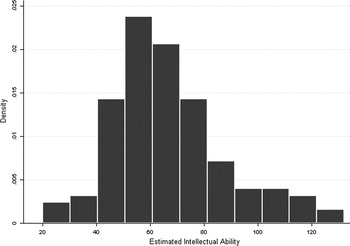
There were 125 children in the sample with a definite diagnosis of TSC based on clinical criteria and/or the presence of a pathogenic TSC1 or TSC2 mutation, comprising 63 females and 62 males. Fig. 1 illustrates the distribution of estimated IQ. The distribution exhibited significant positive skew (p = 001), but no significant kurtosis (pr = 0.22). A square root transformation normalized the data. (See online Supplementary material for the distribution of estimated IQ by genotype.)
Frequency distribution of estimated IQ.

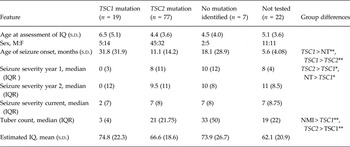
The sample characteristics by genetic subtype are summarized in Table 1. TSC2 mutations were highly significantly associated with cortical tuber count, earlier age of onset of seizures and seizure severity score during the first year of the child's life. Children with TSC2 mutations were more likely to have infantile spasms, status epilepticus, high seizure severity scores in the second year of life and the current period, and have a lower estimated IQ, although these differences did not reach statistical significance.
Age, sex and associated features of tuberous sclerosis complex by genetic subtype

IQR, Interquartile range; NT, not tested; NMI, no mutation identified; s.d., standard deviation.
*p < 0.05, **p < 0.01.
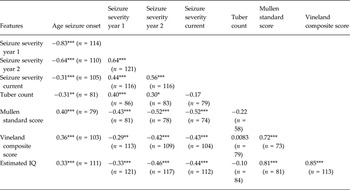
Table 2 summarizes the correlations between the different phenotypic features. A higher tuber count was associated with an earlier age of onset and severity of seizures. Both age of onset and severity of seizures were associated with lower Mullen and Vineland scores. The Vineland and Mullen scores were strongly correlated. There was not a significant association between tuber count and estimated IQ.
Correlations (ρ) between main phenotypic features

*p < 0.05, **p < 0.01, ***p < 0.001.
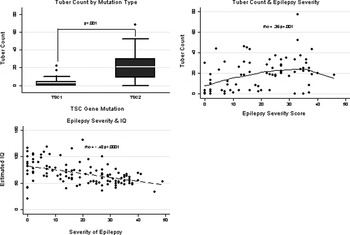
Examination of the features of epilepsy that were associated with estimated IQ, showed that age of seizure onset (ρ = 0.33, p < 0.001), history of infantile spasms (F = 11.34, df = 1, p = 0.001) and status epilepticus (defined as continuous seizures for ≥30 min: F = 5.8, df = 1, p = 0.018) were each significantly associated with lower estimated IQ. Multivariate analysis of variance indicated that among these three predictors, a history of infantile spasms (β = −0.69, s.e. 0.24, p = 0.005) and status epilepticus (β = −0.45, s.e. 0.22, p = 0.04) were the most strongly associated with estimated IQ and that in their presence, age of seizure onset was no longer significantly associated (β = 0.0006, s.e. 0.006, p = 0.9). However, none of these variables were significantly associated with estimated IQ in the presence of the epilepsy severity score (which incorporates aspects of these individual features of epilepsy history), which remained a significant predictor of intellectual ability. However, among children without a history of infantile spasms and/or status epilepticus (n = 41) the epilepsy severity scores in years 1, 2 and currently were not associated with intellectual outcome (ρ = −0.21, p = 0.18). By contrast, the epilepsy severity score in those with a history of spasms or status epilepticus (n = 71) was significantly associated with estimated IQ (ρ = −0.4, p = 0.006). This was evidence that features of the infantile spasms and status epilepticus , such as duration and frequency of spasms, response to treatment and number of drugs used to treat, were predictive of outcome. However, the interaction term for epilepsy severity by presence/absence of spasms/status epilepticus did not reach significance. Fig. 2 illustrates the key bivariate associations linking genotype to tuber count, epilepsy severity and IQ. [See online Supplementary material for results of correlations between phenotypic features by genotype (TSC1, TSC2).]
Key bivariate associations.

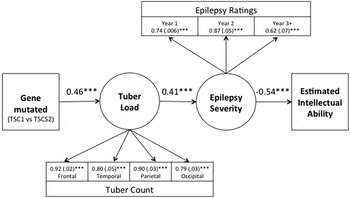
In order to determine the structure underlying these inter-correlations, we analysed the data using latent variable and structural equation modelling implemented in MPlus. Fig. 3 summarizes the results of this modelling. The model fitted the data well (Comparative Fit index = 0.996, root mean square error of approximation = 0.23 ). It shows that there were highly significant paths linking TSC2 mutations to increased tuber load, which was then linked to greater seizure severity, which in turn was linked to intellectual impairments.
Structural equation model: gene mutated, tuber load, epilepsy severity and estimated IQ (Model: Comparative Fit index = 0.996, root mean square error of approximation = 0.23; standardized parameter estimates, ***p < 0.001) (only significant paths illustrated).

Further analyses indicated that there were weak but significant indirect associations linking the paths between type of genetic mutation and epilepsy severity (0.19, s.e. = 0.07, p = 0.01) and from type of genetic mutation through epilepsy severity to intellectual ability (−0.10, s.e. = 0.05, p = 0.03). Similarly, there were weak but significant indirect associations via the paths linking tuber count through epilepsy severity to intellectual ability (−0.22, s.e. = 0.09; p = 0.01).
Discussion
This study aimed to identify genetic, neurological and epilepsy-related risk factors for intellectual outcome in TSC and examine their interplay using multivariate modelling in the first prospective population-based study of TSC. The findings converge to indicate a significant pathway from genetic subtype, through tuber burden and through epilepsy severity, to intellectual outcome.
Estimated IQ showed a skewed unimodal distribution. This contrasts with the bimodal distribution reported in previous clinical (Winterkorn et al. Reference van Eeghen, Chu-Shore, Pulsifer, Camposano and Thiele2007) and epidemiological studies of TSC (Joinson et al. Reference Joinson, O'Callaghan, Osborne, Martyn, Harris and Bolton2003). Comparable methodological approaches were used in estimating IQ in the study by Joinson and colleagues and the current study, but the TS 2000 cohort comprised predominantly young children whereas the Joinson et al. study comprised adolescents and adults (Joinson et al. Reference Joinson, O'Callaghan, Osborne, Martyn, Harris and Bolton2003). It remains possible, therefore, that the difference in IQ distribution reflects developmental change, with IQ declining over time in a subset of cases. Declines in IQ in subgroups have been reported in TSC (Humphrey et al. Reference Humphrey, Neville, Clarke and Bolton2006, Reference Humphrey, MacLean, Ploubidis, Granader, Clifford, Haslop, Neville, Yates and Bolton2014; van Eeghen et al. Reference Tillema, Leach, Krueger and Franz2012; Jeste et al. Reference Jeste, Wu, Senturk, Varcin, Ko, McCarthy, Shimizu, Dies, Vogel-Farley and Sahin2014), although the limited available evidence suggests this mainly occurs in the first years of life (Humphrey et al. Reference Humphrey, Williams, Pinto and Bolton2004; Jeste et al. Reference Jeste, Wu, Senturk, Varcin, Ko, McCarthy, Shimizu, Dies, Vogel-Farley and Sahin2014) and therefore prior to the assessment of intellectual ability in our study sample. Another possibility is that advances in early identification and treatment of epilepsy in TSC have resulted in less morbidity and improved intellectual outcome, so that severe and profound impairments are less common. Clearly, further longitudinal investigations are required in order to delineate the specific risk factors and processes that are involved in intellectual development in TSC.
In line with previous work, individuals with a TSC2 mutation had a more severe phenotype in terms of the extent of brain involvement, as indexed by the number of cortical tubers, an earlier age of seizure onset and increased seizure severity in the first year. These associations have been noted in other studies, although not consistently (Au et al. Reference Au, Williams, Roach, Batchelor, Sparagana, Delgado, Wheless, Baumgartner, Roa, Wilson, Smith-Knuppel, Cheung, Whittemore, King and Northrup2007; Jansen et al. Reference Jansen, Braams, Vincken, Algra, Anbeek, Jennekens-Schinkel, Halley, Zonnenberg, van den Ouweland, van Huffelen, van Nieuwenhuizen and Nellist2008a , Reference Jansen, Vincken, Algra, Anbeek, Braams, Nellist, Zonnenberg, Jennekens-Schinkel, van den Ouweland, Halley, van Huffelen and van Nieuwenhuizen b ), which may reflect differences in methodology. In addition, a higher cortical tuber load was associated with an earlier age of onset of seizures and a more severe form of epilepsy during the first 2 years of life, which extends previous work that has noted an association between tuber count and age of seizure onset as well as presence of infantile spasms (Doherty et al. Reference Doherty, Goh, Poussaint, Erdag and Thiele2005; Jansen et al. Reference Jansen, Vincken, Algra, Anbeek, Braams, Nellist, Zonnenberg, Jennekens-Schinkel, van den Ouweland, Halley, van Huffelen and van Nieuwenhuizen2008b ).
This study also confirms previous research indicating associations between lower intellectual ability and early age of seizure onset, a history of infantile spasms and status epilepticus (Shepherd et al. Reference Roach, DiMario, Kandt and Northrup1995a ; Holmes & Stafstrom, Reference Holmes and Stafstrom2007; Raznahan et al. Reference Peters, Taquet, Prohl, Scherrer, van Eeghen, Prabhu, Sahin and Warfield2007; van Eeghen et al. Reference Tillema, Leach, Krueger and Franz2012), using contemporaneous reports of epilepsy. In addition, our composite measure of the severity of epilepsy was a better predictor of intellectual outcome compared to a history of infantile spasms or status epilepticus alone, which suggests that details about the frequency and duration of seizures contributes additional prognostic information. Our analysis did not show an association between tuber count and intellectual outcome, which is supported by previous work (e.g. Jansen et al. Reference Jansen, Vincken, Algra, Anbeek, Braams, Nellist, Zonnenberg, Jennekens-Schinkel, van den Ouweland, Halley, van Huffelen and van Nieuwenhuizen2008b ). Combined with evidence from animal studies, these findings raise the possibility that seizures may themselves have deleterious effects on structural and functional brain development and hence cognitive and intellectual development (Holmes, Reference Holmes2009).
Importantly, this work extended these proposed relationships by mapping the paths linking genetic abnormality with brain changes and intellectual deficits. These analyses were clear in showing significant paths from the type of genetic mutation to the extent of brain involvement, to the severity and persistence of epilepsy and to the degree of intellectual impairment. It was notable that there was no evidence for a direct path linking genotype with epilepsy severity and persistence. The findings suggest that our latent measure of tuber load is a key determinant of seizure severity and that the latent measure of seizure severity is a key association of intellectual outcome (Jansen et al. Reference Jansen, Vincken, Algra, Anbeek, Braams, Nellist, Zonnenberg, Jennekens-Schinkel, van den Ouweland, Halley, van Huffelen and van Nieuwenhuizen2008b ).
Data from preclinical animal research has indicated that TSC1 and TSC2 haplo-insufficiency can give rise to mTOR signalling abnormalities and neurocognitive deficits in the absence of tubers or epilepsy and that at least some of these neurocognitive deficits can be reversed with mTOR inhibitors (Ehninger et al. Reference Ehninger, Han, Shilyansky, Zhou, Li, Kwiatkowski, Ramesh and Silva2008). Accordingly, it has been suggested that in TSC, dysregulation of the mTOR pathways directly contributes to neurocognitive deficits (de Vries & Howe, Reference de Vries and Howe2007). However, the animal models do not fully ‘model’ the neuropathology seen in humans with TSC and as yet, reports on neurocognitive and behavioural outcomes in clinical trials of mTOR inhibitors lend only partial and limited support to this proposition (Franz et al. Reference Franz, Leonard, Tudor, Chuck, Care, Sethuraman, Dinopoulos, Thomas and Crone2006; Krueger et al. Reference Krueger, Care, Holland, Agricola, Tudor, Mangeshkar, Wilson, Byars, Sahmoud and Franz2010, Reference Krueger, Wilfong, Holland-Bouley, Anderson, Agricola, Tudor, Mays, Lopez, Kim and Franz2013; Tillema et al. Reference Sparrow, Balla and Cicchetti2012; Cappellano et al. Reference Cappellano, Senerchia, Adolfo, Paiva, Pinho, Covic, Cavalheiro and Saba2013). Our findings suggest that the pathophysiological mechanisms are more complex in humans and that epilepsy related to TSC neuropathology may also contributes to outcome. This conclusion is supported by the finding that the onset of infantile spasms is associated with a decline in intellectual ability (Humphrey et al. Reference Humphrey, MacLean, Ploubidis, Granader, Clifford, Haslop, Neville, Yates and Bolton2014), and that preventive treatment of seizures in tuberous sclerosis infants may improve intellectual outcome (Jóźwiak et al. Reference Jóźwiak, Kotulska, Domanska-Pakiela, Lojszczyk, Syczewska, Chmielewski, Dunin-Wasowicz, Kmiec, Szymkiewicz-Dangel, Kornacka, Kawalec, Kuczynski, Borkowska, Tomaszek, Jurkiewicz and Respondek-Liberska2011). Data from ongoing clinical trials will help clarify these important issues.
The results of this study have potentially important clinical implications. First, the findings indicate that the type of genetic mutation, the extent of brain involvement and the severity and persistence of epilepsy are informative with respect to prognosis. Second, the study provides strong support for an association between the severity of seizures, particularly infantile spasms, and intellectual impairment that is potentially causal. Since prenatal and early postnatal diagnosis of TSC before the onset of seizures is becoming increasingly common (Yates et al. Reference Winterkorn, Pulsifer and Thiele2011), this raises important questions about how these children should be monitored and whether there should be a randomized controlled trial of prophylactic treatment to prevent or delay the onset of epilepsy. There is already evidence from retrospective studies of improved cognitive outcomes in infants who are started on epileptic therapy when active epileptic discharges are first seen on EEG or very soon after the onset of clinical seizures (Bombardieri et al. Reference Bombardieri, Pinci, Moavero, Cerminara and Curatolo2010; Jóźwiak et al. Reference Jóźwiak, Kotulska, Domanska-Pakiela, Lojszczyk, Syczewska, Chmielewski, Dunin-Wasowicz, Kmiec, Szymkiewicz-Dangel, Kornacka, Kawalec, Kuczynski, Borkowska, Tomaszek, Jurkiewicz and Respondek-Liberska2011). In a mouse model of TSC, it has been shown that mTOR inhibitor treatment can prevent the onset of seizures and prolong survival (Zeng et al. Reference Zaroff, Barr, Carlson, LaJoie, Madhavan, Miles, Nass and Devinsky2008). Current guidelines on the management of epilepsy in TSC emphasizes the importance of early recognition and prompt treatment of epilepsy (Curatolo et al. Reference Curatolo, Józwiak and Nabbout2012).
The main limitation of our study lies in the fact that the brain-imaging data were derived from clinical investigations undertaken in different centres using different procedures and at different points in development. Moreover, details about seizures prior to the diagnosis of TSC necessarily had to be gathered from contemporaneous reports and retrospective parent account. Further research that assesses these parameters in a prospective longitudinal design, especially prior to seizure onset, is therefore warranted (Humphrey et al. Reference Humphrey, MacLean, Ploubidis, Granader, Clifford, Haslop, Neville, Yates and Bolton2014). The main caveat in interpreting these findings resides in the measurement of the mediating variables (extent of brain involvement, epilepsy persistence and severity). In particular, we cannot exclude the possibility that unmeasured aspects of the brain changes may have independent direct associations with IQ (Ridler et al. Reference Raznahan, Joinson, O'Callaghan, Osborne and Bolton2001, Reference Ridler, Bullmore, De Vries, Suckling, Barker, Meara, Williams and Bolton2007; Peters et al. Reference Orlova and Crino2013). This question can only be resolved by performing more systematic and detailed brainimaging studies in the sample. Nevertheless, our study has several strengths over previous work, through systematic assessment with standardized and semi-standardized measures. Epilepsy assessments were repeated over time and therefore were likely to accurately capture information on the type and severity of seizures during different periods of development.
In conclusion, this is one of the few studies to assess the combined and specific influences of genetic, neurological and neurophysiological risk factors on intellectual outcome within a large prospective population-based cohort of newly diagnosed cases of TSC. The findings confirm the key role of seizure severity on IQ, in a potential cascading risk pathway from gene through tuber burden through seizure severity through intellectual outcome. Delineating the risk mechanisms that lead to intellectual disability in TSC has important implications for prognosis and treatment.
Appendix. Members of the Tuberous Sclerosis 2000 Study Group
V. Attard, A Clarke, F. V. Elmslie, A. K. Saggar, St George's Hospital, London; D. Baines, B. A. Kerr, Royal Manchester Children's Hospital, Manchester; C. Brayne, Institute of Public Health, University of Cambridge; I. Carcani-Rathwell, C. Connolly, A. Lydon, C. Srivastava, Institute of Psychiatry, King's College London; J. A. Cook, Sheffield Children's Hospital, Sheffield; C. Falconer, St James's University Hospital, Leeds; D. M. Davies, J. R. Sampson, Institute of Medical Genetics, Cardiff; A. E. Fryer, Alder Hey Children's Hospital, Liverpool; M. Haslop, Y. Granader*, University of Cambridge (*currently Yeshiva University, New York); P. D. Griffiths, University of Sheffield; A. Hunt, Tuberous Sclerosis Association; W. W. K. Lam, Western General Hospital, Edinburgh; J. C. Kingswood, Royal Sussex County Hospital, Brighton; Z. H. Miedzybrodzka, College of Life Sciences and Medicine, Aberdeen; H. Crawford, P. J. Morrison, Belfast City Hospital; F. J. K. O'Callaghan, University of Bristol; S. G. Philip, Birmingham Children's Hospital, Birmingham; S. Seri, Aston Brain Centre, School of Life and Health Sciences, Aston University, Birmingham; R. Sheehan-Dare, The General Infirmary, Leeds; C. H. Shepherd, Craigavon Area Hospital, Craigavon.
Supplementary material
For supplementary material accompanying this paper visit http://dx.doi.org/10.1017/S0033291715000264.
Acknowledgements
This study was funded by a grant to John Yates and Patrick Bolton from the UK Tuberous Sclerosis Association, a grant to John Yates from the Isaac Newton Trust and a grant to Patrick Bolton from The Bailey Thomas Charitable Trust. Patrick Bolton is a NIHR Senior Investigator and was supported by the UK National Institute of Health Research Biomedical Research Centre in Mental Health at the South London & Maudsley NHS Trust & Institute of Psychiatry. We thank all the families for their time and help with this study.
Declaration of Interest
None.