Introduction
At a 2004 banquet in San Juan for the Latin American Free Trade Zones Committee Conference, Richard Bolin gave a celebratory speech in honor of Puerto Rico. Bolin and his colleagues understood Operación Manos a la Obra (Operation Bootstrap), launched in the late 1940s, as the economic plan that had established the first fully formalized enclave for the manufacture of cheap exports. Around well-appointed tables, elites from finance, trade, and government applauded Puerto Rico for creating the model of what had come to be called export processing zones (EPZs).Footnote 1
In 1942, the US and Puerto Rican governments had hired the firm Arthur D. Little for a study of industrial possibilities.Footnote 2 The consultants carried forward their recommendations into the projects and policies that became Operation Bootstrap. Bolin had been a lead consultant and lived in Puerto Rico during the 1950s to help coordinate it. He went on to guide the 1960s development of the Border Industrialization Program (BIP) in Mexico, known as “the maquiladoras.” In the 1970s, Bolin worked with the United Nations (UN) to create the World Export Processing Zone Association (WEPZA).Footnote 3 For people sitting in that 2004 banquet hall, twenty-first century “free trade” special economic zones (SEZs) traced to Operation Bootstrap. This focus on the postwar period accorded EPZs and SEZs the mark of modern business legitimacy and reinforced the rationale of advanced nations bringing scientific development to the Global South.
The roots of EPZs and SEZs, however, run much deeper—to the initial years of US colonialism in Puerto Rico at the turn of the twentieth century. Puerto Rico opened up new possibilities because the 1898 Treaty of Paris did not address territorial incorporation. Decades of experimentation with duties and tariffs, investment, taxes, banking, subsidies, labor laws, wages, migrations, and lines of sovereignty and citizenship established colonial infrastructure that financial, industrial, and government agencies admired and adapted for Operation Bootstrap. The imperial experimentation started in 1898 and continued through the liberal economic policies of the New Deal and World War II, consistently reproducing Puerto Rico as a site for drastic exceptions.Footnote 4 These exceptions were neither permanent nor complete, but the constant rearrangement of sovereignty and citizenship—what was or was not included and enforced—established Puerto Rico as a site of potential and persistent exemption.
Labor unions and aggrieved workers contested and resisted this colonial industrialization. They advocated their own proposals and pushed against US economic policies and insular business management. Throughout these fights, the asymmetrical power of the federal government and industrial capital allowed the colonial regime to repeatedly assert US sovereignty while continually realigning exemptions for Puerto Rico and redefining citizenship for liberal economic objectives. Rather than representing a weakening of the nation-state, this strong interventionist approach provided the scaffolding for Operation Bootstrap and the later neoliberal projects, EPZs and SEZs.
Puerto Rican needleworkers were central to this colonial industrialization—not as dormant labor awaiting outside developmental forces but as skilled workers experienced in production. US trade agents and manufacturers immediately noted the intricate needlework of Puerto Rican women and their employment in homes and small shops for contractors across the island. US colonialism did not transplant industrialization to Puerto Rico—instead, it positioned needleworkers and their contract manufacturing within the US Atlantic textile and garment industry as a particular but interconnected option for investors and manufacturers. The women also knew how to train, move, organize, and strike for better wages and conditions. Their labor and demands shaped the erratic if ongoing establishment of a colonial infrastructure that was then adapted for Operation Bootstrap.
The malleable parameters of their colonial citizenship were crucial to the creation of EPZs and SEZs as well. In 1917, Congress enacted US citizenship for Puerto Ricans but with exemptions when they were in the archipelago, where the accessible rights and resources changed throughout the twentieth century.Footnote 5 Women needleworkers navigated and migrated through the shifting lines of sovereignty and citizenship because they made the most of available opportunities. On Puerto Rico, they were lowest-wage labor in a demarcated system dominated by contracting. On the mainland, they were mobile lower-wage labor taking advantage of the comparatively better pay, inadvertently participating in an overall downward spiral of wages.
Their northward migrations as well as the movements of capital contributed to the scaffolding for Operation Bootstrap. When US labor history focuses its lens on colonial industries and Puerto Rican needleworkers, it challenges the dominant historiographical narrative of deindustrialization, in which capital and manufacturing relocated in a direct line from the Northeast to the South on the US mainland to a final stage in the Global South.Footnote 6 To be sure, scholars of Puerto Rico have written extensively about workers, union organizing, and the labor movement.Footnote 7 Centering the women and insular industry in US history does not contradict their work or subsume Puerto Rico in US historiography. Rather, it is an effort to study the United States as an imperial power in which many workers labored and migrated, and which had consequences for the metropole as well as for the colonies and global trade.Footnote 8
US labor historians Eileen Boris, Aviva Chomsky, and Jefferson Cowie have also highlighted the relevance of Puerto Rico to industrial history. Boris and Chomsky argue Puerto Rico became part of the US textile and garment industry during the 1920s and 1930s as a site of “export-oriented industrialization.” Chomsky also states Operation Bootstrap was the precursor to EPZs. In his book about RCA, Cowie connects Bolin and Arthur D. Little to the BIP in Mexico and the rejection of import-substitution for “a neo-liberal development model.” He notes Bolin helped Puerto Rico set up a similar program. These historians do not, however, trace the economic connections back to earlier colonial governance.Footnote 9 In addition, Cowie's study of an RCA factory through three relocations complicates the declension narrative of deindustrialization but still presents a linear transfer of manufacturing from the Northeast to the South to Mexico.
A reconsideration of the roots of EPZs and SEZs and the direct linear paradigm leads to a rethinking of the neoliberal turn. Intellectual and political histories of neoliberalism often focus on the debates and ideas coming from hegemonic elites, like Friedrich von Hayek, the Mont Pèlerin Society, the Chicago School, and Ronald Reagan and Margaret Thatcher.Footnote 10 Although elites were crucial to the proliferation of “free trade” projects, these histories can obscure the importance of the pragmatic scaffolding, the arrangements developed through the quotidian operations of manufacturing and trade for US imperial ambitions. Studying the history of these bureaucratic and technical functions reveals that certain capitalist strategies associated with the neoliberal turn emerged much earlier.
Early colonial experimentation
Federal government and business experiments with Puerto Rico began immediately after the occupation, and pulled the island into a disaggregating array of US textile and apparel enterprises. Disaggregation denotes the twentieth-century process of breaking manufacturing and trade into more and more separate steps while constantly rearranging these around the world to achieve the highest rate of return for any given time.Footnote 11 As with the South after the Civil War and the West during conquest, commerce was a top priority in Puerto Rico. When US occupation in July 1898 ended the Spanish empire's recent implementation of an insular constitution, a series of generals served as appointed governors until 1900. The War Department established the Division of Customs and Insular Affairs (DCIA), which started collecting duties and implementing numerous trade policies. The DCIA increased Cuban tariffs on tobacco and coffee entering from Puerto Rico, but Congress did not open North American markets. Since tobacco and coffee were two of the top products the island had exported to Cuba, these tariffs reshaped Puerto Rico's economy. The loss of trade drove landowners from coffee to sugar and women in the coffee region to more needlework to make up the lost income.Footnote 12
The development of this commercial infrastructure for Puerto Rico was not neutral. As the United States implemented the legislation, policies, and offices it conceived as necessary for colonial governing, measuring, taxing, and investing, it relied on and reconstituted racial formations at the intersection of Spanish Caribbean and US conceptions of race and gender.
Press releases, government memos, magazine photographs, and world's fairs represented Puerto Rico as backward and primitive but not aggressive, fostering a narrative of colonial benevolence. Early US political and economic authority relied on this embedded cultural narrative of Puerto Rican people as a “dark Other”—childlike, impoverished, uneducated, dependent—even as government and business leaders collaborated with criollo elites.Footnote 13 These elites had advanced formal education, cosmopolitan experiences, and highly concentrated wealth. The cultural narrative endured, and free trade advocates used it to promote EPZs and SEZs even as they collaborated with elites in the Global South.Footnote 14
During these early years of occupation, textile and apparel businesses took note of Puerto Rican needleworkers. The revitalized US cotton regime, from plantations to textiles to retail, was a primary engine for the nation's global ambitions.Footnote 15 Possibilities for utilizing Puerto Rican needleworkers in US industry quickly became clear. Puerto Rican girls participated in a tradition of Spanish needlework, learning needlepoint, embroidery, and fine hand sewing. Affluent women continued this tradition as an expression of gentility, while poor girls and women completed piecework for a system of contracting agents. They produced “exquisite table linens, lingerie, dresses, blouses, handkerchiefs, and dress accessories” with embroidery, lace, and drawn work for agents who traveled rough city streets and rural lanes. By the end of 1898, US importers and department stores were buying finished products. Within a few years, manufacturing companies with fine finishing and embroidery in their nightgowns, handkerchiefs, and home goods were using island agents to contract needleworkers for prescribed orders.Footnote 16
The 1901–1902 Inter-State and West Indian Exposition in Charleston, South Carolina, exemplifies how “diverse actors on the metropolitan homefront” impacted the unfolding of colonial industrialization in Puerto Rico.Footnote 17 It also highlights the impact of imperialism on the metropole, with the realignments of finance, manufacturing, and transportation. In 1899, South Carolina cotton growers and manufacturers, with the assistance of local and state politicians, launched a fundraising and exhibit drive for an exposition in Charleston. Their objective was not a world's fair. They wanted to cultivate economic ties between the South, the Northeast, and the Caribbean with South Carolina as a hub (see Figure 1). The exposition booklet, written by and for industrial, financial, and political leaders, stated the event would afford “a splendid opportunity for the extension of industrial and commercial enterprise. . . . There is a fine field in Porto Rico for American occupation—not occupation by arms, or as the result of military conquest, but occupation by the merchants and manufacturers of the United States.”Footnote 18
Pamphlet for the exposition in Charleston
Photo courtesy of the author, pamphlet from the Osborne Library, American Textile History Museum

Puerto Rico received a great deal of attention from the Charleston Exposition planners. The Special West Indian Commissioner traveled to Ponce, Yauco, and San Juan, where he met with the Chamber of Commerce. An article in the promotional magazine celebrated the fine embroidery of Señorita Herminia Davila, who ran a school for needlework. In the article, Davila said the embroidery of Puerto Rico was unlike any in the United States because it had been “cultivated among the young society girls.” She knew to emphasize the distinctive quality of the art embroidery rather than the piecework and low-wage contract system. A few issues of the magazine noted Puerto Rican needlework would be shown at the exposition and invited cotton planters, politicians, and textile, garment, and hosiery companies from throughout the United States.Footnote 19 As a public expression of emerging US colonial relations with Puerto Rico, the Charleston Exposition helped to articulate the island as a commercial resource that could provide manufacturing with skilled women workers for business interests along the US Atlantic.
At the same time, Puerto Rican workers were launching their own organizations and alliances to influence US occupation. Many low-income and rural workers initially welcomed the United States because they had concerns about the demands for immediate self-rule from Puerto Rican elites. They feared independence would entrench criollo hacendado exploitation of the poor. In 1901, the Federación Libre de Trabajadores (Free Federation of Workers, FLT) even formed an affiliation with the American Federation of Labor (AFL).Footnote 20 Despite tensions within the Puerto Rican labor movement and between metropolitan and insular unions, these labor relationships continued to the postwar period.Footnote 21 They impacted manufacturing and trade practices, especially during the Great Depression.
Crucial provisions in three early acts of governance served to constitute Puerto Rico as a site of potential and persistent exemptions. Although the authors understood they were assuming a role in US imperialism, these initial enactments represent a mode of experimentation with Puerto Rico. As Ann Laura Stoler argues, colonial administration is saturated with “uncertainty and doubt” as people throughout the regime have to “‘catch up’ with what is emergent and ‘becoming’ in new colonial situations.”Footnote 22 The Foraker Act (1900), Downes v. Bidwell (1901), and the Hollander Act (1901) conveyed this anxiety even as they converged to construct important aspects of the colonial scaffolding used by Operation Bootstrap.
A detailed history of US imperial governance in Puerto Rico lies beyond the scope of this article. However, a brief analysis of specific provisions illuminates the importance of early colonial practices to postwar neoliberal projects. The provisions did not set hard unchanging codifications, but rather initiated a routine of exempting Puerto Rico from constitutional, regulatory, or national frameworks as deemed necessary by the metropole, often but not always in contentious collaboration with relevant insular elites.
The Foraker Act instituted the fundamental aspect of colonial infrastructure later adapted for EPZs: the nation-state deployment of sovereignty for exemption from its own established laws. This power, rather than an uninhibited “free flow” of capital and goods, sits at the center of EPZs and SEZs. The Foraker Act created an appointed civilian government for Puerto Rico as part of the United States yet implemented a tariff on goods coming from the archipelago despite the Constitution's “uniformity clause.”Footnote 23 This clause and related Supreme Court cases had prohibited tariffs between parts of the United States. With the Foraker Act, Congress asserted the ability of the federal government to disregard its own Constitution and legal precedents in one site even as it maintains them elsewhere.Footnote 24
Some scholars emphasize the eventual lifting of this tariff and argue the removal launched the start of “free trade” with Puerto Rico, indicating things to come.Footnote 25 This perspective aligns with the narrative of globalization as a relentless expansion of free flows of capital and trade rather than as a contested and limited process of coalescing power and capital.Footnote 26 The eventual tariff removal, however, mattered less for colonial experimentation and future neoliberal trade projects than its imposition, a hindrance to trade, and the legalistic and bureaucratic scaffolding it inaugurated. The US government had not imposed tariffs on its earlier territories, so such trade was not special. Setting and holding a tariff with Puerto Rico, even as it was increasingly subsumed in US sovereignty, was the distinctive act of exception.
The Supreme Court decision Downes v. Bidwell upheld the Foraker Act and confirmed that the US government could redefine sovereignty via its overseas territories. It is considered the most significant of the Insular Cases, a series of decisions from 1901 to 1922 that enabled the United States to acquire and govern its recent non-continental possessions. Most cases involved tariffs, taxes, and business.Footnote 27 Justice Edward Douglass White wrote a concurring decision, and his ideas shaped practices over the twentieth century. White differentiated between “incorporated” and “nonincorporated territories,” arguing that mere possession did not imply incorporation in the Union. He stated that nonincorporated possessions were not foreign in the international sense because they were under US sovereignty, but they were foreign in a domestic sense. The dissent by Justice John Marshall Harlan argued Congress was bound by the Constitution for all parts of the United States. Critics said Downes v. Bidwell was a rationalization for imperialism, but they did not undermine the appeal of its justification.Footnote 28
A land assessment stipulation in the Hollander Act implemented another formative exemption. It imposed a tax on the assessed value of rural property and gave the appointed governor the power to select assessors. In the metropole, elected municipal officials handled assessment, allowing for some influence by local residents. Governor Charles H. Allen wanted “every acre of rich sugar land” in production, and he planned to tax it to force that result—land owners would either have to intensify sugar yields to pay the property taxes or sell.Footnote 29 Real estate manipulation was not new, but this tactic was overt. The colonial arrangement allowed the appointed governor to drive land usage in more coercive ways. Such land schemes became a key part of building industrial parks in early-1940s Puerto Rico.
In addition to these provisions, federal monitoring and quantification of Puerto Rican trade, investment, real estate, production, and consumption intensified and served colonial industrialization. The development of this pragmatic infrastructure of capitalism was a crucial aspect of US imperialism, as important as military occupation and political authority. In 1902, the DCIA was renamed the Bureau of Insular Affairs (BIA) and expanded as a civilian agency that oversaw customs, trade, sugar, and industry.Footnote 30 The BIA began an accumulation of statistics, descriptions, and photographs of Puerto Rico. Depictions of Puerto Rican needleworkers and statistics about their labor and poverty were integral to this bureaucratic work.Footnote 31 Such quantitative and qualitative data made Puerto Rico more accessible to investors and manufacturers as a particular option for financial and labor reconfigurations.
The United States also created programs that defined textile and garment industrialization as a top colonial concern. The federal government played an explicit role in fostering the contracting of needlework and apparel finishing. In 1909, it funded the Departamento de Instrucción Pública's partnership with mainland manufacturers, retailers, and the Philadelphia Textile School. The Departamento de Instrucción Pública offered classes for women in crochet, embroidery, and sewing and advocated piecework to improve living conditions.Footnote 32 Its classes reached over 26,000 women between 1909 and 1926.Footnote 33 EPZs and SEZs built on this model of metropole public funding for workforce development on behalf of private enterprises in spaces exempted from regular taxation.
World War I and the entrenchment of malleable citizenship and labor
The effects of World War I prompted a reconfiguration of Puerto Rico as a source of dual labor options: an insular site for lowest-wage women's manufacturing work and a facile supply of mobile lower-wage labor for the metropole. When the war started in 1914, US businesses lost their primary sources of lace and fine needlework in Belgium and France. It also caused a decline in European immigration, a source of skilled low-wage labor for the Northeast. These disruptions directed more attention to Puerto Rico's role in the national textile and garment operation.Footnote 34 Government and business experts from both the mainland and the island promoted Puerto Rico, and New York City manufacturers increased their shipments of bundled pre-cut fabric for assembly and finishing.Footnote 35 Two insular labor arrangements grew simultaneously: the rural homework system multiplied with an increasing number of agents putting out pieces to thousands of families, and new urban factories appeared. The needlework industry expanded most in impoverished coffee areas, which had lost much of their Cuban trade. In addition, by 1918 the city of Mayagüez had adopted a needlework curriculum for its public schools and opened four large apparel and home goods manufacturers with one thousand workers. Ponce had two plants that employed fourteen hundred women.Footnote 36
The war also expedited the migration of needleworkers from Puerto Rico to the mainland for better wages and conditions. The Jones Act (1917) granted Puerto Ricans citizenship in the United States and instituted a military draft yet maintained limited elected representation in the insular government and no elected representation in the federal government. It rearticulated the archipelago's ties to the United States, with the insistent definition of Puerto Rico as subsumed in US sovereignty, but without access to full participation in the nation-state and citizenship and the benefits they conferred.Footnote 37 A House Committee overseeing the legislation said, “Porto Rico has become [a] permanent territory.”Footnote 38 The Jones Act constructed a distinct type of US citizenship based not on the promise of electoral participation, statehood, or even federal standards. Citizenship in this case served as a mechanism to make demands on residents without increasing their ability to make demands on the government and to preclude an easy path to independence. It also boosted colonial-metropole mobility and the movement of residents as the favored solution for poor or inadequate conditions. It is the model for citizenship within EPZs.
When restrictions on European immigration after the war continued to limit labor for the Northeast, US manufacturers could now seek alternatives both in and from Puerto Rico. In the 1920s, more mainland department store and garment factory owners developed pre-cut designs and shipped them to Puerto Rico to reduce costs and speed production. Their orders quickly increased the contracting of women to finish and embroider apparel, handkerchiefs, and linens. The practice further aligned Puerto Rican women's needlework with mass production and sewing machine operation and entrenched the island as a lowest-wage labor market.Footnote 39
The tone and terminology of a 1923 article would sound familiar to anyone who followed debates about “free trade” in the 1990s and 2000s. The article opened with a description of walking through Ponce, a city four centuries old, yet turning a corner to discover a modern concrete building with the sound of “the power-driven sewing machine.” A sign over the door read “A. Blaustein & Co., Blouse Manufacturers.” The reporter stated that after US government reforms in Puerto Rico came the sweatshop. “[I]t seemed young and hopeful to Porto Rico, and now it goes by the name of industrial progress. In the United States, the sweatshop is recognized as a menace to workers and consumers; in Porto Rico it is thought of as the bearer of a kind of industrial salvation, and is welcomed by the government, business organizations, and the unemployed.”Footnote 40 The reporter noted that the preexisting piecework system had encouraged the advent of sweatshops, and yet the use of contracts for embroidered handcrafts remained. He described it as a system for “New York concerns” that relied on contract representatives. The reporter believed any legislation on behalf of workers or limiting Puerto Rico's “advantages” would be interpreted as “discouraging new industries.”Footnote 41
At the same time as this intensified insular industrialization, more northeastern managers and labor recruiters reached out to Puerto Ricans in mainland and island cities, and more Puerto Rican women migrated to the Northeast. Although northeastern mills and factories continued to employ European and Québécois immigrants in the 1920s and 1930s, US citizenship for Puerto Rico opened the way for labor arbitrage.Footnote 42 Companies and managers sought mobile lower-wage workers for their northeastern sites, and Puerto Rican women, many who had familiarity with American manufacturers, sought better wages and working conditions.Footnote 43
The majority of this Puerto Rican diaspora settled in Brooklyn and East Harlem, and some joined the city's unions. In the 1920s, women like Doña Eulalia, Minerva Torres Ríos, Lucila Padrón, Luisa López, Louise Delgado, and Eva Monje worked in New York City sweatshops and factories. Padrón and her sisters had helped their mother with piecework on the island, where they received pre-cut fabric to sew. Padrón walked the streets of New York in 1927 to find a job and noticed the dresses and robes she made on the island for $3 apiece selling for $100. When López arrived at the apartment where her parents lived, she learned her mother, sister, and brother took turns sewing coffee bags so the machine could run all day. She eventually worked in a dress factory. Monje moved to New York in 1919 and took a job in a garment factory in 1927. When Delgado arrived in 1923, her mother and sister also ran the sewing machine in their apartment all day. Both Monje and Delgado became active with the International Ladies’ Garment Workers’ Union (ILGWU) as members and then shop stewards.Footnote 44
Rather than a one-way, southward flow of manufacturing to cheap compliant labor, these were related but nonsequential currents of contracted homework and sweatshop manufacturing to the island and women workers from the island. The currents responded in multiple directions to world events and federal, colonial, and state policies as well as to wages. These related but nonsequential currents contributed scaffolding for later EPZs and SEZs, where the manipulation and competition of “surplus” labor remains part of formalized enclaves.Footnote 45
The New Deal formalizes exemptions and cheap export processing
The Great Depression and the New Deal strengthened and extended the practices and policies that configured Puerto Rico as a source of mobile needleworkers and a site of exemptions. Island poverty and migrating workers from Puerto Rico prompted the US and insular governments to establish offices of the Puerto Rican government in the metropole. The Bureau of Employment and Identification opened in New York City in 1930 as an agency of the Puerto Rican Department of Commerce and Industry. Its purpose was to issue English-language documents to prove US citizenship.Footnote 46 This identification program gave women more access to employment but in a way that enabled racialized labor markets, generating a catalogue of options for business. Northeastern textile and garment enterprises welcomed the skilled Puerto Rican women, who they often hired at wages higher than the island's but lower than mainland union shops.
These older factories faced both the plummeting consumption of the Great Depression and the accelerating disaggregation of production away from their previously dense hub. While the number of northeastern looms started to decline after 1925, many facilities remained active either because they ran with fewer employees or large corporations bought them at low cost.Footnote 47 Northeastern manufacturing did not cease to participate in the diffusing national industry, but its role changed. Older mills and factories became contractors for major brands, or outposts for transnational conglomerates that sought to increase rates of return on investment by running antiquated equipment or even modernizing while downsizing and hiring cheaper workers, including Puerto Rican women.Footnote 48
Needleworkers who remained in Puerto Rico responded to the intense economic contractions and distressed living conditions with aggressive resistance and strikes. Their dominant concern was the pay structure, which had always benefited metropolitan firms and insular contracting agents. When the depression caused a growing pool of poor and landless rural women in the South, southern mill managers were able to reduce wages and increase their use of the stretch-out without losing workers.Footnote 49 As a result, needleworkers on the island had to bear cuts to their piece rates since manufacturers could get the work completed in the South for two cents an hour while avoiding freight charges and agent commissions.Footnote 50
In 1931, four hundred needleworkers walked out of a San Juan factory for a month to protest a wage cut. In August 1933, Puerto Rican needleworkers from both homework and sweatshops in Lares, San Germán, and Mayagüez went on strike. Island owners and managers called the police, and officers wounded several women and killed at least one. In Mayagüez, more than two thousand workers from almost seventy shops were involved in the fights with police. Some workers stoned the factory of Representative María Luisa Arcelay, the only woman in the Puerto Rican legislature and a garment contractor who went on to represent insular businesses at the 1934 National Recovery Administration (NRA) code hearings.Footnote 51
FLT and ILGWU representatives used the labor unrest to organize sweatshop workers. Teresa Angleró, an FLT activist, led the effort to use NRA regulatory codes to bring needleworkers into the union. She wanted to engage government agencies on behalf of workers’ interests rather than corporations. Angleró worked closely with Rose Pesotta, an ILGWU organizer from New York, to establish the Needle Workers’ Union Local 300. Pesotta said that one night in Mayagüez, Angleró called at 10:00 pm about a committee going to settle prices with the factories, which often paid sixteen cents per dozen for pieces with intricate sewing. More than three-fourths of urban factory and sweatshop workers organized that year and received a pay increase, but contracting agents neglected to tell workers in remote rural areas and pocketed the increase in those cases.Footnote 52
When President Franklin Roosevelt's Administration enacted New Deal orders and legislation for Puerto Rico, it built on colonial practices. Despite some preliminary efforts to restructure Puerto Rico's economy in ways that would “decolonize” it—particularly regarding land ownership and the sugar industry—New Deal interventions and monitoring made the island more accessible as an exempted and expedient manufacturing option where workers had limited claims on employers or government offices.Footnote 53 As with the previous three decades of colonial industrialization, needlework and apparel received a great deal of attention.
Many industry executives and government officials promoted low-wage jobs in cheap export processing as the means to improve Puerto Rico's economy and bring social progress.Footnote 54 A 1934 New Deal report argued, “[T]he only industries which have important possibilities for development are those which can progressively profit by the utilization of a large supply of labor that is ‘cheap’.” This report also supported Act No. 40, passed by the insular legislature in 1930, which had exempted new Puerto Rican manufacturing facilities from taxes for ten years.Footnote 55 The authors argued that the wage and tax incentives would improve conditions on the island.
Data generated by New Deal reports and studies both intentionally and unintentionally made Puerto Rico a more obvious option for exempted offshore investment, production, and trade facilitated by the nation-state. Via their reports, recommendations, and memos, agencies provided information and tools that managers could use to hone their decisions, advocate for their interests, and redirect their capital.Footnote 56 In 1934, Roosevelt created the Division of Territories and Island Possessions (DTIP) in the Department of the Interior as part of an executive branch reorganization.Footnote 57 Rexford Tugwell, a prominent economist and renowned member of the “Brain Trust,” participated in the intense assessment and planning.Footnote 58 His recommendations led to the Puerto Rico Reconstruction Administration (PRRA).
An extensive 1935 PRRA preliminary report on “Planning Problems and Activities in Puerto Rico” included statistics for dividend payments, interest payments, real estate rentals, freight charges, and bonded indebtedness. It noted that US occupation had exacerbated problems like population growth, landlessness, and unemployment, but without suggestions for a practical reduction of colonial intervention, the vague concept of “decolonization” did not change the power imbalance.Footnote 59 Instead, the report cultivated further imperialism with the encouragement of industrialization and external investment.
The results of such New Deal projects proved particularly mixed for women workers, for whom attention often meant not leverage but surveillance.Footnote 60 The “Planning Problems and Activities” report listed eighteen areas for research and projects, including farm debt, tariffs, and shipping but also public “beneficencia,” house-to-house slum surveys, tuberculosis, nutrition, and the activities of children. The latter topics involved women and their circumstances as mothers, making them subject to public policy debates. Questions of colonial poverty increasingly focused on population size and poor women, their living conditions, and motherhood rather than on systemic economic reform.Footnote 61
Debates about the 1938 Fair Labor Standards Act (FLSA) were a decisive forum for the entrenchment of Puerto Rico as an industrial site subsumed in US sovereignty but not of the nation.Footnote 62 Questions of a national minimum wage had been ongoing since the turn of the twentieth century, with some states passing their own wage legislation.Footnote 63 During the unrest of the Great Depression, addressing the issue became a primary concern for the federal government. From 1938 to 1940, Puerto Rico shared the FLSA universal minimum wage created to prevent the differential wages in the South. Several interest groups, particularly the Puerto Rico Needlework Association (PRNA), immediately advocated an exemption for Puerto Rico. In 1939, over eight thousand needleworkers struck in Mayagüez demanding compliance with the FLSA wage, but contractors announced they would not pay the rate.Footnote 64
Investors and owners of Puerto Rico's textile and garment enterprises understood global conditions and the constant remaking of trade based on labor and regulation arbitrage.Footnote 65 The PRNA wrote editorials, policy papers, and letters to Congress and the Roosevelt Administration demanding tariff protections or wage and hour exemptions. Rather than pushing for a reduced or weak state, the PRNA advocated a strong interventionist state capable of making and enforcing exemptions to its own laws in order to orchestrate market mechanisms in favor of the association's businesses.
The association's argument about a minimum wage and employment contained core ideas that consultants with Operation Bootstrap and EPZs would reiterate in later decades. A 1938 letter from Daniel Nadal, the PRNA secretary, argued the FLSA represented the “highest human achievement” but could not be enforced in Puerto Rico because of the clause that stated it would only be enacted if it did not substantially curtail employment or earning power. Nadal said the needlework industry ranked second in importance for Puerto Rico, and the “application of the law means the total collapse of every needlework shop.”Footnote 66 A similarly dramatic letter from former PRNA president Victor Domenech insisted the FLSA minimum wage would cause unemployment, collapse of the industry, and inhibition of development.Footnote 67
Industry interests in the metropole also suggested a wage exemption would help the island economically and socially. Edward Leon, a New York attorney for garment companies that contracted to Puerto Rico, sent a letter to DTIP saying many people blamed the 1938 Puerto Rican needlework decline on the FLSA minimum wage. Leon contended the island needed stable employment at a low wage as a solution to its economic problems and social unrest.Footnote 68 This debate about the FLSA spread into the press, publicly reinforcing the idea that Puerto Rico needed lower wages and other exclusions. A dozen articles about needlework appeared in the New York Times from August to November 1938. One piece used the headline “Pay Plea for Puerto Rico” and stated Governor Blanton C. Winship supported a needlework wage exemption.Footnote 69 Another article argued the FLSA was causing unemployment in needlework “despite its good intentions.”Footnote 70 After months of letters, lobbying, and negotiating, Congress passed minimum wage exemptions for Puerto Rico. “Needlework in establishments” was the first industry listed in the FLSA amendment.Footnote 71
New Deal policies continued to support bulk needlework contracting for colonial industrialization, and it became the primary manufacturing mode in EPZs and SEZs. Handkerchiefs illustrate this hardening of Puerto Rico as a distinct space of exempted manufacturing in the global competition. A PRRA report on handkerchief production outlined the conditions of island contracting, which sound similar to descriptions of EPZs: “Puerto Rico has no part in the ownership of material, the planning of products nor the marketing of the manufactured goods . . . in other words, Puerto Rico['s] concern is only with labor and this is contracted.”Footnote 72 In 1938, the US Tariff Commission requested information comparing Puerto Rico and China's handkerchief trade. The memo listed handkerchiefs produced, tariff rates, and world production from 1934 to 1937 and mentioned the increase of competition from China. That same year, a PRRA radiogram explained the need to preserve the insular handkerchief industry and its production share in global trade through lower wages for more contracting.Footnote 73
Despite the New Deal's progressive intentions and promotion of some cooperatives and state-owned enterprises, its policies and programs solidified Puerto Rico's condition as bound to the United States yet excluded from aspects of national incorporation and citizenship. Ongoing rationales for lowest wages and other exceptions had serious consequences for workers’ leverage and the scaffolding for Operation Bootstrap. The rationales distressed labor activists, because they understood how labor markets affected each other. The Council for Pan American Democracy, a Popular Front organization that brought together union, socialist, and communist leaders, argued that sweatshop conditions in New York were “in part due to the working conditions in Puerto Rico. One part of trade cannot be controlled without controlling the other.”Footnote 74 Despite such criticism, New Deal policymakers maintained their justification that exemptions were beneficial for social progress and the poor people of Puerto Rico.
Operation Bootstrap I: The first steps to formalization
The early colonial experiments with governance, industrialization, and needleworkers had positioned Puerto Rico as a site for cheap export processing linked to metropolitan manufacturers and labor markets. New Deal programs confirmed that situation, and the first steps to full formalization occurred during World War II. In 1940, poverty and related issues of housing and illness continued to devastate the people of Puerto Rico. Forty years as a laboratory for shifting exemptions and “off-shore” industrialization had not improved living standards for most residents. In addition, rural population continued to surpass industrial employment. Luis Muñoz Marín and the general leadership of the Partido Popular Democrático (Popular Democratic Party, PPD) increasingly made decisions to address the immediate conditions of poverty rather than political status.Footnote 75
In 1941, Roosevelt selected Rexford Tugwell to serve as governor of Puerto Rico and granted him free rein to pursue economic planning as long as it did not interfere with military planning. Tugwell and the PPD agreed on a strategy to advance industrialization with increased insular government participation in financial development. Proposed tactics included government initiatives, some state-owned factories, and a few worker collectives, with the priority of investment in industrialization. Tugwell cooperated with Muñoz Marín, president of the senate at that time, to push forward legislation that created the Compañia de Fomento Industrial (Puerto Rico Industrial Development Company, Fomento or PRIDC) in 1942.Footnote 76 Conservatives in Congress and Puerto Rico fought even limited attempts at government ownership and interventions that constricted investor options, but they supported the growth of the PRIDC.Footnote 77 They appreciated its facilitation of government-industry-finance partnerships on behalf of private ownership and pushed the PRIDC in that direction.
In 1942, Tugwell, Muñoz Marín, and the PRIDC also decided to hire the firm Arthur D. Little to consult on the island's long-term economic development. Although Arthur D. Little had started at the Massachusetts Institute of Technology (MIT) in the late 1800s as a chemical engineering company, it had become a consultant for the military during World War I. In the 1930s and 1940s, the firm expanded into the new field of “operations research.” Its brochures promised consultants would research a region's resources, infrastructure, finances, and businesses and provide specialized reports with recommendations on logistics. Arthur D. Little's leadership said the application of scientific analysis would produce the best solutions to business problems. This operations research became the firm's postwar area of expertise.Footnote 78
The 1942 “Report on New Industries for Puerto Rico” presented a “preliminary study of the industrial possibilities” and listed “cotton textile production” as the first promising option. Arthur D. Little said it was already attempting to get a northern mill operator interested in starting a new venture in Puerto Rico. The consultants suggested that PRIDC administrators should find a way to build a modern hosiery knitting plant and transfer more women's needlework skills into “assembly operations.”Footnote 79 As with most places pursuing industrialization, physical infrastructure was a top priority. Puerto Rico's colonial status and the concomitant practices that had emerged meant a massive federal government, metropolitan capital, insular elite aspirations, and extreme exemptions could be brought to bear for infrastructure development.
Tugwell and Muñoz Marín worked with the PRIDC board to pass a 1945 resolution authorizing it to construct buildings for use by private firms. The buildings would be sold or leased at below-market rates to private investors or manufacturers rather than to state-owned businesses or collectives, which the PRIDC was phasing out. Later that year, it went further with Aid to Industrial Development (AID), which provided direct subsidies to external investors according to their own building specifications. Such building subsidies became a centerpiece of Operation Bootstrap, the BIP, and EPZs and SEZs. Richard Bolin repeatedly said in meetings and articles that the most effective recruitment technique was taking an external investor or manufacturer to a building, opening the door, and saying, “This is your factory, señor.”Footnote 80
Operation Bootstrap II: A fully-formalized enclave with migrating women
After World War II, the US government granted insular elites more governing power while maintaining Puerto Rico's political and economic colonial status. In 1946, Tugwell backed the appointment of the first Puerto Rican governor, Jesús T. Piñero. In May 1947, Piñero, Muñoz Marín, and the PRIDC supported the Industrial Incentives Act, the formal launch of Operation Bootstrap. It extended the 1917 individual and business federal income tax exemptions and ended all import duties to the mainland, making the island a bounded and completely duty-free zone. The act also exempted qualifying firms from property taxes, excise taxes on machinery and raw materials, municipal taxes, and industrial license fees.Footnote 81 Puerto Rico's status allowed the US and insular governments to experiment with such extensive exclusions, beyond what was possible even in the villages of the South.Footnote 82
Operation Bootstrap's pastiche of policies and initiatives adapted the colonial export industrialization, financial exemptions, and narratives of the island's backwardness while presenting proposals as a scientific business solution. Relying on the colonial scaffolding, they built a fully formalized enclave with extreme exceptions for investment, taxes, real estate, and wages plus extensive subsidies—all in the name of modernizing Puerto Rico. Operation Bootstrap also appeased conservative business interests because the postwar PRIDC moved toward a rejection of even limited state ownership. It marginalized import substitution in favor of cheap exports, external direct investment, and public-private cooperation on behalf of firms and investors, not workers.Footnote 83
In 1947, Textron, a large US textile and home goods corporation, built a mill in Puerto Rico with the guidance of Arthur D. Little. Textron's executives acknowledged the appeal of a clear exemption from the federal minimum wage, fifteen years without taxes, and the elimination of customs duties. Textron announced plans for five additional Puerto Rican mills that would include rayon fabric and sewing production.Footnote 84 As Operation Bootstrap went into effect, the US government entered negotiations with the PPD for the first gubernatorial election. Muñoz Marín was the favorite despite a growing Partido Nacionalista (Nationalist Party).Footnote 85 After Muñoz Marín's election in 1948, his administration increased support for Operation Bootstrap.
Puerto Rican needleworkers and contract manufacturing remained central to this phase of colonial industrialization, and women took full advantage of any opportunity to improve their living conditions. Operation Bootstrap was designed to contour the related but nonsequential currents of colonial industrialization by promoting the migration of workers as well as the recruitment of manufacturing.Footnote 86 The PRIDC preferred to subsidize urban factories, so textile and garment exports did not have a major impact on the exploitation in rural areas. The insular government also used its Women's Bureau (1945–1952) to monitor needleworkers, encourage their modernization through employment in urban factories, and promote family planning.Footnote 87
Informal connections supported the women's movements as well. Women from rural areas had been moving to island cities and to the Northeast for three decades. Some women who attended rural training programs grew frustrated with piece rates and moved to a city. Sewing instructors spoke openly about earning more money on the mainland. Other needleworkers knew family or friends who had been in the Northeast for years. Their letters and remittances carried the informal network to the next generation, and their connections helped new women get hired. A 1953 survey of San Juan needlework operators indicated migration to the Northeast was the primary reason women quit.Footnote 88
The US and insular governments expanded offices for the government of Puerto Rico on the mainland to facilitate the recruitment, transportation, and hiring of these workers. In 1948, the Bureau of Employment and Identification became the Migration Division under the Puerto Rico Department of Labor. The Migration Division expanded its offices throughout the Northeast, serving as an employment agency from 1948 to 1989. Its staff took an active role not only in housing and hiring but also in describing Puerto Rican culture and traditions. Regional offices operated in New York, Rochester, Cleveland, Miami, Philadelphia, Hartford, and Boston.Footnote 89
Most scholarship on the Migration Division has focused on farmworkers, but its offices also expedited the relocation of needleworkers. Dozens of textile and garment factories submitted forms to the Migration Division's Employment Program requesting sewing machine operators, cutters, floor girls, and packers. Howard Clothes in Brooklyn completed multiple order forms in 1951, including a request for three hand sewers and seven trimmers for men's coats. Fairway Skirt on Houston Street had two openings for sewing machine operators earning $30 a week, and the Employment Program sent Sixta and Laura Rivera.Footnote 90
These women's migrations did not flow southward, but rather surged northward from the island and then rippled out from northeastern urban cores. In the 1950s, women pursued jobs in Holyoke, Massachusetts. In Connecticut, factories in Bridgeport and Hartford, Sunbeam Dress in New Haven, and American Thread in Willimantic relied on hundreds of Puerto Rican workers. When a woman moved from New York to Wallingford, Connecticut, for a residential neighborhood and lower cost of living, she expressed some disappointment in changing from an ILGWU city shop to a New England factory with lower pay.Footnote 91
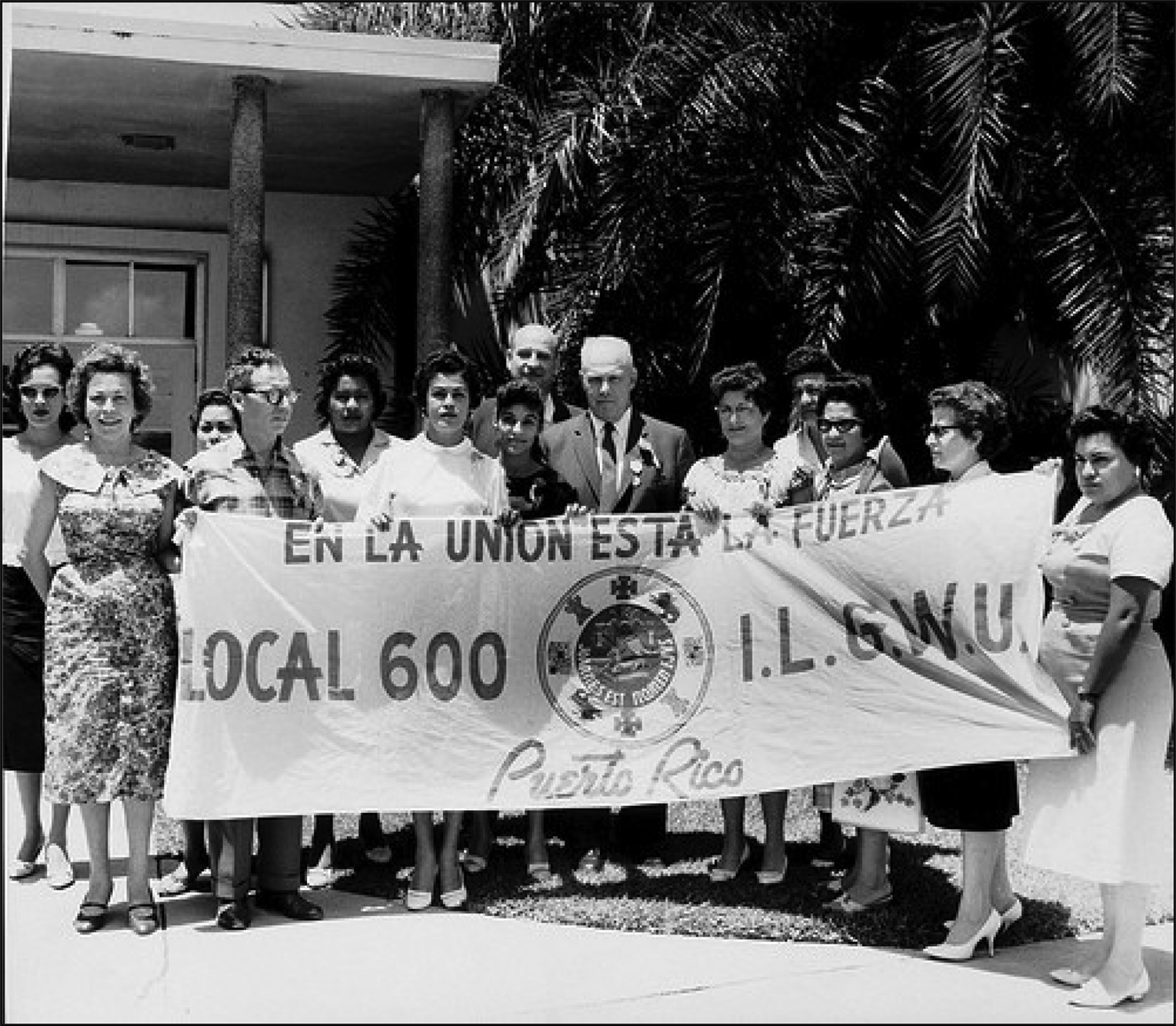
While Puerto Rican women moved northward, manufacturing and capital were invited to investigate the island. A February 1949 New York Times article declared “Puerto Rico Urged on US Business,” and said a hypothetical textile company could retain almost twice the profit due to the extraordinary tax exemptions and low-wage, skilled workers. A pamphlet from the Office of Puerto Rico advised managers and owners to relocate for the abundant orderly workers who appreciated jobs due to the island's unemployment and underemployment—without mentioning the history of union organizing (see Figure 2). By 1950, the island's homework and factories had both increased due to investment from metropolitan capital with finished products exported to the mainland.Footnote 92
Members of ILGWU Local 600 in Puerto Rico pose with a banner, 1950s
Photo from the ILGWU Photographs Collection, Kheel Center for Labor-Management Documentation and Archives at the Catherwood Library, Cornell University

Despite persistent wage stagnation, lack of full employment, and migration of women to the mainland, the PRIDC and Arthur D. Little advocated more colonial industrialization for export. Arthur D. Little noted that the Puerto Rican government was ahead of “other elements in the Insular society” in understanding development. The firm's detailed 1951 report for the future of Operation Bootstrap repeatedly described the importance of “budgetary allocations by the legislature to the agency responsible for industrialization.”Footnote 93 Decades of colonial governance had fostered the formation of a political elite descended from the criollo hacendados, and these leaders often supported the goal of export processing even if they debated the specifics.
The consultants recommended several top priorities, including subsidies for private services and buildings, full tax exemptions, abolition of taxes on income from insurance companies, and a real estate plan. Their report said wage differentials and a calculation of additional costs like shipping were required. In the section on promising industries, there was a special mention of encouraging an “integrated textile industry” linked to the established needleworkers. That year, the US and insular governments expanded tax exemptions for metropolitan investors and included foreign capital as well. By 1963, Puerto Rico had an additional 480 manufacturing plants owned by external investors in 30 industrial parks, and the majority of employees worked in apparel with some in electronics.Footnote 94
The continued migration of Puerto Rican needleworkers in the 1960s foreshadowed the current migrations of women in the global industrial working class (see Figure 3). In 1962, Aracelis Martínez learned sewing machine operation at the Ana Roqué High School in Humacao. She moved from Puerto Rico to New York City in 1964 for better wages in an undergarment factory. Martínez then returned to the island and worked in a sweatshop. She flew to New York again in 1970 and eventually paid for her daughter to join her.Footnote 95 In the late 1970s, they moved to Springfield, Massachusetts, where Martínez worked at Gemini Mill, a former Carter's factory that was owned and managed by Joel Gordon. He was an industry executive from eastern Massachusetts who had attained contracts for OshKosh B'Gosh and Izod.Footnote 96 As women relocated in their quest for better wages and living conditions, they worked as mobile labor for both the enclave and the extending lines of the transnational industry.
New York Puerto Ricans Fight Island Sweatshops, July 1955
Photo courtesy of author snapshot from a page of Justice, publication of the ILGWU, volume 37, courtesy of the Digital Commons of ILR at Cornell University

Export processing for the world
The full transformation of early colonial experimentation into colonial industrialization into postwar economic development occurred in 1948. As part of his Cold War strategy, President Harry Truman implemented the Point IV program to advance export-oriented industrialization in poor regions. It offered technical and financial assistance to “third world” countries and promoted Puerto Rico as a model. Marketing materials from the State Department welcomed students, experts, and politicians from Africa, Asia, and South America to see Puerto Rico's results. In some cases, the State Department even funded the trips. Economists John Kenneth Galbraith and Carolyn Shaw Solo published a brief 1953 piece about the island as a model of economic development and stated that its successful efforts would be recommended elsewhere. They wrote, “[T]he people of Puerto Rico constituted themselves a kind of pilot plant to demonstrate the process.”Footnote 97 The Department of Interior said that trainees on the island see “the entire integrated Puerto Rican development plan and [gain] practical working knowledge of how the particular agency to which they are assigned fits into the over-all setup.” These experts and agencies went on to contribute to the creation of textile and garment EPZs in Taiwan, South Korea, and Singapore.Footnote 98
During the 1960s, enthusiasm spread for “third world” industrialization by cheap exports. In 1961, the Office of Private Enterprise in the US International Cooperation Administration reprinted the 1951 ten-year plan for Puerto Rico. The foreword said the report would benefit “countries going through the same growth process” because the island's experiences had “verified the validity of the plans.”Footnote 99 US government officials also began talks with Mexican policymakers, industrialists, and investors about export-oriented industrialization. Discussions in Mexico and negotiations between US and Mexican trade and immigration offices had prompted intense policy debates about the border region. Leaders in the Partido Revolucionario Institucional (Institutional Revolutionary Party, PRI), like President Adolfo López Mateos, recognized the importance of the northern border and wanted it regulated.Footnote 100
The search for pragmatic ways to operate the border region led the Mexican government to hire Arthur D. Little. After several years in Puerto Rico, Bolin went to northern Mexico in 1961 and produced a report recommending an export processing zone based on Operation Bootstrap. Since the region was not a detached island, the report suggested a demarcated zone along the border that would have extreme exemptions from Mexican minimum wages, taxes, and regulations as well as government subsidized buildings and infrastructure. Again, it was the nation-state's power to deploy its sovereignty to enforce exemptions from its own laws and to constrain citizenship that sits at the center of the BIP. The 1963 enactment of Item 807 of the US Tariff Code, which allowed customs to assess duties only on the value added to materials sent abroad for processing, made the border zone even more appealing. As in Puerto Rico and Taiwan, much of the initial funding for the Mexican EPZ came from the US government. When President Gustavo Díaz Ordaz took office in 1964, he continued these efforts to discipline the border region. The ideas evolved into the BIP, formally opened in 1965 and later called “the maquiladoras.”Footnote 101
Through the end of the twentieth century, Arthur D. Little and Bolin continued to advocate the economic development they had designed in Puerto Rico. Their plans presented poor women working for lowest wages as the expected labor force. As Bolin said, “You start [with] low grade sewing where the young women from the poorest families are legally able to work and be taught… that's the way it was done in Puerto Rico.”Footnote 102 Arthur D. Little and Bolin received contracts for consulting on export processing plans in Egypt, Iraq, and the Philippines, and moved on to El Salvador, Tanzania, Ethiopia, and Nigeria.Footnote 103
In 1974, the UN Industrial Development Organization (UNIDO) formed a working group to create an association of EPZ experts. This UNIDO decision to institutionalize EPZs exemplifies what Kornel Chang has called “technologies of decolonizing management,” ways to administer land, labor, trade, and expectations during a region's transition from European governance.Footnote 104 The spread of EPZs was not uncontested. Resistance appeared in many forms, from union lobbying and strikes to demonstrations and protests over land.Footnote 105 These struggles shaped the terms of global capitalism in the late twentieth century.
Bolin received the UNIDO contract to establish the World Export Processing Zone Association (WEPZA). Two years later in 1976, Bolin founded the Flagstaff Institute for the study and promotion of such zones. WEPZA formed in 1978 as a council of government representatives and regulatory authorities. In 1985, however, WEPZA made arrangements with the help of the Flagstaff Institute to separate from the UN and open membership to private zone operators and consultants. The association still operates with Bolin's son, Doug Bolin, on the Board of Advisors. The son's WEPZA biography celebrates growing up in Puerto Rico and Mexico “in the footsteps of ‘Operation Bootstrap’ and the first maquiladoras.”Footnote 106
Due to World Trade Organization (WTO) language restricting incentives for export processing, SEZ became the more prevalent term. WEPZA retains its title as a name rather than as an acronym. Its current board includes experts from China, Dubai, Egypt, India, Panama, South Africa, and Vietnam as well as diverse specialists from the World Bank.Footnote 107 Like the insular elites of Puerto Rico, they participate in and acquire financial rewards from EPZs and SEZs.
Contemporary experts and policymakers conceptualize an EPZ or SEZ as an “enclave . . . covered by a policy framework designed by a government that is distinct from what applies elsewhere.” The geographic areas, often fenced, have specific criteria to attract foreign investment and export-oriented manufacturing, and their marketing makes use of the culturally potent term “free trade.” By 2006, EPZs and SEZs employed an estimated 66 million workers in 3,500 zones in 130 countries around the world. They all provided exemptions from national wage and safety regulations, tax and tariff exclusions, and malleable citizenship in which workers had little recourse to the nation-state for protections or grievances. As production widened to include information technology (IT) and data service industries, SEZs adapted.Footnote 108
Migrating women in search of steady employment or comparatively better wages remain the primary source of labor. They tend to move multiple times from rural villages to urban centers, within urban centers, outward to new suburban complexes or to other countries, and sometimes back to rural villages. Women navigate a range of employment and labor arrangements that include regimented city factory dorms, paternalist family agreements with township businesses, and subcontracted homework—just as Puerto Rican women navigated coexisting arrangements in the early twentieth century. Contemporary women also continue to find ways to train, move, organize, and strike for better wages and conditions.Footnote 109
Conclusion
When Puerto Rican needleworkers become visible in US labor history, it leads to a new understanding of neoliberal industrialization and trade. EPZs did not emerge innately from the flows of globalization. Their pragmatic geographic, financial, legal, and physical infrastructure coalesced in the contested experimental practices of US colonialism in Puerto Rico during the early twentieth century. The definitive act of creating an EPZ or SEZ still occurs when a government decides not to relinquish sovereignty—but to alter the parameters of its sovereignty and citizenship to demarcate an enclave. This site is not free of regulation, but rather plainly regulated with shifting exclusions and public subsidies on behalf of investors and manufacturers and strict limitations on the claims workers can make as citizens. Free trade advocates argued these arrangements were necessary to bring progress, even as evidence in Puerto Rico in the 1940s and 1950s contradicted their point. By increasing exceptions and appropriations for industrial and financial elites while legitimizing differentials for workers, these economic projects facilitated the contemporary redistribution of wealth toward the top.
Women workers in textile and apparel manufacturing were central to colonial industrialization and to EPZs and SEZs. Trade liberalization did not inadvertently cause a feminization of labor with a spiral of wages to the bottom. Women workers dealing with wage and access disparities were built into Puerto Rican industrialization. As a result, the continuous multidirectional migrations of “surplus labor,” poor women seeking jobs in enclaves but also unable or unwilling to work inside enclaves, were embedded in Operation Bootstrap and its successors. As the 2019 strikes and protests by women from the garment factories of Bangladesh indicate, women workers continue to have their own expectations. They seek to improve their conditions and make demands on contractors, manufacturers, and governments. They expose the consequences of exemption and challenge the SEZ narrative of economic benevolence.