INTRODUCTION
Lianas are an important and ubiquitous component of the forest vegetation in tropical and subtropical regions, and show an impressive ability to colonize and persist in a wide range of habitats (Gentry Reference GENTRY, Putz and Mooney1991a, Schnitzer & Bongers Reference SCHNITZER and BONGERS2002). In tropical forests lianas have been observed to provide an increasing proportion of the total biomass over time (Phillips et al. Reference PHILLIPS, VÁSQUEZ MARTÍNEZ, ARROYO, BAKER, KILLEEN, LEWIS, MALHI, MENDOZA, NEILL, VARGAS, ALEXIADES, CERN, DI FIORE, ERWIN, JARDIM, PALACIOS, SALDIAS and VINCETI2002) and are often highly species rich (Gianoli Reference GIANOLI2004). Lianas and other climbing plants can be difficult to investigate as their habit can render it hard to assess the number of individuals, making quantitative analysis uncertain (Schnitzer et al. Reference SCHNITZER, DEWALT and CHAVE2006) and discouraging analysis of population structure. Given the different growth strategies of lianas it is possible that they may also show different strategies for maintaining populations with greater reliance on vegetative propagation when compared with other woody plants.
In Hong Kong small well-defined populations of three climbing Bauhinia species occur, viz. Bauhinia championii Benth., Bauhinia corymbosa Roxb. and Bauhinia glauca Benth. These species are a widespread component of the natural vegetation, although they are restricted to isolated populations in woodland and scrubland on exposed ridges, stream-sides and steep hillsides. The species differ phenologically, with B. glauca and B. corymbosa flowering at the beginning of the wet season whereas B. championii flowers at the beginning of the dry season. They can all occupy similar habitats locally, mainly found climbing on low shrubs and small trees in the absence of any appreciable areas of closed-canopy forest.
The genus Bauhinia contains over 300 species with the woody lianas classified in subgenus Phanera. Ecological studies have shown a wide diversity of animal pollination syndromes in Bauhinia, including bats, birds, bees, butterflies and moths (Arroyo Reference ARROYO, Polhill and Raven1981, Endress Reference ENDRESS1994). Entomophily appears to be the major mechanism for the liana species, with visits by bees (B. glabra: Hokche & Ramirez Reference HOKCHE and RAMIREZ1990), butterflies (B. glabra: Bergallo Reference BERGALLO1990; B. japonica: Kato Reference KATO2000), and hawkmoths (B. macrantha: Vogel Reference VOGEL1954) all recorded, although humming-bird pollination has been observed in neotropical liana species (B. guianensis: Hokche & Ramirez Reference HOKCHE and RAMIREZ1990). There are numerous reports of bat pollination of Bauhinia tree species, although this has not been reported for the liana species. The flowers of climbing Bauhinia species are generally smaller than those of tree congeners, and tend to have sucrose-dominated nectar (Hokche & Ramirez Reference HOKCHE and RAMIREZ1990).
Field observations of floral phenology, floral biology and pollination of three climbing Bauhinia species, B. championii, B. corymbosa and B. glauca, were conducted. One objective of this study was to measure the levels of both within-population and among-population genetic variation and relate this to differences between the species in their pattern of genetic structure and breeding systems. We also examine how climbing plants may modify the strategies for reproductive success found in related woody plants. Within the genus Bauhinia there is an obvious contrast in the extent of floral display between the tree species (Lau et al. Reference LAU, RAMSDEN and SAUNDERS2005) and the climbing species represented in Hong Kong. We hypothesize that the climbing Bauhinia species will attract targeted pollinators to achieve out-cross success and that high levels of self-incompatibility will be expected to maintain diversity, with local population expansion relying on vegetative propagation.
MATERIALS AND METHODS
Study sites and plant materials
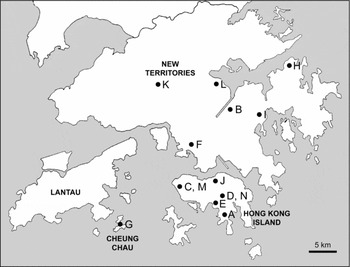
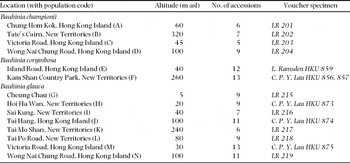
Three climbing Bauhinia species were collected in Hong Kong (22°N, 114°E) from 14 locations (Appendix 1, Figure 1). Populations of B. glauca are widely distributed on the mainland and islands of Hong Kong (populations G–N in Figure 1). Populations of B. championii are less common, consisting of only one to several individuals growing by streams and on steep hillsides (populations A–D in Figure 1). Bauhinia corymbosa is relatively rare in Hong Kong, with only two well-established populations found during the research period (populations E and F in Figure 1).
Geographical distribution of populations studied. Population codes given in Appendix 1.

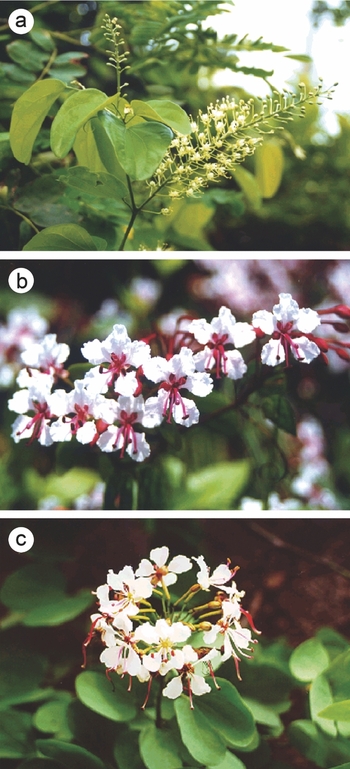
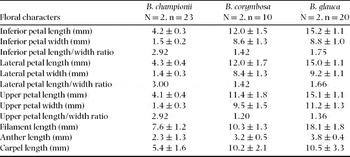
The flowers of all three species are borne in inflorescences: in B. championii (Figure 2a) the inflorescences are large (10–20 cm long) and consist of c. 80 flowers, whereas in B. corymbosa (Figure 2b) and B. glauca (Figure 2c) the inflorescences are smaller (c. 5 cm and 3–6 cm long, respectively) with fewer flowers (20–35 and 30–45 flowers, respectively). All three species have three fertile stamens per flower, although the number of staminodes can vary from 2–5 in B. championii, 2–4 in B. corymbosa, and 2–7 in B. glauca. The flowers have five white or cream petals, although the corolla of B. corymbosa is marked with narrow pink lines, and the stamens and stigma are contrastingly pinkish-red (Figure 2b). In all three species the inferior, lateral and upper petals are uniformly spathulate, without distinctive functions. The dimensions of floral characters for the three species are given in Table 1.
Floral morphology of Bauhinia championii (a), B. corymbosa (b) and B. glauca (c).

Measurements of floral characteristics (mean ± SD) of Bauhinia championii, B. corymbosa and B. glauca. N = number of individuals, n = number of flowers.

Floral phenology
The floral phenology of the three species was investigated to determine changes at the flower, inflorescence and individual plant levels. The flowering periods of populations were assessed over a 4-y period. The timing and duration of flowering events in single plants were measured by tagging five inflorescences consisting of unopened flower buds on two or more individuals of each species. Observations were made daily prior to flower opening, and subsequently every 2 h.
The onset and duration of stigmatic receptivity was initially determined in the field by immersing stigmas in 3% hydrogen peroxide (H2O2) solution. Formation of bubbles on the stigmatic surface by peroxidase activity indicates receptivity (King Reference KING1960). Stigmatic receptivity coincides with the formation of a glistening stigmatic exudate, enabling a simple visual determination of receptivity.
Floral visitors and floral rewards
Extensive observations of the activities of floral visitors were undertaken during daylight hours (07h00–18h00), supplemented with occasional night-time observations (18h00–22h00). The number and types of floral visitors were monitored, and the behaviour of floral visitors was recorded on videotape for 2–4 individuals of each liana species for 30-min periods over several days. Visitation rates were calculated as  where NV = number of visits observed, NF = number of flowers observed, and NH = number of hours of observation.
Nectar sugar composition was determined using a Dionex HPLC system (Dionex Corp., Sunnyvale, CA) fitted with a CarboPac PA-1 (4 × 250 mm) column and a 10-μl sample loop with 10 mM NaOH isocratic elution at 1 ml min−1. An ED40 electrochemical detector fitted with a pulsed amperometric cell was used and peaks were compared with authentic sugar standards.
Plant breeding systems
The breeding systems of the three species were assessed by calculating the pollen:ovule ratio and conducting a series of field-based controlled-pollination experiments. The ratio of the number of pollen grains to ovules produced by a flower was used as an approximate indicator of breeding system (Cruden Reference CRUDEN1977). The numbers of pollen grains and ovules were counted using standard techniques (Dafni Reference DAFNI1992), based on 10–40 flowers from 2–4 individuals.
Pollen germination percentages were assessed using pollen from freshly dehisced anthers from 20 flowers of each species incubated in 5%, 10%, 15%, 20% and 25% sucrose solutions containing 50% (w/v) H3BO3 and 50% (w/v) Ca(NO3)2 for 24 h at ambient temperatures (Dafni Reference DAFNI1992). Two hundred pollen grains were visually assessed to determine the proportion of pollen grains germinating.
A total of six different controlled-pollination treatments were conducted in order to determine the breeding system, using 30-μm-mesh polyethylene pollination bags, viz.: (1) control – flowers not bagged and left to freely pollinate; (2) test for induced autogamy – flowers bagged and subsequently emasculated and artificially pollinated with pollen from the same flower; (3) test for induced geitonogamy – flowers bagged and subsequently emasculated and artificially pollinated with pollen from another flower of the same individual; (4) test for induced xenogamy – flowers bagged and subsequently emasculated and artificially pollinated with pollen from flowers of different individuals of the same species; (5) test for natural xenogamy – flowers emasculated and left to freely pollinate; and (6) test for agamospermy – flowers bagged and emasculated but not artificially pollinated. Analysis of variance (ANOVA) was used to compare the means of different treatments. Statistical significance was evaluated using Duncan's multiple range test.
After scarification seeds were germinated in Petri dishes under dark, moist conditions at 25–28°C to assess seed viability.
Population genetic structure
A total of 124 accessions from 14 localities were studied (23 from B. championii, 25 from B. corymbosa and 76 from B. glauca: Appendix 1). Total DNA was extracted from young leaves in liquid nitrogen using a CTAB protocol (modified from Doyle Reference DOYLE, Hewitt and Johnston1991) and samples purified using a Wizard Plus SV Minipreps DNA purification system (Promega Corp., Madison, WI). After screening 30 ISSR primers (UBC SSR Primer, Oligonucleotide Set 100/9, Biotechnology Laboratory, University of British Columbia, Vancouver, Canada) 13 were selected for use in single-primer PCR amplifications, viz.: 807 [(AG)8-T], 809 [(AG)8-G], 810 [(GA)8-T], 817 [(CA)8-A], 818 [(CA)8-G], 823 [(TC)8-C], 834 [(AG)8-YT], 835 [(AG)8-YC], 836 [(AG)8-YA], 842 [(CA)8-YG], 844 [(CT)8-RC], 888 [BDB-(CA)7], and 889 [DBD-(AC)7]. PCR reaction conditions and characterization of products followed the procedures in Lau et al. (Reference LAU, RAMSDEN and SAUNDERS2005).
The resultant data matrix was analysed with POPGENE (Molecular Biology and Biotechnology Centre, University of Alberta, Canada). Genetic parameters within populations were calculated according to Nei (Reference NEI1978).
The relative magnitude of gene differentiation among the populations was assessed using the coefficient of gene differentiation, G ST (Nei Reference NEI1973). The genetic identity (I) between populations was also computed at the species level (Nei Reference NEI1972). Dendrograms of coancestry distance were constructed using the unweighted pair group method with arithmetic averages (UPGMA). The relationship between geographical distances among populations and levels of genetic differentiation were determined with a Mantel test.
Estimates of genetic diversity within populations were also measured using Shannon's information index (H o = –Σpi In pi) (Lewontin Reference LEWONTIN1972), where pi is the ISSR product frequency. H o values were calculated on polymorphic loci to reduce error due to the relative insensitivity to detect hidden heterozygous loci with dominant markers (Dawson et al. Reference DAWSON, SIMONS, WAUGH and POWELL1995).
The HG (Hamrick & Godt) method was used for calculating G ST values to allow comparison with the data of Hamrick & Godt (Reference HAMRICK, GODT, Brown, Clegg, Kahler and Weir1990, Reference HAMRICK, GODT, Avise and Hamrick1996). In the HG method G ST values were averaged over polymorphic loci, whereas the Nei method uses the mean values of HT and H S over all loci.
RESULTS
Floral phenology
The timing of flowering differed between species: B. corymbosa and B. glauca flowered from April to June and from May to July respectively, whereas B. championii flowered from August to November.
Flowers of all three species were open for a similar length of time (3 d) but showed differences in the onset of anthesis: in B. glauca, anthesis began between 10h00 and 12h00 with up to seven flowers open per inflorescence per day (2.8 ± 0.9 SD); in B. championii, anthesis began between 12h00 and 15h00 with up to 13 flowers open per inflorescence per day (5.4 ± 0.8); whereas in B. corymbosa, anthesis began between 14h00 and 16h00 with up to six flowers open per inflorescence per day (3.7 ± 1.1). The flowers opened in sequence within the inflorescence, from the base to the apex.
The anthers of all three liana species dehisced within 30 min of flower-opening although the stigma was dry and not receptive for the first c. 24 h; during this phase the flowers were therefore functionally staminate. During the first 24 h the style was oriented horizontally and hence the stigma was spatially separated from the anthers which are borne on upwardly curved filaments. As the stigma became receptive the style gradually curved upwards, bringing the stigma to the same level as the anthers; at this stage the stigma produced exudate and became receptive whilst the anthers withered and curved downwards. The flowers are therefore dichogamous, with marked protandry. Nectar production was initiated 1–2 h after the onset of anthesis and was continuous until the flowers wilted.
Floral visitors and floral rewards
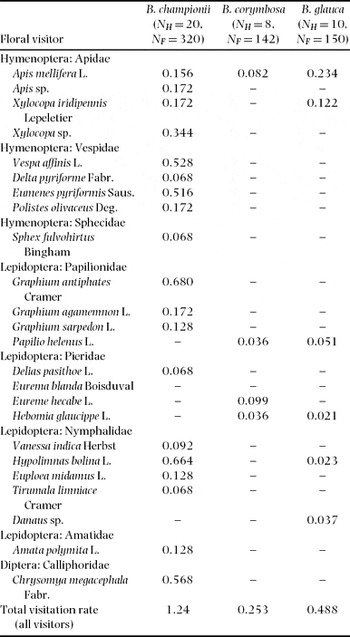
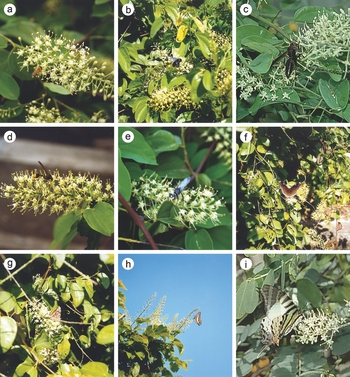
Eight families and 19 species of insect were recorded visiting B. championii in daytime (07h00–18h00), resulting in the highest total visitation rate (1.24 h−1) amongst the three species studied (Table 2). Three families of Hymenoptera (bees and wasps) visited the flowers, amongst which bees (Apidae) and Eumenes and Vespa wasps (Vespidae) were the most common (Table 2; Figure 3). Amongst the Lepidoptera, the most common visitors were Graphium species (swallowtail butterflies, Papilionidae) and Hypolimnas bolina (brushed-footed butterflies, Nymphalidae) (Table 2; Figure 3). The calliphorid fly Chrysomya megacephala (Diptera) was also a common visitor to B. championii flowers (Table 2). Bauhinia corymbosa and B. glauca received far fewer floral visitors, with total visitation rates of only 0.25 and 0.49 h−1, respectively (Table 2). In both cases, the floral visitors were primarily bees (Apidae) and butterflies (Papilionidae, Pieridae and Nymphalidae). No floral visitors were observed to any of the three species during night-time observations (18h00–22h00).
Floral visitors and visitation rates (visits per flower h−1) for Bauhinia championii, B. corymbosa and B. glauca. Floral visitors with visitation rates < 0.01 for all three Bauhinia species are excluded. NH = total number of hours of observation, NF = total number of flowers under observations. Visitors were recorded at all sites used for the respective species except sites B, G and H.

Floral visitors to Bauhinia championii. Apis mellifera (honeybee) (a). Xylocopa iridipennis (bamboo carpenter bee) (b). Polistes sp. (paper wasp) (c). Eumenes pyriformis (common potter wasp) (d). Sphex fulvohirtus (burrowing wasp) (e). Hypolimnas bolina (common eggfly) (f). Vanessa indica (Indian red admiral) (g). Graphium doson (common jay) (h). Graphium antiphates (swordtail butterfly) (i).

The behaviour of the various floral visitors was observed to differ. Apis mellifera (honeybee) gathered both nectar and pollen during visits, generally between 10h00 and 14h00 (Figure 3a). Although individual foraging events were brief (c. 2 s), the body of the bee was observed to touch the anthers, hence collecting pollen. Each bee typically visited several flowers within the same inflorescence before visiting other inflorescences. Xylocopa iridipennis bees have a body length of c. 25 mm (Figure 3b) and can touch the anthers of several flowers simultaneously as they extract nectar. Xylocopa iridipennis was observed to walk along the inflorescence in search of nectar and spent c. 5 s visiting several flowers of one inflorescence before flying to another. Visits by X. iridipennis were typically recorded between 13h00 and 16h00.
Eumenes pyriformis (common potter wasp) with a large body around 20 mm long (Figure 3d), also visited several flowers on the same inflorescence before moving to another inflorescence. On the first visit to an inflorescence the wasps typically spent c. 20 s searching for nectar but only 2–3 s on subsequent visits. They clung below the flower to obtain nectar, with the thorax touching the anthers. Because the flowers are dichogamous with marked protandry the wasps transport pollen grains among flowers in the same inflorescence and also to other inflorescences, potentially inducing both geitonogamous and xenogamous pollination. Vespa affinis wasps show a similar foraging behaviour.
Butterflies showed two different foraging behaviours, either landing on, or hovering over the inflorescence whilst drinking nectar. Most butterflies alighted on the inflorescences and accumulated pollen grains on their legs, typically visiting the same inflorescence several times and spending about 2–3 s on a flower per visit. In contrast, Graphium antiphates (Papilionidae) hovered while consuming nectar, and hence only collected pollen on its proboscis and head. Graphium antiphates visited several flowers in an inflorescence per visit and repeatedly returned to the same inflorescence (c. 3 visits min−1) before moving to other inflorescences.
Chrysomya megacephala (Calliphoridae) fed on nectar in flowers of B. championii with their bodies touching the stamens of surrounding flowers. They were frequent visitors, contributing more than 11.5% of the total visitation rate.
The average (± SD) volume of nectar secreted was highest in B. glauca (33.1 ± 14.8 μl), but B. corymbosa produced 28.5 ± 11.7 μl, and B. championii only 14.3 ± 6.3 μl. The overall concentration of sugar was highest in nectar from B. championii (33.4% ± 7.7%), whereas nectar samples from B. corymbosa and B. glauca contained 25.6% ± 7.6% and 25.3% ± 9.3% sugar, respectively. The nectar of B. championii was dominated by the hexose sugars fructose (40%) and glucose (57%); in contrast the nectar of B. corymbosa and B. glauca was sucrose dominated (85% and 80% sucrose, respectively).
Plant breeding systems
Pollen germination experiments revealed that pollen was viable for approximately 3 d after the onset of anthesis. Of the three species studied, B. championii had the lowest levels of pollen viability (mean ± SD = 16.2% ± 10.8%, determined using 20% sucrose solution); in contrast B. corymbosa showed 23.1% ± 14.8%, and B. glauca 31.4% ± 17.2%. These mean pollen germination percentages are not statistically different.
The pollen:ovule ratios in B. corymbosa and B. glauca were moderately high (807:1 and 783:1, respectively). Bauhinia championii showed a much higher pollen:ovule ratio of 2675:1.
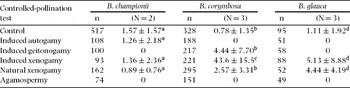
The percentages of fruitset resulting from the controlled-pollination experiments are given in Table 3. All three species studied had very low fruiting percentages following open (control) pollination, with less than 2% of flowers setting fruit. Agamospermy was not observed in any of the three species. No self-pollination was observed with B. glauca, whereas low levels of autogamy (c. 1.3%) were achieved in B. championii but none with B. corymbosa. Conversely B. corymbosa showed a low level of geitonogamy (c. 4.4%) but none was observed with B. championii. Tests of induced and natural xenogamy gave non-significant within-species results for both B. championii and B. glauca; in B. corymbosa, however, significantly higher fruitset resulted from artificial cross-pollination (c. 43.6%) than natural cross-pollination (c. 2.6%).
Percentage fruitset (mean ± SD) resulting from controlled-pollination experiments in Bauhinia championii, B. corymbosa and B. glauca. N = number of individuals; n = number of flowers. Superscript letters summarize the results of the Duncan's multiple range test; treatments within the same species with the same superscript letter do not differ significantly (P < 0.05).

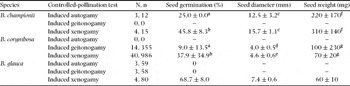
Although B. championii produced fruits in tests of both autogamy and xenogamy, the viability of seeds formed after autogamy was significantly lower than that resulting from xenogamy (Table 4). The mean index of self-incompatibility (ISI) for the species was calculated as 1.07 (4.00 seeds per self-pollinated flower, compared with 3.75 seeds per cross-pollinated flower). Although few fruits resulted from geitonogamy in Bauhinia corymbosa the seed viability was lower than that in seeds resulting from xenogamy (Table 4). Bauhinia glauca had the highest percentage of seed germination following artificial cross-pollination (Table 4). The absence of seed formation following autogamous self-pollination gave an ISI value of zero for both B. glauca and B. corymbosa.
Average seed germination percentage, seed size and seed weight in Bauhinia championii, B. corymbosa and B. glauca, after different controlled-pollination treatments. N = number of fruits; n = number of seeds. Treatments were compared within species and superscript letters summarize the results of the Duncan's multiple range test; treatments with the same letters within the same column do not differ significantly (P < 0.05).

Population genetic structure
Twenty-three accessions from the four populations of Bauhinia championii (Figure 1A–D) gave 3–20 ISSR bands from eight primers.
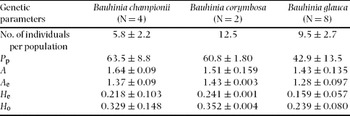
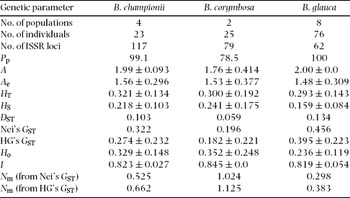
The mean percentage of polymorphic loci within populations (P p) was 63.6 ranging from 53.9% to 75.2%. The mean effective number of alleles per locus (A e) was 1.37, and the mean expected heterozygosity (H e) was 0.218. The Shannon information index (H o) ranged from 0.283 to 0.419, with an average of 0.329 ± 0.148 (Table 5).
Average genetic variability in populations of Bauhinia championii, B. corymbosa and B. glauca. Values are mean ± SD. N = number of populations, P p = percentage of polymorphic loci, A = number of alleles per locus, A e = effective number of alleles per locus, H e = expected heterozygosity, and H o = Shannon's Information Index.

The percentage of polymorphic loci among populations was significantly higher (P = 99.1%) than the population average. The effective number of alleles per locus (A e = 1.56) and the total gene diversity (H T = 0.321) were also higher when compared with the within-population level of variation. The coefficient of genetic differentiation between populations (G ST), was 0.322 using Nei's method, or 0.274 with the HG method; both estimates of G ST revealed a high level of genetic differentiation between populations. The level of gene flow (Nm) was low (Nm < 1), estimated at 0.525 (derived using Nei's G ST) or 0.662 (derived using HG's G ST) individuals per generation between populations (Table 6).
Genetic diversity at the species level in Bauhinia championii, B. corymbosa and B. glauca. P p = percentage of polymorphic loci, A = number of alleles per locus, A e = effective number of alleles per locus, H T = total gene diversity, H S = within population genetic diversity, D ST = genetic diversity among populations, G ST = coefficient of genetic differentiation, H o = Shannon's Information Index, I = genetic identity and N m = level of gene flow.

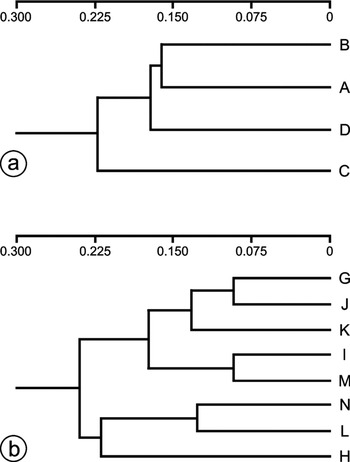
Nei's genetic identities (I) between populations at ISSR loci varied from 0.793 to 0.880 with a mean value of 0.847 ± 0.029, and the mean genetic distance (D) was 0.166 ± 0.035. Geographical distances between populations ranged from 5.13 to 16.8 km. A Mantel test performed to compare the matrices of genetic identity and geographical distances failed to show any relationship between them (r = 0.163, P = 0.757). A dendrogram was constructed for B. championii using the unweighted pair group method (UPGMA) with co-ancestry distance (Figure 4a).
Dendrograms showing co-ancestry distances between populations of Bauhinia championii (a), and B. glauca (b). Population codes according to Appendix 1.

Twenty-five accessions from two populations (E and F, Figure 1) of Bauhinia corymbosa gave 6–14 ISSR bands from eight primers. The mean percentage of polymorphic loci within populations (P p) was 60.8%. The mean effective number of alleles per locus (A e) was 1.43, and the mean expected heterozygosity (H e) was 0.241. The Shannon's information index (H o) was 0.349 and 0.355, with a mean of 0.352 from the two populations (Table 5), revealing similar levels of within-population diversity.
Amongst populations the percentage of polymorphic loci was higher (P = 78.5%) than the population average, but the effective number of alleles per locus (A e = 1.53) and the total gene diversity (H T = 0.300) were similarly high compared with the population level of variation. Both estimates of G ST values (Nei's G ST = 0.196; HG's G ST = 0.182) revealed a high level of genetic differentiation between populations. The level of gene flow (Nm) was high (Nm > 1), estimated to be 1.02 (calculated using Nei's G ST) or 1.13 (calculated using HG's G ST) individuals per generation between populations (Table 5). Nei's genetic identity (I) between populations at ISSR loci was 0.856, showing a high degree of overall similarity. As only two B. corymbosa populations were studied the relation between genetic distances and geographical distances among populations could not be investigated.
A total of 76 accessions from eight populations of Bauhinia glauca (G–N in Figure 1) gave 6–12 ISSR bands using seven primers. The percentage of polymorphic loci (P p) for a single population ranged from 22.6% to 58.1% with an average of 42.9% ± 13.5%. The mean effective number of alleles per locus (A e) was 1.28, and the mean expected heterozygosity (H e) was 0.159. The Shannon's information index values (H o) were 0.121 to 0.332, with a mean of 0.239 from the eight populations (Table 6).
The percentage of polymorphic loci (P = 100%) and the total gene diversity (H T = 0.293) among populations were much higher than the population average, but the effective number of alleles per locus (A e = 1.48) was similarly high compared with the population-level variation. The within-populations genetic diversity (H S) was 0.159. The coefficient of genetic differentiation between populations (G ST) was 0.395 (based on the HG method), or 0.457 (based on Nei's method); both estimates of G ST revealed a very high level of genetic differentiation between populations.
The level of gene flow (Nm) was estimated at 0.383 individuals per generation between populations (based on the HG method). Nei's genetic identity (I) between populations using ISSR loci varied from 0.739 to 0.923, with a mean of 0.828 ± 0.054, and mean genetic distance (D) was 0.191 ± 0.065. A UPGMA dendrogram was constructed for B. glauca (Figure 4b).
DISCUSSION
Bauhinia championii
The main floral visitors to B. championii all showed foraging behaviour that would permit them to act as effective pollinators and promote out-crossing. The large inflorescences of B. championii provide an effective landing platform for insects, and enhanced visual effect, reducing travel costs for the pollinators (Faegri & van der Pijl Reference FAEGRI and VAN DER PIJL1979). The inflorescences appear to enable B. championii to attract more species of butterfly than the other climbing Bauhinia species with smaller inflorescences. The larger inflorescences are suitable for hovering butterflies which require more food and frequent flower visits (Faegri & van der Pijl Reference FAEGRI and VAN DER PIJL1979). The nectar produced in B. championii flowers is hexose dominant and potentially an adaptation to pollination by insects such as flies, bees and butterflies (Baker & Baker Reference BAKER and BAKER1990, Stiles & Freeman Reference STILES and FREEMAN1993).
The controlled-pollination experiments revealed that B. championii has similar levels of fruit-set following induced self-pollination and artificial cross-pollination. The seed germination percentage following selfing was significantly lower than that following artificial crossing suggesting that B. championii shows some degree of self-incompatibility. The high pollen:ovule ratio suggests that B. championii is obligately xenogamous (Cruden Reference CRUDEN1977). In the absence of a strong biochemical self-incompatibility system this may be achieved through marked protandry and the selection of pollinators that favour outcrossing.
Bauhinia championii has high levels of genetic diversity within populations compared to other long-lived perennial woody species (P = 50.0%, A e = 1.21, H e = 0.149) (Hamrick & Godt Reference HAMRICK, GODT, Brown, Clegg, Kahler and Weir1990) or other legume species (e.g. Gliricidia sepium, an insect-pollinated obligate outbreeder, H o = 0.252; Dawson et al. Reference DAWSON, SIMONS, WAUGH and POWELL1995). As breeding systems account for the largest proportion of the within-population variation, the high values observed may imply mixed-mating or outcrossing breeding systems. The pollination experiments suggest that the species has a mixed-mating breeding system with similar levels of selfing and outcrossing and pollen dispersal is due to energetic pollinators that facilitate gene flow between individuals within populations.
A high level of genetic diversity among populations was observed for B. championii (P p = 99.2%, H T = 0.321, and G ST = 0.274) when compared with other woody legumes (76.0%, 0.229 and 0.124 respectively; Hamrick & Godt Reference HAMRICK, GODT, Avise and Hamrick1996). The P and H T values are higher than the mean for mixed-mating species with explosive dispersal but the G ST values are similar (P p = 52.7%, H T = 0.174 and G ST = 0.248) (Hamrick & Godt Reference HAMRICK, GODT, Avise and Hamrick1996).
As expected we observed targeted pollinators that can provide out-cross success; though the level of self-incompatibility was lower than anticipated it can be maintained by the loss in fecundity of self-fertilized seed. The high levels of genetic diversity in B. championii could arise from its discontinuous distribution impeding gene flow between populations. This is supported by the low estimates of gene flow (0.525) among the four populations studied, indicating effective migration of only one plant in nearly two generations. Gene flow of more than four migrants per generation (N m > 4) among populations is necessary to prevent genetic drift from causing local genetic differentiation (Slatkin Reference SLATKIN1987). As the local populations of B. championii are small and isolated from one another, genetic drift may have a dominant influence on population genetic structure.
Bauhinia corymbosa
The bright colour of the stamens and carpel in B. corymbosa, diurnal anthesis, low viscosity of the nectar, and the dense multi-flowered inflorescences are all typical of butterfly-pollinated flowers. The sucrose-dominated nectar also implies that B. corymbosa is adapted to pollination by long-tongued bees and butterflies (Baker & Baker Reference BAKER and BAKER1990).
The moderate pollen:ovule ratio calculated for B. corymbosa, which is indicative of facultative xenogamy, corroborates the results from the controlled-pollination experiments. Fecundity was greatly reduced following geitonogamous pollination suggesting that inbreeding depression occurs in terms of seed production; the absence of fruitset after autogamous self-pollination furthermore shows that B. corymbosa is self-incompatible. The much higher levels of fruitset after induced xenogamy in B. corymbosa compared with the other two species may be due to the two populations studied occupying more exposed habitats with absence of competing vegetation allowing better access to resources.
High levels of within-population variation suggest that B. corymbosa is an outcrossing species, comparable to the average of within-population variation of other outcrossing animal-pollinated woody species (P = 47.6%, A e = 1.22, H e = 0.163) (Hamrick et al. Reference HAMRICK, GODT and SHERMAN-BROYLES1992). This is corroborated by the controlled-pollination experiments, which reveal that the species is predominately outcrossing: the fruiting percentage and seed germination percentage following outcrossing are much higher than the equivalent percentages following geitonogamy. These observations together with the visitors attracted by the flowers are consistent with our original hypothesis. The distribution of ISSR variation among Bauhinia corymbosa populations (P p = 78.5%, H T = 0.300, and G ST = 0.182) is close to the mean values for mixed-animal pollinated species (H T = 0.304 and G ST = 0.216) (Hamrick & Godt Reference HAMRICK, GODT, Brown, Clegg, Kahler and Weir1990) but higher than the mean values for typical long-lived perennial, mixed-mating species (P = 42.5%, H T = 0.135 and G ST = 0.145) (Hamrick & Godt Reference HAMRICK, GODT, Avise and Hamrick1996). The high G ST value (0.182) shows that gene differentiation has occurred largely among populations, which may be attributed to the predominantly xenogamous breeding system.
Bauhinia glauca
The floral characteristics and sucrose-dominated nectar observed in B. glauca are consistent with bee and butterfly pollination. The moderate pollen:ovule ratio obtained suggests that B. glauca is facultatively xenogamous (Cruden Reference CRUDEN1977). In the controlled-pollination experiments there was no fruitset in tests for either induced geitonogamy or autogamy showing that B. glauca is completely self-incompatible. Although the fruiting percentage following artificial outcrossing is low the seed germination percentage is relatively high compared to B. championii and B. corymbosa for the same treatments and may compensate for the low fruit production. Xenogamy may be facilitated by the efficiency of pollen transport from nototribic pollination by Xylocopa iridipennis, which ensures precise and economic pollen transfer (Reddi & Rao Reference REDDI and RAO1993), and B. glauca flowers may therefore conserve energy by minimizing pollen production. Such targeted pollination coupled with self-incompatibility agrees with our hypothesis and the effectiveness of the strategy is indicated by the similar levels of within-population variation compared with typical xenogamous animal-pollinated woody species (P = 47.6%, A e = 1.22, H e = 0.163; Hamrick et al. Reference HAMRICK, GODT and SHERMAN-BROYLES1992), suggesting that it is an outcrossing species. This prediction matches the results obtained from the controlled-pollination experiments where only cross-pollination resulted in fruitset. Bauhinia glauca has the greatest percentage of polymorphic loci (P = 100%) and the coefficient of genetic differentiation between populations, but a lower average heterozygosity within populations than typical long-lived perennial outcrossing plants (P = 65.5%, H S = 0.180, G ST = 0.094; Hamrick & Godt Reference HAMRICK, GODT, Avise and Hamrick1996), and animal species (H S = 0.243, G ST = 0.197; Hamrick & Godt Reference HAMRICK, GODT, Brown, Clegg, Kahler and Weir1990). The unexpectedly high G ST in B. glauca (0.298) is puzzling for a widespread, long-lived, woody, perennial species with a xenogamous breeding system. The high G ST may arise from the relatively low within-population variation compared to B. championii and B. corymbosa. The local orchid Eulophia sinensis has a similarly high G ST level of 0.653 (Sun & Wong Reference SUN and WONG2001). There is evidence of extremely high genetic differentiation among populations in both species, suggesting that population structures are mainly determined by colonization dynamics (Sun & Wong Reference SUN and WONG2001).
The lack of correlation between genetic identities and geographical distances among populations of B. glauca suggests that the populations sampled from different regions of Hong Kong had been part of a continuous distribution until the destruction of the forest for settlement and agriculture, with fragmentation of the previously continuous forest habitat. Following deforestation, B. glauca presumably proliferated by vegetative propagation and occupied newly created open habitats. Individuals drawn from the surviving populations subsequently recolonized vacant habitats. Colonists might be recruited from a single population, resulting in more genetic differentiation among populations and increasing the G ST (Hamrick & Nason Reference HAMRICK, NASON, Rhodes, Chesser and Smith1996). The extinction and recolonization model in propagule-pool mode may explain the population structure of B. glauca with the very high G ST.
CONCLUSIONS
The three climbing Bauhinia species studied all show an overlapping range of pollinators, with the most frequent visitors being bees and butterflies. Bauhinia championii attracts a broader range of butterfly species, however, and B. glauca is visited principally by bees and wasps. Bauhinia championii is furthermore unique in attracting many visits from flies. It has been suggested that forest lianas would have a similar range of pollinators to those found in co-occurring forest trees (Bawa et al. Reference BAWA, BULLOCK, PERRY, COVILLE and GRAYUM1985) and it was found that lianas with conspicuous flowers in the neotropics were largely pollinated by bees (Gentry Reference GENTRY, Putz and Mooney1991b).
The inflorescences of B. championii are very different from those of the other two species studied with regard to the arrangement of the flowers. The smaller and more densely arranged flowers could represent an adaptation to pollination by smaller insects such as dipterans. Bauhinia championii also differs in having hexose-dominated nectar whereas the other two species had sucrose-dominated nectar. Flies are more common below the canopy in closed forest and it is possible that B. championii represents an adaptation to shaded habitats whereas the other two species are adapted to more exposed conditions.
Although the general lack of closed canopy in Hong Kong obliges all the species to grow in more exposed conditions, the growth habit of the lianas favours early successional habitats rather than mature forest. The three liana species studied all climb with the aid of tendrils and this adaptation has been associated with growth in early succession as it is suited to attachment to thinner stems of pioneer trees (Dewalt et al. Reference DEWALT, SCHNITZER and DENSLOW2000). Further studies on the plasticity of photosynthesis in these species and growth in different light conditions could establish the relative importance of these differences on the ecological status of the lianas (Cai et al. Reference CAI, POORTER, CAO and BONGERS2007).
The three Bauhinia tree taxa present in Hong Kong (B. purpurea, B. variegata and the sterile hybrid derived from these species, B. ‘Blakeana’) have similar but much larger flowers; they are mainly visited by Hymenoptera, appear much less attractive to Lepidoptera and are not visited by Diptera (Lau et al. Reference LAU, RAMSDEN and SAUNDERS2005). These locally co-occurring trees are self-compatible and all possess sucrose-dominated nectar but are less fragrant than the liana species with sucrose-dominant nectar (Lau et al. Reference LAU, RAMSDEN and SAUNDERS2005). Adaptation to a climbing habit with thinner stems appears to be accompanied by a reduction in flower size but a broadening in the range of potential pollinators which could ensure the maintenance of gene flow.
The distribution of genetic variation within and between populations is largely determined by breeding system, population size and colonizing ability. Generally high levels of genetic diversity within populations were recorded in B. championii and B. corymbosa compared with long-lived perennial woody species, in contrast to the moderate levels recorded in B. glauca. Mixed-mating systems increase genetic variability within populations, and B. championii and B. corymbosa have higher levels of genetic diversity than typical long-lived woody species. Lianas can potentially show enhanced survival compared with individual forest trees through their ability to propagate vegetatively and the possession of numerous stems (Putz Reference PUTZ1984). High levels of heterozygosity in out-crossing lianas were suggested by Gentry (Reference GENTRY, Putz and Mooney1991b) as appropriate for K-selected long-lived plants, which is consistent with our observations. The possibility was also raised of the accumulation of somatic variation in different parts of a vegetatively propagated liana giving rise to differentiation by non-sexual means (Gentry Reference GENTRY, Putz and Mooney1991b). Such a mechanism could explain some of the genetic differentiation observed as occurring independently of levels of gene flow between populations.
With regard to between-population genetic divergence, the high G ST values suggest that gene flow among populations has been low in recent history. Bauhinia glauca has the highest G ST value, whereas B. championii and B. corymbosa have intermediate and lowest values respectively. Generally high levels of genetic differentiation occur among the populations of the three species, possibly as a result of the heterogeneous landscape in Hong Kong, with patches of forest interspersed in a matrix of fire-maintained grassland and coastal water, which could reduce pollinator flights between discontinuous populations. Especially high levels of genetic differentiation occur among populations of B. glauca, suggesting that the population structures are mainly determined by colonization dynamics. Seed dispersal in the lianas is unlikely to be a major contribution to gene flow as all the seeds are large and depend on an explosive dispersal mechanism of limited range. The level of seed production also appears low when compared with prolific wind-dispersed climbers of the neotropics (Gentry Reference GENTRY1983).
The examination of this closely related group of three liana species has revealed differences and similarities in reproductive strategies that could have important consequences on population development and survival in different habitats. Although our expectations with regard to mating system and pollination were broadly fulfilled it is possible that differences between the three species could reflect adaptations to different past habitats, in particular between B. championii and the other two species. It is not necessarily the case that all liana species can occupy a similar position in the ecosystem as they can form an integral part of both forest regeneration and climax communities. Future investigation of the physiological adaptations of these liana species is expected to reveal further links with the reproductive strategies. In this context the importance of gene flow in determining population structure may be strongly affected by the capacity for vegetative reproduction of lianas, which can have a varying contribution in response to environmental pressures. For a clearer answer to such questions molecular analysis can play an important part by allowing an improved assessment of the identity of the individual in extensive liana communities.
ACKNOWLEDGEMENTS
The authors thank Professor T. Culley, Dr X. J. Ge, Dr G. Hao, Rebecca Hu, Eugenia Lo, Dr M. Sun and Professor D. X. Zhang for assistance with the molecular study. We are also grateful to Cecily Law and Dr R. Kendrick for identification of moth and butterfly species, Maria Yu and Cindy Chan for help with analyses and collecting.
Provenance of accessions sampled in Hong Kong, China. Location of populations as indicated in Figure 1. Voucher specimens deposited in HKU herbarium.