INTRODUCTION
A topical debate is the role of large herbivores in the top–down regulation of ecosystems (Moe et al. Reference MOE, RUTINA, HYTTEBORN and DU TOIT2009). There exists a considerable literature on herbivores modifying habitat by impacting vegetation. However, studies addressing the impact of entire guilds on the broader vegetation and complete habitats are rare (Heroldova Reference HEROLDOVA1996, Hulme Reference HULME1994, Makhabu Reference MAKHABU2005, Olofsson et al. Reference OLOFSSON, HULME, OKSANEN and SUOMINEN2004). Research assessing the long-term impact of altering the numbers of one member of a species pair (Albon et al. Reference ALBON, BREWER, O'BRIEN, NOLAN and COPE2007, Hobbs et al. Reference HOBBS, BAKER, BEAR and BOWDEN1996) or of part of a guild (Flecker Reference FLECKER1997, Madhusudan Reference MADHUSUDAN2004) is also very uncommon. Yet consideration of various concepts of niche partitioning in herbivore guilds, suggests that focusing on entire guilds, rather than supposed keystone species, may be a better approach.
A prime example is the role of the African elephant (Loxodonta africana (Blumenbach)), versus that of other browsers, in savanna woodland dynamics. As African elephant populations have increased, habitat modification has been observed (Scholes & Mennell Reference SCHOLES and MENNELL2008). Some observers maintain that elephant and tree populations will stabilize only when woodlands have been converted to grassland (Lewis Reference LEWIS1991), with an associated decline in diversity (Cumming et al. Reference CUMMING, FENTON, RAUTENBAUCH, TAYLOR, CUMMING, CUMMING, DUNLOP, FORD, HOVORKA, JOHNSTON, KALCOUNIS, MAHLANGU and PORTFORS1997). Others contend that other browsers, because of niche overlap (Walker Reference WALKER, Tothill and Mott1985), may similarly modify woodland structure by impacting smaller individuals of the same plant species. In that case, reducing a single browser species, even elephant, may have little effect on community composition over the long term (Owen-Smith et al. Reference OWEN-SMITH, KERLEY, PAGE, SLOTOW and VAN AARDE2006, Pickett et al. Reference PICKETT, CADENASSO, BENNING, du Toit, Rogers and Biggs2003).
Although elephants are widely described as a keystone species (Bond Reference BOND, Schulze and Mooney1993), a substantial, but less quoted, literature describes other savanna browsers impacting woody vegetation. We reviewed the literature from 1960 to 2009 and found surprisingly few (21) studies that have researched plant usage by elephant and at least one other browser in the same locality. Only one paper (Makhabu Reference MAKHABU2005) gives details of the entire guild's diet. The respective roles of different sympatric browsers in woodland dynamics are therefore unclear.
Elephant are non-ruminants, with most digestion occurring in the hind-gut (Van Hoven et al. Reference VAN HOVEN, PRINS and LANKHORST1981), and as such are adapted, compared to ruminants such as giraffe, kudu, nyala and impala, to process coarser forage at a rapid rate (Napier Bax & Sheldrick Reference NAPIER BAX and SHELDRICK1963). As larger animals, they can also survive on relatively lower-quality foods (the Jarman-Bell principle (Bell Reference BELL1971, Jarman Reference JARMAN1974). Thus elephant would be expected to have a broader diet and show a greater increase in diet breadth with increasing forage depletion (Beekman & Prins Reference BEEKMAN and PRINS1989, Owen-Smith Reference OWEN-SMITH1988), compared with smaller, ruminant browsers. Degree of dietary overlap could also be explained in terms of resource competition. Niche overlap leads to competition only when resources are limiting (Pianka Reference PIANKA and May1976), suggesting that overlap should be lower in intensely competitive situations (Pianka Reference PIANKA1972). Low levels of overlap between different groups may thus, paradoxically, indicate heightened competition between the two groups. Competition has been used to explain feeding-height separation amongst African browsing ruminants (Woolnough & du Toit Reference WOOLNOUGH and DU TOIT2001).
This study examined dietary resource partitioning between elephant, giraffe, kudu, nyala and impala. We hypothesized that (1) overlap between different guild members, in both woody species use and plant parts browsed, would be greatest between those of similar size and/or digestive strategy, (2) overlap in browsing heights would be greatest between similarly sized herbivores, (3) variation in annual and seasonal rainfall, via its effect on resource availability, would influence these overlaps, and (4) mixed feeders would browse more in the dry season.
METHODS
Study site
We conducted the study from September 2006 to October 2008 in Hluhluwe–iMfolozi Park (HiP), KwaZulu–Natal, South Africa (28°00′–28°26′ S; 31°43′–32°09′ E). HiP is a 900-km2 fenced nature reserve, situated in the foothills of the first escarpment on the west side of the Zululand coastal plain (Whateley & Porter Reference WHATELEY and PORTER1983). Mean annual rainfall and altitude decrease from Hluhluwe in the north (990 mm and 450 m asl), to iMfolozi in the south (635 mm and 60 m asl), with April to September being the dry season (Balfour & Howison Reference BALFOUR and HOWISON2001). During the study the second dry season was noticeably drier than the first, with the height of the second dry season (July–September) particularly dry (first year: wet season 569 mm, dry season 253 mm, July–September 51 mm; second year: wet season 577 mm, dry season 167 mm, July–September 19 mm). Terrain varies between valleys, hills and plains. The soils are mainly derived from sandstone, shale and dolerite intrusions and are generally eutrophic (Balfour & Howison Reference BALFOUR and HOWISON2001). In Hluhluwe during June and July (coldest months) the mean daily minimum temperature recorded over the study period was 12 °C, and during January and February (hottest months) 31°C.
The majority of HiP is savanna, classified as Northern Zululand Sourveld and Zululand Lowveld, with areas of Scarp Forest in Hluhluwe (Mucina & Rutherford Reference MUCINA and RUTHERFORD2006). The vegetation of the park is characterized by fine-leaved Acacia savanna with a continuous grass layer and a fairly open tree canopy. Hluhluwe is typified by Acacia nilotica (Pooley Reference POOLEY2003) woodlands, Acacia karoo–Dichrostachys cinerea thicket, Euclea divinorum woodlands and, at higher altitudes, Celtis africana forest communities; in iMfolozi Acacia nigrescens woodlands, Acacia tortilis woodlands and Spirostachys africanus woodlands predominate (Whateley & Porter Reference WHATELEY and PORTER1983). The A. nilotica woodlands and A. karroo–D. cinerea communities that dominate Hluhluwe are allied with dense, tall grass swards, consisting primarily of species of the tribe Andropogoneae such as Themeda triandra and Cymbopogon excavatus.
The principal browsers, and their current estimated average densities, are elephant 0.56 km−2, giraffe (Giraffa camelopardalis (Linnaeus)) 0.89 km−2, black rhino (Diceros bicornis (Lichtenstein)) 0.35 km−2, kudu (Tragelaphus strepsiceros (Pallas)) 1.3 km−2, nyala (Tragelaphus angasii (Gray)) 7.3 km−2 and impala (Aepyceros melampus (Lichtenstein)) 26.1 km−2 (K.Z.N. Wildlife 2008, unpubl. data).
Data collection
We drove at 20 km h−1 on a fixed route through a representative sample of the different vegetation types, using the reserve's road network, for 5 d once a month. When study animals were seen, the vehicle was stopped. One observer then recorded the number of animals, their sex, their main activity and the percentage of animals grazing versus browsing. The other observer noted, by simple instantaneous visual scan, which individual plants were being browsed. We then visited on foot each of the individual plants that were observed to have been utilized and recorded the plant species, height browsed at, height of the plant and plant parts consumed. For 88% of observations animals browsed over a height range, rather than one point, and hence the highest and lowest points were recorded.
Data analysis
We analysed the data in terms of ‘browsing records’, where a particular herbivore browsing from a particular individual plant formed one record, irrespective of how many bites were taken from that plant. Data were analysed across the whole study period, by year and by separate seasons (Schooley Reference SCHOOLEY1994).
To assess whether the data collected on plant species browsed by herbivores recorded the full range of their use of different woody species, the number of browsing events were plotted against the cumulative number of different plant species browsed, to establish whether an asymptote was reached.
For each herbivore species, the proportion contributed by each plant species to the total observed browsing of that herbivore was calculated. Using these proportions, herbivore niche breadth, in terms of woody plant species used, was assessed using Levins' measure (Levins Reference LEVINS1968),

where B is the niche breadth, Ps is the proportion of all browsing events on plant species s and n is the number of plant species browsed by that herbivore. This was standardized using the procedure of Hurlbert (Reference HURLBERT1978),

where Bs is the standardized niche breadth, B is the niche breadth and n is the number of plant species eaten at least once by at least one of the herbivore species studied. On the standardized scale, one represents the complete generalist feeder that feeds without preference, while zero represents the complete specialist that feeds exclusively on one species and ignores all others.
Overlap of browsed woody species between all pairwise combinations of herbivores in the guild was assessed using Schoener's index (Schoener Reference SCHOENER1974). Where there is no use of the same resources this index is zero, and where completely identical resources are used to the same extent it is one; overlap is generally considered significant where the index ≥0.6 (Wallace Reference WALLACE1981). Schoener's index for overlap of browsed-species was:
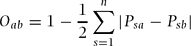
where Oab is the overlap between herbivore species a and b. Psa is the proportion of all browsing events on plant species s by herbivore species a, Psb similarly for herbivore species b and n is the number of plant species browsed by either herbivore species. Spearman rank correlations, based on these same proportions, were determined as an additional measure of diet similarity between herbivores. To assess potential problems in calculating Schoener's index values due to variation in sample sizes amongst the guild, the index was also calculated using a random subsample of 60 browse records per herbivore per season.
To determine overlap in browsing height between all pairwise combinations of herbivores, average feeding height (defined as the average of the highest and lowest browsing levels) for each browse record were classed into 20-cm intervals and these intervals replaced plant species in the above Schoener's index.
The Wilcoxon rank-sum test was applied to test the difference between the wet- and dry-season overlaps in plant species and browsing height by comparing the |Psa − Psb| part of the overlap index equation.
Regressing all average feeding heights on all tree heights revealed no correlation. Therefore in analysing herbivore browsing heights, it was assumed they were independent of plant species. To determine whether herbivore species browsed at significantly different overall average heights (i.e. the average of the average feeding heights) to one another, after Fisher's F test showed that the majority of variances were not equal, the robust ANOVA in S-PLUS was applied and followed by multiple pairwise comparisons using the robust Dunnett's test – both tests assuming unequal variances (Crawley Reference CRAWLEY2002). Seasonal differences in the overall average feeding height, the average upper and the average lower feeding height at which individual herbivore species fed were analysed using the standard two-sample t-test (equal variances) or Welch's modified two-sample t-test (unequal variances).
Interspecific, intraspecific and seasonal differences in various other aspects of the herbivore foraging strategies were tested using Pearson's chi-squared test with Yates's continuity correction (Crawley Reference CRAWLEY2002).
Estimates of the relative abundance of different woody species in the study area were derived from the 2007 Elephant Impact Study carried out by HiP reserve scientists. This study recorded all woody plant species, their stem numbers and diameters within 180 transects spread throughout a representative sample of the reserve's different vegetation types. We calculated the total basal area for each woody plant species across all the transects, and then expressed this as a proportion of the total basal area of all woody species across all transects.
All statistical procedures were carried out in S-PLUS 2000 (Mathsoft, Lucent Technologies, Inc., Murray Hill, USA).
RESULTS
Woody plant species browsed
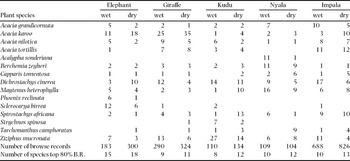
We obtained a total of 3068 browse records (Table 1). Only eight records of black rhino feeding were obtained, so this browser species was not included in the analysis. Asymptotes of the cumulative number of different plant species browsed against number of observations were approached between 40 and 70 records for all herbivores in all seasons, except for nyala in the 2008 dry season.
Frequency of browsing events on different woody species by guild members in Hluhluwe-iMfolozi Park. The values show the use of each plant species by each herbivore, expressed as a percentage of the total records for that herbivore over the two wet or two dry seasons. Only plant species that contributed ≥10% to the browsing of at least one herbivore species in one season are named. The penultimate row shows the total number of browse records obtained for each herbivore over the wet or dry seasons. The last row shows the number of plant species that formed the top 80% of browsing records (B.R.) for each herbivore. Nomenclature follows Pooley (Reference POOLEY2003).

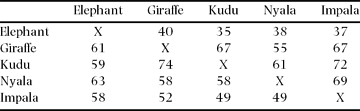
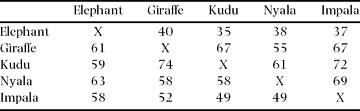
A total of 133 woody species, from a potential of at least 223 listed for HiP, were observed browsed by at least one of the five herbivore species during the study period. However, few woody species accounted for more than 10% of the total browsing records for each herbivore in each season, with a small suite of these woody species forming the staple or core diet of the entire guild (Table 1). Elephant utilized the greatest number of different woody species (Table 2), and utilized higher percentages of species utilized by other guild members, than other guild members utilized of elephant woody diet (Table 3).
Utilization of different woody plant species by the browser guild in Hluhluwe-iMfolozi Park. The number of different woody species utilized, by season, by the guild and by each herbivore species are shown, together with the total number of different woody species utilized by each herbivore species over the study period.

Overlap in utilization of woody plant species amongst the browser guild in Hluhluwe-iMfolozi Park. The figures show the percentage of plant species used by the herbivore in a row, that the herbivore in the column also utilized (e.g. elephant utilized 61% of the plant species utilized by giraffe, but giraffe utilized only 40% of the plant species utilized by elephant).
Acacia karoo had the highest number of browsing events by elephant and giraffe, with both herbivores increasing use of it in the dry season. Sclerocarya birrea was the second most used species by elephant, especially in the wet seasons, but was used little by other members of the guild. Dichrostachys cinerea, Ziziphus mucronata and, to a lesser extent, Maytenus heterophylla, were important for all members of the guild. Spirostachys africana was another important food source for all members of the guild, except for elephant. The genus Acacia was used more in terms of browsing events than any other (Table 1).
With the design of the study, some random variation between season and year in the number of plant species recorded as utilized would be expected. However, whilst there were minimal inter-seasonal changes by giraffe and impala, there was a marked increase in the number of woody species utilized by elephant in the dry season in both years, whilst kudu and nyala did so only in the more severe dry season (Table 2).
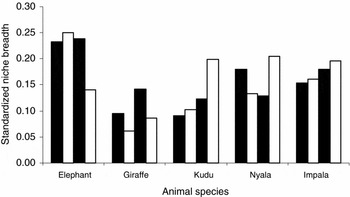
In terms of plant species browsed elephant occupied the widest niche of the guild in both wet seasons, and narrowed this niche during the second, considerably drier, dry season (Figure 1). Over both dry seasons the browsed-species niche of giraffe decreased, whilst that of kudu and nyala increased during the severe second dry season. As plots for nyala did not reach an asymptote, further data collection would probably have revealed an even broader niche.
Seasonal standardized niche breadth of woody species browsed, shown by Levins' niche-breadth index, standardized to a scale of 0–1 following Hurlbert (Reference HURLBERT1978). Wet (black) and dry (open) seasons are shown, with, for each herbivore, the first two columns representing the first year, the second two the second year of the study in Hluhluwe-iMfolozi Park.

Elephant did not show a significant (Schoener's index ≥0.6) or high (Schoener's index ≥0.5) overlap with other herbivores in species browsed. High or significant overlaps in species browsed were found, to varying extents, between herbivore pairs excluding elephant (wet season 2007: giraffe/kudu 0.52, giraffe/impala 0.64, kudu/impala 0.54; dry season 2007: giraffe/impala 0.52; wet season 2008: giraffe/impala 0.51; dry season 2008: kudu/impala 0.53, nyala/impala 0.50). Schoener's index results were generally supported by the corresponding Spearman rank correlations; however, there was a positive correlation between species browsed by elephant and giraffe over the wet and dry season of 2008. Although there were no significant differences (P > 0.05, Wilcoxon rank-sum test) in dietary overlap between the wet and dry seasons of 2007, in 2008, with its harsher dry season, highly significant increases (P < 0.005, Wilcoxon rank-sum test) in overlap between elephant and kudu and between kudu and nyala were found. Schoener's index based on the random subsample of 60 browse records closely matched that based on the full data set – higher overlaps were again found between non-elephant pairs and >90% of the index values varied from those of the full data set by <0.1. As would be expected from sampling theory, the vast majority (>90%) of this minor variation was in the direction of reduced overlap.
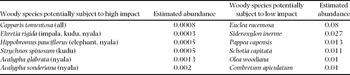
Comparison of the estimated abundance of woody species in the reserve with observed browsing events, suggests potential impact will be high on certain species (e.g. Capparis tomentosa, Table 4) and low on others (e.g. Euclea racemosa, Table 4).
Woody plant species potentially subject to high or low impact from the browser guild in Hluhluwe-iMfolozi Park. The first column shows plant species that contributed ≥5% to the observed browsing of at least one herbivore species (shown in parentheses) and have low estimated proportional abundance in the reserve (second column), whilst the third column shows plant species that did not contribute ≥5% to the browsing of at least one herbivore species and have high estimated abundance in the reserve (fourth column). Estimated abundance is expressed as the proportion of the total basal area of all woody species sampled during the 2007 Elephant Impact Study in Hluhluwe-iMfolozi Park.

Browsing heights
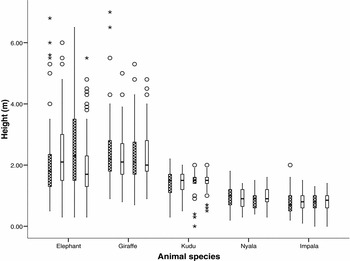
Elephant and giraffe showed a wider range of average feeding heights than did kudu, nyala and impala during all four seasons (Figure 2). Pairwise analysis of overall average feeding heights, showed that each herbivore species fed at a significantly different (P < 0.05, Dunnett method) average height compared with other members of the guild, except impala and nyala, where there was no significant difference (P > 0.05, Dunnett method) in feeding heights in any of the four seasons, and elephant and giraffe, where feeding heights during the wet and dry season of 2007 did not differ significantly (P > 0.05, Dunnett method) (wet season 2007, F4,607 = 134; dry 2007, F4,751 = 216; wet 2008, F4,725 = 239; dry 2008, F4,918 = 191). Similarly, Schoener's index for overlap in browsing heights showed significant overlap between impala and nyala in all four seasons (wet 2007: 0.77, dry 2007: 0.72, wet 2008: 0.80, dry 2008: 0.74), whilst for elephant and giraffe there was significant overlap in both the wet and dry season of 2008 (0.62, 0.65) and the dry season of 2007 (0.71). There was also significant overlap between elephant and kudu in the wet season of 2007 (0.62).
Location and variation in heights browsed by members of the browser guild in Hluhluwe-iMfolozi Park during the wet (cross hatched) and dry (open) seasons. The box plots are based on average feeding heights (the average of the highest and lowest browsing levels) from browse records. The first pair of boxes for each herbivore represent data from the first year; the second pair from the second year. The lines within the boxes are sample medians and the 25th and 75th quartiles are respectively shown by the lower and upper box ends. The lines outside the boxes extend to the minimum and maximum values within the next 25th quartile and the symbols beyond represent outlying observations.

There were no significant seasonal differences (P > 0.05, Wilcoxon rank-sum test) in the Schoener's index for overlap in browsing heights for any herbivore pair, in either year. There were no significant seasonal differences in the overall average feeding height (P > 0.05, standard two-sample t-test or Welch modified two-sample t-test, as appropriate), or the average upper or average lower feeding height at which individual herbivore species fed in either year, with the exception of elephant. Elephant fed at a significantly lower overall average feeding height in the dry season (average = 1.85 m) of 2008 compared to the preceding wet season (average = 2.52 m; t = 5.3, P < 0.005 (two-tailed), df = 299), and at significantly lower average upper (2.32 m versus 3.17 m; P < 0.005) and average lower (1.46 m versus 1.84 m; P < 0.05) feeding heights.
Plant parts and mixed feeding
Browsing technique varied amongst the guild members. Elephant favoured breaking off leafy branches or stripping leaves (70% and 23%, respectively, of the total observed browsing events for elephant over the study period), giraffe stripped leaves (67%), kudu bit off branch ends or shoots (53% and 33% respectively), nyala bit off shoots, mature leaves or branch ends (44%, 29% and 22% respectively), and impala bit off shoots and mature leaves (57% and 31% respectively). Kudu foraging showed significantly higher taking of branch ends compared to nyala (χ2 = 21.1, df = 1, P < 0.0001). Nyala showed a significantly higher usage of branch ends amongst the males versus the females (χ2 = 4.51, df = 1, P = 0.034). Impala, alone, showed significant changes in plant part usage between wet and dry seasons in both years; there was a significantly lower usage of mature leaves (first year: χ2 = 6.12, df = 1, P = 0.014; second year: χ2 = 14.4, df = 1, P = 0.0001) and higher usage of shoots (first year: χ2 = 4.12, df = 1, P = 0.043; second year: χ2 = 9.61, df = 1, P = 0.0019) in the wet seasons compared to the dry seasons.
Amongst the mixed feeders in the guild, elephant and impala showed a highly significant increase in the percentage of browsing versus grazing feeding-observations in both dry seasons, compared with the preceding wet season (elephant, first year: χ2 = 41.8, df = 1, P < 0.0001, second year: χ2 = 43.2, df = 1, P = < 0.0001; impala, first year: χ2 = 61.9, df = 1, P < 0.0001; second year: χ2 = 34.7, df = 1, P < 0.0001). Nyala, however, showed a significant decrease in the relative frequency of browsing to grazing in the first dry season (χ2 = 12.0, df = 1, P = 0.0005), but a significant increase in the second dry season (χ2 = 34.5, df = 1, P < 0.0001). Elephant and nyala, but not impala, increased the percentage of browsing versus grazing in the drier, second dry season significantly more than in the wetter, first dry season (elephant: χ2 = 211, df = 1, P < 0.0001; nyala: χ2 = 19.5, df = 1, P < 0.0001). However, both impala and nyala still grazed substantially more than browsed in both seasons, whilst elephant browsed more than grazed in both dry years.
In both years, the percentage of animal activity observations that were recorded as feeding significantly increased in the dry versus wet season (year one: wet = 58%, dry = 78%, χ2 = 127, df = 1, P < 0.0001; year two: wet = 68%, dry = 79%, χ2 = 30.3, df = 1, P = 0.0001).
DISCUSSION
Selection of woody species
Overlap in species browsed was greater amongst the non-elephant browsers than that between elephant and other browsers. Elephant showed the most overlap with giraffe, a fellow megaherbivore (Owen-Smith Reference OWEN-SMITH1988), generally the broadest species-browsed niche and utilized a higher percentage of plant species utilized by other guild members, than vice versa. These results agree with the predictions arising from differences in body-size and from differing digestive systems, as discussed in the introduction. They also agree with the few relevant studies in the literature. Jarman (Reference JARMAN1971) studying dietary overlap in Kariba, Zimbabwe, and Makhabu (Reference MAKHABU2005) studying overlap in Chobe, Botswana, both found greater overlap amongst non-elephant browsers than that between elephant and other browsers. Field & Ross (Reference FIELD and ROSS1975), working in Kidepo Valley, found high levels of overlap (64%) in diet between giraffe and elephant, as did Lamprey (Reference LAMPREY1963) in Tarangire (77–86%). Our review of the literature from 1960 to 2009 showed that elephant utilized the widest range of woody species and shared higher percentages of diet with other browsers than vice versa.
Makhabu (Reference MAKHABU2005), who also used Schoener's Index to assess woody diet overlap amongst the guild, found lower levels of overlap between elephant and other browsers (ranging from 0.2 to 0.32) than this study, even though the suite of plants browsed was considerably smaller (35 woody species versus 133). Jarman (Reference JARMAN1971), although calculating dietary overlap differently, also found ‘considerable separation between (elephant, black rhino, kudu and impala) in the plants upon which each was most dependent’. Both authors describe resource limitation at their sites – the latter studying the guild after the construction of the Kariba dam had markedly compressed its range, the former along the Chobe riverfront, an area of very high browser densities (Mosugelo et al. Reference MOSUGELO, MOE, RINGROSE and NELLEMAN2002). In contrast, Lamprey (Reference LAMPREY1963) found high overlap between elephant and other browsers (elephant utilizing between 71% and 77% of other browsers' diet), whilst studying the guild in Tarangire in the early 1960s when browse would probably have been plentiful. Current browse availability in HiP probably lies midway between these extremes – as does the degree of overlap between elephant and other browsers. Thus there appears to be a continuum with increasing levels of resource depletion being associated with decreasing dietary overlap between elephant and other browsers – agreeing with the niche overlap hypothesis of Pianka (Reference PIANKA1972).
An unexpected finding, in terms of the body-size hypothesis and, for elephant, digestive tract type, was the marked dry-season decrease in the browsed-species niche breadth of giraffe and elephant. Greater mobility of these species may be the explanation. Home ranges for both elephant and giraffe are considerably greater than those for smaller herbivores (du Toit Reference DU TOIT1990a). They are also, by virtue of their size, less susceptible to predation (Owen-Smith Reference OWEN-SMITH1988) and consequently less restricted by dense undergrowth which may conceal predators (Grand Reference GRAND2002). Elephant and giraffe might therefore be expected to mitigate resource depletion more successfully than smaller herbivores, by concentrating their foraging in whatever part of their larger range provides the best forage, relatively independent of predators. This appeared to be the case, with the relevant dry-season diet of both elephant and giraffe having a considerably higher percentage contribution from Acacia karoo – a species principally available in the north-eastern part of the study area, which is characterized by thicker undergrowth.
Interspecific variation in plant utilization might also relate to plant chemical defences (Owen-Smith Reference OWEN-SMITH1993). Rapidly absorbed toxins such as alkaloids may influence hindgut fermenters, such as elephant, more than ruminants, which may be more affected by compounds hindering digestion (Palo Reference PALO, Provenza, Flinders and McArthur1987). For example, Spirostachys africana, poisonous to man, has previously been reported as avoided by elephant (Bowland & Yeaton Reference BOWLAND and YEATON1997) but favoured by impala (Rodgers Reference RODGERS1976), kudu (Hirst Reference HIRST1975) and nyala (Vincent et al. Reference VINCENT, HITCHINS, BIGALKE and BASS1968) – as was the case in this study.
Arid/eutrophic savannas typically support high biomasses of both elephant and other browsers (East Reference EAST1984) and HiP is no exception – indeed, the estimated total biomass of other large browsers exceeds that of elephant (3000 Mg versus 1400 Mg). Thus the heavy utilization by the entire guild of a relatively small suite of woody species, whilst at least 90 (40%) of available species were ignored, suggests that the guild as a whole may impact these core species. This suggests the potential for interspecific competition in the guild, in turn implying the potential for guild members to influence the population size of other guild members. Keystone species are species defined as having a disproportionate effect on the ecosystem compared with their biomass. It may be that amongst the savanna browser guild impact is proportional to total biomass and that, therefore, the high profile impact of elephant is purely a reflection of its high total biomass in many areas.
Browsing heights
That different-sized herbivores browse at different heights, thus reducing niche overlap, is well established (du Toit Reference DU TOIT1990b). Similar mean browsing heights, and high Schoener's index values, between the comparably sized nyala and impala and, to a lesser extent, between giraffe and elephant, were therefore expected. Only elephant adjusted feeding height in response to resource availability. Giraffe may have reduced the available forage in the higher branches, competitively displacing elephant lower, but still above nyala and impala. Woolnough & du Toit (Reference WOOLNOUGH and DU TOIT2001) concluded that when resources are restricted smaller ungulates competitively displace larger ones from shared feeding sites.
Plant parts and mixed feeding
Plant parts browsed differed amongst the guild broadly as predicted by both the body-size hypothesis and variation in digestive systems. The large, non-ruminant elephant fed mainly on leafy branches, containing a high proportion of relatively indigestible (Gordon & Illius Reference GORDON and ILLIUS1996) woody matter, whilst impala, the smallest ruminant, fed mainly on nutritious shoots or leaves. Kudu showed the highest use of branch-ends (a resource that contains some wood, but also nutritious young leaves and/or buds), nyala, between kudu and impala in size, less usage and impala the lowest. Nyala, a markedly sexually dimorphic species, showed greater branch-end usage by males versus females. Plant parts browsed were not, except for impala, influenced by resource availability.
As grass ages the concentration of protein decreases whilst relatively indigestible crude fibre increases (McDonald et al. Reference MCDONALD, EDWARDS and GREENHALGH1987). Browse, although generally a lower-quality food than young grass (Codron et al. Reference CODRON, LEE-THORP, SPONHEIMER and CODRON2007), thus becomes more attractive as the dry season advances (Williamson Reference WILLIAMSON1975), explaining the increase in browsing versus grazing feeding observations for elephant and impala in both dry seasons. Flushes of green grass follow dry-season burning (Scholes & Walker Reference SCHOLES and WALKER1982); the attractiveness of newly burnt areas to large herbivores is widely recognized (Rowe-Rowe Reference ROWE-ROWE1982). However elephant were not observed utilizing grass flushes and would be unlikely to be physically able to harvest such short grass. Thus in the dry season elephant rely heavily on browse, whilst grass flushes form an important part of impala and nyala diet – as reflected in the dry-season feeding-observations for elephant being predominantly browsing, whilst those for impala and nyala were predominantly grazing (Meissner et al. Reference MEISSNER, PIETERSE and POTGIETER1996). The impact of impala and nyala on woody vegetation during the dry season is likely, therefore, to be reduced by the availability of grass flushes.
The increase in ‘feeding’ observations in the dry versus wet seasons probably reflects the lower quality of dry-season forage, requiring proportionately greater time spent foraging to satisfy metabolic requirements.
CONCLUSIONS
Overlap in plant species browsed was less between elephant and the rest of the guild than amongst the latter. Seasonal and annual variation in resource availability influenced herbivore choice and range of woody plants utilized. However, variation in resource availability rarely had a significant effect on interspecific overlap in plant species browsed, on overlap in browsing heights, on browsing heights themselves or on plant parts utilized. Elephant, contrary to theoretical predictions, decreased their niche breadth of plant species browsed in response to marked resource depletion.
A relatively small suite of species formed the core diet of all guild members, implying that there is the potential for synergistic impacts by guild members on these species and for competition between populations of different guild members. This strongly suggests that management, concerned about the long-term dynamics of savanna woodland, should consider the entire guild, rather than exclusively manage elephant.
ACKNOWLEDGEMENTS
We thank the management of Hluhluwe-iMfolozi Park, South Africa. We thank Geoffrey Clinning, Tarik Bodasing and Dr Shaun Ramroop for assistance with data, and two anonymous reviewers for comments on an earlier draft. We are deeply grateful to Nick and Katy Vetch and to Sabine and Richard Wood, who principally funded this study. A grant was received from the National Research Foundation, South Africa.