When Wilhelm Karczag first heard Franz Lehár’s score to Die lustige Witwe, he supposedly exclaimed, ‘Das is ka Musik! [That ain’t music!]’ The setting was Lehár’s own apartment on the Mariahilferstrasse in Vienna in the summer of 1905, a little before the operetta was to premiere at Karczag’s Theater an der Wien. This anecdote, not celebrated in print until 1924 and disputed by several of those who claim to have been present, makes Karczag the butt of a joke, for Die lustige Witwe was the music that would rule operetta for the next two and a half decades.Footnote 1 Karczag’s Hungarian accent – he had moved from Budapest only four years prior – is rendered phonetically, marking him as an outsider who could not hear what the rest of the Vienna later recognised.
Lehár’s audition for Karczag became an iconic event in Die lustige Witwe’s narrative as an underdog success. The operetta’s purportedly hostile initial reception, including not only the resistance of the theatrical management but also its ostensibly lukewarm opening night, positions it as a ‘Naturkind’ – so radically different in tone from Karczag’s operetta habits that he was unable to recognise it as music. Against all odds, it emerged to conquer the theatrical world and launch what would become known as the Silver Age of Viennese operetta.Footnote 2 This was a story told over and over again in Viennese newspapers.Footnote 3 The shifting details in the retellings of this anecdote by those involved in the original production were, in large part, reflective of a dispute over ownership. Everyone – composer, librettists, impresarios and actors – was eager to claim credit for (and preferably also some of the profits from) the greatest theatrical success of the time. Die lustige Witwe racked up 483 performances in its initial run in Vienna and, by 1921, 8,338 on all German-speaking stages.Footnote 4 Karczag’s co-director, Karl Wallner, even claimed to have conceived the third act of the operetta himself. Librettist Victor Léon vehemently refuted this, and denied that Wallner heard the operetta for the first time at the fateful audition at all.Footnote 5
The ‘Das is ka Musik’ anecdote was popularised in the 1920s, just as operetta was beginning its inexorable decline. Mythmaking practised on an acknowledged classic of the genre served to rescue from anachronism this most successful work by transforming it into an autonomous entity, worthy of lasting esteem. Indeed, Die lustige Witwe is one of the few Viennese operettas still to be regularly performed today – and not in its original commercial environs but in the sanctified space of modern opera houses. But this occludes the very different circumstances under which the operetta was conceived. The energetic self-advocacy of the operetta’s creators helped to conceal the fact that Die lustige Witwe was created not with high-art aims nor with thoughts of how it would play decades later, but rather to please, and to please immediately.
The scant operetta literature has tended to describe Die lustige Witwe in the same superlative terms used by its creators, positioning it as a work whose immense success seems to have separated it from its lowly colleagues in fundamental yet vaguely defined ways. In his English-language history of operetta, Richard Traubner introduces his discussion of Die lustige Witwe with a generalised paean to its fantastic success: the operetta is ‘ravishing’, ‘as good or better than any other of its day’, ‘exciting’, ‘fragrant’, and ‘fabulously effective’.Footnote 6 In Traubner’s teleology, Die lustige Witwe is established as an extraordinary phenomenon before it is put in the context in which it began, as an ordinary operetta. In fact, in contrast to the conventional narrative of Die lustige Witwe as a work that transcended its era, a look at the world of operetta of 1905 reveals it as an encapsulation of its time – and an instance in which the hybridised musical style of operetta is integral to the dramatic action.
Die lustige Witwe was created while operetta was itself in crisis, following the deaths of Johann Strauss II and several other major nineteenth-century composers and at a point when the genre’s direction and purpose were uncertain. Set to a plot about a group of hapless ‘Pontevedrans’ playing matchmaker in the midst of Parisian society, the operetta’s music embodies and utilises this instability. Die lustige Witwe dramatises the contrast between the imaginary Balkan principality and Paris as the contrast between Parisian/English and Austro-Hungarian operetta styles. Its score presents an Austro-Hungarian/French binary, but one whose drama is generated by the friction between the two styles. For all that it respects many established operetta conventions, it uses them in a way that is arguably more consistent, creative and dramatically pointed than any other work of its era, and it has a rare element of self-consciousness.
The operetta was also created for a particular audience. The true geographical home of Die lustige Witwe is not Paris or ‘Pontevedro’, but 1905 Vienna. Die lustige Witwe captures the experience of a city of immigrants in the throes of modernisation. The Austro-Hungarian Empire’s belated industrialisation was transforming the city’s demographics, bringing an influx of new citizens, new models of social organisation and new technology. The Pontevedrans of the operetta are ethnic outsiders, planted in the centre of a dazzling urban metropolis, forced to balance the boredom of wage labour and the pull of urban temptation against the weight and value of their indigenous traditions. Like many operettas, Die lustige Witwe is wish fulfilment, displaying an opulently staged, romantic solution to problems found in its audience’s everyday lives.
This cosmopolitan vision of society and this socially conscious role for art are markedly different from what is often associated with the Vienna of this era. For scholars, the study of so-called fin-de-siècle Vienna is still most closely associated with Carl Schorske’s theory of ‘hothouse modernism’. According to Schorske, the downfall of Liberalism resulted in an intelligentsia with energies that, rebuffed from politics, were channelled into the creation of modern art.Footnote 7 The popularity of Schorske’s work, however, has tended to restrict study of Vienna to the narrow purview he considered, effectively writing out art forms which do not conform to his elite modernist model. The case of operetta, the creators of which came from the same social classes and societies as Schorske’s more exalted group, demonstrates that dependence on Schorske’s model tends to limit perspectives on Viennese culture. A new look at Die lustige Witwe suggests a more inclusive consideration of Viennese culture and history.
I begin this article by surveying the world of operetta in Vienna up to 1905, considering its French heritage and quickly acquired Germanic identity. The passing of the nineteenth century’s ‘Golden Age’ composers resulted in both an identity crisis, endlessly debated in the contemporary press, and a richly experimental period for a new generation of composers and librettists. This, I argue, led directly to the allegorical character of Die lustige Witwe, which emerges as a meta-operetta dramatising the polemics of this unstable era. Die lustige Witwe’s context offers some glimpses into why Felix Salten wrote that ‘All that resonates and hums in our daily lives, what we read, write, think, praise, and what for new, modern clothes our expressions wear, all these are intoned in this operetta, they sound there.’Footnote 8 Supposedly escapist entertainment engaged with its audiences’ most urgent concerns, and the polemics of newspaper critics extended into operettas themselves. Despite its current status as the rare operetta to withstand the test of time, Die lustige Witwe is inseparable from the aesthetic and social concerns that surrounded its creation.
Operetta in Vienna to 1905
Viennese operetta scavenged from many other genres of music theatre. Containing elements of French opérette and opéra-comîque with German Singspiel and komische Oper, it borrowed unabashedly also from Viennese theatre pieces such as the Lustspiel, Schwank and Posse, the traditional Germanic Volksstück, Italian opera, and the French boulevard theatre that bequeathed the Viennese so many librettos.Footnote 9 Through this generic hybridity and its many conspicuous borrowings, operetta built a rich vocabulary of conventions and codes with remarkable speed. Operetta benefitted from the diversity of Vienna’s cultural offerings, and sought to offer something for everyone. As the librettist Victor Léon wrote, ‘What pleases the aristocrat in the stalls does not always please the female cook in the gallery, but what pleases the cook doesn’t always also suit the aristocrats … [Operetta] is not caviar for the people. Its purpose is to serve as entertainment, pur et simple.’Footnote 10 The fact that operetta was dependent on market forces and the changing tastes of audiences rather than on the generosity of patrons was neither incidental nor a liability, but rather a defining feature of the genre’s construction and development. Each operetta responded to the successes and the failures of its predecessors, replicating what worked and excising what did not. The talents and personalities of the leading actors defined the roles written for them. The few operettas that survive today can be hard to appreciate in isolation: like earlier comic opera, much of their delight comes from their manipulation of known codes and conventions.
Vienna had inherited operetta from Offenbach, whose works first gained popularity in commercial Viennese theatres in the late 1850s. Offenbach worked from an opéra-comîque template featuring repetitive, symmetrical phrases and straightforward harmonic language (usually in major keys), but these simple building blocks were enriched with off-kilter rhythms and, often, very fast tempos. Once operetta was established in Vienna, local composers began to write works for the local taste. Johann Strauss II, the ‘Waltz King’, entered operetta in 1871, and the progress of his operettas, beginning with Indigo und die vierzig Räuber in 1871, mirrored the development of the genre itself. At first, Strauss maintained the satire and farce of the French model (as in Die Fledermaus, 1874), while his later efforts, beginning in 1885 with Der Zigeunerbaron, turned serious and more conventionally operatic.Footnote 11
By the end of the nineteenth century, Viennese operettas featured romantic plots with sympathetic characters (the comic relief confined to supporting roles), and often included folk- and nationalistically inspired plots or music. The integration of the waltz into operetta made operettas composed in Vienna, for the first time, fully Viennese in spirit, drawing their music from (and incorporating it into) a pre-existing sound world. As Eduard Hanslick described Strauss’s Apfelfest, ‘What is the setting? The libretto doesn’t say. But the music tells us without any doubt: it’s an Austrian setting, a good Viennese work.’Footnote 12 (Operetta was seen by Hanslick and many of his contemporaries as filling the need for a quasi-folk art where all of Vienna could laugh at the same jokes.Footnote 13)
The pressures for composers to create ‘good Viennese work’ had been growing. Political developments in the 1870s from the unification of Germany to the Franco-Prussian War simultaneously fuelled a precipitous increase in pan-German nationalism and a turn against all things French, including Offenbach.Footnote 14 Both impresarios and critics called for a revival of the purportedly morally upright Germanic tradition. What was once, because French, modern and racy, was now decadent and lascivious. When the alternative was French ‘frivolity’ and wilful strangeness, the familiar appeals of the new Viennese operettas – waltzes, Hungarian colour, and sentimentality – seemed only more attractive.Footnote 15 An 1875 reviewer of Johann Strauss’s Cagliostro in Wien wrote:
The Viennese composer Johann Strauss has sustained a new victory over the French … Above all, the libretto is a rational one, free from the idiocy that the French take for fun. It doesn’t play in a fool’s land where the people wear impossible hats and robes and speak and act like lunatics, rather the events take place here in the fatherland, in the city of Vienna.Footnote 16
The crux of this move towards localism was a return to the subjects of the old Volksstück: homespun, deliberately naïve and ‘anti-decadent’, often connoting a degree of xenophobia and anti-Semitism.
By the 1890s the fervour for German nationalist theatre had already ebbed. For Viennese operetta, there loomed another problem, not ideological this time: a lack of major composers. Johann Strauss II and Carl Millöcker – both had already retired earlier in the decade – died in 1899; Franz von Suppé in 1895. Their works continued to be the most popular draws at Viennese operetta theatres. Commentators began looking back to Strauss’s or even Offenbach’s eras with nostalgia, and wondering whether the genre had a future. Impresarios and librettists began to cast around for the next big thing.
Operetta was too popular to ignore. Several high-art critics (such as Hanslick, mentioned above) had affection for the more strongly Viennese-accented operettas, and some were also composers or librettists themselves (such as Richard Heuberger and critic/librettist Leopold Jacobson).Footnote 17 But many critics thought operetta’s turn towards opera and sentimentality was a mistake, depriving the genre of its unique appeal as satire and making it no more than opera manqué for a less discerning audience. Around 1900, popular media coverage began to fixate on the idea of a ‘crisis of operetta’. Crisis was in some ways integral to operetta culture: to the less favourably disposed, the very popularity and centrality of operetta in cultural life was the crisis. To those more enamoured of the genre, the problem was a perceived decline in quality, as well as the sudden disappearance of the established Golden-Age composers.
Most critics believed that operetta served a purpose distinct from that of opera: while opera could and even should challenge its audience, operetta must divert without taxing the audience’s understanding. Berlin theatre critic Erich Urban described operetta’s virtue as its ‘likeable superficiality’ and ‘cheerful, easy-going essence’.Footnote 18 Critic Ferdinand Scherber wrote in the Neue Musik-Zeitung that it should be effortless, ‘music that goes into our ears without pain, and without exertion brings new excitement to our nerves’.Footnote 19 This entertainment, Scherber wrote, should be accessible to everyone and offer relief from the toil of modern life (neatly prefiguring Danilo’s entrance song in Die lustige Witwe):‘music that accompanies people in the workshop and office, that makes bearable the monotony of division of labour, that makes bleak minutes fly by’.Footnote 20 Similarly, the pre-Witwe Franz Lehár wrote in a feuilleton essay (the likes of which many composers wrote on occasion in order to propagate their views) that many critics condemned operetta music as lacking worth; however, he felt that, while most people lacked the privilege to enjoy and understand difficult music, anyone could enjoy operetta as aiding ‘recuperation after the day’s trouble and toil’.Footnote 21
Given this scrutiny, it is not surprising that the history of operetta in Vienna is represented as one of degeneration. Critics condemned Vienna’s sentimental romance as inferior to the sharper wit of Offenbach. Berlin-based critic Erich Urban went so far as to proclaim: ‘Offenbach began, fulfilled, and completed operetta. He is simultaneously its beginning, apex, and end.’Footnote 22 Like Urban, Eugen Thari found the true purpose of operetta to be merry parody and political satire, exemplified by Offenbach, and argued that current composers had abandoned their purpose for mere business concerns.Footnote 23
Before prescribing a cure for operetta’s post-Golden Age woes, critics summed up the problems. After arriving in Vienna, critics suggested, operetta gave way to three temptations: the waltz and dance music in general, an aspiration to the emotional and musical scale of full-blown opera (an accusation seemingly contradictory to the first, but an indication of how variegated both operetta and criticism could be), and dramatic cliché. Urban blames Johann Strauss II for dance and cliché, arguing that the Waltz King brought the closed forms of dance music into music theatre, to its detriment. (Considering Strauss’s late career operatic experiments, this charge seems slightly misplaced.) Operetta, Theodor Antropp wrote in the Viennese paper Die Zeit, was not dramatic: it had ‘no self-contained [geschlossene] lyric-dramatic plot which requires the music to serve as an expressive or atmospheric [Stimmung] medium, but rather a wild potpourri of low folk theatre scenes, inserted songs, and spectacular processions; words and music aren’t positioned to signify together and interact but rather are rendered individually for their own purposes’.Footnote 24 These criticisms would never really go away, and are still at the heart of Carl Dahlhaus’s dismissal of the entire genre as trivial music, interesting as social history but unimportant for the long-term development of compositional technique – a perspective which deems only certain kinds of composition to be worthy of discussion.Footnote 25
Those who thought operetta salvageable proposed various solutions. Thari wrote that operetta should return fully to its Offenbachian roots, a model of a ‘satyr play’ that would seduce with ‘human, artistic, and political humour’.Footnote 26 Urban thought that the solution was to look to the artists of his city, Berlin, for a fresh ‘jovial, brash, satirical spirit’. (Indeed, Berlin composers produced many light-hearted, irreverent works in the early twentieth century, and the Berlin milieu was an important influence on Viennese composers Leo Fall and Oscar Straus.)Footnote 27 The Silver Age is easily demarcated by this period of instability and the complete replacement of its major composers by a new group. But many of the criticisms that would be levelled against twentieth-century operetta were already clearly stated around 1900, before the Silver Age even began: namely, a perceived conflict between the satire of Offenbach and the increasing tendencies of Viennese composers to reach towards sentiment and musical grandeur.Footnote 28
In search of ‘Die Operette der Zukunft’
Even as critics saw a genre in decline, access to operetta in Vienna was expanding rapidly. By the era of Die lustige Witwe, Viennese audiences had unprecedented choice in venues and genres of musical theatre. The closer a theatre was to the central ‘first’ district (the area encircled by the Ringstrasse), the wealthier the audience it could attract, the more coverage it would receive in major newspapers, and the higher the ticket prices it could command. The most prestigious operetta stages were the Carl-Theater and the future home of Witwe, the Theater an der Wien, both located in the suburban Vorstadt (the doughnut-shaped area between the circles of the Ringstrasse and the Gürtel).Footnote 29
The Theater an der Wien, located across the Resselpark from the Hofoper, had long been one of the most prominent and important commercial theatres in the city.Footnote 30 But by 1900, under the direction of Karl Langkammer, the quality of its productions had sunk. The theatre hosted few premieres, the performances were provincial in quality, and the programming was a haphazard miscellany which lacked a clear artistic agenda. In April 1901, in the financial doldrums, the theatre was closed and sold to a new consortium of investors, who appointed Hungarian journalist and playwright Wilhelm Karczag as director.Footnote 31 Karczag revolutionised the programme almost overnight. While he had no background in operetta, he decided that it was what his audiences wanted and embarked on a mission to discover a new generation of composers, aggressively taking on new works by unknown artists.Footnote 32
Karczag and his colleagues’ efforts produced a wildly experimental period of operetta that ended with Die lustige Witwe’s establishment of a new set of genre expectations. But it also produced a fair amount of hype without results, sometimes met with great scepticism:
Every day we receive another memo about the health of operetta. Then Herr X or Herr Y appears with a muse-consecrated on the calendar – by which we mean on the performance schedule of a Viennese theatre – there is a rustling in the leaves of the newspaper: ‘No, operetta isn’t dead, Herr X has revived it. Charming melodies, a sparkling mood, stirring rhythms, etc’. But that doesn’t prevent the fact that eight days later at the same place there follows the revival of a Strauss operetta.Footnote 33
While none of the works of this period stuck in the repertoire for long, some of their novelties were not forgotten: most of the dramatic innovations in Witwe can be found in one or another momentarily successful work. Through the efforts of Karczag and a few other enterprising producers, most of the important composers of what would be termed the Silver Age – not only Lehár but also Oscar Straus, Leo Fall and Edmund Eysler – all emerged as promising figures in this 1900–5 period.
The most popular composer of this time was not, however, Viennese at all but rather the English music-hall veteran, Sidney Jones. His two greatest operetta hits, San Toy and The Geisha, were both exercises in empty exoticism – The Mikado without the political satire. Jones’s music had manic, infectious energy that refreshed Viennese audiences. His most lasting contribution was a style of physically strenuous, semi-pantomime known as ‘grotesque dance’ or ‘parody dance’ (later known as ‘eccentric dance’), a series of contortions that tested the performers’ elasticity.Footnote 34 One of its most famous early proponents was the actor Louis Treumann, who would eventually find himself in the leading role of Die lustige Witwe. Of his dance in San Toy, he said:
I can modestly say that I laid the foundations for eccentric dance onstage … [in San Toy] because something grotesque was required, I pushed myself so far onstage as to do a ‘salto mortadella’ in the dance after my couplet (‘The Chinese soldier’). This sparked such a frenetic ovation in the audience that I often had to encore it. Many came to the theatre just to see if I would make it through unscathed. The desire for thrills and stimulation!Footnote 35
The dance numbers did not advance the operetta’s drama but rather stood apart from it. (The same can be said of some of the musical numbers entire, which are often directed more at the audience than the other characters.) The spectator is aware of the spectacle; there is no mimesis or opportunity for identification with the performer. In this respect, as well as in the general buffo character of the music, dance operetta extended Offenbachian style. What had been dropped, for the most part, was the satiric element.
According to Austrian and German critics, the English craze was a fad without lasting importance for operetta, whose core resided on the Continent. They awaited a new messiah. Already in 1904, Albert Kauders had written that he put his hopes ‘with even greater happiness in Franz Lehár, who through all the popular hash can’t hide a superior musical education’.Footnote 36 Indeed, unlike the composers of the Golden Age, Lehár was formally trained, having attended the Prague Conservatory, and subsequently served as a military bandmaster.Footnote 37 He wrote an unsuccessful opera and some successful salon music, and after leaving the military took conducting positions at various theatres, eventually as an assistant Kapellmeister at the Theater an der Wien.
This position and the four operettas that Lehár composed before Die lustige Witwe amounted to a crash course in a genre with which he had little prior familiarity; Stefan Frey goes so far as to characterise the young Lehár as a Parsifal of operetta, lost in a magic garden and remaking a genre whose rules he did not know.Footnote 38 Lehár’s first operetta, Wiener Frauen (1902), starred the most important of all nineteenth-century operetta actors, the aging Alexander Girardi.Footnote 39 Girardi adopted his customarily folksy Viennese persona, and Lehár’s music similarly summoned up an earlier era. But while Wiener Frauen followed tradition, Lehár’s second operetta, Der Rastelbinder (1902), was radically unconventional: written to a libretto by Victor Léon (the most doggedly experimental of operetta librettists), it takes place primarily in Vienna but the characters are mostly Slovakian immigrants struggling to adjust to city life. Lehár’s score mixes Slovakian folk music with more typically Viennese sounds (an obvious antecedent to Witwe), exploring issues of integration and homesickness. An enormous box office success, the theme clearly resonated with contemporary Vienna.
In 1904, before Die lustige Witwe, Lehár wrote two more operettas, neither of which was particularly successful but which further demonstrated his ability to write fluently in multiple styles. Die Göttergatte is an Offenbach throwback, a domestic adventure among Greek gods set to light, French-style music with none of the regional colour of either of Lehár’s previous works. It was not particularly successful, but its successor, Die Juxheirat, failed even more quickly, despite another star performance by Girardi. Critics suggested that Lehár’s increasing cosmopolitanism was not compatible with the old-fashioned style of the libretto and of its lead actor.Footnote 40 Shortly after Die Juxheirat, Girardi announced his retirement from the stage, a move that would complete the generational shift that had begun with the departure of Johann Strauss and the other Golden Age composers.
The theatre’s autumn 1905 season began on 10 October with Leo Ascher’s new operetta Vergelt’sgott!, featuring a novel New York setting and starring two actors new to the theatre, Louis Treumann and Mizzi Günther (whom Karczag had lured away from the rival Carl-TheaterFootnote 41). It ran a successful 69 performances. Karczag’s 29 November premiere was an even bigger risk: the debut operetta of composer Leo Fall and new librettists, Rudolf Bernauer and Ernst Welisch, Der Rebell, an experimental piece that attempted to graft grand opera ensembles onto the absurd plot of an Offenbach operetta. Had it been successful, it could have heralded an alternate future for operetta, one of satire and absurdity rather than romanticism. But while Fall received encouraging notices and critics were intrigued by the work’s originality, by all accounts it was still was a mess. Der Rebell closed after only five performances, when the creators withdrew the work for revision.Footnote 42 Karczag rushed his next work – Die lustige Witwe – into production, planning the revised Der Rebell to return after Witwe ran its course. Witwe’s expedited production schedule, as well as Karczag’s doubt as to the work’s prospects, led to a hastily assembled premiere, which took place on 30 December 1905, furnished with stock scenery and costumes. To this extent, the Witwe’s great success was, as myth later had it, indeed unplanned and unexpected.
Die lustige Witwe: conception and libretto
Die lustige Witwe was conceived by librettists Victor Léon and Leo Stein. Their heroine is Hanna Glawari, a down-to-earth Pontevedran peasant girl raised to exalted status after catching the eye of and marrying Pontevedro’s richest man. Conveniently, and before the operetta begins, he dies and leaves her all his money. This makes Hanna a hot commodity on the Parisian marriage market, but the Pontevedrans (represented by national banker Baron Zeta and embassy attaché Njegus) are intent on her wealth remaining in Pontevedro to prop up the national bank – so she must marry a fellow Pontevedran. At the operetta’s start, the embassy staff are desperately trying to play matchmaker. They identify the lazy diplomat Count Danilo Danilowitsch as the most eligible Pontevedran bachelor in Paris (and indeed he and Hanna had had some sort of romance years before, foiled by her low social standing at the time). But Zeta’s French wife, Valencienne, wants to convince Hanna to marry her own French would-be lover, Camille de Rosillon, so he can take control of her millions. (She is assailed by a few additional French suitors as well.) Danilo and Hanna love each other, but he cannot face proposing to her, believing that she would think that he is only attracted to her money. After this exposition, the plot largely concerns itself with the cautious circlings of Hanna and Danilo, and the interference of Camille and Valencienne. After a dramatic falling-out at the end of Act II, Danilo and Hanna finally successfully declare their love in the third act.
Léon and Stein described the libretto as ‘partly based on a foreign basic idea’, without naming the specific source. But the origin, Henri Meilhac’s L’Attaché d’Ambassade, first performed at the Théâtre de Vaudeville on 12 October 1861, was a known quantity in Vienna, and still performed on occasion.Footnote 43 The librettists probably avoided crediting it solely so they would not be obliged to pay royalties to Meilhac’s estate; indeed, the lack of attribution would lead to legal action in 1909.Footnote 44 As Leopold Jacobson dryly put it in the Neues Wiener Journal, ‘the basic idea is not entirely foreign’. Similarly, Julius Stern wrote in the Fremden-Blatt, ‘Already after the introductory scenes of the exposition it comes to one: “Pretty mask, but I recognize you!”’Footnote 45
But critical changes were made from Meilhac’s play, ones that would have enormous importance for the operetta’s musical style. The operetta, like the play, takes place in Paris, but the key location of the imaginary bankrupt principality has changed. ‘Birkenfeld’, Meilhac’s small Germanic state, made little sense in the wake of a unified Germany, and the shift to the imaginary ‘Pontevedro’ relocated the cast of characters within the Austro-Hungarian empire’s orbit. Musically, the new background invited an Eastern European musical style that was not only appropriate for Lehár but would also offer a strong contrast with the Parisian setting. In fact, ‘Pontevedro’ was an obvious stand-in for the actual state of Montenegro. (Léon and Stein had originally named the setting as Montenegro, but the police censor, extremely sensitive on matters of nationality, had disallowed its use.Footnote 46)The male lead is called Danilo (the name of the crown prince of Montenegro at the time and one of its previous ruling princes) and Baron Zeta’s name references Montenegro’s largest river, the Zetà. The royal house of Montenegro was itself called Petrović-Njegoš, the name of the embassy’s attaché in Léon and Stein’s libretto. In the opening of the operetta, the Pontevedrans celebrate the sixty-fourth birthday of their ruling prince; the Montenegran Prince Nikola Petrović had reached that same birthday only a few months prior to the operetta’s premiere.Footnote 47
The use of Montenegran costumes was apparently obvious (see Fig. 1). Critics were not fooled. Without specifically naming Montenegro, the critic of the Deutsches Volksblatt described ‘a very transparent paraphrase of nationality, whose truth is fully revealed by the costumes’.Footnote 48 Julius Stern dryly noted, ‘Pontevedro is the official theatre name of the country where all the people wear Montenegrin caps and dance the kolo.’Footnote 49 In the Arbeiter-Zeitung, David Josef Bach wrote, ‘“Montenegro,” or, as the daftness of our theatre censor demands, “Pontevedro”.’Footnote 50 Other changes were made from the recognisable source: Meilhac’s French widow Madeleine Palmer is now the Pontevedran Hanna Glawari, a more down-to-earth character, and the Frères Provençaux restaurant is now the disreputable nightclub Maxim’s.Footnote 51 The result is a more colourful and musical drama, one with both nightclub performers and ethnic dances, which makes integral the contrast between the Slavic expatriates and the Parisian circus.
Photo, Franz Lehár with Louis Treumann and Mizzi Günther as Danilo and Hanna in Act II of Die lustige Witwe (Austrian ÖNB/Wien NB 608, 704-B).

Musical dualities
The libretto was given first to Richard Heuberger; presumably the many sexually charged party scenes of Die lustige Witwe reminded the librettists of Heuberger’s sole great success, Der Opernball, a piquant 1898 operetta based on a French farce.Footnote 52 After composing several songs – which appear not to have survived – he was fired by the librettists because, as leading actor Louis Treumann wrote, ‘despite all his talent and significant technical ability, [he] lacked two elements that were essential for this composition: the exotic and the erotic’.Footnote 53 Emil Steininger, the secretary of the Theater an der Wien, suggested Lehár as a replacement. The match was canny – like Léon, Lehár had shown his proficiency and interest in a wide range of new and old operetta styles, and in Die lustige Witwe the two would put this expertise into action.
The music dramatises the libretto’s duality between Paris and Pontevedro. Ironically, this issue was first discussed in detail by Carl Dahlhaus, one of the scholars whose framework would seem to dismiss operetta as irrelevant. In his 1985 article ‘Zur musikalische Dramaturgie der Lustigen Witwe’, he argued that Lehár’s music operates according to a principle of Stilmischung, style mixture, with the two predominant strains being a buffo Parisian tone to stage the external outer plot – the political intrigues and farcical action – and a sentimental, romantic folksong-influenced style to portray the characters’ internal psychological states.Footnote 54 While Dahlhaus considers the gap between Paris and Pontevedro as primarily temporal spaces (Paris representing modernity and the folkloric numbers timelessness), his analysis also raises questions of genre mixture and spatial relationships which merit further investigation.
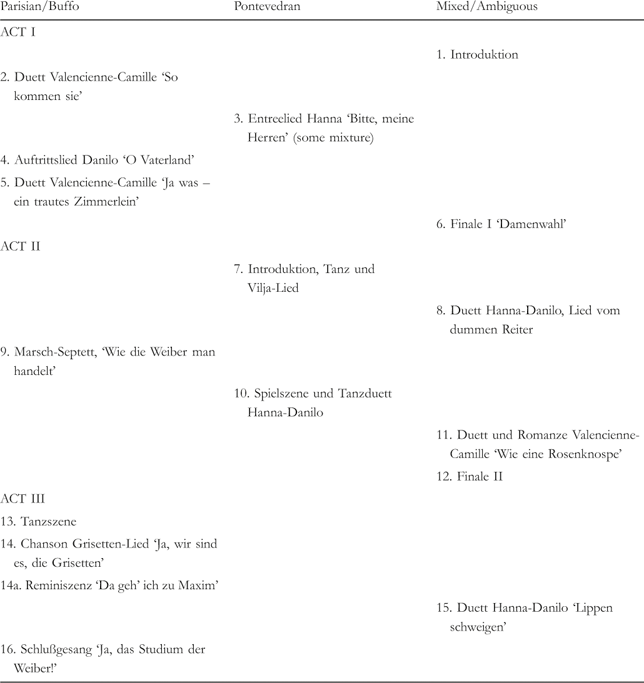
Table 1 shows the distribution of the score between the Parisian/Offenbach-style numbers and the Pontevedran/Volkston ones. Several numbers do not fit clearly into either category or mix the two; these are included in the third column. As is immediately apparent, the first act is dominated by the Parisian numbers, the second by the Pontevedran ones (most importantly the extended Vilja-Lied), and the last again by the Parisian (although it is quite short and serves as a kind of coda).
Musical numbers, Die lustige Witwe
The texts of the Parisian numbers, such as Danilo’s entrance song ‘O Vaterland, du machst bei Tag’, the septet ‘Wie die Weiber’ and the Grisetten-Lied ‘Ja, wir sind es, die Grisetten’, speak of big-city ambivalence, cynicism and showmanship.Footnote 55 The national and folkloric numbers such as Hanna’s ‘Vilja-Lied’ and Danilo’s ‘Es waren zwei Königskinder’ articulate patriotism, sincerity, enthusiasm and genuine emotion. For both Danilo and Hanna, the plot’s challenge is to put the Offenbachiade of Paris in its proper, external place, to not permit the intrigues to compromise their relationship, and to allow for the triumph of the true self, nation and love exemplified by the operetta’s finale. The operetta is not so moralising as to assign an explicitly negative value to the frivolity of Paris – after all, it is fun and enjoyable as spectacle. But ultimately it is the sentimental Volkston that triumphs. Hanna marries Danilo and the homeland is saved; Valencienne and Camille are foiled. To sum up the ideological effect, Lehár, Léon and Stein found a way to revive Offenbach and yet inter him again, a way for the sentimental and the satirical to productively coexist.
The operetta begins by setting the tone with Parisian music, but it is almost immediately juxtaposed with the Pontevedran. The short prelude (in lieu of an overture) is a galopp marked Presto (No. 1). The Offenbachian tone is obtained with near-unison use of the large orchestra, maniacally repeating figures, extremely fast tempo and even the genre of the galopp itself (closely related to the cancan). But when the curtain rises, the focus soon turns to the Pontevedran partygoers, and the tone of the music shifts as well. Pontevedran Baron Zeta notes that that party is being held to celebrate the birthday of the unnamed Pontevedran prince, ‘to whom we patriotically dedicate ourselves’.Footnote 56 No sooner does Zeta proclaim his patriotism and duty, but he switches into a mazurka and recalls his status as a senior representative of rustic Pontevedro in urban Paris (Ex. 1). Though the oboe figure over ‘bin Landesvater per procura’ recalls the repeated mordent motive of the prelude, the easy-going tempo and wind solos give the section a small-scale, rustic tone, despite the official nature of his proclamation. (Pontevedro is evidently not a nation to be taken very seriously in geo-political terms. Its citizens hold allegiance to a small and individualised community rather than a modern city such as Paris.) Thus, while the celebrations of Parisian society are marked with the explicitly Parisian music of French operetta, Zeta’s responsibilities to home and country are depicted with the more Eastern European music of the mazurka.
Die lustige Witwe No. 1 Introduktion, bars 98–108
Lehár made no attempt to achieve ethnic unity in his folk music. As a mythic nation, Pontevedro had no native ‘sound’, but equally, there was a long history of exoticist approximation of regional sounds on which Lehár could draw. Dahlhaus describes this eclecticism as innate to music theatre in general, comparing it to the plurality found in ballet music. He claims it gives national music a symbolism that is colouristic rather than specifically referential and trades in familiar clichés without specific intention – ‘he [Lehár] indifferently takes what he needs’ for a score featuring a variety of local colours.Footnote 57 Yet the assortment of dances found in Die lustige Witwe suggests that Lehár’s intentions may have been more verisimilar in nature. The folk dances all hail from Central or Eastern Europe, which is to say the Austro-Hungarian empire and its immediate surroundings. (Only the kolo in Act II [No. 10] is specifically native to the Montenegro region.Footnote 58) Austro-Hungarian Vienna was itself a collage, and Witwe’s mixture of ethnicities could be read as a plausible representation of its sound. For example, Lehár himself was ethnically Slovakian, resident for much of his youth in Hungary, and educated in Prague. In the army, he had been stationed in Poland, Breslau, the Balkans and many other locations.Footnote 59 He was not atypical: while nationalism sought to sort people into clear-cut categories, in practice few people would ever be so purebred. And in a city, all groups overlapped. The Pontevedrans stand in for all expatriates in Vienna who could hear one, or probably more than one, of the regional musics as their own. Throughout the score, ethnic dances are associated entirely with the Pontevedran characters and never the Parisians.
The score’s tour of regional music – including, as well as multiple mazurkas, a polonaise, the kolo and the use of a tamburizza band at the beginning of Act II – recalls the ‘Fünf-Kreuzertanz’ chapter of Felix Salten’s Würstlprater, in which the narrator strolls through the titular Viennese amusement park and hears a medley of different dance music from Austria, Bohemia and Hungary. Salten writes:
Here no one revolted against the song of another … whether the music was a waltz, a Ländler, a polka, or a csárdás, all the people here have one thing in common: that they are foreigners in this giant city that devours their toil.Footnote 60
The various musics exist in involuntary harmony, assuaging the homesickness of the alienated expatriates and diverting them from their difficult, poorly paid work. While nationalism dictates that they were, as members of different groups, all different, here their homesickness and low social status – as labourers and as unsophisticated outsiders – unites them. The Pontevedran music does not speak to one specific group of immigrants but, like that of the Prater, to all groups.
Folk dance’s significance as a sound of Pontevedro is reconfirmed in Hanna’s entrance song (No. 3). She is greeted by a waltz, but introduces herself by proudly proclaiming her Pontevedran soul and incomplete adjustment to Parisian life. On the line ‘I haven’t yet completely acclimatised to Paris’,Footnote 61 she falls, like Zeta, into a mazurka. When the male choir re-enters, she shifts back to a waltz, noting with Parisian cynicism, ‘I have often heard, well, that we widows are coveted!’Footnote 62
While Hanna only adopts modern, urbane language when self-consciously voicing Parisian sentiments, her would-be paramour Danilo slips into it all too readily. Upon his entrance, the operetta makes an auspicious return to Parisian style. His entrance song immediately follows hers and stands in stark contrast to it (No. 4). In a jaunty tone, he laments the woes of his bureaucratic job and celebrates the glories of the nightclub, Maxim’s (Ex. 2). In the refrain, a descending scale insistently repeats, and the litany of his favourite showgirls’ pet names sounds like the nonsense syllables of an Offenbach operetta.
Die lustige Witwe No. 4 Lied, bars 49–64
The role of Danilo was tailored to the particular talents of Louis Treumann, the Theater an der Wien’s new leading man and the self-proclaimed inventor of eccentric dance in Vienna. Previously known for portraying comic, non-aristocratic characters, Treumann engineered a change of character type when he moved from the Carl-Theater to the Theater an der Wien in autumn 1905 along with Mizzi Günther, who would play Hanna Glawari. Treumann’s first role at his new theatre was as the protagonist of Vergelt’sgott, where he played an aristocrat who disguises himself as a beggar. This was the initial step in his transformation from comic relief to leading man. Librettist Victor Léon was the engineer of this shift, and wrote a long letter of advice to Treumann on 20 September 1905, before the Vergelt’sgott! premiere, telling him that he must no longer rely on comic dance duets with ‘die Günther’ but instead ‘must appear as a completely different person, a new and unexpected Treumann’. He encouraged Treumann to develop a character who, unlike his customary dancing caricatures, would communicate depth and emotion: ‘interiority’ and ‘temper’ (‘Stimmung’) (all emphases original). He repeatedly assured Treumann that following this advice would lead to ‘artistic’ acclaim, rather than just popular success.Footnote 63 The association of interiority with artistic worth, on the one hand, and merit and comedy with mere popularity, on the other, is one that would be made by many advocates for Silver Age operetta, and one which its critics, longing for a return to Offenbach, would declare was simply backwards.
But to return to Danilo’s entrance song: the pattering rhythm in the French/English style and the suggestion of dance in between the verses, as well as the attitude of relaxed dissipation, suggest the old, comic Treumann, not the new one.Footnote 64 The difference is significant, because Danilo is merely awaiting reformation. Soon enough his purported true self – a patriot who is desperately in love with Hanna – is revealed. Léon, in creating this role specifically for Treumann, thematises the actor’s own evolution from comic, distanced, eccentric dancer to soulful lover (conveniently allowing Treumann to display his dramatic range). The ‘real Danilo’ is the new Treumann, a figure of identification for the audience and later a major operetta celebrity. He is the new operetta.Footnote 65
The Parisian tone is epitomised most of all in the Act II ensemble number ‘Wie die Weiber’ (No. 9) and the Act III ‘Grisetten-Lied’ (No. 14). Both are marches, and both include the percussive nonsense syllables familiar from Offenbach, which provide rhythm and motion, chatter without meaning – sequences of ‘zippel zippel zippel zapp’ and ‘und so und so und so’ that mean nothing in particular. Both are explicitly external numbers for a large ensemble dealing with generalisations and types rather than individual characters – the over-the-top performing personae of showgirls and the men’s view of the entire female gender, respectively. They are spectacular production numbers of the sort that would be found in the varieté – in the case of the Grisetten-Lied, featuring diegetic varieté performers – unnecessary to the plot but adding gloss and panache to the score that has little relation to the inner states of the main characters. The perspective is essentially distanced, offering the audience spectacle to admire and enjoy without emotional commitment.
The ‘Pontevedran’ numbers, however, are united not in ethnicity but in earnestness. They come in two forms: national dances and dance-like songs for fast numbers and the folksong-like strophic forms. While the Parisian numbers such as the Prelude and ‘Wie die Weiber’ feature orchestral unisons, the Pontevedran numbers tend to be orchestrated with woodwind solos, giving them a kind of personal and individual touch. The most popular number of the entire score, the ‘Vilja-Lied’ (No. 7) includes all of these attributes. Framed in the libretto as part of Hanna’s ‘true Pontevedran party’ and performed in ‘Pontevedran’ national costume, it is introduced by a polonaise, including a Balkan tamburizza banda of triangle, cymbals and various other clamorous instruments. The chorus makes its entrance on a long melisma on ‘ah’, then continuing ‘Mi velimo da se veslimo’ (‘we like to celebrate’) – for once forced to ethnically commit, Léon and Stein have the chorus singing in Bosnian–Serbian–Croatian.
Lehár’s depiction of the Pontevedrans reveals some eccentricities that differentiate it from the predominantly diatonic language of the Parisian numbers. The musical language being conventionally exotic, it defies the diatonic Parisian music (Ex. 3a). After a vivace dance that cadences in D major, the chorus enters on ‘ah’ in an abrupt modulation to the subdominant minor, G, then performing a harmonic perambulation that first seems to return to the previous section’s key on an A major chord, allowing the tang of a tritone in the top voice’s C sharp against the bass’s G. This A major is resolved as a V/V to D major in the fourth bar. Hanna’s following strophic song is marked ‘declaimed like a folk song’, and has a simple, flowing rhythm and harmony, but similarly is not entirely straightforward: the hovering on the seventh degree of the scale gives the theme a haunting instability, as does Hanna’s cadence in the final chorus on a high B, the third degree of the scale.
Die lustige Witwe No. 7 Introduktion, Tanz und Vilja-Lied a) bars 62–9 b) bars 158–65
Hanna’s song’s text is similarly unstable: it tells of a forest spirit, or Willi, and replicates the plot of the ballet La Sylphide. (Willis are also familiar from Giselle, and even Lehár’s teacher Dvořák’s 1901 opera Rusalka.) Yet for a folksong the story is oddly unresolved: in the first strophe the hunter sees the nymph and longs to be her lover, in the second strophe she beckons to him, he enters her house, but after one kiss she disappears forever. That is all; the hunter is left lovesick and the dance music returns. Even without the missing ending, the song is an obvious parable for Hanna and Danilo, with Hanna as the mysterious forest girl who disappeared years ago from Danilo’s life. The folkloric aspects are laid on thickly, including not only the music but also the national costume seen onstage.
The conflict between the Parisian and Pontevedran styles comes to a head in the Act II finale (No. 12). After being caught in the gazebo with Camille (actually covering for Valencienne), Hanna proclaims that she will marry Camille without any love or expectation of faithfulness, ‘ganz nach Pariser Art’, which she celebrates in a bright 6/8 march.Footnote 66 After this merry salute against romantic love, Danilo proclaims that he will tell a story. Like the Vilja-Lied, it is a parable of a failed romance, a young prince and princess who love each other. The prince is unable to state his love openly, and the princess leaves him for another (Ex. 4).
Die lustige Witwe No. 12 Finale II, bars 293–307
The song is itself a quotation of a German folksong, a fact that has not been noted by previous scholars.Footnote 67‘Es waren zwei Königskinder’ appears in many major nineteenth-century German folksong collections, and its appearance in Witwe amounts to both a textual and musical quotation, albeit somewhat altered to fit into triple time (Ex. 5).Footnote 68 In the folksong version, the two royal children are separated by a lake, but their love is betrayed by a ‘treacherous little nun’ (ein falsches Nönnchen) and the prince drowns when trying to reach the princess. Danilo begins with the first three lines of the poem:
Folksong ‘Es waren zwei Königskinder’, from August Linder, ed. Deutsche Weisen (Stuttgart, 1900), 181
But instead of continuing with ‘The water was far too deep’, he notes the quotation, ‘as a poet once described’. The parallels with Hanna and Danilo’s own relationship are obvious, and Danilo even slips into the first person at one point and corrects himself – ‘I couldn’t ever dream that – the prince said that, not me! And then the prince continued.’Footnote 69 The musical setting is of the utmost folk-like simplicity, accompanied by strings and harp. The ending, as Danilo becomes more and more agitated and unable to keep up the fiction that he is not, in fact, the prince himself, collapses into a kind of Sprechstimme on the words ‘Then take him whom you desire!’Footnote 70
Next, Danilo ironically recapitulates the refrain of his entrance song, ‘Ich gehe zu Maxim’, a gesture that would become virtually mandatory in subsequent Silver Age operettas. What was previously superficial fun has now been confirmed through the ‘Königskinder’ folksong as a defence mechanism. The line ‘they let me forget the dear Fatherland’ has now become ‘they let me forget that which I find so frightening!’ Hanna’s reaction is an aside, but jubilant: ‘me alone! He loves me alone.’ Danilo has allowed his Pontevedran soul and true love for Hanna to be revealed.
All that remains in Act III is for Danilo and Hanna to untangle their confusion. This is in part because their love had in fact already been articulated, albeit wordlessly. Before being split up by the escapades in the gazebo, Hanna and Danilo had already declared their love in dance in the ‘Tanzduett’, No. 10. The number begins with a few Pontevedran dances, then a waltz. In the last iteration of the waltz theme, Hanna and Danilo hum the theme, a theme that will in Act III become their duet, ‘Lippen schweigen’. The waltz, in fact, has something of a special status in the score. While in Hanna’s entrance number it was associated with Parisian sentiments, here, in a slower, wordless form, it is associated with interiority. Perhaps this dual signification is simply due to its close association with Viennese operetta in general: its meaning is not overtly tied to either Pontevedro or Paris, but rather to Viennese operetta itself.
This wordlessness is as important an element of the Pontevedran numbers as the frequent nonsense syllables are to the Parisian ones. If the Parisian numbers are linguistically typified by the percussive nonsense of ‘trippel trippel’ and ‘zippel zippel’, the Pontevedran numbers are defined by the melismatic sighs of the Tanzduett and Vilja-Lied. The percussive, staccato, repetitive Parisian noises are markedly mechanistic, articulation without melody (such as the short motivic cells of the Prelude and Danilo’s entrance song, Ex. 2), while the Pontevedran are organic, melody without articulation, such as the wandering melisma of the Vilja-Lied. The Parisian yelps imply rhythm, motion, dance and externality without a deeper significance, while the Pontevedran sighs imply an emotion that is too internalised to apply the rational medium of speech.Footnote 71
The plot’s challenge for Danilo and Hanna is to embrace this inner desire, to give it words beyond parable and humming without surrendering to the cynicism of Parisian speech. At the very end of the operetta, they finally put words to their hummed waltz: ‘Lippen schweigen, ’s flüstern Geigen: hab’ mich Lieb’ (‘Lips be silent, the violins whisper: love me’). The words ironically describe a need to remain silent, for the music has already spoken. Danilo and Hanna reached this point, like many of the other emotional high points of the score, through pure farcical plot mechanics, this time the almost laughable trick of Hanna’s to claim that should she remarry she will have to give up all her money. The Frenchmen are put off and Danilo promptly proposes, now believing he can now do so without the stigma that he is attracted solely to her fortune. She accepts and says that her wealth will remain but now pass into his hands.
Dahlhaus proclaims the finale to be hardly that of Minna von Barnhelm (referring to the similar ending of Lessing’s comedy – in Dahlhaus’s view, operetta inevitably fails to live up to a higher art model), and indeed the pacing is disconcerting: after the librettists and composers went to considerable length to keep Hanna and Danilo apart for two acts, their difficulties evaporate in thirty seconds. The Neue Freie Presse also found the lovers’ sudden reconciliation unconvincing, writing that after hours of arguing’, she speaks to him so nicely with her eyes through the wild tenderness of Slavic dances that he finally kisses her; the house applauds encouragingly’.Footnote 72 But the essential battle, the struggle to bring Danilo to do his Pontevedran duty and sing in their style and acknowledge the fraud of his Parisian Maxim song, had already been achieved in Act II. The rapprochement is made on musical rather than spoken terms.
Premiere and legend
Convention has long portrayed Die lustige Witwe as a victorious underdog, succeeding despite minimal support from the theatre and an unsuccessful first night. Indeed, as noted above, Die lustige Witwe was rushed into production after the withdrawal of the flop that preceded it, Der Rebell. According to the Rebell librettist Rudolf Bernauer’s possibly fanciful recollection, Karczag begged for the revision of his work as soon as possible rather than put on another operetta by Lehár, whose most recent work was a ‘sentimental, boring business with an impossible title’. The new Lehár, Bernauer wrote, was ‘openly a fiasco’, and a few days after its premiere he received another telegram from the theatre management: ‘Completion of Rebell allows no delay. New operetta as feared catastrophic revenue. Reminding you of your promise. Yours, Karczag Wallner’.Footnote 73 But after struggling through more revisions, the telegrams stopped; the problematic new operetta had apparently ‘suddenly received a jolt and now brings only sold out houses’.Footnote 74
Karczag and Wallner evidently placed limited investment in Die lustige Witwe’s chances for success, as Léon suggested: due to the short rehearsal period, the first stage rehearsal took place at night after an evening revival performance of Sidney Jones’s The Geisha. After major problems with choreography, a dance rehearsal took place the next day behind the safety curtain while the orchestra rehearsed in front of it. The operetta received one more stage rehearsal, a dress rehearsal (with at least one critic in attendance), and then opened.Footnote 75 Yet Bernauer’s account of the operetta’s initial reception is at odds with the reviews and other descriptions of Die lustige Witwe’s first night, which demonstrate a strong reception with many numbers encored. Reviews were entirely positive, including Ludwig Karpath’s notice opening ‘finally, an operetta as it should be.’Footnote 76 By both Léon’s and Wallner’s accounts, Die lustige Witwe did only moderate business in its first week or two.Footnote 77 These early performances may have served as a final rehearsal period, allowing the cast to turn the operetta into a success before a live audience. Apparently it was word of mouth – aided by the dissemination of the score in sheet music form – that led the operetta to become such a success. It then became an international phenomenon, a major success in London, Paris, New York and elsewhere.Footnote 78
Die lustige Witwe’s success doomed the pointed stylistic plurality that it had celebrated. Most of the subsequent operettas of the Silver Age followed Witwe’s model in one or more particulars. English operettas faded, no full-fledged Offenbach revival occurred, and a mixture of waltzes, folksong and non-parodic buffo writing became the most popular model for composition. Die lustige Witwe bestowed upon operetta a stylistic unity that it itself did not possess. Until the influx of American dance styles and the creation of revue-operetta in the late 1910s and early 1920s, Die lustige Witwe was the reigning model.
When this model became codified, and when operetta had become a product for syndicated international export, the genre had taken a step towards the autonomy retroactively bestowed upon Die lustige Witwe. Outside its home territory, of course, Die lustige Witwe itself became a phenomenon rather than a product of a particular time and place in operetta history. It became easier to speak of ‘operetta’ rather than ‘operettas’, and to consider works independent of their place and time of origin. For Theodor Adorno, Die lustige Witwe represented a kind of last bastion of true art in the operetta, after which all subsequent efforts were mere commercial copies. Witwe, he wrote in 1934, ‘stands on the border, one of the last operettas that still had something to do with art and one of the first that unthinkingly renounced it’.Footnote 79 But previous operettas had been just as commercial, and just as apt to copy previous hits. It was the scale of Die lustige Witwe’s success that had the homogenising effect.
While operetta’s success led many members of the musical establishment to criticise it, it prompted others – prominently including Lehár himself, as well as Karczag – to claim for the operetta a place in the high-art pantheon.Footnote 80 The ascent of the Silver Age meant, for supporters of operetta, an objective improvement in the genre’s musical quality as measured in individuality of style, complexity and care in craftsmanship. This would, they claimed, cultivate the ears and improve the discernment of the masses. Many opponents found this aspiration misplaced. For Karl Kraus, Die lustige Witwe opened the floodgates for a succession of sentimental, materialist works that neglected the social satire he considered the essential function of true operetta.Footnote 81 Kraus’s critique, filtered through Adorno’s construction of aesthetic autonomy, became the conventional musicological approach to Silver Age operetta as a once-valuable genre that lost its independent voice and declined into mass production.Footnote 82 This obscures the construction of Witwe as well as the social role of subsequent operettas, whose function may have shifted but which were nonetheless more than simple commodities. It was operetta’s unstable location between high and low art that made its reception so contested.
But in 1905, all this lay in the future. In January of 1906, the authors of Der Rebell were still rewriting their operetta for the Offenbach revival that would never occur, Karczag was still handing out free tickets, and the world of Silver Age operetta was only nascent. It was, arguably, crowned with Felix Salten’s feuilleton essay ‘The New Operetta’, published in December 1906, which declared Die lustige Witwe the music of the era, with a new rhythm befitting the spirit of an age that was no longer that of Johann Strauss II. ‘It is’, Salten wrote, ‘hard to say what defines the sound of an age. It is ten thousand tiny truths, a country’s air, a language’s accent, the steps and gesticulations of a people.’Footnote 83 For Salten, Die lustige Witwe now represented not multiple worlds but a single one. If Witwe embodied a diverse, cosmopolitan world, it is the ultimate irony that its success begot greater homogeneity.