Children learn language in conversational interactions as they discover how best to express themselves, and interpret the language of others (Clark, Reference Clark2017). In the context of adult–child conversation, adults deploy a range of strategies to establish their child's intended meaning, and to model conventional forms and uses of language. One such approach is the use of recasting. A recast is an adult reformulation of an immediately preceding child utterance in which the adult models more complex and/or accurate linguistic structures, while employing elements of the child's prior turn and maintaining its intended meaning (Bohannon, Padgett, Nelson, & Mark, Reference Bohannon, Padgett, Nelson and Mark1996). The following from Clarke, Soto, and Nelson (Reference Clarke, Soto and Nelson2017) provides an example: child: dolly jump; adult: yes, dolly is jumping. Here the adult acknowledges the essential meaning of the child's utterance and provides a model of correct grammar.
It has been proposed that recasts used in adult–child conversations are effective in promoting the acquisition of linguistic targets for two main reasons. First, the adult recast provides a direct structural contrast to what the child just said, while preserving the central meaning of the child's utterance. The precise positioning of this contrast just after the child's utterance is thought to provide the optimal conditions for the child to attend to and analyze the formal properties of his or her utterance, by comparing a structure already existing in his or her linguistic system with a new structure provided by the adult (Clark, Reference Clark1990, Reference Clark2017; Nelson Reference Nelson1977; Saxton, Reference Saxton2005). Second, it is argued that recasts facilitate language development because they are unobtrusive and contingent on the child's intent to communicate, and link directly to the current topic of interest to the child. The adult reformulation represents the child's intention but changes the form in a naturally occurring way (Chouinard & Clark, Reference Chouinard and Clark2003; Saxton, Reference Saxton2005). Clark and her colleagues note that it is in the typical to-and-fro of conversation that children learn about the appropriateness of their own utterances (see Clark, Reference Clark2014). They learn that adults typically ‘accept’ utterances that conform to the conventions of language, but often ‘check up’ on those that do not.
Recasts can take many forms and can vary in terms of their length (e.g., partial recast or expansion), mode (e.g., interrogative or declarative), number of targets (e.g., simple or complex), and linguistic focus (e.g., morphology or syntax). Recasts can also be classified as corrective, when the adult reformulation corrects an erroneous child utterance, or non-corrective, when the adult adds to, modifies, or expands a correct but perhaps limited or immature child utterance (see Clarke et al., Reference Clarke, Soto and Nelson2017 for an extensive review of recast types).
In the case of corrective recasts, the extent to which they signal to the child that they are doing the work of correcting their prior utterance can vary. Implicit (corrective) recasts offer no overt indicators that the child has produced an error (see ‘dolly jumping’ example above), while explicit forms of recasts unambiguously provide correction, as in the following example: adult: Where were you in this photograph? child: I am Disneyland; adult: Oh, you are at Disneyland, because you are not Disneyland, are you? Researchers in first and second language acquisition have argued that the implicitness/explicitness of recasts affects their perceived pragmatic function; for example, whether the child treats the recast as an overt correction, or as something else, such as a receipt of meaning (Ding, Reference Ding2012; Ellis & Sheen, Reference Ellis and Sheen2006; Li, Reference Li2010; Saxton, Reference Saxton2005).
Adult scaffolding of child language through the use of recasts is one of the most commonly adopted intervention approaches in programs designed to facilitate grammatical development in children with language difficulties. Recasts may be delivered either as the sole or main intervention strategy, or as part of a set of intervention techniques (see Cleave, Becker, Curran, Van Horne, & Fey, Reference Cleave, Becker, Curran, Van Horne and Fey2015, for an extensive review of the literature). Such interventions have been shown to be effective with children with autism spectrum disorder (Scherer & Olswang, Reference Scherer and Olswang1989), specific language impairment (aka Developmental Language Disorder; Camarata & Nelson, Reference Camarata, Nelson, McCauley and Fey2006; Nelson, Camarata, Welsh, Butkovsky, & Camarata, Reference Nelson, Camarata, Welsh, Butkovsky and Camarata1996; Plante et al., Reference Plante, Ogilvie, Vance, Aguilar, Dailey, Meyers and Burton2014), language learning disabilities (Stiegler & Hoffman, Reference Stiegler and Hoffman2001), language delay (Ruston & Schwanenflugel, Reference Ruston and Schwanenflugel2010), and children and youth with motor speech disorders who use augmentative and alternative communication (AAC) (Soto & Clarke, Reference Soto and Clarke2017, Reference Soto and Clarke2018). AAC includes a set of communication strategies and tools that can be used by individuals who have little or no functional speech. These strategies can range from using unaided forms of communication, such as manual signs and gestures, to aided forms of communication such as the use of speech-generating technologies (e.g., Clarke, Price, & Griffiths, Reference Clarke, Price and Griffiths2016).
Evidence for the facilitative power of recasts for language acquisition in intervention programs for children with language disorders can be derived from three measures: (a) spontaneous production of linguistic targets in conversations days or weeks after original exposure, and improved comprehension of targets measured by specific language tests; (b) spontaneous production of language forms in the same conversation in which those forms had earlier been recast; and/or (c) immediate child repair of their original utterance in the next turn following the adult recast, integrating elements or all of the recast (Soto & Clarke, Reference Soto and Clarke2017, Reference Soto and Clarke2018).
In first language development, immediate child reproduction of the adult recasted form is not needed for the child to have ‘noticed’ and learned the target. In fact, according to Clark (Reference Clark2014), only 20% of adult recasts are followed by children's immediate repair, and learning is yet evidenced by the child's spontaneous use of the recasted form later in the same or different conversation. Likewise, most recast intervention studies with children with language disorders who are verbal (e.g., Specific Language Impairment) did not include prompts for production and still showed positive results (e.g., Nelson et al., Reference Nelson, Camarata, Welsh, Butkovsky and Camarata1996).
While repair has not been used as evidence of acquisition in research with first language learners (whether neurotypical or non-typical children) (i.e., it could be interpreted as imitation), the relationship between immediate learner repair and acquisition of specific linguistic targets has been firmly established in second language learning (e.g., Ammar, Reference Ammar2008; Ammar & Spada, Reference Ammar and Spada2006; Ding, Reference Ding2012). When learners of a second language repair their ungrammatical utterances following a recast, they confront their errors, revise accordingly, and practice the linguistic targets. It has been suggested that recasts and repair play different but complementary roles in second language acquisition, with the former facilitating the internalization of the new linguistic targets and the latter enhancing the procedural knowledge necessary for the production of the already internalized target (Ding, Reference Ding2012). We have argued elsewhere (Clarke et al., Reference Clarke, Soto and Nelson2017) that, for children with little or no functional speech who rely on speech-generating technology to communicate, immediate repair is also particularly beneficial. This is not only because production supports language development, but also because it enhances the child's knowledge of the language storage infrastructure of the speech-generating technology, and helps the child to establish motor plans for more accurate, efficient, and ‘automatic’ device access (e.g., in a similar way that one develops a motor plan for typing).
The relationship between language output (i.e., production) and acquisition of linguistic targets has also been established with young children learning aided AAC (Romski et al., Reference Romski, Sevcik, Adamson, Cheslock, Smith, Barker and Bakeman2010). In Romski and colleague's study, 62 children with developmental delays ranging from 21 to 40 months of age were taught single word vocabulary which was individually chosen for each child, and suitable for age-appropriate activities such as playing or shared book-reading. Children were randomly assigned to three intervention conditions: (i) speech communication condition, whereby children were prompted to produce targets using speech only; (ii) augmented communication input condition, in which target vocabulary was modeled using the child's speech-generating device as well as with natural speech but with no expectation that the child should produce vocabulary items, and (iii) augmented communication output condition, where adults modeled targets using speech and the children's devices, and prompted the child to produce the target words using their device. Results revealed that children who were expected to produce the target words on their communication devices learned to use more augmented words than those who were taught the words but were not expected to produce them on their devices.
In a recent meta-analysis of the effectiveness of recasts as the main element or primary focus of intervention with children with language impairments, Cleave and her colleagues (2015) identified that, in general, recasting produced better results in the acquisition of specific linguistic targets such as bound morphemes (e.g., -ing, third person -s) and auxiliary verbs (e.g., will, do) than comparison treatments or no-treatment conditions. Moreover, effect sizes were very high relative to other language intervention procedures. Cleave et al. strongly endorse the appropriateness and effectiveness of using recasting in intervention because the recast and the targets can be individualized to, and selected on, the basis of the children's language level (e.g., Camarata, Nelson, & Camarata, Reference Camarata, Nelson and Camarata1994).
However, most of the studies included in Cleave et al. (Reference Cleave, Becker, Curran, Van Horne and Fey2015) meta-analysis were not explicit about what type(s) of recast were included in the interventions, or whether the interventions included a single type or a mix of recast types. Cleave et al. concluded that additional research into the efficacy of recasting in general, as well as the relative efficacy of different types of recasts, is therefore needed. To date, no study has compared the effectiveness of different types of recasts on the acquisition of linguistic targets with children who use AAC, nor the relationship between adult recasts, immediate child repair, and spontaneous use of the linguistic targets within the same or a later conversation.
While evidence indicates a positive relationship between adult recasting and acquisition of novel vocabulary in users of aided AAC (e.g., Binger, Mauire-Marshall, & Kent-Walsh, Reference Binger, Maguire-Marshall and Kent-Walsh2011; Soto & Clarke, Reference Soto and Clarke2017, Reference Soto and Clarke2018), the relationship between type of recast, rate of repair, and spontaneous use of linguistic targets remains elusive. The purpose of the current study was to examine the relationship between type of recast, child repair, and child spontaneous use of linguistic targets. The following two research questions guided this study:
1. What is the relationship between type of recast and child repair?
2. What is the relationship between child repair and spontaneous use of linguistic targets?
Methods
The research questions were addressed through the secondary analysis of data drawn from a language intervention study for children with motor-speech disorders who used speech-generating technologies (Soto & Clarke Reference Soto and Clarke2017). In that study, Soto and Clarke investigated the effects of a conversation-based intervention on children's production of pronouns, verbs, bound morphemes, and spontaneous clauses. During baseline sessions, the participating children met with a student clinician and engaged in a conversation about a mutually agreed topic of personal relevance to the child, such as family, vacations, favorite activities, and so on. The conversations ranged between 30 and 40 minutes. During baseline conditions, clinicians did not acknowledge correct or incorrect productions. Rather, they used appropriate conversational responses such as open-ended questions, expectant pauses, verbal redirection, and contingent queries to stimulate the conversation, without using any corrective or therapeutic procedures to shape the participants’ productions. Baseline sessions were conducted before clinicians received intervention training, and served to establish participants’ profiles of expressive language skills in conversational interaction. Each participant completed five baseline sessions.
After the baseline period, intervention sessions ran for 50–60 minutes, twice a week, for up to 12 weeks. Each session consisted of a 50–60 min. conversation between the clinician and the child on a topic chosen by the child (see Soto & Clarke, Reference Soto and Clarke2017, for detailed intervention procedures). In the context of those conversations, the clinicians used verbal scaffolding such as recasts, prompts, and contingent questions to elicit and model the linguistic targets. Due to research design features (i.e., a multiple probe design across participants), not all participants received the same number of intervention sessions. One participant received as many as 24 intervention sessions while another received as few as 6 (see Soto & Clarke, Reference Soto and Clarke2017). During each intervention session, the clinician targeted at least five different words and two verb inflections (e.g., -ed, -ing), not observed during baseline sessions. The targets included a variety of different word classes that were developmentally appropriate, essential to grammaticalization, and that are frequently used by school-aged children of similar age (see Boenisch & Soto, Reference Boenisch and Soto2015). These included pronouns (e.g., I, me, you, him), verbs (e.g., go, like, want, put, get), auxiliary verbs (e.g., is, can, could, will, was, did), adjectives (e.g., good, bad), adverbs, (e.g., again, now, here, more, there), prepositions (e.g., in, on, with, of, for), determiners (e.g., this, that), conjunctions (e.g., and, or, because), interjections, (e.g., yes, no, please, sorry), question words (e.g., who, what, when, where, why), and nouns (e.g., house, tree, boy). All intervention sessions were videotaped and transcribed using the conventions of Systematic Analysis of Language Samples (Miller, Andriacchi, Nockerts, Westerveld, & Gillon, Reference Miller, Andriacchi, Nockerts, Westerveld and Gillon2012).
Participants
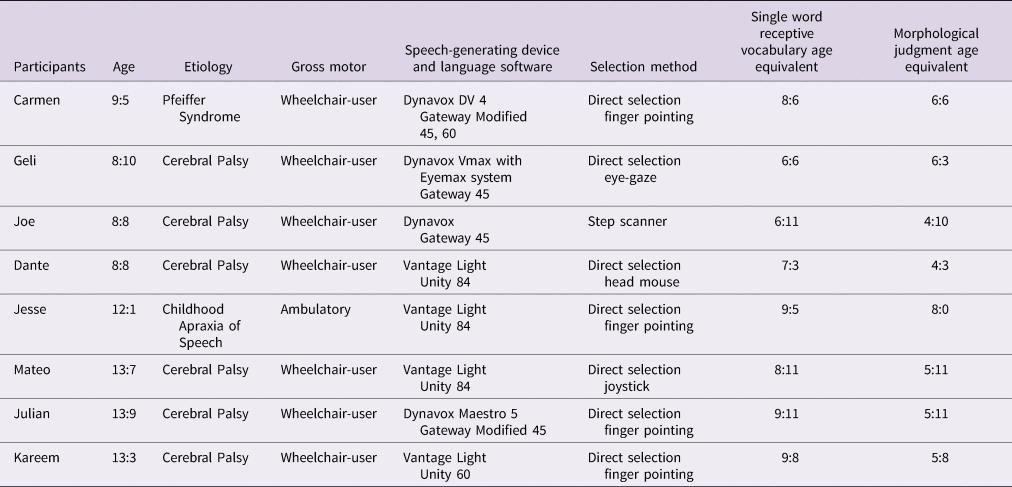
Eight children (3 girls and 5 boys) between the ages of eight and thirteen years participated in the study (see Table 1 for participant characteristics. Names are pseudonyms). All had speech and motor disorders affecting their ability to use speech functionally, and all used a speech-generating device (SGD) to communicate. Their speech-generating devices made available to them pronouns, verbs, and verb inflections, and other linguistic structures that would afford the generation of grammatically correct utterances. The vocabulary was presented on a main core vocabulary page, with multiple pages of vocabulary organized taxonomically within subfolders that required navigation for access. The participants also met the following inclusion criteria; they (a) displayed operational competence at Level III on the Augmentative and Alternative Communication Profile (AACP; Kovach, Reference Kovach2009); (b) used a form of direct selection or step scanning to formulate their messages (e.g., pressing the SGD screen, or navigating the device by operating two switches: one to move the cursor and one to make a selection); (c) had English as the primary language; (d) communicated mostly through single-word utterances in typical daily conversational interaction; (e) had functional vision and hearing (with or without correction), suitable for SGD use and conversational interaction; and (f) had a speech intelligibility score of less than 50% on the Index of Augmented Speech Comprehensibility in Children (i.e., as judged by familiar partners in the semantic context condition which includes presenting the participant with a picture stimulus plus an embedded verbal model; Dowden, Reference Dowden1997).
Participants’ characteristics and test performance

Data coding and analysis
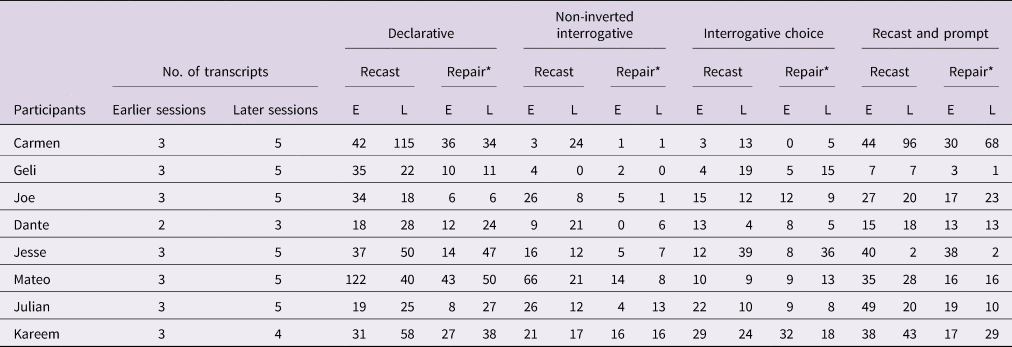
Data for the present study were drawn from 60 transcripts, representing a total of 43.88 hours (2,633 min) of clinical interaction. In order to examine change in language use over time, transcripts were randomly selected among the first six and the last six intervention sessions for each participant, henceforth referred to as ‘earlier’ and ‘later’ sessions. The total number of transcripts and minutes per child were (see also Table 2): eight transcripts for Carmen (313 min.); eight transcripts for Geli (413 min.); eight transcripts for Joe (388 min.); eight transcripts for Jesse (278 min.); eight transcripts for Mateo (369 min.); eight transcripts for Julian (368 min.); seven transcripts for Kareem (274 min.); and five transcripts for Dante (230 min.).Footnote 1 The transcripts included utterances generated by the child and the adult during the intervention sessions. SGDs can store complete fully pre-prepared utterances. Any use of such utterances was excluded from analysis. Given that the transcripts represent clinical sessions of unequal length, we rated all dependent measures per 60 minutes.
Frequency of different types of recast and repair

Notes. E = early sessions; L = later sessions; * There some instances where the number of repairs is larger than the number of recasts. This is a reflection of the fact that users of SGDs often repair their utterances across several communication turns that progressively incorporate different parts of the adult recast.
To answer the first question on the relationship between recast type and child repair, we examined the dataset to identify every turn sequence where adults recast child utterances using the following operational definition: a recast was an adult reformulation of all or part of the child's immediately preceding utterance that provided a grammatically correct or expanded version of it by adding or changing one or more of its components, while maintaining reference to the same basic meaning (Al-Surmi, Reference Al-Surmi2012; Baker & Nelson, Reference Baker and Nelson1984).
All recast sequences were classified into two groups according to the presence or absence of prompting: (i) recast plus a prompt to repair, such as using direct verbal encouragement or a gesture (e.g., pointing to the linguistic target on the device); and (ii) recast alone. Those recasts that were not followed by a prompt were then classified into three categories, according to the following operational definitions:
(a) a declarative recast (DR) whereby the adult reformulates the child's utterance in a statement. For example:
child: Appointment. I was appointment.
adult: I was at an appointment.
(b) A non-inverted interrogative recast (NIIR), when a reformulation is produced with rising intonation:
adult: What do you want?
child: playground
adult: You want to go to the playground?
(c) An interrogative choice (IC), whereby a reformulation presents the linguistic target as a binary or multiple choice:
child: I want for Christmas from Santa Claus. Dora backpack
adult: I want a Dora backpack for Christmas or I want a Dora backpack from Santa Claus?
Finally, for each adult recast sequence (both recast plus prompt, or recast only) we examined the content of the children's subsequent turn to determine whether they repaired their original utterance by incorporating parts (e.g., partial repair) or all of the adult's modeled words (e.g., full repair), as in the following example:
child: This is my Dad and she Grandma.
adult: This is my dad, and she is my Grandma.
child: This is my Dad and she is my Grandma.
To answer the second question on the relationship between child repair and spontaneous use of linguistic targets, we first identified every word that was modeled (i.e., added or corrected) by each recast across participants and across all sessions. However, because there were so many recasted words that were specific to a single participant or had only been used in one session (e.g., doctor), we narrowed the sample to the 15 words most frequently used by typically developing school-aged children of comparable developmental age in the United States (see Boenisch & Soto, Reference Boenisch and Soto2015). These 15 words had all been targeted during intervention across all participants, and included personal pronouns I, it, he, she, copula forms am, is, was, were, verbs go, went, like, liked, article the, conjunction because, and preposition to.
Next, we calculated which of those 15 words had been: (a) recasted or recasted plus prompted; (b) repaired by the child immediately following an adult recast or a recast plus prompt to repair; and (c) used spontaneously by each participant (i.e., not following an adult recast or prompt). Last, out of those 15, we identified the targets that had not been used spontaneously in earlier sessions but were used spontaneously in later sessions, and noted whether those words had been part of a recast–repair sequence during the earlier sessions.
Reliability
A second observer randomly selected and coded 25% (n = 13) of transcripts, and inter-rater agreement for each dependent variable was calculated by dividing the total number of agreements by the total number of agreements and disagreements. The inter-observer agreement scores were 96% for Declarative Recast; 98% for Non-Inverted Interrogative Recast; 98% for Interrogative Choice Recast; 96% for Recast followed by a prompt; 98% for Child Repair; and 96% for Child's Spontaneous use of linguistic targets. Coding discrepancies were resolved through the two independent coders identifying coding differences, discussing discrepant utterances, and reaching consensus on the final code for all discrepancies (Kovacs & Hill, Reference Kovacs and Hill2015). Occasionally, and when consensus was not possible, the coders consulted with the first and second author to discuss the discrepancies until consensus was reached.
Results
Relationship between recast type and repair
The first research question examined the relationship between recast type and child repair. The results of this analysis for each participant are presented in Table 2. The children received a total of 1,707 recasts. Out of those, 71% (1,218) were presented as recasts alone (i.e., not followed by a prompt), and 29% (489) were followed by a prompt to repair. Among the recasts that were presented alone, 57% (694) were declarative recasts, 23% (286) were non-inverted interrogative recasts, and 20% (238) were interrogative choice. The overall rate of child repair for the recasts that were presented alone was 52% (633). Among those, interrogative choice and declarative recasts resulted in overall higher rates of repair (81% and 57%, respectively) than non-inverted interrogative recasts (29%). The rate of repair for recasts (of any type) followed by a prompt was 64% (315).
In the earlier sessions, participants received a total of 872 recasts. Out of those, 71% (617) were presented as recasts alone and 29% were followed by a prompt (255). Of the recasts that were presented alone, 55% were declarative (338), 28% (171) were non-inverted interrogative, and 18% (108) were interrogative choice. The overall rate of repair for recasts that were presented alone was 46% (286). Interrogative choice and declarative recasts resulted in higher rates of repair (77% and 46%, respectively) than non-inverted interrogative recasts (27%). The recasts that were followed by a prompt to repair resulted in a rate of repair of 60% (see Table 2).
In the later sessions, children received a total of 835 recasts. Out of these, 72% (601) of recasts were presented alone and 28% (234) were followed by a prompt to repair. Of the recasts that were presented alone, 59% (356) were declarative, 22% (130) were interrogative choice, and 19% (115) were non-inverted interrogative. The overall rate of repair for recasts that were presented alone was 64% (382). Interrogative choice and declarative recasts resulted in higher rates of repair (84% and 67%, respectively) than non-inverted interrogative recasts (31%). The recasts that were followed by a prompt to repair resulted in a rate of repair of 69% (see Table 2).
Statistical analysis was conducted to determine whether the relationship between recast type and child repair was significant. All the recasts that had been presented alone and those that had been followed by a prompt were summed across all participants along with the number of times that those recasts had been resulted in child repair or not. A 2 × 2 (recast alone vs. recast plus prompt × repaired vs. not repaired) chi-square calculation yielded a significant relationship (χ 2 = 20.3857, df = 1, p < .001), indicating that recasts followed by a prompt to repair yielded a higher rate of child repair than recasts presented alone.
An additional 4 × 2 chi-square calculation analyzed the relationship between type of recast (recast plus prompt, declarative recast, non-inverted interrogative recast, and interrogative choice) and child repair (repaired vs. non-repaired). The chi square yielded a highly significant result (χ 2 = 159.0057, df = 3, p < .001), indicating a significant relationship between type of recast and rate of child repair.
Relationship between repair and spontaneous use of target words
The second research question examined the relationship between child repair and spontaneous use of linguistic targets. Of the 15 targets investigated, no participants showed spontaneous use of the linguistic targets during baseline sessions. Only two participants showed spontaneous use of some linguistic targets during the early intervention sessions: Carmen used one (I), and Jesse used six (He, She, am, is, the, and to).
During the later intervention sessions, all eight participants showed spontaneous use of at least one target: Dante used one (I); Joe used three (I, go, and went), Julian and Jesse used four. Julian used I, is, the, and to, and Jesse used I, She, am, and the. Geli used five (I, was, went, the, and to). Kareem, Mateo, and Carmen used six. Kareem used I, am, is, was, go, and to. Mateo used I, am, is, go, like, and to. And Carmen used I, is, was, go, the, and to.
Statistical analysis was conducted for the six participants who used spontaneously four or more targets during the later sessions. All the targets that had not been used spontaneously during earlier sessions were summed across participants for a 2 × 2 chi-square calculation that also incorporated whether in early sessions a linguistic target had received a recast-and-repair sequence or not. Out of 90 possible targets (6 × 15), 83 targets had not been used spontaneously during the earlier sessions. Of these 83, 31 were used spontaneously during the later sessions. Interestingly, 71% of these (22 out of 31) had been repaired following a recast or a recast plus prompt by the participants in the early sessions (9 did not receive this sequence). In contrast, of the 52 targets that were not used spontaneously in the later sessions only 34% (17 of the 52) were repaired in early sessions (35 of the 52 were not). The chi square yielded a significant result (χ 2 = 11.42, df = 1, p < .001), indicating that the repair of the linguistic target during earlier sessions may have contributed to its spontaneous use during later ones.
Discussion
This study is the first of its type to investigate the relationship between different types of adult recast and child repair, and the relationship between child repair and later spontaneous use of linguistic targets. In this study, repair varied according to recast type, with participants repairing more often when they were directly prompted to do so and when they were presented with an interrogative choice recast. Crucially, later spontaneous use of target items was significantly and positively related to earlier conversational sequences in which adult recasts included targets that the participants used in a repair of their prior turn, pointing to a relationship between child repair and distal spontaneous use of linguistic targets.
Relationship between type of recast and frequency of child repair
The overall rate of repair varied between recasts that were followed by a prompt to repair (64%) and recasts that were presented alone (52%), although the former were less frequently used by adults. This relationship is statistically significant and indicates that, when recasts are followed by a prompt to repair, children are most likely to do so. Of those recasts presented without prompts, interrogative choice and declarative recasts led to the highest rates of child repair (81% and 57%, respectively). The type of recast that was followed by the lowest rate of child repair was the non-inverted interrogative recast (29%). This pattern remained constant across earlier and later sessions.
Our findings point to a significant relationship between type of recast and child repair. The differences in rate of child repair by type of recast are likely to be related to participants’ ‘in-the-moment’ evaluation of the pragmatic functions of the various classes of recast (Clarke et al., Reference Clarke, Soto and Nelson2017). For example, the interrogative choice recast was most commonly treated by the child as a forced choice whereby she or he had to select one of the presented options by the adult to be delivered in a repaired utterance, as in the following example: child: The cat went table, to which the adult responded: The cat went under the table or the cat went over the table? The child responded The cat went under the table.
On the other hand, a non-inverted interrogative choice can be relevantly responded to with simply a ‘yes’ or a ‘no’. In the following exchange from Clarke et al. (Reference Clarke, Soto and Nelson2017), the adult and the child have been talking about a recent event in which the child played in snow. In response to the adult's question about what the child did in the snow the child responds: Sled. The adult then produces a non-inverted interrogative recast saying: You went on a sled?, to which the child simply nods in affirmation but does not repair his initial utterance.
Relationship between child repair and spontaneous use of linguistic targets
Our findings indicate a positive relationship between child repair and distal spontaneous use of linguistic targets. Of all the linguistic targets that were used spontaneously by the participants in the later sessions, 71% had been repaired by the participants in earlier sessions. These findings are consistent with existing research in AAC that points to a relationship between child output and learning of linguistic targets (e.g., Romski et al., Reference Romski, Sevcik, Adamson, Cheslock, Smith, Barker and Bakeman2010). While the crucial role of adult input seems to be widely acknowledged in the field of AAC (von Tetzchner, Reference von Tetzchner2018), input alone is not sufficient to cause a change in a child's communicative competence when using speech-generating technologies (e.g., Romski et al., Reference Romski, Sevcik, Adamson, Cheslock, Smith, Barker and Bakeman2010). There are procedural (i.e., operational) aspects to device use that can only be developed through practice. Output practice can facilitate word learning and spontaneous use because it supports cognitive, linguistic, social, and motor processes that underlie automaticity.
Our findings suggest that children who use SGDs would benefit from interventions that incorporate a range of recast types that lead to child repair, including declarative recasts, interrogative choice, and recasts followed by explicit prompts for repair. As discussed above, child repair by itself is not evidence of acquisition. Acquisition has only occurred after the linguistic target has been internalized and the child has reached a level of automaticity in its distal use. However, for children who use SGDs, learning and using language requires the integration of spoken language input with the symbolic representation of language on their SGD (e.g., graphic symbols), and its organizational architecture, as well as the development of effective motor plans to automatize the retrieval of language items from the device. Children who use SGDs are then also challenged to deploy language in the high-speed bustle of face-to-face conversation. If language is a resource for and a product of interpersonal interaction, then, arguably, for children who use SGDs the language use through immediate repair may be critical for long-term word retrieval and use; perhaps far more so than is the case for naturally speaking children. In addition, carefully designed recast–repaired sequences within conversations of child interest may allow for timely adult scaffolding of AAC-related child learning, without interrupting the flow of the conversation and demotivating children for whom AAC use may be effortful.
Study limitations and future research
The outcomes of this study should be interpreted with respect to its two main limitations. First, this study reports on a secondary analysis of an existing corpus of data and the original study did not control for the total number of linguistic targets, recasts, or prompts. Future empirical studies should examine the relative effects of recasts and prompts on the spontaneous use of linguistic targets in children learning to use SGDs by using designs that provide more specificity for the total number of recasts and prompts for each individual linguistic target in an experimentally controlled study. Additionally, as with many studies in child language that include observational data on language acquisition, the sample size of participants and linguistic targets was relatively small, although we note that the intervention data yielded a large sample of 1,707 recasts on which the analyses were based.
A close look at the data reveals some individual variation in terms of the total number of recasts each participant received, the total number of times they repaired, and the type of recast they repaired more frequently, with Carmen receiving the highest number of recasts, and Kareem repairing at the highest rate. Differences between participants’ overall rate of recast and repair may be attributed to a number of individual and SGD-related factors, including differences in participants’ overall language competence prior to intervention, as well as the language organization and navigation demands of their SGDs. Receptive language ability differences among the participants may be related to more general language and cognitive skills that support retention of the modeled targets across sessions and the spontaneous production of the linguistic targets at later sessions (Clarke et al., Reference Clarke, Soto and Nelson2017).
Variation in participants’ expressive language capabilities during intervention, which is also linked to differences in vocabulary organization and access demands of their devices, may have influenced the frequency with which they received adult recasts. The dialogic nature of the intervention implied that participants who produced more language per session might have received more recasts than those who produced fewer utterances (see Soto & Clarke, Reference Soto and Clarke2017). This may have influenced the total number of recasts received, the total number of opportunities for utterance repair, and the total number of opportunities for spontaneous use of linguistic targets. The population of users of SGDs is extraordinarily heterogeneous, not only in terms of ability levels and etiology, but in the use of SGDs that are very different in terms of language organization, and access demands. Ideally, future studies would include participants who are more closely matched in terms of their receptive and expressive linguistic skills, and their operational competence in their use of their SGDs, as well as the language organization features of their SGDs.
It is possible that different types of recasts and prompts play a different role in the psycholinguistic processes of learning language via speech generating technologies. Our study did not compare recasts and prompts but recasts alone and recast plus prompts. Future studies should examine the relative effects of recasts and prompts on facilitating the acquisition of specific linguistic targets in users of SGDs. These studies should also include a measure of whether participants spontaneously incorporate the linguistic targets into their own utterances outside and beyond the intervention context.
We note also that recast studies in second language acquisition report that differences in rate of repair may also be related to types of linguistic targets. For example, recasts that focus on lexical, phonological, and semantic errors have been shown to lead to higher rates of repair than those targeting morphosyntactic errors (see Ding, Reference Ding2012). Recasts have also been found to be more effective when they targeted linguistic forms that had never been used before (Nassaji, Reference Nassaji2009). Future studies in AAC should control for the relationship between the type of recast, the type of linguistic target, and whether the targets are within the receptive and expressive repertoire of the AAC user prior to intervention.
Conclusion
This study is the first to investigate the relationship between different types of recasts, child repair of 15 linguistic targets in earlier intervention sessions, and the spontaneous use of those words in later intervention sessions. We have identified a relationship between different types of recasts and rate of child repair, as well as a relationship between child repair and distal spontaneous use of linguistic targets. The relationship between different types of adult input and later spontaneous use of vocabulary in this population has significant theoretical and clinical implications and needs to be further investigated. Comparing the effects of different types of recast on language learning casts light on theoretical issues such as the role of input and output in AAC mediated language development. It also provides clinicians with guidance to maximize the effect of their interventions by including a range of recasts and prompts for the child to repair.
Acknowledgments
The research reported herein was funded by a grant from the Disabilities Communication Fund.