Young sexual minority men (YSMM) are at higher risk for mental health disorders (Bostwick et al., Reference Bostwick, Meyer, Aranda, Russell, Hughes, Birkett and Mustanski2014; Fergusson, Horwood, & Beautrais, Reference Fergusson, Horwood and Beautrais1999; Hershberger & D'Augelli, Reference Hershberger and D'Augelli1995; King et al., Reference King, Semlyen, Tai, Killaspy, Osborn, Popelyuk and Nazareth2008; McLaughlin, Hatzenbuehler, Xuan, & Conron, Reference McLaughlin, Hatzenbuehler, Xuan and Conron2012; Remafedi, French, Story, Resnick, & Blum, Reference Remafedi, French, Story, Resnick and Blum1998) and engage in substance use more frequently compared with heterosexual male youth (Corliss, Rosario, Wypij, Fisher, & Austin, Reference Corliss, Rosario, Wypij, Fisher and Austin2008; Hughes & Eliason, Reference Hughes and Eliason2002; Marshal et al., Reference Marshal, Friedman, Stall, King, Miles, Gold and Morse2008; Newcomb, Birkett, Corliss, & Mustanski, Reference Newcomb, Birkett, Corliss and Mustanski2014; Talley, Hughes, Aranda, Birkett, & Marshal, Reference Talley, Hughes, Aranda, Birkett and Marshal2014). Previous research has demonstrated an association between experiences of victimization (which include bullying, being threatened or attacked with a weapon, and physical and sexual assault) for YSMM and higher symptoms of both mental health problems (Birkett, Newcomb, & Mustanski, Reference Birkett, Newcomb and Mustanski2015; Burton, Marshal, Chisolm, Sucato, & Friedman, Reference Burton, Marshal, Chisolm, Sucato and Friedman2013; Poteat & Espelage, Reference Poteat and Espelage2007; Russell, Ryan, Toomey, Diaz, & Sanchez, Reference Russell, Ryan, Toomey, Diaz and Sanchez2011; Swann, Minshew, Newcomb, & Mustanski, Reference Swann, Minshew, Newcomb and Mustanski2016) and increased substance use (Bontempo & D'Augelli, Reference Bontempo and D'Augelli2002; Huebner, Thoma, & Neilands, Reference Huebner, Thoma and Neilands2015). Mental health symptoms and substance use problems have different patterns of change over the transition from adolescence to young adulthood. Mental health problems decrease over this transition for YSMM (Birkett et al., Reference Birkett, Newcomb and Mustanski2015) and substance use issues increase (Halkitis et al., Reference Halkitis, Siconolfi, Stults, Barton, Bub and Kapadia2014; Marshal, Friedman, Stall, & Thompson, Reference Marshal, Friedman, Stall and Thompson2009; Swann, Bettin, Clifford, Newcomb, & Mustanski, Reference Swann, Bettin, Clifford, Newcomb and Mustanski2017); however, the association that both share with victimization suggests that victimization may be one driver of mental health and substance use disparities between YSMM and heterosexual young men.
Minority stress theory describes a model through which victimization and stigma-related stress results in more negative outcomes for members of minority groups, such as YSMM (Hatzenbuehler, Reference Hatzenbuehler2009; Meyer, Reference Meyer2003). The theory posits that sexual minorities face higher levels of bullying and victimization because of their stigmatized minority status. In turn, this minority group–specific victimization and stigma results in more negative health outcomes, such as substance use problems and mental health issues symptoms. Recent work has provided empirical support for this framework in lesbian, gay, bisexual, transgender, and queer samples, including finding that minority stress increases mental health problems via increases in rumination (Liao, Kashubeck-West, Weng, & Deitz, Reference Liao, Kashubeck-West, Weng and Deitz2015; Schwartz, Stratton, & Hart, Reference Schwartz, Stratton and Hart2016), deficits in emotion regulation and higher general life stress (Burton, Wang, & Pachankis, Reference Burton, Wang and Pachankis2018), and lowered self-compassion (Liao et al., Reference Liao, Kashubeck-West, Weng and Deitz2015). The effects of minority stress are especially important to understand for YSMM over the developmental period from adolescence into young adulthood. Youth are making important transitions such as the move from high school into either college or the work force over this period (Arnett & Hughes, Reference Arnett and Hughes2012). Identity development is still occurring and, for some sexual minority youth, the process of incorporating their sexual identity is still ongoing (Morgan, Reference Morgan2013). Brain development is also continuing to occur, including development of the prefrontal cortex that is essential to impulse control and executive functioning, into a person's 20s (Lebel, Walker, Leemans, Phillips, & Beaulieu, Reference Lebel, Walker, Leemans, Phillips and Beaulieu2008). This period of continued transition and development across multiple arenas make it a critical time for victimization and stigma-related stress to have a negative and potentially long-lasting impact.
Research has shown that YSMM are particularly vulnerable to victimization. Generally, sexual and gender minority (SGM) youth, including YSMM, report high rates of victimization compared with their heterosexual peers (Bontempo & D'Augelli, Reference Bontempo and D'Augelli2002; Pilkington & Daugelli, Reference Pilkington and Daugelli1995; Robin et al., Reference Robin, Brener, Donahue, Hack, Hale and Goodenow2002; Russell & Joyner, Reference Russell and Joyner2001; Shields, Whitaker, Glassman, Franks, & Howard, Reference Shields, Whitaker, Glassman, Franks and Howard2012). The rates of victimization differ depending on the exact question asked. Bontempo and D'Augelli (Reference Bontempo and D'Augelli2002), using data from the Youth Risk Behavior Survey, found that 24% of gay- and bisexual-identifying males reported experiencing more than 10 incidents of victimization at school in the previous year compared with 2.7% for heterosexual males. Robin et al. (Reference Robin, Brener, Donahue, Hack, Hale and Goodenow2002), also reporting on Youth Risk Behavior Survey data, found that, for their two samples, percentage of youth who reported being threatened or injured with a weapon at school in the previous year was 13.4% for youth who reported having same-sex relationships only, ranged between 38.6% and 45.3% for youth reporting both-sex relationships, and ranged between 8.3% and 9.1% for youth who reported opposite sex relationships only. More recently, Shields et al. (Reference Shields, Whitaker, Glassman, Franks and Howard2012) found that 62% of lesbian-, gay-, or bisexual-identifying youth reported at least one victimization indicator (threatened or injured with a weapon, bullied at school, or in a physical fight) compared with 31% of heterosexual youth.
For YSMM, victimization is strongly associated with increased endorsement of mental health problems, such as depression, internalizing symptoms, and posttraumatic stress (Birkett et al., Reference Birkett, Newcomb and Mustanski2015; Whitbeck, Chen, Hoyt, Tyler, & Johnson, Reference Whitbeck, Chen, Hoyt, Tyler and Johnson2004). There is also evidence that experiences of victimization can be more damaging for YSMM. Compared with heterosexual peers, YSMM with comparable levels of victimization were more likely to attempt suicide (Bontempo & D'Augelli, Reference Bontempo and D'Augelli2002). The association between victimization and mental health problems, coupled with their higher risk for victimization, make YSMM a particularly vulnerable group for negative mental health outcomes.
Among YSMM, victimization related to their minority identity is not only concurrently observed with higher rates of substance use, specifically, binge drinking, marijuana use, and cocaine use (Bontempo & D'Augelli, Reference Bontempo and D'Augelli2002; Mustanski, Andrews, Herrick, Stall, & Schnarrs, Reference Mustanski, Andrews, Herrick, Stall and Schnarrs2014; Robin et al., Reference Robin, Brener, Donahue, Hack, Hale and Goodenow2002), but victimization also serves as a risk factor for increased substance use. A meta-analysis found that victimization was one of the strongest risk factors for substance use, defined as use of alcohol, marijuana, cocaine, and ecstasy, among YSMM (Goldbach, Tanner-Smith, Bagwell, & Dunlap, Reference Goldbach, Tanner-Smith, Bagwell and Dunlap2014). In a recent analysis of the effect of victimization on alcohol use, greater experience of victimization specific to their minority identity was significantly associated with heavy alcohol use in YSMM, even after controlling for baseline alcohol use and concurrent affiliation with substance-using peers (Dermody, Marshal, Burton, & Chisolm, Reference Dermody, Marshal, Burton and Chisolm2016). This suggests that victimization is a key predictor of substance use for YSMM.
Research has found associations among victimization, mental health problems, and substance abuse for YSMM, but what is less clear is how these relationships change over time. Birkett et al. (Reference Birkett, Newcomb and Mustanski2015) followed SGM youth over the course of 3.5 years. They found that victimization was strongly associated with psychological distress and that it mediated the developmental decline in psychological distress. In other words, the decrease in victimization over time partly explained SGM youth's similar decrease in symptoms of psychological distress. Building off this work, it is unknown if victimization will also mediate additional outcomes that have been shown to change significantly over the course of adolescence, such as the externalizing spectrum of mental health issues (Hicks et al., Reference Hicks, Blonigen, Kramer, Krueger, Patrick, Iacono and McGue2007) and substance use problems, including escalating rates of alcohol, marijuana, and hard drug use (Swann et al., Reference Swann, Bettin, Clifford, Newcomb and Mustanski2017). Furthermore, it is also not clear how additional risk and protective factors for minority stress, such as internalized stigma and social support, might affect these associations, despite evidence linking mental health and substance use (i.e., alcohol, marijuana, ecstasy, cocaine, opiates, and sedatives) with both internalized stigma (Hequembourg & Dearing, Reference Hequembourg and Dearing2013; Livingston, Oost, Heck, & Cochran, Reference Livingston, Oost, Heck and Cochran2015; Newcomb & Mustanski, Reference Newcomb and Mustanski2010) and (lack of) social support (McConnell, Birkett, & Mustanski, Reference McConnell, Birkett and Mustanski2016; Ryan, Russell, Huebner, Diaz, & Sanchez, Reference Ryan, Russell, Huebner, Diaz and Sanchez2010).
Internalized stigma refers to the negative impact on a person's self-concept that occurs from exposure to societal bias (Shidlo, Reference Shidlo, Greene and Herek1994). In the case of YSMM, it is the internalization of negative attitudes and biases toward same-sex sexuality. Internalized stigma has been found to be a predictor of higher levels of internalizing mental health problems, including symptoms of depression and anxiety disorders, for sexual minorities (Feinstein, Davila, & Dyar, Reference Feinstein, Davila and Dyar2017; Kaysen et al., Reference Kaysen, Kulesza, Balsam, Rhew, Blayney, Lehavot and Hughes2014; Newcomb & Mustanski, Reference Newcomb and Mustanski2010; Pachankis, Sullivan, Feinstein, & Newcomb, Reference Pachankis, Sullivan, Feinstein and Newcomb2018; Puckett, Levitt, Horne, & Hayes-Skelton, Reference Puckett, Levitt, Horne and Hayes-Skelton2015; Puckett, Mereish, Levitt, Horne, & Hayes-Skelton, Reference Puckett, Mereish, Levitt, Horne and Hayes-Skelton2018). Hatzenbuehler's (Reference Hatzenbuehler2009) mediation framework suggests that internalized stigma also leads to higher levels of externalizing problems, including conduct problems and substance abuse, because stigma-related stress increases vulnerability in SGM to psychological processes that are generally predictive of psychopathology. Specifically, stigma leads to an increase in emotion dysregulation and general negative affect, which increases engagement in maladaptive coping behaviors (e.g., substance use).
Experiences of victimization and discrimination have been found to not only predict internalized stigma, but internalized stigma has also been shown to mediate the association between experiences of discrimination and mental health problems (Puckett, Newcomb, Garofalo, & Mustanski, Reference Puckett, Newcomb, Garofalo and Mustanski2016; Szymanski & Ikizler, Reference Szymanski and Ikizler2013). The association between internalized stigma and alcohol and drug use is less clear, with some research studies finding a positive association (Hequembourg & Dearing, Reference Hequembourg and Dearing2013; Livingston et al., Reference Livingston, Oost, Heck and Cochran2015; Moody, Starks, Grov, & Parsons, Reference Moody, Starks, Grov and Parsons2018), others finding none (Amadio, Reference Amadio2006; Amadio & Chung, Reference Amadio and Chung2004; Ross et al., Reference Ross, Rosser, Bauer, Bockting, Robinson, Rugg and Coleman2001), and at least one finding a negative association, but only for lesbian, gay, bisexual, or transgender individuals who were low on depressive symptoms (Span & Derby, Reference Span and Derby2009).
Whereas experiences of victimization and the internalization of stigma have been documented as risk factors for higher rates of mental health and substance use problems, social support is a potential protective factor (Davidson & Demaray, Reference Davidson and Demaray2007). Higher perceived social support has been associated with fewer symptoms of depression and lower rates of suicidal ideation (Liu & Mustanski, Reference Liu and Mustanski2012; McConnell et al., Reference McConnell, Birkett and Mustanski2016; Ryan et al., Reference Ryan, Russell, Huebner, Diaz and Sanchez2010; Safren & Heimberg, Reference Safren and Heimberg1999; Teasdale & Bradley-Engen, Reference Teasdale and Bradley-Engen2010) for lesbian, gay, bisexual, or transgender youth, including YSMM. There is also evidence of a similar effect of perceived social support as a protective factor against alcohol, marijuana, and illicit drug (i.e., cocaine, ecstasy, or opiate) problems in more general samples of young adults (Newcomb & Bentler, Reference Newcomb and Bentler1988) and sexual minority women (Lehavot & Simoni, Reference Lehavot and Simoni2011).
For the present study, we plan to expand upon the previous research that has found an indirect effect of within-person age on psychological distress through victimization by testing whether this effect is also true for symptoms of externalizing disorders and levels of substance use. We hypothesize that victimization will mediate the association between age and mental health (both internalizing and externalizing symptoms) and substance use outcomes both concurrently and over time. In addition, we hypothesize that gay-related stigma will be associated with higher mental health symptoms and substance use and that it will mediate the association between victimization and our outcomes, so that as participants get older they will experience less stigma from victimization, resulting in less mental health and substance use problems. Finally, we hypothesize that social support will moderate the effects of victimization on our outcomes, so that YSMM who report higher support experience fewer negative outcomes.
Method
Participants and procedures
Data were collected as part of Crew 450, a longitudinal Chicago-based study examining a syndemic of psychosocial stressors associated with HIV in a cohort of 450 YSMM. To be eligible for the study, individuals were required to be between 16 and 20 years of age at baseline, assigned male at birth, speak English, have reported a sexual encounter with a man or identified as gay or bisexual, and available for 2 years of follow-up. Participants were recruited through a modified form of respondent-driven sampling (Heckathorn, Reference Heckathorn1997) that allowed for a greater number of seeds than standard respondent-driven sampling (Kuhns et al., Reference Kuhns, Kwon, Ryan, Garofalo, Phillips and Mustanski2015; Newcomb, Ryan, Garofalo, & Mustanski, Reference Newcomb, Ryan, Garofalo and Mustanski2014). The initial convenience sample (i.e., “seeds”; N = 172; 38.2%) was recruited from YSMM-frequented venues, school/organizational outreach, flyers posted in the community, and geosocial network applications.
Six waves of data were included in these analyses, which were collected every 6 months over approximately 2.5 years. Retention at follow-up waves was high: 85.8%, 80.7%, 75.6%, 75.4%, and 75.6%, respectively. Participants completed surveys using computer-assisted self-interview technology during in-person visits. Compensation was provided at each wave: $70 for baseline and $45 for each follow-up. Individuals provided consent/assent before participation, and all procedures for the study were approved by the institutional review boards of the primary investigators’ institutions, with a waiver of parental permission under 45 CFR 46.408(c) (Mustanski, Reference Mustanski2011).
The average age of the sample was 18.93 (standard deviation = 1.29) years at baseline. The majority of the sample identified its primary race/ethnicity as African American/Black (N = 240, 53.3%), followed by Hispanic/Latino (N = 90, 20.0%), non-Hispanic White (N = 81, 18.0%), participants who identified their race as “Other” (N = 24, 5.3%), Asian (N = 8, 1.8%), and American Indian or Alaska native (N = 7, 1.6%). Most of the sample described its sexual orientation as “only gay/homosexual” (N = 226, 50.2%), followed by “mostly gay/homosexual” (N = 103, 22.9%), “bisexual” (N = 96, 21.3%), “mostly heterosexual” (N = 11, 2.4%), Other (N = 11, 2.4%), and “only heterosexual” (N = 3, 0.7%). When asked at baseline to report their highest level of education, the largest group was “some high school” (N = 172, 38.2%), followed by “some college” (N = 152, 33.8%), “high school diploma” (N = 104, 23.1%), and 4.8% (N = 22) that fell into all other answer options (grade 8/GED/trade school certificate/undergraduate degree). Most of the sample identified as current students (75.1%) and were not currently working at baseline (68.9%).
Measures
Demographics
Questions about demographic characteristics, such as age, race/ethnicity, and sexual identity were assessed at baseline. Race/ethnicity response options of American Indian or Alaska Native, Asian, Native Hawaiian or Other Pacific Islander, and Other were collapsed in to a single Other category for use as a covariate.
Internalizing/externalizing problems
Participants completed the Adult Self-Report (ASR) developed by Achenbach System of Empirically Based Assessment (Achenbach, Reference Achenbach2009). All questions used a 3-point response scale: 0 = not true, 1 = somewhat or sometimes true, or 2 = very true or often true. Total scores for eight syndrome scales were calculated by taking the sum of Achenbach System of Empirically Based Assessment–identified items. Second-order factor analysis has shown that the syndrome scales Anxious/Depressed, Withdrawn, and Somatic Complaints create one broad-band group (labeled Internalizing), whereas syndrome scales Aggressive Behavior, Rule-Breaking Behavior, and Intrusive scales form a second (labeled Externalizing). Reliability at baseline was excellent for both ASR Internalizing (α = .93) and ASR Externalizing (α = .91).
Alcohol use
Items assessing alcohol use were taken from the Task Force on Recommended Alcohol Questions (National Institute on Alcohol Abuse and Alcoholism, 2003). The recall period was changed from 12 to 6 months. Total alcohol consumed was scored by multiplying typical quantity (“how many alcoholic drinks did you have on a typical day when you drank alcohol?”) with frequency (“during the past 6 months, how often did you usually have any kind of drink containing alcohol?”). Quantity was scored on an 11-point scale (0 = 0 drinks, 5 = 7 to 8 drinks, 10 = 25 or more drinks) and frequency was scored on a 10-point scale (0 = never, 9 = every day). Total scores had a possible range of 0 to 90.
Marijuana and illicit drug use
Participants reported whether they had used any of the following drugs in the past 6 months: marijuana, cocaine, methamphetamines, prescription stimulants, prescription depressants, heroin, other opiates (e.g., morphine, codeine, Demerol), MDMA (ecstasy), psychedelics, gamma hydroxybutyrate, ketamine, and other inhalants. For each drug endorsed, participants answered “During the past 6 months, how many times did you use [insert drug]?” on a 7-point scale from 0 (0 times) to 6 (every day or almost every day). This frequency score was used for marijuana use. Because of low endorsement of other illicit drugs, frequency was dichotomized and a sum score of total unique substances used in the previous 6 months was computed.
Victimization
Sexual orientation–based victimization was assessed through 24 items adapted from previous research with gay and bisexual men (Kuhns, Vazquez, & Ramirez-Valles, Reference Kuhns, Vazquez and Ramirez-Valles2008; Ramirez-Valles, Kuhns, Campbell, & Diaz, Reference Ramirez-Valles, Kuhns, Campbell and Diaz2010). Themes included mockery, rejection, harassment, refusal of services, and experiences of threats and physical violence. Responses fell on a 4-point scale (1 = never, 2 = once or twice, 3 = a few times, 4 = many times). The total victimization score was calculated by taking the mean of all 24 items (α = .86 at baseline).
Social support
The 12-item Multidimensional Scale of Perceived Social Support (Zimet, Dahlem, Zimet, & Farley, Reference Zimet, Dahlem, Zimet and Farley1988) was used to assess social support. Previous research has shown the Multidimensional Scale of Perceived Social Support to have high reliability and consistent factor structure (Canty-Mitchell & Zimet, Reference Canty-Mitchell and Zimet2000; Dahlem, Zimet, & Walker, Reference Dahlem, Zimet and Walker1991; Zimet, Powell, Farley, Werkman, & Berkoff, Reference Zimet, Powell, Farley, Werkman and Berkoff1990). A Total Support score was calculated by taking the mean of all items (rated on a 7-point scale: 1 = very strongly disagree, 7 = very strongly agree), with higher scores indicating higher support (α = .89 at baseline).
Internalized homophobia
The 8-item desire to be straight subscale comes from The Internalized Gay-Related Stigma measure created for this study. All items in this subscale were originally used in the Internalized Homosexual Stigma scale found in Ramirez-Valles et al. (Reference Ramirez-Valles, Kuhns, Campbell and Diaz2010) and recently validated for this sample by Puckett, Newcomb, Ryan, et al. (Reference Puckett, Newcomb, Ryan, Swann, Garofalo and Mustanski2016). Items are scored on a 4-point scale (1 = strongly disagree, 4 = strongly agree), with higher scores indicating more internalized homophobia. The subscale was computed by taking the mean of all items, and reliability at baseline was good (α = .88).
Statistical Analyses
Multilevel models were conducted in MPlus to test for the within-person effects of age, victimization, social support, and internalized gay-related stigma on mental health and substance use outcomes. Between-subject baseline age, sexual orientation (coded as bisexual vs. other), and dummy-coded race (with White identification as the reference group) were included as covariates. The baseline age of the sample ranged from ages 16 to 20, which meant that participants began Crew 450 at different points in their own development. For this reason, we took an age-based approach to modeling change over time and treated it as our marker of change instead of a wave-based approach. Recruitment at different ages was also a factor in using a multilevel approach for analysis instead of autoregressive cross-lagged models that would have been wave focused. Latent growth curve models with individually varying assessment schedules would have been another alternative, but interpreting time-varying covariates that vary by wave within that framework can be a challenge compared with performing similar analyses within the multilevel framework.
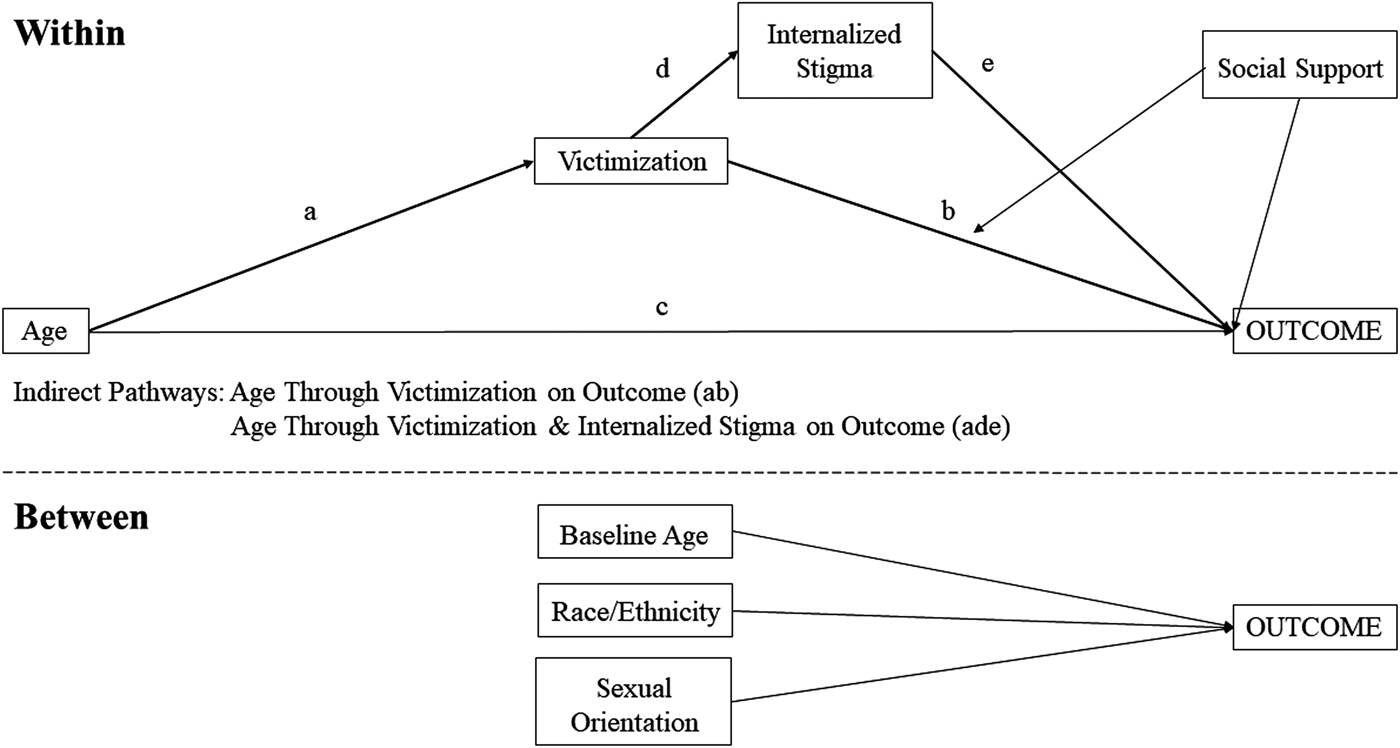
The developmental trajectories of the within-person variables, as well as the mental health and substance use outcomes, were first modeled by testing the effects of age on each variable individually. The substance use outcomes were treated as count data and estimated using a Poisson distribution. We initially tested for quadratic effects within these models but, because of the complexity, we did not carry over the quadratic effects into the subsequent multivariate analyses even when significant. We followed up the developmental trajectory models by analyzing the within-person effects as concurrent predictors of internalizing and externalizing symptoms. The model tested is shown in Figure 1. Social support was tested as a moderator of the association between victimization and mental health. We also tested for two indirect pathways using the Preacher, Zyphur, and Zhang (Reference Preacher, Zyphur and Zhang2010) framework for testing multilevel mediation: (a) age on mental health mediated by victimization and (b) age on mental health mediated by victimization and internalized stigma. We only included the second indirect pathway in models in which the association between victimization and internalized stigma was significant and the association between internalized stigma and the outcome was significant. MPlus does not allow for bootstrapping in multilevel models but recommends instead using the Bayes estimator for models that include the estimation of indirect effects (Muthén, Reference Muthén2010). The Bayesian approach is better for estimating indirect effects because it does not assume a normal distribution. When using the Bayes estimator, MPlus reports one-tailed significance tests (p < .025 is considered significant instead of p < .05) and 95% credibility intervals. The Bayes estimator has been used for all models that included indirect effects.
Multilevel Model of Indirect Pathways on Study Outcomes

We also took a time-lagged approach by testing whether previous wave victimization, social support, and internalized gay-related stigma that occurred 6 months prior predicted internalizing and externalizing after controlling for mental health at the previous wave. We repeated the concurrent and time-lagged models with alcohol, marijuana, and drug use as the outcomes in the place of mental health.
Results
Differences in retention
YSMM in the sample participated in an average of 4.80 (standard deviation = 1.64) waves of data collection in the first 2.5 years of the study. Bivariate linear regression models were run to identify any differences in retention based on demographic covariates or any of the primary study variables. Participants who reported using marijuana more often at baseline (B = –0.09, p = .010), who reported using more illicit drugs at baseline (B = –0.14, p = .001), or who reported higher internalized stigma at baseline (B = –0.30, p = .007) participated in significantly fewer waves. Bisexual-identifying participants participated in significantly fewer waves compared with participants who reported any other sexual orientation (B = –0.55, p = .004). There were no significant differences in retention based on race/ethnicity, age, baseline internalizing symptoms, externalizing symptoms, alcohol use, victimization, or social support.
Developmental trajectories
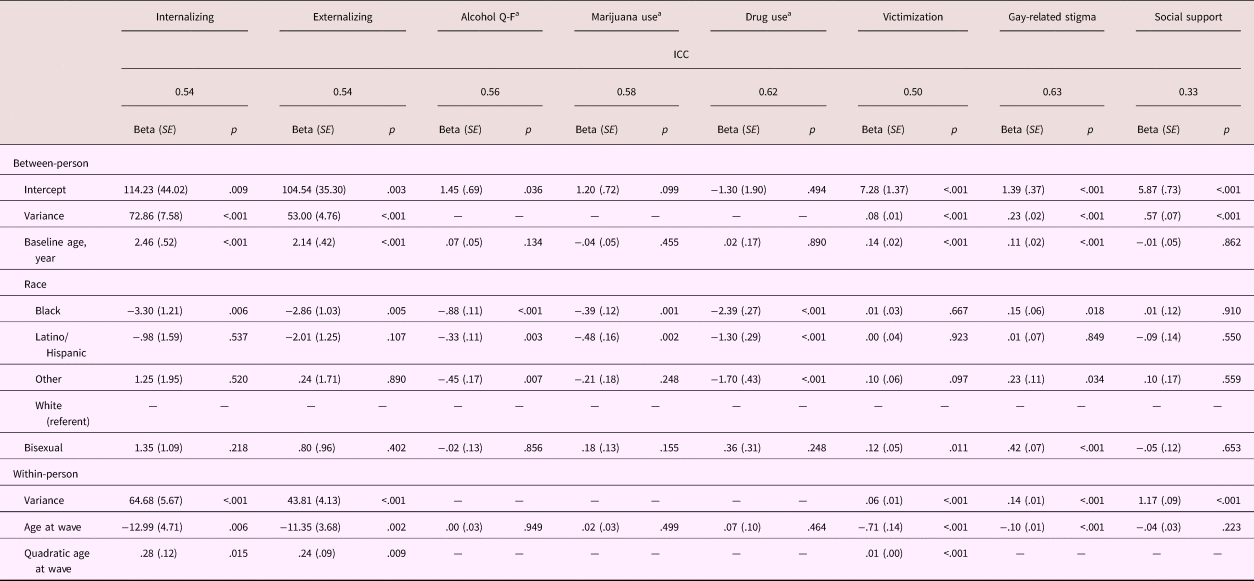
Intraclass correlations (ICCs) and developmental trajectories for each variable are presented in Table 1. The ICC is a measure of consistency between time points. ICC values are inversely related to within-person variance and values closer to 1 indicate less within-person variance (i.e., less change within individuals across measurement periods). Based on the ICC, 45.8% of variance in internalizing symptoms and 45.6% of variance in externalizing symptoms was within-person. Both internalizing and externalizing symptoms had a significant within-person effect of age such that for each year of age, participants decreased in their number of internalizing symptoms by 12.99 and externalizing symptoms by 11.35 on average. There was also a significant quadratic trend for both that suggested that this pattern of decreasing symptoms slowed as participants aged. In terms of between-person differences, participants who were older at baseline had higher internalizing and externalizing symptoms, and Black participants had fewer symptoms compared with White participants. There was no significant difference for bisexual participants in comparison to participants with other identities.
Developmental trajectories

Note: Quadratic effect of age was only included in models where it was significant. ICC = intraclass correlation; Q-F = quantity-frequency; SE = standard error. aPoisson distribution was used and MPlus does not compute variances.
Within-person variance was 44.1% for alcohol use and 42.3% for marijuana use. Drug use had the lowest amount of within-person variance at 38.0%, indicating that illicit drug use was more consistent within-person compared with alcohol and marijuana use. There was no significant effect of age for alcohol, marijuana, or drug use. Black and Latino/Hispanic participants were significantly lower on all three substance use outcomes compared with White participants. Participants in the Other race/ethnicity category had significantly lower rates of alcohol and drug use compared with White participants. There was no difference for bisexual-identifying participants compared with participants who identified with a different sexual orientation.
Within-person variance for victimization was 49.7%. There was a within-person effect of age on victimization such that for each additional year of age participants’ victimization scores lowered by 0.71. There was also a small but significant quadratic effect that suggested that this decrease begins to slow at older ages. Participants who identified as bisexual reported higher levels of victimization compared with other sexual orientation groups. Participants who were older at baseline also reported significantly higher victimization. Within-person variance was the lowest for internalized stigma at 37.5%. The within-person effect of age showed that internalized stigma decreased by 0.10 for each additional year as participants got older. Similar to victimization, participants who were older at baseline or who identified as bisexual reported higher internalized stigma. Participants who identified as Black or who fell in the Other racial category also reported significantly higher internalized stigma compared with White participants. For social support, 67.1% of variance was within-person. There was no effect of age on social support and no between-person demographic differences.
Concurrent predictors of internalizing and externalizing symptoms
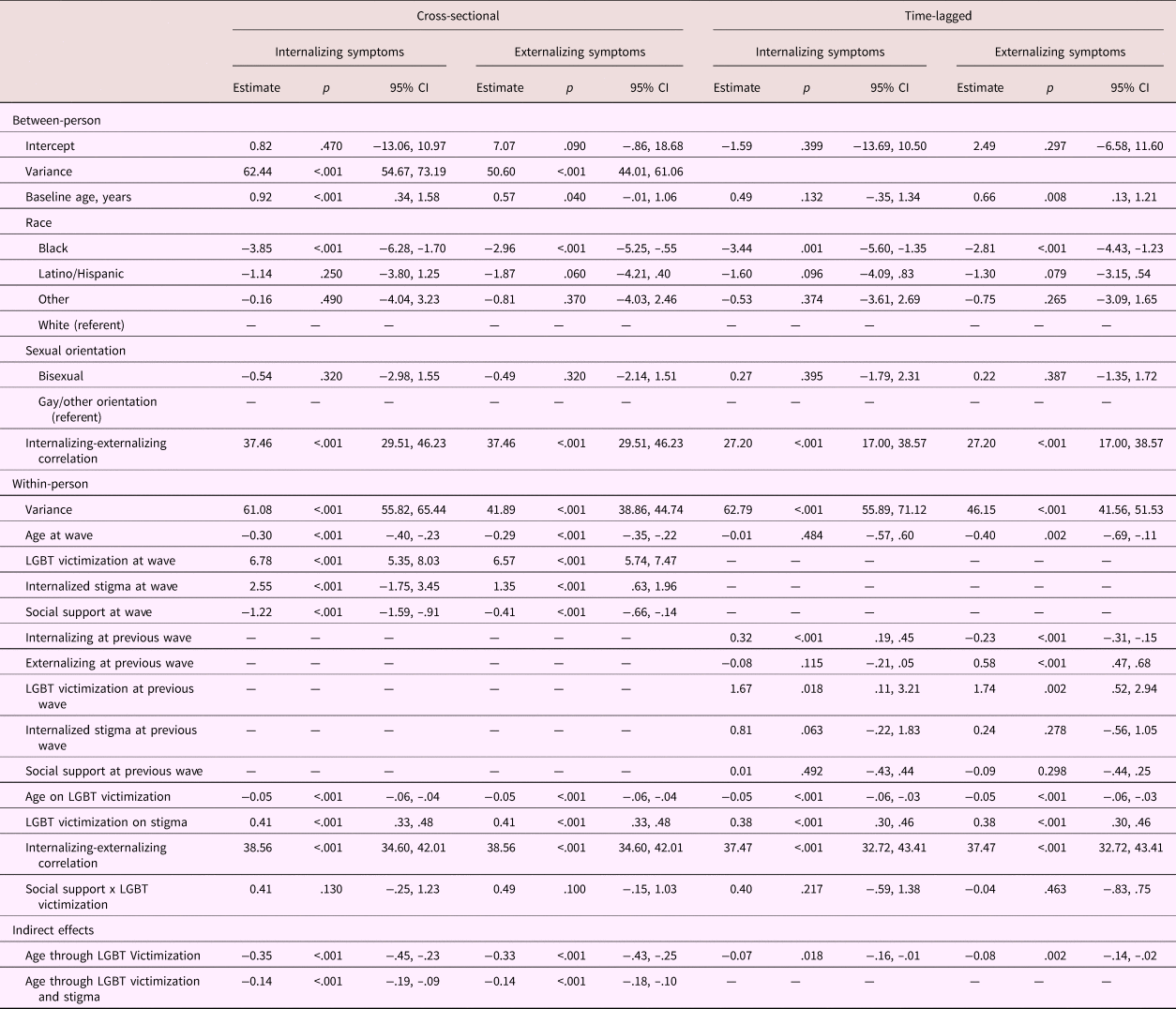
The concurrent within-person effects of age, victimization, internalized stigma, and social support were included in a single model to assess the effect of these variables on internalizing and externalizing symptoms at the same wave (Table 2). Higher levels of victimization were a significant predictor of higher levels of both internalizing (B = 6.78, p < .001) and externalizing symptoms (B = 6.57, p < .001). Victimization was also significantly associated with internalized stigma such that participants who reported higher victimization also had higher stigma (B = 0.41, p < .001). Higher internalized stigma was also significantly associated with higher internalizing (B = 2.55, p < .001) and externalizing symptoms (B = 1.35, p < .001). High social support was associated with lower internalizing symptoms (B = –1.22, p < .001) and externalizing symptoms (B = –0.41, p < .001). Social support did not significantly moderate the pathway between victimization and internalizing (B = 0.41, p = .130) or externalizing (B = 0.49, p = .100).
Multilevel cross-sectional and time-lagged models for mental health outcomes

Note: Models used Bayes estimator. p values based on one-tail test and must be below .025 to reach significance. CI = confidence interval; LGBT = lesbian, gay, bisexual, transgender, and queer.
There was a significant indirect effect of age on internalizing symptoms through victimization (95% credibility interval [95% CI] [–0.45, –0.23]; B = –0.35, p < .001) and through both victimization and internalized stigma (95% CI [–0.19, –0.09]; B = –0.14, p < .001). The decrease in victimization as participants got older was associated with a decrease in the effect of victimization on internalizing symptoms both directly and through a decrease in internalized stigma. For each additional year of age, the direct effect of victimization on internalizing decreased by 0.35 and the indirect effect of internalized stigma through victimization decreased by 0.14. These same indirect effects were also present for externalizing symptoms (age through victimization: 95% CI [–0.43, –0.25]; B = –0.33, p < .001; age through victimization and internalized stigma: 95% CI [–0.18, –0.10]; B = –0.14, p < .001). For each additional year older, the direct effect of victimization on externalizing decreased by 0.33 and the indirect effect of internalized stigma through victimization decreased by 0.14.
There were between-person differences based on age, such that participants who were older at baseline reported higher internalizing symptoms (B = 0.92, p < .001). Black participants reported fewer internalizing (B = –3.85, p < .001) and externalizing (B = –2.96, p < .001) symptoms compared with White participants. There were no differences for participants who identified as Latino/Hispanic or for participants in the Other race/ethnicity category. There also was no difference based on sexual orientation.
Time-lagged predictors of internalizing and externalizing
The time-lagged effects of victimization, internalized stigma, social support, and past wave internalizing and externalizing symptoms on current wave internalizing and externalizing symptoms are presented in Table 2. Higher past wave victimization was associated with higher current internalizing (B = 1.67, p = 0.18) and externalizing (B = 1.74, p = .002) symptoms. Past wave internalized stigma and social support were not associated with current internalizing or externalizing symptoms, including no significant effects of social support as a moderator. Past wave internalizing symptoms were positively associated with current internalizing symptoms (B = 0.32, p < .001) and were negatively associated with current externalizing symptoms (B = –0.23, p < .001). Higher previous wave externalizing symptoms were associated with higher current wave externalizing symptoms (B = 0.58, p < .001) but were not significantly associated with current wave internalizing symptoms (B = –0.08, p = .115).
There was a significant indirect effect of age on current wave internalizing symptoms through previous wave victimization such that as participants got older, victimization decreased and the effect of victimization on internalizing symptoms decreased (95% CI [–0.16, –0.01]; B = –0.07, p = .018). For each additional year of age, the effect of previous wave victimization on internalizing decreased by 0.07. The indirect effect of age on current wave externalizing symptoms through previous wave victimization was also significant (95% CI [–0.14, –0.02]; B = –0.08, p = .002). Decreases in past wave victimization as participants got older were associated with decreases in externalizing symptoms. For each year older, the effect of previous wave victimization on participants’ externalizing symptoms decreased by 0.08.
In the time-lagged model, participants who were older at baseline reported higher symptoms of externalizing (B = 0.89, p < .05), but there was no difference in internalizing symptoms based on baseline age. Similar to the concurrent model, Black participants reported fewer internalizing (B = –3.47, p < .01) and externalizing symptoms (B = –2.82, p < .01) compared with White participants. There were no differences for participants who identified as Latino/Hispanic, who fell in the Other race/ethnicity category, or who identified as bisexual.
Concurrent predictors of substance use behaviors
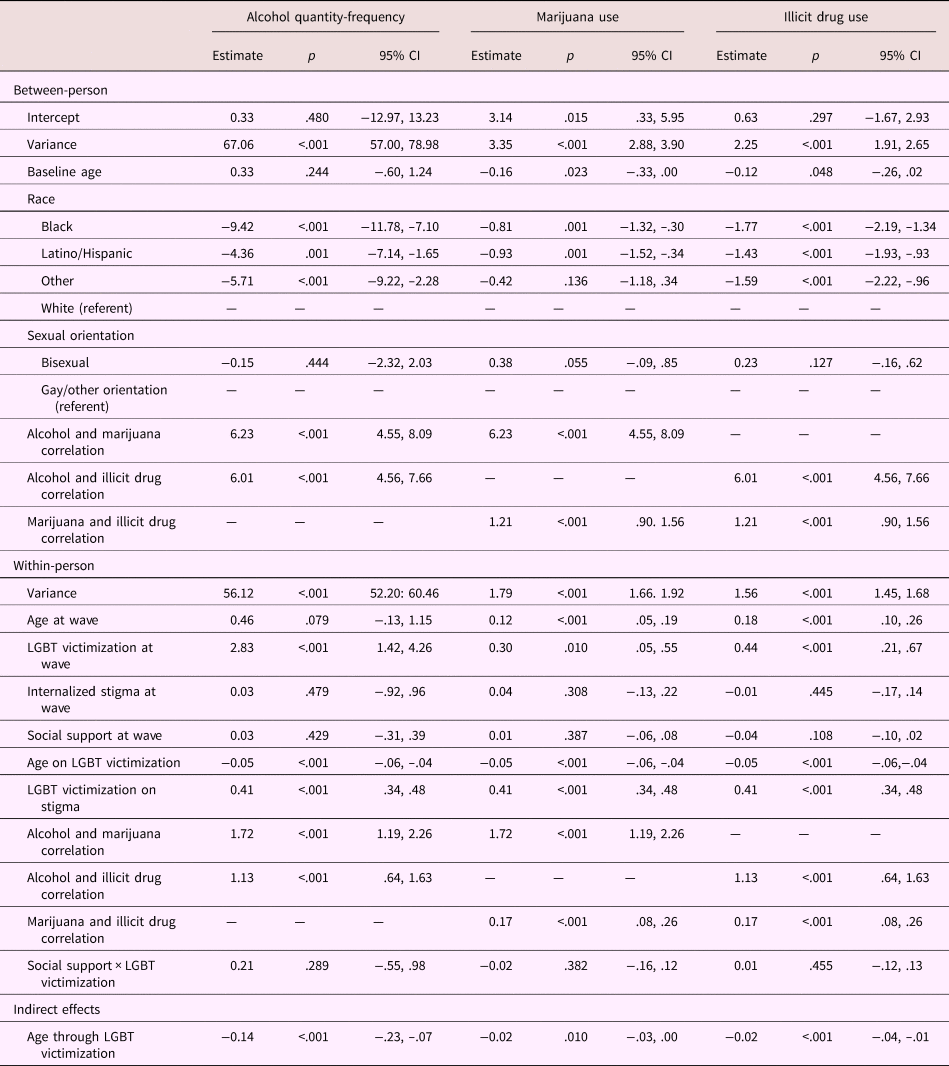
The within-person effects of age, victimization, internalized stigma, and social support on substance use outcomes are presented in Table 3. Age was significantly associated with drug use (B = 0.18, p < .001) and marijuana use (B = 0.12, p < .001) such that as participants got older, their use increased. The association between age and alcohol use was not significant (B = 0.46, p = .079). Higher victimization was significantly associated with higher alcohol frequency (B = 2.83, p < .001), higher marijuana use (B = 0.30, p = .010), and higher drug use (B = 0.44, p < .001). There were no significant associations between internalized stigma and social support on substance use outcomes, including moderating effects of social support.
Multilevel cross-sectional model for substance use outcomes

Note: Models used Bayes estimator. p values based on one-tail test and must be below .025 to reach significance. CI = confidence interval; LGBT = lesbian, gay, bisexual, transgender, and queer.
The indirect effects of age on alcohol frequency through victimization was significant (95% CI [–0.23, –0.07]; B = –0.14, p < .001). Those who experienced larger declines in victimization also experienced larger declines in alcohol use. For each additional year of age, the effects of victimization on alcohol use decreased by 0.14. There were similar indirect effects for marijuana use through victimization (95% CI [–0.03, 0.00]; B = –0.02, p = .010). The pattern was the same for indirect effects on drug use through victimization (95% CI [–0.04, –0.01]; B = –0.02, p < .001). For each additional year older, the effects of victimization on marijuana use decreased by 0.02 and the effects of victimization on drug use decreased by 0.02.
There was a between-person difference for baseline age such that participants who were older at baseline reported lower marijuana use (B = –0.16, p = .023). There were no differences for alcohol or drug use. Black and Latino/Hispanic participants reported lower alcohol (Black: B = –9.42, p < .001; Latino/Hispanic: B = –4.36, p = .001), marijuana (Black: B = –0.81, p = .001; Latino/Hispanic: B = –0.93, p = .001), and drug use (Black: B = –1.77, p < .001; Latino/Hispanic: B = –1.43, p < .001) compared with White participants. Participants in the Other race/ethnicity category were lower on alcohol (B = –5.71, p < .001) and drug use (B = –1.59, p < .001) compared with White participants, but not marijuana use.
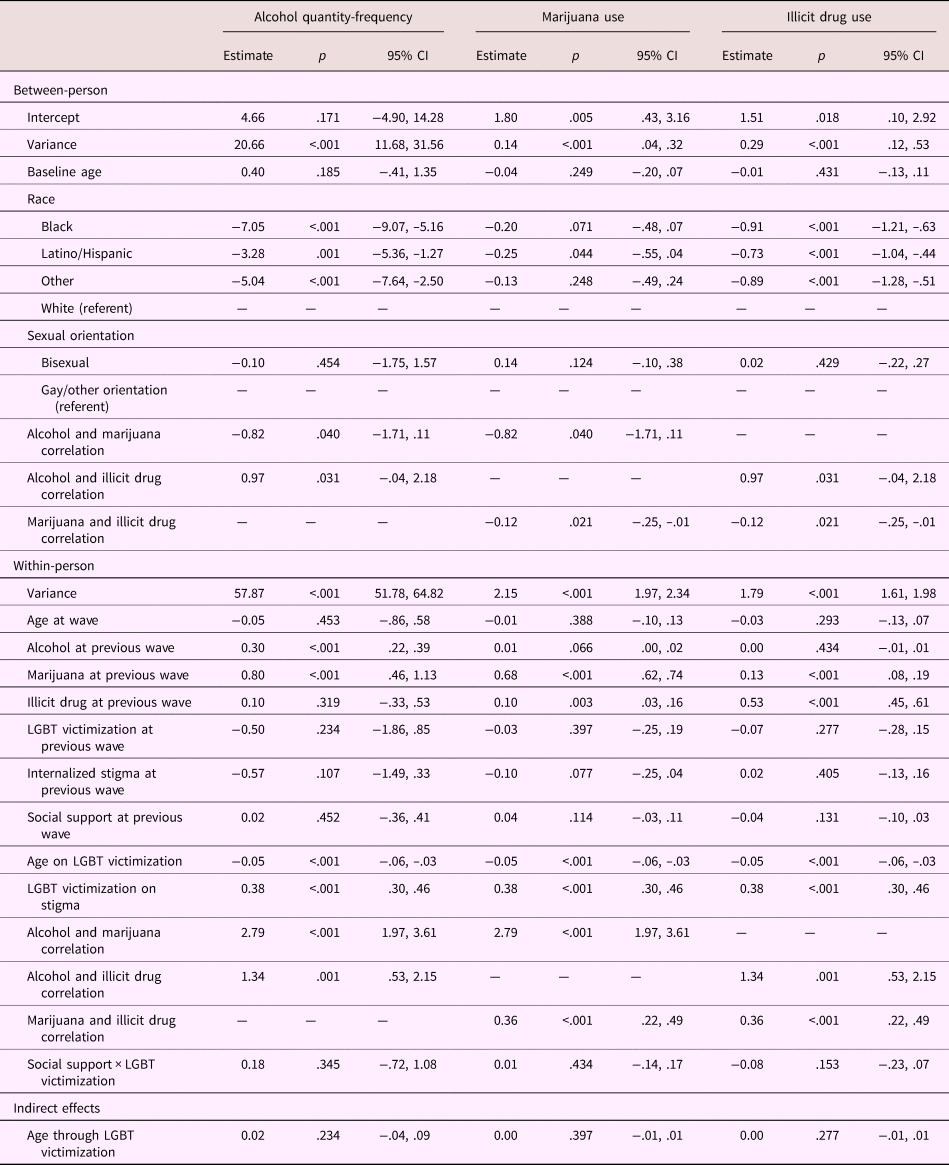
Time-lagged predictors of substance use behaviors
The time-lagged effects of victimization, internalized stigma, social support, and previous wave substance use on current substance use are presented in Table 4. There were no significant effects of previous wave victimization, internalized stigma, or social support on current wave substance use outcomes. Higher past wave alcohol frequency (B = 0.30, p < .001) and marijuana use (B = 0.80, p < .001) was predictive of higher current wave alcohol frequency. There was no significant effect of past wave drug use on alcohol frequency. Previous wave marijuana use (B = .68, p < .001) and drug use (B = 0.10, p = .003) were predictive of current wave marijuana use such that higher past use was associated with higher current use. There was no significant effect of past wave alcohol use on marijuana use. Previous wave drug use (B = 0.53, p < .001) and marijuana use (B = 0.13, p < .001) was predictive of current wave drug use, but not alcohol use.
Multilevel time-lagged model for substance use outcomes

Note: Models used Bayes estimator. p values based on one-tail test and must be below .025 to reach significance. CI = confidence interval; LGBT = lesbian, gay, bisexual, transgender, and queer.
There were no significant indirect effects on substance use behaviors in the time-lagged models. In terms of between-person differences, Black participants reported lower alcohol use (B = –7.05, p < .001) and drug use (B = –0.91, p < .001) compared with White participants. Latino/Hispanic participants reported lower alcohol use (B = –3.28, p = .001) and drug use (B = –0.73, p < .001) compared with White participants. Participants in the Other race/ethnicity category also reported lower alcohol (B = –5.04, p < .001) and drug use (B = –0.89, p < .001) compared with White participants. There were no differences based on baseline age or sexual orientation for substance use outcomes.
Discussion
The purpose of the present study was to understand how experiences of victimization impact mental health and substance use among YSMM, and how these associations change as YSMM age from adolescence to young adulthood. In the concurrent predictor models, more experiences of victimization were associated with higher internalizing and externalizing symptoms and higher alcohol and marijuana use. These findings are in concordance with research that has found a positive association between victimization and mental health problems (Birkett et al., Reference Birkett, Newcomb and Mustanski2015; Swann et al., Reference Swann, Minshew, Newcomb and Mustanski2016) and among victimization and alcohol, marijuana, and illicit drug use for YSMM (Bontempo & D'Augelli, Reference Bontempo and D'Augelli2002; Huebner et al., Reference Huebner, Thoma and Neilands2015). Our findings also support our hypothesis that victimization would mediate the association between age and both mental health and substance use outcomes, such that as participants transitioned from late adolescence into young adulthood, they would experience less victimization and as a result have fewer symptoms of mental health problems and substance use behaviors associated with victimization.
Our findings indicated that the decrease in both internalizing and externalizing symptoms as YSMM moved into young adulthood was partially explained by the decrease in experiences of victimization over time. For internalizing symptoms, this result was true for both concurrent and time-lagged victimization and replicated previous findings with a sample of sexual minority young men and women (Birkett et al., Reference Birkett, Newcomb and Mustanski2015). This is the first study to extend those findings to externalizing symptoms. The results suggest that for YSMM, the decline over time in symptoms of mental health problems is not just a decontextualized developmental process. Instead it is, in part, a function of the decrease in exposure to the bullying and victimization that increase rates of mental health issues in sexual minority youth both directly and via increases in internalized stigma. The results of the time-lagged model also suggested that for mental health, the effects of victimization can linger and still affect participants’ wellbeing 6 months later.
The current study also extends previous research analyzing the effect of victimization as a mediator of the association between age and substance use, although the effect was somewhat different than its mediating effect on developmental change in mental health symptoms. Victimization showed a similar mediating effect between age and alcohol, marijuana, and drug use, but this effect must be interpreted in the context of an overall increase in these substance use behaviors. In other words, there was an overall increase in illicit drug and marijuana use over time similar to what has been found in previous research (Halkitis et al., Reference Halkitis, Siconolfi, Stults, Barton, Bub and Kapadia2014; Swann et al., Reference Swann, Bettin, Clifford, Newcomb and Mustanski2017), but there were substantial individual differences in these rates of change (i.e., some decreased their use over time). Those YSMM who experienced large declines in victimization also tended to experience less substance use over time; however, given that substance use behaviors tended to increase for the sample as a whole, it is likely that other developmental factors contributed to the rate of change (e.g., increased access to substances, greater independence from family). More work is clearly needed to disentangle the multiple influences on substance use. We should also note that the indirect effect for substance use outcomes was not significant in the time-lagged models. This might suggest that, for substance use, the effect of victimization is more proximal and did not linger into the subsequent assessment period. It is possible that YSMM turn to alcohol, marijuana, and illicit drugs to cope when victimization occurs, but they do not continue to use substances to cope unless their experiences of victimization are sustained.
In the concurrent model, we found that internalized gay-related stigma was positively associated with both internalizing and externalizing mental health symptoms. There was no significant association for stigma in the time-lagged model for mental health outcomes, or for stigma and the substance use outcomes in either the concurrent or time-lagged models. However, higher victimization was associated with higher internalized stigma in all of our models and there was evidence of decreased stigma via decreased victimization as participants got older resulting indirectly in fewer mental health symptoms in the cross-sectional model. Our findings concur with previous research that has shown associations between internalized stigma and the internalizing spectrum of mental health issues and disorders (Kaysen et al., Reference Kaysen, Kulesza, Balsam, Rhew, Blayney, Lehavot and Hughes2014; Newcomb & Mustanski, Reference Newcomb and Mustanski2010; Puckett, Levitt, et al., Reference Puckett, Levitt, Horne and Hayes-Skelton2015; Puckett, Woodward, Mereish, & Pantalone, Reference Puckett, Woodward, Mereish and Pantalone2015). It is also one of the first to suggest that experiences with internalized stigma are not just associated with feelings of depression and anxiety, but also symptoms on the externalizing spectrum such as aggression and rule-breaking behavior. The lack of association between internalized stigma and substance use was in concordance with previous research that has failed to find a significant link between the two (Amadio, Reference Amadio2006; Amadio & Chung, Reference Amadio and Chung2004; Ross et al., Reference Ross, Rosser, Bauer, Bockting, Robinson, Rugg and Coleman2001).
Participant reports of social support were not a significant factor in the majority of our models. The sole exception was the negative association social support had with internalizing and externalizing symptoms in the concurrent model. This finding was similar to research that found social support to be associated with better mental health outcomes (Liu & Mustanski, Reference Liu and Mustanski2012; McConnell et al., Reference McConnell, Birkett and Mustanski2016). The current findings do not support research that has linked social support and substance use issues (Lehavot & Simoni, Reference Lehavot and Simoni2011; Newcomb & Bentler, Reference Newcomb and Bentler1988). There was also no evidence that social support acted as a moderator between experiences of victimization and any of our outcomes. The results of our models suggest that the effect of victimization on mental health and substance use is significant even after accounting for the possible mitigating influence of social support.
Implications
The present study expanded upon previous research that showed victimization mediating the association between age and mental health problems into the areas of externalizing and substance use. It also lent further support to minority stress theory by demonstrating that higher levels of victimization that YSMM experience are associated with higher rates of negative health outcomes (Hatzenbuehler, Reference Hatzenbuehler2009; Meyer, Reference Meyer2003). The current research highlights the importance of addressing the bullying and victimization that YSMM and other SGM youth face during adolescents. Previous research has already shown that YSMM are at higher risk of being victimized (Bontempo & D'Augelli, Reference Bontempo and D'Augelli2002; Robin et al., Reference Robin, Brener, Donahue, Hack, Hale and Goodenow2002; Russell & Joyner, Reference Russell and Joyner2001; Shields et al., Reference Shields, Whitaker, Glassman, Franks and Howard2012) and being victimized multiple times (Bontempo & D'Augelli, Reference Bontempo and D'Augelli2002). The current study illustrates that these experiences of victimization have a negative impact on YSMM across a range of health indicators and that the negative impact begins to reduce as YSMM become less exposed to victimization as they become older. This is not to say that we should simply allow victimization to decrease naturally over time, however. Efforts to reduce victimization experienced by sexual minorities, particularly at younger ages, are an important step in reducing the lifespan mental health and substance use disparities between YSMM and their heterosexual counterparts. This is especially important within the context of adolescence and young adulthood as a period of ongoing development. Negative experiences can have long-lasting psychosocial and physiological consequences. In particular, this is a crucial period for brain development in which chronic stress (Eiland & Romeo, Reference Eiland and Romeo2013), substance use (Squeglia, Jacobus, & Tapert, Reference Squeglia, Jacobus and Tapert2009), and mental health problems (Whittle et al., Reference Whittle, Lichter, Dennison, Vijayakumar, Schwartz, Byrne and Allen2014) can stunt development in regions governing executive functioning and emotion regulation with long-term consequences into adulthood. It is critical that we develop interventions that seek to safeguard YSMM from experiencing victimization, in addition to developing programs to help YSMM who experience victimization cope more adaptively with these detrimental experiences.
Limitations
The multilevel framework used in the current study presented several important limitations. In the concurrent models, the order of effects cannot be confirmed. Minority stress theory suggests that YSMM experience negative health outcomes at disproportionate rates because they are exposed to more discrimination and victimization. Within the concurrent framework, however, we cannot confirm that experiences of victimization proceeded higher mental health problems or substance use. The time-lagged model allowed us to test for longitudinal effects, but the effects on substance use may be too proximal and short term to be detected 6 months later. The more complex models we fit were designed to account for linear effects only. We know from our initial trajectory models that internalizing symptoms, externalizing symptoms, and experiences of victimization had significant quadratic effects in their change over time. Excluding those quadratic effects from the cross-sectional and time-lagged models may have introduced additional bias into our results. We also found differences in retention based on marijuana use, illicit drug use, and internalized stigma. Participants who were higher on those variables at baseline participated in significantly fewer waves; therefore, our models may be less accurate for YSMM who report the highest levels of substance use or experience the most internalized stigma.
Suggestions for future research
Additional research should expand to other SGM youth beyond YSMM, including women who have sex with women and transgender and other gender minority youth. Researchers should also explore what factors put YSMM and other SGM groups at higher risk for experiencing victimization. More research should explore the associations between victimization experiences and internalized stigma to understand more about the mechanisms by which internalized stigma mediates the association between victimization and health outcomes. Finally, researchers should follow YSMM further into adulthood to see the extent to which victimization experiences continue to decline over time and how that affects their mental health and substance use.
Conclusions
The current study found that declines in victimization across development are an important explanatory factor in understanding changes in mental health and substance use among YSMM across development. These results illustrate a vital need to address the higher levels of victimization that YSMM are exposed to compared with their heterosexual peers. This study shows that the reduction in victimization that YSMM experience as they grow older and become better able to select their own environments is associated with a reduction in negative mental health and substance use outcomes. Prevention efforts to limit victimization exposure may be a necessary step to reducing the health disparities that YSMM and other SGM youth face.
Financial support
Grant funding supported data collection for the Crew 450 study (National Institute on Drug Abuse, R01DA025548) and the analysis and writing of this manuscript (National Institute on Drug Abuse, U01DA036939).
Acknowledgements
Dr. Robert Garofalo was a multiple PI with Dr. Mustanski on Crew 450, and we thank him and his team for their involvement in that project. We thank the participants for sharing their experiences with us.