Introduction
Despite a growing body of research reporting sleep difficulties in adults after a traumatic brain injury (TBI) (Ouellet, Savard, & Morin, Reference Ouellet, Savard and Morin2004) the pediatric literature remains sparse. In Scotland, TBI is estimated to result in 100,000 emergency department attendees each year, over half of which are school-age children (Jennett, Reference Jennett1998). Pediatric TBI is associated with long-term physical, cognitive, emotional and behavioral sequelae, and it is in this context that pediatric sleep difficulties may present.
In healthy children, restricted sleep can impact on daytime functions such as academic performance, cognition and behavior (Beebe, Rose, & Amin, Reference Beebe, Rose and Amin2010; Dewald, Meijer, Oort, Kerkhof, & Bogels, Reference Dewald, Meijer, Oort, Kerkhof and Bogels2010) and estimated prevalence rates for sleep difficulties are higher in children with developmental disabilities (Dorris, Scott, Zuberi, Gibson, & Espie, Reference Dorris, Scott, Zuberi, Gibson and Espie2008). It is, therefore, important to systematically investigate sleep after TBI, especially as this group is already at increased risk of poorer cognition and behavioral function.
Sleep difficulties are among the most common symptoms reported in the weeks and months post-injury (Hooper et al., Reference Hooper, Alexander, Moore, Sasser, Laurent, King and Callahan2004). However, parent-reports of sleep difficulties after mild pediatric TBI are equivalent to those in several control populations, including orthopedic injury (OI), mild bodily injuries, and healthy children (Hawley, Reference Hawley2003; Ponsford et al., Reference Ponsford, Willmott, Rothwell, Cameron, Ayton, Nelms and Curran1999). These findings often rely on one prompt within a parent–proxy questionnaire encompassing a wide range of post-concussional difficulties. Objective measurement of sleep using polysomnography (PSG) or actigraphy is rare. Only one such study (Milroy, Dorris, & McMillan, Reference Milroy, Dorris and McMillan2008) could be identified with appropriate controls, and found no differences between mild TBI and OI groups on actigraphy parameters.
Severe TBI is associated with more severe brain pathology, which may interrupt the brain systems implicated in sleep–wake regulation. Greater school and behavioral difficulties after more severe pediatric TBI (Hawley, Reference Hawley2003) may also increase vulnerability to the impact of any potential sleep disruptions. Despite this, no studies systematically investigate sleep after severe TBI. Studies adopting parent-report measures suggest that those sustaining more severe injury report more sleep problems (Beebe et al., Reference Beebe, Krivitzky, Wells, Wade, Taylor and Yeates2007; Hawley, Reference Hawley2003; Hooper et al., Reference Hooper, Alexander, Moore, Sasser, Laurent, King and Callahan2004; Tham et al., Reference Tham, Palermo, Vavilala, Wang, Jaffe, Koepsell and Rivara2012). Although these studies use a prospective design and recruit moderate participant numbers, limitations include a lack of objective sleep measurement.
The current study systematically investigates sleep quality and quantity following moderate–severe pediatric TBI. Siblings were selected as controls for family and environmental factors; because they sleep in the same home, experience similar parental limit-setting, and have experienced the emotional impact of traumatic injury within the family. It was hypothesized that children with moderate–severe TBI would have more sleep–wake difficulties than sibling controls across sleep measures.
Design
A between-subjects design was adopted. Due to challenges in recruiting from a small retrospective population, an a priori power calculation based on Sleep Efficiency (SE) guided minimum recruitment. A sample size of n = 15 per group was estimated to detect a difference in SE using actigraphy with 80% power, alpha = 0.05 and d = 0.95. This calculation is based on data published by Kaufman et al. (Reference Kaufman, Tzischinsky, Epstein, Etzioni, Lavie and Pillar2001); 90.2 ± (4.6)% vs. 94 ± (3.3)%; p < .05; who recruited adolescents with mild TBI and self-reported sleep problems and compared them with healthy controls. This prediction is limited by the selection bias from self-report in the study design and a calculation based on only one broad sleep parameter (SE). However, Kaufman et al. (Reference Kaufman, Tzischinsky, Epstein, Etzioni, Lavie and Pillar2001) is the only study reporting significant differences between groups on actigraphy measures in a pediatric TBI sample.
Methods
Ethics approval was granted by the West of Scotland Research Ethics Committee. Potential participants were identified via electronic and hand searches of hospital records, identifying children with; (i) moderate–severe TBI (including all International Classification of Diseases codes for head injury); (ii) currently aged 5–16 years; (iii) who were 6 months to 6 years post-injury. Participants with premorbid sleep disorders, developmental disabilities, and neurological and psychiatric disorders were excluded. TBI severity was verified by medical records and defined by Glasgow Coma Scale (GCS) score (Teasdale & Jennett, Reference Teasdale and Jennett1974) as severe (GCS ≤ 8) or moderate (≥9 and ≤12). Where GCS was not recorded, moderate TBI was defined by hospital admission ≥48 hours, positive neuroimaging of skull fracture or contusion, post-traumatic neurological abnormality and/or loss of consciousness >15 min; and severe TBI by intubation and sedation, positive neuroimaging, neurosurgery, and neurological abnormality.
Children were recruited from four hospital sites: Glasgow Royal Hospital for Sick Children (RHSC) and Southern General Hospital, Edinburgh RHSC, and Newcastle General Hospital. Individuals fulfilling inclusion and exclusion criteria (n = 78) were invited by post to participate. Families who volunteered via returned consent forms (n = 25; 32%) were contacted for initial telephone screening, and those meeting inclusion and exclusion criteria were invited for interview with a clinical psychologist. Two families dropped out following screening and one was excluded due to Autistic Spectrum Disorder (ASD) diagnosis, leaving n = 21 participants with TBI, 15 of whom had a school-aged sibling. Siblings were (a) aged 5–16 years; (b) attending mainstream school; (c) had no previous diagnosis of sleep disorder, developmental disability, neurological or psychiatric disorder; and (d) no hospital admission in the past six months.
Family interviews (with parents and children together) established sleep history. Parents completed proxy questionnaires independently while children completed neuropsychological tests and sleep self-report in a separate room (with administrator support for younger children). The English Index of Multiple Deprivation (IMD, 2010) and Scottish Index of Multiple Deprivation (SIMD, 2006) were used to estimate socio-economic status (SES), using deprivation deciles. Psychosocial measures described the groups in terms of parent-reported quality of life (Pediatric Quality of Life Inventory (PedsQL) Core Scale; Varni, Limbers, & Burwinkle, Reference Varni, Limbers and Burwinkle2007) and behavior [Strengths and Difficulties Questionnaire (SDQ; Goodman, Reference Goodman1997)]. Brief neuropsychological assessment described cognitive function [Wechsler Abbreviated Scale of Intelligence (WASI) Two Subtest Form and Digit Symbol Coding Subtest, Wechsler Intelligence Scale for Children-IV (WISC-IV)].
Sleep Measures
(i) Sleep History: Pre- and post-injury sleep was parent-rated on a Likert-scale (No problems; few problems/not concerned; few problems/mildly concerned; some problems/fairly concerned; definite difficulties/very concerned).
(ii) Children's Sleep Habits Questionnaire (CSHQ; Owens, Spirito, & McGuinn, Reference Owens, Spirito and McGuinn2000). Parent frequency-ratings of sleep behaviors over 1 week. The sum of 33 items provides a total score, where higher scores indicate more sleep problems; with a cut-off ≥41 recommending referral to a sleep specialist.
(iii) Sleep Self-Report (SSR; Owens, Maxim, Nobile, McGuinn, & Sell, Reference Owens, Maxim, Nobile, McGuinn and Sell2000): Child-report frequency-ratings of sleep behaviors, with higher total scores indicating more sleep problems.
(iv) Sleep Diary: Family report of bed, “lights-out” and rise times, daytime naps and watch removal over the time of participation provided corroboration of actigraphy data.
(v) Actigraphy: Actiwatch AW7 (Cambridge Neurotechnology) worn on non-dominant wrist for 5 weekdays and nights; meeting the recommended duration for reliable actigraphy data capture for sleep efficiency in children (Acebo et al., Reference Acebo, Sadeh, Seifer, Tzischinsky, Wolfson, Hafer and Carskadon1999). A button was pressed on the watch at “lights-out” to signal settling-to-sleep. Data were collected in standard 1-min epochs. Actigraphy parameters included: Time in Bed (TIB); Total Sleep Time (TST): difference between first sleep onset and sleep end; Wake After Sleep Onset (WASO): total time spent awake after first sleep onset; Sleep Latency (SL): time to sleep onset following “lights out”; Sleep Efficiency (SE): proportion of time spent in bed asleep [SE = (TST-WASO)/TIB]. Nonparametric Circadian Rhythm Analysis (NPCRA; Actiwatch Sleep Analysis software) was completed to calculate the stability and fragmentation of sleep–wake rhythm in line with day and night environmental cues. Finally, day-time periods were analyzed for naps ≥20 min (with inactivity sensitivity threshold set to zero to avoid mistaking quiet periods as naps), cross-referenced with diary-report.
Data Analysis
Actigraphy sleep–wake parameters were averaged over the 5-night period (Actiwatch Sleep Analysis software, 2001). All in the TBI group successfully recorded 5 nights of actigraphy data, but three of the sibling controls had 1 night missing and were analyzed on the basis of 4 school nights (Statistical Package for the Social Sciences; SPSS v15.0). Significance levels were set at p < .05). Questionnaires were scored blind to actigraphy results. Where distributions were skewed, the median and range are reported. Due to the modest sample size, no attempt was made to analyze the effect of TBI severity on sleep outcomes (the group was considered as a whole to have sustained significant injury); nor to complete regression analysis relating to psychosocial measures.
Results
Participants
TBI participants were a median of 25 months (range, 9–65 months) post-injury. They were admitted to Glasgow (n = 4), Edinburgh (n = 5), or Newcastle (n = 6) hospitals for a median of 14 days (range, 2–35 days). Nine (60%) sustained a severe TBI, and six a moderate TBI. GCS was not available in medical records for three cases (one defined as severe TBI, and two as moderate TBI by methods described above). Mechanisms of injury were road traffic accidents (n = 6), falls or being hit by a falling object (n = 7), and sports injuries (n = 2). The control group comprised 15 siblings, one per family. TBI and control groups did not differ in age (t = 0.170; p = .87) or gender (χ2 = 0.536; p = .36). Groups were exactly matched for SES because siblings grew up in the same household as index children. Most families lived in deprived areas (67% SIMD and 83% IMD <4th decile). No participant (index or control) had a delayed school start, and none had repeated a school year before or after injury. Fourteen of the TBI group had returned to mainstream school, and one to special education since injury. One TBI participant took prescribed melatonin for sleep difficulties since injury.
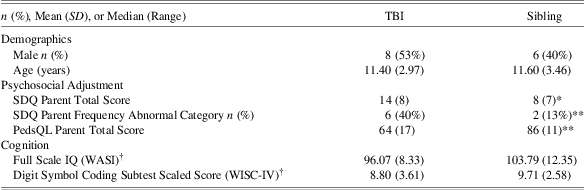
Demographic, psychosocial, and cognitive characteristics can be seen in Table 1. The TBI group had a significantly poorer quality of life (PedsQL, t = 4.141; p < .001) and more behavioral problems (SDQ, t = 2.104; p = .045) than sibling controls. More of the TBI group fell in the abnormal range of the SDQ (weighted χ2 = 15.185; df = 3; p = .002). The groups did not significantly differ on the WASI (t = 1.985; p = .057) or WISC-IV Coding subtest (t = 0.776; p = .445).
Descriptive characteristics of TBI (n = 15) and Sibling (n = 15) groups
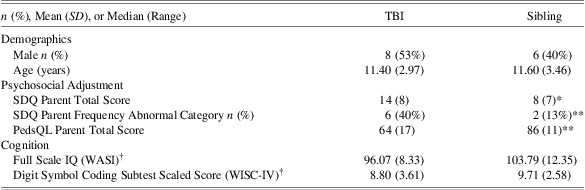
† control group, n = 14.
* Significant p < 0.05.
**p < 0.01.
TBI = traumatic brain injury; SDQ = Strengths and Difficulties Questionnaire; WASI = Wechsler Abbreviated Scale of Intelligence; WISC-IV = Wechsler Intelligence Scale for Children-IV.
Sleep Measures
Pre- and post-injury sleep report
Of the TBI group, n = 12 (80%) families reported an increase in sleep difficulties (moving from no problems or few problems/not concerned to few/not concerned (n = 4); few/concerned (n = 4); some/fairly concerned (n = 3); or definite/very concerned (n = 1). Two siblings (13%) had an increase in sleep difficulties after the injury (moving from no problems to few problems/not concerned).
Sleep-report measures
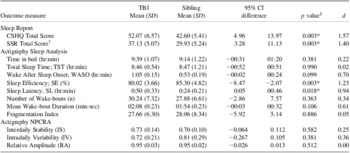
The TBI group had significantly higher CSHQ and SSR total scores than siblings (Table 2). More TBI participants (n = 14; 93%) than controls (n = 8; 53%) fell above the CSHQ cut-off (χ2 = 6.14; p = .013). More TBI participants (n = 7; 47%) self-reported overall “trouble sleeping” on the SSR (item 2) than controls (n = 1; 7%; χ2 = 6.14; p = .013).
Group Differences on Sleep Measures: TBI (n = 15), Sibling (n = 15)

† Control group n = 14.
§ t test, difference for two independent means.
*Significance, d = Cohen's effect size.
TBI = traumatic brain injury; CI = confidence interval; CSHQ = Children's Sleep Habits Questionnaire; SSR = Sleep Self-Report questionnaire; NPCRA = Nonparametric Circadian Rhythm Analysis.
Actigraphy analysis
Significantly longer Sleep Latency (SL) and poorer Sleep Efficiency (SE) were identified in the TBI group (Table 2). Wake after Sleep Onset (WASO) (p = .099; d = 0.70) and Mean Wake-bout Duration (MWD) (p = .106; d = 0.61) did not reach significance, and large effect sizes were found.
NPCRA revealed no significant differences between groups (Table 2). Two TBI and two control participants reported taking one nap each (21–35 min duration) during the study period, which were verified by actigraphy.
Discussion
This is the first study to systematically measure subjective and objective correlates of sleep in a pediatric group with moderate–severe TBI. Sleep difficulties occurred more often in the TBI group than in sibling controls, both for subjective report (self/parent) and actigraphy. The TBI group had poorer Sleep Efficiency and longer Sleep Latency than their siblings. Circadian rhythm disorders and daytime naps were not evident in either group. Bearing in mind the limitations of relying on retrospective report, sleep difficulties were recognized as newly occurring after TBI in all but one case.
The use of sibling controls suggests that moderate–severe TBI is associated with objectively identifiable sleep difficulties which are not explained by environmental and family factors. Siblings may be affected emotionally and behaviorally when a brother or sister sustains a brain injury (Sambuco, Brookes, & Lah, Reference Sambuco, Brookes and Lah2008) and may experience nightmares and anxiety, which in turn may impact on behavior and sleep. This makes siblings an appropriate control group, which allows for some of the psychosocial impact of TBI within the family. No injury comparison group was recruited, meaning that the direct experiences of injury and hospital admission were not controlled for. There is some evidence that such injury-related factors are associated with sleep difficulties, with elevated rates of parent-reported sleep difficulties in both mild TBI and other mild injury control groups (Milroy et al., Reference Milroy, Dorris and McMillan2008; Ponsford et al., Reference Ponsford, Willmott, Rothwell, Cameron, Ayton, Nelms and Curran1999).
The rate of parent-reported sleep difficulties in the TBI group (93%) is high, and similar to those reported for children with a range of neurodevelopmental syndromes (40–85%; Dorris et al., Reference Dorris, Scott, Zuberi, Gibson and Espie2008). Anecdotally, sleep difficulties did not present as reported insomnia, or as related to post-traumatic stress disorder, and only three families had sought medical assessment of sleep or fatigue. Others note that sleep difficulties are not spontaneously reported by families, who tend instead to focus on physical and behavioral changes following TBI (Hawley, Reference Hawley2003). To some extent, parental complaints may depend on what is considered to be the threshold for a “problem” by families when there are many consequences of TBI to contend with. Children themselves may not associate sleep difficulties with daytime problems or may be unable to articulate problems. The impact on function may not present in an obvious way (such as expected daytime sleepiness), but instead as reduced attention, high activity and irritability (all of which may be seen in the context of TBI without sleep problems). It is important that clinicians explore the potential for sleep difficulties with this population as difficulties may not be spontaneously reported, particularly by children and young people themselves.
Evidence regarding the importance of sleep for children's learning and development is growing (Beebe et al., Reference Beebe, Rose and Amin2010; Blunden & Beebe, Reference Blunden and Beebe2006; Dewald et al., Reference Dewald, Meijer, Oort, Kerkhof and Bogels2010). In the current study, the sample size was not large enough to examine relationships between actigraphy and psychosocial measures, and daytime function was not comprehensively measured. A within-TBI-group comparison using a larger sample of defined “good” versus “poor” sleepers is required to determine if sleep disruption further compromises cognitive and behavioral function following TBI. Actigraphy is convenient and cost effective, it enables long-term recording in the natural sleep environment, and has reasonable validity and reliability across several populations and device brands (Sadeh, Reference Sadeh2011). However, actigraphy is only a behavioral correlate of sleep, and limitations include variability between devices, high sensitivity to sleep but low specificity to wake (resulting in potential underestimation of WASO), and a lack of validity studies across specific pediatric age groups and clinical populations (Meltzer, Montgomery-Downs, Insana, & Walsh, Reference Meltzer, Montgomery-Downs, Insana and Walsh2012; Sadeh, Reference Sadeh2011). This study can, therefore, only indicate that sleep after moderate–severe TBI is worthy of further investigation, and future studies are recommended to adopt the gold standard of PSG to validate the use of actigraphy after pediatric TBI. Future research might attempt to correlate PSG findings with learning paradigms to determine whether disordered sleep electrophysiology, with or without reported sleep disturbances, is associated with learning problems in this already vulnerable group.
Design strengths of the current study include sibling controls for environmental factors and recent family trauma, and the use of validated sleep measures with child and parent report as well as objective correlates of sleep. The large effect sizes identified in this preliminary study with a modest sample size indicates that the study was only powered to detect significant differences for some sleep parameters. The CSHQ and SSR are not validated for use with teenagers, but are useful screening tools to differentiate those with sleep difficulties, and are well-established in assessment of diverse developmental diagnoses (Lewandowski, Toliver-Sokol, & Palermo, Reference Lewandowski, Toliver-Sokol and Palermo2011). Families with ongoing difficulties may have been more eager to participate and premorbid sleep report may be biased. Future studies should follow families prospectively to address these limitations. There was no control for direct experience of injury or hospitalization, and, therefore, conclusions cannot be drawn about the specificity of sleep problems after injury to the brain.
The findings have implications for understanding sleep sequelae after moderate–severe TBI in children. These include the importance of exploring sleep parameters in relation to behavior following TBI, particularly as both are identifiable and potentially treatable (Beebe, Reference Beebe2012). Children with moderate–severe TBI in the current study had more behavioral problems and poorer quality of life than their siblings as rated by their parents. By measuring sleep quality and quantity, we can better understand sleep problems and determine appropriate interventions to ameliorate potential emotional, cognitive, and behavioral impacts in a group already at risk of difficulties in educational attainment and psychosocial adjustment.
Acknowledgments
This research was completed in part fulfillment of a Masters degree in Clinical Neuropsychology. The authors thank Dr. David Young for consultation on statistical analyses. The research was sponsored by NHS Research and Development, but received no grant from any funding agency. There are no conflicts of interest. The authors thank all the children and young people and families who took part.