Implications
Feeding supplemental fat to ruminants decreases enteric methane emission, but there are relatively few direct comparisons of the effects of feeding different fat sources. In the present study not all oilseed sources decreased methane emissions when fed at the same level, despite effects on milk fatty acid (FA) profile for all the supplements fed. Therefore, higher feeding levels may be required to achieve both lower methane emissions and improved milk FA profile.
Introduction
Currently there is considerable interest in developing nutritional strategies to reduce methane emissions by ruminant food-producing animals. It is well established that feeding supplemental fat (excluding calcium salts) to ruminants can reduce methane production, both on a daily and dry matter intake (DMI) basis (Beauchemin et al., Reference Beauchemin, McGinn, Benchaar and Holtshausen2009; Martin et al., Reference Martin, Morgavi and Doreau2010; Grainger and Beauchemin, Reference Grainger and Beauchemin2011), the main reason being that supplemental lipids provide metabolizable energy (ME) to the diet which is not fermented, therefore reducing excess hydrogen available for methane synthesis. It is also suggested that lipid supplements rich in monounsaturated fatty acids (MUFA) or polyunsaturated fatty acids (PUFA) provide an alternative to methane synthesis for hydrogen disposal in the rumen (Clapperton, Reference Clapperton1974; Fievez et al., Reference Fievez, Dohme, Danneels, Raes and Demeyer2003). In addition, some FA can have direct toxic effects on cellulolytic microbes and fibre digestion, thereby reducing methanogenesis (Martin et al., Reference Martin, Morgavi and Doreau2010). These microbial changes result in a shift in fermentation pattern towards propionate, which reduces hydrogen available for methane synthesis. It has been suggested that the effectiveness of lipid supplements to reduce methane production is inversely proportional to the degree of saturation of the component FA (Giger-Reverdin et al., Reference Giger-Reverdin, Morand-Fehr and Tran2003). However previous studies have demonstrated little difference between MUFA- and PUFA-rich supplements in their ability to decrease methane emissions (Beauchemin et al., Reference Beauchemin, McGinn, Benchaar and Holtshausen2009), and it is thought that the form of the lipid fed (and therefore rumen availability) is possibly more important (Martin et al., Reference Martin, Rouel, Jouany, Doreau and Chillliard2008).
There has long been interest in feeding oilseed supplements to decrease milk saturated FA (SFA) by replacement with MUFA and/or PUFA (Kliem and Shingfield, Reference Kliem and Shingfield2016), as it has been shown that milk and dairy products contribute substantially to adult SFA consumption in European countries (Hulshof et al., Reference Hulshof, van Erp-Baart, Anttolainen, Becker, Church, Couet, Hermann-Kunz, Kesteloot, Leth, Martins, Moreiras, Moschandreas, Pizzoferrato, Rimestad, Thorgeirsdottir, van Amelsvoort, Aro, Kafatos, Lanzmann-Petithory and van Poppel1999). Current evidence is inconsistent for the effect of dairy SFA in particular on cardiovascular disease risk (Lovegrove and Givens, Reference Lovegrove and Givens2016). However the impact of dietary SFA on blood cholesterol is indisputable (Givens, Reference Givens2008). Effectiveness of oilseed supplements for decreasing milk SFA concentration is dependent on source and form of oilseed (Glasser et al., Reference Glasser, Ferlay and Chilliard2008; Kliem and Shingfield, Reference Kliem and Shingfield2016). Greater effects are observed if greater amounts are fed (e.g. ca. 1.2 kg oil/cow per day; Givens et al., Reference Givens, Allison and Blake2003), however negative effects on DMI, milk yield and milk composition mean that this strategy is less likely to be practical on commercial farms. Significant decreases in milk SFA concentration compared with control diets can be obtained by feeding oilseeds at more modest (e.g. 350 to 400 g oil/day) levels (Collomb et al., Reference Collomb, Sollberger, Bütikofer, Sieber, Stoll and Schaeren2004; Kliem et al., Reference Kliem, Humphries, Reynolds, Morgan and Givens2016), and recent evidence demonstrates that this strategy can successfully be transferred to commercial practice (Kliem et al., Reference Kliem, Humphries, Reynolds, Morgan and Givens2016). However a review of available literature suggests that these low levels of lipid supplementation (around 2 g/kg DM) may have little impact on methane production (Martin et al., Reference Martin, Morgavi and Doreau2010), and feeding growing or lactating cattle either 260 or 280 g oil/day as extruded linseed (EL) had no significant effect on methane emissions (Hammond et al., Reference Hammond, Humphries, Crompton, Kirton and Reynolds2015; Livingstone et al., Reference Livingstone, Humphries, Kirton, Kliem, Givens and Reynolds2015). The review of Martin et al. (Reference Martin, Morgavi and Doreau2010) also highlighted a lack of direct comparisons between oilseed types on methane emissions, with most studies utilising different forms of the same oilseed.
The objective of our study was therefore to investigate whether different selected oilseed supplements, when fed to provide similar increases in diet oil concentration had any impact on both milk FA concentrations and methane emissions of lactating dairy cows.
Material and methods
Experimental design, animals and management
Four multiparous Holstein-Friesian cows of mean±standard error parity 4.0±0.82, milk yield 45.8±1.27 kg/day and 169±14.4 days in lactation were used. Animals were randomly allocated to one of four treatments in a 4×4 Latin square design experiment with 28-day periods. As only two cows could be housed in respiration chambers at any one-time cows started the experiment in pairs, staggered by 1 week. During weeks 1 to 3 of each period cows adapted to diet changes whilst kept in an open yard bedded on rubber mats and wood shavings, and individual feeding was achieved using an electronic identification system and pneumatic feed barrier (Insentec, Marknesse, The Netherlands). Fresh water was available ad libitum. During week 4 of each period cows were transferred to respiration chambers and held in individual tie stalls for four × 24 h measurements of methane emission and feed intake were obtained as described in detail previously (Reynolds et al., Reference Reynolds, Humphries, Kirton, Kindermann, Duval and Steinberg2014; Hammond et al., Reference Hammond, Jones, Humphries, Crompton and Reynolds2016). The methane analysers were calibrated at the beginning and end of each daily measurement period. At the time of the present study measured CO2 recoveries for the two chambers averaged 101.2% and 100.8%. Although in the chambers cows were restrained using head yokes, bedded using rubber mats and wood shavings, had continuous access to drinking water through drinking bowls, and were milked at 0530 and 1600 h.
Experimental diets
Diets were offered ad libitum (fed for 10% refusals) as total mixed rations (TMR; forage : concentrate ratio 50 : 50 on a DM basis) with the forage consisting of maize silage and grass silage (750 and 250 g/kg of forage DM, respectively). Treatments consisted of a control diet (control) containing no added fat source, or similar diets with the addition of 22 g oil/kg DM as either EL (86 g/kg DM; Lintec, BOCM Pauls Ltd, Wherstead, Suffolk, UK), calcium salts of palm and linseed oil (CPLO) FA (44 g/kg DM; Flaxpro, Volac International Ltd, Royston, UK) or milled rapeseed (MR) (59 g/kg DM; provided for the study by BOCM Pauls Ltd). The MR supplement was manufactured by crushing rapeseed in a hammer mill using wheat feed as a carrier in proportions of 75 : 25 on a fresh weight basis, respectively. These were the same supplements as those used in the study of Kliem et al. (Reference Kliem, Humphries, Reynolds, Morgan and Givens2016) and supplemented diets were formulated to achieve an increase in oil intake of 500 g/day at 22 kg predicted DMI.
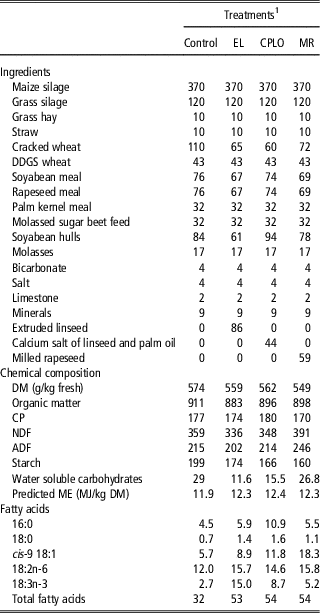
Diets were formulated to be isonitrogenous and contain similar levels of NDF (Table 1), with supplemental oil primarily replacing starch from ground wheat and increasing diet ME concentration relative to the control diet. Cows were offered diets at 0900 h (2/3) and 1600 h (1/3). Refused feed was removed and weighed before the morning feeding.
Ingredients and measured chemical composition of experimental diets fed to lactating dairy cows (g/kg dry matter (DM) or as stated)

EL=extruded linseed; CPLO= calcium salts of palm and linseed oil; MR=milled rapeseed; DDGS=distillers’ dried grains with solubles.
1 Where EL, CPLO and MR are diets containing ~500 g oil/day equivalent of extruded linseed, calcium salts of palm and linseed oil and milled rapeseed, respectively.
Experimental sampling
Individual forage components of experimental diets, the concentrate portion and TMR were sampled on days 22 to 27 of each experimental period and added to a composite sample. Forage DM concentrations were determined daily by drying at 100°C for 23 h to ensure that the DM composition of experimental diets was maintained. Refused feed was removed before the morning feeding and weighed daily; fresh weights were recorded and during week 4 of each period a weekly composite of refused feed was dried at 60°C for 48 h to determine individual daily DM intake (DMI). Samples of dietary components, TMR and refusals (if appreciable) were retained at −20°C for chemical analysis.
Cows were milked twice daily, at 0530 and 1600 h. When in respiration chambers cows were milked using a pipeline system into buckets and milk yield determined gravimetrically and recorded. Samples of milk for the determination of fat, protein and lactose concentration were collected during the last 6 days of each experimental period, treated with potassium dichromate preservative (1 mg/ml; Lactabs, Thompson & Capper, Runcorn, UK), and held at 4°C until analyzed. Additional samples of milk were collected from two consecutive milkings during the last 24 h of each experimental period and stored at −20°C until composited using proportions based on milk yield immediately prior to FA analysis.
Chemical analysis
Chemical composition of oven dried (60°C), milled (1 mm screen) samples of forages and concentrates were determined using methods described and referenced by Kliem et al. (Reference Kliem, Morgan, Humphries, Shingfield and Givens2008) for NDF, ADF, organic matter, CP, water soluble carbohydrates, starch and FA concentrations. Feed FA quantification was achieved using methyl heneicosanoate (H3265, Sigma-Aldrich Company Ltd, Dorset, UK) in toluene as an internal standard.
Milk fat, CP and lactose were determined by mid-IR spectroscopy (Foss Electric Ltd, York, UK). Lipid in 1 ml milk was extracted, transesterified and resulting FA methyl esters (FAME) separated using the methods of Kliem et al. (Reference Kliem, Shingfield, Livingstone and Givens2013). Carbon deficiency in the flame ionization detector response for FAME containing 4- to 10-carbon atoms was accounted for using a combined correction factor which also converted FAME to FA (Ulberth et al., Reference Ulberth, Gabernig and Schrammel1999). All milk FA results were expressed as g/100 g total FA.
Statistical analysis
Intake, milk production, milk composition, methane production and milk FA composition data obtained during the 4 days of methane emission measurements were averaged for each cow and period (n=16) and analyzed using the mixed procedure of SAS (Statistical Analysis Systems software package version 8.2; SAS Institute, Cary, NC, USA) and models testing fixed effects of period and treatment and random effect of cow, with period as a repeated effect within cow, and the Kenward Rogers option used for denominator degrees of freedom. Compound symmetry, heterogeneous compound symmetry, first-order autoregressive or a heterogeneous first-order regressive covariance structures were used for repeated measures analysis, based on goodness of fit criteria (Bayesian Information Criteria, BIC) for each variable analyzed. Each treatment mean was compared with the control diet using Dunnett’s comparisons. Least square means±SEM are reported and treatment effects are considered significant at P≤0.05.
Results
Analysis of the supplements confirmed the FA profile of each, with CPLO containing the greatest amount of 16:0 (146 g/kg DM compared with 18 and 21 g/kg DM for EL and MR, respectively) and 18:0 (18 g/kg DM compared with 8.0 and 5.0 g/kg DM for EL and MR, respectively). The MR supplement contained the most (208 g/kg DM and 72 g/kg DM) cis-9 18:1 and 18:2n-6, whereas EL contained the most (145 g/kg DM) 18:3n-3, closely followed by CPLO (138 g/kg DM). Total FA contents of each supplement were 263, 386 and 501 g/kg DM for EL, MR and CPLO, respectively.
Differences were observed in FA profile of the TMR diets (Table 1). The CPLO diet contained approximately double the amount of 16:0 than the other diets (Table 1). The MR diet contained the most cis-9 18:1, whereas the EL diet contained the most 18:3n-3. As intended, including these supplements caused an increase in total FA content of the diet when compared with the control diet (Table 1).
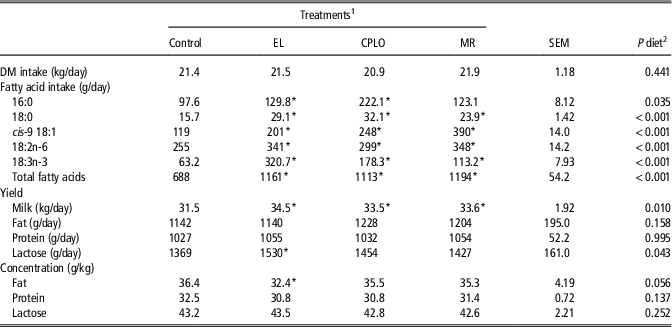
There was no effect (P=0.441) of treatment diets on DMI (Table 2). There were however effects on intakes of individual FA (Table 2). Intake of 16:0 was the highest (P<0.05) for CPLO followed by EL. Cows on all three supplement diets consumed more (P<0.001) 18:0 than those on the control diet (Table 2). Supplementation increased (P<0.001) the intake of cis-9 18:1, 18:2n-6, 18:3n-3 and total FAs when compared with the control (Table 2).
Effect of oilseed supplementation of dairy cow diets on dry matter and fatty acid intake, and milk and constituent yield (least square mean results, units as specified)

EL=extruded linseed; CPLO=calcium salts of palm and linseed oil; MR=milled rapeseed.
1 Where EL, CPLO and MR are diets containing ~500 g oil/day equivalent of extruded linseed, calcium salts of palm and linseed oil and milled rapeseed, respectively.
2 Overall effect of treatment diet.
*Within rows treatments are different (P<0.05) from the control based on Dunnett’s pdiff test.
Including oilseed-based supplements increased (P=0.010) daily milk yield. However there were no treatment effects (P>0.05) on milk component yields (Table 2) apart from lactose yield which increased (P=0.009) following EL supplementation when compared with the control. There were no effects of supplements on milk component concentration except for an 11% decrease in fat concentration when EL was fed, compared with control (Table 2).
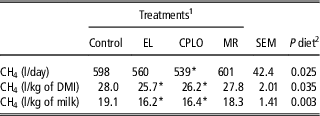
Daily methane production (l/day) was reduced (P=0.012) by 10% by the CPLO diet compared with control (Table 3), and both linseed-based supplements reduced methane production per kg DMI (by on average 7%; P<0.03) and per kg milk yield (by on average 15%; P<0.002) compared with control. In contrast feeding MR had no effect (P=0.886) on methane emissions.
Effect of oilseed supplementation of dairy cows diets on methane production (least square mean results, units as specified)

EL=extruded linseed; CPLO=calcium salts of palm and linseed oil; MR=milled rapeseed; DMI=dry matter intake.
1 Where EL, CPLO and MR are diets containing ~500 g oil/day equivalent of extruded linseed, calcium salts of palm and linseed oil and milled rapeseed, respectively.
2 Overall effect of treatment diet.
*Within rows treatments are different (P<0.05) from the control based on Dunnett’s pdiff test.
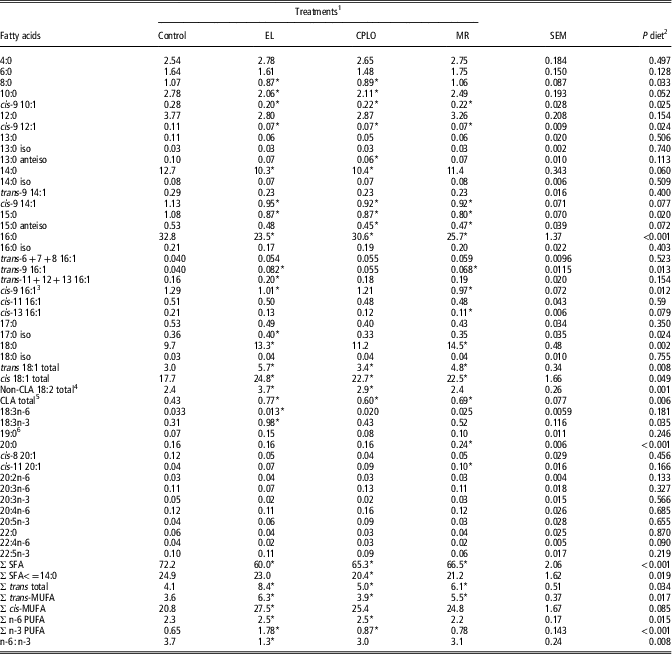
Short- and medium-chain FA concentrations in milk fat were affected by treatment diet (Table 4). Concentrations of 8:0, 10:0, 14:0, 15:0 and 16:0 were all lower (P<0.05) following supplementation when compared with the control diet, which contributed towards an overall lower (P=0.029) concentration of short- and medium-chain (<=14:0) SFA. Conversely 18:0 concentration was increased (P=0.001) following supplementation (more so for rapeseed- than linseed-based diets). Despite this there was still an overall reduction in concentration of total SFA when compared with the control diet (average decrease of 8.3 g/100 g FAs).
Effect of oilseed supplementation of dairy cow diets on milk fatty acid composition (least square mean results as g/100 g fatty acids)

EL=extruded linseed; CPLO=calcium salts of palm and linseed oil; MR=milled rapeseed; CLA=conjugated linoleic acid; SFA=saturated fatty acids; MUFA=monounsaturated fatty acids; PUFA=polyunsaturated fatty acids.
1 Where EL, CPLO and MR are diets containing ~500 g oil/day equivalent of extruded linseed, calcium salts of palm and linseed oil and milled rapeseed, respectively.
2 Overall effect of treatment diet.
3 Co-elutes with 17:0 anteiso.
4 All 18:2 isomers excluding CLA.
5 Including cis-9, trans-11 CLA, trans-7, cis-9 CLA, trans-8, cis-10 CLA, trans-10, cis-12 CLA.
6 Co-elutes with cis-15 18:1.
*Within rows treatments are different (P<0.05) from the control based on Dunnett’s pdiff test.
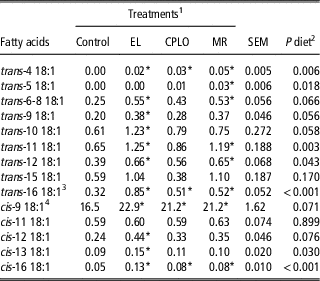
Oilseed supplementation increased (P=0.008) trans-9 16:1 but decreased (P<0.05) cis-9 10:1, cis-9 12:1 and cis-9 16:1 concentrations (Table 4). There were changes in other MUFA concentrations, such that most trans-18:1 isomers and cis-13 18:1 and cis-16 18:1 increased (Table 5) following supplementation with EL, CPLO and MR compared with the control diet. This resulted in an overall increase in both total cis- and trans-MUFA.
Effect of oilseed supplementation of dairy cow diets on milk fat 18:1 isomer composition (least square mean results as g/100 g fatty acids)

EL=extruded linseed; CPLO=calcium salts of palm and linseed oil; MR=milled rapeseed.
1 Where EL, CPLO and MR are diets containing ~500 g oil/day equivalent of extruded linseed, calcium salts of palm and linseed oil and milled rapeseed, respectively.
2 Overall effect of treatment diet.
3 Co-elutes with 18:1 cis-14.
4 Co-elutes with 18:1 trans-13/14.
*Within rows treatments are different (P<0.05) from the control based on Dunnett’s pdiff test.
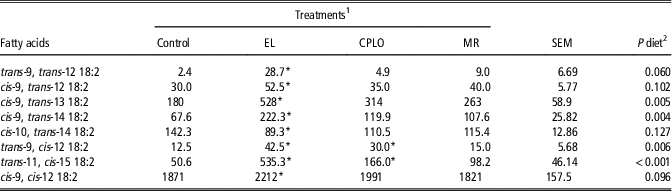
Concentrations of PUFA in milk fat were also affected by supplementation. There was an effect of diet (P=0.035) on 18:3n-3, where EL increased the concentration three-fold (to 0.98 g/100 g FA) compared with the control diet (Table 4). This resulted in an increased (P<0.05) concentration of total n-3 PUFA for EL (and CPLO) treatments (Table 4). A similar increase was observed in the concentration of total n-6 PUFA (Table 4), due to increased (P<0.05) concentrations of trans-9, trans-12 18:2, cis-9, trans-12 18:2 and trans-9, cis-12 18:2 isomers after cows were fed the EL diet compared with control (Table 6). Increases (P<0.05) were also observed in other 18:2 isomers such as trans-11, cis-15 18:2 and cis-9, trans-13 18:2 when EL was fed compared with the control diet (Table 6).
Effect of oilseed supplementation of dairy cow diets on milk fat 18:2 isomer composition (least square mean results as mg/100 g fatty acids)

EL=extruded linseed; CPLO=calcium salts of palm and linseed oil; MR=milled rapeseed.
1 Where EL, CPLO and MR are diets containing ~500 g oil/day equivalent of extruded linseed, calcium salts of palm and linseed oil and milled rapeseed, respectively.
2 Overall effect of treatment diet.
*Within rows treatments are different (P<0.05) from the control based on Dunnett’s pdiff test.
Discussion
Dietary strategies to mitigate methane emissions by dairy cows need to be commercially practical, and not have any negative impact upon milk production and composition. Feeding linseed- and rapeseed-based supplements has been shown to be an effective strategy for decreasing methane emissions from ruminants (Martin et al., Reference Martin, Morgavi and Doreau2010) as well as decreasing milk fat SFA/increasing unsaturated fatty acid concentrations (Glasser et al., Reference Glasser, Ferlay and Chilliard2008). However, the effectiveness depends upon the oil concentration of the supplement, the supplement form and the amount of supplement fed, and must be balanced with any negative effects on cow production and health.
In the current study, supplementing cow diets with 22 g oil/kg DM in the form of EL, CPLO and MR had no effect on DMI and increased milk yield when compared with a control diet containing no supplemental oil. There are a plethora of older studies reporting positive effects of feeding supplemental fats on milk yield (Palmquist and Jenkins, Reference Palmquist and Jenkins2017), but the milk yield response depends on DMI, which is in part dependent on the degree of saturation of the lipid fed (Palmquist and Jenkins, Reference Palmquist and Jenkins2017). As reported by Firkins and Eastridge (Reference Firkins and Eastridge1994), negative effects of fat supplements on DMI are typically greater as the iodine value (unsaturation) of the lipid fed increases. Inconsistent effects of supplemental plant oils on milk yield reported in the literature may also be due to the amounts fed. At lower supplementation levels (≤500 g oil/day), unsaturated plant oils have been shown to increase milk yield (AlZahal et al., Reference AlZahal, Odongo, Mutsvangwa, Or-Rashid, Duffield, Bagg, Dick, Vessie and McBride2008) or have no effect (Collomb et al., Reference Collomb, Sollberger, Bütikofer, Sieber, Stoll and Schaeren2004; Kliem et al., Reference Kliem, Humphries, Reynolds, Morgan and Givens2016) when compared with control diets containing no supplemental oil. At higher intake levels (>500 g oil/day) both DMI and milk yield can be decreased (Chilliard et al., Reference Chilliard, Martin, Rouel and Doreau2009), but not always (Kliem et al., Reference Kliem, Shingfield, Humphries and Givens2011). Feeding higher levels of oil supplements (≥50 g oil/kg DM) can have a negative impact on ruminal and total tract organic matter and NDF digestion (Firkins and Eastridge, Reference Firkins and Eastridge1994). In addition, stage of lactation/production level can also affect the milk yield response to lipid supplementation, with cows in early lactation or of higher genetic merit being more likely to show positive milk yield responses to supplementation (Grainger and Beauchemin, Reference Grainger and Beauchemin2011). In the present study the supplemented diets were formulated to have an increased ME concentration, so as there was no effect of treatments on DMI the increased milk yield following oilseed supplementation can be attributed to the increased provision of energy provided by the supplements.
The effect of oilseed supplementation on milk composition is also dependent on type, form and amount of oilseed fed. In general, feeding plant oils in their partially disrupted seed form has less impact on milk fat and protein concentration than feeding plant oils per se (Beauchemin et al., Reference Beauchemin, McGinn, Benchaar and Holtshausen2009; Givens et al., Reference Givens, Kliem, Humphries, Shingfield and Morgan2009; Kliem et al., Reference Kliem, Shingfield, Humphries and Givens2011), possibly due to a degree of rumen protection inferred by seed components. In a recent study at our location (Livingstone et al., Reference Livingstone, Humphries, Kirton, Kliem, Givens and Reynolds2015), feeding EL at a lower level than in the present study had no effect on milk fat concentration in diets containing greater than 300 g NDF/kg DM. However, in the present study the EL supplement caused a decrease in milk fat concentration, similar to that observed by Chilliard et al. (Reference Chilliard, Martin, Rouel and Doreau2009), after feeding a similar amount of EL. However a later study reported no effect of EL supplementation (560 g oil/day) on milk fat concentration when fed in a diet with low NDF content (174 g/kg DM; Oeffner et al., Reference Oeffner, Qu, Just, Quezada, Ramsing, Keller, Cherian, Goddick and Bobe2013). This suggests that in addition to the amount and form of the plant oil fed, basal diet composition (e.g. NDF concentration) can also influence the response of milk fat concentration to supplemental plant oils.
Only the CPLO supplement decreased methane production (l/day; Table 3). Both linseed-containing supplements also decreased methane yield and intensity, whereas there was no effect of MR on methane emissions. A previous study reported a decrease in methane yield (g/kg DMI) after feeding 750 g oil/cow per day as crushed linseed and canola when compared with a control diet, but no effect was observed with crushed sunflower seed (Beauchemin et al., Reference Beauchemin, McGinn, Benchaar and Holtshausen2009). The differences in effects of oilseed supplements on methane production observed in the present study is unlikely to be due to the degree of unsaturation of supplemental oils; intake of PUFA (18:2n-6+18:3n-3) was highest for the EL group, but those of CPLO and MR were comparable. In addition, complete biohydrogenation of 1 mol 18:3n-3 will only spare 0.75 mol CH4 (Martin et al., Reference Martin, Morgavi and Doreau2010). It has been reported that 18:3n-3 has a greater toxicity to cellulolytic bacteria than 18:2n-6 (Maia et al., Reference Maia, Chaudhary, Figueres and Wallace2007), which can result in a shift in rumen fermentation towards propionate, and thus an increase in hydrogen utilization. Cows consuming the EL diet had a higher 18:3n-3 intake than cows consuming the other supplements, and the milk fat content was lower, consistent with a shift from acetate to propionate in the rumen as observed by Gonthier et al. (Reference Gonthier, Mustafa, Berthiaume and Petit2004). The difference in response between oilseed supplement types could also be due to differences in the carbohydrate contents of the different diets, with the MR diet containing a greater amount of NDF and ADF and less starch than that of the other diets, which can also effect methane yield (Hammond et al., Reference Hammond, Humphries, Crompton, Kirton and Reynolds2015).
A meta-analysis of methane production following different oilseed-supplemented diets suggested that each 1% addition in supplemental fat intake to the diet DM results in a mean decrease in methane yield (l/kg DMI) of 3.8% when compared with a control diet (Martin et al., Reference Martin, Morgavi and Doreau2010). Both the EL and CPLO methane responses in the present study (mean decreases of 3.4% and 2.9% per additional 1% supplemental fat, respectively) approach this value, but not the MR response as discussed above (mean decrease of 0.3% per additional 1% supplemental fat).
The most effective strategy for decreasing milk fat SFA concentration is by supplementing cow diets with oilseed preparations (Glasser et al., Reference Glasser, Ferlay and Chilliard2008; Kliem and Shingfield, Reference Kliem and Shingfield2016). Increases in the supply of ≥16-carbon FA from the diet inhibit acetyl CoA carboxylase transcription and activity in the mammary gland, decreasing de novo synthesis (Barber et al., Reference Barber, Clegg, Travers and Vernon1997). In the present study, supplementing cow diets with ~500 g additional oil per day decreased milk SFA compared with the control diet, with the linseed-containing diets being more effective than MR. This was partially due to enhanced milk fat 18:0 concentration with the MR diet, which may have been partially derived from rumen biohydrogenation of dietary cis-9 18:1. This process for cis-9 18:1 is more complete than that for 18:2n-6 and 18:3n-3 (Doreau and Chilliard, Reference Doreau and Chilliard1997). Previous research involving the same EL supplements fed at lower oil inclusion levels (280 to 350 g/day) reported no significant effects on milk SFA concentration (Livingstone et al., Reference Livingstone, Humphries, Kirton, Kliem, Givens and Reynolds2015; Kliem et al., Reference Kliem, Humphries, Reynolds, Morgan and Givens2016), highlighting the variability of the response and suggesting that in order to achieve a consistent effect on milk SFA at least 500 g/day or more of additional oil should be fed.
Milk SFA were mainly replaced with cis-MUFA following supplementation, the most predominant being cis-9 18:1. Intake of cis-9 18:1 was highest for the MR diet, and the appearance of cis-9 18:1 in milk is associated with both increased intake and also increased rumen outflow of 18:0 following complete biohydrogenation of dietary MUFA and PUFA that is subsequently desaturated by mammary Δ9 desaturase. A comprehensive meta-analysis of 106 experiments using lactating cows concluded that plant oils and oilseeds all increase milk fat cis-9 18:1 concentrations (Glasser et al., Reference Glasser, Ferlay and Chilliard2008). The EL supplement also increased cis-12 18:1 and cis-16 18:1 concentrations, which tend to be higher following linseed supplementation (Lerch et al., Reference Lerch, Ferlay, Shingfield, Martin, Pomiès and Chilliard2012) and are biohydrogenation intermediates of 18:3n-3 (Shingfield et al., Reference Shingfield, Bernard, Leroux and Chilliard2010). In the present study increases in the concentrations of trans-FA in milk fat were observed when oilseed supplements were fed, particularly for EL. These increases reflect the higher intake of PUFA for the EL diet. In particular, trans-10 18:1 and trans-11 18:1 and most of the trans-18:2 isomers (including trans-11, cis-15 18:2 and cis-9, trans-13 18:2) were higher in concentration in milk from cows supplemented with EL. Trans-10 18:1 is thought to arise as an intermediate of rumen 18:2n-6 biohydrogenation in response to certain rumen conditions, such as when rumen pH is decreased (Bauman et al., Reference Bauman, Harvatine and Lock2011). Intake of 18:2n-6 was similar for both EL and MR diets, and yet only EL increased milk trans-10 18:1. It may be that the EL diet resulted in a lower rumen pH resulting in this alternative biohydrogenation pathway, but unfortunately this was not measured. Trans-11 18:1 and trans-11, cis-15 18:2 are intermediates of rumen 18:3n-3 metabolism (Shingfield et al., Reference Shingfield, Bernard, Leroux and Chilliard2010), and cis-9, trans-13 18:2 is thought to arise in milk following increased availability of trans-13 18:1 for mammary Δ9 desaturation (Rego et al., Reference Rego, Alves, Antunes, Rosa, Alfaia, Prates, Cabrita, Fonseca and Bessa2009). There was a distinct lack of difference between the control and CPLO diets in terms of concentration of biohydrogenation intermediates, despite both CPLO and EL being sources of 18:3n-3. In fact, EL provided over twice the amount of 18:3n-3 than CPLO in terms of intake (274 v. 128 g/day). In addition, the calcium salt preparation would have afforded some degree of rumen inertness for CPLO PUFA.
The main objective of the present study was to demonstrate whether oilseed supplements fed at a commercially practical level have an impact on both methane emissions and milk FA profile. A previous study involving the same supplements fed at a slightly lower level reported modest but significant improvements in milk FA profile, in terms of replacing milk SFA with unsaturated FA (Kliem et al., Reference Kliem, Humphries, Reynolds, Morgan and Givens2016). Results from the present study and our previous study with EL (Livingstone et al., Reference Livingstone, Humphries, Kirton, Kliem, Givens and Reynolds2015) suggest that this milk FA response may be inconsistent at these low (but more practical in commercial situations) inclusion levels. Methane emissions were lower with the linseed-based supplements but there were no noticeable effects with the MR diet. In order to achieve both objectives consistently a higher dietary inclusion level of MR will be needed.
Acknowledgements
This research was supported by the Biotechnology and Biological Sciences Research Council (BBSRC) – Diet and Health Research Industry Club (DRINC) ‘Reducing Saturated Fatty Acids in the Food Chain’ (Project: BB/1006087/1). The authors would like to thank all commercial partners involved; BOCM Pauls Ltd, National Milk Laboratories, Volac International Ltd, and gratefully acknowledge staff at the Centre for Dairy Research for their technical contributions and care of the experimental animals.
Declaration of interest
The authors declare no conflicts of interest.
Ethics statement
All regulated experimental procedures used were licensed and inspected by the UK Home Office under the Animals (Scientific Procedures) Act, 1996.
Software and data repository resources
Data are stored on a secure server at the University of Reading.