INTRODUCTION
Karphi is one of the best-known settlements of the east Mediterranean Bronze to Iron Age transition (1200–1000 bc: Late Minoan IIIC–Early Protogeometric; Pendlebury et al. Reference Pendlebury, Money-Coutts and Pendlebury1937–8; Nowicki Reference Nowicki1987; Reference Nowicki2000, 157–64; Wallace Reference Wallace2005a). This is one of the clearest, most geographically extensive horizons of state collapse in Mediterranean prehistory, yet its causes and consequences remain poorly understood (Dickinson Reference Dickinson2006; Drews Reference Drews1993; Ward and Joukowsky Reference Ward and Joukowsky1992; Yasur-Landau Reference Yasur-Landau2010, 58–95). In Crete, survey and excavation projects have started to produce the kind of high-quality evidence needed to investigate them in depth (Day, Klein and Turner Reference Day, Klein and Turner2009; Haggis Reference Haggis1993; Reference Haggis2005; Hayden Reference Hayden2003; Reference Hayden2004; Reference Hayden2005; Nowicki Reference Nowicki2000; see Wallace Reference Wallace2010a, 54–60). A picture of very widespread, complex and coherent restructuring of settlement in Crete at just this time suggests an unusually proactive response to crisis. The latter may help explain why a marked rise in complexity occurred in Crete from as early as the tenth century bc (rather than at the period traditionally linked to polis emergence in Greece, c.700 bc) and ultimately why and how the development of Classical states took a special path in the island (Wallace Reference Wallace2010a).
Despite recent substantial advances in understanding of the earliest Early Iron Age period c.1200–1000 bc, particularly in pottery dating based on stratified settlement records, only a very small sample of settlements (a much smaller proportion than for most Bronze Age periods) remains excavated in the island. Excavated sites are mostly small villages, up to about 1 ha in size; some have later Iron Age occupation which obscures material relating to their foundation and early development. Thus, insight into the social, political and economic organisation of the island in the immediate post-collapse period is still highly restricted. It is likely that the group of the largest new sites, particularly where located on major communication routes and/or important boundaries between different environmental/subsistence zones, had a greater degree of social and economic complexity than the smaller ones. Excavating them at this stage offers the best opportunity to explore both the depth of the crisis forcing relocation, and the complex, rapid and successful nature of the adaptations made by relocating populations.
Karphi, which belongs to this group, provides an ideal case study to further our understanding of the sophisticated nature of collapse in Crete. Unlike a number of its coevals, it did not go on to develop into a large regional polity during the Protogeometric–Archaic period, meaning the early remains are not obscured under later deposits. The site's good preservation and high informative potential were established by limited excavation in the 1930s. Surface architectural remains and dense sherd scatters are plentiful across the currently grazed surface. Its defensible location, while generally characteristic of the new settlements of Late Minoan IIIC (Nowicki Reference Nowicki2000; Reference Nowicki2002) has special features: the site is situated on and around a dramatic, sheer-sided mountain peak 1100 m above sea level, and commands one of Crete's major passes, leading from the north coast into the east-central uplands and fertile Lasithi plain. This setting emphasises the scale of both the challenges and the opportunities faced by relocating communities across Crete, who seem to have treated defensible location as a priority.
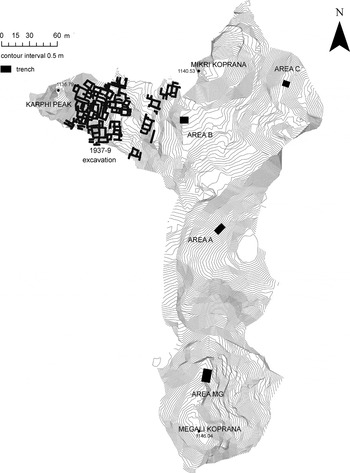
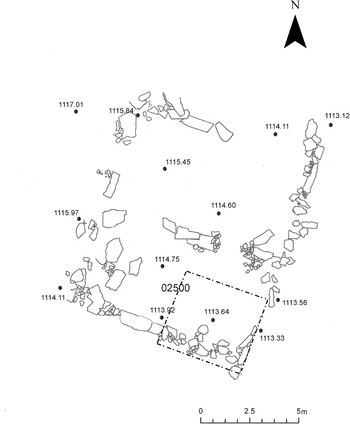
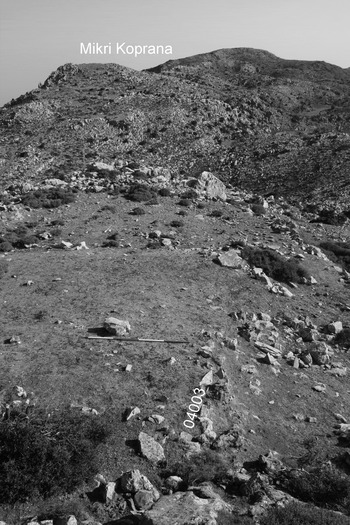
Excavations in the Karphi-Mikri-Koprana saddle in 1937–9, covering about a fifth of the site's total area (Fig. 1), revealed a densely built zone with paved streets and squares, a temple, a single large, centrally-positioned ‘oven’, and agglomerative building complexes of varying sizes, but no extreme kinds of architectural differentiation (Day Reference Day2011, 1–7; Pendlebury et al. Reference Pendlebury, Money-Coutts and Pendlebury1937–8; Wallace Reference Wallace2005a). Extensive cemeteries were discovered to the town's east and south. Finds of figurines and pebbles on and just below the peak of Karphi showed it to have been a peak sanctuary in the Middle Minoan II period (c.1900–1800 bc; Pendlebury et al. Reference Pendlebury, Money-Coutts and Pendlebury1937–8, 98; Nowicki Reference Nowicki1994, 35–6). The excavation as a whole mainly focused on exposing extensive architecture and retrieving interesting finds. While some stratigraphy was observed, the preliminary report did not describe it in any detailed way. Pottery dating for the Bronze to Iron Age transition was of limited resolution at this time (Seiradaki Reference Seiradaki1960; Wallace Reference Wallace2005a, 219–20; see Day Reference Day2011 for a masterly restudy of the assemblage in the light of material recently excavated from other sites of the period). Thus the diachronic growth of the settlement, and the nature of any social or functional zoning within it, remained poorly understood after excavation. Scholarship has often cited Karphi as an archetype of the new site pattern c.1200 bc, especially in discussion of social change (e.g. Desborough Reference Desborough1972, 58–62; Mazarakis Ainian Reference Mazarakis Ainian1997, 219–20; Nowicki Reference Nowicki and Chaniotis1999b; Whitley Reference Whitley2001, 78). Yet, given both the limited quality of the original excavations at the site and its membership of a minority, little-explored class of large settlements, we need to investigate and contextualise it afresh, expecting many of its features actually to differ considerably from those at contemporary small rural sites.
The wider cultural landscape around Karphi, parts of which were also investigated by Pendlebury in the 1930s (Pendlebury and Money-Coutts Reference Pendlebury and Money-Coutts1935–6; Pendlebury et al. Reference Pendlebury, Money-Coutts and Pendlebury1937–8), is now well-studied, incorporating a number of sites of various types and sizes overlapping in date with Karphi (Day Reference Day2011, 221–43; Nowicki Reference Nowicki1995; Reference Nowicki2000, 147–70; Watrous Reference Watrous1982). A nearby large site founded in exactly the same period is Kera (Ayios Giorgios) Papoura. This saw very long-lived occupation, surviving into the Archaic period as the only large polity in the Lasithi region (Nowicki Reference Nowicki2000, 167–70; Wallace Reference Wallace2010b, 23–31; Watrous Reference Watrous1980). The context and circumstances of Karphi's abandonment by the early tenth century (the start of the Early Protogeometric period), while Papoura continued and flourished, seem important in understanding how and why polis states emerged in Crete by around 700 bc. Recent analyses by Wallace of a widespread pattern of similar settlement nucleation occurring in tenth-century Crete have represented it as peaceful and deliberate, linked to recognition of changing wider economic and political circumstances and shifting concepts of community identity (Wallace Reference Wallace2010a, 231–353), a view which still requires testing.
Pilot excavation at Karphi in 2008 took place as part of a wider-ranging field project in this local region, commencing in 2002 (Wallace Reference Wallace2003b; Reference Wallace2005a; Reference Wallace2005b) and designed to answer research questions relating to (a) changing human relationships with, and perceptions of, landscape through the crisis period, and (b) the potentially complex nature of social construction at large new communities in the post-crisis period. Pertinent to both these wider questions and partly elucidated by the pilot investigation is the nature of Karphi's economy – both subsistence and commodity spheres. Some of the literature has presented the settlement shift c.1200 bc as caused by (or necessitating) economic revolution or regression at various levels, including a move to pastoralism (e.g. Coldstream Reference Coldstream and Huxley2000, 162; Haggis Reference Haggis1993; Watrous Reference Watrous1977, 2–3). This needs to be tested, especially at large and/or extreme new sites where subsistence would require major investment. Excavations at smaller sites have already helped undermine models of a newly pastorally-centred economy for post-collapse Crete (Klippel and Snyder Reference Klippel and Snyder1991; Snyder and Klippel Reference Snyder and Klippel1994; Reference Snyder, Klippel, Vaughan and Coulson1999). Insight into commodity production and trade in Crete at this period is still generally lacking (Evely Reference Evely2000, 562; Wallace Reference Wallace2010a, 187–94), due in part to the excavation focus on small settlements or cemeteries. The few large sites continuing directly between the Late Bronze Age and Early Iron Age periods, like Knossos, cannot provide adequate insight into new sets of economic relations. Investigating some larger newly established sites from this angle is likely to prove more rewarding (Wallace Reference Wallace2010b, 16–18).
The excavation was carried out by the University of Reading under the supervision of the 24th Ephorate of Prehistoric and Classical Antiquities between 8 August and 10 September 2008. The nature of local landholding types led to many uncertainties about which areas it would be possible to purchase (as required by law) even immediately prior to the start of excavation. A planned excavation adjacent to Pendlebury's in the south part of the saddle area had to be given up at the last moment because of difficulties over the purchase of the plot. The plots finally negotiated cover four widely dispersed areas of the site in which surface architectural remains indicate good preservation. They total 1.4 ha, providing plenty of scope for future extensive excavation. The areas (the nomenclature and boundaries of which are based on Nowicki's [1987] observations) include the entire summit and upper slopes (7000 sq m) of the large hilltop named Megali Koprana (Area MG); a plot of 3500 sq m in the area immediately east of the excavated zone, on the long ridge linking Mikri and Megali Koprana (Area B); a plot of 3000 sq m east of and below the central part of this ridge (Area A); and a plot of 3500 sq m at the northeastern edge of the built area, on the southeast slopes of Mikri Koprana (Area C) (Fig. 1). Excavation of trenches totalling c.124 sq m in these zones (31 sq m in Area A, 25 sq m in Area B, 18 sq m in Area C, and 50 sq m in Area MG) was carried out by a team of 11 people, with the following primary aims: (1) to assess the state of preservation, including the quality of context definition (not clear from the earlier excavation reports), for the site as a whole; (2) to gain a first idea of the nature and direction of the Early Iron Age town's growth and density over time, and better judge the validity of the current final size estimate of c.3 ha based on surface artefact scatter; (3) to identify any evidence of functional or other zoning which might inform understanding of the settlement's organisation and growth; (4) to investigate uses of the site in other ancient periods suggested by surface and excavated remains; (5) to undertake initial scientific sampling programmes allowing the potential of the record to be fully evaluated to modern standards.
Site plan, showing old and new excavation areas.

Excavation of buildings in Areas A and B was undertaken in the first two weeks of the project, and in Areas C and MG in the second two-and-a-half weeks. No building was excavated in its entirety; instead, representative parts of each were investigated. In all areas, archaeological deposits were found at a maximum of 0.7 m below ground surface, and bedrock no deeper than 1.3 m below ground surface. Below, the reasons for excavating, an account of the main contexts and finds and a catalogue and commentary on pottery are presented by area. A catalogue with comments of non-pottery finds from across the site follows, then a general pottery discussion. The area catalogues treat ‘early Late Minoan IIIC’ as the period of transition from Late Minoan IIIB styles (see Hallager Reference Hallager2000; Nowicki Reference Nowicki and Mazarakis Ainian2011); ‘late Late Minoan IIIC’ as equivalent to ‘Subminoan’ as defined at sites like Knossos, and ‘mid-Late Minoan IIIC’ as a symbolic marker point (not a phase) between these two, used to provide further nuance in the dating through the use of two further terms: ‘early-mid Late Minoan IIIC’; and ‘mid to late Late Minoan IIIC’. A concluding general discussion links the findings to broader research concerns and gives an overview of how the excavation has improved knowledge of Karphi.
BUILDING A1 (FIGS. 2–6)
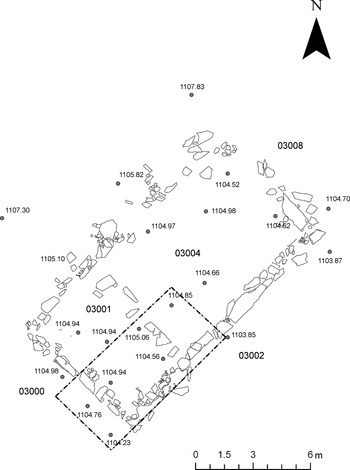
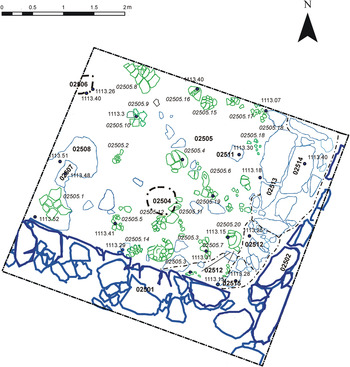
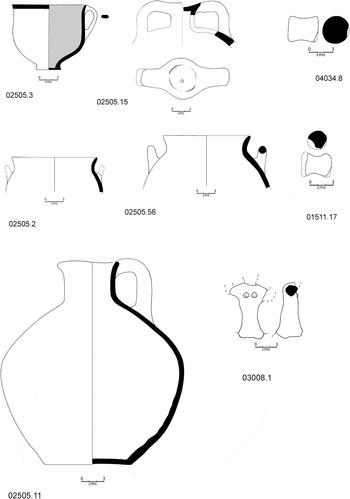
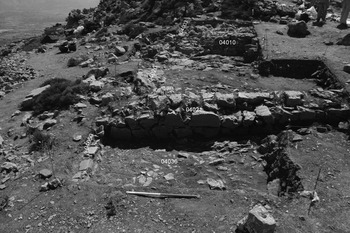
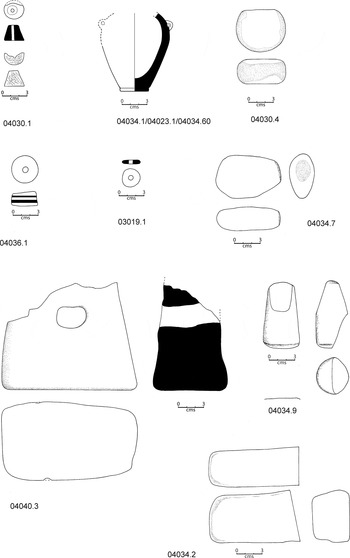
This is almost the sole piece of ancient architecture in a large area (A) within the site's boundaries. Its unclear date, and hints from surface remains at a special status (suggesting that excavation here could enhance our knowledge of social practice in large Early Iron Age settlements), as well as the good surface preservation and location, all informed the decision to investigate the building. First recorded in 1983 (Nowicki Reference Nowicki1987, 242–3; 1999b, 147), it is an axially-planned rectangular structure (15.0 × 6.5 m) containing one small room (3.5 × 6.5 m) at the south end and a larger one (11.5 × 6.5 m) to the north (Fig. 2). Isolation, large size, and massive construction (several surface blocks measure more than 1.5 × 0.6 m) all suggested a ‘special’ use in the context of the period (see Day and Snyder Reference Day and Snyder2004; Wallace Reference Wallace2005a, 261–72; Wallace Reference Wallace2010a, 104–36). Structures potentially associated with public dining in Late Minoan IIIC settlements share some of these architectural features, but cannot yet be fully defined or characterised as a group (Wallace Reference Wallace2010b). In contrast, cult buildings with some common features have been clearly identified at excavated Late Minoan IIIC sites. Like the probable dining buildings, they are of essentially axial form (though exact plan varies), and usually set slightly apart from the rest of the built zone, with a large space suitable for public gatherings adjacent to them. Here, a large flat-bottomed hollow just downslope to the southeast would fulfil this function admirably (Day Reference Day2009b; Eliopoulos Reference Eliopoulos2001; Reference Eliopoulos2004; Gesell, Day and Coulson Reference Gesell, Day and Coulson1988, 289–90; Gesell, Glowacki and Klein forthcoming; Klein and Glowacki Reference Klein and Glowacki2009; Pendlebury et al. Reference Pendlebury, Money-Coutts and Pendlebury1937–8, 75–6; Prent Reference Prent2005, 126–54, 188–200; Rutkowski Reference Rutkowski1986; Tsipopoulou Reference Tsipopoulou2001; Reference Tsipopoulou2009). Cult buildings also have concentrations of specialised equipment setting them apart from domestic cult areas, including, particularly, large wheelmade female figurines, plaques and tubular stands (Day et al. Reference Day, Joyner, Kilikoglou and Gesell2006; Day Reference Day2009b; Gesell Reference Gesell1985, 47–58; Tsipopoulou Reference Tsipopoulou2009). This equipment was sometimes clustered in the smallest of the building's rooms, and often placed on or around a stone-built bench. At least one room within the cult building usually had a central hearth and contained cooking, serving and storage vessels of the types found in ordinary houses. In view of its surface features (including a female figurine found prior to excavation: see Fig. 23:03008.1) it was considered that A1 could have had a specialised cult or feasting use, or even represent a limited reuse of the site for ceremonial purposes in the later Early Iron Age, a practice seen on a number of other Aegean sites in the later Early Iron Age (Wallace Reference Wallace2003a).
Building A1: surface plan of entire building.

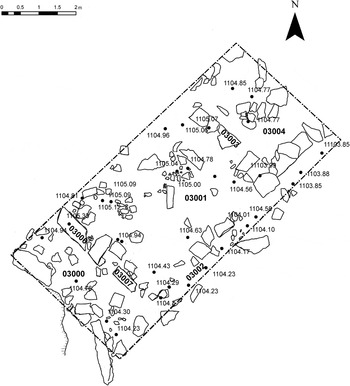
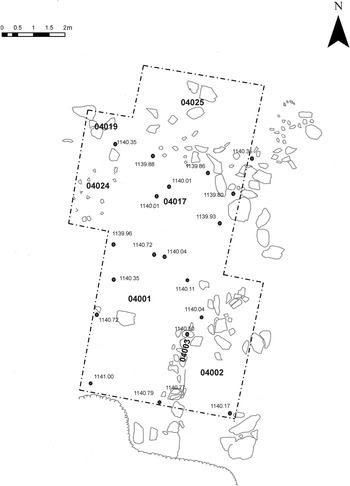
The building's western half has many heavy fallen blocks on the surface, which would have made excavation there unsuitably time-consuming. A trench 8.25 × 3.8 m (half-sectioning the small room and the south part of the large one in a north–south direction) was placed in the southeast part of the building (Fig. 2; Fig. 3). The east and south walls, about 0.8 m thick, were found preserved up to five courses high and mostly founded directly on bedrock, though where this was very uneven, as at the north end of the east wall, a layer of large stones acted as a footing. Excavation showed the building to be placed on a natural shelf in the bedrock, which slopes sharply down to the southeast; some cutting-back of the rock may have occurred to enhance this protective effect.
Building A1: plan of surface remains in trench area prior to excavation.

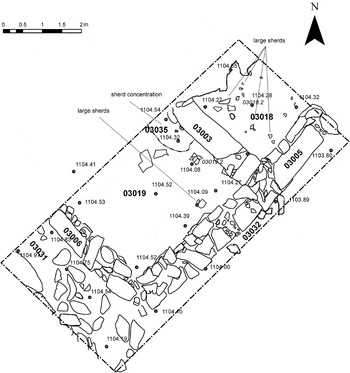
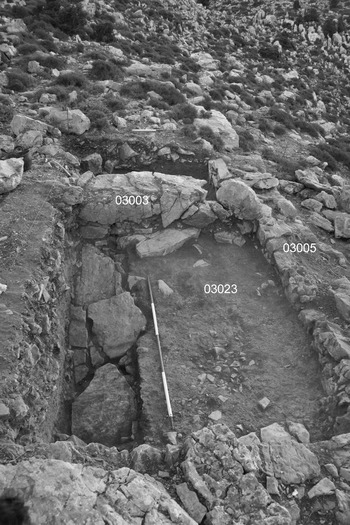
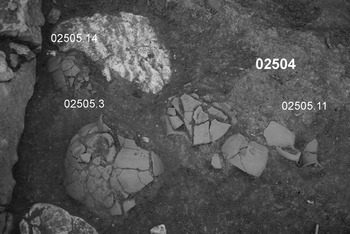
Topsoil clearance revealed a layer of medium- to large-sized stone collapse in dark greyish-brown sandy silt in both rooms (03011/03012), sloping down with the shelf strongly to the east and covering the top preserved surface of much of the east wall, 03005. Collapse proved to be very similar on both sides of the internal wall 03003, with an absolute lack of pottery or other occupation material: none was found until about 0.5 m below present ground level, showing that the undisturbed upper collapse completely sealed original occupation and lower collapse deposits everywhere. The steep rocky slope on which A1 is located has no terrace or boundary walls and is not known to have been cleared or cultivated in the recent past, explaining this. A lens of light reddish-brown sandy silt, 0.1 m thick, containing occasional small or medium-sized stones (03013), was identified under the collapse south of 03003, extending about two-thirds of the way across the room to the east. Its colour resembled that of the natural soil found under the building's walls and over bedrock: it probably represents a period of exposure and weathering of soil downslope following the building's first phase of collapse. About 0.2 m under it was a layer of medium-sized rubble in a relatively loose dark reddish-brown matrix (03014) lying across the whole width of the room to a maximum depth of about 0.3 m. 03014 contained small sherds in a density of about 1–2%, increasing by three to four times at the bottom of the context. At this point a new context was designated (03017). This had a partly similar consistency to the rubble above it, while being more heavily mixed with soil. It contained fairly frequent pottery, including cooking pot and pithos fragments, as well as occasional charcoal. 03019, under it, was also unevenly deposited, deepest in several bedrock pockets near wall 03003 (Fig. 4). It was rich in compact soil of a light yellowish-brown colour, of a type used for roofing in ancient and traditional Cretan buildings. As well as residual large stones from wall collapse, the layer contained many large sherds: sherds in general were much more frequent here than in the deposits above or below, suggesting the main occupation level had been reached. Nothing was in situ (though some sherd clusters suggest that pots originally stood against 03003) and there was no recognisable floor surface. As we were to find in all excavated buildings, floors at Karphi were bedrock, often covered or packed patchily with local red soil. In the trench's west section, a thin compacted lens (c.0.01 m thickness) of brown soil and charcoal fragments (03023) appeared at the very bottom of 03019 and above the floor packing. This may represent the original walking surface, but was too ephemeral and discontinuous to be picked up during excavation.
Building A1: plan of main occupation deposits.

There was a notable concentration of fine wares in 03019, as well as fragments from a number of pithoi and pithoid jars and at least one large cooking pot. Also found in 03019 (and the equivalent 03017 in the adjoining room) were fragments of several clay objects with profiles not conforming to any known Late Minoan IIIC pot shape, usually in a light-red, often friable fabric. These seem to represent stands of various types, totalling at least eight individual items (S. Chlouveraki, L. Day, M. Mook pers. comm.). Notable among the coarse pottery was the rim of an outsize pithos (03019.6) unique on the site and best paralleled in a building used for public feasting at Kavousi Vronda.
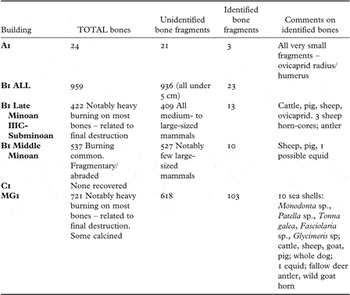
03019 contained moderate charcoal and occasional fragmentary burnt mudbrick or clay, but very little burnt material generally. Though there were a few animal bones, the relative lack of bone is also striking. Sherds from a significant proportion of the vessels found in 03019 appeared in equivalent strata in the northern room, suggesting that extensive clearing/disturbance of the occupation layers occurred shortly after the building's end of use, before any significant collapse of its walls.
A loose, bright-red soil (2.5YR 4/4) with many angular, medium-sized stones lay under 03019 (03023; Fig. 5) and a maximum 0.2 m above bedrock. The limited archaeological material present was confined to its uppermost levels. It looked like a fill/packing of natural soil over the stepped rock of the area, with the upper levels perhaps representing part of the original walking surface (Pendlebury et al. Reference Pendlebury, Money-Coutts and Pendlebury1937–8, 67 refers to this kind of soil packing as characteristic of ‘better houses’ at Karphi). The question again arose of why this especially difficult and uneven slope location was chosen for a single large and well-constructed building. The likely importance of the flat-bottomed hollow nearby is highlighted.
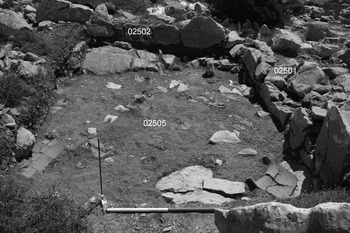
Building A1 from south, showing south part of trench during removal of 03023.

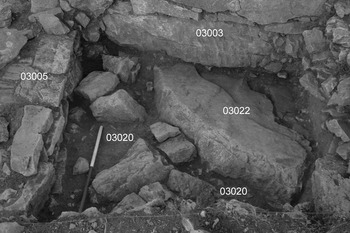
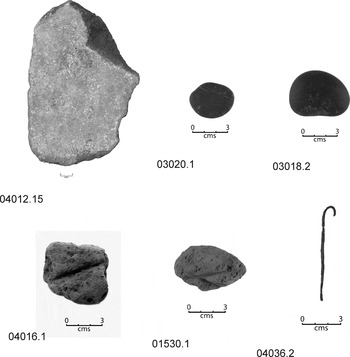
In the larger room, removal of 03011 revealed the collapse layer 03015, equivalent to 03014 (c.0.5 m thick). Below it lay 03016, a layer of sparser rubble in a loose greyish-brown matrix (7.5YR 4/6) containing occasional charcoal and mudbrick fragments and sherds. This was removed to expose a layer of soil heavily mixed with yellowish roofing material, 03018, paralleling 03019 (Fig. 4). It had moderate charcoal inclusions and mudbrick/baked mud fragments, occasional stones of all sizes, and large pithos and cooking pot sherds. It darkened, and contained many more large sherds, towards its base. Under it was a deposit with larger stones (03020) still containing archaeological material but lacking the yellow roofing soil – perhaps representing the very first stage of building collapse (Fig. 6). Two small river/sea pebbles of grey crystalline limestone lay just over bedrock, the latter being named 03022 in this area (03020.1; 03018.2). A layer of dark reddish-brown soil with sherds, small stones, and charcoal fragments (03021) was identified under 03018 and over bedrock in the most southerly part of the trench, against 03003 and in the corner made by this wall and the west edge of the trench. It may represent the remains of the patchy original occupation surface, packed over bedrock. On removal of 03020 in the rest of the room a soft, loose mid yellowish-brown soil (03024/03029), containing sherds, mudbrick fragments and charcoal, appeared. This seems to represent the same kind of deposit, with more admixture of roofing material. The scattered pieces of a small cooking pot (03024.52) were found here. Below 03024/03029 and 03021 the increasingly stony and red soil 03030 (7.5YR 4/6) appeared. It contained few sherds, all near the top, and small amounts of fragmentary charcoal and bone. It looks like a subfloor packing, with large stones incorporated in it to fill deep bedrock crevices.
Building A1 from north, showing south part of trench (larger room): low deposits over bedrock.

The trench included narrow areas outside the building to the east and south. After removal of heavy wall collapse lying on the current ground surface, and of topsoil, collapse deposits of medium- to large-sized stones in a light reddish-brown to mid-brown sandy silt were exposed, with minimal associated archaeological material. It is clear that many of the larger stones from the wall collapse have gradually rolled downslope beyond the terrace created by the building. Bedrock in both areas was reached at only c.0.25 m below present ground surface, whereas inside the building a much greater depth of debris had been retained on the slope by the walls. There seems to have been no build-up of occupation/rubbish deposits outside the building, nor was there any trace of paved paths, courts or other designed open space. This tends to support the thesis that A1 had a special use, with less day-to-day waste material and/or more maintenance of its surroundings than in the case of normal houses such as MG1 (below).
Commentary on A1 pottery (Figs. 7–8).
Particularly in its smaller room, A1 contained remarkable proportions of fine ware in comparison to those of other buildings excavated in 2008. There were also sherds from numerous pithoi (at least 7–8 individual vessels, with a remarkable diversity of fabrics) and some cooking pots. Previous studies of local pottery indicate that much Early Iron Age fine ware is in a reddish-brown fabric, buff-coated (Day Reference Day2011; Nodarou and Iliopoulos Reference Nodarou and Iliopoulos2011; Wallace Reference Wallace2010b, 28–9). In contrast, the almost exclusive use of a yellowish-buff fabric in A1 fine wares might suggest a particular manufacturing tradition, or a heavy use of imported clays/pots. The soft buff fabric with easily flaked-off paint resembles material from Early Iron Age east-central Cretan sites like Kalo Chorio Maza (Wallace Reference Wallace2010b, 31–40) and is most likely, if imported, to have come from the wider local region. There is a lack of pottery as late as the latest material found in other parts of the 2008 excavation, and in the latest floor deposits in the 1930s excavation. The best associations are with low deposits on the saddle identified as early to mid Late Minoan IIIC in date by Day (Reference Day2011, 253–325) and an early to mid Late Minoan IIIC date for the building's foundation and use is indicated. The fragments of clay stands are unique in the 2008 excavation.
In the catalogue below (as in all the others presented here) each find is listed by context number and suffix (if registered during excavation) or by context number only with alphabetic suffix (if taken from the general sherd assemblage). Identifications and frequency estimations of mineral inclusions, made macroscopically, are conservative, being based on the work of Nodarou and Iliopoulos (Reference Nodarou and Iliopoulos2011) and on the advice of Nodarou.
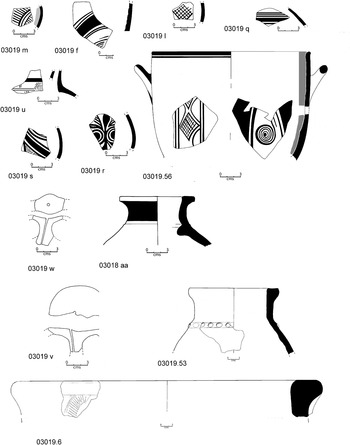
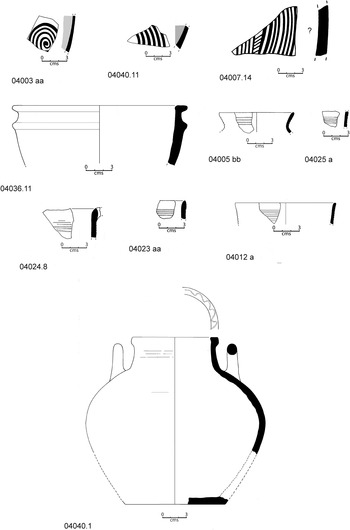
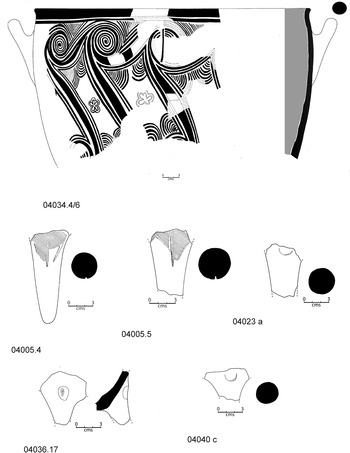
03019.56 Small krater (Fig. 7). Straight-sided; rounded rim and round-section horizontal handles. At least half complete. Weight 750 g. Rim diameter 24 mm; body thickness 5–11 mm; handle 15 mm. Light yellowish buff, 10YR 7/6; soft, with powdery surface. Self-slipped; mid-grey to black paint, 10YR 4/1. Inclusions: 1% calcite, speck. Painted with external narrow rim band; thinner band just below it; possible reserved band at rim. Upper half of handles painted. Body has vertical panels enclosed by double vertical lines. Vertical linked hatched lozenges in panel on one side, vertical row of hooked spirals on other. Interior monochrome paint. Date: early-mid Late Minoan IIIC.
A vertical hatched lozenge chain is found on krater K103.3 from the old excavations (Day Reference Day2011, 168, fig. 5.15, citing a parallel from Kastelli Pediada in early Late Minoan IIIC; Rethemiotakis Reference Rethemiotakis1997, 312, fig. 15 b). The deep bowl K97.1, from another apparently early context, has a horizontal lozenge chain (Day Reference Day2011, 162, fig. 5.13). A pyxis with horizontal hatched lozenge chain (K75.9) was found among other early material (Day Reference Day2011, 182, fig. 6.6). Day also treats spirals as an early Late Minoan IIIC feature (Hallager and Hallager Reference Hallager and Hallager2000, pl. 52; Popham Reference Popham1965, 326, fig. 6.31). The deep bowls K29.1, 2 and 3, with horizontal hooked spiral decoration, are dated early Late Minoan IIIC (Day Reference Day2011, 97, fig. 4.9), as is K36.1, with horizontal hooked spiral decoration and a reserved circle on the base interior (Day Reference Day2011, 103, fig 4.12).
03019 l Deep bowl (Fig. 7). Wall thickness 4 mm. Mid-buff, 10YR 7/4; soft. Self-slipped; mid-grey paint 10YR 4/1. Inclusions: 2% calcite, speck. Body decoration of horizontal hatched lozenge. Interior monochrome paint. Date: early-mid Late Minoan IIIC. See comments on lozenge decoration for 03019.56.
03019 s Small stirrup jar/juglet (Fig. 7). Globular body. Wall thickness 4 mm. Buff, 10YR 5/3; soft; powdery surface. Self-slipped; dark-grey/black paint, 2.5YR 4/1; interior unsmoothed. Inclusions: 1% dark-grey rock, up to 1 mm. Painted with touching arcs of varying thickness, the narrowest areas between them filled by sets of smaller transverse arcs. Date: early-mid Late Minoan IIIC. The decoration parallels that on medium to large fine vessels from the 1930s excavations dated by Day to early Late Minoan IIIC (Day Reference Day2011, figs. 2.16 [octopus stirrup jar], 3.15, 5.5 [kraters]).
03019 r Small jar/amphora/stirrup jar (Fig. 7). Wall thickness 4 mm. Mid-buff, 10YR 7/4; soft; powdery texture. Self-slipped; black paint, Grey 1 4/N. Inclusions: 1% calcite, speck. Painted with octopus head (eyes area). Date: early Late Minoan IIIC. A number of octopus stirrup jars from the previous excavations – e.g. K147.14, K147.15 and K150.3 – are dated to early Late Minoan IIIC by Day (Day Reference Day2011, figs. 2.1, 2.5). An octopus head similar to the present example appears on the small stirrup jar K83.2 (Day Reference Day2011, fig. 5.9). Use of the detailed octopus design is seen through Late Minoan IIIA–B (especially on large fine jars, kraters and amphorae: Hatzaki Reference Hatzaki2005, 131, 181, fig. 4; Hallager and Hallager Reference Hallager and Hallager2003, pl. 62). This fact suggests that fine Late Minoan IIIC pottery bearing detailed octopus designs dates from early in the period (see Hallager and Hallager Reference Hallager and Hallager2000, 72, 107, pls. 41, 42; both vessels are given a Late Minoan IIIB:2–IIIC date).
03019 m Small jug/jar/amphora (Fig. 7). Wall thickness 3 mm. Buff, 10YR 7/4; soft, powdery surface. Self-slipped; black paint, 10YR 4/1. Inclusions: 1% hard grey rock, speck; self-slipped. Possible internal monochrome paint. Painted with three arcs across body, a fringe protruding from the outermost arc on both sides. Date: early-mid Late Minoan IIIC. Fringed decoration is common on early Late Minoan IIIC painted pottery.
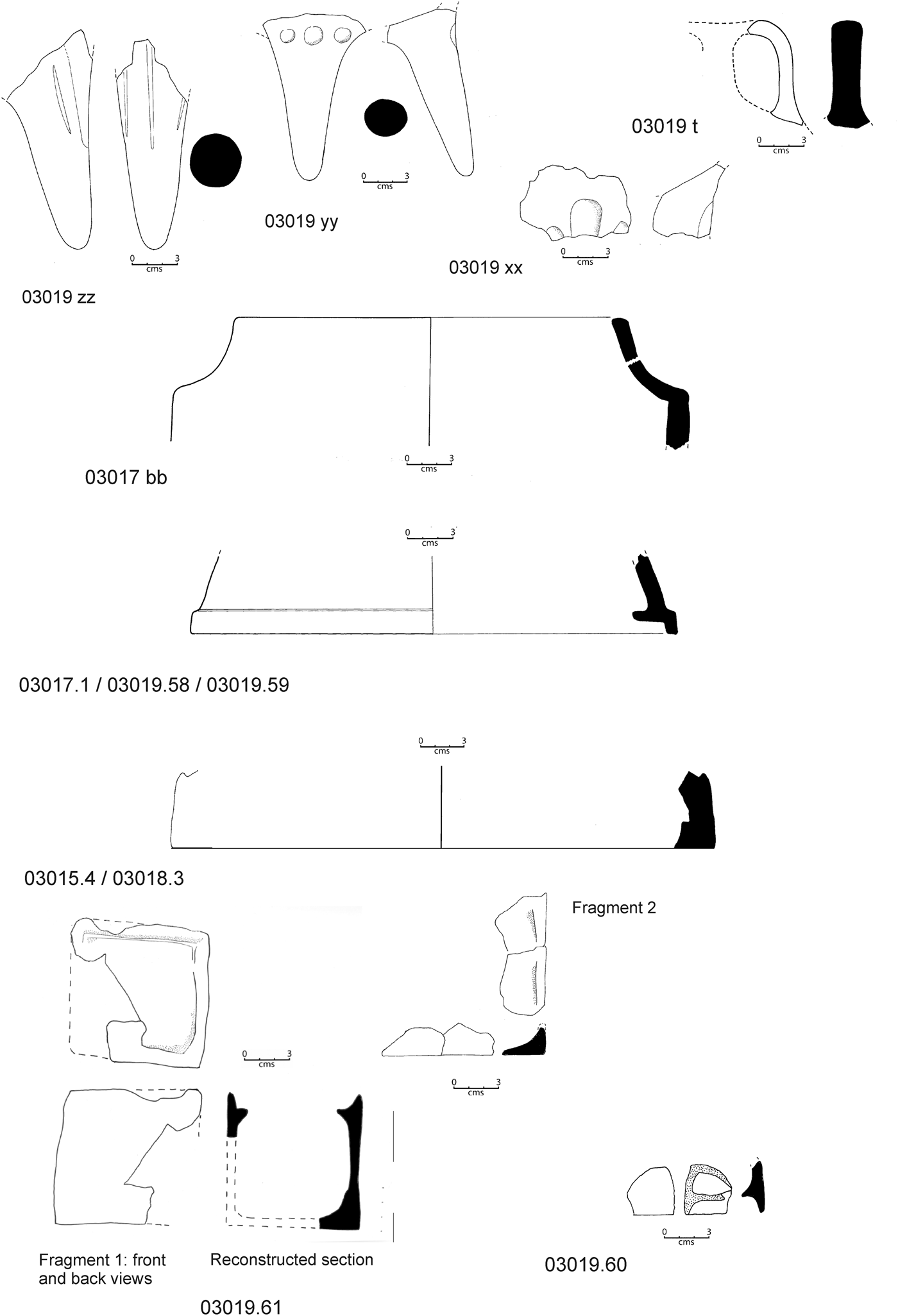
03019 t Juglet or stirrup jar (Fig. 8). Ovoid-section vertical handle, 14 × 7 mm. Fine buff; soft. Black paint, 10YR 3/1. Painted over all or part of handle. No visible inclusions. Date: Late Minoan IIIC.
03019 f Krater (Fig. 7). Wall thickness 6 mm. Greenish buff, 10YR 7/4; hard. Self-slipped with shiny surface; red paint, 2.5YR 5/6. No visible inclusions; occasional large air bubbles. Painted with arcs of varying thickness (see comments for 03019 s). Wheel ridging on interior. Date: Late Minoan IIIC. The high quality of the fabric and surface treatment distinguish it, and suggest an import: the fabric recalls Late Minoan III pottery from Knossos and other north-central Cretan sites. The technique of manufacture, with heavy wheel ridging, also stands out in the assemblage.
03017 bb Large pyxis (Fig. 8). Wide mouth; rounded rim; relatively tall neck. Rim diameter 280 mm; wall thickness 15 mm. Light red, 2.5YR 6/8; medium hard. Inclusions: 8% quartz, 1 mm; 13% phyllite, 1–2 mm. Date: Late Minoan IIIC. Pyxides appear regularly in Cretan assemblages from early IIIC onward, becoming less common towards the transition to Protogeometric. Karphi has an especially high concentration of them. Shapes, sizes and decoration vary greatly, and Day dates the shape variously within Late Minoan IIIC (Day Reference Day2011, 140, 185, 286–8, figs. 5.2, 6.8).
03019 q Jug/jar/amphora (Fig. 7). Globular body. Wall thickness 5 mm. Buff, 10YR 8/4. Self-slipped; no internal smoothing; bluish-black paint, Gley 2 3/5BG. Inclusions: 1% calcite, speck. Painted with multiple horizontal bands of varying thicknesses. Date: Late Minoan IIIC.
03019 u Jug/amphora with narrow attached spout (thelastron?) (Fig. 7). Short neck and globular body. Neck diameter 70 mm; wall thickness 6 mm. Buff, 2.5YR 6/4, with frequent air bubbles; soft, with powdery surface. Self-slipped; black paint, 7.5YR 3/1. No visible inclusions. Painted with narrow band just above join of neck to body; ‘Minoan flower’ with central hatched zone below band; two narrow horizontal bands 10 mm below this, with vertical fringe extruding downwards from bottom band, upwards from top band. Traces of hatching below spout. Date: early Late Minoan IIIC. ‘Minoan flower’ designs appear on stirrup jars from the old excavations, e.g. K149.19, K45.6 and K79–89.25, dated to early Late Minoan IIIC (Day Reference Day2011, 12, 127, 174, figs. 2.3, 4.27, 6.3, cf. 262–3 [citing Popham Reference Popham1965, 327–8, fig. 7]; Popham Reference Popham1970, pl. 47 c). Popham traced the motif's origin to Late Minoan IIIB: in early Late Minoan IIIC the central zone of the ‘flower’ may comprise scale pattern, U-filling or hatching, as here.
03019 v Large fine stirrup jar (Fig. 7). Concave disc with off-centre piercing. Neck diameter 18 mm; disc diameter 86 mm; disc thickness 6 mm. Buff, 5YR 7/6. Self-slipped; black paint, 10YR 3/1. Disc possibly painted. 3% inclusions: 3% calcite; speck. Date: early-mid Late Minoan IIIC. Disc piercing is a new feature in Late Minoan IIIC, perhaps not so common in the very earliest phase of the period: at Palaikastro Kastri, for example, there are unpierced examples (Sackett, Popham and Warren Reference Sackett, Popham and Warren1965, figs. 10, 16). K114.7, found in use in the last phase of the Karphi settlement, has a pierced disc; K 150.3, dated to early Late Minoan IIIC, an unpierced one (Day Reference Day2011, 16, 195, figs. 2.5, 6.13).
03019 w Small stirrup jar (Fig. 7). Slightly concave disc with off-centre piercing. Neck diameter 17 mm; disc diameter 29 mm; disc thickness 6 mm. Pinkish buff, 5YR 7/6; medium hard. Self-slipped; black paint, 5YR 3/1. Inclusions: 2% red sandstone, up to 1 mm. Date: early-mid Late Minoan IIIC.
03018 aa Amphora/jug (Fig. 7). Flat ledge rim; globular body. Wide interior ledge at join to body. Rim diameter 100 mm; wall thickness 11 mm. Buff, 10YR 7/4; soft; powdery texture. Black paint, 10YR 3/1. Inclusions: 3% calcite, speck. Top of rim reserved; thick painted band at rim. Date: Late Minoan IIIC. There are no published parallels for this vessel form.
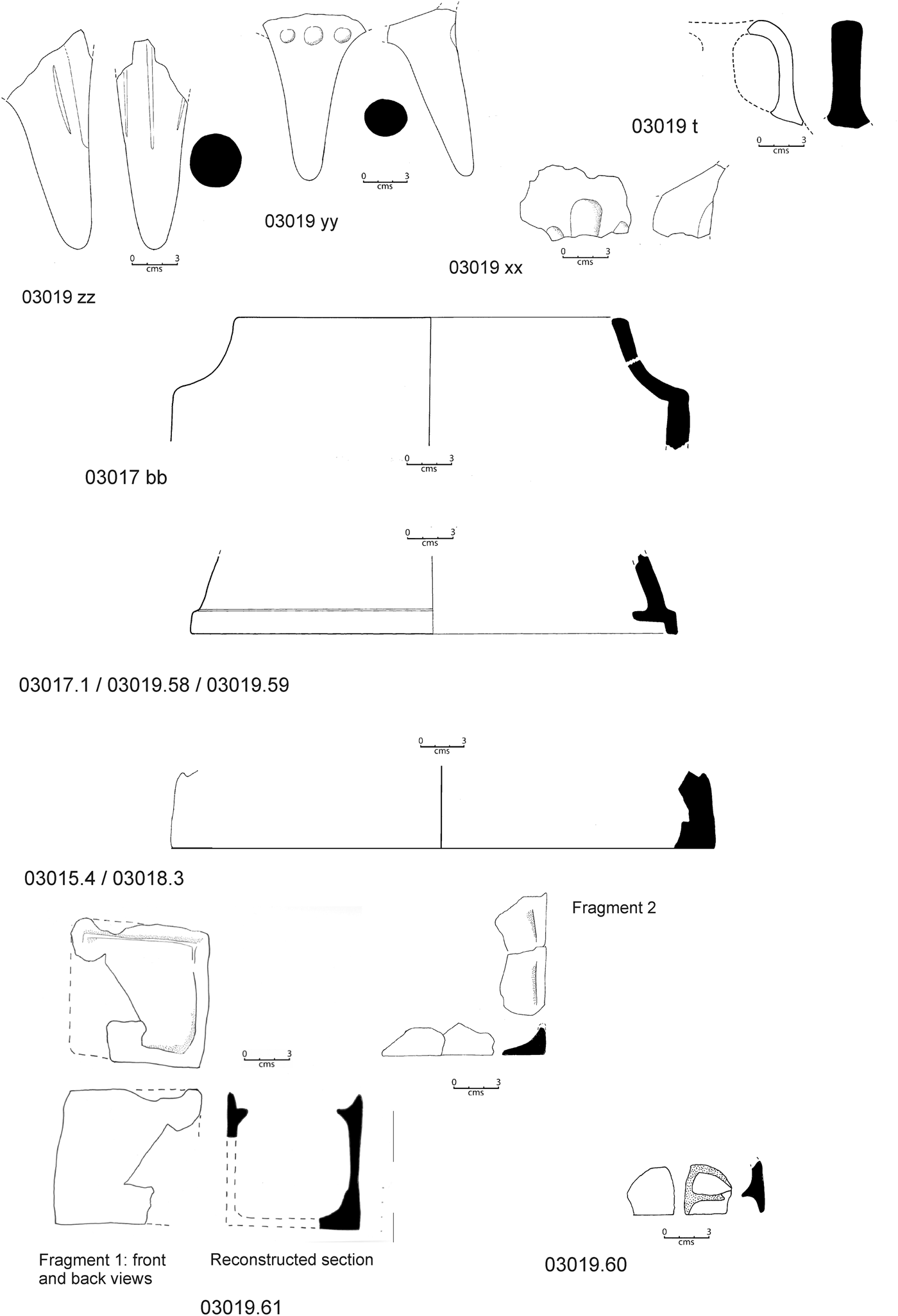
03019 xx Tripod cooking pot (Fig. 8). Leg with flattened circular section, 40 × 60 mm at top. Mid reddish brown, 2.5YR 4/6; medium hard. Inclusions: 10% quartz, 1–3 mm; 17% phyllite, 1–2 mm; 10% hard grey rock, 1–2 mm; 7% red sandstone, 1–7 mm. Three ovoid (finger) impressions at top, the central one larger. Date: Late Minoan IIIC. Sets of impressions or slashes on Late Minoan IIIC pots suggest a slightly later date than single impressions/incisions, which were an innovation at the start of the IIIC period.
03019 yy Tripod cooking pot (Fig. 8). Round-section leg, 30 × 27 mm. Mid reddish brown, 5YR 5/6, medium hard. Inclusions: 13% quartz, 1–3 mm; 10% phyllite, 1–3 mm; 6% hard grey rock, 1 mm. Three round finger impressions at top, the central one slightly larger than those at the sides. Date: Late Minoan IIIC.
03019 zz Tripod cooking pot (Fig. 8). Round-section leg, 34 × 35 mm. 34% inclusions: 16% quartz, 2–3 mm; 8% phyllite, 2 mm; 10% hard grey rock, 2 mm. Three vertical slashes of different lengths at top. Mid-grey fabric, Gley 2 4/5B, with black/dark-grey core. Date: Late Minoan IIIC.
03019.53 Large pithoid jar/small pithos (Fig. 7). Thickened flat rim, bevelled at edge; straight tall neck. Rim diameter 118 mm, rim width 27 mm, neck thickness 17 mm. Mid-red, 2.5YR 5/6, hard. 55% inclusions: 15% quartz, 2 mm, 40% phyllite, 2–4 mm. Finger-impressed cordon, 14 mm wide, at junction of collar and body. Date: Late Minoan IIIC. The shape is paralleled in the old excavations (Seiradaki Reference Seiradaki1960, 2) and in other early to mid Late Minoan IIIC assemblages.
03019.6 Outsize pithos (Fig. 7). Flat rim, bevel-edged. Rim diameter 800 mm, rim width 70 mm, wall thickness 48 mm. Pinkish-buff fabric, 5YR 6/6, with 12 mm mid-grey core, 10YR 5/2. Possibly self-slipped; secondary burning on interior and exterior. Applied wavy band, 30 mm wide, with incised hatching, under rim. Inclusions: 8% quartz, 1 mm, 45% hard grey rock, 2–6 mm, 20% red sandstone, 2–6 mm. Date: Late Minoan IIIC. Pithoi of this size are very rare. Similar examples, with heights of up to 1.65 m, were found in the special Building A/B at Kavousi Vronda, which seems to have been used for public meals (Day, Klein and Turner Reference Day, Klein and Turner2009, figs. 24, 40). No pithos of commensurate size was recorded in either the old or new excavations at Karphi; Seiradaki (Reference Seiradaki1960, 3) notes the height of the tallest examples was around 1.25 m, with a maximum rim diameter of 540 mm.
03015.4/03018.3 Circular stand (Fig. 8). Inward-slanting profile; flat base, probably with large hole in centre. Shoulder 47 mm above base; vessel profile turns inwards from here at a sharper angle. A groove encircles the base underside 10 mm from its outer edge. Base diameter 320 mm, wall thickness 15 mm. Mid-red, 5YR 5/6, medium hard; powdery texture. Inclusions: 18% quartz, 1–3 mm, 25% phyllite, 2–3 mm, 25% red sandstone, 2–4 mm, 15% hard grey rock, 1–2.5 mm. Date: Late Minoan IIIC. These objects from A1 all differ in form, but seem to belong to the class of stands or tubes (rectangular or circular; fenestrated or not: see Day Reference Day2011, 230, fig. 7.5:M8.4 for an example from a Karphi tomb). Day notes no other example of a circular fenestrated stand from Karphi, in contrast to Vronda, where many houses contained one (Day, Klein and Turner Reference Day, Klein and Turner2009, figs. 41, 60, 96; Pendlebury et al. Reference Pendlebury, Money-Coutts and Pendlebury1937–8, pl. XXXV.7). Throughout the Early Iron Age–Archaic period in Crete, stands in any number are usually associated with special (cult or feasting) contexts, so A1's high concentration seems unlikely to be insignificant. A cluster of stands appears at Archaic Azoria, but in what seems to be a public feasting building, so we need to keep an open mind about what groups of stands mean when not accompanied by typical shrine material (Haggis et al. Reference Haggis, Mook, Scarry, Snyder, Fitzsimons, Stephanakis and West2007a, 373–9; Hallager Reference Hallager2009, 115). The bases of most A1 stands seem different from those of the ‘snake tubes’ or tubular stands from the temple at Kavousi Vronda (kindly shown to the author by G. Gesell), though K58.5 from the old excavations shows similarities with the present profile (Day Reference Day2011, 138, fig. 5.1, cf. 246, fig. 8.3).
03017.1/03019.58/03019.59 (fragments found separately). Circular stand (Fig. 8). Inward-slanting profile. Vessel rests on ‘rim’ base. Wide internal ledge, angled slightly upwards, 12 mm above base; ‘shoulder’ on exterior surface where base joins vessel. Base diameter 29 mm, wall thickness 9 mm. Mid reddish brown, 5YR 6/6, with dark-grey core, 6 mm; hard. Inclusions: 6% quartz, 1–2 mm, 15% phyllite, 1–2 mm, 15% hard grey rock, 1 mm, 18% red sandstone, 1–2 mm; chaff. Date: Late Minoan IIIC.
03019.61 (03019.60 may belong to the same vessel). Stand? (Fig. 8). Straight-walled vessel, apparently squarish in form, with flat base. Internal ledge 90 mm above base, perhaps to hold a lid or other vessel in place. Base thickness 7 mm, wall thickness 5 mm. Light red, 2.5YR 6/8, soft, with powdery surface. Self-slipped. 33% inclusions: 25% phyllite, 1–1.5 mm, 8% hard grey rock, 1–2 mm. Date: Late Minoan IIIC. This object may have a relationship to the hut-urn/small pyxis type of vessel. Hut-urns appear elsewhere at Karphi (domestic contexts); see Day Reference Day2009b, 149–50; Day Reference Day2011, 11, 68, 102, 206, 216, figs. 2.2, 3.11, 4.11, 6.20, 6.24. Though they are not present in most IIIC town shrines, they do seem to be associated with the same cult of a female figure (Evans Reference Evans1928, 129; Gesell Reference Gesell2004; Hägg Reference Hägg1990; Hallager Reference Hallager2009, 119–20), and the find may be significant in helping to mark the A1 context out as a special-use one.
03019.60 Stand (Fig. 8). Slightly inward-slanting profile. May rest on ‘rim’ base as shown here, or ‘rim’ may be an upward projecting element on the higher body of stand 03019.61. Narrow internal ledge, angled slightly downwards, c.13 mm above base. Base thickness 9 mm, wall thickness 5 mm. Light red, 2.5YR 6/8, soft and friable; self-slipped. Inclusions: 25% phyllite, 1–2 mm, 8% hard grey rock (sometimes light grey), 1 mm. Date: Late Minoan IIIC.
Late Minoan IIIC pottery from Building A1.

Late Minoan IIIC pottery from Building A1.
Summary analysis
A1 seems to have been founded in early Late Minoan IIIC, making it contemporary with the earliest stratified deposits in the saddle area. The deep sealing of the occupation deposits by wall collapse indicates that the building was cleared/disturbed not long after the end of its original use, which appears to have occurred by mid-Late Minoan IIIC (though it should be borne in mind that a special function for the building might cause its contents to have an especially long use-life). Deliberate clearing of A1 might result in the most valuable items being removed and the rest of the broken material being spread carelessly around between the rooms. Alternatively A1 could have ended its life in a process of relatively gradual abandonment, with people returning to and disturbing the structure and contents more casually at various times before the building's full collapse. The latter thesis may be marginally more likely, given the frequency of large pottery sherds found at around floor level and mixed with roofing collapse, suggesting that any clearance was very rough indeed. In either case, the building seems to have been excluded from the final destruction event evidenced elsewhere on the site (see below) either because it was a ruin, or because of its special function, or both.
The excavated data tend to reinforce the initial impression of a special building of some kind, but it is not yet possible to identify the exact nature of A1's use. Since it apparently went out of use well before the end of the settlement's lifetime, we might expect it to be replaced by one or more other institutions. Understanding potential complexity in ceremonial practice is vital to mapping social organisation and change over time in this large community, so A1 is a priority for further excavation.
BUILDING B1 (FIGS. 9–15)
Area B is immediately adjacent to the 1930s excavation, on the flat ridgetop to the east of the saddle (Fig. 1; Nowicki Reference Nowicki1987). There is no sign of a break in the architecture between the areas. Testing buildings in this zone, especially close to the saddle's east edge, offered the chance to record in detail for the first time structures potentially similar in character to those documented by Pendlebury, as well as establishing the date and character of zone B as a whole. Across the zone, very numerous surface sherds and large piles of stones produced by historical cultivation indicate extensive ancient architecture, but because of the clearance activity and the use of mostly small- to medium-sized rubble in original construction, it is difficult to discern clear plans, or even wall lines, among the surface remains. B1 was exceptional in showing a good corner and some preserved height of deposit during surface review. Even here, clearance proved to have been so substantial that no well-preserved walls were found. Yet the accessibility, good preservation and richness of floor deposits is striking and informative.
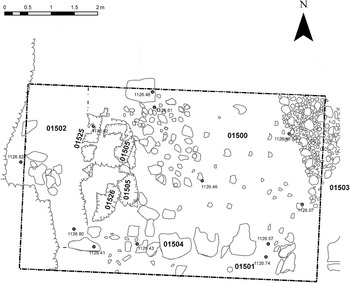
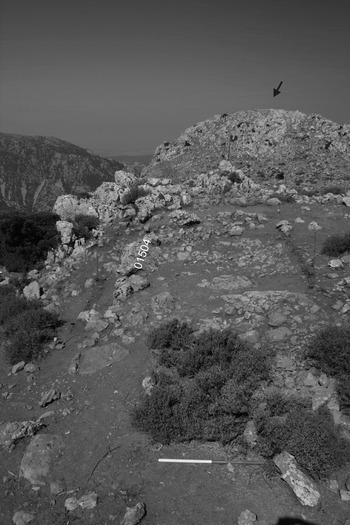
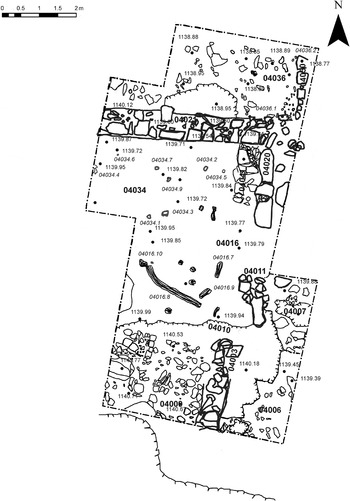
An outcrop of limestone c.1 m high lay on the building's west. Two alignments of large stones nearby abutted each other at right angles on the surface (Fig. 9). One (01525–01526) lay on a north–south-running ledge about 1.5 m east of the outcrop, the other (01504) extended to the east at the south end of the ledge. The ground surface dropped by 0.2 m south of 01504, suggesting that this wall lay on another natural ledge. The line of 01504 petered out to the east, where a large heap of medium-sized stones (01503) seemed related to the structure. An east–west section was cut through the building, allowing the best-preserved deposits, lying at the west end, to be explored. The south parts of two rather narrow rooms were uncovered east and west of 01525–01526, both probably orientated north–south and entered from the north. A bedrock ledge visible near 01503 probably formed the east boundary of the east room, and there may have been another room east of this on the same orientation.
Building B1: plan of surface remains in trench area, prior to excavation.

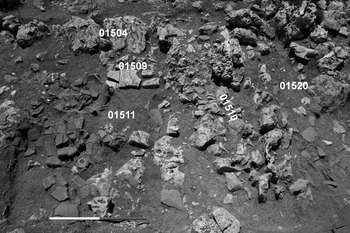
After topsoil removal, the bedrock terrace 01510 (c.0.6 m high), on which 01525 and 01526 were positioned, became better defined (Fig. 10; Fig. 11). To its west, the 1.4 m-wide space hereafter designated Room A, bounded on the west by the high bedrock outcrop, suggests a storeroom at the back/side of the building. The practice of using an outcrop to define or support one or more walls of a small storeroom (sometimes perhaps unroofed) is well known from Karphi and other contemporary sites (e.g. Hatzi-Vallianou Reference Hatzi-Vallianou2004, 109; Pendlebury et al. Reference Pendlebury, Money-Coutts and Pendlebury1937–8, 73). It is not clear whether a full-height wall was ever built along 01510; it may simply have been a step separating the storeroom from the larger room to its east. Under topsoil in the room was 01508, a very compact light reddish-brown stony soil with rather few sherds and occasional burnt mudbrick fragments. The relatively compact texture suggested the residue of a roofing collapse layer which once lay below the (now missing) stone tumble from the walls. Below it, a higher concentration of sherds, many of them large, was found in a looser, but still compact, deposit of a reddish-brown colour (01515) c.0.1 m thick. This also contained frequent medium-sized stones and burnt mudbrick fragments, a number of semi-rounded flat pieces of purple phyllite c.150–200 mm in diameter (possibly parts of small lids or pot stands) and a number of sherds from fine vessels, all of Late Minoan IIIC date. Large coarse domestic vessels such as a basin and pithos of the same date also appeared. One Middle Minoan sherd (01515.1, from a miniature amphora) appeared in a bedrock crevice. Small fragments of charcoal were moderately distributed throughout this layer, and much of the pottery appeared heavily burnt. Under 01515, in the filling of the same bedrock crevice as 01515.1, was a cluster of fine pottery designated as context 01517; this appeared to be entirely of Middle Minoan date. In the west part of Room A, removal of 01515 revealed a greyer, looser deposit with moderately frequent small- and medium-sized stones (01516). It extended over an area of c.1 × 0.7 m and contained occasional Late Minoan IIIC pottery sherds as well as more fragments of phyllite.
Building B1: floor/destruction deposits in both rooms, from north.

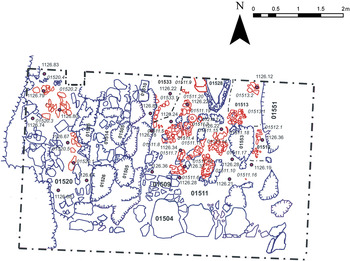
Building B1: plan of destruction deposit 01511, with hearth.

Below 01516 and directly under 01515 in the rest of Room A, 01520 was revealed (Fig. 10) – a compact light reddish-brown layer containing moderate medium- and large-sized stones, frequent charcoal and occasional burnt mudbrick fragments. It was rich in Late Minoan IIIC sherds, including several nearly complete vessels (e.g. 01520.5) found in the east part of the room. Sherds of more than one pithos were also found. Again, most pottery was heavily burnt. A small fragment of a straight bronze pin with square section was found in the flotation residue.
01520 best represents the Late Minoan IIIC floor/occupation layer in this room. Below it, a looser greyish-brown soil matrix (01530) was found, incorporating considerable quantities of ash, small stones and frequent sherds from Middle Minoan cups, jars and tripod cooking pots, as well as occasional mudbrick and charcoal. This appears to have been a well-sealed Middle Minoan deposit, with no Late Minoan IIIC material recognised at all. The general lack of mixing in the area suggests that little or no cleaning of existing Middle Minoan deposits over bedrock took place when this space came into use during Late Minoan IIIC. The layers found just over bedrock in small crevices, and removed using the context numbers 01549, 01531 and 01534, seem largely to represent natural soil. This tended to be reddish brown in colour (2.5YR 5/4 – 5YR 5/4), and compact. Only 01531 contained occasional sherds (of Middle Minoan date) in its uppermost part. It lacked charcoal and animal bones, and had frequent small stones.
In the larger room east of 01510 (Room B) a layer of medium-sized rubble and soil (01507) spread over much of the west part. Large sherds appeared in this deposit, alongside moderate fragments of burnt mudbrick. It ran right up against wall 01504, and up to and over parts of the bedrock ledge 01510. A number of hollows and ledges in the latter were revealed as 01507 was dug. Many contained Middle Minoan material at the bottom, with Late Minoan IIIC occupation material filling up the rest of the space. The base of a Middle Minoan cup (01514.1) was found in the lower fill of a large niche, 01514, located at a roughly central point in 01510. The upper fill of 01514, however, looks equivalent in date to the Late Minoan IIIC floor/collapse matrix in Room B (01511). A kind of shelf, c.0.5 m long, made from several flat medium-sized stones, occupied another niche at the north end of 01510.
A square stone-built platform (01509/01548), c.0.9 × 0.6 m, was revealed in the southwest corner of the room, against wall 01504 on the south and 01510 on the west (Fig. 12). It comprised one to two courses of stones with a packing of small rubble. Corner platforms, often with various types of objects (stone tools, fine vessels, figurines) lying on, near or in them, are well paralleled elsewhere at Karphi and at other Late Minoan IIIC settlements (e.g. Coulson and Tsipopoulou Reference Coulson and Tsipopoulou1994, 77; Klein Reference Klein2009, 95). A sheep/goat horn was found lodged against the north edge of the platform, while another was found actually inside the platform; this may have slipped down or been stuck into the relatively loose rubble fill, or the platform may have been roughly rebuilt at intervals over the building's lifetime. A stone tool (01548.1) was also found on/within the upper part of the platform fill.
Context 01533 with fragments of cooking dish 01533.1, from north.

Running up to this feature, to the bedrock terrace 01510 on the west, and to wall 01504 on the south, was 01511, under 05107 (Figs. 10–11). It was a loose sandy silt, dark reddish brown (2.5YR 5/4), with moderate medium and large stones and frequent small stones. It had frequent small- to medium-sized burnt mudbrick inclusions, and moderate charcoal and animal bone fragments, the latter often burnt. The deposit and its associated/equivalent contexts contained many complete or nearly complete vessels, only slightly damaged by the building's collapse and the later cultivation disturbance. The first to become visible was a large pithos with an unusual decoration of incised bosses (01511.1). Scattered under and around it were other well-preserved vessels including a ring vase, two amphoriskoi, a krater, a coarse kalathos, at least four basins/tubs of various sizes; a large coarse jug, at least five small cooking pots and at least four large ones; semi-coarse jars, and fragments of other pithoi. Some post-use scattering had occurred – for example, part of the large basin 01511.9 was found lying more than 1 m southeast of its other sherds in the north part of the trench – but the quantities of ‘stray’ sherds in the deposit were very few, so we have a very good picture of the room's actual contents at the time of destruction. The fact that most vessels were heavily burnt, along with the quantities of charcoal and burnt mudbrick, supports the impression of a burnt destruction. Some vessels lay on top of others within the same thick deposit, which continued into the north section of the trench. The fill within/between/under some large smashed vessels contained burnt mudbrick/mud packing from the walls. These facts, and the number of vessels, suggest that at the time of destruction vessels were standing densely packed on the floor, but also on shelves, ledges or furniture from which they fell. At the northeast edge of 01511, running into the north section, a roughly ovoid hearth (01528; diameter c.0.4 m) was found, located in the probable centre of the room (01528; Fig. 11). Lying roughly flush with the floor level, it had a dark-greyish clay surface about 15 mm thick. This was hard and cracked, with a slight depression in its centre.
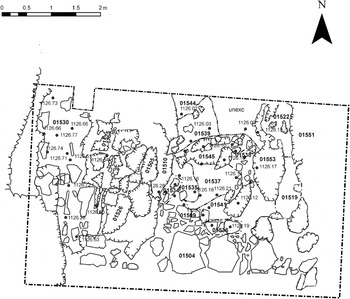
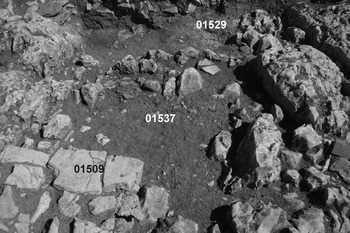
Some of the burnt layers found immediately under and adjacent to 01511 appear to be part of the same general deposit, representing episodes within the destruction event. In the northwest part of the trench, separated from the south part of the room by a curving ridge of bedrock (01545) was the grey/reddish-brown deposit 01533, resting in a natural hollow (Fig. 12). This contained much ash, moderate charcoal, occasional animal bones, small mudbrick fragments and occasional small- to medium-sized stones. A large cooking dish (01533.1) lay apparently in situ. In the eastern part of the room, 01513 had a concentration of pottery vessels (including a stirrup jar, 01513.3, and an amphora, 01513.2), while 01512 had a Late Minoan IIIC cooking pot; it also contained part of a Middle Minoan cup, probably intrusive from the layer 01519 below. Further compact reddish-brown to grey deposits (01522, 01521 and 01532) containing less frequent mudbrick and charcoal were found to underlie 01511 and its related layers. They contained frequent burnt pottery of mostly Late Minoan IIIC date, occasional animal bone and fallen yellowish-brown roofing material, suggesting the first collapse of the roof. Below these, sitting just above bedrock or in bedrock crevices, were deposits representing a use/occupation layer of Middle Minoan date (Fig. 13). Their disturbance in parts by the construction and use of the Late Minoan IIIC room accounts for the sporadic presence of Middle Minoan artefacts within the Late Minoan IIIC occupation levels. The deposits include 01522, 01534, 01535, 01536, 01537, 01538, 01539, 01540, 01541, 01542, 01544 and 01547. Each occupied a different natural crevice, or varied slightly in colour due to the uneven distribution of ash, and these variations were recorded under different context numbers. One of the most extensive deposits, apparently of pure Middle Minoan date, was the ashy 01537, covering a fairly large area in the room's centre (Fig. 14). It contained a Middle Minoan miniature amphora (01537.1) and cup, cooking pot and jug sherds of Middle Minoan date, as well as some small stones and charcoal. 01538, equivalent to 01537 and lying to its northeast, was particularly ashy in character and also contained Middle Minoan cups and tripod cooking pot fragments. Features in common between all the deposits included the sherds' abraded nature, the high proportion of cup fragments, the concentrations of ash and the lack of any associated architecture or other built constructions. These suggest that the area had an open-air use in the Middle Minoan period, perhaps focused on preparation and consumption of food/drink. These characteristics, the nature of some other aspects of the assemblage including the presence of miniature vessels and lack of large storage jar fragments, and the positioning of the deposit in a local context (Karphi site) and a wider environment (high Cretan mountain tops) where no traces of normal Middle Minoan settlement activity have been found, suggest it probably related to the use of the peak sanctuary, 150 m to the west, in a way as yet unclear (Fig. 15). Below all the Middle Minoan deposits lay the uneven bedrock with a shallow overlay of stony red soil, the latter mostly sterile but sometimes containing a few Middle Minoan sherds.
Building B1: plan of Middle Minoan deposits.

Building B1 from south, showing surface of Middle Minoan deposits, with 01537 labelled.

Area of Building B1 in relation to the Karphi peak sanctuary (shown by arrow), from east.

A narrow exposure south of 01504 showed bedrock to lie directly under the topsoil. This was presumably an external area in Late Minoan IIIC, but apparently not used as any kind of living surface or rubbish-dumping zone. A layer of small rubble (01536) underlay the base blocks of 01504 on its north side, probably forming a levelling deposit over bedrock, and there are traces of something similar on the south side at the east end of the wall. The sterile nature of deposits south of the building could suggest entrance was not from this direction, and that this formed the building's blind back end.
Commentary on B1 pottery (Figs. 16–18)
The lack of any early Late Minoan IIIC material is striking in comparison to Building A1. Cups are by far the dominant element in the Middle Minoan pottery. Because of its extensive assemblage, high-quality publication, palatial character and proximity, Middle Minoan II Quartier Mu at Malia is the main comparison for shapes used here. Sites in central and eastern Crete are also used to show the range of comparability.
Late Minoan IIIC pottery (Figs. 16–17)
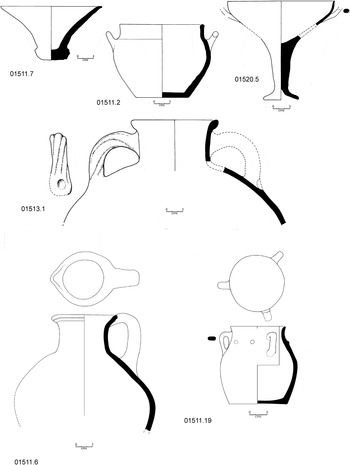
01511.7 Kalathos (Fig. 16). Very thin rim; narrow convex base. Half complete; weight 600 g. Rim diameter 196 mm, rim thickness 4 mm, wall thickness 65 mm, height 103 mm. Light brownish red, 5YR 5/4, medium hard, friable. Inclusions: 15% quartz, 1–3 mm; 40% grey/purple phyllite, 3–5 mm; 20% red sandstone, 2–4 mm; 5% calcite, speck. Late Minoan IIIC. This is typical of the coarse kalathoi, in a red-brown phyllite-rich fabric, found widely at Karphi (e.g. Day Reference Day2011, 29, 87, figs. 2.11, 4.3) and utterly different in form and use from fine vessels with a ‘kalathos’ shape here at or other sites. Day compares Karphi kalathos fabrics closely to those of the cooking pots from the site, an observation also valid for the 2008 pottery and understandable if, as Day suggests, the vessels were often used as lamps; rough bases like this would also be explained well if the vessels were supposed to rest in/on stands.
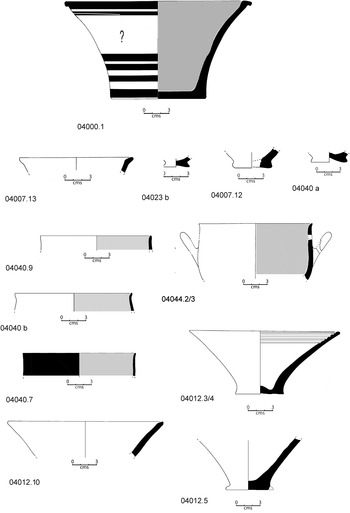
01520.5 Kylix (Fig. 16). Thin tapered rim; slight carination just below rim and small vertical handles with flattened ovoid section, probably rising above rim. Stem slightly swollen in middle; pierced all the way up. Approximately half complete; weight 320 g. Rim diameter 200 mm, base diameter 66 mm, handle section 10 × 8 mm, estimated height 185 mm. Light yellowish buff, 10YR 7/4, soft and powdery; patches of secondary burning; dark brownish-grey paint, 10YR 3/1. Inclusions: 15% hard grey rock, speck–2 mm, 2% calcite, speck. External monochrome(?) paint; stem may be banded; interior banded or monochrome. Date: mid-late Late Minoan IIIC. Day suggests that the best-preserved vessels in the 1930s assemblage represent the latest material on the site. The best-preserved kylikes do tend to have the deep, carinated conical bowl and very swollen stem of the late Late Minoan IIIC period (e.g. Day Reference Day2011, 24, fig. 2.9). The present kylix is not as deep-bowled as most of these. Cretan kylikes tend to become large by late IIIC; thus the small diameter of the present vessel also points to an early date. The profile shows similarities to K131.2 (Day Reference Day2011, 39, fig. 2.17) with a relatively shallow bowl; Day dates it to early Late Minoan IIIC. The lowest deposit in Room 23 contained a similar shallow-bowled kylix, K23.62 (Day Reference Day2011, 95, fig. 4.8). In Room 43, where the assemblage shows a number of early features, a shallow-bowled kylix, K43.8, also appears (Day Reference Day2011, 121, fig. 4.22). Thus the present kylix seems earlier than the latest kylikes from Karphi. On the other hand it differs from kylikes of the Late Minoan IIIB–C transition or the early IIIC period which have very slim, straight stems as well as very shallow, curved-profile bowls (Nowicki Reference Nowicki2008a, figs. 45–6, 49; see also Gesell, Day and Coulson Reference Gesell, Day and Coulson1995, fig. 14.1). Thus the date of this diagnostic vessel seems to lie before the latest IIIC (D'Agata Reference D'Agata, Gauss, Lindblom, Smith and Wright2011, fig. 2:8 shows a similar example from Thronos dated ‘Subminoan I’).
01511.2Amphoriskos, semi-coarse (Fig. 16). Flat base, squat body and horizontal round-section handles. Straight collar, slightly inset from body, producing a joining ridge. Complete; weight 1000 g. Rim diameter 162 mm; height 147 mm; handle 5 mm. Light yellowish buff, 2.5Y 7/4; soft powdery texture with uneven distribution of voids. No surface treatment. Inclusions: 35% hard grey rock, 2–3 mm; 20% red sandstone, 1–2 mm; chaff. Date: late Late Minoan IIIC. The shape parallels K115.16, from a late-looking assemblage (called a ‘jar’ by Day Reference Day2011, 206–10, fig. 6.21). This has painted decoration (with a zigzag on shoulder and bands below). The shape is common at Karphi, though there are no very strong parallels elsewhere; it could be part of a specific local tradition.
01511.9 Large coarse basin (Fig. 17). Flat base, rounded rim, right-angled profile at join to base. Less than one-third complete; weight 3000 g. Rim diameter 400 mm; wall thickness 18.5 mm; height 27 mm. Light reddish brown, hard. No surface treatment. Inclusions: 30% quartz, 2–4 mm; 40% phyllite, 3–6 mm; 15% hard grey rock, 2–3 mm. Date: Late Minoan IIIC. This is likely to have served for a frequent domestic task such as washing pots or textiles, or mixing bread; it was probably too heavy to move often.
01511.6 Large coarse jug, spouted (Fig. 16). Everted rim above straight neck and globular body; oval-section handle joining at rim and on upper body. Groove where neck is set into body. Slightly thickened rim, with one narrow groove along top, another wider one just below. Pinched spout. Rim diameter 130 mm, wall thickness 9 mm, handle 26 × 17 mm; estimated height 350–400 mm. Mid reddish brown, 7.5YR 6/6; soft and brittle. Smoothed surface; handle unsmoothed. Burnt in places on upper body. Inclusions: 20% quartz, 0–4 mm; 20% purple phyllite, 0–4 mm; 35% red sandstone, 1–2 mm; chaff. Date: Late Minoan IIIC. While jugs are common in the 1930s assemblage, few have spouts; no spouted examples of this size are published by Day. Smaller unspouted semi-coarse examples, often painted, also appear, apparently most commonly towards the end of the settlement's life (Day Reference Day2011, 14, 123, figs. 2.3, 4.24).
01511.19 Small semi-coarse amphoriskos (Fig. 16). Slightly everted short collar; rounded rim. Flat base. Three small vertical handles with flat ovoid section, joining just below rim and on shoulder. Small round knobs at intervals just below base of collar. Complete; weight 527 g. Rim diameter 97 mm, handle 6.5 × 14.5 mm, height 141 mm. Light greenish buff, 2.5Y 7/3; soft powdery texture with uneven air bubbles. Possibly monochrome painted. Inclusions: 18% hard grey rock, 2–5 mm; 20% red sandstone, 1–2 mm. Heavy secondary burning. Date: late Late Minoan IIIC. Knobbed decoration is relatively popular at Karphi, but not widely seen in Late Minoan IIIC Crete, suggesting rather isolated local traditions in Lasithi. It appears mainly on well-preserved vessels from the old excavation, suggesting a more frequent use towards the end of Karphi's life – though on a wide range of coarse and semi-coarse shapes (askoi, jugs, jars), all in local red fabrics, indicating a long history (Day Reference Day2011, 29, 37, 60, 97, 118, figs. 2.13, 2.16, 3.8, 4.8, 4.20; Seiradaki Reference Seiradaki1960, pl. 5 c, bottom right [labelled K 80]); K27.8 (called a ‘cooking jar’) is one of the closest parallels in shape for the present vessel and also has knobs on the shoulder (Day Reference Day2011, 118).
01513.1 Amphora, semi-coarse (Fig. 16). Rounded rim; twisted round-section handles joining below rim and at shoulder; very globular body. Large circular impression at join of handles to body. Rim diameter 180 mm, handle 22 mm, wall thickness 9 mm; estimated height 400 mm. Dark yellowish-buff fabric, 7.5YR 6/4; hard, with powdery surface. Self-slipped; possible narrow painted bands on upper body. Secondary burning (including on interior) to a mid bluish grey, 10YR 5/1. Inclusions: 5% quartz, 0.5–7 mm, 10% hard grey rock, 1–2 mm, 3% mica, speck. Date: late Late Minoan IIIC. These distinctive amphorae, usually painted, are seen regularly at central Cretan sites (Wallace Reference Wallace2010b, 40, fig. 10). They seem one of the best indicators of the late Late Minoan IIIC period (D'Agata Reference D'Agata2007, 99). The shape is present in the 1930s excavation assemblage (Day Reference Day2011, 73, fig. 3.14; Seiradaki Reference Seiradaki1960, fig. 8.4, pl. 5 c; see also Day, Coulson and Gesell Reference Day, Coulson and Gesell1986, pl. 84 a). The relatively coarse, round-bodied buff amphora 200.4, from Knossos North Cemetery (Coldstream and Catling Reference Coldstream and Catling1996, 193, fig. 128), given a purely ‘Subminoan’ date, shares the narrow neck of the present example. In both cases this curves out to a rim thinner than the solid ledge rims of amphorae given a date of Subminoan–Early Protogeometric, e.g. 98.11 (Coldstream and Catling Reference Coldstream and Catling1996, 129, fig 100). Finger impressions on large coarse and semi-coarse vessels other than cooking pots and pithoi appear regularly at Karphi (Day Reference Day2011, 11, 29, figs. 2.2, 2.12).
01511.13 (found with 01511.12). Small cooking pot with ovoid body and flat base (Fig. 17). Tall, slightly everted rim, vertical ovoid-section handles, flattened on top, joining at bottom of rim and a third of the way down the body. Complete; weight 827 g. Rim diameter 110 mm, handle section 9 × 15 mm. Dark brownish grey where burnt in use (2.5YR 3/1); otherwise mid brownish red, 2.5YR 5/8. Inclusions: 8% quartz, 1–2 mm; 25% phyllite, 0.5–4 mm; 10% red sandstone, 1–2.5 mm. Non-use burning. Date: Late Minoan IIIC. This belongs to the smallest class of cooking pots at Karphi. Legless Aegean cooking vessels with single vertical handles have sometimes been called ‘cooking jugs/amphorae’ (e.g. Yasur-Landau Reference Yasur-Landau2010, 128) and seen as indicating new, characteristically ‘Aegean’ cooking methods spreading elsewhere at this time. It is worth noting that the vertical handle is not used in any standard way, or exclusively on legless pots, at Karphi or other sites in Late Minoan IIIC Crete (see Day Reference Day2011; Hallager and Hallager Reference Hallager and Hallager2000, pl. 46: Andreadaki-Vlasaki and Papadopoulou Reference Andreadaki-Vlasaki and Papadopoulou2007, 53, fig. 10.4) and the tripod pot form with horizontal handles is still very common. The present pot is rather unusual in its specific handle position, though K1.21 has vertical shoulder handles, and MK.5 is also a good match (Day Reference Day2011, 19, 47, figs. 2.6, 3.3). The large cooking pot from a tomb, M2.1, with four handles (two vertical and two horizontal), shows how freely handle types could be adapted for either decorative or practical purposes (Day Reference Day2011, 223, fig. 7.1).
01511.18 Small tripod(?) cooking pot (Fig. 17). Flattened rim, everted collar, rather ovoid body. Horizontal round-section handles; flat base. Rim diameter 150 mm, handle 13 mm; wall thickness 6 mm. Mid reddish brown, 5YR 5/6, hard; mid-grey core, 5YR 5/1, 2 mm; medium hard. Surface smoothed. Inclusions: 15% quartz, 0.5–2 mm; 15% hard grey rock, 0.5–2 mm; 3% gold mica, speck; small chaff inclusions. Unevenly burnt, including on handles; interior secondary burning. Date: Late Minoan IIIC. It is well matched for size in the Palaikastro Kastri assemblage, dating from early Late Minoan IIIC (Sackett, Popham and Warren Reference Sackett, Popham and Warren1965, fig. 17). Unusually for Karphi, it lacks phyllite inclusions.
01520 cc Cooking tray (Fig. 17). Flat base, straight lower sides and long gently-flared rim; narrow horizontal groove where sides join rim. Rim diameter 380 mm; base thickness 6.5 mm. Dark-red fabric, 2.5YR 4/4, burnt on exterior to 2.5YR 3/2; medium hard. Inclusions: 15% quartz, 2 mm; 25% phyllite, 2–3 mm; 15% red sandstone, 2–3 mm; 20% dark-grey rock, 2 mm. Date: Late Minoan IIIC. Parallels come from many Late Minoan IIIC sites, from early and late deposits (Day, Klein and Turner Reference Day, Klein and Turner2009, fig. 30; Hallager Reference Hallager2000, 160–1; Sackett, Popham and Warren Reference Sackett, Popham and Warren1965, 296, fig. 16.P13; Andreadaki-Vlasaki and Papadopolou 2007, fig. 2.18), as well as from the 1930s Karphi excavation (Day Reference Day2011, 71, fig. 3.12).
01533.1 Cooking dish (Fig. 17). Flared profile, with folded-over rim meeting vessel body in slight ridge/carination. Below this, sides slope much more sharply inwards for at least 36 mm before meeting a thin, friable base, found shattered into many tiny fragments. Small hole, diameter 3 mm, just below bottom of rim. Two pinched depressions across thickness of rim, each 18–20 mm long and 6 mm deep, create a broad spout, 260 mm wide. Almost complete; weight 3100 g. Rim diameter 520 mm; body thickness towards base 8 mm; base thickness 1–2 mm. Mid brownish red, 5YR 3/3, patchily burnt in use to dark grey 5YR 3/1 (especially on exterior); hard and compact, with little surface cracking. Inclusions: 15% quartz, 2–3 mm; 50% red phyllite, 2–5 mm. Date: Late Minoan IIIC. The phyllite and quartz-rich fabric is typical of cooking vessels at Karphi. The dishes, spouted and unspouted, are seen widely here and at a number of other Late Minoan IIIC sites (Hallager Reference Hallager2000, 160; Hallager and Hallager Reference Hallager and Hallager2000, pl. 46; Sackett, Popham and Warren Reference Sackett, Popham and Warren1965, fig. 11r). Hallager suggests they lay permanently on a bed of embers, rather than being moved regularly. The lodging of the present example in a bedrock crevice at the edge of the room supports the idea.
01511.5 Large coarse amphora (Fig. 17). Swollen ovoid body; narrow straight neck, two ovoid-section handles joining at upper body, flat base. Slight shoulder where neck joins body. Neck diameter 110 mm, wall thickness 5 mm, base diameter 180 mm, handle 30 × 20 mm. Mid brownish red, 2.5YR 5/8; friable, with large unstable inclusions. Dark yellowish-buff slip; cracked surface. Inclusions: 18% quartz, 2–3 mm, 45% phyllite, 3–6 mm. Date: late Late Minoan IIIC. The shape is almost identical to the fine jar K3.9 from the old excavations (Day Reference Day2011, 32–4, fig. 2.14).
Late Minoan IIIC pottery from Building B1.

Late Minoan IIIC pottery from Building B1.

Middle Minoan pottery (Fig. 18)
Cups with incurved profile
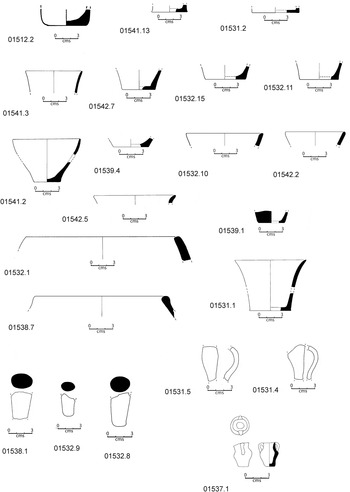
01541.2 Narrow thick flat base and tapered rim (Fig. 18). Rim diameter 88 mm; base diameter 40 mm; base thickness 4 mm; wall thickness 3 mm. Mid yellowish red, 5YR 6/8, soft. 13% inclusions: 8% quartz, 0.5–1.5 mm; 5% red sandstone, 1 mm. Date: Middle Minoan II. This cup shape is generally seen rarely before Middle Minoan II (a version first appears in Middle Minoan IB) and seems mostly to be a central Cretan type, especially in its earliest phases (Betancourt Reference Betancourt1990, figs. 16:147, 17:184–5, 18:220; Macdonald and Knappett Reference Macdonald and Knappett2007, 85, figs. 3.17, 3.36:571–80; MacGillivray Reference MacGillivray1998, 83, 156, 694, pl. 23, fig. 2.20; Reference MacGillivray and Momigliano2007, 133, figs. 4.20, 4.21; Levi and Carinci Reference Levi and Carinci1988, 100; Fiandra Reference Fiandra1973). It was already changing by Middle Minoan IIB-III (Betancourt Reference Betancourt1990, fig. 33:696,700; Macdonald and Knappett Reference Macdonald and Knappett2007, 24). Most of the Middle Minoan material from B1 finds parallels in the extensive Middle Minoan II Quartier Mu deposit from Malia, the nearest palatial site to Karphi. However, cups with this profile are not seen at Mu or its closely related site, Myrtos Pyrgos (Knappett pers. comm.). The type's presence here may potentially illustrate separate links between the Lasithi area and central Crete, as well as the Malia region, in Middle Minoan II.
01532.10 (Fig. 18). Rim diameter 60 mm, wall thickness 4 mm. Red, 2.5YR 5/6, hard. Inclusions: 1% calcite, speck; 5% phyllite, 1 mm. Date: Middle Minoan II.
01539.4 Flat base; wide-angled join of walls and base (Fig. 18). Base diameter 50 mm, wall thickness 5 mm. Light reddish brown, 2.5YR 6/6–6/8, medium hard. Inclusions: 20% phyllite, 1 mm; 5% quartz, 1 mm; 10% dark-grey rock, 1 mm. Date: Middle Minoan II.
01542.2 Rounded rim; vessel appears of squat proportions and relatively thick-walled (Fig. 18). Rim diameter 80 mm; wall thickness 6 mm. Mid reddish brown, 5YR 6/6. 28% inclusions: 18% quartz, 1–1.5 mm; 10% phyllite, 1–1.5 mm. This could be either an incurved-profile cup or a variant on the class of ‘tasses tronconiques’ at Malia Quartier Mu in Middle Minoan II (see below). It resembles the ‘Type 2’ (handled) cup from the nearby Middle Minoan sites of Tzermiado Kastello and Trapeza (Pendlebury and Money-Coutts Reference Pendlebury and Money-Coutts1935–6; Pendlebury, Money-Coutts and Pendlebury Reference Pendlebury, Money-Coutts and Pendlebury1937–8, 33–4).
01539.1 Cup or goblet (Fig. 18). Narrow flat base, rounded join of base to sides. Base diameter 45 mm; base thickness 2.3 mm; wall thickness 3 mm. Mid reddish yellow, 5YR 7/8, soft. Black/brown paint, 7.5YR 3/1. Exterior monochrome(?) paint. Inclusions: 5% quartz, 0.5 mm. This could belong to either the general class of cups discussed above, or the following one.
Middle Minoan pottery from Building B1.

Cups with flared profile
01531.1 Tapered rim and flat base with slight outward kick (Fig. 18). Rim diameter 60 mm; wall thickness 5 mm; height 75 mm. Red, 10R 5/8, medium hard. Inclusions: 12% quartz, 0.5–1 mm; 5% dark-grey rock, speck. Date: Middle Minoan II. This belongs to the class of ‘tasses tronconiques’/‘gobelets tronconiques’ at Malia Quartier Mu, representing the commonest cup shape there (Poursat and Knappett Reference Poursat and Knappett2005, 77–9, 144–5, figs. 25:1, 2, 5, 23:1, 2, 5). The ‘gobelet tronconique 1’ is the closest parallel, but this may well be a cup: these are commonly painted at Malia. Pendlebury, Money-Coutts and Pendlebury (Reference Pendlebury, Money-Coutts and Pendlebury1937–8, 25, 27, 33, fig. 13:1, 3, 10) note a gritty red clay with grey core and dark slip as common for this cup type at Tzermiado Kastello. Parallels appear at Katalimata and Palaikastro in painted and unpainted Middle Minoan II handled cups (Nowicki Reference Nowicki2008a, figs. 65, 70; Knappett and Collar Reference Knappett and Collar2007, figs. 23:107, 18:91, 92).
01532.15 Flat base; angular join of walls to base (Fig. 18). Base diam. 60 mm; wall thickness 4 mm. Light reddish brown, 2.5YR 6/6–6/8, hard. Inclusions: 10% quartz, 1 mm; 10% phyllite, 1 mm; 22% dark-grey rock, 1 mm. This belongs to the class of ‘tasses/gobelets tronconiques’ at Quartier Mu, with parallels at Katalimata and Palaikastro (Nowicki Reference Nowicki2008a, fig. 57:KP345; Knappett and Collar Reference Knappett and Collar2007, fig. 18).
01542.7 Flat base; angular join of walls to base (Fig. 18). Base diameter 45 mm; wall thickness 4 mm. Mid reddish brown/grey fabric, 5YR 5/6; burning on interior surface. Inclusions: 18% quartz, 0.5–1 mm; 6% phyllite, 1 mm. Date: Middle Minoan II.
01532.11 Flat base; angular join of walls to base; very slight outward kick (Fig. 18). Base diameter 60 mm; wall thickness 3 mm. Light red, 2.5YR 7/6, hard. Inclusions: 10% quartz, 1 mm; 10% phyllite, 1 mm; 22% dark-grey rock, 1 mm. Date: Middle Minoan II.
Handled cups, non-specific form
01531.4 Long ovoid-section handle, 19 × 5.5 mm (Fig. 18). Mid yellowish red, 5YR 6/8. Inclusions: 5% phyllite, up to 1 mm; 5% calcite, up to 1 mm. Date: Middle Minoan II. Both this and 01531.5 could have belonged to several different cup types seen at Quartier Mu, but were most probably broken from ‘tasses tronconiques’ (Poursat and Knappett Reference Poursat and Knappett2005, 77–8, 144, fig. 23:1, 2). Pendlebury and Money-Coutts (Reference Pendlebury and Money-Coutts1935–6, 26) noted similar handles from Tzermiado Kastello.
01531.5 Long ovoid-section handle, 16 × 4.7 mm (Fig. 18). Mid reddish yellow (5YR 7/8); grey core; self-slipped. Date: Middle Minoan II. Inclusions: 5% calcite, up to 1 mm; 10% phyllite, up to 1 mm.
Goblets
01541.13 Narrow flat base; rounded right-angled join of walls to base on interior; pronounced external kick; interior centre slightly convex (Fig. 18). Base diameter 50 mm, wall thickness 5 mm. Red, 10R 5/8, hard. Inclusions: 10% dark-grey rock, speck. Date: Middle Minoan II. The base shape is paralleled in the ‘gobelets tronconiques’ at Quartier Mu (Type 3 or Type 4). Both types are usually painted (Poursat and Knappett Reference Poursat and Knappett2005, 79, fig. 25). There are also parallels for the shape at Monastiraki Katalimata (Nowicki Reference Nowicki2008a, figs. 61, 68). Pendlebury, Money-Coutts and Pendlebury (Reference Pendlebury, Money-Coutts and Pendlebury1937–8, 25) refer to this shape at Tzermiado Kastello as a ‘tumbler’, noting a fine buff clay with traces of a dark shiny slip as common.
Carinated cups
01541.3 Cup (Fig. 18). Flared, slightly concave profile and round rim. Rim diameter 80 mm; wall thickness 3 mm. Buff, 7.5YR 6/4. Probable black paint. Inclusions: 8% quartz, 0.5–1.5 mm; 8% sandstone, 0.5–1 mm. Date: Middle Minoan II. Though this could belong in the class of ‘tasses/gobelets tronconiques’ it could also represent the upper part of a carinated cup of the type seen at Quartier Mu (Poursat and Knappett Reference Poursat and Knappett2005, 70–2), which are usually dark-slipped and/or painted. The shape (unusual in the Karphi assemblage to date), the fabric and the preserved paint may suggest an import.
Hemispherical cups
01542.5 Globular profile and everted rim, slightly tapered (Fig. 18). Rim diameter 110 mm, wall thickness 5.5 mm. Red, 2.5YR 5/6. Inclusions: 15% quartz, 1–1.5 mm; 10% phyllite, 1 mm. Date: Middle Minoan II. At Quartier Mu this is partly paralleled by Type 1 (Kamares cup) within the general class of ‘tasses hemispheriques’ (Poursat and Knappett Reference Poursat and Knappett2005, 74–5, fig. 22:1, 8a). At Knossos, MacGillivray (Reference MacGillivray and Momigliano2007, fig. 4.26:4 [Type 5]) notes that this shape appears mostly in Middle Minoan IIB, though it has predecessors with less everted rims in Middle Minoan IB-IIA.
Straight-sided cups
01512.2 Flat base; rounded right-angled join of walls to base (Fig. 18). Base diameter 55 mm; wall thickness 5 mm. Red, 2.5YR 5/6. Inclusions: 10% calcite, speck. Date: Middle Minoan II. This is best paralleled by Type 4 in the ‘tasses droites’ group at Quartier Mu (Poursat and Knappett Reference Poursat and Knappett2005, 144). Decoration is frequently a dark slip, or else there is no surface treatment. From Tzermiado Kastello, cup Type 11 has a similar form (Pendlebury, Money-Coutts and Pendlebury Reference Pendlebury, Money-Coutts and Pendlebury1937–8, 33–4). At Knossos, the form first appears in Middle Minoan IB and continues through Middle Minoan IIA–B (MacGillivray Reference MacGillivray and Momigliano2007, 138, fig. 4.25 [Type 7]). At Monastiraki Katalimata, KP 406, dated Middle Minoan II, is similar (Nowicki Reference Nowicki2008a, fig. 63).
01531.2 Flat base; right-angled join of walls to base (Fig. 18). Base diameter 60 mm; wall thickness 3 mm. Mid yellowish red, 5YR 6/8, fine. Inclusions: 5% phyllite, up to 1 mm; 5% calcite, up to 1 mm. Date: Middle Minoan II. This most resembles Type 1, the most common type of ‘tasse droite’ at Quartier Mu, usually made in buff clay (Poursat and Knappett Reference Poursat and Knappett2005, 73, fig. 21:1). Poursat and Knappett cite parallels from Kommos (Betancourt Reference Betancourt1990, 114 no. 665), Myrtos Pyrgos (Knappett Reference Knappett1999, fig. 10) and Phaistos (Levi and Carinci Reference Levi and Carinci1988, pl. 88a). There are also parallels at Katalimata (Nowicki Reference Nowicki2008a, fig. 71).
Holemouth jars
01532.1 Flat rim, with a slight slope inwards and downwards (Fig. 18). Rim diameter 203 mm; wall thickness 11 mm. Fabric burnt to dark grey, 7.5YR 3/1 to 2.5/1, hard. Inclusions: 15% quartz, 1 mm; 25% phyllite, 1–2 mm. Date: Middle Minoan II. The type belongs to the class of ‘jarres sans col’ at Quartier Mu (Poursat and Knappett Reference Poursat and Knappett2005, 47–8, 141, fig. 4:2): the relevant sub-type, 2, is usually painted and has two handles, and appears in both local and imported fabrics. Knossos Middle Minoan IIA deposits include similar jars (Macdonald and Knappett Reference Macdonald and Knappett2007, 102, fig. 3.29:515). Similar vessels were also noted at Tzermiado Kastello (Pendlebury, Money-Coutts and Pendlebury Reference Pendlebury, Money-Coutts and Pendlebury1937–8, 35, fig. 15).
01538.7 Swollen rounded rim (Fig. 18). Rim diameter 160 mm; wall thickness 6 mm. Mid yellowish red, 5YR 6/6–5/6, hard. Inclusions: 10% quartz, 1 mm; 15% phyllite, 1 mm; 5% dark-grey rock, 1 mm. Date: Middle Minoan II. This shape most resembles Sub-Type 1 in the class of ‘jarres sans col’ at Malia Quartier Mu (Poursat and Knappett Reference Poursat and Knappett2005, 47, 141, fig. 4:1), which can be plain or painted and usually has four handles. It is most often found in a red semi-coarse fabric. Diameters are often markedly larger than the present example (240–300 mm). Another parallel appears at Katalimata in KP 548 (Nowicki Reference Nowicki2008a, fig. 74).
Tripod cooking pots
01532.8 Oval-section leg, 24 × 20 mm, with squared end (Fig. 18). Mid reddish brown, 5YR 5/6–6/6; hard. Inclusions: 25% quartz, 1 mm; 18% sandstone, 1 mm. Date: Middle Minoan II. Poursat and Knappett (Reference Poursat and Knappett2005, 56–9, 142–3, fig 12:1–3) show a range of tripod vessels with splayed oval-section legs from Quartier Mu, all in a red semi-coarse fabric. The present example's diameter suggests one of the smaller tripod vessels (‘chaudrons’) with relatively thin, short legs. Parallels come from Katalimata (Nowicki Reference Nowicki2008a, fig. 39:KP 109, KP 110), from Kommos (Betancourt Reference Betancourt1990, fig. 59:1594, dated Middle Minoan III) and from Middle Minoan IIA Knossos (Macdonald and Knappett Reference Macdonald and Knappett2007, fig. 3.32).
01532.9 Oval-section leg, 18 × 12 mm, with squared end (Fig. 18). Mid reddish brown, 5YR 5/6–2.5YR 5/8, hard. Inclusions: 15% quartz, 1–2 mm; 15% sandstone, 1–2 mm. Date: Middle Minoan II.
01538.1 Oval-section leg, 30 × 21 mm, with squared end (Fig. 18). Mid reddish brown, 5YR 5/6–6/6, with grey core, medium. Inclusions: 18% quartz, up to 1 mm; 15% phyllite, up to 1 mm; 25% hard grey rock, up to 1 mm. See discussion above for 01532.8.
Other vessel types
01537.1 Miniature amphora (Fig. 18). Pinched ovoid rim perhaps suggesting a spout; round-section handles joining at rim and shoulder. Rim diameter 16 mm, height 28 mm. Light pinkish buff, 10YR 7/4, medium hard. Possible exterior monochrome paint. Inclusions: 2% hard grey rock, up to 1 mm, 25% red sandstone, 0.5–2 mm, 1% calcite, speck. Date: Middle Minoan II. A handle from a very similar example appears in 01515.1. Several similar examples (maximum height 40 mm) were noted from the area of the peak sanctuary in the 1930s investigations (Pendlebury et al. Reference Pendlebury, Money-Coutts and Pendlebury1937–8, pl. XXXIII). Such vessels are not exclusive to cult environments (see e.g. Knappett and Collar Reference Knappett and Collar2007, fig. 28:156). However, they are notably concentrated in peak sanctuary contexts (usually associated, as here, with cups) (see e.g. Chrysoulaki Reference Chrysoulaki2001, 62; Myres Reference Myres1902–3, 378–9; Rethemiotakis Reference Rethemiotakis2009, pl. 16.4). Tournavitou (Reference Tournavitou2009) suggests they were deposited in order to make symbolic reference to the role of wine in sanctuary rituals, noting that actual wine storage and pouring vessels are not commonly found at sanctuaries.
Summary analysis
A typical domestic stratigraphy at Karphi, including a hearth, platform/stand and a rich assemblage of domestic pottery mostly dating from the mid-late Late Minoan IIIC period (with a few early-mid IIIC pots), was able to be recorded in detail for the first time here, opening the way to more informed interpretations of buildings in the 1930s excavated zone. The building's destruction by fire in late Late Minoan IIIC gives an entirely new perspective on the circumstances of Karphi's abandonment. The discovery of destruction in this building located close to the old excavated zone combines with the record from other 2008 trenches to suggest that quite widespread evidence for burnt destruction there may have been overlooked by Pendlebury, who only mentioned traces of fire in some rooms (Pendlebury et al. Reference Pendlebury, Money-Coutts and Pendlebury1937–8, 136). This is supported by Day (Reference Day2011; pers. comm.), who has noted burning on a large number of the latest sherds in the restudied assemblage.
B1's excavation revealed the presence of deposits of Middle Minoan date contemporary with, and almost certainly connected to, those of the peak sanctuary. This finding has the potential to contribute significantly to our understanding of peak sanctuary use in Crete (see discussion below).
BUILDING C1 (Figs. 19–22)
A large building (9.7 × 12.3 m), constructed using massive blocks, stands at the far eastern edge of the Karphi settlement (Fig. 19). It comprises two almost identically-shaped and -sized rooms, orientated northwest to southeast, with walls preserved up to four courses above the present ground surface, like several other large buildings in the same area (Nowicki Reference Nowicki1987, 242–3 [called C2]; Wallace Reference Wallace2005a, 246). No doorways are clearly visible (Wallace Reference Wallace2005a, 233–8). Such massive construction is infrequently seen in the rest of the Karphi site – the Great House and Building A1 provide the closest excavated parallels. The reason for exploring Area C was its status as a distinct and extensive zone covering the summit and slopes of the Mikri Koprana mountain, bounded on the east by a fortification wall marking the edge of the settlement in this direction (Nowicki Reference Nowicki2002). The wall is currently being recorded as part of the present wider project. We may reasonably assume that buildings close to this ‘edge’ zone had similar construction dates to the wall, since it is unlikely, in the context of settlement in this period and area, to have been built enclosing any large empty space. Since the wall's nature and condition make dating evidence hard to retrieve, excavation of C1, with its good preservation and proximity, offered a chance to investigate this period of the site's development. Though C1 is part of a continuous stretch of buildings, the curious features of this particular structure (with two very large parallel rooms, 41.6 and 46.1 sq m respectively) suggested an alternative interesting possibility – that it had an altogether different date, perhaps related to one of the Middle Minoan ‘guardhouse’ structures known from the area (Chrysoulaki Reference Chrysoulaki1999; Evans Reference Evans1896; Nowicki Reference Nowicki1999a; in press). Testing its relationship to the rest of the Late Minoan IIIC settlement was thus important. If of IIIC date, the question of whether it functioned as a single exceptionally large house (outclassing even Pendlebury's Great House in size, and unique in having two such large rooms), or as two very large household spaces, was of interest in relation to gauging the nature of social organisation and division at large sites.
Building C1: surface plan of entire building.

The collapse of the building appears to have occurred mainly in an outward direction, though the west part, where the wall backs onto rising ground, has a heavier inward fall of blocks. Clearance inside the walls (particularly in the eastern part) probably occurred within the historical period (C1 is close to a fieldhouse complex used into the 1970s, and to numerous agricultural terraces). Stones set on edge at the south end of the east wall (west face) suggested the construction of a threshing floor (aloni) at some point. Overall, however, the height of soil within the walls of the south room, and the absence of large fallen stones inside the east part of the room, indicated this as one of the easiest buildings to excavate in the whole of Area C, where wall collapse on the surface is generally heavy and massive.
The room was sectioned in a northeast to southwest direction by a trench 4 × 4.5 m in its eastern half. This was located entirely inside the walls, due to the very heavy stone tumble on the exterior. After removal of the loose topsoil, which contained some tiny abraded sherds, 02503 appeared – a light reddish-brown soil containing occasional large wall stones, with more frequent small- and medium-sized stones, in a silty matrix c.0.2 m thick. Towards the bottom of this residual wall collapse layer, patches of light yellowish-brown soil and fragments of green phyllite averaging 50–200 mm in diameter were found, suggesting roofing material. An intrusive object of galvanised iron was found here, confirming the impression of limited, relatively recent disturbance in the building. As 02503 was excavated, a softer, smoother, and more compact soil of a light reddish-brown colour (02505) was revealed, apparently representing the main occupation level. As usual at Karphi, the floor was defined not by a uniform smooth surface but by the presence of large numbers of well-preserved pottery vessels smashed in situ and lying immediately above or very close to bedrock (Fig. 20; Fig. 21; Fig. 22). All the pots were of mid-late Late Minoan IIIC date, with the same absence of concentrated early material already observed in B1. The layer 02505 contained occasional mudbrick fragments, frequent charcoal flecks and medium-sized and large stones. Two hearths were located within it and above bedrock – 02504 (0.42 × 0.49 m) in the southeast part of the room, and 02506 (c.0.22 × 0.3 m) in the approximate centre (Figs. 20–21). Both were roughly ovoid and of hard-packed clay; occasional small and medium-sized stones were included within the matrix, as were tiny fragments of charcoal. The surface of each was 20–35 mm thick, and a mottled red and yellow colour (10R 4/8 to 2.5YR 4/8–6/8). Under both hearths, sherds of the same date as those in the floor deposit were found above bedrock, suggesting the regular renewal (and possible moving) of hearths over the room's lifetime. The presence of two hearths within a single room is rare in Late Minoan IIIC settlements (though hearths and ovens quite often appear together within a room; see e.g. Glowacki Reference Glowacki2004).
Building C1: plan of destruction deposit with hearth.

Building C1: hearth 02504 from southeast, with pots smashed around it.

Building C1: southwest room from west, showing destruction deposit 02505 and disturbed nature of east wall 02502.

A variety of activities seems to have occurred here, as is typical for the main rooms of Late Minoan IIIC houses. Cooking was clearly one of them, though the lack of animal bones in any quantity stands out, suggesting careful discard processes. The pots were a mixed domestic assemblage including several cups/deep bowls, widely scattered around the room, and at least three or four cooking pots; three of the latter were located close to the central hearth. A very large globular jar with short neck may have been used for water storage. The wall/corner positions for two pithoi found here are typical of Late Minoan IIIC houses at Karphi and elsewhere.
This building did not appear to be as heavily burnt as B1 and MG1 (neither the ceramics nor the surfaces of the hearths were blackened), but the presence of so many well-preserved vessels in situ, as well as burnt mudbrick and frequent charcoal, suggests the same kind of destruction event affected C1. The slightly less complete condition of vessels here than in B1 supports the other evidence of recent limited disturbance which removed some of the stone collapse layer and skimmed the floor deposits. Excavation of 02505 showed that stones from the inner face of the east wall (02511, 02512, 02513, 02514; Figs. 20, 22) had been upturned, and penetrated into the ancient deposits, long after the destruction and collapse of the building. A layer of small- and medium-sized stones (02516), probably representing the original wall foundation/levelling course, was visible under the displaced stone 02513. A packing of red soil (2.5YR 4/8) mixed with small stones (02510) was found lying patchily under 02505, and immediately over bedrock, in the rest of the room. This contained occasional small Late Minoan IIIC sherds, mostly in its top part, apparently deposited in the regular relaying/use of the floor over time.
Commentary on C1 pottery (Fig. 23)
Among the typically mixed household assemblage are two coarse vessels in a consistent bluish-grey fabric slipped with red, not seen anywhere else on the site and different from the fine ‘blue ware’ found in the Temple and some other places on the saddle (02505.1, 02505.11; Pendlebury et al. Reference Pendlebury, Money-Coutts and Pendlebury1937–8; Day Reference Day2011). They hint at a locally specialised tradition of production or consumption, and this idea is strengthened by the presence of a number of vessel near-pairs – semi-coarse jars and amphorae with almost exactly the same sizes, forms and fabrics – in the building.
Pottery
02505.3 Cup (Fig. 23). Rim with slight outward curve; tapered. Vertical handle with flattened ovoid section, joining at rim and halfway down body. Narrow, relatively high foot-like base. Rim diameter 140 mm; wall thickness 4 mm; handle 11 × 5 mm; height 120 mm. Mid pinkish buff, 7.5YR 7/6, brittle and powdery-surfaced. Self-slipped; black paint, 5YR 4/1. Inclusions: 18% quartz, up to 1 mm, 10% hard grey rock, up to 1 mm. External rim band, 9 mm wide; internal monochrome paint. Date: mid-late Late Minoan IIIC. The rather unusual narrowed base shows the tendency to raised feet characteristic of the later Late Minoan IIIC period, when S-shaped profiles also emerge in cups and skyphoi. A parallel appears in K148.1 (Day Reference Day2011, 14, fig. 2.4), though this lacks the high hollow base. K79–89.1 is similar but squatter (75 mm high), with blob/monochrome decoration, while the present example belongs to an earlier tradition with bands (Day Reference Day2011, 172, fig. 6.2). Seiradaki (Reference Seiradaki1960, 139) notes that blob-painted cups were the most common type at Karphi, suggesting they date latest in the site's sequence. Hallager and Hallager (Reference Hallager and Hallager2000, 37) also note that blob decoration tends to characterise later examples at Chania Kastelli (i.e. mid-Late Minoan IIIC). At Kommos, a slightly later evolution of the shape appears in a monochrome cup with round handle; its applied pedestal base places it in Protogeometric (Shaw and Shaw Reference Shaw and Shaw2000, 226 no. 134, pl. 4.5:134). The combination of features in the present case, suggesting a date in mid-late Late Minoan IIIC but prior to the very end of the period, is echoed in a cup from Thronos Kefala (D'Agata Reference D'Agata, Gauss, Lindblom, Smith and Wright2011, fig. 2:6) which D'Agata places in her ‘Subminoan I’ category.
02505.15 Large coarse stirrup jar (Fig. 23). Pierced through disc. Concave disc; globular body; ovoid-section handles. The hollow false spout contrasts with the solid ones on the fine stirrup jars from Building A1. Disc diameter 70 mm; wall thickness 5 mm, handle 30 × 18 mm. Estimated height 180–200 mm. Buff, 10YR 7/4, very soft and brittle with powdery texture. Possible black paint, 10YR 3/1. Inclusions: 17% quartz, 1 mm; 8% hard limestone, up to 1 mm. Date: early-mid Late Minoan IIIC. Large coarse stirrup jars continue a Late Minoan IIIB tradition, but had stopped being made well before the end of the Late Minoan IIIC period (E. Hallager Reference Hallager and Krzyszkowska2011; Maran Reference Maran2005). One appears at Katalimata dated to the Late Minoan IIIB/C transition (KP 248: Nowicki Reference Nowicki2008a, fig. 48; the disc is unpierced). From the old Karphi excavations, the large coarse stirrup jar K70.1 has a pierced disc like the present example (Day Reference Day2011, fig. 3.14). A similar example with partially pierced disc comes from the Temple (K1.13: Day Reference Day2011, fig. 3.2).
02505.56 Small tripod(?) cooking pot (Fig. 23). Everted rounded rim; globular body; high round-section horizontal handles. Rim diameter 110 mm; wall thickness 4.5 mm, handle 13 mm. Light reddish brown, 5YR 5/6, medium hard. Inclusions: 30% quartz, 2–3 mm; 28% hard limestone, 1–2 mm. Date: Late Minoan IIIC.
02505.2 Small semi-coarse jar (Fig. 23). Long everted rim and round-section horizontal handles. Rim diameter 13 mm, wall thickness 5.5 mm, handle 10 mm. Mid pinkish buff, 7.5YR 6/8, soft, with powdery surface. Inclusions: 8% hard grey rock, 1 mm, 20% red sandstone, 1–2 mm. Date: late Late Minoan IIIC. Despite strong resemblance to a cooking pot in profile, the fabric is not a cooking one. The pot's function seems to have been more that of a large semi-coarse bowl or small open-mouthed jar.
02505.11 Large coarse jug (Fig. 23). Spouted, with narrow straight neck, slightly everted rim and globular body; round-section handle; flat base. Shallow dent midway up body on one side, at the same level as a narrow horizontal groove; vessel was possibly made in two halves or repaired during manufacture. Complete; weight 3350 g. Rim diameter 89 mm, spout 15 × 11 mm; handle 23 mm, height 300 mm. Mid blue-grey, 5YR 5/1, medium hard. Mid-red slip, 5YR 6/6. Inclusions: 30% quartz, 1–2 mm, 25% hard grey limestone, 1 mm. Internal wheelmarks, very pronounced near base. See discussion of 01511.7 above. Date: Late Minoan IIIC.
Late Minoan IIIC pottery from Building C1, and various small finds.

Summary analysis
Despite its unusual construction and size, and its proximity to the fortification, there is no indication of any special or unusual use for C1, and no evidence for a foundation date earlier than mid-Late Minoan IIIC, as noted for the saddle area and A1. In this, C1 seems to broadly parallel B1 and MG1 (below) and offers a probable terminus post quem for the fortification.
The south room seems to have been a single large unit, including a roughly central hearth during part of its lifetime, though hearth spaces were apparently moveable over the building's lifetime. It is not clear, however, that C1 functioned as a single household, and hearth concentration could even indicate a specialised cooking function for this room within the wider building; some storage was also present. Numerous near-complete pots were preserved on the floor, smashed in situ during a presumably sudden, unexpected destruction in the late Late Minoan IIIC period. As in B1, the sheer number and range of pots suggest the room was crowded with them, with at least some standing on shelves or in stacks.
BUILDING MG1 (Figs. 24–31)
Uniquely, the north summit of Megali Koprana commands a view of almost the entire settlement area. There are two natural routes to it from the rest of the site (each taking up to 15 minutes). One (the quicker, but more difficult) goes up a broad gully in the steep north slope. Another goes along the ridge linking Mikri with Megali Koprana, then climbs the upper western slopes of the latter. Both run close to Building A1 and through a large space in which continuous architecture is lacking. Views from Megali Koprana over the wider landscape contrast with those obtained from other parts of the site. For example, the approaches from the Nisimo plain to the southeast (invisible from the Karphi peak, the Karphi-Mikri Koprana saddle, and Area B) are visually well-covered, as is the small contemporary settlement of Vigla, several hundred metres below the summit to the west (Nowicki Reference Nowicki2000, 164–6). There are excellent views towards the Papoura ridge, which can be accessed directly from the Megali Koprana summit. Megali Koprana is also much less intrinsically defensible than the Karphi saddle and peak. We can assume a certain protection was afforded by its inhabitants' collaboration with people in the rest of the site and perhaps in neighbouring settlements, and its sheer height above the surrounding landscape, with steep slopes on all sides. It would, notwithstanding, have been vulnerable to attack – yet it was never included within the fortified area in the northeast part of the site. In excavating there, we wanted to shed light on how separate the Megali Koprana sector really was: for example, was there an especially late date for the establishment of this part of the settlement, or a different subsequent history; did its buildings and inhabitants differ in certain shared ways from those elsewhere at the site?
The north summit, which has a particularly well-preserved large squarish building with several east–west-running subdivision walls (Fig. 24; Fig. 25), seemed a good place to start. The soil here proved to be nearly 100% archaeological in its composition; the currently flat topography represents a kind of shallow tell formation, and the Late Minoan IIIC buildings were founded on craggy rock ledges. Despite the long history of cultivation, no huge rock clearance piles are seen here, and architectural remains appear well on the surface, along with much Late Minoan IIIC pottery (Nowicki Reference Nowicki1987, 243; Pendlebury et al. Reference Pendlebury, Money-Coutts and Pendlebury1937–8, 65; Wallace Reference Wallace2005a, 244–6). Excavation showed that the walls were of small rubble, with their collapse debris (0.4–0.5 m thick) well-buried/small enough not to pose a problem to recent cultivators, though the latter probably removed some of the densest rubble near the surface. The initial strategy was to half-section MG1 lengthwise, in a north–south direction. On the surface, internal deposits appeared to stand particularly high at the building's southeast end, against a sharply rising bedrock outcrop. The east wall, 04003, also seemed best-preserved at this point, so the initial trench (5 × 4.5 m in area) was sited here to expose a significant area inside 04003 and a narrower external area east of it, where a drop in ground level of up to c.0.4 m appeared. The trench was gradually extended north via a series of extensions intended to answer developing questions.
Building MG1: view from south before excavation.

Building MG1: plan of surface remains prior to excavation.

No clear face was found for the inner side of 04003 during its excavation. Below topsoil, a layer of reddish-brown soil with frequent small stones, 04001, proved to contain many horizontally-lying sherds, particularly in its southern part, close to the likely south end of the building (given that no wall traces are visible on the surface, the high bedrock outcrop c.1.25 m south of the trench probably formed the end wall). A cockle shell and occasional fragments of burnt mudbrick and charcoal were also found. As excavation proceeded towards the north, sherds reduced in number and the deposit was characterised by more frequent small stones. Under 04001 was a mid reddish-brown deposit containing medium-sized stones and occasional coarse pottery, designated 04005. As this was excavated, 04003 still failed to show any extension to the north, ending instead on what proved to be a bedrock ledge (04010) running east–west across the interior space at approximately right angles to 04003, about 2.75 m north of the south edge of the trench. As soon as the fact that the ledge ran across the whole trench became clear, different context numbers were allocated to the deposits on either side of it. 04009 was given to the deposit south of the ledge, which proved to be shallow, with frequent small stones and occasional sherds and bone; bedrock was soon reached at about 0.1–0.2 m below present ground surface (Fig. 26). The ledge was c.0.7 m high (its line having possibly been enhanced/regularised by deliberate cutting). It probably supported, or functioned as, an internal wall dividing a narrow room to the south (hereafter called Room A) from a larger room below it to the north (Room B). The fact that no wall stones remained in place, combined with the poor preservation of 04003 in this area and the possibility that the south wall was formed by a natural bedrock outcrop, suggests that Room A was roughly built, like the small, possibly unroofed likely storage areas seen in other parts of the site (e.g. in B1, above). The large sherds found just below topsoil probably represent the residue of the floor surface/occupation layer, heavily impacted by later ploughing and cultivation because so close to the modern surface. 04009 may represent a subfloor packing, or part of this residual floor/destruction matrix. North of the bedrock ledge, substantial wall collapse of weathered medium-sized stones in a loose soil matrix appeared (04005).
Building MG1: plan of surface of destruction deposits in both main rooms, lowermost deposit over bedrock in south room and rubbish deposits outside building.

East of 04003, context 04004 was uncovered under topsoil. This yellowish-brown sandy silt contained frequent medium-sized stones and occasional small sherds and bones. At the south end, excavation came down onto bedrock very soon; 04003 was shown to be founded directly on bedrock and to stand only one course high. The rock sloped down very steeply to the east, with 04004 directly overlying its upper slopes. Towards the east edge of the trench, at the lowest point of the slope, 04004 overlay two soft, compacted deposits (divided only by a low east–west-running rock ridge) which were both very rich in pottery, bone and charcoal (04006, 04007; Fig. 26). These deposits filled bedrock crevices, which must represent the original uneven land surface at the time of MG1's construction. Their surfaces probably represent the ground level during the last phase of the building's use. On the north, 04007, a soft mid reddish-brown sandy silt, contained medium-sized and large stones, frequent pottery (including many cooking pot sherds) and frequent animal bone fragments, but rather little charcoal and no burnt mudbrick. The slightly less stony 04006 to the south also contained fairly frequent animal bone and pottery. These organic-rich, loosely-packed layers suggest rubbish accumulation; importantly, they were not consistently burnt in the same way as occupation deposits within the building proved to be. The bedrock around the foundation of the east wall was clearly exposed during the whole time of the building's use, with the crevices in it forming a natural resting point for rubbish thrown out of the building.
Inside the building again, under 04005, a deep collapse deposit of much larger and less weathered stones than in 04005 (04012) was found, in a loose soft matrix of dark reddish-brown soil, mixed with occasional charcoal and animal bones. Several large pithos sherds lying against the bedrock step 04010 became visible as 04012 started to be excavated. The vessel may have belonged to Room A to the south and been standing against the south face of a wall on the step as it collapsed northwards (or have stood on the step, facing directly into Room B, if there was no wall). A small (1 × 5 m) extension was now made at the north end of the original trench to permit a wider view into the interior of Room B. In the extension, more sherds of the pithos appeared; they went deeply down into the collapse, suggesting that a floor deposit would be found in close proximity. The pithos (04012.1) was of Late Minoan IIIC date, with decoration of hatched wavy bands and chevron bands. Towards the bottom of the context, increasing amounts of sherds, charcoal and bone were found. After removal of most of the largest stones, a very loose soft soil matrix (04016) became visible, containing heavily burnt organic material, burnt mudbrick, and charcoal in multiple lenses, as well as heavily burnt pottery (Fig. 26). It was roughly 0.15 m thick and seems to represent the burnt roof collapse and floor contents of the building. In the northwest part of the extension, the density of burnt mudbrick/clay was particularly great, with many very large pieces recovered; a hearth, from which many of these fragments may have come, was later found in the area. As 04016 was excavated, a fallen beam (branch-size), surrounded by burnt mudbrick fragments and lying in a northwest to southeast orientation, became visible (04016.10), approximately 0.15 m wide and 1.7 m in preserved length. A number of other timbers lay nearby (04016.7, 04016.9, 04016.8) but were not preserved in their entirety (Fig. 27). Around and between them lay thinner carbonised twigs and branches, suggesting roofing material. The timbers, and other finds from this area, lay directly or almost directly on bedrock, with minimal traces of any floor surface or subfloor packing (except in small bedrock crevices). The rock was remarkably level in this area, and would have provided an excellent floor.
Building MG1: fallen beam 04016.10 and beam fragments in deposit 04016 from northeast.

A larger extension to the north was now opened to reveal more of this informative context and establish the line of Room B's east wall. Below an upper stone collapse layer, 04022, was a layer containing larger stones, frequent animal bone, and mudbrick (04032), equivalent to 04012 (the pattern of a weathered upper collapse layer and more solid lower collapse was repeated across MG1). As 04032 was excavated, the line of an east–west-running wall 0.6 m thick (04021) appeared, bounding the collapse in Room B on its north. In order to follow this wall westwards and provide more space to work within the room, a small western extension was now made. Excavation again came down, after collapse layers, onto a loose, ashy and burnt destruction deposit equivalent to 04016 and called 04034 in both extensions (Fig. 26). It contained very frequent burnt mudbrick, animal bones and pottery, with many bones burnt to a white colour and the pottery often burnt grey. A roughly ovoid or rectangular hearth (04043), running into the west section, became visible as 04034 was excavated. It had an approximately central position in the room (the west wall of which can be partly seen on the surface, suggesting an area of c.30 sq m; Fig. 28, Fig. 29 and Fig. 30). 04043 seems to have been large (maximum 1.75 m diameter) and to have had the same kind of blackened clay surface seen in the B1 hearth.
Building MG1: plan of lowermost part of destruction deposit 04040 just over bedrock in north part of central room, showing fill of bedrock hollow against wall 04021 and hearth; surface of destruction deposit in south part of room; bedrock surface in other rooms.

Building MG1: view from east showing 04043/04040 during excavation, including hearth against west section.

Building MG1: close-up of area around hearth 04043.

The east wall of Room B, 04020, proved much better preserved at its north than its south end, forming a good corner with the north wall 04021. However, it was only preserved one course high, whereas 04021 was preserved to 3–4 courses. In excavating the north part of Room B to bedrock, 04021's good preservation was found to be due to the presence of another east–west-running step in the bedrock about 1 m south of it. Collapse deposits in this area had helped to shore up and protect the wall. Like Room A, then, most of Room B was sited on a natural terrace or step, one of a set running down towards the north.
Around the hearth, in 04034 and its stonier lower continuation immediately over bedrock (designated 04040; Figs. 28, 30), finds included a number of stone tools, two limpet shells and a shattered Early Minoan–Middle Minoan stone vessel (04034.1/04023.1/04034.60) found upended. Protruding from the west section and heavily burnt in the destruction were the remains of a very large krater of a remarkably hard, good-quality fabric (04034.6). A very large trapezoidal clay weight was also found here, along with two clay spools and a clay bead/spindle whorl. An unusual semi-coarse jar with thin incised wavy line around the rim (04040.1) also lay in pieces near the hearth. The building was clearly destroyed by fire while still in use. However, the fragmentary and dispersed character of much of the pottery (most sherds here do not join into complete vessels, in contrast to the situation in B1 and C1) suggests some limited interference with the room's contents before the full collapse of the building (but leaving the majority of the burnt wreckage in place). This was supported by the presence in some of the collapse deposits of very small fragments from thin-walled cooking pots with grooved necks, characteristic of the Late Protogeometric–Archaic period). A single sherd from such a pot was also found in the 1930s excavated material by Day (from the Great House: K12.8; Day Reference Day2011, fig. 3.9). On this basis, some limited or specialised reuse of the building or area is suggested, after the main destruction but within the late Early Iron Age and before the building had entirely collapsed. There is no evidence for continuous use through the Early Iron Age – all the material in the destruction deposit is Late Minoan IIIC, whereas the grooved pots look very much later. They form a tiny minority of the recovered sherds, and are all from the same type of vessel – no other material of later Early Iron Age date was recovered from this building.
Removal of 04040 revealed a bench or platform two stones wide and one stone high (04043) built on bedrock in the corner formed by Room B's east and north walls. The bench ran north–south against wall 04020 for 1.5 m. Its north end filled in part of the hollow, c.0.3 m deep, between the east–west-running bedrock step and wall 04021. The rest of the hollow was found filled with medium to large stones, mixed with frequent sherds and bone, a limpet shell and occasional charcoal fragments (deposit 04044). There was no soft, heavily burnt floor-type deposit equivalent to 04034 under or between these stones. Since large stone collapse from the walls was never found lying directly on bedrock elsewhere in the room, 04044 may represent a deliberate packing to fill the hollow to floor level, made during the lifetime of the building. The presence of abraded Late Minoan IIIC sherds in the fill suggests it was put in place after a period of use in which the hollow was a normal part of the room – perhaps functioning as a storage niche.
A final extension of the trench by 1.5 m to the north was made in order to define the north face of 04021 and characterise deposits north of it. The usual sequence was found, of an upper collapse layer (04023) with smaller stones, occasional pottery, mudbrick, animal bone and a fragment of the stone vase found in 04034 (confirming the idea of disturbance before the final collapse of the structure), and a lower collapse layer (04030) containing larger stones and frequent mudbrick, animal bone and pottery inclusions. A steatite bead, two stone tools and a clay spindle whorl were found in 04030 close to the north face of 04021 at its east end; another limpet shell was also found here. Thus, MG1 clearly had a third room, C, bounded on the south by 04021. Traces of a probable northern wall for this room appear on the surface more than 4 m north of 04021. Excavation of 04030 revealed the line of its east wall (designated 04050) at the very eastern edge of the trench (Fig. 31). This wall's inner face (the only one exposed) proved to be aligned about 0.75 m east of the east wall of Room B, 04020. Of the three rooms in the complex, each had its east end offset progressively further to the east (Fig. 31). This form is not unusual either in the 1930s excavation area at Karphi (cf. the ‘Megarons’ complex) or at other Late Minoan IIIC sites (Wallace Reference Wallace2005a). It allowed the building of sturdy corners at multiple points, helping to terrace rooms and buildings well onto rugged terrain. The current lack of evidence for doorways between any of the MG rooms, and their positioning on rock terraces stepping down to the north, could suggest that they were entered separately, from doorways in their east or west walls; the rather poor condition of 04020 could explain why no doorway survives.
Building MG1, from north: stepped character of east walls highlighted.

A soft floor deposit/destruction matrix (04036) with occasional stones of mixed size, frequent bone and horn fragments, charcoal and pottery, though less mudbrick (and less burnt material generally) than 04034 and 04016, was found to overlie bedrock in Room C. The many large sherds found here, as in Room B, did not join into complete vessels, suggesting disturbance after the destruction but before final collapse. A straight bronze dress pin with hook end (04036.2) was found close to 04050.
Commentary on MG1 pottery (Figs. 32–4)
The long time-range covered by the MG1 pottery stands out in two rather unusual finds – the extremely large early-mid Late Minoan IIIC krater (04034.4/6) and the unusual incised jar which recalls Subminoan–Early Protogeometric examples from Knossos (04040.1). Both may relate, as discussed below, to a special status for the inhabitants, reflected in a preference for luxury heirlooms and a rapid uptake of new fashions at the end of the site's life. However, as in B1 and C1, the majority of the pottery falls into mid-latest Late Minoan IIIC, with S-profile deep bowls and a deep fine kalathos notable, while including a few early-mid Late Minoan IIIC residual pieces, some from levels close to bedrock or in bedrock crevices. The date of such sherds, which are relatively few in number, does not need to indicate an early date for the building's construction. As in B1, some elements of old drinking sets, for example, might easily still have been in use by mid-IIIC.
04000.1 ‘Basket’-type kalathos (Fig. 32). Uneven (slightly rolled-over) rim, flat base. More than half complete; weight 700 g. Rim diameter 230 mm; wall thickness 10 mm; height 160 mm. Light yellowish buff, 10YR 7/4, medium hard, with powdery surface. Self-slipped. Mid reddish-brown paint, 2.5YR 4/6. Inclusions: 3% red sandstone, 2 mm; 3% calcite, speck. Exterior band, 13 mm wide, immediately below rim, with another narrow band below it. Four bands of varying thickness 50 mm below the latter, then a 12 mm base band. Internal monochrome paint. Date: late Late Minoan IIIC. Several banded, flat-based vessels with flaring sides appear in the old Karphi assemblage (e.g. MK3, K150.4; Day Reference Day2011, figs. 2.5–6). Day dates them on the basis of early-mid Late Minoan IIIC parallels from Chania Kastelli and Palaikastro Kastri (Hallager and Hallager Reference Hallager and Hallager2000, pl. 54; Sackett, Popham and Warren Reference Sackett, Popham and Warren1965, 296, 290, fig. 11 e) but the latter examples are shallower and have rather different decorative schemes. Other cited examples from Late Minoan IIIC Chalasmeno, Kavousi Vronda and Kastro also have complex decoration on the body. The range of pots with simple banded/wavy line decoration from the Knossos North Cemetery, all dated Subminoan or earliest Protogeometric, seems instructive here. A particularly close parallel in shape and size is dated Early Protogeometric (Coldstream and Catling Reference Coldstream and Catling1996, 49, fig. 71:65). It has a more everted rim than the present example and the base is slightly concave. There is a thick painted rim band on the interior, and triangles and stripes across the rim. The latter decoration is found on all the North Cemetery kalathoi, and may also have appeared on the present example, where all paint traces are evanescent. 207.40 from Knossos North Cemetery (Coldstream and Catling Reference Coldstream and Catling1996, 198, fig. 126) is also similar to the present example in its irregular rim form and is treated as one of the earliest in the cemetery, with a ‘Subminoan–Early Protogeometric’ attribution. It seems at Knossos that the features of regular flat rim, regular wavy line decoration, and fully monochrome interior developed within the Early Protogeometric period and that we should treat the present vessel as dating very late in Late Minoan IIIC (‘Subminoan’: see discussion below).
04003 aa Deep bowl (Fig. 33). Wall thickness 3–5 mm. Buff, 10YR 5/3, medium hard. Self-slipped; black paint, 7YR 3/1. Inclusions: 2% calcite, speck. Body painted with running spiral or double-ended spiral design. Internal monochrome paint. Date: early-mid Late Minoan IIIC.
04007.12 Deep bowl (Fig. 32). Low solid base. Base diameter 50 mm; base height 10 mm. Buff, 10YR 7/3; medium hard. Inclusions: 5% hard grey rock, up to 1 mm. Date: early-mid Late Minoan IIIC (Day Reference Day2011, fig. 4.7).
04023 b Deep bowl (Fig. 32). Low solid base with slight outward flare. Base diameter 35 mm; base height 7 mm. Greyish buff, 10YR 6/3. Inclusions: 1% calcite, speck. Date: early-mid Late Minoan IIIC. A good parallel is K48.5 (Day Reference Day2011, 108, fig. 4.14).
04044.2/3 Deep bowl (Fig. 32). Straight sides and very slightly everted rim; horizontal round-section handles. Rim diameter 150 mm; wall thickness 4 mm. Mid buff, 2.5Y 7/3; soft; powdery surface. Black paint, 2.5Y 3/1. Inclusions: 1% calcite, speck. Internal monochrome paint. Date: early-mid Late Minoan IIIC. More strongly everted rims, and reserved rim bands, are seen in transitional Late Minoan IIIB-IIIC pieces (e.g. Nowicki Reference Nowicki2008a, figs. 39, 40; Sackett, Popham and Warren Reference Sackett, Popham and Warren1965, fig. 8), but this piece also contrasts with some later-looking skyphos rims found in the destruction deposit (see below). Its findspot, in the fill of the hollow in Room B, suggests a residual sherd from a relatively early stage of the building's occupation.
04040.7 Deep bowl (Fig. 32). Straight-sided, with slight curve outwards at lip. Grey, Gley 2.4/5 PB; dense structure with few air bubbles. Black paint, 10YR 3/1. Heavy secondary burning. No visible inclusions. Internal and external monochrome paint. Date: mid-late Late Minoan IIIC. The monochrome paint, and the emergent S-profile, suggest a late date (see Day Reference Day2011, 130, fig. 4.27, citing parallels from Kommos, Phaistos, Knossos and Chamalevri; Watrous Reference Watrous1992, 109, fig. 68:1922; Borgna Reference Borgna1997, 278, fig. 6.7; Popham Reference Popham1965, 319, fig. 1A; Andreadaki-Vlasaki and Papadopoulou Reference Andreadaki-Vlasaki and Papadopoulou2007, 47, fig. 4.29).
04040 a Deep bowl (Fig. 32). Low applied base with slight outward curve. Concave, rising in centre of interior. Base diameter 45 mm; base height 7 mm. Buff, 10YR 5/1; no visible inclusions. Date: mid-late Late Minoan IIIC. A good parallel appears in the krateriskos K115.4, part of a late Late Minoan IIIC assemblage (Day Reference Day2011, 204–6, fig. 6.18).
04007.13 Amphora/bowl/krateriskos (Fig. 32). Everted rim. Rim diameter 120 mm. Red, 2.5Y 5/8. Inclusions: 5% calcite, up to 1 mm; 10% hard grey rock, speck. Date: late Late Minoan IIIC. A similar profile (with a flatter rim than the present example) comes from the Ta Mnimata cemetery in M17.1 – a painted krateriskos with vertical handles (Day Reference Day2011, 238–9, fig. 7.10; Seiradaki Reference Seiradaki1960, fig. 14.7, pl. 11 b, top, third from left). Day, dating the vessel in late Late Minoan IIIC/Subminoan, notes its unusual character, and cites a parallel from Thronos Kefala in late Late Minoan IIIC (D'Agata Reference D'Agata1999, 201, fig. 12:20.1).
04040.9 Deep bowl/skyphos (Fig. 32). Rim diameter 140 mm; wall thickness 2.5 mm. Buff, 10YR 7/3, dense; hard. Black paint, 2.5Y 5/5. No visible inclusions. Interior monochrome paint. Date: late Late Minoan IIIC. There are parallels from Kavousi Kastro Phase III (Gesell, Coulson and Day Reference Gesell, Coulson and Day1991, 105–6, fig. 15: 2 and 3; see also Mook Reference Mook2004). The profile echoes those of footed krateriskoi from Ta Mnimata M17 dated Early Protogeometric by Day (Day Reference Day2011, fig. 7.10) but the present vessel seems earlier, with much less of a pronounced collar. It prefigures vessels from Protogeometric layers at Kommos, all with feet (Callaghan et al. Reference Callaghan, Johnston, Bikai, Hayes and Jones2000, 217, 225, 229, pls. 4.2:32–3, 4.4:128, 4.7:171) and Knossos Fortetsa cemetery (Brock Reference Brock1957, 14 no. 85, 24 no. 208, pls. 6:85, 17:208, all dated Protogeometric). A larger dipped vessel from Fortetsa (rim 150 mm; see Brock Reference Brock1957, 33, pl. 21:303) has a rather low foot and dipped decoration, placing it in the Subminoan/Early Protogeometric class.
04040 b Deep bowl/skyphos (Fig. 32). Short everted rim; gently outward-swelling body. Rim diameter 140 mm; wall thickness 3 mm. Buff, 10YR 5/1. No visible inclusions. Black paint, 10YR 3/1. Interior monochrome paint. Date: late Late Minoan IIIC. Knossos North Cemetery vessel 175.69 (dated Middle Protogeometric) has a similar short, though rather more everted, rim; 207.35 is similar (Coldstream and Catling Reference Coldstream and Catling1996, figs. 119, 126).
04034.4/6 Large krater (Fig. 34). Straight-sided, with thickened round rim. Slightly ovoid shape; traces of a pre-firing repair join extending downwards from rim on one side. More than two-thirds complete. Almost certainly footed. Rim diameter 700 mm; wall thickness 10–15 mm. Greyish buff, very hard. Self-slipped; mid greyish-brown paint, 10YR 3/1. External rim band of irregular width (approximately 20 mm) with narrower band below it. Body decoration of running spirals from which long streamers extend downwards. Curved hatching fills corners of panels. In the centre of each panel, a five-part floral motif. Probable bands towards base. Interior monochrome paint. Early-mid Late Minoan IIIC.
The profile matches many kraters at Karphi (though only one, K131.4, dated to late Late Minoan IIIC, has a diameter above 500 mm, at 550 mm [Day Reference Day2011, 39, fig. 2.18]). A good parallel also appears at mid to late IIIC Kavousi Vronda (Gesell, Coulson and Day Reference Gesell, Coulson and Day1991, fig. 7:1). The decoration is typical of large fine vessels at Karphi and elsewhere in early-mid Late Minoan IIIC, though the floral motifs are not very common (Day Reference Day2011, 110–12, fig 4.16 for an occurrence dated in early Late Minoan IIIC). An early Late Minoan IIIC krater from Palaikastro Kastri (Sackett, Popham and Warren Reference Sackett, Popham and Warren1965, 299, fig. 13) has shared decorative elements, as does one at Chania (Hallager and Hallager Reference Hallager and Hallager2000, pl. 38). It seems that the krater was considerably older than the destruction date of the building, and we might infer from its good condition at this date that it was kept as an heirloom, marked by its size and quality.
04040.11 Jug/amphora (Fig. 33). Wall thickness 5 mm. Buff, 10YR 5/4, with red core, 10R 6/6, 3 mm. Self-slipped; dark-grey paint, Gley 2 3/5B. No visible inclusions. Painted spiral/arc design on body, much eroded. Internal monochrome paint. Date: Late Minoan IIIC.
04007.14 Krater/large jug or amphora (Fig. 33). Wall thickness 6 mm, 10YR, soft-medium. Self-slipped; mid reddish-brown paint; 5YR 6/6. Inclusions: 3% hard grey rock, speck. Internal monochrome paint. Narrowly spaced arc sets on body, interspersed with hatched zones. Date: Late Minoan IIIC (Day Reference Day2011, figs. 4.30, 5.8).
04012.10 Kalathos (Fig. 32). Inward-angled flattened rim. Rim diameter 180 mm; wall thickness 7 mm. Red, 2.5YR 5/8, brittle. Self-slipped. Inclusions: 10% quartz, 1–3 mm; 10% phyllite, 1–2 mm; 20% hard grey rock, 1–2 mm. Date: Late Minoan IIIC. The flattened rim shape is well paralleled in K148.7 from the old excavations (Day Reference Day2011, 14, fig. 2.4).
04012.5 Kalathos (Fig. 32). Sharp outward flare on roughly cut base. Half complete; weight 250 g. Base diameter 51 mm; rim diameter c.140 mm, wall thickness 9 mm. Mid red, 2.5YR 4/8, medium hard. Inclusions: 10% quartz, 1–3 mm, 15% phyllite, 2–6 mm, 5% red sandstone, 1 mm, 11% hard grey rock, 1 mm. Date: Late Minoan IIIC. The shape parallels K110.12, 13 and 15, in one of the latest-dated groups in the old excavations (Day Reference Day2011, 183–5, fig. 6.8).
04012.3/4 Kalathos (Fig. 32). Wide, flat rim. Base has slight outward flare. Convex centre of base interior, with roughened surface. Rim has seven narrow grooves, starting 3 mm from rim edge and spaced 1–3 mm apart. Two-thirds complete; weight 470 g. Rim diameter 203 mm; wall thickness 7 mm; height 90 mm. Light reddish brown, 5YR 6/4, medium hard, brittle. Smoothed surface. Inclusions: 10% quartz, 1 mm, 8% hard grey rock, 1–2.5 mm, 9% red sandstone, up to 1 mm. Wheelmarks on interior. This finer type of kalathos, with wide rim, otherwise differs little from its coarse counterpart. The type is common in the old excavations (Day Reference Day2011, 58, 119–21, 159, figs. 3.7, 4.23, 5.12).
04036.11 Small basin (Fig. 33). Ledge rim; carination 23 mm below rim. Rim diameter 200 mm; wall thickness 10 mm. Buff, 10YR 7/6, hard. Self-slipped. 5% inclusions: 5% red sandstone, 1–2 mm; smoothed. Date: Late Minoan IIIC. This shape is most often found in larger vessels; see Andreadaki-Vlasaki and Papadopoulou Reference Andreadaki-Vlasaki and Papadopoulou2007, figs. 2.9, 2.24, 2.33; Day Reference Day2011, figs. 2.2, 6.23; Hallager and Hallager Reference Hallager and Hallager2000, pl. 54; Sackett, Popham and Warren Reference Sackett, Popham and Warren1965, 296, fig. 16. A small, relatively fine example with banded decoration is K107.9 (Day Reference Day2011, 213, fig. 6.23).
04040.1 Coarse jar (Fig. 33). Short inward-sloping neck. Thick flat rim and globular body; high horizontal round-section handles on shoulder. Flat base. Rim diameter 112 mm; wall thickness 7 mm; height 240–80 mm. More than half complete; weight 1250 g. Light reddish brown, 7.5YR 6/6, to mid brownish grey, 10YR 5/2; soft and brittle. No surface treatment. Some secondary burning, including on interior. Inclusions: 15% quartz, 1–2 mm, 15% hard grey rock, 1–2 mm. Discontinuous horizontal groove, 2 mm wide, 3 mm below handles; rim decorated with incised wavy line. Set of three narrow incised parallel lines 18 mm below rim. Heavy wheel ridging on interior. Date: late Late Minoan IIIC.
The tall neck, squarish rim and incised decoration here look forward to Protogeometric–Geometric jars and cooking pots. The jar K23.31 from the old excavation (Day Reference Day2011, 87–93, fig. 4.6; Seiradaki Reference Seiradaki1960, fig. 3.1, pl. 1 d), has some similarities, but lacks the incised rim and the squarer body shape of the present example. A larger painted coarse jar, K110.20, from a late assemblage, also provides a partial match in shape (Day Reference Day2011, 183–8, fig. 6.10). From stratified settlement deposits at the Knossos Villa Dionysos, Coldstream and Hatzaki (Reference Coldstream and Hatzaki2003, 292, fig. 6) show a short-necked, globular-bodied ‘cooking jar’ with four narrow grooves on mid-body, dated Protogeometric, which recalls this. However, the fabric of the present case is not similar to either Late Minoan IIIC cooking pots or later cooking wares; the pot is too thick-walled in proportion to its size and there are no traces of burning in use. The rather larger vessels termed ‘plain pithoi’ in the Knossos Fortetsa cemetery are partly similar (e.g. Brock Reference Brock1957, 32, pl. 19:278 has a similar squared rim, short neck and use of incised decoration [spaced hatching on rim and body] with vertical strap handles; see also Brock Reference Brock1957, pl. 18:242, dated to developed Protogeometric). In the Knossos North Cemetery, a ‘coarse necked pithos’ with vertical handle, dated Protogeometric, is of similar size and profile (Coldstream and Catling Reference Coldstream and Catling1996, 184, fig. 121:163.7).
04005.5 Tripod cooking pot (Fig. 34). Round-section leg, 42 × 39 mm. Mid reddish brown, 5YR 6/6; hard. Inclusions: 8% quartz, 1–2 mm; 22% phyllite, 1–2 mm; 10% red sandstone, 1–2 mm. Single narrow groove/slash at top of leg. Date: Late Minoan IIIC.
04005.4 Tripod cooking pot (Fig. 34). Round-section leg, 35 × 32 mm. Mid reddish brown, 2.5YR 5/6; hard. Inclusions: 10% quartz, 1 mm; 25% phyllite, 1–5 mm; 20% hard grey rock, 1–2 mm. Two narrow slashes preserved at top of leg – probably an original set of three. Date: Late Minoan IIIC.
04036.17 Tripod cooking pot (Fig. 34). Flat base. Round-section leg, 29 × 26 mm. Base thickness 10 mm, wall thickness 8 mm. Mid-red, 2.5YR 5/6; medium hard. 56% inclusions: 8% quartz, 1–2 mm; 8% phyllite, 1–2 mm; 30% hard grey rock, 1–5 mm; 10% red sandstone, 2–3 mm. Single finger impression at top of leg. Date: Late Minoan IIIC.
04040 c Tripod cooking pot (Fig. 34). Round-section leg, diameter 29 mm. Mid-red, 5YR 4/6, hard. 23% inclusions: 10% quartz, 1 mm; 13% phyllite, 1–2 mm. Single finger impression at top of leg. Date: Late Minoan IIIC.
04023 a Tripod cooking pot (Fig. 34). Round-section leg, diameter 31 mm. Mid reddish-brown fabric, 5YR 5/6; 15% quartz, 1–2 mm; 20% phyllite, 2–3 mm. Single finger impression at top of leg. Date: Late Minoan IIIC.
04005 bb Cooking pot (Fig. 33). Tall outward-curving neck. Rim diameter 100 mm; wall thickness 4 mm. Mid-brown, 2.5YR 4/3; brittle. Surface smoothed. Inclusions: 4% quartz, up to 1 mm. Three narrow horizontal grooves around neck. Date: Late Protogeometric–Early Archaic. This type of thin-walled pot, usually with one vertical handle joining at the rim and a grooved neck, develops in Crete only from Late Protogeometric (Coldstream Reference Coldstream1960, 162, fig. 5; Coldstream and Catling Reference Coldstream and Catling1996, 18, 134, figs. 102 [Protogeometric–Early Geometric], 60 [Protogeometric–Early Geometric]; Mook Reference Mook1993, fig. 98; Sackett and Branigan Reference Sackett and Branigan1992, pls. 75, 79). Knossos North Cemetery examples are described as having a rough, ‘gritty’ micaceous red/orange clay, recalling the present cases; they are often burnt around the rim. Coldstream and Hatzaki (Reference Coldstream and Hatzaki2003, 289) show that Knossos cooking pots started developing a necked profile from early in Protogeometric: B24, called a ‘cooking jug’ has a ridge at the join of collar and body, a short flared neck, and a thick vertical strap handle. Wall thickness was still substantial at this stage (9 mm). At Kommos, a Protogeometric date is given to a rather similar vessel (Shaw and Shaw Reference Shaw and Shaw2000, 229, pl. 4.7:169) The thin walls of the Karphi examples point to an advanced date within the period Late Protogeometric–Early Archaic.
04025 a Cooking pot (Fig. 33). Straight neck with slight outward slant. Wall thickness 3 mm. Mid reddish brown, 7.5YR 6/6; soft/brittle. Inclusions: 5% quartz, 1 mm; 10% phyllite, up to 1 mm. Five narrow grooves around neck. Date: Late Protogeometric–Early Archaic.
04012 a Cooking pot (Fig. 33). Straight neck; rounded rim. Rim diameter c.130 mm(?); wall thickness 3.5 mm. Light reddish brown, 2.5YR 6/6; brittle, soft. Inclusions: 18% hard grey rock, up to 1 mm. Seven narrow grooves around neck. Date: Late Protogeometric–Early Archaic.
04023 aa Cooking pot (Fig. 33). Straight neck. Wall thickness 6 mm. Dark reddish brown, 7.5YR 6/4; brittle. Inclusions: 3% hard grey rock. Four narrow grooves around neck. Date: Late Protogeometric–Early Archaic.
04024.8 Cooking pot (Fig. 33). Straight neck. Vertical handle joining at rim. Wall thickness 7 mm. Light reddish brown, 10YR 6/3; brittle/soft. Inclusions: 15% quartz, 1–2 mm. Six narrow grooves around neck. Date: Late Protogeometric–Early Archaic.
Late Minoan IIIC pottery from Building MG1.

Late Minoan IIIC pottery from Building MG1.

Late Minoan IIIC pottery from Building MG1.

Summary analysis
The north summit may have formed a prime location for an important building within the MG district, an idea borne out by the sizes of rooms and the exceptional nature/concentration of some finds; seashells in all three rooms, a Minoan stone vase, an exceptionally large and fine heirloom krater, a large weight and a particularly diverse assemblage of stone tools all hint that the residents were prosperous, perhaps involved in undertaking some specialised activities. The external refuse deposits are unique so far in the Karphi record and are extremely informative in their own right.
The building's destruction does not seem to have occurred any later than those in B1 and C1; the finds of distinctively late Late Minoan IIIC pottery styles here could relate instead to a somewhat later foundation date and/or to the prosperity of the building's inhabitants and their ability to access the latest fashions. Despite the presence of some early pottery, an early Late Minoan IIIC foundation for MG1 seems unlikely – especially given its positioning outside the fortification wall, which could indeed suggest a construction date even later than that of the B1 or C1 zones. In the wider context of Cretan Early Iron Age developments (see Wallace Reference Wallace2003a) the apparent reuse of MG1 during the later Early Iron Age (perhaps alongside the Great House at the south edge of the Karphi saddle) for a specific and spatially limited activity (cooking) at a specific and limited time is particularly interesting in the light of Megali Koprana's close physical and visual relationship to Papoura, the presence of an open-air sanctuary at Vitsilovrysi on the hill's lower west slopes probably established in Protogeometric, and the extensive use or reuse of tombs on the adjoining Ta Mnimata slopes facing Papoura in the Protogeometric–Archaic period, while the Astividero tombs east of Karphi saw no such references (Day Reference Day2011, 221–43). The MG area was apparently a distinct and flourishing district at the end of the settlement's life. After Karphi's abandonment and during the development of a complex polity centred at Papoura, this part of the site and its environs seem to have been targeted for various kinds of reference, possibly by groups at Papoura with strong actual or claimed ancestral links to the Karphi site and the MG area in particular. These activities may have drawn on and helped develop a distinct sub-community bond within the expanded population at Papoura, as large kin group structures became increasingly important in the Geometric period (Wallace Reference Wallace2010a, 231–338).
OTHER FINDS: COMMENTARY FOR THE SITE AS A WHOLE (FIGS. 23, 35–36)
Despite the limited size of the area excavated, non-pottery finds were remarkably rich, just as in the 1930s excavation. This was probably thanks to the destruction of many buildings by fire and the absence of heavy post-deposition disturbance. MG1 stands out because of its particularly diverse stone tool range, outsize clay weight, and antique stone vase; with other features, they may indicate a high status for the inhabitants and/or their engagement in specialised activities. In general, Karphi tool types indicate the continuation of many work activities carried out in Late Minoan IIIA–B Crete (Evely Reference Evely1993; Day, Klein and Turner Reference Day, Klein and Turner2009, 9). They include palm-sized pounding/hammering/abrading tools made from cobblestones (Blitzer Reference Blitzer, Shaw and Shaw1996, 420), and small to medium-sized querns, as well as more unusual tools – the pestle of white neogene rock found in MG1, for example. The B1 and C1 tools are mostly of the hammer/pounder/polisher type. A1's lack of any stone tools is notable in the light of its possible role as a special, potentially non-domestic building. Two pebbles from floor contexts here may be of interest in contributing to the idea of a special use, given their association with cult during parts of the Cretan Bronze Age (e.g. Nowicki Reference Nowicki1994). Pumice fragments with wear holes/grooves, probably used to abrade the ends or edges of metal, wood or bone tools, appear in all buildings except A1, again highlighting the latter's unusual character. Considering the travelling distances needed to acquire pumice from Karphi, its regular presence suggests supply was organised at some level.
Weaving and spinning equipment is found in all buildings except A1. Solid clay spools, probably used as loomweights, are common, as well as discoid spindle whorls cut from kylix stems. Small pierced objects in other materials may have been beads (such as the steatite cones and the green phyllite discoid object from 03019).
03008.1 Clay figurine (found on surface at northeast corner of A1) (Fig. 23). Broken at head, base and arms; probably joined at the waist to a vessel (kalathos?). Arms originally in upraised and slightly spread position; broken off at shoulder. Breasts indicated by two shallow applied knobs. Body widens below waist. Preserved height 76.5 mm, waist diameter 19 mm. Very dark grey/black (probably surface discolouration due to long exposure) 2.5Y 2.5/1, hard. Surface smoothed and/or self-slipped. 25% inclusions: 15% quartz, 0.5–1 mm; 10% phyllite, 0.5–2 mm. Date: Late Minoan IIIC. A very similar half-figure, a kalathos attachment, comes from a house on Mikri Koprana (Day Reference Day2011, 14, fig.2.3:K149.21; Pendlebury et al. Reference Pendlebury, Money-Coutts and Pendlebury1937–8, pl. XXXV.6; Gesell Reference Gesell2004, 141, fig. 7.10; Gesell pers. comm.; see Pendlebury et al. Reference Pendlebury, Money-Coutts and Pendlebury1937–8, pls. XXXII.2, XXXII.4). A roughly made clay torso about the same size, with pierced breasts, comes from the Chania Kastelli settlement (Hallager and Hallager Reference Hallager and Hallager2000, 124, pl. 109). Such vessels were clearly not restricted to cult or special settings at this period; nevertheless, neither are they common items, and the presence of one near A1 may be significant in view of the building's other special features.
01511.17 Clay spool (Fig. 23). Circular section. Concave profile; smooth, rounded ends. End diameter 32 mm, height c.39 mm, weight 25 g. Mid reddish brown, 5YR 6/4, medium hard. 50% inclusions: 15% quartz, 1–2 mm; 20% phyllite, 1–8 mm; 15% hard grey rock, 1–5 mm. Secondary burning. Similar spools appear in the Greek mainland and the wider east Mediterranean at this time (Alram-Stern Reference Alram-Stern2007, 19; Rahmstorf Reference Rahmstorf, Kyparissi-Apostolika and Papakonstantinou2003; Yasur-Landau Reference Yasur-Landau2010, 267–70) and at other sites in Crete, such as Palaikastro Kastri (Sackett, Popham and Warren Reference Sackett, Popham and Warren1965, 305), Knossos (Evely Reference Evely and Popham1984, 248–9; Reference Evely2000, 498, 502; their poor fabric quality and low firing are noted; heights are given as 30–40 mm) and Chania Kastelli (Bruun-Lundgren and Wiman Reference Bruun-Lundgren and Wiman2000, 177; Hallager and Hallager Reference Hallager and Hallager2000, pls. 97, 100b; these are also of rough manufacture, with heights of 36–80 mm, and weights of 30–280 g). Day notes concentrations of spools in some Karphi rooms, suggesting looms there, but also a generally wide scatter of spools across the site – they might also have been used as bobbins (Day Reference Day2011; Pendlebury et al. Reference Pendlebury, Money-Coutts and Pendlebury1937–8, 138). At some sites, such as Chania Kastelli, discoid loomweights, with a Late Minoan IIIB heritage, were in use alongside spools during the first part of Late Minoan IIIC. At Karphi, though, the new method of weaving seems to have been more heavily relied on. It remains unclear why patterns of weaving changed so strongly during the crisis period, across such a wide region. We should consider issues such as the abrupt decline in support for specialists, and the household-centred economies which dominated Crete after 1200 bc, when assessing evidence for new techniques and reduced technique diversity.
04034.8 Clay spool (Fig. 23). Concave profile and convex end. End diameter 34 mm, estimated height c.40 mm, weight 49 g. Mid-red, 2.5YR 5/4, hard. Smoothed exterior surface. Inclusions: 10% quartz, 1–2 mm. Secondary burning on one side.
04040.3 Clay weight (Fig. 35). Truncated pyramidal shape, pierced widthways through centre. Broken across body, with top piece missing. More than half complete; weight 1713 g. Height 125 mm (probably originally at least 200 mm), base 63 × 150 mm. Light reddish brown, 5YR 6/4. Inclusions: 25% white granular limestone/sandstone, up to 19 mm; chaff. Secondary burning in places. Slight thickening/protrusion of clay on both sides around hole, loose moulding around base, and numerous cracks and folds in fabric all suggest the object was roughly finished. This seems too large to have functioned as a loomweight, though the shape echoes a Bronze Age tradition of much smaller pyramidal clay loomweights designed to hold multiple threads (and common in east Crete; Evely Reference Evely2000, 502, fig. 204:2, 3, 4, 6, 7). Day (Reference Day2011, 210, fig. 6.22) notes a ‘loomweight’ of a somewhat similar type (but with a different, phyllite-rich fabric) from the old excavations in K126 (base measuring 90 × 90 mm). She stresses the lack of Late Minoan IIIC analogies, noting, however, a similar object from Geometric levels at Kavousi Kastro (citing Turner pers. comm.).
04030.1 Steatite spindle whorl/bead (Fig. 35). Truncated cone with flat base. Slightly off-centre circular vertical piercing. Height 19 mm, top diameter 12.5 mm, base diameter 23.5 mm, hole diameter 3.5 mm. Weight 6 g. Glossy black steatite, Gley 1 2.5N. Multi-direction working striations on surface and single-direction ones on base. These objects, of which several appear in MG1, have a long history in Crete. At least 57 small pierced steatite objects of various shapes (the vast majority truncated cones) were recorded across the 1930s excavation, and their frequency elsewhere in the Late Minoan/Late Helladic IIIC Aegean suggests most are contemporary with the settlement (e.g. Alram-Stern Reference Alram-Stern2007, 19). Most analysts view them as beads (Evely Reference Evely and Popham1984, 196, who notes the special skills required to make one; Pendlebury, Money-Coutts and Pendlebury Reference Pendlebury, Money-Coutts and Pendlebury1937–8, 53–5; Pendlebury et al. Reference Pendlebury, Money-Coutts and Pendlebury1937–8, 128). Bruun-Lundgren and Wiman (Reference Bruun-Lundgren and Wiman2000, 175) suggest an additional/alternative use for these objects as dress weights and trace their history at Chania back into Late Minoan III (see also Dabney Reference Dabney, Shaw and Shaw1996, 264). They point out that a minimum weight of 10 g is necessary for objects to function as spindle whorls and that the suspension hole on a spindle whorl needs to have a minimum diameter of 3–4 mm, but more commonly 7–8 mm. Evely (Reference Evely2000, 488) notes that whorl diameter needs to be at least 20 mm and less than 80 mm. Given its small dimensions (quite apart from its distinctive material) the present example and its counterparts look most like ornaments.
04007.1 Clay spindle whorl/bead. Truncated cone with flat base. Height 15 mm, top diameter 14.5 mm, base diameter 24.5 mm; hole diameter 6.5 mm (top), 8 mm (bottom). Weight 3 g. Mid reddish brown, 5YR 6/6, medium soft. 5% inclusions: 5% calcite, speck. These clay versions of the conical whorl/bead are known from many other sites. Bruun-Lundgren and Wiman (Reference Bruun-Lundgren and Wiman2000, 175–6) point out that at Chania they tend to have dark slips, suggesting an attempt to imitate the more valuable steatite form. They are well finished, and some have incised decoration on the bottom, suggesting a possible ornamental character. Average diameters are 24–47 mm, average weights 13–46 g. The heavier examples differ little in weight from clay spools, potentially suggesting a loomweight function. However, the present, much lighter example looks most like a bead.
04036.1 Clay spindle whorl (Fig. 35). Squat cylindrical shape with central vertical piercing. Cut from kylix stem. Top diameter 29 mm, base diameter 31 mm, hole diameter 6.5 mm, height 17 mm, weight 17 g. Mid-buff, 10YR 7/4, medium hard, with powdery surface. Light reddish-brown to mid-brown paint, 5YR 4/3–5YR 5/6. No visible inclusions. Painted with lower thick and upper thin band. These types of spindle whorl, which look too rough to have had any ornamental role, are very common in Late Minoan IIIC Crete (Hallager and Hallager Reference Hallager and Hallager2000, pls. 110, 112, 113; Evely Reference Evely2000, 488; Pendlebury et al. Reference Pendlebury, Money-Coutts and Pendlebury1937–8, 128). Bruun-Lundgren and Wiman (Reference Bruun-Lundgren and Wiman2000, 175–6) note they first become common from IIIC onwards. The weight of this example is close to that of the smaller clay spools, so a loomweight function is another possibility.
03019.1 Bead (Fig. 35). Flat disc of greenish phyllite, roughly worked, with central piercing. Thickness 0.5 mm; hole diameter 0.4 mm. Working marks visible on upper and lower surfaces. There are similar objects in various materials, interpreted as ‘pendants’, from the old excavations (Pendlebury et al. Reference Pendlebury, Money-Coutts and Pendlebury1937–8, 126); related items appear at Late Minoan IIIA–B sites like Kommos (Blitzer Reference Blitzer, Shaw and Shaw1996, pl. 8.72).
04034.1/04023.1/04034.60. Stone vase (Fig. 35). Shouldered form; narrow neck or mouth. Vertical lug handles on shoulder; horizontal groove on exterior just above base. About half complete; weight 210 g. Height c.100 mm, wall thickness 7.5 mm, handle height 9 mm, base thickness 20 mm. Mid greyish-brown breccia, 5YR 4/1, mottled in large patches with light grey/white, 7.5YR 8/2, and dark grey/black, Gley 2 2.5/5BG. Smooth-polished exterior surface; interior working ridges. Date: Early Minoan–Middle Minoan. This belongs to the class of miniature amphorae appearing in Early Minoan I–Middle Minoan II tombs (Warren Reference Warren1969, 71, pl. 28). There is so far no trace of Middle Minoan use of the MG summit, and the vase is most likely to have come from an Early Minoan–Middle Minoan burial site (perhaps the one at Trapeza Cave) rather than the peak sanctuary or the likely related area in B1 (few peak sanctuaries have stone vases). Its attractive material and high production quality, in a period when little or no stone vase manufacturing tradition existed, would make it a valuable object for the Late Minoan IIIC inhabitants of MG1. It was not the only stone vase reused in the IIIC settlement: the 1930s excavation retrieved 12 different stone vases (Pendlebury et al. Reference Pendlebury, Money-Coutts and Pendlebury1937–8, 122–3). It is interesting to consider the ways in which these old objects might have been acquired, perceived and manipulated (e.g. in terms of asserting status and local ancestry) by the probably disparate groups settling Karphi from the surrounding landscape in Late Minoan IIIC.
04030.4 Grinder (Fig. 35). Water-worn cobble of ovoid shape with one long side flattened; rest of circumference abraded, suggesting the long side was held in a toolhead and used in a rolling motion. Thickness 30 mm, length 66.5 mm, width 56.5 mm, weight 241 g. Dark greenish-grey igneous rock – pyroxenite/diabase. Gley 2.4/5BG. The type is common in Late Minoan IIIC Crete and has a long heritage (Blitzer Reference Blitzer, Shaw and Shaw1996, 438, 523–5 Types 2–3). It is usually ascribed a grinding or milling function (Bruun-Lundgren and Wiman Reference Bruun-Lundgren and Wiman2000, 181; Evely Reference Evely2000, 111, fig. 47.6–8; Hallager and Hallager Reference Hallager and Hallager2000, 198). At Chania, the type is mostly found in granite and limestone; the source of the igneous cobbles used for all the tools of this type found at Karphi in 2008 is not clear.
04034.7 Hammer/pounder (Fig. 35). Water-worn cobble of rounded triangular form with convex surfaces and abraded narrow end. Thickness 21 mm (narrow end), 19 mm (broad end); length 77 mm; width 29 mm (narrow end), 49 mm (broad end); weight 168 g. Large surfaces smooth, with gloss. Dark brownish-grey basalt, 7.5YR 3/1, with lighter striations across width of tool. This type of tool is seen widely in Late Minoan IIIC Crete and continues long-established traditions (Blitzer Reference Blitzer, Shaw and Shaw1996, 523–5 Type 1, 529). All the Karphi hammers/pounders are in a brownish basalt, clearly selected for its heaviness, hardness and shatter-resistance. The high gloss on the large surfaces strongly suggests an additional use for polishing (Evely Reference Evely2000, 111; Hallager and Hallager Reference Hallager and Hallager2000, pl. 98 types 1 and 5, polisher type 2). At Chania Kastelli, Bruun-Lundgren and Wiman (Reference Bruun-Lundgren and Wiman2000, 175, 181) suggest a polishing role in cloth production for these items (though specialised polisher tools are also found), and note the frequent use of basalt to make them.
04034.9 Pestle (Fig. 35). Tapered, roughly cylindrical shape. Rounded ends. Length 83 mm, thick end diameter 44.5 mm, thin end diameter 31 mm, mid-point diameter 41.5 mm. Weight 159 g. Fine-grained cream-coloured marly limestone, 2.5Y 8/1. Flakes of rock seem to have come away/been removed at both ends of the object, on opposite sides. At the thin end the flaked area has smooth edges. The flaked area at the thick end has sharp edges, possibly resulting from damage. The non-local rock suggests a special tool. Pestles of a broadly similar shape are known from other Late Minoan IIIC sites, but are never common, and usually not so carefully shaped (Evely Reference Evely2000, 111; Hallager and Hallager Reference Hallager and Hallager2000, pl. 98). Bruun-Lundgren and Wiman (Reference Bruun-Lundgren and Wiman2000, 181) note that most pestles from Chania are simple cylinders. They highlight one example in an attractive pale-yellow limestone which they suggest could have been used as a gaming piece. Evely also notes that unusual rocks, particularly those of fine-grained type, are often used to make these tools.
04034.2 Handstone(?) (Fig. 35). Flattened cuboid form, evenly shaped and rounded on all sides. Broken more than halfway along its probable length. Width 60 mm, length 108 mm, height 47 mm, weight 718 g. Light brownish-grey (2.5Y 6/1) dolomitic limestone/marble or ‘sideropetra’; heavy, with compact and smooth texture. Whitening on lower edge at one end. The stone type, and the smoothly abraded surface, suggest a pressing or polishing activity carried out at a relatively small scale (see Blitzer Reference Blitzer, Shaw and Shaw1996, 523–5).
04012.15 Quern (Fig. 36). Bottom part of small rectangular quern set. Underside rough; flat upper side smoothed through use. More than half complete; weight 1550 g. Thickness 50 mm, length 149 mm, width 114 mm. Light brownish-grey sandstone, 10YR 6/2, speckled with white. Querns show little change between the Bronze and Iron Ages in Crete (Evely Reference Evely2000, 112). They can be up to 500 mm long; the maximum probable length of this example was around 300 mm. The use of sandstone is typical. Querns were not recorded at all in the original excavation report, but the new results, with several querns from the limited areas excavated in 2008, suggest they were widely present.
03020.1 Water-worn pebble (Fig. 36). Ovoid shape; one end slightly roughened/ encrusted but no evidence of wear; no gloss. Thickness 10.5 mm, length 38 mm, width 28 mm, weight 15 g. Mottled mid brownish-grey phyllite, 2.5Y 4/1.
03018.2 Water-worn pebble (Fig. 36). Roughly kidney-shaped. Slightly paler colour around indentation. No obvious wear or gloss. Thickness 18 mm, length 50 mm, width 37 mm, weight 51 g. Dark bluish-grey basalt or diabase? Gley 2 3/5B.
04016.1 Pumice fragment (Fig. 36). 64 × 40 × 37 mm. Flat lower and convex upper surface. Mid-buff, 10YR 7/4. Narrow groove on lower surface, 25.5 × 3 mm, suggesting tool abrasion use (Blitzer Reference Blitzer, Shaw and Shaw1996, 509–10; Bruun-Lundgren and Wiman Reference Bruun-Lundgren and Wiman2000, 182; Evely Reference Evely1993, 112, pl. 25:16, 18; Klein Reference Klein2009, 84).
01530.1 Pumice fragment (Fig. 36). 14 × 57 × 37 mm. Mid-buff, 10YR 7/4. Two narrow grooves, each 4 mm wide, form an X shape on one surface, suggesting tool abrasion use.
04036.2 Straight bronze pin with hook end (Fig. 36). Round section. Length 77 mm, diameter 1.5 mm. The type is seen throughout the Bronze Age (Evely Reference Evely2000, 434, figs. 172:5, 173:2). Various types of straight round-section bronze pins, including those with hook ends (though the latter are not very common) are seen in Late Minoan IIIC–Subminoan assemblages; the 1930s excavations produced several examples (Coldstream and Catling Reference Coldstream and Catling1996, figs. 157, 158; Evely Reference Evely2000, 438; Pendlebury et al. Reference Pendlebury, Money-Coutts and Pendlebury1937–8, 114). Laser-Induced Breakdown Spectroscopy analysis carried out at the INSTAP Study Center for East Crete showed this pin to have a relatively high tin content compared to earlier Bronze Age periods in Crete. The highly variable tin content of bronze items at Late Minoan IIIC Chania suggests the site imported finished objects from various parts of the Mediterranean (Bruun-Lundgren and Wiman Reference Bruun-Lundgren and Wiman2000, 180). Other evidence indicating Karphi's regular contact with the coasts supports the idea that residents could have obtained newly imported new metal goods or supplies, rather than relying on remelting of older local bronze objects, even as the trade economy went through major changes.
Small finds, various.

Small finds, various.

POTTERY AND SITE CHRONOLOGY: GENERAL COMMENTS
The lack of complex multi-phase stratigraphy in the Karphi buildings (which are characterised by apparently continuous occupation and simple, constantly renewed rock/earth floors) means that, while we have an excellent picture of each building's last use, establishing and comparing their foundation dates using pottery is difficult. Building A1 clearly stands out as different in its high quantities of early to mid IIIC material and absence of anything late. Day's restudy of the 1930s excavated material shows that concentrations of similarly early Late Minoan IIIC material appeared in dumps and patchy substrata on the Karphi saddle. No such concentrations were found (even among residual material) in B1, C1 or MG1. Though these buildings do have occasional finds dated in early to middle IIIC, these are rare enough to represent preserved objects, sometimes obviously precious ones, such as the large krater in MG1. We can thus tentatively suggest that the above buildings were founded later than either A1 or the saddle district, though it is not clear whether all three were founded at the same time. My inclination is to suggest a major step up in the size of the site somewhere in mid to late IIIC, to which the abandonment of A1 was potentially connected. Turning to the end of the buildings' lives, their respective destruction events, though they vary in severity and preservation even between rooms of the same building, seem likely to represent a single development: Day's recent observations of significant burning on the huge majority of pottery from the saddle, particularly marked on late material, suggests the same event affected the saddle. Some vessels found in the destruction layers of the 2008-excavated buildings would typically be designated ‘Subminoan’ in the central Cretan context (Coldstream and Catling Reference Coldstream and Catling1996, 206–7, 715; Kotsonas Reference Kotsonas2008, 32, 35–7; Mook Reference Mook2000; Tsipopoulou Reference Tsipopoulou2005, 56; Wallace Reference Wallace2010a, 22–9). D'Agata (Reference D'Agata2007, 90–1; Reference D'Agata, Gauss, Lindblom, Smith and Wright2011) has recently suggested that ‘Subminoan’ is a long period covering all of Crete, dividing it into two phases. While the value of her approach is recognised here, and reflected in the differentiation between ‘mid to late IIIC’ and ‘late IIIC’ in my scheme, the issues around the very variable use in the literature of the term ‘Subminoan’ (discussed in e.g. B.P. Hallager Reference Hallager and Krzyszkowska2011; Wallace Reference Wallace2010b, 23–4) have led me to avoid its use as a chronological phase. Instead, I define Late Minoan IIIC as a pottery period lasting two hundred years prior to the advent of Protogeometric styles (Mook and Coulson Reference Mook and Coulson1997; Mook in preparation [a]; in preparation [b]). In her study of the Karphi 1930s assemblage Day uses ‘Subminoan’ to describe the style of a few items from the settlement and tombs, but gives no estimated span for the Subminoan period (Day Reference Day2011, 137 note 9). Since she designates only a very few finds, in some parts of the site only, as ‘Subminoan’, an assumption that Subminoan represents a separate, substantial chronological period would suggest Karphi was finally abandoned around 1100 bc, the traditional date for the start of Subminoan. This would leave only a 100-year lifespan for this large and complex site. An abandonment of Karphi around 1100 bc would in general fit poorly with the pattern of settlement nucleation across Crete from Protogeometric (early tenth century) onwards and the evidently long and complex pottery sequence, starting in early Late Minoan IIIC, which Day describes at the site (as well as with the new radiocarbon dates, below). Rather, it appears Karphi was in use from around 1200 bc right up until the transition to Protogeometric in the early tenth century, whether we consider the above period to include ‘Subminoan’ as a separate period, or choose to term the whole c.200-year period Late Minoan IIIC.
Turning to fabrics, coarse fabrics vary in quality, but cooking pots are in general of a friable, softish dark-red fabric. Semi-coarse wares and pithos wares appear in both red and buff clay. Red fabrics tend to outnumber the buff, particularly in coarse wares, suggesting that the most local, commonly used source was one with a red-firing clay. In their study of the 1930s assemblage Nodarou and Iliopoulos (Reference Nodarou and Iliopoulos2011) identify a red fabric with metamorphic inclusions as dominant in the coarse and semi-coarse wares, and this is reflected in surface material at other sites of the Early Iron Age in the wider area (Wallace Reference Wallace2010b). They point out that buff clay in Karphi coarse wares often seems associated with dark-grey inclusions derived from a flysch geology. This is also seen in the 2008 assemblage – for example, in at least one pithos from A1. The nearest flysch deposits lie in the Gonies plain some kilometres northeast of Karphi, and Nodarou, together with Dr M. Morris, is currently researching possible clay sources in the area as part of a soils, clay and petrography programme for the present project. The regularity and breadth of its use suggests the buff clay source was not particularly distant or difficult to access. In common with traditions seen at other Late Bronze Age–Early Iron Age sites, there was a strong preference for the use of buff clays and slips in fine ceramics, whether painted or unpainted. Even where fine wares were manufactured in red clay, a thick buff slip was applied to produce the desired visual effect. Typically, again, of much other Late Minoan IIIC pottery, the fine fabrics are powdery-surfaced and soft, with black or red paint which is easily eroded or removed.
Many of the probable stands/models in A1 have a semi-coarse light-red fabric. Although also seen in other vessels, such as pyxides, this could suggest the existence of a distinct tradition for stands, which is worth characterising in more detail petrographically, as is the unusual blue coarse fabric from C1. As with the old excavation assemblage, obviously alien fabrics from the new excavations are limited in number. A large jar with unusual ring base from 01511 has high concentrations of transparent quartz. One jug/jar from the MG1 upper levels has concentrations of mica suggesting a non-local provenance. Building A1 has sherds of a hard and shiny-painted fabric, probably from a krater (03019 f), which may be imported from a different Cretan region.
The Middle Minoan fabrics seem to divide into three main groups: (a) a red semi-coarse fabric without slip or surface smoothing; (b) a finer red fabric, often very bright in colour (2.5YR 6/6–6/8) with few inclusions and a sometimes powdery texture; and (c) a minority buff fabric. As in Late Minoan IIIC, the red clay seems to have been the main, most local source. A very local manufacture for the red semi-coarse fabric is clearly suggested by purple phyllite inclusions in the Middle Minoan jars and cooking pots. The buff wares stand out as tending to preserve paint traces, suggesting either that the buff ware technology was better or that the red wares were mostly unpainted. In both cases, a higher value or an external origin for the finished buff vessels or their prototypes may be hinted at. In cooking pots, Middle Minoan fabrics are easy to distinguish from their IIIC counterparts because of their uniformly hard quality, dark brownish-red colour and sandy texture – they have generally very small inclusions, but the inclusion types (quartz and phyllite) match the local traditions in IIIC. Jar fabrics resemble those of cooking pots.
SCIENTIFIC ANALYSES
Strategy and method
During the 1930s excavations, only casual observations were made on faunal and archaeobotanical remains, and only when these were particularly well preserved, concentrated or large. No systematic identification of species, or comparison of species occurrence by context, was undertaken. The current project has this as a baseline aim, and an integrated strategy was developed before excavation with Dr D. Mylona. All visible burnt plant material and bone was collected. Dry sieving of 100% of all deposits using 5 mm mesh took place – a heavy investment of labour and time given the rugged nature of the site. Three heavy-bodied sieve frames and insets had to be carried up the steep 20–30 minute climb to the site from the Nisimo plain. There was no scope for use of wheelbarrows; all stones and soil thus had to be moved in baskets to spoil heaps away from the trenches to be sieved. The results of sieving proved important in regard to the lower deposits: for example, a broken clay spool, a shell, fine potsherds and several beads were all retrieved. However, dry sieving of the upper stone tumble matrix from all trenches produced no significant finds, and is likely to be given up during any future excavation season on this basis. Soil samples for wet sieving were taken at the proportion of 20% (minimum 30 litres) from every excavated context. This resulted in more than 200 bags, each weighing about 10–15 kg. Dry sieving was carried out to reduce unnecessary weight from stones before removing the samples from the site. Even so, each team member could carry only one to two sample bags down from the site per day, and donkeys to transport the residue proved very difficult to hire. Sieving was completed in April 2009 using the following sieve sizes: 1 mm for coarse flot; 0.25 mm for fine flot. Residues were hand-sorted in 2009. Professor Scarry made a preliminary review of the samples during 2009; the commentary below is based on this work, and the recognition that the few trenches of the 2008 excavation will not provide a statistically valid sample for the whole site. While well preserved for identification purposes, the material was particularly fragmented. Among samples deliberately not dry-sieved for comparative purposes, there was less fragmentation. Analysis also showed the sampling strategy to have been unnecessarily intensive, given the good preservation of archaeobotanical remains in most areas. Future sampling will be less intensive, with more focus on floor deposits, and most samples will be removed from the site without dry sieving.
Following a plan devised with Dr A. Koh, on-site selection of up to 10–15% of pottery was made from each context for the extraction of organic residues. This sampling strategy was intended to produce a good overall picture of preservation of residues at the site generally, as well as between different context and vessel/ware types, and to develop understanding of food storage and consumption patterns, as well as any non-food production activities producing residues. The principles informing selection were coverage of (a) a range of context types, and (b) a range of vessel types. No other Cretan site yet sampled in this way shares the thin soils, intensive grazing or upland weathering environment of Karphi; all the above factors may affect the quality of data here (Koh and Betancourt Reference Koh and Betancourt2010). Extraction of the samples in ethanol, the method used by Koh for several other prehistoric Cretan assemblages, was completed at INSTAP Study Center for East Crete in 2009. A selection of 50 samples was prioritised by the project for Gas Chromatography-Mass Spectrometry analysis.
Soil micromorphology samples (block size c.16 × 0.10 × 0.8 m) were cut by Ms S. Kyrillidou immediately following the end of the excavation from the west section in A1's south room, and from the hearths in B1 and MG1, with their immediately overlying layers. It was hoped that the A1 block would allow the important question of exactly how the building went out of use to be resolved. The hearth samples were intended to clarify the way in which hearths were made and used over a building's lifetime, and to throw light on any processing and preparation activities in the adjacent kitchen/living areas. A large mudbrick fragment from MG1 was also thin-sectioned in order to explore the way building materials were prepared.
Preliminary results
Seed and plant remains
Contexts with significant concentrations included the Middle Minoan contexts in B1 (which contained grape pips); the Late Minoan IIIC floor deposit in B1 (containing large olive pip fragments, cereal grains, pulses, lentils and numerous grape pips); the refuse and floor deposits in MG1 (containing numerous cereal grains, pulses, broad bean, numerous grape pips, at least 40 olive pips, a probable fruit fragment and dense wood charcoal); the floor deposit in C1 (containing cereal grains and pulses); and floor deposits in A1, particularly 03018 in the north room (containing cereal grains and seed remains).
Among the olive pips, no clear size differentiation can be noted; Scarry suggests that by this period all olives consumed were domesticated. Even in somewhat hotter climates than today's, olive cultivation at or around this high site would not be feasible. Yet the frequent finds of pips suggest a wide availability of olives at the site, and thus that lower-lying territories in the Lasithi plain or valleys to the north were visited directly by the site's residents, or that exchanges/obligations existed between those exploiting the lower-lying areas and people living at Karphi (Nowicki Reference Nowicki and Chaniotis1999b, 160–7; Wallace Reference Wallace2006, 161–2). The identification (by Dr Maria Ntinou) of olive wood among the charcoal from B1, A1 and MG1 is noteworthy in this regard. There is no evidence as yet, however, for oil production or consumption on site: none of the pips found were crushed, for example. A mainly or entirely off-site production of oil would be unsurprising in view of Karphi's inaccessibility from production areas, and would suggest an organised economy stretching over a considerable territory.
The grain concentration in the larger room of A1 (03018) suggests wheat/barley was stored in the numerous pithoi found here. Scarry notes that remains of husks, indicating in-husk grain storage, are rarely found. At Azoria, she has found no evidence at all of storage in the husk in Late Minoan IIIC–Archaic levels. She suggests this relates to the fact that the large polity could organise off-site grain processing, with small quantities of de-husked grain or finished flour then being acquired by households and institutions. In the small Late Minoan IIIC–Geometric village at Kavousi Kastro, by contrast, Scarry found that husks appeared widely, suggesting most households stored and processed their own grain. We could surmise from this that Karphi may have operated at a more complex economic level than smaller contemporary or near-contemporary settlements like Kastro, with some degree of off-site/centralised processing or storage of grain. However, the querns frequently found in the excavation suggest that individual households did regularly process grain into flour themselves (even if it came to them de-husked).
A variety of legumes is present, confirming their continued use in the diet from the Late Bronze Age (as noted at other Late Minoan IIIC sites: Flint-Hamilton pers. comm.; Hatzaki et al. Reference Hatzaki, Prent, Coldstream, Evely and Livarda2008). Vine cultivation is currently possible (and took place in the historical and recent past) in the wider Karphi hinterland, especially on the south-facing slopes around the Lasithi plain and the western one above Kera, at heights up to around 800 m. The widespread finds of grape pips suggest it also took place in the area during the Early Iron Age. The absence of skin remains could suggest there was no regular processing of grapes into wine within the site; as with oil and grain, processing may have been organised closer to the main cultivation locations, which were perhaps lower and more sheltered than the immediate vicinity of Karphi.
The large amounts of charcoal recovered are being studied from two perspectives – species identification and radiocarbon/dendrochronological dating – under the guidance of Dr M. Ntinou and Dr T. Higham. Radiocarbon samples were taken for analysis under the UK Natural and Environmental Research Council's Radiocarbon Dating programme at the Oxford Research Laboratories for Art History and Archaeology. Five samples were analysed in 2009: three came from destruction deposits 04016 and 04034 in MG1 (two pieces of wood charcoal from outer ring sections, identified as Quercus sp. [deciduous type] and Pinus brutia respectively, along with a cereal grain); one from 01516 in B1 (a grape pip); and one from 02505 in C1 (a cereal grain). The Quercus sample in MG1 came from one of the fallen beams mapped during excavation (04016.8); the Pinus sample was found in fragmentary form within the destruction matrix and may represent branches used to make the roof, part of another beam or firewood stored in the house. Given the remoteness of the location from any known earlier settlement area, wood used in construction at Karphi is very unlikely to have been reused from any earlier buildings, so the cutting date of the beams and other construction wood should correspond approximately to the date of MG1's construction. On the basis of the pottery, there is every likelihood that this was in mid-late Late Minoan IIIC rather than the earliest part of the IIIC period. Traditionally this would correspond to dates in the later twelfth to mid-eleventh century. The seed remains, assuming they were from recently gathered plants, should date the destruction period in each building. Given that the latest pottery in the destruction deposit from MG1 seems of late Late Minoan IIIC (Subminoan) date, and assuming that the destruction was a single site-wide event, the traditional chronology would lead us to expect dates around the beginning of the tenth century.
The results of the C14 dating were as follows: in MG1 the Quercus sample (04016.8) was dated 3017 BP ± 26 (1130 cal bc), the Pinus sample (04034.4) was dated 2978 BP ± 26 (1121 cal bc), and the cereal grain sample (04034.5) was dated 2966 BP ± 26 (1111 cal bc). The grape pips from B1 (01516.1) were dated 2863 ± 25 (972 cal bc) and the cereal grains from C1 (02505.1) were dated 2924 ± 25 (1025 cal bc). The gap in date between the grain sample from MG1 and the seeds from the other two buildings is remarkable, but otherwise these dates seem roughly to fit the traditional chronology and make sense within the current interpretative scheme for the site based on stratigraphy and pottery.
One way of explaining the unexpected closeness of the cereal grain and timber dates from MG1 is to suggest that the grain represents organic material (whether constructional or food-related) which was already old at the time the house was destroyed. It is difficult to accept the grain date as correct for the building's destruction – not only does it differ considerably from the seed dates for the destruction in two other buildings, but if accepted it would require a major redating of the Late Minoan IIIC/Protogeometric transition and give MG1 a lifespan of only about 20 years, if the constructional dates from the wood are accepted. The most economical explanation thus seems to be to accept the grain date as some kind of anomaly, the two wood dates as constructional and the B1 and C1 destruction dates as valid.
Dr Ntinou has made a range of preliminary species identifications and quantifications for the charcoal assemblage, which offer new insights into ancient Cretan climate. The presence of deciduous oak alongside evergreen (Quercus sp., holm/prickly oak) in the construction timbers is remarkable (in the 2008 charcoal as a whole there is a roughly equal split between the species). Deciduous oak currently grows only in moist pockets much lower than Karphi – for example, on the lower slopes around the Lasithi plain, and in the spring-rich Kera valley. Otherwise, evergreen oak is dominant in the area. The good representation of deciduous oak in the excavation may indicate this was a significantly more common species on the Selena massif (in which Karphi forms one peak) at the time the settlement was established than it is today, suggesting a slightly wetter climatic regime as well as much less grazing. Cretan pine (Pinus brutia) is today largely absent from the slopes of the massif, though present in the south Lasithi mountains. Its limited representation at Karphi suggests it, like olive, may have been brought to the site from more distant areas. Branches from maquis species such as mock privet/buckthorn (Phillyrea/Rhamnus) were clearly used as roof/wall packing and/or firewood in a number of buildings. The latter (browsed) shrub grows today in the Selena massif at altitudes similar to those of Karphi. The frequency of the plant in the assemblage suggests some browsed maquis existed alongside full trees in the region during antiquity.
Faunal remains (with D. Mylona) (Table 1)
Dr D. Mylona has conducted a preliminary analysis of the assemblage, on which the following comments are based. No complex statistics (e.g. Minimum Number of Individuals figures) have been calculated, given that only parts of each building have so far been excavated. The near-calcined nature of many bones in MG1 and B1 reflects the particularly high temperature of the destruction. Several bones (long bones and ribs) bear cut marks, mostly created by chopping. A wide range of species is represented, with some specific interesting features. While the presence of deer antler supports the idea of a wooded local environment and some hunting, the lack of meat-bearing bones could suggest limited exploitation of the species for this purpose, with the main focus on gathered antler as a craft material. Game is generally lacking from the assemblage, a fact at odds with the idea of a ‘stressed’ economy at this period. However, dog bones appear in MG1, in fragmented form, indicating that dogs lived and died in the settlement. They were not buried or otherwise disposed of as whole carcasses, but instead treated in the same way as other meat, and thrown away with it. It is therefore possible that dogs were occasionally consumed as food (Turner Reference Turner2009, 130). While ovicaprid remains are very common across the site, as elsewhere in Late Minoan IIIC Crete (e.g. Day, Klein and Turner Reference Day, Klein and Turner2009; see Wallace Reference Wallace2010a, 36–9), cattle bones also appear regularly in enough numbers to suggest an important resource, with implications regarding fodder cultivation and long-distance pasturing for large herds, as well as the likely continued use of the ox plough. Three sheep horn-cores were found; one bears a shaving cut mark. A remarkable number of horn-cores (and antlers) was observed in the old excavation (Pendlebury et al. Reference Pendlebury, Money-Coutts and Pendlebury1937–8, 78, 81, 85, 93, 95, 96, 134) and heightened use of horn-cores and antlers in this period compared to the Late Bronze Age has been noted in several sites across the island (Klippel and Snyder Reference Klippel and Snyder1991; Mylona Reference Mylona, Tzedakis and Martlew1999; Mylona forthcoming; Mylona in press; Table 1).
Analysis of faunal remains.

In MG1, as well as limpet (Patella) shells and representatives of Fasciolaria sp. and Glycimeris sp. in the destruction layers, the upper stone collapse 04029 produced a Tonna galea shell, and the equivalent layer 04030 contained a further shell (Monodonta sp.), making 10 shells in total. Common seafood species like these were widely present at Late Minoan IIIC sites like Kavousi Vronda, but Karphi's distance from the sea makes access to seafood consumption much more remarkable (Klein Reference Klein2009, 82, 84, 86, 93; Turner Reference Turner2009, 130). The food species in MG1 contrast with the larger conch and cowrie shells (most typically associated with cult in Bronze Age contexts) found in the Temple (Pendlebury et al. Reference Pendlebury, Money-Coutts and Pendlebury1937–8, 133). Food shells were reported from other contexts in the old excavation, but no similar concentration/variety of shells was recorded in such a small area. This may well relate to selective collection of faunal material and/or limited care in excavating or processing during the old excavation, but seems worth noting in view of the other indications of distinctive wealth/status pertaining to MG1.
In A1, neither the lack of a burnt destruction nor the post-depositional clearance explains the extremely low incidence of faunal remains by comparison with normal domestic contexts of the period. Rather, the latter helps support the case for a distinctive use of this building. Identifications of possible feasting buildings in Late Minoan IIIC Crete are usually supported by especially high concentrations of animal bones (Day Reference Day2009a; Tsoukala and Hatzi-Vallianou Reference Tsoukala and Hatzi-Vallianou2000). Their absence from A1 certainly tends to discourage a view of it as linked to meat-based feasting. Instead the concentrations of fine wares (mostly jugs, amphorae, stirrup jars and kraters) and storage vessels suggest that other kinds of food and/or drink consumption were more important in the building's use. It is worth noting that we have as yet uncovered no hearth in A1; the most likely location for one seems to be the north room, of which less than half is excavated and from which most carbonised plant remains came. If a hearth is present there, we might expect any concentration of animal bones to appear around it. The absence of animal bones from C1 is as yet unexplained.
Lastly, in the Middle Minoan deposits under B1, the high proportion of medium-sized mammals (mostly pig and sheep) in relation to cattle is notable, contrasting with patterns in the Late Minoan IIIC settlement. This partly recalls assemblages associated with peak sanctuaries; animal remains from the peak sanctuary at Vrysinas, for example (Mylona pers. comm.), appear to be much more diverse taxonomically, but the significance of pig and the scarcity of cattle are shared between the two sites. The Karphi Middle Minoan material contrasts markedly with assemblages from Middle Minoan settlements, such as Chamalevri; the latter includes cattle in a high percentage (about 35%) but also a considerable amount of deer (13%: Mylona Reference Mylona, Tzedakis and Martlew1999; pers. comm.).
Building materials
Macroscopic study of all brick/clay building material took place in 2010 and showed it to have been based on local terra rossa soil, with inclusions of locally outcropping rocks (Nodarou, Frederick and Hein Reference Nodarou, Frederick and Hein2008). No single whole mudbrick survives, though some fragments in MG1 and B1 (where the architecture is of small stone rubble, and a heavy burnt destruction preserved clay better) are of a size to suggest some use of bricks rather than mud packing alone. The more massively built A1 and C1 may have incorporated fewer mud components in general. If bricks were used, they were very roughly made, with impressions of vegetable matter (particularly grasses) on the surface and in the matrix; jagged stone inclusions often protrude from the surface. There is thus no evidence of mould manufacture and few indications of a standard brick size, though the maximum preserved length of fragments clusters at around 100–150 mm. At Late Bronze Age Palaikastro, the standard length seems to have been around 400 mm and the width 100 mm (Devolder Reference Devolder2009, 69). Even in that large town, however, brickmaking occurred on an ad hoc basis, during an individual building's construction; there was no highly organised, large-scale brick manufacture. In the circumstances of Karphi's establishment, we might well expect preparation of building materials to be an individual practice, but it would be interesting to see if any degree of bulk manufacture obtained by mid-late IIIC, apparently a period of site expansion.
Burnt mud packing from wall crevices, sometimes still in situ, is widely found in B1 and MG1. However, there is no trace of mud wall coatings. Other irregularly-shaped pieces of burnt mud with impressions of plant matter may come from roof packing. Layers of yellowish soil, the domatochoma frequently associated with roofing of Bronze Age houses, are present in A1 and C1, but not very clear in B1 and MG1; the heavy burnt destructions here may have changed the appearance of the soil or mixed it very heavily with charcoal. Thus it seems unwise to assume, as the 1930s excavators did, that where the yellow soil is not visible in preserved deposits it was not used, and that the relevant spaces were unroofed.
BUILDING CONSERVATION
A conservation plan was made following excavation, building on earlier recommendations for the management of the site as a whole (Wallace Reference Wallace2003b). Dr S. Chlouveraki (INSTAP Study Center for East Crete) advised with regard to methods, and began a conservation study at the site. Weathering and other likely threats to the newly excavated structures were assessed with regard to the condition of the buildings excavated in the 1930s. In 2008 Dr Chlouveraki advised immediate consolidation of the newly excavated wall tops and upper sides only, taking into account the huge difficulties of site conservation in this location. The recipe used, adjusted for the exposed conditions, was white and grey sand (a 50–50 mix), Portland cement (white), and slaked lime, in the following proportions: 1:1:8. In 2010 the sides of all walls, plus sensitive features like the platform 01509, were conserved fully; hearths in MG1 and B1 were covered with soil to protect them. However, because all the 2008 excavation trenches make half-sections through buildings or rooms, the latter's walls cannot be fully and securely conserved until excavation is complete.
GENERAL CONCLUSIONS
Though the project fulfilled its aims as a pilot, the full plans of the buildings in question (and ideally a much larger area of the site) need to be excavated before any really useful statistical data on the finds can be compiled or larger questions addressed in depth. All interpretations made here should be considered in this light. However, the site's generally excellent preservation and accessible stratigraphy over a large area were fully demonstrated in 2008, highlighting the potential for future excavation. The new findings significantly improve our understanding of the 1930s data, helping correct mistaken perceptions – e.g. of the absence of hearths as a standard domestic feature, which has favoured ideas about the use of communal cooking facilities, or of the site's occupation as ending in abandonment rather than destruction. The destruction evidence recovered in 2008, assessed together with Day's observations on the pottery from the old excavations, affects the view of Protogeometric–Archaic state formation as a peaceful process (Wallace Reference Wallace2003a; Reference Wallace2010a, 231–353). In context, it suggests that, especially among large sites in close proximity, forceful takeovers and expansions may have been as important as – or more important than – a recognition of changing common interests and/or shifts in structures of political identity in promoting settlement nucleation and new, more complex political organisation from the Protogeometric period onwards. The date of C1 (adjacent to the fortification) along with the dating of MG1 and B1, supports the idea, arising from observations on the excavated pottery, that the site reached its maximum extent to east and south only by mid to late IIIC: concentrations of early IIIC pottery of the type found in the lowest strata on the saddle are missing anywhere except in A1.
The new excavation helps us to infer the existence of multiple and diverse social institutions at the site from its beginning, and significant changes in their operation as the settlement changed shape and size. A1, a probable public building contemporary with the earliest settlement on the saddle, indicates a certain level of security and confidence on the part of the early inhabitants of the site, who apparently positioned it well outside their residential boundaries. Yet the dynamics of A1's use clearly changed over time: by mid Late Minoan IIIC it was perhaps no longer able to be controlled or supported from the saddle area. New locations for similar types of structure may now have developed to serve the expanding settlement. The late adaptation of several houses on the Karphi–Mikri Koprana saddle for semi-public feasting may be part of the same process of change, involving the emergence of competition in this sphere (Wallace Reference Wallace2005a; Day and Snyder Reference Day and Snyder2004). In this process, A1 seems to have fallen out of use, but not without clearance, perhaps of valuable equipment and objects. It was certainly excluded from the final and apparently widespread burnt destruction of the town.
Some differentiation between domestic contexts, as well as between ‘special’ and ordinary buildings, seems able to be elucidated as a result of careful contextual recording. Most notable is the case of MG1, where the combination of the large early krater, antique stone vase, outsize weight, concentration of deep bowls/skyphoi, clustered seafood remains and diverse range of stone tools suggests a particularly wealthy or influential group of inhabitants by the end of the site's life. Further research on potential complexity of social relations, and its spatial correlates, within this large settlement is encouraged by these observations.
Excitingly, even in this limited investigation Karphi revealed significant evidence for multi-period use, suggesting there is a lot more to find out in this regard. The Middle Minoan finds help open up new avenues in the understanding of peak sanctuaries. The Middle Minoan deposits under B1 have a concentration of items relating to food/drink preparation and consumption, rather than to either typical domestic-type activities (for example, pithoi are lacking) or specifically to ritual (figurines and pebbles are both lacking: see Nowicki Reference Nowicki1994; Peatfield Reference Peatfield1990, 122). If associated, as they seem most likely to be, with the peak sanctuary on the Karphi peak opposite (given the nature of the finds, the relative proximity and the location in an isolated, inhospitable area forming an unlikely, unparalleled context for Middle Minoan settlement), the B1 data seem to contradict the hypothesis that cooking activities are restricted to major sanctuary sites, or sites continuing through the Neopalatial period (Nowicki Reference Nowicki1994, 40; Peatfield Reference Peatfield1992; see Warren's response to Peatfield in Peatfield Reference Peatfield1992, 80–1). Even among those peak sanctuaries which do have cooking remains, few show such clear evidence for separated and concentrated cooking, including carbonised food remains and ash (Karetsou Reference Karetsou1974; Reference Karetsou, Hägg and Marinatos1981; Myres Reference Myres1902–3; Peatfield Reference Peatfield1983, 276; Reference Peatfield2009, 256; see Chrysoulaki Reference Chrysoulaki2001). The B1 area seems to be set apart from the sanctuary on the peak, in role as well as physical location, even while being linked to the sanctuary in some way. ‘Zoning’ has been hinted at by qualitatively variable or widely spaced finds distributions within other peak sanctuary sites (e.g. Peatfield Reference Peatfield1992). The Karphi case seems exceptional in the distance between the putative zones and the particularly clear distinction in find types seen. We might consider that the complex and unusual topography of the area, with its three peaks combining outstanding views over surrounding territories in all directions, encouraged the foundation of several points or stations within the sanctuary's vicinity, offering slightly different visual connections/access orientations (Nowicki Reference Nowicki1994, 42–5; Reference Nowicki2008b; Peatfield Reference Peatfield1983). It is worth noting that the Lasithi plain and foothills are seen much better from B1 than from the Karphi peak (potentially providing an especially close sense of ownership/connection between B1's users and this region); at the same time, the peak itself is not visible from large areas of the northern Lasithi plain and foothills. If the sanctuary was used in part by people from settlements in the Lasithi plain, they almost certainly accessed it via the Nisimo plain/Astividero slopes route leading directly to/through Area B. The B1 area is exactly opposite and in direct visual contact with the central part of the peak sanctuary, where the main cult area seems to have been. Did B1, then, act as some kind of supplementary space to the sanctuary, specifically used or managed by people from the plain? Or was it a separate functional zone serving all the sanctuary's users? We still have little insight into which local communities were involved with the sanctuary, but the peak's status as a particularly striking and memorable landmark suggests it was not a reference point for just one area or site, a role which many ‘rural’ peak sanctuaries have previously been considered to fill (Nowicki Reference Nowicki2008b). Views from the Krasi and Kera valleys up to the peak which dominated the skyline suggest these territories were major ‘audience’ areas for it, and we must take these groups, as well as the Lasithian communities, into account in understanding its operation. Pottery fabrics and forms do suggest that Lasithi inhabitants were heavily involved in using the B1 site, and the absence of cups with incurved profile from Middle Minoan II Malia, though they are present both at Karphi and in central Crete in the same period, could suggest that some connections with central Cretan suppliers applied which coastal communities to the north might not share. Pendlebury and Money-Coutts' note of the general lack of Kamares-style pottery in the area, which they used to argue for the absence of a Middle Minoan II phase here (Pendlebury, Money-Coutts and Pendlebury Reference Pendlebury, Money-Coutts and Pendlebury1937–8, 25, 54–6), still usefully highlights the lack of any major polity within Lasithi during this important period of palatial consolidation, helping support the notion that the establishment of the Karphi peak sanctuary took place under an at least partly externally-referent structure. The new evidence could hint that this came from central Crete rather than the Malia region – even while strong trade/cultural/identity links between Malia and the Lasithi plain probably existed (Knappett Reference Knappett1999).
The reuse of MG1 at some time during the Protogeometric–Archaic period, while still unclear in nature, joins a wide range of other evidence, recently collated and analysed, for reference to selected aspects of the (Bronze Age or earliest Iron Age) material past – giving important insight into how post-crisis and pre-polis communities identified and developed themselves (Prent Reference Prent, van Dyke and Alcock2003; Wallace Reference Wallace2003a; Wallace Reference Wallace2010a, 312–25). The chances are minimal that the MG1 reuse – involving a single period of use which corresponds to the intensification of parallel activities in Crete, a significant concentration of vessels and a single type of vessel, taking place on an exposed mountaintop and occurring alongside other reuses pointing to a strong regional historical resonance for the old Karphi settlement in Protogeometric–Geometric – was accidental (Day Reference Day2011, 221–43; Pendlebury et al. Reference Pendlebury, Money-Coutts and Pendlebury1937–8, 98–100). Elsewhere in both old and new excavations, only one sherd of a cooking pot similar to those from MG1 was found, in the Great House. Like MG1, this seems to have been one of the site's wealthiest residences, and faces directly out to Papoura. During the development of a large polity centred at Papoura, it seems likely, in context, that these prominent parts of the old site were targets for various kinds of symbolic reference by diverse groups with strong actual or claimed ancestral links to Karphi and interests in promoting sub-community bonds within the expanded Papoura population.
The scientific results have already greatly improved our understanding of production and consumption activities at the site, and of its environment, though more extensive excavation is needed to build on this. Any lingering conception of Karphi as a specialised/seasonal site, reflecting a subsistence revolution in Crete at this time, is swept away by the broad suite of animals and crops shown to have been consumed. All the species represented were exploited by Late Bronze Age communities, and there are hints at a deliberate determination to maintain certain Late Bronze Age practices such as cattle-raising. This does not mean that no changes took place in the balance of subsistence during and after the collapse period. The new conditions of life meant considerable changes in access to existing resources, necessitating the rapid renegotiation of social solutions, or of labour/access practices, or both. The demonstrated desire and ability of the Karphi community to obtain a variety of products from the regions outside its immediate hinterland, and even potentially to organise processing in those regions, highlight the agent-driven nature of adaptation. Given the settlement's size, these activities probably involved a degree of specialisation in production/procurement activity.
Recent ideas on how climatic change, especially drought combined with cold, might have contributed to state collapse processes in the east Mediterranean c.1200 bc (e.g. Kaniewski et al. Reference Kaniewski, Paulissen, van Campo, al-Maqdissi, Bretschneider and van Lerberghe2008; Moody Reference Moody2005; Reference Moody2009) are queried by some of the 2008 results. The charcoal data suggest that conditions in the northern Lasithi mountains were wet enough to support substantial stands of deciduous oak, though a combination of dry climate, land clearance and heavy grazing now favours evergreen oak. This does not entirely rule out the hypothesis that a shift to drier conditions than those of the Late Bronze Age affected Early Iron Age subsistence (Moody Reference Moody2005). However, it does suggest that higher moisture levels than today's, as well as lower grazing intensity, were present in the region as a whole, and that continuing to cultivate the full Late Bronze Age range of subsistence products was unlikely to be problematic in terms of moisture availability (see Wallace Reference Wallace2010a, 49–60 on the lack of evidence for Late Minoan IIIC settlement pattern as directly driven by climate concerns).
Primary issues for field research at Karphi in future are the nature of Building A1's use, the character of food processing and the operation of commodity production, exchange and consumption at the site, including the circulation of specialised craft materials, pottery and metals. They can best be elucidated in the first instance by completing excavation of the buildings uncovered in 2008 in a second excavation season, followed by a programme of more extensive excavation in Areas B, C and MG.
ACKNOWLEDGEMENTS
The 2008 project was undertaken on behalf of the University of Reading, in collaboration with researchers based at the Polish Academy of Sciences, the Institute of Mediterranean Studies (FORTH), the Vrije Universiteit Amsterdam, and the British School at Athens. Funding for excavation, and for post-excavation and site conservation seasons in 2009–10, came from the Institute for Aegean Prehistory, the British Academy, the British School at Athens, the University of Reading, the Mediterranean Archaeological Trust, the Vrije Universiteit Amsterdam and private donors. Special thanks are due for in-kind help to Mr and Mrs Perisinakis of the Eco-Lasinthos Park, Ayios Giorgios, Lasithi. The field team comprised Ms K. Chudzik, Mr R. Fernandes, Ms V. Klontza, Prof. K. Nowicki, Mr N. Pankhurst, Mr E. Rodriguez-Alvarez, Ms E. Semelidou (the latter also acting as representative of the Greek Archaeological Service), Mr R. Wallace (no relation) and Mr D. Wheeler. Nowicki helped produce many of the artefact drawings. Chudzik and Fernandes set up and developed the intra-site GIS which generated the basic site plans, while Klontza performed many challenging managerial tasks. They are all warmly thanked for their time and patience. The science specialists involved in the project to date are credited in the text, for which their reports are the direct source. All went out of their way to produce rapid preliminary analyses. In addition to this Dr D. Mylona provided a great deal of help in designing environmental sampling strategies before excavation, and visited the team in the field several times to offer advice. Dr S. Soetens enthusiastically arranged the link to Vrije Universiteit Amsterdam, organised the development of the site GIS and visited the team in the field to advise on aspects of its use. Dr S. Strack kindly visited the excavation with a view to future collaboration and helped to organise the finds processing while there.
Many other colleagues helped hugely with general advice during both the setting up of the field season and the post-excavation processing. Prominent among these were Dr Tom Brogan, Prof. Leslie Day, Prof. Gerry Gesell, Prof. Donald Haggis, Prof. Peggy Mook and Prof. K. Nowicki. Prof. C. Knappett kindly advised on aspects of the Middle Minoan pottery study. Dr T. Higham provided productive advice throughout the process of C14 dating at Oxford. Extensive in-kind resources and expertise were offered by the INSTAP Study Center for East Crete and its staff, including Dr T. Brogan, Dr S. Chlouveraki, Ms K. Hall, Mr D. Faulmann and Ms E. Huffman.
In Tzermiado, there are too many people to thank individually. Special thanks must go to the landowners who engaged in helpful discussions on ownership and sale rights, particularly Mr Giorgios Tzanakakis, Mrs Alexandra Spanakis, Mr Dimitris Anifandakis, Mr Michalis Anifandakis and Mr Giorgios Spanakis. Mr Michalis Paterakis of the Lasithi demos helped greatly in this, and the mayor, Giorgos Miliaras, kindly lent his support to the project. Mrs Maria Spyridakis gave constant help and support with the land purchase issues. Yiannis and Eleni Siganos and Vassilis and Christina Kargiotakis provided constant and friendly hospitality. Giorgos Tzabanakis kindly lent his house in Ayios Konstandinos. As always, the good humour, friendship and support of Mr H. Mandelenakis and his family was much appreciated. This paper is dedicated to Haralambos' father, Emmanouil Mandelenakis (1925–2010) who herded sheep and goats on the Karphi and Megali Koprana peaks in all weathers for over fifty years.