Introduction
Silicate and oxide minerals containing essential V are relatively uncommon. They were found in vanadium-rich calcareous metapelites-metapsammites, metacherts, marbles, skarns and metapyroclastic rocks, usually enriched in calcium, sulfur and organic carbonaceous matter, and commonly found in contact metamorphic aureoles associated with magmatic rocks. The vanadium-rich metamorphic mineral assemblage consists of garnets (V-rich grossular to goldmanite), commonly found together with other V-rich silicate minerals: members of the epidote supergroup, mica supergroup, pyroxene group, amphibole supergroup and titanite and other phases (as in Moench and Meyrowitz, Reference Moench and Meyrowitz1964; Shepel and Karpenko, Reference Shepel and Karpenko1969; Karev, Reference Karev1974; Litochleb et al., Reference Litochleb, Novická and Burda1985, Reference Litochleb, Sejkora and Šrein1997; Benkerrou and Fonteilles, Reference Benkerrou and Fonteilles1989; Osanai et al., Reference Osanai, Ueno, Tsuchiya, Takahashi, Tainosho and Shiraishi1990; Pan and Fleet, Reference Pan and Fleet1991; Jeong and Kim, Reference Jeong and Kim1999). Rarely, the V-rich silicate minerals are also notably enriched in Cr3+ (Filippovskaya et al., Reference Filippovskaya, Shevnin and Dubakina1972; Uher et al., Reference Uher, Chovan and Majzlan1994, Reference Uher, Kováčik, Kubiš, Shtukenberg and Ozdín2008; Secco et al., Reference Secco, Martignaco, Dal Negro, Reznitskii and Sklyarov2002; Canet et al., Reference Canet, Alfonso, Melgarejo and Jorge2003; Makrygina et al., Reference Makrygina, Petrova, Koneva and Suvorova2004). Moreover, a specific compositional group is represented by manganoan-vanadian garnets, including Mn,V-rich grossular–V-rich spessartine–momoiite (Mn3V2Si3O12)–Mn-rich goldmanite solid solution (Momoi, Reference Momoi1964; Kato et al., Reference Kato, Shimizu, Okada, Komuro and Takeda1994; Černý et al., Reference Černý, Litochleb and Šrein1995; Tanaka et al., Reference Tanaka, Endo, Minakawa, Enami, Nishio-Hamane, Miura and Hagiwara2010; Matsubara et al., Reference Matsubara, Miyawaki, Yokoyama, Shigeoka, Miyajima, Suzuki, Murakami and Ishibashi2010).
In this work, we describe a new occurrence of vanadium-rich garnet- and epidote-supergroup minerals in amphibole-rich metasediments with organic matter (black shales) near Čierna Lehota village in the Strážovské vrchy Mountains, Western Carpathians (Western Slovakia). This V-Cr silicate mineralization in black shales is related closely to the syngenetic metamorphic pyrite-pyrrhotite and younger hydrothermal Ni–Bi–As sulfide mineralization described in earlier works (Mikuš et al., Reference Mikuš, Chovan, Ponomarenko, Bondarenko and Grinchenko2013; Pršek et al., Reference Pršek, Mikuš, Makovicky and Chovan2005). The V- and Cr-enriched silicate mineralization at Čierna Lehota has geological and mineralogical similarities to previously described metamorphic V- and Cr-rich silicate assemblage from the Pezinok area in the Malé Karpaty Mountains in south-western Slovakia (Uher et al., Reference Uher, Chovan and Majzlan1994, Reference Uher, Kováčik, Kubiš, Shtukenberg and Ozdín2008; Bačík and Uher, Reference Bačík and Uher2010). Both occurrences are located in Lower Paleozoic (Devonian) metamorphosed, deep-marine carbonaceous volcano-sedimentary rocks related to ophiolites; the silicate minerals in these metasediments have significant V and Cr enrichment.
The garnet- and epidote-supergroup minerals from Čierna Lehota reveal a uniquely complex V, Cr,±Mn and REE enrichment not previously reported in the global occurrences mentioned above. The objective of this paper is description of the crystal chemistry, compositional zoning and substitutions of V- and Cr-rich members of garnet and epidote-supergroup minerals from the Čierna Lehota occurrence. on the basis of crystal chemistry and zoning, we propose a genetic model for the evolution of these minerals and discuss their similarities and differences with comparable occurrences.
Geological setting
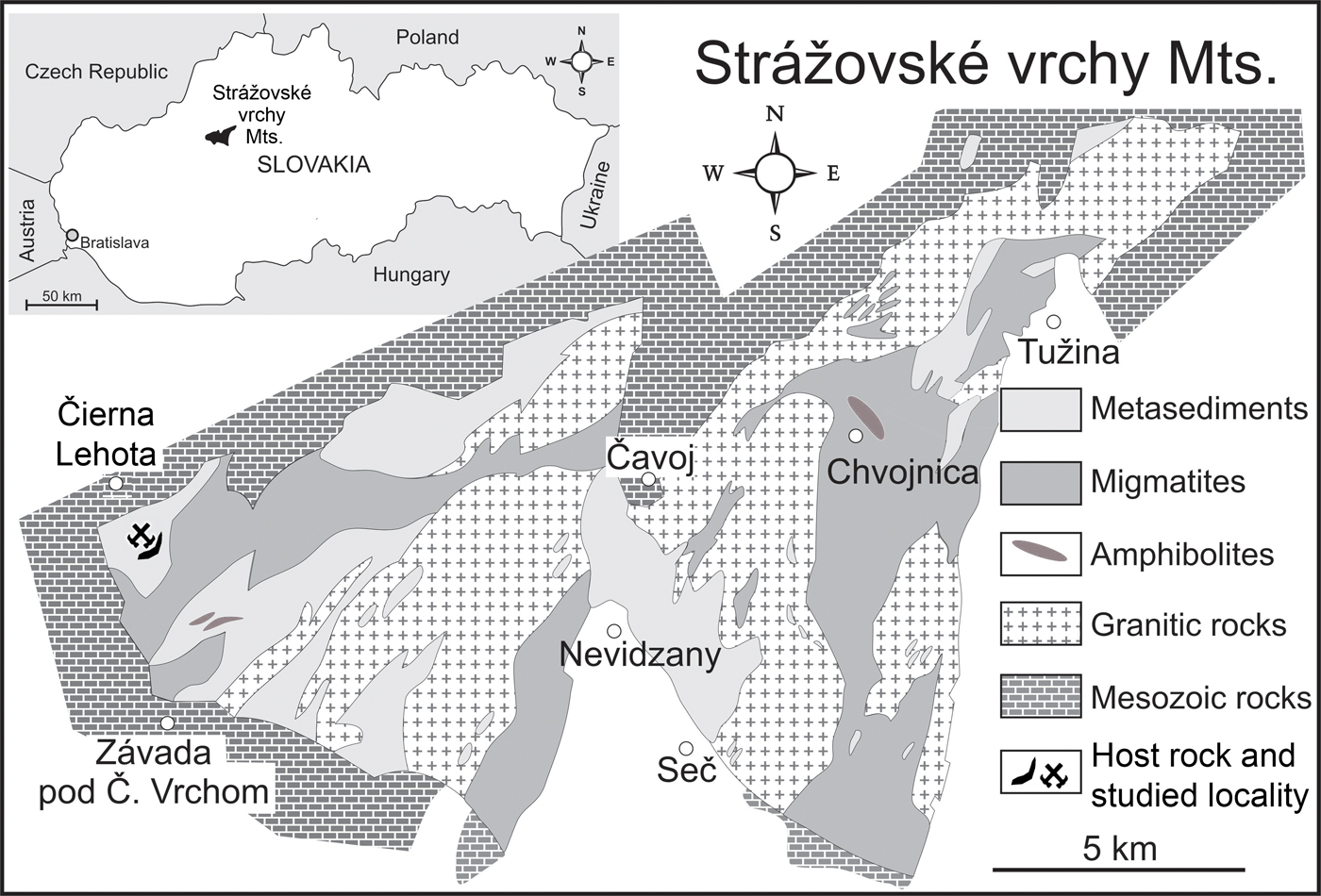
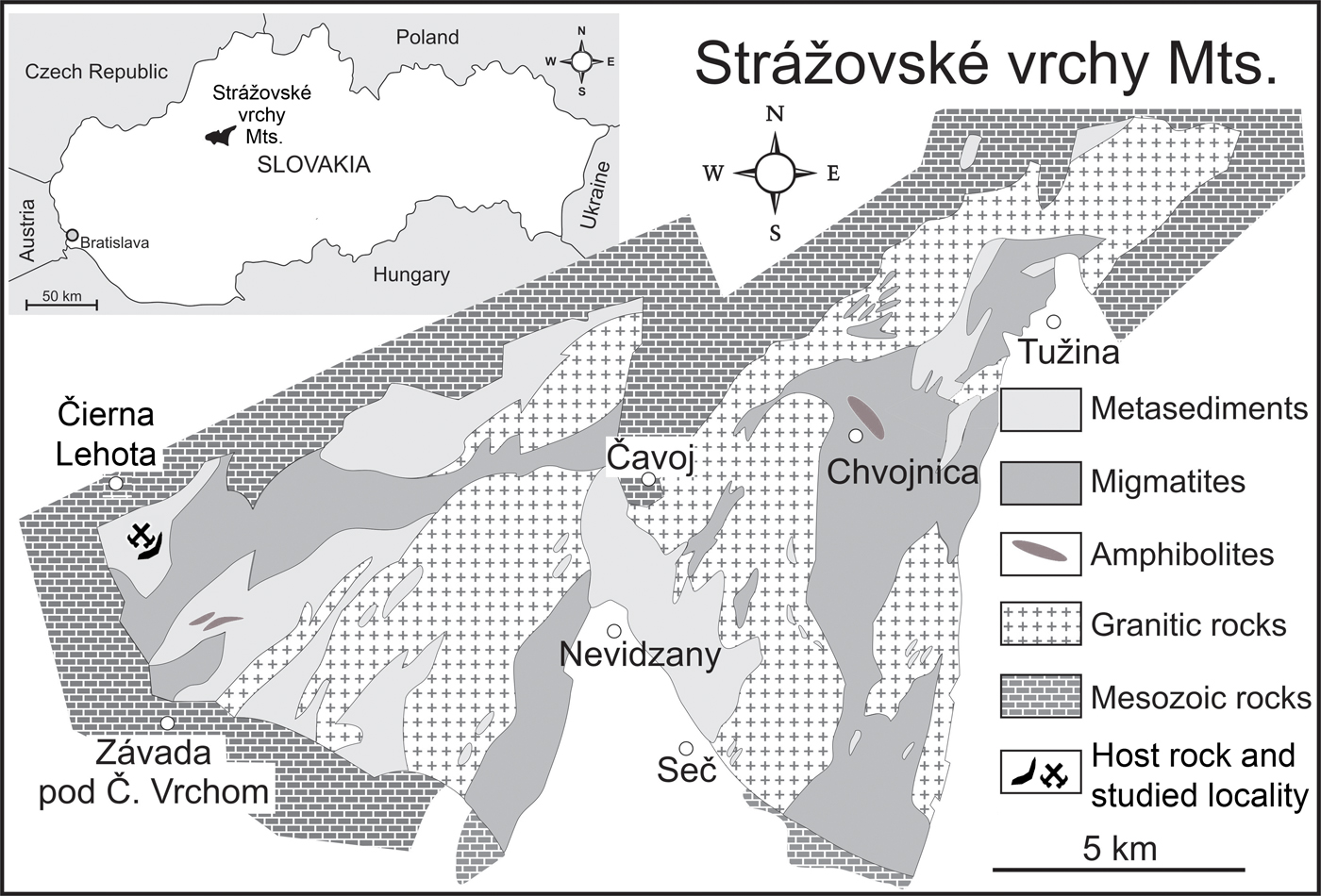
The occurrence of vanadian-chromian and sulfide mineralization investigated is situated 2 km SSE of Čierna Lehota village in the Strážovské vrchy Mountains, western Slovakia (Fig. 1). The Strážovské vrchy Mountains are part of the Tatric Superunit of the Central Western Carpathians (Plašienka et al., Reference Plašienka, Grecula, Putiš, Kováč, Hovorka, Grecula, Hovorka and Putiš1997) and they form part of the Tatra–Fatra Belt comprising the Tatric pre-Alpine, Lower Paleozoic crystalline basement and its Late Paleozoic to Mesozoic sedimentary cover (Plašienka et al., Reference Plašienka, Grecula, Putiš, Kováč, Hovorka, Grecula, Hovorka and Putiš1997). Together with the Vepor belt, the Tatra–Fatra Belt forms the inner Variscan zone of the Central Western Carpathians basement complexes. These contain medium- to high-grade metamorphic rocks and abundant granitic plutons.
Simplified geological map of the Strážovské vrchy Mountains showing the area of this investigation (modified after Maheľ et al. Reference Maheľ, Kahan, Gross, Vaškovský and Salaj1982)
The pre-Alpine Suchý–Malá Magura crystalline basement in the Strážovské Mountains consists of granitic rocks, migmatites, metapelites to metapsammites, amphibolites, schists and granitic rocks (Kahan, Reference Kahan and Maheľ1979, Reference Kahan1980; Hrouda et al., Reference Hrouda, Kahan and Putiš1983; Maheľ, Reference Maheľ1986; Hovorka and Méres, Reference Hovorka and Méres1991; Krist et al., Reference Krist, Korikovskij, Putiš, Janák and Faryad1992 and references therein). The metamorphosed sedimentary rocks represented by Lower Paleozoic gneisses, graphitic metasediments and metacherts underwent Variscan regional and contact metamorphism under greenschist- to amphibolite-facies conditions at ~300–500 MPa and 460–700°C (Korikovsky et al., Reference Korikovsky, Cambel, Miklóš and Janák1984; Vilinovičová, Reference Vilinovičová1990; Hovorka and Méres, Reference Hovorka and Méres1991; Krist et al., Reference Krist, Korikovskij, Putiš, Janák and Faryad1992; Dyda, Reference Dyda1994). The Suchý–Malá Magura crystalline complex is intruded by meso-Variscan (~350 Ma, Kráľ et al., Reference Kráľ, Hess, Kober, Lippolt, Grecula, Hovorka and Putiš1997; Finger et al., Reference Finger, Broska, Haunschmid, Hraško, Kohút, Krenn, Petrík, Riegler and Uher2003) peraluminous, garnet-bearing granitic rocks with S-type affinity (Hovorka and Fejdi, Reference Hovorka and Fejdi1983; Vilinovičová, Reference Vilinovičová1990; Broska and Uher, Reference Broska and Uher2001).
The host rocks of syngenetic pyrite and pyrrhotite and associated V-Cr-rich silicate mineralization are Lower Paleozoic, and probably Devonian, metamorphosed black shales, mainly gneisses, metaquartzites (metacherts), amphibole schists and amphibolites. The samples investigated are metabasic rocks (amphibolites to amphibole schists) with abundant disseminated sulfide mineralization consisting mainly of pyrite (euhedral cubic crystals up to 1 cm or anhedral aggregates up to several cm) and pyrrhotite (anhedral grains and irregular aggregates up to 4 cm) and also minor sphalerite and galena (both as anhedral grains and aggregates up to 1 cm). The mineralized black shales and metabasic rocks form a narrow, ~20 m thick zone trending SSW–NNE in biotite paragneisses of the Suchý–Malá Magura crystalline complex (Mikuš et al., Reference Mikuš, Chovan, Ponomarenko, Bondarenko and Grinchenko2013). The layers of basic amphibolite and amphibolite schist metavolcanic rocks and the associated carbon- and silica-rich oceanic sediments (black shales) deposited in anoxic conditions are remnants of an Upper Devonian oceanic ophiolite sequence in the Suchý–Malá Magura crystalline complex. They are presumed to be part of the Pernek Group of tectonic relicts of Variscan ophiolite in a suture created by oceanic closure in the Lower Carboniferous and then preserved in the Malé Karpaty and Suchý–Malá Magura crystalline basements (Ivan and Méres, Reference Ivan and Méres2015).
Analytical methods
The composition of garnets and epidote-supergroup minerals was determined using a CAMECA SX100 electron microprobe analyser (EMPA) in wavelength-dispersive spectrometric (WDS) mode (State Geological Institute of Dionýz Štúr, Bratislava), using the following analytical conditions: accelerating voltage 15 kV, beam current 20 nA and beam diameter 2 to 5 µm. The following standards were used: wollastonite (SiKα, CaKα), TiO2 (TiKα), ThO2 (ThMα), UO2 (UMα), Al2O3 (AlKα), pure V (VKα), pure Cr (CrKα), synthetic phosphates of La-Lu and Y (REELα), fayalite (FeKα), rhodonite (MnKα), pure Ni (NiKα), forsterite (MgKα), SrTiO3 (SrKα), baryte (BaKα), albite (NaKα), orthoclase (KKα), LiF (FKα) and NaCl (ClKα). Numerous interferences are present in the spectral lines of the measured elements, which were chosen to eliminate or at least minimize overlap. Empirical correction factors were applied where overlap persisted, and these were resolved for PbMα–YLγ2,3 and ThMζ1,2, UMβ–ThMγ, ThM 3 and ThN 4, UMβ–Kα, GdLα–CeLχ, GdLα–LaLα, Lχ2,3, GdLα–NdLβ2, LuLβ–DyLχ2,3, HoLχ and YbLβ2, EuLβ–DyLν, FeKα and MnKβ, ErLβ–EuLχ2,3, GdLχ and LuLν, SmLα–CeLβ2, TmLα–SmLχ, FKα–CeMζ1,3, FKα–MnLβ and FKα–FeLα (Konečný et al., Reference Konečný, Siman, Holický, Janák and Kollárová2004; Uher et al., Reference Uher, Ondrejka, Bačík, Broska and Konečný2015). The averaged 20 nA detection limits for REE-bearing minerals with their concentrations in ppm are as follows: S 150; Si 430; Ti 390; Th 410; U 660; Al 350; Cr 360; V 520; Y 640; La 880; Ce 750; Pr 800; Nd 685; Sm 730; Eu 940; Tb 940; Dy 1030; Ho 1180; Er 1380; Tm 1090; Yb 980; Lu 2210; Fe 550; Mn 450; Mg 390; Ca 190; Sr 550; Ba 420; Pb 470; Na 450; K 180; F 380; and Cl 190. The standard deviations (±1σ) vary between 0.02 and 0.3 wt.%, depending on the specific element concentration and peak measurement time between 10 and 90 s. Data were reduced with the PAP correction.
The structural formulae of garnet-supergroup minerals; {X 3}[Y 2](Z 3)φ12, were calculated based on eight cations (Grew et al., Reference Grew, Locock, Mills, Galuskina, Galuskin and Hålenius2013), and the epidote-supergroup minerals, A 2M 3[T 2O7][TO4](O,F)(OH,O), were normalized based on Σ(A + M+T) = 8 cations and the Armbruster et al. (Reference Armbruster, Bonazzi, Akasaka, Bermanec, Chopin, Gieré, Heuss-Assbichler, Liebscher, Menchetti, Pan and Pasero2006) procedure.
Instrumentation for laser ablation inductively coupled plasma mass spectrometry (LA-ICP-MS) analysis comprised the UP 213 laser ablation system (New Wave, USA) and the Agilent 7500 CE ICP-MS spectrometer (Agilent, Japan) at the Department of Chemistry, Masaryk University, Brno. A commercial Q-switched Nd-YAG laser ablation device working at the 5th harmonic frequency; corresponding to a 213 nm wavelength. The ablation device is equipped with a programable XYZ-stage to move the sample along a programed trajectory during ablation. Visual inspection and photographic documentation of analytical targets were accomplished with a built-in microscope/CCD-camera system.
The ablation cell was flushed with helium carrier gas to transport the laser-induced aerosol to the inductively coupled plasma (1.0 l/min), and a sample 0.6 l/min argon gas flow was mixed with the helium carrier gas flow behind the laser ablation cell. LA-ICP-MS conditions of gas flow rates, sampling depth and MS electrostatic lens voltage were optimized with NIST SRM 612 glass reference material to ensure maximum signal-to-noise ratio and minimum oxide formation (ThO+/Th+ counts ratio 0.2%, U+/Th+ counts ratio 1.1%). Hole drilling mode with fixed sample position during laser ablation was used for 40s for each spot; with 65 µm diameter (samples TSW), 13 J cm–2 laser fluence and 10 Hz. repetition rate. All element contents obtained by LA-ICP-MS measurement were normalized using Si as the internal standard.
Results
Garnet-supergroup minerals
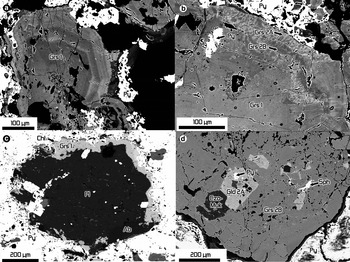
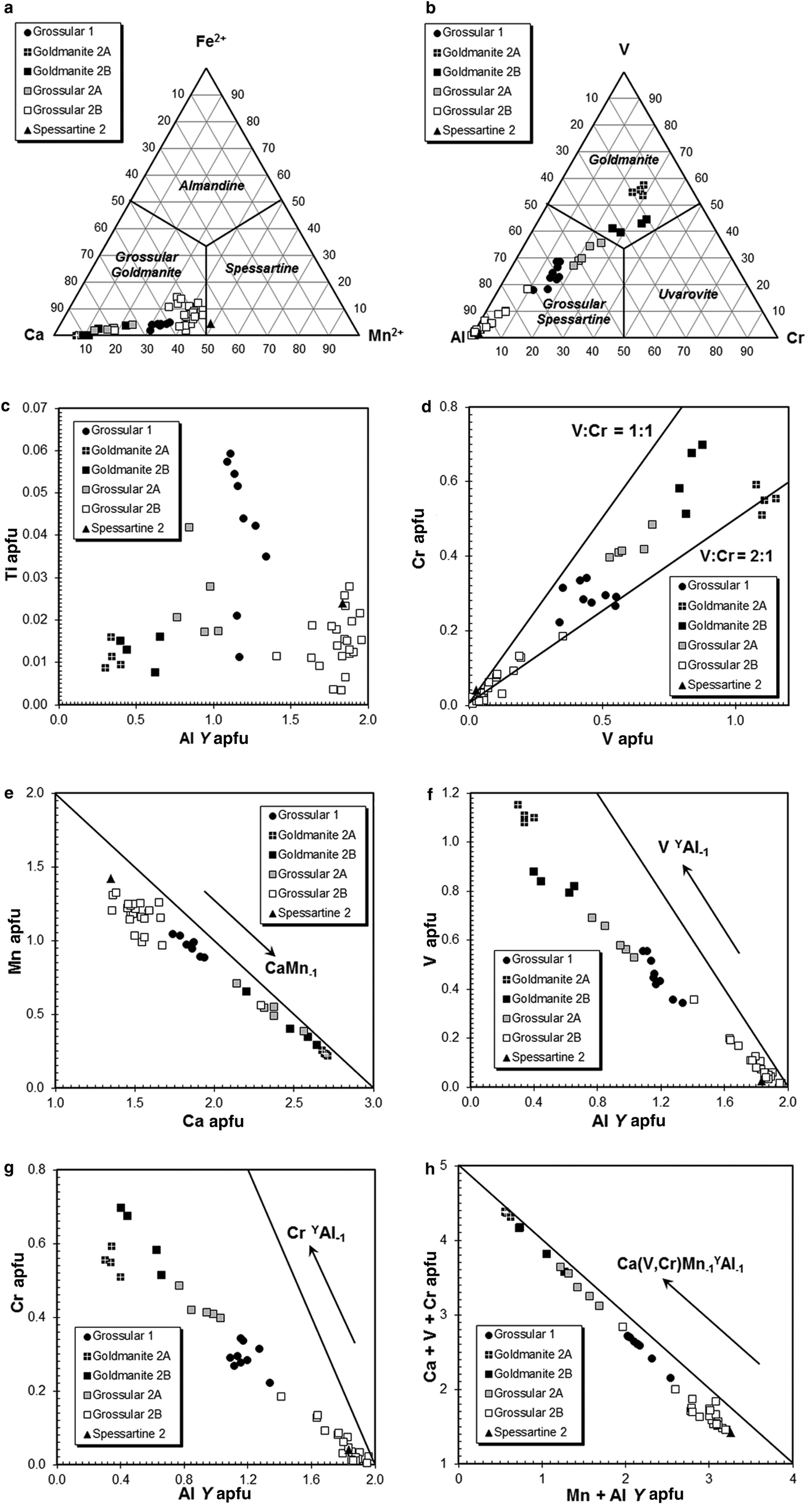
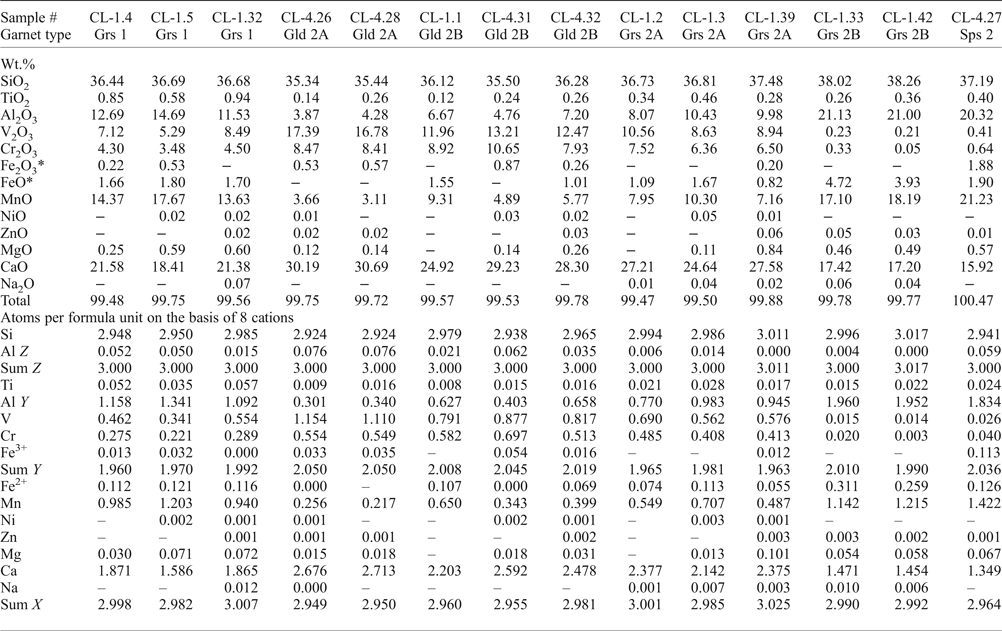
Garnets from Čierna Lehota form euhedral to subhedral isolated crystals up to 1 mm in size, and quite commonly, anhedral atoll-like overgrowths and aggregates ≤ 3 mm across (Fig. 2). Garnets have wide compositional range, especially in V, Cr and Al at the Y site, and Ca and Mn at the X site. Textural and compositional features indicated that there are two generations, G1 and G2, and five types of garnets (Table 1, Figs 2, 3a–b) in this study: V-Cr-rich grossular (Grs 1); goldmanite (Gld 2A) with highest V; Cr-rich goldmanite (Gld 2B) with lower V; V-Cr-rich grossular (Grs 2A); and solid solutions between Mn-rich grossular and spessartine (Grs-Sps 2B). The Grs1 garnet forms crystals with oscillatory zoning or relatively homogeneous grains and overgrowths on plagioclase (Fig. 2a–c), whereas the other garnet types have irregular patchy zoning or they are unzoned (Fig. 2b,d). Textural patterns indicate the primary and older origin of generation 1 (Grs 1), and the other four garnet types form the secondary and younger generation 2 (Gld 2A, Gld 2B, Grs 1A and Grs-Sps 2B)
Back-scattered electron images of garnets and associated minerals: (a) primary V-Cr and Mn-rich grossular (Grs 1) forming subhedral crystals with oscillatory zoning; (b) detail of homogeneous primary grossular crystal (Grs 1) with irregular alteration domains along the rim consisting of secondary grossular (pale grey Grs 2A and darker grey Grs 2B); (c) Grs 1 grossular on the rim of plagioclase (Pl) grain with albite (Ab), chlorite (Chl) and pyrite (Py); (d) large crystal of secondary grossular (Grs 2B) with irregular patchy domains of goldmanite (Gld 2A) in association with clinozoisite-mukhinite (Czo-Muk), sphalerite (Sph) and pyrite (Py).

Classification and substitution diagrams for garnet-supergroup minerals.

Representative compositions of garnet-supergroup minerals from Čierna Lehota.

*FeO and Fe2O3 were calculated from charge-balanced formula.
‘–’ = not detected
Each garnet type exhibits a specific composition (Table 1). The primary Grs 1 grossular is V-Cr and Mn-rich and contains 0.34–0.55 atoms per formula unit (apfu) V, 0.22–0.34 apfu Cr and 0.88–1.20 apfu Mn; YAl varies between 1.1 and 1.3 apfu. Chromium-rich (0.51–0.59 apfu Cr) goldmanite Gld 2A has the highest V content (1.1 apfu) but lower YAl (0.3 to 0.4 apfu) and Mn (0.22–0.26 apfu) contents. The Gld 2B goldmanite exhibits highest Cr (0.51–0.70 apfu) and slightly lower V (0.8–0.9 apfu) contents but elevated YAl (0.4 to 0.7 apfu) and Mn (0.29–0.65 apfu) concentrations. Grossular Grs 2A is V- and Cr-rich (0.53–0.69 apfu V, 0.40–0.49 apfu Cr) but has medium Mn concentrations (0.38–0.71 apfu) and lower YAl (0.8 to 1.0 apfu). Grossular–spessartine solid solution Grs-Sps 2B exhibits the lowest V and Cr concentrations (0.01–0.35 apfu V and 0.003–0.19 apfu Cr) but the highest contents of Mn (0.56–1.42 apfu) and also YAl (1.4–2.0 apfu).
Magnesium content is generally low in all garnet types; reaching a maximum of 0.10 apfu Mg in Grs 2A and Grs-Sps 2B. Garnet Fe concentrations are relatively low with maximum of 0.3 apfu (Fe3+ + Fe2+) in V-Cr-poor garnets; intermediate between grossular and spessartine in composition (Grs-Sps 2B).
Whereas garnet titanium contents are also generally low, the Grs 1 grossular has somewhat higher Ti concentrations (0.03–0.06 apfu) compared to secondary garnet types (<0.04 apfu Ti) (Table 1, Fig. 3c). Vanadium correlates positively with Cr, with the garnet V:Cr atomic ratio usually between 1:1 and 2:1 (Fig. 3d). Dominant garnet substitutions include CaMn–1 at the X site and (V,Cr)Al–1 at the Y site, resulting in coupled Ca(V,Cr)Mn–1Al–1 mechanism (Fig. 3e–h).
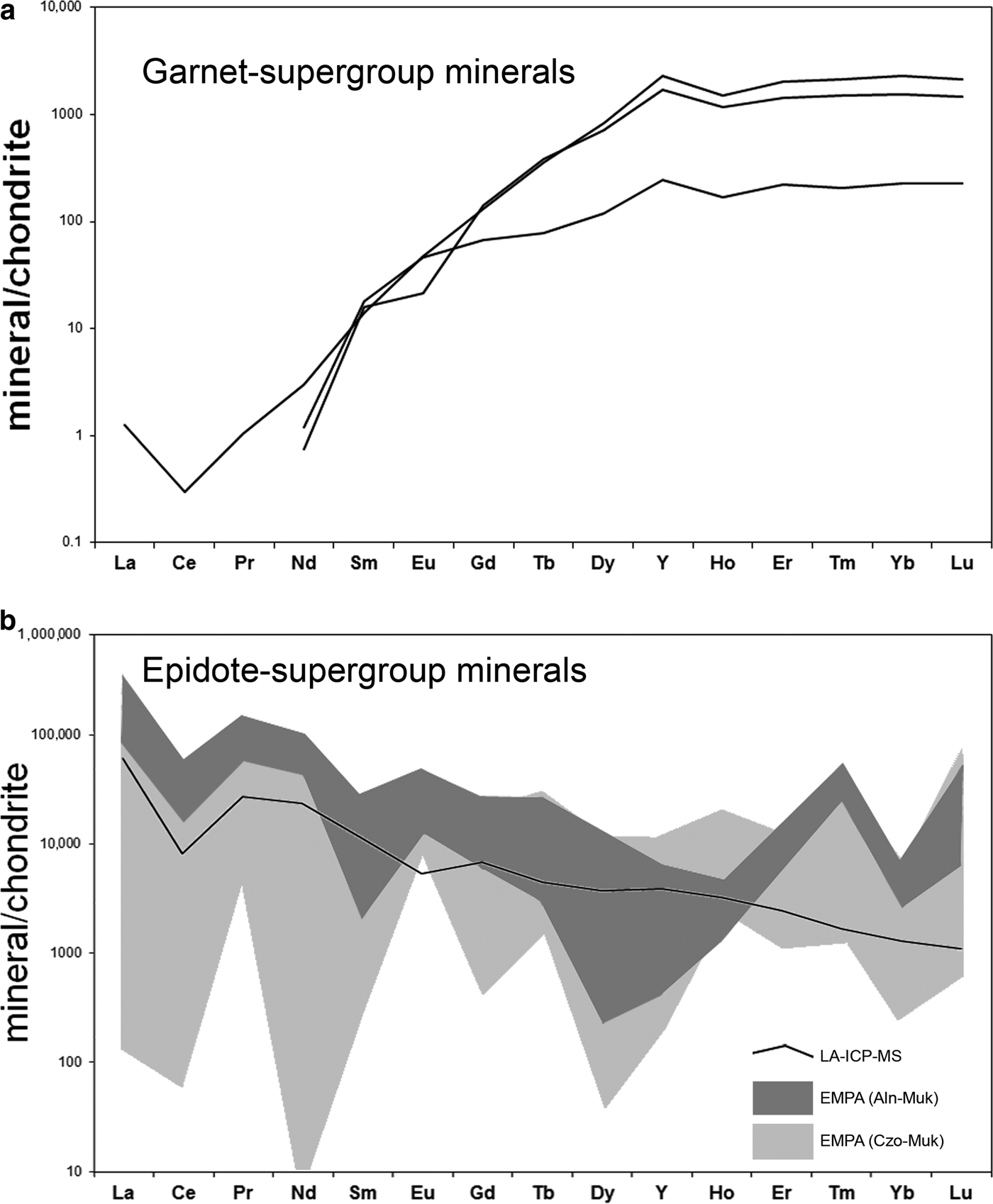
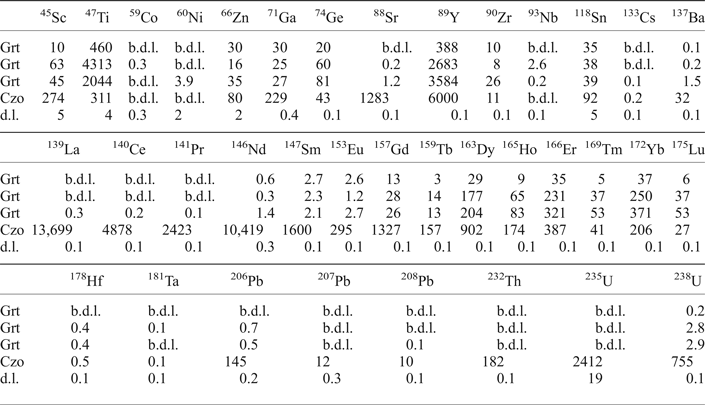
Garnet trace-element contents were determined by LA-ICP-MS (Table 2). Yttrium is the most abundant trace element with contents up to ~3600 ppm, and heavy REEs (HREE) are also relatively enriched, with Dy, Er and Yb varying between 30 and 370 ppm. The dominant role of HREE in garnets is documented in the chondrite-normalized REE diagram (Fig. 4a). The contents of other trace elements, including Ge, Ga, Zr, Zn and Sn, do not exceed 100 ppm.
Average chondrite-normalized REE distribution patterns of (a) garnet- and (b) epidote-supergroup minerals from Čierna Lehota based on LA-ICP-MS (a, b) and EMPA (b) data. Chondrite values from Anders and Grevesse (Reference Anders and Grevesse1989).

Contents of trace elements (in ppm) in garnet- and epidote-supergroup minerals. Analysed with LA-ICP-MS.

d.l.–detection limit; b.d.l.–below detection limit
Epidote-supergroup minerals
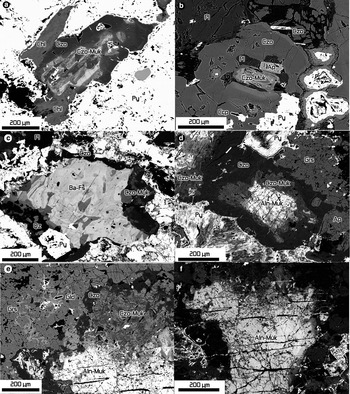
The Epidote-supergroup minerals occur as abundant anhedral crystals 0.1 to 2 mm in size. Although these single crystals are commonly isolated and surrounded by pyrite (Py) (Fig. 5a), in some places they occur in close association with other minerals; mainly with apatite (Ap), Ba-rich feldspar (Ba-Fs) and plagioclase (Pl) with variable anorthite content, and these constitute the primary mineral association (Fig. 5b,c). However, they are commonly overgrown by chlorite (Chl), quartz (Qz) and almost pure albite (Ab) (Fig. 5a), while pyrite and other rarer sulfides including chalcopyrite (Ccp) and sphalerite (Sph) commonly occur along fissures in epidote-supergroup minerals.
Back-scattered electron images of epidote-supergroup and associated minerals: (a) Isolated grain of epidote-supergroup mineral with distinct clinozoisite-mukhinite (Czo-Muk) and clinozoisite (Czo) zones overgrown by chlorite (Chl) and pyrite (Py); (b) Czo-Muk in association with plagioclase (Pl) and apatite (Ap) overgrown by Czo with chalcopyrite (Ccp) and Py; (c) Rim of Czo-Muk, Czo and quartz (Qz) around barium-rich feldspar (Ba-Fs); (d) grain of epidote-supergroup mineral with allanite-mukhinite (Aln-Muk) core and Czo-Muk and Czo zones associated with grossular (Grs) and Ap; (e) crystals of epidote- (Aln-Muk, Czo-Muk and Czo zones) and garnet- (Gld and Grs) group mineral in contact. Czo-Muk zone displays patchy zoning; (f) Aln-Muk zone of the crystal shown in (e) is cut by a system of parallel cracks that are spatially limited to this zone.

The epidote-supergroup minerals from Čierna Lehota have variable chemical zoning and evolution. Moreover, extensive compositional variation at the M sites, especially at the M1 and M3 sites, makes unambiguous site assignment difficult. Therefore, the occupancy of these sites is not divided in the formulae used here.
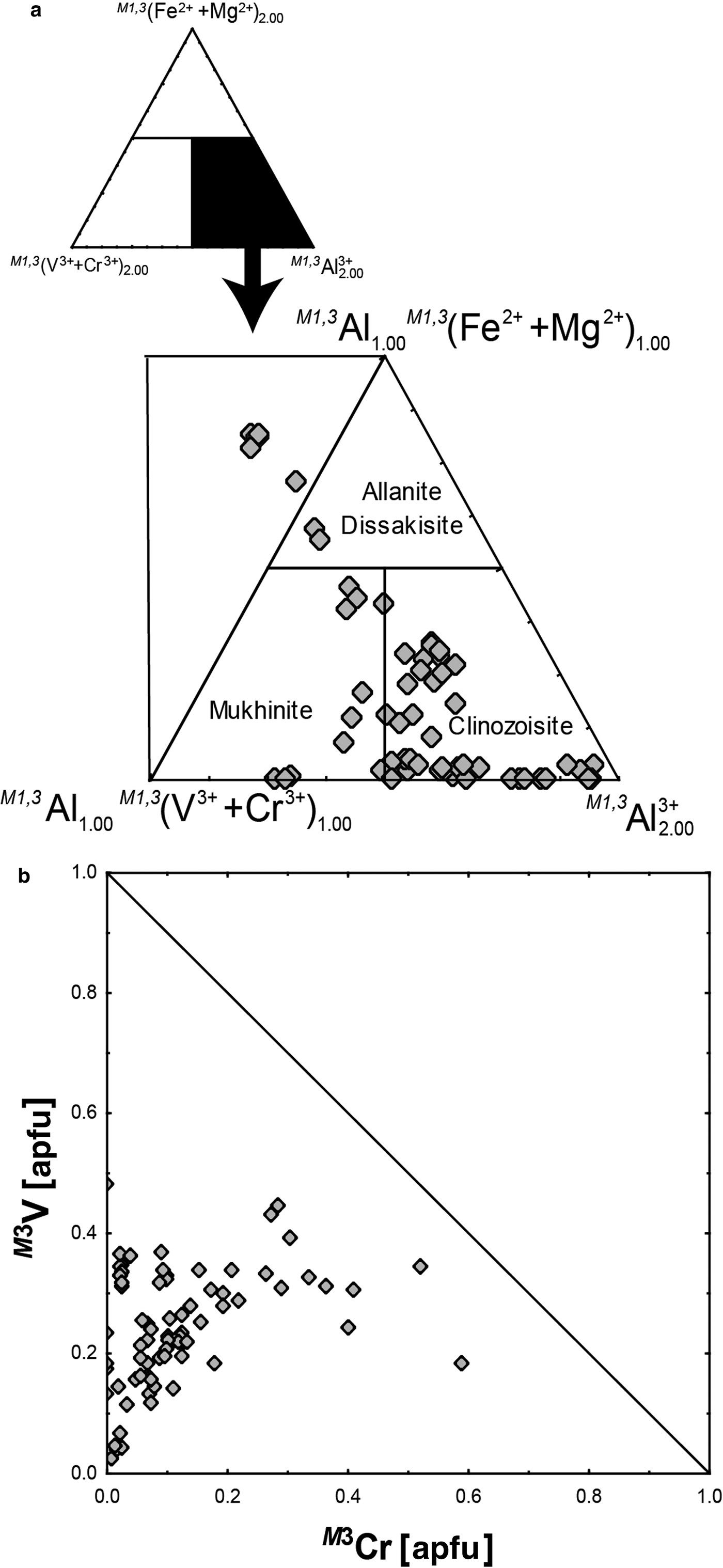
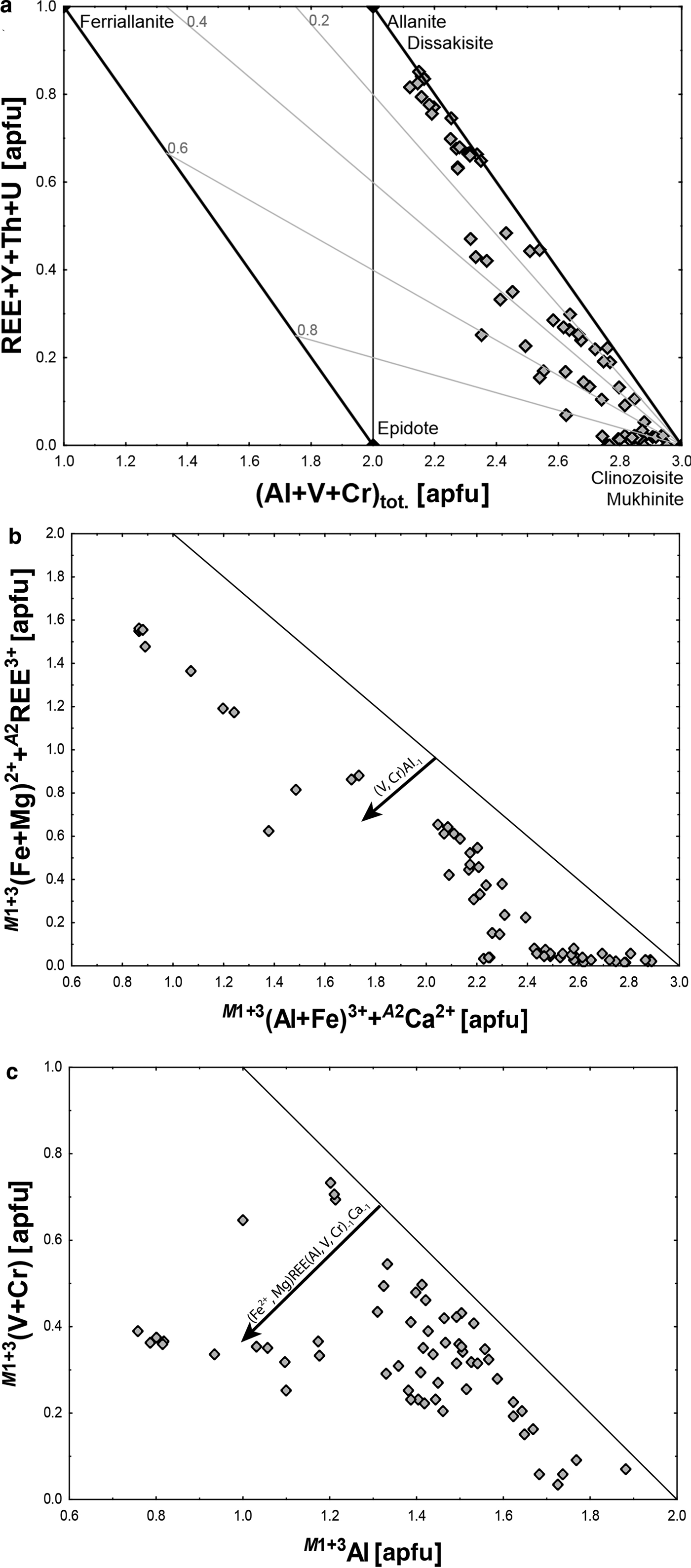
Some crystals have a complete zoning sequence with the oldest allanite-(La) and REE- and Mg-rich mukhinite containing a large proportion of dissakisite-(La) component (Aln-Muk) rimmed by V- and Cr-rich clinozoisite to mukhinite parts attaining compositions close to allanite-(La) composition (Czo-Muk) and V- and Cr-poor clinozoisite (Czo) (Figs 5 and 6). However, the majority of the epidote-supergroup minerals do not have completely evolved zones, with only Czo-Muk in the core and Czo on the rim (Fig. 5a). Chromium and V are correlated positively, but this correlation is relatively poor with considerable scatter in the data suggesting irregular distribution of Cr in the most Cr and V enriched zones (Fig. 6b).
Diagrams for epidote-supergroup minerals: (a) classification diagram involving dominant M1- and M3-site cations; (b) plot of M3V (apfu) vs. M3Cr (apfu).

The transition between zones is also irregular; where Czo-Muk penetrates and resorbs Aln-Muk (Fig. 5d,e). Although the border between Czo-Muk and Czo is irregular, it is sharper, and there is textural difference between zones; for example, Aln-Muk zone has a system of almost parallel cracks which do not extend to other zones (Fig. 5d,f). The Aln-Muk zone has weak compositional zoning with irregularly distributed zones with mukhinite-(La) composition (darker grey in back-scattered electron image) in major allanite-(La) (Fig. 5f). In contrast, the Czo-Muk zone displays very strong irregular zoning based on variations in V, Cr, Fe, Al and REE (Fig. 5e). Finally, the Czo zone has weak zoning induced by the decrease in V and Cr from the border between Czo-Muk and Czo towards the outer rim (Fig. 5a).
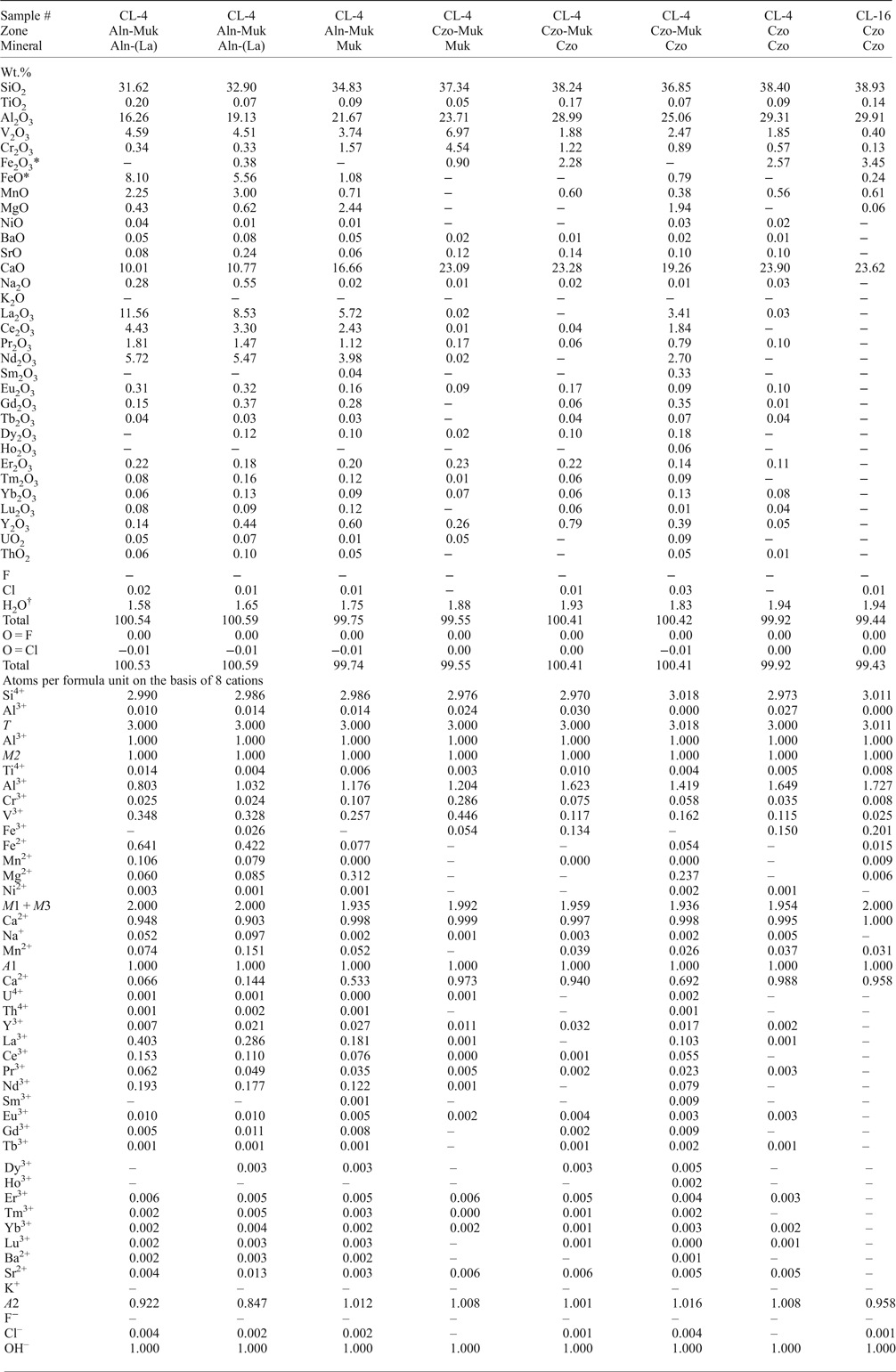
Allanite-(La) and Mg- and REE-rich mukhinite is the most enriched in La (up to 0.407 apfu), the La/Ce ratio is 2.05–2.62, the La/Nd ratio is 1.47–2.10, and even the content of Nd (0.076–0.204 apfu) is higher than Ce (0.036–0.158 apfu) and Nd/Ce is 1.25–2.12, resulting in a negative Ce anomaly (Table 3). Ferrous iron usually dominates over Mg in most of the Aln-Muk zone with Fe2+/(Fe2++Mg) between 0.79 and 0.91; Mg is the dominant divalent cation at the M3 site only in irregular zones and veins of mukhinite, with Fe2+/(Fe2++Mg) between 0.11 and 0.20 (Table 3). Both allanite-(La) and Mg- and REE-rich mukhinite are also rich in V (0.14–0.36 apfu) and Cr (0.02–0.11 apfu). The structural formulae of allanite-(La) suggest that some V and/or Cr is located at the M1 site; at least in compositions with MAl content lower than 2 apfu (Fig 6b). However, without crystallographic data it is impossible to determine the actual extent of the Al-Cr and/or Al-V disorder. Allanite-(La) is also enriched in Mn2+ (0.09–0.23 apfu) and Mg- and REE-rich mukhinite is slightly depleted, with Mn only up to 0.05 apfu (Table 3). Stoichiometry of the analyses requires that part of the Mn is located at the A1 site. Interestingly, allanite-(La) is enriched in Na (0.05–0.10 apfu), while it is only slightly above the detection limit (up to 0.003 apfu) in mukhinite and in other zones apart from the REE-rich Czo-Muk.
Representative compositions of epidote-supergroup minerals from Čierna Lehota (wt.%) and converted to apfu on the basis of 8 cations according to the procedure in Armbruster et al. (Reference Armbruster, Bonazzi, Akasaka, Bermanec, Chopin, Gieré, Heuss-Assbichler, Liebscher, Menchetti, Pan and Pasero2006).

*Fe2O3 and FeO calculated from charge-balanced formula; †H2O calculated assuming OH = 1 pfu
The Czo-Muk zone displays large compositional variability. When the Aln-Muk core is present, the composition of epidote-supergroup minerals in the Czo-Muk zone is REE-enriched with up to 0.40 apfu (Table 3). Interestingly, the proportions of individual REE differ from the proportions in Aln-Muk in that the La/Ce ratio is 2.05–2.13 and the Nd/Ce ratio is 2.08–2.13. Furthermore, the La/Nd ratio in Czo-Muk is 0.96–1.03 which indicates that Nd is the dominant REE in part of this zone. In contrast, the REE content is lower in crystals lacking the Aln-Muk core; not exceeding 0.36 apfu REE and usually below 0.1 apfu. However, the REE-depleted parts of crystals are enriched in V (up to 0.45 apfu) and Cr (up to 0.29 apfu) attaining mukhinite composition (Table 3). The REE-rich and REE-depleted parts of Czo-Muk zone are well separated, but irregular in spatial distribution.
Aluminium is the most abundant octahedral cation, fully occupying the M1 and M2 sites (except for possible disorder with V and Cr) and it varies between 0.22 and 0.71 apfu at the M3 site. After V, Fe2+ is the third most abundant octahedral cation with up to 0.38 apfu. The Mg content also increases in some places up to 0.26 apfu. Both Fe2+ and Mg correlate well positively with REE content. Moreover, part of the Fe (up to 0.20 apfu) is calculated as ferric. Although Mn is lower with no more than 0.06 apfu compared to its concentration in the Aln-Muk zone, it can increase up to 0.12 apfu, but only in parts attaining allanite composition.
The most external zone has the following composition; REE- (up to 0.02 apfu), V- (up to 0.07 apfu) and Cr-poor clinozoisite (up to 0.04 apfu). The content of divalent octahedral cations such as Fe2+ (up to 0.03 apfu), Mg (up to 0.01 apfu) and Mn (up to 0.04 apfu) is also very low, which makes Fe3+ (0.01–0.20 apfu) the dominant substituent of Al in octahedral sites. The A sites are dominated by Ca (1.96–1.99 apfu).
The composition of epidote-supergroup minerals is influenced by several sets of coupled substitutions. Heterovalent substitutions expressed as A23+M 2+(A22+M 3+)–1 result in a compositional trend from clinozoisite to allanite-(La) and dissakisite-(La) (Fig. 7a). The resulting trend (Fig. 7b) is the sum of several substitutions including REEFe2+(CaAl)–1, REEMg(CaAl)–1, REEMn2+(CaAl)–1 and REEFe2+(CaFe3+)–1. Deviations in the trend from an ideal correlation are due to homovalent substitutions at the M sites such as VAl–1 and CrAl–1 (Fig. 7c). Homovalent substitutions at the A2 site are limited only to variations in REE, and the increase in Na in allanite-(La) can be attributed to the coupled heterovalent substitution A1NaR3+(A1CaR2+).
Substitution diagrams for epidote-supergroup minerals. Fig. 7a modified after Petrík et al. (Reference Petrík, Broska, Lipka and Siman1995)

Epidote-supergroup minerals are enriched in U, Sr, Sc, Ga and Pb, whereas other elements including Sn, Ge and Ba are <100 pm in concentrations. Enrichment in REE is also documented in LA-ICP-MS analysis (Table 2). Chondrite-normalized distribution patterns from EMPA and LA-ICP-MS are similar and show marked negative Ce anomalies (Fig. 4b). Whereas patterns from EMPA analyses have positive Eu anomalies, the LA-ICP-MS Eu anomaly is also negative.
Discussion and conclusions
Crystal chemistry of garnet-supergroup minerals
All five compositional types of garnets from Čierna Lehota have notable enrichment in V, Cr and partly also Mn. The garnet minerals primarily belong to a complex goldmanite–uvarovite–grossular–momoiite–spessartine solid solution. On the basis of textural relationships, the primary metamorphic grossular (Grs 1) contains elevated V, Cr and Mn concentrations (0.34–0.55 apfu V, 0.22–0.34 apfu Cr and 0.88–1.20 apfu Mn). This grossular is interpreted as a precursor to secondary goldmanite and grossular–spessartine solid solution (Gld 2A, Gld 2B, Grs 2A, Grs 2B–Sps 2, Fig. 3), which form irregular domains with convolute, vermicular, lamellar and mosaic textures, locally riddled with tiny voids. The secondary garnet has partly replaced the primary Grs 1 grossular (Fig. 2b,d). These textures and microporosity indicate later-stage metasomatic alteration of Grs 1 by a fluid-driven dissolution-reprecipitation process (Putnis Reference Putnis2002, Reference Putnis, Oelkers and Schott2009). Consequently, these two processes of primary metamorphic crystallization and secondary metasomatic overprint caused the unusual compositional variability and complex V-Cr- and Mn-rich compositions of the Čierna Lehota garnets.
The vanadium-rich garnets (V-rich grossular to goldmanite), commonly in association with other V-rich silicate phases (mainly minerals of the epidote supergroup, mica supergroup, pyroxene group, amphibole supergroup and titanite) have been reported from numerous metamorphic rocks enriched in organic carbon and vanadium and V-rich silicate minerals (Moench and Meyrowitz, Reference Moench and Meyrowitz1964; Shepel and Karpenko, Reference Shepel and Karpenko1969; Karev, Reference Karev1974; Litochleb et al., Reference Litochleb, Novická and Burda1985, Reference Litochleb, Sejkora and Šrein1997; Benkerrou and Fonteilles, Reference Benkerrou and Fonteilles1989; Pan and Fleet, Reference Pan and Fleet1991; Jeong and Kim, Reference Jeong and Kim1999). However, these V-rich garnets are usually poor in Cr and Mn. Rarely, V-rich grossular–goldmanite also have distinct Cr enrichment (Filippovskaya et al., Reference Filippovskaya, Shevnin and Dubakina1972; Uher et al., Reference Uher, Chovan and Majzlan1994, Reference Uher, Kováčik, Kubiš, Shtukenberg and Ozdín2008; Canet et al., Reference Canet, Alfonso, Melgarejo and Jorge2003; Makrygina et al., Reference Makrygina, Petrova, Koneva and Suvorova2004). Moreover, a distinctive compositional group comprises Mn-rich vanadian garnets, including the Mn,V-rich grossular–V-rich spessartine–momoiite (Mn3V2Si3O12)–Mn-rich goldmanite solid solution from several metamorphic Mn deposits in Japan (Momoi, Reference Momoi1964; Kato et al., Reference Kato, Shimizu, Okada, Komuro and Takeda1994; Tanaka et al., Reference Tanaka, Endo, Minakawa, Enami, Nishio-Hamane, Miura and Hagiwara2010; Matsubara et al., Reference Matsubara, Miyawaki, Yokoyama, Shigeoka, Miyajima, Suzuki, Murakami and Ishibashi2010) and also in the Domoradice graphite deposit in the Czech Republic (Černý et al., Reference Černý, Litochleb and Šrein1995).
Crystal chemistry of epidote-supergroup minerals
The crystal chemistry of V-, Cr- and REE-rich epidote-supergroup minerals from Čierna Lehota is influenced by a variety of substitutions. For example, Cr and V are incorporated in both the REE-free (e.g. Shepel and Karpenko, Reference Shepel and Karpenko1969; Treolar, Reference Treloar1987a) and REE-rich epidote-supergroup minerals members. (Ovchinnikov and Tzimbalenko, Reference Ovchinnikov and Tzimbalenko1948; Rao and Babu, Reference Rao and Babu1978; Treolar and Charnley, Reference Treloar and Charnley1987; Yang and Enami, Reference Yang and Enami2003; Bačík and Uher, Reference Bačík and Uher2010); In Čierna Lehota, these elements are present in both REE-rich and REE-free compositions. Vanadium content is the highest in the Czo-Muk zone where it attains the mukhinite composition with up to 0.45 V apfu (7.0 wt.% V2O3).
Both Cr and V occupy the octahedral M sites by homovalent substitutions with Al. Vanadium usually enters the structure of epidote-supergroup minerals as V3+ because only an extremely oxidizing environment allows V5+ stabilization in epidote-supergroup minerals (Gieré and Sorensen, Reference Gieré and Sorensen2004). The behaviour of Cr in the epidote-supergroup minerals structure is unclear due to the possible Al–Cr disorder between the M1 and M3 sites (Armbruster et al., Reference Armbruster, Bonazzi, Akasaka, Bermanec, Chopin, Gieré, Heuss-Assbichler, Liebscher, Menchetti, Pan and Pasero2006, Nagashima et al., Reference Nagashima, Akasaka, Kyono, Makino and Ikeda2007). It is even more enigmatic in the light of previous research on Cr-rich clinozoisite from Finland and Japan with presumed exsolution of a V- and Cr-bearing phase from a clinozoisite structure (Nagashima et al., Reference Nagashima, Armbruster, Herwegh, Pettke, Lahti and Grobéty2011). If a V- and Cr-bearing epidote-supergroup mineral phase showing Al–Cr disorder, such as the amorphous phase reported by Nagashima et al. (Reference Nagashima, Armbruster, Herwegh, Pettke, Lahti and Grobéty2011), were present in epidote-supergroup minerals from Čierna Lehota, we found no evidence for it in the available analytical data. Indeed, we are not aware of any evidence reported for Al–V3+ disorder at the M1 and M3 sites, although potentially such disorder is possible in epidote-supergroup minerals. However, the abundance of octahedral cations other than Al, including Fe2+, Mn2+ and V in some compositions of allanite-(La) from Čierna Lehota, suggests that V could be distributed in both M1 and M3 sites. This presumption is based on the geometry of the octahedral sites, where the M3 site is larger and more distorted than both M1 and M2 sites (Dollase, Reference Dollase1968) and also on REE occupancy at the A2 site, which requires divalent cations in the M3 octahedra (Nagashima et al., Reference Nagashima, Akasaka, Kyono, Makino and Ikeda2007). Vanadium, which is smaller (0.64 Å) than Fe2+ (0.78 Å) and Mn2+ (0.83 Å), is the most probable substituent for Al3+ (0.535 Å, radii from Shannon, Reference Shannon1976). Notably, allanite-(La) with an excess of V3+, Fe2+ and Mn2+ is poor in Cr, which could be entirely accommodated at the M1 site.
Vanadium was probably remobilized by metamorphic processes from the organic matter and incorporated into silicate minerals (Canet et al., Reference Canet, Alfonso, Melgarejo and Jorge2003; Uher et al., Reference Uher, Kováčik, Kubiš, Shtukenberg and Ozdín2008 and references therein) and the Cr source is probably related to magmatic processes. Torrez-Ruiz et al. (Reference Torres-Ruiz, Pesquera and López Sánchez-Vizcaíno2003) suggested the following two origins of the Cr-bearing metamorphic minerals: (1) the activity of Cr-rich hydrothermal fluids produced from the alteration of mafic/ultramafic rocks; and (2) metamorphic reactions inducing the destruction of preexisting Cr-rich phases. However, there is no direct evidence for either of these interpretations in Čierna Lehota, where metamafic rocks could be the source of Cr, but the influence of the hydrothermal processes is not evident. Although, residual chromium minerals such as Cr-spinel were not observed in the samples, these may have been completely decomposed during metamorphism. It is probable that a combination of these processes played a part and moreover, heterogeneity of Cr distribution can result from Cr immobility under metamorphic conditions following chromite decomposition (Nagashima et al., Reference Nagashima, Akasaka and Sakurai2006).
One of the characteristic features of the epidote-supergroup minerals studied is the irregular Czo-Muk zone texture (Fig. 2). While developed zones can be attributed mainly to REE variations, there is also a difference in Cr content whereby REE-richer zones are slightly depleted in Cr. These can be interpreted as the product of a metasomatic alteration and dissolution-reprecipitation process (Putnis, Reference Putnis2002, Reference Putnis, Oelkers and Schott2009) by fluids with a high alkali content. A similar phenomenon is observed in secondary domains in garnet where this process could be connected with partial exsolution of a zone richer in REE and poorer in Cr due to lower mobility of Cr during metamorphic processes (Treolar, Reference Treloar1987b; Nagashima et al., Reference Nagashima, Akasaka and Sakurai2006).
On the basis of poor X-ray and electron diffraction patterns, Nagashima et al. (Reference Nagashima, Armbruster, Herwegh, Pettke, Lahti and Grobéty2011) initially considered that Cr-rich clinozoisite from Finland and Japan resembles metamict epidote-supergroup minerals. However, it does not contain significant U or Th as potential sources of radiation and destruction of lattice periodicity, so consequently they concluded that increased Cr and V content in these samples is due to the presence of a Cr- and V-bearing amorphous phase, which is not part of the clinozoisite structure. Rare-earth-element-dominant epidote-supergroup minerals may also contain an increased Cr content. Consequently, the exsolution of a Cr- and V-bearing amorphous phase presumed in Cr-rich clinozoisite from Finland and Japan (Nagashima et al., Reference Nagashima, Armbruster, Herwegh, Pettke, Lahti and Grobéty2011) may also result in development of zones with higher and lower Cr content in our samples, and therefore the zones with a higher proportion of the above-mentioned amorphous phase would have lower REE contents. However, proving, or disproving, each interpretation requires a more detailed analytical approach.
Incorporation of the REE in the epidote-supergroup minerals structure results from complex substitutions involving the 10-coordinated A2 site and the octahedral M3 site (Rouse and Peacor, Reference Rouse and Peacor1993). The REE may be included in the Fe2+REEFe3+–1Ca–1 substitution in the epidote–allanite solid solution (Ercit, Reference Ercit2002). This substitution produces an allanite-(La) composition in the epidote-supergroup minerals from Čierna Lehota. More rarely, Mg-dominant dissakisite composition results from REEMgCa–1Al–1 substitution (Enami and Zang, Reference Enami and Zang1988). Whereas REEMgCa–1Cr–1 substitution appears to be present in Cr-rich dissakisite from Outokumpu (Treolar and Charnley, Reference Treloar and Charnley1987) and substitution from Pezinok–Rybníček is REEMgCa–1V–1 (Bačík and Uher, Reference Bačík and Uher2010). Importantly, all these substitutions play a role in variations of the Čierna Lehota epidote-supergroup minerals composition. Enrichment in Mn was also observed in the Aln-Muk zone of the epidote-supergroup minerals studies, and this may result from the combination of REEMnCa–1Al–1, REEMnCa–1V–1 and REEMnCa–1Cr–1 substitutions. Interestingly, Mn decreases in the outer zones of epidote-supergroup minerals crystals. While this can be explained by the chemical properties of younger clinozoisite and mukhinite with distinctly lower REE content, whereby trivalent cations are preferred. It is unlikely that Mn3+ is present because of the reducing environment resulting from the presence of organogenic carbon at Čierna Lehota. Moreover, Mn is preferentially incorporated at the 8-coordinated site in garnet relative to epidote-supergroup minerals. This preference is evident in Čierna Lehota garnets because the increased spessartine component can be correlated with the Czo-Muk zone in epidote-supergroup minerals.
However, the sum of typical octahedral cations is higher than 3 apfu in some compositions in the Aln-Muk zone. Although this may be explained by analytical errors, assigning part of the Mn2+ to the A1 site can easily solve the problem. The substitution of Mn for Ca at A1 is common in allanite-group minerals, resulting in A1Mn-dominant end-members such as manganiandrosite-(La) (Bonazzi et al., Reference Bonazzi, Menchetti and Reinecke1996) and ferriandrosite-(La) (Nagashima et al., Reference Nagashima, Nishio-Hamane, Tomita, Minakawa and Inaba2015). Moreover, A1Ca-dominant vanadoallanite-(La) and ferriakasakaite-(La) also contain a significant proportion of A1Mn (Nagashima et al., Reference Nagashima, Nishio-Hamane, Tomita, Minakawa and Inaba2013, Reference Nagashima, Nishio-Hamane, Tomita, Minakawa and Inaba2015).
Evolution of garnet- and epidote-supergroup minerals
The relationship of the silicate minerals investigated to associated minerals is usually difficult to deduce because of the strong tectonic reworking and hydrothermal alteration of the host rock; resulting in the silicate minerals being surrounded and isolated by pyrite (Figs 2, 5). On the basis of textural relationships, we assume that epidote-supergroup minerals, garnets, apatite, Ba-rich feldspar and plagioclase form a primary metamorphic association. These metamorphic minerals are typically overgrown by late chlorite and quartz (Figs 2, 5). Moreover, the younger pyrite, and locally chalcopyrite and sphalerite commonly fill fissures in silicate minerals (Figs 2, 5).
It is difficult to correlate individual epidote-supergroup minerals and garnet compositions to associated minerals but some relationships can be inferred. The Aln-Muk is obviously the oldest generation in epidote-supergroup minerals because it is never isolated but always overgrown by Czo-Muk, and it may represent the first stage of progressive metamorphism. The system of cracks localized only in the epidote-supergroup minerals Aln-Muk core suggests that it was overprinted by tectonic processes before the formation of the Czo-Muk zone. The Czo-Muk zone of epidote-supergroup minerals is synchronous with Gld 2A garnet, as indicated by their close association with well-defined boundaries between grains, but is older than the secondary Grs 2B garnet types that enclose it (Fig. 2d). This also demonstrates that Aln-Muk is older than all the garnet. Apatite and plagioclase probably crystallized contemporaneously with Czo-Muk and are older than Czo (Fig. 5b). However, Czo-Muk is younger than Ba-rich K-feldspar because it forms on the feldspar crystal rim (Fig. 5c), and the youngest Czo probably formed with Grs 2 (Fig. 5e).
The evolution of the mineralization can be compared to the occurrence of V-Cr-rich silicate mineralization in Pezinok–Rybníček, which is analogous to Čierna Lehota in geological position, age, whole-rock composition and metamorphic evolution (Uher et al., Reference Uher, Kováčik, Kubiš, Shtukenberg and Ozdín2008; Bačík and Uher, Reference Bačík and Uher2010). Enrichment of primary mafic volcanic rocks in specific elements including V, Cr, Fe and Mg is most probable due to their association with pyrite-pyrrhotite SEDEX mineralization (Uher et al., Reference Uher, Kováčik, Kubiš, Shtukenberg and Ozdín2008). Primary rocks can be interpreted as ocean-ridge sedimentary rocks consisting of material from two different sources: altered N-MORB-type basalts; and ocean-floor siliceous sediments with a significant proportion of organic matter (Méres, Reference Méres2005).
The compositions of garnets in both the Čierna Lehota and Pezinok–Rybníček occurrences have V-Cr-rich members with a goldmanite–grossular–uvarovite solid solution. As in epidote-supergroup minerals, garnets from the Pezinok area are richer in V and Cr with dominant goldmanite composition and only partly changing to V-(Cr)-rich grossular (Uher et al., Reference Uher, Chovan and Majzlan1994, Reference Uher, Kováčik, Kubiš, Shtukenberg and Ozdín2008). In contrast, goldmanite is volumetrically a minor phase in Čierna Lehota with lower contents of both V and Cr than in the Pezinok area. Moreover, the Mn content is the main difference between these occurrences – Pezinok V-Cr garnets contain no more than 0.29 Mn apfu (Uher et al., Reference Uher, Kováčik, Kubiš, Shtukenberg and Ozdín2008), whereas Mn-rich grossular and spessartine (Grs 2B–Sps 2) in Čierna Lehota contain up to 1.42 Mn apfu (Table 1, Fig. 3a).
The zoning of epidote-supergroup minerals is also very similar to Pezinok–Rybníček with a REE enriched core and a V- and Cr-enriched intermediate zone decreasing to the clinozoisite composition rim (Bačík and Uher, Reference Bačík and Uher2010). While this coincidental enrichment in V and Cr is specific for these two localities, there are significant differences in epidote-supergroup minerals from Čierna Lehota and Pezinok–Rybníček. The REE-rich core in Čierna Lehota has mostly an allanite-(La) composition and the dissakisite-(La) component is dominant in only a few places, whereas this component generally dominates at Pezinok–Rybníček (Bačík and Uher, Reference Bačík and Uher2010). The intermediate zone in Pezinok–Rybníček is also richer in V and Cr with a significant proportion of the mukhinite component (Bačík and Uher, Reference Bačík and Uher2010), while V and Cr contents at Čierna Lehota are lower, resulting in a V- and Cr-bearing clinozoisite generally containing a low proportion of the mukhinite component. Negative Ce anomalies are characteristic of both the studied epidote-supergroup minerals and those from Pezinok–Rybníček (Bačík and Uher, Reference Bačík and Uher2010). This may have resulted from interaction between seawater, hydrothermal fluids and basalts with related hyaloclastites on the ocean floor (Méres, Reference Méres2005). The enrichment in HREE in the garnets can be attributed to structural requirements which result in a preference for HREE incorporation in garnet (e.g. Grew et al., Reference Grew, Marsh, Yates, Lazic, Armbruster, Locock, Bell, Dyar, Bernhardt and Medenbach2010).
These differences may have been caused by different palaeogeographical positions of the precursors to the two deposits. The mineralization at Pezinok–Rybníček primarily originated from V-, Cr- and C-rich mafic pyroclastic rocks on the deep ocean floor with the sedimentary admixture affected by volcano-exhalative processes (Uher et al., Reference Uher, Kováčik, Kubiš, Shtukenberg and Ozdín2008). Abundant pyrite and pyrrhotite produced by volcano-exhalative processes formed disseminated crystals or sulfide-rich stratiform layers and small localized SEDEX-type pyrite deposits in the ‘productive zones’ of the Pezinok-Pernek crystalline complex (Cambel, Reference Cambel1958). Although Čierna Lehota shares similar features, increased Mn content in garnets and Ba in feldspars (Bačík et al., unpublished data) suggest different volcano-exhalative processes. Barium in the form of baryte is typical in volcano-exhalative deposits, and while pyrrhotite- and pyrite-dominant mineralization originating from ‘black smokers’ at temperatures around 350°C contains baryte, larger amounts are produced by ‘white smokers’ at temperatures <300°C (Pirajno, Reference Pirajno1992, Reference Pirajno2009). Moreover, baryte is widely disseminated in ocean-floor sediments where it is related to strong upwelling and high productivity on continental margins (Koski and Hein, Reference Koski, Hein, Bliss, Moyle and Long2003). Consequently, although it is impossible to determine the origin of Mn and Ba on the basis of current data, their increased content at the Čierna Lehota deposit suggests that the protolith may have derived from an area further from the ocean ridge than the Pezinok–Rybníček protolith.
Regardless of all these differences, the multistage evolution of epidote-supergroup minerals and garnets is similar at both localities due to very similar geological settings. The early Variscan, low-grade greenschist-facies metamorphism observed in Pezinok–Rybníček, which resulted in a fine-grained silicate + carbonaceous matter + pyrite mineral assemblage in the mafic tuffs and metamorphic foliation (Uher et al., Reference Uher, Kováčik, Kubiš, Shtukenberg and Ozdín2008), is hard to see in the Čierna Lehota epidote-supergroup minerals and garnets, and therefore we question whether the early Variscan metamorphism affected Čierna Lehota. However, the Aln-Muk cores in epidote-supergroup minerals could have formed either during this stage or be a product of pre-Variscan volcanic processes. The development of V- and Cr-rich zones in both garnets (Grs 1) and epidote-supergroup minerals (Czo-Muk) could have resulted from late-Variscan contact metamorphism associated with the granite intrusion in the Suchý Massif. The situation is analogous to the development of epidote-supergroup minerals and garnets with similar compositions at Pezinok–Rybníček, where minerals with this composition formed coevally with the intrusion of granitoid in the Modra Massif (Uher et al., Reference Uher, Kováčik, Kubiš, Shtukenberg and Ozdín2008; Bačík and Uher, Reference Bačík and Uher2010). The decrease in temperature after the metamorphic peak resulted in a fluid-driven metasomatic overprint of primary metamorphic assemblage and formation of the REE-, V- and Cr-poor Czo epidote-supergroup-mineral zone and secondary garnet types (Gld 2A and 2B, Grs 2A and 2B, Sps 2). (3) The last stage highlights the differences between the two localities. The later and probable Alpine metamorphic association in Pezinok–Rybníček includes V- and Cr-free clinozoisite (Bačík and Uher, Reference Bačík and Uher2010). However, this composition was not observed in Čierna Lehota, where the Czo zone can be correlated to the Czo1 rim in Pezinok–Rybníček (Bačík and Uher, Reference Bačík and Uher2010). Therefore, the presence of chlorite on the rims of epidote-supergroup minerals and garnet crystals (Figs 2 and 5) in Čierna Lehota can be attributed either to the final low-T stage of retrograde metamorphic phase or to the Alpine low-temperature hydrothermal overprint.
Acknowledgements
We thank Patrik Konečný, Viera Kolárová and Ivan Holický, for assistance during the EMPA study, and Ray Marshall for the review of English language. We also thank the editors of Mineralogical Magazine and Masahide Akasaka and the anonymous reviewer for their detailed reviews which improved the quality of our work. This work was supported by the Slovak Research and Development Agency under the contracts APVV-14-0278, APVV-15-0050 and APVV-0081-10, and the Ministry of Education of Slovak Republic grant agency under the contracts VEGA-1/0079/15 and VEGA-1/0499/16.