Introduction
The order of tailed amphibians (Caudata or salamanders) includes 10 families, 66 genera, about 660 species (AmphibiaWeb, 2014) and displays a considerable variety of reproductive and developmental traits (Salthe, Reference Salthe1969; Nussbaum, Reference Nussbaum1985, Reference Nussbaum1987; Duellman & Trueb, Reference Duellman and Trueb1994; Wake & Hanken, Reference Wake and Hanken1996; Desnitskiy, Reference Desnitskiy2011). Several salamander species from the families Ambystomatidae and Salamandridae have been widely used as model organisms in embryological studies during the first half of 20th century (Beetschen, Reference Beetschen1996). During the second half of the last century, however, the South African clawed frog, Xenopus laevis, became the dominant amphibian developmental model (Gurdon & Hopwood, Reference Gurdon and Hopwood2000; Callery, Reference Callery2006). At the end of the 20th century, Nieuwkoop (Reference Nieuwkoop1996) considered the usefulness of various tailed and anuran species for the morphogenetic analysis of embryonic development and underlined the value of axolotls (Ambystomatidae) and newts (Salamandridae) for experimental analysis of early development. At the same time, Wake & Hanken (Reference Wake and Hanken1996) undertook an attempt to attract the attention of embryologists to the direct-developing lungless salamanders (Plethodontidae). Nonetheless, Xenopus laevis and its close relative, Xenopus tropicalis, represent the most popular model organisms for amphibian developmental biology at the beginning of 21st century (Hirsch et al., 2002; Khokha et al., Reference Khokha, Chung, Bustamante, Gaw, Trott, Yeh, Lim, Lin, Taverner, Amaya, Papalopulu, Smith, Zorn, Harland and Grammer2002).
This paper aims to re-draw attention to the early development of tailed amphibians and concentrates on comparative and phylogenetic aspects of their cleavage. Among salamanders, the period of embryonic cleavage was most thoroughly studied in the axolotl, Ambystoma mexicanum (Signoret & Lefresne, Reference Signoret and Lefresne1971, Reference Signoret and Lefresne1976; Hara, Reference Hara1977; Signoret, Reference Signoret1977, Reference Signoret1980; Lefresne et al., Reference Lefresne, Andeol and Signoret1998). These authors discovered and analyzed the midblastula transition (MBT); when the rate of cleavage divisions slows down, the cell synchrony is lost, and the initiation of major transcriptional genomic activation occurs. Afterwards, the MBT was thoroughly investigated in Xenopus laevis (Newport & Kirschner, Reference Newport and Kirschner1982a, Reference Newport and Kirschner1982b; Kimelman et al., Reference Kimelman, Kirschner and Scherson1987; Masui & Wang, Reference Masui and Wang1998; Collart et al., Reference Collart, Allen, Bradshaw, Smith and Zegerman2013). It is appropriate to remark, therefore, about some differences between the two species. In axolotl, development is blocked at MBT by the transcriptional inhibitor α-amanitin (Signoret, Reference Signoret1980; Lefresne et al., Reference Lefresne, Andeol and Signoret1998). In Xenopus, in contrast, the cellular desynchronization process is insensitive to α-amanitin treatment (Newport & Kirschner, Reference Newport and Kirschner1982a, Reference Newport and Kirschner1982b).
Conversely, the cleavage processes in some tailed and anuran species strongly differ from those in both Mexican axolotl and South African clawed frog. Interestingly, tailed species Cryptobranchus alleganiensis (Smith, Reference Smith1906) and Ensatina eschscholtzii (Collazo & Keller, Reference Collazo and Keller2010) as well as anuran species Ascaphus truei (Brown, Reference Brown1989) and Gastrotheca riobambae (del Pino & Loor-Vela, Reference del Pino and Loor-Vela1990) have large, yolky, and unpigmented eggs, the synchrony of cell divisions in which is usually already lost at the eight blastomere stage. In this context, two questions may be raised: (1) Which amphibian cleavage pattern is ancestral and which one is derived?; and (2) Does the cleavage pattern with MBT, which is characteristic of some tailed and anuran embryos (such as Ambystoma mexicanum and Xenopus laevis), represent a symplesiomorphy or a homoplasy?
A recent comparative survey (Desnitskiy, Reference Desnitskiy2014) of the embryonic cleavage process in the class Amphibia has used published data on 41 anuran and 22 caudate species and preliminary recognized four cleavage patterns, three of which occurred during the development of tailed amphibians. However, no strict phylogenetic analysis was fulfilled; the data were not mapped onto amphibian phylogenetic trees.
This paper deals with evolutionary analysis of salamander cleavage only, because the phylogeny of tailed amphibians is better understood and more stable than the phylogeny of anuran amphibians. Note that these two amphibian orders include about 660 species and 6400 species, respectively (AmphibiaWeb, 2014). Furthermore, the percentage of species for which there are precise data on cleavage pattern is much more in the case of tailed amphibians than in the case of anuran amphibians.
We collected published data on 36 species from six families of tailed amphibians with respect to two important characteristics of early ontogeny: (1) occurrence or absence of an extensive series of synchronous cleavage divisions in the animal hemisphere; and (2) the orientation of the third cleavage furrow (latitudinal, longitudinal or variable). Based on this, we analyzed comparative and phylogenetic aspects of salamander cleavage process. This is the first comparative study of the amphibian cleavage process (including MBT) within a phylogenetic framework.
Materials and methods
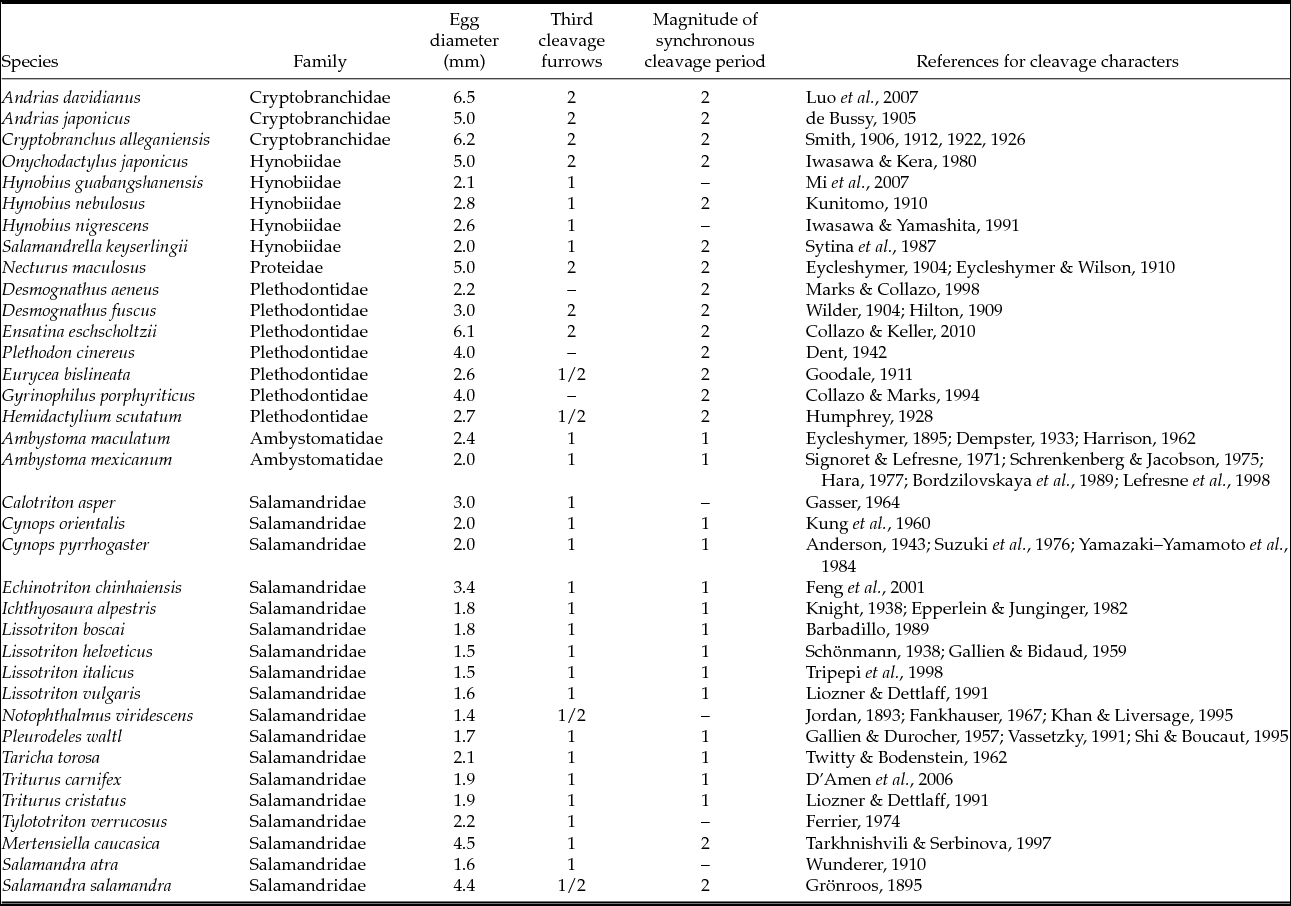
The information on cleavage pattern in 36 species (5.5% of the total number of salamander species) originates from both experimental embryological literature (if it exists for a given species) and zoological papers with morphological descriptions of early embryos (mostly developmental tables). References for cleavage pattern for each species are given in Table 1.
Egg diameter and cleavage characters in various species of tailed amphibians

Characteristics for third cleavage furrows: latitudinal furrows (1), longitudinal furrows (2), variable furrows (1/2).
Characteristics for the magnitude of synchronous cleavage period in the animal hemisphere: extensive period of synchronous divisions (1), short period of synchronous divisions (2).
Lack of data (–).
In the present paper, we analyzed two characteristics of early ontogeny: (1) the magnitude of synchronous cleavage period; and (2) the orientation of the third cleavage furrow. It should be especially noted that we also included in our analysis several caudate species with variable third cleavage furrows (latitudinal or longitudinal). Each characteristic was mapped onto the phylogenetic tree of tailed amphibians (San Mauro, Reference San Mauro2010; Vieites et al., Reference Vieites, Román, Wake and Wake2011; Wiens et al., Reference Wiens, Sparreboom and Arntzen2011; Zheng et al., Reference Zheng, Peng, Kuro-O and Zeng2011, Reference Zheng, Peng, Murphy, Kuro-O, Hu and Zeng2012; Shen et al., Reference Shen, Liang, Feng, Chen and Zhang2013). As outgroup taxa, we use literary data on the cleavage process in the primitive frog Ascaphus truei (Brown, Reference Brown1989), the caecilian Ichthyophis glutinosus (only magnitude of synchronous cleavage period for this species) (Svensson, Reference Svensson1938), and the lungfish Neoceratodus forsteri (Kemp, Reference Kemp1982). Lungfishes are close living relatives of land vertebrates (Brinkmann et al., Reference Brinkmann, Denk, Zitzler, Joss and Meyer2004a, Reference Brinkmann, Venkatesh, Brenner and Meyer2004b). It should be also noted that Ascaphus truei was chosen because Ascaphus and Leiopelma, both with large and yolk-rich unpigmented eggs (Bell, Reference Bell1978; Brown, Reference Brown1989; Bell & Wassersug, Reference Bell and Wassersug2003), are the most basal genera among extant frogs (Irisarri et al., Reference Irisarri, San Mauro, Green and Zardoya2010; Pyron & Wiens, Reference Pyron and Wiens2011; Zhang et al., Reference Zhang, Liang, Mao, Hillis, Wake and Cannatella2013), but there is no information about cleavage in Leiopelma.
The additional information on egg size (mean diameter of vitellus) in various species originates partly from the aforementioned literature on cleavage process as well as from AmphibiaWeb (2014) and several reviews on salamander reproductive biology (Salthe, Reference Salthe1969; Nussbaum, Reference Nussbaum1985, Reference Nussbaum1987; Davenport & Summers, Reference Davenport and Summers2010). We decided to map the character ‘egg size’ onto the phylogenetic tree as well. The published data on egg diameter are available for all 10 families of the tailed amphibians. Therefore, we have supplemented our analysis with four representative species from four caudate families, which have never been studied before with respect to cleavage: Amphiuma tridactylum (Amphiumidae), Dicamptodon ensatus (Dicamptodontidae), Rhyacotriton olympicus (Rhyacotritonidae), and Siren intermedia (Sirenidae). Egg diameter is about 3 mm in Siren (Reihard et al., Reference Reinhard, Voitel and Kupfer2013) and more than 4 mm in three other species (Nussbaum, Reference Nussbaum1987; Sever et al., Reference Sever, Doody, Reddish, Wenner and Church1996). There are no clear-cut criteria for small and large egg size in salamanders. In this paper, the critical diameter discriminating small and large eggs is conditionally 2.5 mm.
Results
Data on cleavage patterns in 36 species from six families of the tailed amphibians are represented in Table 1. However, both of the characteristics that we have analyzed are represented once for 27 species only.
Data on third cleavage orientation and on the magnitude of synchronous cleavage period have been collected for 33 and 30 species respectively. Third cleavage furrows are latitudinal in 22 species, longitudinal in seven species, and variable in four species. The synchronous cleavage period is short (maximum three or four synchronous divisions) in 16 species and extensive in 14 species. In the latter case, the most detailed data are available for Ambystoma mexicanum (Signoret & Lefresne, Reference Signoret and Lefresne1971; Lefresne et al., Reference Lefresne, Andeol and Signoret1998) and Cynops pyrrhogaster (Suzuki et al., Reference Suzuki, Kuwabara and Kuwana1976; Yamazaki-Yamamoto et al., Reference Yamazaki-Yamamoto, Takata and Kato1984): 9–10 and 11–12 synchronous divisions respectively. In the other 12 species, the process of early cleavage has been studied in less detail: the period of synchronous cell divisions in animal hemisphere of the embryo is sufficiently extensive, although their number was not exactly determined.
The data in Table 1 also favor the existence of some correlation between cleavage pattern and egg size. In most of species with large eggs (mean diameter of 3.0–6.5 mm), the third cleavage furrows are longitudinal and the period of synchronous cleavage divisions is short. In contrast, in species with small eggs (1.5–2.4 mm), the third cleavage furrows are generally latitudinal and the period of synchronous cleavage is extensive. An exception to this rule is represented by several species with large eggs (3.4–4.5 mm), such as Mertensiella caucasica (latitudinal furrow), Salamandra salamandra (variable furrow), and Echinotriton chinhaiensis (latitudinal furrow and extensive period of synchronous cleavage). Another exception is represented by Hynobius nebulosus and Salamandrella keyserlingii (egg diameter of 2.0–2.8 mm) with latitudinal furrows of the third cleavage and a short period of synchronous divisions.
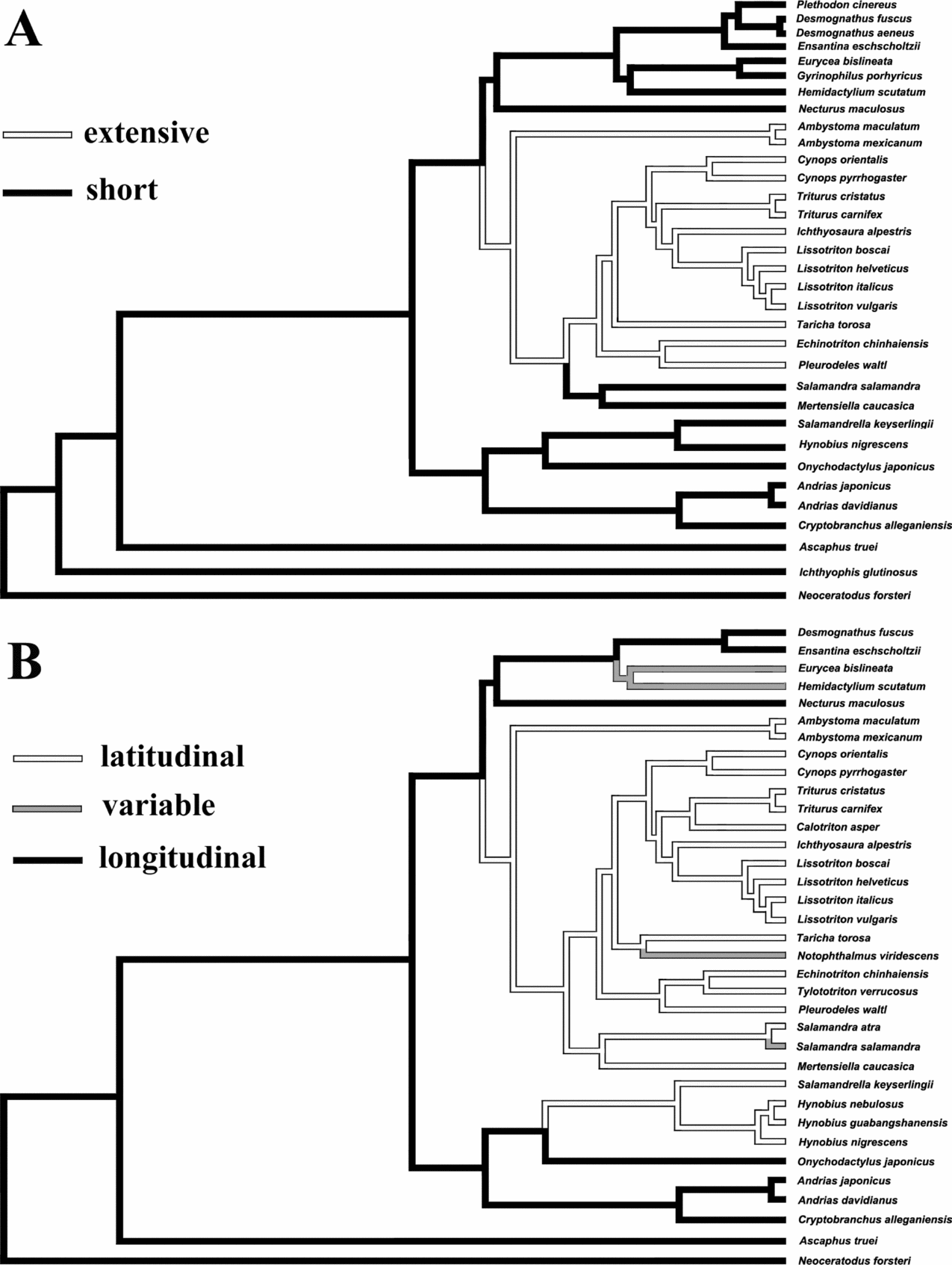
Phylogenetic analysis of two characteristics of cleavage process is shown in Fig. 1A,B. Fourteen species (from the families Ambystomatidae and Salamandridae) with the extensive period of synchronous cleavage are nested inside a group of species with the short period of synchronous cleavage (Fig. 1A). The latter group includes 16 species from the families Plethodontidae, Proteidae, Salamandridae, Hynobiidae, and Cryptobranchidae as well as three outgroup species (Ascaphus truei, Ichthyophis glutinosus, and Neoceratodus forsteri). In contrast, the suite of data on the orientation of third cleavage furrows is more ambiguous with respect to phylogeny, because four species of tailed amphibians have a variable cleavage pattern and they are interspersed among other species (Fig. 1B).
Characteristics of tailed amphibian cleavage reconstructed on the phylogenetic tree of this order (with the addition of three outgroup species, Ascaphus truei, Ichthyophis glutinosus, and Neoceratodus forsteri). (A) Magnitude of synchronous cleavage period. (B) Orientation of third cleavage furrows.
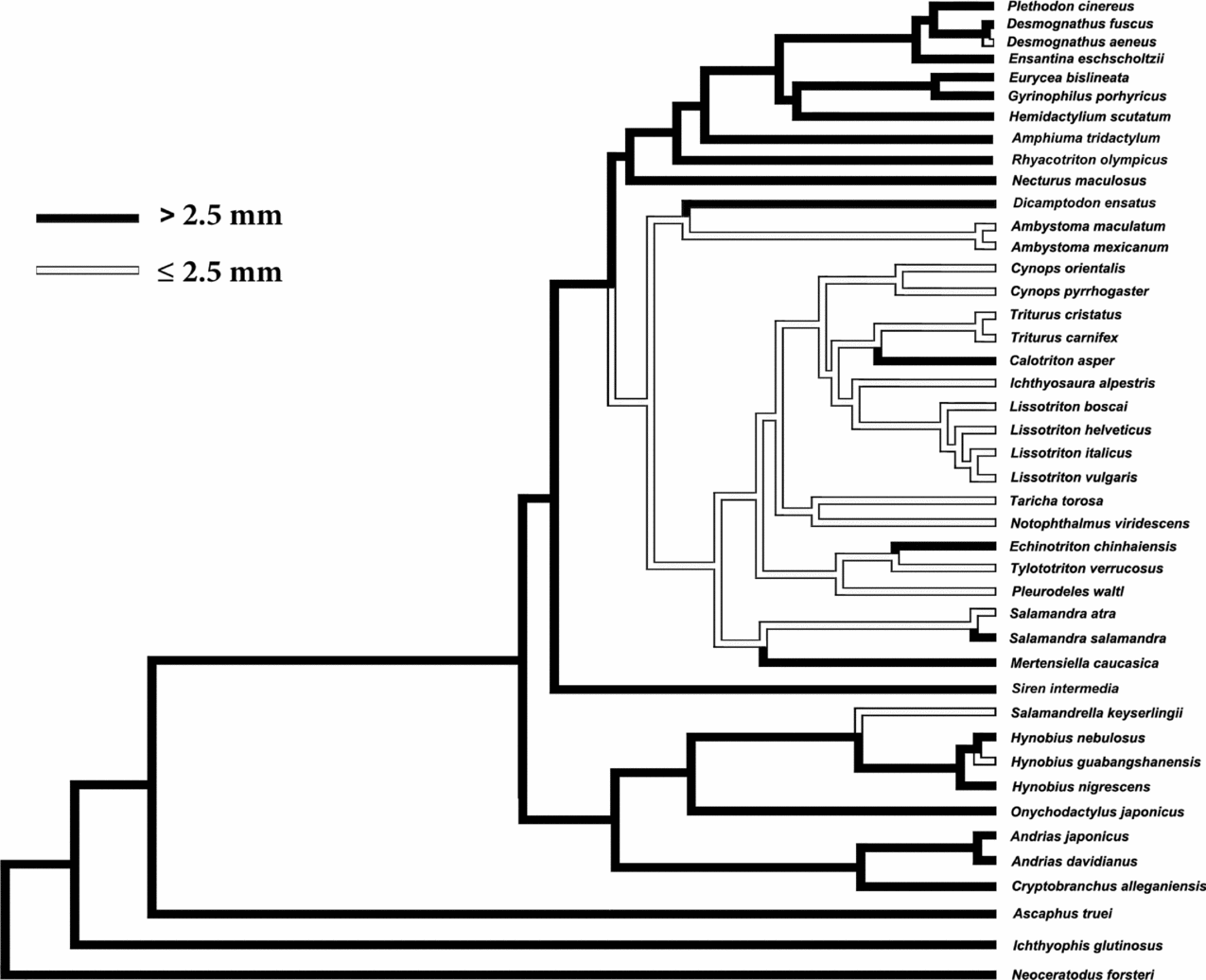
Phylogenetic analysis of egg size is shown in Fig. 2. First, it seems that the ancestral salamander egg might have been large. Second, evolutionary transitions from large to small egg size as well as subsequent reverse transitions from small to large eggs have occurred several times during the phylogenetic history of the order Caudata.
Egg diameter in various species of the tailed amphibians reconstructed on a phylogenetic tree of this order (with the addition of three outgroup species, Ascaphus truei, Ichthyophis glutinosus, and Neoceratodus forsteri).
Discussion
In their recent review on developmental diversity of amphibians, Elinson & del Pino (Reference Elinson and Pino2012) noted that: (1) the large egg size in the tailed amphibians is generally associated with asynchronous and irregular pattern of early cleavages; and (2) the relationships between egg size, cleavage timing, and cleavage pattern required fuller analysis. Here, we have analyzed the cleavage patterns of tailed amphibians along with their egg size in respect to phylogeny, while precise data on cleavage timing are currently not available for the majority of species.
In all 14 species with an extensive period of synchronous divisions, this characteristic is associated with latitudinal furrows of third cleavage. The group includes two species of Ambystoma, two species of Cynops, four species of Lissotriton, two species of Triturus, Echinotriton chinhaensis, Ichthyosaura alpestris, Pleurodeles waltl, and Taricha torosa (Ambystomatidae and Salamandridae). Echinotriton chinhaensis has large eggs developing on land (an edge of water body). However, all other species of this group have small eggs, which develop in lentic water. Conversely, all seven species with longitudinal furrows of the third cleavage are simultaneously characterized by a short period of synchronous divisions. The second group includes two species of Andrias, Cryptobranchus alleganiensis, Onychodactylus japonicus, Necturus maculosus, Desmognathus fuscus, and Ensatina eschscholtzii. All of these have large eggs, which undergo cleavage while they are in lotic water (Cryptobranchidae, Hynobiidae, and Plethodontidae) or on land (Plethodontidae). From a morpho-physiological viewpoint, these two suites of cleavage characteristics may correspond with two principal pathways of early (pregastrular) embryogenesis in the tailed amphibians. From the same viewpoint, several other species may represent ‘interim’ pathways. Interestingly, Eurycea bislineata, Hemidactylium scutatum, and Salamandra salamandra (Plethodontidae and Salamandridae) have short periods of synchronous cleavage divisions and furrows of the third cleavage are variable. Hynobius nebulosus and Salamandrella keyserlingii (Hynobiidae) also have short periods of synchronous divisions, but the furrows of third cleavage are latitudinal.
Tailed amphibians that breed in lentic waters generally have numerous small eggs and brief embryonic periods. In contrast, salamander species with lotic or terrestrial breeding generally have fewer large eggs and long embryonic periods (Nussbaum, Reference Nussbaum1985). In the light of these facts, it is reasonable to think that the extensive series of rapid synchronous cleavages of small egg followed by the MBT (seen in the Mexican axolotl) might have arisen as an embryonic adaptation of salamanders to lentic habitats. The ontogenetic diversity of amphibians is a reflection of their ecological diversity, but further discussion on this topic is not within the scope of present paper.
We will now proceed to a discussion of phylogenetic perspectives for two principal cleavage characters of the tailed amphibians. Figure 1A shows that the extensive period of synchronous cleavage divisions may be a derived ontogenetic trait in this order. Fourteen species with this characteristic (from the derived families Ambystomatidae and Salamandridae) are deeply nested within the clades with the short period of synchronous divisions. The latter ontogenetic trait seems to be an ancestral one for the tailed amphibians. Interestingly, six representatives of the primitive families Cryptobranchidae and Hynobiidae as well as eight representatives of the derived families Plethodontidae and Proteidae are characterized by a short period of synchronous cleavage divisions. However, the same trait is also seen in Mertensiella caucasica and Salamandra salamandra. Thus, it is possible that these two members of the derived family Salamandridae might have evolved from ancestors with the extensive period of synchronous cleavage divisions (similar to Cynops pyrrhogaster, Pleurodeles waltl and several other salamandrids), but later reduced the period of synchronous divisions along with the increase of egg size in lotic or terrestrial breeders. In this connection it is appropriate to be reminded that life-history reversals, namely the restorations of larval stages, did occur during evolution of some amphibian families, such as plethodontid salamanders (Chippindale et al., Reference Chippindale, Bonett, Baldwin and Wiens2004; Bonett et al., Reference Bonett, Mueller and Wake2005) and hemiphractid frogs (Wiens et al., Reference Wiens, Kuczynski, Duellman and Reeder2007).
As was indicated in the results section, Fig. 1B shows that the data on orientation of the third cleavage furrows (latitudinal, longitudinal or variable) are ambiguous with respect to phylogeny. In this connection it is appropriate to note that the orientation of third cleavage furrows might be associated not only with egg size and especially mass of yolk-free cytoplasm as was previously suggested for amphibian embryos (Rugh, Reference Rugh1951), but also with mitotic apparatus and cortex structures (Valles, Reference Valles2002; Mietchen et al., Reference Mietchen, Jakobi and Richter2005). The problem has been poorly investigated for non-model amphibians. Meanwhile, the orientation of third cleavage furrows in Xenopus eggs may be changed under the influence of magnetic fields (Valles et al., Reference Valles, Wasserman, Schweidenback, Edwardson, Denegre and Mowry2002; Mo et al., 2012).
Our phylogenetic analysis of egg size in the tailed amphibians (Fig. 2) supports the hypothesis, according to which the ancestral salamander egg was large (Elinson, Reference Elinson1986). Our data show subsequent decrease of egg size in some evolutionary lineages of the tailed amphibians. This event was linked with the acquisition of the extensive series of rapid synchronous cleavages in Ambystoma mexicanum, Cynops pyrrhogaster, Lissotriton vulgaris and several other representatives of the families Ambystomatidae and Salamandridae. Nonetheless, the reduction of egg size in Desmognathus aeneus (Plethodontidae) and Salamandrella keyserlingii (Hynobiidae) did not result in the extensive period of synchronous cleavage divisions. Therefore, a link between egg size and embryonic cleavage patterns seems to be flexible rather than rigid in the order Caudata. In accordance with this is also the fact that the restoration of large egg size in the salamandrid Echinotriton chinhaiensis is not linked with the short series of synchronous divisions.
Despite uncertainty in the case of the third cleavage furrows, the data with the use of other character, the magnitude of synchronous cleavage period, seem to be sufficient to elucidate an evolutionary trend of pregastrular ontogeny in the tailed amphibians. The cleavage pattern of large, yolky eggs with short series of synchronous divisions is an ancestral trait for this order. The extensive period of synchronous cleavage divisions followed by the MBT is, in turn, a derived trait. In conclusion, it is reasonable to say that the MBT, which is characteristic of the model species Ambystoma mexicanum (Caudata) and Xenopus laevis (Anura) might have evolved convergently in these two amphibian orders. This assumption explains the inter-specific difference in MBT sensitivity of axolotl and Xenopus to transcriptional inhibitors.
Acknowledgements
We would like to express sincere gratitude to two reviewers (one of whom identified himself as David Wake) who read an earlier draft of this paper and made useful suggestions.
Financial support
This work was supported by St. Petersburg State University research grant no. 1.0.137.2010 to A.G.D., grants NSh-4385.2012.4 and RFBR.12–0401277 to S.N.L.
Declaration of interest
The authors declare that there is no conflict of interest.