

Introduction
Dysoxylum Blume (Meliaceae) is the second largest genus (exceeded only by Aglaia Lour.) in one of Papuasia's dominant lowland families. The most recent taxonomic summary (Mabberley, Reference Mabberley, Mabberley, Pannell and Sing1995) treats 28 Dysoxylum species for New Guinea and its satellite islands, within a total regional conspectus of 47 species.
Owing to its economic importance in the timber industry, Dysoxylum was an early focus of attention by forestry collectors, to such an extent that no new species have been found in New Guinea since the territorial period (Mabberley, Reference Mabberley1994). Contemporary botanical exploration suggests that arborescent Dysoxylum have probably received a near-complete accounting, and future revision will be arguably confined to nomenclatural fine-tuning. Although this appraisal may seem overly optimistic, such is the view from the field, where new records from the upper canopy have proven increasingly difficult to obtain. Of the four most recently described species in New Guinea Dysoxylum, only D. annae Mabb. is arborescent.
Exploratory surveys in Papuasia have accelerated in frequency and intensity within the last decade, driven primarily by Conservation International's Rapid Assessment Program (RAP) of biological reconnaissance. Since the initial launch of RAP in 1994, a consistent pattern in the assessments has been the pronounced paucity of new discoveries from the forest canopy (compared with other forest strata). Despite the deployment of effective tree-climbing teams on RAP surveys, an overwhelming proportion of new taxa is being found among understorey, vining, or epiphytic plants – not the arborescent ones. The apparent asymptote in phanerophyte discovery is testimony to the accomplishments of earlier, forestry-focused surveyors, and of the finite limits in floristic diversity even in speciose environments.
Within woody families such as Meliaceae, where a wide range of differently sized species is represented, local neo-endemism is apparently skewed towards the small-statured forms, since that is where RAP discoveries are concentrated. In the following account, one of the smallest known species of Dysoxylum is described from a congeneric assemblage composed primarily of timber trees.
Description
A Dysoxylo phaeotricho Harms foliis 7–8-jugatis, tubis staminalibus valde 8-lobulis, discus glaber differt. – Type: Papua New Guinea, Southern Highlands Province, South Karius, 1430 m, 9 ii 2008, Takeuchi, Gambia & Jisaka 22697 (holo LAE; iso A, L).
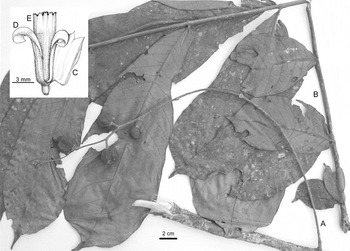
Dysoxylum middletonianum Takeuchi. Unmounted sheet from the type collection. A, fruiting raceme; B, basal leaf section with apical blades removed. Inset, upper left – illustration of anthetic flower: C, calyx, tube sectioned and turned aside; D, petal; E, staminal column (Takeuchi et al. 22697).

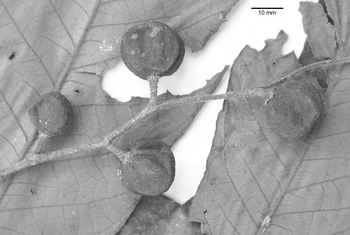
Dysoxylum middletonianum. Fruit detail. The capsules are light pink in vivo but dark reddish-brown after drying (Takeuchi et al. 22697).

Terrestrial undershrubs, 1.5 m tall. Branchlets terete, 3–5 mm diameter at the first nodes, nigrescent, lenticellate, pithy or hollow; apical bud foliaceous (not subulate); indumentum densely hirtellous, acicular, persisting, hyaline brown; periderm crustaceous, decorticating in irregular flakes, pallescent; internodes 1.5–4.5 cm. Leaves paripinnate with a terminal scar (or imparipinnate), 7–8-jugate, velutinous on all parts, spiral, lax, exstipulate, epunctate under transmitted light; petioles cylindrical, 2.8–10 cm long, 3–6 mm diameter, base 6–11 mm wide, not sulcate; rachis terete, (17–)50–64 cm long, 2–5.5 mm diameter, straight or nearly so; lateral petiolules (2–)3–5 mm long, 1.5–2.5 mm diameter, terminal petiolule (when present) 5–12 mm long, 1.5 mm diameter; leaflets papery, frangible, varying in size and shape: lowermost ones reduced, suborbicular to broadly elliptic, 4.8–11.5 × 3.1–5.7 cm, uppermost blades largest, oblanceolate, 21–29.1 × 8–10.4 cm, other leaflets transitional; base usually oblique, margin entire, apex abruptly acuminate or up to 2.5 cm cuspidate; surfaces opaque, adaxially fuliginous, abaxially brown or somewhat fulvous; hairs late-falling, their bases persisting as a pusticulate residue; venation reticulate-brochidodrome (rarely camptodrome), lateral veins 5–7 per side on proximal leaflets, 16–24 per side on distal leaflets, (4–)9–22 mm apart, at the lamina centre diverging 50–70° from midribs, abruptly turned c.1–3 mm before the margin, closing by periclinally looping nerves (or not); tertiary veins subscalariform, reticulum discolorous, conspicuous, irregular, coarsely areolate; midribs prominent on both sides, higher-order nervation planate or weakly raised. Inflorescence axillary from foliate nodes, racemose, 10.5–28.7 × 0.5–1.5 cm, solitary, pendulous, axes velutinous; peduncle 9.5–12 cm long, 1–2 mm diameter, cylindrical; rachis 1–16.7 cm long, 0.8–1 mm diameter; rachis bracts foliaceous, elliptic, to 6.5 mm long, entire, antrorse, persisting. Flowers (rehydrated measurements) inserted singly on rachises, ebracteolate; pedicels 3–4.5 mm long, 1–1.5 mm diameter, articulate; calyx synsepalous, tubiform, c.11 × 5 mm, externally hirtellous, internally glabrous, cleft 1.5–6 mm from the top, lobules 4, triangular, erect, unequal; corolla valvate, petals distinct, 4, lorate, 15–16 × 2.5–3 mm, reflexed, distally sericeous on the outside, otherwise glabrous; staminal tube cylindrical, c.14 × 3 mm, glabrous, ± fleshy, conspicuously 8-lobate at the summit, lobes equal, rectangular, c.3 × 1 mm, apically notched; anthers 8, included, attached to sinuses, muticous, oblong, 1.2–1.3 × 0.8–0.9 mm; disk cylindrical, c.2.5 × 1.7 mm, bifacially glabrous, margin erulose; ovary globuliform, strigulose; style columnar, c.13 × 0.8 mm, pilose on the lower 1/3–1/2, minutely papillate above, style-head collariform, c.0.8 × 1.3 mm. Infructescence below the leaves, flagelliform, 20–43.5 × 3–5.5 cm, pendulous, ebracteate, velutinous on all axial surfaces, lenticellate; fruiting pedicels 6–9 × 1.8–2.5 mm, cylindrical, furrowed. Capsules subglobose, 14–17 × 17–19 mm, estipitate, recessed at the top or not, loculicidal, 4-celled, laxly strigulose, glabrescent, mature exocarp reddish-brown pulverulent; seeds black.
Field notes. Monoaxial undershrubs, branchlets myrmecophilous, no exudate; leaflets papery, bifacially dull green; corolla off-white; fruits subglobose, pink.
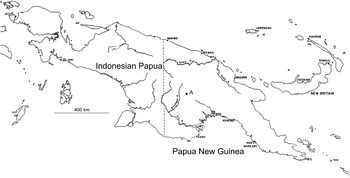
Distribution. Known only from the type locality (Fig. 3).
Island of New Guinea. A, Karius Range, type locality for Dysoxylum middletonianum.

Habitat. Shady understoreys in mossy montane forest, 1430 m elevation.
Phenology. Flowering and fruiting in early February.
Etymology. The epithet recognises the collective contributions of David J. Middleton to the Flora Malesiana.
Notes
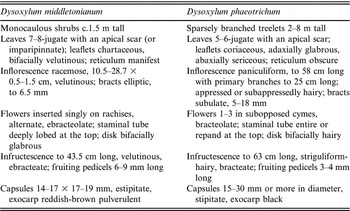
1 Dysoxylum middletonianum has a whip inflorescence/infructescence recalling D. phaeotrichum Harms, the only other Papuasian congener of comparable aspect. Table 1 summarises the distinctions between the two species.
2 The new plant resembles precocious individuals of Aphanamixis polystachya (Wall.) R.N.Parker, for which it might be confused in the field. Although the flagelliform racemes and myrmecophilous habit are obvious points of similarity, floral structures easily reveal the correct identities: corollas are tetramerous in Dysoxylum middletonianum (not trimerous as for Aphanamixis), and the staminal tube is cylindrical (not cupuliform). The type collection for Dysoxylum middletonianum includes anthetic flowers and mature fruits, allowing for decisive generic assignment despite the superficial similarities to Aphanamixis.
3 Dysoxylum middletonianum will key directly to D. phaeotrichum (couplet 31a in Mabberley, Reference Mabberley, Mabberley, Pannell and Sing1995: 65). It can then be identified using the numerous character contrasts listed in Table 1, or alternatively, the two species can be separated with the following simplified couplet:
1. Leaves 5–6-jugate with an apical scar, reticulum obscure; flowers 1–3 in subopposed cymes, bracteolate, staminal tube entire or repand; fruiting pedicels 3–4 mm long, capsules stipitate, exocarp sparsely sericeous, drying black Dysoxylum phaeotrichum
1. Leaves 7–8-jugate with an apical scar (or imparipinnate), reticulum conspicuous; flowers inserted singly on rachises, ebracteolate, staminal tube deeply lobed; fruiting pedicels 6–9 mm long, capsules estipitate, exocarp densely mealy-farinose, drying reddish-brown Dysoxylum middletonianum
4 Dysoxylum phaeotrichum has been recorded from a number of localities in Papua and Papua New Guinea, at elevations up to 700 m (Harms, 1942; Mabberley, Reference Mabberley, Mabberley, Pannell and Sing1995; Takeuchi & Kulang, Reference Takeuchi, Kulang and Mack1998). Judging from its occurrence in mossy forest at 1430 m, Dysoxylum middletonianum is probably a derived montane counterpart to the more common congener in the lowlands.
The new species is the smallest Dysoxylum in New Guinea, occurring as elegant monocauls c.1.5 m tall. Among the described congeners in eastern Malesia, only Dysoxylum boridianum Mabb. is of comparably diminutive stature. This latter species has been characterised as a montane sister species to Dysoxylum sparsiflorum Mabb. of lowland environments (Mabberley, Reference Mabberley, Mabberley, Pannell and Sing1995: 101), a relationship analogous to the presumed connection between D. middletonianum and D. phaeotrichum.
Dysoxylum boridianum, D. middletonianum and D. phaeotrichum are three of the four most recently described Dysoxylum in the eastern region. All of these taxa are also among the smallest Dysoxylum in Papuasia, a circumstance consistent with emerging patterns of RAP discovery in woody genera.
Summary of differentiating characters for Dysoxylum middletonianum and D. phaeotrichum

Acknowledgements
The multidisciplinary assessments of the Southern Fold Mountains were collectively sponsored by Conservation International, Porgera Joint Venture, Oil Search, and Exxon Mobil. My activities in Papuasian botany are also supported by the National Science Foundation (grant DEB 0315930), the Arnold Arboretum, and the Harvard University Herbaria.