Scattered over miles of desolate country, where the villages have been literally pulverized, and the shell-pocked land is like the surface of a rough sea, there are many colonies, containing thousands of India's working classes.Footnote 2
The literature on “India's Contribution to the Great War” has focused overwhelmingly on the rushing of the Indian Corps to France and Belgium in autumn 1914. As it became clear that there were going to be no swift and easy victories, the accolades dimmed. In December 1915 amid rumors that they had been “broken” by shellfire, the Indian infantry divisions were shifted to Mesopotamia, although the cavalry was retained until March 1918. What did not register in public perception was a second flow of South Asian personnel to France in 1917–1918, to deal with the manpower crisis that had overtaken that theater.Footnote 3
The Government of India, battered by public inquiry into the Mesopotamian disasters, hoped to restore its reputation by sending Indian manpower again to the most prestigious theater of the war. From June 1917, companies of the Indian Labour Corps (ILC) began to disembark at Marseilles, eventually contributing 50,000 noncombatants meant to enable the transfer of white personnel to combatant positions. On March 24, 1917, the War Office stated that it also required 18,286 horse and mule drivers to replace British personnel in supply and divisional artillery columns, and these began to arrive in batches later that year.Footnote 4 In August 1919 there were still 680 Indian laborers in northern France, along with 14,441 artillery drivers, remount personnel, and Accounts and Postal employees.Footnote 5 Their presence permitted the earlier demobilization of many a British soldier, yet the impression in England was that all the Indians had left France in 1915.Footnote 6
The Department of Labour (DOL), established in December 1916 to administer and allocate all unskilled labor, white and colored, in the British sector in France delivered a very unenthusiastic verdict on the ILC—that it had not justified the expense of bringing it over because its contract had been too short, its organization confused, and the men had not been able to withstand the winter.Footnote 7 This judgment is reproduced in some historical assessments of this corps.Footnote 8 However, this paper proposes not so much to revise these representations as to assess them for what they reveal about the experiences of the ILC.
There are very few sources that allow us to assess how the laborers communicated their own understanding of this historical moment.Footnote 9 However, the subaltern experience becomes more visible at the points at which it had to be probed and managed by those raising and supervising the ILC and reordered to provide propaganda material. This article draws upon discussions about the capacities and limitations of recruits to the ILC to get a sense of their embodied experience of this moment and their activity as sentient beings in the orders of time, object-worlds, and environments in which they were positioned.
Coolie Corps had been a regular feature of frontier making in India as well as of military expeditions overseas, including Abyssinia (1868), China (1900), and Somaliland (1902–1904). In the First World War these units acquired the politically more acceptable title of the Indian Labour, or Porter, Corps, and the men were formally enrolled as followers. This was a label that consigned them to the lowest institutional rung of the Indian Army, with its lower “follower standard” for kit, food, pensions, and medical care. Nevertheless, the fact that this was a standard gave them a point from which to negotiate.
The labor advisor to the ILC, Lord Ampthill, wanted the corps to be treated as an extension of the Indian Army instead of merging into the frame of “coloured labour.”Footnote 10 There were some organizational features that supported this claim, but he never managed to get the men recategorized as combatants on the lines of those serving in British Labour Battalions. The range of encounters permitted to the ILC in France was very limited and their work sites often stark and isolated. Nevertheless, the rank and file tried to generate resources from the social and material environments in which they were positioned, not only to soften harsh conditions, but also to create suggestive equivalences between themselves and other military personnel. They thereby sought to lift themselves from the position of mere wage workers to the status of participants in a common project of war service. At the same time, they indicated that they had not put their persons at the disposal of the state in exactly the same way as the sepoy.Footnote 11 The Government of India wanted, for fiscal and ideological reasons, to keep the line between laborer and sepoy manipulable without allowing it to collapse. For different reasons, the men in the ILC also had an investment in maintaining this separation.
Probing, Constraining, and Reordering Experience
A corpus of letters preserved by the operations of censorship in Europe provides one of the most evocative sources for exploring the war experience of Indian sepoys and laborers, but it yields just a handful of letters from the ILC. “The bulk of the Labour Corps letters received are in languages which we cannot read,” wrote Captain Tweedy, chief censor of Indian mail, “and the few in Hindi and Urdu contain nothing of the slightest interest.”Footnote 12
Commanding officers of the ILC have left virtually no account of their experiences. Some had very short tenures, and others probably felt their service with a “coolie” formation was not worth writing about.Footnote 13 In his novel The Dripping Tamarinds, C. C. Lowis, a retired civil servant who served with the ILC, hints at the condescension its officers could encounter. When Fendle, who was commanding a Burma company, meets Miss Underwick in France, she has never heard of the ILC, is incredulous that he is serving with it, and finally concedes, “That's because you're wounded, I suppose.”Footnote 14 Colonial administrator-ethnographers, who had recruited for the ILC from the “aboriginal” communities of Bihar and Orissa, and “primitive hill-men” from the Assam-Burma ranges, may have found it difficult to engage conceptually with an exercise that involved the catapulting of such “simple” beings into the cauldron of industrial war.Footnote 15
There are scraps of information on Indian follower units in missionary periodicals and YMCA literature that hailed the transformation of “primitive” and “low- caste” communities into useful subjects and staked a political claim for them in the postwar dispensation for India. This essay draws upon a hitherto unexplored source in the form of newsletters sent to The Catholic Herald of India by two Belgian Jesuits, Fathers Henri Floor and Frans Ory, who went as supervisors to France with labor recruited from Chota Nagpur in Bihar and Orissa.
Recruiters promised experiences normally inaccessible to the laboring classes—a monthly wage, some savings, a plentitude of food and clothing.Footnote 16 Experience itself was one of the attractions on offer: “Young men will get a chance to see the world in a safe job on good pay.”Footnote 17 A propaganda paper remarked that returning laborers were more prosperous and samajhdar, or intelligent and capable beings.Footnote 18 Joy Pachuau points out that Sainghinga's memoir of his trip to France is informed by the educated Mizo's drive for changkanna, or self-improvement through knowledge of the modern world, a characteristic of travel accounts published in Mizo leh Vai.Footnote 19 However Sainghinga joked that the young men of his village also wanted to return as figures of interest to women.Footnote 20 For sepoys and laborers, the hope of returning with the wherewithal to marry was an important inducement. On the other hand, there was the disturbing prospect that death away from home might write them out of the generational cycle.
If encounters with the novel in its intriguing, pleasurable, or horrifying forms were one aspect of war service, the other was an ever-present sense of the constraints put upon sights, encounters, new tastes, and the communication of experience.Footnote 21 Crammed into the lower deck of very rundown ships, the men were marched away immediately on disembarkation to the outskirts of Marseilles. Soon after, they were moving northwards in trains bound for remote worksites in the Third Army area, often in landscapes devastated by war.Footnote 22 Lianbuka described how disappointed the Lushais were that only those sent to a hospital got to see Marseilles.Footnote 23 The laborer's stay in Europe was for a much shorter period than the Indian cavalryman who remained for over three years. The cavalryman was billeted at times in village barns, whereas the ILC was more usually housed in camps or barracks. In addition, the sheer length and intensity of the ILC workday and the comprehensiveness of discipline meant that interaction, if any, with other personnel in the British sector, as well as the French, was very limited.Footnote 24
Political Agendas and Ethnic Comparisons: Colored Labor, Indian Labor, Coolie Ethnicities
There were three registers for assessing the physiology, cultural traits, and work skills of the ILC in Europe. The first was the label “coloured” or “native labour,” which communicated new anxieties because of the notion that it could replace white manpower in the very heart of the metropolis.Footnote 25 The second was the term “Indian labour,” which carried a special terminological charge,because at the very moment that the British empire needed this resource most acutely, there was a widespread campaign in India to end the system of indentured migration and to claim “the coolie” as a national resource and the object of paternalist uplift.Footnote 26 The war had also stimulated interest in the industrial future of India, and with it debates about the health, efficiency, and skills of “Indian labour,” or rather the regrettable want of these qualities in this workforce.Footnote 27 These discussions also reached the theaters of war, where Indian manpower was deployed. And finally there were ethnic labels such as “Santhali,” “Pathan,” or “primitive hill-man” labor, which were shaped by the long history of generating workforces for British military and commercial projects in India, a history that had extended into Europe as a consequence of the Great War.Footnote 28
The Department of Labour in France had appointed advisors “to study the peculiarities of, and the best way to handle different classes of Native Labour.”Footnote 29 The “ethnicising” and “tribalising” frames put around all colored units allowed their physiology and culture to be discussed in terms that justified a more comprehensive discipline, inferior treatment, longer work hours, and fewer rest days than was possible with British or Canadian labor companies. Comparisons between colored corps reinforced the notion that a lower standard of institutional care was appropriate to all. If, for instance, the ILC men were inherently more fragile than South African or Egyptian labor, then their death from respiratory disease could be discounted. Ethnicized dividing lines also allowed symptoms of assertiveness or discontent to be isolated within a particular company, and changes of units were used to step up work norms.Footnote 30 The cross-cutting imperative, that of standardizing the use of all labor, white or colored, was the weaker drive, though it gathered force in 1918.Footnote 31
However, the vocabulary of ethnic comparison was rendered more complex by the variety of political agendas that shaped the mobilization of each colored unit. For instance, the political cooptation of Fijian chiefs gave a special gloss to accounts of the small labor contingent of 104 men from that colony. The Times cast the Fijians as “aristocrats of the Pacific,” whose willingness to work as stevedores was especially praiseworthy, for “in his island home the Fijian is not a manual worker.”Footnote 32 This conceptual distance between the ethnically “pure” Fijian and the “real” coolie, the Indian positioned on sugar plantations, made it easier for this Corps to winch itself up from the level of “coloured labour” and to be publically lauded for its war service.Footnote 33
Praise for the ILC was very faint in comparison to that received by the Fiji Corps, but it, too, benefitted from a more paternalist cast of representation than that which was the lot of the Chinese, Egyptians, and South Africans.Footnote 34 The need to conciliate political opinion in India in 1917–1918, and the fraught situation along her borders at this time, meant that loyalty had to be looked for and found in the ILC.Footnote 35
In its “Report on the work of labour during the war” the Department of Labour accepted that Indians were motivated by a fidelity to “their” King Emperor so they “could always be relied upon to turn out.”Footnote 36 The Chinese Labour Corps, by contrast, was described as rigidly adherent to contract and having come “primarily for money.”Footnote 37 A special tone of loathing was reserved for Egyptian laborers because they had to be acknowledged as politically aware beings—but ones supporting the Turkish side.Footnote 38 But though harsh, racist terminology was applied quite freely to the men from South Africa and Egypt, they were also cast as splendid stevedores, their stamina contrasted with the physical “frailty” of the Indians.Footnote 39
Recruitment and Organization
“Unsatisfactory Terms of Enrollment”Footnote 40
Provincial officials tapped into existing structures of authority to find recruits for the ILC, but they also had to probe local expectations about waged work away from home and modify the service package suggested by the War Office.Footnote 41 For instance, the War Office wanted “duration of war” agreements as in the case of the sepoy, but local governments felt this indefinite formulation would discourage labor recruitment, so the term was fixed at a year.Footnote 42 Madras officials complained that many coolies backed away from taking up work with railway labor companies in Mesopotamia when the term of service was changed from one year to “period of war.” The very reference to war “leads to an apprehension that the men are to be sent into the firing line.”Footnote 43 The War Office had wanted a system in which some payments were deferred to the end of service because it allowed more control over the men.Footnote 44 But a wage advance was the norm for migrant contract work, and its importance had probably increased in recruitment areas such as Chota Nagpur, because of the suffering of families who had received no money or information from men sent earlier to Mesopotamia.Footnote 45 Eventually three months advance pay was given to encourage creditors and families to let the men go.Footnote 46
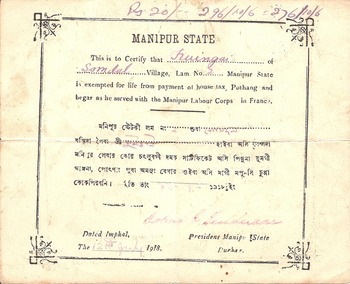
Though the men in the ILC were recruited for “General Service,” which meant they could be sent anywhere and to any unit, recruits indicated that they were engaging for the European theater. Kashi Nath described rustics of the United Provinces coming to the depot “suspicious and careful,” insisting the sahib understand that they wanted to go to Phranch, not Bachchra.Footnote 47 Some of the men in the ILC, as well as the Garhwali and Gurkha NCOs posted with them, had prior experience of work in other theaters and had realized that conditions would be better in Europe and there would be more acknowledgement for war service.Footnote 48 Finally, a concession more usually offered to the soldier was now extended to the laborer as well, namely an exemption from corvee, which formed a part of the tax structure in the Kumaon Himalayas and the Assam-Burma hill districts. By handing himself over to the army for a year, the ILC recruit could hope that he had secured a lifelong emancipation from the humiliating capture of his person for porterage and construction work, which disrupted farm work. “No greater reward,” observed an Assam missionary, “could possibly be given to any Lushai than perpetual exemption from this part of his taxes.”Footnote 49
The Ethnicization of Companies: From Above and Below
In propaganda literature the ILC was described as a force drawn largely from “primitive people who had never been beyond their villages.”Footnote 50 The presence of such recruits was invoked as an illustration of the trust that officials and missionaries had generated at the “civilisational fringes” of empire. As a result, even modern histories assume that the ILC was made up of “tribal groups” overlooking its other components.Footnote 51
The Department of Labour had concluded that the company of 500, divided into four platoons, each under a subaltern, was the best size for the most economic use of labor. It also referred vaguely to the need to “prevent tribal feuds.”Footnote 52 The ILC was reorganized on August 20, 1917, and eventually made up into the 21st to 85th Indian labor companies. In the process, some companies acquired a more ethnicized designation, which Ampthill hailed as good for morale.Footnote 53 Modern ethnic identities were emerging from processes of social transformation in India, but greater cohesion within companies also emerged as a consequence of mutual obligations developed along the way and in France, which made the men resistant thereafter to any indiscriminate assignment in drafts.Footnote 54
Printed with permission. “Kuingai Muivah's certificate of exemption from house-tax and corvée.” Acknowledgements to his son Ngalangzar Muivah.

The Assam province contributed eighteen companies in which the “primitive hill-man” element from the Naga, Garo, Lushai, Khasi, and Manipur districts was prominent.Footnote 55 From Burma, three “hill-man” companies acquired the ethnic label Chin, whereas two drawn from the “agricultural classes of Upper Burma” retained the Burma label.Footnote 56 From the opposite side of British India there were four North-West Frontier Province (NWFP) companies drawn from Mahsuds, Swatis, and Punjabi Muslims, but with a draft made up of “Jews, Parsis, Christians and low-caste Hindus from Bombay.”Footnote 57 The label “trans-frontier Pathan,” often used for the NWFP companies, had overtones of suspicion because of border clashes and the reluctance of this element to fight in Ottoman domains.
The United Provinces (UP) sent eighteen labor companies. Fourteen of these, which were of a “mixed-caste” composition, retained the UP label, but four recruited from the central Himalayan belt of the province were labeled Kumaon.Footnote 58 Bihar and Orissa contributed fifteen companies. Here again, those of “mixed-caste composition” retained the provincial label, whereas those recruited from the “aboriginal” tracts of Chota Nagpur were renamed the Santhal, Oraon, and Ranchi companies, the last name derived from the town that was the recruiting hub in that region.Footnote 59 The two labor companies from Bengal retained their original designation. Among them were Bengali Christians, a cluster of “Santhals” and Muslims from East Bengal, said to be “of the class from which the lascars of the P&O ships are drawn.”Footnote 60
“Confusion of Command”?
Much of the criticism in France that the organization of the ILC was “confused” or “too elastic” arose from the discomfort caused by the race and occupational hybridity of its upper command structure.Footnote 61 Unable to spare more than three British commissioned officers for each Labour Corps of 2,000 men, the Government of India supplemented them with civilian supervisors, who consisted of Europeans, Eurasians, and educated Indians, some from the Provincial Civil Service.Footnote 62 The expanded need for manpower from India widened the connections between the army and civil society. Some “Indianisation” of command had in fact taken place in a labor formation, but the Government of India was reluctant to acknowledge this development.
In France, Brigadier-General Evan Gibb, the Director of Labour, insisted that he would need five British commissioned officers per company.Footnote 63 Ampthill contended that the better solution was to give all the civilian supervisors an Indian Army Reserve Officer commission, thereby knitting the ILC together as a self-sufficient formation that could be treated as an extension of the Indian Army.Footnote 64 The agenda of pulling the different components of empire together into one cohesive unit was one Ampthill was pursuing in other forums as well.Footnote 65 However, the Government of India, which had accepted the idea of commissions for some aristocratic Indians, “deprecated” the idea of giving commissioned rank to middle-class educated Indians.Footnote 66 Eventually the European supervisors were given a King's commission, the Eurasians a commission with the Indian Army Officer Reserve (IARO), and the Indians a commission in the Native Indian Land Forces, an experiment with a Territorial Force.Footnote 67 The War Office stated that ILC officers were to be regarded as part of the Indian Expeditionary Force in France.Footnote 68
Another distinguishing feature of the ILC was the reliance, at lower levels of command, on Indian NCOs to drill and supervise recruits, in contrast to the South Africans and Chinese who came under greater supervision by British NCOs. For instance, a Chinese Labor company was assigned eight British sergeants and nine British corporals.Footnote 69 An Indian Labor company had only four British staff sergeants as foremen, and these were attached only when specially authorized.Footnote 70 The presence instead of Indian NCOs—one Havildar-Major, one Pay-Havildar, one Havildar, and twenty-one Naiks—meant the ILC was cast in a more military frame than some of the other colored labor units, the propaganda value of which was mined in captions to war photographs: “Members of an Indian Labour Battalion reading papers,” “Burmese troops receive their mail at Contalmaison, Autumn 1917.”Footnote 71
Making Over into Military Labor
Along the Long Way: Disorientations and Reorientations
The first step in surrendering one's body to the army was the ritual of having to strip naked and submit to an invasive medical examination, an unfamiliar and shaming experience for South Asian men, one recalled with discomfort by Sainghinga.Footnote 72 Peter Alderson recounted what his father William Hubert Alderson, Captain of the 42nd Ranchi company, witnessed when his men were
all lined up… for a rapid medical inspection (like I had when I registered for National Service) when you have to drop your trousers and have your privates inspected for signs of VD … the men were shocked and horrified, because exposing themselves was only to give point to an intended mortal insult. A great cry of “Nai!” went up … and it took some time to sort out a way … without them all heading for home.Footnote 73
For some Indian companies, medical intervention would be experienced as a gateway to entry and exit with little actual care in between.Footnote 74 However, a European doctor came regularly to the Ranchi companies when they were working in the Ancre valley and an RAMC corporal was deputed to some other companies.Footnote 75
Daryl Klein, a CLC commander, described how the “village free-liver” from China was transformed into a numbered coolie whose “wakeful hours are taken from him and transformed into bounden duties.”Footnote 76 This process of taking control of the laborer's time began with the daily roll call, which was a lengthy process at large labor depots in India.Footnote 77 Experience in Mesopotamia established that drilling reduced the time laborers took to get to work, and it checked the scattering of workmen when they came under fire.Footnote 78 Sainghinga gives a humorous account of how this orientation of their bodies to command inaugurated their disorientation from a familiar landscape. “(A) Gorkha havildar of three stripes” taught the Lushais that when he said, “right turn” they had to look toward Vanlaiphai, and when he said “left,” they had to turn to Tlabung; but when they were brought to march before the Deputy Commissioner's bungalow, they turned in all directions.Footnote 79
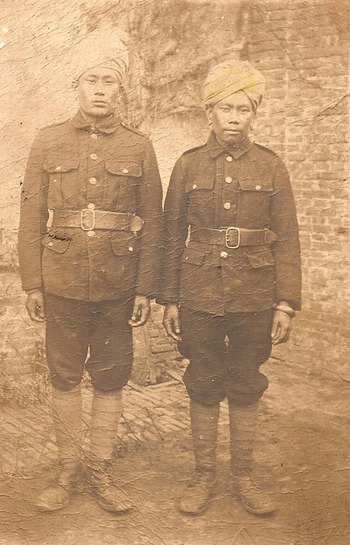
At the provincial labor depot, the men were issued the uniforms and kit that marked them as military property: “blouse and pyjamas made of woollen material, one coat warm, of drill, lined with cotton blanketing … one flannel vest … one pair of mittens ….”Footnote 80 Sainghinga writes, “A number to mark us was given … to wear on our wrist.”Footnote 81 The quality of kit was an index of standing in the Indian Army: the Gurkhas received a British style greatcoat, other sepoys “serge overcoats, on the Indian pattern,” and the followers a coat of such bad quality that men in the Mule Corps referred to it derisively as “mehter ki brandi,” or fit only for sweepers.Footnote 82 Some of the Indian officers in the lower command structure of the ILC preferred to shiver through the winter rather than accept the follower's service dress.Footnote 83
Nevertheless, the sight of young men standing in drilled formation was recalled as a novel event for communities that hitherto had not entered the army. For Sainghinga, the spectacle of Lushai youths massed in formation on the parade ground of Aizawl presented an impressive vision of ethnic destiny.Footnote 84 It was a sight more typically associated with Gurkha military display at the festival of Dussehra. In the Assam-Burma hills, the government had developed an interest in discovering local “martial communities,” so the occasion merited an official photograph as well.Footnote 85
Men who Had “Never Seen the Sea Before”
Railways and steam ships had made modern war a test of demographic strength, but getting manpower up to a railhead in India could involve a time-consuming journey by footpath, bridle path, cart road, or river. Shortage of shipping caused by the heavy demand for freight to Basra, was another problem.Footnote 86 For some labor companies, the staggered stages by which they were brought down from some remote village to Bombay, taken cautiously up the Red Sea, and then across the Mediterranean to Taranto for the rail journey to France, was a significant part of the war experience. The Manipur Labour Corps assembled at Imphal in April 1917, spent three weeks drilling, and then walked 210 km to the rail head at Dimapur.Footnote 87 The Chin Labour Corps left Tiddim on June 23, 1917, and reached Marseilles on September 8, 1917. Some drafts sent for the ILC were detained for three to four months in Egypt while others worked for short periods on the Suez stretch of the passage home.Footnote 88
H. A. Orton, a medical orderly, described the sleeping accommodations below deck for laborers on the SS Merima: “Two foot wide boards covered with straw palliasse packed very tightly side by side, two blankets each with instructions to use kit bags as pillows. They were allowed the freedom of the lower decks.”Footnote 89 His account is of passengers seen rather than heard, getting stronger with better sleep and food: “(T)heir chatter became a clamor and their strange sing-song chants passed the time away.”Footnote 90 However the sea journey for the Manipur Labour Corps is recounted in one Baptist web site as a passage marked by fear, seasickness, depression, and a cholera outbreak that resulted in a month-long quarantine at Taranto.Footnote 91 Wartime crowding, at depots and on board ships, created conditions for disease.Footnote 92 Some recruits were consigned to a watery grave, a disturbing experience for their companions.Footnote 93 Others were buried at Taranto.
Sainghinga describes the Lushais getting weaker due to sea sickness and a monotonous diet of potatoes, onions, and ginger.Footnote 94 The tedium was broken by moments of fear, as during a submarine alarm, or of excitement, such as when the Lushais sighted Mount Sinai along the Red Sea and told each other that this was where Moses received the Ten Commandments.Footnote 95 Clearly for some “tribals” with a mission school background, their movement through biblical landscapes and into a wider Christian ecumene was as significant as their encounter with war in the metropolis.
Officers often assumed that with “illiterate” personnel, the short, sharp, shock rather than time-consuming instruction was the appropriate method for induction into new routines. Kashi Nath writes that after a man was dropped overboard at Port Said to demonstrate that his lifebelt would keep him afloat, a new understanding developed between the men and this uncomfortable accessory.Footnote 96 Sainghinga, the knowing consumer of modern medicine, who accepted the necessity of vaccination, recalled their being subjected without explanation to a chemical spray at Marseilles: “We did not like it and we did not know why it was necessary.”Footnote 97
Assessing and Managing Indian Labor
Unskilled, Exotic, Fragile
The Viceroy had warned that Indian labor was “less adaptive than British to unaccustomed work.”Footnote 98 At first sight, Ampthill wondered how the “exotic” element in the Corps, men “from the hills and jungles, who have barely merged from barbarism,” would shape up as labor.Footnote 99 Put to work loading and unloading transports at Marseilles, the verdict was that the men's physique was inferior to those from China and South Africa, but that they compensated with their tractability.Footnote 100
Shifted out to the Third Army area, many Indian companies were put on battlefield clearance and salvage.Footnote 101 Some were detailed to road and railway construction as well or to forestry work under the supervision of Canadian labor companies.Footnote 102 In October 1917, three Indian companies were transferred to the construction of an aerodrome complex for the Royal Flying Corps around Nancy.Footnote 103
By this stage of the war, Mespotamia and frontier military works had absorbed a lot of artisanal labor from India. Nevertheless, craft skills were discovered in the ILC, some deriving from the construction of border roads and railways; forestry work; or the artisanal training encouraged at mission stations to demonstrate that education did not “spoil” converts for manual labor.Footnote 104 A former deputy director of labor remarked that the work in France involved little use of machinery “and therefore gave scope to individual and collective contrivance to a degree not possible with machine production.”Footnote 105 The demonstration of craft skills probably saved some units from the more strenuous and closely supervised forms of labor. The Khasis working on a stone quarry at Peronne were probably taxed more heavily than the 150 members of a UP company who, “with 50 looms constructed by themselves, were turning out 1000 mattresses a day.”Footnote 106
Ampthill declared that some lime burners, by tradition, in the 50th NWFP company had “nearly wept” at the sight of the kilns prepared by the Royal Engineers. These had not been hooded, so at the first rain the lime swelled and slaked. Now, they were being allowed “to do the job in their own way.”Footnote 107 The Lushais, possibly in the course of salvaging fuel for themselves, had shown that wooden rivetments from abandoned trenches could be turned into the charcoal needed for trench heaters and gas masks.Footnote 108 Yet one Forest Control officer's explanation for why the 27th UP company was better at charcoal burning than German prisoners of war was that “they stood the heat of opening a kiln better than white men.”Footnote 109
In the CLC, a higher pay bracket was conceded for skilled labor. This did not happen in the ILC, but skills, such as in rough carpentry and railway plate laying, began to be acknowledged.Footnote 110 Even the ILC reputation for stevedore work improved. The Department of Labour observed that at first there had been consternation at base depots when Indians had replaced “Kaffir” labor (the South African Native Labour Contingent, the SANLC), but they had equaled and sometimes exceeded that performance.Footnote 111 In January 1918 Ampthill noted that at the forward supply base of Abancourt, the “inferiority” of the Indian companies to British and South African companies was “almost negligible.”Footnote 112 At Abancourt, this commendation came at a considerable physical cost.
Time-Work or Task-Work: Segmentation or Standardization
Lindsay, deputy director of labor in France, recalled that treating the men in British labor companies as though they were “living shovels” had had a disastrous effect on morale.Footnote 113 There was an even greater tendency to treat native labor as though it was just a factor of production but with less concern for its wastage. A draft of Maratha Mahars had stoked the very ship they had sailed on, then at each halting spot from Taranto they had been seized upon for fatigue labor “without the slightest show of decency or consideration.”Footnote 114 At Faenza they had constructed a tennis ground for officers; in St. Germain they had loaded a train. Ampthill complained that even “The order that the troops should have opportunity to obey the calls of nature were disregarded.”Footnote 115
The agreement signed by the ILC said nothing about hours of work or rest days, and in France these were debated largely above their heads. The Department of Labour was expected to raise and standardize the output for all units of unskilled labor, white or colored. However, the danger it constantly warned against was that if colored labor was worked in proximity to white labor, then standardization would take place in a downward direction: “[T]he native working alongside has his ideas of the position of the white man disturbed in addition to the natural tendency to slacken to the white man's pace.”Footnote 116 The SANLC men had for instance, dared to complain that the Canadians worked fewer hours and got Sunday off.Footnote 117
It is also instructive to compare the DOL's prescriptions for improving output with British and colored labor. To alleviate their alienation from work, it was thought that British labor ought to be assigned to familiar units, and given the sense of a task accomplished.Footnote 118 In contrast, when dealing with the Chinese Labour Corps (CLC) and SANLC, the stress was put not on esprit de corps, but on plumbing the depths of deception to arrive at their true capacity for work. Slackness of supervision “reacted upon natives to an extent not appreciated by officers used only to European Labour.”Footnote 119 The supervision of the CLC “should approximate as closely as possible to labour conditions in China.”Footnote 120 Employers had not realized “the considerable moral deterioration” that resulted from failure to get a full day's work from the South African native.Footnote 121
However, the Department of Labour did sometimes bracket white prisoners of war with colored labor, the assumption being that, in the absence of patriotism, other incentives and controls had to be devised.Footnote 122 Clubbing these two categories also allowed it to take the edge off prescriptions designed to intensify labor across the board. For instance, in advising a general shift from time-work to task-work, it added carefully that this would be especially advantageous for the CLC and Prisoners of War “for whom there could be no interest in our winning the war.”Footnote 123
Since piecework payment or the offer of a bonus was prohibited for military labor units in France, increases in work intensity were bargained for in the currency of rest.Footnote 124 The “employers,” for instance the Royal Engineers or the Controller of Salvage, would outline a fixed task and permit a cigarette break or an earlier knockoff time for speedy completion. The issue then was to set the task at the right level. However, there was always some uncertainty as to whether, in the case of colored labor, the shift from time-work to task-work really left the balance of advantage with the employer. A common contention was that with the SANLC, the correct management technique was simply tough supervision.Footnote 125 Some of the Chinese companies, by a creative reorganization of their work, were held to have knocked off at scandalously early times.Footnote 126
The stereotype that circulated about Indian laborers was not so much that they were hiding their true capacity for work, but that they were physically incapable of intensifying the pace.Footnote 127 The Indian “would plod along till he completed quite a good day's work”; they were capable of “steady work whether watched or not, in contrast to the Kaffir or Chinaman,”Footnote 128 the Indians had to be worked “in large gangs under their own NCOs.”Footnote 129 Such vague statements hinted that work hours could stretch on until output reached the prescribed level. In India, employers used the same justification to oppose any reduction in factory hours, namely that Indian laborers were so physiologically weak and so culturally predisposed to a dispersed work schedule, that a shorter, more intense workday would not sustain production levels.Footnote 130 Responding to postwar interest in the topic of managerial expertise and labor efficiency, an ILC officer concluded that for British labor, a task requiring six hours a day was ample, but Indian labor was “so constituted that it cannot put the same intensive effort into work.”Footnote 131
Fathers Floor and Ory's newsletters describe a nine-hour workday for the Ranchi and Oraon companies, the men setting off at seven in the morning and working from 8 a.m. to 5 p.m. with a break for lunch.Footnote 132 They claimed that the men of the Catholic-dominated companies from Chota Nagpur embraced a further extension of their hours in the form of daily Mass at 5 a.m. and rosary, catechism, or confession in the evening.Footnote 133 In August 1917 we find Ampthill pleading with the DOL for collective rest days for the ILC men, pointing out that promises had been made in India about Sunday observance for Christians.Footnote 134 Ory and Floor's Catholic companies do seem to have gotten Sundays off, though rest days were also used to overhaul kit and clean the camp.Footnote 135
However at other sites, and perhaps everywhere during more intense phases of the war, the pace of work could be relentless, and sometimes only physical breakdown set a limit. It was after April 1918 that the need to conserve all noncombatant labor, whether white or colored, was finally recognized and the pace of work relaxed.Footnote 136 The 22nd Khasis were praised in February 1918 for having “established a record for rapid loading of permanent way material” when the railway was being pushed up to Marcoing.Footnote 137 However Ampthill complained their health was deteriorating due to overtaxation, and they had to be hurriedly repatriated on March 1, 1918, due to an outbreak of beriberi.Footnote 138 One of the explanations he gave for why the Indian companies at the supply base of Abancourt refused to accept any formal extension of their service was that they were “dead stale and tired.”Footnote 139
Embodied Experience: “Inability to Stand the Cold”
Bahut jara suru hua, lekin kapra bahut achha wala milta hai, koi hath ke chamra se lohu nikalta, lekin hoshiyar admi hamar moja hath men lagate hain. Footnote 140
The extracts the censor selected from ILC letters to illustrate the morale of the men tended to confirm the picture he drew of uncomplicated beings, delighted with their food and clothes.Footnote 141 Significantly, none were from Abancourt, a major railway junction, supply base, and ordnance dump, where at one point the 40th Naga, 61st, 62nd Chin, 65th, 66th Manipur, and 69th Garos were concentrated.Footnote 142 It is the spare repetitive entries of the Senior Medical Officer's diary that give us a chilling sense of the toll taken by respiratory disease at this site.Footnote 143 Ampthill's observations about Abancourt are a contradictory mix, registering simultaneously his desire to report that the ILC was performing well, his conviction that if they were felled by pneumonia it was because of “malarial germs” brought over from India, and yet his obligation to note old huts, cold flooring, and the “grind of relentless toil.”Footnote 144 Arriving at Abancourt on January 6, 1918, he observed that the men were withstanding the cold well.Footnote 145 This was the very day that the Senior Medical Officer recorded the deaths of three men of the 66th Manipur company from bronchial pneumonia.Footnote 146 Ampthill attributed respiratory infection to “the germs of malaria,” but he also recommended that once winter was over, other companies be given “the exacting work of this great distributing centre.”Footnote 147 Certainly the extent of malnutrition in India was being exposed on the battlefields of the First World War, but it was also easier to put the blame for physical breakdown on bodies that “harboured” malarial fevers and beriberi than on the carelessness with which colored labor was used.
Interestingly, when he argued that ILC men ought to be recategorized as soldiers, not laborers, Ampthill used the index of bodily damage to underline similarities in war experience. Laborers too would require artificial limbs because of the amputation of hands and feet due to frostbite. “Others have suffered mutilations on account of bombing by enemy air-craft and in accidents with the shells and bombs which they have had to handle.”Footnote 148 Some of the essentialist comparisons made at the time between the vitality of different units of colored labor might well break down if we could compare the toll on bodies in similar milieus. For instance, significant frostbite injury due to the insufficient issue of leather gloves was noted in both an SANLC company at Abancourt and a Lushai company working at Rosiel dump.Footnote 149
To keep the men on their feet over the winter of 1917–1918, some Indian companies were given a dose of opium mixed with treacle twice a week.Footnote 150 “Treacle” was the euphemism under which Indian Army officers could order opium from military stores to keep sepoys, followers, or porter columns going in conditions of cold, fatigue, and fear.Footnote 151 Some Christian superpvisors complained that this practice might reintroduce an addiction they were struggling against.Footnote 152 Brigadier Gibb, the Director of Labour, insisted that with Indians opium worked better than quinine to ward off fever, but he added that the dose also secured better work, so clearly the drug was also offered as an incentive.Footnote 153 General H. V. Cox, Military Secretary at the India Office, ruled obliquely that no exception could be taken to the use of opium “under medical advice.”Footnote 154
Discipline
Constraining Experience
The regime of segregation that had closed around the SANLC and the CLC was extended to the ILC, but enforcement was more discreet.Footnote 155 Instead of the galvanized iron sheets surrounding the SANLC compounds, or the barbed wire and armed guards circling ELC and CLC camps, the separation may have relied more on Indian NCOs.Footnote 156 The length of the workday and the isolation of worksites probably did the rest.
Passes were given rarely and only to groups under the supervision of an officer or a YMCA worker. Colored laborers were not only prohibited from entering French cafes, but their own canteens were not allowed to sell liquor.Footnote 157 Two “wet” canteens that had been introduced for Indian companies were shut down.Footnote 158 The other norm was to permit colored laborers to keep only a minimal amount of money in their possession to discourage gambling, or the acquisition of tastes inappropriate to their station, and to ensure they returned home with savings.Footnote 159
Discipline: “Simplicity in Procedure Combined with Promptness”Footnote 160
A great deal of the discipline must have been left to the informal authority of headmen and mates of Indian labor companies, many of whom had helped in recruitment.Footnote 161 However, the Department of Labour's Notes has sections relating to the formal mechanisms of discipline as well. The COs of British labor companies often did not have sufficient seniority or experience, so the CO of the Labour Group, at a higher level of command, could restrict their powers.Footnote 162 However, for colored labor, the Notes stressed the need “for simplicity in procedure, combined with promptness.”Footnote 163 For instance, the CLC also fell under the British Army Act, but in its case, the “want of qualified officers and great urgency” was invoked to institute “a summary form of Field General Court Martial.”Footnote 164
In India, summary caning was the most common form of disciplining coolies and porters attached to some frontier expeditions.Footnote 165 However in the First World War, commanding officers of Indian Labor and Porter Corps in Mesopotamia and France discovered that, irksome and infra dig as it was, “coolies” enrolled under the Indian Army Act would have to be court martialed before they could be sentenced to a flogging.Footnote 166 Ampthill reported that ILC officers held that the punishment best understood by their men was a flogging on the spot and asked for an ordinance to permit this without having to hold a court martial: “The Indian, like the child or a dog, does not understand deferred punishment.”Footnote 167 The arguments he put forward are very revealing of service conditions for the ILC. Rigorous imprisonment, Ampthill said, was meant only for serious cases, and laborers would welcome confinement to barracks.Footnote 168 Since laborers did not get certain institutional benefits such as “good conduct pay” or “acting rank,” there was less that could be taken away.Footnote 169 Fines would not make an impact because the men had very little money and nowhere to spend it, and this would penalize their families.Footnote 170
Ampthill was not given the special ordinance he asked for, but the Notes steered attention to the extensive powers given to COs of detachments under the Indian Army Act “when they held a Summary Court Martial.”Footnote 171 This was a tribunal “peculiar to the Indian Army” in which the CO, as sole judge, could deliver a wide range of punishments including a flogging of up to thirty lashes, which could be carried out immediately.Footnote 172 I do not have any records for ILC court martials in France, but the war diaries for Mespotamia reveal that Summary Court Martials and Summary General Court Martials handed down sentences of corporal punishment and fines to the Indian Labour and Porter Corps, especially in jail-recruited units.Footnote 173 Indian Labour companies were usually described as “tractable and willing,” but the situation changed as their contracts began to come to a close.
Transforming Experience: Engaging with Environments and Object-Worlds
Battlefield Salvage: The Plentitude and Waste of the “European Great War”
From the spring of 1917, as the German submarine blockade began to make itself felt, salvage activity rose in importance. In July 1917 a Controller of Salvage was appointed, and fifteen Indian labor companies were allocated to battlefield clearance in the Third Army area.Footnote 174 Side by side with officially prescribed salvage work, soldiers of all ranks and nationalities searched for material to supplement food, fuel, clothing, and shelter or to shape into souvenirs to be sold, exchanged, or gifted. British officers of the Indian Army prided themselves on “resourceful” Pathan orderlies, or batmen (soldier-servants) said to display a special talent for extending regimental comforts.Footnote 175 Race and rank determined which act of appropriation was categorized as an amusing act of pilferage, souvenir collection, loot, theft, or barbarity.Footnote 176 But because they worked upon the environments in which they were positioned, Indian laborers developed a particularly intimate relationship with natural and material resources, and frames of devastation could soften sometimes to take on other meanings.
An Indian cavalryman posted as NCO with a Lushai Labour Company complained bitterly about conditions, which were very different from those he had come to expect as his due in France. They were five miles from the nearest village. They never saw a newspaper and had no recreation. There was no medical care, so twenty men had come down with mumps, and yet there was no separation of the sick. “The men are utterly filthy and take no care of their health.”Footnote 177 And yet this was probably the very same site of which Sainghinga would recall, “We had good times together.”Footnote 178 His memoir describes how the 26th and 29th Lushai companies positioned at the ruins of Monchy au Bois used salvage material to create spaces and activities they could claim as their own.Footnote 179 Sainghinga describes the men's rising apprehension as their train moved through ever more devastated landscapes toward the frontline, then the joy of waking up after the first night to discover an abandoned field with a stand of greens, something they missed terribly in their meals in France. Their first act of salvage was to create a sense of “home” by boiling up a pot.Footnote 180 Well before the YMCA organized any recreation, the Lushais made their own arrangements:
We looked around and collected corrugated iron sheets and other things, and we built a big recreation hall. The other room was made into a canteen. We pooled our money to buy and sell all kinds of things. The canteen began to make a profit. We bought a bioscope. Since many of us had not seen “moving pictures” it brought us much joy. The recreation hall was used as a fellowship hall on Sundays.Footnote 181
The tents of the 41st, 42nd, and 43rd Ranchi Company were pitched on both banks of the Ancre valley, an area that had been wrested back after prolonged German occupation with enormous loss of life on both sides. Father Ory wrote of the ghastly scenes the men encountered as they stripped down dugouts and filled in shell holes:
[E]very five yards we come across bones still wrapped up in their putties, arms and legs blown off by shell-fire. One of our old Ranchi boys had his heart full and stood by weeping … The Park of Thiepval is littered with human remains … British and German helmets lie in heaps.Footnote 182
And yet the same men fished in flooded shell holes along the Ancre river, hunted down hares startled from the high grass by heavy shelling, and returned to camp decked out in odds and ends that had been abandoned on battlefields:
German helmets have taken a hold on their fancy, when the steel pike has been knocked off, they stick field flowers in the hole. What with the airman's fur headgear and the Pomeranian blue ribboned cap, they make a most successful parody of the mighty War Lord's noble army.Footnote 183
Other articles, “eloquent if malodorous evidence of the life-and-death struggle” in which they had figured, found their way into the kit of colored labor as, for instance, military coats found unfit for combatant use, which were dyed gray or black and kept for them or for prisoners of war.Footnote 184 Men crafted cigarette holders and pipes to smoke their allowance of “ration” cigarettes and loose tobacco.Footnote 185 But the debris that surrounded them and that they worked upon could also be lethal, though there was a tendency to attribute “accidents” to the naïveté of illiterate personnel.Footnote 186 When a man trying to make a cigarette holder out of a detonator had his hands ripped open, Father Ory concluded that this “slight accident” would work as a warning, “as it is in their nature to take lessons from experience alone.”Footnote 187 However, even he had to admit that no human prudence could really keep the men safe from the unexploded bombs lurking everywhere around their worksites.Footnote 188
Sainghinga recalled how they had also been cautioned not to eat the tinned beef, soda water, and sweets they found in German trenches, lest these had been poisoned.Footnote 189 The Ranchi companies had set out eagerly for the “hidden treasures and fairy-like surprises” of German dugouts in Rossignol wood. One Johan, opening what he thought was a brandy bottle, uncorked a teargas bomb.Footnote 190 In this glimmer of riches found in trenches we get a sense of how men for whom want and making do were so much a part of everyday existence experienced the plentitude and waste of the “European Great War.”Footnote 191 In his ethnography of the Lhota Nagas, J. P. Mills remarked in passing that, “The men who went to France with the Naga Corps thought our method of cleaning an animal and throwing away the offal most wasteful.”Footnote 192
Suggestive Equivalences: Food, Hospitality, Entertainment
“We were all Johnnies to them.”Footnote 193
The men in the ILC worked upon what they found in their kits, canteens, and environments not only to recreate what was comfortable and familiar, but also to forge connections with those around them. By striving to place themselves in a common frame of “war service,” they could claim some of the amenities which combatants demanded as their due. They were also taught how to put themselves in this frame, for British and Australian soldiers, as well as German prisoners of war, found some relief from fear and monotony in the exoticism of Indian personnel, and in assuming a pedagogical role. Race distinctions did not vanish, but the barriers were sometimes lowered to allow forms of subaltern cosmopolitanism to emerge. In contrast, one hardly finds any references to friendly interaction between Indian and other “colored” units, even at sites where they camped or worked in proximity.Footnote 194 They are placed in the same frame only to compare work capacity or their civilizational acceptability in Europe.
I also found very little about relations between the ILC men and French residents, partly because of the isolation of worksites. “The Pathans are not happy,” wrote Ampthill. “They had been told by the cavalry they would have access to large cities and a glorious time among Houris.”Footnote 195 Sainghinga's description of the effort, which had to be put into the important business of taking a photograph to record his presence in France gives us an idea of the isolation of his campsite:
On day on 25.9.1917, with 2nd Lt G T Badeley we went to a place not too far away where there were only three French houses and we asked them to take a photograph. We gave 30 francs for the photo. Except for this one time, while we were at Monchy-au-Bois for about five months and after we shifted, right up to 24.2.1918, we did not see a single civilian again.Footnote 196
Printed with permission. “Kuingai Muivah of Somdal, Manipur and his friend Pashi Ruivah of the Manipur Labour Corps in France.” Acknowledgements to Ngalangzar Muivah.

Printed with permission. “The 26th Lushai Labour Company, France.” Acknowledgements to Collection Sainghinga/Chawngpuii, from the digital archives of Joy L.K. Pachuau.

The British censor of letters had an ambivalent attitude about the rather too rapturous accounts that sepoys gave of the kindness and graciousness of the French.Footnote 197 “Although they are white they don't look down on dark people,” wrote one Lushai laborer, adding that African soldiers got the same salary, and the same rations, as the French.Footnote 198 Indian labor companies must have had some engagement with the French at Marseilles, but I could find no reference to this. Perhaps it was no coincidence that of the three companies—the 63rd and 64th Bengal and the 57th Oraon—sent to the French zone of Nancy, the 57th under Father Floor was made up of Oraon Catholics and the 64th under Father Douglass of the Oxford mission had a cluster of Bengali Christians. Billeted in barns and lofts, their interaction with the French had some propaganda value. British military authorities found occasion both to deplore the “filth” of French villages and to revel in the impression that Father Floor created when his Oraon Catholics began to clean up the streets and sing in the parish church.Footnote 199 Father Floor reported proudly that local prejudices, which he attributed to the behavior of the French Moroccans who had preceded them, soon dissolved, and his men were invited to tea on their departure.Footnote 200
The Department of Labour felt too much fraternization between British NCOs and the colored labor they supervised might erode discipline;Footnote 201 Ampthill warned against the tendency of British soldiers “to treat the Indians as Gollywogs.”Footnote 202 Yet some space for fraternization among Indian, British, and Dominion personnel had to be allowed, for it was one of the themes of war propaganda. Kashi Nath gave a rapturous description of the “few glorious days” when a host of Australians camped nearby:
They would swarm into our barracks … exchange cigarettes … eat small bits of chapattis …. would teach our men how to darn socks, would … drill them, … bring their own football and start kicking it about. Once I found an Anzac soldier lathering and shaving one of our men … two others were … awaiting their turn.Footnote 203
Turning conscientiously thereafter to extol the friendliness of “Tommy Atkins,” he wrote of British NCOs who sent postcards when they left, of meals offered and hospitality returned in the form of “dal chapati korma and Indian sweets”: “Often at night I would find soldiers sitting snuggled in a corner talking, talking, with our men and often wondered what they could talk about when the others understood hardly a word.”Footnote 204
Perhaps “speech acts,” rather than speech alone, built bridges across race that left a mark in the vocabulary of returning servicemen. For instance, the phrases a Ranchi company picked up in an instructional context from the British sappers who guided them into dugouts reappeared when the Ranchi men played football: “Come here, you b… fool,” “Stick to it, Johnny,” “Hang on, man.”Footnote 205
Transnational circuits of congregational music provided a common point of reference for Christian Lushais and sailors on board the ship that took them to France.Footnote 206 It is with some disingenuousness that Sainghinga wonders why, in clashes with vais (Indians from the plains) over water supply, “the sap (sahib) workers of the ship would always take our side … they would give us the sticks of the brooms used to sweep the ships. If we had off-times together … we would sing God's songs together. …”Footnote 207 At Monchy au Bois, sap soldiers would visit the Lushais on Sundays:
Sometimes we sang hymns together. Most of them knew “Abide with me” and “Nearer my God to thee.” We found very few who knew other hymns. However they knew songs that were not hymns, what we called hla lenglawng (sentimental songs).
Indian soldiers and laborers positioned in Europe were aware that they had to take on a certain public persona if they wanted to be placed on the same footing, at least notionally, as British and Dominion forces.Footnote 208 Kashi Nath writes that his men would warn each other not to indulge in unseemly behavior before “these sahibs,” namely the British and Australian soldiers who befriended them, “men who though of a different nation were soldiers of the same Empire.”Footnote 209 Being able to give was a matter of pride, a demonstration of responsiveness to the ideals of sacrifice associated with war service. The 26th Lushais donated their canteen profits to charity although the 1,200 francs was a substantial sum for them.Footnote 210 One Kumaon company used up their store of tea for an incoming party of British soldiers and allowed them to heat up bully beef in their cookhouse, explaining to their officer, “Sahib, this is war time.”Footnote 211
Food constituted a complex symbolic terrain. Kit, ration items, and canteen supplies were markers of status, elevating the Tommy much above the Indian sepoy, and the latter above the follower ranks. But an important part of imperial propaganda was the capacity of the British to bring supplies right up to the front line and to meet the dietary requirements of loyal ethnicities. For the Indian infantry and cavalry regiments in Europe, special arrangements had been made to ensure the availability of fresh meat, slaughtered in the appropriate way for Muslims, Hindus, and Sikhs. In contrast, fresh meat was often a rarity for the ILC.Footnote 212 Assuming that the “primitive” element in the ILC would accept just about any kind of flesh, Ampthill proposed that their rations be supplemented with horsemeat. However, he had to report that it had become “a matter of dignity” with the hill men to accept only the same meat as Europeans.Footnote 213
Although the men in the ILC wanted to reproduce “home” in their meals, they felt they were entitled to the ration and canteen items dispensed to other soldiers and which they too had come to enjoy. The 59th Burma Company wanted sesame oil for cooking, but they also asked for “sprats and smelts as do the German prisoners.”Footnote 214 Cox noted with astonishment that the canteen items most in demand with the Manipur and Chin companies were “note-books, sardines, sausages and soap.”Footnote 215
Suggestive Equivalences: “Leisure” and “Organized Sports” for Labor
Ampthill had felt it was politically important to give the men in the ILC a sightseeing tour of England before they returned.Footnote 216 However, shopping and sightseeing trips, even within France, only began to be organized in March 1918, when the men had to be induced to extend their stay.Footnote 217 However, the military framework did make the idea of organized recreation acceptable for the ILC, whereas in India “leisure” was still a disputed entitlement for labor.Footnote 218 The Indian Industrial Commission Report (1916–1918) stated discouragingly that “until the workers have learnt how to use a longer period of leisure more advantageously, such a concession may not be an unmixed benefit.”Footnote 219 However, in France there was just the one officer, Captain Griffiths, who took the harsh view that if the men were being worked properly, they ought to be too tired to require recreation.Footnote 220 Many ILC companies took the initiative to organize hockey and football for themselves well before any YMCA assistance, to the surprise of Ampthill, who had not expected to discover this interest among laborers.Footnote 221
However, the transfrontier Pathans, cast as the one “mercenary” element in the ILC, proved to be ideologically resistant in this sphere. The 50th NWFP Company wanted only “a fire, cigarettes, smoking and talking,” and the CO of the 48th NWFP said Pathans did not take kindly to organized games.Footnote 222 In fact there was a mysterious “affair” in connection with athletic sports in the 48th NWFP Company which resulted in an inconclusive enquiry and the sending home under a cloud of its supervisor, Khan Sahib Mohammad Gul Khan.Footnote 223
The sphere of performance was also one that allowed exchanges between military personnel, but this essay does not attempt to explore it.Footnote 224 Theatricals and skits were the medium through which sepoys and laborers could assume a variety of other roles, low-caste followers could display their creativity, officers could be parodied, race could be changed, and “women” could materialize in highly masculine spaces.Footnote 225
Suggestive Equivalences: In the Flow of Mass Commodity Circuits
The other way in which Indian laborers sought to place themselves in the same frame as other military personnel was by adding certain distinctive items to their kit. Sepoys and laborers found that military service could secure them the privilege of being able to tell the time themselves, instead of only being told it. During the First World War mass commodity chains and military supply channels made the wristlet, an item of jewelry for women, into something available for the ordinary soldier. Army contractors began to issue cheap, reliable, mass-produced wristwatches.Footnote 226 The wristwatch, “ration-cigarettes” (rather than snuff, chewing tobacco, or cheroots), the safety-razor surfacing in Europe with the coming of American troops, began to feature in the kit of Indian military personnel.Footnote 227 The possession of these items and a familiarity with their use indicated someone who had been out in the world. When sepoys and laborers described their war experiences, these items provided rich descriptive references and analogies. For instance, expressing his skepticism about Kitchener's’ newly trained recruits, one Indian veteran wrote home:
Manufacturers of watches in this country have made watches for the Kitchener Army … only one or two are capable of going for a year or two … I have no faith in these watches, the only reliable timekeepers among us are those which we brought from India.Footnote 228
Kashi Nath's account of the “epidemic of watches” that overtook his labor company is interesting for the density of transactions taking place around this object:
In the beginning it was hard to make the men understand the variation in the time of sunrise and sunset … then commenced our epidemic of watches. Every man aspired to have at least one … watches were very cheap. The most envied were those who possessed a bijli ke ghari which glowed in figures of fire, even at night. One of the men had… three watches, one purchased from the canteen, another bought from a chum “Tommy,” and a third in a deal … from an American. This ardor cooled, for watches stopped frequently, as they are apt to do when one is … performing heavy manual labour. … Some watches did however come out to India …Footnote 229
Kashi Nath implied that it was impractical for laborers to wear watches, but being able to tell time for themselves had symbolic value for men whose work hours could stretch on indefinitely. In Mesopotamia the Director of Labour inspecting the 6th Indian Porter Corps at Kut said they were “a fine body of men but appear to lack discipline. … At 11 o'clock when work is supposed to stop, they all point to their wrist–watches, which many of them have and inform their Indian Officers that it is time to stop.”Footnote 230
In the Sound of the Guns: Auditory and Other Experiences of the Frontline
Indian and Chinese coolies at the front hear aeroplanes long before the British, and give valuable warning.Footnote 231
The definition of danger zone was a point of contention with colored labor in Europe.Footnote 232 The CLC could not be worked less than sixteen kilometers from the front line, but the Department of Labour said that this did not exempt them from sites exposed to air raids.Footnote 233 The South African government's insistence on a high degree of segregation for the SANLC and a prohibition on its use near the front hampered its mobility.Footnote 234 Prisoners of war were not supposed to be deployed less than thirty kilometers from the front or in scattered parties.
The ILC agreement made no specification about distance from the frontline, which suggested it could be used more flexibly than these other formations.Footnote 235 Enquiries indicated that widely different assurances had been given to Indian companies, from the vague formulation that “they would not be called upon to fight” to the promise that they would not be taken into the danger zone.Footnote 236 In December 1917, responding to an enquiry on whether Indians could be deployed upto six kilometers from the front-line, Ampthill pointed out that billets above ground at this position were often more exposed to shelling than trenches at the front and that the spirit of their contract should not be violated.Footnote 237 On the whole, there was little resistance in the ILC to deployment close to the front though a Pathan (NWFP) company protested that working under aerial bombardment was a violation of their agreement, and harrowing exposure to shelling and bombing along the Somme from mid-January 1918 made the Ranchi companies long to return home.Footnote 238 Indian labor companies would get swept up in a moving frontline on two terrifying occasions. During the Cambrai offensive launched in November–December 1917 some were working on roads at very forward points such as Bus, Fins, and Manancourt Wood.Footnote 239 The second time was during the series of attacks from March 21, 1918, which marked the German spring offensive:
Since the 6th March our life has been a veritable hell. We have been shelled and bombed night and day. … The Germans being twice on us we had to run for dear life. … Three nights we ran, sleeping one hour along the road. … None of us could sleep though for the last month, as the shells went bang, bang, bang, every minute. …Footnote 240
Under fire, twelve men from the 44th UP company at Achiet were killed and seventeen wounded and ten went missing from the 46th UP company at Manancourt.Footnote 241 On March 23, 1918, the Commander of the 61st Labour Group was ordered to send away all colored labor, but since no white labor was at hand, he kept the 26th Lushais to clear out ammunition dumps at Bray and Merignolles. The 59th British Labour Company was so exhausted when it reached Merignolles that the Lushais had to be kept working till they were relieved by the 59th Burma Labour Company on the afternoon of March 25.Footnote 242 This brings us to March 26, 1918, with the Lushais retreating through Amiens, which was rocking under a heavy barrage, and to the stirring passage in Sainghingha's memoir where he relates how they suddenly wanted to turn around and fight:
[W]e could hear the rumble of houses falling down. People, women with babies, and children all filled with fear … and in tears. … One called out to me as I was in the front … “Sainghing, Sainghing, tell our commander we don't want to go ahead.”
“Let him think of acquiring guns for us, we are returning to fire at the Germans.”
The Commander said, “I cannot give you guns, we have to march on.”Footnote 243
The March offensive seemed to generate such sagas of labor companies turning around to join the stand against the Germans or wanting to do so.Footnote 244 Equally there were allegations that there were units that stampeded to get away.Footnote 245 Nevertheless, the Indian companies were acknowledged to have held up very steadily through all the fear and chaos of the retreat.Footnote 246
“Thus Far and No Further”
Through this period restiveness was also rising in Indian companies.Footnote 247 On March 12, 1918, Cox noted that over the following three months 20,000 men of the ILC would have to be repatriated, yet shipping was not available, and their labor was badly needed.Footnote 248 The terms seemed to be good—a bonus of Rs. 25/, Rs 10/- extra for the first three months, and Rs. 15/- for every extra month thereafter. Yet on February 22, 1918, only three Indian companies were willing to extend their term.Footnote 249 Lord Ampthill tried to express what they felt: “[W]e are treated like animals. Nobody takes any notice of us, there is not recreation, or time for recreation, and we get no credit for the work we do.”Footnote 250
On March 18, the 39th Manipur Company suddenly refused to work, though it was not due to leave until April 10. Ampthill hoped they would see reason “as of course it is open mutiny on their part.”Footnote 251 The headmen of one Naga company declared they could hold the men for three weeks at most: “If they aren't shifted they'll burn their camp.”Footnote 252 Hoping the men would stay on until October 1918, the War Office wanted them to sign a fresh contract with a new end date. Ampthill was convinced that they would refuse to do so but might be persuaded to treat the extension as “overtime” until shipping could be arranged.Footnote 253
This is not the time for niceties of legal contract, nor is it necessary to take power to compel the men to work when they will go on working voluntarily if only they are left alone. … The Indian labourers have had more than they bargained for. …”Footnote 254
On the one hand, the ILC men refused to allow what they felt was a breach of their agreement to be turned into a “voluntary contract.”Footnote 255 If they had to go on working beyond the conclusion of their contract, they would cast it as a favor that would have to be reciprocated by the arrangement of their passage home. But the military authorities also behaved with circumspection. Though punitive measures were reviewed, there were no trials for mutiny.Footnote 256 Harsh action would have been embarrassing, especially after the spring offensive, during which the ILC companies had been praised for their constant readiness to turn back and keep working.Footnote 257 Companies whose contract had come to an end and refused to carry on were separated out and sent to a “rest camp” on their way out.Footnote 258 Those who went on working finally got some rest breaks and recreational trips, and the King reviewed some parties of ILC officers, NCOs, and headmen at Buckingham Palace, an event captured in newsreels.Footnote 259
Conclusion: At the Threshold of War
Even in the face of the devastating losses of the Somme there had been immense public criticism of the proposal to induct colored manpower into Europe. Stories that Indian troops had been unable to cope with the cold and with the trauma of modern warfare circulated again. It was “impossible to imagine,” wrote a correspondent of the Evening Post, that Sikhs, Gurkhas, Zulus, and the like should be sent to France, but for war work behind the lines, “a stronger case can be made.”Footnote 260
The idea that colored manpower could substitute for white manpower was more supportable if it could be slotted as “non-combatant” and “unskilled.” To see Indians laboring in these positions in Europe also served as a reassuring reminder that the empire carried on serenely in areas far removed from scenes of industrial slaughter.Footnote 261 The new discursive element was provided by the search for loyal ethnicities such as the Nagas and Chins who, it was hoped, would contribute to the postwar future of empire in India.Footnote 262 However, the war also gave a fillip, both in India and in theatres of war overseas, to a more generalized discourse about “Indian labour” and the degree to which its “efficiency” could be improved, though stereotypes about the “unskilled coolie mass” were difficult to displace.
Laborers entered the theater of war often wary that they might be taken over the threshold into combat. The battles that had taken place were starkly visible in the damaged land they worked over, in the density of the bodies they stumbled across, in the scatter of broken bayonets, abandoned ammunition, and kit, which they gathered up. Ongoing battles were ever present in a skyscape of observation balloons and aerial sorties and the thunder and flash of heavy guns melded into the weather that assailed them. In March 1918, noncombatants of various sorts found themselves scooped up into a moving frontline with an inevitability they had dreaded for weeks.
But laborers also engaged with the material of war in a particularly visceral way. The sheer weight of the iron rails and girders they wrenched out of dugouts and heaved onto lorries;Footnote 263 their daily exposure to danger “along the trenches where Mills bombs lurk in the high grass and explode at a touch”;Footnote 264 the pain of hands sticking to frozen metal and the bite of icy winds in sopping marshy tract.Footnote 265 This was the war as they experienced it through their bodies, an experience that brought some home disabled, others stronger in health and with a sense of consequence, and left some buried in cemeteries in France. By retrieving and recycling objects strewn about battlefields, the men in the ILC renewed their life for military use, although the German offensive swept away many salvage piles. Indian laborers clearing up the Ancre valley also revived the hope that ravaged earth might once again be restored to productive farmland.Footnote 266
However, if the fate of the highly publicized India Expeditionary Force of 1914–1915 was to be damned by faint praise, this was even more the case for the less interesting coolie formations. Two labor companies stayed on in France until well after the armistice, constituting with Indian artillery drivers pockets of depletion and exhaustion at the edge of triumphalist displays of victory. It was perhaps appropriate then that, “On armistice day India was represented in France by only artillery and A.S.C drivers and by Indian Coolie Corps.”Footnote 267
Supplementary material and methods
The supplementary material referred to in this paper can be found online at journals.cambridge.org/ilw